







Abstract
Recent developments in criminology that allow investigators to statistically analyse patterns in criminal cases can create an impression of scientific profiling. However, many criminal cases, for example child abduction–homicides (CAH), seldom follow clear statistical patterns. This study critically examined the limitations of two contemporary temporal analysis techniques, crime script analysis (CSA) and behaviour sequence analysis (BSA), using 48 closed CAH cases sourced via open-source intelligence (OSINT). Although CSA offered structured frameworks and BSA provided statistical mapping, both undermined the chaotic, interrupted, and non-linear nature of real-world crimes. A comparative analysis of the crime data revealed minimal variation in offender profiles but significant differences in crime sequences. The study also highlighted how cognitive biases and statistical representations—e.g. standardised residuals (SRs) versus prevalence scores (PrevScores)—can distort investigative outcomes. Ultimately, the article advocates for flexible, context-sensitive approaches that integrate analytical tools with experiential insight, treating each case as unique rather than extrapolating from generalised data.
Keywords
During a recent cold case review meeting attended by the authors, a task force reviewed the investigation of a child who was initially reported as missing and was later found murdered. As the task force deliberated on how to move the case forward, a criminal profiler proposed that the likely offender was a man in his 30s, with a criminal record and a background in manual labour. This profile was drawn from the profiler's recent experiences reviewing a similar case. The limitations of profiling are well-documented in the literature (Chifflet, 2015; Ribeiro & Soeiro, 2021), yet, despite their inherent bias and subjectivity, these profiles may influence investigative discussions, especially if voiced by those with perceived authority and experiential expertise (de Roo et al., 2025). Experience can provide some proficiency when it comes to case analysis, but understanding the effects of biases is essential to fair and open reviews (Dror et al., 2018; Goldman, 2001).
To tackle biases inherent in experiential, “top-down” assessments, some academics have advocated for a more systematic, data-driven approach (Keatley, Sheridan, et al., 2019). This approach typically involves developing a database of relevant cases and analysing them for statistical patterns. Of course, what defines a case as “relevant” and what is meant by “patterns” are key issues (Skipanes et al., 2025). In the aforementioned cold case review, the taskforce compiled a dataset of solved child abduction–homicide (CAH) cases. The goal was to analyse these cases and identify recurring patterns. Through continued discussion, some patterns did appear to emerge across the cases. From there, statistical analyses were suggested to “test” the patterns. However, although underpinned by data and statistics, the quantitative “scientific” approach still has limitations, such as the accessibility of data (Krämer et al., 2021), inclusion/exclusion criteria, and cut-off values. Furthermore, most databases comprise “solved” cases, which means that a fundamental assumption is being made: the unsolved case being reviewed involves the same variables as the solved ones being analysed.
Although both approaches, “top-down” experiential expertise and “bottom-up” data-driven analysis, intend to help narrow the pool of potential suspects, they both have limitations. Even though these limitations are relatively well-known in academia, especially when it comes to cold case reviews (Chapman et al., 2020; 2024; Keatley & Cormier, 2020; Price et al., 2025), it is timely to offer a reminder of some of the central limitations, especially in relation to some of the newer methodological developments (Allsop, 2018). The aim of the current research is not to resolve the long-standing issue between intuition and data analysis, but to highlight the risks of over-relying on either top-down expertise in reviews and analyses or bottom-up data-driven approaches in relation to emerging temporal methods (D. Keatley & D. D. Clarke, 2020). The current research outlines two leading temporal approaches in forensic psychology and criminology with regard to major crimes and cold case reviews. First, a relatively top-down approach, crime script analysis (CSA; Keatley et al., 2022; Leclerc & Wortley, 2013; Rossmo & Beauregard, 2025), which although grounded in real case information, may still involve a degree of subjective interpretation and expert-driven analysis. Second, the more bottom-up approach of behaviour sequence analysis (BSA; Keatley, 2018; Leclerc, 2025; Rossmo & Beauregard, 2025), which although similarly drawing on real case data and gaining increasing support within criminology, may—owing to its quantitative foundations—foster overconfidence in its capacity to reduce subjectivity, potentially obscuring its own limitations relating to data sourcing and coding practices. To date, only one publication has directly compared these approaches in a single publication (Keatley et al., 2022) but more are needed to show the strengths and limitations of their application in real-world cases, particularly regarding CAH.
Child Abduction Resulting in Homicide Literature Review
Definitional Issues
Defining child abduction and the subsequent offence of CAH remains a major challenge across both legal and research contexts (Boudreaux et al., 2000). The absence of a universally accepted definition means that terms such as “stereotypical abduction”, “kidnapping”, and “missing” are often used interchangeably and inconsistently across jurisdictions and studies (Boudreaux et al., 2000). This definitional ambiguity complicates data collection, case classification, and cross-study comparison. Consequently, investigative and policy efforts are hindered by the lack of standardised terminology and reporting practices, which obscure the true prevalence and characteristics of CAH (Hanfland et al., 1997; Miller et al., 2008).
For the purposes of this article, a broad definition similar to the one proposed by Boudreaux et al. (1999) is used: CAH refers to the unlawful movement of a child under the age of 18, regardless of distance, followed by their murder. Although statistically rare, CAH cases represent some of the most complex and emotionally charged crimes faced by investigators (Beyer & Beasley, 2003). Their rarity, combined with intense media scrutiny and public pressure, creates a challenging investigative environment where law enforcement must act rapidly while managing limited leads and heightened expectations (Beyer & Beasley, 2003; Hanfland et al., 1997; Miller, 2014). To address these challenges, researchers have increasingly applied criminological frameworks to better understand offender behaviour, victim risk factors, and opportunities for prevention.
Offender Characteristics
Research consistently identifies CAH offenders as young, unmarried white men with unstable employment histories, prior violent or sexual offending, with predominantly sexual motivations (Beyer & Beasley, 2003; Boudreaux et al., 1999; Collie & Greene, 2017; Greenfeld, 1996; Hanfland et al., 1997). Across studies, offenders were overwhelmingly male, 98% in Hanfland et al.'s (1997) sample and 87% in Boudreaux et al.'s (1999), and predominantly Caucasian (Beyer & Beasley, 2003; Boudreaux et al., 1999; Greenfeld, 1996; Hanfland et al., 1997). Age trends indicate that most offenders are in their mid to late 20s (Beyer & Beasley, 2003), with mean ages of 27 and 28 years reported respectively by Hanfland et al. (1997) and Boudreaux et al. (1999). Relationship status also appears key to profiling cases, with 73% being single, a trend common in offender samples (Beyer & Beasley, 2003). Only half of offenders were employed at the time of the offence, primarily in unskilled or semi-skilled occupations such as construction, transport, or service work (Beyer & Beasley, 2003; Hanfland et al., 1997). Criminal histories were common, 60% had prior arrests for violent crimes, and 53% had previously offended against children, most often through assault or sexual assault (Hanfland et al., 1997). Sexual motivation remains the dominant driver in CAH cases, with the majority involving sexual assault or sexualised intent, while other motives such as anger or revenge occur less frequently (Boudreaux et al., 1999; Hanfland et al., 1997).
Victim Characteristics
Research indicates that although female victims are more frequently targeted overall (Boudreaux et al., 1999), male victims are more likely to be successfully abducted by persistent or chronic child sex offenders, suggesting that offender experience and determination influence offence outcomes (Collie & Greene, 2017). Victims are typically young, low-risk children engaged in routine activities close to home (Hanfland et al., 1997). Common risk factors include unsupervised outdoor play, familial instability, and prior victimisation (Boudreaux et al., 1999).
The Research Gap
Despite considerable academic effort, operational research on CAH remains limited (Beyer & Beasley, 2003; Boudreaux et al., 1999; Hanfland et al., 1997). Although existing studies have advanced statistical understandings of offender and victim characteristics, they often overlook the narrative and temporal dynamics of these crimes, potentially reducing their immediate functional value. For example, Hanfland et al. (1997) presented extensive statistical data, but acknowledged that many cases are treated as static events, overlooking the fluidity of offender behaviour and situational factors. Overall, there is a pressing need for research that captures the temporal, evolving nature of CAH incidents (Hanfland et al., 1997; D. A. Keatley & D. D. Clarke, 2020; Keatley & Cormier, 2020). Integrating temporal analyses, such as offender decision-making sequences and situational shifts, may enhance the real-time applicability of findings and better support investigative practice.
Temporal Methods
There are currently more than 20 temporal analyses (Keatley, 2020; D. A. Keatley & D. D. Clarke, 2020) that have been applied to various crimes and criminal behaviours. A full review is beyond the scope of this article and has been provided elsewhere (Keatley & Clarke, 2020; Keatley, 2020). As the aim of this article was to assess the use of temporal analyses in cases involving missing and murdered children, CSA (LeClerc & Wortley, 2013) and BSA (Keatley, 2018) were used owing to their prevalence in the criminology literature.
Crime Script Analysis
CSA is a temporal framework designed to dissect the stages of an offence and group them into scenes (Cornish & Clarke, 1986; Leclerc & Wortley, 2013). It is a criminological development of the concept of scripts and sequential mental schemas for routine behaviours in cognitive psychology (Cornish & Clarke, 1986; Leclerc & Wortley, 2013). CSA applies this psychological structure to criminal events; typically viewing offenders as actors progressing through a series of scenes in a script—the script being the commission of a crime (Keatley et al., 2021). CSA can be applied at varying levels of specificity, ranging from broad metascripts that capture general offence structures (e.g. burglaries; O’Hara et al., 2020), to highly detailed script tracks that map specific behavioural pathways (e.g. variation and/or alignment with anticipated behaviours seen in residential burglaries; Carney et al., 2024; Cornish & Clarke, 1986; Leclerc & Wortley, 2013; O’Hara et al., 2020). These would be more akin to BSA, but without the statistical approach. More detailed script analyses often delineate stages such as preparation, entry, preconditions, initiation, actualisation, post-condition, and exit, allowing for increasingly fine-grained interpretations of offender behaviour (Cornish & Clarke, 1986; Cornish, 1994; O’Hara et al., 2020). This approach is effective in providing more nuanced sequences; however, insufficient detail—often seen in CAH cases—may be an issue. A benefit of CSA, however, as with many other temporal analyses (Keatley, 2020), is that the approach can be developed to assist investigators in terms and approaches they prefer. For example, Wood et al. (2022) used “influences”, “signals”, and “triggers” in their construction. For the current study, the crimes are parsed into pre-, peri-, and post-crime stages (Adcock & Stein, 2014a, 2014b; Walter et al., 2014). As noted previously, the authors are frequently involved in both “hot” and “cold” case analyses and during such talks these terms are most commonly used by law enforcement practitioners as they provide a succinct, clear overview of the three main stages of CAH (Adcock & Stein, 2014a, 2014b; Walter et al., 2014). It is still important, however, to align applied work with wider research, therefore, in the interest of aligning this terminology with a standard CSA framework, it aligns most closely with a metascript-level analysis. Although CSA—at all discreteness levels—has shown promise in understanding school shootings (Keatley, McGurk, et al., 2019), terrorism (Gill, 2015; Keatley et al., 2021; Silva, 2023; Wood et al., 2022), and sexual offences (Chiu & Leclerc, 2021; Leclerc et al., 2011; Lee et al., 2025), its core assumption that offenders follow broadly similar behavioural pathways has rarely been tested against chaotic, interrupted, or one-off crimes like child abductions resulting in homicide or been compared with other temporal techniques that align in temporal focus but differ in their analytical emphasis.
Behaviour Sequence Analysis
BSA is a method used in criminal investigations to map out the sequence of actions taken by an offender during the commission of a crime (Keatley, 2018). By breaking down the crime into discrete events and behaviours, investigators can potentially identify statistical patterns in transitions between behaviours and events (Keatley, 2018). This method provides a statistical and visual pathway map that can help in understanding the offender's modus operandi and perhaps even signature or behavioural fingerprint (Keatley & Clarke, 2020). However, BSA has limitations, such as the potential for over-complication, difficulty in parsing behaviours accurately and most prominently the need for detailed and accurate temporal information (Keatley, 2018; Keatley et al., 2023). There are also inherent biases and heuristics in database creation and analysis interpretation (Gilovich et al., 2002; Pogarsky et al., 2017). BSA also allows mapping of past offenders’ actions, which do not always predict future actions in clear, linear narrative (e.g. A then B then C); their actions may be interrupted, influenced by unique circumstances, or deviate entirely from expected patterns.
Crime type may also affect the effectiveness of BSA. Children and their vulnerability and unpredictability may cause offenders to act impulsively, change their plan mid-offence, or to be affected by factors not captured in standard databases. Normalised patterns of behaviour are difficult to establish when so much information is unknown, and perhaps unknowable. BSA is also a descriptive, not predictive approach, meaning that a pattern or sequence that has been found for a particular data set of cases may not be generalisable to other cases (Walker, 2021). To date, many academics are carefully positioning their papers to avoid application to real-world cases; however, more needs to be done to assess and overcome the inevitability of such work being applied prematurely.
Biases
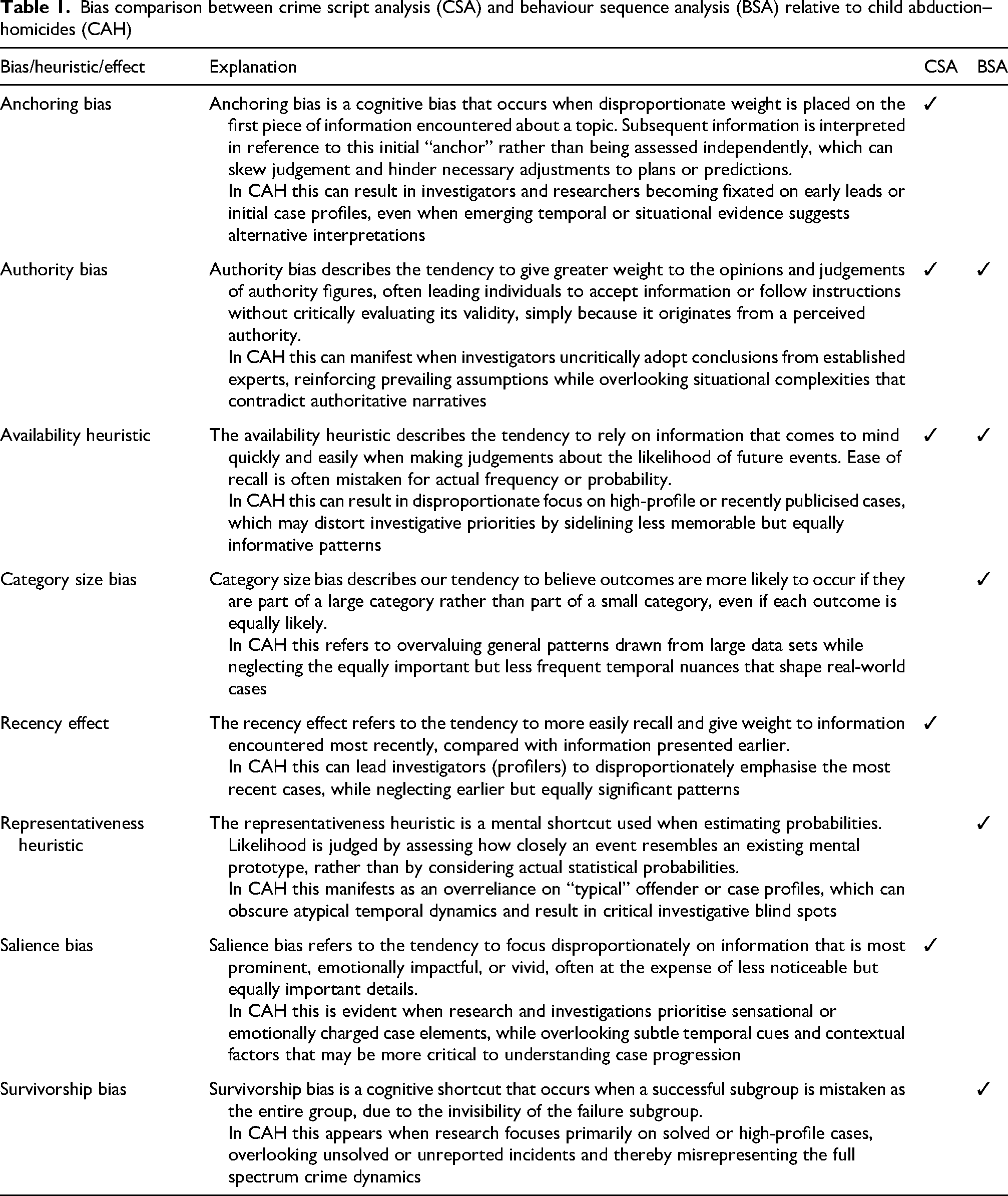
This investigative shift from open-ended exploration to pattern detection and matching may be influenced by biases. Biases are a common limitation in the application of large-scale analytical approaches like CSA and BSA because researchers are susceptible to cognitive bias in interpretation (Kassin et al., 2013; Meterko & Cooper, 2022). Cognitive biases including confirmation bias, anchoring bias, hindsight bias, and the availability heuristic can distort the objectivity with which behavioural patterns are interpreted. These cognitive biases may be more of an issue when a relatively new method (e.g. BSA) appears to provide statistical support for the prejudiced conclusions.
Research has consistently shown how biases are not simply errors in judgement but predictable cognitive tendencies that can seriously undermine analytical accuracy (Dror, 2020; Dror & Charlton, 2006; Dror & Hampikian, 2011; Dror & Rosenthal, 2008; Dror et al., 2005; Kukucka et al., 2017). In the context of temporal methods, this means that even robust patterns can become misleading when investigators interpret ambiguous or incomplete timelines through biased lenses, particularly when working with high-stakes cases such as child abduction and resulting homicides. A list of common biases and their relevance to CSA and BSA and CAH are provided in Table 1. The goal is not to “solve” the issue of biases, but to remind readers that they still apply to newer methods of behavioural investigation.
Bias comparison between crime script analysis (CSA) and behaviour sequence analysis (BSA) relative to child abduction–homicides (CAH)
The Current Study
Although data-driven analytical approaches may seem to be more rigorously backed by evidence compared with experience-based profiling, they often fail to account for the complex, context-dependent nature of real-world crimes. The aim of this article is to critically examine the limitations of relying on generalised patterns derived from data sets through the temporal analysis method of CSA (“top-down”) and BSA (“bottom-up”) when investigating and reviewing CAH cases. There are no hypotheses, per se, in the current study owing to the exploratory and review nature, which is common in other temporal analysis research. The outcomes will show how patterns may emerge but may be misleading based on biases and misinterpretations.
Method
Sample
Open-source intelligence (OSINT) was the method of data collection for this study. This approach entailed the collection and analysis of publicly available information from legal and accessible sources such as police reports, court reports, news articles, social media, government databases, forums, and online archives (Lazarov et al., 2025; Yadav et al., 2023). Media reports, court records, and public databases were used to identify and contextualise abduction–homicide cases to try and best ensure data comprehensiveness (even though this is never a guarantee). To be included, cases were required to involve the abduction of a child followed by confirmed homicide, sufficient publicly available information to reconstruct a basic sequence of events, and lastly case closure. Given that the present study uses a metascript-level approach with three scenes, pre-, peri- and post-crime, mimicking that of law enforcement practice, inclusion prioritised cases with enough detail to identify broad stages of offending but still reflect the realities of an investigation—allowing some level of flexibility. As such, cases meeting these criteria were included iteratively until the data set was considered satisfactory to address the study's exploratory aims, consistent with similar sample sizes in temporal analysis research. A total of 48 closed cases involving child abduction followed by homicide were then entered into an Excel database under the three subcategories multiple abduction–homicides by same perpetrator(s) (MAHSPs), multiple abductions and abduction–homicides by same perpetrator(s) (MA-AHSPs) and single abduction–homicides by varying perpetrator(s) (SAHVPs). To clarify, MAHSPs refer to cases in which a single offender or a couple of offenders abduct multiple victims, all resulting in the victim's homicide; MA-AHSP refers to cases in which a single offender or a couple of offenders abduct multiple victims, with only some resulting in the victim's homicide. However, only the cases resulting in homicide were included in the data set. This category, although similar to MAHSPs, was included to represent perpetrators with a known history of offences that did not always end in homicide, in contrast to MAHSPs, where there are no known survivors. SAHVP refers to cases in which victims are abducted and killed, with each incident being independent and committed by a different offender or couple of offenders. These categories were established to facilitate comparative analyses of behavioural patterns and crime dynamics across distinct offender typologies with CAH. Although there are no power analyses, per se, for temporal analyses, the total of 48 cases was commensurate with other sample sizes in the literature.
Coding
Full case information was gained through a number of independent sources (including media, published police and court records, and biographies). Researchers were then tasked with reading the details of the cases, across the sources, multiple times to achieve data familiarisation (Keatley, 2018; Keatley et al., 2021). Next, case details were systematically analysed according to various relevant criteria (e.g. victim information, age, sex; offender information, career, criminal history; abduction information, date, method, location; crime scene actions; body deposition site locations). These variables were coded and recorded because they are the key information points in many task force reviews. This information was then independently coded by researchers, who then fully agreed on final codes that were accurate reflections of the source material. Reverse translation methods (Keatley, 2018) were also conducted to ensure all key information from crime to temporal analyses were included.
Crime Script Analysis Scene Development
D. B. Cornish's (1994) CSA phases of preparation, pre-activity, activity, and post-activity were adapted to pre-, peri- and post-crime scenes, as mentioned previously, to better capture the more important moments that occur during a CAH and reflect the terminology used by real-world investigators, such as those in task force meetings. Consistent with the broader, “top-down” orientation of CSA, a metascript-level approach was adopted to identify overarching behavioural “scenes–patterns” across cases. By adopting this way of breaking up the criminal narrative commonalities and divergences in action were easier to detect.
Behaviour Sequence Analysis
A lag-one BSA was conducted on the data using IBM SPSS (version 30; IBM Corp., 2024; Keatley, 2018). Lag-one is the typical form of BSA, showing transitions between pairs of indicators (e.g. A → B; B → C, wherein A, B, and C represent coded behaviours). Standardised residuals (SRs) were calculated for the lag-one sequences to determine whether particular behavioural transitions occurred more frequently than expected (Keatley, 2018). Prevalence scores (PrevScores) were also calculated for the lag-one sequences to ascertain the proportion of individual behavioural chains in which a given sequence occurred (Keatley et al., 2023). For example, if four behavioural chains were present (ABC, ABD, ADF, and ADX), the sequence “AB” would have a prevalence of 50% because it appears in two of the four chains, whereas “DF” would have a prevalence of 25% because it appears in only one chain. The resulting SRs and PrevScores were then converted into state transition diagrams to facilitate interpretation (Keatley, 2018), with thicker connecting lines representing either a higher SR or PrevScore value.
Results
Crime Script Analysis
During the CSA, few notable differences were found between the case categories (MAHSPs, MA-AHSPs, and SAHVPs). Across the groups, offenders tended to display relatively consistent demographic and behavioural characteristics. Perpetrators of CAH commonly shared traits including being unmarried men with unstable employment histories, often across varying manual labour positions, prior violent or sexual offending, and predominantly sexual motivations for their crimes. Because of the high degree of similarity across offender profiles, and the inability of BSA to further scrutinise this data, information relating to the demographic details of perpetrators has been omitted from Table 2—which summarises the prominent occurrences identified during CSA—to improve clarity and emphasise more relevant data to the aims of this study. As for behavioural characteristics, perpetrators broadly followed very similar sequences during the commission of their crimes: child abductors were typically strangers to their victims and commonly lured the child from a residential area, often into a vehicle, before restraining, beating, and sexually assaulting them. The offenders then strangled their victims to death and disposed of the bodies in a rural location, generally in a careless manner (Table 2). To statistically examine any differences that may not have emerged through CSA, BSA was conducted on the crime-committing portion of the data set.
Summary of common occurrences and examples from the crime script analysis (CSA) of child abduction–homicide (CAH) cases
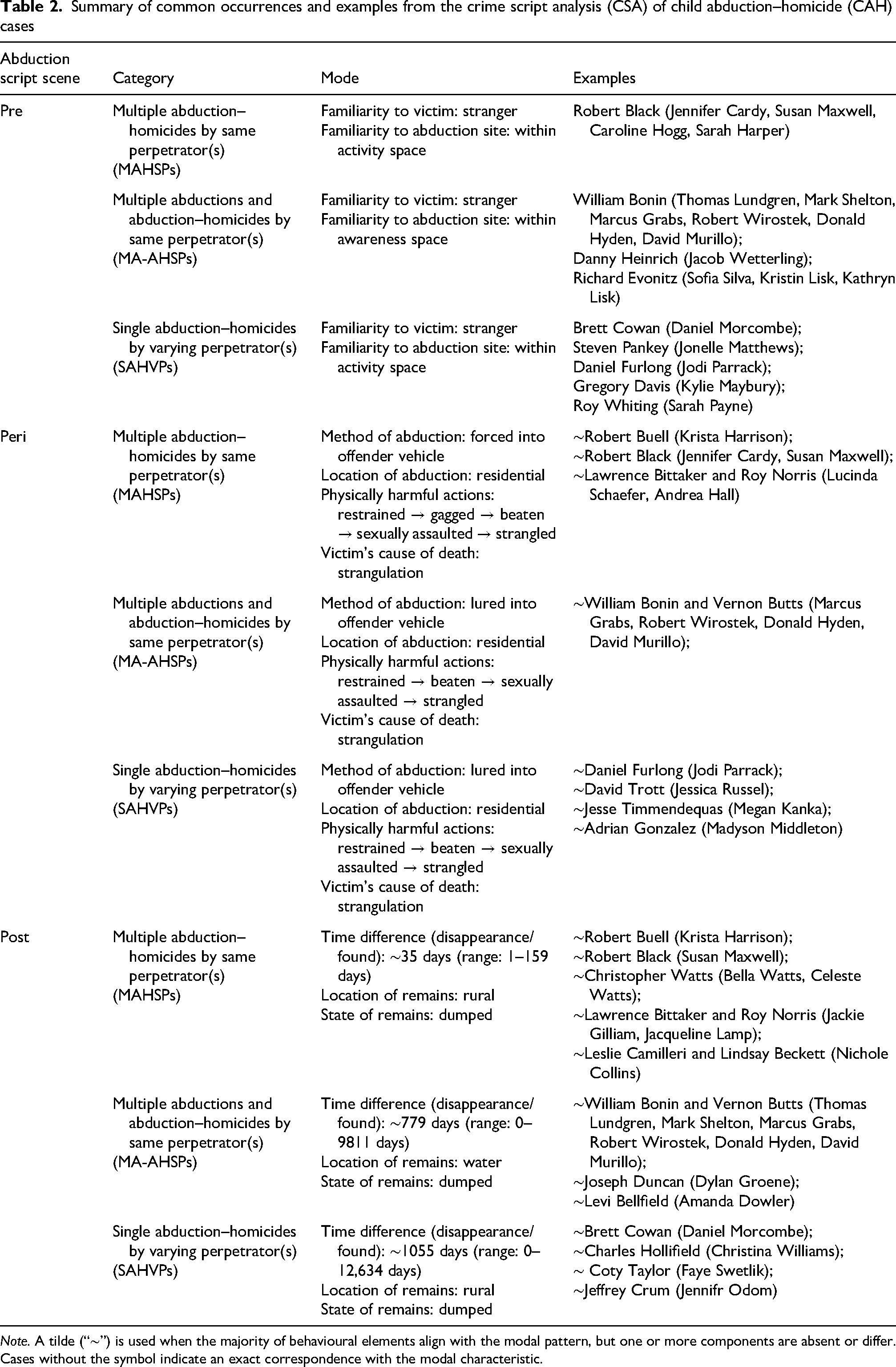
Note. A tilde (“∼”) is used when the majority of behavioural elements align with the modal pattern, but one or more components are absent or differ. Cases without the symbol indicate an exact correspondence with the modal characteristic.
Behaviour Sequence Analysis
BSA was used to statistically map offender actions during the commission of the crime. A lag-one BSA was used for the behaviours during the homicide phase of the abduction and murder. Initially, transition frequency matrices and associated SR scores were analysed for the three groups. These were then converted into state transition diagrams to allow for ease of understanding (Figure 1). There are some obvious overlaps between the three groups (e.g. the use of restraints and physical beating of the victim). A notable distinction, however, is seen in the BSA sequence for the MAHSPs group, wherein the use of gags was sequential after restraints (n = 8, SR = 4.24). Other notable divergences between the groups were that victims being sexually assaulted then bludgeoned in the MAHSPs (n = 2, SR = 1.97) and MA-AHSPs (n = 3, SR = 1.77) groups, yet, in the SAHVPs group, sexual assault was followed by strangulation (n = 7, SR = 1.97). This also highlights the risks of relying solely on frequency counts or SRs.
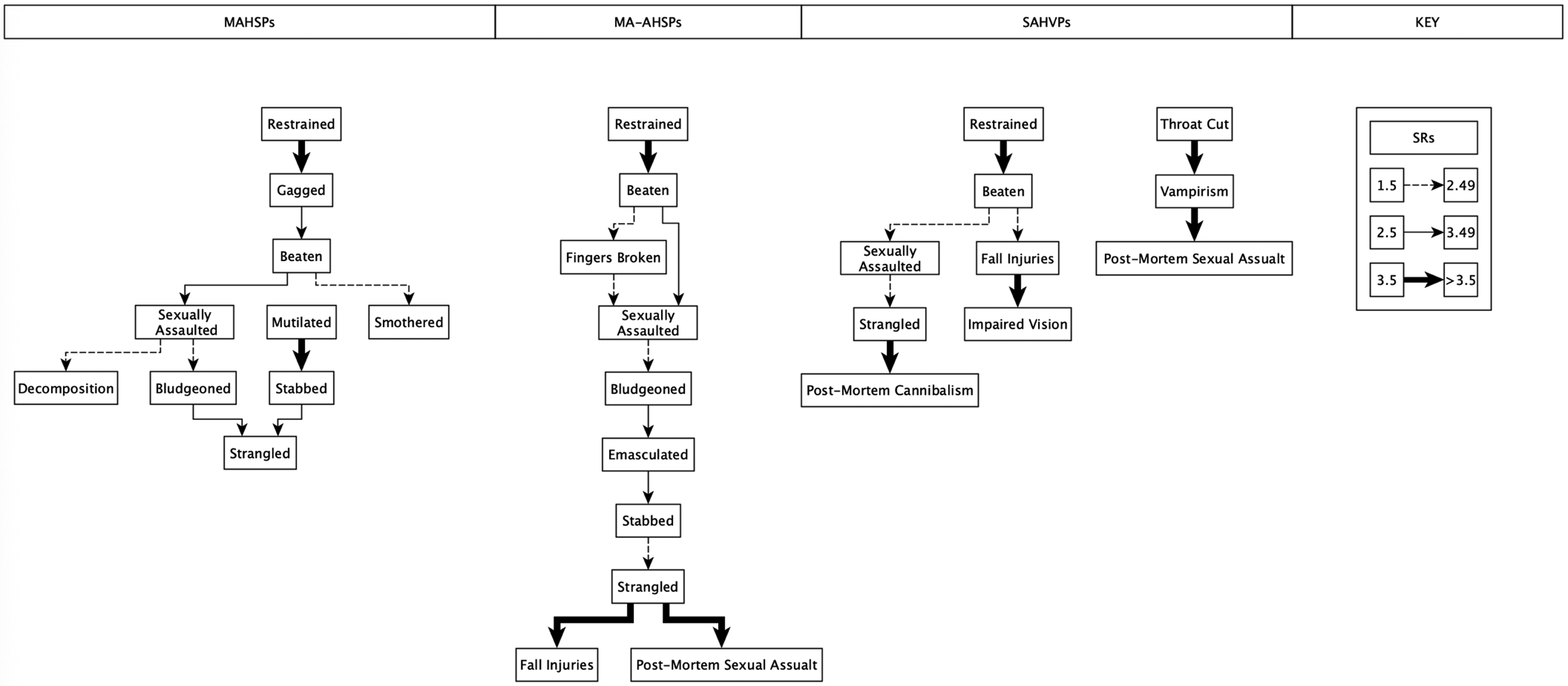
Standardised residual (SR) behaviour script analysis (BSA) of offender actions during the homicide phase of child abduction–homicides (CAH) for all categories (multiple abduction–homicides by same perpetrator(s) (MAHSPs), multiple abductions and abduction–homicides by same perpetrator(s) (MA-AHSPs), and single abduction–homicides by varying perpetrator(s) (SAHVPs)).
Sequence Chain Islands
The standard BSA results shown in Figure 1 are typically where research into BSA and criminal behaviours ends; however, there is more that can and should be done to map further patterns in the data. Focusing on the SAHVPs, there is a clear break in the sequences, creating islands of sequences (Keatley, 2018). This is caused because one of the cases began with throat cut, which led to vampirism (n = 1, SR = 5.48); vampirism then led to post-mortem sexual assault (n = 1, SR = 5.48). In the analyses presented in Figure 1, arrow thickness indicates that these are “stronger” or “larger” SRs. Although this is statistically true, it may also be misleading, especially to those not well versed in interpreting statistical analysis. Germane to the focus of this article, it is worth exploring further, here as the reporting of SRs only may be misleading.
Alongside SR scores, PrevScores (Keatley et al., 2023) have been suggested as an additional analysis to map patterns in data sets. Therefore, PrevScores were analysed and included (Figure 2). Although the structure remains consistent, the Throat Cut → Vampirism; Vampirism → Post-Mortem Sexual Assault sequence is clearly shown to not be very prevalent in the SAHVPs sample (both scoring 1 and a prevalence of only 7.14%). This was the reason for developing the PrevScore (Keatley et al., 2023)—because another approach to mapping the data provides an insight into transitions that may appear repeatedly in one case but not across a group.
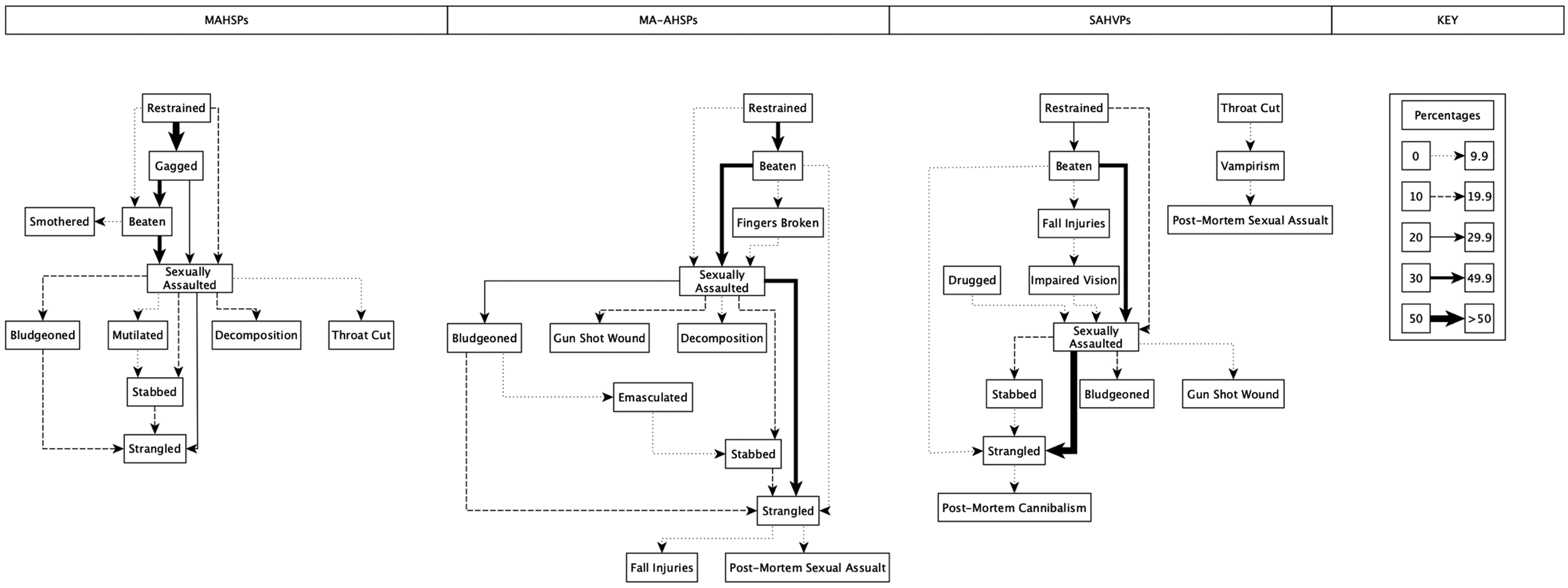
Prevalence score (PrevScore) behaviour script analysis (BSA) of offender actions during the homicide phase of child abduction–homicides (CAH) for all categories (multiple abduction–homicides by same perpetrator(s) (MAHSPs), multiple abductions and abduction–homicides by same perpetrator(s) (MA-AHSPs), and single abduction–homicides by varying perpetrator(s) (SAHVPs)).
In addition, for the MA-AHSPs group, the SR traditional diagram makes it appear as though there are no Restrained → Sexually Assaulted transitions. This is owing to the cut-off criterion that is often used. A misinterpretation could, therefore, be that the MA-AHSPs group does not exhibit this sequence. When the prevalence diagram is produced, however, that link is shown. Although the connection is low (PrevScore = 7.69%), it was still shown in the group.
Discussion
This study set out to critically examine the use and limitations of temporal analysis techniques in the context of child abduction cases resulting in homicide. Although these tools are increasingly used in investigative and academic settings (Carney et al., 2024; Keatley, 2018; Keatley & Clarke, 2020; Keatley et al., 2021, 2022; Leclerc, 2025; Lee et al., 2025; Rossmo & Beauregard, 2025; Silva, 2023; Wood et al., 2022), their application to real-world crimes remains underexplored. The research aimed to assess whether these tools can meaningfully contribute to understanding offender behaviour in such complex cases. Beyond this, the current article provides an important contribution for understanding the limitations of applications of methods, both “top-down” and “bottom-up”. Reliance on statistical outputs to provide numerical scores may appear scientific but should be treated cautiously. Focusing on BSA because it provides statistical outputs may not be optimal; similarly, relying solely on SRs residuals may be misleading. The current research highlights the need for all analyses, and potentially further statistical analyses, to be conducted before conclusions are made.
Offender and Victim Characteristics
First, it is important to note that the main findings, mainly drawn from the CSA portion of this study, support those shown in the existing literature (Beyer & Beasley, 2003; Boudreaux et al., 1999; Collie & Greene, 2017; Greenfeld, 1996; Hanfland et al., 1997). Male offenders remained predominant (Boudreaux et al., 1999; Hanfland et al., 1997), and although the average age was found to be slightly higher, 35 years compared with the late 20s reported in prior studies (Beyer & Beasley, 2003), other variables such as ethnicity (Beyer & Beasley, 2003; Boudreaux et al., 1999; Greenfeld, 1996; Hanfland et al., 1997), relationship status (Beyer & Beasley, 2003; Hanfland et al., 1997), occupation (Beyer & Beasley, 2003; Hanfland et al., 1997), criminal histories (Hanfland et al., 1997) and motivational factors (Boudreaux et al., 1999; Hanfland et al., 1997) were largely consistent with previous research. Victim characteristics were also consistent with previous studies, with females being disproportionately represented (Boudreaux et al., 1999; Collie & Greene, 2017) and having an average age of 11 years old. In addition, most abductions occurred in residential areas (Boudreaux et al., 1999; Hanfland et al., 1997), also reflecting established patterns in the literature. This indicates that the current data set is relatively consistent with wider findings, and on this basis, the current data set, although relatively small, is commensurate with temporal methods papers and can therefore be used to assess such methods on this topic. Therefore, the main focus now turns to understanding the strengths, limitations, and interpretations of the temporal methods, CSA and BSA.
Temporal Analysis Findings
This study critically compared CSA, a typically “top-down” grouping perspective on crime data, and BSA, a much more “bottom-up”, fine-grained analysis of crime data; showing that although both offer valuable frameworks for understanding criminal behaviour, they both may not fully capture or show the complexity and unpredictability of CAH cases. This is not to say that either method should be abandoned, only that caution should be taken in interpreting results.
Despite CSA providing a structured framework for understanding the stages of a crime, it may oversimplify the dynamic and non-linear nature of CAH cases. The drive to create taxonomies from spreadsheets overlooks the unpredictable variables such as mental illness (Peterson et al., 2014), media (Cotterill, 2011; Miller, 2014), and opportunity (Wilcox & Cullen, 2018) that may shape criminal cases, particularly the CAH ones. CSA is useful only when its flexibility is acknowledged. For example, it helps reduce several biases by imposing structure and reflection on the stages and behaviours therein (Wood et al., 2022). However, in crimes, such as CAH, the complexity of victim–offender interactions may mean that broad stages remove the idiosyncrasies and signatures that are important investigative leads. These distinctive behaviours are not anomalies or statistical noise. They may reflect important elements of the context, crime, or offender cognitions, crucial to case resolution. Therefore, CSA should be treated as a malleable lens for organising and structuring information rather than dictating investigative expectations. When applied without this nuance, CSA risks reinforcing cognitive biases (e.g. representativeness, anchoring) and misdirecting resources toward “typical” patterns that may not exist in the case at hand.
By contrast, BSA, although statistically more robust, has limitations in clearly showing the interruptions and anomalies inherent in real-world events. Its reliance on detailed and accurate behavioural coding means that investigators, often working with incomplete timelines and fragmented evidence, may find it impractical in active cases. The output may also show transitions with high SRs, but low frequencies. For example, the presence or absence of gagging produced markedly different BSA transition strings between offender categories (MAHSPs versus MA-AHSPs), yet these distinctions could easily be lost if case details were missing or misclassified. Further, cut-off criteria, type of analyses, and inclusion/exclusion criteria may all affect results but be forgotten when simply viewing transition diagrams. In addition, the comparison between BSA SRs and PrevScores highlights how different forms of statistical representation—SRs reflecting mathematical fidelity and PrevScores offering visual comprehensibility—can lead to divergent interpretations. Although readers with strong quantitative training can readily interpret SRs, practitioners in operational roles (e.g. law enforcement or frontline investigators) may benefit from prevalence-based displays that reduce the need for statistical background and support faster, shared situational understanding. Either way, the need for methodological transparency, audience-aware reporting, and caution in drawing conclusions from any single representation should be noted, especially when using a temporal method like BSA.
Although BSA has limitations, it does open new avenues of discussion and investigation. For example, returning to the presence or absence of gagging; it offers up new questions to be posed in an academic or investigative setting. How does the presence or absence of gagging correlate with the likelihood of homicide? MAHSPs showed BSA strings of Restrained → Gagged → Beaten → Sexually Assaulted → Strangled, whereas MA-AHSPs showed Restrained → Beaten → Sexually Assaulted → Strangled. Although it would be speculative to interpret the presence/absence of gagging and its corollary on case outcome, such speculation is where academics, with their methodical, scientific methods should research—because as experience teaches, profilers in task forces may speculate sans academia.
In summary, both temporal methods were limited when applied to CAH. Treating any crime as a cluster of statistics or data points oversimplifies its dynamic nature. This does not discount the temporal analyses methods used entirely; it just shows how an overreliance on anything can cause distorted investigation trajectories, hindering time sensitive cases, like those involving children.
Limitations
It should be noted once more that even though the sample in this research was relatively small, it was commensurate with other research using these methods and on similar topic areas. Therefore, there is no reason to consider the current sample a limiting factor. Indeed, the sample size in this research is proportionate with the samples often referred to in task forces (drawn from team members experiences and work history). Therefore, the current sample size provided a relatively realistic and commensurate comparison to the type and number of cases often forwarded in task force reviews.
Returning to the limitations of this study, several warrant consideration. The reliance on OSINT may introduce constraints. Publicly available information is often incomplete, inconsistent, or fragmented, which mirrors the challenges faced in real-world investigations where evidence may be missing or inaccessible. There is no completely accurate version or record of events. Therefore, the strategy in the current research was to gather information from multiple sources to try and improve accuracy. Again, the greater focus of this article was on the methods and their interpretation, although data source and accuracy are obviously associated, to focus too narrowly on this would be to miss the greater point of the article—a caution about the interpretation of results, per se. It is critical that end-users, such as investigators and law enforcement, interpret statistical patterns with caution, recognising that gaps in data can distort analytical outputs. In additional, the inability to verify certain details, such as whether a gag was used or sexual assault had occurred when decomposition obscured evidence, highlights the problem of unknowable variables. These uncertainties can alter offender categorisation and sequence mapping, showcasing the need for transparency about data limitations and caution when generalising findings.
Future Research
These findings have important implications for both theory and practice. Theoretically, they draw attention to the limitations of applying rigid behavioural analyses to crimes that are inherently variable and unpredictable. Practically, the results caution against an overreliance on pattern-based analytical tools in active investigations, particularly in high-stakes cases involving children, and underscore the need for a more holistic investigative approach. The pressing need for tools capable of dynamically adapting to the evolving nature of criminal behaviour through the incorporation of real-time data and qualitative insights is continually highlighted in this research. Therefore, future research should prioritise the development of hybrid analytical models that integrate the strengths of CSA and BSA while mitigating their respective biases and limitations. Closer collaboration between academics and practitioners could contribute to this creation, creating a framework that is both ecologically valid and operationally useful.
Conclusion
This study reinforces that real-world crimes, particularly child abductions resulting in homicide, are not always amenable to simplistic analytical categorisation. CSA provides “top-down” structure, aligning closely with pre-existing profiling ideology, and BSA offers fine-grained statistical insight positioning itself closer to more positivist science, yet both risk oversimplification and resulting myopic attitudes when applied rigidly. Moving beyond data sets requires investigative approaches that are adaptable, context-sensitive, and informed by both human experience and data. Embracing complexity is not optional, it is essential for advancing academic understanding and improving operational decision-making in high-stakes cases, especially in CAHs.
Footnotes

Ethics statement
Ethical exemption approval was gained by the authors’ research institute
Funding
The authors received no financial support for the research, authorship, and/or publication of this article.
Declaration of conflicting interests
The authors declared no potential conflicts of interest with respect to the research, authorship, and/or publication of this article.
Data availability
Data are open source.