






Abstract
This study explores the role of social identity and group-level processes in shaping public perceptions of police legitimacy and procedural justice during anti-war demonstrations in the United Kingdom. Building on procedural justice theory and extending the findings of Radburn and colleagues, we conducted two studies to examine how social context and identification with protestors influenced evaluations of protest policing. Study 1 investigates the impact of prior attitudes towards the Israel–Palestine conflict on perceptions of procedural fairness, identification with police and legitimacy. Results show that participants who viewed a video of the policing of protests over the war in Gaza who identified with pro-Palestine protestors viewed the police as less procedurally fair and legitimate than with neutral or pro-Israel attitudes. These findings affirm the importance of social identity in shaping vicarious experiences of policing. Study 2 extended this analysis by examining how the perceived operational independence of the police influenced these relationships. We found that perceptions of police independence moderated the effect of protestor identification on evaluations of procedural justice, police legitimacy and identification with police. This research highlights that police legitimacy is a dynamic and contextually embedded social psychological process. By demonstrating how social identity, vicarious experience and perceptions of police–government relations shape public evaluations of policing, the study underscores the importance of maintaining operational independence and engaging with group-level dynamics to foster legitimacy and trust in diverse democratic societies.
Keywords
With increasing empirical support for the value of legitimacy in and for policing (Walters & Bolger, 2019), it is not surprising to see policymakers in many western democracies focusing on questions of public trust and police legitimacy (Mayor's Office for Policing and Crime (MOPAC), 2022; The President's Task Force on 21st Century Policing, 2015). Nonetheless, the social psychological processes governing perceptions of police legitimacy remain only partially understood. One core argument is that procedurally fair policing promotes legitimacy because it signifies that those being policed have inclusion and status within a superordinate social category, such as a nation-state, that the police represent and embody (Bradford, 2014; Sunshine & Tyler, 2003). Police officers are seen as key state actors and as such those who are subjugated to police attention evaluate how officers make decisions (quality of decision making) and whether they respect rights, dignity and privacy (quality of treatment) (Tyler, 2003). Positive experiences along these dimensions are then assumed to provide signals about inclusion that encourage citizens to internalise and legitimise the positive beliefs and values associated with the social category (e.g. the law-abiding citizen) (Bradford et al., 2014).
From this perspective, social identity is hypothesised as a key social psychological mediator linking procedural justice perceptions and legitimacy judgements via what has come to be termed the group engagement model (GEM) of procedural justice theory (PJT) (Tyler & Blader, 2003). GEM's social identity mediation hypothesis is broadly supported by the existing PJT literature (Chan et al., 2023). Although the theorisation of PJT builds upon the relational nature of legitimacy and acknowledges the centrality of group processes (Tyler, 1997), subsequent empirical studies of PJT often rely on large-N cross-sectional surveys and are based upon assumptions that: (a) interactions between police and citizens are interpersonal, rather than also intergroup; and (b) that people's judgements about procedurally fair policing emerge from direct – rather than vicarious – experiences (Armaline et al., 2014; Waddington et al., 2015).
This direction of PJT development is at risk of oversimplifying the complex, situated nature of legitimacy processes (Radburn & Stott, 2019). To be clear, the social psychological roots of PJT – particularly in the early work of Tyler and colleagues (Lind & Tyler, 1988) – have long recognised the contextual and group-based nature of procedural justice, distinguishing policing encounters from courtroom processes studied in earlier procedural justice research (Thibaut & Walker, 1975, 1978). However, subsequent empirical applications of PJT, especially within criminology and criminal justice, have often abstracted away from this complexity, privileging methods that imply context-free, individually experienced processes. By contrast, Radburn et al. (2018) used experimental methods to reintroduce this situational nuance. They showed video footage of a police use-of-force incident during a crowd event and systematically manipulated the social categories of those involved. Their findings revealed that participants were significantly more likely to judge the police action as procedurally unfair when they identified with the group being policed, compared with when they did not – emphasising that legitimacy judgements are not only relational but identity-contingent.
In other words, what PJT suggests is that judgements about procedural fairness and hence police legitimacy are mediated by social identities and hence informed by the broader historical and group-level properties of the social context within which that interaction is taking place. It is unlikely that the subjective experiences of interaction with the police in the United States (US) and the United Kingdom (UK) among people who identify as black will be merely acontextual interpersonal interactions, for example. Rather, those encounters will be informed by group-level beliefs and collective historical experiences (Blount-Hill, 2021).
It also follows that such experiences do not need to be direct. Shared social identities can lead individuals to “feel” and “see” police interactions with fellow ingroup members as if they themselves had experienced the encounter. This is consistent with long-standing developments within PJT, particularly in its integration with legal socialisation research, which explicitly acknowledges that legitimacy perceptions are shaped over time through both direct and vicarious experiences with authority (Tyler & Trinkner, 2018). Such vicarious processes are especially potent in a digitalised society, where images and narratives of police treatment can circulate rapidly and powerfully across group and geographical boundaries. As was evident in the widespread responses to the police murders of George Floyd in the US and Sarah Everard in the UK, public reactions often reflected not only personal experience, but collective, identity-based understandings of how “the policed” are treated. All this suggests that the relational and group-based elements of procedural justice are not only contextually grounded, but also amplified and extended through mediated, vicarious experience.
These issues come into sharp focus in the policing of highly politicised events such as protests (Della Porta & Fillieule, 2004). Such situations can be especially challenging for police seeking to uphold their legitimacy, especially where other powerful actors, such as the government, are active stakeholders. As Reiner (1985) argued, policing is inherently political, and is shaped by the broader social and political contexts within which it occurs. Efforts to understand how people judge the legitimacy of the police should take into account the complex interplay among police, government and society and, crucially, the group identities and social categories associated with and embedded within police–citizen interactions.
In this paper, we present the findings of two linked studies that explore the role of social identity and group-level processes in shaping public perceptions of police legitimacy and procedural justice during anti-war demonstrations in the UK. Study 1 investigates the effect of identities associated with the Israel–Palestine conflict on judgements of observed procedural fairness, identification with police and legitimacy. Study 2 extends this analysis by using an experimental design to examine how the perceived operational independence of the police from the government influences how people judge and respond to police activities in this context.
Study 1: A study on the effect of group membership
In the first study, we explore the role of group-level identities and context by systematically testing the relationships between identification, perceptions of procedural fairness and judgements of police legitimacy. We do so in a manner that allows us to examine the impacts of the political context on how police actions in managing protests were interpreted by people who identify with different social groups.
As such, we have taken advantage of the series of anti-war demonstrations that took place in the UK in the wake of the upsurge in conflict in the Middle East after the Hamas-led attacks on Israel in October 2023. These protests occurred internationally, were at times very large, and continued regularly for several months, well into the first half of 2024. They were often highly controversial and presented unique challenges for public order policing, particularly in terms of the costs and resultant drain on resources, but also in relation to public narratives concerning police fairness and legitimacy.
Radburn et al. (2018) showed that perceptions of police fairness and legitimacy when policing crowd events are dependent on context. By manipulating the intergroup relationship between those being policed in the crowd, and those who observed the interaction, they demonstrated that identification with the police and perceptions of procedural justice changed as a function of the social categories involved. Specifically, those who viewed “the policed” as an “outgroup” who supported racist political ideas tended to see police coercion more positively than those who viewed “the policed” as an a non-racist “ingroup”. This finding supports the idea within PJT that it is important to take the intergroup context and social identity into account in understanding how police actions are interpreted by those judging them.
In the context of the current study, the conflict between Israel and Palestine in the Middle East essentially created, or at least activated, two contrasting social categories – pro-Israel and pro-Palestine. We assumed that those who support Israel and possess pro-Israeli attitudes would tend to see those who are pro-Palestine as an outgroup, and vice versa. The first objective of this study is to assess how these prior attitudes and identities impacted the way people perceived police actions when viewing an episode of police intervention against anti-war protestors in London. Our ambition is to advance the research of Radburn et al. (2018) by utilising the policing of a demonstration against the war in Gaza that took place in London in November 2023.
Specifically, we aim first to explore how identification with the different social categories involved impacted observers’ perceptions of policing. We hypothesise that people who held pro-Palestine attitudes would identify with those protesting against the war and would be more likely to see police actions against protestors as procedurally unfair. On the contrary, those who hold a pro-Israel position would tend to identify less with the anti-war protestors and will be more likely to see police control measures as procedurally fair.
The second objective of this first study is to examine whether perceptions of procedural justice mediate any association between identification with the protestors, perceptions of police legitimacy and identification with the police.
Method
To address these hypotheses, we conducted an online survey between 7 and 12 February 2024 via Prolific Academic. In this study, we showed participants video footage of the policing of a relatively recent anti-war demonstration that had controversially taken place in the main concourse of one of London's main railway stations on 18 November 2023. The event had disrupted rail users and made national press and television news on the day it occurred.
The video
We used open-source video footage published by The Independent, a British online newspaper 1 . It was published on the day of the protest, with a caption stating that “around 100 pro-Palestine protestors have been removed from Waterloo station in London after holding a sit-in demonstration demanding a ceasefire in Gaza”. The video showed that some police officers were handing out Section 14a notices to the protestors, which prohibited the protest under the Public Order Act 1986 2 , while they were sitting and chanting inside the station. At the end of the video, the protestors were surrounded and contained by police officers. The article mentions that the police subsequently escorted the protestors from the train station and arrested at least five of them, although this was not shown in the video footage.
It is important to note that the police behaviour in the video is not, from an objective viewpoint, “procedurally unfair”. Officers are talking to protestors as they hand out the notices, and there is no shouting, use-of-force or other aggressive behaviour. What is clear, however, is that the police are corralling and trying to prevent the protestors from continuing to protest in that particular location. The video is thus deliberately ambiguous, and our goal was merely to examine how the same set of police–citizen interactions were vicariously perceived by people not themselves directly involved.
Participants
We recruited 150 participants from the Prolific panel. This was a convenience sample within which any panel members aged 18 or above and living in the UK were eligible. Participants’ majority age groups were 25–34 (29.3%, n = 44) and 35–44 (28.0%, n = 42), with 49.3% being female (n = 74), 48.7% being male (n = 73), and 1.3% identified as non-binary (n = 2). For ethnic origin, 82.7% (n = 124) self-identified as white. The average political orientation of the sample was “slightly liberal” (M = 3.45, SD = 1.33), measured by a 7-point scale from “extremely liberal” (1) to “extremely conservative” (7). For their identification with the major political parties in the UK, we asked them “If there was a general election tomorrow, which political party would you vote for, if any?” The majority chose the Labour Party and the Conservative Party, accounting for 42% (n = 64) and 16% (n = 24) respectively; 6% (n = 9) chose the Green Party, 3.3% (n = 5) chose the Liberal Democrats, 20% (n = 30) chose others; and 12% (n = 18) chose none.
Variables
Attitudes toward the Israel–Palestine conflict
To identify the participants’ prior positions towards the Israel–Palestine conflict in Gaza, we started by asking them “Which side in the Israel–Palestine conflict do you sympathise more with?”, with the possible answers of: (a) the Israeli side, (b) the Palestinian side, (c) both sides equally, and (d) don’t know. This question has been used by YouGov (2024), an international polling research group, to track the national trend of attitudes towards the Israel–Palestine conflict (see Appendix I for the correlation matrix).
Identification with the Pro-Palestine protestors
The questionnaire then used a 5-point Likert scale to measure their level of agreement with different statements (from 1 “strongly disagree” to 5 “strongly agree”). To confirm the level of identification with the protestors a 3-item scale of identification with the protestors was used. Our items were adapted from Radburn et al. (2018), the three items were “In general, I identify with pro-Palestine protestors”, “In general, I feel similar to pro-Palestine protestors” and “In general, I feel a sense of solidarity with pro-Palestine protestors” (α = .95). The mean score of these three items was used as the measure of the participants’ identification with the pro-Palestine protestors.
Dependent variables
Regarding our outcome variables, we measured procedural justice perceptions, identification with the police and judgements of police legitimacy. Again our items were adapted from Radburn et al. (2018). A 4-item scale was used to measure their procedural justice perceptions of the police in the video: “The police in the video treated the protestors with respect”, “The police in the video treat the protestors fairly”, “The police in the video made their decisions on the basis of the facts of the situation, and not on their personal opinions” and “The police in the video made decisions about how to handle problems in fair ways” (α = .91). For identification with the police, we use the 3-item scale: “I identify with the police in the video”, “I feel similar to the police in the video” and “I feel a sense of solidarity with the police in the video” (α = .96).
Finally, we measured police legitimacy with a 6-item scale adapted from Kyprianides et al. (2021). Thus, our scale includes the two most commonly used constructs in measuring police legitimacy: obligation to obey and normative alignment (Jackson et al., 2011). The participants were asked to imagine they had been at the station that day and answer the following questions: “I would have felt a moral duty to obey the police”, “I would have felt a moral duty to support the decisions of the police officers, even if I disagreed with them”, “I would have felt a moral duty to obey the instructions of the police officers, even if I didn’t understand the reasons behind them”, “I support the way the police were acting”, “The police were acting in ways that are consistent with my own ideas about what is right and wrong” and “The police were standing up for values that are important for people like me” (α = .94). Similarly, mean scores were used to measure these outcome variables.
Procedure
At the start of the survey, participants were provided with the study information and asked for their consent. If they agreed to take part, they completed the single question about sides in the recent Israel–Palestine conflict and the 3-item scale of identification. After watching the video, we measured procedural justice, identification with the police, and police legitimacy. Lastly, they answered questions about their demographics and were debriefed.
Results
Group membership effect
Turning first to participants prior attitudes towards the conflict, 38.0% responded that they sympathised with “the Palestinian side” (n = 57); 12.7% responded “the Israeli side” (n = 19); 28.7% responded “both sides equally” (n = 43); and 20.7% responded “don’t know” (n = 31). Although those who selected “both sides equally” and “don’t know” may differ in certain respects, we grouped them together as representing a broadly neutral stance towards the conflict, because no significant differences were found between them on any of the variables in the subsequent analysis. Those who responded as sympathising with each side were labelled as the “Pro-Palestine” and “Pro-Israel” groups respectively.
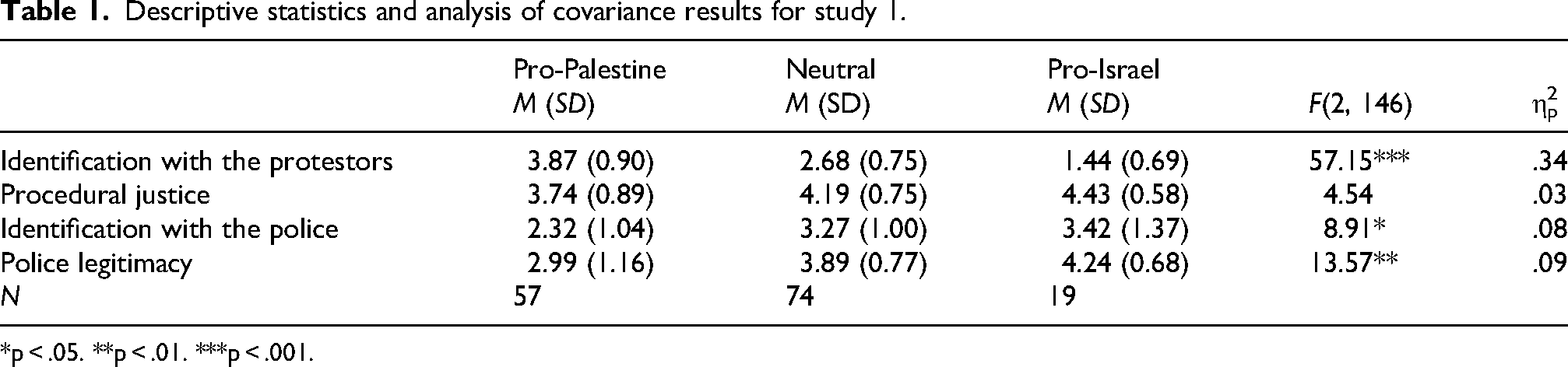
Table 1 summarises the descriptive statistics and one-way analysis of covariance (ANCOVA) results for study 1. After running an initial regression analysis, political orientation was found to be a significant covariate and thus controlled in the ANCOVA. Owing to the unbalanced data and the non-normal distribution of the measured variables, as indicated by a Shapiro–Wilk test (Shapiro & Wilk, 1965) (identification with protestor: W = 0.94, p < .001; procedural justice: W = 0.90, p < .001; identification with the police: W = 0.95, p < .001; police legitimacy: W = 0.93, p < .001), we applied bootstrapping with 1000 resampling (Canty & Ripley, 2021) to obtain more robust estimates. The results showed that there was a significant between-group difference in the extent to which participants identified with the protestors, F(2, 146) = 57.15, p < .001, ηp2 = .34. A bootstrapped Tukey's HSD was then performed to assess the differences between each pair of the groups with bootstrapped 95% confidence interval (CI) of the mean difference as an indicator of statistical significance. The pro-Palestine participants had significantly stronger identification with the protestors than both neutral (95% CI [0.78, 1.30]) and pro-Israel (95% CI [1.78, 2.56]) participants; and the pro-Israel participants also had significantly weaker identification with the protestors than the neutral groups (95% CI [−1.47, −0.78]).
Descriptive statistics and analysis of covariance results for study 1.
*p < .05. **p < .01. ***p < .001.
Moreover, there was only a marginally significant between-group difference in participants’ procedural justice perceptions, F(2, 146) = 4.54, p = .08, ηp2 = .03. The pro-Palestine participants perceived the police as significantly less procedurally fair than both pro-Israel ((95% CI [−0.87, −0.15]) and neutral (95% CI [−0.61, −0.05]) participants. However, there was no significant difference between pro-Israel and neutral participants in terms of their procedural justice perceptions (95% CI [−0.15, 0.48]). Regarding identification with the police, there was a significant between-group difference, F(2, 146) = 8.91, p = .01 ηp2 = .08. The pro-Palestine participants had a significantly weaker identification with the police than both pro-Israel (95% CI [−1.35, −0.04]) and neutral (95% CI [−1.08, −0.36]) participants. Although the pro-Israel participants had a weaker identification with the police than neutral participants, the difference was not significant (95% CI [−0.66, 0.58]). Finally, group membership has a significant effect on participants’ judgement of police legitimacy, F(2, 146) = 13.57, p = .001, ηp2 = .09. The pro-Palestine participants perceived the police as significantly less legitimate than both pro-Israel (95% CI [−1.46, −0.60]) and neutral (95% CI [−1.12, −0.44]) participants. However, the pro-Israel participants did not perceive police legitimacy differently than the neutral participants (95% CI [−0.11, 0.59]).
Path analysis
To examine whether the perceptions of procedural justice mediate the relationship between protestor identification and evaluations of the police, a path model was estimated using maximum likelihood estimation with 1000 bootstrap draws (Figure 1). Similarly, political orientation was included as a covariate owing to its relevance to the political nature of the protests.
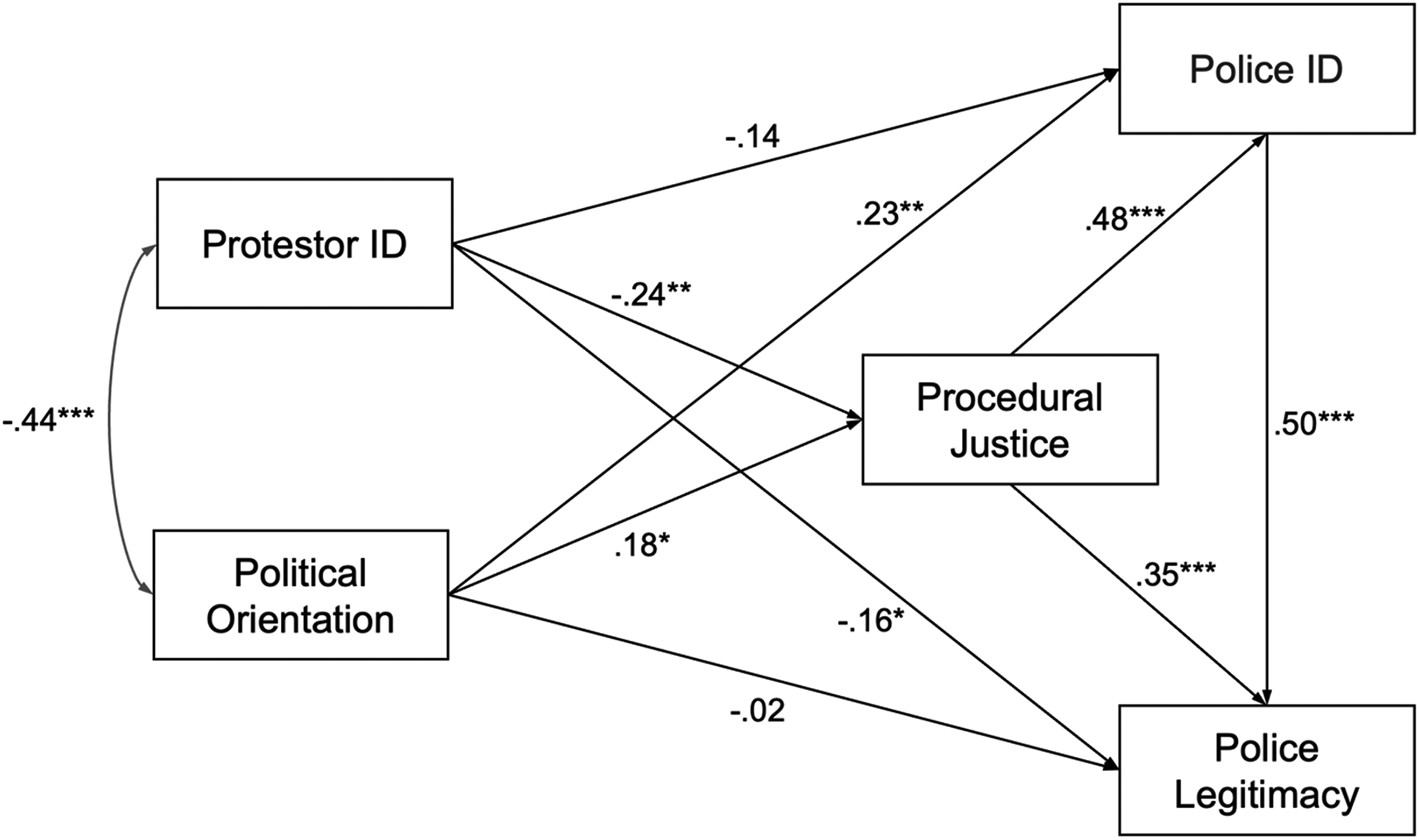
Standardised regression coefficients for the path analysis in Study 1. *p < .05. **p < .01. ***p < .001. Protestors ID = identification with protestors; police ID = identification with police.
The results showed that stronger identification with protestors significantly predicted lower perceptions of procedural justice (β = –0.24, SE = 0.060, p = .003, 95% CI [–0.297, −0.062]). In turn, perceptions of procedural justice positively predicted both identification with the police (β = 0.48, SE = 0.092, p < .001, 95% CI [0.508, 0.865]) and perceived police legitimacy (β = 0.35, SE = 0.082, p < .001, 95% CI [0.294, 0.603]). Identification with protestors also had a significant negative direct effect on perceived legitimacy (β = –0.16, SE = 0.059, p = .015), but its direct effect on police identification was not statistically significant (β = –0.14, SE = 0.086, p = .106).
Moreover, police identification significantly predicted police legitimacy (β = 0.50, SE = 0.060, p < .001, 95% CI [0.327, 0.562]), indicating an additional indirect pathway from procedural justice to legitimacy via police identification. Political orientation, included as a covariate, was positively associated with perceptions of procedural justice (β = 0.18, SE = 0.071, p = .032) and police identification (β = 0.23, SE = 0.087, p = .003), but not significantly related to police legitimacy (β = –0.02, SE = 0.061, p = .677).
Indirect effect estimates confirmed significant mediation paths. Protestor identification had a significant indirect effect on police identification via procedural justice (β = –0.12, SE = 0.042, p = .004), and on police legitimacy via both procedural justice and police identification (β = –0.08, SE = 0.029, p = .007). The total effect of protestor identification on police legitimacy remained significant (β = –0.37, SE = 0.079, p < .001), supporting a partial mediation model.
Altogether, the model explained 13.2% of the variance in procedural justice perceptions (R2 = .132), 43.2% of the variance in police identification (R2 = .432), and 68.0% of the variance in police legitimacy (R2 = .680).
Discussion
Findings from Study 1 suggest that, even after accounting for the effects of political orientation, participants’ prior attitudes towards the Israel–Palestine conflict in Gaza had a significant effect on the extent to which they identified with anti-war protestors in the video. Participants who had positive attitudes towards the Palestinian side in the war had a significantly stronger identification with the anti-war protestors than both neutral and pro-Israel groups. By contrast, those who had positive attitudes towards the Israeli side had a significantly weaker identification with protestors.
This pattern of group-based alignment extended into participants’ perceptions of policing. Identification with the protestors was associated with lower perceptions of police procedural fairness, weaker identification with the police, and lower legitimacy judgements. Although the overall group difference in procedural justice perceptions did not reach conventional levels of statistical significance, post hoc bootstrapped pairwise comparisons revealed that pro-Palestinian participants perceived the police as significantly less procedurally fair than both neutral and pro-Israel participants. These findings suggest that social identity shaped the way participants experienced policing, evaluated their relationship with the police and judged the latter's actions in terms of procedural justice and legitimacy. This was all despite not having any direct contact with officers, but rather viewing the interaction vicariously.
Building on what we might term this “group membership effect”, we then moved on to test the mediating effect of procedural justice judgements. Procedural justice judgements significantly mediated the effect of identification with protestors on both identification with police and police legitimacy judgements. Protestor identification had a direct negative effect on legitimacy judgements, but its effect on police identification was fully mediated by perceptions of procedural justice. This suggests that procedural fairness serves as a key interpretive lens through which group identifications shape individuals’ willingness to identify with and confer legitimacy upon the police.
Political orientation also played a role in shaping these dynamics. Right-leaning participants were more likely to perceive the police as procedurally fair and to identify with the police. However, political orientation had no direct effect on police legitimacy judgements. This suggests that, even in politically sensitive contexts, perceived fairness and identity-based processes more proximally influence how people judge the legitimacy of police actions than political ideology per se.
Moreover, the effect of procedural justice on police legitimacy was partially mediated by police identification. That is, higher perceptions of procedural fairness predicted stronger identification with the police, which in turn was associated with higher legitimacy judgements. This partial mediation supports the social identity pathway outlined in the GEM (Tyler & Blader, 2003), in which procedural justice not only directly enhances legitimacy, but also strengthens identification with the police that reinforces legitimacy judgements.
Overall, Study 1 showed that prior attitudes and identities play a critical role in influencing perceptions of policing. In the context of the policing of anti-war demonstrations in the UK, those who held pro-Palestine attitudes and had a strong identification with the pro-Palestine protestors tended to perceive the police as less procedurally fair, have weaker identification with the police, and judge the police as less legitimate, compared with those who held different attitudes. This is consistent with Radburn et al.'s (2018) findings that, in a crowd policing context, those who had an ingroup identification with the group being policed tended to perceive a lower level of procedural justice and have a weaker identification with the police. In addition, we also found a significant difference in police legitimacy judgements between groups with different prior attitudes in the conflict. Regarding the relationship between the measured psychological constructs, our findings showed that procedural justice perceptions significantly mediated the effect of identification with protestors on identification with police, and police legitimacy judgements. This suggested a complex interplay between prior attitudes, and perceptions of and identification with policing, and that how people perceive procedural justice is important in explaining their differential judgements of the police during this protest action. In other words, context matters.
Study 2: A study on the effect of police operational independence
In our second study, we aim to extend our investigation further by testing the effect of a changing social context on how people evaluate police management of demonstrations. While Study 1 investigated how prior attitudes and identities towards the war and its associated demonstrations impacted judgements about policing, Study 2 explores how these dynamics might be shaped by people's understandings of the underlying political and structural context.
Although operational independence is a fundamental principle of British policing 3 , perceptions of the police as “working for the government” when policing protests are not uncommon (Earl & Soule, 2010). When such views emerge, they could violate normative judgements of what is taken as fair and legitimate policing. In Study 1 this was left implicit. However, the controversy surrounding the anti-war protests in London amplified through late October and into early November 2023, coming to a head just before Remembrance Sunday. That weekend, anti-war protestors announced their intention to hold another demonstration. The situation was amplified by far-right protestors planning to counter-protest in central London on the same day. This led senior politicians of the then Conservative government to push for banning the anti-war protests. Although initially being publicly sympathetic to this demand, just a few days beforehand the Metropolitan Police Service (MPS) stated that they did not see the need for a ban on public safety concerns 4 (Forrest, 2023).
In addition, the government actively and explicitly supported the Israeli government-led war against Hamas (Foreign Commonwealth & Development Office, 2023). During the protests then Home Secretary Suella Braverman made several highly controversial public statements about the motivations of those involved – at one time even going as far as labelling anti-war protests as “hate marches” 5 . It has been argued that the police are often perceived as the most visible and physical representative of government (Bottoms & Tankebe, 2017). Particularly in the context of protest, how the government representatives respond to an issue could therefore set a context for perceptions and (mis)interpretations of police actions (Channing, 2018). In other words, the relationships between the police and government, and between government and “public”, may become relevant to the relationship between police and public, particularly at moments when particular groups – here, those protesting against the war in Gaza – are policed in contexts where government actions are salient and are, potentially, affecting police behaviour.
As such, Study 2 takes advantage of this difference between the then Conservative government and the MPS on whether the demonstrations on Remembrance Weekend in 2023 should be permitted. Our assumption is such resistance from the police to government calls to prevent protests changed the intergroup context, wherein the police may be repositioned from working “for the government” to working “for the protestors”, or, at least, not against the protestors. We hypothesise that perceptions of police operational independence in this context will moderate the negative effect of identification with protestors on (a) procedural justice perceptions, (b) identification with police, and (c) legitimacy judgements.
Our assumption is thus that this dispute between institutional actors constituted a significant contextual change for protest policing, aligning the police as protecting rather than inhibiting the right to protest. Study 2 thus uses random assignment design to systematically examine the impact of this shifting context on the relationships between identity and policing. In this study, participants were randomly assigned to one of two experimental conditions: the independence condition and the collaboration condition. Those assigned to the independence condition were provided text about the above-mentioned conflict between the MPS and the then government, emphasising the police's operational independence in making decisions about how the protests were managed (Appendix II). By contrast, those in the collaboration condition received text stressing how the MPS were committed to alignment with the government's call for a “stricter clampdown” on pro-Palestine protests (Appendix II). Here, perceptions that police working closely with and indeed represent the government in managing the protests would be reinforced.
Experiment design
To reduce confounding variables and selection bias, random assignment design is used to test the effect of police operational independence on perceptions of the police. With a 1 × 2 design, the experiment was conducted between 10 and 15 April 2024. After a “baseline” measure of identification with protestors, participants were randomly assigned into either independence or collaboration conditions in equal numbers and given the corresponding prime text. These texts were rephrased from two newspaper articles (Boffey et al., 2023; Topping, 2023) to fit this purpose. Although these are actual incidents reported by news outlets, our manipulation “reminded” the participants about these incidents and sought to reinforce their perceptions of the police as operating independently from or collaboratively with the government in managing the protests. After that, participants completed a manipulation check before watching the same video used in Study 1. Lastly, perceptions of the police in the video were measured: procedural justice, identification with the police, and police legitimacy. Participants were fully debriefed at the end of the experiment.
Participants
Another batch of 150 participants was recruited from the Prolific Academic panel for Study 2. As a follow-up study, Study 2 excluded participants from Study 1 in sampling. The demographics of participants from Study 2 were very similar to that of Study 1. The majority age groups were 25–34 (31.3%, n = 47) and 35–44 (32.7%, n = 49). Some 47.3% of participants (n = 71) were female and 50.7% (n = 76) were male. The majority self-identified as white (81.3%, n = 122). Regarding their political orientation, the average was 3.57 of 7 (SD = 1.44), which refers to a “slightly liberal” sample. For the participants’ voting intention, the majority chose the Labour Party (39.3%, n = 59) and the Conservative Party 14.7%, n = 22). The remaining went for Liberal Democrats (11.3%, n = 17), Green Party (10.0%, n = 15), others (16.7%, n = 25) and none (8.0%, n = 12).
Measures
Independent variable
Because the identification with protestors was found to be a significant predictor of different perceptions of the police, Study 2 used this as a baseline measure of participants’ “starting points” before the manipulation. We sought to explore how identification with the pro-Palestine protestors interacts with perceptions of the police operational independence in predicting procedural justice perceptions, identification with police, and legitimacy judgements. We used the mean score of the same 3-item scale from Study 1 to measure identification with protestors (α = .96).
Manipulation check
To check whether we successfully manipulated perceptions of police operational independence, a 2-item scale was used to measure the perceived operational independence of the MPS. The two items were “To what extent do you think Metropolitan Police act independently from the government in dealing with protests?” and “To what extent do you think Metropolitan Police act collaboratively with the government in dealing with protests?” (reverse coded) (α = .73). The mean of these two items was taken as the measure of the perceived police operational independence.
Dependent variables
Study 2 used the same dependent variables as Study 1 to assess participants’ perceptions of the police in the video. After the participants watched the video, we measured their procedural justice perceptions (α = .90), identification with the police (α = .94) and police legitimacy judgements (α = .93). Similarly, mean scores of these scales were used in the analysis.
Results
Manipulation check
To confirm we successfully manipulated participants’ perceptions of the police operational independence, an independent samples t-test was conducted to compare the means of the experimental groups. The results showed that participants from the independence prime group (M = 3.09, SD = 0.91) perceived a significantly higher level of police operational independence than those from the collaboration prime group (M = 2.37, SD = 0.92), t(148) = −4.86, p < .001. The manipulation had a large effect on the extent to which participants perceived the police as operational independent, d = −0.79, 95% CI [−1.13, −0.46].
Experimental effects
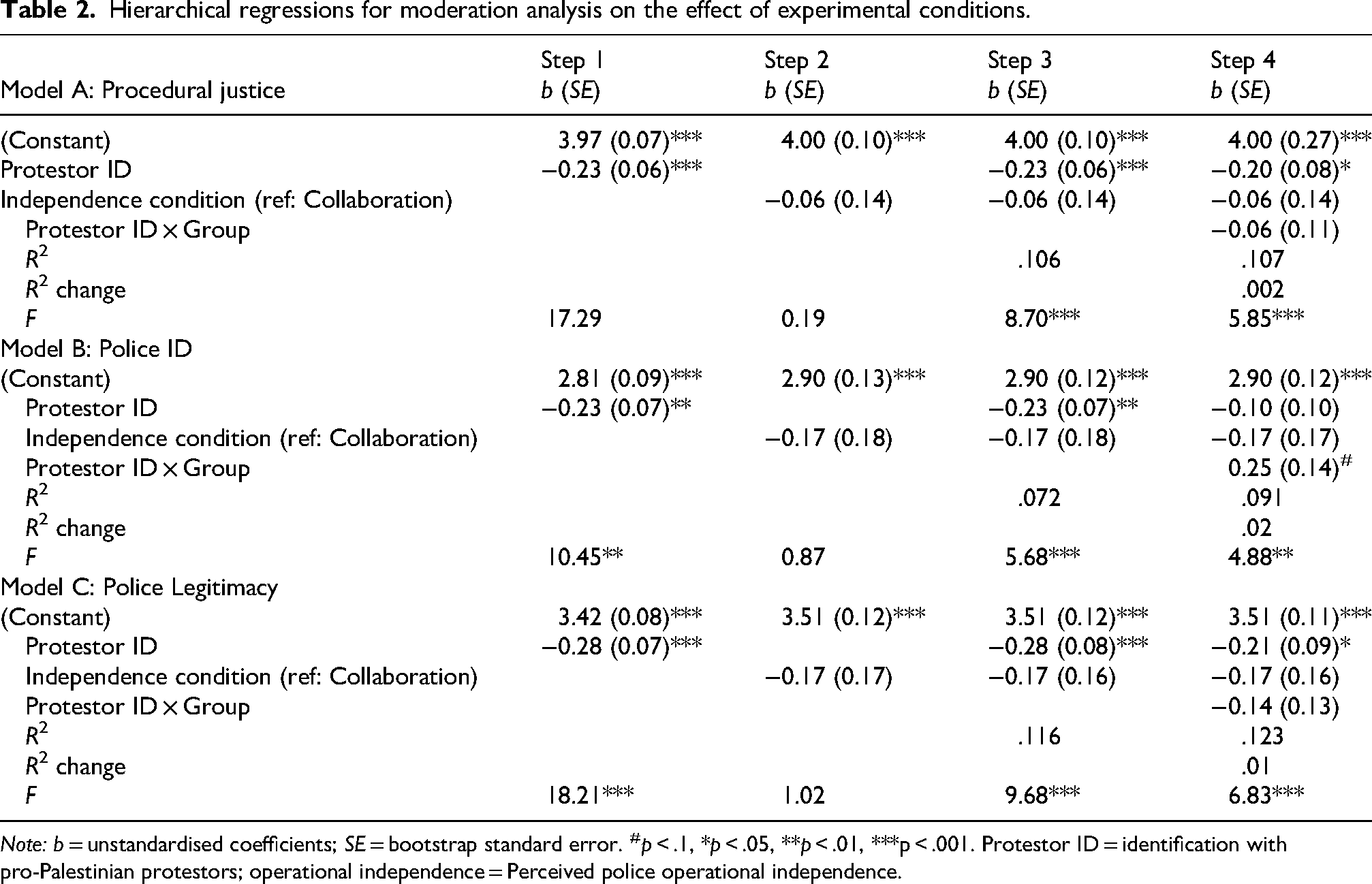
After confirming our manipulation, three OLS regressions with bootstrapping were performed for each of the three dependent variables procedural justice (Model A), identification with police (Model B), and legitimacy (Model C) (Table 2). Identification with protestors was mean-centred before creating the interaction item and entering the models. The results showed that identification with protestors is a statistically significant predictor of all dependent variables (step 1 of all models), whereas the experimental condition does not appear to be a significant predictor in all models, either by itself (step 2) or in combination with identification with protestors (step 3). In the last step of each model, the interaction item between identification with protestors and experimental condition was entered and showed no significant improvement to the models. This implies that experiential manipulation did not moderate the effect of protestor identity on the dependent variables.
Hierarchical regressions for moderation analysis on the effect of experimental conditions.
Note: b = unstandardised coefficients; SE = bootstrap standard error. #p < .1, *p < .05, **p < .01, ***p < .001. Protestor ID = identification with pro-Palestinian protestors; operational independence = Perceived police operational independence.
The effect of perceived police independence
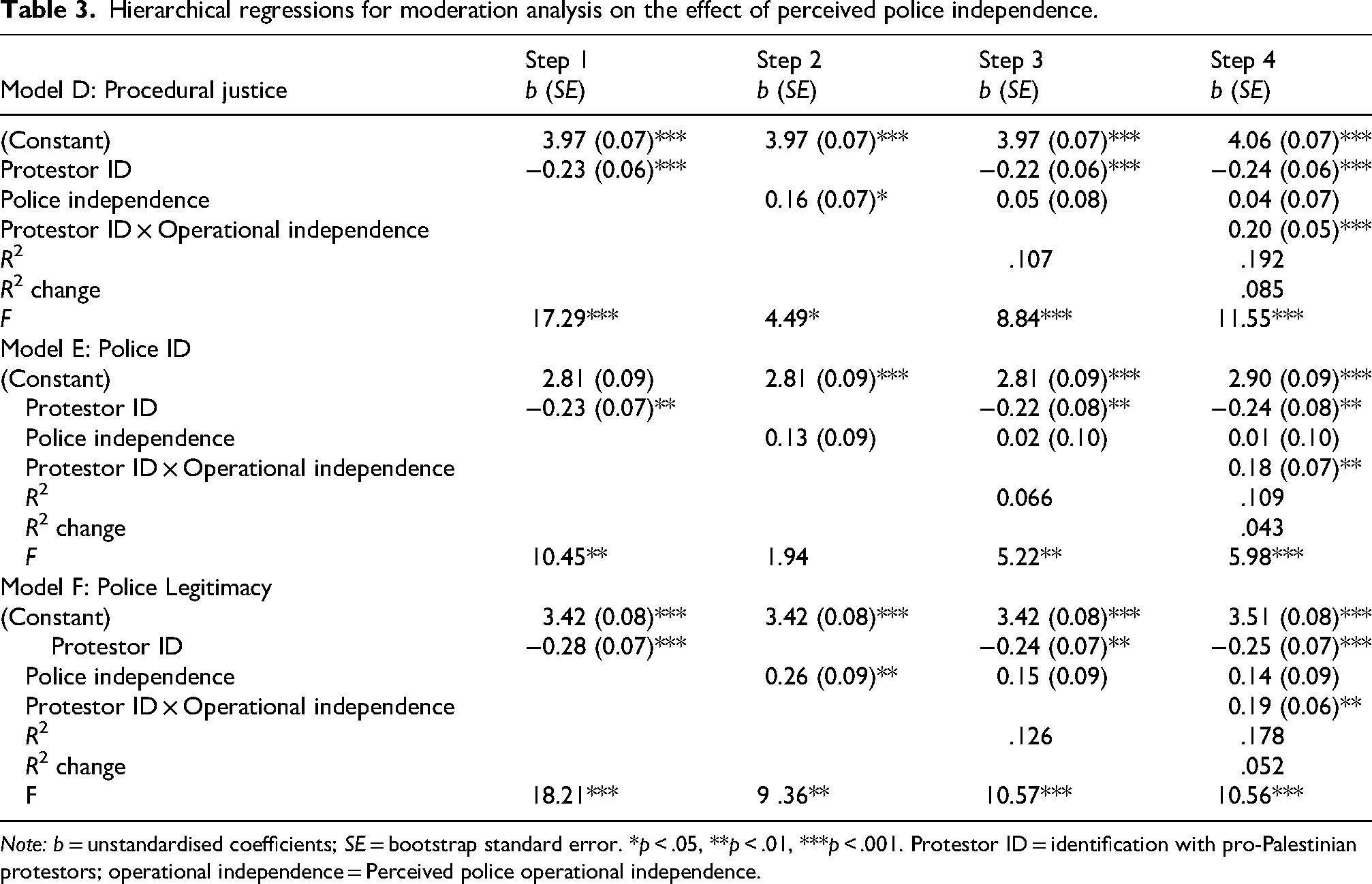
Although the experimental manipulation did not show a significant moderation effect, what we are ultimately interested in is the effect of perceived police independence on the relation between identification with protestor and evaluations of the police. To explore further, we conducted another set of moderation analyses with the measure of perceived police independence (the manipulation check) instead of the experimental condition (Table 3) as the moderator. Similarly, both identification with protestors and police independence were mean-centred before creating the interaction item and entering the regression models.
Hierarchical regressions for moderation analysis on the effect of perceived police independence.
Note: b = unstandardised coefficients; SE = bootstrap standard error. *p < .05, **p < .01, ***p < .001. Protestor ID = identification with pro-Palestinian protestors; operational independence = Perceived police operational independence.
The results confirm that identification with protestors had a consistent negative statistical effect on procedural justice perceptions (Model D), identification with police (Model E) and police legitimacy (Model F). On top of that, the perception of police operational independence had a significant statistical effect on procedural justice perceptions (Model D) and police legitimacy (Model F), but not on identification with police (Model E). More importantly, the perception of police independence has a consistent moderation effect on the relationship between identification with protestors and all three dependent variables. Although there is a negative effect of identification with protestors on the dependent variables, the positive interaction effect implies that such a negative effect would be mitigated when the police are perceived as more independent.
These relationships can be visualised by the plots presented in Figure 2. Here, the solid lines represent the relationship between identification with the protestors and the dependent variables for participants who perceived the police as 1 SD more independent than the mean. These lines are almost flat in all three plots, indicating that identification with protestors had only a very weak negative association with the dependent variables when the police are seen as (very) operationally independent.
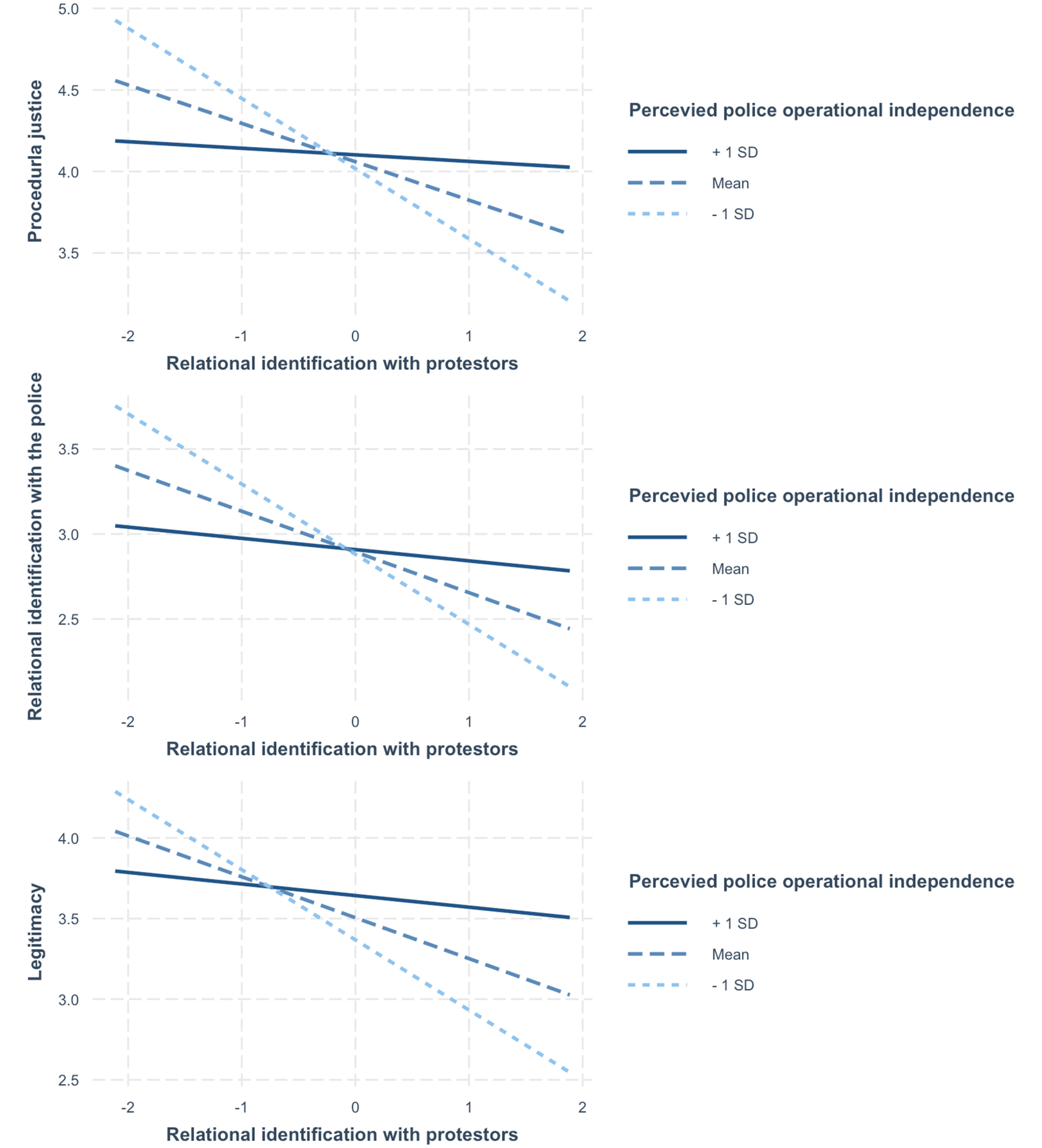
Identification with the protestors × perceived police operational independence interaction effect for procedural justice perceptions, identification with the police, and police legitimacy.
Discussion
The goal of Study 2 was to extend the investigations from Study 1 by exploring the potential impact of underlying political context on perceptions of police. We manipulated the perceptions of police operational independence in the face of attempted governmental interference. The manipulation check confirmed that those from the independence condition had significantly stronger perceptions of police operational independence than those in the governmental bias condition. The experimental condition itself did not have a significant moderating effect on the relationship between identification with protestors and perceptions of the police; yet the measurement of perceived police operational independence (the manipulation check) did significantly moderate this relationship. This suggests that perceptions of police operational independence may indeed moderate the impact of identification with protestors on perceptions of procedural justice, identification with police and judgements of police legitimacy.
These divergent findings are puzzling. One explanation may be that the texts used in the experiment not only shaped the way the participants perceived police, as we intended, but also caused other psychological or perceptual changes, for example by invoking the then government or the specific political leadership involved. In this case, the experimental conditions may wrap a number of different, contradictory, factors that in effect cancel each other out. However, when we switched to a direct measure of the construct of interest, perceived police independence, we did identify the hypothesised relationship between identification with protestors, police independence and the three dependent variables. It is important to note, in this case, that this second analysis is correlational in nature, and we cannot identify causal effects as would be the case if the experimental manipulation had “worked” as intended.
As an extension to Study 1, Study 2 utilised the same set of measurements and video footage, which allowed us to control participants’ identification with protestors and the evaluated police actions in the experiment. The only element Study 2 added was the manipulation of participants’ perceptions of police operational independence. The conflict between the then government and police on whether the anti-war demonstration should be banned at the Remembrance Weekend was the contextual change, which allowed us to examine the potential effect of the social context within which the policing activity at the station was being viewed. Although our results are contradictory, on balance they seem to suggest that the nature of the relationship between police and government moderated the impact of identification with protestors on judgements about and identification with the police.
General discussion
Building on Radburn et al.'s (2018) study of how social identification with “the policed” affects people's judgement of police–public encounters, the current study sought to expand our understanding of this phenomenon by applying it to the context of policing anti-war demonstrations in the UK. By contextualising police actions in the protests against the war in Gaza, our studies showed that attitudes towards and identification with those being policed are important antecedents influencing judgements about policing. Moreover, as suggested in previous studies, judgements of the procedural fairness of police seem to play a powerful role in the extent to which people perceive the police as legitimate and identify with them. Our findings add further support to Radburn et al.'s (2018) claim that group-level social psychological processes influence how people judge police actions. They also add to the growing body of PJT literature emphasising the central role of social identity and social context in shaping these perceptions (Bradford, 2014; Kyprianides et al., 2021; Murphy et al., 2015).
Building on an increasing body of policing research that examines how macro-level factors shape perceptions of the police (Gau et al., 2012), we extended our investigation to explore the impact of the underlying political and structural context – in this case the relationship between the police and the government – on perceptions of policing. We found that perceptions of police operational independence moderated the association between identification with protestors and judgements of the police. When the police were perceived as operationally more independent, the negative effects of identification with protestors on procedural justice perceptions, identification with police and legitimacy judgements were all mitigated.
These findings imply that contextual factors like police independence can significantly influence group-based perceptions of the police. Protest can be seen as communication, action arguing for development and social change made by the protestors to the government (Oyedemi, 2020). Police are thus positioned between the protestors and the government, and their actions determine their relative distance from both parties. When the police are viewed as independent from the government, they are more likely to be viewed as neutral. By contrast, when the police are perceived as working more collaboratively with the government, they tend to be positioned closer to it. As such, police operational independence can serve as a protective factor against the group-based negative perceptions built on the protestors’ conflict with the government.
In other words, our study supports one of the foundational ideas of civic policing, by acting independently, the police are seen to maintain an appropriate distance from both parties, which motivates those who identify with the protestors to see the police as more neutral, decreasing the social distance between them. This echoes the increasing evidence found from crowd management studies on how a dialogue-based and legitimacy-focused policing approach can be effective in facilitating self-regulation within protest crowds (Gorringe et al., 2012; Pearson & Stott, 2022; Stott et al., 2012, 2025). Ultimately, these strategies allow the police to decrease the social distance between themselves and “the policed” (Lee & Gibbs, 2015), promoting the idea of seeing the police as an ingroup working for (facilitating expression) rather than an outgroup working against “the policed” (Radburn et al., 2018).
This study has several implications for police practice and policymaking. First, it stresses the importance of taking a process-based perspective towards understanding what is seen by the public or a particular group as fair and legitimate policing. Our data suggest that police legitimacy is a situationally and contextually embedded process, within which group-level identification and relationships are central. This relational and interactional view of legitimacy aligns closely with legal socialisation scholarship (Fagan & Tyler, 2005; Trinkner et al., 2020) and Bottoms and Tankebe's (2012) dialogue model, which stress that perceptions of legitimacy are continually shaped over time through both direct and vicarious experiences with authority.
These findings also resonate with the historical principles of British policing, often encapsulated in the Peelian ideals, which emphasise the importance of public approval and consent as the foundation for effective policing. This model, built on legitimacy and fairness, resonates with our findings that procedural justice and group-level identification play central roles in shaping public perceptions. However, as our results show, efforts to achieve this legitimacy are deeply intertwined with social context, group dynamics and the broader sociopolitical environment, underscoring the need for further research into the social and institutional conditions that influence legitimacy (Bottoms & Tankebe, 2020; Jackson et al., 2025). Police practitioners and policymakers need to take a more nuanced and context-sensitive approach – one that recognises how factors, such as ethnicity, political affiliations and group identity, influence the way individuals judge the police.
Second, although much research applying PJT has focused on individuals’ direct interactions with police, it is important to recognise that the theory itself – particularly in its integration with legal socialisation frameworks – has long acknowledged that perceptions of legitimacy are shaped by both direct and vicarious experiences (Tyler & Trinkner, 2018). Our study reinforces and extends this theoretical insight by providing empirical evidence that procedural justice also matters to those who witness police–public encounters as bystanders. In fact, such mediated and vicarious experiences may reflect how most people encounter policing in everyday life – through news reports, viral videos and social media content, rather than direct contact. Although the research participants did not have direct contact with the police officers in the video, their perceptions of the police were shaped by their vicarious experience of intergroup interaction between police and protestors. When we think about examples such as the development of the Black Lives Matter movement as people witnessed the police misconduct against George Floyd on social media, it is important to pay attention to how vicarious experiences of police interactions may affect public perceptions of the police (Jonathan-Zamir et al., 2021; O'Brien & Tyler, 2020).
This study had a number of limitations. First, Study 1 is purely correlational, while the experimental manipulation in Study 2 did not function as expected. Our results cannot therefore be seen as representing causal effects. Second, the samples in both studies are limited in size, and were recruited from the Prolific sample so cannot be seen as representative of the UK or any other population. Third, the video footage used in both studies depicted police behaviour in an intentionally ambiguous manner. Although this allowed for a range of interpretations, it may also have led participants to rely heavily on prior beliefs and past experiences. Different results might have emerged if the footage had clearly depicted procedurally just or unjust police conduct. Fourth, although protests against the Israeli government’s actions in Gaza were a world-wide phenomenon, the way the people in our sample seemed to think about policing, particularly in relation to the idea of operational independence, may be unique to the UK. Future studies could profitably address all these short-comings.
Conclusion
This study underscores the critical role of social identity and group-level processes in shaping perceptions of police legitimacy and procedural justice. By situating police–protestor interactions within the highly politicised context of anti-war demonstrations in the UK, we revealed how prior attitudes and group identities significantly impact the interpretation of police actions. Our findings affirm the idea that procedural justice is a contextually embedded social psychological process. Importantly, the studies highlight the interplay between social context, procedural fairness, legitimacy and identification with the police. They also highlight how the perceived operational independence of the police matters. This suggests that police legitimacy is a dynamic construct, influenced not only by direct or vicarious interactions, but also by the broader sociopolitical and structural context in which these interactions occur.
These findings contribute to the evolving literature on PJT by reminding us of some of its historical assumptions emphasising the need for a contextualised approach that integrates group-level dynamics and psychology. They also carry practical implications for policing strategies, particularly in managing protests, as they highlight the importance of maintaining operational independence and aligning actions with principles of fairness and inclusivity to foster trust and legitimacy across diverse social groups in democratic society.
Supplemental Material
sj-docx-1-psm-10.1177_14613557261460267 - Supplemental material for Exploring the dynamics of identity, procedural justice and police legitimacy in the context of anti-war demonstrations in the UK
Supplemental material, sj-docx-1-psm-10.1177_14613557261460267 for Exploring the dynamics of identity, procedural justice and police legitimacy in the context of anti-war demonstrations in the UK by Angus Chan, Ben Bradford, Clifford Stott and Matthew Radburn in International Journal of Police Science & Management
Footnotes

Ethical approval and informed consent
This study was reviewed and approved by the Departmental Ethics Committee, Department of Security and Crime Science, University College London (Project ID: 759). Before beginning the online experiment, participants were presented with a digital information sheet detailing the study's purpose, procedures, and their rights, including the right to withdraw at any time. Informed consent was obtained electronically, with participants indicating their consent by selecting a checkbox before proceeding with the study.
Author contributions
A Chan: Conceptualization, Methodology, Data collection, Formal analysis, Writing – original draft. B Bradford: Conceptualization, Methodology, Formal analysis, Writing – review & editing. C Stott: Conceptualization, Writing – review & editing. M. Radburn – Writing – review & editing.
Funding
The authors disclosed receipt of the following financial support for the research, authorship, and/or publication of this article: This work was supported by the University College London, (grant number 156782).
Declaration of conflicting interests
The authors declared no potential conflicts of interest with respect to the research, authorship, and/or publication of this article.
Data availability statement
The data that support the findings of this study are available from the corresponding author upon reasonable request.
Supplemental material
Supplemental material for this article is available online.
Notes
Author biographies
References
Supplementary Material
Please find the following supplemental material available below.
For Open Access articles published under a Creative Commons License, all supplemental material carries the same license as the article it is associated with.
For non-Open Access articles published, all supplemental material carries a non-exclusive license, and permission requests for re-use of supplemental material or any part of supplemental material shall be sent directly to the copyright owner as specified in the copyright notice associated with the article.
