







Abstract
Who texts, and with whom do they text? This article examines the use of texting using metered traffic data from a large dataset (nearly 400 million anonymous text messages). We ask: 1) How much do different age groups use mobile phone based texting (SMS)? 2) How wide is the circle of texting partners for different age groups? 3) To what degree are texting relationships characterized by age and gender homophily? We find that texting is hugely popular among teens compared to other age groups. Further, the number of persons with whom people text is quite small. About half of all text messages go to only five other persons. Finally, we find that there is pronounced homophily in terms of age and gender in texting relationships. These findings support previous claims that texting is an important element of teen culture and is an element in the construction of a bounded solidarity.
Keywords
Introduction
The mobile phone fits into a modern mobile life style (Elliott and Urry, 2010), placing individuals in ‘perpetual contact’ (Katz and Aakhus, 2002) with their network of contacts. Texting 1 is one of the core features of mobile phones and has become a central form of mediation with literally trillions of text messages being pecked out on mobile phones around the globe every year (ITU-D, 2010). Texting is used in a variety of situations for simple, circumspect and ‘under the radar’ communication. It is used to coordinate interaction, to send and receive reminders and to maintain social contact (Licoppe, 2004). In short, texting is a highly useful medium for maintaining social relationships and managing everyday life.
While texting has become popular across all age groups, the literature has mostly focused on the importance of the technology in teenage life. It is teens, after all, who in the late 1990s discovered texting and it is this group who made it their own. Indeed, it is well established that texting has become a fixture of youth culture and teen form of mediation (Ling, 2010).
In the literature, teens have been described as the most active texters, but this does not mean that teens are the only users of texting. In general, however, other groups are not as committed to texting as are teen and young adult users (Vincent, 2011: 181). This is particularly true for the elderly who in general have not taken up texting (Ling, 2008a).
These differences in texting behavior among various age groups have been established and explored in the literature. However, much of the previous research into the socio-demographics of texting has been either qualitative research or quantitative research based on relatively small self-report datasets. Rarely has metered data been available on the actual patterns of texting behavior across a broad range of age groups allowing for comparison between them. In this article, we contribute empirical insight into the question of ‘Who texts, and with whom do they text?’ on the basis of a large dataset consisting of metered traffic data. The use of metered data gives us an important corrective to the more common use of self-report data (Boase and Ling, 2011).
We compare teen texting behavior to the rest of the population of mobile phone users by addressing three main questions: How much do different age groups use mobile phone based texting? How wide is the circle of texting partners for different age groups? To what degree are texting relationships characterized by age and gender homophily?
To answer these questions we examine metered texting traffic data from a sample of nearly 400 million text messages sent and received by anonymous users. The data was extracted from a larger dataset gathered by Telenor (a large GSM operator based in Norway) in the fourth quarter of 2007.
Our data shows that, as suggested by the literature, teens dominate the texting landscape compared to other age groups, in terms of volume. The data confirms that texting is indeed a teen phenomenon. However, the metered data underscores the dimensions of this phenomenon. Further, teens text with more texting partners than do any other age groups and engage in more cross-gender texting than other age groups. Finally there is pronounced age, but not always gender, homophily with very little texting to persons outside of an individual’s age group.
These findings taken together support previous work suggesting that texting is a central element of teen culture (Goggin and Crawford, 2011) and that texting is an element in the construction of a bounded solidarity (Ling, 2008b), namely that the mobile phone as a personal device helps us in the project of developing and maintaining social cohesion particularly in smaller groups.
Literature review
In a surprisingly short time, texting has gained a well-defined position in our social interaction. It appeared on the scene in the early 1990s as a part of the GSM standard (Hillebrand et al., 2010). It languished for a few years until the late 1990s when teens discovered its potential and, in many ways, made it their own. The functions of texting are many and varied. It is frequently used in both instrumental interaction such as coordination of activities (Ling, 2004) and in expressive interaction. Patterns of use are not necessarily uniform across different social groupings: practices of mobile phone use have been found to differ among different age groups as well as between genders (Baron and Campbell, 2010).
Older people in general have been very reluctant to adopt texting (Ling, 2010) and even today are not texting to any noticeable extent. Adults have been found to often use texting for instrumental purposes such as coordinating when to pick up the kids or to remember which groceries to buy at the store (Ling, 2004). In contrast to the above mentioned groups, teens have embraced texting more wholeheartedly. Among teens, texting is used for a variety of purposes and it has achieved a central position in the youth culture (Bolin and Westlund, 2009; Goggin, 2006). Within this culture, to be available via texting is taken for granted (Ling, forthcoming) and in many countries a teen who wishes to follow the ebb and flow of peer interaction needs to master texting. Originally, texting was seen as a low cost way of interacting (Goggin, 2006; Kopomaa, 2005; Ling, 2005; Ling and Haddon, 2008). From there it developed into a forum where teens could develop their own lingo and style (Goggin, 2006; Hård af Segerstad, 2005; Ling, 2004; Skog and Jamtøy, 2002). These are cultural elements which have later been adopted by other groups. Teen infatuation with texting is perhaps not surprising since in many ways texting as a medium is ideally suited for this period of life. Teens have to manage the dual sets of expectations put forth by their peers and their parents. Peer-based interaction is what helps them through the transition from childhood into their adult life situation (Ling, 2009) and yet parents still play an important role in their lives. In this context, texting provides teens with a discrete and continuously available link to their intimate community (Cohen et al., 2007; Ito and Daishuke, 2005; Ling, 2009) while at the same time acting as a ‘buffer’ to the prying eyes of parents. For example, teens report texting to their parents when the ambient background sound in a phone call would tell their parents that they are at a party (Lenhart et al., 2010). Texting in this way supports teen emancipation and the transition from the sphere of the parents to the peer group (Ling, 2005, 2009; Ling and Yttri, 2006; Oksman and Rautianen, 2003). Texting allows teens to manage independence (Green, 2003). Further, texting allows teens to explore different aspects of romantic relationships (Cohen et al., 2007; Ibahrine, 2008; Lenhart, 2009), pacing their interaction with potential boy/girlfriends (Lenhart et al., 2010). Different types of courting and sexual interaction may also be negotiated (Dietmar, 2005; Döring et al., 2005; Ellwood-Clayton, 2003; Prøitz, 2005). In addition to these important social functions of texting, it is also used as a form of entertainment (Thulin and Vilhelmson, 2008) and a way to fill in time (Johnsen, 2003; Lenhart et al., 2010). In sum, texting is not a peripheral element in teens’ lives but rather a central feature in teen culture (Green, 2003; Ito and Daishuke, 2006; Kasesniemi and Rautiainen, 2002).
At a societal level, mobile telephony has been found to be a form of mediation that supports the development and maintenance of social cohesion (Campbell and Kwak, 2007; Igarashi et al., 2005; Ishii, 2006; Ito and Daishuke, 2005; Reid and Reid, 2004; Smoreda and Thomas, 2001) with our nearest sphere of friends and family. Indeed, texting and mobile telephony is used for the creation of bounded solidarity (Gergen, 2008; Ling, 2008b).
Method and data
The material comes from an analysis of 394 million anonymous text exchanges in Q4 2007 from Telenor traffic data in Norway where there is particularly complete data on gender and age. 2 The material includes anonymized billing records that include traffic volume as well as the age and gender of the user. Other demographic variables were not available in the database and thus we were not able to include them in the analysis. In Figure 1 all the messages are examined. In Figure 2 only a subset of people are included, namely only the same-aged individuals sending and receiving texts, that is about 64.8 million texts. Figure 3 is the same material as in Figure 2. The material for Figures 4 and 5 is from another database from the same operator for the third quarter of 2009. This consists of the data for 49,895 anonymous subscribers.
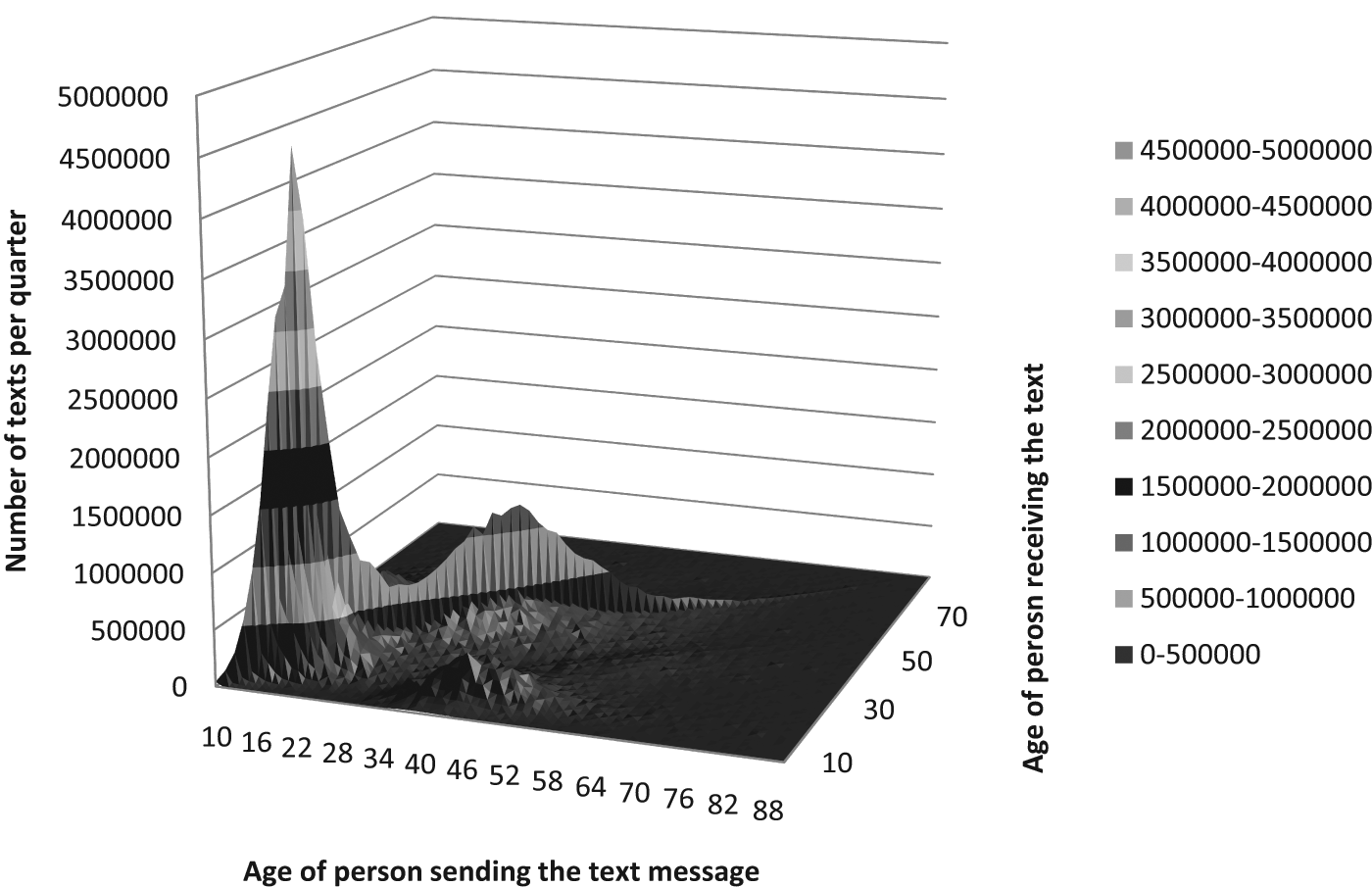
Topographic chart of text messages being sent and received in Norway by age, Q4 2007 (n = 394 million text messages).
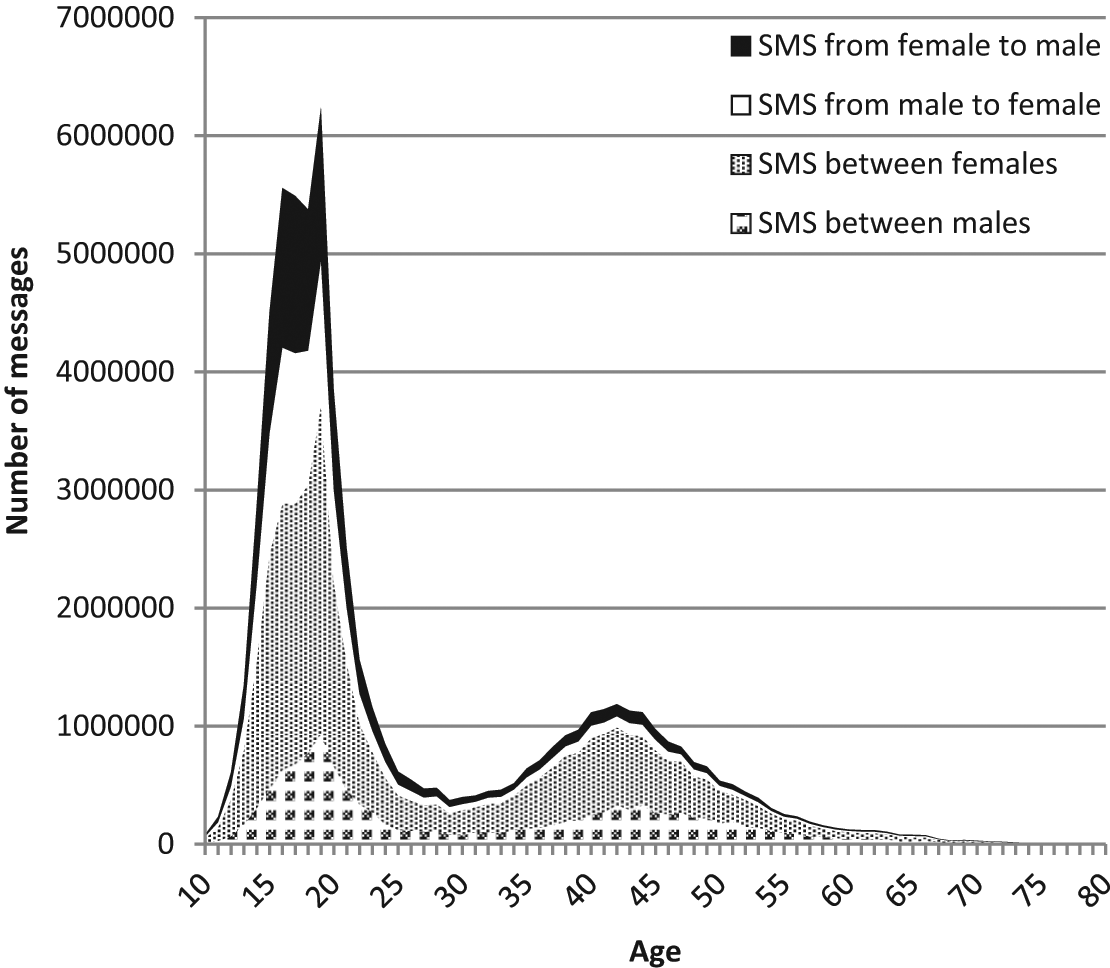
Layer cake diagram of same-gender and cross-gender communication for same-aged individuals. The figure is the great diagonal of Figure 1 sorted by the gender of the sender and receiver of the texts (n = 64.8 million texts).
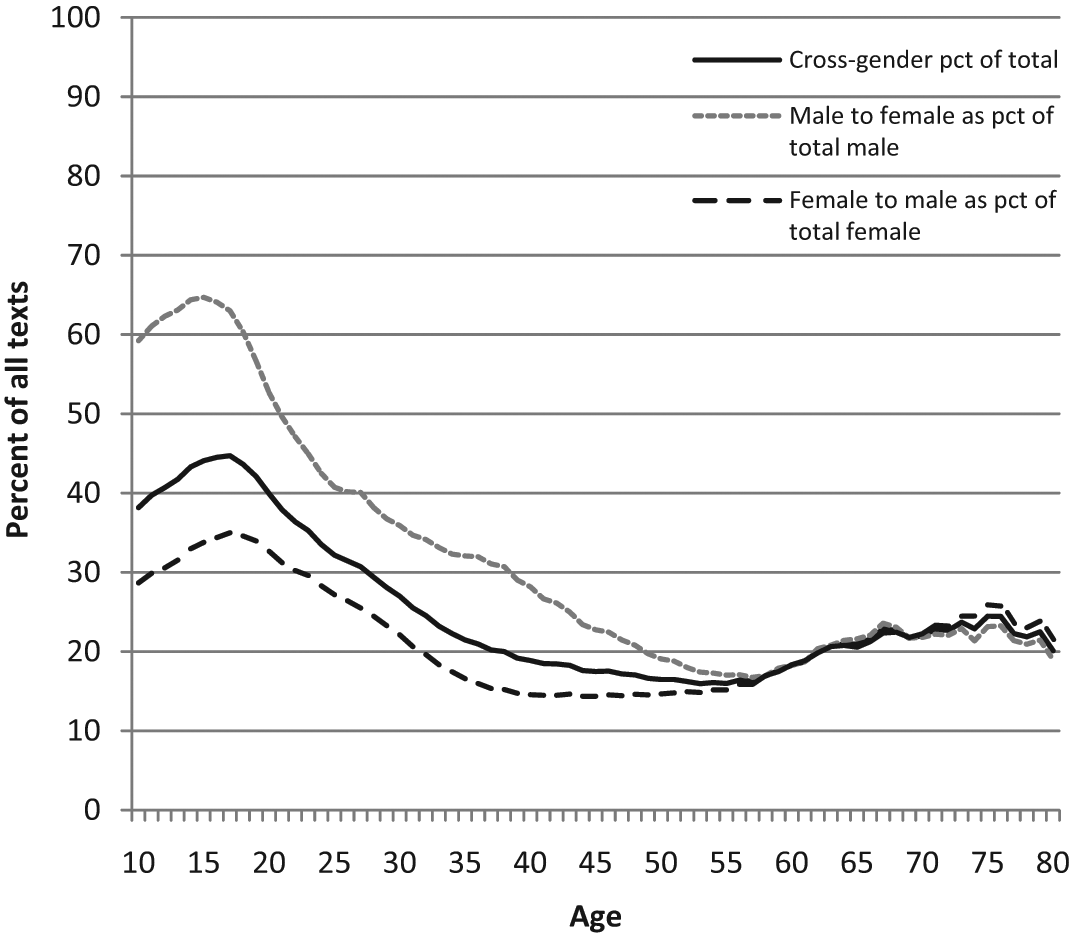
Cross-gender texting in percent by age (7 year running mean).
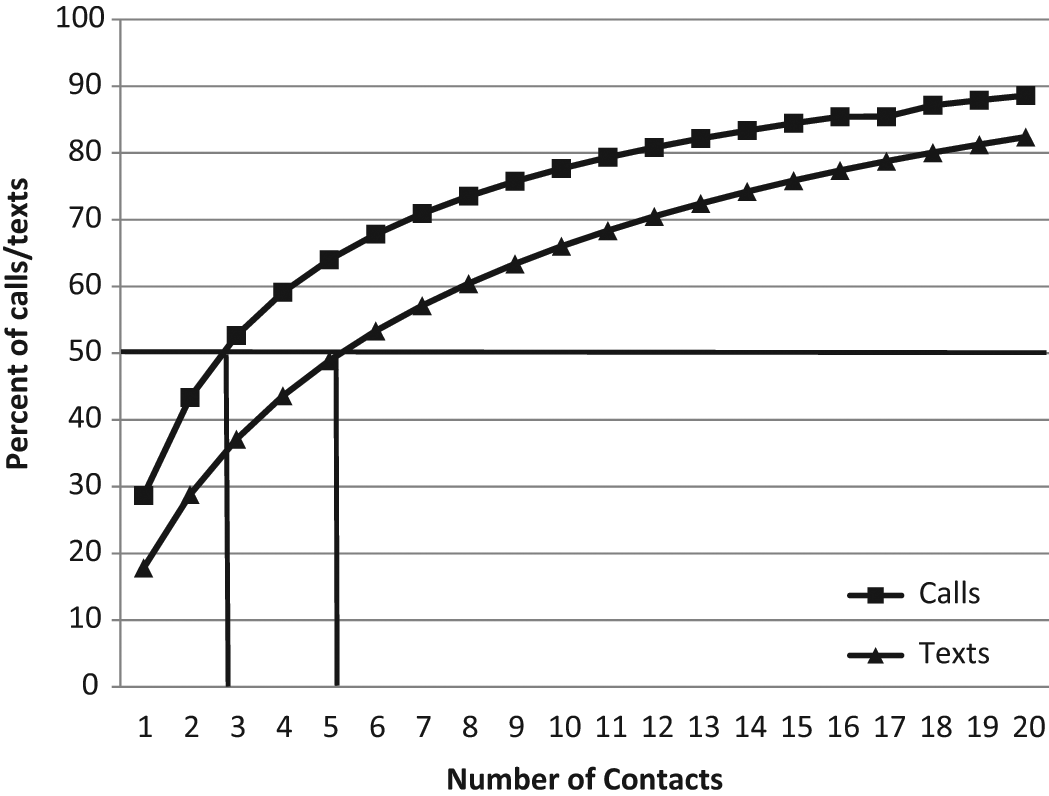
The diffusion of calls and texts by number of contacts. The vertical lines show the number of contacts that account for 50% of all calls (about 3 different contacts) and texts (about 5 different contacts).
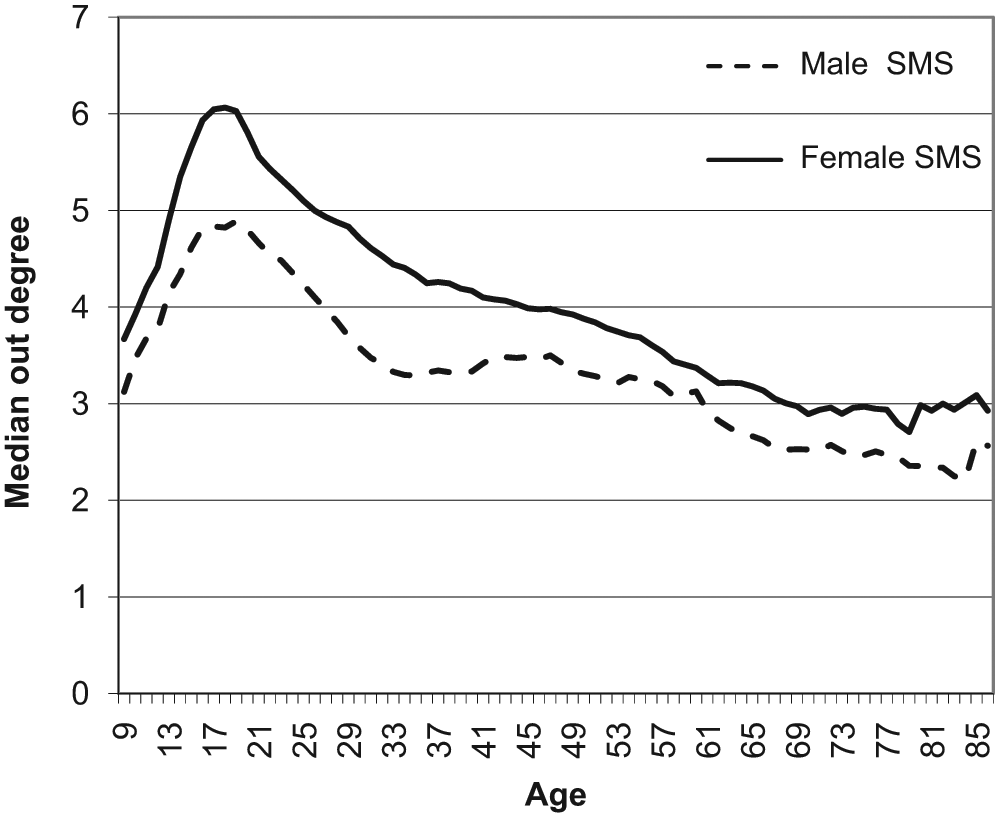
Median number of texting partners by age and gender of the person initiating the texts
Results
Topographic analysis of texting between age groups
Figure 1 is a topographic chart showing the volume of text messages sent between pairs of texting partners. The age of the sender is mapped on the X-axis while the age of the recipient is mapped on the Z-axis. The volume is mapped on the Y-axis and shows differences in the volume of messages sent between individuals belonging to various age groups. The ages range from 10 to approximately 90 years of age.
The graph shows a distinct pattern with most of the volume of traffic falling on and closely around the ‘same-aged’ diagonal running from the lower left corner to the upper right corner of the graph. This clearly shows that most of the traffic occurs between similarly aged texting partners and most particularly between same-aged teens. It is clear from the lower left corner of the graph that teens are the most active texters and that they text more with roughly same-aged individuals than any other group. Moving further up the diagonal, another interesting feature is the relatively active texting done by those aged approximately 36–45.
Looking at the data another way, we compared the empirical material given in Figure 1 to the number of texts that a particular age group would generate if each person, regardless of age, generated the same number of texts. If we compare this hypothetical number to the actual number of texts sent by the different age groups, we can see the relative over and under production of texts. This analysis shows that teen to teen texting, and in particular among same-aged teens, outperforms the ‘expected’ level of texting. Same-aged persons 16 to 22 years old send and receive on average almost 60 times more texts that one would expect were texting evenly distributed through society. Nineteen year olds specifically generate 80 times more texts than one would expect if every member of society texted equally. By contrast, persons over 70 generate less than 0.01 times the texts that one would expect from this population given the size of that group.
Two distinct and interesting clusters are present on each side of the diagonal – these clusters are comprised of a great number of messages being sent between what appears to be teens and adults aged approximately 37–57. This will be discussed below.
Finally, it is worth noting that there is relatively little texting by those who are over retirement age and that there is very little texting between young adults and younger teens (or indeed between young adults and any other age group). Overall, the chart shows that there is a large degree of age segregation associated with texting among the younger persons.
Cross-gender texting along the great diagonal
The topology of the diagonal in Figure 1 shows that there is a lot of texting activity between same-aged texting partners. Further, it shows that this activity seems to vary among different age groups. This merits a closer examination. First, we will examine the total volume of messages being sent to same-aged texting partners for the different age groups in the dataset.
Communication between same-aged individuals
Figure 1 shows that there is a large element of age-based homophily in texting, i.e. the ‘ridge’ along the grand diagonal. Figure 2 is a ‘layer cake’ cross-section of the grand diagonal from Figure 1 showing the volume of same-gender and cross-gender communication occurring between same-aged texting partners. Where Figure 1 was a type of bird’s eye view of all the texting activity, Figure 2 shows only the activity of the same-aged individuals, that is where the person sending and receiving the text are both the same age. As in the topographic chart in Figure 1, it is immediately clear in Figure 2 that teens communicate more with same-aged texting partners than do any other age groups in the data material.
From the low volume onset of the graph at age 10, the total number of messages sent to same-aged partners rapidly increases for each succeeding age group until age 17 through 18 where there is some leveling off. The volume of messages then continues to increase until the distribution reaches its overall peak at age 19.
After the peak at age 19, the number of messages to same-aged persons sharply decreases with each succeeding age group until the late 20s reaching a low point at age 29. The decrease in volume of messages through the 20s is quite dramatic – most evidently between age 19 and 25 where the number of messages between same-aged individuals declines by an average of about 30% for each succeeding age group before leveling off. The difference in the number of messages from the peak level to the lowest level is substantial with the number of messages sent by the 29 year olds to other 29 year olds being only about 6% of the number sent between the 19 year olds.
Following the low point for same-aged interactions at age 29, the volume of messages slowly begins to increase, gaining in number until closely before reaching the distribution’s secondary, but relatively minor, peak at age 42. This peak – while three times higher than lowest point of the trough – is only approximately 19% of the size of the number of messages sent between the 19 year olds. Again, this underscores the intense activity associated with teen texting, particularly to same-aged peers. From age 42, the volume of messages steadily decreases through the rest of the data shown in the chart.
Cross-gender texting
In addition to the simple number of texts being sent and received, we are also able to see the inter- and intra-gender traffic in Figure 2 as well as in Figure 3. In Figure 2 the volume of same-aged interactions is presented as a total comprised of four layers. The lowest layer is males texting to other males, the next level is females texting to other females, this is followed by males texting to females and finally females texting to males. It is apparent from the material that the largest portion of the messages in Figure 2 are being sent by females to other same-aged females. This remains true across the entire graph. Males in comparison send fewer messages to same-aged males across all age groups. It is also interesting that after the teen/young adult period, there is very little cross-gender texting.
In Figure 3, we show the communication that occurs between same-aged texting partners of opposite gender (males texting to females and females texting to males).
As can be seen in the chart, the proportion of cross-gender texting is greatest around age 16. From this point onward, the general trend is that the proportion of cross-gender communication steadily declines until approximately age 60 where the data becomes too thin for valid analysis. For males the decline is constant from around age 16 to around 55 whereas for females the curve flattens around age 37, after which there is a slight increase in the age groups that follow.
Generally, we find that there is a homophile preference concerning the gender of texting partners in the dataset. This is most pronounced for females where the proportion of cross-gender communication is below 40% for all age groups. For males, the pattern is more nuanced. From age 12 to around age 18, males send more than 60% of their messages to females. As is the case with females, the proportion of males’ cross-gender communication also declines with time and gender homophily ensues – but the proportion of cross-gender communication consistently remains higher for males than the females until around age 55. Indeed in some cases the literature has shown that it is not seen as being appropriate for males to spend time texting to other males (Ling et al., 2010).
Texting as a small group phenomenon
Given the findings in the preceding charts that people tend to engage in texting with partners of the same age and, particularly for females, the same gender, it is interesting to ask how many people form the circle of texting contacts and how strong the tendency is toward bounded solidarity (Ling, 2008b). While we of course cannot answer this conclusively, we will present data that may support further analysis and interpretation. Figures 4 and 5 present data on the number of contacts with whom people text.
Figure 4 shows that our number of texting partners is surprisingly small. Indeed, the median number of different texting partners is only about five persons. This indicates that users send the majority of their texts to a select collection of individuals. In terms of sheer volume then, a handful of strong ties take up most of the texting communication. This leaves a small portion of all texts for other, presumably weaker, ties (Granovetter, 1973). The material in the chart also shows that the circle of voice calling partners is smaller than the texting partners. In this case, the median number of calling partners is about three persons. As we will discuss below, this analysis indicates that the mobile phone is primarily a tool used for maintenance of the intimate sphere.
Taking the analysis shown in Figure 4 one step further, we examined the median number of mobile numbers communicated with by age and gender. In this analysis, we see that teens generally have the largest number of texting interlocutors. The median out degree, i.e. the number of different other telephone numbers that a teen sends texts to, is higher for teens and young adults than it is for other age groups. Indeed, for teen girls it is the highest of any other group. Half of all an 18 year old teen girls’ texts go to slightly more than six persons. For a same-aged teen boy this is slightly less than 5 other persons. From this point, the median number falls through the rest of the age groups. This distribution in all likelihood reflects the fact that the teen years are often focused on cultivating friendships outside the family. Indeed, it is only in this period that friendships are so central. In the period leading up to adolescence and afterwards it is often the family that commands this focus (Rubin, 1985).
Looking at somewhat older persons, after the teen peak, there is a rather long decline in the median number of other persons that are texting partners. For females the decline is approximately a straight line through the remaining age groups. For men there is a somewhat steeper curve that flattens for those between about 33 and the early 50s.
In summary, the material shows that teens are by far the most active texters, that the teen period is the most active period for cross-gender texting and that while the number of different persons we text with is small, it is nonetheless largest for the teens.
Analysis
The teen peak
The data has confirmed that teens are the most intense users of texting. While other studies have shown this, the metered data shows the degree to which this finding obtains. Teens use this medium as they navigate through the straits of adolescence. They rely on each other as they confront the different trials and also celebrate the different victories of adolescence. Friends are the source of social interaction and of information on different daily activities. It is in the teen period that friends are most important. For younger children, friends are often a fixture in daily life, but parents are still central (Goggin and Crawford 2011; Ling and Haddon, 2008). Among adults, our partners and eventually children demand our attention. It is the transition from childhood to adulthood, i.e. during adolescence, that interaction with peers is the most important (Rubin, 1985). The material here indicates that, at least in the Norwegian context, it is in the period corresponding to high school and just after, that is around age 18, that texting is most central. The teens in this age group use the most texts and have the largest circle of texting partners. It is also in this period that there is the largest amount of cross-gender texting.
As others have noted, the mobile phone is a useful tool for teens who are, for the first time, trying their hand at more adult forms of social interaction. It gives them a direct channel of communication with peers. They are able to control when and where they communicate. It gives them the opportunity to chat with one another, to report on their locations and to coordinate meeting one another. It helps them to communicate personal matters and to manage school work (Lenhart et al., 2010). While it is possible to engage in important ‘conversations’ via texting, it is also a channel through which teens can fill in time. They can use texting for chitchat or to exchange the latest news. While a call might be needed for important matters, a text is a simple interaction that does not have to mean that much in the broader sweep of the day. Texting is a ‘low maintenance’ form of interaction (Ito and Daishuke, 2005). Perhaps because of these reasons, texting has a unique position in the repertoire of teen interaction. Texting is an ambient channel that can be used while other copresent activities are unfolding.
Texting is also taken for granted. There is the expectation among teens that their interlocutors are available via texting. There is the expectation that they will have their mobile phone with them and thus they are never really out of contact (Ling, forthcoming). A friend is always available for textual interaction. Not to be available defies the expectations of the teens.
Where younger persons can expect that their texting partners respond to their messages, this is not a part of older people’s interaction. Teens also have specific forms of interaction and a different style of communication in their texts. This same form of address is not retained as they move into young adulthood.
At a broader level, texting is a feature of teen culture (Goggin, 2006) that is also seen in teen ‘bedroom culture’ particularly in the case of girls, i.e. it is a quasi-private space where it is possible to develop and maintain teen culture (Bovill and Livingstone, 2001; Livingstone, 2007). It is somewhat outside the purview of parents, teachers and other authority figures. Texting is also a space in which teens can develop a lingo and embroider their sense of group cohesion. The sum of all this is the generation of a large number of texts. The data shows that teens indeed are vastly over-represented in their use of texting and that their circle of contacts is larger than that of other groups.
Elderly non-texters
By contrast, the data shows that elderly persons do not text at any appreciable level. There are exceptions to be sure, but in general the elderly neither text to others nor do they receive texts. Why we are seeing this is not clear. Perhaps the design of mobile phones makes it difficult for elderly persons to use them. It might also be that younger persons do not include the elderly in their texting circle (Ling, 2008a). Finally, it may be that the lives of the elderly are not arranged around the expectation that they be available via text messages. The culture of elderly persons in Norway has its characteristic forms of mediation. Indeed this group is perhaps most reliant on the landline telephone (Vaage, 2010). Regardless of the reasons, the material here shows that elderly persons for all intents and purposes are not texters.
The young parent trough
The material in Figure 2 indicates that the young adults send far fewer texts than do the teens. If texting is so clearly functional for teens, why is there such a dramatic drop in use in the older age groups?
First, it is worth noting that the drop in texting is not a cohort effect. Evidence points to the idea that life phase, more than cohort membership lies behind the drop in texting. The young adults in Figure 2 were, in their time, the first generation of teens to use texting. Time series analysis that has followed pre-teens into their teens and has also followed cohorts of teens into the young adult phase of life has shown that while the young adults described in Figures 1 and 2 text at moderate levels, their position as the most active texters has declined since the time that they were teens (Helles, 2009; Ling, 2010). The time series data in the work of Helles and Ling shows that teens only carry texting with them to a certain degree as they move out of the teen phase of life. The latter study covered seven years of data and allowed analysis of pre-teens moving into the teen phase as well as teens moving into the young-adult phase. It shows that the proportion (not the absolute number) of text messages sent by different age groups stays stable over time. Indeed there seems to be a ‘standing wave’ of use associated with older teens and those in their early 20s.
The material in Figure 5 also shows that the circle of texting partners is smaller for this group. One explanation may be found in the increased routinization in daily life of the young adults. To the degree that texting is a proxy for social interaction, research has shown that people who are in more routinized periods of their lives have a more limited social radius (Fischer, 1982). For people who face the quotidian structural elements of jobs, careers, childcare and the mundane constraints of daily life, social interaction has a place, but it often has to take a position behind more pressing activities. This can be seen in the time use analysis of Norwegians (Kitterød, 2002). The demands of a career can place interaction with the peer group into a secondary position. Childcare and the logistics of having small children perhaps take the focus away from same-aged peer interaction. The nadir in texting (approximately age 29) maps onto the period in life where females – and presumably their approximately same-aged partners – experience having their first children in Norway (SSB, 2009). While the arrival of children doubtlessly increases the communication between the partners for various types of coordination, the sheer pressure associated with caring for the child means that there is less time for social interaction.
Norwegian statistics associated with time use show that those adults who have infants and small children in the home apportion the largest amount of time to care giving. They report using nine times as much time for this activity when compared to those who have older children (SSB, 2000). By contrast, among teens there is a relatively open time budget for personal activities and social interaction. However, as individuals move from that phase of life towards parenthood, the dimensions of social interaction change. This change is reflected in their use of texting. As social life is replaced by family life, the stream of texts also becomes constrained.
This interpretation finds additional support in studies conducted by Licoppe and Smoreda in the late 1990s in a French context (Haddon, 2004). Here, changes in the use of the landline phone over the life course were explored. Key findings were that as young people formed couples, there was an increase of calls between the couple but calls to friends of the two people before they formed a couple decreased by half. Having a young baby also affected phone use leading ‘to a reduction of calls overall and a reduction in the number of people called’ (Haddon, 2004: 126).
Another issue that may be at work here is that as we move into more adult phases of life, other forms of mediation become more important. Many teens use email, but it is not their primary form of communication (Vaage, 2010). By contrast, business and work life is often carried out in email as opposed to texting.
Cross-gender texting
Another interesting feature of Figures 2 and 3 is the transition in cross-gender texting that accompanies the young parent trough. The material shows that for same-aged teens slightly less than half of the texts being sent and received are from a same-aged person of the opposite gender. For 16 year olds these make up almost half of all texts. This compares with 24% for people in their early 30s. For those over 35, this falls well below 20% of all texts. That is, after the teen/young adult period, there is relatively little cross-gender texting among same-aged individuals.
Some of this may be due to people ‘not being on the market’ in the same way. As partnered relationships become sorted out, there is not the same pressure to interact with people of the opposite gender. Rather there can be a retrenchment associated with same- gender contacts. This is seemingly reflected in the material shown here.
The middle-aged ‘bump’
The data in Figure 2 shows an interesting bump in females texting to other same aged females around the age of 45. This is, in some ways, the most mysterious of the features of the figure. Some of this may be adult females recapturing their social networks after children have become more independent.
Another explanation has been suggested, and indeed tested, by Rasmus Helles (2009). The rise in traffic activity seen here may, to some degree, actually be teens who are using the subscriptions of their parents. Teens under 18 cannot sign a subscription contract and so in some cases this means that their parents may be the owner of the contract according to the data material but that the actual user is a teen with their penchant for texting. Thus, the official subscription is in the name of a 45 year old female, but the person actually using the device is her teen child. Helles modeled the use pattern of teens and then compared that to a similar group of what appears in the data to be adults. His work points to the possibility that it may well be teens who are using their parents’ phones. In the context of our material the bump may be pre-adolescents who are ‘borrowing’ their mothers’ phones while they await establishing their own subscription. This clarification is not completely satisfying, however, since it excludes the involvement of the fathers and it also assumes that there is symmetry among teens borrowing the phones of their same-aged mothers.
The bounded group of friends
The final feature of the material is the extremely small number of people with whom we text. When looking at the topographic chart in Figure 1, it is easy to get the impression that some groups are texting to a large number of people. In order for teens, for example, to generate the many millions of texts that are shown there, it is easy to imagine that they are sending a small number of texts to a large number of persons. The data in Figures 4 and 5 shows that it is the opposite. Namely, there are a relatively small number of persons who are receiving a large number of texts. Figure 5 shows that teens have a somewhat larger number of persons with whom they are in contact via texting. Teen girls send about half of their texts to six other numbers, their mothers send to about four and their grandmothers three. This is still a relatively small number of persons.
It has been found (Ishii, 2006) that this small group of persons often constitutes our closest sphere of friends and family. As noted above, texting gives us continual access to these strong ties. An important function of the mobile phone and texting is that we can send and receive communications during the day to hold one another updated with regards to our daily interactions (Licoppe, 2004).
Conclusion
In this article, we have examined the use of texting based on the actual number of texts being sent and received by customers of Telenor in Norway. Nearly 400 million texts being sent and received were included in the analysis. We have examined this traffic in terms of the age and gender of the senders and the receivers as well as the number of contacts they text with. We presented three questions which guided the analysis.
First, ‘How much do different age groups use mobile phone based texting (SMS)?’ There are great differences in the volume of texting among different age groups. In terms of sheer volume, texting is a teen phenomenon with the peak being in the late teen years. These findings support previous research showing that texting is a salient feature of teen culture in Norway. This allows us to assert that there is a form of symbiosis between texting and teen culture. Texting is a way for teens to keep in touch and to cultivate different types of age-bound expression without disturbing other copresent individuals such as teachers and parents. It is a venue where teens can flirt and where they can confer with confidants. It fits well into the teen life phase where the peer group feels an intense need to be in touch, but is still in many cases living with their parents. Almost immediately following the teenage years, texting volume drops quickly and those who are past their mid-20s have dramatically reduced the volume of texting. It is not really news that teens text a lot and this metered data confirms the studies based on self-report data.
Second, the question ‘How wide is the circle of texting partners for different age groups?’ examined the breadth of the texting circle. The results show that most texting goes to relatively few contacts. This supports the idea that texting is mostly a small group phenomenon. Generally, our number of texting partners is surprisingly small with half of the texts going to about five persons. There is, of course, a long tail of other contacts, but the core of texting partners is a small group. For teens, the median number of contacts they text with is higher than for other age groups.
Finally, answering question three ‘To what degree are texting relationships characterized by age and gender homophily?’ there is a strong tendency for persons to text with same-aged interlocutors. Particularly when considering teens, only a small number of texts are sent to and received by persons who are of a different age (with the exception of some communication taking place between teens and what appears to be their parents). Further, there is a strong tendency to text with partners of the same gender – particularly for females. Aside from this, the material here shows that, at least in Norway, teen-to-teen texting is the dominant use of this mediation form. No other group sends and receives anywhere near the number of texts that teens and young adults do. There is very little traffic outside this age group.
This analysis has several limitations. First, it is based on data collected in Norway. This is a small but very affluent corner of the world. Mobile phone ownership is nearly universal and the country has a long tradition of use. The findings might not scale to other countries or other locations. Second, this article examines primarily texting and does not place it into the larger context of multi-modal communication. Third, this is largely an analysis of traffic data. The links between the traffic data and the demographic material can be somewhat problematic. For example, the age of the user is most often, but not always, correctly registered in the database. This can result in some incorrect analysis. Finally, there is no attitudinal material in the database. This means that the discussion linking the traffic information with specific motivations is, to some degree, speculation.
The analysis here has implications for further research. There are two main threads, which are the role of texting in teen culture and the construction of bounded solidarity. First, there is a need to better understand how texting has affected the process of being a teen and how it plays into parenting and the educational system. Since it is such a strong element in daily life, we need to know if texting and the peer group bonding afforded by the mediation form are coming at the expense of other points in the lives of teens. On the whole, it is probably good that teens have access to friends and are able to socialize in a variety of ways. It is a place where teens can do traditional ‘teen’ things like develop a special argot, work out the dynamics of dating or help one another with school. In short, texting is one of the places that teen culture is being played out. However, this might also mean that it is a forum that can steal attention away from education or the efforts of parents to guide their children. It is also a forum where there can be mischief and wrongdoing. Just as teens can use texting to organize a charity car wash for orphans in Haiti, they can use it to organize a beer party at the home of a friend whose parents are away for the weekend or to bully a classmate. These issues are not possible to trace in this data. They are nonetheless important questions associated with the rise of texting.
The second general question focuses on how texting and more generally mobile communication affects the balance between cultivation of close ties vs. those that are more remote. The material here shows that the circle of texting ‘friends’ is remarkably small. This suggests that the mobile phone is an instrument of the intimate sphere. It gives us direct access to the closest friends and family. However, does it do this at the expense of the wider circle of acquaintances? It may be that texting enforces bounded solidarity at the expense of interaction with the weaker links in our social networks.
Footnotes
Notes
Author biographies
Rich Ling (PhD, University of Colorado, 1984) is a professor at the IT University of Copenhagen. He has also been the Pohs visiting professor of communication studies at the University of Michigan where he holds an adjunct position. Ling has also worked for the mobile telephone operator Telenor. He is the author of the books New Tech, New Ties (MIT Press) and The Mobile Connection (Morgan Kaufmann). Ling has received recognition as an outstanding scholar from the International Communications Association (the 2010 CROF Award), Rutgers University, the 2009 Erving Goffman Award from the Media Ecology Association and the 2009Telenor Research Award. Most recently he has become one of the founding editors of the SAGE journal Mobile Media & Society.
Troels Fibæk Bertel is a PhD student at the IT University of Copenhagen. His research interests include changes in social behavior and interpersonal communication associated with new information and communication technologies, particularly mobile media.
Pål Roe Sundsøy is a research scientist and project manager for the Advanced Analytics Centre of Excellence (AACE) in the Telenor Group. Sundøy’s work is mainly related to research on large-scale social networks based on mobile communication data. His work in this area has received widespread recognition. His educational background is in physics from the Norwegian University of Science and Technology and the University of New South Wales. He has also worked on quantum cryptography at the University of Geneva and at the World Health Organization as a database developer.