







Abstract
Online news production is guided by journalists’ institutional orientation such as monitoring and imitation, which can result from power relations among popular news websites. Bourdieu suggested that news media are positioned within a set of economic and symbolic power relations. Given this framework, this study investigates how 13 popular Korean news websites respond to headlines of top online stories on their competitor websites by tracking the headlines on an hourly basis during one consecutive week. The results indicate that the top-ranked news websites often initiate the posting of headlines, whereas others simply follow the headlines by posting similar headlines. But symbolic power relations are not straightforward, because the leading news websites imitate the headlines posted by intermediary or following news websites. Power relations for the production of online news are a complex and fast phenomenon.
Top online story
This study examines the nature of top online stories and the monitoring of news websites. A top online story is salient in that its headline is larger than that of any other story on the homepage of the news website. The headline of a top online story is located in the upper left corner or center of the news website below the website logo (Kautsky and Widholm, 2008). This visibility attracts the eyes of online readers because the readers can easily recognize more visible objects (Joseph and Optican, 1996). More importantly, top online stories can reflect the news website’s editorial policy, news frame, and political orientation.
Given the institutional structure of competition for attracting users and providing breaking news stories, online journalists monitor other news websites to review top news stories (Quandt et al., 2006). Offline news media also engage in this monitoring activity, but real-time updates and fast news cycles put constant pressure on online journalists to evaluate how competitors cover their top online stories. Such regular monitoring induces online journalists to imitate competitors’ news stories, resulting in the consonance of top stories (Boczkowski, 2009).
The consonance phenomenon provides this study with a unique opportunity to look into influential relationships among popular news websites. Specifically, this study examines the extent to which intermedia influence occurs among popular news websites by tracking continuous changes in the headlines of top online stories during one consecutive week. This micro-level analysis will identify which news websites initiate the posting of similar headlines and which websites follow the posting. The results can reveal economic and symbolic power relations that guide the production of similar headlines. These power relations among popular news websites have not been empirically tested by previous intermedia agenda-setting studies. Further, this study will identify meaningful types of popular news websites involved in the power relations. The results provide a better understanding of the power relations among popular news websites.
Effects of immediacy on online content
Online journalists perceive that the absence of the internet negatively influences updates and real-time publishing of breaking news (O’Sullivan and Heinonen, 2008). Through the internet, news websites instantly replace stories with new ones, inducing users to revisit news websites. News users access a diverse range of news sources, and they can even participate in producing news content through crowdsourcing (Russell, 2009). This participatory news production has contributed to innovation and expansion in journalism.
One innovation is immediacy (Karlsson and Stromback, 2010), which is defined as the real-time news production of news content with a time stamp. Such real-time production can lead to the delivery of provisory, incomplete, and dubious news stories (Karlsson, 2011). For instance, during the 9/11 attacks, websites of 16 prestigious international news organizations (e.g., the New York Times, CNN, Le Monde, and The Times) delivered news on a real-time basis, but they committed serious mistakes such as false news items and misleading headlines (Salaverría, 2005). However, the nature of immediacy does not necessarily lead to poor news judgments because instant feedback from readers can help correct factual errors.
The possibility of mistakes in the production of online news indicates that immediacy may influence online news content. Journalism scholars have taken three approaches (which sometimes overlap) to investigate the relationship between immediacy and the production of online content (Karlsson, 2011). The first approach examines how news websites communicate immediacy through time stamps, and the second approach analyzes the effects of immediacy on online content in general (e.g., accuracy versus speed, and the news direction). The third approach evaluates the effects of immediacy on specific online content.
The third approach is informative because this study examines how top online stories change under pressure of immediacy. Previous studies have examined the relationship between immediacy and specific news content (Kutz and Herring, 2005; Tremayne et al., 2007). Online news editors change the headline of a story to provide readers with the latest stories (Kutz and Herring, 2005). For instance, the CNN website demonstrated a continuous sequence of nine updates of a headline from 9:05 p.m. on 3 February 2004, to 9:47 p.m. on 5 February 2004. The BBC website provided continuous updates from 12:09 a.m. on 20 February 2004, to 9:46 p.m. on 21 February 2004. Hourly content updates increased from 2004 to 2006 for 24 online newspapers in the United States (Tremayne et al., 2007).
Online news stories’ focus and factual elements change during continuous news cycles, indicating that the nature of real-time coverage allows audiences to view various segments of online news work (Karlsson, 2011). In this sense, ‘journalism is becoming less a product than a process, witnessed in real time and in public’ (Tumber, 2001: 98). If news websites emphasize high immediacy to allow news consumers to evaluate changes in news content, the websites can be more open. This transparent behavior seeks openness and forthright exchange in communication (Plaisance, 2007). Immediacy contributes to this openness in communication, facilitating transparency (Karlsson, 2011).
This openness in immediacy addresses the needs of news users because immediacy is the most appreciated reason for online news use and significantly predicts the frequent use of online news (Nguyen, 2010). The consideration of news users is related to the concept of news value, which is not reduced to a set of professional criteria for news judgments or the inherent properties of news events, because the commercial value of news audiences is a meaningful component (Gasher and Klein, 2008).
Therefore, news websites need to deliver news around the clock while maintaining a balance between breaking news stories and ensuring news quality (Nguyen, 2010). To maintain this balance, news websites need to institutionalize real-time news delivery. This implies a relationship between institutional orientation and online news production.
Institutional orientation: Monitoring competitors’ top online stories
Institutional approaches explain news websites’ efforts to innovate under uncertainty (Lowrey, 2011). According to this explanation, news websites show a low level of innovation, and uncertainty about audiences and technologies does not lead to actual changes in website features. This indicates that news websites follow their institutional orientation (Lowrey, 2011) and thus represent an institution governing the production of online content through ritualized practices.
A news website’s decision not to deliver many follow-up stores indicates its institutional orientation. A comparison of websites of the New York Times, the Chicago Tribune, and the Portland Oregonian showed that they offered few follow-up stories after the first report regardless of the topic (Barnhurst, 2010). This indicates that ‘a greater emphasis on breaking events accompanied a loss: fewer stories followed up after a story first emerged’ (Barnhurst, 2010: 564).
Another interesting example of an institutional orientation is monitoring routines in the newsroom. Journalists read newspapers to monitor their competitors’ stories (Bourdieu, 1996), and television reporters also monitor their competitors’ networks to determine whether they missed anything (Ehrlich, 1995). In the online newsroom, Boczkowski (2009) found that online journalists monitor their competitors’ news production not through face-to-face interactions with other journalists but through computers, newspapers, television and radio. In Argentina, the websites of two leading daily newspapers constantly monitored their competitors’ websites every 10 minutes after publishing online content. This monitoring with the help of technology led to the imitation of news stories and influenced the way they were presented.
The monitoring and imitation of news stories indicate that online journalists consider the use of news websites as an important method for gathering information (O’Sullivan and Heinonen, 2008). One consequence of this routine is the consonance in the publication of stories among news media (Boczkowski, 2009).The top 10 news stories by Yahoo News, MSNBC.com, CNN.com, AOL News, and Google News reflected those by newspapers, television networks, cable television, and radio stations (Maier, 2010). Accordingly, the same news agenda circulated among online and offline news outlets.
Intermedia influence in the field of online news
After monitoring a competitor’s news website, an online journalist may publish a story similar to that of a competitor. The main reason behind this imitation process is that the competitor already covered the story (Boczkowski, 2009). The imitation process reveals that online news is often produced through the effects of a news website’s stories on those of other websites. This may be because major news websites are able to control the flow of news and information (Weber and Monge, 2011).
With respect to the relationships among news media, Bourdieu (1996) provided an insightful concept: a field. A field is defined as a structured social space that ‘contains people who dominate and others who are dominated. Constant, permanent relationships of inequality operate inside this space’ (Bourdieu, 1996: 40). When this concept is applied to the relationship between news media, the news media function within a set of economic and symbolic power relations (Bourdieu, 1996). For instance, each news outlet occupies a specific position such as a dominant, leading position or a secondary position in this field. Economic power relations are estimated by the news outlet’s market share, that is, the economic weight of the news outlet. Symbolic power relations emerge when we consider the position of the national news media relative to the global media (Bourdieu, 1996). If these two types of power relations can be applied to the field of online news, then they may delineate the following three types of news websites: leading sites that initiate news coverage, intermediary sites that contribute to the coverage, and following sites that join the coverage in the end.
These power relations in the field of news media fit into the nature of intermedia agenda-setting processes, which indicates that major news media influence secondary news media’s news agendas. Some studies have examined the influential relationship among online news media. These studies can be divided into two categories in terms of the object of analysis and the time lag. Those studies belonging to the first category have investigated intermedia influence among online news media by focusing on broad issues during a relatively long time lag (Ku et al., 2003; Lee et al., 2005; Lim, 2011; Sweetser et al., 2008). However, this approach is limited in that its focal issue is too broad to be specific. Ku et al. (2003) considered abstract issues such as health care and social security, and Sweetser et al. (2008) also considered abstract issues such as the Iraq War and homeland security.
Those belonging to the second category have investigated how news media cover broad issues during a short time lag (Roberts et al., 2002; Vliegenthart and Walgrave, 2008). Roberts et al. (2002) compared the coverage of broad issues such as immigration and health care between national news media and internet bulletin boards for periods ranging from one to seven days. Vliegenthart and Walgrave (2008) examined agenda-setting effects for newspapers and television networks by considering 25 issues and periods ranging from one day to two weeks. This approach is meaningful in that it focuses on the possibility that intermedia influence among the news media could occur during one day. However, it is limited in that it addresses abstract and broad issues.
Therefore, researchers need to investigate specific online news stories within a short time lag. In this regard, this study examines the changes in top online stories in the most salient space of news websites at one-hour intervals. Intermedia influence among news websites will occur when the following two conditions are met (Lim, 2011). First, a news website posts a top story in the most salient space before its competitors. Some may argue that competitors also have the same top story but are simply late in posting it. However, this argument is not valid because being fast and first is an institutional requirement in online news production. Online users spend 3.6 minutes browsing a news website (Newspaper Association of America, 2011). This is why online reporters focus on breaking stories and updating them to compete with their rivals (Stein, 2008). Second, once a news website initiates the coverage of a top story by another news website, the headlines of the story should be similar.
When the above two conditions are met, a news website initiates the coverage of a top story. Online journalists regularly visit their competitors’ websites and check whether they missed any important stories (Weaver et al., 2003). This monitoring can induce the imitation of top news stories, which leads to similar headlines across news websites. The following two hypotheses are advanced:
Method
This study focuses on South Korea because it is a world leader in terms of broadband speed and penetration (Cutler, 2010). The country could provide interesting implications for online media in the United States because the two countries share similar characteristics with regard to the development of the online news market. First, major online news websites were launched in both countries in 1995 and 1996. According to their homepages, USATODAY.com began to publish its online edition in April 1995, while NYTimes.com and washingtonpost.com started providing their online editions in January 1996 and June 1996, respectively. Major South Korean news websites were also developed in those same years according to their homepages. Joinsmsn.com started publishing online content in March 1995, followed by Chosun.com in October 1995 and Donga.com in June 1996.
Second, the two countries maintain high levels of internet penetration at the workplace and at home. U.S. broadband penetration rates reached 96% among web users at the workplace in October 2008 (Nielsen Online, 2008). The number of South Koreans who subscribed to high-speed broadband internet services was over 16 million as of December 2009, reaching over 90% of total households (Korea Communications Commission, 2010). Third, these websites dominate their national online news markets. According to Editor & Publisher (2008), in terms of the number of unique visitors, NYTimes.com was the number one news website, followed by USATODAY.com and washingtonpost.com. In South Korea, Joins.com, the former version of Joinsmsn.com, was the number one news website, followed by Chosun.com and Donga.com (as cited in Yoon, 2007).
Researchers captured screenshots of the homepages of 13 Korean popular news websites from 12 July 2010 to 18 July 2010. This period of seven consecutive days allowed for an analysis of continuous changes in the headlines of top online stories. Two research assistants captured the screenshots at one-hour intervals from 8 a.m. to 11 p.m. each day during the week by using Snagit 10, a screen capture software package. Snagit 10 captures screenshots of websites and shows the time and date of the captured image in a JPEG file (Snagit, 2010). This data collection is consistent with regular-interval content capturing, which captures PDF versions of top online news stories over a continuous period of time. This method evaluates how top news stories change over time (Kautsky and Widholm, 2008).
The 13 news websites included nine newspaper websites: Chosun.com (www.chosun.com, 8th), Donga.com (www.donga.com, 16th), Hankooki.com (www.hankooki.com, 17th), Kyunghyang.com (www.khan.co.kr, 18th), Hankyoreh (www.hani.co.kr, 36th), Kukinews (www.kukinews.com, 53th), Munhwa.com (www.munhwa.com, 57th), Joinsmsn.com (www.joinsmsn.com, 83th), and Seoul (www.seoul.co.kr). In addition, there were two online-only news websites – OhmyNews (www.ohmynews.com, 54th) and Pressian (www.pressian.com, 56th), and two online wire services – Newsis (www.newsis.com, 37th) and Yonhap News Agency (www.yonhapnews.co.kr). This study obtained the rankings from Google’s list of the 100 most visited websites in Korea in December 2010 (Google, 2010). Seoul, an online newspaper, and Yonhap News Agency were included because of the popularity of their offline counterparts.
Among the Korean internet users, 83.1% visited online newspapers and 99.3% of users aged 20 to 29 and 96.8% of users aged 30 to 39 read news through online newspapers (Lee et al., 2010). The 13 news websites constituted these popular online newspapers. Korean journalists adopt journalistic principles (e.g. objectivity, accuracy, fairness, and balance) (Nam, 2008), which is similar to those used by Western journalists. The violation of the principles often draws criticism from news readers. Conservative newspapers and liberal newspapers take opposing stances on current issues (e.g., presidential candidates or social welfare). Conservative newspapers support the current governmental policies, while liberal newspapers are critical of them. In 2010, 11 national daily newspapers, nine financial daily newspapers, five sports newspapers, and 102 local newspapers were positioned in the Korean newspaper market (Korea Press Foundation, 2010). The Korea Times and the Korea Herald are national English newspapers.
The area of analysis was the most salient space on the homepage of a news website, and the unit of analysis was the headline of the top online story. Figure 1 shows a sample screenshot of Yonhap News Agency at 6:30 p.m. on 27 June 2010. The red rectangle contains a large photo, the headline in bold type and sub-headlines. This study considered this rectangle to be the most salient space. Each top online story contained a headline in bold type and was sometimes accompanied by sub-headlines. This study applied the same definition to other news websites.
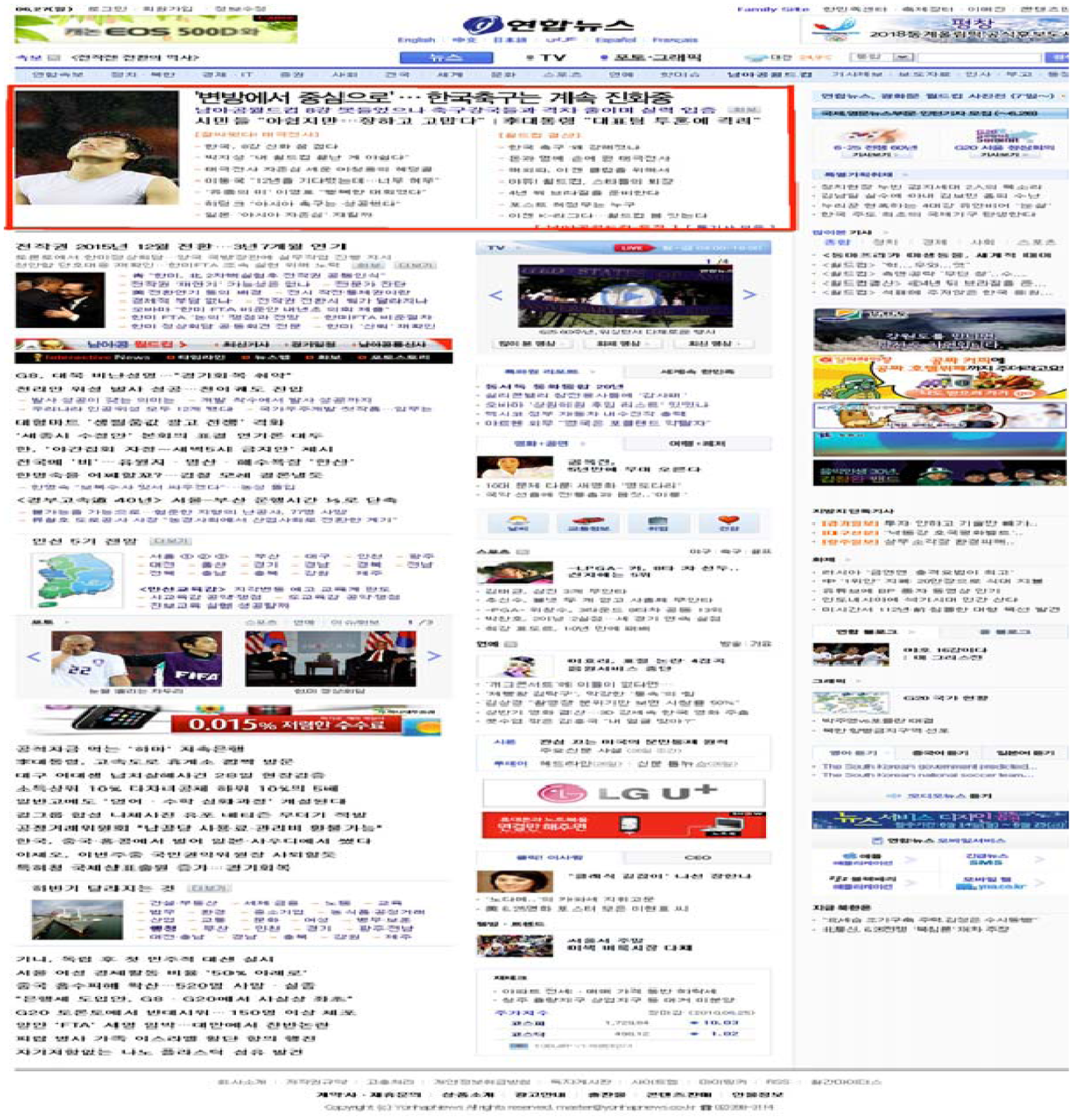
A sample screen of Yonhap News Agency (reprinted with permission).
Measures
The variable of interest was the posting of similar headlines in the most salient space by popular news websites. This study assessed the degree of similarity between headlines of those top online stories by comparing the headlines at each point in time. For instance, this study compared the headline on Chosun.com at 4 p.m. on 13 July 2010, with the headlines appearing on the remaining 12 news websites at that exact point in time. Headline keywords were examined. Joinsmsn.com posted the headline ‘Seongnam “Palace” City Hall Declares “We Cannot Pay $500 Billion Debt”’ at 4 p.m. on 12 July 2010, and Donga.com followed with the headline ‘Luxurious City Hall, Seongnam City, Cannot Repay $500 Billion Debt’ at 11 p.m. on the same day. The keywords were ‘Seongnam City Cannot Pay Debt’.
This study tested the reliability of the measure of the degree of similarity through Scott’s Pi. Approximately 10% (150) of top online stories were selected by employing SPSS, which used a random-number generator. This procedure included ‘RV Uniform (1, 1456)’ in the function of ‘Random Numbers’ of the option of ‘Compute Variable’ in SPSS. Scott’s Pi was 0.93 for the intercoder reliability of similarity between headlines.
Results
For one period of seven consecutive days, this study collected the screenshots of headlines of top online stories from 13 popular news websites at one-hour intervals from 8 a.m. to 11 p.m. each day. This study collected a total of 112 screenshots (seven days multiplied by 16 collection points from 8 a.m. to 11 p.m.). The total number of headlines of top online stories from the 13 news websites was 1456 (13 websites multiplied by 112 screenshots), and 510 (35%) were similar, implying that 65% were unique. These similar headlines were grouped into 30 topics. Noteworthy is that the news websites did not change the headlines over time.
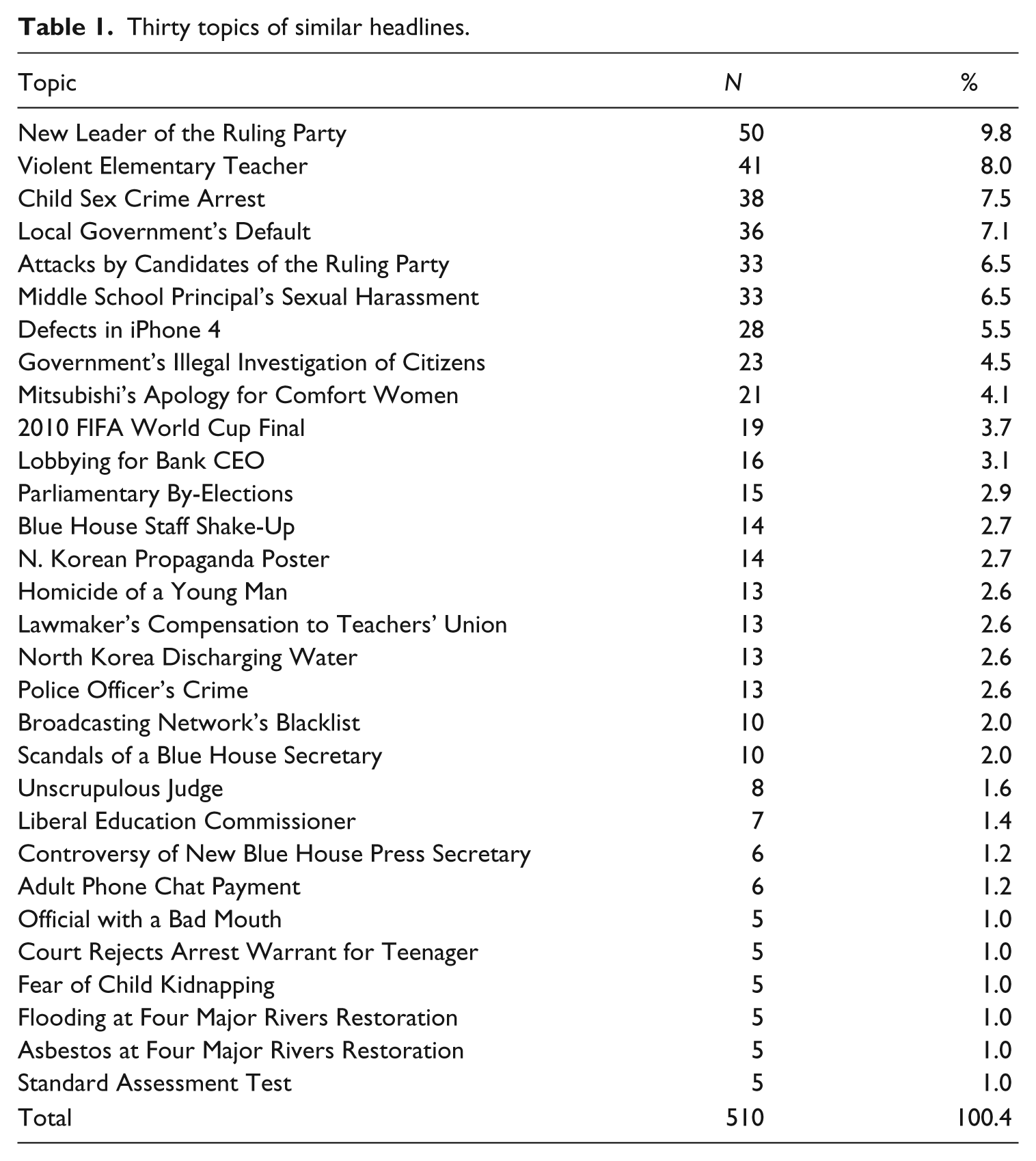
Table 1 presents the 30 topics for similar headlines. The total percentages (100.4%) reflected a rounding error. The most frequent topic was ‘New Leader of the Ruling Party’, which accounted for 9.8% (50) of 510 similar headlines.
Thirty topics of similar headlines.
In Tables 2 to 4, the first column provides the identification number, and the second column indicates the posting date and the specific time with the time point in parentheses. Time points ‘1’ and ‘2’ indicate that the headline at ‘1’ was posted before the headline at ‘2’, that is, the larger the number, the later the posting of the headline. The results clearly indicate which news websites initiated the posting of headlines. The three tables include 78 similar headlines posted sequentially by the 13 news websites over time. The results indicate a consistent pattern: one news website posted a headline before other news websites. In particular, the second column of each table clearly shows this pattern, which was used to test the two hypotheses. The first hypothesis predicted that news websites posted headlines similar to those posted earlier by other news websites, and the second hypothesis predicted that this pattern was consistent over time.
Posting pattern of similar headlines over time (ID 1–10).

Posting pattern of similar headlines over time (ID 11–19).

Posting patterns of similar headlines over time (ID 20–29).

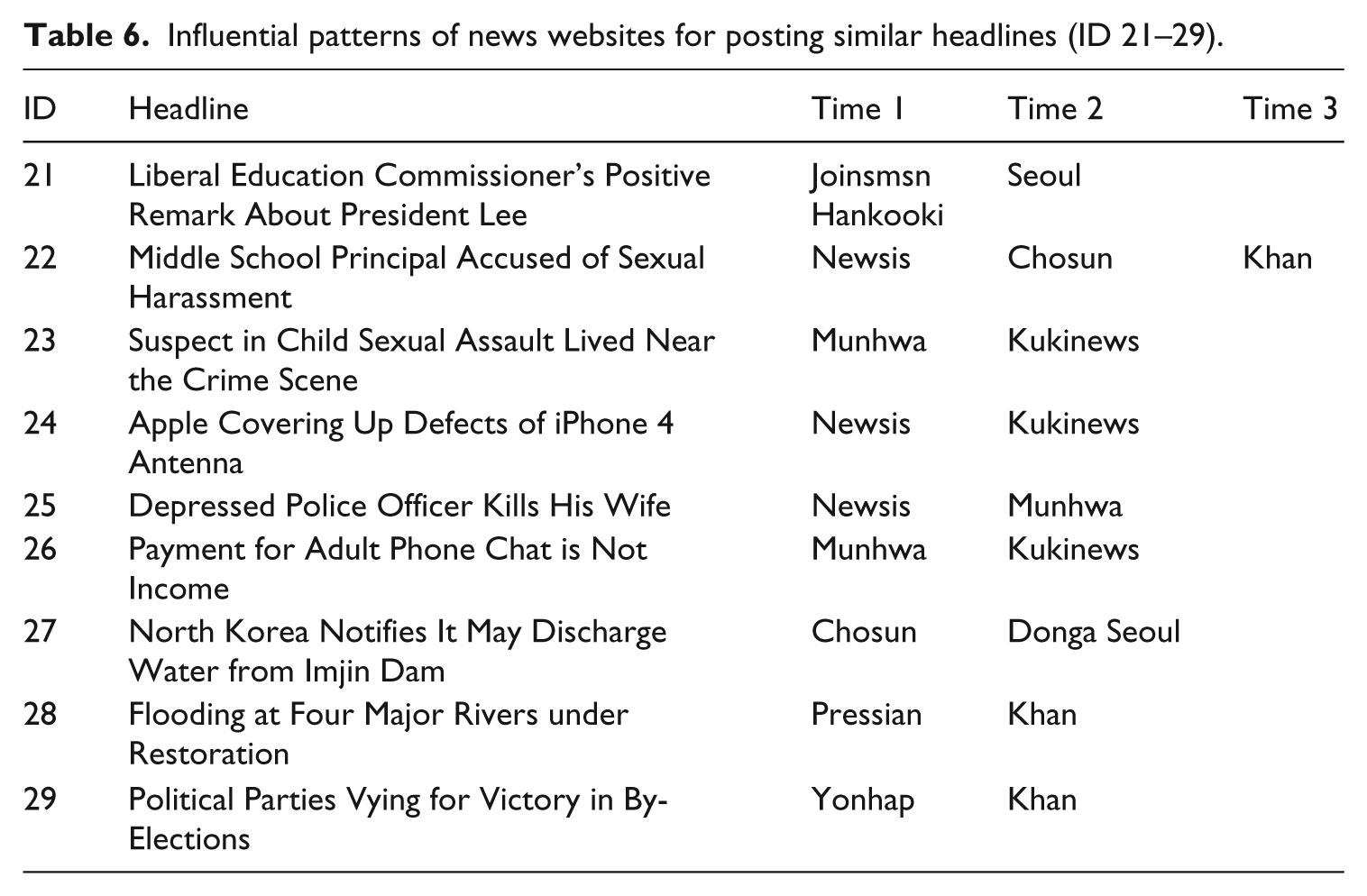
Tables 5 and 6 present a clearer picture than the previous tables. The figures for time 1, time 2, time 3, time 4, and time 5 in Table 5 corresponded to those in Tables 2 to 4, and the figures for time 1, time 2, and time 3 in Table 6 corresponded to those in Table 4. As shown in Tables 5 and 6, intermedia influence among the news websites for posting headlines was complex. This indicates that not every news website led other news websites to post similar headlines. In other cases, a news website posting a headline followed the posting of headlines by other news websites. Nonetheless, these results provide support for the first hypothesis and the second hypothesis.
Influential patterns of news websites for posting similar headlines (ID 1–20).
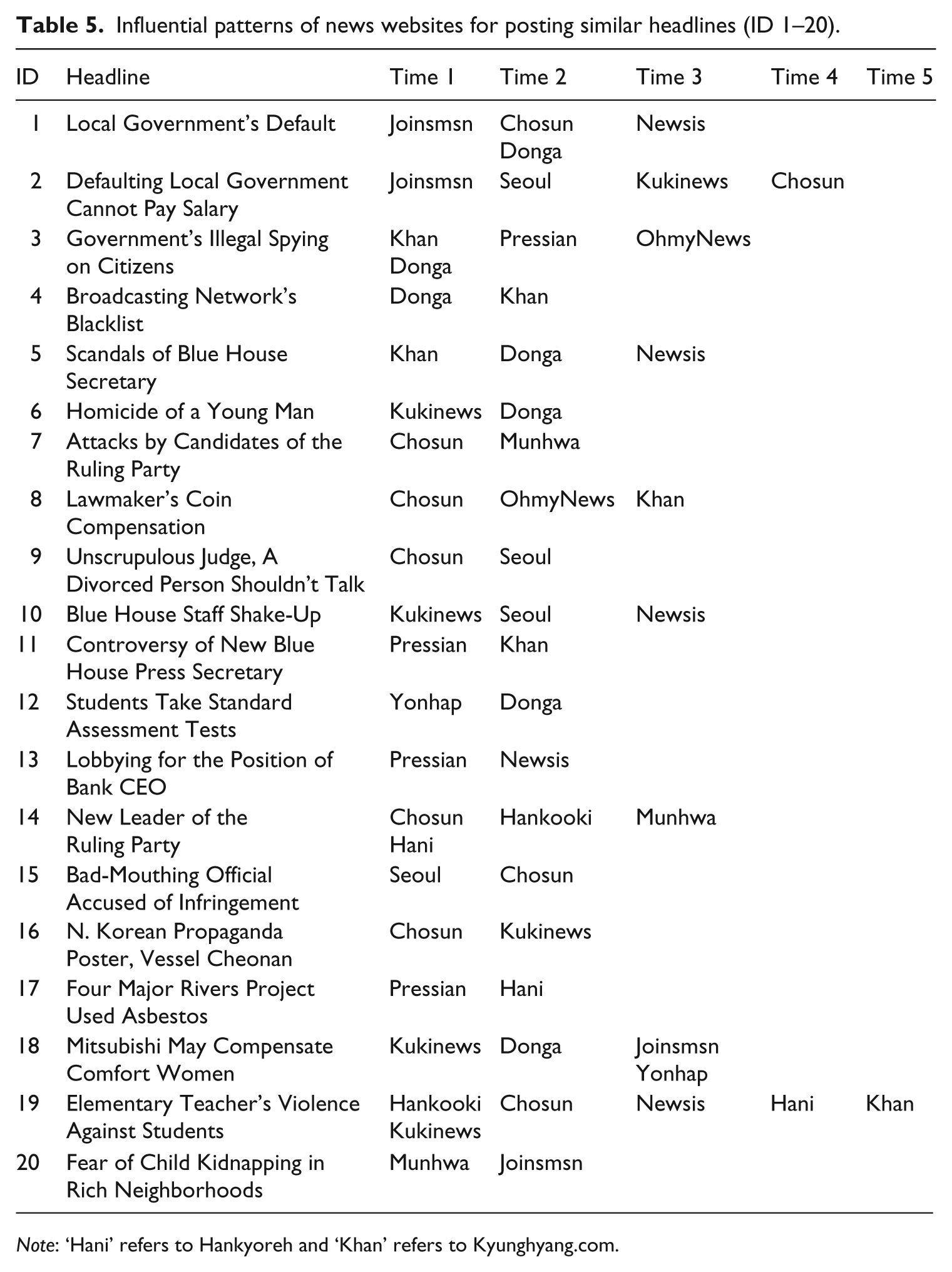
Note: ‘Hani’ refers to Hankyoreh and ‘Khan’ refers to Kyunghyang.com.
Influential patterns of news websites for posting similar headlines (ID 21–29).
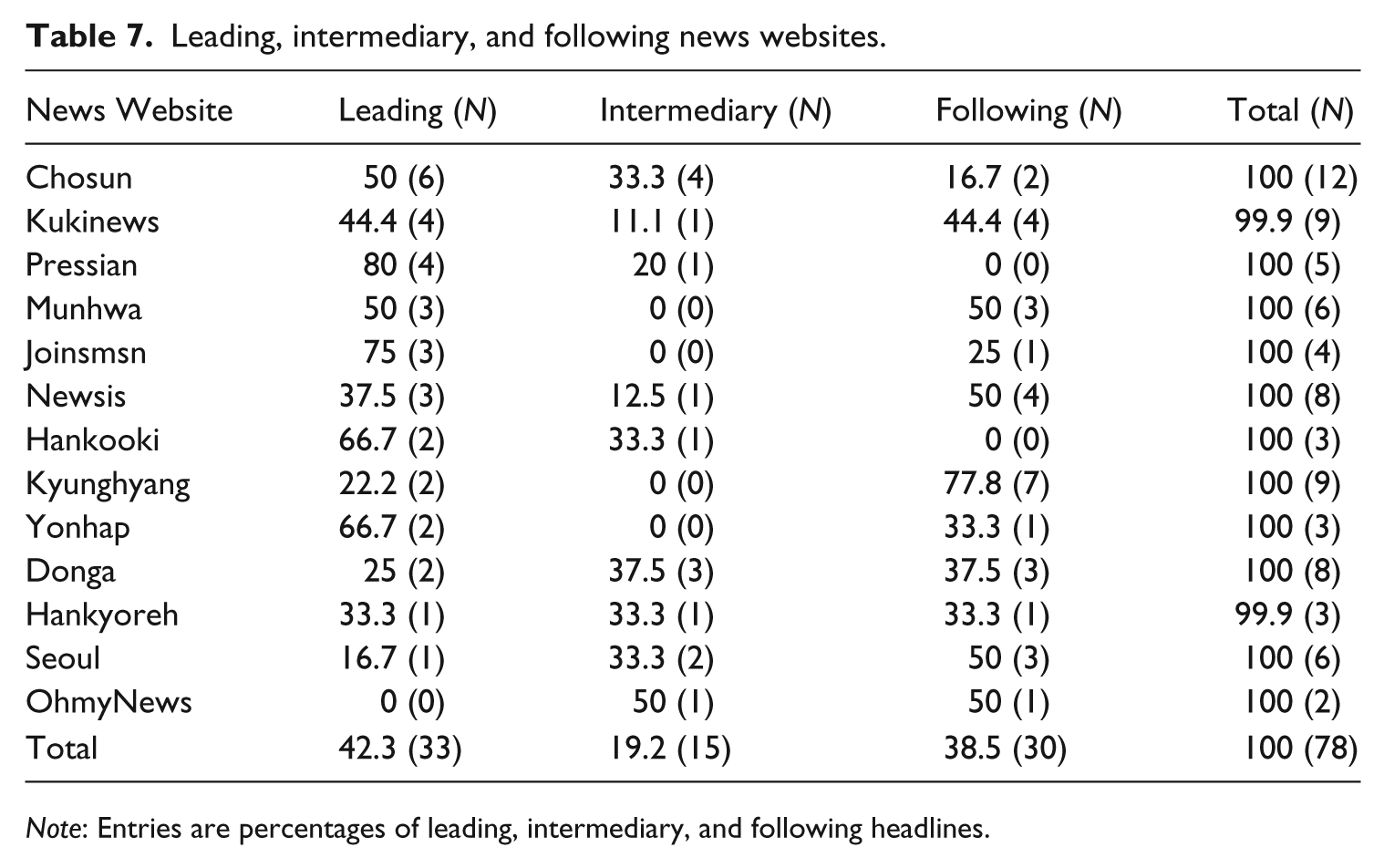
This study also analyzed the relationships indicated in Tables 5 and 6 and obtained interesting results (Table 7).
Leading, intermediary, and following news websites.
Note: Entries are percentages of leading, intermediary, and following headlines.
As shown in Table 7, three types of news websites emerged: leading news websites, intermediary news websites, and following news websites. Leading news websites initiated the posting of headlines of top online stories, and intermediary news websites contributed to the diffusion of the headlines to other news websites by posting similar headlines. Following news websites posted similar headlines after intermediary news websites. Table 7 shows that Chosun.com, Pressian, and Joinsmsn.com were leading news websites because they initiated headlines frequently. Donga.com was an intermediary news website because it frequently followed the posting of headlines by leading news websites. Chosun.com also played an intermediary role. Kyunghyang.com and Newsis followed the posting of headlines by intermediary news websites. Kukinews initiated headlines at four time points but also followed the posting by other news websites at four time points.
Discussion
The results indicate that the 13 popular news websites deliver similar headlines. This pattern, which is observed at various points in time, indicates meaningful economic and symbolic power relations that can influence the choice of headlines for the most salient space in response to competitors’ headlines.
While posting similar headlines, popular news websites face a highly competitive online news environment. This environment constitutes the field of inequality where powerful news media and less powerful news media coexist, and their relationships are developed into a set of economic and symbolic power relations (Bourdieu, 1996). This study advances this understanding by identifying how the economic and symbolic power relations occur among popular news websites in South Korea. The power relations deserve due scholarly attention. The economic power relations are exemplified as the rankings of news websites determined by their popularity among users. In terms of the 100 most visited websites in Korea (Google, 2010), Chosun.com ranked eighth, which was the highest position among news websites, followed by Donga.com (16th), Hankooki.com (17th) and Kyunghyang.com (18th). In this sense, Chosun.com is the leading news website that induces other news websites to monitor its news production. Highly popular news websites attract regular attention from other news websites because the latter need to update their content. The more popular a news website becomes, the more frequently other news websites check and monitor it. This process is an interesting indicator of economic power relations established among popular news websites.
Symbolic power relations are measured as the degree to which a news website initiates the posting of headlines of top online stories. The more frequently a news website triggers the posting of headlines that other news websites follow, the more consistently the news website exerts symbolic influence on the news production of the other news websites. The results of this study clearly indicate these symbolic power relations by revealing which news websites initiate headlines and which news websites follow them. Leading news websites play a dominant role in these power relations because all other news websites follow by posting similar headlines. Intermediary news websites respond to the posting of headlines by leading news websites, thus inducing other websites to produce similar headlines. Following news websites occupy the lowest level in these power relations because they follow the posting of headlines by intermediary news websites.
More importantly, symbolic power relations are a complex process. The leading news websites do not have consistent symbolic influence on what headlines intermediary and following news websites post. The leading news websites often imitate the headlines of top online stories initiated by the other news websites. One possible reason is that the 13 news websites are popular websites among news users. Accordingly, these news websites have the potential to initiate the posting of significant headlines. This study suggests that the symbolic influence of popular news websites depends in part on the speed of posting a significant headline, regardless of their relative economic positions in the field of online news. If a news website is able to post its newsworthy headline faster than its competitors, the website is likely to lead the other news websites to follow the posting.
That is why many news websites try to break a story first and revise it later (Stein, 2008). Being first often leads to a scoop. This nature of symbolic power relations reflects the competitive nature of online news production. News websites are positioned within the competitive ethos controlling their news production. Journalists working for news websites are under constant pressure to compete with their rivals (Boczkowski, 2009). They compete to publish the most important stories on the most salient location on the homepage. Future research should examine the degree of this competitive ethos by considering a diverse range of news websites.
Further, this study’s analytical approach is meaningful because it tracks changes in the headlines at one-hour intervals from 8 a.m. to 11 p.m. each day during a period of seven consecutive days. This micro-level analysis expands the previous intermedia agenda-setting research that has focused on changes in news content during a long time span. The analysis of hourly changes in headlines also captures the essence of online news, which is fast and immediate. The results indicate that immediacy influences online content production (i.e., the posting of headlines of top online stories). For instance, after Chosun.com posted the headline ‘Lawmaker Turns in a Piggy Bank for Compensation to Teachers’ Union’ at 3 p.m. on 13 July, OhmyNews replaced its headline with the similar headline ‘“Open This Piggy Bank” Lawmaker Carries a Package in Cloth for Compensation to Teachers’ Union’ an hour later at 4 p.m. At 8 p.m., Kyunghyang posted the similar headline ‘Coins Spread from a Piggy Bank, Lawmaker’s Awkward Move’. Chosun.com initiated the posting of the headline and OhmyNews and Kyunghyang followed the headline. These symbolic responses occurred over a span of one to five hours, demonstrating that symbolic power relations among the three news websites do occur. Symbolic influence is a fast phenomenon because popular news websites need to attract busy readers’ attention
Such symbolic responses suggest that news websites constantly monitor their competitors and that they are willing to imitate headlines. The results of this study suggest that similar headlines rarely circulate among news websites by chance. Online journalists working for news websites are likely to monitor other news websites, and this monitoring is institutionalized within their daily work to the extent that posting similar headlines is almost a natural response. Another aspect of monitoring and imitation includes the fact that competitors’ news websites can serve as strategic sources for evaluating whether a top story is meaningful and checking whether any story is missed. Indeed, online journalists accept their competitors’ websites as a reliable source of news gathering (O’Sullivan and Heinonen, 2008). One source frequently used by Korean news websites is news agencies such as Yonhap News Agency and Newsis. Stories and photos are typical items that Korean news websites use from these news agencies.
This study conducts the quantitative content analysis. Accordingly, this study is limited in that the content analysis cannot explain the relationships beyond the content (Riffe et al., 2005). Future research should conduct a qualitative analysis of the nature of online news production by considering field observation and in-depth interview methods. The results of this study can serve as baseline information for such analyses. In addition, this study considers news websites from only one country (Korea) and, thus, future research should consider news websites from a diverse range of countries.
In summary, popular news websites occupy their economic and symbolic positions in the field of online news. The top-ranked news websites often initiate headlines, and other news websites follow them. But symbolic power relations are not straightforward, because the leading news websites imitate the headlines posted by intermediary or following news websites. Power relations for the production of online news are a complex and fast phenomenon.
Footnotes
Funding
This work was funded by the Sogang University Research Grant of 2010 [grant number 201010004.01].