







Abstract
With the emergence of the blogosphere, women have gained a unique opportunity to share their experiences. This study explored the formation of self and the conceptualization of sports in the “Sports Blog” directory of BlogHer, a women’s blog network. A content analysis of 449 profiles in the directory revealed that women bloggers tend to use blogging to document personal experiences of participation in sports and to provide resources for others about physical activity, health, and fitness. Women’s active and participatory relationship with sports defies both stereotypical representations of women in mainstream sports media and hegemonic masculine discourses replicated in the blogosphere. We suggest that women who blog about sports challenge assumptions about sports consumption and engagement in sports. This study offers an alternative conceptualization of sports blogging as well as a broader understanding of the role of sports in women’s lives.
As blogging gains popularity, women’s ubiquity in the blogosphere increases. Women’s engagement is significant for feminist scholars, as women often use the blogosphere as a tool for organizing and community building. Somolu (2007: 484) suggested that when women blog, “irrespective of the topic – they are sharing their life experiences and perspectives, documenting and passing on knowledge, reaching out to other women (and men), and giving women a voice.” Thus, the blogosphere can assist women’s efforts toward social change and provide visibility to their endeavors.
While scholarship on blogging reveals that women engage online around a variety of issues and topics, little work has been done to document women’s ‘voices’ in relation to sports. Yet these voices are important to better understand women’s participation in the blogosphere and the ways in which they relate to sports. Even with increased opportunities for women in the United States, men’s sports occupy the “center” of the American sports culture, which leaves women’s sports and women athletes marginalized (Messner, 2002). Also, coverage of women’s sports in the media is slim, and sports are often evaluated according to standards such as force, aggression, violence, and “straight maleness” (Miller, 2001: 48). When women participate in the blogosphere, particularly in the context of sports, their voices remain segregated and peripheral.
The blogosphere is not an inherently feminist space. However, it allows women to share their experiences without gatekeepers to frame their accounts. Research on the blogosphere thus offers a perspective on the way women relate to sports and what they consider to be a “sport.” Here, we strive to understand how bloggers frame their identities and how they frame, or conceptualize, sports. Furthermore, we examine whether there is a difference in conceptualization of sports depending on the blogger’s writing style and intent to connect to others online. This research attempts to expand our understanding of the role that sports play in the everyday realities of women who blog.
The character of blogs
Blogs are web pages on which content appears in reverse chronological order; the most updated content, then, is at the top of the page (Blood, 2000; Dart, 2009; Herring et al., 2004). According to the Nielsen/McKinsey company, the number of blogs reached over 181 million worldwide in 2011 (Nielsen Wire, 2012). Blogs do not require sophisticated technical knowledge to access or create (Blood, 2000). Blogs “challenge once-sacred distinctions between interpersonal, group, and mass communication” because they can serve as journal or diary-type outlets and be shared with a large community of web users (Sundar, 2008: 58).
Blogs allow users to explore the “self” in a social sphere in a way that is not permitted by face-to-face interaction (Lievrouw et al., 2001). Since user-generated content is widely accessible, the blogosphere may be seen as a democratizing force (Blood, 2000; Dart, 2009). Although it is important to acknowledge that Internet access is not universal, and the Internet community often replicates existing social power relations (Youngs, 2007), blogs do offer a public outlet for perspectives historically ignored by mainstream media (Mitra, 2001; Nardi et al., 2004; Somolu, 2007).
A great deal of research about why people blog has emerged in the past decade. Based on these findings, reasons for blogging can be grouped into two categories: Intrinsic and extrinsic. Intrinsic motivations include the desire to express one’s feelings and writing to cope with problems (Liu et al., 2007; Nardi et al., 2004; Stavrositu and Sundar, 2008). Other motivations include the desire to document one’s life and construct a self-identity (McCullagh, 2008; Nardi et al., 2004). In a study of political bloggers, Ekdale et al. (2010: 224) found that the three most common reasons why bloggers started a blog were “to let off steam,” to “keep track of [their] thoughts,” and “to formulate new ideas.” Blogs, therefore, may function as a sort of “directory” of thoughts, where bloggers document their emotions through writing.
While the online diary form tends to be the most common type of blog, it is certainly not the only one. Bloggers are often driven to produce content with meaningful implications for readers. They intend to connect to others with similar interests and build a virtual community (Liu et al., 2007; Newbury, 2008). These are most commonly fan communities about television shows or movies, but sports blogs also tend to belong to this category (Royal, 2008).
The blogosphere as a space for women
Community building has been of particular significance to marginalized groups, including women (Somolu, 2007). Mitra (2001: 31) pointed out that “on the Internet, the marginalized can call out the dominant and put the dominant in the difficult position of either having to acknowledge the marginalized, or further distance the disposed by ignoring the call.” Even so, women’s voices often remain isolated (Rainie, 2005). One reason for this may be the gender divide in regard to blog subjects. Women are more likely to talk about their personal experiences, while men take on political issues. The topics women address are culturally undervalued; thus, women struggle to gain credibility (Herring et al., 2004; McCullagh, 2008; Royal, 2008). Women also use a more “personal style of writing”: the first-person, narrative form (Lopez, 2009: 731). For instance, Harp and Tremayne (2006) analyzed 30 political blogs and found that only three were written by women; none were among the site’s 10 most linked blogs. Women were less likely to express political opinions and conversed in a less authoritative manner than men (Harp and Tremayne, 2006). When women expressed their views, they were criticized and harassed more often than male bloggers (Johnston et al., 2011).
Still, women use blogs to challenge gender stereotypes (Herring et al., 2004). One such instance is the emergence of “Mommy” blogs, where women claim the agency of their parenting experiences. “Mommy blogging” first appeared on BlogHer, a network of women bloggers, and gained attention when BlogHer organized a conference that approached ‘mommy blogging’ as a “radical act” (Lopez, 2009: 730). “Mommy blogging” is an example of how social constructions become re-constructed in the blogosphere (Lopez, 2009: 741). Although these communities generally remain segregated, they allow individuals with mutual concerns to build alliances. Furthermore, blog networks showcase how women communicate their experiences online.
Although research suggests that there are gender differences in writing style, Herring and Paolillo (2006) found no significant gender effect. Because men tend to write about politics and sports and women about their parenting experiences, the language difference might be attributed to the gendered distribution of blog topics. As Herring and Paolillo (2006: 456) suggested, “genres are socially constructed, in part through association with the gender of their producers.”
Sports, blogging, and the dominant discourse
The power dynamics in sports, which have historically subjugated women, have long been a concern for scholars. Burstyn (1999: 4) argued that sport as an institution idealizes the violent, anti-collaborative, anti-societal values of hypermasculine behavior. Likewise, Messner (2002) pointed out that misogyny, homophobia, and sexism are at the center of institutionalized sports. Masculinity is normalized and positioned as superior while other gender performances are considered deviant. Pat Griffin (1998: 100) used the term “glass closet” to suggest that lesbians in sport keep their identities secret, because of the pressure on women in sport to perform traditional feminine roles in order to offset the social stigma and deviance attached to (all) women in sport. Scholars who examine the intertwined relationship of media and sport have documented the ways in which sexism and hegemonic masculinity are embedded in mainstream depictions of sport (Duncan, 2006; Messner, 2002).
Media scholars have been attentive to how new media could change media depictions of sport. By “new media,” we refer to the technologies that allow creation, digitalization, and distribution of content and connectivity through networks among people who might otherwise be distant (Rice, 1999). While journalists use the blogosphere, they still tend to cover sport in traditional ways and link to mainstream media sites. Singer (2005: 193) wrote that “the blog is being normalized as a component and, in some ways, an enhancement of traditional journalistic norms and practices.” This seems also to be true for blogs written by sports journalists. Schultz and Sheffer (2007), who asked sports journalists about their blogging, suggested that journalists used traditional norms of information gathering and presentation. While journalists are increasingly using new media outlets, they apparently do not take advantage of the connectivity and content diversity opportunities these technologies offer. Journalists are yet to recognize the potential to converse with other bloggers (Carlson, 2007; Lowrey and Anderson, 2005).
Scholars studying new media produced by individuals who are not professional journalists (fans, for instance) are concerned that these accounts do not challenge traditional ideologies, but merely reflect them. For instance, Kian et al. (2011) observed that hegemonic masculinity, in the form of homophobia and sexism, thrived on online message boards on a football site. Also, Hardin et al. (2012: 65), who surveyed sports bloggers about their attitudes and values, found that “young sports fans who blog are not more progressive on issues of gender, sexuality, and sport although they have grown up with Title IX and in a culture where gay-marriage rights are gaining more acceptance.”
Although the blogosphere is “open” to all, sports bloggers based in the US tend to be male and to cover men’s sports (Hardin et al., 2012). According to a Sport Business Journal survey, Deadspin and the Bleacher Report were among the respondents’ top three favorite independent sports websites (Sport Business Journal, 2011). While Deadspin and the Bleacher Report may be seen as “non-mainstream sites” (Kian and Shaw, 2011: para. 5), they are hardly more progressive than “mainstream” media, as they heavily report men’s sports and exclude women’s sports.
That said, new media has been used for resistance. Female athletes use social media such as Facebook and Twitter to connect with their followers, and many have blogs (Pegoraro, 2010). Fans can also be “strikingly active” in creating content (Real, 2006: 178). Scholars have observed that “new technologies have broadened the sports experience and are often used in more complex and layered ways by sports fans and the more casual sporting viewer” (Boyle and Whannel, 2010: 260).
Sports-related networks for/about women are rare, but two collectives, Women Talk Sports and BlogHer, provide a starting point. While these blogs are sports-related, they are not always written by fans. Rather, the women connected to these networks may be journalists, scholars, athletes, and more generally participants in sports (Hardin, 2011; Maxwell, 2009). In our previous work, we have considered the potential of Women Talk Sports and suggested that the network could provide a space for feminist activism (Antunovic and Hardin, 2012). Hardin (2011: 57) also found, after interviewing female sports bloggers connected to the network, that their blogs might work “in concert to destabilize – in tiny ways – dominant discourses” about sports.
Summary and research questions
Blogging invites community building around alternative discourse on cultural issues and serves as a form of self-expression and identity building. The professionally driven (journalistic) blogosphere, driven by consumption of images that reinforce sexism, has not yet seen alternatives to the presentation of sport as a masculine domain. Independent female bloggers, however, have an opportunity to identify with sports in personal ways and build new communities around sport. Or do they?
We approached this question by considering the “frames” which bloggers might use to convey the way they relate to sport. Frames are cognitive schemas that enable individuals to identify, classify, and interpret new information (Scheufele and Tewksbury, 2007). Even though the process of framing might not be intentional, bloggers use the frames most salient to their identities to relate to their online communities. Thus, the analysis of frames can help us understand how bloggers relate to themselves, others, and the focus of their blogs (that is, sports).
Based on our literature review, we propose the following research questions:
RQ 1: How do women who blog about sport frame their identities?
RQ 2: How do women who blog frame sports?
RQ 3: Is there a relationship between writing style (journal or “diary-type,” for instance) and the conceptualization of sports?
RQ 4: What is the relationship between external motives (or the intent to connect to audiences), as reflected in the blog profile, and the conceptualization of sports?
Method
Our goal was to examine a space where women converse about sports. BlogHer is a popular blog collective established in 2005 and includes sports-related content. The network’s content is featured on NBC U’s iVillage, Oxygen.com, and Bravo TV (Learnmonth, 2008). The network aggregates more than 3000 bloggers and claims to be one of the top online women’s networks (Stone, 2009). To join the network, a contributor has to update her blog weekly and welcome comments; the blog must also be “written by women, or with a demonstrated female audience” (Stone, 2009). There is no registration fee. We refrained from registering with the site in order to prevent potential violation of the bloggers’ privacy in the case that some content was limited only to users; thus, the information we used is available to the public.
Users have the option to classify their blogs under 16 categories, which include career, entertainment, food, love and sex, news and politics, and sports. In December 2011, when the data was collected, the category with the largest number of participants was life blogs (N=9280). The next most popular were family blogs (N=8107), DIY (do it yourself) blogs (N=3722), and food blogs (N=3414). Sports was among the three least popular categories (N=449), along with tech (N=419) and money (N=148). The categories are not mutually exclusive, and bloggers can tag their blogs under multiple categories. It is noteworthy – but not surprising, given the cultural positioning of sport – that the number of blogs tagged under sports was low in comparison to other categories. The only two less popular categories (technology and money) have also historically been associated with the male gender role.
We considered blogs tagged under sports blogs (N=449). Rather than going to the blogs, we analyzed the BlogHer directory. Although blog texts will be useful for subsequent analyses, the constrained space of the introduction profiles prompts bloggers to more purposefully and intentionally articulate their identities – providing a useful space for analysis in light of our research questions.
We used content analysis – most commonly defined as an objective and systematic method for a quantitative analysis of manifest content – to address our questions (Holsti, 1969; Kian et al., 2011; Riffe et al., 1998). As opposed to qualitative textual analysis, which is subjective and interpretive, quantitative content analysis does not make any claims beyond what can be identified and counted in the text (Hardin et al., 2007; Kian et al., 2011; Riffe et al., 1998). As feminist scholars, however, we were cognizant that our social locations shaped our research (Hesse-Biber et al., 2004).
We developed the coding scheme to account for all information provided by the blogger. The tags were coded as categories; the title and the bio were considered the text. The text was coded for gendered language and references to sports. In order to capture sports broadly, we used a definition provided by the European Journal of Sports Science, where “sport” is defined as referring to “all forms of human movement that aim to maintain or improve physical and mental well-being, create or improve social relationships, or obtain results in competition at all levels” (European Journal of Sport Science, 2012: para. 2). We also worked off the assumption – bolstered by BlogHer’s description as “written by women” – that all bloggers were, in fact, women. For operational definitions, see Table 1.
Categorical variable definitions.
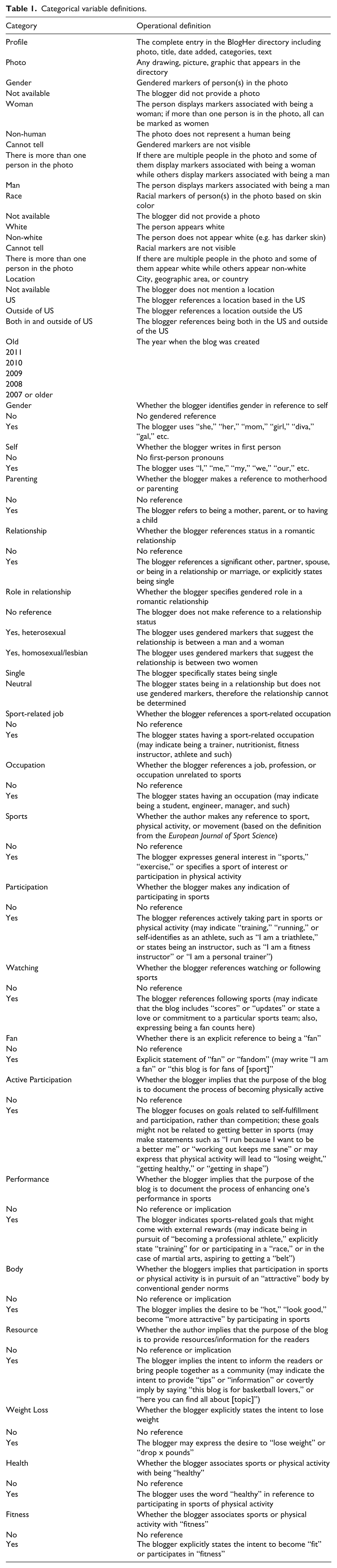
We completed two randomly assigned pretests and modified the codebook accordingly. While some variables required simple recognition of words, others required a more interpretive judgment. For example, we had to determine whether bloggers indicated participation in sports for the sake of self-fulfillment or for an external reward. After each pretest, we reviewed the codebook and confirmed our understanding of the concepts. To ensure the reliability of the measures, we calculated inter-coder reliability using stratified sampling (Riffe et al., 1998). We coded every fifth blog (19.82%, N=89) from the directory (sample) where the blogs appear in alphabetical order and calculated inter-coder reliability on 20% of the sample (N=89). Scores ranged from 76.05% for one category (active participation) – the only category with under 80% reliability – to 100%. Overall reliability across all categories was 96%. All data was nominal; frequencies were analyzed as well as cross-tabulations. Chi-square tests with a statistical significance of .05 or less are reported.
Findings and analysis
More than half of the profiles (59%; N=264) included a photo. The majority (83%; N=218) pictured a woman (those that were not of a woman were often of nature scenes), and in the majority of the photos the individuals were coded as white (78%; N=205). We also looked at the tags for the blogs, finding that 35% were tagged solely under sports. The most frequently tagged categories besides sports were health (45%; N=201), life (45%; N=201), and food (20%; N=91). The categories least frequently tagged were feminist (5%; N=23) and “blogging and social media” (5%; N=22). An increase in the number of blogs was apparent through the years since 2005, when the BlogHer network was established, with the most significant growth in the number of blogs occurring in 2009 (see Table 2). Less than 3% (N=12) of the bloggers indicated a non-US location, 18 (N=79) specified they were from the US, and the rest did not provide a location in the directory. Although we did not code for blogger location and most bloggers did not provide it, we surmised that most of them lived in the US.
RQ1: Framing of identities in profiles
Crosstabulation of year and self-reference.
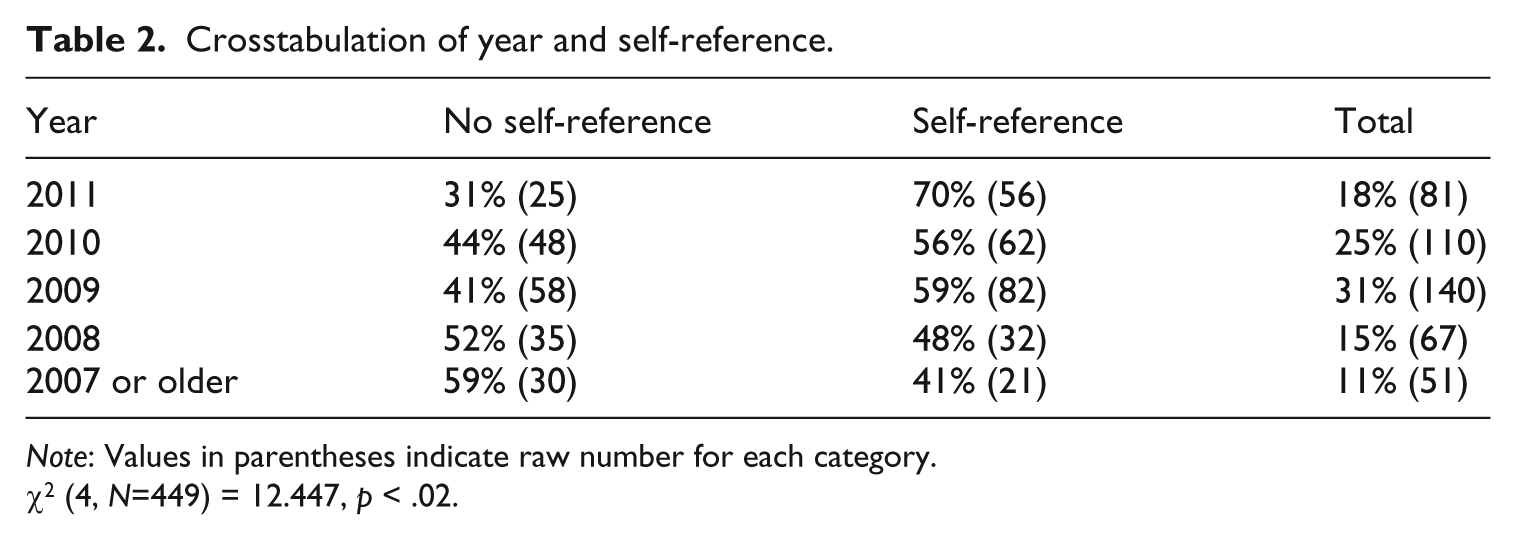
Note: Values in parentheses indicate raw number for each category.
χ2 (4, N=449) = 12.447, p < .02.
More than half of the bloggers used first-person pronouns in their profiles (56%; N=253). There was a significant positive relationship, χ2 (4, N=449) = 12.447, p < .05, between the age of the blog and whether the blogger wrote in first person (see Table 2). The bloggers who wrote in first person generally provided more information about their lives and were more likely to tag their blogs under “Life Blogs,” χ2 (1, N=449) = 4.225, p < .05.
Most of the bloggers did not make any gendered references (62%; N=277). However, it was still useful to consider the relationship between gendered language and other variables. Bloggers who used gendered language referred to themselves in third person by using “she,” or identified their roles as “mom” or “wife.” The bloggers who indicated having children or being a parent were less likely to use a gender-neutral term, such as ‘parent’ (18%; N=16), than they were to use gendered language (82%; N=71) such as “mom” or feminine pronouns, χ2 (1, N=449) = 85.616, p < 0.005. Overall, 20% of the bloggers referenced parenthood.
References to parenting were related to sports-related variables. For instance, 17.5% (N= 70) of those who did not reference having a sports-related job mentioned being parents, compared to 35.4% (N=17) who claimed a sports-related job, χ2 (1, N=449) = 8.85, p < .005. Those who indicated having children also more often referred to participation in sports or physical activity, χ2 (1, N=449) = 7.35, p < .01, but there was no statistical significance between parenting and becoming physically active or having sports-related goals.
Predictably, bloggers who identified as parents (64%; N=56) were also more likely to tag “Family Blogs” than those who did not identify as parents (14%; N=51); furthermore, when “Family Blogs” were not tagged, only 9% (N=31) referenced parenting, as opposed to 52% (N=56) of those who used this tag, χ2 (1, N=449) = 97.69, p < .005.
Only 12.7% (N=57) reported their relationship status. A quarter indicated being a “wife” or “girlfriend” but did not make any gendered references to a partner or spouse (25%; N=14); others explicitly stated being single (18%; N=10). None stated being in a gay/lesbian relationship.
RQ2: Conceptualization of sports
More than a quarter made no reference to sports, physical activity, or movement (27%; N=121). When the profile was tagged only under “Sports,” bloggers were more likely to reference sports, χ2 (1, N=449) = 51.22, p < .005. Nearly half indicated participation in sports (48%; N=215) but only about 10% suggested they watched sports (10%; N=44), while less than 5% identified as “fans” (5%; N=21). In profiles tagged under sports only, bloggers were more likely to indicate participation, watching sports, and being fans. Participation was also correlated with the blog’s age, χ2 (4, N=449) = 18.95, p < .005. The newer the blog, the more likely it was to include references to participation, which increased every year from 36% (N=18) in 2007 to 64% (N=52) in 2011.
Bloggers who indicated sports participation were more likely to state that the purpose of the blog was to document becoming physically active, χ2 (1, N=449) = 97.58, p < .005, and to document training for a race or achieving a sports-related goal, χ2 (1, N=449) = 84.21, p < .005. Participation was related to explicit references to fitness, χ2 (1, N=449) = 9.67, p < .005. Bloggers who did not reference participation mentioned “fitness” (36.6%; N=30) less often than bloggers who referenced participation (63.4%; N=52). Those who participated also expressed an interest in following sports less often, χ2 (1, N=449) = 29.41, p < .005, than those who did not.
RQ3: Self-references and sports
First-person references were correlated with references to sports (see Table 3). Bloggers who wrote in the first person (69%; N=148) more often implied sports participation than bloggers who did not use “we” or “I” (31%; N=67), χ2 (1, N=449) = 26.16, p < .005. Table 3 also shows that those who wrote in the first person more often associated sports with being “healthy” (69%; N= 58) than those who wrote in the third person (31%; N=26), χ2 (1, N=449) = 6.78, p < .01. The number of bloggers who associated sports with losing weight was relatively low (8%; N=37) but, similarly to the previous variable, those writing in the first person associated losing weight with participation (76%; N=28) more often than those who did not write in the first person (24%; N=225), χ2 (1, N=449) = 6.12, p < .02. First-person language and emphasis on participation indicate that for these bloggers, personal experiences of sports – as opposed to spectator experiences – are at the forefront.
RQ4: Connecting with other bloggers and sports
Crosstabulation of self-reference and participation, active participation, performance, health and weight loss.
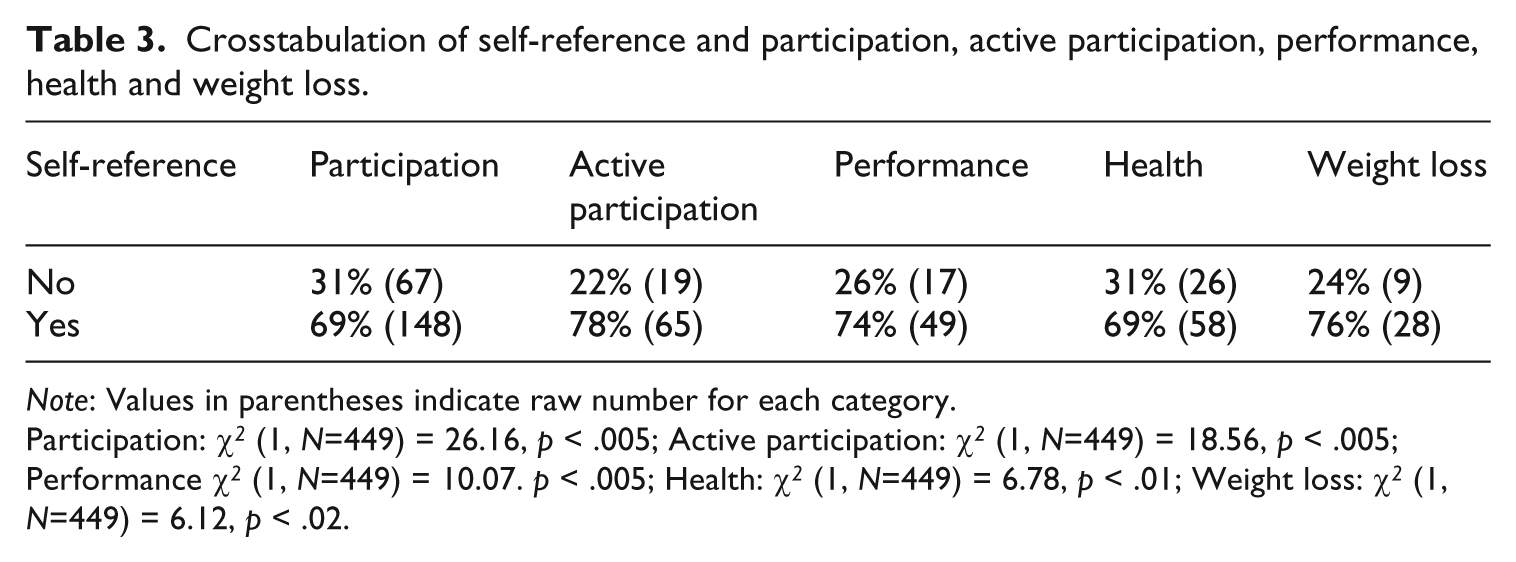
Note: Values in parentheses indicate raw number for each category.
Participation: χ2 (1, N=449) = 26.16, p < .005; Active participation: χ2 (1, N=449) = 18.56, p < .005; Performance χ2 (1, N=449) = 10.07. p < .005; Health: χ2 (1, N=449) = 6.78, p < .01; Weight loss: χ2 (1, N=449) = 6.12, p < .02.
More than one-third of the bloggers (37%; N=165) stated or implied that their blog’s purpose was to provide resources and information or to create a space for community. These profiles, what we call resource blogs, tagged the category of “Life Blogs” less often, χ2 (1, N=449) = 20.258, p < .005, than those that were not coded as resource blogs.
Table 4 shows that bloggers who framed their profiles as resource blogs were slightly less likely to associate sports with weight loss, χ2 (1, N=449) = 3.97, p < .05, but were more likely to imply that sports are associated with health, χ2 (1, N=449) = 4.17, p < .05, and fitness, χ2 (1, N=449) = 3.97, p < .05, than non-resource blogs. Overall, nearly half of the profiles that referenced health (46.4%; N=39) and, similarly, nearly half of the profiles that referenced fitness (46.3%; N=38) were coded as “resource blogs.” Bloggers who had sports-related jobs, such as personal trainer, nutritionist, or athlete, were more likely to indicate a desire to connect with others or to offer information, χ2 (1, N=449) = 8.79, p < .005, than those who did not imply having a sport-related job (see Table 4). Additionally, those who indicated participation less often were coded as having resource blogs, χ2 (1, N=449) = 6.45, p < .05, (see Table 4); less than one-third (31%; N=66) of the profiles were coded as indicating participation and as being a resource blog.
Crosstabulation of resource and weight loss, fitness, health, sport job, and participation.
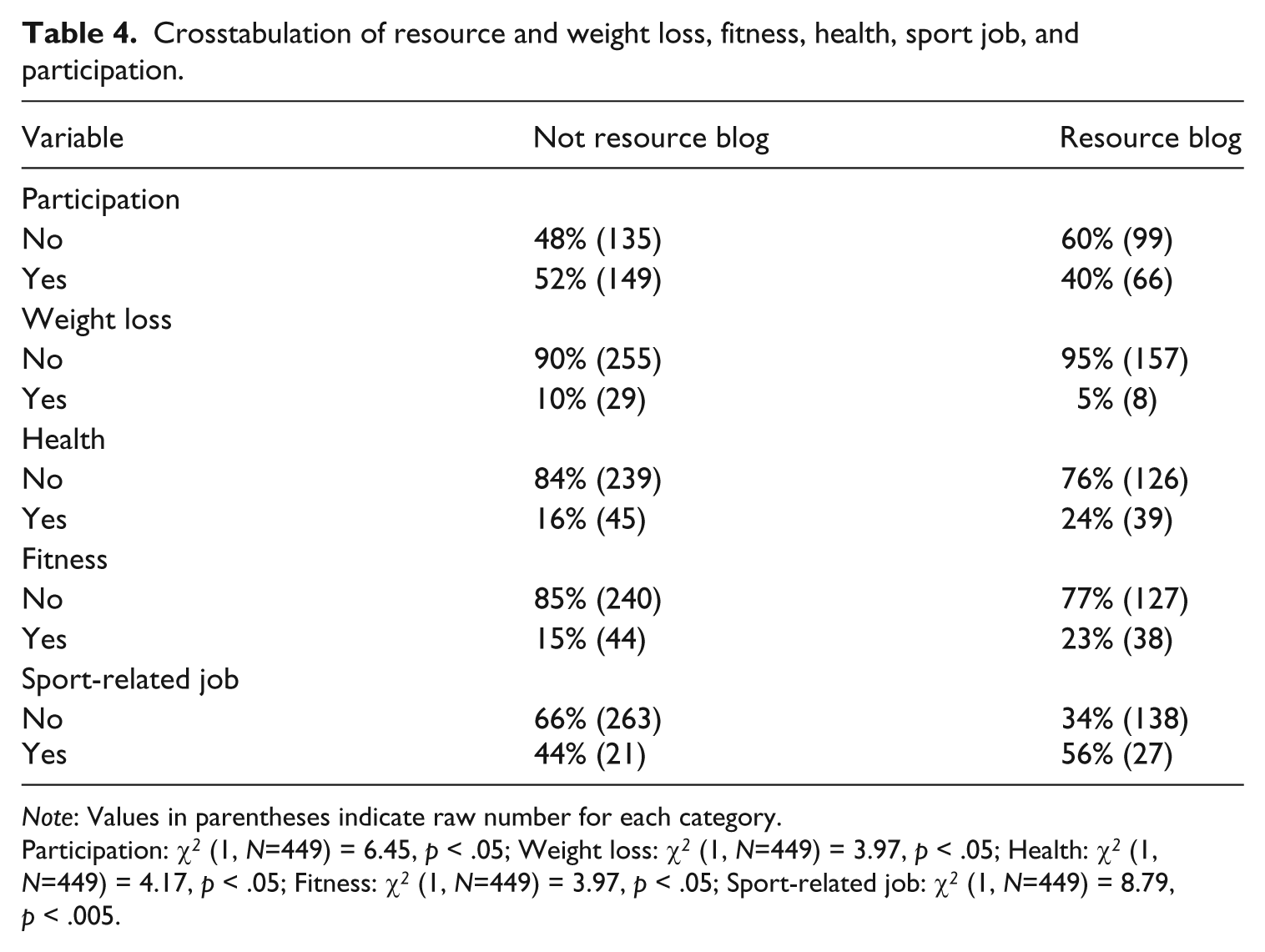
Note: Values in parentheses indicate raw number for each category.
Participation: χ2 (1, N=449) = 6.45, p < .05; Weight loss: χ2 (1, N=449) = 3.97, p < .05; Health: χ2 (1, N=449) = 4.17, p < .05; Fitness: χ2 (1, N=449) = 3.97, p < .05; Sport-related job: χ2 (1, N=449) = 8.79, p < .005.
Discussion
We sought to learn more about the ways in which women who profess an interest in sports represent themselves in BlogHer profiles. We also sought to explore how these bloggers conceptualize sports, and subsequently how they relate to sports.
Although literature points to the feminist potential of the blogosphere, very few bloggers tagged their blogs as such. This might suggest that these bloggers do not consider their writing as a feminist act, though we would argue that women’s participation in the public space – especially around sports – could be a form of feminist activism. In the dominant sports structure, women occupy a marginal status (Messner, 2002). But in these blogs, women take the initiative to create their own outlet and speak about experiences that might otherwise not have been heard about.
Bloggers were divided in the way they situated themselves. The increase in first-person pronouns over time might be explained by the realization that blogs carry an interactive and personalized potential. Perhaps users have become more comfortable with the platform and, therefore, are moving away from replicating journalistic structures to instead be more innovative.
Women whose profiles we analyzed sometimes framed sport within the wider context of their lives. Personal references, such as to children and romantic partners, were not uncommon; however, based on accounts of BlogHer’s engagement with “mommy bloggers,” we found fewer than expected. Our study found that only one-fifth made references to parenthood and fewer referenced relationship status. Many participated in some kind of sport or physical activity. Bloggers rarely referenced their relationship status; when they did, most of them suggested they were in heterosexual relationships. While some bloggers did not use gendered language for their spouse/partner, overt references to gay/lesbian relationships were absent. This might be reflexive of the “glass closet” Griffin (1998) described, which – even though it involves an assumption of lesbian sports participation – essentially encourages lesbians’ silence for fear of being (further) labeled as deviant. Perhaps some of these women bloggers were in a relationship with a woman, but opted to remain private about it due to societal pressures (i.e. the “glass closet”). Another explanation would be that lesbian women do not go to this blog network to blog about their sporting experiences.
In our attempt to be inclusive, we defined sports broadly. Even so, some bloggers made no reference to sports. The blogs that did, however, offered an interesting insight. The prevalence of sports participation is an important finding considering that the most popular sports blogs predominantly revolve around coverage of professional sports, rather than the bloggers’ active experience in sports. Typically, bloggers who participated in sports were less likely to report watching or following sports. This raises the question of whether participation in sports, for women, is inherently linked to consumption of sports, and vice versa. The answer to this question has implications for our understanding and expectations of women who see themselves as interested in sports. They may not, for instance, see that interest as translating to sports spectatorship. If they do not, marketers and women’s sports advocates should be careful about making assumptions about the potential fan base for a women’s sports league or professional female athletes – and about how to appeal to a potential fan base.
Newer blogs were more likely to reference participation, which could be explained by the simultaneous increase in first-person writing, a format that allows for the disclosure of more information about one’s life. Bloggers who wrote in the first person more often associated participation in sports with becoming healthier than those who wrote in the third person. Often, these profiles were framed as documenting the blogger’s process of becoming healthy through participation in sports. Perhaps these bloggers would fall under the category of those with intrinsic motivations who write in order to preserve their thoughts (Ekdale et al., 2010). These profiles took a narrative form and were also tagged under “Life Blogs.” We found that bloggers who expressed an interest in connecting to readers or providing resources did not typically consider their blogs as fitting into the “Life” category. Rather, these resource blogs reflect factors associated with extrinsic motivation, such as a desire to build a community or give advice to others (Liu et al., 2007; Newbury, 2008). Bloggers who had sports-related jobs fell into this category as they sought to share their experiences from the industry on fitness and health. Overall, women often shared their sporting experiences in a narrative form. More than one-third of the profiles in our sample served as resource blogs.
Conclusion, limitations and future research
Our research raises further questions regarding the conceptualization of sports by women who blog about them and women’s experiences with sports. First, the most popular sports blogs, such as Deadspin or Bleacher Report, tend to follow journalistic norms, formats and standards and serve the purpose of providing fans with information about games, athletes, and so forth. This type of sports blog was scarce in our sample, and “fan” blogs (where a team or athlete was the topic) were even scarcer. The bloggers in this study were not as concerned with reporting about professional athletics. Rather, they appeared to have two distinct purposes. One was to document their own process of becoming physically active and going through a training routine or a workout, and the other was to provide information about sports that would contribute to the well-being of the reader. These two agendas were not always mutually exclusive.
Based on these findings, we would suggest that the BlogHer profiles offer a view of sports that might differ from that typically associated with sports blogs. The most widely read sports blogs, such as Deadspin and the Bleacher Report, tend to reinforce hegemonic masculinity and sexism (Hardin, 2011). They are also generally written from a spectator’s point of view. The BlogHer profiles suggest a view of sports that rejects an understanding of sports as a male domain and considers it solely in terms of spectatorship. Rather, they reflect women’s active and participatory relationship with sports. We suggest that our study reveals a new dimension of sports blogs: One that has apparently been marginalized in the online discourse. Because women’s discussions of sports may be different from those of men, we recommend that scholars be attentive to these discourses, which bring visibility to women’s experiences.
There are a number of limitations in this study. One is a limitation of virtually any online discourse study, which is that knowing who is actually behind these blogs is impossible. Unlike many other online communities, BlogHer is a network that makes continuous effort to bring the community together in person. For instance, the network holds conferences multiple times per year. That said, however, we cannot be sure if the information provided by bloggers reflects reality or if the photos they uploaded were of the actual writers – even though the description in the profile often seemed to reflect the person in the photo.
Although the network is prominent for women, it might not necessarily be prominent in the realm of sports discourse. This factor is a limitation in terms of the influence these bloggers actually hold in the larger conversations about sports, but it is beyond the scope of this article to make claims in that regard. Considering that these bloggers are – similar to other sports bloggers – independent and often unpaid, we would suggest that the findings of this study regarding women’s writing about sports are that much more important.
Another limitation of the sample is that we only analyzed profiles in the network directory, as opposed to the full blogs. It is possible that the actual blogs reflect a different tone and style of writing and a different approach to sports, though we find the latter unlikely. Because we did not go to the blogs, it is unclear how active these bloggers are in terms of the frequency of their postings. While it would be important for the bloggers to remain active and thereby continue to share their experiences, we can conclude that the women in this particular network offer us an account of an otherwise invisible sporting experience, regardless of posting frequency.
This study opens up a number of opportunities for future research. A more in-depth analysis that goes beyond the profiles in the directory could be useful to better understand how women approach sports and what role sports play in their lives. It would also, as we suggested earlier, help us better conceptualize female fandom and spectatorship in relation to women’s sports – an important issue for advocates and marketers who wish to see a stronger female fan presence behind emerging sports leagues and enterprises aimed at women. Sports fandom has, traditionally, been defined in male terms that spring from standards of hegemonic masculinity. Therefore, assumptions about sports consumption and engagement in and with sports have also been defined according to these hegemonic norms. Women bloggers who write about sports challenge these assumptions about fandom. More broadly, they raise important questions about the relationship between men, women, and sports and the power structures that shape these discourses. Talking to these bloggers would offer an opportunity to find out more about their motivations for blogging and their sense of connectedness with other bloggers. It would also be useful to better understand how they see blogging in relationship to feminism and to sport. Doing so would perhaps help scholars, advocates, athletes, and fans generate more powerful ways to turn the Internet into a more liberatory, less constrained space for sports-minded people.
Footnotes
Acknowledgements
The authors would like to express their gratitude to Jaime Schultz for her feedback and support during the beginning stages of the research. The authors also wish to thank the two anonymous reviewers for their comments on earlier versions of this article.
Funding
This research received no specific grant from any funding agency in the public, commercial, or not-for-profit sectors.