







Abstract
Previous research shows that the influence of a computer game’s task demand on the mood-repair capacity of game play follows a quadratic trend: mood repair increases as task demand goes from low to moderate levels, after which further increases in demand reduce repair. Applying selective exposure logic to this finding, we reasoned that familiarity with games known to vary in task demand should influence game choice among users experiencing negative moods. To test this, a 2 × 3 experiment was conducted, varying induced participant mood (boredom, stress) and computer game task demand (low, moderate, or high). Findings revealed a curvilinear association between task demand and game choice replicating the association between task demand and mood repair in previous research. Participants preferred moderate task demand over high and low task demand, and this preference was stronger for stressed participants. In addition and in line with mood management theory, resultant mood repair was greatest for stressed individuals choosing moderate demand, and bored individuals choosing high demand.
Keywords
Zillmann and Bryant’s (1985) affective-dependent selective exposure theory holds that mood state is a robust predictor of media choice. Companion logic from mood management theory (Zillmann, 2000) provides scholars examining mood’s effect on media selection with a theoretical framework to explain these choice behaviors. Arguing that media selections are motivated by an innate desire for individuals to dissipate noxious mood states, researchers have found evidence to explain the influence of mood on media selection patterns regarding television and film (Bryant and Zillmann, 1984), music (Knobloch and Zillmann, 2002), and Internet browsing behavior (Mastro et al., 2002). However – perhaps with the exception of Internet browsing behavior – these prior investigations have not examined the influence of interactivity and task demand on selective exposure or mood management processes. The importance of interactivity and task demand cannot be overstated, as they are integral components of an increasingly popular form of entertainment media: the computer game. Recent work (Bowman and Tamborini, 2012; Chen and Raney, 2009) has begun to examine the importance of interactivity (the term used by Chen and Raney) or task demand (the term used by Bowman and Tamborini) in computer games by examining how varying levels of interactivity-based task demand might influence the mood-repair process; that is, a shift in mood state from noxious (negative valence) to optimal (positive valence). In both studies, results generally indicate that an increase in interactivity-based task demand resulted in greater mood repair, although data from Bowman and Tamborini (2012) suggested a curvilinear pattern in which extreme task demand had a detrimental effect on mood repair. Although data from both of these studies provides evidence of mood repair stemming from experimentally induced task demand states, neither study attempted to examine actual selective exposure behavior – that is, connection of the mood management and selective exposure processes specified in Bryant and Zillmann’s theories. Thus, the current study extends this line of research to investigate the effect of experimentally induced noxious mood states on subsequent selective exposure to computer games known to differ in task demand, as well as the resultant mood repair from these task demand selections.
Intervention potential, task demand, and computer games
Entertainment scholars assert that the experience of computer game play is unique among other media forms, and that features of technology responsible for this uniqueness afford computer games great mood management potential. Both Grodal (2000) and Bryant and Davies (2006) suggest that computer games differ significantly from “passive” media such as film and television viewing, in part because of the increased attention and physical engagement required for the ongoing experience of computer game play to continue (cf. Tamborini and Bowman, 2010). This viewpoint has been adopted by others (Klimmt and Hartmann, 2006; Vorderer, 2000) who argue that the cognitive and tactile engagement required for computer game play increases their intervention potential over other forms of media, such as television and film. It is argued that whereas film and television require some of an individual’s attentional resources, computer game play requires a user’s more focused attention. This concept of variance in the level of attentional resources required for media exposure to progress is referred to by Bowman and Tamborini (2012) as task demand. In the language of selective exposure and mood management theory, task demand is closely related to the concept of intervention potential, or the medium’s ability to capture an aroused individual’s attentional resources and distract them towards other thoughts (Bryant and Davies, 2006).
Generally, it is argued that media with higher intervention potential are more likely to distract an individual from the root cause of a noxious mood state, thus hastening the mood-repair process. Although most research on mood management theory operationally defines intervention potential based on attributes of message content, we suggest that intervention potential can differ also based on attributes of the media form itself. As such, attributes of media form might be thought to affect both selective exposure and mood-repair processes. For example, while previous research shows selective exposure to newspaper (Zillmann et al., 2001) and Internet magazine articles (Knobloch et al., 2003) attributable to the different photographs and images accompanying the articles (attributes of message content), both Chen and Raney (2009) and Bowman and Tamborini (2012) found significant differences in mood repair resulting from attributes of computer game control mechanisms (attributes of media form). Thus, to the extent that computer games have a greater intervention potential than other forms of media as is suggested in recent work on the subject, we should expect individuals experiencing noxious mood states to prefer video gaming over other forms of media entertainment, given that the media forms have similar content. 1
Prior research on computer games and mood management and selective exposure
Most published work examining mood-based selective exposure to computers has largely focused on theoretical arguments rather than empirical evidence, but there are a few notable exceptions. Chen and Raney (2009) examined the post-game play mood of individuals who played a boxing computer game at three different levels of interactivity – viewing boxing on DVD, playing a Flash-based game with keyboard controls, or playing a Nintendo Wii boxing game with motion-sensor controls. Their findings showed that individuals who played the highly interactive computer game (the Nintendo Wii version) experienced significantly greater positive mood than individuals in the other two experimental conditions. Although this study provided some insight into the effect of computer game technology on mood repair, subjects in the three interactivity conditions played different games that might have varied on dimensions besides interactivity that also affected mood repair. Extending this work, Bowman and Tamborini (2012) manipulated the control schemes of the same computer game in order to create different levels of task demand without introducing media content confounds. Their study varied three levels of task demand (low, moderate, or high) in a flight simulator game controlled through a naturally mapped flight stick and throttle mechanism. Participants were randomly assigned to play the flight simulator game with all controls set on auto-pilot (akin to television viewing, or the DVD condition in Chen and Raney, 2009), with only the flight stick and throttle activated, or with all controls activated. Results for this study corroborated in part the findings from Chen and Raney (2009) by showing an increase in mood repair from low to moderate task demand games; however, a significant curvilinear pattern in Bowman and Tamborini (2012) showed that repair declined at the highest level of task demand (see Figure 1). In tandem, these studies suggest not only that attributes of computer games may provide this technology with greater mood repair potential than film or television, but also that these technology attributes can allow users to determine the intervention potential of a given game by varying its task demand. Left unanswered, however, is how these differences in task demand might affect selective exposure patterns.
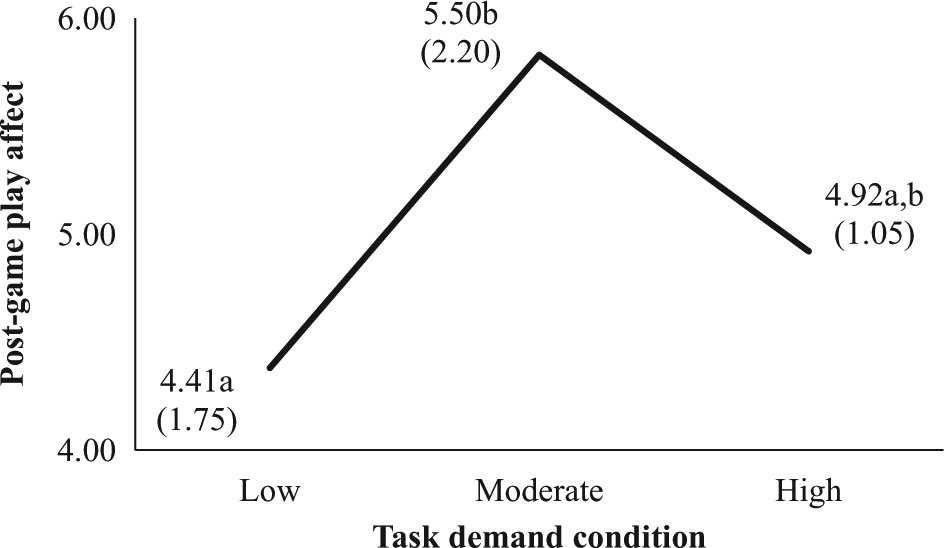
Post-game play affect scores as a function of task demand from Bowman and Tamborini (2012).
Current study
The present investigation begins by asserting that task demand is in part responsible for the mood management potential of computer games, as suggested in prior research (Bowman and Tamborini, 2012; Chen and Raney, 2009). Extended, the current study is engineered to examine selective exposure processes expected to result in mood repair. This is done by providing users with a choice among game conditions that they know from experience vary in task demand. Data from Bowman and Tamborini (2012) suggest a curvilinear pattern in which high levels of task demand (compared to moderate levels) have a detrimental effect on repair. Their study found mood repair was highest at moderate levels of task demand, decreased slightly at the highest level of task demand, and was significantly lower at the lowest amount of task demand. As such, if selection is driven by anticipated mood repair as would be predicted from theory, we cannot assume that the experience of a noxious mood would result in an unlimited desire for added task demand as might be expected from a strict interpretation of selective exposure theory. Since our study replicates the task demand conditions used by Bowman and Tamborini (2012), our game-choice hypotheses are modeled after the pattern of mood repair they observed.
H1: If given the choice to play a computer game with varying conditions of task demand, a curvilinear choice pattern will be observed in which individuals in a noxious mood state will prefer a game with low task demand less than one with moderate task demand, and will prefer a game with moderate task demand more than one with high task demand.
Related to this, we are also concerned with how this pattern of task demand choices might differ as a function of the type of noxious mood state an individual is experiencing. Logic from Bowman and Tamborini (2012) proposed that bored individuals might benefit more from task demand than stressed individuals. This is because bored individuals should benefit not only from the intervention brought on by increased task demand, but may also benefit from game play’s ability to heighten arousal. This would differ for stressed individuals, who should benefit from the intervention brought by increased task demand but also be negatively affected by the heightened arousal that comes with increased task demand. Notably, these differences in the amount of repair expected for bored and stressed individuals are consistent with mood-repair data observed by Bowman and Tamborini (2012) (see Figure 2).

Post-game play affect scores as a function of task demand from Bowman and Tamborini (2012) comparing bored and stressed participants.
For stressed individuals, they found that the moderate task demand game led to greater mood repair than either the low or high task demand game, and that little mood repair from the high task demand game was apparent. By contrast, the mood-repair primacy of the moderate task demand condition was not apparent for bored individuals. For these respondents, the moderate task demand game again led to greater mood repair than the low demand game, but the repair benefits for the moderate demand condition did not differ significantly from those in the high demand condition.
Our second hypothesis is based on two previously identified considerations: Firstly, given that the logic for our game-choice hypotheses is based on the understanding that selection is driven by anticipated mood repair, we would expect differences in the game-choice behaviors of bored and stressed individuals to mirror differences between bored and stressed individuals in the amount of mood repair expected from games at different levels of task demand. Secondly, since our study replicates the task demand conditions used by Bowman and Tamborini (2012) our game-choice hypotheses are modeled after the pattern of mood repair they observed.
H2: Selective exposure patterns will differ significantly between stressed and bored individuals such that stressed participants will show a greater preference for moderate levels of task demand over both low and high task demand, whereas bored participants will not show the same preference for moderate levels of task demand over both low and high task demand.
Finally, although not the central focus of the current study, we expect that individuals selecting the predicted task demand games from H2 will have the highest post-game play mood scores. Specifically, we expect both bored and stressed individuals to benefit least from low task demand choices and most from high task demand choices, but we expect bored individuals to benefit more than stressed individuals when choosing high task demand. We also expect bored individuals to benefit overall more than stressed individuals when choosing moderate or high levels of task demand. As explained by Bowman and Tamborini (2012), bored individuals should benefit more than stressed individuals because demanding tasks provide both an attentional distraction as well as an arousal benefit, while stressed individuals are aided in mood repair by increased attentional distraction but disrupted in mood repair by the increased arousal that comes with increased task demand.
H3a: For stressed individuals, mood repair will be lowest when choosing either low or high levels of task demand, and highest when choosing moderate levels of task demand.
H3b: For bored individuals, mood repair will be lowest when choosing low levels of task demand, highest when choosing moderate levels of task demand, and moderate when choosing highest levels of task demand.
H3c: Bored individuals will experience greater mood repair than stressed individuals when choosing either moderate or high levels of task demand.
Method
Participants
Participants were recruited from a large, Midwestern university and offered course credit and the chance for a US$100 cash prize for participating in the study. Using an effect size measure of f = .31 calculated from prior research (Chen and Raney, 2009), we set an expected moderate effect size of ω = .40 (cf. Cohen, 1988). Power analyses using ω = .40 were performed for a chi-square contingency table with three possible choices, α < .05 (two-tailed) and a desired statistical power of β = .80; this analysis provided us with an optimal N = 61. After all data was collected, a final sample size of N = 64 was achieved for this study (39 male, 25 female, age M = 22 years, 5 months).
Design and procedure
Upon entering the lab, participants first reviewed and signed the informed consent form and then were asked to complete a questionnaire measuring perceived computer game skills, demographics, and an affective state measure. After completing the questionnaire, participants were given five minutes to learn the controls of the flight simulator game before playing each version (each of the three levels of task demand) for five minutes each to become familiar with them. The game versions were played in the following order of task demand: high, low, and moderate. This order was selected for two reasons. Firstly, ordering the first two games from high to low accentuated the differences in task demand between the extreme conditions. Secondly, having participants play the highest demand condition first protected against potential skill gains that players might have if they started with lower demand conditions and progressed to higher ones, which could have diminished the perceptions of task demand for the higher conditions. After each game play session, participants were asked to complete a perceived task demand measure. Playing all three games prior to the mood manipulation was important, as selective exposure processes are driven by learned expectations regarding the medium’s capacity to repair mood that stem from an individual’s prior experience with that medium (cf. Atkin, 1985). After playing all three versions of the game, participants were subjected to either a boredom or stress manipulation for 20 minutes and completed an affective state measure after the manipulation. Following this, they were asked to choose one of the three task demand games to play. Task demand choice was recorded by the primary researcher. Once game play was completed, participants completed a final affective state measure and were fully debriefed as to the purpose of the study. The entire procedure lasted about one hour.
Stimuli/materials
Mood inductions
For the boredom induction, participants were given a large box of metal washers, and asked to thread the washers onto a length of string. For the stress induction, participants were asked to complete a booklet of difficult logic puzzles designed to exceed the talents of the participants. Furthermore, participants in the boredom induction were left to their own volition, whereas participants in the stress induction were under constant pressure from an experimenter to perform better.
Computer game
The computer game played in this study was Lock-On: Modern Air Combat, the same used by Bowman and Tamborini (2012). The game is played using the Saitek X36F flight stick and X35T throttle and a standard PC keyboard and mouse, and was suited for the current study due to its fully programmable controls that allowed for the task demand manipulations.
Task demand
All participants began playing the flight simulator game with the aircraft in-bound towards a landing strip, approximately five minutes off in the distance. For the low task demand game version, participants played the game with full auto-pilot engaged and all user controls turned off; that is, the game did not require any input from the user in order to progress from flight to landing. For the moderate task demand game version, participants were able to manipulate the speed and direction of the plane using the joystick, throttle, and rudder, while the simulator automatically controlled all other flight controls, including landing gears, wing flaps, airbrakes, wheel brakes and drogue chute. For the high task demand game version, participants had full control of the aircraft. Notably, these are the same task demand conditions used (and explained in more detail) by Bowman and Tamborini (2012).
Measures
Perceived task demand
The NASA-Task Load Index (NASA-TLX) was used as a self-report measure of subjective workload assessment. This six-item, 20-point semantic differential scale is useful in measuring workload in human–machine interactions (NASA-TLX, n.d.), including flight simulations (c.f. Moroney et al., 1993). Sample items from the scale were: “How much mental and perceptual activity was required?” and “How much physical activity was required?” One item from the scale designed to measure perceived performance negatively affected scale reliability and was dropped from subsequent analysis. Average reliability of this scale was α = .72.
Mood repair
Mood repair was measured using a pre-test and post-test administration of an adapted version of the Affect Grid (Russell et al., 1989; see Figure 3). The scale asks participants to visually map their current mood state in the semantic space between positive and negative affect (the x-axis) and high or low arousal (the y-axis) using a 9 × 9 grid, with the square the center of the grid representing a “neutral, average, everyday feeling” (Russell et al., 1989: 501). The scale has been validated in prior research as a measure of mood and affect in the context of computer interfaces (Swindells et al., 2007), and the pre-test/post-test implementation of the scale has been established as a valid measure of mood change (Eich and McCaulay, 2000).
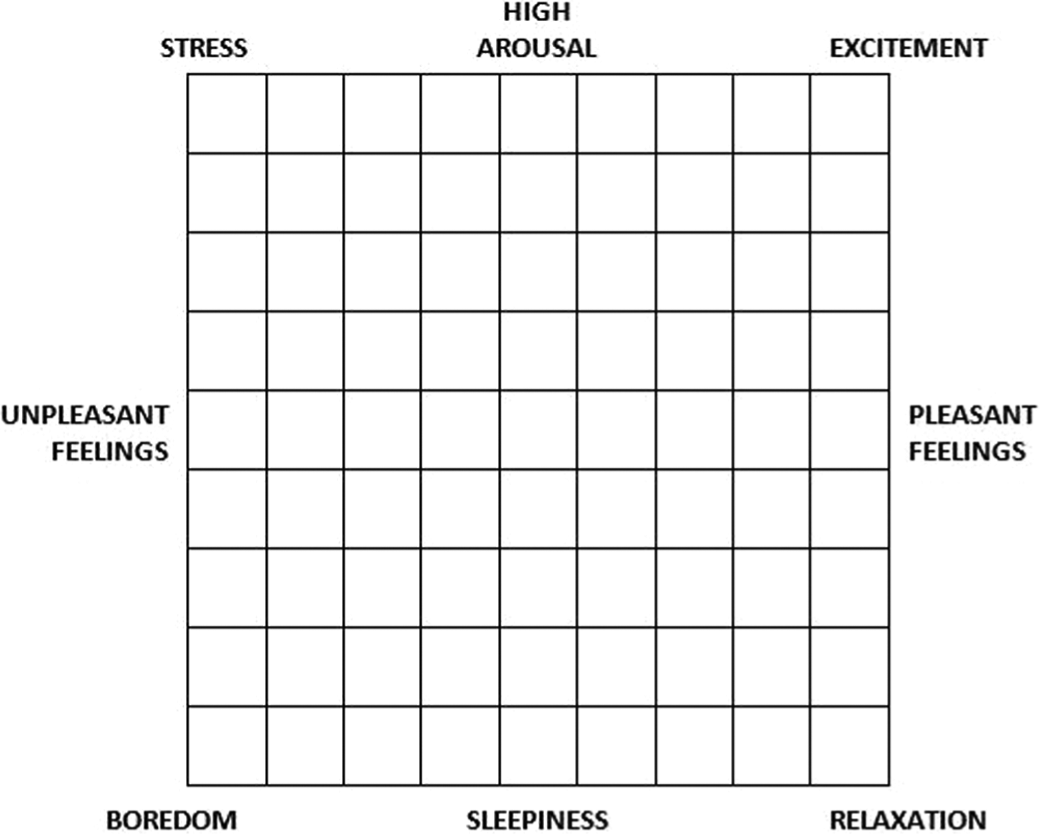
Russell et al. (1989) Affect Grid metric, adapted for use in the current study.
Selective exposure
The primary investigator recorded which version of the computer game (low, moderate, or high task demand) participants chose to play.
Game skill
Self-perceptions of computer game skill were assessed using the 10-item, seven-point Likert-scaled Game Playing Skill scale (GaPS; Bracken and Skalski, 2006). Game skill did not differ significantly between bored (M = 4.22, SD = 1.38) and stressed (M = 4.46, SD = 1.62) participants, t(62) = –.64, ns, and no significant correlation existed between game skill and computer game task demand condition (r = –.04, ns) or game choice (r = .23, ns); thus, controlling for the potential effects of perceived game skill on computer game choice was not required in this study. 2
Results
Manipulation check
Mood
The mood manipulations used in this study were found to significantly affect both arousal and affect levels of participants in expected direction. There was no significant difference in either pre-manipulation arousal, t(62) = .40, ns, or pre-manipulation affect, t(62) = .63, ns, between mood conditions. For the boredom manipulation, we found that post-manipulation affect was significantly lower than the pre-manipulation affect, t(30) = 6.92, p < .01, and post-manipulation arousal significantly lower than pre-manipulation arousal, t(30) = 5.42, p < .01. For the stress manipulation, we found that post-manipulation affect was significantly lower than the pre-manipulation affect, t(32) = 10.14, p < .001, although post-manipulation arousal did not differ significantly from the pre-manipulation arousal above, t(32) = −1.80, p = .08. However, post-manipulation affect in the stress condition was significantly lower than post-manipulation affect in the boredom condition, t(62) = 3.19, p < .01, indicating that the stress mood manipulation induced a more noxious mood state than the boredom mood manipulation (see Figure 4).
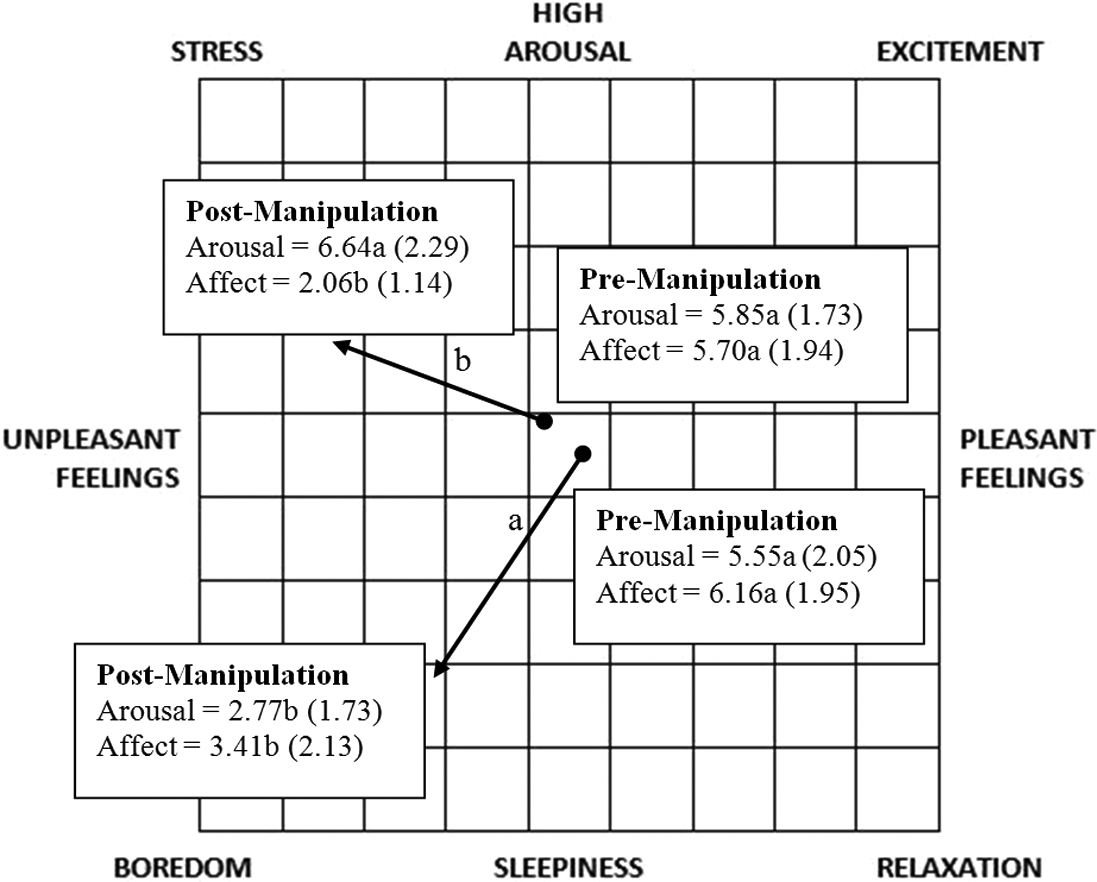
Induction check: Arousal and affect means for mood groups, pre and post induction.
Task demand
Participant’s self-reported task demand was measured after each of the three practice sessions with the computer game as indicated by their scores on the NASA-TLX. A repeated-measures analysis of variance (ANOVA) reports that indeed a significant difference in perceived task demand was found between the three computer game conditions in the expected direction, F(2,126) = 265.13, p < .011, η2 = .818. Perceptions of task demand were lowest in the low task demand condition (M = 3.72, SD = .39), moderate in the moderate task demand condition (M = 11.53, SD = .39), and highest in the high task demand condition (M = 12.64, SD = .35).
Hypothesis testing
Our first hypothesis predicted that, given the choice to play video games known to vary in task demand, a curvilinear choice pattern would be observed among individuals in noxious mood states such that individuals would prefer low amounts of task demand the least, moderate amounts of task demand the most, and high amounts of task demand less so than moderate but more so than low amounts. To examine this, we conducted a chi-square goodness-of-fit test to see if the observed pattern of game-choice behaviors differed from chance, and examined visually the observed pattern of game choices compared to the curvilinear pattern of post-game play affect scores from Bowman and Tamborini (2012). Indeed the observed pattern of game-choice behaviors both differed significantly from chance, χ2 (2, n = 64) = 15.62, p < .01, and followed the predicted curvilinear pattern, consistent with H1. Participants chose the low task demand condition the least (7 observed choices), the moderate task demand condition the most (32 observed choices), and the high task demand in the middle (25 observed choices).
The second hypothesis predicted that stressed individuals would prefer moderate task demand over high task demand more so than bored individuals. To examine this, a chi-square goodness-of-fit test was conducted to compare the observed pattern of selected task demand exhibited by bored participants with the observed selection pattern exhibited by stressed participants. This test required us to split the data file into separate groups of n = 31 (bored participants) and n = 33 (stressed participants; see Table 1). As at least one cell – more than 20 percent of all cells – had a frequency of less than five, Yate’s correction was applied to the final chi-square critical value (Preacher, 2001; Yates, 1934).
Observed frequency of task demand choices by mood manipulation.
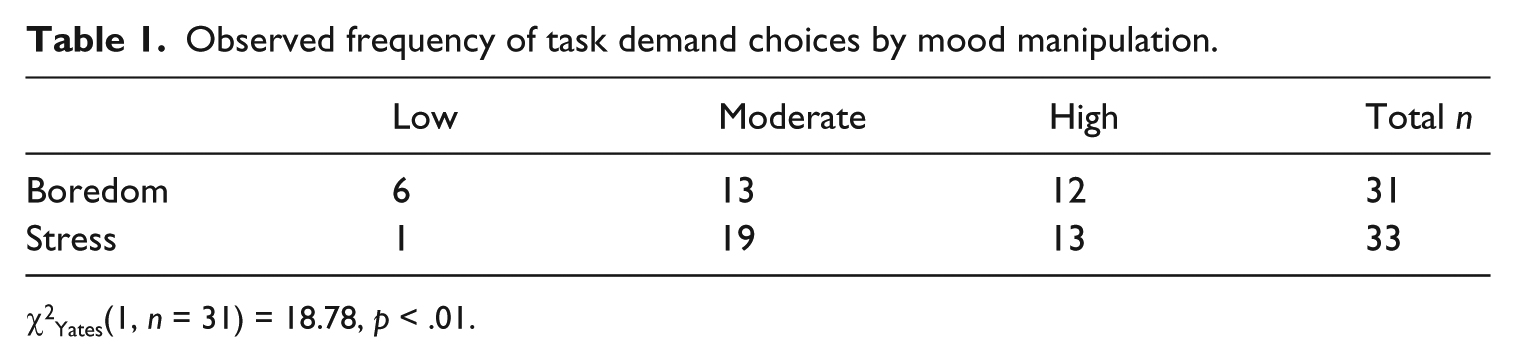
χ2Yates(1, n = 31) = 18.78, p < .01.
The test revealed that the pattern of choices between mood manipulation conditions varied significantly, χ2Yates(1, n = 31) = 18.78, p < .01. Although all participants showed aversion to the low task demand condition, stressed participants showed greater preference for moderate task demand than did bored participants, and both stressed and bored participants showed equal preference for high task demand. Thus, we conclude that the findings are consistent with H2.
A secondary focus of this study was to examine the resultant mood-repair scores stemming from the patterns of selective exposure observed. Thus, our third set of hypotheses focused specifically on resultant mood repair as a result of task repair decisions. We note here that as a secondary focus of our study, our comparison groups are quite small and render standard statistical significance tests impractical. For these analyses, we focus on patterns of mood change rather than statistical significance in these changes, recognizing that these results are subject to replication in further research.
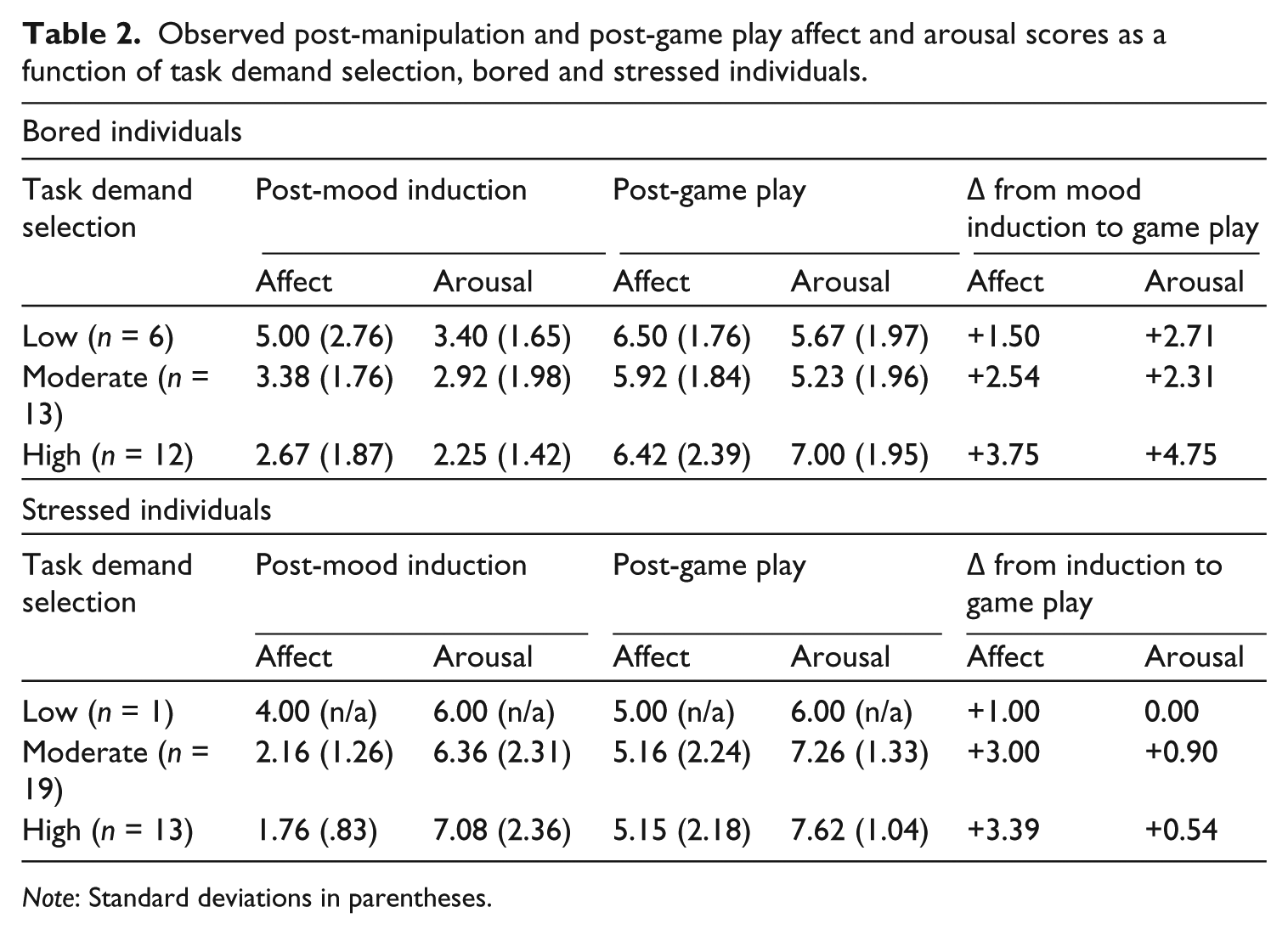
For stressed individuals (H3a), we predicted lowest levels of mood repair when choosing low or high levels of task demand with greatest mood repair when choosing moderate task demand. For bored individuals (H3b), we predicted lowest mood repair with low task demand, highest mood repair with moderate task demand, and a moderate level of mood repair at high levels of task demand. We also predicted (H3c) bored individuals to benefit more than stressed individuals when choosing moderate or high levels of task demand. Table 2 reports the full results of affect scores across mood manipulations and video game task demand selection levels, and Figure 5 shows mood repair change scores in relation to selected task demand conditions.
Observed post-manipulation and post-game play affect and arousal scores as a function of task demand selection, bored and stressed individuals.
Note: Standard deviations in parentheses.
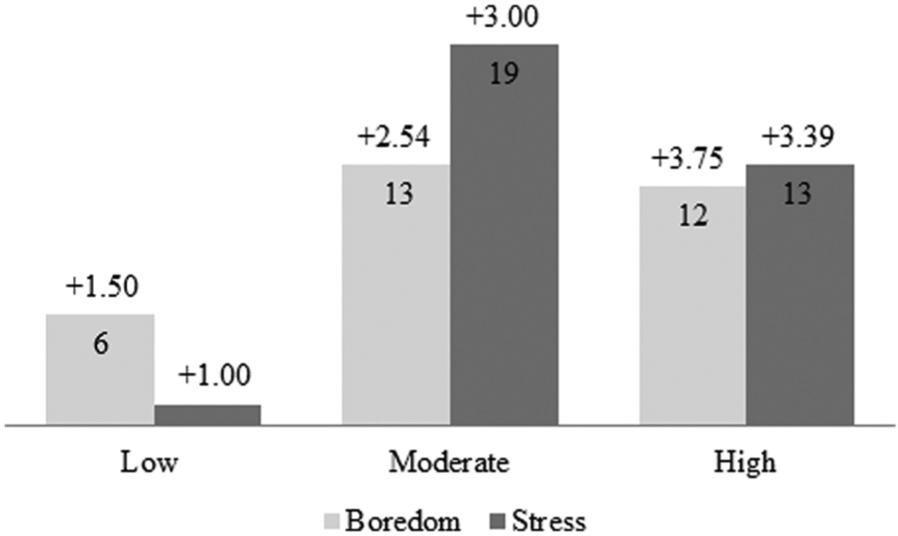
Observed selective exposure frequencies with associated mood change scores (from baseline), split by mood manipulation condition.
In examining H3a, the greatest mood repair was found for stressed individuals selecting the high task demand condition (Δ affect = +3.39, see Table 2). This finding is counter to our stated hypotheses, as we expected stressed individuals to experience only minimal mood repair when playing highly demanding games. However, we did find substantial mood repair for stressed individuals selecting the moderate task demand game (Δ affect = +3.00) and minimal mood repair when choosing low task demand (Δ affect = +1.00). Of course, although mood repair was observed as expected in the moderate task demand conditions, H3a could not be confirmed given the observed pattern of mood repair in the high task demand condition.
In examining H3b, we found the lowest levels of mood repair for bored individuals choosing the low task demand game (Δ affect = +1.50), but counter to our predictions the greatest mood repair was found for individuals choosing high demand (Δ affect = +3.75). Moderate levels of task demand resulted in moderate levels of mood repair (Δ affect = +2.54). Thus, although mood repair was witnessed for both moderate and high levels of task demand, H3b could not be confirmed given that mood repair was greatest at the highest levels of task demand.
Study results were also inconclusive with regard to H3c’s claim that bored individuals would benefit more from task demand than stressed individuals. Overall, bored individuals had greater affect scores (M = 5.92, SD = 1.84) than stressed individuals (M = 5.16, SD = 2.24), but they also had higher pre-game play moods on average (boredom M = 3.68, SD = 2.13; stress M = 2.64, SD = 1.05, see Figure 4). Looking at mood change measures, stressed individuals (Δ affect = +3.00) benefited more than bored individuals (Δ affect = +2.54) when considering the choice to play the moderate task demand game, which is inconsistent with H3c. However, bored individuals (Δ affect = +3.75) benefitted more than stressed individuals (Δ affect = +3.39) when considering the high task demand condition, offering support for H3c. In all cases, mood repair was substantially greater for moderate or high task demand selection than for low task demand selection.
Overall, the empirical results regarding mood repair from Bowman and Tamborini (2012) were not confirmed in the current study. Yet, further analysis of the data in line with unique aspects of this study allows us to offer an interpretation informed by a mood management-based version of selective exposure theory. Some of these unique aspects included (a) a disordinal influence of our mood manipulations that resulted in stressed individuals being in overall more negative moods than bored individuals, and (b) a post-hoc analysis that reports differences in pre-game play mood between the different task demand selection groups (which could not have been caused by our methodology, given that all task demand selections occurred after the second mood measurement). In fact, when considering the anomalies found in this study, the data reported here indeed seems consistent with a mood management-based version of selective exposure theory. This interpretation – qualified given concerns about replication as well as the need to avoid suggesting hypotheses post-hoc – is offered in the discussion section of our manuscript.
Discussion
The current study was designed to extend selective exposure and mood management theory by demonstrating how conceptualizing intervention potential in terms of task demand might aid in extending the scope of the theories to interactive media. Previous studies using this conceptualization (Bowman and Tamborini, 2012; Chen and Raney, 2009) have shown that the more focused attention required to play a computer game distinguishes the intervention potential of this technology from other entertainment media, and that the increased task demand associated computer game play can significantly increase mood repair when compared to non-interactive media such as television. However, whereas these previous studies showed that variance in task demand is related to variance in mood repair, neither study examined how differences in task demand affected actual selective exposure behaviors. The present study addresses this gap in research by examining the distinct selective exposure qualities of computer game play, using three versions of a computer game for which precise differences in mood-repair capacity had already been established. As predicted, participants in our study demonstrated a clear preference for moderate levels of task demand, and this preference was greater for stressed as compared to bored participants. However, when considering resultant mood repair from these predicted choices as represented by mood change scores, our results diverged somewhat from prior work. Stressed individuals benefitted the most when choosing moderate levels of task demand and bored individuals benefitted the most when choosing the highest levels of task demand. Moreover, participants selecting the lowest level of task demand conditions experienced the least mood repair. These data are explained in further detail below, and alternative explanations are presented for divergent results.
Task demand and selective exposure
Our first set of hypotheses (H1 and H2) predicted that participants experiencing noxious mood states would prefer moderate levels of task demand as compared to extremely high or low levels, and that stressed participants would show a more distinct preference for moderate task demand levels than would bored participants. Indeed, both of these predictions were supported, and this data is compelling for two reasons. Firstly, it lends further empirical support to our assertions regarding selective exposure processes in newer forms of interactive media. The data give us a closer look at how we can understand intervention potential in terms of the task demand associated with playing a video game, and demonstrate how this task demand can be used as a predictor of computer game choice related to two orthogonal and commonly experienced mood states. Secondly, this research provides empirical evidence for selective exposure assumptions regarding learned expectations that have gone largely untested. Most research on selective exposure tends to be conducted on traditional entertainment media forms that are so ubiquitous that learned expectations are difficult to vary, or assumed to be universal. However, our study was able to more clearly demonstrate the role of learned expectations by controlling participants’ prior exposure, albeit in a rather small dosage.
Selective exposure and mood repair
Our second set of hypotheses (H3a, b, and c) made predictions about mood repair based on selective exposure choices observed by Bowman and Tamborini (2012). Results from this study diverged in part from past work. We expected that (a) stressed individuals to benefit only from moderate levels of task demand, (b) bored individuals to benefit most from moderate task demand but to a smaller degree from high task demand, and (c) bored individuals to benefit more than stressed individuals overall. However, we found that stressed individuals choosing the moderate task demand condition experienced greater mood repair than bored individuals making the same selection, and bored individuals experienced more mood repair than stressed individuals when choosing the highest task demand level.
Closer examination of our data in view of unique aspects of the current study suggest that some of the observed mood-repair patterns do fall in line with the selective exposure and mood management logic developed by this line of research. Firstly, the findings show that our mood inductions resulted in more noxious affective states for individuals who eventually selected high task demand (M = 2.22, SD = 1.35, n = 31) than for those who eventually selected moderate task demand (M = 2.77, SD = 1.51, n = 25), albeit not a significant difference in part given the low statistical power of this test, t(53) = 1.45, p = .077). Given that all task demand choices were made at the end of the study and thus could not have caused any differences in pre-game play affect, the observed differences in noxious affect could not have been produced by our study methods. Having one condition with lower affect scores than another might result in a desire for increased task demand for individuals in that condition (this was not the case in Bowman and Tamborini, 2012), as these individuals would want the extra intervention potential that higher task demand could provide. For example, the fact that these selection patterns were more successful for bored than for stressed individuals is indeed congruent with a mood management-based selective exposure logic. The (very) bored individuals in our study (at least, as compared to other bored participants, see Table 2) benefitted more from the affect and arousal boost provided by the higher task demand game. This interpretation is further corroborated when looking at the substantial gain in arousal for bored participants choosing high task demand (Δ arousal = +4.75) compared to stressed participants doing the same (Δ arousal = +0.54).
Regarding the low task demand condition, we found it compelling to examine in closer detail those few participants whom unexpectedly chose the low task demand game. The low task demand games should not have been an attractive choice for anyone in our study given their limited ability to disrupt noxious mood states. However, for the seven individuals who chose the low task demand game (six in the boredom manipulation conditions, and one in the stress manipulation condition), each entered the game play situation with unexpected moderate levels of affect. Thus, these individuals were not experiencing noxious moods in need of repair and, as a result, should not have desired any sort of task demand that might have altered their moderate moods – the “neutral, average, everyday feeling” typified by their central scores on the Russell et al. (1989: 501) scale. Consequently, their affect change scores post-game play were minimal compared to other conditions (boredom Δ affect = +1.50, stress Δ affect = +1.00). The selection of a low task demand game for these seven individuals is in line with the selective exposure interpretation proposed in this study: these participants did not seek disruption from their current neutral mood state, so they did not desire the intervention potential that would come with additional task demand.
Limitations and future research directions
As with any research, elements of the current study should be scrutinized for their potential threats to validity. The issues discussed here include the short amount of time participants spent playing computer games, our focus on intervention potential over other theoretically relevant computer game variables (and, related to this, our use of only one computer game and two mood states), our lack of a “no-experience” control group, a small and restricted (e.g. college-aged) sample frame, and questions regarding the ability to replicate our mood-repair data given the idiosyncrasies associated with our study. Each of these is discussed in detail (and in order) below.
For this study, participants were given five minutes to play each version of the computer game (in the order of high, low, moderate) in order to establish a familiarly with and, by extension, a learned expectation about the game’s mood-repair potential. Although this seemed to be enough time for participants to get a feel for the differential task demand in each of the three conditions (confirmed via manipulation checks), we wonder whether or not there might be an important relationship between game play time and task demand. For example, it is possible that as people spend more time with a computer game and become increasingly familiar with the game’s controls, the game becomes less demanding of their attentional resources. In this case, task demand would be highest upon first exposure with a computer game, and reduced with each subsequent exposure (or, demand may be reduced simply as a function of time spent playing during any one exposure). At the same time, our study does provide evidence that learned expectations may be formed rather quickly – in this case, after five minutes of game play – and that this (quick) learned expectation formation is enough to cause significant differences in selective exposure patterns. Future research should consider this relationship with more experimental rigor.
When conducting research on selective exposure and mood management, both Bryant and Davies (2006) and Zillmann and Bryant (1985) specify three other theoretically relevant dimensions that one must consider along with intervention potential: arousal regulation (the ability for a medium to increase or decrease an individual’s felt arousal), behavioral affinity (the similarity between message content and one’s current affective state), and hedonic valence (the general pleasurable or unpleasurable tone of a message). Although our study statistically controlled for self-reported arousal and experimentally controlled for behavioral affinity and hedonic valence by keeping content constant across task demand conditions, future research should examine how these other elements might function differently with interactive media, such as understanding mechanics of player–avatar relationships (cf. Banks, 2013; Bowman et al., 2012) or engagement in digital narratives (cf. Green et al., 2006). Tangentially related to this point, our study focused on only one type of game (a flight simulator game) and only two types of moods (boredom and stress) and thus future studies should expand to consider other types of computer games and other types of mood states commonly associated with exposure to entertainment media.
Our experimental design was distinct from other selective exposure and mood management research in that participants were given an opportunity to practice and experience each of the three experimental computer game conditions prior to post-mood manipulation selection. However, our design did not include a no-practice control group. As such, we cannot compare the different levels of learned expectation against a no-expectation control, and this should be considered in future work.
The current study relied on a small sampling of college-aged students. Although our a priori power analysis justified the use of a small sample and our sampling frame represents a significant portion of computer game players (Jones, 2003), other populations may differ in their experience with and perceptions of computer games. Although the effects of self-reported video game self-efficacy were not found to have a role in selective exposure process in the current study, this variable should be examined with more scrutiny in replication. Related to this, although our power analysis provided an optimal sample size for selective exposure patterns, it was not designed to provide a similar estimation of the sample size needed to make between-subjects comparisons of mood repair as a function of selective exposure patterns. Notably, mood-repair data were seen as a secondary goal of the current work, but future work should provide a more robust test of the relationships between selection and repair.
Finally, although we feel the interpretations we have offered for the mood-repair patterns found in the current research are logical and theoretically rooted in light of the mood inductions observed, we acknowledge that any post-hoc interpretation of study data should be subject to scrutiny. The fact that our mood manipulations had a disordinal influence on the negative affect experienced by different task demand selection groups (individuals eventually choosing high task demand also having been in the most intense negative affective state prior to selection) and on the manipulation of discrete moods themselves (with stressed individuals reporting more intense negative affect than bored individuals) suggest that more refinement is needed in understanding the methods of manipulating both mood states.
Conclusion
This study extends work examining the influence of interactive media task demand on mood management and selective exposure processes. Results indicate that once learned expectations have been established regarding the relative benefit of different task demand conditions on mood repair, a moderate amount of task demand is most preferred by individuals experiencing noxious mood states, and that moderate task demand was preferred by stressed more so than bored individuals. Stressed individuals choosing moderate task demand experienced the greatest levels of mood repair, while bored individuals benefitted from higher task demand levels. As the computer game and interactive media industry continues to grow, so must our understanding the reciprocal processes that govern how mood states can affect game play choices, and how game play choices can in turn affect mood states.
Footnotes
Funding
This research received no specific grant from any funding agency in the public, commercial, or not-for-profit sectors.