







Abstract
The aim of this research was to investigate the effects of online social networking use on bridging and bonding social relationships as well as on social capital effects. The study examined how the self-systems of users of the social networking website Facebook (where a self-system comprises four elements—self-efficacy, self-assertion, social presence, and self-esteem) and intensity of use affected the abovementioned social relations and social capital effects. Using data from a survey of Facebook users (n =306), the result revealed that Facebook users’ self-systems played an important role in the formation of bridging and bonding social relationships as well as in generating social capital effects. However, self-esteem did not affect bonding social relationships significantly. The study also found that Facebook users’ self-systems mediated the relationship between bridging and bonding social relationships and social capital effects.
Introduction
The core value of social network sites (SNSs hereafter) lies in the associated relationship-building: making friends and participating in social organizations, communities, and even trivial interactions and exchanges. Relationships with others are important both for generating offline benefits—most commonly, social capital—and for psychological development in young people (Steinfield et al., 2008). Maintaining friends through SNSs allows users to engage in social activities as well as to build social capital in online settings (Ellison et al., 2006; Pfeil et al., 2009).
Many researchers have investigated the meaning of communication and relationships in the context of online SNSs. Recently, several major journals, including the Journal of Computer-Mediated Communication (2012), the International Journal of Advertising (2011), the Journal of Interactive Marketing (2012), and the International Journal of Electronic Commerce (2012) have published special issues regarding social media (on Myspace, Twitter, Cyworld, and other online communities), social capital, and the relationship between user behavior and communication technologies. Related articles have focused on the relationship between life satisfaction and Facebook use (Valenzuela et al., 2009), the relationship between the intensity of Facebook use, measures of psychological well-being, and bridging social capital (Steinfield et al., 2008), and differences between how teenagers and adults use social capital (Pfeil et al., 2009).
Although Steinfield et al. (2008) found that self-esteem is an element of the self-system (a set of cognitive processes through which an individual perceives, evaluates, and regulates her own behavior to respond effectively to environmental conditions) and that satisfaction with life variables was strongly associated with social capital outcomes, we do not yet fully understand the social psychology of SNS use. Indeed, few empirical studies have attempted to build a theoretical model that explains individual Facebook users’ self-systems as a factor affecting social relationships or moderating social capital effects. Thus, the goals of this study are to understand how the structure of an individual Facebook user’s self-system affects his or her social relationships and mediates social capital effects, and to suggest a model that explains the relationship between a person’s self-system and social capital. This investigation will provide valuable data to support a theory of SNS use.
Theoretical and empirical background
Social network sites and social capital
Facebook was created in February 2004 by Mark Zuckerberg, then a student at Harvard University (Steinfield et al., 2008), and has become the world’s largest social network. According to recent corporate statements, at least 1.1 billion people use Facebook. Nearly 80% of Facebook users (78.1%) were young adults between 18 and 54 years of age, while 55% were female.
According to boyd and Ellison (2007), SNSs are ‘web-based services that allow individuals to (1) construct a public or semi-public profile within a bounded system, (2) articulate a list of other users with whom they share a connection, and (3) view and traverse their list of connections and those made by others within the system’ (p. 211). As boyd and Ellison note, the terms ‘social network site’ and ‘social networking site’ are often used in public discourse interchangeably, but for the purposes of this study they should be distinguished. The phenomenon of social networking may occur using a social network, but networking emphasizes the use of a social medium (not necessarily electronic) or social event to initiate relationships, to meet new people who by definition are strangers. Most SNS users do not network in the same sense: rather than participating primarily to initiate relationships with people with whom they are unacquainted, they seek to extend or enrich existing relationships. Thus, this study uses the term SNS, following boyd and Ellison, who argue that SNSs ‘enable users to articulate and make visible their [existing] social networks’ (boyd and Ellison, 2007: 211).
Social networks are critical to psychological well-being (Durden et al., 2007). SNSs are designed to ‘foster social interaction in a virtual environment’ (Pempek et al., 2009: 228), providing web-based services that allow individuals to form ‘groups of people with whom they are not otherwise acquainted who willingly interact with them over the Internet’ (boyd and Ellison, 2007: 211). A social network is ‘a configuration of people connected to one another through interpersonal means, such as friendship, common interests, or ideas’ (Coyle and Vaughn, 2008: 13). SNSs typically allow a user to build and maintain a network of friends for social or professional interaction. The core use of an ‘SNS consists of personalized user profiles’ (Trusov et al., 2009: 92).
SNSs might help individuals create and maintain social capital because the ‘technical and social affordances of SNSs enable interaction, and therefore reciprocity, within a larger network of social connections’ (Steinfield et al., 2008: 246). SNSs might not increase the number of strong ties that people have, but the SNS technology supports the formation and maintenance of weak ties, increasing what is known as ‘bridging’ social capital for its users (Donath and boyd, 2004). Putnam (2000) distinguished between bridging and bonding social capital. Bridging social capital comprises loose connections or weak ties between individuals, the thin and impersonal trust that we develop with strangers we meet through business or social engagements, while bonding social capital is characterized by close relationships in which emotional support is exchanged in the context of dense, multi-functional ties that can bring heterogeneous groups together in meaningful or productive interactions (Ellison et al., 2007; Granovetter, 1982; Pfeil et al., 2009). In light of this distinction, this study attempts to investigate the relationship between Facebook users’ self-systems and both bridging and bonding social relationships as well as social capital.
Social capital studies have examined individual social relationships as well as how the use of mass media influences social trust and an individual’s relationships with others and society. Lin (1999: 39) defines social capital ‘as an investment in social relations on the part of individuals through which they gain access to embedded resources to enhance expected returns on instrumental or expressive actions.’ The core idea is that of resources that are available to people through social interactions (Lin, 2001; Putnam, 1993; Valenzuela et al., 2009). Identifying such resources can help explain how social capital is generated and distributed as well as how social networks benefit members. Investment in social networks enables ‘individuals to develop norms of trust and reciprocity, which are necessary for successful engagement in collective activities’ (Valenzuela et al., 2009: 877). Social capital complements the concepts of economic capital and human resources by incorporating the role of social relations.
Social capital theory has long been applied in computer-mediated environments to explore SNS user behavior. Putnam (1993) emphasized trust, civic engagement, and participation as playing critical roles in building social capital, and subsequent studies have identified trust, social participation, and reciprocity as key factors for understanding how SNS use is related to social capital (McLeod et al., 1999; Shah et al., 2001; Wellman et al., 2001).
Social capital effects are social relationships and related resources that are available through social networks. Social capital effects fall into two categories: social-level social capital and individual-level social capital (Putnam, 2000; Shah et al., 2001). Beaudoin and Thorson (2004) studied the relationship between the use of mass media, social capital, and social participation, finding that social capital is closely related to social participation as a pro-social behavior. Based on these studies, the present study regards social trust, reciprocity, and social participation as key factors in generating social capital effects.
Self-systems and intensity of use
Many trace the origin of the modern self-concept as a psychological construct to the work of William James, a psychologist and philosopher, who claimed that the self involves anything that one owns, analyzing the concept to include the I: self as knower, the pure self, and the me: self as known, the empirical self. Although these concepts have been superseded, ‘the distinction between the self as the subject of cognition and the self as the object of cognition remains useful’ (Kleine et al., 1993: 210).
Employing such a self-concept, people can examine and evaluate themselves and everything they own objectively. This awareness supports the formation of a ‘personality’ based on consistency of the self-concept and behavior. Consistent behavior facilitates the development of self-esteem and predictability in interactions with other people (Epstein, 1980). Along with self-esteem, other key components of a self-system embody one’s views of the self and one’s standards or aspirations for oneself (Dubois et al., 2000; Harter, 1999; Higgins, 1991). According to Dubois et al. (2000), a self-system comprises four elements: self-esteem, self-description, standards for self-evaluation, and self-value. Across the relevant literature, self-efficacy (Staples et al., 1998), self-assertion (Alberti and Emmons, 1978; Bolton, 1983) and social presence (Dunlap and Lowenthal, 2009) have also been identified as elements of the self-system.
The evaluation of the self that forms the basis for self-esteem has been viewed as resulting from ‘(a) an individual’s appraisal of the descriptive content of the self relative to (b) the individual’s internal standards or aspirations’ (Dubois et al., 2000: 14). Self-esteem is thought to include faith in the self and feelings of self-worth, and reflects one’s overall emotions and attitudes towards the self (Battle, 1978).
Self-efficacy has been defined as ‘the judgment of one’s ability to execute a particular behavior pattern’ (Bandura, 1997: 240), and has been used as a theoretical framework in communication studies because it is closely associated with work-related performance, which may depend on the relationship between self-efficacy and adaptability to new technology and mass media user behavior (Hill et al., 1987; Staples et al., 1998).
Garrison et al. (1999: 89) introduced ‘social presence,’ defining it as ‘the ability of participants in a Community of Inquiry to project their personal characteristics onto the community, thereby presenting themselves to other participants as real people.’Dunlap and Lowenthal (2009) pointed out that this theory took on new importance with the rise of computer-mediated communication and, later, online network analysis.
Self-assertion is the feeling, desire, or need to express oneself to others (Alberti and Emmons, 1978; Wolpe, 1958). Bolton (1983) posited listening and self-assertion as negative and positive poles of communication. Self-assertion combined appropriately with listening helps one maintain ideal relationships with others.
Intensity as measured in this study is the extent and frequency of mass media use. When applied to Facebook, intensity has been called ‘Facebook intensity’ (Steinfield et al., 2008). In the present study, the self-system construct, based on the aforementioned studies, is regarded as a function of one’s self-efficacy, self-assertion, social presence, and self-esteem. This study also takes into account Facebook intensity to study the effects of Facebook use and self-systems on social relationships and social capital.
Facebook users’ self-systems and bridging and bonding social relationships
One element of a self-system is self-efficacy, which has been identified mainly to explain behavior related to mass media use such as, for example, accepting information technology (Davis, 1989). Straub (2009) argued that self-efficacy is always a forward-thinking factor pertaining to judgments based on beliefs about personal capabilities. The development of self-efficacy is thought to include the following factors: mastery experiences, vicarious experiences, verbal persuasion, and psychological and affective states (Bandura, 1997; Straub, 2009). Agarwal and Karahanna (2000) found that users perceive ease of use to be greater when rating their own efficacy regarding a target system and that application-specific self-efficacy is a more powerful, direct determinant of perceived ease of use than general computer self-efficacy. Staples et al. (1998) pointed out that self-efficacy assessments play a critical role in influencing user performance as well as user attitudes towards both work and organizations. Other research has found that self-efficacy plays a critical role in influencing post-outcome behavior (Straub, 2009). These studies of self-efficacy suggest that both bridging and bonding social relationships function as basic determining factors in building social capital.
The self-assertion construct was developed by Wolpe and Lazarus (1966). Wolpe (1958) defined self-assertion as one’s feeling of being able to express oneself to others without interpersonal anxiety, and it has been characterized in social psychology as involved in expressing intimacy as a strategy for maintaining interpersonal relationships (Sprecher and Hendrick, 2004). Self-assertion reflects the degree of intimacy, response, and commitment to others that one feels (Derlega et al., 1993). Online self-assertion, expressed through such behaviors as posting contents or decorating Avatars, may provide a less expensive medium of self-expression than is available offline. Monetary resources are among the major predictors of SNS usage (Lee et al., 2011). SNS users interact with others in their existing real-world relationships; this can be interpreted as suggesting that those with rich social capital in the offline world enjoy similar social interactions online. Thus, self-assertion is significantly affected by aspects of a person’s relationship with others when using SNSs.
Lee (2004) defined social presence as a psychological state in which para-authentic or artificial social actors are experienced as actual social actors in either sensory or non-sensory ways (Lee, 2004: 37), arguing that social presence is created when technology users successfully simulate other humans or nonhuman intelligences. On the other hand, Short et al. (1976) refer to social presence as a key to understanding face-to-face communication as well as one of the most important perceptions involved in social circumstances. Dunlap and Lowenthal (2009) pointed out that Twitter seems to provide an additional means for enhancing social presence because it is a multiplatform tool—part SNS, part microblog—that is freely accessible on the Internet (Stevens, 2008).
Straub (2009) invoked social presence theory to explain how social context affects media use. According to social presence theory, media users assess the degree of social presence required by a task and adjust accordingly based on the way in which a medium enables a communicator to experience communication partners as psychologically present (Short et al., 1976; Williams, 1977).High social presence is typically found in face-to-face communication, whereas low social presence is more often found in email and paper-based mail (Gefen and Straub, 2004). The higher the social presence, the greater the social influence communication partners have on each other’s behavior (Kaplan and Haelein, 2010). Thus, social presence is positively related to building relationships with others through using SNSs.
Self-esteem, ‘the manner in which an individual evaluates self-characteristics relative to the perceived characteristics of peers, is a crucial variable for understanding identity development, and underpins the development of mental health adjustments’ (Bagley et al., 1997: 82). As such, self-esteem involves confidence, whether one sees oneself as trustworthy, and negative or positive evaluations of one’s value (Young and Bagley, 1982). Steinfield et al. (2009) found that SNSs help people with lower self-esteem to engage with others outside of their close personal networks. Self-esteem is therefore closely related to SNS user behavior.
A previous study argued that intensity in the use of SNSs should be measured along two dimensions: frequency of use and hours of use (Middleton and Leith, 2007). Steinfield et al. (2009) found that Facebook use positively influences bridging social capital based on their finding that such use has significant predictive power regarding the generation of bridging social capital using SNSs. Therefore, it is likely that the components of self-systems affect bridging and bonding social relationships as well.
Hypotheses and theoretical model
The relationship between self-system elements and bridging and bonding social relationships
The foregoing review of the literature and theoretical constructs pertaining to self-systems and the use of Facebook provides the framework within which this study examines how the elements of self-systems affect social relationships and social capital effects as well as how the addition of intensity as a factor plays into these relationships. Focusing on self-systems first and applying the study to Facebook use yields the following set of hypotheses:
H1: When using Facebook, the higher the self-efficacy, the stronger the bridging social relationships (H1-1) and bonding social relationships (H1-2).
H2: When using Facebook, the higher the self-assertion, the stronger the bridging social relationships (H2-1) and bonding social relationships (H2-2).
H3: When using Facebook, the higher the social presence, the stronger the bridging social relationships (H3-1) and bonding social relationships (H3-2).
H4: When using Facebook, the lower the self-esteem, the stronger the bridging social relationships (H4-1) and bonding social relationships (H4-2).
H5: When using Facebook, the higher the intensity of Facebook use, the stronger the bridging social relationships (H5-1) and bonding social relationships (H5-2).
The relationship between SNSs and social capital effects
This study also investigates the relationship between Facebook user behavior and social capital effects. If Facebook users’ self-systems enhance both bridging and bonding social relationships, perhaps SNS use generates social capital effects, which are characterized by trust, social participation, and reciprocity through this mechanism. That is, it is reasonable to suggest that bridging and bonding social relationships mediate the relationship between users’ self-systems during SNS use and social capital effects, yielding the sixth hypothesis to be tested in this study:
H6: When using Facebook, bridging social relationships (H6-1) and bonding social relationships (H6-2) mediate the relationship between user self-systems and social capital effects.
Theoretical model
To guide the analysis of the data collected for this study, I devised the following theoretical model to illustrate the relationships between the elements of SNS users’ self-systems, bridging and bonding social relationships, and social capital effects (Figure 1).
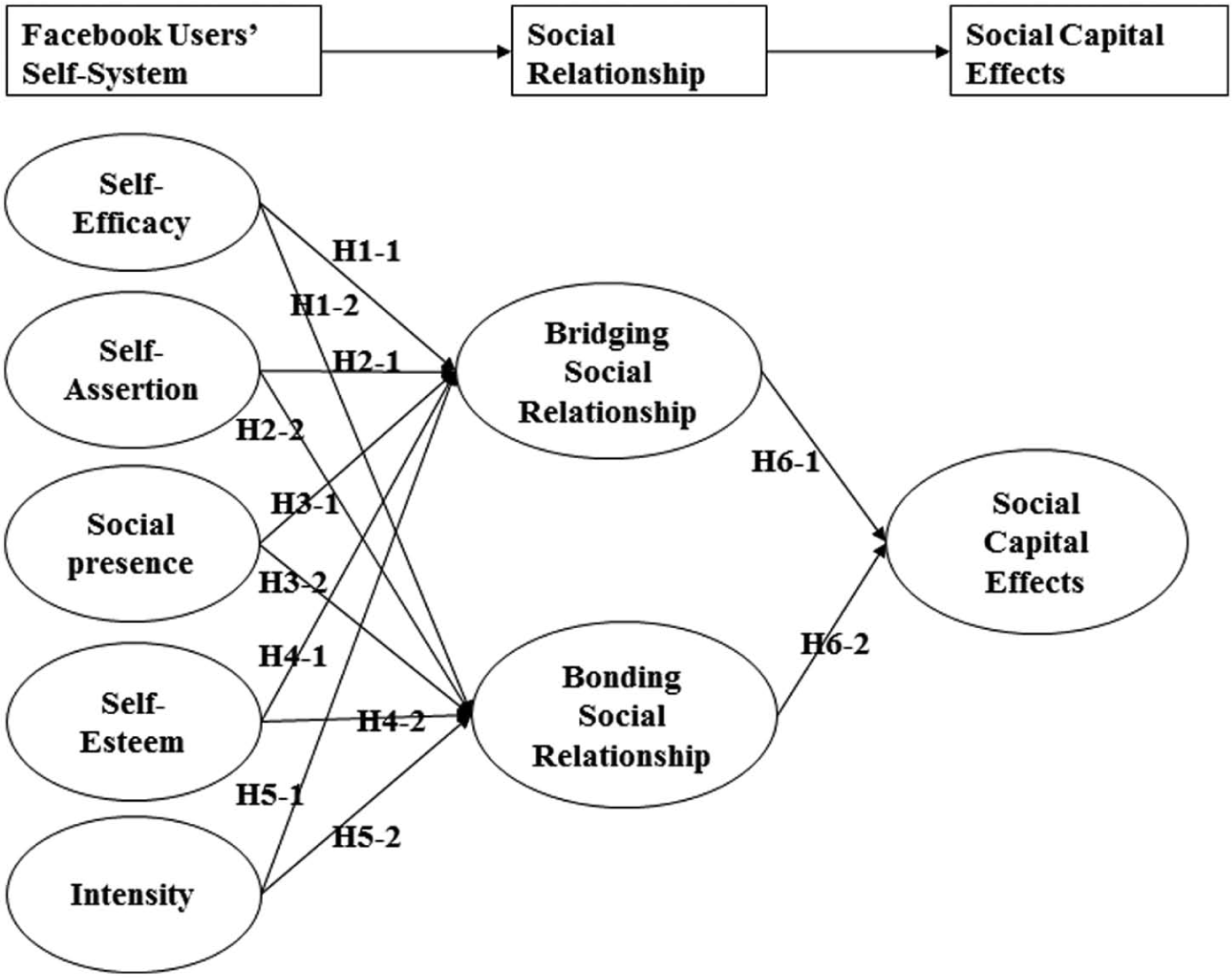
Suggested research model.
Research methodology
Questionnaire development
A pretest was administered to 25 undergraduate students who were registered in business and communications school majors at a large university in Seoul, Korea because these students have knowledge of and information about new media (e.g. SNSs) as well as a strong tendency to communicate with others through SNSs, making them good judges of the clarity of the questions. Following the pretest, a list of unfamiliar words that were used on the questionnaire form was compiled and clearer directions about how to complete the survey were added. The measurement tools used in the study and based on the literature review are related to Facebook users’ self-systems (self-efficacy, self-assertion, social presence, and self-esteem as endogenous variables; intensity as an exogenous variable). Bridging and bonding social relationships and social capital effects were also measured as endogenous variables.
Sampling and data collection
The sample for this study was identified through convenience samples of Facebook users from member companies of the Federation of Korean Industries. Investigators directly contacted managers of companies in finance, construction, business services, hotels, manufacturing, education, etc., including chief executive officers (CEOs), other management personnel, and social education program staff from colleges, seeking to capture representative consumer segments of regular Facebook users and to avoid a demographically homogeneous sample. Participants answered questionnaires before leaving their offices or classrooms (some were enrolled in employee training courses). In all, 400 participants were surveyed about their Facebook use and associated behavior from 1 March 2011 through 30 May 2011. Three hundred and six of those users returned the study questionnaire. To increase the volume of statistical evidence and enhance credibility, actual data were collected from each respondent to identify those who had been using Facebook for at least three months, while participants who were not Facebook users were asked to stop filling out the questionnaire.
The eventual sample consisted of 156 men and 150 women for 316 questionnaires. Ultimately the analysis included only 306 respondents because 10 questionnaires were deleted due to too many missing values or too infrequent Facebook use. Respondents’ positions ranged from CEO to general employee. One hundred and fifty subjects were 20–29 years of age, 106 were 30–39 years of age, and 50 were over 40 years of age. One hundred and fifty-nine of the respondents were salaried workers (52%), 95 were college students (31%), and 52 had specialized jobs or ran their own businesses (17%). Two hundred and fifty-three of the respondents had an educational background that included at least some college-level instruction (52%). On average, respondents used Facebook about two hours per day at their homes, on campus, at their workplaces, on public transportation, and in cafeterias.
Instrument construction
Exogenous variables
The research used previously developed scales, modified when necessary, to measure the variables. The role of the self-system was measured by self-efficacy, self-assertion, social presence, and self-esteem. The other key variable was intensity. Three items for self-efficacy (Garrison et al., 1999; Hill et al., 1987; Staples et al., 1998), four items for self-assertion (Alberti and Emmons, 1978; Bolton, 1983; Derlega et al., 1993; Sprecher and Hendrick, 2004), three items for social presence (Dunlap and Lowenthal, 2009; Kaplan and Haelein, 2010; Stevens, 2008), three items for self-esteem—including two reversed items (Steinfield et al., 2009; Young and Bagley, 1982)—and three items for intensity (Middleton and Leith, 2007; Steinfield et al., 2009) were developed or adopted from previous studies.
Endogenous variables: Bridging and bonding social relationships and social capital effects
Bridging social relationships
Three items for bridging social relationships and bonding social relationships, respectively, were developed from previous studies (Granovetter, 1982; McLeod et al., 1999; Pfeil et al., 2009; Putnam, 2000; Shah et al., 2001; Wellman et al., 2001).
Social capital effects
Social capital effects were analyzed into three subordinate concepts and were measured in reference to nine items eliciting respondents’ opinions about trust (items 1–3), reciprocity (items 4–6), and social participation (items 7–9; Ellison et al., 2007; Granovetter, 1982; Pfeil et al., 2009; Trusov et al., 2009). Nine items were used to measure bonding social capital effects: believability, trustworthiness, fairness for trust, strong solidarity, fellowship, sense of comradeship for reciprocity, intention to participate in a non-profit organization, intention to participate in a civic organization, and intention to participate in a social organization or political party.
All items used in this study were scored on 5-point Likert scales with 1 indicating ‘strongly disagree’ and 5 indicating ‘strongly agree’. The means and standard deviations of all reliability scores are described in Table 1.
Statistics of construct items for Facebook users.
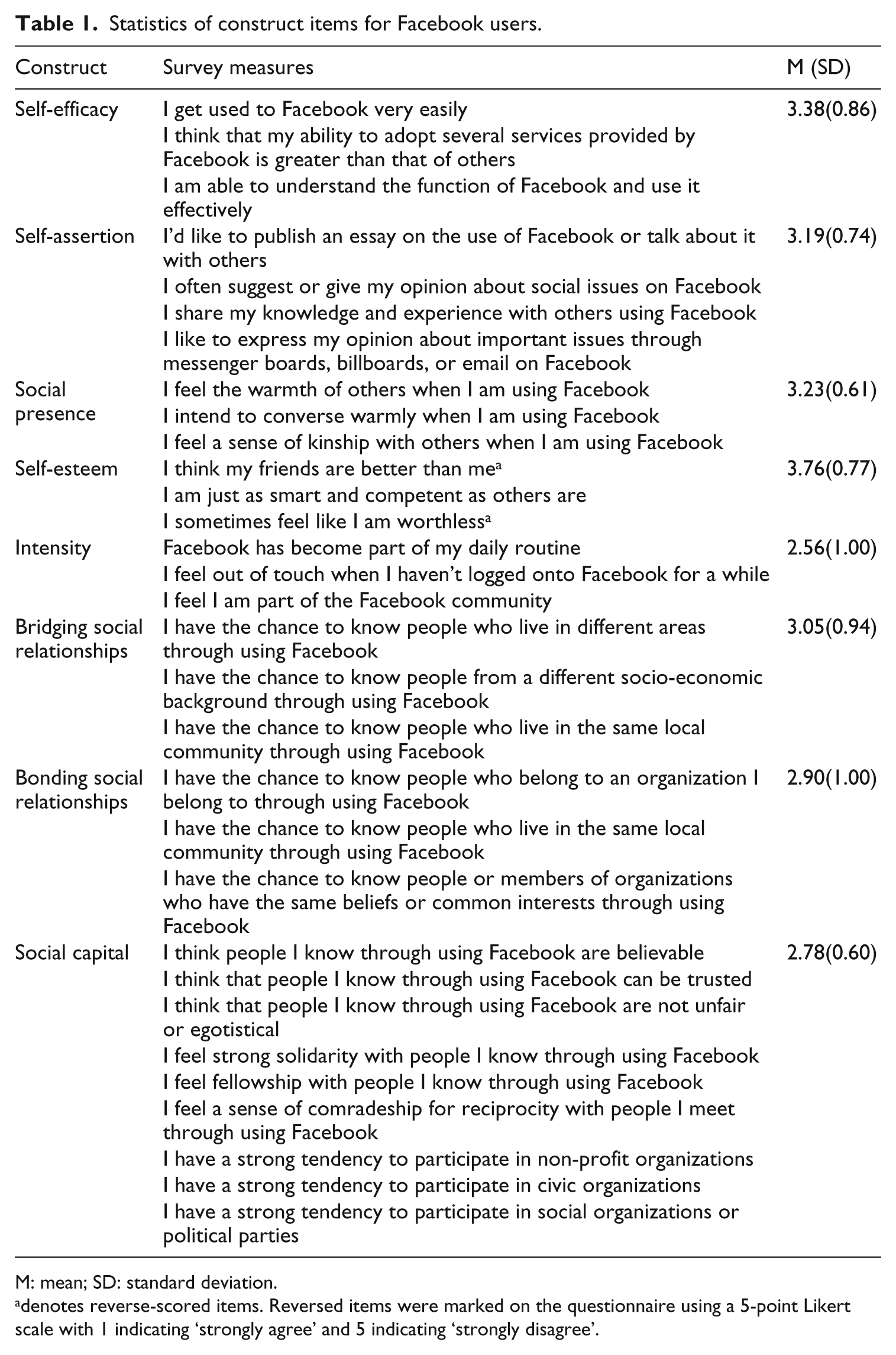
M: mean; SD: standard deviation.
denotes reverse-scored items. Reversed items were marked on the questionnaire using a 5-point Likert scale with 1 indicating ‘strongly agree’ and 5 indicating ‘strongly disagree’.
Data analysis
Assessment of the self-system and social capital measurement model
In order to verify the hypotheses, demographic data were analyzed using a statistical package, SPSS 15.0, and covariance structure analysis was conducted using EQS6b and the maximum likelihood method. The study carried out required procedures for building a structural equation model and assuring model goodness of fit. Normality and sample adequacy were examined in light of Hair et al. (1998), according to which the means of skewness and kurtosis should fall within the range of ±1.96; this study satisfied that condition.
This study assessed convergent validity using Cronbach’s alpha following Bagozzi and Yi (1988) and Hair et al. (1998), and composite construct reliability and average variance extracted (AVE) following Fornell and Larker (1981). Discriminant validity was assessed by comparing the correlation of components to AVE.
As seen in Table 2, the Cronbach’s alpha mean for all concepts is above 0.7. According to Nunnally (1978), the Cronbach’s alpha mean should be 0.6 or higher, so in this respect this study has sufficient reliability (Nunnally, 1978; Sujan et al., 1994). The study’s AVE also satisfies the standard of 0.5 suggested by Bagozzi and Yi (1988) and Hair et al. (1998), which means the measurement indexes satisfy the requirement for convergent validity.
Internal consistency of the constructs.
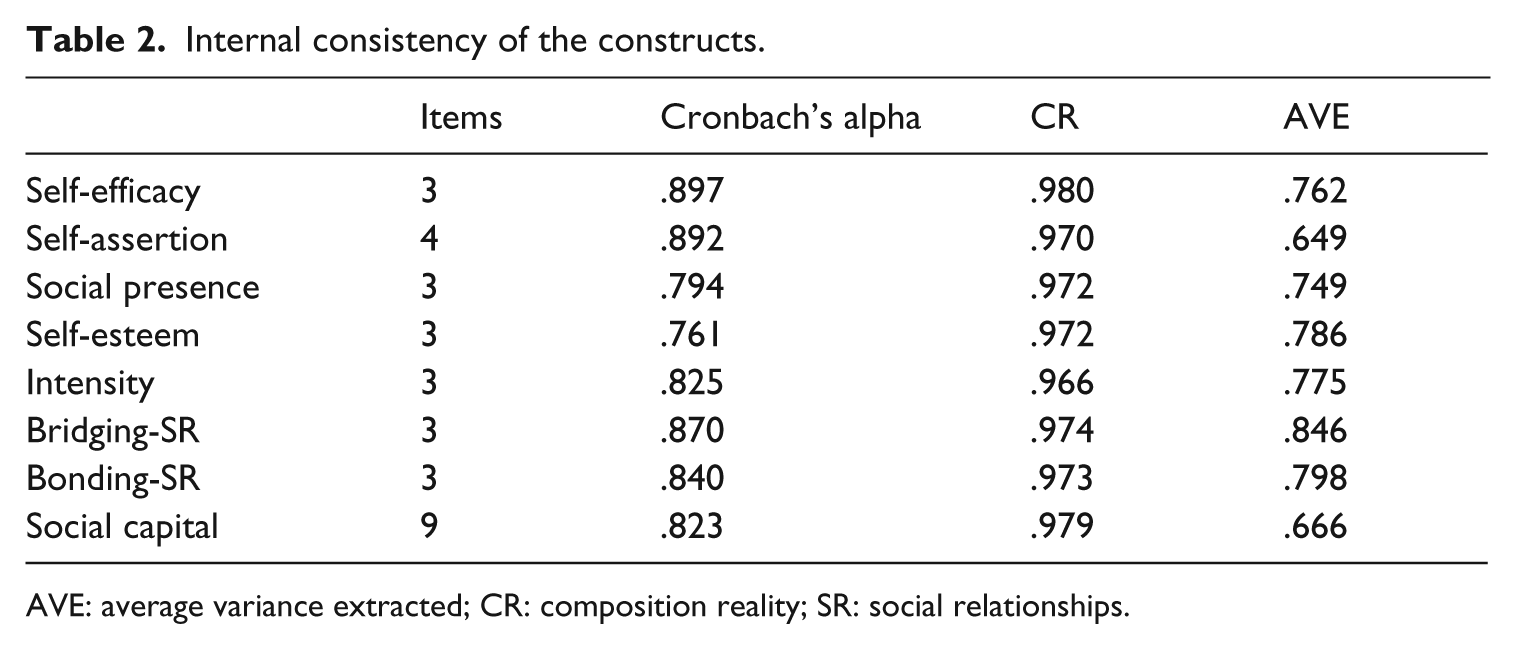
AVE: average variance extracted; CR: composition reality; SR: social relationships.
To verify discriminant validity the AVE of each of the two potential factors was compared with the square of the correlation between the two potential factors. As seen in Table 3, the means of the squares of the correlation coefficients (r2) are smaller than AVE. Fornell and Larker (1981) suggested that AVE should be larger than the means of the squares of all correlation coefficients. The extracted AVE is between .649 and .846, and the means of the squares of the correlation coefficients are between .004 and 592, which results in an AVE that is larger than the means of the squares of the correlation coefficients (r2), also ensuring that the data collected for verification have sufficient discriminant validity.
Analysis of discriminant validity using average variance extracted.
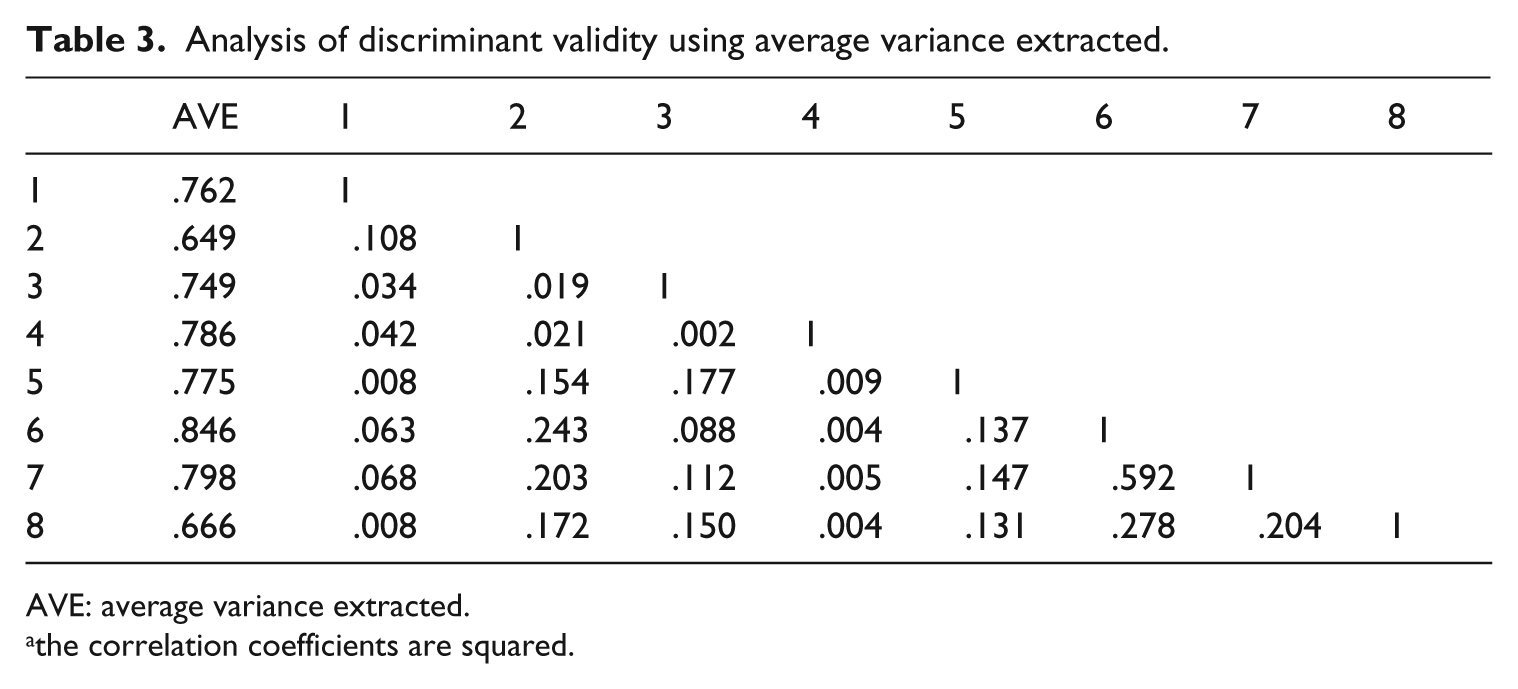
AVE: average variance extracted.
the correlation coefficients are squared.
The results of verifying model goodness of fit are seen in Table 3: χ2=449.3, df=357, and p=.000, while comparative fit index (CFI) =.983, normed fit index (NFI) =.925, and non-normed fit index (NNFI) =.978, which satisfy the advised base values. The goodness of fit index (GFI) =.914, which is slightly above the advised base value of .90, while the adjusted goodness of fit index (AGFI) =.881, which is slightly below the advised base value, but both are expected to be acceptable. Root mean square error of approximation (RMSEA) =.029, which also satisfies the advised base value, between .05 and .08. This is acceptable goodness of fit, which means that the measurement methodology of this study is sufficiently reliable.
Tests of hypotheses
The structural equation model was used to verify the hypotheses associated with the proposed model. As proved previously, hypotheses for this study based on the research model satisfy the advised base values. The goodness of fit of the model hypotheses yielded χ2=(340)=525.9, CFI=.966, NFI=.912, NNFI=.954, GFI=.899, AGFI=.853, standardized root mean square residual (SRMR)=.126, RMSEA=.042, which means that the model’s goodness of fit satisfies the advised base values. It does not meet the requirement of a conservative index of the structural equation model, but it is acceptable enough considering the study’s exploratory character.
To test structural relationships, the hypothesized casual paths were estimated. Eleven hypotheses were supported and one was not supported. The results are shown in Figure 2 and Table 4. The results indicate that self-efficacy is positively related to bridging and bonding social relationships. Both of these proposed paths were significant in the hypothesized direction (self-efficacy, with a standardized path coefficient for bridging and bonding social relationships: γ= .093, p< .07 for H1-1, which is marginally significant; γ= .156, p< .05 for H1-2). Thus, both hypotheses H1-1 and H1-2 were supported.
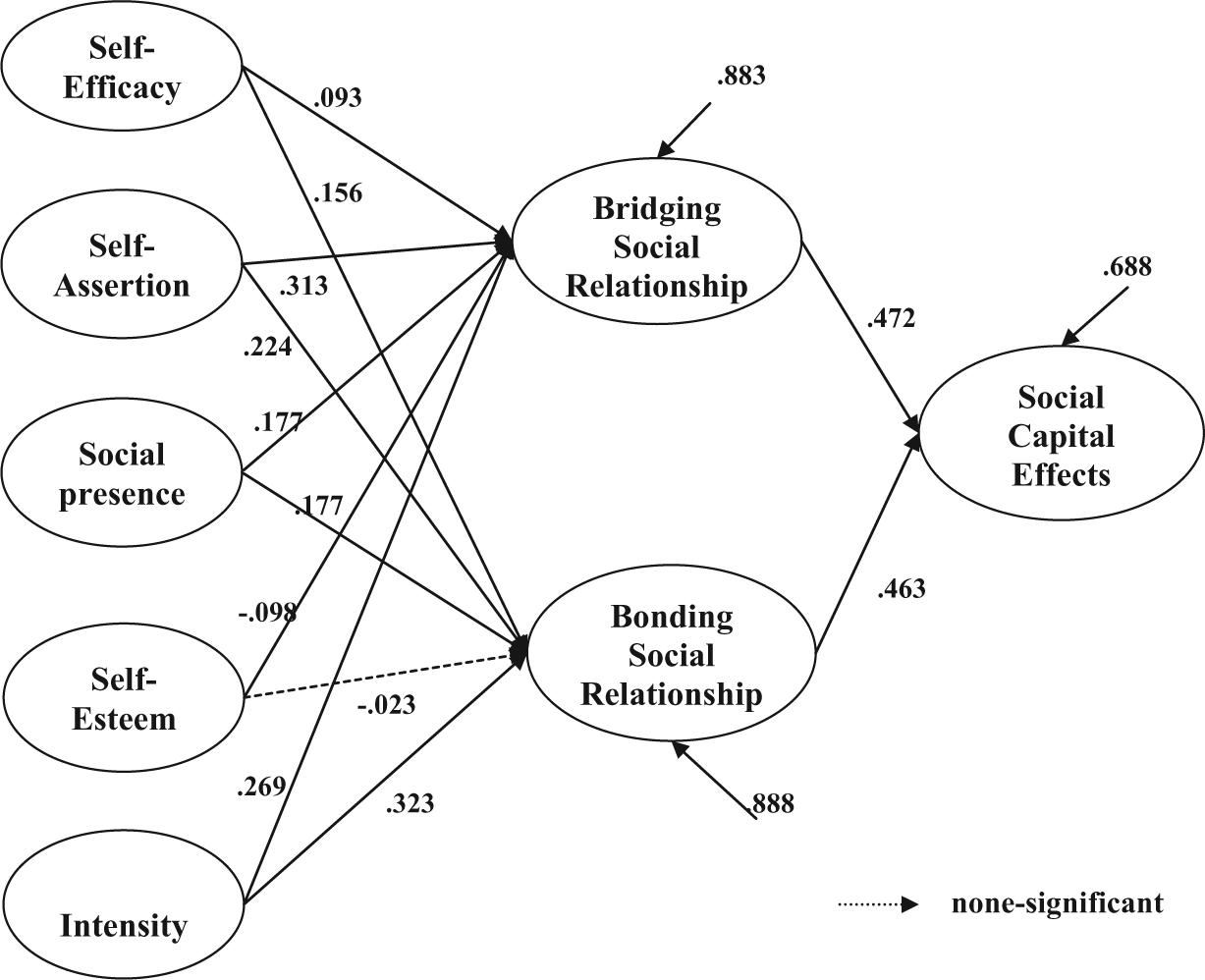
Results of suggested research model with path coefficients.
Summary of hypothesis tests.
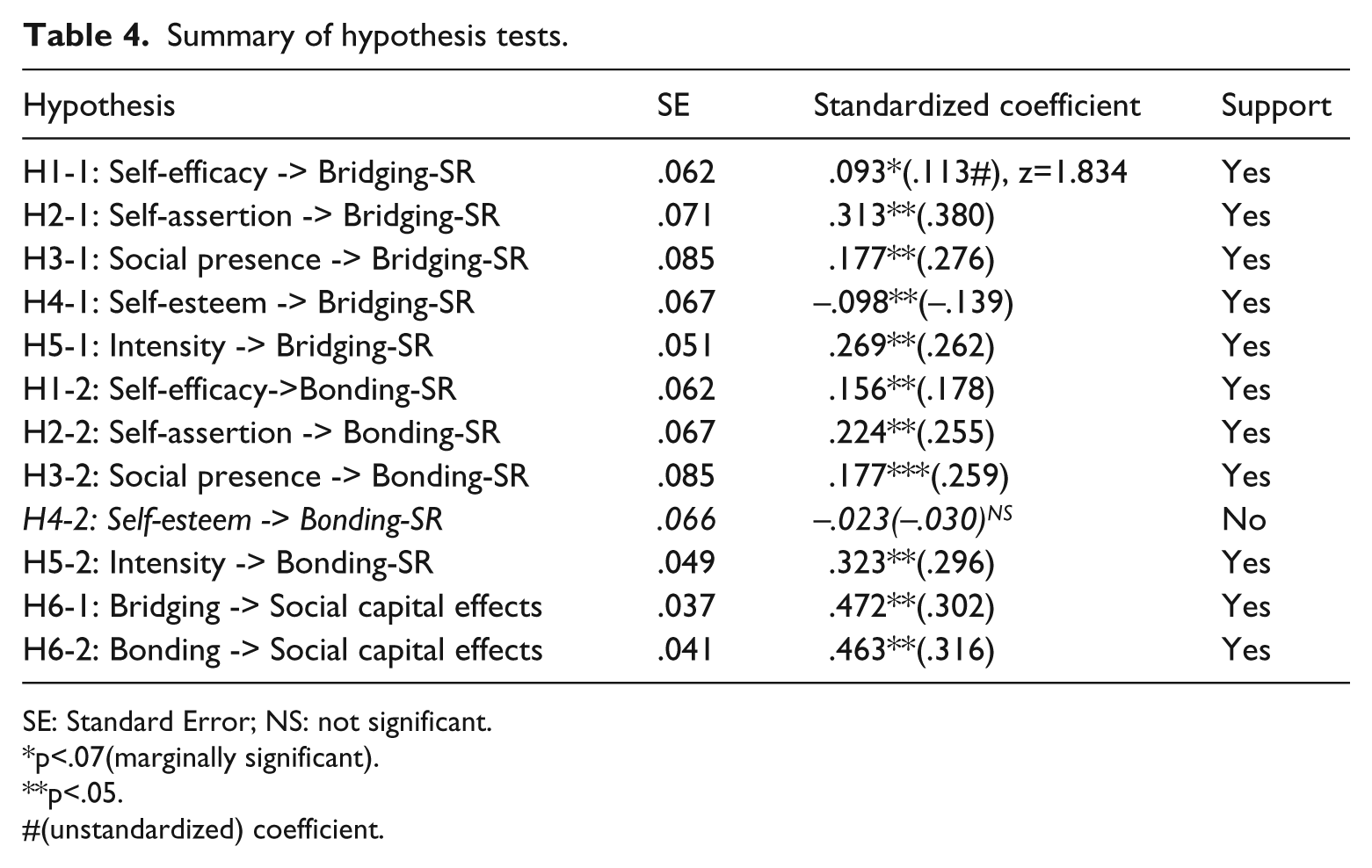
SE: Standard Error; NS: not significant.
p<.07(marginally significant).
p<.05.
(unstandardized) coefficient.
Self-assertion is positively related to bridging and bonding social relationships. Both of the proposed paths were significant in the hypothesized direction (self-assertion, with a standardized path coefficient for bridging and bonding social relationships: γ= .313, p< .05 for H2-1; γ= .224, p< .05 for H1-2). Thus, both H2-1 and H2-2 were supported.
Social presence is positively related to bridging and bonding social relationships. Both of the proposed paths were significant in the hypothesized direction (social presence, with a standardized path coefficient for bridging and bonding social relationships: γ= .177(.276), p< .07 for H3-1, marginally significant; γ= .177(.259), p< .05 for H3-2). Confirmation of H3-1 was marginally significant, while confirmation of H3-2 was significant. Thus, both H3-1 and H3-2 were supported.
Self-esteem is closely related to bridging social relationships but not to bonding social relationships. The proposed path for self-esteem to bridging relationships was significant in the hypothesized direction (self-esteem, with a standardized path coefficient for bridging and bonding social relationships: γ= –.098, p< .05 for H4-1; γ= –.023, p> .05 for H4-2). The relationship proposed in H4-1 was significant, while that proposed in H4-2 was not statistically significant. Thus, H4-1 was supported but H4-2 was not supported.
Intensity is positively related to bridging and bonding social relationships. Both of the proposed paths were significant in the hypothesized direction (intensity, with a standardized path coefficient for bridging and bonding social relationships: γ= .269, p< .05 for H5-1; γ= .323, p< .05 for H5-2). Thus, both H5-1 and H5-2 were supported.
Hypothesis 6 was that, when using Facebook, bridging social relationships and bonding social relationships mediate the relationship between Facebook users’ self-systems and social capital effects. The hypothesis was supported, the results suggesting that bridging and bonding social relationships are positively affected by social capital effects. Both of these proposed paths were significant in the hypothesized direction (bridging and bonding social relationships, with standardized path coefficients for social capital effects: β= .472, p< .05 for H6-1; β= .463, p< .05 for H6-2). Thus, both H6-1 and H6-2 were supported.
Conclusions and discussion
In addition to generally supporting the hypotheses derived from the research model and previous empirical studies, this study also found that some elements or functions of Facebook, when conjoined with users’ self-systems, played a critical role in accounting for the formation and strength of bridging and bonding social relationships. The study also suggests that both types of social relationship mediate the relationship between self-systems and social capital effects.
To summarize the hypotheses tested in this study, self-efficacy had a positive influence on bridging and bonding social relationships, although the path coefficient of self-efficacy on bonding social relationships is higher than the corresponding path coefficient on bridging social relationships. Therefore, when using SNSs such as Facebook (the medium involved in this study), self-efficacy seems to play a more important role in bonding social relationships than in bridging social relationships. Self-assertion plays a more critical role in bridging social relationships than in bonding social relationships where Facebook is involved. Users with higher self-assertion tended to trust and feel intimacy with others when using Facebook than users with lower self-assertion did.
Social presence is closely related to both bridging and bonding social relationships through Facebook use. Users with strong social presence were more willing to trust others and more likely to feel intimacy with others than users with lower social presence were.
The study found a significant relationship between users’ self-esteem and bridging social relationships but did not find a corresponding relationship regarding self-esteem and bonding social relationships. This study also found that users with lower self-esteem are more engaged with bridging social relationships than with bonding social relationships.
Intensity of Facebook use plays a more important role in bonding social relationships than in bridging social relationships. Users who tend to use Facebook frequently, especially when it becomes part of their daily routines, showed a willingness to form bridging social relationships and bonding social relationships.
Both bridging and bonding social relationships mediated the relationship between self-systems and social capital effects. Although stronger bridging social relationships are associated with effective social capital building, bonding social relationships are just as strongly associated with effective social capital building.
Implications and limitations
The results of the study should encourage SNS marketers to identify Facebook users’ characteristics and then to segment consumers accordingly. From an SNS marketing perspective, this study associates Facebook users’ self-systems with the building of social capital and focuses on how bridging and bonding social relationships mediate the relationship between Facebook users’ self-systems and social capital effects. The findings encourage the identification of Facebook users who can be distinguished by the predominance in their personalities of one or another element of the self-system, or have a large number of friends and also wish to express their opinions about or participate in activities related to social issues. Once such users’ personal characteristics have been identified they can become a primary segment targeted by marketing practitioners.
The results of this study suggest that marketing strategy for SNSs should focus on opportunities for SNS users to interact, promoting the development of deeper relationships between customers and firms using SNSs for marketing purposes. The study also proposes a theoretical and systematic model that may be applied in SNS service marketing by examining the effects of individual self-systems on outcomes regarding the behavioral intention to use SNSs and the relationship between the self-system and social capital. Advances in the marketing communication paradigm require consumer-oriented marketing; communication messages containing marketing and creative strategies should be based and built on user characteristics. The study correlated user behavior with various personality traits and motivations to achieve or develop self-identity through SNSs as they interact with other people or participate in society through their participation on these platforms.
According to the results obtained in this research, SNSs could be used as communication channels by marketers to reach their customers with product information and information related to customer service issues. Marketers should also develop tools that accommodate user-generated online content that is adapted to potential and profitable customers, in effect allowing customers to market their products and services. Understanding Facebook users’ self-systems would allow for refined market segmentation depending on the industry involved. An analysis of user behavior could also provide early warning of product or service problems. That is, a marketing strategy that leverages SNS use should use SNSs as a channel for listening to the customer’s voice.
This study was subject to a significant limitation. The study examined how self-systems affect social relations and the social capital effect. It is possible that self-systems co-vary with individual personal differences in cognitive style, personality, or demographic status that influence decision-making and would be relevant to marketing (Zinkhan et al., 1987; Zmud, 1979). Therefore the relationship between personality traits and SNS usage should be studied in greater depth (Amichai-Hamburger and Vinitzky, 2010). Future research should examine how individual differences, for example differences in motivation, impact SNS behavior and outcomes of SNS use. Such research should explore individual differences as independent variables related to information-searching patterns and new technology system usage or satisfaction.
Regarding the sample used in this study, consumer segmentation might not be as representative as it could have been because the sample was drawn from only one region of one Asian country. Furthermore, the data were collected through convenience sampling at several companies, which may have resulted in sampling bias. Therefore, additional studies with appropriate controls are needed to apply these results to theoretical models of media usage behavior.
In addition, as noted above, 10 questionnaires were deleted due to too many missing values or too infrequent Facebook use. An anonymous reviewer suggested that the dropped cases may include high-frequency users, which could lead to sampling selection bias, such that the results of the study may not be generalizable to the entire population. Infrequent users are likely to have very different reasons or motives for accessing Facebook than regular users. SNSs should also be understood and discussed in light of a deeper understanding of user behavior and motivations as they relate to SNS outcomes in future studies. Moreover, media users’ perceptions of traditional media should also be examined as functional aspects of SNSs.
Footnotes
Funding
This research was supported by Kyonggi University Research Grant 2013.
Author biography
References
Supplementary Material
Please find the following supplemental material available below.
For Open Access articles published under a Creative Commons License, all supplemental material carries the same license as the article it is associated with.
For non-Open Access articles published, all supplemental material carries a non-exclusive license, and permission requests for re-use of supplemental material or any part of supplemental material shall be sent directly to the copyright owner as specified in the copyright notice associated with the article.
