







Abstract
This study examines ‘participatory journalism’ from the perspective of participants. Through a series of in-depth interviews with 32 participants from two different participatory journalistic environments set up by professional news organizations, we investigated how participants view and evaluate their participation in journalism. We propose that participants views progress through a series of four stages: anticipation, participation, evaluation and reconsideration. A clear breach is observed between the stage of anticipation and evaluation. We propose that this breach could be couched in terms of both a need and a wish for reciprocity, but also a lack of it. The term ‘reciprocity’ is inspired by Lewis et al.’s notion of ‘reciprocal journalism’ and Loosen and Schmidt’s conceptualization of journalism as a ‘social system’. Implications for the study of participatory journalism and journalism practitioners are discussed.
Keywords
Introduction
Confronted with new technological opportunities, changing habits in news use and decreasing revenues from existing business models, journalism is facing turbulent times. Amidst these developments, a new phenomenon has been on the rise, so-called participatory journalism. The term was coined in 2003 by Shayne Bowman and Chris Willis to capture the widespread idea that digital media could enable the audience to make news themselves, instead of being dependent on professional journalists and news organizations. Over the past decade, many journalism scholars and observers have anticipated that a new type of journalism will come into existence in which the traditional role division between journalists and audience could radically change (Bowman and Willis, 2003; Gillmor, 2004; Rosen, 2006). In other words, participatory journalism puts at stake the definition of journalism and of who counts as a journalist.
News organizations and journalists around the world have been experimenting with participatory journalism. In 2005, for instance, the British Broadcasting Corporation (BBC) launched the discussion platform Have Your Say and a User-Generated Content (UGC) Hub for eliciting audience material. A year later, CNN set up IReport, a platform where the audience can upload material. Around that time, news organizations in the Netherlands, too, set up projects to try out new ways of getting the audience involved. However, many of these projects were short lived.
Over the past decade, a fair amount of research has focused on professional journalists’ and news organizations’ ideas on, and evaluations of, participatory journalism, but relatively few studies have been devoted to the participants’ point of view. If one wants to understand why some projects succeed while many others fail, at least part of the answer should be sought in the perspective of those who take part in these projects: the participants. The aim of this article, therefore, was to further examine how participants view and evaluate participating in journalism.
Literature review
Most research of participatory journalism focuses on professional journalists. Much of this research is based on qualitative interviews and newsroom ethnographies, and suggests that journalists adopt an ambivalent attitude towards audience participation. On the one hand, journalists wish to encourage audience participation: they accept audience comments to journalists’ stories (Domingo et al., 2008; Jönsson and Örnebring, 2011; Örnebring, 2008) and embrace audience material when it yields extra (source) material that enhances their stories (Harrison, 2010; Robinson, 2010; Singer, 2010). On the other hand, journalists adhere to their traditional gatekeeping role (Chung, 2007; Domingo et al., 2008; Karlsson, 2011; Singer, 2010) and discard audience material when it threatens to overthrow existing routines, practices and values (Harrison, 2010; O’Sullivan and Heinonen, 2008; Quandt, 2008; Wardle and Williams, 2010; Williams et al., 2010). In other words, existing research demonstrates that journalists want to remain in ‘control’ over the journalistic process and its output.
This notion of control was further investigated in a recent study of ‘frontrunners’: journalism practitioners who were pioneering with audience participation in a wide variety of participatory projects in Dutch journalism (Borger et al., 2013b). The repertoire analysis of frontrunners’ talk on participatory journalism revealed that they drew from six ‘repertoires’ or ‘vocabularies’ that granted journalists and audience participants specific roles and rights. It was found that, even in the discursive environment set by innovative frontrunners, the dominant repertoires were likely to sustain traditional journalistic patterns and hinder change that tampers with traditional values, role divisions, and practices. This study, thus, further emphasized that for professional journalists, be they editorial staff from mainstream news organizations or innovative pioneers, ‘control’ is key when it comes to participatory journalism.
Apart from participatory journalism research from the professional journalistic perspective, with the proliferation of ‘Web 2.0’ applications, there has been a considerable amount of theorizing on ‘participatory culture’ and the ‘active audience’ (see Van Dijck [2009] for an overview). At the same time, there has long been a commonly held conviction within communication and media studies that people develop media use ‘habits’ (Diddi and LaRose, 2006; Rosenstein and Grant, 1997) that can be very persistent. LaRose and Eastin (2004) find that, when facing new media choices, people tend to fall back onto habitual patterns of media consumption rather than develop revolutionary new ones.
Audience studies of participatory journalism suggest confirmation of the strength of ‘old’ media use habits. Researchers found that the audience appreciates that participatory opportunities exist, but that it only uses these moderately (Bergström, 2008; Chung and Nah, 2009; Hujanen and Pietikäinen, 2004; Larsson, 2011). Some researchers, therefore, propose that it might take time for news users to adapt to the new opportunities (Larsson, 2011).
Furthermore, studies point towards differing participation agendas between journalists and audience. For example, people do not seem intent on making news that serves the common good, but would rather share news of a personal character (Papacharissi, 2007), present their own ideas (Fröhlich et al., 2012) and publicize themselves (Picone, 2011). And instead of participating for democratic reasons, as scholars and media observers hoped people would, people participate to have ‘fun’ and be creative (Bergström, 2008; Hujanen and Pietikäinen, 2004). Finally, it is suggested that participants want to develop their own norms and values regarding news, which can deviate from traditional journalistic norms and values (Robinson, 2010; Wahl-Jorgensen et al., 2010).
These findings prompted our assumption that, even when participants have adapted to the participatory capabilities of new media, the strong tendency among journalists to adhere to professional control could clash with participants’ needs and preferences regarding participatory journalism.
The approach of this study
Three concepts stand out in the literature on participatory journalism: ‘control over process and output by professional journalists’, ‘moderate use of participatory opportunities by the audience’ and ‘differing participation agendas’. Against this background, and given the relative scarcity of audience studies of participatory journalism, the goal of this article is to arrive at a better understanding of how participants view and evaluate participatory journalism. The broad question that drove our study was how do participants view and evaluate participation in journalism? Since studies of the professional perspective so strongly demonstrate that journalists adhere to a notion of control, we were specifically interested in how participants viewed the contacts or relationships that they had with the journalists involved in the projects in which they participated.
It is important here to clarify two aspects of our definition of participatory journalism. First, we interpret the phenomenon as audience participation within the context of professional news organizations. There are several reasons for this demarcation: in a previous literature study on ‘participatory journalism’ (Borger et al., 2013a), two-thirds of the articles associated the phenomenon with the audience participating in professional news organizations, rather than with citizens engaging in journalistic activities outside the scope of professional organizations (labelled ‘citizen journalism’). Furthermore, we suspect that the notion of professional journalistic control can be most strongly felt in contexts in which professional journalists are involved too. Finally, most research of the participating audience has focused on the perspective of bloggers (Tremayne, 2007) and citizen journalists (Reich, 2008), while little is known about those who take part in professional contexts.
The second remark relates to the participatory acts that we range under ‘participatory journalism’. Following Shao’s (2008) analytical framework of user-generated media, this study focuses on participatory journalistic acts of ‘producing’ rather than ‘participating’. Shao’s notion of ‘producing’ involves the creation and production of one’s own content, whereas ‘participating’ comprises acts like ranking and sharing articles. This means that when performing acts of producing, it is much more likely that participants get in touch with professional journalists than when performing acts of participating. Although we adopt Shao’s notion of participatory acts of ‘producing’, in this article, we refer to such acts in terms of ‘participation’, ‘participating’ and ‘participants’. The reason for this is that these and other words that are derived from the verb ‘to participate’ more naturally fit in with common language use. Given the open character of our research questions, we chose to follow an inductive, qualitative approach, based on the principles of grounded theory (Strauss and Corbin, 1998).
Methods
Research setting
The data for this study were collected within two participatory journalistic environments in the Netherlands. The way in which Dutch journalism has been traditionally organized can be considered representative of the North Atlantic (United States and United Kingdom) and Central European (Germany and Scandinavia) situation: journalism in the Netherlands can be labelled ‘highly professionalized’ (Schudson and Anderson, 2009: 93). By means of schooling and journalism degrees, the presence of professional associations, distinct professional norms and codes of ethics, and a public service orientation, a relatively strong distinction between ‘professional “insiders” and paraprofessional “outsiders”’ (Schudson and Anderson, 2009: 94) is constructed.
The choice for the two projects was rooted in our previous repertoire analysis of frontrunners’ talk on participatory journalism (Borger et al., 2013b), and was, thus, the first step in a process of ‘theoretical sampling’ (Strauss and Corbin, 1998). Based on the key importance of ‘control’, we selected two environments that represented opposites in terms of professional control. From both projects, we had interviewed frontrunners in the context of the previous study. For reasons of anonymity, we label the projects Project Expert and Project Hyperlocal.
Project Expert is part of a publicly funded, national news broadcaster. The project started in early 2010 with the goal of getting in touch with ‘experts’ – their expertise gained either through a certain discipline or through experience – among the Dutch population. People can approach the editorial staff on their own initiative, but in most cases, they reply to a request for information put out by the journalists. People are addressed as experts and invited to contribute as such. Once a participant has been in touch with the project’s staff, their contact details and field of expertise are noted in a database that is available for all journalists in the organization. At the time of the interviews, there were over 1000 ‘experts’ in Project Expert’s database.
Project Hyperlocal is a hyperlocal online news network. Its slogan is ‘The latest news from your neighbourhood’. The project is owned by a large, commercial multi-media corporation, and started in early 2010 with the goal of setting up a new, profitable business model for local/regional journalism. People are invited to ‘make their own news’. Once people sign up as a ‘co-writer’, they can post items (footage, text) on the website. At the time of the interviews, Project Hyperlocal consisted of 40 local news communities. Each community is headed by a ‘community manager’, employed by the corporation.
Interviewees
The goal of the interviews was to talk to people who had been active in participatory journalistic contexts. With this main selection criterion in mind, we approached the staff of both projects, on whom we were dependent to be able to contact participants. Both news organizations provided us with a list of people who had been active in their participatory projects.
All the people on the list that Project Expert provided us with were part of the project’s ‘participants database’. Since we wanted our group of interviewees to be representative of the project, we composed a group whose variety in expertise reflected the variety in expertise in the project’s participants database. During our talks with potential interviewees, we found out that some of them had indeed contributed to a news item, and that others had ‘only’ had email correspondence with the project’s editorial staff. The final group of interviewees consisted of nine people who had contributed to a news item and eight people who had been in touch (often more than once) with the editorial staff. In total, 17 participants were interviewed (Table 1); 11 men, 1 6 women; their ages varied from 32 to 60, with most being in their 40s and 50s.
List of interviewees.
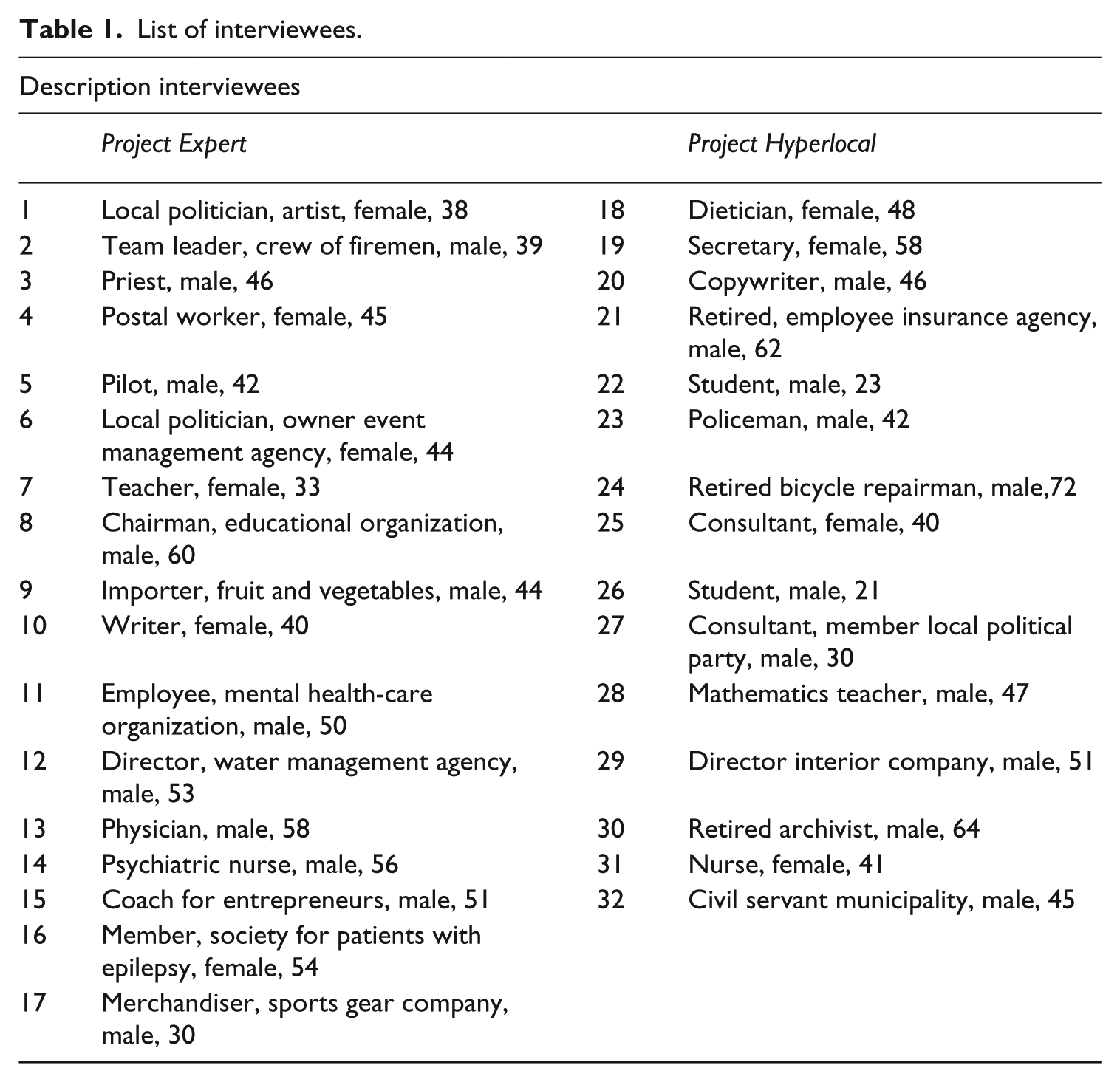
In the case of Project Hyperlocal, the news organization provided us with a list of rather active ‘co-writers’ (they posted items at least twice a month). From this list, we made a selection based on two criteria: a diverse collection of local communities and a diverse collection of topics, reflecting the diversity of the topics on the website. In total, 15 participants were interviewed (Table 1), 11 men, 1 4 women, and ages varied from 23 to 72 years, but most interviewees were in their 40s.
Data sources
Semi-structured interviews
The main source of data was semi-structured in-depth interviews. We developed a set of open-ended questions to have interviewees describe and discuss their participatory activities in their own terms. The goal was to learn as much as possible about participants’ perceptions, observations, thoughts, and evaluations regarding their participation. We avoided using the terms ‘participation’ or ‘participatory journalism’ as these are academic notions rather than words from common language use. We tested and refined the list of interview questions in two pilot interviews (not part of the final dataset). Questions were asked in more or less the same order in every interview.
To make interviewees feel at ease and get a broad idea of their news use, we started each interview by asking them to describe what role news played in their daily lives. Next, we asked about interviewees’ perceptions of the news organization behind Project Expert/Hyperlocal. Third, we asked questions about participation in Project Expert/Hyperlocal. We then posed questions on the importance of Project Expert/Hyperlocal in the interviewees’ daily lives. At the end of each interview, we asked for any other aspects of Project Expert/Hyperlocal or pieces of information that interviewees felt were important. Although we covered the same topics with each interviewee, we also left room to discuss topics that interviewees considered relevant.
The wording of the questions was open and concrete when asking about past experiences (e.g. ‘Tell me about the last time you were in touch with Project Expert/Hyperlocal’), and open and empathetic when asking about evaluations (e.g. ‘Imagine that the organization has hired you as a consultant with the assignment to improve Project Expert/Hyperlocal, what advice would you give?’). The interviews were conducted in private and face to face, and lasted 60–90 minutes. Anonymity was guaranteed at the beginning of each interview. The interviews were audio-taped with the consent of the interviewees and literally transcribed shortly after they had taken place. Once transcribed, the interviews were anonymized, so that interviewees could not be individually identified.
Additional data
Although in-depth interviews were our main source of data, we were able to draw from additional data sources. First, we contacted the interviewees by email the day after the interview to give them the opportunity to add information, to reconsider what they had said or to examine the transcripts. The responses to these emails were incorporated into the dataset as field notes and assisted our interpretation of the interviews. Second, since we had interviewed – among others – frontrunners from Project Expert and Hyperlocal, we were able to benefit from these data as extra context for the interpretation of the interviews with participants.
Analytical procedures
In grounded theory, the stages of data collection and analysis cannot be neatly separated, as they form an intertwined and emergent process (Strauss and Corbin, 1998). Here, we describe how the processes of interview sampling and coding 2 developed. They were driven by notions of ‘theoretical sampling’, ‘constant comparison’ and ‘categorical saturation’ (Strauss and Corbin, 1998). The entire process can be described in five phases.
We started by interviewing five participants from each project. The verbatim transcripts were put through a round of open coding. Once initial ideas had been formed, we probed these further in a next round of interviews: the main researcher interviewed another three participants from Project Expert and two from Project Hyperlocal. During open coding, we coded short segments of data. The result of this coding phase was a messy and detailed list of 210 codes, hardly any less ‘chaotic’ than the raw data themselves (Phase 1).
In Phase 2, students interviewed another five participants from both projects. These additional interviews were analysed and compared to the findings from the first round of interviews. To make the list of codes more manageable, we loosely reorganized the open codes into four main preliminary categories but also kept a close eye on the initial codes.
During the next round of interviews, students interviewed another four participants from Project Expert and three from Project Hyperlocal. In a process of going back and forth between old and new data, gradually a preliminary set of ‘axial codes’ and tentative hypotheses on how the categories related to each other emerged (Phase 3).
At this point in the coding process, a stronger idea of the interpretative framework through which we would come to understand the data emerged, which resulted in a reorganization into a final set of axial codes (Phase 4). The subcategories were further specified per participatory project, depending on the set-up of each project. In this stage, we formulated final ideas on conditions, actions/interactions and consequences linking major and subcategories to each other and translating them into stages of the model. We continued interviewing until we observed a repetition of information, and noticed no new categories emerging. In total, we interviewed 32 participants (Table 1).
In the final stage of the coding process (Phase 5), we developed a central explanatory category – ‘reciprocity’ – integrating the other categories into a theoretical framework, and underlying our interpretation of ‘what the research is all about’ (Strauss and Corbin, 1998: 146).
Results
The data revealed that participants had diverse views and evaluations of participatory journalism, elicited by different set-up and functional structures of the projects. Despite the differences, the data also suggest that participants’ views in both projects progressed through a series of four analytically separable stages: anticipation, participation, evaluation and reconsideration (Figure 1). In the next paragraphs, we discuss the stages of the model and describe the specifics of both projects.
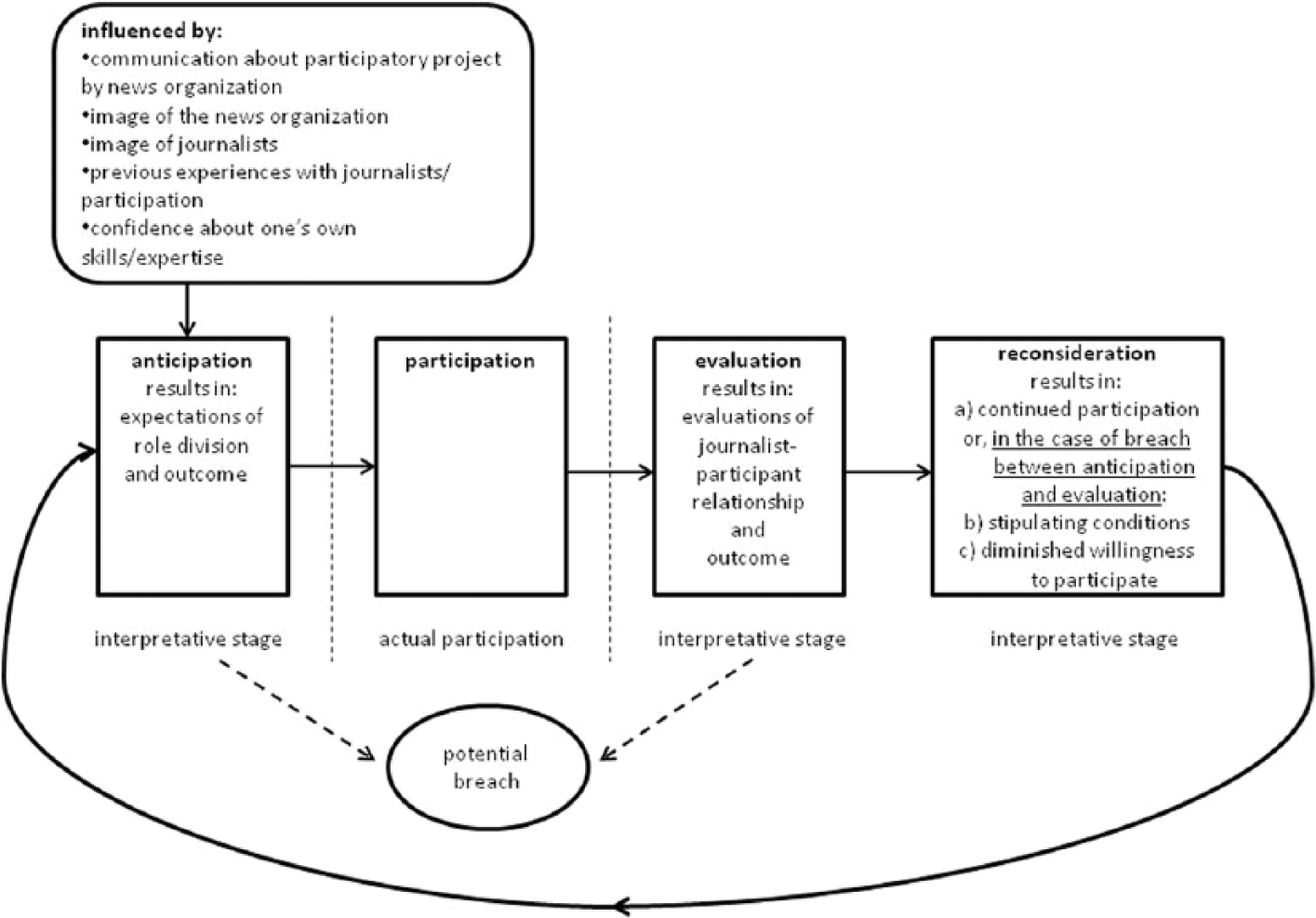
Model of participants’ perspective on participatory journalism.
Anticipation
During the stage of anticipation, participants formed an idea of what participation in the projects would be like. Their expectations concerned two aspects of participation: the role division between themselves and the journalists involved, and the outcome of their participation.
Expected role division
Regarding Project Expert, expectations on role division were, firstly, influenced by participants’ confidence about their own skills and expertise. All interviewees thought that they could make a valuable contribution:
Excerpt 1 – Interview 5 I think I could be a filter for Organization X on aircraft-related news. In the sense that I have certain knowledge that one can’t expect a journalist to have. […] Like, we’re reading this, but let’s check this information with the people from the field. Is this correct? How should we interpret this?
The excerpt illustrates that participants imagined providing journalists with an insider perspective, background information, and in-depth knowledge and expertise from their field. However, they did not feel comfortable with completely taking over a journalist’s role. This, first, had to do with the participants’ image of the journalistic profession: ‘I don’t think I have the capacity to produce a good item. […] There are journalism studies and schools for a reason, you know’ (Interview 7). Interviewees considered journalism a ‘craft’ for which schooling and training were needed. Second, most interviewees adopted a modest attitude towards the journalists of Project Expert, as they highly respected the news organization behind it, a national broadcaster with a long-standing reputation of producing ‘quality journalism’. In numerous instances, interviewees called it a ‘beautiful idea’ (Interview 7) or a ‘great initiative’ (Interview 16) that such a well-known and high-quality news organization was asking ‘ordinary people like them’ for input. In summary, participants from Project Expert expected to act in a role of expert sources, providing specialist input; journalists, skilled craftsmen, were expected to act as newsmakers.
In Project Hyperlocal, previous participation experiences were important in shaping interviewees’ expectations on role division. Many of them had attempted to get material published at other news media, but had come up against brick walls. Now that they had been invited to ‘post your own news’ (project’s website), they wanted to seize this opportunity, without others interfering: ‘I like being in control myself. […] So that you’re sure that it’s read by people without someone else putting his spin on it’ (Interview 27). Considering themselves as newsmakers, participants expected journalists to take up a facilitating role. As one interviewee explained, ‘[Journalists’ task is] managing and delegating. I think her [the journalist’s] job is to … she needs to find news, but she needs to get other people to write about it’ (Interview 22). Others added that journalists should also ‘promote the platform’ (Interview 19) and that it was their task to ‘look for advertisers’ (Interview 23). Put differently, interviewees considered it the journalists’ task to create the preconditions for a participatory environment and to encourage participants to become active in it and make the actual news. They, thus, radically altered the traditional role division between journalists as producers of news and the audience as mainly receivers.
Finally, in both projects, the wording of the communication about the project shaped participants’ expectations: in Project Expert, participants had been addressed as experts from a certain field, and they consequently expected to contribute as such; in Project Hyperlocal, participants had been invited to ‘make their own news’, which they subsequently also expected to do. Participants, thus, took over the role division that the news organizations had proposed.
Expected outcome
In addition to expectations regarding role division, participants formed ideas on what they would get out of participating. Having been addressed as experts from a certain field (often a social or a professional group), the invitation to participate triggered a sense of social responsibility among participants of Project Expert towards the other members in their field. In the following excerpt, a postal worker explains why she suggested that the journalists made an item about ‘social wrongs’ in the postal services: Excerpt 2 – Interview 4 And really, there are things going on that are just unacceptable. Mailmen that have been working for forty years, plodding out in all weathers, and they are set back in salaries, just like that, without mercy, and they get an offer of 21 hours [of work] a week at the most. And these people are breadwinners! […] And then I’m thinking … they should look into this!
This interviewee, like many others, expected to be able to speak up for the co-members of her field. The expectation of getting a voice for their group was rooted in criticism of how their group was usually represented in news coverage. Interviewees described current coverage as lacking nuance, one-sided and as focusing solely on negative aspects. Many interviewees wanted ‘to make things more nuanced’ (Interview 3). They expected that by participating in Project Expert, they could contribute to ‘more representative news coverage’ of their group (Costera Meijer, 2012).
Concerning Project Hyperlocal, expectations regarding outcome were influenced by the website’s invitation to ‘post your own news’, leaving the definition of ‘news’ up to participants. The interviewees were strikingly uniform in the way they interpreted this call for participation. They all expected Project Hyperlocal to be an opportunity to generate positive attention for a certain (concrete) cause: Excerpt 3 – Interview 19 You know, we organize musical evenings at our Church. […] And we’re now trying to give publicity to it, because we want to attract more visitors, to keep doing this. […] So that’s the reason why I started doing this.
Two-thirds of the interviewees wanted to promote an organization (company, political party) or a social club they were part of, about one-third wanted to promote their local surroundings. In short, participants in Project Hyperlocal considered themselves Public Relations (PR) agents who generated exposure for a cause or interest in their immediate context. This goal would most likely not be approved of in more traditional news organizations, like the one behind Project Expert. However, the news organization behind Project Hyperlocal did not consider participants’ PR goals problematic, as the organization’s main goal was to ‘get people active’ (Borger et al., 2013b).
Participation
The stage of actual participation is not an interpretative stage like the other stages of the model, but consists of participants’ participatory acts. Participants in Project Expert reported either having contributed to a news item, or having attempted to do so. Participants in Project Hyperlocal reported contributing rather regularly, certainly when compared with participants from Project Expert. They posted an item whenever there was something new to announce in relation to their organization or club, generally at least twice a month. Thus, participatory acts showed a considerable variation in content, frequency, and duration in time, both between the two projects and between participants.
Evaluation
During evaluation, participants evaluated their participation experiences against the expectations they had had beforehand. Participation was assessed on two points: the relationship with the journalists involved and the results of participation.
Participants from Project Expert mainly talked about their relationship with the journalists involved. A frequent complaint was that the project’s staff members were unresponsive. Note that most interviewees were surprised to have been approached for this study, since they had never received acknowledgement that they were indeed registered as a participant of Project Expert. Others recounted that they had provided input, but had never received a response of any extent, apart from an automated ‘thank you’ email. The following excerpt is typical of how interviewees experienced participation in Project Expert: Excerpt 4 – Interview 3 Yeah, I’m looking for a word here, because I have the experience that journalists want to know everything about you, until the moment of their deadline and after that has passed, you never hear from them again. […] So, yes, it’s like a lost love. Maybe that’s not the right comparison, but it’s that idea, that you suddenly get abandoned again.
Participants, like the one in this excerpt, had expected to be engaged in a co-operative, interactive relationship with journalists, helping journalists with their knowledge and expertise. Put differently, they had expected to contribute to journalism as a process of ‘gatewatching’, in which journalists would harness ‘the collective intelligence and knowledge of dedicated communities to filter the newsflow and to highlight and debate salient topics of importance’ (Bruns, 2008: 5). However, upon getting involved in Project Expert, participants experienced that the journalists changed back into traditional ‘gatekeepers’ (Bruns, 2008), adhering to professional control, closing off the process of news gathering and selecting. As a result, participants, like the one in Excerpt 4, ended up feeling overlooked, and sometimes even used, instead.
In the case of Project Hyperlocal, participants turned out to be very satisfied with their relationship with journalists. There were numerous instances of interviewees emphasizing how responsive the journalists were: ‘Well, normally you never hear anything about it anymore. Little response, in general. But they, yes, we were immediately in touch you know! They responded!’ (Interview 20). Several others made clear that the journalists were not just responsive, but that they also put in extra effort to generate exposure for participants’ publications – in this excerpt by using their own journalistic contacts to get participants’ articles published in a local print newspaper too: Excerpt 5 – Interview 19 So I asked: [if I want to get it published in the local newspaper] where should I send it to? And he [staff member] said like: ‘I’ll send it to them for you. Let me try’. And then I received an email back from him stating ‘well, they’re going to publish it’.
In short, all interviewees appreciated that participation in Project Hyperlocal was a mutual process in which participants provided input and the staff responded. Although interviewees considered interaction to be a matter of ‘common decency’, they acknowledged it as exceptional for journalists to relate to participants in this way, given their previous experiences with the media. This is illustrated by the fact that interviewees time and again took the effort to explicitly report cases of interaction with the editorial staff.
Despite appreciating the relationship with the journalists involved, at the same time, participants were not satisfied with the platform’s quality. Paradoxically, the type of news items that participants uploaded themselves (often content of a positive, promotional kind) was not appreciated when made by other participants. Then, this type of content was suddenly devalued to ‘just a good news show’ (Interview 22). In general, we observed that participants considered themselves as capable of making valuable and interesting news, but did not think that others were. They classified the platform as trivial, unimportant and not urgent, and most interviewees said that they only posted items, but did not read other contributors’ articles. As a consequence, participants doubted that the platform attracted any audience at all. As one interviewee puts it, ‘If I don’t read it [the website of Project Hyperlocal], and I’m someone who posts articles, then you really need to ask yourself how many people actually do read it’ (Interview 19).
Reconsideration
The breach between the anticipation and evaluation stage turned out to diminish participants’ willingness to continue participation in the reconsideration stage. Although participants did not immediately pull out of the projects, they did stipulate conditions regarding future participation.
Participants from Project Expert emphasized that they wanted the journalists to be more responsive. To begin with, when contributing information, participants at least expected a proper reaction. Second, interviewees wanted to be informed about the results of their input – ‘let us know what happens to our contributions’ (Interview 5) – also when input did not lead to a news item. Participants reasoned they could only learn from this kind of feedback so that they could provide better input next time. Third, instead of only journalists having participants’ contact details, interviewees wanted it to be easier to get in touch with journalists, too. One interviewee suggested having a direct phone line installed for the participants from Project Expert to ‘[…] make sure that […] you [the journalists] can be easily reached by the people in this network’ (Interview 5). In summary, participants wanted to be involved in an interactive relationship with journalists, in which journalists and participants were communicating back and forth with each other.
Participants from Project Hyperlocal stressed that only offering a platform was not enough, they also wanted an audience for their contributions. To draw an audience, participants reasoned, contributions needed to have quality. Several interviewees advised the news organization to make participation more exclusive again, to give the platform a quality boost: Excerpt 6 – Interview 18 I would hope that they provided only a selected group of people with an inlog code. You know, if you ask me to upload a recipe, and say ‘here are the inlog codes’, yeah, I get that! It means less work for them. And I get that. But to just let anyone create his own inlog code, yeah, then I think, what’s the added value of that?
Paradoxically, this condition undermined the aspect that participants valued the most, that is, the freedom to produce and publish their own news. However, participants were willing to make sacrifices in exchange for an audience, because, as one interviewee put its, ‘If you don’t have traffic, then what’s the point?’ (Interview 20).
Despite the fact that participants were willing to give participatory journalism in both projects another chance (symbolized by the arrow back to the anticipation stage), we suspect that a continued breach between expectations on the one hand, and experiences and failure to meet participants’ conditions on the other threaten the viability of the projects.
Expecting reciprocity
We propose that the breach between the anticipation and evaluation stage can be couched in terms of ‘reciprocity’. This notion plays a role on two levels: the level of ethics, elaborating on the idea of ‘reciprocal journalism’ (Lewis et al., 2013), and the system level, building on the idea of journalism as a ‘social system’ (Loosen and Schmidt, 2012).
Regarding the ethics level, participants expected to be involved in a ‘reciprocal type of journalism’ (Lewis et al., 2013), a type of journalism that focuses ‘on exchanges of mutual benefit that recognize the contribution of others’ (Lewis et al., 2013: 2). In Project Expert, participants were willing to provide input as sources and, in return, they expected an interactive exchange with journalists in which both their presence and contribution were acknowledged. In Project Hyperlocal, participants emphasized that they were willing to create content for the platform on the condition that their contributions were read by an audience; they also valued interaction with journalists, but here these expectations were indeed met.
Lewis et al. (2013) distinguish three types of reciprocity– direct reciprocity, indirect reciprocity and sustained reciprocity – and we discuss each of these in the light of our findings. Direct reciprocity involves mutual exchanges between individuals (Lewis et al., 2013: 4), either unilaterally (A gives to B or B to A, without the guarantee that something of value will be received in return) or bilaterally (A and B give to each other upon prior agreement). The unilateral kind is considered most effective in building relationships, since its ‘inherent danger’ (Lewis et al., 2013: 5) that acts of kindness are not reciprocated makes it all the more rewarding if they are. Our data suggest that journalists from Project Hyperlocal performed quite high degrees of unilateral direct reciprocity, since participants expressed satisfaction with how journalists related to them. By contrast, journalists from Project Expert performed small degrees of direct reciprocity: participants no longer considered it a potential risk that their acts were not reciprocated, and had come to take it as a certainty. In support of Lewis et al. (2013), we emphasize that developing ‘patterns of responsiveness’ (p. 5), as seen in Project Hyperlocal, is key for building participatory journalistic environments. However, note that the data from Project Hyperlocal suggest that both responsiveness in terms of interaction between journalists and participants (process-reciprocity), and reciprocating expectations in terms of output (output-reciprocity) are equally important.
‘Indirect reciprocity’ refers to patterns of generalized reciprocity within larger networks (Lewis et al., 2013: 6). This works as follows: A gives to B who gives to C; A receives something valuable in return eventually, but does not know from whom. Lewis et al. (2013) term this the ‘bedrock of social networks’ (p. 6). Combining participants’ utterances with insights from our previous study (Borger et al., 2013b), we suggest that indirect reciprocity had not been developed in either of the participatory projects. In both projects, participants were first and foremost engaged as individuals, since they mainly had contacts with journalists (if they had these contacts at all), and not so much as a collective, since they had little dealings with other participants. In Project Expert, the participation process was closed off to ‘outsiders’: participants provided input, which was handled by journalists behind closed doors. In Project Hyperlocal, journalists and participants were involved in direct reciprocity and the infrastructure of the platform provided for visitors to react to participants’ articles, but mutual exchanges between participants were not facilitated or encouraged. This is striking, since such an exchange could be a useful instrument to foster quality control, which would tap into journalists’ concerns about quality in Project Expert (Borger et al., 2013b), and participants’ concerns about quality and related levels of exposure of the platform of Project Hyperlocal.
‘Sustained reciprocity’, finally, develops when patterns of both direct and indirect reciprocity are maintained and re-engaged over time (Lewis et al., 2013: 7), feeding expectations of future interaction and future mutual benefit. Our data suggest that participants were willing to give participation in both projects another chance, but were far from sustained reciprocity in which they would trust in patterns of mutually satisfying exchanges. Participants’ willingness to participate must be considered fragile and subject to a further decrease if participants’ expectations are failed to be met.
Regarding the reciprocity on the system level, in neither of the projects were the expectations between the news organizations and the participants reciprocal. Note that journalism as a social system only functions well if the actors that are part of the system have ‘reciprocal expectations’ of each other’s ‘roles’ (Loosen and Schmidt, 2012). Traditional journalism was such a functioning social system, because expectations of journalists as gatekeepers and audience as receivers were ‘fairly stable and reciprocal’ (Loosen and Schmidt, 2012: 870). Our data suggest that the way the projects were set up by the news organizations elicited expectations concerning role division and outcome on the part of participants, but that these expectations were not met. Project Expert was traditionally designed in that the relationship between expert sources and journalists was transactional, while participants expected it to be interactive. In Project Hyperlocal, the news organization assumed that providing the opportunity to participate was sufficient in itself, but participants expected the organization to safeguard the quality of the output in order to guarantee the presence of a relevant audience. In both projects, participatory journalism as a functioning social system, based on stable and reciprocal expectations of what all actors involved would deliver and receive, did not materialize. We suggest that this is a potential explanation for the failure of many participatory journalistic projects.
Discussion and conclusion
This article complements existing research on participatory journalism: first, given the wealth of studies on the professional perspective and the relative scarcity of audience perspective, it contributes to a more symmetrical study of the phenomenon, and second, the study provides detailed insights into the perspective of participants who participate in professional journalistic contexts. The study shows how the relationship with journalists and the framing of projects may influence participants’ views and evaluations of participatory journalism. It complements previous audience studies in which patterns of moderate use of participatory features were found (Bergström, 2008; Chung and Nah, 2009; Hujanen and Pietikäinen, 2004; Larsson, 2011) by suggesting an additional explanation for not, or no longer, participating: the viability of participatory projects could also be diminished by a need and wish for, but a factual lack of, reciprocity. This article, thus, further emphasizes the value of the notion of reciprocity (Lewis et al., 2013; Loosen and Schmidt, 2012) for the study and practice of participatory journalism.
Please note that this study has two important limitations. First, it was an inductive study whose product was a model, and not a test of a model. Further research is needed to assess its strength. Second, the model presented here does not capture the perspective of participants in all participatory journalistic environments. As we have tried to show, participants’ expectations and experiences of participatory journalism depend on the framing of the contexts in which they take part.
We suggest several directions for further research. The proposed model generates new hypotheses about participatory journalism as well as open questions to be explored. The main hypothesis entails that the chances of success of participatory journalistic projects increase if the journalism in which participants get involved is more reciprocal – pertaining to both the ethics level and the system level. A second path for further research entails the exploration and testing of mechanisms to establish reciprocity on the level of ethics: which tools and principles are effective in which participatory journalistic contexts? The findings from this study suggest that direct responsiveness by (at least) responding to participants’ contributions is an important starting point; second, communicating traffic or visitor numbers could be another, as well as developing systems for quality control (potentially through indirect reciprocity between participants rather than enforced top-down by journalists). Furthermore, we suggest researching social media spaces outside journalism for reciprocity mechanisms, as social networks like Twitter and Facebook flourish on reciprocity (Lewis et al., 2013).
The notion of reciprocity also has implications for journalistic practice. News organizations and journalists tend to approach participatory journalism from their own perspective and to set rather self-serving conditions regarding participation (Harrison, 2010; Singer, 2010; Wardle and Williams, 2010; Williams et al., 2010). We suggest that approaching participatory journalism through the lens of reciprocity could be a starting point for approaching it from the vantage point of participants as well.
Footnotes
Acknowledgements
The authors thank Diana Kreemers and students of the VU journalism master’s 2011–2012 for contributing to this research.
Funding
The study is part of the research project ‘Rethinking Journalism in the Digital Age’, financed by the Stimuleringsfonds voor de Pers and conducted under the auspices of Prof. Dr Irene Costera Meijer, The Network Institute and LCC at the VU University of Amsterdam.