







Abstract
This study describes the structure of the international Facebook friendship network and its determinants using various predictors, including physical proximity, cultural homophily, and communication. Network analysis resulted in one group of nations, with countries that bridge geographic and linguistic clusters (France, Spain, United Kingdom, and United Arab Emirates) being the most central. Countries with international Facebook friendship ties tended to share borders, language, civilization, and migration. Physical distance, shared hyperlinks, use of common websites, telephone traffic, cultural similarity, and international student exchange were either weakly or not significantly related to international Facebook friendships.
Keywords
As of 2013, over 2.7 billion people have used the Internet (International Telecommunication Union [ICT], 2013). It has become available worldwide and has driven the globalization of social, political, and economics. Individuals use the Internet to access social network, entertainment, and education or information websites. Irrespective of time, space, or linguistic barriers, the convenience of the Internet and the expansion of “Web 2.0” services connect individuals to a global community.
Web 2.0, the second generation of digital services, encourages bilateral communication through the World Wide Web (Ryan, 2010). Its flagship product, Social Network Services (SNSs), encourages peer-to-peer sharing online. SNSs emerged in the late 1990s (boyd and Ellison, 2007). These early SNSs included Sixdegrees.com, LiveJournal, Korea’s Cyworld, LinkedIn, and Friendster. SNSs became mainstream in the early 2000s with a multitude of web services catering to niche audiences. Originally serving college students, Facebook grew popular first in the United States and then expanded worldwide.
Ten years after its launch, Facebook has the second greatest traffic of any website (Alexa.com, 2015), with over 1.44 billion monthly active users worldwide (Facebook.com, 2015b). Facebook’s mission is to “make the world more open and transparent … by giving individuals greater power to share and connect” (Facebook.com, 2015a). Internet users from most countries can access Facebook, except those with instituted government bans. Currently, China, Iran, and North Korea blocked Facebook. Bangladesh, Egypt, Pakistan, and Syria have enforced temporary bans on Facebook to discourage political activism and unrest (Kirkland, 2014).
For most users, Facebook and other SNSs support offline social relationships (boyd and Ellison, 2007; Pempek et al., 2009). Users connect and share content through a collection of “friends.” Each Facebook friend is linked to a user by accepting a “friend request” to gain access to the other’s online profile. On this profile, users can publish information, pictures, or media online for their “friends” to access. Through a user’s “friends-of-friends,” the median Facebook user can reach around 31,000 others (Hampton et al., 2012). Using SNSs, the average user has the potential to access and maintain relations with geographically dispersed individuals. Aggregating these relations tie countries together, creating an interconnected global social network.
International Facebook research
Recently, there has been considerable research on SNSs that examine the psychological and behavioral effects on individual users. This study focuses on international communication. Thus, most prior research is not relevant to this article. Studies on international SNSs are typically focused on the cultural differences between social media users. For example, research suggests that Americans are more concerned with privacy than Indians, which may result in less online disclosure (Marshall et al., 2008). Online social patterns may also correspond with cultural similarity such as individualistic or collectivistic tendencies (Cardon et al., 2009). In addition, some suggest SNS users from collectivistic cultures tend to have more online ties with users they have never met (Marshall et al., 2008). Somewhat related, individualistic SNS users may have more ties with people they do not know (Rosen et al., 2010). In addition, SNS users from the United States, India, and Turkey tend to have many online friends, while users from France, China, Israel, and Sweden tend to have fewer online friends (Cardon et al., 2009).
Many of these cross-cultural SNS studies examined cultural differences across SNS websites. Korea’s Cyworld and China’s qq.com are popular SNSs that researchers study for cultural differences (Ji et al., 2010). But because SNSs have different social goals, users, and functions (information, economic, or social), researchers may be confounding cultural differences with web features. This article examines international friendships across one SNS, Facebook. Although SNS usage patterns may be different across cultures, the features of Facebook are the same across countries.
Forming international SNS links
When an individual connects to someone from another country, a micro-level transnational tie is created. Instead of examining patterns of individual SNS users (Nash, 2010), the sum of individual transnational ties can be aggregated to measure the relational strength between two countries. This article tests various predictors in their ability to explain online ties between countries. Because offline relationships and Facebook friendships are related (boyd and Ellison, 2007; Pempek et al., 2009), examining offline international ties may help explain the global structure of computer-mediated relationships. We identify three groups of variables that may facilitate online ties between countries: (1) physical proximity, (2) cultural homophily, and (3) communication flows between countries. These predictors are commonly used to describe and predict computer-mediated international communication (Aiello et al., 2012; Barnett, 2001, 2012; Barnett et al., 2001; Barnett and Choi, 1995).
Physical proximity
On Twitter, there was regional clustering of Twitter communities when individual mobility patterns were measured at the national (Hawelka et al., 2014) and international levels (Takhteyev et al., 2012), as well as for aNobii.com, a book-focused SNS (Aiello et al., 2010). Individuals who are physically closer are more likely to interact and form friendships (Festinger and Kelley, 1951). Proximity has also been used as a predictor of friendship through social relationships between middle-aged individuals (Johnson, 1989), e-mail exchanges of college students (Marmaros and Sacerdote, 2006), and Facebook friendships between international residents (Nash, 2010). Physical proximity between countries is often measured through common borders or great circle distance between capitals. Great circle distance is the shortest route between two points on the globe, measured using an arc rather than a straight line. Nash (2010) indicated that a common border is a good geographic predictor of individuals’ international Facebook friendships. These individual-level trends may be generalized to a country’s total international SNS ties, leading to Hypothesis 1a and 1b:
H1a, H1b. Countries that are geographically closer through (a) common borders and (b) the physical distance between capitals are more likely to share international SNS links.
Cultural homophily
A second explanation for online international friendships may be cultural homophily. Homophily is the attraction between actors due to the similarity of shared attributes (McPherson et al., 2001). The relation between actor similarity and the amount of communication between two actors increases in a recursive fashion. Cultural homophily describes the similarity of attributes due to a shared system of beliefs, attitudes, or cultural traits. Although homophily can be measured using one attribute, the usefulness of the theory is its ability to combine the effects of two or more variables (Monge and Contractor, 2003). Homophily functions as a multiplex relation, with more the types of relationship ties, the greater the cumulative homophily (Fischer, 1982).
Cultural homophily can be examined using objective or official data. Objective homophily attributes are observable and relatively unchanging shared traits between actors (Rogers and Bhowmik, 1970), such as gender or race. Cultural homophily can also be measured more subjectively. Subjective homophily is the degree of shared similarity of less observable traits (Rogers and Bhowmik, 1970), including attitudes, beliefs, and values. We measure cultural homophily through (1) shared language, (2) shared civilization, and (3) Hofstede’s (2010) cultural dimensions because these data are readily available.
Language
One objective attribute of cultural homophily is shared language. Individuals who speak the same language are more likely to be culturally similar and interactive. Language similarity across nations may also predict international SNS friendship ties because SNSs use common languages (Aiello et al., 2010, 2012; Takheteyev et al., 2012):
H2a. Countries that speak the same language are more likely to share international SNS links.
Civilization
Friendships between individuals are often formed from value and status (similarity of class or power) homophily. Civilization homophily, a form of subjective homophily, often dictates national relations. Civilizations are cultural entities composed of smaller, unique communities grouped by a unified identity, often corresponding to race and belief systems (Huntington, 1996). They endure over time and evolve as conflict modifies national boundaries. Civilizations are not governments, but cultures, composed of a collection of political entities, rather than a single state.
Experts have disputed the number of civilizations in the world. Cardon et al. (2009), for example, found differences in SNS use across culture clusters, such as Confucian Asia, the Middle East, and Nordic Europe. Huntington (1996) describes nine civilizations: Western, Latin American, African, Islamic, Sinic (Chinese), Hindu, Orthodox (the former Soviet Union), Buddhist, and Japanese. His classification of civilizations has been used in research on international relations, such as the structure of global telecommunications (Barnett, 2001) and e-mail networks (State et al., 2013).
Individuals with shared membership in a civilization are more likely to interact and form relationships. Subjective homophily, as indicated by membership in the same civilization, may predict international ties between countries, even if they are geographically distant and speak different languages. Countries with civilization homophily share an underlying cultural identity, which may facilitate offline and online relationships:
H2b. Countries from the same civilization are more likely to share international SNS links than those from different civilizations.
Hofstede’s cultural similarity
Another set of indicators of subjective homophily is Hofstede’s dimensions of culture (Hofstede and Minkov, 2010). Hofstede assigned each country a numeric value on a number of dimensions based on cultural differences in attitudes, beliefs, and behaviors. The dimensions are power distance (PD), individualism versus collectivism (IDV), masculinity versus femininity (MAS), uncertainty avoidance, pragmatic versus normative (PRA), and indulgence versus restraint (IND). PD is the amount that less powerful citizens accept unequal power relations (Hofstede et al., 1997). For example, Germany is in the middle on this dimension. Arab countries are high and Austria is low; Germany does not have a large gap between the wealthy and the poor and has a strong belief in equality. Germans have the opportunity to rise in society. IDV is a scaled continuum with two poles of individualism, “a situation in which people are supposed to look after themselves and their immediate family only,” and collectivism, “a situation in which people belong to in-groups or collectivities which are supposed to look after them in exchange for loyalty” (Hofstede et al., 1997). MAS is a bipolar scale with the success and monetary gain at one end and quality of life and relationships at the other end. Countries with high MAS value masculine ideals, while countries with low MAS value feminine ideals.
Uncertainty avoidance is the amount of flexibility citizens have in dealing with ambiguity. Countries with rigid belief systems have higher uncertainty avoidance than countries with relaxed ideals (Hofstede, 2010). PRA measures the amount that a culture attempts to explain about the world (Hofstede and Minkov, 2010). Low-scoring normative countries on the PRA scale value tradition, expedient results, and attempts to explain the world. High-scoring pragmatic countries adapt traditions to fit context, believe the truth is situational, and save for the future. IND is the final dimension with indulgence and restraint representing two poles on a continuous scale. High-scoring indulgent countries allow for “free gratification of basic and natural human drives,” while low-scoring restraint countries value “strict social norms” (Hofstede, 2010).
Hofstede’s cultural typology has been used as a framework to explain cross-cultural differences and generalizations (Au, 1999). Hofstede’s dimensions have predicted the web’s structure (Barnett and Sung, 2005) and helped to describe cultural differences across SNS platforms (Ji et al., 2010; Marshall et al., 2008; Rosen et al., 2010). This study examines the combined effects of the six dimensions as the third measure of cultural homophily:
H2c. Countries that are more culturally similar are more likely to share international SNS links.
Research supports the predictive power of cultural homophily and friendships in social and computer-mediated relationships. Shared demographics, such as ethnicity, age, religion, and country of origin, predicted friendship on Myspace.com (Thelwall, 2009). Across time, homophily tends to increase between pairs that remain friends (Kandel, 1978). Also, offline friendships that dissolve are related to decreased homophily over time (Noel and Nyhan, 2011). The second hypothesis addresses the predicted relationship between the three measures of cultural homophily and SNS ties:
H2. Countries that are more culturally homophilous (shared language, civilization, and cultural similarity) are more likely to share international SNS links.
Communication
The flow of communication, or the exchange of online and offline information between actors, is essential to the formation of relationships. We suggest three communication factors that may predict international friendships: migration, telecommunication, and international student flow. Although there are many other predictors, such as airline travel frequency (Takhteyev et al., 2012), these factors were selected based on their ability to describe different types of communication, such as face-to-face interactions or contacts through the telephone and the Internet.
Migration
Globalization has encouraged international migration through social, political, and economic processes (Castles et al., 2014). After relocating, migrants form new social ties while retaining transnational relationships. Although some migrants may not have access to telecommunication technologies, migrants serve as cultural bridges, spurring international communication (Castles et al., 2014). Migration has also been used to test tourism patterns (Weber and Zagheni, 2013) and international Internet flows (Barnett et al., 2001):
H3a. Countries exchanging more migrants are more likely to share international SNS links.
Telecommunication
Advances in global telecommunication technology have lowered the cost of international telephone calls and expanded online communication. International telephone use connects people across the globe (Barnett, 2001, 2012), especially between migrants and their kin (Vertovec, 2004). Because frequent telephone use often indicates friendships between individuals (Wellman and Tindall, 1993), telecommunication may also explain SNS friendships. Online international communication flows and networks have been measured through country hyperlinks, bandwidth capacity, and shared website use (Barnett and Park, 2014). A hyperlink is the capability enabling a website to link seamlessly with another. Shared website use is the overlap among nations for a set of websites, measured by the percentage of specific website’s traffic from individual countries. International relations based on shared telephone and Internet communication lead to Hypothesis 3b, 3c, and 3d:
H3b, H3c, H3d. Countries with greater international (b) voice traffic exchange, (c) shared website use, and (d) hyperlink exchanges are more likely to share international SNS links.
International student exchange
Nations that host many international students often become international student hubs. While some students form friendships with individuals from the same country while studying abroad, most international students make friends with the host population (Hendrickson et al., 2011). The global system of international student exchange also leads to communication flows between countries (Barnett and Wu, 1995; Chen and Barnett, 2000). International student flows are stable, with the United States and Western European countries attracting many international students (Chen and Barnett, 2000). These cross-national friendships facilitate international communication flow that may also predict SNS ties:
H3e. Countries exchanging more international students are more likely to share international SNS links.
These three factors are not mutually exclusive. For example, migration and patterns of telephone use have been shown to correlate with other global communication networks (Barnett et al., 2001; Vertovec, 2004). While many of these international relationships are formed offline, they are maintained over Facebook or another communication technology. The specific hypotheses described above suggest the third general hypothesis:
H3. Countries with more bilateral communication through migration, telecommunication, and student exchange are more likely to share international SNS links.
Method
Measures
International SNS links
The dependent variable, international Facebook ties, was taken from Newman (2012) who obtained the data directly from the company and included data for 218 countries. She describes the data as rankings between countries based on the number of Facebook friendships between countries. Based solely on a visual inspection of the data, she concluded that immigration and economics seem to predict country connections. Also, strong Facebook ties exist between nations and their former colonies, whose linguistic, cultural, and economic ties remain.
It is unclear from Newman’s description exactly what is meant by a user’s country. Is it where they live or their country of origin? Or, is it the country where they posted on Facebook? Furthermore, the obtained data are limited. Only five ties for each country are reported, which represented each country’s five most numerous international Facebook friends. The data do not include the actual number of ties between countries. Instead, they represented a binary relation (0 = no relation, 1 = a top-5 rank). Access to only the top-5 ties does not account for the great variety of the less frequent ties that the countries may have with additional nations. For example, while the United States accounted for 22.3% of Facebook visitors, India accounted for 8.1% of Facebook visitors; Brazil, 3.9%; Germany, 3.3%; and the United Kingdom, 3.2% at the time of the data collection. These countries have the same number of ties as those that account for a very small percentage of the site’s users in this data set. Despite the limitations of the Newman data, they have successfully been used by Deutschmann (2015) to examine the global structure of transnational human activity and to reject the notion that socio-technological trends lead to the “death of distance.”
Recently, there has been discussion about the reliability of data from the Facebook company, such as this study’s data (Marini, 2013). While we share this concern, it should be noted that unreliability only limits the strength of the variable’s relationships, assuming, of course, no systematic bias in the data. Thus, the viability of these data rests on its predictive validity.
Physical proximity
Physical proximity between countries is measured as the circle distance between capitals (Eden, 1997) and the presence or absence of a common border for each country. The authors coded the later indicator. Island states, such as Australia, are coded with no common borders.
Cultural homophily
Cultural homophily is measured through shared language, civilizations, and Hofstede’s cultural similarity. The measure for language is a binary relation of shared official language for each pair of the countries (Central Intelligence Agency [CIA], 2013). If there are multiple official languages, each language was included.
The measure for shared civilization is gathered from Huntington’s (1996) categorization of “major civilizations” in the world (pp. 26–27). Japan was grouped with the “Sinic” nations. Member countries of each civilization have a binary relation. Many countries in Huntington’s typology are “cleft countries,” with a significant portion of a country’s population belonging to multiple civilizations. If a country had more than one shared civilization relation, both were coded. India, for example, is considered an Islamic and Hindu nation and was coded for all relations with Islamic/Hindu countries. Israel was the lone country not belonging to any of the coded civilizations.
Hofstede’s cultural similarity is measured using six cultural dimensions listed for each country (Hofstede, 2010). Each of these dimensions is scaled from 0 to 100 for the countries included in the sample. Twenty of the countries were missing one or both PRA and IND measures and were mean-filled. The six dimensions were then pre-multiplied by their transpose to create a matrix of the relations across countries. In this matrix, cultural similarity ranged from 3318 to 31,942.
Communication
Communication is measured through migration, telecommunication, and international student exchange. Data on migration (United Nations, 2013) include the number of a country’s incoming migrants from each other country. The data vary from 0 to 7,115,700 migrants. Twenty-seven of the countries have no available migration data; they were coded as “0” for all incoming migrants from other countries. Telecommunication flow is measured through three independent measures: voice traffic, website use, and hyperlinks. International telephone traffic data were taken from Barnett (2012), who mined data from TeleGeography (2010). Countries’ shared website use was acquired from Alexa.com based on the percentage of website users from each country over 3 months in 2011 (Barnett and Park, 2014). Hyperlink connectivity of country domain names was collected in 2010 from Yahoo.com using LexiURL searcher (Barnett and Park, 2014). International student exchange was gathered from United Nations Educational, Scientific and Cultural Organization (UNESCO)’s (2008) Statistical Yearbook data on post-secondary students’ country of origin and foreign study. It varies from 0 to 103,968 students shared between countries. All data are available from the authors upon request.
Data analysis
The data were analyzed using two methods: network and correlation/logistic regression analysis. The network analysis contains 218 countries to describe Facebook’s international network. The statistical analyses used only 97 countries to predict international SNS links due to the lack of available data across measures. Those excluded from analysis were peripheral countries.
Network analysis
Network analysis examines structures and the relations between actors or “nodes” in a system. Gephi (Bastian et al., 2009) was used to visualize the network of international Facebook friendships. UCINET (Borgatti et al., 2002) was used to calculate a number of network statistics to provide a robust description of the Facebook network. In-degree centrality counts the number of links directed toward a node. Out-degree centrality was not calculated because all countries had five directed ties to other nodes. Betweenness centrality measures the amount a node serves as a bridge that other nodes must go through to reach the other nodes (Scott, 2000). Eigenvector centrality represents a node’s centrality based on the overall structure of the network (Bonacich, 1972). Eigenvector centrality takes into account the positions of a node’s contacts such that its centrality increases relatively if it is tied to more central nodes. Finally, a triadic census was performed. It accesses whether two nodes are connected to a shared third node (Wasserman and Faust, 1994).
Statistical analysis
Statistical analyses were conducted in R (R Core Team, 2013). For each measure, the data were stacked into vectors with 9312 relations, the total number of possible bilateral ties. These vectors were used to calculate correlations and three logistic regression equations to predict international SNS links. Because of the sparseness of the Facebook network (density = 0.038), the likelihood ratio (LR) χ2 test was used for model fit (Cohen et al., 2013) and Wald’s χ2 to access the significance of individual predictors. This LR and Nagelkerke’s R2 tests were calculated using the “rms” package (Harrell, 2014). Nagelkerke’s R2 compares the significance of goodness of fit between models. While the pseudo R2 index has been appropriately adjusted so that “the maximum value it can attain is 1.00,” it should not be confused with effect size and the ordinary least squares (OLS) R2 measure (Cohen et al., 2013). The test compares the significance between models as a function of its deviance, as opposed to the variance in linear models.
Results
Network description
The international Facebook network is sparse (density = 0.038) due to the limited available data, which includes only five relations for each country. There were 828 links in the network, of which 25.4% were reciprocated and 74.6% were one-way. Also, it is composed of a single component. Both hierarchical cluster analysis and the Girvan–Newman algorithm (Girvan and Newman, 2002) failed to find any clusters or communities in the network. Although group detection was performed using Blondel et al.’s (2008) algorithm, nine subgroups were identified. They are similar to the geographic clustering presented in Figure 1, which presents the network with the countries physical locations. Location is indicated by the node’s shade of gray. The United Kingdom lies in the center of the network, with France below and Spain slightly to the left. The Democratic Republic of Congo was also central connecting French- and English-speaking countries in Europe and Africa. The United Arab Emirates (UAE) and Saudi Arabia served as bridges connecting Asian and Arab countries.
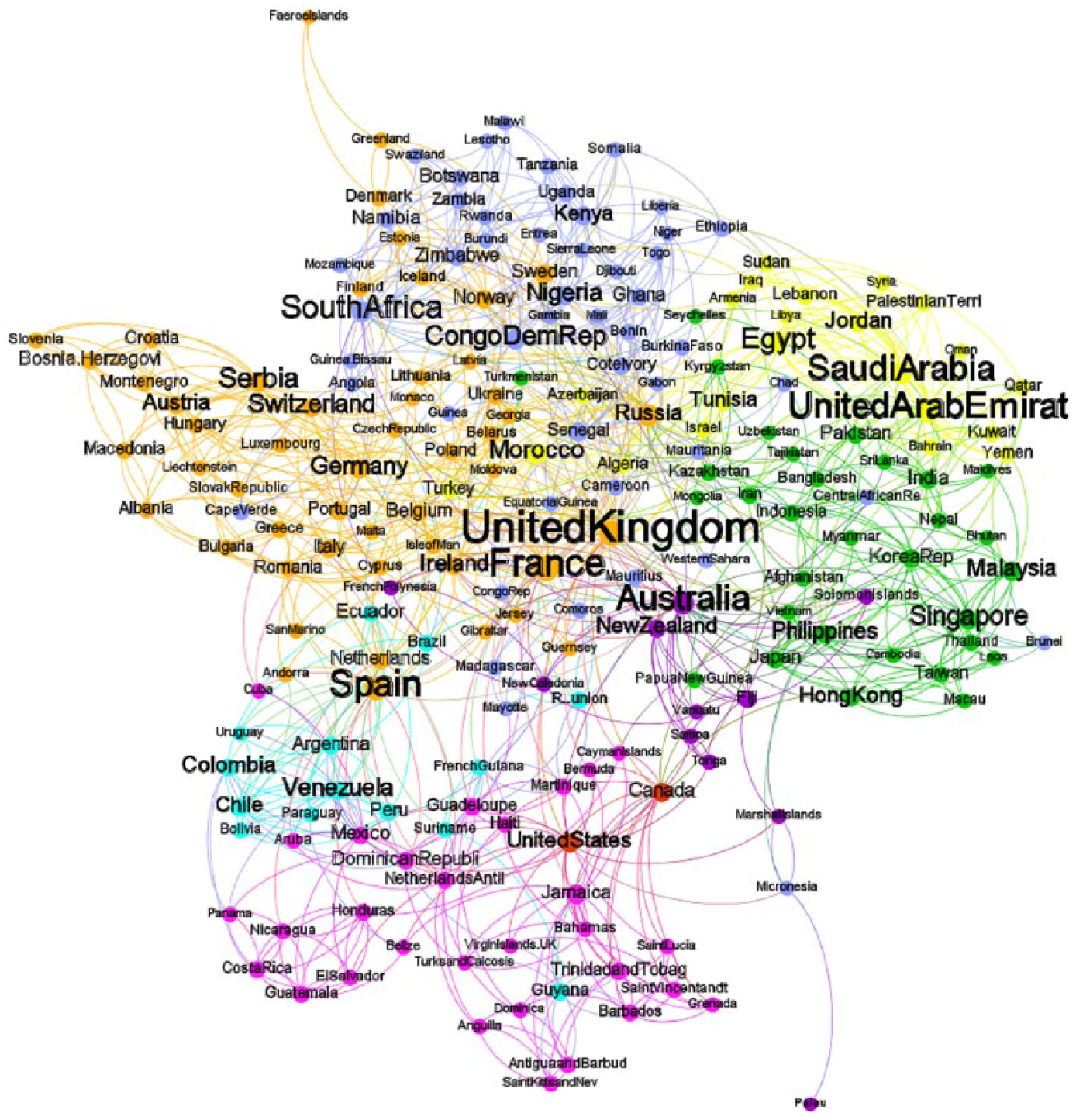
International Facebook Network (N = 210). Label size represents degree centrality; the larger the label, the more central the country. Lines indicate Facebook ties between nations.
These central nations are also evident in measures of degree, eigenvector, and betweenness centrality. France (35), United Kingdom (31), Spain (26), and UAE (25) have the most inward degree links (M = 4.76, standard deviation [SD] = 5.76). France (37.13) has the highest eigenvector centrality, followed by United Kingdom (33.56), UAE (26.92), Australia (25.00), and Saudi Arabia (24.44) (M = 7.99, SD = 5.28). Betweenness centrality is greatest for United Kingdom (8.74), the Netherlands (8.65), Spain (6.74), Australia (6.40), and Germany (6.31) (M = 1.12, SD = 1.61). The countries’ centrality measures are presented in Table 1.
International Facebook friendship network centralities.

Bold indicates 97 countries in regression analysis.
A triadic census was performed on the network to compare the shared connections between any two or three countries. The results indicated that 90% of the 16,795,800 possible triads have no shared links. Of the possible triads, there are only 161,696 (9.6%) with one shared link, 5132 with two links in common (0.3%), and only 702 complete possible triads in the network (0.04%). This is not surprising given the density of the network.
Model selection and comparison
In total, 97 countries were included in the analysis to test the hypotheses, resulting in a denser network, with similar geographic, language, and centrality patterns. Although the correlations between most predictors and the Facebook network are significant, the correlations are relatively small (Table 2). Common borders had the largest correlation (r2 = .37; p < .001), followed by shared civilization (r2 = .10; p < .001). Most of the other predictors were also significantly correlated with the Facebook network (p < .001), including great circle distance, shared language, Hofstede’s cultural similarity dimensions, migration, telephone traffic, web use, and international student exchange. Because the correlation between Facebook links and shared hyperlinks was not significant (r2 = .01; p = .76), H3d was rejected. Many of the significant predictors are highly correlated with one another. For example, international student flow was significantly correlated with web (r2 = .53), telephone use (r2 = .19), and migration patterns (r2 = .19; p < .001). These interrelated correlations make further analyses necessary to determine the combined effects and significance of the predictors.
Mean, standard deviations (SD), and correlations.
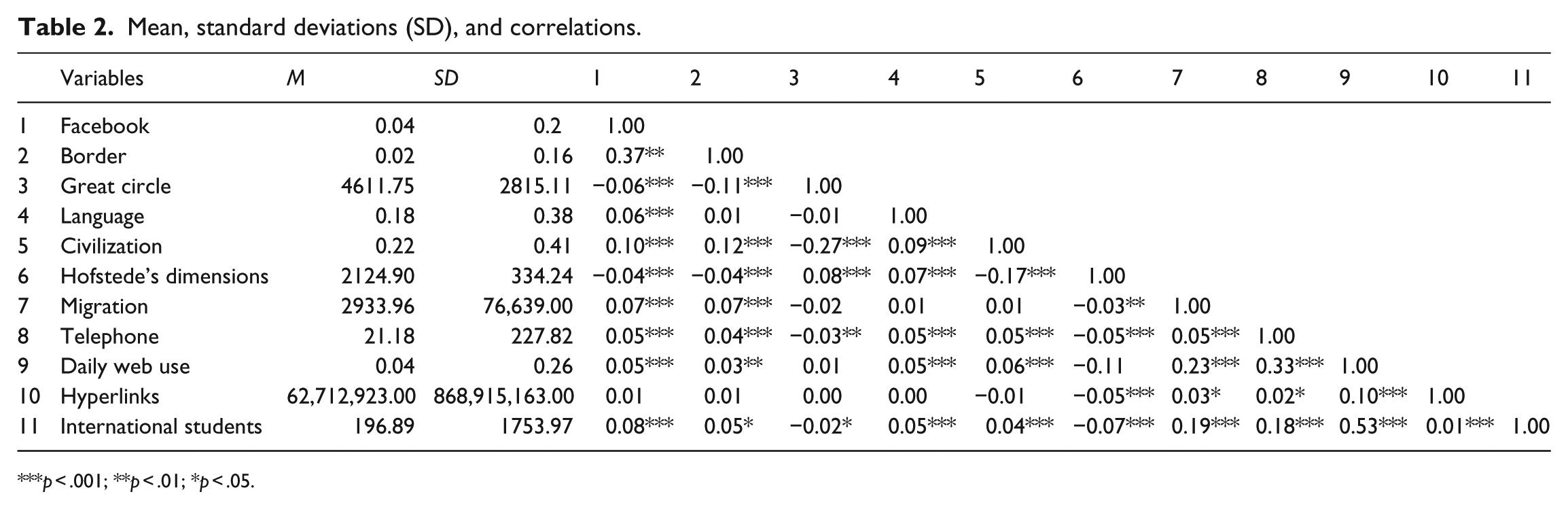
p < .001; **p < .01; *p < .05.
To test the hypotheses, three multiple logistic regression models were conducted to evaluate the predictors’ ability to explain the Facebook network. The first model tested the hypothesis that physical proximity is an indicator of international Facebook friendships. The result of the logistic model showed that the log of the odds of common borders (Wald’s χ2 = 522.82; p < .001; Table 3) and great circle distance (χ2 = 5.14; p = .023) significantly predicted the likelihood of Facebook relations. The high correlations, significant model fit (LR = 467.84), and predictor significance support H1, suggesting that physical proximity predicts international SNS links.
Results from the logistic regression on international SNS ties.
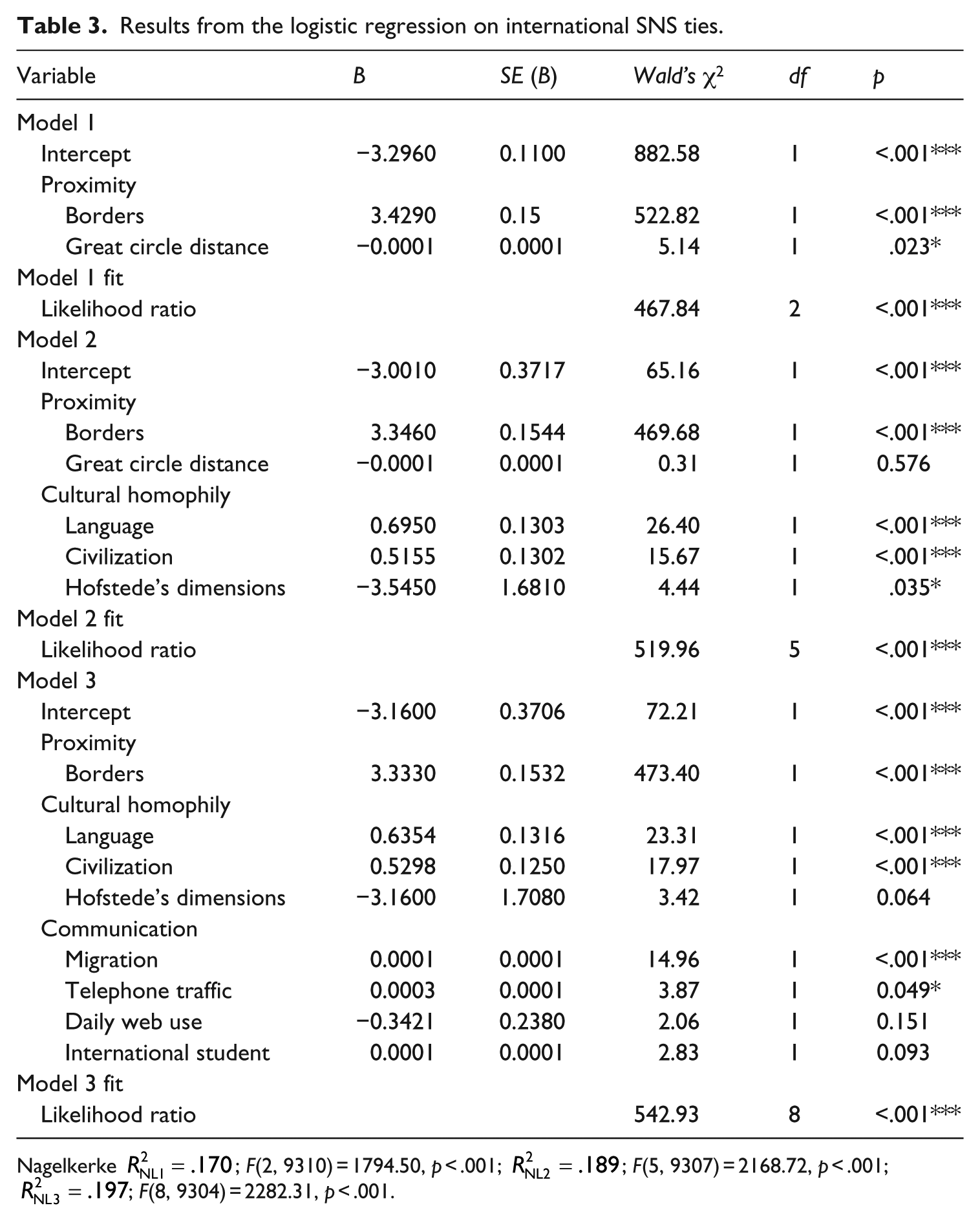
Nagelkerke
The second model tested the hypotheses that both physical proximity and the three measures of cultural homophily (language, civilization, and Hofstede’s dimensions) predict international Facebook friendships. The four-predictor logistic model showed that the log of the odds of common borders (χ2 = 469.68), language (χ2 = 26.40), and civilization (χ2 = 15.67) are each positively and significantly related to Facebook ties (p < .001; Table 3). This model supports H2a’s and H2b’s assertions that both language and civilization predict international SNS links. Hofstede’s cultural similarity measure is negatively related to international Facebook friendships (χ2 = 4.44; p = .035). While the predictor is significant in this model, the weak correlation between Facebook and cultural similarity (r2 = −.04; p < .001) may not support H2c. Great circle distance (χ2 = .31; p = .576), while significant in Model 1, is not significant in Model 2, due to its high correlation with civilization (r = −.27) and borders (r = −.11). Because these predictors describe most of the variance explained by great circle distance, H1b is not supported, and the predictor is excluded from the final model.
Model 3 adds four predictors of communication flow to the international SNS network (Table 3), including migrants, telephone traffic, daily web use, and student exchange. The correlation between Facebook links and shared hyperlink use was excluded because it was not significant.
Most predictors are significant in Model 3, except Hofstede’s dimensions (χ2 = 3.42; p = .064), shared website use (χ2 = 2.06; p = .151), and international student exchange (χ2 = 2.83; p = .093). Because these variables have weak correlations with the Facebook network, the results do not support the predictive power of H2c (Hofstede’s dimensions), H3c (website use), and H3e (student exchange) on international SNS links. The significance of migration (χ2 = 14.96; p < .001) and telephone traffic (χ2 = 3.87; p = .049) supports H3a’s and H3b’s assertion that they predict international SNS links.
To calculate the significance of the goodness-of-fit between models, an F test was performed between Models 1 and 2 (F(3, 9309) = 72.68; p < .001). As a whole, three measures of cultural homophily added significantly to physical proximity in predicting the Facebook network, supporting H2. The addition of communication flow to the Model 3 through migration, telephone traffic, daily web use, and international student exchange was also significant (F(4, 9308) = 30.91; p < .001). This supports H3, which suggests that communication flows predict international SNS links. Although many individual predictors do not add significantly to the model, the three grouped regression models are significant. Based on these analyses, Model 3, which includes proximity, cultural homophily, and communication, is a significantly better predictor of international SNS links.
Discussion
The international Facebook network is very sparse, although it is composed of a single component. The most central nations in the network, France, United Kingdom, UAE, and Spain, bridged two or more distinct regional or linguistic groups. The correlations and logistic regression results supported the findings that shared borders, civilization, language, and migration were significant predictors of international friendships. Great circle distance, shared hyperlinks, Hofstede’s cultural dimensions, voice traffic, daily web use, and student exchange were weak or non-significant predicators, likely due to the high correlation among the indicators. Despite these weak predictors, the grouped measures of physical proximity, cultural homophily, and communication were supported. These results extend Thelwall’s (2009) findings at a more macro level.
The value of this study is its use of a combination of factors to explain different aspects of SNS friendships. It uses objective measures (physical proximity and telecommunications) and more subjective factors (Huntington’s civilizations and Hofstede’s cultural dimensions) to explain SNS users’ international relations. Notably, SNS users form a social network independent of government-mandated relations. This is similar to international conflicts, where citizen-driven SNS patterns may not match international networks formed through official governmental sources (Crooks et al., 2014).
Many of the study’s limitations are due to missing data from the country sample, Hofstede’s dimensions, and the dependent variable. The sample excludes China, which has banned Facebook; China plays a significant role in online and offline international social relations. Thus, these results provide an incomplete description of international social media. Missing data from Hofstede’s cultural similarity dimensions were mean-filled, which could have depressed the predictor significance. In addition, the dependent variable included only each country’s top-5 countries international friendships, excluding proportional or numerical international friendships across all countries. The actual international Facebook is a valued network of higher density. The extent of this limitation was tested with the triadic census, which indicated that a country’s ties are not connected with each other. This limitation is similar to those of traditional sociometric research, which often asks subjects to list a limited number of their relationships. Others have also criticized the use of official migration data, as opposed to web-based behavioral measures (Weber and Zagheni, 2013). However, using a combination of both official measures and online behavioral factors to predict communication flows helps account for some of these inconsistencies.
International relationships connect individuals to a global community and enrich their lives through cross-cultural and international communication. More research is needed to evaluate international friendships and their effects of the global community. Also, there may be other country-level attributes affecting an individual’s ties such as national wealth or isolation. For example, physically isolated countries may require its citizens to travel further (Hawelka et al., 2014). These mobility patterns, in turn, may affect SNS friendships. The context of SNS friendships and their relation with global conflicts also need to be examined. For example, during the Arab Spring, the rate of Facebook registration significantly increased (Wolfsfeld et al., 2013), suggesting that study of the relations between each of these factors and international friendships has merit.
Footnotes
Funding
The author(s) received no financial support for the research, authorship, and/or publication of this article.