






Abstract

With each first issue of a new volume of New Media & Society (NM&S), we have used the space allowed by an editorial column to share basic statistics relating to the journal’s submissions, publication, consumption, and more. Doing so allows us to be transparent about how the journal operates, and also gives our readers an opportunity to put the journal into its proper context. Due to changes in the production schedule, we are writing this editorial a few months earlier than is usually the case, and this will perforce adjust the kind of information we can share with you at this time. The amount of published material in 2015 increased as we increased the number of annual issues from 8 to 11. We have thereby added about 500 pages of content and about two dozen research articles this year, along with additional review articles, review essays, and book reviews. We are thereby able to somewhat speed time to print publication and to increase the number of themed issues and sections we can publish. We are particularly excited about themed issues already under way on timely topics ranging from hacking and making to religion online, from Web histories to online political engagement. Indeed, one of the most stimulating and inspiring elements of editing NM&S is the impressive breadth of topics many scholars, across many fields, are studying, assaying new media and new forms of communication and interaction.
Below is an updated version of Table 1 we have presented in years past. It includes a column of figures for 2015, though the numbers for this year are preliminary and reflect submissions only to 1 November 2015. The numbers for 2014 are revised to reflect the full year’s submissions, as those had been collected only to 15 November 2014, at the time of last year’s editorial. The number of submissions continues to increase. The acceptance rate remains relatively constant, averaging about 20% per year. The acceptance figure for 2015 of 7% is incomplete (as are other figures in that column) because many manuscripts submitted during that year are still under consideration.
Longitudinal Overview of NM&S Submissions.
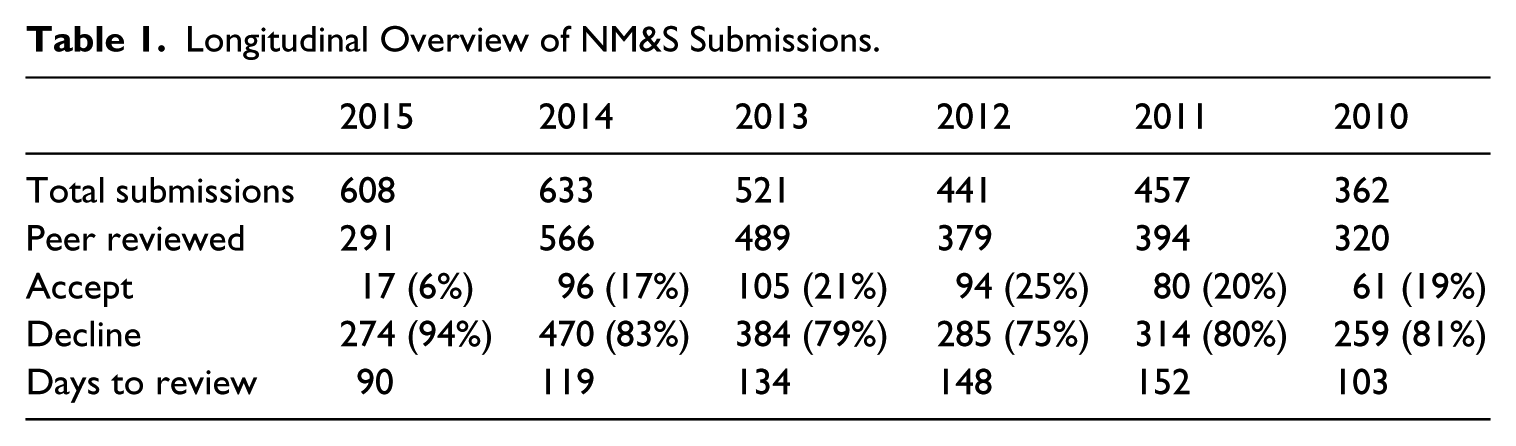
The amount of time between submission and completion of the review process, shown in the row ‘Days to Review’, indicates an average of just 3 months between submission and decision regarding publication, a process sometimes involving 2–3 rounds of external review. We are grateful to reviewers for helping us to greatly reduce the length of time for the review process over the last few years, and we are most grateful to Jenny Ungbha Korn, our editorial assistant, for her diligent and tireless efforts to manage submissions. While this length of time is still substantial, we consider it acceptable, particularly given our policy to solicit detailed reviews of submissions. Unfortunately, it is merely an average, and some manuscripts take longer to review (while others, thankfully, take less time). We continue to be very grateful to the large number of reviewers we have engaged over the past year, and to the members of the editorial board, for their efforts to provide us with timely reviews.
One of the common measures for ranking journals is the Impact Factor (IF) developed by the Thomson Reuters Institute for Scientific Information (ISI). The most recent IF for NM&S is 2.007, and it ranks seventh out of the 76 periodicals noted in the category Communication in Journal Citation Reports. A journal’s IF varies from year to year; for that and other reasons, the ranking should be interpreted with caution. Still, the reported ranking for NM&S across time suggests both increase and recent fluctuation: 2003: 0.689, 2008: 0.821, 2010: 1.326, 2011: 1.091, 2012: 1.394, 2013: 1.824 and 2014: 2.052. The five-year IF is 2.441. If nothing else, one can deduce from these figures that NM&S is widely read and cited by scholars with an interest in new media, and is a key forum in the conversation about new media research. Google Scholar, meanwhile, continues to rank NM&S first in Communication with an h5-index of 54 (up from 45 in 2014) and h5-median of 83 (up from 71 last year).
Two other indicators of use are frequency of downloads from SAGE Journals Online (SJO) and citations recorded in the SAGE database. The NM&S section of the SJO Web site provides information on the indicators, ‘Most Read’ and ‘Most Cited’; see http://nms.sagepub.com/. For both indicators, one finds listed the top 50 articles, showing rank order for frequency of downloads (termed ‘Most Read’ on the SAGE Web site) and for ‘Most Cited’. These highly cited articles range widely in age, and taken together, we believe that they show that the research published in NM&S is of enduring value. We are grateful to the authors and reviewers who have made the journal the premier publication for high quality research on new media.