







Abstract
Disagreement persists as to whether social networking sites (SNSs) are used more frequently to facilitate cross-cutting or like-minded discussions. We examine the relationship between the use of SNSs and involvement in discussions with politically similar and dissimilar others among a sample of US Democrats and Republicans. Affective polarization is negatively related to involvement in cross-cutting discussions, suggesting that individuals extend their dislike of the opposing political party to out-party members within their online social networks. Moreover, political discussion with one’s friends on SNSs plays a mediating role in involvement in both cross-cutting and like-minded discussions. Finally, party identification moderates the relationship between SNS use and involvement in cross-cutting discussions, indicating that Republicans participate more frequently than Democrats in cross-cutting exchanges on SNSs. In the light of these findings, we discuss the contribution of SNSs to the ideals of deliberative democracy.
Keywords
By encouraging greater interpersonal deliberation, deeper reflection, and more tolerance of others, cross-cutting discussions, or exchanges of ideas among people who hold differing political and ideological beliefs, are fundamental to deliberative democracy (Mutz, 2006). Today, social media are playing an increasingly prominent role in facilitating the political discussions through which individuals are likely to encounter new ideas and differences of opinion. For instance, almost half of US adults who use social networking sites (SNSs) spend time on them to discuss current affairs with others (Anderson and Caumont, 2014). Yet, it remains unclear whether SNSs are promoting democratic ideals by increasing users’ exposure to cross-cutting views, or, conversely, deepening societal fragmentation by primarily facilitating discussion among like-minded people. That is, the accumulated studies on selective exposure in the contemporary media environment have produced divergent conclusions on the contribution of social media to citizens’ exposure to cross-cutting and like-minded beliefs.
On one hand, the current high-choice environment has brought greater alignment between individuals’ exogenous preferences and the media content they consume (Prior, 2007). Especially in the United States, the Internet has been shown to provide abundant opportunities for individuals to engage in confirmation-biased selective exposure to political information (Iyengar and Hahn, 2009; Stroud, 2008). Because of these tendencies, new media are feared to be exacerbating heterogeneity and promoting group isolation based on political ideology (Sunstein, 2007). On the other hand, several scholars have argued that new media can facilitate citizens’ exposure to politically dissonant messages. Importantly, online interactions are free from the constraints of physical geography (boyd and Ellison, 2007), which is a primary driver of offline network homophily (McPherson et al., 2001). Compared with offline networks, then, online networks are thought to be more politically diverse. Additionally, the “socialization of internet news” has privileged the social value over the partisan value of news, inhibiting users’ partisan selectivity (Messing and Westwood, 2014). Finally, some researchers have argued that the pro-attitudinal and counter-attitudinal forces of new media are balancing each other out. For instance, Lev-On and Manin (2009) consider online communication to be a “mixed blessing” in terms of its ability to promote deliberation, providing both “unintentional exposure to opposing views, as well as ‘drivers’ that channel users away from opposing views” (p. 105).
Spurred by this uncertainty over the degree of partisan selective exposure occuring in political discussions on social networking sites, this study examines the relationship between the use of SNSs and involvement in both cross-cutting and like-minded discussions. More specifically, it builds upon extant research by investigating the influence of party identification and affective polarization on political discussion in the new media environment. We expect SNS use to relate positively to involvement in both cross-cutting and like-minded discussions. Frequent use of SNSs should generate opportunities to talk with others who think alike as well as with those who think differently. However, we also expect some individuals to be motivated to filter out dissonant voices and gravitate toward views that resonate with their own beliefs. In particular, partisans who are highly polarized along party lines are expected to extend their dislike of the out-party to the rank-and-file party members within their social networks, eschewing cross-cutting discussions in favor of like-minded ones.
To test these claims, we used data from a nationally representative survey of US adults conducted in 2012. We empirically test for direct, mediating, and moderating effects in the relationship between SNS use and involvement in cross-cutting and like-minded discussions on SNSs. The findings contribute to our understanding of the relationships between partisanship, polarization, and political discussion in the new media environment, particularly on SNSs.
SNSs and exposure to cross-cutting views
Dramatic changes to the new media environment—that is, the rise of the Internet, social media, and mobile technology—are thought to have the potential to promote greater engagement between people who hold differing political opinions (Shapiro, 2013). In cultivating an online social network, individuals maintain intergenerational relationships with a mixture of their online and offline acquaintances, as well as work, school, and family ties. Postings on Facebook, for instance, can bring together unconnected users into an extended discussion through a shared personal connection. Thus, SNSs provide opportunities for users not only to interact with people within their immediate, first-order social network but also with second- and third-degree connections (McLeod and Lee, 2012). This should allow for the inclusion of a heterogeneous array of people into conversations facilitated by the use of SNSs (Lee et al., 2014).
In addition, the interfaces of SNSs are designed so as to frequently encourage users to establish additional connections by integrating contact lists from external sources such as third-party email accounts and applications. As SNS users expand their digital social networks from dozens to hundreds or potentially thousands of people, they become increasingly likely to encounter others who hold substantively different worldviews. Indeed, the larger the network one cultivates, the more likely it is to contain a diverse set of individuals (Eveland et al., 2013).
Moreover, for extreme partisans, SNSs provide ample opportunities for inadvertent encounters with political difference (Brundidge, 2010). This incidental exposure may primarily occur via weak-tie interactions. SNSs allow individuals to maintain and solidify existing offline relationships, particularly those weak ties that only share some common offline elements (boyd and Ellison, 2007). Weak ties offer novel information that individuals would not otherwise encounter from their conversations within strong-tie relationships (Granovetter, 1973). Given that individuals are usually unfamiliar with the political views of their weak-tie friends on SNSs (Campus, 2012), they are unlikely to avoid dissonant views and therefore more likely to encounter disagreement incidentally in political conversations on SNSs. Indeed, 38% of SNS users have reported discovering through postings that a friend’s political beliefs were different than they originally thought (Rainie and Smith, 2012b).
In addition, SNSs are known to promote exposure to alternative political points of view even among the politically disinterested. One avenue of involvement in cross-cutting discussions, for instance, is the application of Twitter hashtags with neutral or mixed valence, which have been shown to bring opposing communities into greater contact with one another (Conover et al., 2011). Social endorsements, such as Facebook likes on a news story, also increase exposure to news from politically diverse sources for partisans and non-partisans alike (Messing and Westwood, 2014). Because of the ease of accessing diverse views on SNSs, the more one uses SNSs, the more likely one is to become involved in discussions with others who hold opposing political beliefs. Thus, we posit the following:
H1. Use of SNSs is positively related to involvement in cross-cutting discussions.
Politically homogeneous online discussions
Although SNSs provide users with the capacity to create heterogeneous networks (Lee et al., 2014), the presence of discussion network homogeneity based on political and ideological similarity has recurred throughout studies of computer-mediated communication (Wilhelm, 2000). As Dahlberg (2001) explains, While a great diversity of communication takes place across cyberspace, some of which does involve critical discussion of controversial issues, many participants simply seek out groups of like-minded others where member’s interests, values and prejudices are reinforced rather than challenged. (p. 618)
For instance, Ponder and Haridakis’ (2014) findings demonstrate that blog users are significantly less likely to discuss politics with members of the political out-group. Among both liberal and conservative bloggers, linking patterns are also severely fragmented (Adamic and Glance, 2005; Hargittai et al., 2007).
Due to pressures of conformity and social sanction, political discussions on SNSs should exhibit even greater homogeneity than anonymous or pseudonymous discussions hosted elsewhere on the Web. Individuals may deliberatively avoid inter-partisan discussion so as to not disrupt the harmony of their social networking spaces. For example, popularity within a social network is highly correlated with risk-averse discussion behaviors (Miller et al., 2015). Therefore, we expect SNS use to promote communication among individuals who hold congruent political beliefs:
H2. Use of SNSs is positively related to involvement in like-minded discussions.
Not all activities on SNSs, however, are centered on political discussion. SNSs have become prominent spaces where individuals can cultivate and manage their personal or professional identities (Livingstone, 2008). Many people, in fact, take actions designed to limit their exposure to political information from others. Indeed, around 18% of SNS users have blocked, unfriended, or hidden someone because they disagreed with what that person posted about politics or because that person had posted too often or argued about politics (Rainie and Smith, 2012b). Thus, SNSs also enable people who are not interested in talking about politics with dissimilar others to avoid such discussions.
On the other hand, some people may regularly use SNSs to debate and talk about political issues with others in their social networks. Those who do engage in political discussions with their friends on SNSs should encounter a wider range of political views, some of which will be consonant with their own beliefs and some of which will not. Through participation in these political discussions with friends within their online networks, users should talk with both politically similar and politically dissimilar others. The activity of discussing politics with friends on SNSs should thus serve as an indirect path to involvement in both like-minded and cross-cutting discussions. Thus, we posit the following hypotheses:
H3a. Political discussion with friends on SNSs mediates the relationship between SNS use and involvement in cross-cutting discussions.
H3b. Political discussion with friends on SNSs mediates the relationship between SNS use and involvement in like-minded discussions.
Party identification and cross-cutting discussions on SNSs
Several important individual-level political characteristics are critical to the understanding of what motivates individuals to engage in like-minded and cross-cutting discussions. Chief among these is partisan identification. Akin to religious affiliation, party identification is an affective, psychological attachment to a group that rests on a subjective, internalized sense of belonging (Huddy, 2013). Party identification is thought to result from a complex process of political socialization, beginning in childhood with stimulation from the news media and parental discussions—usually occurring in the context of an election campaign—and continuing into adulthood through conversations with significant others (McDevitt, 2005).
Research suggests party identification may play a moderating role in explaining how individuals use communication technologies to interact with ideologically similar and dissimilar people. For example, when selecting stories from websites, Republicans exhibit greater aversion to counter-attitudinal information than non-Republicans (Garrett and Stroud, 2014). A smaller share of Republicans (24%) than Democrats (32%) also tend to think that debating or discussing political activities on SNSs is important (Rainie and Smith, 2012a). Yet, preliminary evidence also suggests that Republicans utilize Facebook recommendations to a greater extent than Democrats when selecting online news (Messing and Westwood, 2014). Additionally, right-leaning Twitter users exhibit a greater tendency to establish mutually affirmed social ties and create more total connections than left-leaning users (Conover et al., 2012). Conservative bloggers are also more likely to link to liberal bloggers than vice versa (Hargittai et al., 2007).
Meanwhile, Kim (2011) did not find support for the hypothesis that partisanship interacts with SNS use to shape exposure to dissimilar political views. Likewise, Miller et al. (2015) found no significant interactions between party identification and ideology and measures of network centrality on general levels of political discussion on Facebook. Thus, existing studies have provided mixed results regarding the moderating role of party identification with respect to online political discussion.
Considering these mixed results, we ask the following research questions:
RQ1. Does party identification moderate the relationship between SNS use and involvement in cross-cutting discussions on SNSs?
RQ2. Does party identification moderate the relationship between SNS use and involvement in like-minded discussions on SNSs?
Extending affective polarization to discussions on SNSs
Building on social identity theory, affective polarization refers to individuals’ emotional reactions to party identifications (Garrett et al., 2014). The salience of partisan identity causes Democrats and Republicans not only to dislike the opposing party but also to attribute negative traits, such as “closed-minded” and “hypocritical,” to the other side (Mason, 2015). Aversive reactions toward the opposing party in turn prevent partisans from seeking diverse perspective on controversial topics (Valentino et al., 2009). Highly polarized partisans are more trusting of in-party members (Iyengar and Westwood, 2015) and even object to their children marrying across party lines (Iyengar et al., 2012). When they feel that their party is threatened by others, they are likely to react with strong emotions, especially anger (Mason, 2015).
Therefore, affective judgments toward the political parties may not only influence one’s vote during an election (Iyengar et al., 2012), but decisions about whom to connect and converse with on social media. Affectively polarized partisans do not merely dislike the out-party elites and political leaders; they also distrust the rank-and-file members of the other party (Levendusky, 2013). Indeed, previous studies have shown that strong partisans, compared with the less polarized, are less likely to encounter cross-cutting exposure during offline political conversations (Mutz, 2006). Lavine et al. (2012) refer to people who positively rate the in-party and negatively rate the out-party as univalent or non-ambivalent partisans. These individuals, who tend to view politics through a partisan lens, are less responsive to the political environment and are less likely to engage in careful deliberation.
Similarly, affectively polarized partisans who use SNSs should be less willing to talk or forge connections with out-party members. These partisans may use available political cues within the social media environment to avoid or filter out those who do not share their political beliefs, prefering instead to talk and connect with those who do. Thus, we posit the following hypotheses:
H4. Affective polarization is negatively related to involvement in cross-cutting discussions on SNSs.
H5. Affective polarization is positively related to involvement in like-minded discussions on SNSs.
Methods
Data
This study relied on a representative survey of American adults (N = 1032), based on an online panel of Clear Voice Research, a professional firm. A sample matching methodology was used to select a random sample from the online panel, a method similar to that used for the Polimetrix Panel (Hill et al., 2007). To do this, the firm selected a random sub-sample of its panel matching US Census data. The survey data were also cleaned to exclude cases of straight lining, short response times, and the like. The survey data were collected between 3 May and 10 May 2012. The sample was further stratified by gender (52% male) and age (average: 39.8 years) to reflect the parameters of the general US population. The response rate was 17.3%, which is acceptable for online surveys. Sax et al. (2003) explored the predictors of non-response in a web-based survey with a response rate of 17.1%. In terms of socioeconomic background, they found no significant differences between respondents and non-respondents. Because the focus of this study is discussion behavior on social networking websites, an online panel is suitable for testing the aforementioned hypotheses.
Measurement
Cross-cutting discussion on SNSs
Survey respondents were asked, “On social network sites, how often do you talk to people listed below?” Categories of people from four different ideological and partisan groups were then listed, including (1) people with extreme right views, (2) people with extreme left views, (3) people who are Democrats, and (4) people who are Republicans. For each group, respondents indicated on a 4-point ordinal scale whether they regularly, sometimes, hardly ever, or never talk with those people on SNSs.
To examine cross-cutting discussion activities on SNSs, an index was created using the above four items, taking into account each respondent’s self-reported party identification. Thus, to capture only cross-cutting discussion involvement, Democrats’ scores were set to zero on items (2) and (3) above, whereas Republicans’ scores were set to zero on items (1) and (4) above. Because partisans are ideologically divided in contemporary American society (Dimock et al., 2014), Democratic respondents who talk with people on the extreme left of the ideological spectrum are unlikely to encounter cross-cutting views, and the same can be said for Republican respondents who talk with people on the extreme right. Because this study focuses on discussion with politically similar and dissimilar partisans, Independents and individuals with no party preference were removed from the analysis.
The remaining frequencies were then averaged to create the index for cross-cutting discussion. Thus, a Democrat’s level of cross-cutting discussion equals his or her average score only on items (1) and (4) above. For a Republican, it equals his or her average score only on items (2) and (3). Using this procedure, an index of cross-cutting discussion on SNSs was created, with higher scores indicating greater involvement (M = 1.69, standard deviation [SD] = 0.82, range = 0–3, Cronbach’s α for Democrats = .73; Cronbach’s α for Republicans = .81).
Like-minded discussion on SNSs
Mirroring the above procedures, an index of like-minded discussion activities was also created. Since like-minded discussions are those that occur between individuals who hold similar political beliefs, each respondent’s party identification was again taken into account. First, Republicans’ scores on items (2) and (3) were set to zero, as were Democrats’ scores on items (1) and (4). Next, scores on the remaining items were averaged. Therefore, a Democrat’s level of like-minded discussion on SNSs equals his or her average score on items (2) and (3) above, whereas a Republican’s level of like-minded discussion equals his or her average score on items (1) and (4). Higher scores indicate greater involvement in like-minded discussions on SNSs (M = 1.93, SD = 0.81, range = 0–3, Cronbach’s α for Democrats = .74; Cronbach’s α for Republicans = .80).
It is crucial to note here that independent measurements were used to calculate cross-cutting and like-minded discussion so that a high degree of involvement in one type of discussion does not necessitate a low degree of involvement in the other type. Thus, one may be regularly involved in both cross-cutting and like-minded discussions, or one may refrain entirely from both.
SNS use
This was measured by asking respondents, “On an average weekday, how much time do you spend visiting social networking sites such as Facebook or Twitter?” Answer choices ranged on an 8-point ordinal scale, which included none, less than 1 hour, between 1 and less than 2 hours, between 2 and less than 3 hours, between 3 and less than 4 hours, between 4 and less than 5 hours, between 5 and less than 6 hours, and more than 6 hours (M = 2.23, SD = 2.00, range = 0–7).
SNS political discussion with friends
This was measured by asking respondents, “How often do you discuss politics or current events with your friends on social networking sites such as Facebook or Twitter?” Answer choices included regularly, sometimes, hardly ever, and never (M = 1.36, SD = 1.03, range = 0–3).
Party identification
Party identification was measured using a standard item. Respondents were asked, “In politics today, do you consider yourself a Republican, Democrat or Independent?” Answer choices included Republican, Independent closer to Republican, Independent, Independent closer to Democrat, Democrat, no preference, other, and don’t know. Given the research into party identification suggesting that leaners think and act like partisans (Keith et al., 1992; Petrocik, 2009), Republicans and Independents closer to Republican were grouped together as Republicans (29% of sample), while Democrats and Independents closer to Democrat were grouped together as Democrats (37%). True Independents (15%), those with no party preference (13%), and those who answered other and don’t know (2% and 5%, respectively) were excluded from the analysis.
Affective polarization
To gauge their feelings of warmness toward the Democratic and Republican parties, respondents were provided what is known as a “feeling thermometer” for each party. Each respondent was asked, Now please rate Democratic and Republican Party using something we call the feeling thermometer. Ratings between 50 degrees and 100 degrees mean that you feel favorable and warm toward the party. Ratings between 0 degrees and 50 degrees mean that you don’t feel favorable toward the party and that you don’t care too much for that party. You would rate the party at the 50 degree mark if you don’t feel particularly warm or cold toward the party.
Drawing on the conceptualization of Iyengar et al. (2012), we operationalized affective polarization as the difference between in-party and out-party ratings (M = 44.61, SD = 34.65, range = −100 to 100). The in-party and out-party for each respondent were determined from his or her party identification.
Controls
Demographics, media use, and political characteristics, such as ideology and an index of political knowledge, were included as control measures. Summary statistics for these variables are provided in Appendix 1.
Results
As a starting point, Figure 1 shows how often Republicans and Democrats in the sample talk with people of various partisan groupings on SNSs. These data reveal that both partisan sorting (i.e. like-minded discussions) and partisan mixing (i.e. cross-cutting discussions) are occurring on SNSs, albeit to varying degrees. Although both Democrats and Republicans talk more frequently with co-partisans than with opposing partisans on SNSs, the frequency of discussion across partisan and ideological lines is substantial.
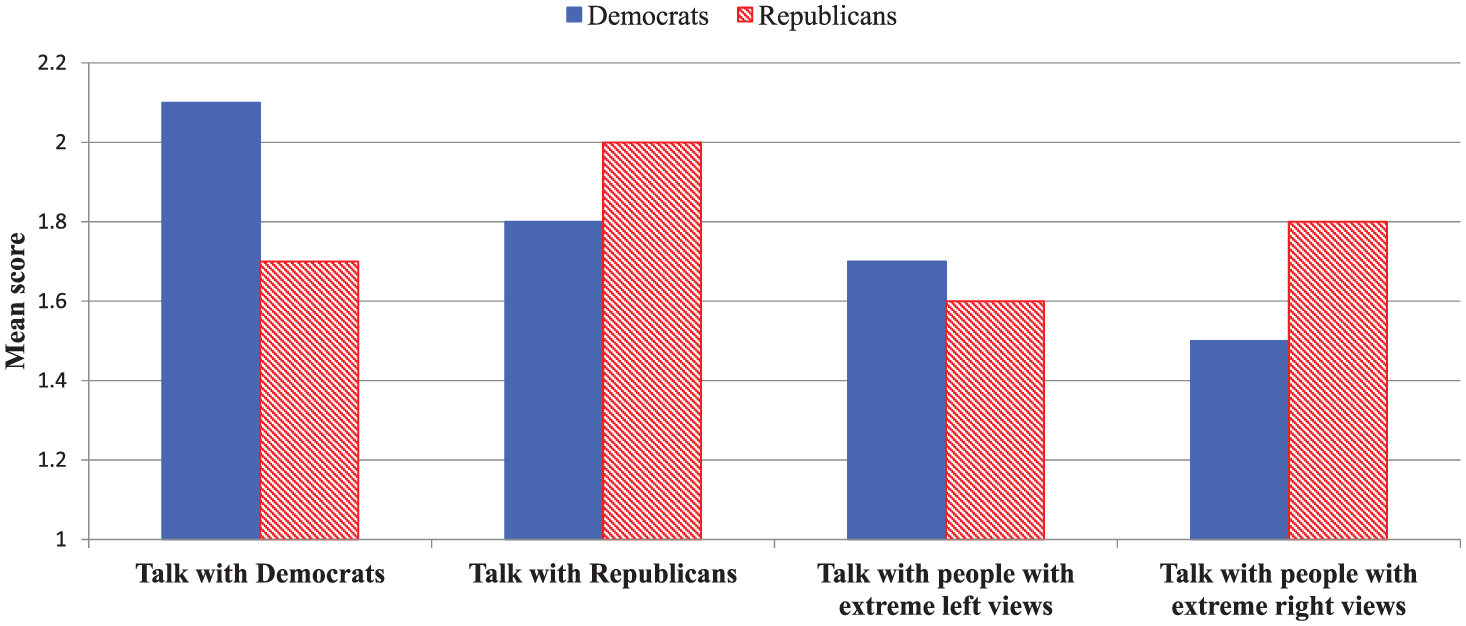
Mean scores of responses to “On social network sites, how often do you talk to people listed below?”
Cross-cutting discussions on SNSs
We specified ordinary least-square regression models to test hypotheses and answer research questions (RQs). Concerning H1, the amount of time spent using SNSs is positively related to involvement in cross-cutting discussions (B = .07, t = 3.12, p < .01). The statistics reported here, which are from the hierarchical analysis before the inclusion of SNS discussion, affective polarization, and the interaction term, differ somewhat from those of Table 1. When all other variables in the model are held constant, a 1-unit increase in time spent on SNSs is associated with increased involvement in cross-cutting discussion by an average of 0.07 units. In other words, individuals who spend less than 1 hour per day using SNSs report on average that they hardly ever talk with people who hold opposing political or ideological beliefs, while those who spend 3 or more hours per day on SNSs report on average that they sometimes engage in cross-cutting discussions. This finding, which indicates that SNS use has a substantive positive effect on involvement in cross-cutting discussions, provides support for H1.
Regression analysis of involvement in cross-cutting and like-minded discussions on SNSs (unstandardized).
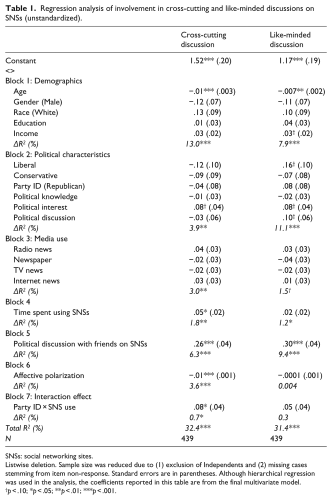
SNSs: social networking sites.
Listwise deletion. Sample size was reduced due to (1) exclusion of Independents and (2) missing cases stemming from item non-response. Standard errors are in parentheses. Although hierarchical regression was used in the analysis, the coefficients reported in this table are from the final multivariate model.
p < .10; *p < .05; **p < .01; ***p < .001.
To test H3a, we used a bootstrapping technique (Preacher and Hayes, 2004). This approach empirically estimates the indirect effect, which is the product of the effect of the independent variable on the mediator and the effect of the mediator on the dependent variable. Regarding H3a, this refers to the effect of SNS use on SNS political discussion and the effect of SNS political discussion on involvement in cross-cutting discussions on SNSs. The 95% confidence intervals associated with the indirect effects of SNS use on cross-cutting discussion via SNS political discussion were analyzed using 5000 bootstrap samples. Because the confidence interval estimating the hypothesized indirect effect does not include 0 (bias-corrected confidence interval = [0.02, 0.05]), the results indicate that the relationship between SNS use and involvement in cross-cutting discussions on SNSs is mediated by SNS political discussion. This supports H3a. The indirect effect was also found using more traditional mediation analyses (i.e. Baron and Kenny, 1986). After including political discussion with friends into the regression model, the effect of SNS use on cross-cutting discussion is attenuated, suggesting that the effect of SNS use on involvement in cross-cutting discussions is partially mediated by political discussion with one’s friends on SNSs. Research has raised concerns about increases in Type 1 errors through the use of bootstrapping and other resampling techniques, particularly for small or non-random samples (Fritz et al., 2012; Rodgers, 1999). Although this data set is from an online panel, it consists of a representative sample obtained by a matching method, which lessens the concern about the overpowering bias of the bootstrapping technique.
In testing H4, affective polarization serves as a significant negative predictor of cross-cutting discussion involvement on SNSs (B = −.01, t = −4.65, p < .001). Providing support for H4, this indicates that people who rate their own party favorably and the opposing party unfavorably are less likely to talk with out-party members on SNSs. Holding all other variables in the model constant, each 1-unit increase in affective polarization leads to a decrease in involvement in cross-cutting discussion by 0.01 units on average (see Figure 2). Comparing individuals who have high affective polarization scores (i.e. 1 SD or more above the mean) with those who have low scores (i.e. 1 SD or more below the mean) reveals significant differences in cross-cutting discussion behavior on SNSs. On average, polarized individuals hardly ever converse across ideological and political lines on SNSs, while non-polarized individuals sometimes do.
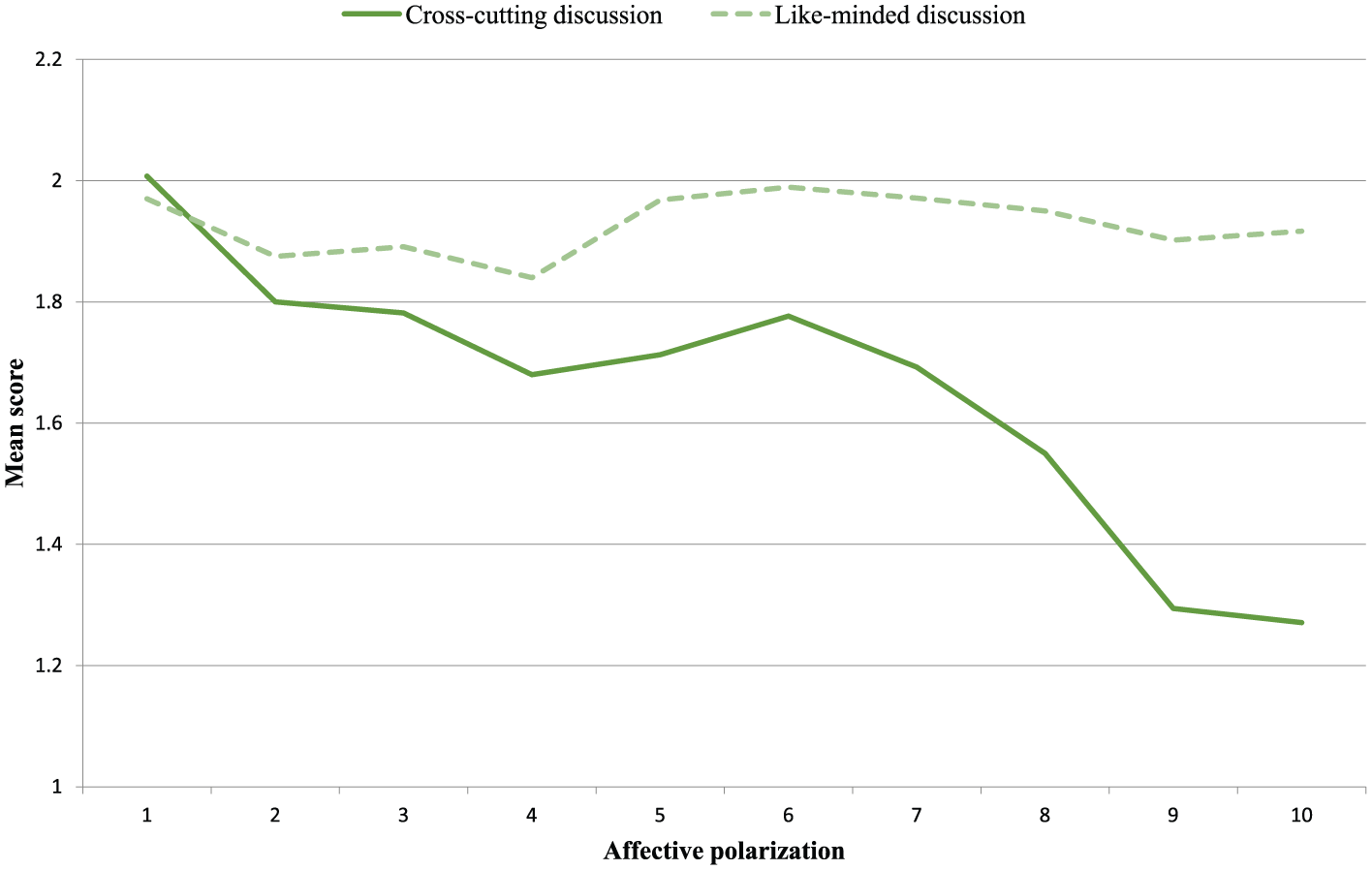
Affective polarization and involvement in cross-cutting and like-minded discussions on SNSs.
To address RQ1, the interaction between party identification and SNS use on cross-cutting discussion frequency was tested next. We found that partisanship moderates the effect of SNS use on involvement in cross-cutting discussions (B = .08, t = 2.14, p < .05). Figure 3 shows differences in the slopes of SNS use for involvement in cross-cutting discussion by party identification.
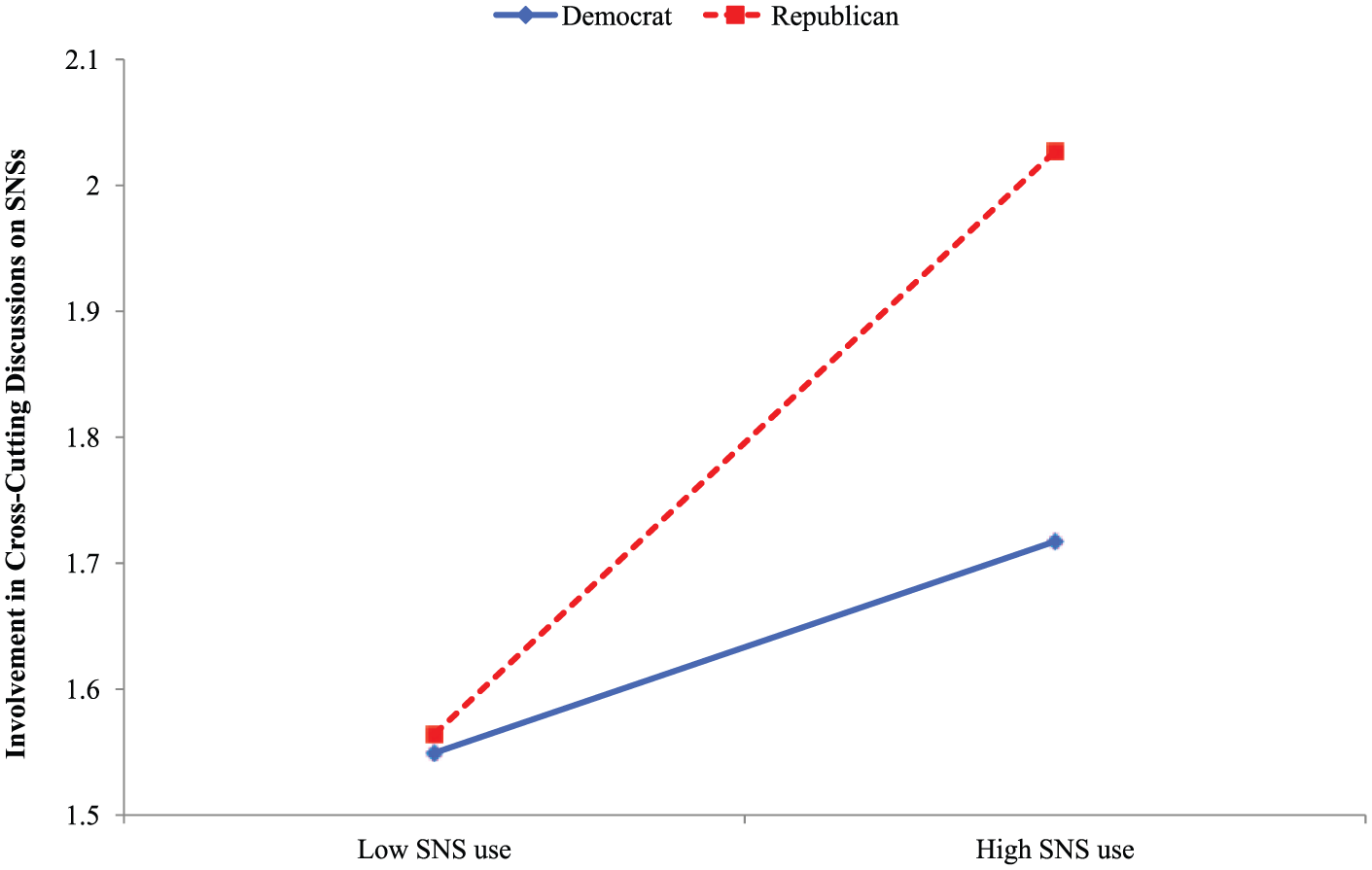
SNS use and involvement in cross-cutting discussions on SNSs by party identification.
To determine the direction, magnitude, and significance levels of the conditional effects of SNS use on involvement in cross-cutting discussions at the two values of the moderator, party identification, we ran separate regressions on Democrats and Republicans, as well as a moderation analysis using Model 1 of the PROCESS macro (Hayes, 2013). For Republicans, the amount of time spent on SNSs is positively related to involvement in cross-cutting discussions (sub-group regression: B = .08, t = 2.14, p < .05; PROCESS: B = .09, t = 2.90, p < .05). (The minor discrepancies in these values arise from differences in these methods of estimation.) Thus, after controlling for all other variables in the model, the average effect of SNS use on involvement in cross-cutting discussions is 0.8–0.9 units for Republicans. For Democrats, however, the relationship between SNS use and involvement in cross-cutting discussions is not significant (sub-group regression: B = .03, t = 0.92, p = .36; PROCESS: B = .01, t = 0.40, p = .69).
Like-minded discussions on SNSs
We next examined H2. Prior to accounting for the effect of political discussion with friends on SNSs, the effect of SNS use on like-minded discussion in the hierarchical model was significant (B = .06, t = 2.57, p < .05). This provides support for H2 and indicates that a 1-unit increase in time spent on SNSs is associated with increased involvement in like-minded discussion by an average of 0.06 units. In the final multivariate model, however, the direct effect of SNS use on involvement in like-minded discussions on SNSs is not significant (B = .02, t = 1.08, p = .28). This indicated the presence of mediation.
We next examined the mediation hypothesis posited in H3b using bootstrapping mediation analysis. This confirmed that SNS political discussion acts as a mediator in the relationship between SNS use and involvement in like-minded discussions on SNSs (bias-corrected confidence interval = [0.02, 0.06]). Because the confidence interval does not include zero, these findings support H3b.
H5 predicted that affective polarization would be positively related to involvement in like-minded discussions. The results from Block 6 in Table 1, however, provide no support for this hypothesis. Thus, variation in participation in like-minded discussions on SNSs is not explained by an individual’s level of affective polarization (see Figure 2).
Finally, concerning RQ2, no significant differences were found between Democrats and Republicans in terms of their involvement in like-minded discussions on SNSs.
Discussion
In this study, we examined the extent to which people use SNSs to filter in politically consonant viewpoints and filter out politically dissonant ones. Our findings demonstrate that the use of SNSs is positively related to involvement in both cross-cutting and like-minded discussions. Moreover, both of these relationships are mediated by political discussion with friends on SNSs. Although like-minded conversations occur more frequently, substantial levels of cross-cutting exchanges are also occurring on SNSs. Talking about politics with friends on SNSs was also shown to be a mediating pathway for both cross-cutting and like-minded discussion invovlement.
This study contributes to a better understanding of how individual-level characteristics, including affective polarization and party identification, shape the interpersonal interactions that occur on SNSs. Univalent partisans, or those who feel positively toward their own party and negatively toward the out-party, are less likely than others to converse on SNSs with people from the opposite ends of the political and ideological spectrums. However, variation in affective polarization does not predict why people participate in discussions with like-minded others on SNSs. Thus, while affectively polarized partisans seem more likely than others to filter out people whose beliefs clash with their own, they are not more likely to seek out like-minded others on SNSs.
By extension, the findings of this study imply that most cross-cutting interactions on SNSs occur between non-polarized partisans, that is, those who evaluate the two parties on similar terms or who may dislike the party they identify with even more than they dislike the opposing party. One consequence of this is that cross-cutting discussions occurring on SNSs lack involvement from each party’s most polarized partisans. In other words, in the discussions that occur on mainstream SNSs such as Facebook and Twitter, the voices of party moderates are accentuated, while the voices of party extremists are diminished. Although they may be key to facilitating cross-party dialogue among the non-polarized, SNSs do not appear to encourage discussion among the parties’ most polarized members.
In addition, we demonstrated that party identification interacts with SNS use in its relationship with involvement in cross-cutting discussions on SNSs. Namely, as their use of SNSs increases, Republicans become more involved in cross-cutting discussions, whereas Democrats do not. On one hand, the source of this difference may be psychological or cognitive: Republicans may be more likely than Democrats to perceive the political discussions that occur on Facebook and Twitter as biased in favor of opposing views. That is, perceptions of liberal bias in the mainstream media may have reached into the realm of social media. On the other hand, this difference may be due to empirical social realities: the political culture of discussions on SNSs may amplify Democratic and left-leaning voices. Indeed, the findings of this study support the notion that the effects of social media use are not uniform across all subgroups of the general population. The moderating effect of party identification on the relationship between SNS use and cross-cutting discussion we reported also conforms with a recent study of 10.1 million Facebook users, which found that conservatives are more likely than liberals to have friends who share cross-cutting news content (Bakshy et al., 2015). Thus, this study advances extant research into social media effects by accounting for the moderating effects of party identification on exposure to political difference through the use of SNSs.
The role that individual characteristics play in facilitating or inhibiting exposure to divergent views on SNSs evinces the need to move away from technologically deterministic understandings of social media. In other words, an individual’s degree of involvement in cross-cutting or like-minded discussions on SNSs is not entirely determined by the technological features of these applications and websites. Thus, researchers must continue to look beyond the affordances of new media to explain how the motivations and characteristics of the discussion participants themselves matter to phenomena such as consensus-building and mobilization (e.g. Karlsson, 2012). Moreover, aside from the mediating effect of SNS political discussion with friends, this study did not identify significant predictors of involvement in like-minded discussions. Therefore, further research should explore other variables that may promote like-minded discussion involvement.
The findings presented here also suggest that the use of SNSs promotes exposure to cross-cutting views for individuals who lack interest in politics or do not engage in political discussion regularly. Given that the positive effect of SNS use on cross-cutting discussion involvement is statistically significant even after controlling for political interest, individuals who have low interest in politics but spend a great deal of time on SNSs participate in cross-cutting discussions. In other words, even without the avenues of political interest or discussion, the use of SNSs is associated with involvement in cross-cutting discussions. Thus, the use of SNSs widely promotes the exchange of ideas among people who hold differing political views, which is a core principle of deliberative democracy.
One of the main limitations of the study to note is the cross-sectional nature of the data, which limits causal arguments. Multi-wave panel data would need to be employed to test whether, for instance, affective polarization explains change over time in levels of involvement in cross-cutting SNS discussions. Moreover, the data used for this study come from a survey conducted in May 2012 in the midst of the US national election campaign. For this reason, party identification was likely to be salient and online discussion activities were likely to be inflated at the time the survey was conducted, as rates of political communication are known to accelerate during political campaigns (Hansen and Pedersen, 2014).
While SNSs do provide many opportunities for exposure to politically dissimilar others, the features of SNSs also uniquely facilitate conversation between politically like-minded people. Sunstein (2007) cautions that unrestrained discussion among like-minded people may lead to a variety of ills, including “excessive confidence, extremism, contempt for others, and sometimes even violence” (p. 10). Given these concerns, identifying the factors that drive exposure to like-minded or homogeneous political discussions on SNSs is a subject deserving of further attention from scholars. Among the variables that scholars such as Ponder and Haridakis (2015) have identified to predict political discussion with in-group members, political opinion leadership may be valuable to consider in future studies.
Given the focus of this study on the antecedents of cross-cutting and like-minded discussions on SNSs, we did not explore the consequences of “filtering out the other side” on SNSs. Some research has begun to explore the relationship between heterogeneous or diverse discussions and variables such as political knowledge and participation (e.g. Eveland and Hively, 2009). However, scholars are yet to fully address whether and how discussions with politically similar or dissimilar others on SNSs may affect attitudes and opinions. There are reasons to doubt that political discussions on SNSs with either cross-cutting or like-minded others will lead to changes in opinion or difference in opinion quality. Halpern and Gibbs (2013) have found that exchanges on social media tend to lack deliberative merits, as most individuals do not provide justification for their own beliefs or consider the views of others. Moreover, as Lovink (2011) puts it, on social media websites “[t]here may be a multiplicity of voices but there is also zero time to reflect on the constant stream of incoming news sources” (p. 30). Thus, how discussions on SNSs influence opinion formation is another important topic future studies can address.
Researchers should continue to investigate how the structural constraints of technology interact with individual characteristics to promote or diminish certain politically relevant outcomes, such as exposure to cross-cutting political views. Yet, while the experiences of SNS users with both cross-cutting and like-minded others are influenced by the actions and decisions taken by those who operate and provide these services, little is publicly known and understood about how the algorithms developed by companies such as Facebook and Twitter shape exposure to particular types of political content and ideas (Herrera, 2014). SNSs may circumscribe the diversity of one’s online network if they primarily propose connections to like-minded others. Such questions merit further research given the significant role of social media in filtering politics today.
Footnotes
Appendix 1
Acknowledgements
The authors thank Zachary Vaughn for his formative suggestions and two anonymous reviewers for their constructive feedback on this article. The lead author also thanks Müge Fazlıoğlu for her indefatigable love and support.
Funding
The author(s) received no financial support for the research, authorship, and/or publication of this article.