






Abstract
This article builds on a growing body of research on social media and authenticity through examining practices of ‘keeping it raw’ in fitness cultures on Instagram. Such practices include posting unedited or ‘realistic’ visuals of the body, storying the everyday and ‘real talk’ about topics such as mental health and body image. Drawing on empirical findings from my research with 21 Australian women aged 20–35 who use Instagram to post and engage with fitness inspiration – fitspo – content, I specifically trace how enactments of ‘raw’ cultivate digital intimacies between Instagram users. Here, I take up a feminist new materialist approach to consider how various body parts, objects, platform functionalities and discourses come together to create affective encounters between my participants and other Instagram users. The contribution of this article lies in attending to the work that raw does, to what end and for whom.
Keywords
Introduction
Everyone has, for years, judged me from photos, and if they look at that, I’m this blonde, with big boobs, fake-tanned skin. I just get put into this category of- and that’s who I’m defined as. Whereas I feel like I have so much more depth about me, and I’m a Mum, and you know, I’m working, and I don’t know, I just want people to see the real Ashy. (Bines, 2016)
Listening to this extract from the teaser for Ashy Bines Raw, a reality YouTube series created by white Australian social media fitness influencer Ashy Bines, I wondered whether the nature of fitness inspiration – fitspo – content on social media was changing. Were desires for expressions of the ‘real’, ‘genuine’ and ‘inner self’ coming into tension with the proliferation of picture-perfect images of women’s bodies in fitspo content? Bines’ desire for her followers to see the ‘real Ashy’ has coincided with growing resistance to the use of Instagram as a ‘highlight reel’, containing only the highlights of one’s life and looks. This resistance was perhaps most noticeable in a viral video made by white Australian influencer Essena O’Neill (2015), in which she announced, with tears pouring down her face, that she was quitting Instagram, along with YouTube and other platforms, because ‘social media is not real life’. This call to authenticity has been mobilised in several ways on social media, with influencers and everyday users taking up practices to convey authenticity based on their assumptions of context and audience.
In my research with 21 Australian women aged 20–35 who post and engage with fitspo content on Instagram, practices informed by a desire to be ‘real’ and relatable to others were described as ‘raw’. These practices included posting unedited or ‘realistic’ visuals of the body, sharing moments from the everyday and talking about struggles with mental health and body image. The use of the word raw to describe such practices was similarly employed in the ‘Bodyful Instagram’s’ feature of the October 2017 edition of Australia’s Women’s Health and Fitness magazine, in which four fitness influencers were interviewed and praised for ‘ditch[ing] the perfect angles and false focus, and instead embrac[ing] every crease and wrinkle’ (Tagaroulias, 2017: 30). Here, ‘raw fitspo’ was positioned as a counter narrative, pushing back against picture-perfect fitspo imagery shown on a myriad of flawless Instagram accounts. Discussions with my participants about the fitspo accounts they like to follow and why echoed these sentiments, with almost all participants expressing admiration for fitness influencers who enacted raw. One of my participants, Simone (aged 31), for instance, explained that she enjoys following white Australian fitness influencer Bec Chambers because ‘she’s definitely raw and unfiltered and just doesn’t care as much about aesthetics’. Another participant, Natalie (aged 35), commented that she ‘likes the ones that are raw and speak how it is instead of making it as if it’s all happy days, every day, because it’s not’. Some of my participants, particularly those who could be considered aspirational fitness influencers themselves, spoke about trying to emulate this ‘rawness’ on their Instagram profiles. Simone, who uses Instagram to promote her work as an online fitness coach, for example, explained, if you want to have substance and truly connect with people it’s so important to be genuine, real [and] show the ups and downs. Instagram for me is about sharing my life and my fitness journey so it’s always raw.
In this article, I take up a feminist new materialist approach to explore the material, discursive and affective dimensions entangled in three practices my participants described as raw: (1) posting the body raw, (2) storying the everyday and (3) ‘real talk’ about topics such as body image and mental health. In so doing, I argue that practices of ‘keeping it raw’ on Instagram work to cultivate digital intimacies – connections mediated through digital technology (Dobson et al., 2018) – between my participants and other Instagram users. Such intimacies are socially productive in that they facilitate a shared sense of belonging and trust, and economically productive in that they assist established or aspirational influencers to successfully promote products, brands and services through personal recommendations and endorsements.
Social media and authenticity
Much early research on authenticity in the context of digital technologies conceptualised online identities as disembodied or representational. Here, scholars sought to uncover how the absence of physical copresence online could liberate people from their bodies and evade chances of discrimination based on race, gender, sexuality or class. This early research, which inspired several studies measuring the relationship between online presentations of the self and the ‘real’ offline self, employed a representational understanding of identity. This understanding maintains a distinction between identity and its representation(s), suggesting that there is an agential, conscious self that can grasp the very essence of one’s identity and direct its performance. Research set within this paradigm often characterised online performances of the self as ‘more or less faithful representations of an offline, corporeal self’ (Schultze, 2014: 85). The online/offline dichotomy at play in such research accordingly worked to conceptualise the digital world as ‘virtual’ and ‘fake’ and the physical world as more ‘real’ and ‘authentic’.
As Internet use and social media participation became embedded in everyday life, the online/offline dichotomy was increasingly considered a ‘false binary’ (Jurgenson, 2011: para. 5). Social media theorist and sociologist at Snap Inc, Nathan Jurgenson (2011), for instance, argued that ‘people are enmeshing their physical and digital selves to the point where the distinction is becoming increasingly irrelevant’ (para. 5). Instead of assuming there is an ‘actual’ or ‘real’ self behind one’s ‘online front’, scholars employed a performative understanding of identity to suggest that ‘all self-presentation in digital and physical spaces is curated and controlled’ (Abidin, 2018b: para. 6). Authenticity, then, has become understood not as an inherent quality, but rather part of a ‘performative ecology’ (Abidin, 2018a: 91). On social media, the performative nature of authenticity may be reflected in choices users make to appear ‘real’ to others. These choices may include disclosing informational and intimate details about one’s life, such as their name, location, likes, dislikes and personal photographs. For Alice Marwick and danah boyd (2010), these performative choices are often based on a user’s assumptions of context and audience. In their study of Twitter users, for example, they found that users who attempt to present themselves in an authentic manner make decisions about what to conceal or reveal based on who they imagine to be reading their tweets. Their participants also described an ongoing process of impression management, based on audience feedback, to ensure they were perceived as ‘true or authentic’ (Marwick and boyd, 2010: 124). According to media studies scholar Gunn Enli (2015: 3), authenticity may therefore be considered a ‘communicative process’, enacted through negotiations between producers of content and audience members.
Increasingly, scholars have documented how established and aspiring social media influencers employ practices of authenticity to foster relatability and intimacy with their followers. In Rachel Berryman and Misha Kavka’s (2018) platform-specific analysis of crying and anxiety vlogs uploaded by young female YouTubers, for instance, they found that the more negative the material exposed, the more ‘real’ it is taken to be. They, in turn, suggest that such vlogs operate within a ‘booming economy of affective labour’ where ‘mediated tears, sobs and struggles’ cement authenticity and strengthen ties of digital intimacy between YouTubers and their followers (Berryman and Kavka, 2018: 85). Practices of curating one’s social media content to appear more authentic, and in turn more relatable, have thus been considered a vital ‘parasocial strategy’ for influencers and micro-celebrities wishing to build intimate connections with their followers (Abidin, 2018a: 91). To explain how authenticity is put to work in digital cultures, anthropologist Crystal Abidin proposes the concepts of ‘calibrated amateurism’ (Abidin, 2017) and ‘porous authenticity’ (Abidin, 2018b). Drawing on ethnographically informed content analyses of family influencers, Abidin (2017) conceptualises calibrated amateurism as a ‘practice and aesthetic in which actors in an attention economy labor specifically over crafting contrived authenticity that portrays the raw aesthetic of an amateur’ (p. 1). While this crafting may indeed involve intentionally unseen work – which Abidin (2018b) terms ‘tacit labor’ (para. 8) – calibrated amateurism gives the impression of a less filtered and more spontaneous self. Abidin (2018b: para. 15) further explains that influencers often employ practices of ‘porous authenticity’ – leaving ‘leaks’ and ‘bleeds’ from their offline lives – to entice their audience into evaluating how genuine their persona is. Calibrated amateurism and porous authenticity thus look to accumulate capital through affective relations which cultivate relatability. As argued by media studies scholar José van Dijck (2013: 202), the more relatable social media users are, the more social capital they accumulate and the more economic capital that can be gained from that connectivity. Performing authenticity therefore becomes a carefully calculated way to market oneself as a commodity within a ‘commercial context of branding and advertising’ (Banet-Weiser, 2012: 66).
Recent work by Stefanie Duguay (2017) builds upon literature on self-presentation and performances of authenticity through interrogating the stuff of authenticity – that is what is ‘interpersonally and materially necessary to generate authenticity’ (p. 353). Duguay employs actor-network-theory to consider how authenticity is established on the mobile dating application Tinder through the configuration of human and non-human actors. For Duguay, the work of constructing authenticity on Tinder involves several actors, such as users, Facebook profiles, algorithms, and application developers, features and settings. The integration of one’s Facebook profile, for example, works to construct a Tinder profile from a Facebook user’s first name, gender, age and recent photos. This situates Facebook profiles as a primary actor in appeasing deception concerns and verifying that people are ‘real’. In so doing, Duguay (2017) brings attention to how ‘multiple actors shape the affordances, constraints and boundaries encountered by users in constructing authenticity’ (p. 364). This shifts understandings of authenticity beyond the centrality of human self-presentation and performance. In this article, I take inspiration from Duguay’s relational reconceptualisation of authenticity to consider practices of raw as constituted by human and non-human elements. Here, I understand raw as a specific enactment of authenticity in digital fitness cultures generated through relations between bodies, objects, platforms and discourses.
While there is a growing body of literature about authenticity and social media, there is no literature that specifically examines how authenticity is enacted in fitness cultures on Instagram or on any other social media platform. There is also an absence of literature attending to women’s lived experiences and embodied practices of posting and engaging with fitspo content more generally. This article aims to go some way towards filling these gaps by providing an empirically informed account of practices of keeping it raw in fitness cultures on Instagram.
Methodology
The data discussed in this article is drawn from a study of women’s practices of posting and engaging with fitspo content on Instagram. In this section, I provide an account of the conceptual framework and methods which inform the subsequent empirical analysis.
Conceptual framework
This study takes up a feminist new materialist approach to ask how body parts, objects, platform functionalities and discourses come together in the enactment of raw. Feminist new materialism is part of a broader shift towards relational ontologies and engagements with matter in social science, humanities and education scholarship, collectively described as the new materialisms (Coole and Frost, 2010). Theorists who have developed feminist new materialism specifically include Donna Haraway (2008), Rosi Braidotti (2013) and Karen Barad (2003). While distinct, these theorists share an orientation towards feminist new materialism as a means to acknowledge the processes with which material objects and bodies act in response to, and independently of, discursive constraints and provocations. In other words, feminist new materialists develop an ‘embedded and embodied’ (Braidotti, 2013) ‘material-discursive’ (Barad, 2003) philosophy of being in the world. This philosophy is operationalised through understanding the world and its contents ‘in a relational, emergent sense’ (Coole and Frost, 2010: 29), where matter, human and non-human, is taken to be agentic and affective (Taylor and Ivinson, 2013: 666–667).
Deleuze and Guattari’s writings on assemblages and affect have been particularly influential in new materialist scholarship aiming to move beyond Cartesian dualisms (e.g. body/mind, nature/culture) and the centrality of discourse. Here, assemblages refer to the ‘coming together of different kinds of entities [human and non-human], in order to produce something new’ (Mulcahy, 2015: 505). As suggested by Deleuze and Guattari (1987), assemblages are held together by ‘affects’, which, following Spinoza, they consider not as attributes or qualities which inhere in people – although psychical matters still matter – but as something which circulates and moves as a force between human and non-human elements, creating changes in bodily capacity. In this article, I consider raw as an assemblage held together by affects which move between women’s bodies, social media influencers, feelings of relatability and platform functionalities. The empirical data included in this article is therefore organised around three material-discursive practices which draw together these diverse elements. These practices were selected for analysis based upon the frequency with which they emerged during participant discussions of raw.
Methods
Twenty-one Instagram users aged 20–35, who self-identified as women, who post and engage with fitspo content were recruited to participate in this study. To access participants, I posted an image advertising the study on my public Instagram account and asked my followers to share it with some of their followers whom I did not know. Once in contact with potential participants, I provided them with a link to my study website where they could find out more information, read the plain language statement and complete the consent form. All participants had public Instagram accounts, with their number of followers ranging from 350 to 50,000, and almost half (n = 9) engaged in influencer-like practices such as product, brand and/or business promotion. The majority of participants (n = 18) lived in Melbourne, Australia, while two lived in Brisbane, Australia and one self-described as a ‘travelling nomad’ with no fixed address. Given I am also located in Melbourne and my recruitment strategy relied upon my existing network of Instagram followers sharing the advertisement, this outcome was somewhat expected. While there may have been further algorithmic effects at play, this suggests that using my existing Instagram account shaped my sample in particular ways. It is interesting to note, however, that while I do have followers who themselves would not identify as ‘white’, it was ostensibly ‘white’ Australians who self-selected to participate in my research. This outcome could be considered as emblematic of the pervasiveness and idealisation of ‘white’ bodies within fitspo content.
Between December 2017 and June 2018, I undertook participant observation and in-depth semi-structured interviews. Participant observation involved ‘following’ participants on Instagram and observing their posts – photos, videos and stories – once a day, 1 every day, over a 3-month period. 2 During this time, I took 3475 screenshots/screen recordings 3 and attempted to remain visible to participants through ‘liking’ their posts (with their permission). Remaining visible to participants in an ongoing way was important to me because I sought to practice a feminist ethics of care which approaches participant-researcher relationships from a position of openness, kindness and mutuality. Here, liking posts was considered a way of reminding participants of my presence and conveying a continued interest in and appreciation of their activities. Approximately, 1 month into participant observation, I asked participants to take part in an in-depth semi-structured interview exploring their lived experiences and embodied practices of posting and engaging with fitspo content on Instagram. During these interviews, participants’ Instagram posts were used as elicitation devices and discussion prompts. In response to the different communication preferences that my participants had, these interviews were conducted in-person (n = 13), over the phone (n = 5), or through private messages on Instagram Direct (n = 3). The latter methods were most convenient for participants who did not live close to Melbourne or had extremely busy schedules. One of my participants, who chose to take part in the interview on Instagram Direct, for example, explained, ‘messages are usually easier as I can get a little busy [. . .] then I can space it out or do it in my quiet times of the day’. It is important to mention though that the mode of interview chosen by participants did influence the depth with which topics were discussed. Interviews conducted in-person and over the phone were generally more conversational in nature than those conducted on Instagram. This afforded further opportunities for me to ask follow-up questions and for participants to elaborate upon their responses. Interviews conducted on Instagram did, however, provide more ‘contextual naturalness’ (Mann and Stewart, 2002: 604) in that they allowed participants to use emojis and share their Instagram posts directly into our conversation.
Data generated through participant observation and interviews was initially analysed thematically to identify patterns and explore how those patterns repeated themselves or varied within and across participants’ Instagram posts and interview transcripts. To add dimensionality and depth to the visual data, I then drew upon Katie Warfield’s practice of reading networked images horizontally, adapted from Karin Hultman and Hillevi Lenz Taguchi’s (2009) model of reading analogue photos horizontally. As explained by Warfield and Demone (2018), reading images horizontally involves marking ‘human and non-human elements of the photo as equally important and agentic in the production of the image’ (p. 126). In my analysis, this involved attending to the materiality of human bodies (e.g. muscles, blisters), the technology used to take the image (e.g. mobile phone camera), the social media platform used to post the image (e.g. Instagram) and how these material practices were entangled with discourses concerning gender, class, race and so on. Altogether, my analytic approach involved mapping associations among the various elements that constitute the raw assemblage. Through this work, seemingly static ideas, people, emojis, captions, visuals and technologies were transformed into interconnected moving pieces and heavy lines of connection (or disconnection).
To preserve participant anonymity, pseudonyms have been used in this article and the Instagram usernames of participants have been hidden. Captions and comments have also been reversed searched to ensure they do not trace back to participants. Approval from the relevant university ethics committee was obtained prior to undertaking this research.
Assembling raw
In this section, I discuss the following three practices my participants described as raw: (1) posting the body raw, (2) storying the everyday, and (3) ‘real talk’ about topics such as body image and mental health. While these practices are interconnected, I take them separately here to lift to view the material, discursive and affective dimensions at play.
Posting the body raw
When uploading a photo or video on Instagram, users can edit it by applying effects and filters. Filters are a combination of effects – colour hues, blending modes, curve profiles – which can alter the look and feel of visuals. While the ability to edit content is a core feature of Instagram, several of my participants discussed raw with reference to practices of posting unedited visuals of the body. Thirty-two-year-old Nicole, for instance, explained, ‘raw to me is leaving it as it is . . . not edited’. She added, ‘don’t fake your posts and your pictures, cause that’s more showing that you aren’t real’. Here, trying to ‘fancy up’ posts was tied to notions of inauthenticity and fakeness, while leaving posts ‘as they are’ marked an authentic image of the self. In so doing, corporeal ‘imperfections’ that have not been edited out of view, such as cellulite, stretch marks and blemishes, work to materially produce raw. These visuals are often accompanied by captions that discursively enact raw through acknowledging what has been left unedited in the post. An example of this genre of posting is shown in Figure 1, featuring a prominent Australian fitness influencer and model Steph Claire Smith.
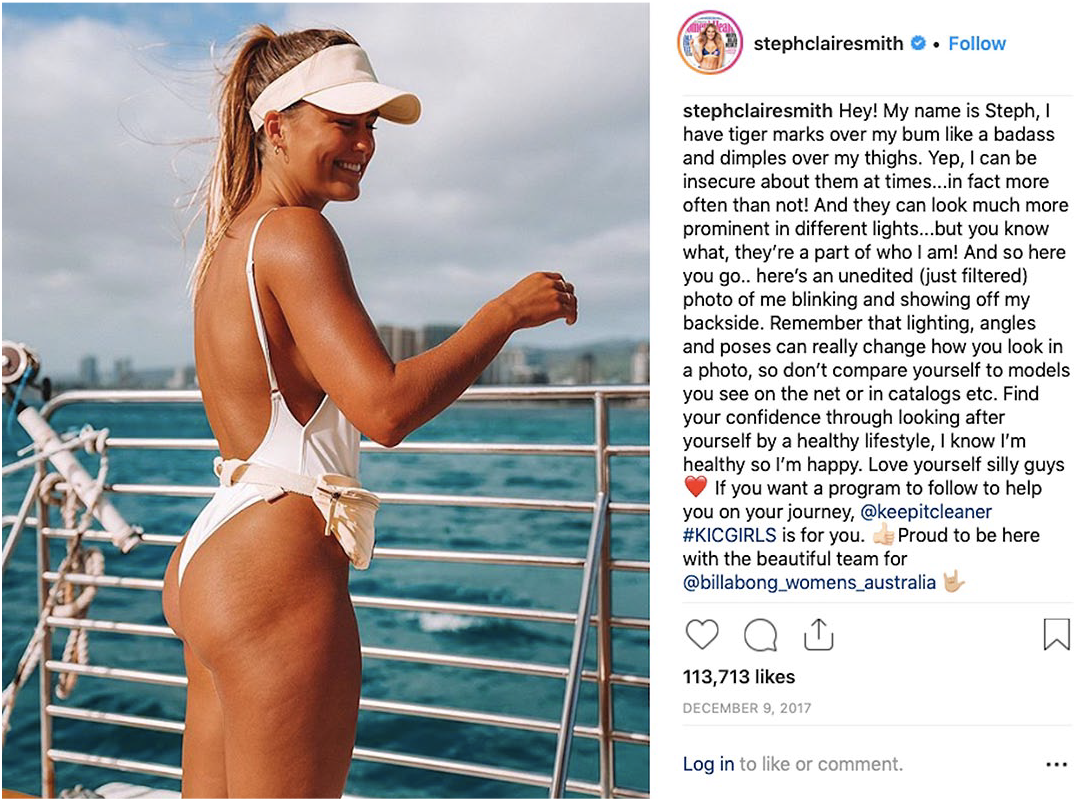
Screenshot of Steph Claire Smith’s Instagram post (Smith, 2017).
This genre of posting was emulated by one of my participants, Alycia (aged 30), who uses Instagram to promote her personal training business and be a ‘positive influence and hopefully inspiring to someone’. During participant observation, Alycia shared a mirror selfie of her body in a bikini with a caption which read: I have hip dips and legitimately could not give less of a  about it. I also have small boobs, stretch marks, my teeth aren’t straight, my face has a shit side . . .
 But really WHO CARES! [. . .] I am trying really hard to care less about being ‘perfect’ and just enjoy the shit I got going on
In this post, the corporeal ‘truths’ of Alycia’s body, such as hip dips, stretch marks and small boobs, are not passive matter, but rather material agents at work. These features of Alycia’s body function in association with her intent to bring an assemblage of caring less about being perfect into being. Caring less can be considered an affect that increases Alycia’s capacity to challenge entrenched social norms of how bodies should look and normative practices of ‘perfection’. When we discussed this post in the interview, Alycia added, ‘I was just like saying, you know, rather than constantly putting yourself up against the perfect woman, let’s just appreciate our differences because they make us who we are’. In attempting to combat body shaming through referencing such corporeal ‘truths’, posts of the body such as Alycia’s come together with a constellation of discourses around body positivity and confidence. These discourses focus on critiquing the beauty industry’s portrayal of ‘harmful’ and ‘unrealistic’ body image ideals and promote the celebration of feeling confident in one’s own skin (Gill and Orgad, 2015). Material and discursive elements are thus entangled in practices of posting unedited visuals of the body on Instagram and do political work, albeit of a somewhat ambivalent kind. These elements serve to ‘speak back’ to the beauty industry while underwriting the importance of the body. It is, however, important to note that some corporeal materiality was not shown in such visuals. Alycia, for example, shared, ‘body hair is something that I do think I would be embarrassed to post if there was something that shouldn’t be in place’. This suggests that cultural standards of beauty and desirable feminine aesthetics do still circulate within the raw assemblage and shape practices of inclusion and erasure. Further to this, bodily enactments of raw evident in the data still worked to produce identities that were mainly white, able-bodied, heteronormative and middle class. This points to the potential exclusivity of such networked publics and suggests that relations between some bodies may not convert to social and economic capital in the same way as others within the raw assemblage.
In addition to unedited visuals of the body, participants discussed raw with reference to fitness influencers who post images of their bodies working out, selfies without makeup on and ‘realistic’ post-pregnancy photos. Here, the materiality of the body, namely sweat, blisters, ‘horrible facial expressions’, and loose skin, work to validate the authenticity of posts. Engaging with visuals such as these produced positive affects of relatability for several participants. This was evident in Katie’s (aged 34) account of following white Australian fitness influencer Emily Skye. As Katie powered on the treadmill during our phone interview, she shared that she was 20-weeks pregnant with her second child and accordingly had begun following active women she aligns with on Instagram, who are pregnant or have recently had a baby. Katie explained that she ‘was never very interested in [Skye] prior to seeing her experience being pregnant’ and only started following her once she realised she was on a ‘similar journey’. In describing Skye’s content, Katie said, ‘her images of post-pregnancy are excellent, like not trying to get that [pre]baby body back or anything like that. Definitely showing that she’s still got a tummy, she’s wearing her daggy undies, all that kind of stuff’. Here, the materiality of Skye’s post-pregnancy body (e.g. ‘showing that she’s still got a tummy’) and clothing (e.g. ‘she’s wearing her daggy undies’) connects with Katie’s ‘current baby body situation’, specifically her body’s changing shape during pregnancy which she documented in her Instagram posts. After the interview, I visited Skye’s Instagram profile to see the types of content Katie discussed. Upon doing so, I could see that Katie left a comment on one of Skye’s recent posts (Figure 2) which read, ‘Thanks for sharing @emilyskyefit. Your honesty and raw images are so refreshing to see. Congratulations on the biggest achievement of your life  ’. This comment indicates that Skye’s ‘raw images’ – which ‘refreshingly’ resist the hyper-stylised Instagram aesthetic – are important for her relatability and follower engagement. In leaving a public comment, rather than a private message, it could also be said that Katie was keen to increase her visibility as a follower of Skye and ascribe value to pregnant bodies and most particularly, post-pregnant bodies, at large.
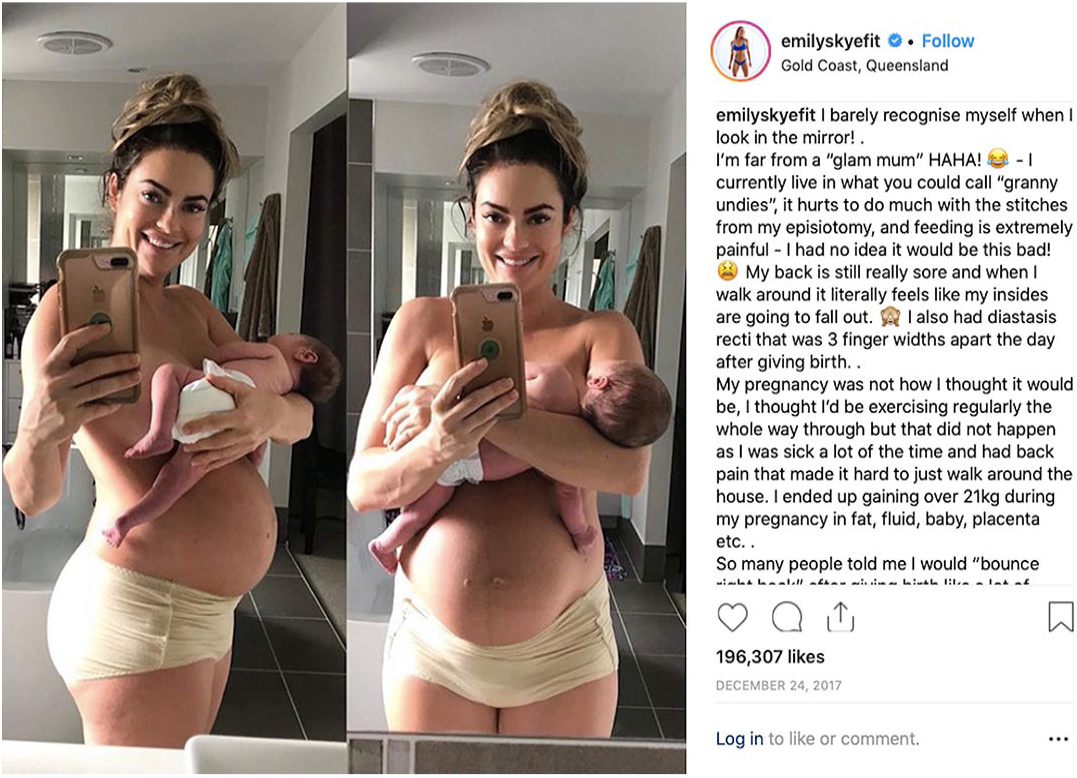
A few days after speaking with Katie, I met Eliza (aged 33) – and her 5-month-old baby – in a café for an interview. Eliza shared similar experiences of following Skye, explaining, It’s so weird and funny to see another fitness person who used to have such a toned middle as well. I just totally relate to how she looks at the moment. I mean, I’ve gone down a lot, but that’s what I feel like still. I just don’t feel like, strong through my middle. I think she legitimises the post-pregnancy journey a fair bit.
The affective capacity of raw is thus evident in connections made between Skye and my participants. Skye’s practice of sharing visuals of her body postpartum in particular convinced Katie and Eliza to feel a rapport and identify with her. Accordingly, it appears that posting the body raw provides a ‘photographic truth’ (Vainikka et al., 2017: 122) which reveals something authentic about a person, despite the fact that staging such content is a typical practice on Instagram. The affective capacity of raw was similarly evident in my participants’ decisions to unfollow fitness influencers who did not post raw images of their bodies. Rosie (aged 27), for example, explained, ‘I initially looked up models like Bella Falconi and Andrea Brazier. They inspired me a lot when I first started my fitness journey. [. . .] I now, am not so sure. I have moved away from the pretty images’. Likewise, Ruby (aged 26), commented, ‘I try to avoid people that only/mainly post real professionally taken photos’. The presence or absence of unedited or ‘realistic’ visuals of the body thus produces affective flows which shape material practices of following and unfollowing on Instagram. These practices are of particular interest to people who are or hope to become influencers, where your ability to establish branding and economic value rests on your capacity to engage with a large number of followers. Accordingly, I infer that the raw assemblage comes together through affects (such as relatability) and works micropolitically to produce an imperfect ‘natural’ self which feels easier to emulate and possibly attain than picture-perfect images of women’s bodies shown elsewhere in mediated contexts.
Storying the everyday
Participants also discussed raw with reference to practices of using Instagram stories to share moments from the everyday. Instagram stories are a feature that enables users to post content that disappears after 24 hours. The temporality of such posts can be considered emblematic of the rise of ephemeral uses of social media popularised by Snapchat and later adopted by Instagram and Facebook. During data collection, moments of the everyday I observed on participants’ Instagram stories included food preparation, daily routines, and time with family, friends and pets. Examples of this genre of posting are shown in Figures 3 and 4.
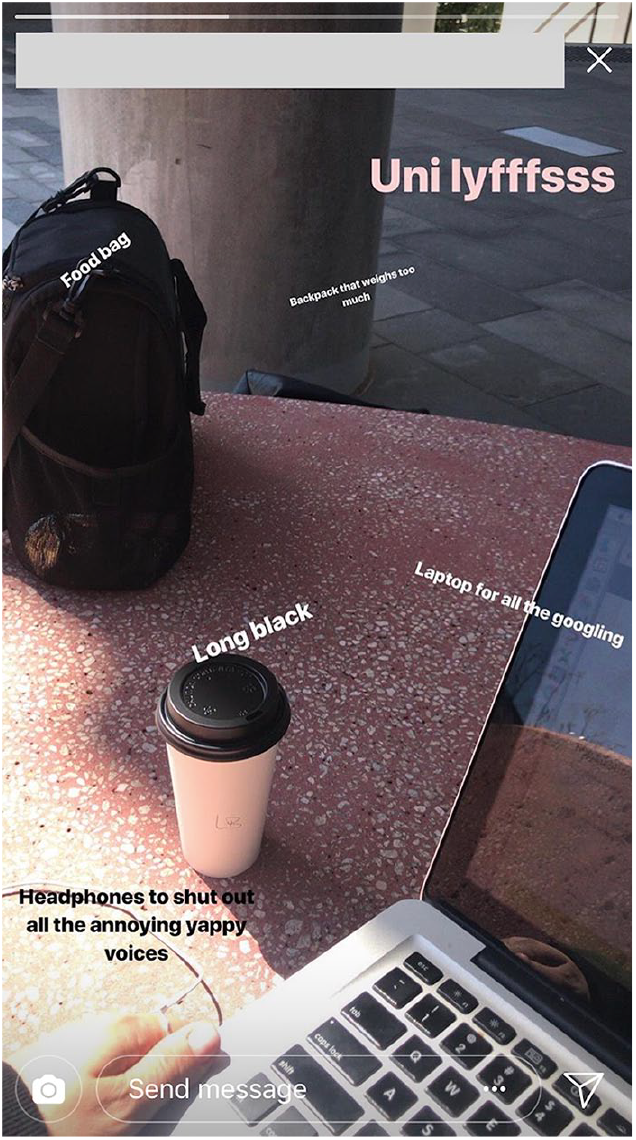
Screenshot of a participant’s Instagram story taken at university, featuring a backpack, food bag, coffee, headphones and laptop.
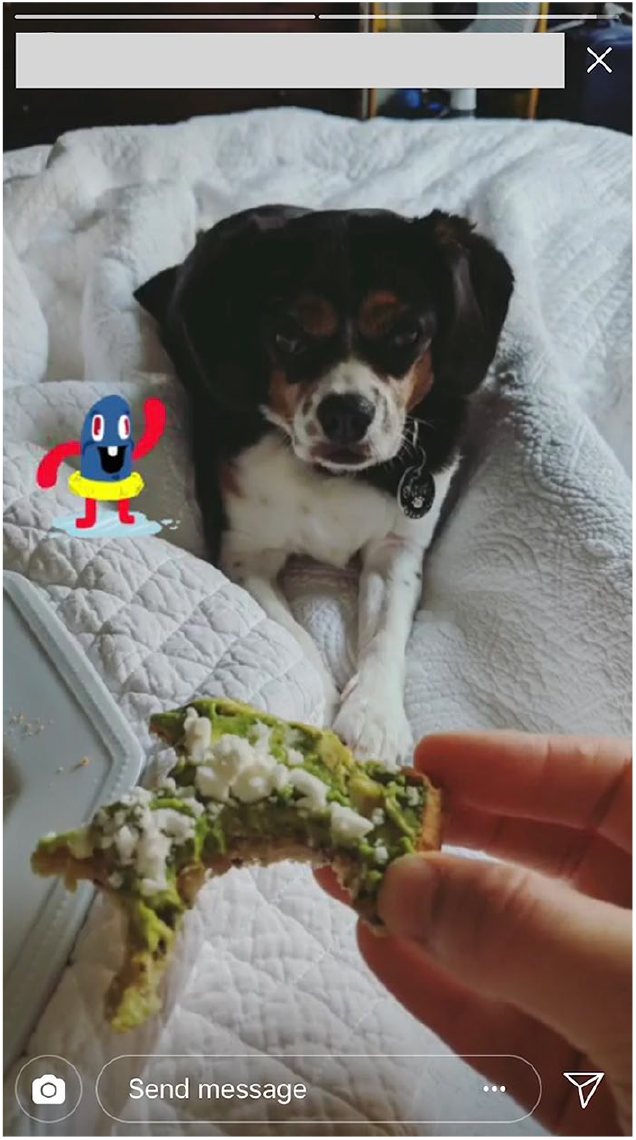
Screenshot of a participant’s Instagram story taken in bed, featuring a pet dog, GIF and avocado on toast.
Capturing the banality of everyday life and including family members, friends and pets in posts corresponds with visual conventions to achieve perceptions of authenticity. This genre of posting moreover mirrors an increasing trend towards the visibility of the ‘ordinary person’ in media representations, what Graeme Turner (2006: 153) refers to as ‘the demotic turn’. Instagram stories were considered by participants as the most practical and fitting way to share this type of content given their temporal immediacy and ease. Amber (aged 27), who uses Instagram to promote her work as a personal trainer and share her fitness journey, for instance, explained, ‘a story is just like something quick in the moment and I’m like, oh, I’ll just share that or yeah, it’s a real-time thing’. Eliza (aged 33) added, ‘posts that are images take a scheduling in my day. A story I can just do [. . .] on the run’. The ‘non-commitment’ of Instagram stories was also described as ‘kind of cool’ and best suited to the ‘boring-but-also-funny stuff’ which you prefer not to be ‘part of your feed for the rest of your Instagram-future’. Here, Instagram stories function in association with discourses of digital risk which often surface in discussions about ‘over sharing’ and ‘data permanency’. These discourses have gained traction in response to what communications scholars Brooke Duffy and Ngai Keung Chan (2019: 121, emphasis in original) call ‘imagined surveillance’, a phenomenon whereby ‘individuals conceive of the scrutiny that could take place across the social media ecology and, consequently, may engender future risks or opportunities’. In this context, the perceived temporality of Instagram stories can be considered a technological remedy for mitigating risks through controlling who sees what and for how long. The manner in which discourses of digital risk and the materiality of Instagram stories – as a platform feature – enfold in the raw assemblage consequently produces new affective and relational possibilities for users sharing content (e.g. ‘I don’t really have to think too much with stories ‘cause [they] disappear’).
Participants who engaged in influencer-like practices on Instagram further explained that Instagram stories were most suitable for product or service promotion given they allow you to add hyperlinks to websites. Rosie (aged 27), who promotes for an activewear brand and nutrition supplement company, for example, explained, ‘stories are easy. I prefer them if I am featuring a product. It’s easy to direct people to a website or page’. Storying, therefore, has the potential to capitalise relationships Instagram users have with their followers through driving traffic to the web pages of brands. This promotional strategy is reflective of a broader shift in social media architecture towards ‘monetizing connectivity by maximising lucrative data traffic between people, things and ideas’ (van Dijck, 2013: 200, emphasis in original). Here, as van Dijck (2013) explains, narratives have become the ‘lubricant for connecting people to products and products to people’ (p. 206).
For several of my participants, practices of storying the everyday were taken up to enact a more authentic and personable self. Twenty-year-old Charlotte, for example, shared, ‘for me, portraying rawness and realness is sort of just taking snippets I guess out of what you would do just in your everyday life [. . .] and not putting it on’. At the heart of these enactments were desires to form relationships with followers. Alycia (aged 30), who uses Instagram to promote her personal training business, for instance, explained, ‘the story is probably more a personal edge I find, so people can get to know me better’. Watching the Instagram stories of fitness influencers produced similar affective relations for my participants, as shown in Vanessa’s (aged 26) comment below: Some people in particular like Em WizzFit, sometimes her posts are a bit boring cause they’re often the same body shots over and over again and I’m like, I don’t know how authentic you are? You don’t really post many videos of you actually doing stuff. But then I realised recently her stories actually have a lot of that! A lot of what I wanted. So now I’ve started watching her stories like more actively [. . .] so then I can see that she’s more real and she’s like legit working out. [. . .] I considered unfollowing her recently and when I actually went to click to unfollow her, I accidentally clicked her stories and then I was like ‘this is where all the good content is!’ So, I haven’t unfollowed her.
Here, the material practice of storying worked to authenticate WizzFit as a fitness influencer through providing a window through which Vanessa was able to ‘see that she’s more real and she’s like legit working out’. Vanessa’s recount of considering unfollowing WizzFit and then deciding not to after accidentally clicking on her Instagram stories illuminates two affective flows at work. The first affective flow was generated through relations between WizzFit’s posts of ‘the same body shots over and over again’ and Vanessa’s desire for authenticity. These relations produced affects such as boredom and scepticism which mobilised Vanessa to contemplate the material practice of unfollowing her. The second affective flow was generated through Vanessa’s accidental encounter with ‘all the good content’ on WizzFit’s Instagram stories. This encounter produced affects of appreciation and interest which strengthened Vanessa’s attachment to WizzFit and mobilised her to remain a follower. These flows of ‘networked affect’ (Hillis et al., 2015) can thus be considered drivers of relational connections (e.g. following) and disconnections (e.g. unfollowing) between different bodies within the raw assemblage.
Instagram stories in which fitness influencers talked to their followers through front-facing cameras were regarded as particularly raw and intimate by my participants. These stories were described as most frequently posted while fitness influencers sat alone in a parked car, at home or while walking outdoors. Here, the setting and framing, in addition to the real-time, temporal immediacy of storying the everyday, became a catalyst for connection, instantaneously closing the spatial and temporal gap between Instagram users. Thirty-two-year-old Victoria discussed this felt closeness in the interview, commenting, ‘I love how other people talk to that [stories]. It’s like a quite intimate sort of way to watch someone’s day’. The digital intimacies formed as a result of talking on Instagram stories are similarly evident in Charlotte’s (aged 20) narration of why she likes to follow fitness influencer Elise Carver. Charlotte explained, She does this really cool thing in the morning which I actually wake up and look forward to listening to and watching. It’s called the Morning Three and she does like three little snippets [on Instagram stories] of what she’s focusing on today or what we should focus on and, you know, like it’s really cool [. . .] I once commented on one of her stories about just looking after your mental health [. . .] and I was just like, ‘Hey just wanted to let you know that you know the stuff that you, like the content that you pump out is really inspiring, blah, blah, blah’ and she was like, ‘Oh thank you so much, blah, blah, blah’ and then I dunno, ever since then we’ve just sort of touched base with each other every now and then.
The affective capacity of storying the everyday is evident here in both Charlotte’s comment that she looks forward to watching Carver’s ‘Morning Three’ when she wakes up, and also in her action to reply to one of these stories with a compliment. Carver’s subsequent reply and messages ‘touching base’ every now and then have since worked to further strengthen Charlotte’s affective attachment to this fitness influencer. Such connections foster a sense of familiarity and trust between social media users which overtime, as explained by Abidin (2018a), ‘allows everyday Internet celebrities to promote other persons, products, or services through personal recommendations and endorsements’ (p. 33). It thus appears that practices of storying the everyday ‘run on’ affective labour and produce digital intimacies which cement the ‘affective economies’ (Ahmed, 2004) formed by the raw assemblage.
‘Real talk’
In addition to posting the body raw and storying the everyday, participants discussed raw with reference to practices of ‘real talk’ about topics such as mental and physical health, body image, competition preparation and recovery. Nicole (aged 32), for example, explained, ‘it’s not just showing all your wins like whether that be in life or competition, but it’s also showing the struggles as well and the fails’. During participant observation, participants practised ‘real talk’ in their Instagram stories and post captions. Participants also directed their Instagram followers to their YouTube videos or blog posts where they discussed their struggles in greater detail. In a caption of one of Simone’s (aged 31) posts, for example, she mentioned, ‘I’ll be filming a [YouTube] Vlog touching on my history with binge eating . . . If there is anything in particular you’d like me to talk about, comment below or DM me!’ Here, sensitive self-disclosures spilled over onto other platforms, potentially intensifying their affective capacity. For several of my participants, talking about struggles with mental health and body image produced positive affects such as feelings of belonging and acceptance. When I interviewed Victoria (aged 32), who did not engage in any influencer-like practices, for instance, she explained, I’ve connected with a lot of people from the more darker, ugly struggles of body image and food struggles and stuff like that. So, it’s actually nice just to share when I do, like, those raw, hard moments amongst all the beauty and perfection.
When reflecting on how she felt when watching and reading similar posts made by others, Victoria added, ‘if you see someone else struggling and you’re having a struggle, that comfort can help pull you through coz then you don’t feel alone’. Comments such as this highlight the capacity of affect to aid ways of being. In Victoria’s case, the affect of comfort generated through seeing others experience similar body image and food struggles allowed her not to ‘feel alone’. Such positive affects suggest that practices of raw undertaken by non-influencers operate within what Berryman and Kavka (2018: 93, emphasis in original) refer to as a ‘connected economy’, which prioritises the formation of connectivity over the prospect of explicit commercial value. Here, social media users can achieve ‘emotional catharsis through the generation of communities in which they can be heard’ (Berryman and Kavka, 2018: 96). Accordingly, I infer that practices of raw can produce different affective and relational possibilities for social media users.
Curating the highs and lows of everyday life also appeared to shape my participants’ practices of following and unfollowing fitness influencers on Instagram. Fiona (aged 27), for example, shared, I think it’s far more important to be real and to show the ups, the downs, the shittest times, the best times, the you know deaths in the family, the broken bones, whatever it is, to show that to people because they’re actually gonna be able to relate to you. And if I can relate to you, I wanna follow you. And I’ve actually unfollowed so many [fitness influencers] ‘cause I’m like, ‘I actually don’t relate to you anymore. [. . .] I don’t relate to the fact that you’re never really raw, you’re never real. It’s always like the same bullshit, here I’m at a beach in a bikini. Are you in a bikini every day? Are you in a freakin’ bikini every day?’ Honestly, like, it just annoys me.
Fiona’s tendency to follow fitness influencers she relates to and unfollow those she doesn’t demonstrates how practices of ‘real talk’ work micropolitically to produce a relatable self and cultivate digital intimacies with followers. It is important to note, however, that although my participants spoke about liking posts that do ‘delve into feelings’, some mentioned that they do not like following fitness influencers who are ‘too whiney or down’ or post about ‘really negative stuff often’. Victoria (aged 32), for example, shared, ‘I wouldn’t follow someone where it’s all negative and struggle. Like I need hope coz what else are we on this planet for?’ Cara (aged 31) added, ‘It does make me judge certain people. I’m like, here you are giving advice when obviously deep down you’re failing miserably, and people are looking up to you’. An ability to ‘have a laugh’ and ‘move the F on’ from these low experiences was also praised. This suggests that fitness influencers have to negotiate the breadth and depth of their self-disclosures in order to still maintain an upbeat personality and inspirational persona. This was similarly discussed in Kim Toffoletti and Holly Thorpe’s (2018: 308) analysis of global celebrity sportswomen’s Instagram profiles, where they found that the women had to limit posts about injuries and negative emotions in order to remain ‘palatable and desirable commercial sporting subjects’. Accordingly, I posit that sensitive self-disclosures made on Instagram are governed by ‘feeling rules’ (Kanai, 2018) which stipulate how young women ought to conduct themselves in a postfeminist, neoliberal and commercial context. These ‘feeling rules’ are normative discourses at work within the raw assemblage, propelling flows of affect which modulate material practices of ‘real talk’ such that Instagram users are emotional but not ‘too’ emotional (e.g. Figure 5). The affective labour mandated by such discourses (e.g. self-regulation) thus illuminates the capacity of affect to restrain ways of being and reveals the manner in which discourse and affect enfold in enactments of raw on Instagram.

Screenshot of a participant’s Instagram post of a meme.
Conclusion
In this article, I have discussed how authenticity is enacted in digital fitness cultures through drawing upon my research with women who post and engage with fitspo content on Instagram. In so doing, I have examined three practices of raw described by my participants as ways they or fitness influencers generate authenticity and relatability: (1) posting the body raw, (2) storying the everyday and (3) ‘real talk’ about topics such as body image and mental health. Through this analysis, I have demonstrated how raw is a form of aesthetic, emotional and affective labour which works to cultivate digital intimacies between my participants and other Instagram users. Such digital intimacies are socially and economically productive in that they facilitate a shared sense of belonging and connectedness, and assist existing or aspirational influencers to establish branding and commercial value through personal recommendations and endorsements. The digital intimacies brought into effect through practices of raw are thereby fruitful for platforms which seek to strengthen consumerism and corporatisation through users generating content, advertising and revenue.
While analyses of fitspo content are emerging in academic scholarship (Fatt et al., 2019; Tiggemann and Zaccardo, 2018), there is an absence of research examining women’s lived experiences and embodied practices of posting and engaging with this content. There is also an absence of scholarship examining how authenticity is enacted within these cultures. This article goes some way towards filling these gaps by providing an empirically informed analysis of practices of keeping it raw in fitness cultures on Instagram. Spotlighting the different ways in which women post and engage with fitspo content on Instagram not only provides a more nuanced understanding of the phenomenon, but also allows us to critically attend to the micropolitical work these practices do, to what end and for whom. This article moreover makes a theoretical and methodological contribution by providing an example of how to ‘do’ digital posthumanist and feminist new materialist research. Such an approach brings material, discursive and affective forces into relation, enlarging the canvas for empirical exploration beyond representational approaches which tend to dominate research in this context. In so doing, this article sets up a materialist basis for analysing the embodied and affective dimensions of engagements with fitspo content on social media and the implications of these engagements for women’s being and becoming.
Footnotes
Acknowledgements
I am very grateful to my PhD supervisors, Dianne Mulcahy and Brady Robards for their support in the development of this article. I am also grateful to Liz Dean for her helpful comments about authenticity and bodies over coffee. And finally, I am grateful to the participants of this research who so generously gave their time and entrusted me to follow them on Instagram for the purposes of this research.
Funding
The author(s) disclosed receipt of the following financial support for the research, authorship and/or publication of this article: This research was supported by an Australian Government Research Training Program Scholarship.
