







Abstract
We interviewed 61 Muslims in 15 focus groups from the most visible Muslim population in the United States: the Detroit Metropolitan Area. Participants shared their experiences of and responses to Islamophobia on social media and face-to-face during the 2016 US presidential election campaign and aftermath. Applying Fraser’s and Squires’ theories of counterpublics, we developed an adapted understanding of counterpublics in collapsed contexts of online and face-to-face spaces. We argue that everyday Muslim internet users in the United States are an example of a hyper differential counterpublic. They face the pressures of near ubiquitous and ever evolving Islamophobic attacks, while needing to engage with the internet for personal and professional purposes. We suggest that hyper differential counterpublics operate in collapsed contexts of mixed, unimaginable publics, switch between group and individual responses, and craft hyper situational responses to discriminations case by case.
This study adapts counterpublic theories developed by Nancy Fraser (1990) and Catherine Squires (2002) by examining the experiences of one of the largest and historically significant Muslim communities in the United States during a period of increased Islamophobia: from the US presidential campaign in October 2016 to the end of the first 100 days of the Trump presidency in April 2017. Although only 1% (3.35 million) of the US adult population identifies as Muslim (Lipka, 2017), hate crimes targeting this minority recently surged for a second consecutive year: from 180 incidents in 2015 to 260 in 2016 (Human Rights Watch, 2017). In spring 2017, three quarters of Muslim Americans said Trump was “unfriendly toward Muslims in America” (Pew Research Center, 2017: para 3).
While previously, we argued that Muslim bloggers form an emerging counterpublic by deliberately using online spaces to create visibility and voice (Eckert & Chadha, 2013), this study focuses on everyday internet users who identify as Muslim and contest ever evolving strategies of Islamophobia spread by mainstream and anti-Muslim micro-publics. We argue that persistent Islamophobia has collapsed online and face-to-face contexts for everyday Muslim social media users in the Detroit Metropolitan Area, rendering them into a new kind of subaltern public: a hyper differential counterpublic.
Studies have analyzed Islamophobic content online and its creators (Farkas et al., 2018; Horsti, 2017), linking negative portrayals of Muslims in media to negative perceptions of Muslims and support for restricting Muslims’ civil liberties (Saleem et al., 2017). In order to learn more about how Muslims in the United States make sense of Islamophobia, we worked with “the country’s most visible Arab and Muslim population” (Howell, 2011: 152). Two hundred thousand Muslims live in the Detroit Metropolitan Area, including “several of the largest, oldest and most influential congregations” (Howell, 2014: 1) in the United States. They are an ethnically heterogenous population—half of them are Arab, 30% South Asian, 10% African American, and 10% European, African, and White US converts (Howell, 2011)—providing insights from diverse Muslim perspectives.
Theoretical approaches: counterpublics and collapsed context
Criticizing Habermas’ (1989) public sphere theory, Fraser (1990) and Squires (2002) conceptualized a plurality of simultaneous dominant publics and counterpublics that are permeable and overlapping, have diverse affiliations, and vary in levels of preferential treatment (see also Asen, 2000; Warner, 2002). Fraser (1990) defined counterpublics as “subaltern publics” in “parallel discursive spaces.” She argued counterpublics develop when marginalized individuals, and their voices, are not accepted within dominant publics. As they are rejected by the mainstream, they form their own counterpublic spaces to make sense of their experiences. She argued that a status-free public space, as Habermas (1989) originally envisioned, cannot exist in societies with deep socio-economic differences. Even if participants could enjoy equal access to public sphere arenas, social hierarchies—constructed by gender, race, class, and other intersecting dimensions of identity such as religion—would not necessarily vanish in democratic debate. Thus, a multitude of counterpublics develops in relation to dominate publics. Fraser (1990) identified three characteristics of counterpublics. First, because of a lack of representation in and identification with dominant discourses, collectives seek relief in separate safe spaces. In these spaces, disenfranchised individuals can feel comfortable about their identity, negotiate and reimagine it positively, and build a community. Second, counterpublics create and distribute counternarratives that oppose dominant discourses. Finally, counterpublics are internally and externally focused for simultaneous intra- and interpublic debates among individual members and between other groups to gain more representation in dominant publics.
Squires (2002) distinguishes three types of counterpublics: Fraser’s classic counterpublics, enclaves, and satellite publics. In contrast to Fraser, Squires described counterpublics as able to be externally focused only when oppression has decreased and speaking out has become less threatening. Individuals and groups in counterpublics can lobby openly for their interests and challenge dominant publics with less fear of punishment, like post 1950–1960s civil rights movements in the United States. In contrast, enclaves are forced into hiding, such as Black individuals in the United States during segregation, using hidden language among themselves and prepared speech in public to survive. Satellite publics refer to groups that voluntarily isolate themselves to preserve group coherence and identity, seldomly emerging in public, similar to the Nation of Islam (Squires, 2002).
Public sphere theory has been previously criticized by Muslim scholars as rooted in European, Enlightenment, and modern philosophies. They have argued that arenas of public discourse in non-Christian religious and non-Western societies have remained largely uninterrogated (Eickelman and Salvatore, 2002). Eickelman and Salvatore suggested that a Muslim public sphere and a Muslim counterpublic can exist simultaneously. In tandem, Salime (2016) described how individual Muslim women formed an embedded counterpublic within the Muslim public sphere, meaning they arose as an “inner rather than marginal public” (p. 70). She argued Muslim women achieved change of daily practices through individual women speaking up within their families, mosques, and other surroundings. Both arguments, however, emerged from studying societies in the Middle East and Northern Africa with Muslim majority populations. Our research contributes to this scholarship by examining the discourse of Muslims in a non-Muslim majority country with a large non-Muslim public sphere.
Similar to Squires’ (2002) enclaves, when responding to negative images of Muslims in US media, American Muslims have developed bifurcated communications to create images and messages for public consumption in contrast to communicating “experiences . . . oriented toward in-group realities and personal attempts to understand and transcend these realities” (Shryock et al., 2011: 13). In this way, individual Muslims in the United States represent a counterpublic actively engaging with a public narrative that has tried to force them to identify as Muslim or American (Calfano, 2018). But Muslims in the United States have resisted juxtaposed “hyphenated selves” by expressing both American and Muslim identities (Sirin and Fine, 2007: 152). This combination of American and Muslim identities is present in parts of the Detroit Metropolitan Area due to the large concentration of both Arab Americans and Muslim Americans. A survey of Arab Americans in the Detroit Metropolitan Area, which included many Muslims, showed that 80% of participants were US citizens (Schopmeyer, 2011). In this metro area, the cities of Dearborn and Hamtramck feature the highest concentration of Muslims within the United States (Aghajanian, 2017; Round and Steele, 2017). During the 2016, US presidential election Dearborn was the target of far-right media fearmongering that spread through social media among Trump supporters increasing Islamophobic sentiments toward Muslims (Hirsch, 2016; Round and Steele, 2017).
Another concept which factored into our analysis was context collapse, meaning multiple, typically distinct, audiences are condensed into one (Marwick and boyd, 2010; Vitak, 2012). Audiences, traditionally, were thought to be passive individuals or small groups who absorbed messages produced by mass media in the privacy of their own home. Social media affordances have increased agency in individual self-presentation, have broadened the directionality of media messages, and have complicated who we imagine our community to be. In a collapsed context, users pivot to consider how an invisible audience—an unknowable public—might react to messages (Vitak, 2012). Thus, “the boundaries between audiences and publics become even harder to disentangle theoretically and empirically when people engage one another online in public and quasi-public ways” (Baym and boyd, 2012: 323). In this study, we focus on the concept of publics in collapsed contexts. We suggest that context collapse also includes the blurring of online and face-to-face spaces, as publics exist and interact simultaneously in both spaces. Online spaces are unique in speed, affordance, and connectivity. But online spaces are also linked to face-to-face spaces through the users’ bodily presence in material spaces, geographic location tracking, time stamped posts, and user identity verification policies.
Context collapse has allowed previously disconnected people to immerse themselves in counterpublic discourses as individuals and/or through joining groups. Search engines and hashtags allow individuals to connect, give support, and amplify messages. Context collapse, however, has also mitigated some of the benefits of previously theorized counterpublics. For example, satellite and enclaved publics previously were able to mitigate messages constructed about them and control the messages they sent to and/or received from dominate publics. While privacy settings and affordances online allow users to increase or decrease interactions with others, unexpected changes in social media policies can result in sudden, unanticipated exposure. Furthermore, screenshotting can preserve posts even after they are deleted by a user and can result in a user’s messages being (re)exposed to unintended, unimagined publics (Baym and boyd, 2012; Vitak, 2012).
As counterpublic messages move from insular discussions toward the center of public debates, creators can lose control of their message (Horsti, 2017; Jackson and Welles, 2015; Kuo, 2018), resulting in unintended, often hostile, interactions between counterpublics and the general public (Davis, 2018; Kuo, 2018). How then do marginalized groups negotiate their presence in collapsed contexts in the face of hostility?
Literature review: social media, Islamophobia, and counterpublics
Islamophobia is defined as “indiscriminate negative attitudes or emotions directed at Islam or Muslims,” including “aversion, jealousy, suspicion, disdain, anxiety, rejection, contempt, fear, disgust, anger, and hostility” (Bleich, 2012: 182). These attitudes constitute a form of racism in which those perceived to be Muslim are also thought to be violent, misogynistic, disloyal to their country, and generally incompatible with Western society (Garner and Selod, 2015). As in face-to-face environments, hate speech, harassment, sexism, and racism exist in online publics (Cammaerts, 2009; Duggan, 2017), including “cyber Islamophobia” (Aguilera-Carnerero and Azeez, 2016: 21). This means Islamophobia spreads across collapsed contexts. While social media can create a wider discourse constituted of co-existing and overlapping dominant publics and counterpublics (Asen, 2000), they also create “contested terrains” (Dahlberg, 2011: 862) wherein multiple publics compete for attention within the same medium. Algorithms, search engines, and connection tools target specific user profiles, shape users’ online experiences, and influence their participation in public discourse as individuals. This means counterpublics in collapsed contexts act via coordinated group efforts and individual responses. Sometimes, it is difficult to discern if a single person or a group is acting, and indeed both can be part of counterpublic activities. For instance, anonymous individuals or groups developed strategies of cloaking the creators of false Facebook pages that manipulated users to post anti-Muslim speech (Farkas et al., 2018). Similarly, individual anti-Muslim bloggers remixed images to link Islam to sexual violence, which spread across global online spaces (Horsti, 2017). In addition, the collective #MuslimWomensDay campaign on Twitter in 2017 was organized to showcase the experiences of real Muslim women through individuals freely sharing personal stories (Pennington, 2018a). Muslims in North America intentionally select particular social media platforms and their affordances to build their own “Muslim social media” to benefit them individually and collectively, to contextualize anti-Muslim hostilities globally, and to manage their identity toward fellow Muslims and non-Muslims (Rochadiat, 2019).
Social media can enlarge counterpublics through a wider dissemination of alternative media content that cultivates counterpublics (Leung and Lee, 2014). Similarly, social media can sustain geographically dispersed counterpublics through directly disseminating original and pre-existing materials in conjunction with face-to-face interactions (Penney and Dadas, 2014). Social media used by counterpublics can also correct “misconceptions of singular identity narratives through an oppositional discourse” (Davis, 2018: 209), be deployed to successfully halt campaigns seen as detrimental to a counterpublic (Morrissey and Kimball, 2017), provide new spaces to share digital recordings and expose injustices to minorities (Hill, 2018), and render intersections of race and religion visible through posting shared concerns and interacting with a broader dominant public (Boutros, 2015).
As social media users normalize their individual communication practices (Gershon, 2010; Renninger, 2015), social media spaces influence normative expressions online and face-to-face (Freelon, 2015) across individual users and groups. It remains difficult, however, to change the framing of issues in mainstream discourse. For instance, a group’s project to stop fake Facebook pages that incited anti-Muslim speech was only partially successful: The pages were removed but individual perpetrators were never held accountable as they could “hide” within the Facebook structure behind fake profiles (Farkas et al., 2018).
Given the affordances and restrictions of social media, the types of oppositional publics described by Fraser (1990) and Squires (2002), and emerging literature on online publics, it becomes clear that there is a need to reexamine the way we frame the relationship between dominant publics and counterpublics in collapsed contexts in which group strategies and individual tactics are blurred. We built on counterpublic theory and adapted it toward the concept of hyper differential counterpublics through the example of Muslims in the Detroit Metro Area. We analyzed what it means to operate as a marginalized individual in collapsed contexts by conducting and analyzing focus group interviews with everyday Muslim social media users, guided by the following research questions:
How do Muslims in the Detroit Metropolitan Area say that they experience Islamophobia in collapsed contexts?
How do Muslims in the Detroit Metropolitan Area say that they respond to Islamophobia in collapsed contexts?
Method
Focus groups are ideal to understand the range of experiences of people who share some common characteristics and in-group communication (Krueger and Casey, 2015; Sirin and Fine, 2007). We conducted focus groups with Muslim social media users to understand their experiences with and responses to Islamophobia online and in face-to-face encounters. While focus groups allowed participants shared identification as Muslims, they also countered the perceived homogeneity of Muslims (Broos and Van den Bulck, 2012) and gave them agency to express their concerns in their own words. As focus groups can be difficult to populate, we used multiple avenues for recruitment (Krueger and Casey, 2015): We distributed flyers at universities, mosques, museums, and Islamic centers in South East Michigan; partnered with a local Muslim organization; and invited participants through social media, personal connections, and a university research pool wherein students received extra credit for participation. Participants had to be 18 years or older and identify as Muslim.
Each focus group had between three and seven participants 1 (Krueger and Casey, 2015) and lasted about an hour. One team member audio-recorded and moderated each group; two others took notes. Team members transcribed each session verbatim and analyzed the first two transcripts in Atlas.ti individually. Notes from this individual inductive analysis were compared in team discussions to identify agreement, dissent, and themes/subthemes in participants’ accounts. This led us to arrive at higher order synthesized themes, which we translated into codes (Appendix 1). Codes were defined and exemplars were selected as representations for the codebook. We then divided transcripts among members to code all remaining transcripts; two researchers coded each transcript. The researchers also made analytic memos throughout the analysis process, noting where codes may connect to each other and overarching themes. Quotes from participants were edited slightly for better readability.
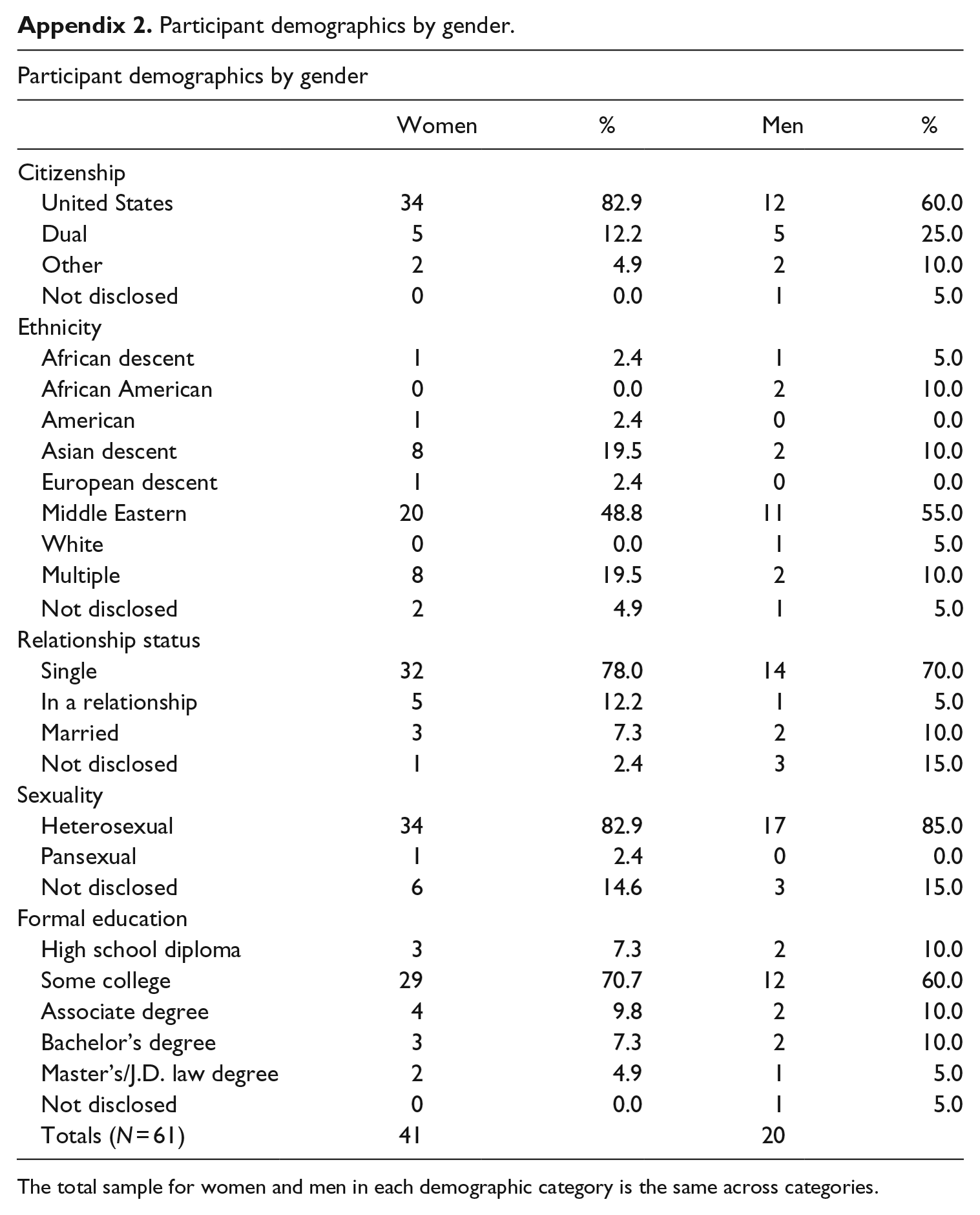
We conducted 15 focus groups between October 2016, shortly before the US presidential election, and April 2017, after Trump concluded his first 100 days as US president. Of 61 participants, 41 were women and 20 men (Appendix 2 provides an overview of participant demographics). The skew toward women reflected the higher percentage of women among undergraduate (57%) and graduate (61%) students of the university whose research pool we used. Participants’ age ranged from 18 to 56 years; median was 21 and mode was 18, skewing toward undergraduate students (45 participants). Most participants were single (47 participants); 10 were in a relationship; 4 did not disclose relationship status. Almost all held US citizenship (56 participants); 10 participants held dual citizenship with Canada, Lebanon, India, Egypt, or Russia. Three Canadians and one Indonesian participated. One person did not disclose citizenship. Two-thirds reflected the large Arab and South Asian Muslim populations around Detroit: 2 Lebanese (16 participants), Arab (10 participants) or Arab-American (4 participants), Iraqi and Palestinian (each 1 participant) as well as Pakistani (8 participants), Indian (7 participants), Chinese and Asian Iranian, and Sundanese/Indonesian (each 1 participant). The other third reflected the smaller groups of African, European, and African-American Muslims around Detroit. Three did not disclose ethnicity.
Experiences of Islamophobia in collapsed contexts
Context collapse condenses different publics into one through various media channels. In addition, we suggest, context collapse meshes private versus public, online versus face-to-face, and individual versus group binaries in unique ways. Individuals must craft messages for invisible, unintended publics, who they may need to interact with in face-to-face and online spaces. The overlap of these spaces still includes experiences that may be rooted more in one context than the other. Members of counterpublics must be prepared to engage with dominant publics in online and face-to-face spaces in ways which account for members’ safety and simultaneously navigate expectations of in-group peers. We first detail experiences of Islamophobia anchored in face-to-face situations, then describe experiences that originated online, highlighting where overlaps occurred. We then follow by describing examples of more fully blurred experiences.
Face-to-face, 48 participants said they experienced Islamophobia at work, school, or during leisure time. Some were blunt remarks or behaviors. A 21-year-old Lebanese-American woman recalled, “We came out of the . . . Lebanese airplane and then there were literally 20 security guards on our door, just interviewing people and asking questions.” Many participants said geography influenced their exposure to Islamophobia, contrasting their life around Detroit with visits elsewhere in the United States, as described by a 22-year-old Lebanese man, “Dearborn is very tight . . . We are all Muslims in Dearborn. There’s a reason we are all concentrated and saturated in one spot. Because if we go out, that is when we get screwed.” These statements illustrated a reluctance to engage with dominant publics in the face of potential threats. Being one of the most visible Muslim communities in the United States, Dearborn has become a target for anti-Muslim sentiment as a 20-year-old Lebanese woman summarized, “Everyone wants to come and attack us . . . The mosque gets threats daily.” For many Muslims and Arab Americans post-9/11 daily life has required an active defense of their culture and faith to outsiders and “immense effort goes into negating the suspect, incomplete and contested aspects of Arab Muslim identity” (Shryock et al., 2011: 8). Shryock and colleagues argued that this ready defense of Islam by Muslims in the Detroit Metropolitan Area was “how the community protects itself from abuse and reassures larger society that Arabs and Muslims, can, in fact, be good Americans” (p. 8). The community is put in a position to have to react on a daily basis to dominant publics rather than being able to feel part of dominant public society.
Despite such efforts toward showing Muslims as “good” Americans, participants said that they experienced Islamophobic outbursts in everyday settings, as a 19-year-old man of Lebanese descent exemplified, “I’ve gone to Wal-Mart and a woman’s come up to me and said, ‘You’re getting deported. You’re getting kicked out’.” A 21-year-old man of Lebanese decent highlighted the fusing of Islamophobia and racism in face-to-face interactions recounting that “most of the Islamophobia that . . . like most of the . . . well, the racist stuff . . . they were very racist . . . Like you know, [calling me] ‘sand nigger’.” When entering dominant publics members of a counterpublic are explicitly reminded of their outsider status. While American Muslims have been a familiar sight in the Detroit Metropolitan Area for more than 100 years as residents, business owners, and politicians, 3 the connection between Islamophobia and racism ensures that when participants were perceived to be Muslim, they were also viewed as a potential threat (Garner and Selod, 2015). This continuation of Islamophobia in public spaces confirms Fraser’s (1990) and Squires’ (2002) argument that status-free speech does not exist. Whether they wanted to or not, participants felt varying levels of pressure to participate in counterpublic behaviors due to the extreme scrutiny they received as individuals and members of a minority group during the 2016 US presidential election despite—or perhaps because of—their long, historically grown, and strong presence around Detroit.
Participants frequently described their fear, sadness, and anger when experiencing Islamophobia face-to-face, with fear being the most salient: 15 participants said they were very concerned for their family’s safety. A 21-year-old woman, who said that she has a “Middle Eastern background,” said, “I worry about my parents who are much older and when they go out in public.” Participants also worried about Muslims who were visually recognizable immediately after the 2016 US presidential election, as incidents of women having headscarves torn off were reported in news media (Luthern, 2017; Mathias, 2017).
Participants’ descriptions of the anger they felt after experiencing Islamophobia face-to-face stood out. They said this was linked to their desire to not be singled out by constant taunting. At the same time, they said they understood anger to be an immature response. A 21-year-old Pakistani woman best described this in retelling an encounter in middle school with a classmate: “She yelled ‘terrorist’ and I got really mad. . . . And right after lunch she said it again and I just, I don’t know, I lost it. I just punched her in the face.” Participants who described reacting angrily reflected that this would only confirm Islamophobic sentiments harbored by dominant publics, summarized by a 20-year-old Egyptian-American woman: “You kinda have to walk away [pause] or just bite your tongue . . . most of the times you just gotta not be a stereotype that day.” Participants mostly discouraged themselves, or fellow participants, from displaying anger to remain physically safe in public, to prevent harming the reputation of Muslims, and to avoid criticism from their own community.
Participants overwhelmingly agreed that Islamophobia happened more frequently online than face-to-face. But some noted that they considered their online presence to be closely connected to their offline identity because they posted their “real life” events on social media. Some said that they were identifiable as Muslim online through avatars or photos that showed them or relatives with headscarves or through content in which they disclosed being Muslim. They said this linked their online presentation directly with their “real life” identity. These participants also described how hostile feedback to their online posts affected them in “real life,” making them feel upset and frustrated. For example, a 30-year-old married man recounted the negative reactions he received online for a wedding photo taken in a face-to-face situation with his wife with headscarf: My wife is a huge Red Wings fan . . . She follows the Red Wings and they had a competition, you know, submit your favorite picture. [The Red Wings] put [the wedding photo] on their official Red Wings feed for Facebook so people started commenting on it and for the most part messages were cool. A few people were like, “I don’t like this” . . . and it was just all negativity . . . They were saying things like, “They need to assimilate.”
The comment section of the Detroit Red Wings’ posts exemplified contested terrain between dominant and counterpublics (Asen, 2000; Cammaerts, 2009) in collapsed contexts. Muslim women in the United States, especially with headscarves, are perceived to threaten American cultural stereotypes of femininity (Eckert et al., 2018). While Americans typically see headscarves as a symbol of the oppression of women in Muslim cultures, Muslim American women described feeling respected and emancipated when wearing a headscarf (Droogsma, 2007). Our participants reflected seeing this tension play out in their online interactions. A 20-year-old American-Canadian Muslim woman with headscarf said, I just kind of give them like the truth and kind of tell them. They’ll [people online] be like, “Oh yeah, Muslim women are oppressed because they wear the hijab.” And I’ll be like, “Well you know, I kind of picked this on my own, I don’t think I’m oppressed at all.”
But when images of everyday Muslims from around Detroit circulate via social media, the ability to control one’s image can be limited. Because publics are collapsed in high speed online spaces, Islamophobic messages fall on fertile cultural ground in societies that have long harbored hostile sentiments toward Muslims (Horsti, 2017).
Several participants argued that Islamophobia is more prevalent online because the internet affords users perceived anonymity. Many participants said Islamophobic messages increased online after news reports had mentioned a terrorist attack or any Muslim in mainstream news media. For instance, a 20-year-old Lebanese woman with headscarf said, “When I hear about a terrorist attack . . . I know that [news media] are always going to find a way to try to find the link to Islam.” She argued people would carry those negative messages from news media into social media without critical thought. Participants also argued that social media accelerated the distribution of local news to a national stage. A 20-year-old Lebanese man recalled the coverage of a murder in Dearborn that was used as an opportunity to attack the Dearborn Muslim community: “Before the police knew, before they released anything, or any names, or anything about the family, some white supremacist said [via Twitter]: ‘That’s what you guys get, you Arabs’.” Examples of tweets like this were talking points across focus groups and confirmed dynamics in which any crime is used to generate Islamophobic propaganda by mixing true and false elements online (Horsti, 2017), leading to some Muslims internalizing the mix up of wrong and right information as well.
Yet, participants also observed that such messages were not left uncontested. For instance, a 21-year-old Pakistani woman described, “If one person shares an article [about the Muslim travel ban], then a bunch of people that agree will comment, showing they agree, and then people that don’t agree will start fighting.” Similarly, fake Facebook pages prompted skeptical users to create the group ‘Stop Fake Hate Profiles’ which succeeded in getting such pages removed (Farkas et al., 2018). These examples are indicative of quotidian counterpublics that emerge and fight in contested terrain rather than accept behaviors and messages that reflected and catered to dominant publics as typically seen in mainstream news media (Jackson and Welles, 2015).
At the same time, many participants agreed that it was easier to ignore hate online. On social media connections can be made and removed on a minute-by-minute basis. Content and connections can be tailored to curate a pro-Muslim feed, as a 19-year-old Pakistani man said, “I wouldn’t really see it on social media because the people that I am friends with . . . a lot of them are Muslims and a lot of them are pro-Muslim.” Islamophobia online was perceived as less intense as face-to-face, as a 22-year-old Black Canadian man described, “When it’s on social media it’s nothing. You brush it off.” Online contexts were seen to permit spontaneous curation of content toward in-group communication to a higher degree than face-to-face.
The emotions that participants described when experiencing Islamophobia online differed significantly from those they described when encountering hostilities face-to-face. Of 61 participants, 37 described feeling frustrated when encountering online Islamophobic content and 17 said they felt oversaturated with anti-Muslim messages, resulting in emotional fatigue. This was perhaps most aptly described by this 20-year-old Lebanese-American man: “You can’t be a Facebook keyboard warrior . . . you can’t go on every comment and just say: ‘Hey, you’ve got the wrong perspective.’ . . . So there’s nothing that you can really do about it.” This fatigue has affected members of counterpublics when they had to endure dominant discourse without an opportunity to regroup within their counterpublic and create their own spaces for communication (Dahlberg, 2011; Renninger, 2015; Squires, 2002). While participants said they experienced fatigue from constantly facing Islamophobia online, they also said that they sometimes could take time crafting a message in defense. This feeling of agency stood in sharp contrast to the fear and shock they experienced during sudden face-to-face encounters of racism and/or Islamophobia. Such face-to-face experiences could then be shared online with fellow Muslims and allies to help process and to regroup, looping into collapsed contexts. But participants carefully gauged their time, energy, and impact and decided on a case-by-case basis if they should bother putting in the effort to contest hostile dominant publics or anti-Muslim micro-publics online or to share online—and be reminded of—hostile face-to-face encounters.
While not completely being enclaved by oppression, these experiences of fatigue and frustration conveyed elements of an enclave that is careful about how to perform in public spaces. In face-to-face encounters, participants said that they were able to leave a threatening space or situation most of the time. However, they described challenges to completely quit social media without isolating themselves entirely from peers who remained present online. These challenges also made it less feasible to retreat into a satellite public. The counterpublic spaces that participants used online often overlapped with dominant publics online and face-to-face, making Islamophobic discourse seem inescapable. Especially comments from trusted people impacted participants; 10 said they were shocked when they saw Islamophobic comments online for the first time from people they personally knew, as a 22-year-old Black Canadian man explained, If I’m scrolling through Twitter and I see some random person from Milwaukee say he hates Muslims, I don’t care what you hate and don’t hate. But if it’s someone I’ve known for years, then it’s a lot more hurtful.
At least one other study demonstrated that personal discrimination was felt to be demotivating when the offender was personally known (Oskooii, 2016). Participants reported feeling less motivated to respond because online and face-to-face experiences blurred publics that included trusted people.
Increased Islamophobia surrounding the 2016 US presidential election translated into a highly politicized and seemingly inescapable collapsed online-and-face-to-face context, as an 18-year-old Arab-American woman with headscarf described, “It was worse after the election. After Trump won . . . Everyone hated more because they had the president of the United States on their side.” Similarly, an 18-year-old Pakistani-Indian woman said, “Before [the election] it was completely different. You didn’t see anything about politics. . . . Now I can’t go on[line] without seeing something about what Trump did or what he’s doing or protesting.” When protests erupted after Trump signed Executive Order 13769 on 27 January 2017, also called the Muslim travel ban, it affected the Detroit Wayne County airport (Shamus, 2017). Several 18- and 19–year-old women highlighted how they experienced the situation through collapsed contexts:
I think after Trump became president, like the protests gave everyone a voice, like, protest at the airport. It wasn’t just Muslims protesting, it was all different kinds of races protesting for what they think is wrong.
Did you go to the airport?
No, it was on Snapchat. It was on their live story.
Snapchat even posted it. The Snapchat itself, the company posted it.
My cousins went.
We had pictures; it was crazy.
Yeah, it was on Snapchat.
My sister went.
These participants experienced an interconnected online-and-face-to-face loop and a successful bid of counterpublic voices reaching dominant publics. Publics who were unable to physically attend, joined online. In line with Oskooii (2016), systematic-political discrimination can propel reluctant counterpublics to engage with dominant publics when they perceive a direct or indirect threat to their life situation. Social media can be a safe(r) space for individuals to enact out-group directed action and connect to physical spaces directly. Below, we discuss the variety of responses that Muslims used to cope with attacks.
Responses to Islamophobia in collapsed contexts
In navigating collapsed contexts, participants’ described how their responses to Islamophobia differed slightly between face-to-face and online experiences. The most common responses across collapsed contexts were educating, contextualizing, ignoring, and avoiding. Defending or showing solidarity with strangers was more common online; removing users or content was unique to online spaces.
Educating
All participants were aware of negative Muslim stereotypes in the United States and 23 participants said that they corrected misconceptions and provided non-threatening, logical, historical, or emotional counternarratives. A 21-year-old Lebanese woman with headscarf recounted, “Unintentionally I said the word ‘Inshallah’ and then I told [a classmate]: ‘This means this. Feel free to ask me any other questions you have. Really.’ I made him comfortable asking questions.” Within that moment, she decided to create a counternarrative to potential negative associations her classmate may hold regarding hearing an Arabic phrase. Online, educating often meant creating content rather than reacting to situations, for instance portraying Muslims as “regular” people as a 20-year-old Bangladeshi woman did on Snapchat and Instagram: “If I post something publicly it’s going to be like our traditional stuff, what Muslims do, prayers and stuff like that, and what everyday life is like for us.” Similarly, Muslim bloggers on Tumblr have described their efforts to authentically display who they are and what it means to be a “good Muslim” to help educate others (Pennington, 2018b). Participants also referenced “pristine” sources and common practices in Islam to check people’s claims online about Islam, as a 20-year-old Lebanese woman with headscarf described about her brother’s Facebook posts: “[He would write] ‘check your sources, buddy.’ Like, ‘you don’t know what you’re talking about’.” In Islam, the concept of striving for a best self and a better world is known as jihad (Streusand, 1997) and includes correcting erroneous views of Islam. But some participants said that attempts to educate others resulted in frustration when facing absurd questions, as a 21-year-old Pakistani woman recounted being asked, “Are all Muslim people ISIS?” The gap of knowledge between Muslims and non-Muslims can appear preposterous to those in the marginalized counterpublic. Online, participants were able to evade or limit failed attempts of educating; face-to-face this was not always possible. Within collapsed contexts of online-face-to-face-online loops, participants’ decision to (dis)engage with dominant publics became more complex. Considering their resources at hand in the very moment, Muslims choose to educate, or not, depending on the specific situation.
Contextualizing
Twenty-two participants said contextualizing helped them to empathize with people who made Islamophobic remarks and to place them in a specific context of time and place. Contextualizing meant acknowledging mistakes, lack of education, negative portrayals of Muslims in mainstream media, or misguided views among members of non-Muslim publics. A 20-year-old woman of Lebanese descent with headscarf offered, Someone living in Kentucky who’s never even seen a Muslim in their life, [are] seeing on TV: “Muslims are bad” That’s the idea that the media is giving . . . Every time they go on social media. It’s really not their fault.
She implied that people who live closer to a Muslim community, such as Dearborn, may be able to critically assess media content by contrasting it with their personal experiences and may not see Muslims as people to be feared. Online, participants gauged the intent of a person’s post using demographic markers, previous posts, and profiles to understand whether a user was malicious or simply uninformed. When encountering “hostile” comments, a 35-year-old Indonesian woman with headscarf explained, “First thing that comes to mind is, I try to discern whether this person is a troll or not.” Contextualizing comments assists participants as they quickly decide if they should ignore, remove, or educate.
Avoiding and ignoring
Avoiding and ignoring are strategies employed by satellite publics (Squires, 2002) and several participants confirmed that they avoided unsupportive people and spaces, extensively contemplating which environments may be (un)safe. Given the increased scrutiny Muslims have received while traveling (Stack, 2017), participants frequently discussed crossing borders. A 35-year-old Indonesian woman with headscarf said airports made her nervous, leading her to avoid praying in public, hiding her Arabic prayer book, and “invest[ing] in this obnoxious pair of Beats 3 headphones . . . I didn’t want to hear micro-aggressive comments.” She practically traveled as a one-person enclave, avoiding engagement with the dominant public and tailoring her behavior toward it for fear of her safety.
Online, not friending/following hostile users and foregoing spaces with potentially hurtful comments was common. A 20-year-old Iraqi woman with headscarf said, “Whenever I do see something . . . anything that fits like a [negative Muslim] stereotype I tend to avoid the comment section because I don’t wanna hear that. I know what is gonna be said.” Participants also forewent specific social media platforms, such as a 21-year-old woman of Pakistani descent who used Instagram, Snapchat, and WhatsApp but deleted her Facebook app “because after the election stuff got heated.” Yet, even after deleting apps, participants were pulled back into dominant discourse because information migrated quickly across social media and into face-to-face interactions. Participants said friends, family, or classmates brought up news in face-to-face conversations and shared content on other social media seen as less political before the election, such as Instagram or Snapchat.
Online, participants described ignoring content and/or users by “scrolling past” potentially undesirable messages, following advice from parents and mentors to ignore Islamophobic provocations in any context, even if this was difficult. A 19-year-old Canadian American of Pakistani descent recalled, “We were always taught even when you’re openly being disrespected and your religion is being put down, don’t say anything.” This allowed Muslims to continue their everyday lives with minimal display of their emotions and avoiding confirming potential stereotypes of Muslims that could harm their communities’ reputation. Participants also cited a Muslim saying, “The moment you start arguing with an ignorant fool, you’ve already lost.” Discussed across focus groups, this approach gave participants an exit strategy from pressures to have to educate, while being consistent with their faith.
Solidarity with strangers
Participants showed solidarity online typically by retweeting, sharing, and liking posts. These forms of solidarity allowed participants to amplify positive messages about Muslims in a low stakes way, as the effort required to post original content was considered much higher. As a 21-year-old woman of Pakistani descent said, “I personally choose not to comment . . . But I will throw a ‘like’ here and there if there’s a comment that is backing up the argument.” Shulman (2009) cautioned against considering such low stakes participation as “true” public engagement. However, given the potential threats to the emotional well-being and physical safety incurred by marginalized individuals posting original content cannot be the only standard by which participation in a counterpublic is measured. As a 19-year-old woman of Indian descent described, “When I do see someone being personally attacked, there’s always someone else who jumps in. I usually retweet that person’s tweet. . . . I’m supporting the person who’s supporting the person who’s being attacked.” In this way, social media features allow Muslims to express themselves and support counternarratives with less fear of becoming targets of harassment themselves.
Defending
Defending is associated with counterpublics (Fraser, 1990). Participants described championing Islam and identifying as Muslim online, moving beyond low stakes support. Thirteen said they defended Islam face-to-face, and 19 online, as an 18-year-old Arab-American woman said, “I will, like, share a political video. I’ll share religious videos. I’m not afraid to take a stance on something on Facebook really.” Some participants risked being blocked by others, as a 19-year-old US-Canadian man with Pakistani background said, “I laughed it [Islamophobic comments] off and then sent him a quick video about what Islam was, and then he blocked me on Twitter.” But few were willing to defend Islam when facing overwhelming opposition or ignorance, choosing other responses such as removing or ignoring.
Removing
Participants described severing one’s account from specific content or users by muting, banning, blocking, and unfriending/unfollowing, mirroring satellite public behavior (Squires, 2002). Eight participants recalled removing Islamophobic content from their social media spaces to varying degrees of success. For example, an 18-year-old Arab-American woman said, “You’re always getting these nasty comments. That’s why sometimes I just need to delete Twitter. Often, I’ll redownload it.” A 20-year-old Lebanese woman with headscarf said, I don’t have social media accounts like Facebook or anything where I can get that, but we have a family chat and my brother and sister always screenshot what’s on Facebook and forward links to the family chat. So, I don’t have social media, but I’m constantly looking on social media due to forwards to my phone.
Although, she chose to disengage with social media, she was still kept abreast of online commentary through her family members, showcasing the collapsed context of online and “real life” connections. A 49-year-old man of Pakistani background said he monitors his feed, “sometimes blocking people from posting personal attacks . . . then I will usually speak to that person offline and say, ‘That won’t wash’.” Social media features allow participants to curate a feed in very short intervals to align with their group-based values and individual needs. Instead of removing themselves from online conversations entirely, some participants sought to cut out Islamophobic messages by temporarily or permanently silencing them. However, removal did not always yield the complete elimination of hostile messages due to the ubiquity of social media and the collapse of separate publics.
Discussion and conclusion: a hyper differential counterpublic
Muslims in the Detroit Metropolitan Area are neither seeking isolation nor are they willing to constantly respond to hateful messages and behaviors in collapsed contexts. They do not constitute an enclave or satellite public as described by Squires (2002) or a counterpublic as envisioned by Fraser (1990). Muslims in the Detroit Metropolitan Area are an example of a hyper differential counterpublic which rapidly decides whether to engage, or not, in oppositional activities on a case-by-case basis.
We argue that a hyper differential counterpublic emerges when three conditions are met. First, a group faces high levels of personal-societal and systematic-political discrimination. This means the group struggles against ubiquitous discrimination during a given time period. Second, a group faces a collapsed context of online and face-to-face communication as well as privately and publicly directed communication. This collapsed context includes an atmosphere of dealing with high pressures for creating publicness about one’s life by participating in social media. These high pressures place expectations on group members to create communication and content that is frequently gathered from their own face-to-face contexts and “real life.” In this process, group members have to decide if and how they disclose the group membership(s) that is/are the target(s) for the discrimination they face. Navigating this collapsed context also means group members are expected to consume online content posted by peers, including their “real life” experiences, to stay in the know. Third, group members bear the burden of individual responsibility. Individual group members are expected to make a high number of decisions by themselves in short periods of time to respond to near ubiquitous discrimination while also balancing group expectations. This burden also includes dealing with the emotional fallout from episodes of discrimination: the emotions group members experience themselves when facing discrimination and emotions they experience when peers judge their responses to discrimination. These conditions may also extend to individuals and groups other than the population with whom we worked.
As individuals feel compelled to react quickly in social media contexts, which often have the potential for global visibility and overwhelming message exchange, individual identity-based communication tactics must factor into how researchers view counterpublic responses. Individuals cannot always connect back to their support groups to craft counternarratives collectively in everyday situations face-to-face and online. Even participants who described not using social media were still influenced by social media trends shared in mainstream news and interpersonal interactions. Hyper differential counterpublics seek to preserve their identity, daily routines, and well-being, while evaluating whether to respond to discrimination and misrepresentations portrayed in dominant publics. They make individual decisions on a case-by-case basis in a rhythm dictated by the relentless flood of content flowing through online-face-to-face-online loops. Depending on the individual’s levels of energy, time, and resources in a given situation, they may bring parts of their counternarrative into dominant publics, exploiting affordances unique to social media. In other moments, such an interaction is deemed as too exhausting and disengagement prevails. In a much more rapid sequence than the historic development of enclaves, counterpublics, and satellites, hyper differential counterpublics switch incessantly between the group behaviors of these three types of oppositional publics while also casting decisions as individuals, crafting hyper situational responses.
Footnotes
Appendix
Participant demographics by gender.
| Participant demographics by gender | ||||
|---|---|---|---|---|
| Women | % | Men | % | |
| Citizenship | ||||
| United States | 34 | 82.9 | 12 | 60.0 |
| Dual | 5 | 12.2 | 5 | 25.0 |
| Other | 2 | 4.9 | 2 | 10.0 |
| Not disclosed | 0 | 0.0 | 1 | 5.0 |
| Ethnicity | ||||
| African descent | 1 | 2.4 | 1 | 5.0 |
| African American | 0 | 0.0 | 2 | 10.0 |
| American | 1 | 2.4 | 0 | 0.0 |
| Asian descent | 8 | 19.5 | 2 | 10.0 |
| European descent | 1 | 2.4 | 0 | 0.0 |
| Middle Eastern | 20 | 48.8 | 11 | 55.0 |
| White | 0 | 0.0 | 1 | 5.0 |
| Multiple | 8 | 19.5 | 2 | 10.0 |
| Not disclosed | 2 | 4.9 | 1 | 5.0 |
| Relationship status | ||||
| Single | 32 | 78.0 | 14 | 70.0 |
| In a relationship | 5 | 12.2 | 1 | 5.0 |
| Married | 3 | 7.3 | 2 | 10.0 |
| Not disclosed | 1 | 2.4 | 3 | 15.0 |
| Sexuality | ||||
| Heterosexual | 34 | 82.9 | 17 | 85.0 |
| Pansexual | 1 | 2.4 | 0 | 0.0 |
| Not disclosed | 6 | 14.6 | 3 | 15.0 |
| Formal education | ||||
| High school diploma | 3 | 7.3 | 2 | 10.0 |
| Some college | 29 | 70.7 | 12 | 60.0 |
| Associate degree | 4 | 9.8 | 2 | 10.0 |
| Bachelor’s degree | 3 | 7.3 | 2 | 10.0 |
| Master’s/J.D. law degree | 2 | 4.9 | 1 | 5.0 |
| Not disclosed | 0 | 0.0 | 1 | 5.0 |
| Totals (N = 61) | 41 | 20 | ||
The total sample for women and men in each demographic category is the same across categories.
Funding
The author(s) received no financial support for the research, authorship, and/or publication of this article.
