







Abstract
Star worship is an ever-growing phenomenon around the globe. Across various social media platforms in China, a new idol–fan relationship model has emerged, such that the fans have stepped up from merely worshipping the idols to being able to co-cultivate their idols, including their public images, the scope of their work, and even their personal lives. Based on a grounded theory approach, this study utilized text analysis and in-depth interviews to explore parakin relationships between fans and idols and proposed a dual motivation model to explain the motivations of fans for forming such a relationship. The findings extend current fandom literature by exploring a new front of fan–idol interactions in the context of social media. Theoretical and practical implications are discussed.
In September 2019, Mi Yang, a well-known celebrity in China who currently has 106,056,928 Weibo fans was about to take on a leading character in a television (TV) show produced by her own agency. This plan, however, upset her fans who claimed to be her “mothers.” They blasted off waves of online protests and even showed up in her many public events, holding signs to protest against Mi Yang playing the leading character. At last, Mi resigned from the show. In early 2019, actor and singer Jeffrey Tung was caught by camera dating with actress Gina Jin shortly after their co-appearance on a TV program. The “sister” fans of Jeffrey, out of dissatisfaction at Gina whom they considered too old (she is 5 years older) and a significant distraction to his about-to-take-off career, put on a strike online and threatened to leave him. A week later, Jeffrey announced his break-up with Gina on social media.
China is currently home to the largest number of fan groups in the world. By 2017, the number of active fans on the Chinese Sina Weibo reached 500 million (Huang et al., 2017). The recent years have witnessed the rise of a group of Chinese pop idols aged mostly 14–25-year old, who are mainly active on social media. Different from celebrities who made their fame for outstanding achievement in a wide range of professions, such as politics and education, these idols arise predominantly in the entertainment industry as a product of careful image branding (Yue, 2007). What is unique about this new generation of fandom is that the status of an “idol” is, by and large, created and maintained through the cultivation of fans. These social media celebrities are hence known as “cultivated idols” (Tencent, 2017).
In fan studies, fans are defined as individuals who are obsessed with media stars, actors, TV shows, and exhibit extremely associated devotions (Hills, 2005). Different from regular media consumers who only receive content (Kozinets, 2001), fans are creating participatory cultures with their own interpretations and creations of media contents (Jenkins, 1992). In the entertainment literature, the way fans ostensibly “interact” with celebrities in the age of TV has been heavily researched as parasocial interaction—the nonreciprocal, imaginary interaction between fans and media personae (Gleason et al., 2017; Horton and Wohl, 1956). Yet, what has been observed on Chinese social media is a new interaction model wherein fans, empowered by social media, collectively cultivate idols by claiming as their mothers, sisters, brothers, and so on (CIW Team, 2018).
Different from fans in parasocial relationships who are still simply appreciating the idols, fans engaged in parakin relationships—fantasized kinships between fans and idols—assume a noticeable degree of influence on their idols. They are highly participatory as normally seen in classic fan culture (Jenkins, 1992), but their major creations are actually their idols instead of fan fiction, art, songs, or other media contents. In the process of cultivating idols, parakin fans are highly self-organized with clear divisions of duties and responsibilities and a strong dedication to action-taking. These fans strategically capitalize their long-term plans on the affordances of social media to campaign for their idols, including posting glowing reviews, designing promotional posters, galvanizing online traffic, and steering the career path for the idol. Deeply involved in every step of the idol’s career planning, parakin fans also garnish a massive fund-raising power invaluable for the idol and his or her affiliated parties (e.g. sponsored products) in the modern entertainment industry. For example, in 2015, on the birthday of Wang Yuan—a member of a popular Chinese idol group TFBoys, his fans not only managed to advertise for their idol on YouTube, but they also put happy-birthday wishes to Yuan on the iconic LED screens at the Times Square in NYC. Likewise, another Chinese idol Xukun Cai made his debut on the LEDs of the Nasdaq Plaza thanks to the amazing fundraising of his fans in 2018.
While much research has extensively examined parasocial relationships and the associated antecedents in the context of mass media. Little has been known about this new generation of fan–idol relationships. Using a grounded theory approach, we employed text analysis and in-depth interviews to explore the characteristics of and motivations for parakin relationships. Findings of this research will advance the existing fan studies and illuminate fan culture research in the age of social media.
Theoretical background
Fannish activities are observed across the world, yet fans’ cultures vary significantly country by country. For example, the Otaku culture in Japan refers to a subculture in which fans become obsessed with or even addicted to certain pop cultures, such as cartoon magazines, video games, and animations (Newitz, 1994). While fans of the Otaku culture are often reviled for being socially withdrawn and psychologically pathologic (Sone, 2014), fans in America, on the other hand, have been applauded for representing a participatory culture that creatively utilizes mainstream media content to serve marginalized populations. As Jenkins (1992) summarized, these fans are “active producers and manipulators of meaning” rather than “cultural dupes, social misfits, and mindless consumers” (Jenkins, 1992, p. 23).
The phenomenon of parakin fans arose as the marketization of Chinese media deepened since the 1980s. As the state media in China used to be subsidized by the government, their choice of content including celebrities, therefore, was a direct reflection of the government’s will. However, with the nationwide push for media marketization at the turn of the 21st century, capitalizing on the strong social media presence of fans offers media organizations a viable means to attract public attention and to secure steady income (e.g. donations, advertisement) much needed for financial independence. In return, fans get their say on social media as to who is worthy of their worship and investment (Yan, 2014). As such, Parakin fans represent a new fan-idol relationship that mimics one of the cornerstones of Chinese culture—kinship (Baker, 2015). In this parakin relationship, fans interact with idols as if they are interacting with family members. Such a fantasized relationship involves a new level of affinity that has gone beyond the parasocial relationship.
Beyond parasocial relationships
Parasocial relationship stems from Horton and Wohl’s (1956) discussion on the nonreciprocal interactions between mass media (radio, TV, and movies) fans and media personae. While ostensibly resembling normal face-to-face interactions, parasocial interactions hinges upon the fantasy and imaginations of media audiences, for the responses from the media personae with whom they are seemingly interacting are absent (Dibble et al., 2016). A rich volume of literature has examined parasocial interactions between TV audiences and TV program personae due to the conducive nature of TV programs—including the vivid portrayals of characters, the techniques of characters addressing the audience directly, and the ongoing series of TV shows whose plots continue to glue audiences to more revelations of characters (Horton and Wohl, 1956). As Burke (1937) put it, all of these techniques significantly helped “coaching” audiences’ illusions of an ongoing “relationship” with their program characters or celebrities.
The interactivity affordance of the Internet and social media has significantly expanded the width and depth with which parasocial interactions could occur thanks to their unprecedented “parasociability” (Ballantine and Martin, 2005: 199). Fans now can legitimately follow their idols on social media that is otherwise impossible in real life without risking breaking the law (e.g. stalking). What is interesting about such a followee-and-follower relationship is that it does not obligate the followee to do anything in response (Hargittai and Litt, 2011), lending itself so naturally to the initiation of parasocial interactions. Idols, who can reply, like, or retweet as they wish, could even block any followers without making it a known move. When occasionally a two-way interaction does happen, fans are significantly encouraged and subsequently more devoted to the parasocial interactions (Marwick and Boyd, 2011; Sanderson, 2009). Moreover, the fact that celebrities nowadays can keep on updating new content to their social media pages significantly increase their “stickiness” to fans (Frederick et al., 2014), so a long-term parasocial relationship is more likely on social media than traditional media (Tsiotsou, 2015).
Scholars have identified a three-stage development of parasocial interactions, escalating from a short-term parasocial interaction that takes place only once during media exposure, to a long-term parasocial relationship that exists inside and outside media exposure, and ultimately to a profound parasocial attachment with the personae from which the audience could obtain intimacy and sense of security (Stever, 2017). The last stage—parasocial attachment—represents a strong bond between the fans and idols that mimics infant-caregiver attachment and adult romantic attachment (Stever, 2017).
While fans formulate parasocial relationships with a wide range of media figures, Giles (2012) empirically compared parasocial relationships with real-life celebrities, fictional human characters, and fictional animated characters. Fans reported the highest desire to meet celebrities and wished themselves to be like the celebrities the most as opposed to fictional human or nonhuman media characters. Social media, more than anything else, have hyped the fantasy of constantly meeting idols and closely mirroring them as role models. Through observing localized practices of parasocial relationships in Singapore, Abidin (2013) proposed the idea of “perceived interconnectedness” to describe how social media influencers exclusively, immediately, and constantly interact with fans to create an impression of intimacy (para. 13). Likewise, through examining social media influencers in Malaysia, Hopkins (2019) explained how they formed “extended parasocial relations” (p. 4702) with fans by actively leveraging social media interactivity to create perceived intimacy.
A recent evolution of parasocial relationship as we observed in fan groups on Chinese social media represents a significant advance. Fans are not just “interacting” with their idols parasocially, instead, they are co-cultivating idols as their “sisters,” “brothers,” “mothers,” “fathers,” so on and so forth. Empowered by interactive communication technology, parakin fans take on a significant amount of responsibilities as well as a certain degree of control toward their idols on social media. While such a parakin relationship shares the key commonality with parasocial relationships (i.e. the imaginary nature of the relationship), it has gone beyond the boundary of parasocial interaction and calls for more scholarly attention.
Potential motives for parakin relationships
While no studies so far have touched upon the motives for parakin relationships, insights could be borrowed from the rich literature on parasocial relationships. A meta-analysis identified motives for forming parasocial relationships, ranging from the characteristics of TV audiences such as age, gender, and personality, to the attributes of TV program personae like attractiveness, authenticity, and parasociability (Schiappa et al., 2007). The battery of motives, though situated in the hype of TV, received support from many studies in computer-mediated contexts (see Liebers and Schramm, 2019).
Individual motives to form parasocial relationships, despite sitting on a wide range of aspects, could be categorized as intrinsic versus extrinsic motives (Deci et al., 2001). Intrinsic motives include audience characteristics that drive the formation of parasocial relationships internally, whereas extrinsic motives encompass the attributes of media personae that promote the relationships externally.
A large volume of literature has identified certain user demographics as noticeable predictors for parasocial relationships. For example, adolescents have a stronger propensity for parasocial interactions (Maltby et al., 2003), so do those post-retirement with decreasing social networks and declining personal health conditions (Vandebosch and Eggermont, 2002). Women are more likely to engage in parasocial relationships than men are (Eyal and Cohen, 2006; Schiappa et al., 2007). Scholars have also found parasocial relationships more prevalent among individuals of low socioeconomic statuses (Auter et al., 2005). Due to limited interpersonal networks in real life, shy and/or lonely individuals are often at a greater need for attachment, leading them to seek parasocial relationships and attachment (Tsay and Bodine, 2012). Low self-esteem could also produce a greater demand for parasocial relationships as individuals struggle with establishing social bonds and attachment in real life (Turner, 1993). Likewise, individuals who are not satisfied with their lives are more likely to seek compensation in parasocial relationships (Adam and Sizemore, 2013; Eyal and Dailey, 2012).
While these intrinsic antecedents were obtained in the context of parasocial relationships, they could also emerge as significant predictors for parakin relationships. For example, the One-Child Policy that ran from 1980 through 2015 in China has deprived generations of Chinese siblings. Having a brother or sister, even at the imaginary level, could be surprisingly fulfilling. The feeling of compensation also holds true for those who were not able to have more children and are lonely as their only child grows up and leaves the house.
A variety of extrinsic factors have been noted as driving forces for the establishment and development of parasocial relationships as well. The attractiveness of media personae, whether it is physical or personality, significantly increases the probability of parasocial relationship and attachment (Klimmt et al., 2006). Audiences are more likely to initiate parasocial interactions and subsequently form parasocial relationships with media personae who are physically charming, of more desirable personality traits (e.g. intelligent, humorous), and with interesting tasks on media (Schramm and Hartmann, 2008).
That being said, attractiveness is not the sole determining factor when it comes to parasocial relationships, as audiences are also more apt to parasocial interactions with media personae with whom they identify (Brown, 2015). Research on selective media exposure has suggested that audiences are more attentive and receptive to contents that resonate with themselves (Zillmann and Bryant, 1985). The same logic applies when it comes to parasocial relationships as “similar characters have the potential to confirm the validity of the viewer’s own beliefs and concerns” (Hoffner and Cantor, 1991: 85). Therefore, fans are expected to form parakin relationships with attractive idols who they could relate to.
Potential gratifications of parakin relationships
From a use and gratification perspective (Katz et al., 1974), media users purposively utilize media to obtain certain gratifications. Although empirical research has repeatedly discovered the negative impact of parasocial relationships on individual well-being (Baek et al., 2013; Eyal and Te’eni-Harari, 2013), fans are also gaining meaningful gratifications, including escapism (Klimmt et al., 2006; Tsay and Bodine, 2012) and sense of belonging and/or security (Stever, 2017). Moreover, as the social cognitive theory (Bandura, 1989) proposes, idols could serve as a role model for fans and encourage them to learn from their idols’ success, fictitious, or real. As a result, fans could boost their self-efficacy and self-confidence when observing rewards to their idols with whom they identify (Derrick et al., 2009; Greenwood, 2008; Phua, 2016).
Research goals
Due to the lack of prior knowledge of parakin relationships, a grounded theory approach (Strauss and Corbin, 2008) is employed to explore parakin relationships and the associated motivations. Guided by this approach, we analyzed Weibo text posted by parakin fans in juxtaposition to traditional fans’ posts. In-depth interviews were also conducted to explore their motives for forming parakin relationships with idols on social media.
Methods
This research combines text analysis and in-depth interviews to understand the characteristics and driving factors for parakin relationships. Social media posts from the parakin fans serve as a natural field for observing parakin relationships between fans and idols in an ecologically unobtrusive manner. In-depth interviews of these fans, on the other hand, provide us rich details that help explain the formation of parakin relationships.
Data collection
Text retrieval
Sina Weibo was purposively chosen as the social media platform as it is the most popular among celebrities and fans in China. Fans could register unlimited accounts, post blogs, comment, and organize activities such as fund-raising to support their idols on Sina Weibo. A total number of 29,109 Weibo fan posts of the most popular fan-cultivated idols—Xukun Cai, Chenyu Hua, Haoran Liu, Han Lu, and Xuanyi Wu, were retrieved according to Sina Weibo’s “Hot List.” We extracted all posts from their parakin fan groups, including the Cai Xukun’s “mother group,” Hua Chenyu’s “sister group,” Liu Haoran’s “family group,” Luhan’s “sister group,” and Wu Xuanyi’s “brother group,” up until June 21, 2019. To identify the unique motives for parakin relationships, we also retrieved a total number of 24,152 blog posts from traditional fan groups of other stars—Bingbing Fan, Jingru Yang, Lau Andy, Yifei Liu, and Ge Hu. Together, these ten stars attracted more than 100 million followers on Sina Weibo.
Each fan group selected in this study had 3000–10,000 blogs (total N = 53,261), forming a corpus of over 10.16 million words. Using systematic random sampling, we analyzed one blog out of every 20 blogs retrieved for both parakin and traditional fan groups. Therefore, the final sample for text analysis included 1455 posts from the parakin fan groups and 1207 posts from the traditional fan groups.
In-depth interviews
To understand the motives for parakin relationships, we conducted semi-structured, in-depth interviews with 36 fans aged from 18 to 36 (10, or 28% males, and 26, or 72% females), who have joined parakin fan groups on Sina Weibo for 1–6 years (Table 1). Using snowball sampling techniques, the interviewees were recruited from 12 provinces across China to maximize response diversity for constructing theories (Charmaz, 2008). Lasting for 40–70 minutes, 29 of the interviews were conducted face-to-face and seven took place online using WeChat. All interviews were audiotaped and then transcribed (see Appendix 1 for interview questions).
Demographics of interviewees (N = 36).
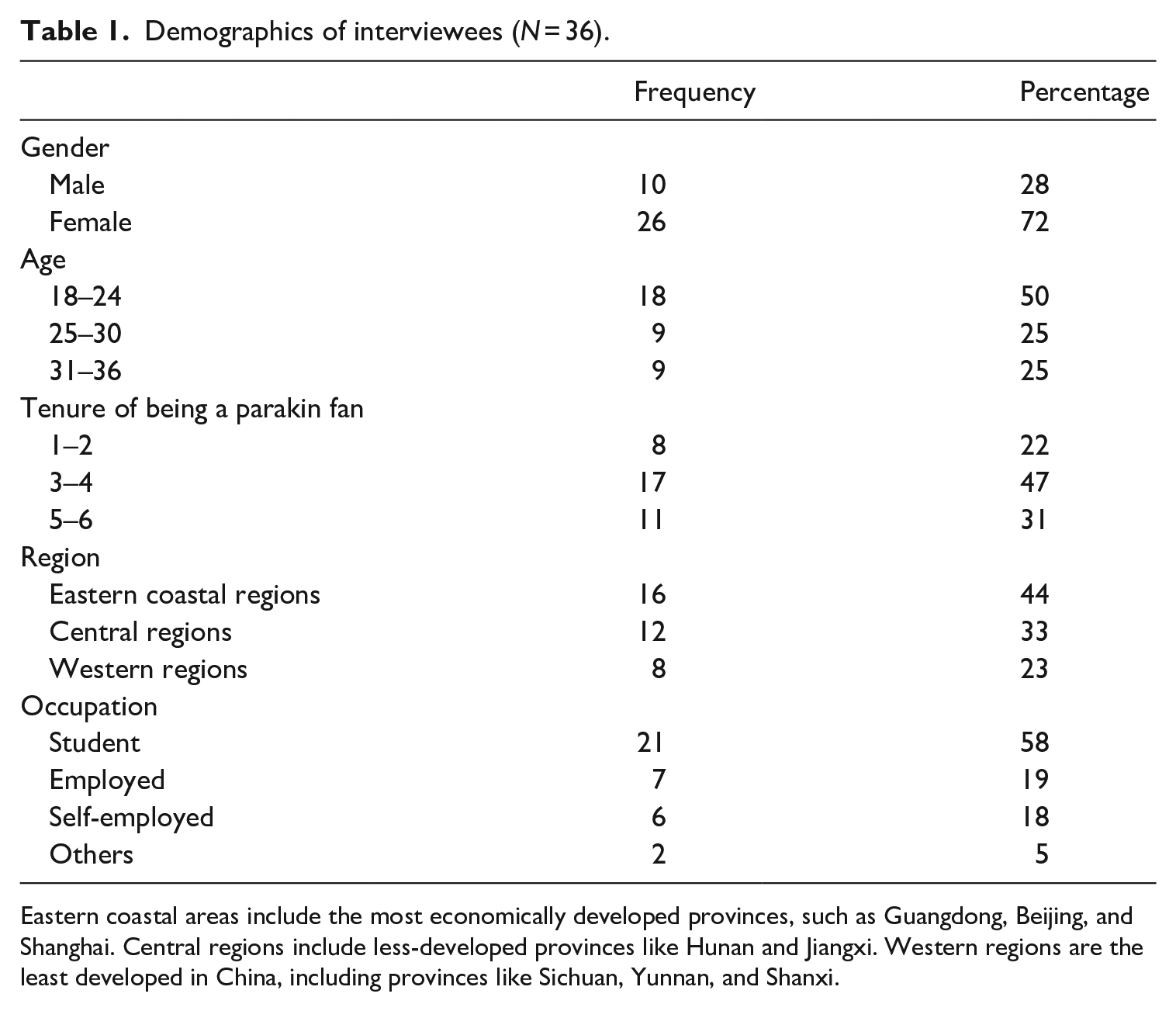
Eastern coastal areas include the most economically developed provinces, such as Guangdong, Beijing, and Shanghai. Central regions include less-developed provinces like Hunan and Jiangxi. Western regions are the least developed in China, including provinces like Sichuan, Yunnan, and Shanxi.
Research procedures
Text analysis
Linguistic Inquiry and Word Count (LIWC) was used to compare and analyze sampled Sina Weibo blog posts. LIWC is a natural language processor (NLP) to reveal distinct word types (e.g. personal pronouns, auxiliary words, and prepositions) and word sentiment. LIWC analyzes language in multi-dimensions to better capture social, psychological processes (Tausczik and Pennebaker, 2010). The 1455 posts from parakin fan groups and 1207 posts from traditional fan groups were entered in LIWC for comparison.
Coding interview responses
Using the qualitative data analysis software Nvivo, in-depth interview data were coded at three stages (see Figure 1). The analytic process consists of coding data, developing, validating, and integrating theoretical categories, as well as recording analytic narratives throughout inquiry (Thornberg and Charmaz, 2014).
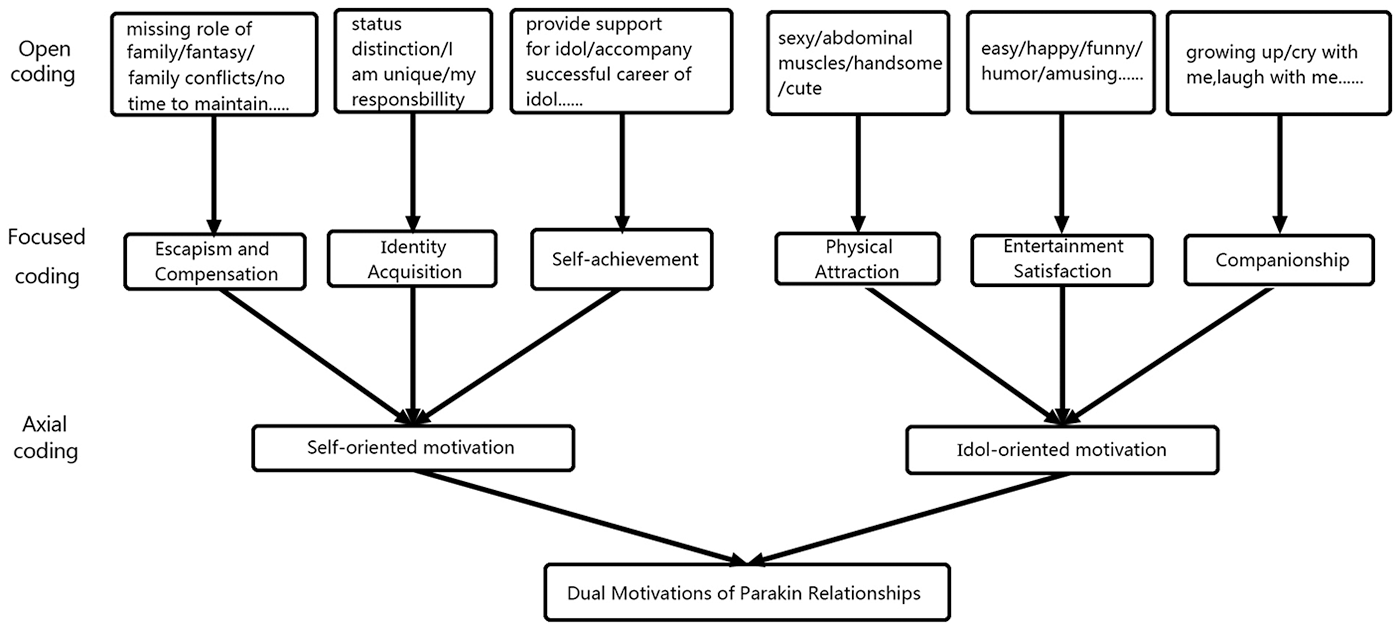
Motives for parakin relationships.
Open coding of the interview responses was first undertaken to extract meaningful concepts, such as physical appearance (e.g. “I like to see her sexy look”), status distinction (e.g. “this is a symbol of identity in a fan community”), and companionship (e.g. “it is more like a feeling of companionship, that is, to accompany him as he grows up”). Second, focused coding was carried out to cluster similar concepts that emerged in the open coding process and to formulate higher-level categories and dimensions through the repeated comparisons of different concepts. For example, “handsome,” “sexy,” “figure,” and “pornography” were clustered under the category label “physical attractiveness.” Finally, axial coding was performed to unify higher-level categories and dimensions toward theorization (Corbin and Strauss, 1990). As the motivational theory suggests, human behaviors are driven by intrinsic and extrinsic motives (Deci et al., 2001), we, therefore, categorized the parakin fans’ motives as self- or idol-oriented. Under the self-oriented motives, there were three categories developed—“escapism and compensation,” “identity acquisition,” and “self-achievement.” In contrast, “entertainment satisfaction,” “physical attraction,” as well as “companionship” were identified as idol-oriented motives.
Two coders independently coded five randomly selected interviews. They analyzed the transcripts, compared their coding, and discussed any discrepancies emerged. After achieving a satisfactory intercoder reliability (above 80%), they applied the coding schemes developed for open coding, focused coding, and axial coding to the remaining 31 interviews. Results of text analysis also serve as a reference for coding interview data, for qualitative data analysis requires repetitive examinations of data (Denzin and Lincoln, 2008), and cross-validations from multiple sources to enhance its reliability and validity (Yin, 2003).
Sampling and data collection should continue until theoretical saturation is reached. We utilized two procedures to ensure theoretical saturation. First, upon the completion of analyzing all transcripts, we returned to the first five interviews and compared the coding. All coding categories were covered in the original coding schemes and no new categories were found. Second, the coding procedure and results were also briefed to a group of eight parakin fans for feedback. As such, our coding of interview data has achieved theoretical saturation.
Results
Profiling parakin relationships
Text analyses of 53,261 messages posted by fans of parakin groups on Sina Weibo revealed the characteristics of parakin relationships different from traditional fan worship. As shown in Table 2, parakin fans and traditional fans were equally expressive about their interest in body (e.g. “physical appearances,” “body figures”), t(2660) = 1.15, p = .07 and sexuality (e.g. “kiss,” “love,” “affection”), t(2660) = .87, p = .11. However, fans engaged with parakin relationships used significantly more personal pronouns “I,” t(2660) = 11.02, p < .001, instead of “we,” t(2660) = –4.96, p < .001, indicating that they had a strong emphasis on self-identity. Positive emotional tones (e.g. “happy,” “cheering”) appeared significantly more frequently in parakin fans’ posts, t(2660) = 9.14, p < .001, whereas traditional fans expressed significantly more negative emotional tones (e.g. “upset,” “sad”), t(2660) = –9.02, p < .001. Parakin fans also displayed significantly more interest in leisure, including words like “fun,” “entertainment,” “joy,” t(2660) = 2.09, p < .05.
Comparisons between posts of parakin and traditional fans.
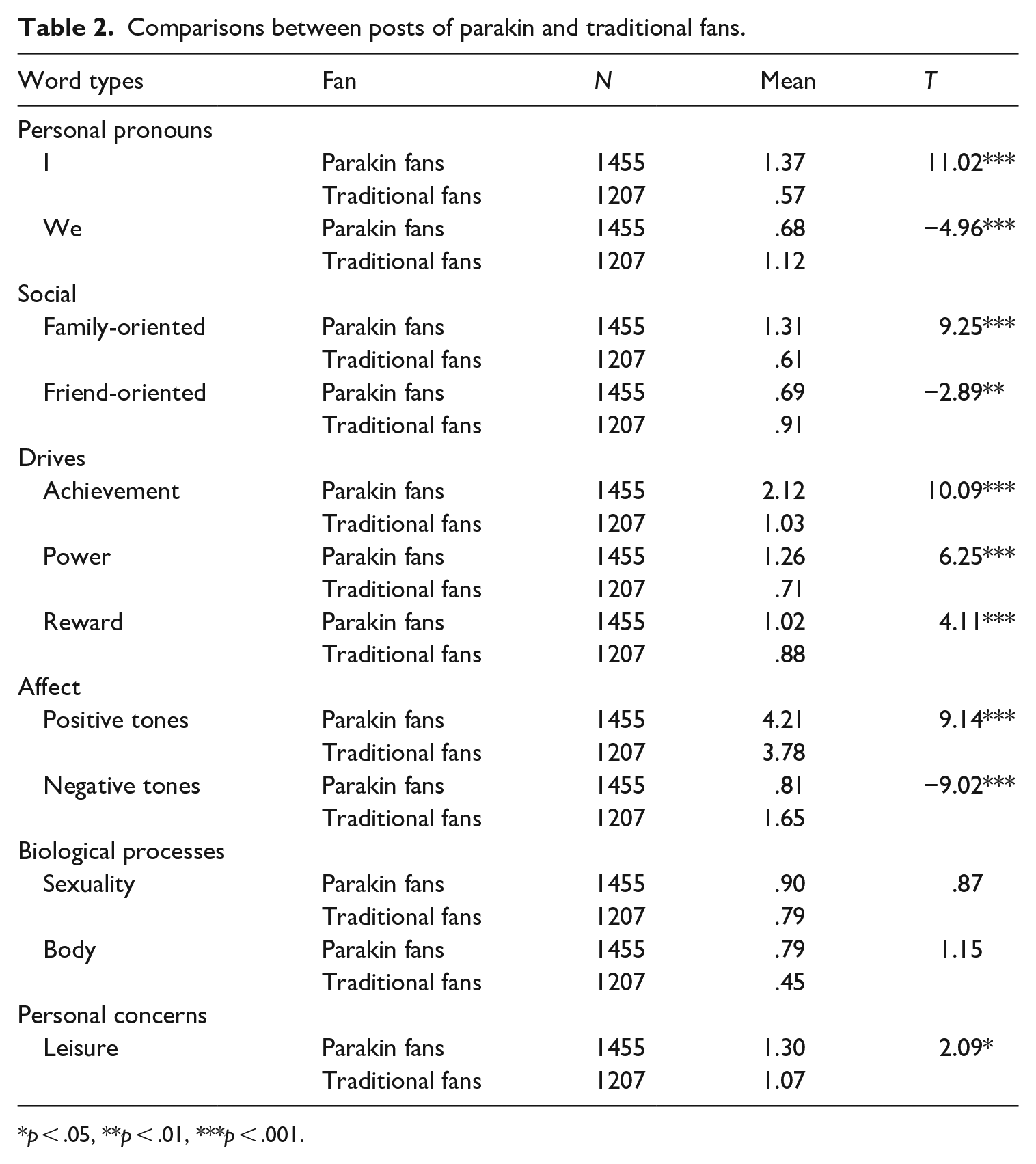
p < .05, **p < .01, ***p < .001.
Interestingly, besides the use of “I,” fans engaged with parakin relationships also used family-related words (“caring,” “intimacy”) significantly more frequently, t(2660) = 9.25, p < .001. The high frequencies of both “I” and family-oriented words suggest that they expressed a great sense of self-accomplishment and self-empowerment, and also, at the same time, assumed an imaginary intimate kinship with their idols for companionship and possibly compensation of missing family roles. The need for self-accomplishment and self-empowerment also manifests in the significantly more frequent drive words among parakin fans’ posts as opposed to traditional fans’ posts. Drives include a constellation of words that exclusively capture needs and motives in the text (LIWC, 2015). Under the umbrella of drive words, parakin fans used significantly more “achievement” words that reference to success, failure, and quests for accomplishment. They also used significantly more “power” words signifying social status, influence, and social ranks. Also emerged from parakin fans’ posts are “reward” words, such as compensations, motivations, stimuli, and aspirations (p. 22). All these drive words indicate that parakin fans were highly self-driven.
Motives for parakin relationships
Guided by the grounded theory, our analyses of 36 interviews revealed two branches of distinctive motives—self- and idol-oriented—for parakin relationships, and we proposed them as the dual motivation model of parakin relationships. This dual motivation model is an extension of the motivation theory in fan studies and lays down a theoretical framework to understand the forefront of fandom in the era of social media.
As reported in Figure 2, across all the 475 motive-related nodes (coding given by the coders) given to a total number of 762 references (text being coded) in the transcripts, 108, or 22.74% were categorized into identity acquisition, and 90, or 18.95% were identified as escapism and compensation, followed by self-achievement (81, or 17.05%), physical attraction (76, or 16.00%), and companionship (61, 12.84%). These findings are in line with our text analysis such that parakin fans are conscious of self-identity (use of “I”), self-motivated for achievement (use of “drive” words), in pursuit of companionship (use of “family”-oriented words), and entertainment satisfaction (use of “leisure”-related words), as well as are interested in physical attraction (use of words relevant to “body” and “sexuality”).

Coding on motives for parakin relationships.
Parakin fans aged from 18- to 24-year old, compared with those aged 25 years and older, are particularly more motivated by self-achievement, entertainment satisfaction, identity acquisition, as well as physical attraction (Figure 3). Sister fans are mostly driven by self-achievement, entertainment satisfaction, as well as physical attractions, while mother fans express more motives related to escapism and compensation. Father fans show strong motivations for self-achievement, and they also clearly express the need for companionship. Brother fans were evenly motivated by all motives across the categories (Figure 4).
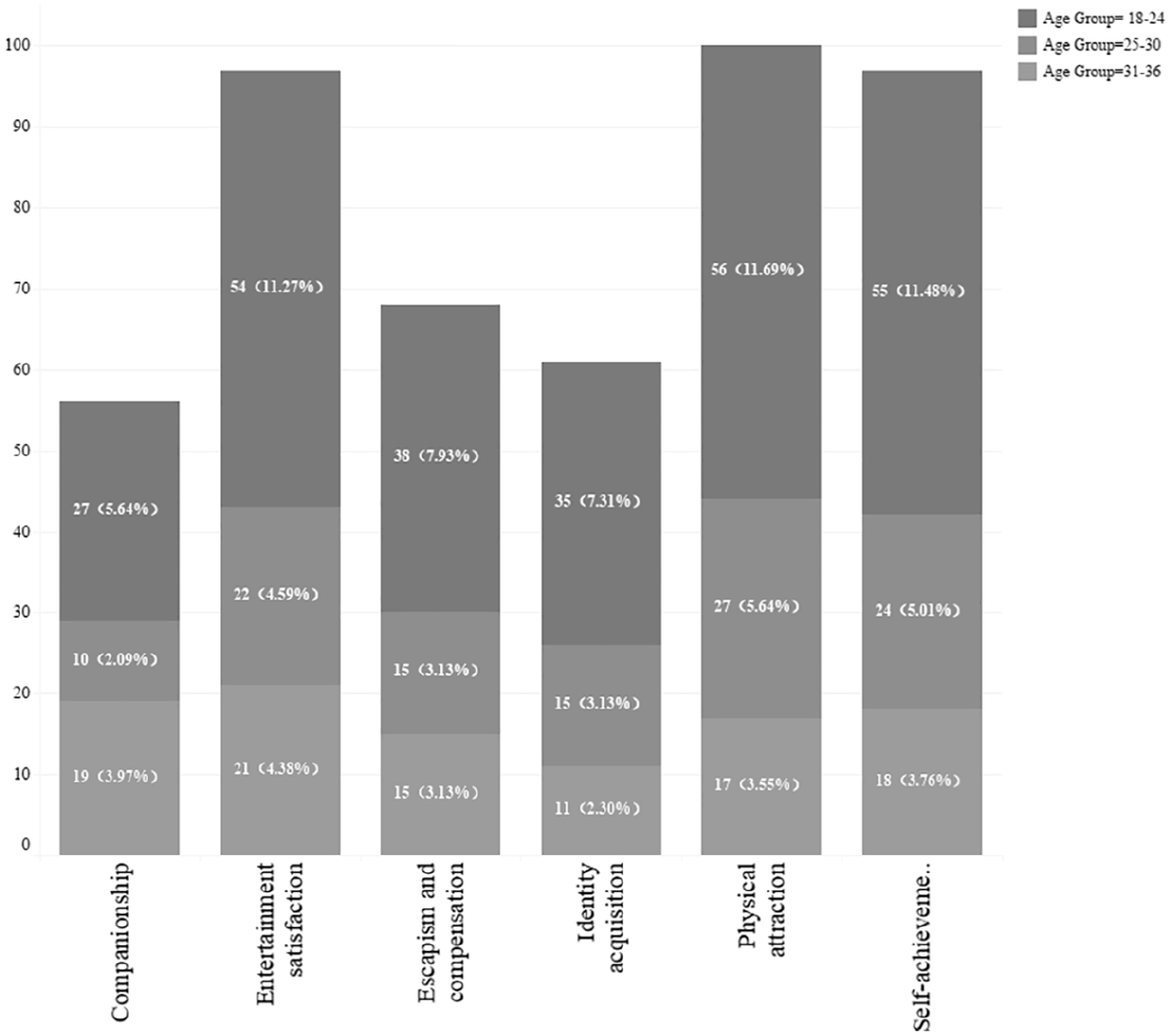
Motivations of parakin fans by age.
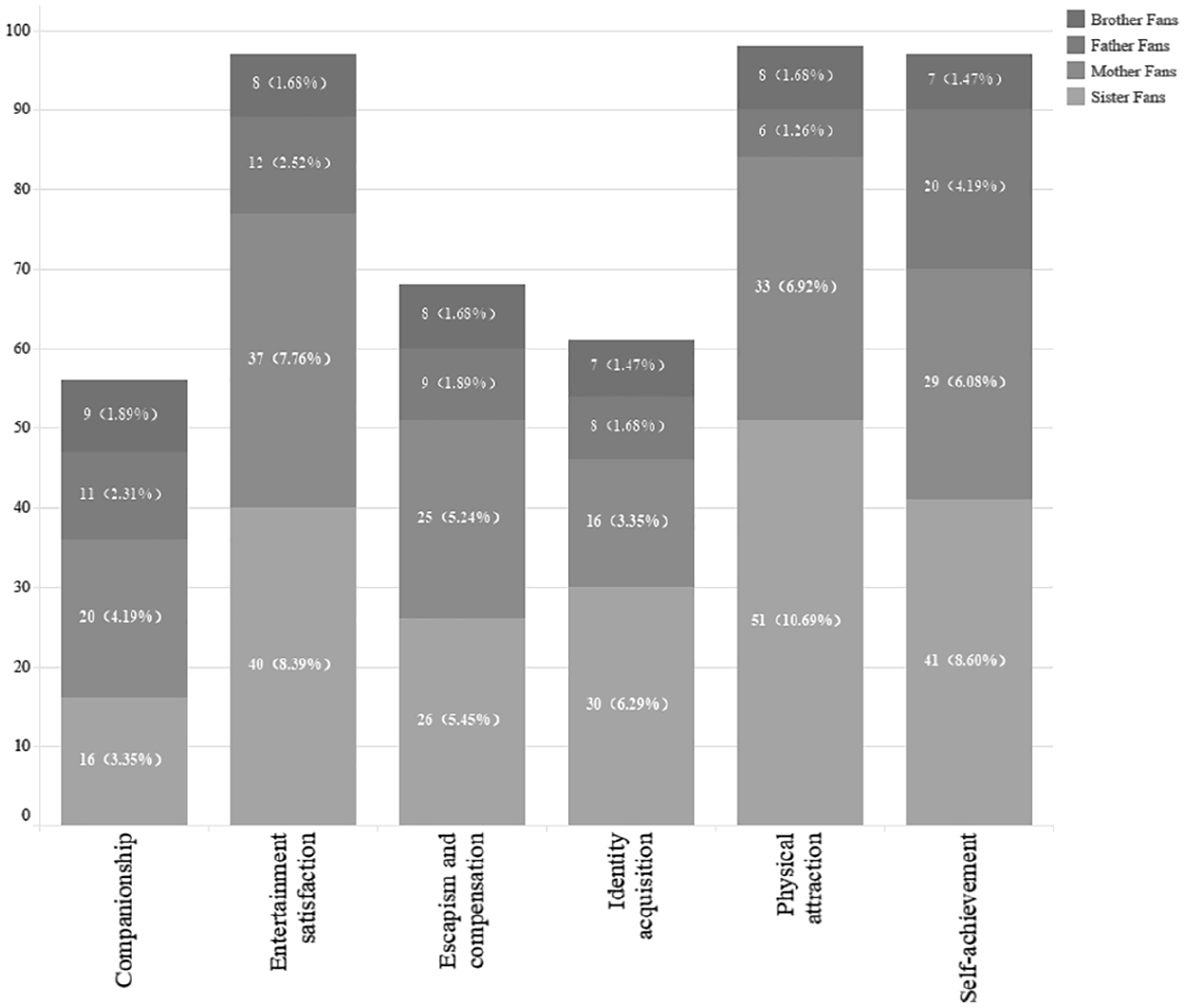
Motivations of parakin fans by fan groups.
Self-oriented motivations
Escapism and compensation
As previous literature noted (Adam and Sizemore, 2013; Eyal and Dailey, 2012; Vandebosch and Eggermont, 2002), fans engaged with parasocial relationships for the purpose of escaping from the unsatisfactory reality. The same applies to parakin relationships as well. The imaginary relationships between themselves and idols, by and large, make up for the lack of attachment, friendship, siblings, romantic relationships, and other inadequacies in real life. Feeling dissatisfied in their real lives, fans are more likely to show compensation-seeking behaviors (Jenson, 1992). One sister fan (aged 19, college student) who considered herself as a sister of her idol stated in the interview: Sometimes life is tough, and it is much better when I see my idol on Weibo. I remember when I was an intern there was a lot of work, and I had to finish my homework at the same time. I was very annoyed and depressed, but suddenly I saw his show updated, and I was instantly cheered up.
It also can be a form of substitution for parental or sibling absence in real life (Cheung and Yue, 2012). As one sister-fan interviewee (aged 22, college student) noted, “Fans are able to project family affections missing in their real lives onto their parakin relationships with the idols.” Parakin fans also felt that real-life family relationships were messy, but their parakin relationships were much simpler. One brother-fan interviewee (aged 24, MA student) stated, “If I had one brother, it is highly possible that we will be constantly fighting each other. This is unfortunately inevitable in real life and somewhat ruins my imaginations of brotherhood.”
Identity acquisition
Literature in fan studies has well documented how fandom plays a significant role in shaping identity formation (Boon and Lomore, 2001; Le Bart, 2004). Obtaining certain identities (e.g. “Trekkies” for Star Trek fans) is an important psychological motivation for fans (Smith et al., 2007; Tufekci, 2008), and media can serve as a significant source for social identities (Festinger et al., 1952; Klein et al., 2007), based on which fans could obtain a strong sense of belonging as revealed by literature on parasocial relationships (Klimmt et al., 2006; Tsay and Bodine, 2012). When a person regards themselves as a part of a community, they are committed to engaging in joint action via implicit or explicit agreement.
To become a fan, an individual must first learn the norms and rituals of a fan group. The most outstanding norm shared by parakin fans is the responsibilities for and expectations of idols as their “family members.” Fans take huge responsibilities to support idols. As one mother-fan interviewee (aged 21, college student) put, “I keep him company as he grows up, matures, and becomes a better man.” However, with incredible support also comes certain expectations as family members do. One mother-fan interviewee (aged 26, office staff) said: I expect him to act in more meaningful, deeper movies. I remembered one time he was going to take a role in a really shallow and naive movie, I was so upset. I posted so many comments in my group expressing my strong objection as I didn’t want to see any self-destruction from him. Later on, I realized a lot of fans shared the same opinion as I did. He finally turned that part down.
Through this give-and-take process, online users form a unique identity as parakin fans. One sister-fan interviewee (aged 23, graduate student) summarized: Parakin fans are different from those who simply worshiping idols no matter what. We have responsibilities and duties. We need to be on the lookout for our idols and constantly remind them not to do anything detrimental to their public images.
One father-fan interviewee (aged 34, office staff) stated, when it comes to my son’s life partner, we need to give her a thorough vetting. This is only possible if his career is solid stable and the girl’s reputation is good. If not, then he is going to be in huge trouble.
Another mother-fan interviewee (aged 26, kindergarten teacher) said, As a mother fan, I get really mad when he is behind his album schedules. I will scold him for his laziness. It is my responsibility as a mother fan to constantly supervise him and to push him moving forward like how mothers treat their children in real life.
Self-achievement
Self-achievement has been deemed as the highest level of humans’ motivational structure (Maslow, 1943). The cultivated idols are heavily dependent on the sheer number of fans and how active they are. Parakin fans fulfill themselves not only through supporting, but also more importantly, through cultivating idols. In addition, by projecting themselves as part of their idols and supporting their accomplishment, fans are able to realize their own ambitions and build up their potentials. For example, in the process of cultivating idols, a specific division of parakin fans are exclusively devoted to public relations (PR), including maintaining the activity of their idol’s social media page through replying and commenting, greeting their idols in the airport, and even making substantial donations to their idols. As one sister-fan interviewee (aged 22, college student) stated: I give him likes, reposts, and comments every day, which helps expand his public influence for sure. Moreover, I also buy his merchandise and donate money to promote his career. There was one time I donated more than 5000 yuan [equivalent to around $700] to help him with marketing. Anyway, it’s worth it for me to help him grow up and that makes me particularly happy!
Like what family members would do, fans also spoke out to defend their idols’ in the event of public crises.
I regularly check Weibo and report posts that are vilifying my “child.” There are defaming posts on Douban, where I will also respond to comments, give likes, and post clarifications. The success of my “child” brings me a sense of achievement just like how mothers are pleased with their children’s bright future (mother-fan interviewee, aged 31, office staff).
Cultivating idols also involves the idea that the idols should comply with fans’ opinions on various issues, including whether they should appear in certain films, TV programs, or advertisements. If the idol starts a romantic relationship with someone, parakin fans will evaluate if the couple matches each other based on the commonality of their career trajectories and outlooks, and whether they have a similar family background. Interestingly, these evaluative standards resemble how Chinese parents are steering their children’s marriages. As parakin fans provide indispensable support to idols, remove all foreseeable career obstacles, and even change idols’ career plans, such a process of cultivating idols, in return, enhances fans’ self-efficacy and self-esteem (Bhanot and Jovanovic, 2009).
Idol-oriented motivations
Entertainment satisfaction
Entertainment satisfaction is one of the most important motives for mass media consumption (see Katz et al., 1974). Media entertainment experience has been usually linked with positive emotions such as pleasure, enjoyment, and delight (Zillmann and Bryant, 1994). It is also identified as an important function of idol worship to satisfy individuals’ need for entertainment (Vorderer and Ritterfeld, 2009). Fans are often drawn by idols who they deemed as “interesting,” “funny,” and “humorous.” My idol has such a good sense of humor. In her TV shows, she is an expert in mocking herself and entertaining others. I often burst into laughter watching her shows and so does my roommate who watched the shows with me. (sister-fan interviewee, aged 22, college student)
Another sister-fan interviewee (aged 22, graduate student) considered her idol as the “salvage” to her boring, busy life, stating “watching his TV shows makes my heart fly.” The satisfaction of entertainment could be intensified on social media as idols take advantage of the interactive features online.
He is so goofy, which is even more prominent when he interacts with fans on Weibo. He always makes us laugh so hard with his amusing language and body movement. He is just a barrel of laughs who brings happiness to everyone around him online. (mother-fan interviewee, aged 31, office staff)
Physical attraction
The appeal of physical appearance also emerged as a notable motivation as illusory romance is one of the main motivations for adolescent idol worship. Scholars have used creational worship to describe the worship of a star’s talent, merit, status, or beauty (Yue and Cheung, 2000). Fans’ initial impressions of stars were often derived from their physical appearances. Many interviewees claimed that their initial reasons for worshipping idols were because they were “handsome,” “sexy,” “delicate,” “tall,” and so on.
First of all, he is handsome. Beauty is my NO. 1 principle when it comes to selecting idols. No doubt. He was really beautiful at the time. Can I use the word beautiful? He is really handsome and very sexy. Boys who look like girls really attract me sometimes. My idol matches my idea of a fantasy boyfriend, who has a delicate face, is a Scorpio, and is 187cm tall. (sister-fan interviewee, aged 19, college student)
Idols with physical attractiveness are viewed by fans as “goodness” (Haas & Gregory, 2005). The imaginary kinship creates an experience of intimacy that is similar to real life (Brooks, 2021). “His soft voice on TV and the casual adorability he inadvertently reveals make a person feel she just have to be his mother fan,” said one mother-fan interviewee (aged 26, office staff), while a sister-fan interviewee (aged 18, high school student) added, “When he calls out ‘sister’ coquettishly in a movie, I want to respond to him immediately.”
Companionship
Social media has become the most popular platform for celebrities due to its large user base and its affordances to create the feeling of “being there” for celebrities (Stever and Lawson, 2013). On Sina Weibo, fans and idols interact with each other by reposting (13.2%), commenting (15.9%), and liking (70.9%; Tencent, 2017). Fans constantly follow the updates of idols and interact with them through social media. These computer-mediated socializations make them feel idols are always present, much like a family member. A mother-fan interviewee (aged 29, doctoral student) stated, “When he interacts with us, I feel our distance is so small as if we have always been together.”
It is not uncommon that fans attempt to contact or approach celebrities in real life (Morton, 1997). However, in parakin relationships, fans are satisfied with the constant presence of their idols on social media that keep them feel in company. In addition, an always-present idol provides an object for fans to attach to (Årseth et al., 2009) and helps obtain a sense of companionship (Mooney et al., 2007). As a brother fan (aged 15, self-employed) stated: If I have to describe this relationship in one word, I would say companionship. When I am happy, he is here. When I am sad, he is here as well. He is here no matter what. We are like close neighbors and friends like peas and carrot.
A mother-fan interviewee added, “This is companionship. I just want to be there for him as he grows. I want to know if he is happy every day” (aged 33, self-employed).
Discussion
Guided by grounded theory, this study explored the forefront of fandom on social media such that fans, empowered by interactive communication technology, are able to co-cultivate idols nowadays. Assuming the roles of “family members,” these fans offer incredible support to their idols, from promoting their social media pages through likes and comments to raising funds by personal donations and online campaigns; they, at the same time, also possess a great deal of influence on idols’ career paths and even personal lives.
Rooted in social media, parakin relationship differs from the traditional parasocial relationship in the context of traditional mass media (e.g. TV) as it symbolizes a new era of fandom. The unprecedented interactivity enabled by social media has gained fans significantly more power in their relationships with idols due to their abilities to generate online comments, likes, sharing, and donations, all of which are the foundations for celebrities who mainly rely on social media for popularity and profits. With this magnificent power, fans could not only support idols as they always do since the birth of fandom but also, more importantly, they can impact and even control idols as their “family members.”
Evidence for empowered fans in the age of social media arises from both our text analyses of parakin fans’ posts and the in-depth interviews of parakin fans on Weibo. When posting about idols on Weibo, whether for promoting idols’ new shows or protesting certain activities they deemed harmful to their idols, parakin fans used the pronoun “I” significantly more often than traditional fans. This indicates that while parakin fans are centering on idols, they, nevertheless, are not dismissive to themselves like traditional fans do (Festinger et al., 1952; Klein et al., 2007). Instead, worshipping idols on social media has also encouraged them to explicitly speak out their own voices and to be assertive of their own identities. The motive for self-achievement identified from interviews manifests in the significantly more drive words—“achieve,” “power,” and “reward” in their social media posts, all of which are indicative of the need for self-achievement in the process of co-cultivating idols as their “family members.” These strong tendencies for self-identity and self-achievement could well be the explanations of why parakin fans conveyed significantly more positive sentiments in their posts compared with traditional fans as they felt more in charge of their relationships with idols.
Results of our interviews confirmed that females (mother fans, sister fans) were more engaged and motivated in the parakin relationships with idols, which is in line with previous literature that females are more likely to engage in parasocial relationships (Eyal and Cohen, 2006; Schiappa et al., 2007). While escapism (Adam and Sizemore, 2013; Eyal and Dailey, 2012; Vandebosch and Eggermont, 2002) and entertainment satisfaction (Vorderer and Ritterfeld, 2009) stay as noticeable motives as prior literature on parasocial relationships suggested, what’s unique about parakin relationships is fans’ motivations for family companionship and need for compensations on missing family roles as they protect and monitor (or even discipline) idols in parakin relationships. Being a parakin fan requires unprecedented support to idols, and it also rewards an unexampled, powerful say over them.
As idols emphasize more on their social media presence, fans are increasingly gaining upper hands in their relationships with them. From a simple “like” to a full-blown social media campaign, parakin fans are constantly contributing to what is most essential to the success of idols on social media. Parakin fans are adept at skillfully utilizing the Internet to create a large volume of social media traffic (likes, comments, etc.) and significant consumption (e.g. views) because of their high productivity, cohesion, and execution (Whiteman, 2009). Through co-cultivating idols online, parakin fans, as stated in their interviews, are building up their characters, enhancing their skills, and fulfilling their ambitions as they watch their created stars progress and succeed.
Parakin fans are drawn externally by the characteristics of idols as well. For one thing, physical attractiveness still works for parakin relationships as it did for parasocial relationships (Klimmt et al., 2006). The appeal of idols could be further magnified on social media through their ever-presence on social media. The idol’s physical appearance (e.g. figure, sexuality), lifestyle (e.g. clothing, movement, hair, etc.), and personality are continuously delivered and reinforced to fans (Frederick et al., 2014). On social media, fans can easily collage as they wish photos, shows, interviews, and all other media contents of an idol that further strengthens the ideal image of him or her. For the other, the fact that idols now, theoretically speaking, can live broadcast 24/7 to fans their daily lives further enhances the feeling of companionship for fans. As the idols regularly address fans and call for their support, fans, aroused by such gluey calls, are more likely to develop the desire to protect idols as if they were to protect and support family members. In return, idols need to cooperate and cater to all kinds of “intimacy” (Abidin, 2013) fans are entitled to as “family members.” For example, in an effort to performing family-like intimacy with fans (Marwick and Boyd, 2011), idols will offer parakin fans exclusive insights on their daily personal lives.
Theoretical implications
By extending the motivation theory to examining fandom in the context of social media, this study is the first to look into the new advancement of fan–idol relationships enabled by interactive communication technology in China. The parakin relationship under study signifies a new era of fandom as fans are getting more say in the process of co-creating idols. The results of this study advance current fan studies by expanding the original boundary of participatory fan culture (Hills, 2005; Jenkins, 1992; Kozinets, 2001).
The dual motivation model proposed in this study confirms previous literature on fandom that certain motivations, such as escapism, entertainment, companionship, and physical attractiveness still work in the context of social media. However, the model also reveals some unique motives of parakin fans compared with parasocial fans in the age of mass media, that is, their identity acquisition and self-achievement. Granted parasocial fans could also increase their self-efficacy through observing the success of their idols (Derrick et al., 2009; Greenwood, 2008; Phua, 2016), parakin fans’ gratifications of self-achievement are arguably much stronger as they see their own “creations” thrive. Through co-cultivating idols, parakin fans are also strengthening their self-identities and achieving their own ambitions. Findings of our text analysis also confirmed this need for self-achievement of parakin fans that was not observed on fans in the traditional parasocial relationships.
Practical implications
Several practical implications stem from this study to PR and marketing professionals in the entertainment industry. Thanks to the ever-evolving media landscape and demographics of newer generations of audience, celebrities nowadays are expected, if not mandated, to maintain an active presence on social media and to engage with fans on a regular basis. As younger generations migrate online for media consumption, the most effective way to reach potential audiences and grow fans is through social media platforms. However, with such a handy and powerful marketing tool also comes costly consequences.
On one hand, idols need to take significant efforts to connect with fans via frequent updates, whether be photos, posts, videos, and so on, as fans will expect a constant presence of idols on social media as revealed by our study. Sluggish updates would certainly hurt the relationship building of celebrities with fans on social media. On the other hand, PR and marketing professionals need to be aware of the changing ground of fandom as fans are now gaining more power over idols, particularly for those who are heavily relying on their social media for popularity. As fans nowadays can determine the success of an idol’s social media profile through likes, comments, sharing, and donation, idols have to be more connected with fans, for better or for worse, and to be prepared for compromises on certain occasions. The empowering fans in the age of social media would certainly continue to refresh the relationship between fans and idols as we know it.
Limitations and future directions
It is worth noting the limitations of this study on which future research can be built. First, so far, the parakin relationship has been primarily a phenomenon in China. Hence, the motivation of compensating missing family roles (e.g. siblings) might not be as strong in other countries due to the unique One-Child Policy enforced in Chinese history. However, we have no reason to believe that other motives such as entertainment, identity acquisition, companionship and the most outstanding motivation for parakin relationship—self-achievement—will change due to the popularity of social media across the globe. In addition, the dual motivation model might not cover an exhaustive list of motives why fans engage with parakin relationships. As social media keep evolving and fans continue to grow their power in their relationships between idols, there may well be new driving factors emerging in future research. As such, future research could build on the dual motivation framework offered in this study and keeps exploring this new advancement of fan-idol relationships in this era of social media. While the label of this new fan-idol relationship might vary culture by culture, country by country, the underlying message is fundamentally similar and noteworthy across the board—a reshaping landscape of fandom wherein fans, empowered by interactive communication technology, are collectively co-cultivating idols.
Footnotes
Appendix 1
Funding
The author(s) disclosed receipt of the following financial support for the research, authorship, and/ or publication of this article: This paper is supported by the Fundamental Research Funds for the Central Universities (No.: 19JNQM02).
