







Abstract
Internet memes are remixed images, videos, GIFs, hashtags, and similar content that usually incorporates humor but also some form of political or cultural critique. Several studies have previously examined the ways in which minority groups curate Internet memes for the purpose of protest or other forms of activism. This article examines user-generated tweets including any of the following hashtags: boogaloo, boogaloo2020, and/or civilwar2. The time period of interest on Twitter concerns any and all images posted between 15 and 25 January 2020, exactly 5 days before and after a controversial gun rally held in Richmond, Virginia. Drawing on Eco’s theory of semiotics, the results from a critical discourse analysis reveal a tendency toward a preference for antagonism as a means to consolidate identity for individuals engaged in online discursive practice within hybrid structures. Findings include the presence of deeply contextualized and situated logics within an emergent boogaloo discourse. In addition, the study found that hypernarrative storytelling serves the movement in terms of identity negotiation and consolidation.
Boogaloo: an ideological practice of violent insurrection
On 20 January 2020, in Richmond, Virginia, approximately 22,000 individuals gathered to show collective disagreement after Governor Northam declared a State of Emergency which referenced the neo-Nazi motivated acts of violence committed in 2018 during a demonstration in Charlottesville, Virginia (Zadrozny, 2020). Prior to President Trump’s impeachment process, he tweeted that a civil war would be an inevitable choice for his supporters following impeachment and removal from office. Later, the moniker boogaloo surfaced online, and its ensuing discourse advocated a violent revolt against the government of the United States (despite also many messages being pro-Trump).
Specifically, boogaloo refers to a film released in 1984 called Breakin’ 2: Electric Boogaloo, itself a sequel to another film. The emphasis on a sequel is carried forward within the current movement, yet it is a desired sequel to the United States Civil War that is embraced by most if not all within boogaloo. The boogaloo movement appears to lack uniformity in ideology, and certain fringe parts of the movement may receive more media attention than other parts. Boogaloo defies normal categorization given its apparently rhizomatic structure. Newhouse and Gunesch (2020) draw attention to online activity among individuals spreading boogaloo memes with themes ranging from violent insurrection of the government to threats toward police officers (ostensibly due to the murder of George Floyd and the seemingly sustained resurgence of the Black Lives Matter movement). However, the presence of boogaloo individuals at current Black Lives Matter protests in the United States should be viewed less as condemning police violence as a form of systemic racism and more as a concerted effort to actualize the boogaloo, or a violent Civil-War-like insurrection (Ellis, 2020). Monikers such as boogaloo bois, boog, boojahadeen, and big igloo also appear online as additional naming conventions within the movement. Incidentally, while boogaloo can appear as disparate individuals engaged in myriad attempts toward an aggressive stance against perceived enemies, it is perhaps worth noting that the removal of hundreds of Facebook and Instagram accounts, pages, posts, and groups associated with the moniker boogaloo suggests that social media platforms already perceive it as a movement that deserves renunciation (Alba, 2020).
According to Goldenberg and Finkelstein (2020), in one of the first data-driven investigations of boogaloo, they describe movement as one that
self organizes across social media communities, boasts tens of thousands of users, exhibits a complex division of labor, evolves well-developed channels to innovate and distribute violent propaganda, deploys a complex communication network on extremist, mainstream and dark Web communities, and articulates a hybrid structure between lone-wolf and cell-like organization. (p. 2)
Given the dearth of academic literature about boogaloo, this contribution aims to provide a close examination of the discourse within messages tweeted by and among individuals subscribing to its ideology. In order to investigate the visual nature of the discourse, it is necessary to consider the semiotic composition of the memes. Accordingly, the merging of popular culture and/or socio-political references within boogaloo memes implies a need to look at the semiotic constructions therein. A critical discourse analysis (CDA) further assists this study as the inclusion of semiotic analysis means that it is possible to discern discourse and ideology in action through examining tweets. Following Eco (1984), meaning is produced with emphasis placed on the intent to communicate. Within boogaloo, this intent translates into opportunities for identity negotiation as well as participation in real-world events, such as the 20 January 2020 armed protest in Virginia.
It is worth noting that online efforts by the alt-right have effectively succeeded in opening the Overton window of social sentiment toward racism and bigotry in online spaces such as 4chan and Twitter (Tuters, 2020). Incidentally, the Overton window refers to a continuum of extreme ideas which can, over time, become perceived as less extreme and more mainstream (Astor, 2019). While the tweets in this sample may not suggest an opening of the Overton window per se, the tendency to use such bellicose and hyper-nationalist rhetoric (Beinart, 2018: para. 12) alongside references to overthrow the government may stem from a suggestion made by Trump. As noted by Reuters journalist Julia Harte (2018), the hashtag civilwar2 “trended on Twitter in September [2019] after Trump quoted a pastor in a Twitter post saying it would ‘cause a Civil War like fracture’ in the United States if he were removed from office” (para. 8). Such rhetoric, devoid of any discernible evidence, suggests a potentially new category of conspiratorial thinking.
Muirhead and Rosenblum (2019) distinguish between two types of conspiracism, classic and new. The chief difference regards the proportion of effort used and for what purpose; for classic conspiracism, a major degree of effort is required to connect the dots to the conspiratorial nature being asserted but also to actual data and/or plausible points. Yet, for new conspiracism, less effort is required for that facet but more effort is mandated for repetition. Platforms such as Twitter, Instagram, TikTok, and Facebook, all largely thrive on repetition—in terms of actual content but also more importantly in terms of the types of engineered engagement. Central to new conspiracism is a conceptual assertion of a claim as being true enough.
The activities associated with the boogaloo meme represents a kind of activism hidden in plain sight. The boogaloo discourse appears quite different than typical hate speech online. In a comparative analysis of online hate speech in Ethiopia and Finland, Pohjonen (2019) concludes that criticism of such exchanges should be situated in their associative social and political contexts to ensure both the meanings implied and measures on how to counter hate speech.
Yet, the added factor of algorithms involved in the agential spreading of hate speech could arguably make it easier for individuals to encounter but perhaps also accept such messaging (Schmitt et al., 2018). Since users tweeted before and after the gun rally on 20 January 2020, I take the perspective that these efforts should be viewed as activism, yet one which evades much of the previous research on social media and activism. To be sure, researchers have produced literature examining how extremist and/or far-right groups employ the Internet and its inherent technological affordances (Caiani and Parenti, 2016). When individuals tweet encouraging messages advocating a violent overthrow of a government alongside seemingly innocuous hashtags, this poses serious challenges to assumptions about social media and activism.
Prior to presenting the analytical framework used to examine the sample, I review literature on technological affordances associated with social media when used for activist purposes. It is my contention that among the categories identified in the content analysis, the one into which the majority of tweets were coded indicates that the expressions of willful violence, government overthrow, paranoiac and/or conspiratorial thinking, and so on, must be taken seriously despite the discursive practice often involving the creation and curation of memes as the vehicle for their discourse.
Technological affordances of social media used in activism
One the ways social media drive the types of content uploaded has to do with a general desire among users to appeal and/or conform to a perceived group or audience. One dominant narrative associated with boogaloo is violent insurrectionist rhetoric often accompanied by imagery of the American Revolutionary War and/or fear-mongering about the Second Amendment (which refers to the right to keep and bear arms). Interestingly, Jenkins et al. (2013) note that the choice among Tea Party activists to wear livery similar to what was common during the American Revolutionary War symbolizes a performed desire to return to a nostalgic view of the US Constitution. Online, one sees boogaloo tweets overtly refer to the American Revolutionary War and demonstrate paranoiac and/or conspiratorial thinking in their urging of a violent insurrection of the US government. While Jenkins, Ford, and Green referenced real-world protests, the boogaloo discourse on Twitter (at least according to this study’s results) appears highly conforming and cognizant of norms, rules, and processes afforded by the platform.
Silvestri (2018) employed the term “attitudinize” to discuss then US President George W. Bush’s “mission accomplished” speech and the memes that emanated from it. The term refers to the process by which a particular attitude is expressed merely for effect, as if to propose an argument or claim without any underlying substance or perhaps even evidence. One possible result is a change within the identity negotiation of a given individual or group. Similarly, boogaloo memes attitudinize Trump’s tweets as well as the conforming ideas and views consonant with boogaloo and serve to co-create a shared identity. In an analysis of the discursive situation of the gilets jaunes (yellow vests) protests in France, Wagener (2019) argues that evidence-based debate is sidestepped in favor of media-stimulated narrative storytelling for the goal of dynamic interaction in the protests both online and off. Taken together, these perspectives suggest that while behavior among activists and protestors becomes performative (such as the wearing of American Revolutionary War-era garb), online discursive practice necessitates a hypernarrative storytelling approach due to the need for group cohesion and continued identity negotiation.
One of the technological affordances available on social media is the hashtag, naturally, but also with respect to building counternarratives to mainstream perspectives on key issues (such as fears about gun confiscation or similar thinking consonant within boogaloo discourse). In the Twitter boogaloo discourse, hashtags are used to further conspiratorial thinking (such as claims of “crisis actors” used to stage fatal shootings) but also to mobilize and encourage solidarity (as in the deployment of #boogaloo and its various iterations).
My approach follows Crosset et al. (2019) namely by acknowledging that the “use of combined tools of visualization and enunciation (texts, images, hashtags, memes . . . ) contributes to the circulation through different audiences of common representations of core far right issues” (p. 949). Accordingly, only a few hashtags (boogaloo, boogaloo2020, and civilwar2) are used in this study in the interest of accessing authentic accounts and also ensuring parsimony in sampled data for the stated timeframe. Lamont and Ross (2019: 3) maintain that the functional importance of hashtags centers on their capacity as archival traces to online themes and discussions generated by individuals for a variety of social, cultural, entertainment-oriented, political, or related motivation. However, the decision to examine the three hashtags mentioned above not only emerged given the relative nascency of boogaloo, but also due to the frequency of paranoiac and/or conspiratorial rhetoric and imagery expressed on Twitter (and elsewhere) within boogaloo discourse.
The rationale for parsimony emerged during the coding process; several tweets tended toward more of an anti-government sentiment whereas others were decidedly more teleologically obsessed with Second Amendment rights and associated anxieties of gun confiscation. In order to focus on the discursive practice of boogaloo (such as inciting violent insurrection), the aforementioned hashtags were emphasized.
Analytical framework
This study presents the results of a content analysis of tweets with images, videos, or animated graphics interchange formats (GIFs) collected between 15 and 25 January 2020 with the hashtags: boogaloo, boogaloo2020, and/or civilwar2. Tweets served as the units of analysis. Only those tweets that had an accompanying image, video, or animated GIF were included in the sample. Following Shifman’s (2013;2014) typology consisting of content, form, and stance, this analysis drew on the elaboration of her model based on Wiggins (2019: 15–17). In the original model, content refers to the ideas and ideologies conveyed, form refers to the actual incarnation of the meme, and stance describes the ways in which human speech communicates meaning but also how interlocutors relate to one another, other possible speakers, and the subject matter at hand (Shifman, 2013: 367). However, it is necessary to employ Wiggins’ (2019) elaboration of the model due to the need to merge content and stance as the original concept tends to rely heavily on human speech especially with reference to how Shifman (2013) originally defined and applied the concept. With the absence of human speech, the memes included in this analysis do not offer any discernible opportunity to understand the essence of stance (in terms of spoken linguistic codes, how people address others and how they are addressed, etc.). The merging of content and stance means that ideologies can be deciphered, for example, through semiotic and intertextual analyses. It is therefore necessary to incorporate semiotics and intertextuality in the analysis of the data from Twitter to make sense of stance.
Methodology
An emergent coding strategy established the content categories. Eight categories emerged and Twitter’s advanced search option produced a sample of n = 65 original tweets (and not retweets) for analysis. Although the CDA is qualitative, computing a reliability coefficient was necessary to confirm accuracy in assigning memes to an appropriate category. An intracoder test–retest reliability coefficient was calculated at 0.93 (Scott’s π). In order to avoid problems of periodicity, the timeframe 15 and 25 January 2020 represents a reasonable period around the central event, namely the rally to support so-called “gun rights” that occurred in Richmond, Virginia, on 20 January 2020. It is perhaps worth noting the irony of the gun rally occurring on that day as it coincided with the federal holiday known in the United States as Martin Luther King, Jr. Day. The event drew approximately 22,000 people, many of whom openly carried a variety of firearms and camouflage (Zadrozny, 2020). While history may have some impact on the findings of the content analysis, this relatively short timeframe was chosen in the interest of capturing the most relevant and timely tweets since the rally on 20 January was planned between approximately 6 and 7 January (Schneider and Vozzella, 2020). Two factors (Twitters’s advanced search option and the date range) selected tweets with the hashtags: boogaloo, boogaloo2020, and/or civilwar2. The rationale for these particular hashtags is due to these concepts becoming gradually more mainstream.
Analysis
In order to produce a viable interpretation of the content within the tweets collected for this study, it is necessary to conduct a CDA in the tradition of Fairclough (1995). The primary rationale to use CDA in this study is based on “the assertion and evidence that internet memes augment human language much in the same way that different fonts impact meaning, the insertion of visuals, emoticons, emojis, etc. similarly function as an ancillary linguistic apparatus” (Wiggins, 2019: 19). Drawing on much experience with corpus analysis on Twitter, Longhi (2020) maintains that “interpretation of textual data is subject to semiotic constraints (discursive practices, discourse genre, intertextuality, etc.) and it is necessary to be able to characterize, before any computer processing, the corpora” (p. 12). Accordingly, while CDA is a qualitative method, this analysis also presents quantitative data from the tweets in the form of percentages of tweets per the identified categories.
An emergent coding method revealed eight distinct and mutually exclusive categories. These are, in the order of their emergence: (1) call to volunteer, be recruited, sign up (ostensibly for the boogaloo, or Second Civil War); (2) reactions to and/or disapproval of the previous tweet; (3) threats of violence and implying a paranoid and/or conspiratorial ideology based on gun confiscation anxiety; (4) ironic/mocking stance as a response to Virginia Governor Northam’s State of Emergency Declaration on 15 January 2020; (5) threats of violence and implying a paranoid and/or conspiratorial ideology but based on rhetoric and images from the American Revolutionary War (1775–1783); (6) claims or accusations that Governor Northam’s declared State of Emergency is illegal; (7) a celebratory and/or otherwise non-serious stance regarding boogaloo; (8) direct ad hominem attacks aimed at Governor Northam (in some cases, using words to directly threaten the governor with lethal violence). Table 1 shows the distribution of tweets as percentages for each category. The column on the right shows the percentage of the tweets falling into the respective category alongside the actual number of tweets comprising the category.
Emerged categories for coding.
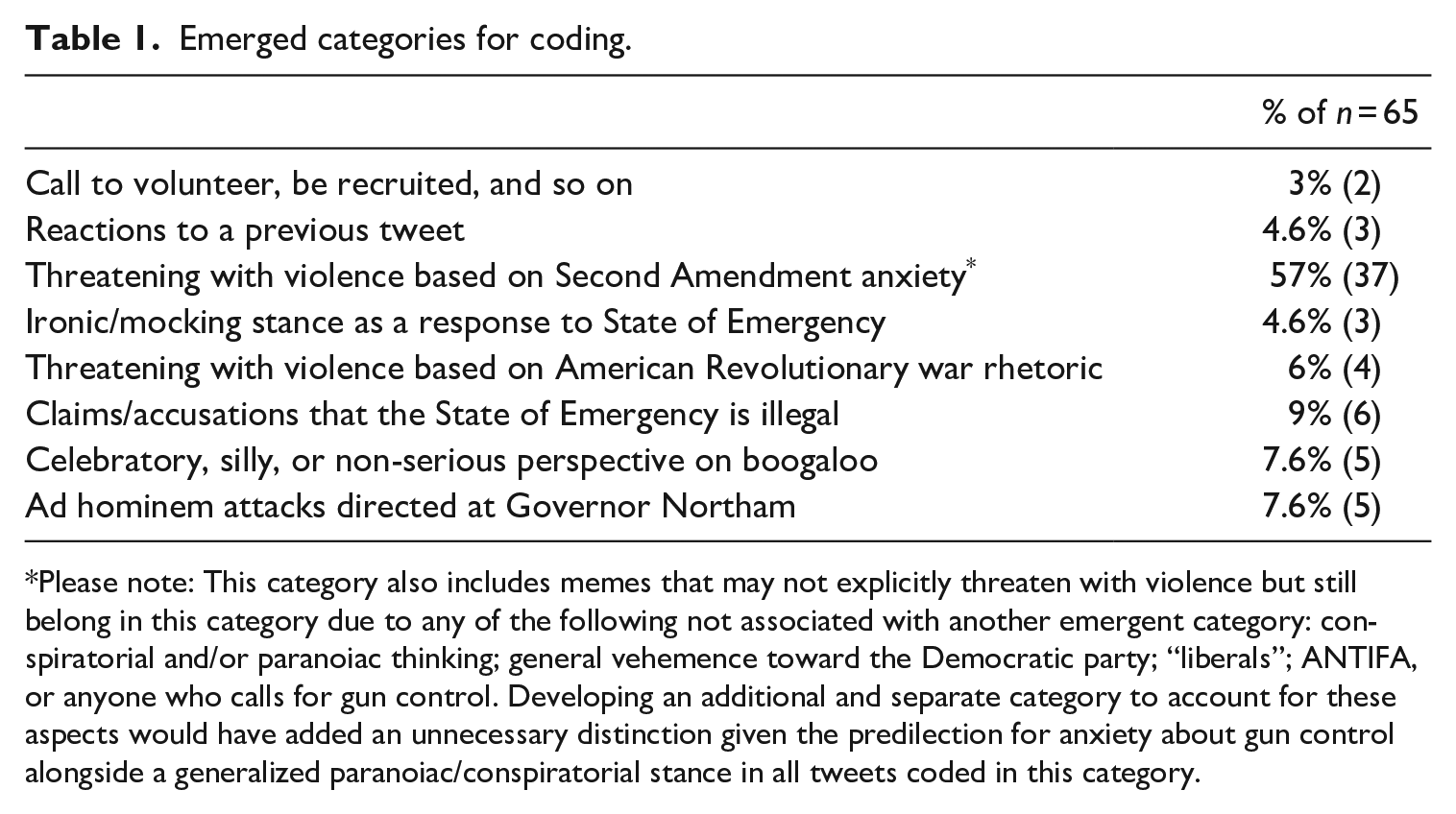
Please note: This category also includes memes that may not explicitly threaten with violence but still belong in this category due to any of the following not associated with another emergent category: conspiratorial and/or paranoiac thinking; general vehemence toward the Democratic party; “liberals”; ANTIFA, or anyone who calls for gun control. Developing an additional and separate category to account for these aspects would have added an unnecessary distinction given the predilection for anxiety about gun control alongside a generalized paranoiac/conspiratorial stance in all tweets coded in this category.
Following Tuters and Hagen (2019), this analysis benefits from their articulation of memetic antagonism which they describe as “political memes [that] can be extremely effective in the formulation of an organic and classless ‘us’ bound together by existential antagonisms against a nebulous ‘them’” (p. 6). Their analysis of all /pol /posts on 4chan from May 2016 onwards revealed a sample of approximately 35,000 occurrences. Interestingly, memetic antagonism is also quite evident in the sample of tweets collected for this study, albeit a decidedly smaller sample size by comparison.
Ideology saturates the majority of tweets but especially those in category #3. Given the predilection for fervent if not also hyper-protectionist rhetoric surrounding the issue of so-called gun rights, it is not surprising that tweets coded into category #3 followed a tendency to position the self as a kind of victim facing an aggressive foe, thus requiring an often-militaristic tone.
Johnson (2017) offers a particularly prescient perspective on Trump’s invocation of his supporters as victims. He notes that Trump found a way also to communicate to wealthy, would-be supporters, encouraging his supporters to embrace a victimized identity and to transform their anxieties into a hypermasculine, White-centric notion of America at a time of a perceived or constructed crisis of national identity. This represents a dominant sentiment within the sample of tweets from this study but also in current calls by Trump’s supporters to “open up the country” during the COVID-19 crisis which has taken the form of protests in many of the country’s state capitals, especially those with Democratic governors. Interestingly, a series of Trump’s tweets addressed supporters and encouraged them to liberate “affected” states; the implication here is tacit support for armed civil unrest and violence.
It becomes important to ask why self-as-victim and hyper-protectionist rhetoric envelops “gun rights” activism especially with regard to paranoiac and/or conspiratorial thinking. Silvestri (2018) notes that pivotal moments such as 11 September 2001 serve to disrupt collective cultural assumptions thereby leading to anxieties and a further fracturing of cultural and/or national identity. The emerging boogaloo discourse displays anxieties of cultural identity, expressed as fears about gun confiscation and a mandate for violent insurrection; their implied need for a narrative appears desperate and resolute. As to the cultural rupture that led to boogaloo in the first place, it is likely to be connected to several factors as opposed to one event (as with 11 September 2001). Perhaps the maelstrom of divisiveness in the United States, the Trump presidency itself, lingering doubts about certain Democratic elites, and so on, and likely a slurry of other contending factors, all provide cause for a crisis of identity. As such, #boogaloo and related tweets and memes function as a kind of nervous, frenzied attempt at cultural identity consolidation.
Conspiracy, paranoia, and anxiety about the Second Amendment
With regard to the threats of willful violence, directed at “liberals,” “ANTIFA,” the Governor of Virginia, and so on, one can identify the emergence and development of a discourse. In particular, discourses that become entangled with the practice of the power to punish represent the location of a new “regime of the truth” (Foucault, 2020). Connecting this concept to conspiracy theories, Hellinger (2019) notes that especially in the age of Trump it is necessary to “identify the ones that should be taken seriously, and how we assess whether they are malevolent” (p. 56). Accordingly, this study takes seriously the discursive practice expressed online through #boogaloo and related hashtags given a predilection for paranoiac, conspiratorial thinking, and violent rhetoric.
Several examples from category #3 are included for contextualized analysis in what follows. The decision to include these particular examples stems from the degree of engagement (how many likes, retweets, and/or comments a particular tweet caused). Figures 1 through 7 belong to category #3 and demonstrate an aggressive and antagonistic tone with semiotic choices tending toward threats (either implicit or explicit) of lethal force alongside frequent conspiratorial and/or paranoiac thinking. The memes’ semiotic construction indicates an emphasis on popular culture and intermemetic citation, or the tendency to refer to other meme-types or actual sub-genres of memes. Saturating the preponderance in Figures 1–7 is conspiratorial and/or paranoiac rhetoric which positions the in-group as an antagonistic and embattled victim, ostensibly comprised of groups as noted under Table 1, above. Figures 8–14 reference the remaining categories and are listed in this order based on the percentage of their type in the entire sample. Accordingly, Figure 8 shows the second largest percentage of tweets falling into this category, in this case #6 which posits Governor Northam’s decision to declare a State of Emergency as an illegal (and therefore an insidious) act. Figures 9 and 10 correspond to the next categories, namely a celebratory stance regarding boogaloo and ad hominem rhetoric directed at Governor Northam. Figures 11–14 show one example each for the remaining categories.
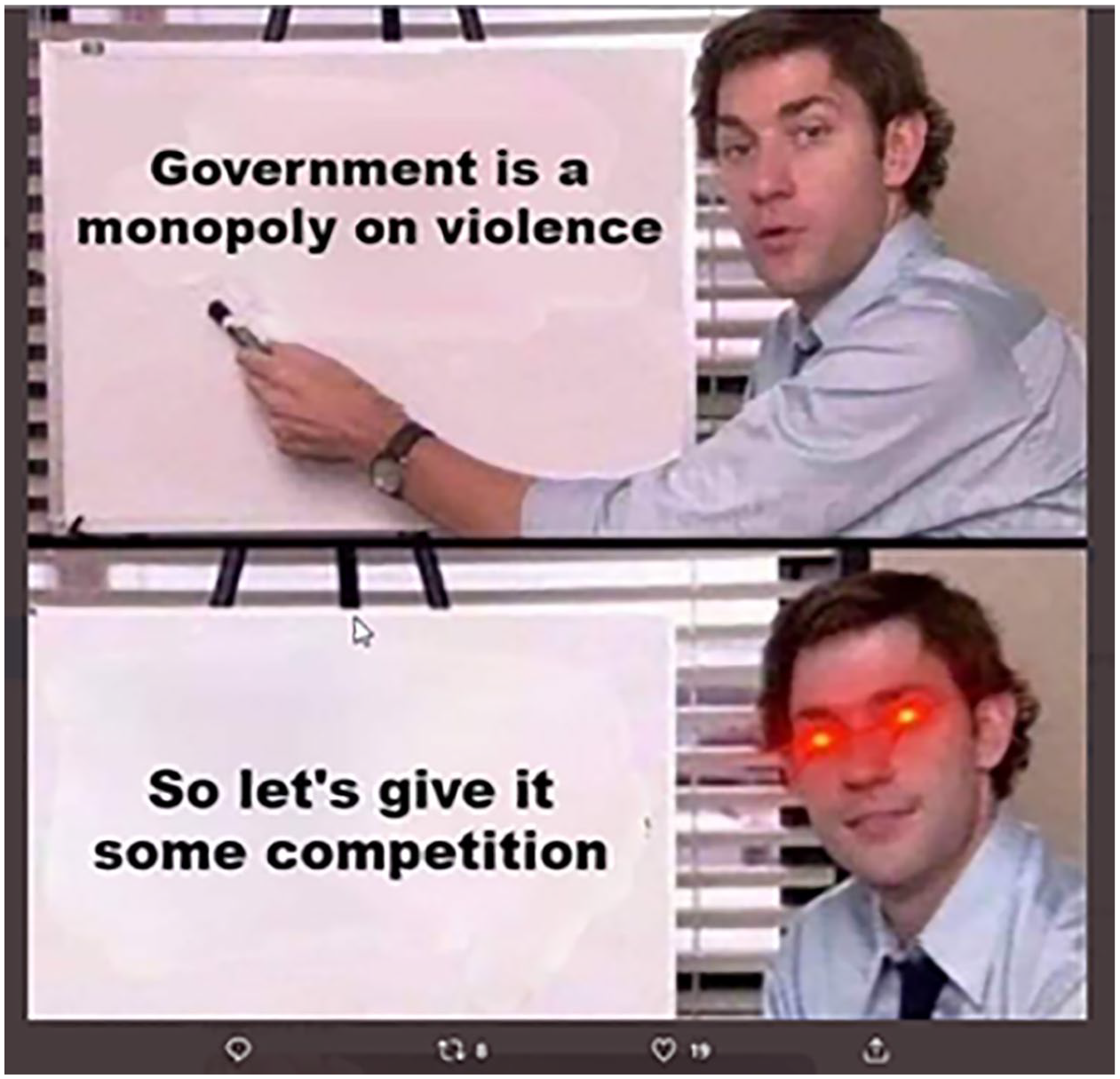
Category #3 example incorporating both threat of violence and conspiratorial thinking.
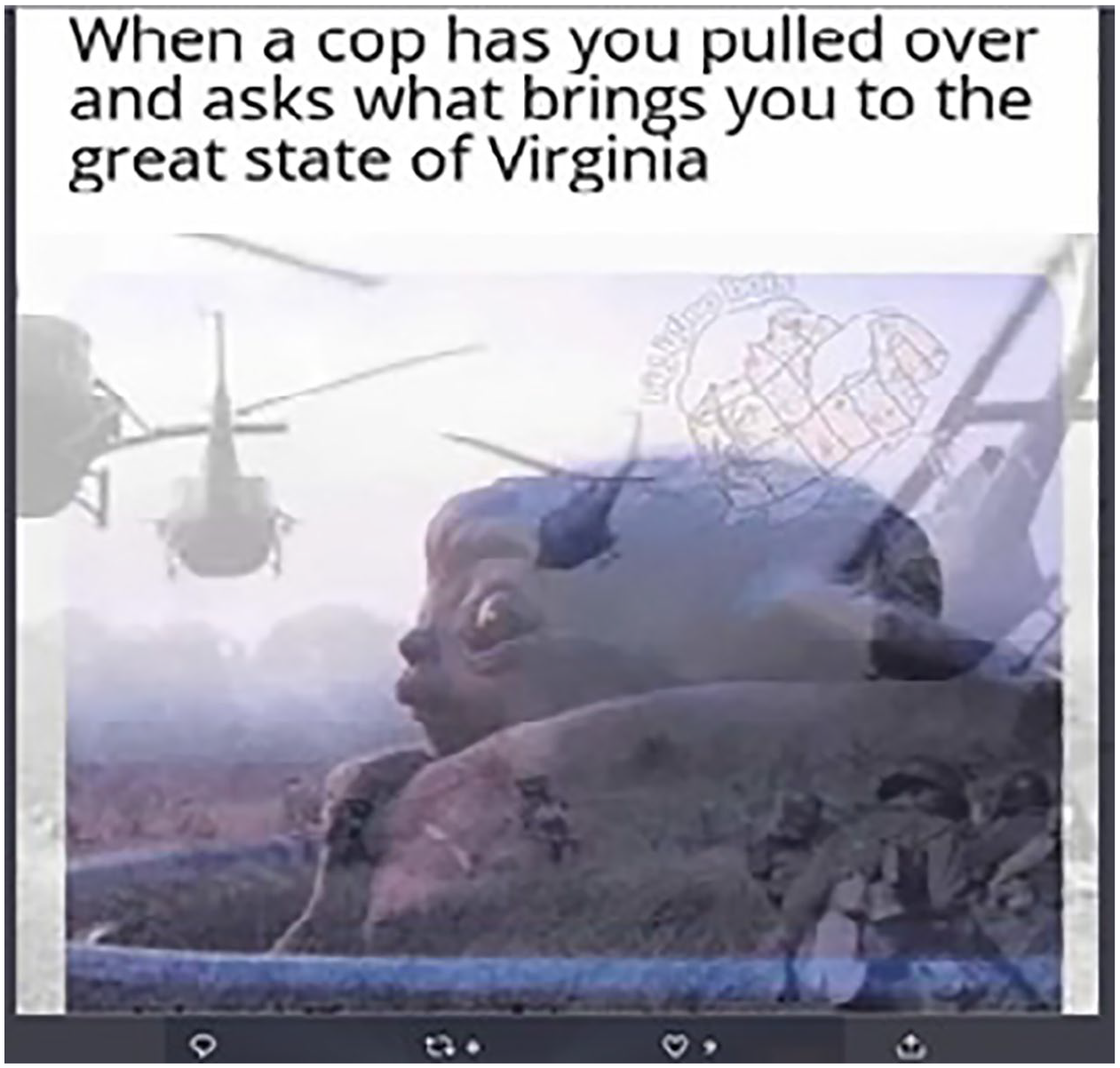
Category #3 example with “Baby Yoda” and threat of violence alongside police angst.
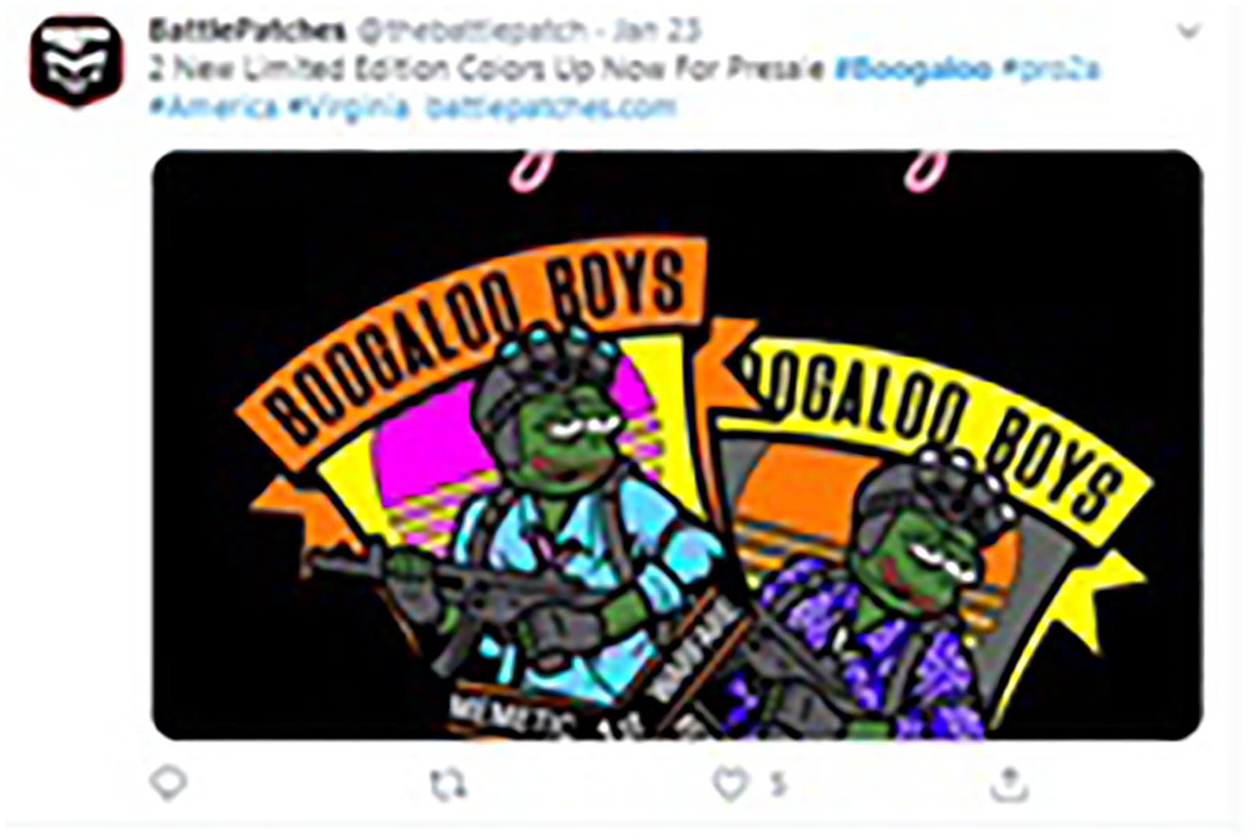
Category #3 example with remixed Pepe the Frog as “boogaloo boys” (note the “memetic warfare” on the figure to the left).
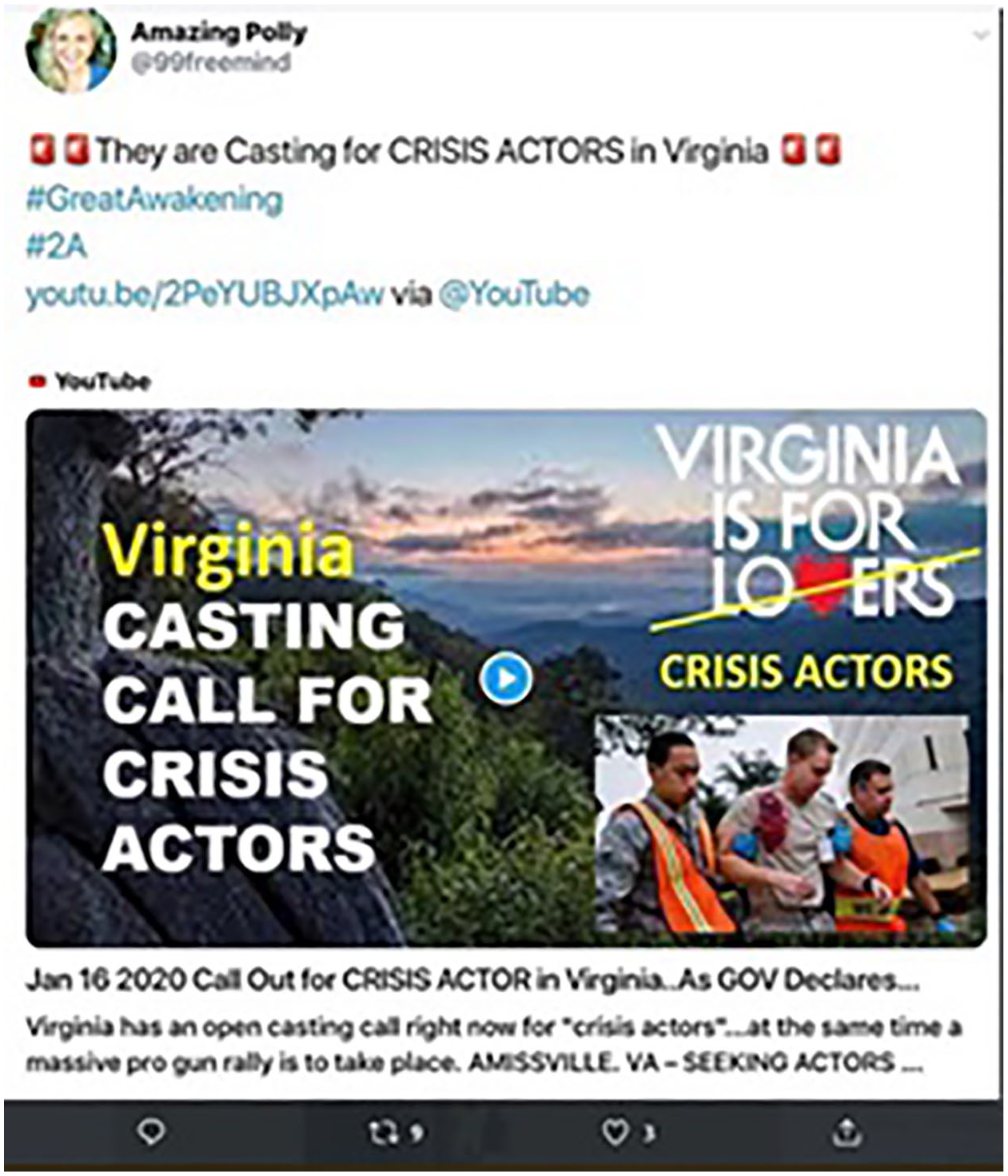
Category #3 example without explicit threat of violence but the high degree of conspiratorial thinking (crisis actors posted as true yet is fake news) suggests an implied rejection of any who would oppose “gun rights.”
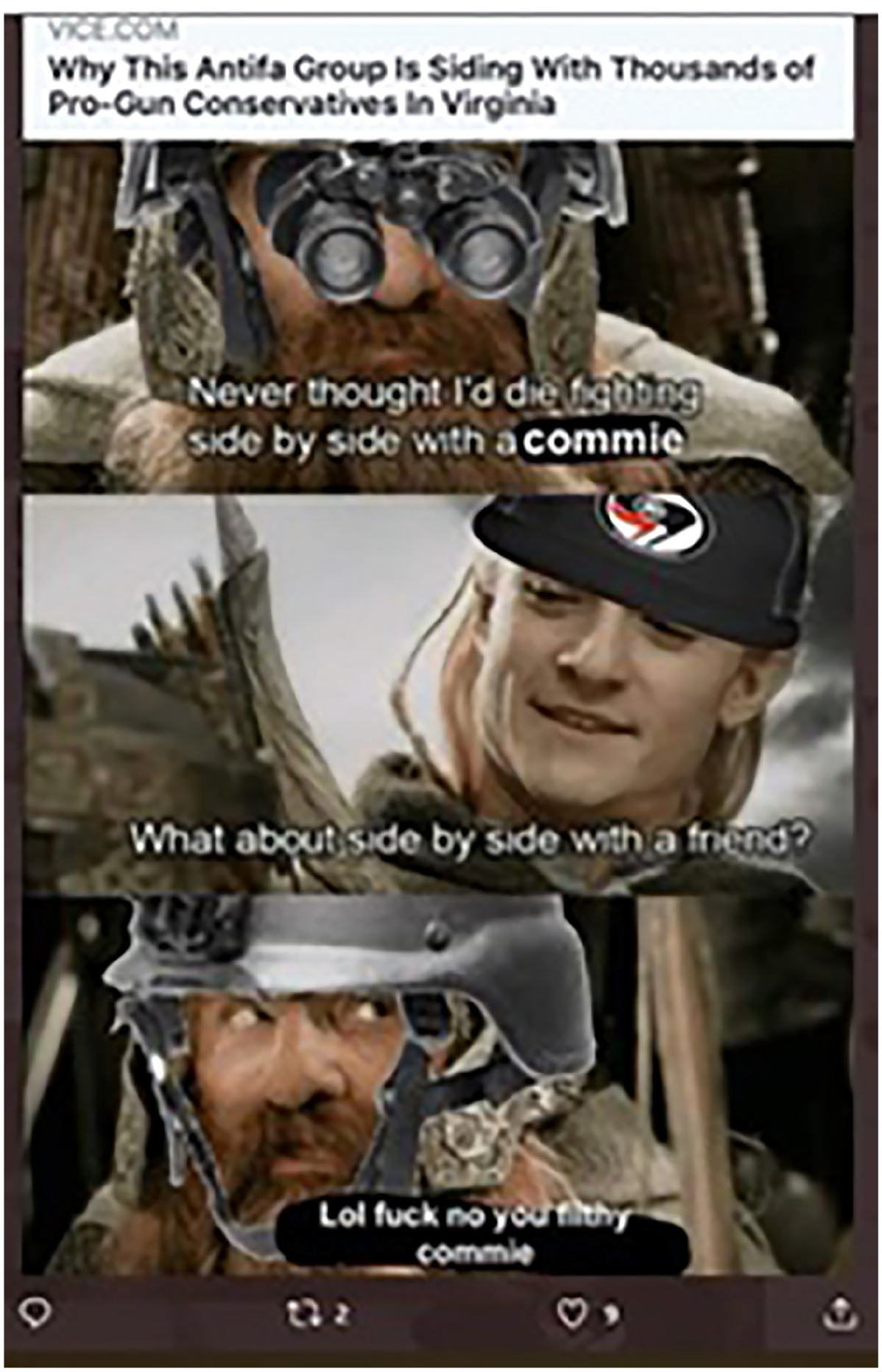
Category #3 example with a remixed Lord of the Rings exchange.
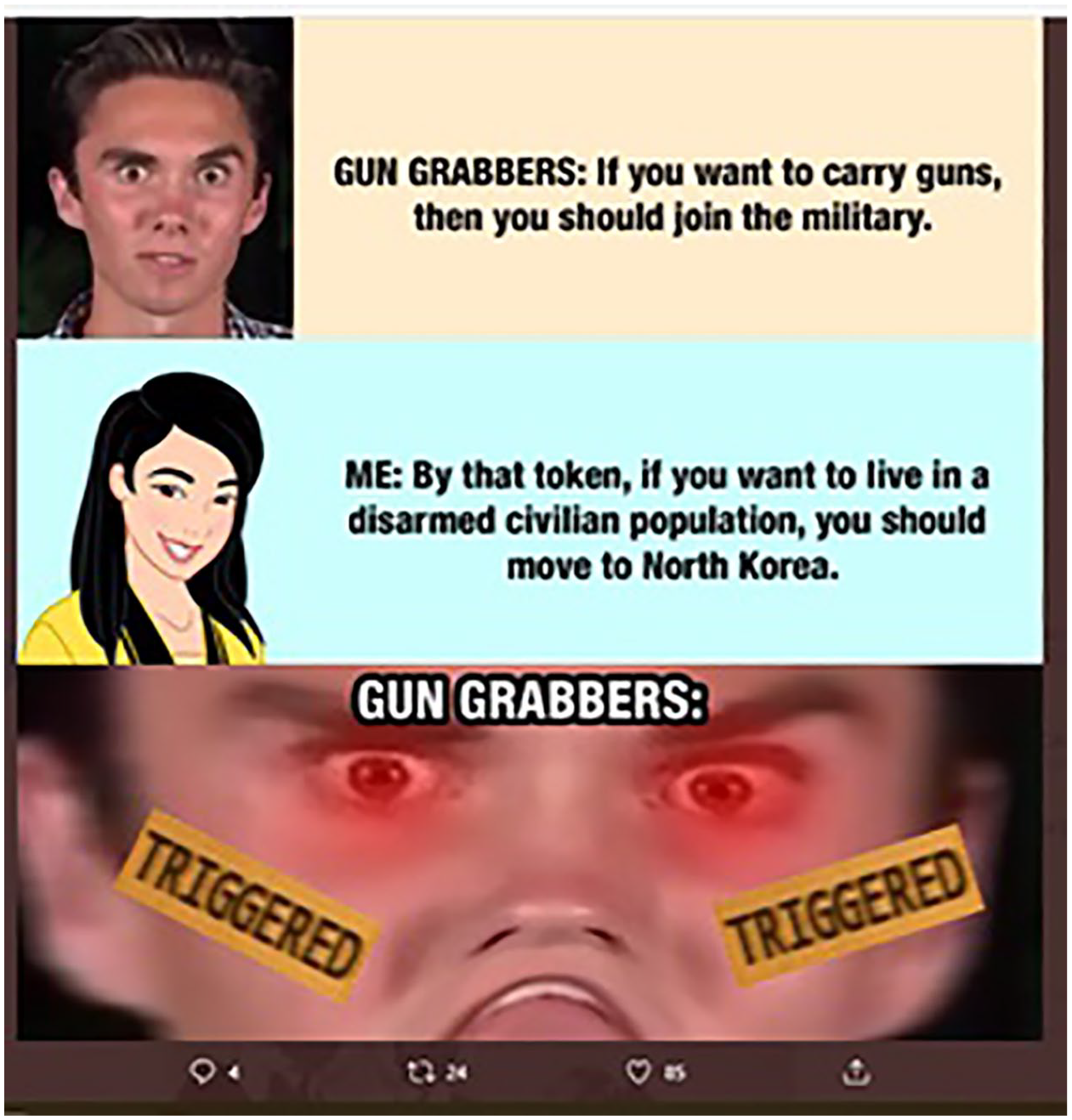
Category #3 example with Parkland School Shooting survivor, David Hogg.
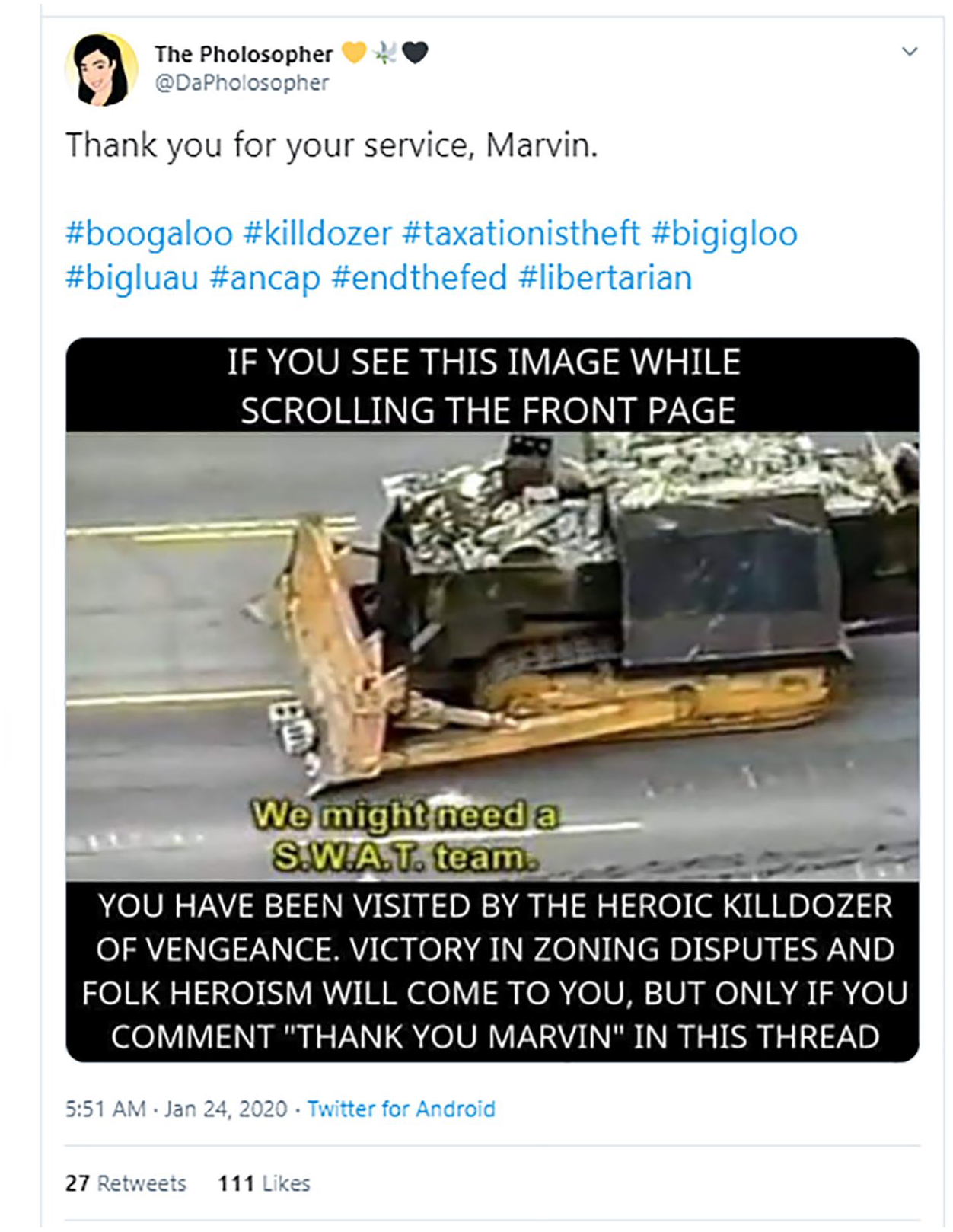
Category #3 example references an aspect of right-wing “folk heroism.”
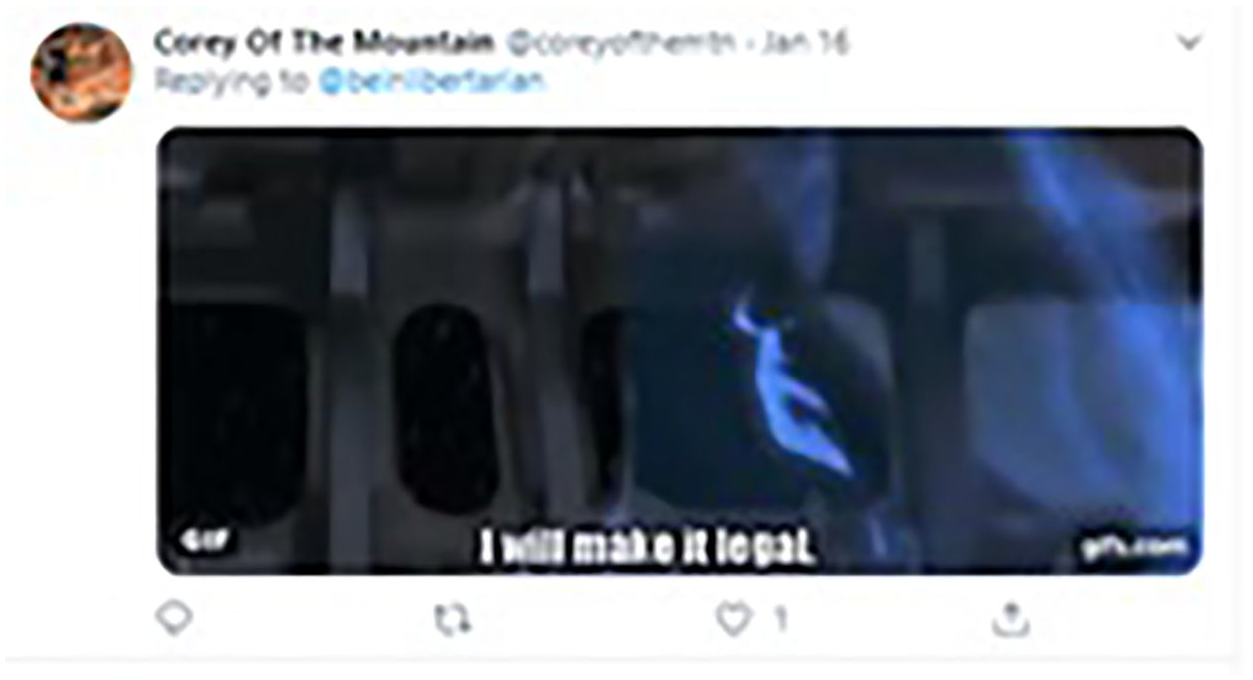
Category #6 using Emperor Palpatine from Star Wars as the Virginia Governor.
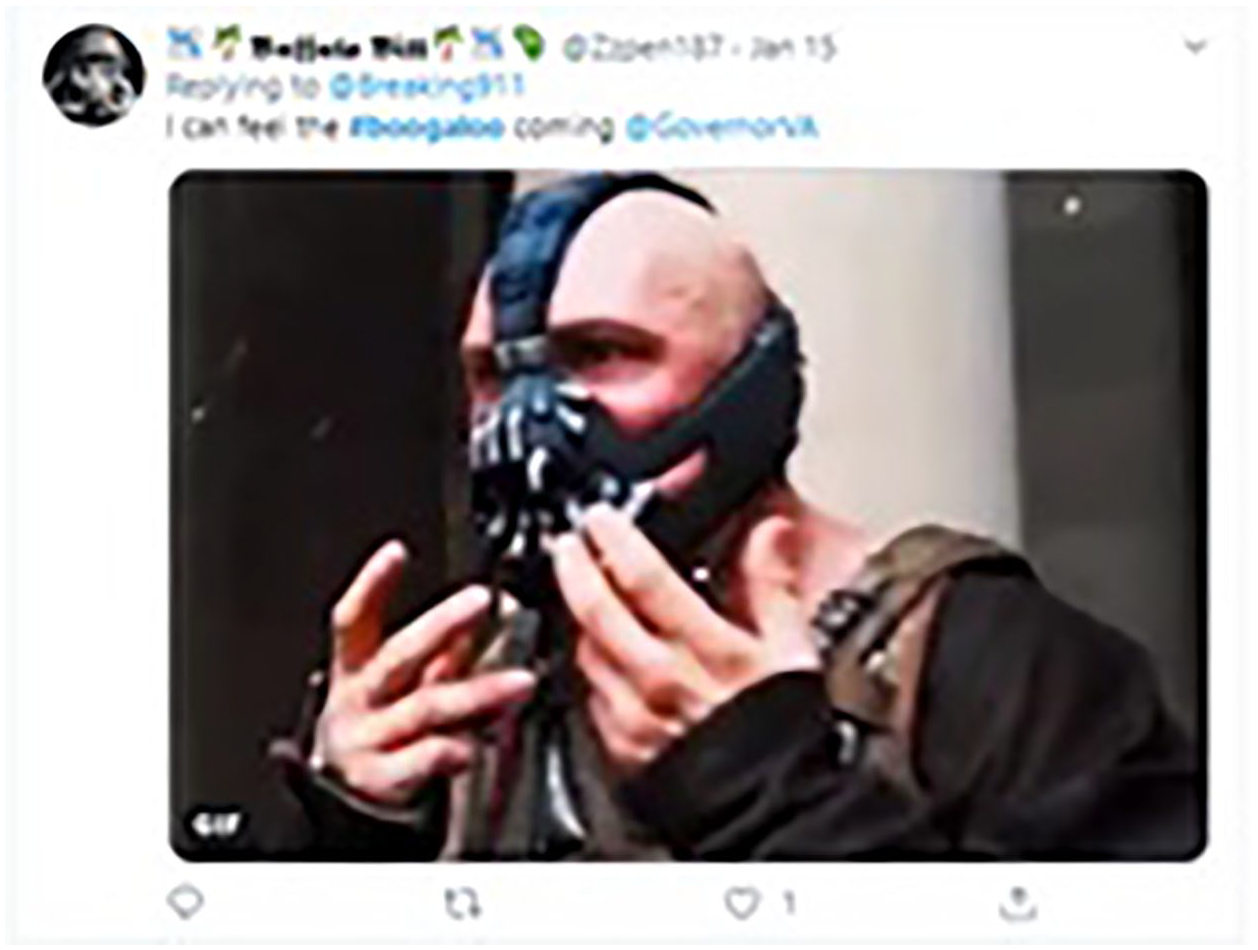
Category #7 referencing Batman character Bane in an animated GIF and a celebratory stance.
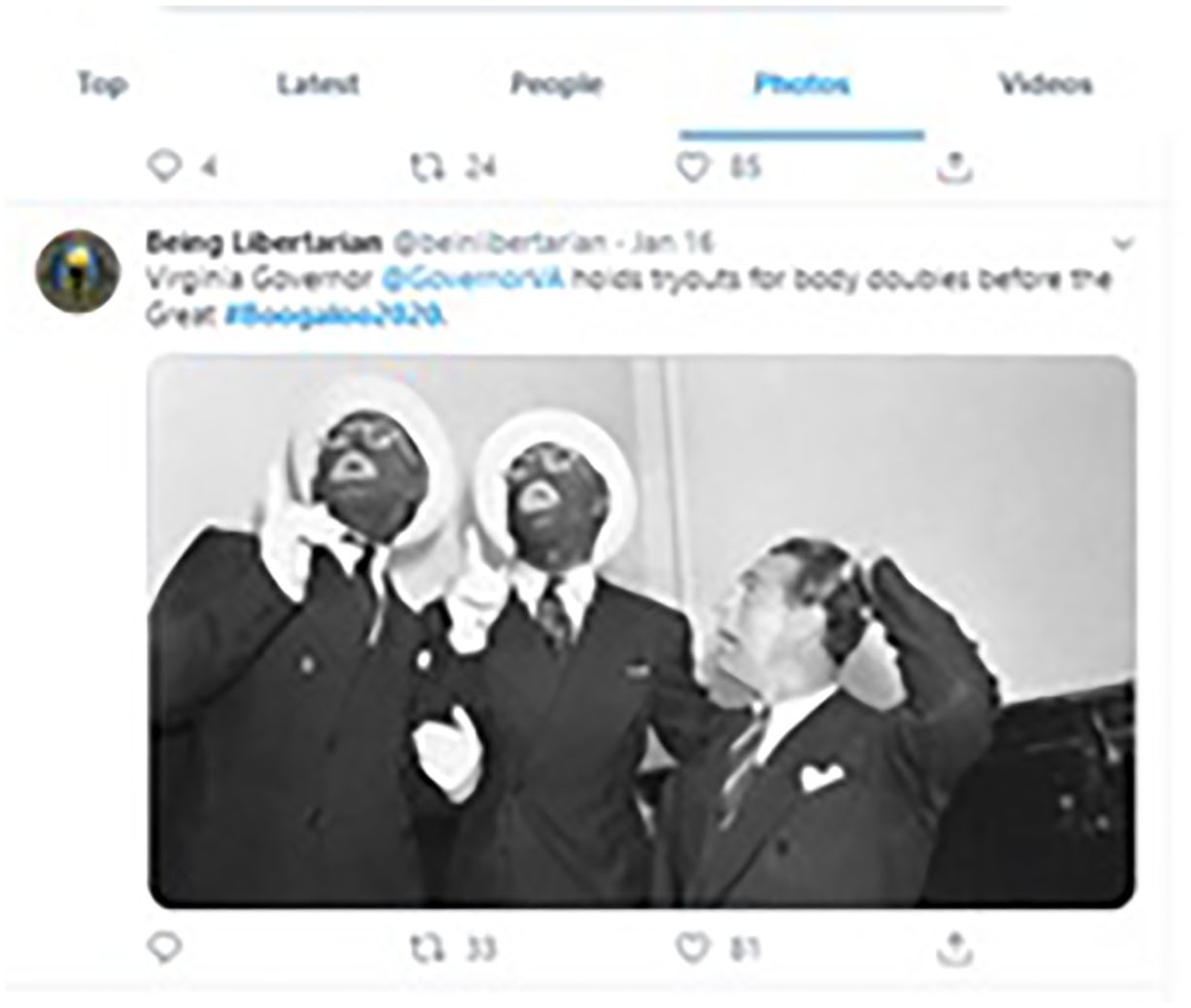
Category #8 remixing an ad hominem directed at Governor Northam because of his controversial medical school yearbook photo.
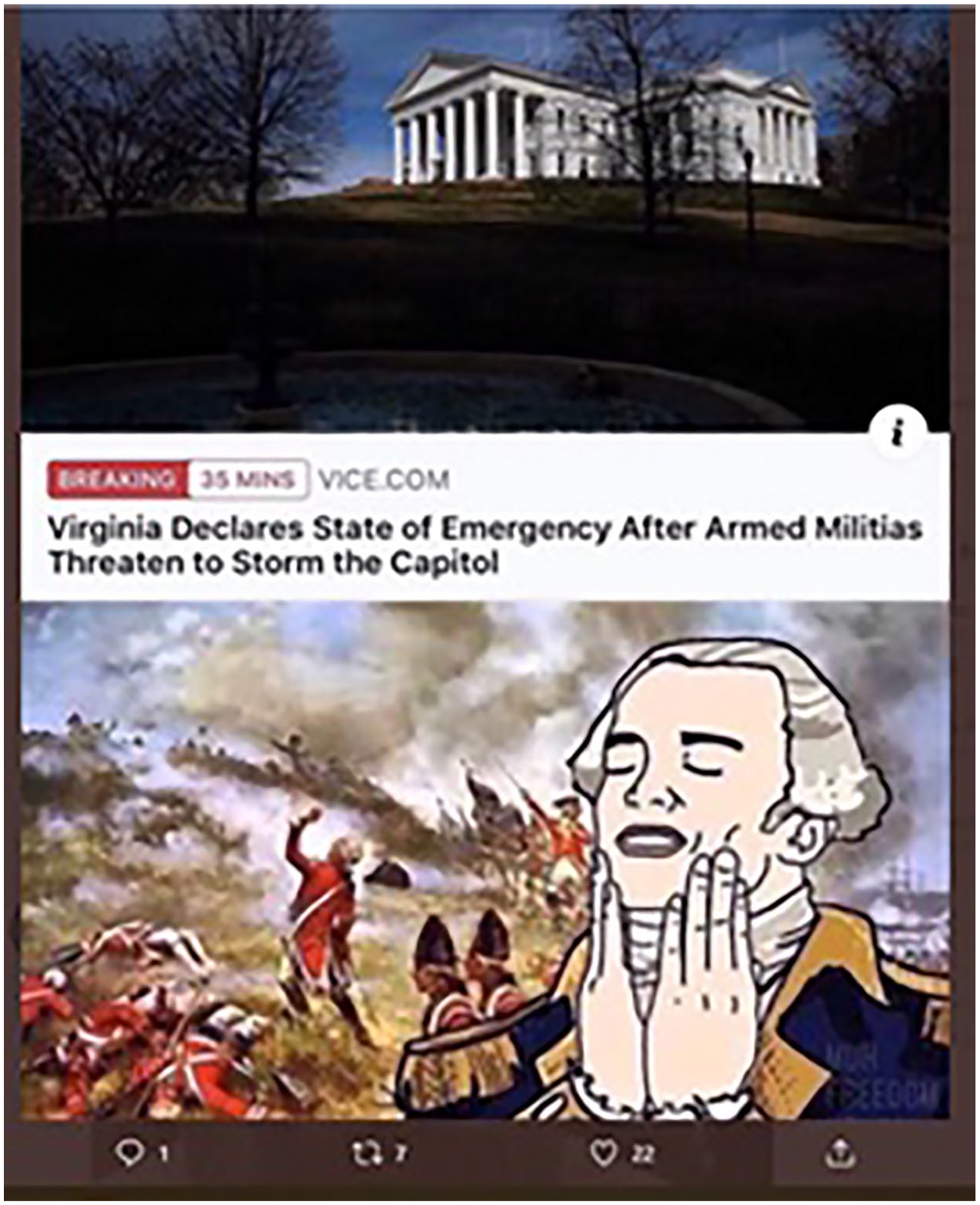
Category #5 example of the American Revolutionary War imagery/visual rhetoric.
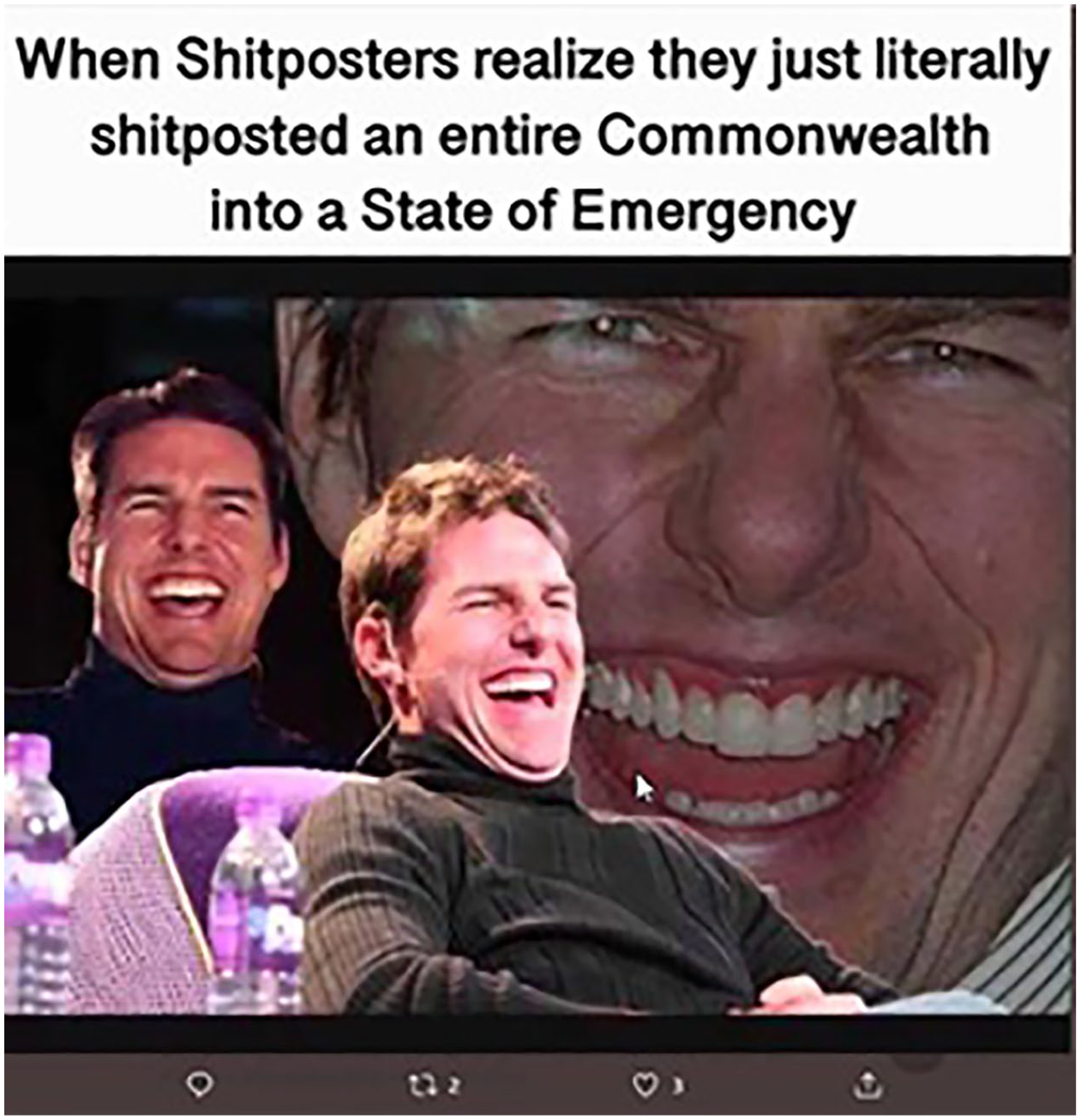
Category #4 example using a multi-image mashup with actor Tom Cruise to demonstrate an ironic/mocking stance regarding the declaration of a State of Emergency.
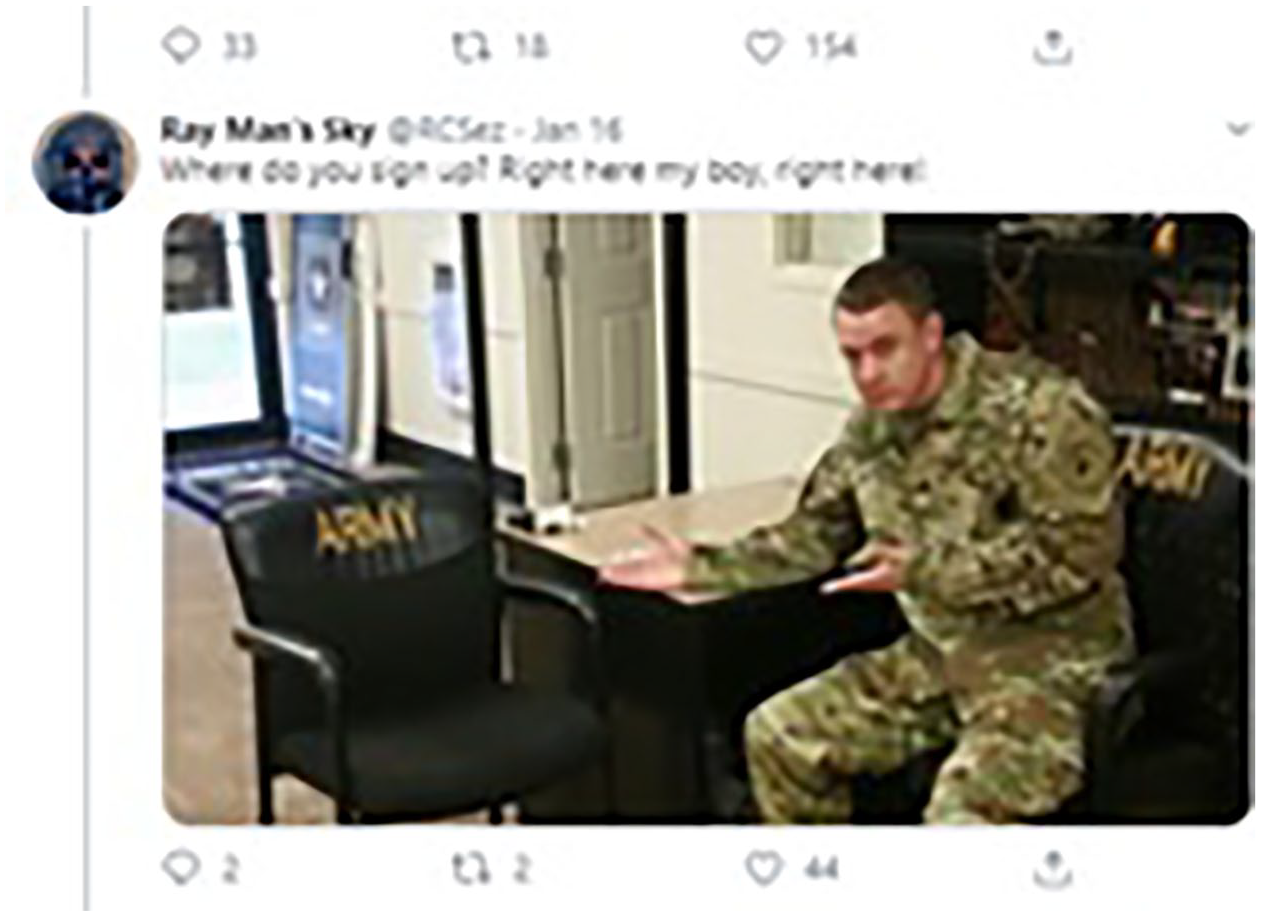
Category #2 reaction to a previous tweet which encouraged recruitment and “signing up” rhetoric.
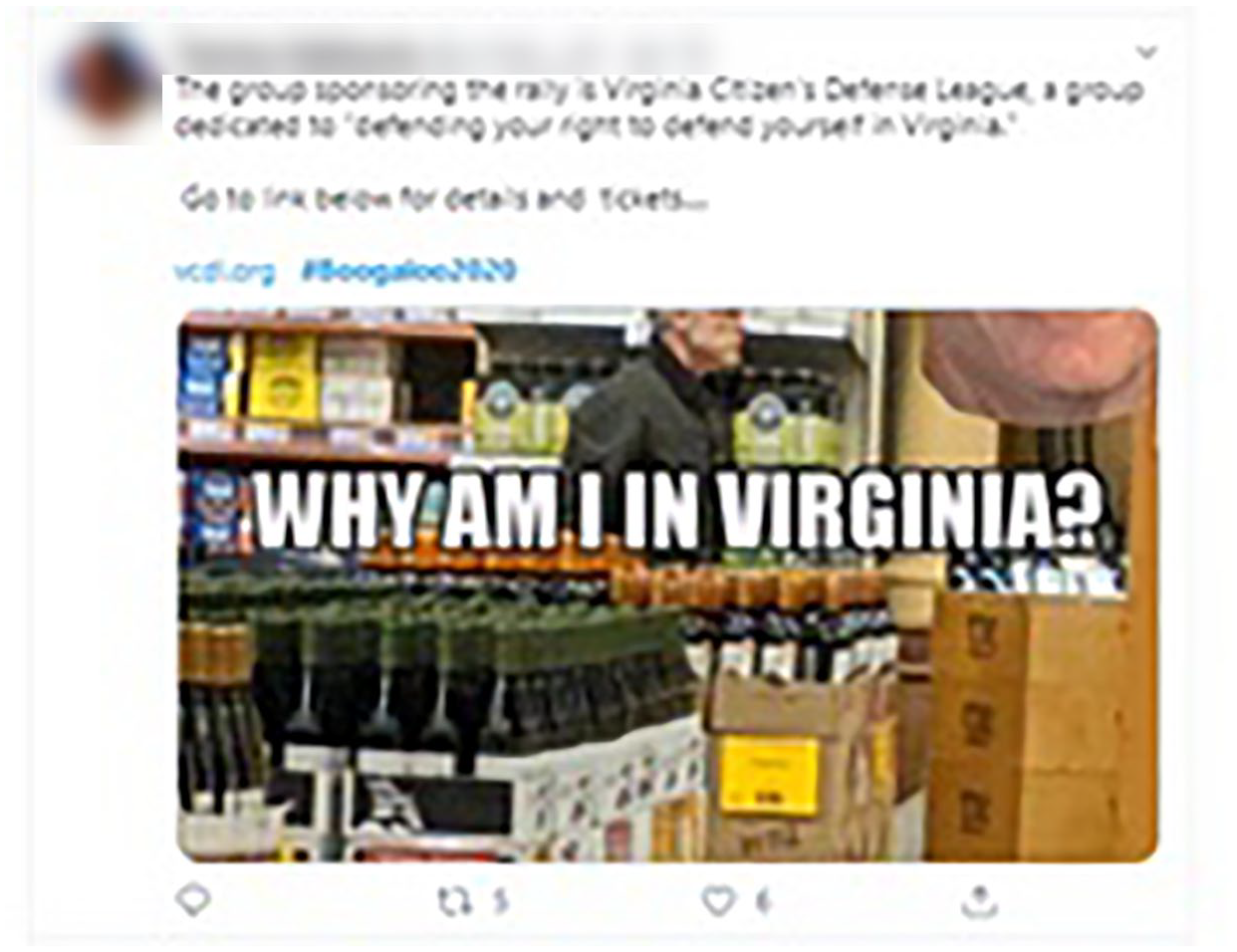
Category #1 example includes information for recruitment.
With Figure 1, an intertextual insertion of a screenshot of the TV show The Office enables a conspiratorial if not also paranoiac messaging to imply a violent overthrow of the government. The insertion of glowing red eyes appears to be a semiotic tool to suggest being triggered and therefore ready for, in this case, a violent exchange. Such structural choices to augment a given message suggests also a certain degree of technological and cultural knowledge. Regardless of the group’s ideology or the type of participation, to participate meaningfully means possessing the technical and social media savviness necessitated when engaging in digital discursive practice. This is as relevant to left-leaning political movements or far-right online expressions. Here, one must also acknowledge the interplay of ideology and identity construction and reification. In order to partake in a group’s activist practices, the individual is expected (by others in the group) to express certain message types which are consonant with the identity in terms of what it is but also what it is not. Within the emerging boogaloo discourse, proficient literacy implies a certain acceptance of conspiratorial thinking, implicit or explicit invocations of violent insurrection, and a generalized, paranoiac “known” truth that “gun control” can only logically signify confiscation and a degradation of perceived personal liberty.
Figures 2 and 3 appear to offer some degree of levity alongside a clearly explicit willful demonstration of lethal force. The use of the so-called “baby Yoda” in Figure 2 suggests cuteness but also implies power given the character’s abilities as depicted in the Disney+ series known as The Mandalorian. The incorporation of low opacity visual references to armed conflict suggests what the meme’s creator may desire and also inheres a certain degree of anxiety toward the police as a metonymic representative of a perceived tyrannical state intent on confiscating guns, and so on. In Figure 3, showing Pepe the Frog as the boogaloo boys suggests a simultaneously White nationalist/racist stance and also the desire for armed conflict. Pepe the Frog is generally considered a hate symbol and one closely associated with White supremacy and antisemitism, although the Anti-Defamation League (ADL, 2020a: para. 5) has suggested that when examining instances of the meme online one ought to take its placement in context as opposed to assuming that all instances are inherently racist.
Crisis actors, ANTIFA, and conspiratorial thinking
Figure 4 illustrates a deeply pervasive assumption within boogaloo discourse, namely a reliance on specific conspiracy theories whose foundations are often easily debunked yet still adhered to because of the explanatory power they give to group’s ideological practice. With reference to Figure 4 but also Figure 6 accusations that student and activist David Hogg, who survived the February 2018 Parkland High School shooting, worked as a trained Federal Bureau of Investigation (FBI) crisis actor emerged online as one of many related conspiracy theories.
The crisis actor meme redirected the discourse away from a sober debate on gun control and toward obfuscation, triggering content structured to attract angry responses from all political perspectives. To offer some background as to the staying power of this meme, on 20 February 2018 YouTube user “mike m.” uploaded a clip of David Hogg entitled “DAVID HOGG THE ACTOR . . . ” in which Hogg explained his altercation with a lifeguard at a beach in Los Angeles (Farhi, 2018). The YouTube video gained over 200,000 views by the time it was removed the next day. The point here is that conspiracy theories online always already knew that Hogg must be a kind of crisis actor—a person ostensibly hired by a corporation or government in order to serve a “false flag” purpose.
Often, attempts to make sense of the patterns of force that are deployed when Internet memes are ideologically positioned seek to obstruct and/or delegitimize one discourse and elevate another. The conspiracy theory itself is a kind of Dawkinsian meme whose ideational construction is useful in reinforcing ideological practice for the purpose of reconstituting one’s identity with a particular way of reading current events but also to demarcate what one groups perceives as other. However, one of the main reasons for the spread of the Hogg-as-crisis-actor conspiracy theory is due in part to a far-right media organization called Gateway Pundit which tweeted a story claiming that Hogg, whose father works for the FBI, was a trained FBI agent acting out an agenda to serve an imagined goal orchestrated by the suspected enemies of Donald Trump (Farhi, 2018). The use of social media in this way, whether to spread blatantly fake news or Internet memes that function similar to fake news in order to further a baseless and refutable claim, underscores what American historian and intellectual Richard Hofstadter (1964) called the paranoid style of American politics. Furthermore, according to Benkler et al. (2017), “[b]y repetition, variation, and circulation through many associated sites, the network of sites makes their claims familiar to readers, and this fluency with the core narrative gives credence to the incredible” (para. 21). Once again, narrative figures prominently in boogaloo discourse and its function is centered on identity consolidation.
Also appealing to conspiratorial thinking, Figure 5 implies a threat of lethal violence against a perceived enemy: individuals associated with ANTIFA, an abbreviation for “antifascist” and is “a loose collection of groups, networks and individuals who believe in active, aggressive opposition to far right-wing movements” (ADL, 2020b: para. 2). Despite the offer of friendship, the perspective of the boogaloo boy is to reject such sentiments and counter with aggression and a clearly antagonistic stance.
Folk heroism, tyranny, batman, and blackface
In Figure 7, this particular tweet references the infamous demolition of numerous buildings with a modified bulldozer, known in online parlance as the “killdozer,” in Granby, Colorado on 4 June 2004, and carried out by Marvin Heemeyer, who later committed suicide. Note also the hashtag, #taxationistheft, an obviously anti-statist stance and the concept of folk heroism again suggests an in-group assumption of victimization in the face of a hegemonic force known within the group as the federal government. This sentiment also suggests certain populist tendencies such as “a vocal anti-establishment attitude, the opposition to some key tenets of neoliberal ideology and the claim to representing ordinary people” (Gerbaudo, 2018: 747). The tweet is also performative in its urging for the viewer to comment on the thread with a scripted text, “thank you Marvin,” thus reinforcing both ideological practice and the consolidation of identity within the in-group.
The character of Sheev Palpatine, known in the Star Wars universe as both the Emperor and Darth Sidious, is deployed in Figure 8 in order to convey the insidious nature of the, perceived, tyrannical actions of Governor Northam in his presumed attempts to seize guns in the declaration of a State of Emergency. It is important to note how this particular meme need not include any reference to the governor, as it is a reply to a previous tweet but also clearly a separate category in its denouncement of the State of Emergency as illegal.
The character Bane from The Dark Knight Rises appears in Figure 9 (online functioning as an animated GIF) to express celebratory excitement regarding the looming boogaloo/civilwar2. The use of Bane is not happenstance; both in the comics and the film Bane is a mercenary, a kind of one-man-army (despite having numerous acolytes ready to do his bidding aggressively against Batman). Coded as an example of a more celebratory stance, it also inheres some degree of implied violence given the powerful nature of the character. Similar references to characters in popular culture often emerge as memes, at times these references can appeal to sentiments ranging from support for the individual to derision. As in the case of the 2016 US Presidential campaign, references to Trump, for example, tended to position him either as a buffoon or as an agent of chaos, and therefore, an outsider who can ‘get the job done’. In contrast, references to Clinton bordered on if not also transgressed the misogynistic and vitriolic in stance and tone. In terms of the semiotic function to make such references, and why these choices may in some cases lead to viral sharing if only for a brief period of time, the reason may lie in the technological affordances of smartphones and always-connected devices given these as dominant media used for sundry communicative functions.
To return to semiotics, of paramount importance is the sign. Recalling Eco (1984), the semiotic choices used in the construction of memes is similar to a gesture or indication of meaning and is “produced with the intention of communication, that is, in order to transmit one’s representation or inner state to another being” (p. 16). In other words, in-group messages as memes carry with them deeply contextualized and situated logics that may seem humorous and critically viable to the in-group but offensive to an out-group. The use of strong emotions embedded in memes-as-messages reinforces identity to encourage users to spread and communicate message conformity among disparate members of boogaloo discourse.
The image in Figure 10 references how Governor Northam became embroiled in a controversy in February 2019, when a medical school yearbook photo surfaced online and featured one figure who was dressed in blackface accompanied by others clad in Ku Klux Klan robes, ostensibly for a Halloween or similar dress-up party. Controversy ensued upon the spread of claims that the governor was one of the figures in the photo. The governor first assumed responsibility for the deed, confessed and promised to do better in the future. The following afternoon the governor then recanted his confession, causing confusion online and off. An investigation found no conclusive evidence supporting (or rejecting) either perspective. Regardless, adopting this type of stance on an issue, especially one covered in the mass media, is of great importance to research on Internet memes due to the ways in which meaning can be negotiated and constructed in terms of a given media narrative (Hall, 2012; Wiggins, 2019). The yearbook photo story appealed to the supporters of “gun rights” and therefore, presumably, opponents to the governor. Regardless of the truthiness of the photo or the governor’s admission of guilt and then retraction, a certain meaning can be negotiated according to a group’s own ideological practice (Hall, 2012). The precarious challenge offered by Internet memes is that within these discursive units of culture, a media narrative operates as it does elsewhere, as a way to convey information regarding a particular real-world event, person, issue, and so on. However, the purpose of referencing a media narrative in memes has potential to recast and/or distort reality to match the desired ideological view as expressed by the group, in this case boogaloo. In other words, the blackface photo, while wildly racist, already resonated with Governor Northam’s opponents. The function it served, as in many other instances regarding Internet memes as well as fake news, was to extend a particular version of a media narrative, thus emboldening further retreat into echo chambers and siloed communication within an in-group. As an example, Gray et al. (2020) found as results of a scenographic analysis of Google search results that “it was very rare for pages that shared junk news stories . . . to also share fact-checking corrections” (p. 328). With challenges such as selective exposure, it is not surprising then that individuals might experience difficulty in discerning real from fake news stories as well as the preferred or negotiated reading of a given narrative embedded in a meme.
American revolutionary war, shitposting, rebuttals, and recruitment
While the incorporation of American Revolutionary War imagery in Figure 11 only emerged in four instances in the total sample, the purpose of such references suggests a hyper-nationalist view of one’s in-group. A social constructivist view of identity formation and negotiation suggests that identity is not permanent and requires some degree of hegemonic influence in its iterative reification. References such as the one in Figure 11 attempt to legitimize calls (either implied or explicit) for violent insurrection of the government. References to the American Revolutionary War pop up frequently in the sample with regard to the ongoing boogaloo discourse (also with reference to the COVID-19 pandemic), and as such “create, circulate, and reproduce attitudes and stories that challenge dominant narratives” (Silvestri, 2018: 3998).
Only three tweets were coded in category #4, but each depicted a less serious, less violent message, and, consequently, each inhered little or no antagonism but rather celebrated the boogaloo process without a direct call to action or a threat of violence. The example in Figure 12 lauds the actions of the shitposters in prompting Governor Northam to declare a State of Emergency. In this case, the meme addresses agency on behalf of the “gun rights” community as determinative in realizing the State of Emergency, which in effect encouraged armed inviduals to mobilize and participate in the 20 January 2020 gun rally in Richmond, Virginia.
Only three tweets were clear and direct responses to a previous tweet, and all three cases appeared to reply in disagreement or disapproval with the previous tweet. In Figure 13, the tweet refers to one previous in which a user posted (but has apparently since deleted) an animated GIF of a merged US flag and the Gadsen flag (with the phrase “Don’t tread on me”) and tweeted a query, “where do I sign up?” (ostensibly for the boogaloo). Figure 13 functions as a rebuttal, whereas others in the same category fail to elicit any engagement.
In that example, some anxiety appears to accompany the process of identity construction of boogaloo types. However, they tweet calls for a violent overthrow of the government, yet, in this example, they appear to support the military and enlistment. This apparent aporia seems consonant with our postmodern condition. In the other two cases, though without any likes or other reactions, a user tweeted an attempt at evidence-based clarification regarding a previous tweet. Such attempts seek to identify fake news and offer an opportunity for civil discourse, yet were met, at least in the two examples mentioned, with no engagement.
In the final tweet from the sample, the user urges others to join in with the main organizers of the rally, the Virginia Citizen’s Defense League and includes a URL to learn more about the group. The function here is clearly to recruit and demarcate lines of identity; the rhetoric in the text suggests a view of the self as victim, the bandwagon effect, and also an enthusiastic invitation to participate. Incidentally, the image included in the tweet is taken from a right-wing Instagram account (powerchairpete, based in Richmond, Virginia) and features a remixed iteration of former deputy then acting director of the FBI, Andrew McCabe, who was summarily fired while on paid leave, while awaiting retirement on 18 March 2018, also coinciding with his 50th birthday. A day before the planned retreat from his posting, Attorney General Jeff Sessions released McCabe of his duties. President Trump lost no time in applauding the move as “a great day for democracy,” as depicted in Figure 15.
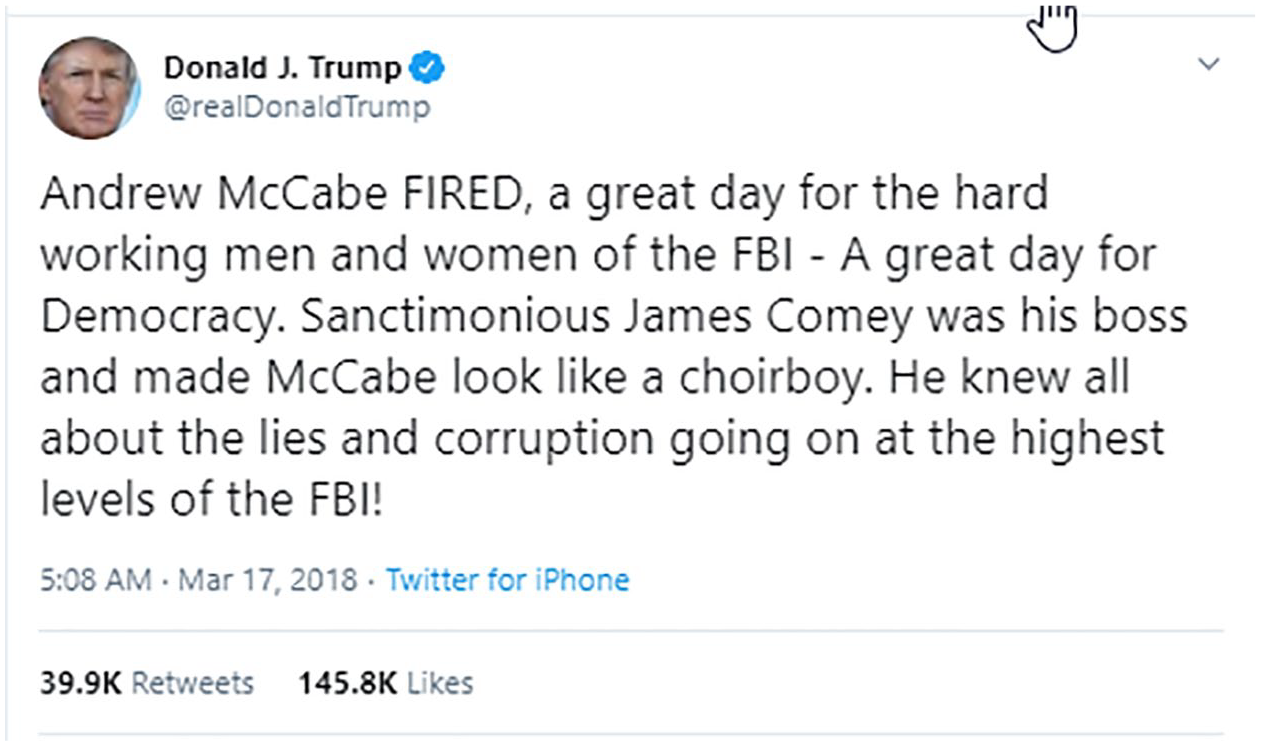
Trump’s celebratory tweet regarding McCabe’s sudden dismissal.
Discussion
This main impetus of this study has been to contribute results from a CDA of memes tweeted apparently by individuals who advocate fierce protection of the Second Amendment as well as implicit/explicit activism for violent insurrection. As noted by Tuters and Hagen (2019), “political memes [used] as protest against the apparent hegemony of liberalism take on a different valence when used in this style of memetic antagonism” (p. 16). Such activities may encourage further participation, and perhaps the venting of one’s frustrations through the curation of memes echoes group sentiments thereby consolidating identity.
Building on Finnegan (2001) and Smith (2007), Wiggins (2019) maintains that such messages-as-memes function less as the Dawkinsian variant, which emphasizes replication and imitation, and more dominantly as an enthymeme, or visual argument. The viewer of the meme receives the message as a means of identity consolidation with respect to the group’s or movement’s ideological practice. Memetic antagonism functions as a centrally important ideological tool in the construction and expression in boogaloo discourse. Certain symbols and codes are preferred over others, and even the phrase itself, boogaloo, at first seemingly innocuous, upon further regard it appears as a kind of covert activism. As Phillips and Milner (2017) remark, “just because something is silly doesn’t mean it can’t also forward a serious message” (p. 190). Accordingly, this study has shown how memes deployed for in-group communication also carry deeply contextualized and situated logics. In addition, the reliance on hypernarrative storytelling serves the boogaloo movement in terms of identity negotiation and consolidation.
Boogaloo has attracted a following of individuals within a “hybrid structure between [a] lone-wolf and cell-like organization” (Goldenberg and Finkelstein, 2020: 2). As such, their covert forms of activism necessitated the creation of new codes of meaning, which invariably also reference conspiratorial thinking thus emboldening a retreat to like-minded others. The memes and bellicose rhetoric rife within boogaloo discourse suggest a context which involves ready-made sentences, metaphor, juxtaposition, and more. Within boogaloo discourse, catachresis emerges to reference conspiratorial thinking, such as claims of crisis actors or anxieties about mass gun confiscation; in effect, these ideas must be true in order for their status as victims to justify violence and insurrection. Such memes reference media narratives and/or assumptions such as conspiracy theories and their incorporation into memes, made easily shareable and consumable, further complicates civic discourse.
While the sample analyzed for this study is a snapshot of boogaloo activities in January 2020, it is perhaps appropriate to acknowledge the potential interactive effects of the COVID-19 pandemic and boogaloo. Muirhead and Rosenblum (2019: 65) characterize Trump’s conspiracism as one defined by grandiosity and victimization; this especially resonates with groups such as boogaloo, but also similarly conspiratorially oriented groups like QAnon, anti-vaxxers, now also anti-maskers, and others. Resistance to lockdown orders, the wearing of face masks in public and in close quarters, and other measures necessary during COVID-19 echo unresolved anxieties within strands of the American public, finding fecund ground in spaces occupied by boogaloo and similar groups. One particularly fitting meme taken from Instagram captures the merging context of boogaloo and COVID-19 quite succinctly, shown in Figure 16. 1
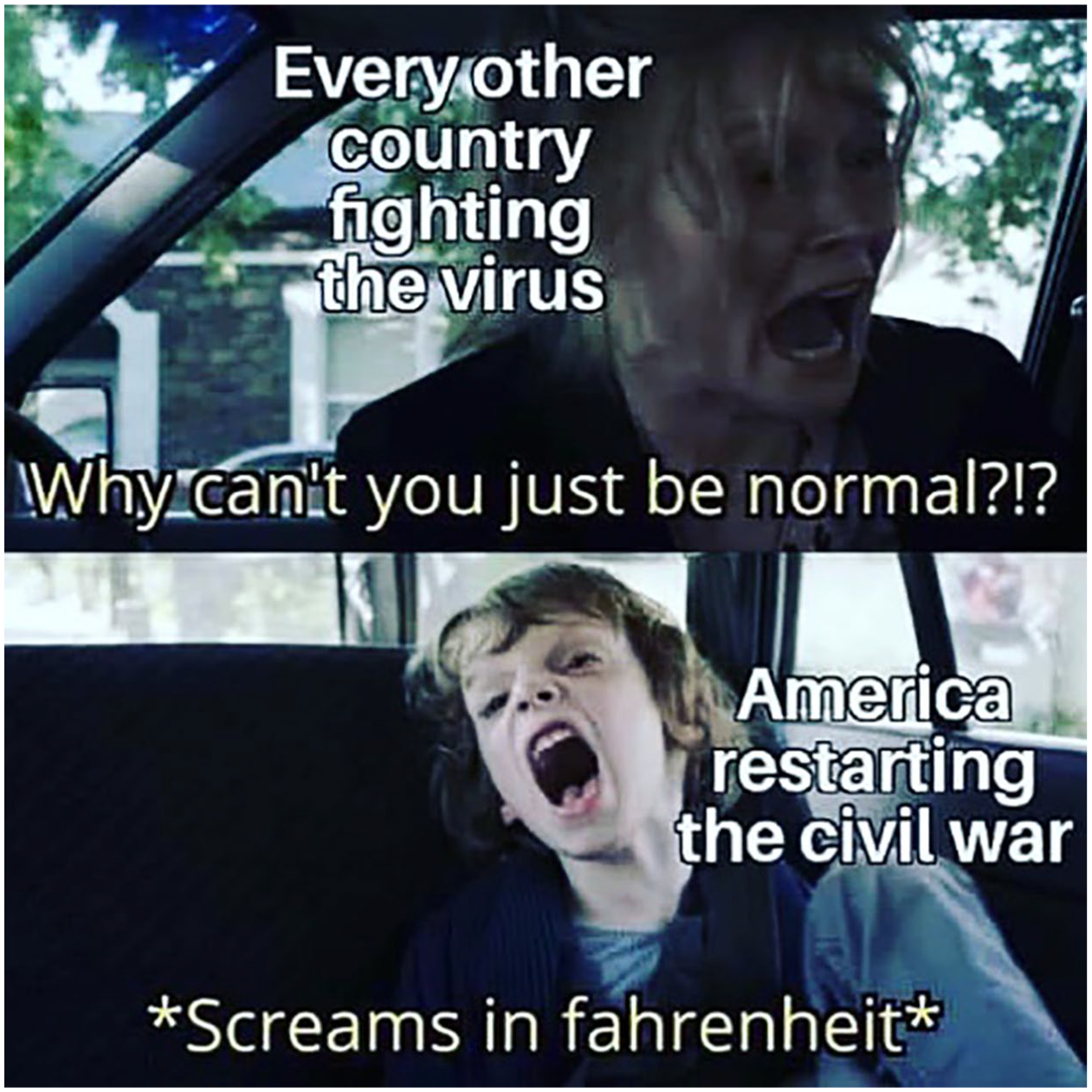
COVID-19 and boogaloo discourse merged.
A few limitations in this study include the relatively small-scale of the sample but also necessarily so as boogaloo was not a mainstream or widely discussed topic during the sampling phase of the study. Accordingly, hashtags may be seen as a limitation, but their use in nascent groups online is consonant with studies looking at consolidating and maintaining a network for online as well as offline participation.
Future studies should continue to examine the boogaloo and related discourses, such as the Three Percenters movement, which also advocates for “gun rights” and is largely antagonistic toward government (Sankin and Carless, 2018). Future studies may wish to consider the interplay of COVID-19 and conspiratorial thinking, though due to removals by Facebook and Instagram on 30 June 2020 of boogaloo content (Alba, 2020), perhaps other or related groups may be of interest for further research. Outside of the United States but similar in conspiratorial tone is the so-called Kalergi plan, often invoked by far-right groups in Europe such as the Identarian movement (Teitelbaum, 2017). Movements as these, whether rhizomatic/hybrid or united, deserve critical examination in order to develop pedagogical and related strategies to be prepared for such evolving discourses.
Footnotes
Funding
The author(s) received no financial support for the research, authorship, and/or publication of this article.
