







Abstract
Naked loan selfies are a Chinese Internet phenomenon in which naked selfies taken by young women are used as a form of collateral in peer-to-peer loaning systems. Despite being the subject of sensationalised media coverage in China, naked loan selfies have so far received only very limited academic attention. Drawing on the new materialist ontologies of Karen Barad and Annemarie Mol, this article investigates naked loan selfies as techno-social entities that are enacted through specific online networks and practices. The article uses text-based research and online walkthroughs to trace the way naked loan selfies are constituted first as collateral, and second as pornography. As well as providing insight into an under-researched online phenomenon, this article contributes to the growing body of work on selfies as networked, lively and agentic.
Introduction
On 30 November 2016, a zip-file containing the nude selfie images and videos of 167 women was circulated on the Chinese Internet (Xu, 2017). The file contained personal information about these women: their full names, Chinese Citizenship IDs, screenshots of conversations, as well as contact details of their friends and family (Xu, 2017). While the hacking and leaking of nude images of celebrities had occurred before on the Chinese Internet, this case was markedly different as these images were of ‘ordinary’ women. In addition, these images had been taken by the women themselves with the agreement that they would operate as collateral for loans that they owed.
Referred to as ‘naked IOU loan’ (Luotiao daikuan – 裸条贷款), ‘naked loan’ (luodai – 裸贷) or ‘naked IOU’ (luotiao – 裸条) by the Chinese media, the practice received sensationalised media coverage in China as well as overseas (Leavenworth, 2016). Although the now infamous Zip-file (dubbed the ‘10G Zip-File’ by the media) 1 has become the symbol of naked loans, the first leaked images occurred earlier, in June 2016 (Xu, 2017). In both instances, the images all took the form of a young naked woman with a neutral expression holding her Chinese Citizenship ID in front of her breasts or genitals, looking straight into the camera. The images are angled so that the citizenship ID – which contains their name, identity number and address – is clearly visible. Taken by the women themselves, these images were of a ‘selfie-style’, with outstretched arms and tilted head (Frosh, 2015).
The Chinese media soon discovered that naked loan selfies were not only being used in loan agreements but were also being sold on various social media platforms and forums (Zhang and Li, 2016). Sellers advertised the availability of naked loans ‘resource’ (luodai ziyuan – 裸贷资源), and purchasers could buy access to the images. Thus naked loan selfies quickly became images that were advertised and consumed as pornography, most without the women’s consent.
In response to public attention and media coverage, there have been active efforts by the Chinese government to remove naked loan content from the Chinese Internet (Wang, 2016). Furthermore, articles were also published to highlight the illicit nature of both the usury associated with naked loans and the distribution of naked images (Liu and Wang, 2017).
As in other leaked image incidents, Chinese media and public discourse blamed the women for producing such images and the resulting harm was seen as their responsibility (Zhang, 2016a). While the limited academic literature on naked loan selfies offered a different perspective, it too has focused on the women involved. For example, Qin (2016) challenges the media view that the naked loan phenomenon demonstrates the disturbing consumerism and materialism of contemporary young Chinese women. Rather, she argues that such patterns of self-objectifying behaviour are part of a broader societal construction of the feminine. She interprets naked loans as a practice produced by a patriarchal society which prioritises male desire, where a property-less young woman’s body is her only source of value and worth (Qin, 2016).
While such an account challenges the discourse of individual blame, it tends to present women as cultural dupes and passive victims of patriarchy (Bordo, 1993). More importantly for this article, it limits analysis to the human subject and social forces, constituting the naked loan selfie as a simple and singular object that is of interest because it is symptomatic of a social or individual problem. The naked loan selfie is abstracted from its specific location at the intersection of finance, technology and gender. Its enactment and operation as a complex entity that is both collateral and pornography is obscured.
In this article, we investigate the naked loan selfie through the material-discursive networks that hold the phenomenon together. Drawing on Science and Technology Studies (STS) and new materialism, in particular the agential realism of Karen Barad, we take an object-oriented approach to these images, rather than interpreting them as forms of representation or the manifestation of social problems.
Our analysis of naked loan selfies contributes to selfie research in two ways. First, it adds to the growing body of feminist and STS literature which questions the interpretation of selfies as merely objects of self-representation or communication. Rather, our work highlights the materiality of selfies as complex, networked objects which link human and non-human elements (Renold and Ringrose, 2017; Warfield, 2016, 2017). Second, we draw attention to a dynamic notion of what selfies can do in a space such as the Chinese Internet, rather than beginning with a static conception of what selfies are in a universal sense. In the particular financial and media landscape we studied, naked loans rely on women taking selfies and securing loans through the verification of these images. These images are what lenders use to apply pressure on debtors; they are sold onwards as pornography; they are how naked loan practice became known to the public; and their movement is partly what constitutes the practice as illegal. In other words, the capacities of these images have shaped the naked loan phenomenon and the naked selfie is integral to the phenomenon.
Perspectives on the selfie
Selfies have been theorised in a range of ways. A prominent perspective has focused on selfies as forms of self-representation (Tiidenberg and Cruz, 2015). The relationship between the selfie taker, the image and broader ‘cultural’ images and narratives is central to this framing. Some accounts of the selfie as a visual form emphasise the agency of the image taker and highlight the possibilities of self-definition, especially within collaborative spaces that enable the development of alternative aesthetics (Murray, 2015; Tiidenberg and Cruz, 2015). For example, Tiidenberg (2018) found that posting selfies and text on Instagram enabled middle-aged women to reject if not subvert the normalised ‘un-photographability’ (p. 72) of ageing female bodies. Similarly, through enabling the capacity for self-representation, selfies can challenge the lack of diversity in media representations in relation to race (Murray, 2015; Williams and Marquez, 2015).
However, many critics challenge this emancipatory view of selfie culture (Barnard, 2016; Vivienne, 2017). As Schwarz (2010) states, it ‘tends to confuse the eye with the gaze, assuming that since the eye behind the camera belongs to the photographed person him- or herself, photography is no longer subject to any external scopic regime’ (p. 164). A growing body of research highlights the extent to which selfies rely on and reproduce gender norms, conforming to hegemonic beauty standards and familiar versions of sexualised and commodified femininity (Butkowski et al., 2020; Chua and Chang, 2016).
Another branch of research locates selfies as part of a genealogy of communicative objects. Here, the selfie is conceptualised as a form of ‘visual chat’ and is grouped with other forms of visual communication in Internet culture such as memes, graphics interchange formats (GIFs), and emojis (Cruz and Thornham, 2015; Katz and Crocker, 2015). While this framework also focuses on the selfie taker, further attention is paid to the relationship with the selfie-receiver/consumer as well as the technologies that are used to produce the image (Barnard, 2016). Under this perspective, the human subject is no longer viewed as the autonomous creator; rather, the selfie is viewed as the dynamic outcome of the interaction between technology and the human.
This insight has been developed by recent work which addresses the materiality of selfies and conceptualises them as the products of dynamic and shifting networks (Renold and Ringrose, 2017). This view regards selfie images and practice as a collective accomplishment of human and non-human actors, instead of conceptualising non-human technologies as tools used by human subjects (Latour, 1990). What distinguishes this approach from the ‘communicative object’ perspective is the emphasis on the intimate entanglement of human and non-human actors (Warfield, 2016).
Not only do the human and the non-human work together in this conception, but importantly, in this relation, they mutually constitute each other, in a form of networked relationality. This suggests that objects do not have stable or essential identities but rather, ‘take their form and acquire their attributes as a result of their relations with other entities’ (Law, 1999: 3). Therefore, close attention must be paid to the particular, situated, and local network relations that enable the image and give rise to different ‘becomings’ (Warfield, 2017). Here, the notion of becoming stresses the potentiality of the selfie, rather than assuming it has a pre-existing essence distinct from its surroundings.
Finally, recent research has focused on the vitality and agency of selfies and other digital data. Rather than viewing selfies as ephemeral and ‘short-lived’ (Hess, 2015), expiring once the human agent has moved on, selfies can be conceived of as ‘a digital file that has a potentially infinite lifespan’ with the capacity to ‘socialise’ with other digital data (Lupton, 2016; Van Loon, 2016: 51).
In our research, we found that these images cannot be understood as self-representations and extensions of personal identity, or as the communication of ideas. Rather, placing naked loan selfies in a genealogy of human–machine relations and exploring their materiality and performativity brought to light the specificities of this particular phenomenon. Specifically, by attending to the specific apps and digital platforms that naked loan selfies are entangled with, we illustrate how in the practice of naked loans, the selfie loses its ‘essence’ as a certain type of object and instead becomes a collection of capacities and a site of manifold possibilities.
Approach: theorising multiplicity
To deepen our analysis of the material networks of naked loan selfies and their multiple becomings, we draw on Karen Barad’s (2003, 2007, 2009) notion of ‘agential realism’ and Annemarie Mol’s (2002) work on ‘empirical ontology’. Barad’s theory of agential realism offers a powerful way of attending to different becomings of the naked loan selfie and allows us to explore how naked loan selfies are constituted through the different material practices they encounter (and are entangled with) as they move across Chinese cyberspace.
Barad’s concept of agential realism challenges the assumption that there is an ontological separation between representations and the objects which they represent. This concept emerges from her (Barad, 2003, 2007) reading of Niels Bohr’s work on quantum theory and the double-slit experiment. The double-slit experiment shows that electrons, which are typically considered particles, produce diffractive patterns that are suggestive of the property of waves. At the ontological level, waves and particles are seen as fundamentally different; yet, electrons simultaneously occupy both identities. Importantly, Bohr argued that changes to the research apparatus would not help the researchers access the single truth of the electron, because, in Barad’s (2009) words, ‘the ontology of the electron is changing depending upon how [one] measures it’ (Para 26).
Barad’s argument is that just as the double-slit apparatus is inseparable from the ontology of the electron as wave, we cannot separate material practices from the ontologies of objects. There is an inherent ontological ‘entanglement’ and inseparability between our material practices, and the identities and ontologies of objects (Barad, 2003: 818). The relationship between practices and the objects they investigate is therefore not one of discovery, but rather, one of constitution and enactment; a relationship that is productive of identities and becomings.
The notion that objects are inseparable from the wider material networks and practices they are situated in, and that practices constitute objects in their identities, is relevant to the study of images such as selfies (Warfield, 2016, 2017). Barad (2007) herself examines the ways in which images (in her example, an ultrasound) are entangled in and constituted by material practices and the ways in which both ‘subjects’ and ‘objects’ are produced through this material encounter.
While a Baradian analysis allows us to apprehend how objects might ‘become’ different entities and how they are constituted through their relations, it is less attentive to how these differences are made to cohere and appear singular. After all, the naked loan selfie as collateral and the naked loan selfie as pornography coexist despite their differences. To explore this aspect of the naked selfie phenomenon, we turn to the empirical ontology of Annemarie Mol (2002).
Mol’s work asserts not only the ontological multiplicity of objects but also focuses on the work that is done to make this multiplicity appear coherent and singular. In research on the treatment and diagnosis of lower limb atherosclerosis within a hospital, Mol (2002) highlights how different departments and specialties enact the disease using different apparatuses and systems of measurement: for example, the pathology lab examines blocked arteries under microscopes, while the surgeons in the outpatient clinic feel for the pulsations of dorsal foot arteries. These practices, she argues, each generate their own material realities (Mol, 2002).
Crucially however, these different realities are not disparate. Rather, they are co-ordinated and made to cohere so that they appear as a single reality. They are thus best understood as a multiplicity-in-singularity (Mol, 2002). By drawing on Mol’s approach, we are able to attend to the coexistence of different becomings of naked loan selfies, including the way they compete at times and cohere at others.
Methods
Drawing on both agential realism and the empirical work outlined earlier, we undertook a material-semiotic analysis of naked loan selfies. By material-semiotic, we mean an approach which explores practices in the world, on the basis that it is practices that bring objects and meanings into being (Mol, 1999). Our approach thus rejects the idea of a stable, independent reality that pre-exists our interactions with it. Instead, it investigates the way practices enact multiple realities within specific historical, cultural and material locations (Mol, 1999).
The data collection phase of the study was carried out by the first author, JL (a native Mandarin speaker) in 2017. Two main methods were used. First, she drew on the material-semiotic tradition of text-based research, and systematically collected, collated, translated and analysed media texts and research literature on naked selfie loans. This process was constrained by the virtual non-existence of English language literature on naked loan selfies. The Chinese literature, though growing, also remains limited. The majority of texts identified were Chinese newspaper articles, primarily sourced through the database of Chinese newspaper articles held by Factiva. The terms 裸贷 (luodai – naked loan), 裸持 (luochi – naked loan), 裸条 (luotiao – naked IOU) and 借贷宝 (Jiedaibao) 2 were searched, between 2014 and 2017. The same search terms were applied in CNKI, China’s largest academic literature database. Overall, after eliminating articles that were irrelevant, JL identified 20 Chinese newspaper articles and 14 Chinese journal articles. These texts were analysed to develop a detailed picture of the various elements, materials and spaces involved in naked loan selfies.
In addition, references in the newspaper and journal articles led to other texts and images from sources including government policies, online pop encyclopaedias and advertisements. Networked ‘spaces’, peer-to-peer loan websites, Chinese social networking sites and public forums were also found, which in turn revealed further traces to follow.
The second method employed was the walkthrough. Walkthroughs have been used effectively to perform critical analyses of apps (Duguay, 2016; Light et al., 2018) and digital platforms more broadly (Duguay, 2018). The method is used to examine the technological and cultural elements of a particular app through direct engagement with its interface, with the aim of establishing its ‘environment of expected use’ (Light et al., 2018: 881). In our research, we used this method to verify the information that was gathered in textual analysis, as well as to gather richer, and more in-depth data about the platforms and movements of naked loan selfies.
The walkthrough method was adapted to enable JL to experience the structures, arrangements and pathways of online spaces related to naked selfie loans and how they invite and respond to the user. We focused on apps and digital platforms because as we outline later, these are the sites where the key processes of naked loans take place. Specifically, JL registered as a user of Jiedaibao, WeChat and QQ, the apps most associated with naked loans. She used the different functions of each app, systematically observing and documenting its ‘screens, features, and flows of activity’ (Light et al., 2018: 882). She documented the affordances of the design (icons, buttons, pathways), paying attention to the ways in which the different structures of the app elicited, promoted or rejected certain actions (Davis and Chouinard, 2016; Light et al., 2018), and also examined the cultural discourses and the ‘related materials and ancillary media’ associated with the spaces (Light et al., 2018: 887). This approach was then applied to other platforms that are entangled and equally important in naked loan phenomena: Baidu Forum, Weibo, QQ group chat, Twitter and Tumblr. Overall, JL spent a period of several months immersed in online naked loan spaces.
Unsurprisingly, this research produced a number of ethical challenges and dilemmas. Most of what is known about naked loan practice has come from leaked data which has become public, such as the zip-file discussed at the start of this article. In addition, during the walkthrough, JL unintentionally came upon naked loan selfie images on Tumblr and Twitter. The question of what responsibility the researcher has (and to whom) in these encounters is complex. As others have argued, online research in networked spaces reveals the limitations of conventional models of research ethics (Orton-Johnson, 2010). In addition, work with networked images raised particular ethical issues as the act of looking itself alters the networks and the realities of the entities encountered, and the generated traffic may lead to an increase in the accessibility and searchability of the illicit images. The fact that the researcher is not separate from the field, and that her presence has effects on the field is a recognised feature of ethnographic research (both online and offline), and although our research was not ethnographic we faced a similar dilemma (Atkinson, 2017; Buscatto, 2018; Gatson, 2011).
In our research, we decided to ‘stay with trouble’ (Haraway, 2008) and to ethically respond to the phenomenon of these circulating naked images. JL reported naked loan selfies on Tumblr and Twitter for privacy violation and copyright infringement (Levendowski, 2013). We have also chosen not to reproduce any of the images in any publication.
The multiple becomings of naked loan selfies
Becoming collateral
As with Barad’s (2003) analysis of the double-slit experiment, we can account for the multiplicity of selfies by exploring how other material practices differentially ‘cut’ the phenomenon of naked loan selfies. If it is practice that performs objects in their specific ‘objectness’ (and subjects in their specific ‘subjectness’), then it follows that different material practices constitute different naked selfies (as collateral and as pornography). Below, we use this framework to detail two becomings of the naked loan selfie.
The first becoming of the naked loan selfie is the becoming of collateral. In the lending context, collateral is an asset or assets owned by the debtor that operates both as a promise/guarantee of repayment to the lender, and as financial protection for the lender in the case of default (Garrett, 1995). In naked loan selfies, the image takes the place of traditional collateral such as property or investments and operates as both a promise and as financial protection.
While the naked selfie as collateral is the defining feature of naked loan activity, the taking and sending of the image occurs only at the end of a naked loan transaction that involves a number of processes. Naked loans typically begin with the viewing of a loan advertisement in Baidu Forum, Weibo or QQ group chat 3 (Liu and Zhao, 2017; The China Times, 2016).
The infrastructures of Baidu Forum, Weibo and QQ group chat all enable a large audience to read and receive posts. Weibo and Baidu Forum also facilitate connection between a poster and large viewership by permitting users who do not follow the poster or forum to view posts, allowing advertisements to be widely dispersed. The advertisements in these spaces are simple and contain no more than a short phrase offering loans and the WeChat ID, QQ number or QR code of the poster (Zhang and Li, 2016; Zhang, 2016b). Some used gender-neutral language (‘loans for university students’) while others were gender specific (‘loans are only available to women’). 4 However, the use of gender-neutral language does not necessarily mean that men would be able to take out a naked loan once they disclosed their gender. We did not encounter any male naked loan selfies in our research.
To establish contact, interested parties add the posters as ‘friends’ on either WeChat or QQ where negotiations begin (The China Times, 2016; Wen, 2016; Zhang and Li, 2016). In contrast to Baidu and Weibo, which allow engagement without connection, WeChat and QQ require authorisation by the user in order to connect.
The process leading up to the naked loan selfie is entangled in the language and practices of loans and debts. It begins with bargaining the loan amount and interest rate. Reports suggest that the loan amounts are usually small, between 2000 and 6000 RMB (around US$280–US$850; Zhang, 2016b). In contrast, interest rates tend to be extremely high, between 12% and 30% for the short loan period (Liu and Zhao, 2017; Zhang, 2016b; Zhongjinwang, 2016). 5 Once the loan amount and interest rate are agreed on, a few ‘everyday’ photos are sent for verification (Zhongjinwang, 2016). Upon verification, the debtor must provide identity-authenticating personal information and documents such as their name, date of birth, student card, phone number, the names and phone numbers of their parents, and in some cases their exam certificate, 6 meal card, 7 China higher education website ID, 8 and the names and phone number of roommates, and friends. The debtor may also be asked to write an IOU (jietiao – 借条) (a practice common in everyday loans in China) which outlines the amount, interest, date of repayment, the debtor’s agreement that they are using a naked selfie as collateral, and that they consent to the release of the image in the case of default (Zhang, 2016b; Zhongjinwang, 2016).
It is only once all this information is provided that the naked selfie is demanded, produced, sent, authenticated and verified. The image must meet specific requirements. The lighting must be good, with broad daylight recommended (Zhongjinwang, 2016); the camera must focus on the text of the Chinese Citizenship Identity Card to ensure legibility; the face of the debtor must be clear; and the body must be minimally obstructed. In all of the images we encountered in our research, the women’s breasts are shown, and the focus is on the breasts and upper part of the naked body. In some cases, debtors might also be requested to depict themselves squatting and carrying out a sexual act such as masturbation (Shen, 2016; Zhongjinwang, 2016), although we did not encounter any such images in our research. Once taken, the image is sent to the lender to be verified. While naked loan lenders state that the images and personal data are securely stored, to be deleted once the loans are repaid, such claims are dubious (Zhang and Li, 2016).
The process does not necessarily end once the image has been sent. There have been reports of lenders asking debtors to set up and ‘secure’ the loans through P2P apps like Jiedaibao. In fact, it was found that 128 of the 167 victims of the 10G zip-file were Jiedaibao users and 109 had taken out their naked loans through this app (Bi, 2016). On Jiedaibao, debtors are asked to write out the loan amount, interest rate, the date of return in the app and send a ‘loan request’ to the lender through their phone number (Jiedaibao, 2017a). Once the lender accepts the loan request, Jiedaibao automatically generates a legally binding electronic contract (Jiedaibao, 2017a). It will also set up repayment reminders through phone calls and texts to the debtor, and assist with the filing of a civil lawsuit if the debtor defaults (Jiedaibao, 2017b). Once the transaction is finalised, the loan amount is typically transferred into the debtor’s bank account in a very short period of time. Figure 1 presents the network involved.
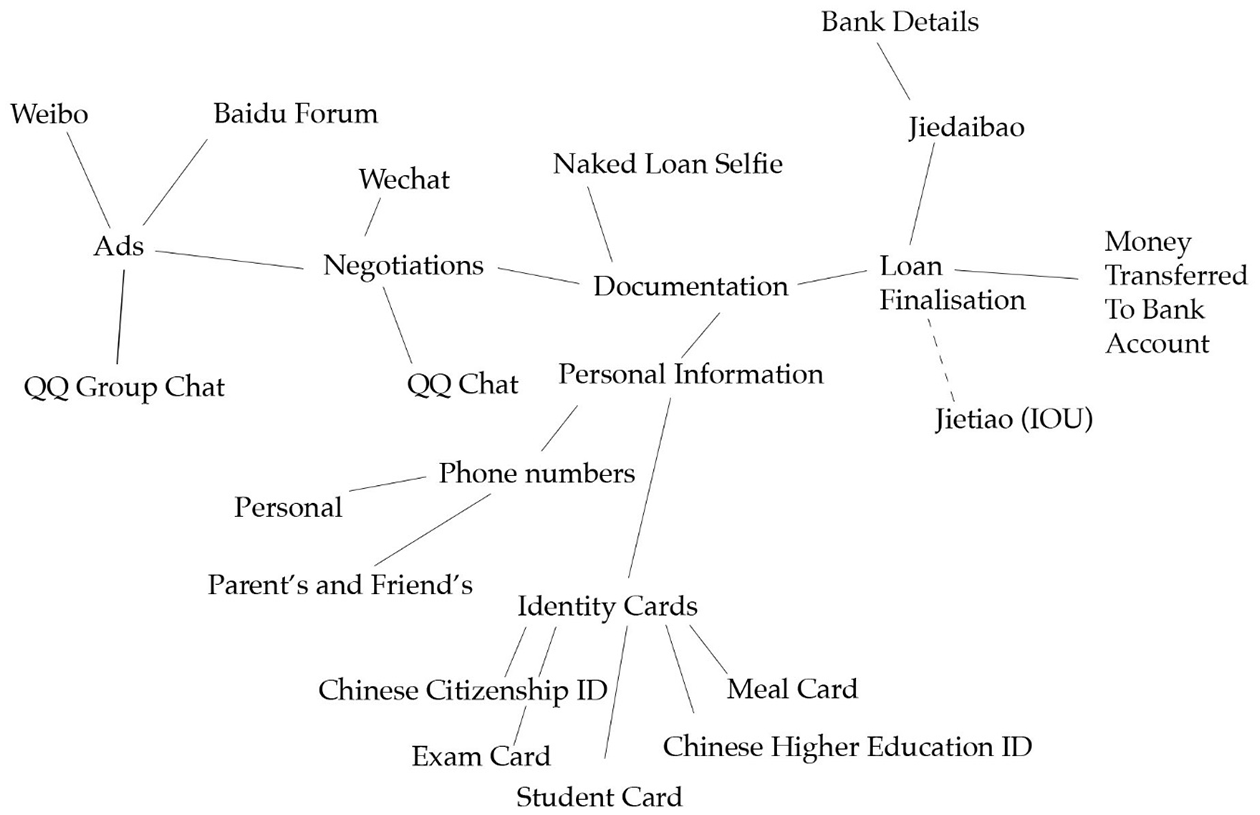
Material network of naked loan as collateral.
Here, a naked loan selfie becomes collateral through its ‘intra-action’ with a range of material bodies and discursive practices (Barad, 2003). To produce it as a loan, it is first embedded in monetary practices such as negotiation and formalisation through the production of legally binding contracts. In this way, the naked loan selfie becomes enacted as a temporal and monetary object, where the dates of repayment and figures (interest rates, loan amount) become enfolded and materialised into the image itself. Second, the image is constituted through practices and materials of identification, practices and materials that are also used by Chinese peer-to-peer loans and other technological banking systems more generally. For example, apps like Alipay (the biggest online payment platform in the world) require users to submit an image/selfie taken, while holding their Chinese Citizenship ID as a form of identity authentication (Alipay, 2017).
These practices deliberately make visible the identity of the woman who is taking out the loan, while the recognisable style and composition of the naked loan selfie makes clear that these women are ‘subjects of debt’, just as the selfies become ‘objects of debt’ (Adkins, 2017). Here, the naked loan selfie becomes enacted as collateral in the sense of promise/evidence/shame. It makes the ties between the loan and the women hypervisible, entangling the borrower with their acts of naked loan borrowing in the form of a materialised ‘promise’. In addition, the nudity of the female body is enacted as ‘financial protection’, for these naked images are mobilised to regain losses/repayment through pressuring the image-takers and their families with the threat of public release.
The becoming of the woman as a subject of debt is accomplished through practices of visibility that collate and record naked bodies, personal information and loans. In this process, the debtor ‘becomes’ a coagulation of information, specifically information that makes her beholden to her debt. It is important to note that this subject of debt is not gender-neutral. The use of the at times gendered language in the advertisements and the demand for images of breasts and occasionally vaginas as ‘evidence’ of bodies that belong to the debtors and that can be used as financial protection, produces the naked loan debtor as a typically female and sexualised subject (Gill, 2003).
The gendered nature of the process is built on the relationship between the female body, sexual imagery, shame, humiliation and victim blaming, which is also mobilised in phenomena such as revenge porn and celebrity image leaks (Bates, 2017; Marwick, 2017). The targeting of a familial rather than public audience for the naked images produces the threat of a particular form of shaming related to parental expectations and the transmission of shame to intimate and loved others. The processes we have described fundamentally challenge the ‘ephemerality’ of the selfie. In ‘intra-acting’ with the debtor, the naked loan participates in the temporality of debt, a temporality that is not short-lived but structured and future oriented. Moreover, this temporality demonstrates the ways in which selfies become an active, material force that holds their subject to past agreements and compels certain actions.
Becoming pornography
In the enactment of the naked loan as collateral, the image is entangled in a particular set of financial practices. In those practices of exchange, the content of the image, that is, the naked body, is not constituted as primarily erotic. However, the images nevertheless possess an erotic potentiality, a capacity to become pornography. This potential becomes manifest when naked loan selfies move outside the debtor/lender contract and become images for sale on cloud services with accessibility to multiple users. In contrast to the storage and security of collateral, naked loan selfies on the cloud are rapidly downloaded and uploaded, bought and sold through group chats, and transmitted onto multiple Tumblr blogs.
The question of what makes an image pornographic is widely debated in the literature. Paasonen et al. (2007) state that an image or video have been considered pornographic if it contains sexually explicit content, a lack of ‘artistic, culture or social values’ (p. 1), and has been made with the intention to sexually arouse their consumers. Others have focused on the transgressive aspect of pornography, arguing that it is a cultural form that contains sex, intends to arouse and has a ‘transgressive relationship to prevailing codes of sexual display’ (McNair, 2013: 18). The naked loan selfie complicates these definitions as its original purpose is not to evoke desire, and its content is not at all explicit by contemporary standards. Nevertheless, it has been commodified as a sexual product through a movement into specific online spaces. In addition, this commodification occurs without the knowledge or consent of the women depicted.
As multiple reports suggest, a ‘yellow industry’ 9 has developed around naked loan selfies (Zhang and Li, 2016). In 2016, advertisements selling these images began to appear regularly in spaces such as QQ group chat (The China Times, 2016; Wang, 2016). These advertisements proclaimed that the images were of ‘real university students who have defaulted on naked loan images’ and highlighted their sexual content (Wang, 2016). The price of the images varied, according to one source they were being sold for around 20RMB (US$2.8) for 64 images (Zhang and Li, 2016). Vendors ranged from naked loan lenders who claimed that the sales were to remedy a financial loss incurred from defaulted loans; individuals who had bought the images from a ‘middle-man’; and those re-selling images purchased for their own consumption (Wang, 2016; Zhang and Li, 2016). Images and image bundles could be purchased directly or through a password granting access to a hosting website like Baidu Cloud. 10 Payment was often through WeChat Pay, a function on the WeChat messenger app (Wang, 2016).
Outside of Chinese apps and social media, we found that websites such as Tumblr and Twitter hosted and presented naked loan selfies as pornographic, that is, for erotic gratification. The images were generally accompanied by denigrating comments such as ‘these girls don’t love themselves’, ‘they gave their identities away for a measly X dollars’, ‘too easy to trick’ and ‘stupid girls’. As with other photo leaks of naked female bodies, the textual comments attached to the image disparaged the women who have chosen to take images of themselves on moral grounds (Marwick, 2017). Such comments enact the leaked image as an acceptable object of erotic consumption for an audience, rather than a form of harm. Such an enactment also has implications for the constitution and representation of women.
We found numerous Twitter posts on naked loan selfies which re-routed individuals to Tumblr blogs containing uncensored naked loan selfies. These were often hosted by ‘Porn’ Tumblr blogs that seemed to be directed towards a Chinese-speaking and most likely Mainland Chinese audience (indicated by the sole use of Simplified Chinese on the blogs). 11 This finding was striking because both Twitter and Tumblr are banned in China. Viewers are often encouraged through text at the top of the blog to add the blogger on WeChat and QQ if they would like to access larger amounts of naked loan images. On these porn blogs, the naked loan selfies sit next to standard pornographic content. The lines between these images and standard pornography were further blurred when we found ‘fake’ naked loan selfies on these sites. These selfies included key visual elements of authentic naked loans such as the centring of an ID card, but in combination with poses that were enthusiastic, sexual and explicit, quite unlike genuine naked loan selfies. It has been reported that fake naked loan selfies are often ‘hidden’ in naked loan selfie bundles (Wang, 2016). Therefore, at the same time as naked loan selfies are enacted as pornography on these sites, pornography is enacted as naked loan selfies. The network of naked loan as pornography is represented in Figure 2.
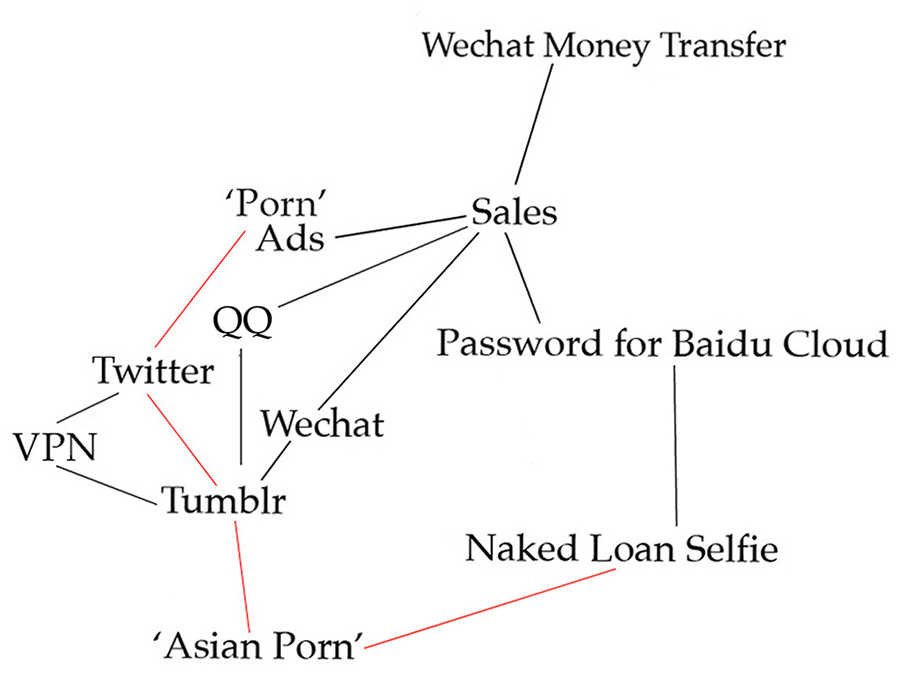
Network of naked loan image as pornography. The red lines suggest where the content is inaccessible from within China without a VPN.
Our investigation revealed that the naked selfie as pornographic commodity becomes a radically different object from the naked loan as collateral. The pornographic image is timeless rather than temporal; circulating ‘as a digital file that has a potentially infinite lifespan’ (Van Loon, 2016: 51) through different spaces where it is repeatedly downloaded, uploaded, purchased and sold. In such a becoming, the loan dates are no longer of any importance.
The becoming of naked loan selfies as pornography (and their difference from naked loan selfies as collateral) is further enacted through practices such as buying and selling, proximity to other pornographic images and the supplementation of the image with sexualised comments. Whereas, naked loan selfies as collateral produce women as subjects of debt, naked loan selfies as pornography constitute women as subjects defined by their sexual availability and their capacity to be bought and sold. Furthermore, the becoming of the image as pornography is facilitated through the use of apps that restrict viewership and access – a process that reifies the image as an object of exchange value in and of itself (rather than an object that ensures interest and repayment). This restriction further operates as a protective measure in an environment where pornographic content is illicit.
The co-ordination and competition of realities
Thus far, we have discussed two different becomings of naked loan selfies and how each is entangled in a set of different practices. However, this is not to suggest that these becomings are separate and unrelated. As Mol (2002) argues, these kinds of complex ontologies are always multiplicities-in-singularity. That is, despite the clear differences of these realities, they are understood and encountered as a singular object. Multiplicities then must also interact and be co-ordinated with one another such that they (for the most part) cohere (Law, 2004). Therefore, we now consider how and to what extent the multiple realities of naked loan selfies are co-ordinated.
While the obvious answer is that the images themselves, through their visual similarities, tie the processes together, we argue there is more at work. Specifically, we found that the co-ordination of naked loan selfies is achieved through deliberate efforts that assert their sameness and enfold the realities within one another. Examples of this can be seen in the practices of the image sellers which deliberately perform ‘naked loan selfie as collateral’ and ‘naked loan selfie as pornography’ as realities that are continuous and singular. Tumblr porn blogs proclaim that the images they display were not manufactured as pornography but are authentic images of ‘real university women’ engaged in ‘real naked loan practice’. The images as collateral, and the images as pornographic are co-ordinated because unmediated access to ‘real’ women and ‘authentic’ female bodies is a key selling point that distinguishes these products from other erotic representations. The circulation of fake naked loan selfies which mimic ‘real’ ones further demonstrates this co-ordination. In this sense, naked loan selfies can be located within the rise and popularity of amateur pornography and the broader cultural fascination with ‘reality’ (Wosick, 2015).
At times however, the multiple realities do not cohere, but rather compete with each other. In the space of this article, we have not been able to explore the ‘becoming illegal’ of the naked loan selfie, but regulatory responses by the Chinese government from 2016 onwards made naked loan content increasingly difficult to find (Wang, 2016) and there were noticeable restrictions to access during the course of our research in 2017. Whereas, the ‘naked loan selfie as illegal’ aims to make the image invisible, inaccessible, immobile and absent; collateral and loan practices rely on the production, visibility and mobility of the image to thrive. In the local context of Chinese cyberspace, these different realities struggle to coexist.
However, the assemblage can shift such that new realities are formed. While government regulations reduced the accessibility of naked loan selfies in Chinese cyberspace, they remained easy to access on non-Chinese social media spaces. Here, the competition of realities results in spatial shifts that move the naked loan image outside of the locality in which they are deemed illegal. The use of VPNs, a software that alters the IP address of the user is crucial in this practice. Here, the VPN enacts the user as no longer in China. Instead, it enables a ‘foreign’ online identity to be performed, allowing the images to flow past blocks and onto websites such as Twitter. Careful choreographies of movement enable naked loan selfies as pornography (on non-Chinese websites) and the prohibition of naked loan selfies as pornography (in China) to coexist and cohere without contradiction.
Conclusion
This article has explored naked loan selfies from an STS and new materialist perspective. Through text-based research and online walkthroughs, we found that naked loan selfies are not just nude selfies used to take out loans, or selfies that are used to extort young women to return their debt, or pornography. Rather, they occupy these, and other multiple identities, simultaneously. Our research has a number of limitations. As noted in the ‘Methods’ section, investigation of this topic involved ethical and logistical challenges related to the illicit and sensitive nature of the practice. While interviews with naked loan debtors and/or participant observation would have added another dimension to our findings, these were not possible within the scope of our study, especially given the social and political environment of the People’s Republic of China. In addition, as in all research on digital practices, our study was carried out in a rapidly changing techno-social landscape. Over the duration of our study, increased government scrutiny of naked loan practices meant that images, posts and links were deleted, and related search terms were restricted. In 2017, the Chinese government issued a mandate prohibiting lending to users below 23 years on the popular P2P loaning systems (Dong, 2017).
In addition, Tumblr banned all adult images and videos in 2018 (Hern, 2019). This significantly reduced naked loan content on this site, although at the time of writing, Twitter continues to host posts that openly buy and sell naked loan images. The instability of platforms such as Tumblr reinforces the importance of paying attention to digital and technological networks in selfie research.
As well as examining naked loan selfies, the article contributes to the growing research on selfies as networked, lively, agentic and material. Images such as selfies are relationally constituted through and against other material elements in their networks. Therefore, materialist and ontological approaches are well-suited to investigating the movement of such images through online spaces and their enactment in multiple forms.
While naked loan selfies may appear to be a niche topic within selfie research, our view is that examination of such specific, local and non-Western-centric practices is vital to understanding the diversity and multiplicity of selfie practices and forms. Along with other research which focuses on specific selfie practices, our analysis demonstrates the limitations of general debates about whether these images are empowering or oppressive. In recognising the ontological instability of things and the differential becomings and multiplicities of selfies, the question ‘what is a selfie?’ no longer satisfies. Instead, in thinking about the relational and complex choreographies of selfies, we can instead ask ‘what can the selfie do?’ in its specific locations.
Footnotes
Acknowledgements
The authors are grateful to Dr Jenny Davis and Dr Matthew Wade for their comments on early versions of this work. They would also like to thank the anonymous reviewers for their valuable feedback.
Funding
The author(s) received no financial support for the research, authorship, and/or publication of this article.
