







Abstract
The success of the public display of restaurant hygiene scores has encouraged online review sites to display these scores digitally on their platforms. By investigating 225,252 Yelp reviews toward 1,937 restaurants in Charlotte, North Carolina, we find that while displaying hygiene scores digitally can inform consumers in a way that reduces bias in reviews, it paradoxically can also promote the creation of more reviews that are biased, something we call the cognitive–discursive dilemma. Specifically, after the digital display on Yelp, reviews mentioning hygiene were more in line with scores, indicating an improvement in “accuracy” across reviews in general. Yet, the digital display also led to greater attention to hygiene, leading to lower scores for restaurants of lower social status as measured by price and cuisine type. Our findings thus call for more attention to a broader theoretical implication about the provision of “accurate information” on review sites.
Hygiene is an important standard in a food and dining context. The display of hygiene scores is an effective way to advocate transparency, foster public health, and support consumer choices (Fleetwood, 2019). Specifically, a restaurant’s hygiene score is a concise way to disclose its recent hygiene condition as determined by inspections by local authorities. This transparency in restaurants was found to effectively reduce foodborne-disease hospitalizations (Simon et al., 2005). In addition, hygiene scores also help consumers make better choices because hygiene is one of their considerations when choosing restaurants (Cullen, 2005). Given these clear benefits to publicizing official hygiene ratings, Yelp, a popular crowdsourced review site, has started to display restaurants’ hygiene scores digitally on its platform in a growing number of cities.
Thus, it would appear that displaying hygiene scores more prominently, particularly on platforms, such as Yelp, would be a straightforward, positive development. Yet, like other communication between platforms and users, the digital display of hygiene scores on review sites does more than extend hygiene displays from offline (on doors) to online. Similar to purchasing behaviors in online markets, reviews are vulnerable to social influence bias (Askalidis et al., 2017). Specifically, previous consumer behaviors including reviews and purchase history influence other people’s consumption decisions and their construction of merchants’ reputation (Salganik et al., 2006). That is, because review sites, such as Yelp, are not just for displaying information like traditional “yellow pages,” but also encourage their users to contribute information (i.e. reviews), the presentation of new information has to take into account both its tendency to inform consumption decisions—where users choose to eat—and its tendency to promote further discussion.
Can the presentation of accurate (hygiene) information nonetheless distort the larger online conversation? We argue that it can. One possible mechanism is through making a characteristic for which people tend to hold biases more salient and thus seemingly important to discuss. Specifically, while hygiene practices are often based on objective standards, people’s perceptions of hygiene vary by cultural and social norms (Ahmed, 2000; Lehman et al., 2014). For instance, people have higher tolerance of unhygienic conditions toward authentic ethnic restaurants (Lehman et al., 2014), but they associate dirtiness with lower-status groups (Reich, 2016; Vargas, 2021). This suggests that when prompted to discuss restaurant hygiene, many people may draw on these biases.
These dynamics suggest the possibility of a two-pronged effect of publishing information on a topic. On one hand, publishing (ostensibly) more accurate information makes users more accurate in their reviews. Specific to the reviews of restaurants, with the salient digital display of hygiene scores, consumers’ reviews may become more objective. That is, rather than guessing about the cleanliness of a restaurant based on personal experience, they consult the result of a more rigorous process (inspections done by health departments). However, on the other hand, it encourages people to talk more about a subject where they are likely to be biased and inaccurate. Thus, it is not clear the extent to which the overall effect is positive. For example, the digital display of hygiene scores may trigger and amplify the biases people have toward lower-price restaurants and restaurants serving lower-status cuisines (Kovács and Horwitz, 2018; Lehman et al., 2014). Therefore, by calling attention to hygiene as “something to comment on” or “something to think about,” the digital display may also lead to consumers’ heightened scrutiny of hygiene toward certain restaurants. This can be particularly problematic even if the effect of display on one review is small because reviews mentioning negative hygiene may accumulate strong impacts that further hurt restaurants owned by historically marginalized groups which are already found to struggle in review sites (Kovács and Horwitz, 2018; Yu and Margolin, 2021b).
We describe this phenomenon as a cognitive–discursive dilemma. The principle is that the display of information can have a beneficial cognitive effect (improving people’s understanding) but a detrimental discursive by encouraging them to talk about something where, though they are less inaccurate than they were before the information display, they are likely to be biased. Thus, similar to the problems of inference due to selection effects, the average message becomes less biased, but the quantity of biased messages increases. For example, in online political discussions, corrections of misinformation can also shift the agenda to topics where misinformation is rife.
Online review sites and hygiene scores provide a useful context for studying this cognitive–discursive dilemma because of the unique structure of the data. Online review sites include data about entities that are independently rated by the government (in this case, for hygiene). Furthermore, each review carries a “user rating” that has a direct (if small) commercial impact (Luca, 2011; Margolin and Markowitz, 2018). This enables observation of “winners” and “losers” of a policy and the comparison of these outcomes to their “true” merits (hygiene).
To explore this effect from digital hygiene display on reviewing behaviors, we analyze Yelp restaurant reviews in Charlotte, North Carolina. Yelp is one of the most popular crowdsourced review sites in the United States, especially for restaurant reviews. Restaurants in Charlotte are regularly inspected by the Health Department in Mecklenburg County, and Yelp started to display the health scores from May 2017. Different from other online platforms, such as TripAdvisor and Airbnb, which display hygiene ratings crowdsourced from their users’ subjective evaluations, hygiene scores of restaurants on Yelp are directly collected from local health departments. Although Yelp only displays the most recent hygiene scores on a restaurant’s landing page, all of the restaurant’s previous hygiene scores are available on the platform as well (at least in the case of Charlotte). This allows us to study people’s reviewing behaviors before and after the digital display of hygiene scores on Yelp.
We focus on the Yelp restaurant reviews in two aspects: (1) the expression of negative hygiene words (analyses of positive hygiene words are also included in Table S1 and Figure S1 in the supplementary materials) and (2) review rating. The expression of negative hygiene words is a direct signal of people’s concern about a restaurant’s hygiene condition. As reviews are publicly displayed to all users, those containing more negative hygiene words are likely to have long-term negative effects on the restaurants they evaluate. Similarly, people’s concern about hygiene may also be reflected in their overall “star ratings” of a restaurant (Kovács et al., 2013; Luca, 2011). Thus, the expression of negative hygiene words and review ratings are two direct ways to measure the effect of the digital hygiene display.
In the following sections, we first discuss how restaurants’ hygiene scores, as assigned by the health department, may influence people’s expression of negative hygiene words and review ratings. We also describe how such influence may vary by restaurants’ economic and cuisine status. We then discuss how the display of these hygiene scores on Yelp may increase users’ scrutiny of hygiene which influences people’s expression of hygiene words and review ratings. Finally, we explore how the digital display of hygiene scores would further complicate the abovementioned relationships with restaurants of different economic and cuisine status.
The importance of hygiene score display in restaurants
Hygiene is an important practice to avoid contamination, infections, and diseases (Curtis, 2007). In the restaurant industry, hygiene is quantified into scores/grades by local health departments through inspections. Restaurants’ hygiene scores in the United States date back to 1934 when the first “restaurant sanitation program” was created by the US Food and Drug Administration (FDA) and the US Public Health Service (Fuchs, 1942). While hygiene inspections are not required by federal laws, restaurants in many states are now required to display their inspection results (i.e. hygiene scores) to the public.
The public display of hygiene scores, typically through posting on the door or the front window of the establishment, is a public policy success. Restaurants’ hygiene score displays are found to effectively reduce foodborne illness (Jin and Leslie, 2003). This is because outbreaks of food illness are often caused by inappropriate hygiene practices, and regular inspections on restaurants help prevent such bad practices (Greig et al., 2007). In addition, the hygiene display also has reputational incentive for restaurants with good hygiene scores to keep up the good performance (Jin and Leslie, 2009). Similarly, restaurants with poor hygiene scores may feel embarrassed and thus make positive changes (Fleetwood, 2019).
Importantly, the display of hygiene scores is widely supported by consumers. With the hygiene display, consumers feel more confident when making consumption decisions because the hygiene inspections disclose more back-stage information that is otherwise not easily observable (Worsfold and Worsfold, 2008). Indeed, consumers are more likely to become regulars to cleaner restaurants (Lee et al., 2012). In short, whether hygiene scores are posted or not, consumers generally care about hygiene. In addition, reviewers are also likely to factor restaurants’ hygiene into their overall evaluations (Lehman et al., 2014; Liu and Lee, 2018). Therefore, we predict the following:
Hypothesis 1 (H1). Reviewers are more likely to express negative hygiene words in reviews toward restaurants with poorer hygiene scores.
Hypothesis 2 (H2). Reviewers give lower star ratings toward restaurants with poorer hygiene scores.
Subjective perceptions of hygiene
While hygiene practices as a set of standards of avoiding dirt, diseases and infections have its root in microbiology, the evaluation or assessment of hygiene is embedded in social environment (Curtis, 2007). Hygiene evaluation is subjective because “there is no such thing as absolute dirt: it exists in the eye of the beholder” (Douglas, 2003: 2). More specifically, expressions of cleanliness and dirtiness indicate a conceptual understanding of social order and group boundaries (Ahmed, 2000; Douglas, 2003). That is, the designation of “cleanliness” is often associated with objects or individuals that are familiar to the evaluator, whereas the labeling of “dirtiness” is used to distant an object or individual from the evaluator (Ger and Yenicioglu, 2004). Thus, people are likely to scrutinize hygiene when evaluating restaurants with lower status symbols because of their tendency to distinguish themselves from lower-status groups as an attempt to display status (Veblen, 1899).
One particular marker of status is wealth. People purchase expensive products to convey desirable identities to others (Belk, 1988; Veblen, 1899). People also tend to visit and review restaurants strategically as a way of seeking and displaying status (Kovács and Horwitz, 2018; Yu and Margolin, 2021b). Thus, people may have different perceptions of hygiene depending on products’ different status. Indeed, studies show that people tend to view grocery stores in poorer neighborhoods as dirtier than those in wealthier neighborhoods even though the stores operate under the same standards (Reich, 2016; Vargas, 2021).
Status is also implicit in the food and dining context. Within particular cultures, there are many cuisines for which there is an implicit consensus regarding high or low status (Ray, 2016). For instance, in the United States, consumers view Chinese food as lower status but consider French cuisine as higher status (Kovács and Horwitz, 2018). These biases toward cuisines may influence how people talk about hygiene. For example, a study found that reviewers tend to make suggestive comments about perceived dirt and disorder toward Black-identified restaurants (Zukin et al., 2017). These negative comments may also reflect in the overall ratings, so that, we predict the following:
Hypothesis 3 (H3). Reviewers are more likely to express negative hygiene words in reviews toward restaurants (a) with lower price levels and (b) serving lower-status cuisines, controlling for restaurants’ hygiene scores.
Hypothesis 4 (H4). Reviewers give lower star ratings toward restaurants (a) with lower price levels and (b) serving lower-status cuisines, controlling for restaurants’ hygiene scores.
Digital display of hygiene scores
When Yelp, or another review site, posts health department hygiene scores on a restaurant’s page, this is a “digital display” of the restaurant’s hygiene score. Importantly, this digital display has two impacts. First, it disseminates information. By posting the score, this information is more accessible. Second, it highlights this information as a relevant criterion for evaluation and discussion of a restaurant.
Restaurant hygiene scores are already publicly available on health department websites; however, these can be hard to find. In fact, not many consumers are aware of the scores being available on those websites and rarely check them (Worsfold, 2006). Even though people can visit a restaurant to see its hygiene score, this requires them to have already chosen at least a location for dining, limiting their options (Yu and Margolin, 2021a). One of the benefits of Yelp and other review sites is the ability to inform decision-making before individuals incur the sunk cost of going to a particular restaurant to gather information about it.
Thanks to the growing user base and better user-friendliness of online review sites, such as Yelp, the digital display of hygiene scores on those platforms is a huge improvement in information salience and convenience. To some extent, the digital display of hygiene scores is similar to food nutrition labeling that informs consumers at their point-of-purchase (Fleetwood, 2019), and such labeling has been found to influence people’s consumption behaviors (Farronato and Zervas, 2022; Temple et al., 2011). Indeed, recent studies show that the digital display of hygiene scores is an improvement of the offline display in many aspects (Dai and Luca, 2020; Fleetwood, 2019; Makofske, 2020).
Beyond providing information, the digital display of hygiene scores also sends a social signal about the relevance of hygiene when evaluating a restaurant. This is closely related to previous studies in behavioral science that show information salience influences consumer responses (Hastings and Weinstein, 2008; Metzger et al., 2010; Pope, 2009). Specifically, Dai and Luca (2020) show that consumers pay attention to the hygiene scores displayed on Yelp and the digital display influences consumers’ purchase and review intentions.
Importantly, digital displays can influence reviews even if they have no direct impact on reviewers’ experiences at the restaurant itself. The digital display may simply encourage reviewers to remember hygiene-related details after the fact, as reviews are often written away from the restaurant location, but, by definition, are always written in interaction with the platform. Thus, we predict that the digital hygiene display should also increase reviewers’ scrutiny of restaurant hygiene, influencing their reviewing behaviors as predicted below:
Hypothesis 5 (H5). With the digital display of hygiene scores, people become more likely to express negative hygiene words in reviews toward restaurants.
Hypothesis 6 (H6). With the digital display of hygiene scores, people give lower star ratings toward restaurants.
Varying impacts of digital hygiene display
Previous studies show that when showed more information, people tend to make more objective evaluations and rational decisions (Linville and Jones, 1980). Thus, it is possible that with the increased salience of hygiene scores, people may become less biased in their hygiene evaluations when reviewing restaurants. However, the digital display of hygiene scores may also lead to unequal impacts toward restaurants depending on their economic and cuisine status.
First, talking about hygiene itself is bad even if the hygiene is good because the topic of hygiene is a marker of status. People may not be primed to talk about hygiene when they review high-end restaurants because they take their good hygiene for granted. However, they may be prompted to think about and talk about hygiene when visiting lower-end restaurants because it is considered as a talking point (Zukin et al., 2017). In other words, while the digital hygiene display is equal to every restaurant, lower-status restaurants may suffer from heightened scrutiny of hygiene, which is unfair and stereotypical to those restaurants.
Second, people’s hygiene biases toward lower-end restaurants may be amplified due to social influences on review sites. Consumers’ reviewing behaviors are not only influenced by their own opinions but also vulnerable to social influences, such as others’ reviews and purchase records (Askalidis et al., 2017). In other words, reviews not only signal consumer choices and evaluations but also signal others for how to think about their own choices and evaluations. For instance, hygiene-related reviews are found to be supplementary cues of restaurants’ sanitary conditions (Kang et al., 2013). Thus, reviews that talk about the hygiene of a particular restaurant on Yelp may encourage others to talk about hygiene for that restaurant, too, amplifying the production of biased messages. That is, although users may be less biased than they would have been before seeing the digitally displayed hygiene score, seeing a signal that hygiene is a good topic for discussion in relation to this restaurant can trigger them to say something they would not have said, which carries their (potentially substantial) “remaining” bias. To explore the impact of digital hygiene display on people’s expression of hygiene and rating, we ask the following:
Research Question 1 (RQ1). How does the influence of digital hygiene display on negative hygiene expression differ by restaurants (a) with lower price levels and (b) serving lower-status cuisines?
Research Question 2 (RQ2). How does the influence of digital hygiene display on ratings differ by restaurants (a) with lower price levels and (b) serving lower-status cuisines?
Method
Our Yelp restaurant review data came from the 2020 Yelp Open Dataset. While the dataset contained several cities in the United States and Canada, Charlotte in North Carolina was the only city among those where restaurants’ hygiene scores were displayed on Yelp. However, the dataset itself did not include restaurants’ hygiene information, so that, we scraped the hygiene scores from Yelp. We also compared the restaurants’ previous hygiene scores on Yelp with their hygiene inspection records available on the local health department website, 1 and we found the hygiene scores from the two sources were identical. In the dataset for analysis, there are 225,252 reviews toward 1,937 restaurants from 17 June 2005 to 13 December 2019.
Measurement
Hygiene scores
The hygiene scores on Yelp for restaurants in Charlotte came from the Health Department in Mecklenburg County in North Carolina. Depending on restaurants’ menu items and food processes, their hygiene can be inspected one to four times a year. During an inspection, a restaurant inspector checks a restaurant’s compliance status in various aspects, such as employee health, food temperature control and proper use of utensils. After an inspection, a restaurant will receive a hygiene score ranging from 0 to 100. A restaurant’s permits are immediately revoked if its hygiene score is below 70. In our dataset, the average hygiene score received by restaurants is 95.72 (SD = 2.23).
Digital hygiene display
Yelp did not have an official announcement about the exact date that it started to display hygiene scores for restaurants in Charlotte, but according to The Charlotte Observer, a local newspaper, Yelp rolled out this new feature in early May 2017. 2 We thus treated 15 May 2017 as the approximate date when the digital hygiene display was introduced to Yelp in Charlotte. There are 105,721 reviews (46.93%) posted after the digital display. We have also done robustness checks by moving the digital display date five days before (10 May 2017) and after (20 May 2017), but the results do not change substantially, and our conclusions still hold (see Tables S2 and S3, and Figures S2–S5 in the supplementary materials for more details).
Reviews mentioning negative hygiene
Following the method from a previous study (Lehman et al., 2014), we made a custom dictionary of negative hygiene words which consists of 69 synonyms for “dirty” and “unhygienic” (see the dictionary items in the supplementary materials for more details). We then imported this custom dictionary of hygiene-related keywords to the Linguistic Inquiry and Word Count 2015 (LIWC) software to detect whether a review contains words in the dictionary. This type of keyword extraction method is especially reliable and accurate for detecting hygiene-related reviews (Schomberg et al., 2016). There are 9,746 out of 225,252 reviews contain negative hygiene words, 4,445 (45.61%) of which are posted after the digital display (see Table S4 in the supplementary materials for a more detailed breakdown of the reviews toward restaurants of different categories).
Star rating
Reviewers on Yelp give an overall evaluation of a restaurant by giving 1–5 stars (the more the better). The average star rating in our dataset is 3.71 (SD = 1.39).
Price level
Restaurants on Yelp are categorized by dollar signs ($) ranging from $ to $$$$ as an indicator of their price levels (the more dollar signs the more expensive). Since there are only seven out of 1,937 restaurants (0.36%) with four-dollar signs, we grouped them with three-dollar-sign restaurants (N = 54) to create a total of three levels of price.
Cuisine status
Each restaurant serves one or more types of cuisines (e.g. French, Chinese) which are clearly indicated on its Yelp landing page. People have different perceptions of status toward different cuisines (Ray, 2016), and we used a pre-existing scale of cuisine status from Kovács and Horwitz (2018). The scale is generated by having participants compare random pairs of cuisine types on Yelp in a crowdsourced Wiki survey (Salganik and Levy, 2015) implemented in the “All Our Ideas” framework. The status scale ranges from 0 to 100 (higher scores means higher status; see Kovács and Horwitz, 2018 for more details). We then calculated each restaurant’s cuisine status by the average cuisine status scores it serves (M = 41.81, SD = 13.55). The status scores are centered in our models for clearer interpretation.
Control variables
We included three control variables in our analyses. We included the cumulative number of restaurant reviews by the time a consumer posted a review (M = 182.07, SD = 247.65) because a restaurant’s review count is an indicator of its online reputation which may influence consumers’ reviewing behaviors (Abrahao et al., 2017). We also controlled for reviews’ word counts (M = 102.64, SD = 92.37) because hygiene is more likely to be mentioned by probability in longer reviews. Both the review count and word count are log transformed because they are highly skewed. Finally, we also controlled for reviewers’ Yelp elite status when they wrote the reviews (N = 40,457). The “elite squad” is Yelp’s own program for curating and promoting its influencers. Users’ Yelp elite memberships are evaluated annually. We controlled the Yelp elite status because those with the status are more influential and more subject to the motivation of status seeking (Yu and Margolin, 2021b).
Analytical procedures
Mixed-effects regression models
Since reviews are clustered by restaurants, we included a random effect of restaurants in the model along with the fixed effect of the independent variables and control variables listed in the measurement section. There are two dependent variables in our hypotheses and research questions: (1) whether a review mentions negative hygiene words and (2) star rating. Thus, we used mixed-effects logistic regression model for the first dependent variable, and mixed-effects linear regression model for the second dependent variable. An R package, lmerTest, was used for these analyses.
Results
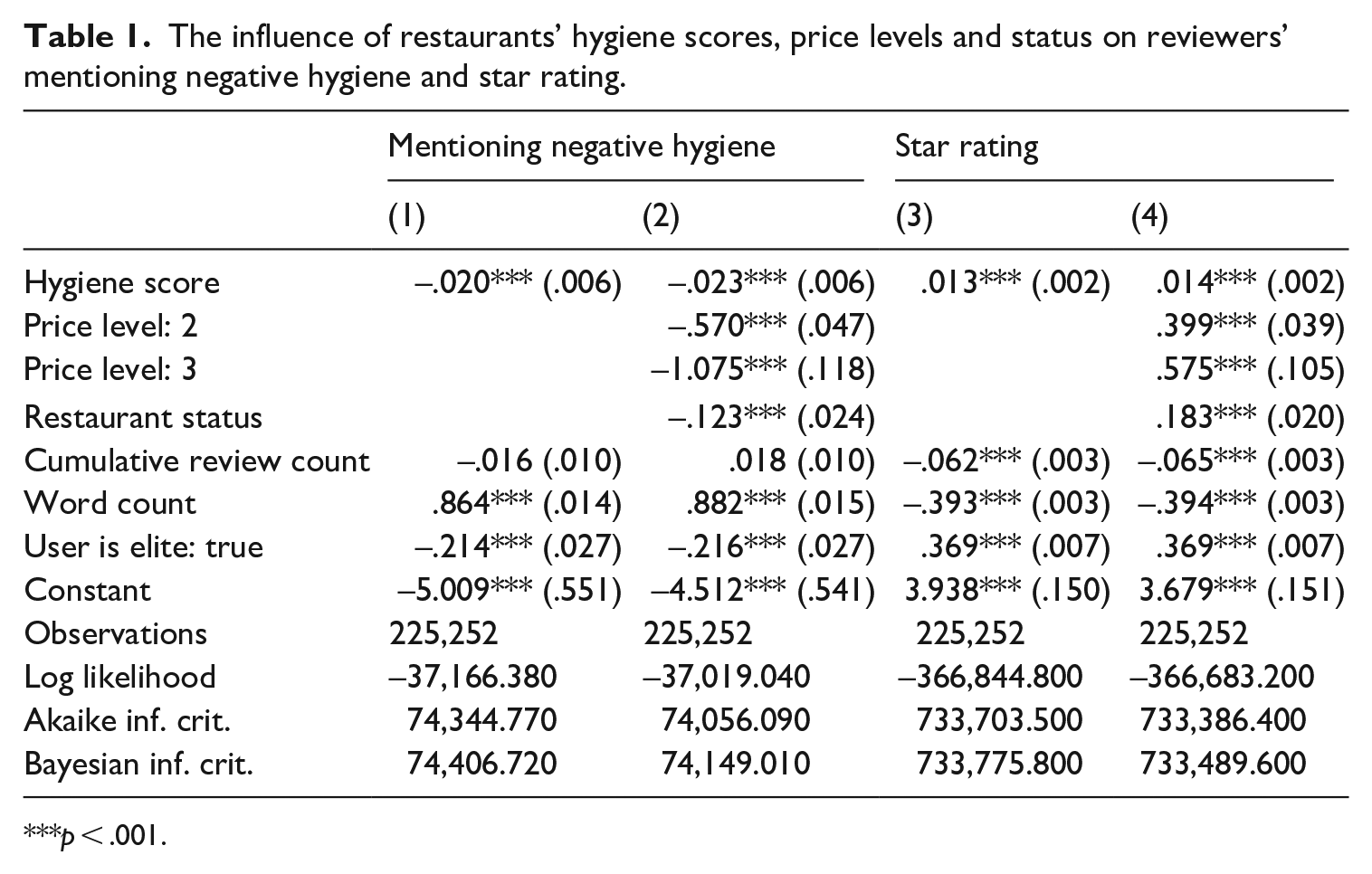
Our first two hypotheses predict that reviewers are more likely to express negative hygiene words (H1) and give lower star ratings (H2) toward restaurants with poorer hygiene scores as determined by the local health department. Model 1 in Table 1 shows that higher hygiene scores are associated with lower probability of mentioning negative hygiene words in reviews (B = –0.020, SE = 0.006, p < .001); Model 3 shows that higher hygiene scores are associated with higher star ratings (B = 0.013, SE = 0.002, p < .001). Therefore, both H1 and H2 are supported.
The influence of restaurants’ hygiene scores, price levels and status on reviewers’ mentioning negative hygiene and star rating.
p < .001.
The next two hypotheses postulate that reviewers are more likely to express negative hygiene words in reviews (H3) and give lower star ratings (H4) toward restaurants (a) with lower price levels and (b) serving lower-status cuisines. Model 2 in Table 1 shows that compared with restaurants from price level 1, those from price level 2 (B = –0.570, SE = 0.047, p < .001) and price level 3 (B = –1.075, SE = 0.118, p < .001) are less likely to receive reviews mentioning negative hygiene words. Restaurants serving higher-status cuisines are less likely to receive those types of reviews (B = –0.123, SE = 0.024, p < .001) than those serving lower-status cuisines. These results provide strong support for H3.
Similarly, Model 4 in Table 1 shows that compared with restaurants from price level 1, those from price level 2 (B = 0.399, SE = 0.039, p < .001) and price level 3 (B = 0.575, SE = 0.105, p < .001) receive higher star ratings. Restaurants serving higher-status cuisines receive higher star ratings (B = 0.183, SE = 0.02, p < .001) than those serving lower-status cuisines. Thus, H4 is also supported.
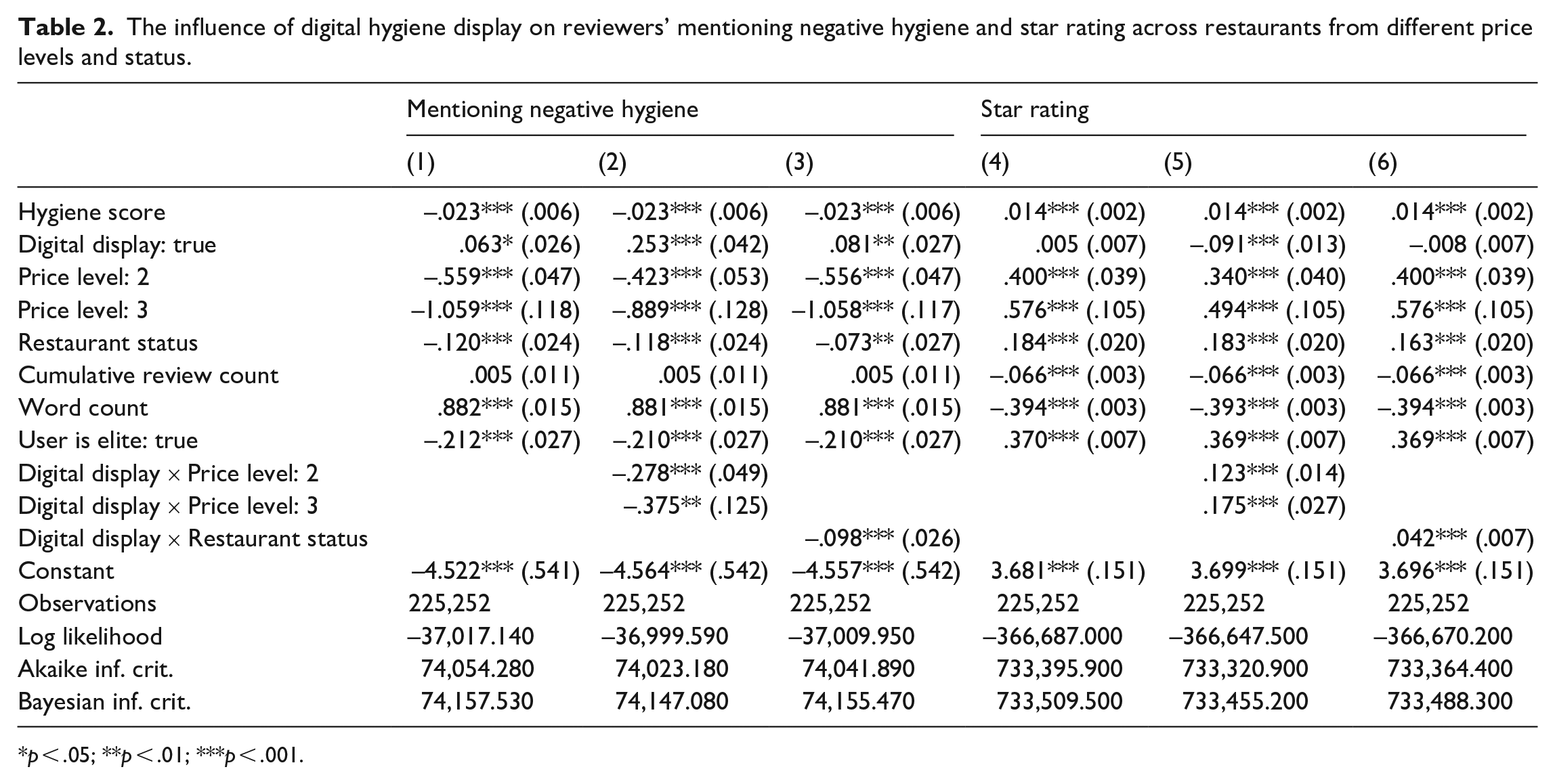
We also predict that the digital display of hygiene scores will further increase reviewers’ likelihood of negative hygiene expression (H5) and lower their review ratings (H6). Model 1 in Table 2 shows that with the digital display, reviewers are more likely to talk about negative hygiene words (B = 0.063, SE = 0.026, p < .05), but Model 4 shows that their star ratings are not influenced by the digital hygiene display hygiene (B = 0.005, SE = 0.007, p = .482). Therefore, H5 is supported, but H6 is not supported.
The influence of digital hygiene display on reviewers’ mentioning negative hygiene and star rating across restaurants from different price levels and status.
p < .05; **p < .01; ***p < .001.
Finally, our two research questions ask about the influence of digital hygiene display on negative hygiene expression (RQ1) and star rating (RQ2) across restaurants (a) with different price levels and (b) serving cuisines of different status. According to Model 2 in Table 2, there are significant interaction effects between hygiene scores being digitally displayed and price level 2 (B = –0.278, SE = 0.049, p < .001) as well as price level 3 (B = –0.375, SE = 0.125, p < .001). To better interpret the interactions, we calculated the odds ratio (OR) of negative hygiene expression between when the hygiene scores are digitally display and when they are not. Specifically, for price-level-1 restaurants, the digital display increased the odds of negative hygiene expression (OR = 1.288, SE = 0.054, p < .001), but the digital display did not have significant impact on restaurants from price level 2 (OR = 0.976, SE = 0.031, p = .439) or price level 3 (OR = 0.885, SE = 0.106, p = .306) in terms of the odds of negative hygiene expression.
Results of Model 3 in Table 2 indicate that there is significant interaction effect between hygiene scores being digitally displayed and restaurant status (B = –0.098, SE = 0.026, p < .001). More specifically, the influence of digital display on the negative hygiene expression increased as the cuisine status decreased, with high-status (one unit above the average) restaurants experiencing no significant change (OR = 0.983, SE = 0.034, p = .611), average status restaurants experiencing a small change (OR = 1.084, SE = 0.029, p < .01) and low-status (one unit below the average) restaurants experiencing a greater change (OR = 1.195, SE = 0.048, p < .001). In summary, after the digital hygiene display, reviewers are more likely to talk about negative hygiene when reviewing restaurants from lower price levels and lower cuisine status. See Figure 1 for a visual illustration.
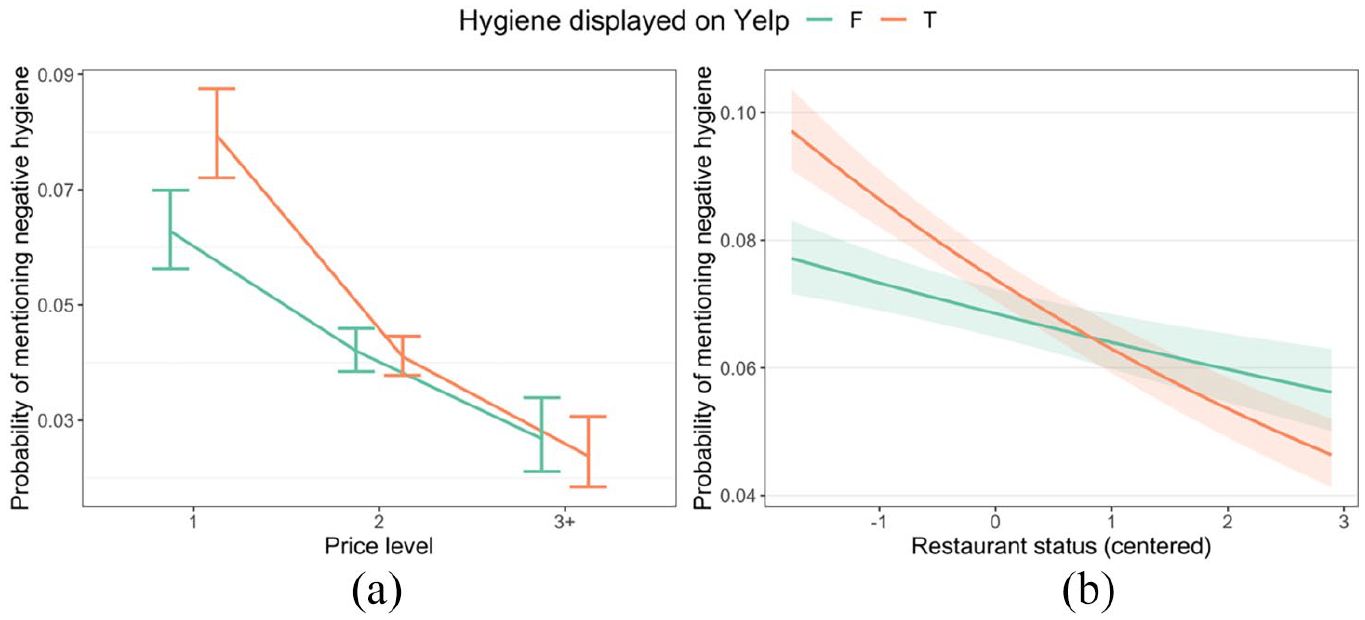
Reviews mentioning negative hygiene broken down by restaurants’ economic and cuisine status. The y-axis reports the probability of mentioning negative hygiene in reviews. The x-axis is restaurants’ (a) economic status/price and (b) cuisine status. The colors represent if the reviews are posted when the hygiene scores are displayed on Yelp. In general, people are more likely to talk about negative hygiene when reviewing restaurants from lower economic and cuisine status. Such tendency is more salient when the hygiene scores are displayed on Yelp.
Model 5 in Table 2 shows that there are significant interaction effects between digital hygiene display and price levels (price level 2 × digital display: B = 0.123, SE = 0.014, p < .001; price level 3 × digital display: B = 0.175, SE = 0.027, p < .001). We did pairwise comparisons to better understand the interactions. Specifically, the digital display decreased the average ratings by 0.091 for price-level-1 restaurants (SE = 0.013, p < .001), but increased the average ratings by 0.033 (SE = 0.008, p < .001) and 0.084 (SE = 0.025, p < .001) for price-level-2 restaurants and price-level-3 restaurants, respectively.
Model 6 similarly shows that there is a significant interaction effect between digital hygiene display and restaurant status on restaurant rating (B = 0.042, SE = 0.007, p < .001). Specifically, consistent with the findings above for price levels, the digital display increased the average ratings for higher-status restaurants (one unit above the average cuisine status) by 0.034 (SE = 0.008, p < .001), but decreased the average ratings for lower-status restaurants (one unit below the average cuisine status) by 0.050 (SE = 0.011, p < .001). In short, after the digital display of hygiene scores, reviewers give lower ratings toward restaurants from lower price levels and lower cuisine status. See Figure 2 for a visual illustration.
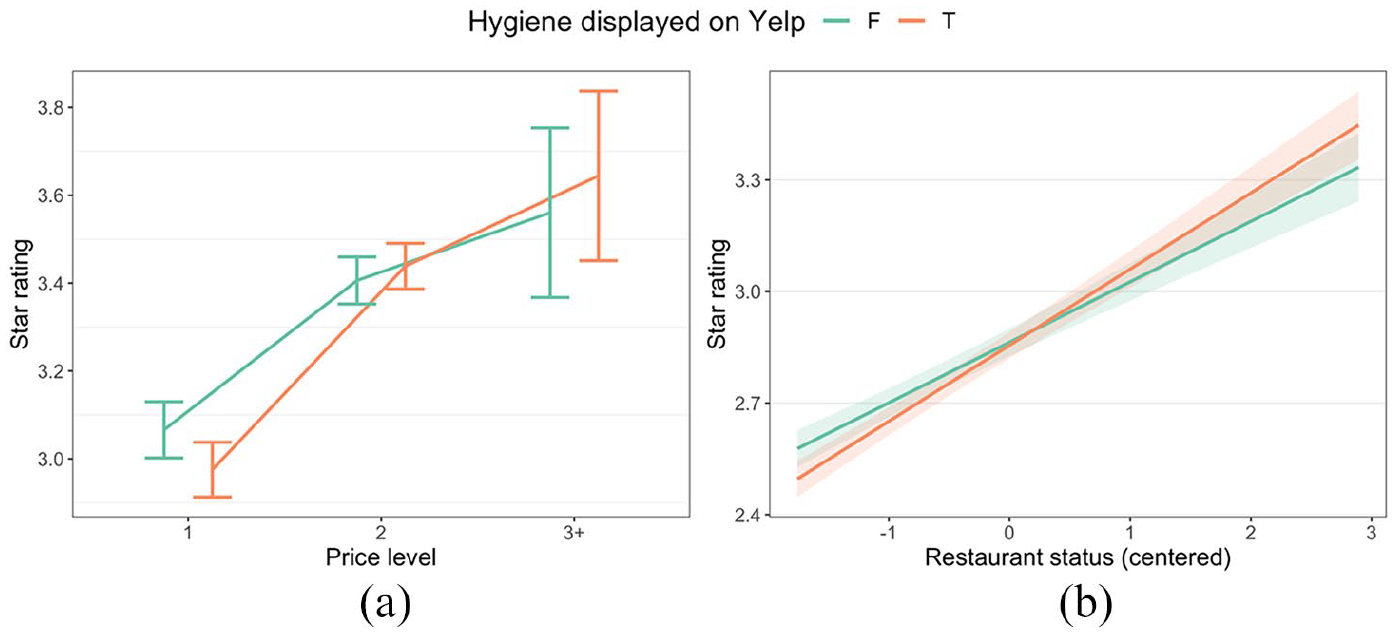
Star ratings broken down by restaurants’ economic and cuisine status. The y-axis reports the star ratings toward restaurants. The x-axis is restaurants’ (a) economic status/price and (b) cuisine status. The colors represent if the reviews are posted when the hygiene scores are displayed on Yelp. In general, people give lower ratings toward restaurants from lower economic and cuisine status. Such tendency is more salient when the hygiene scores are displayed on Yelp.
Post hoc analysis
The previous results demonstrate that the digital display of hygiene scores further increase reviewers’ likelihood of talking about negative hygiene in reviews especially toward restaurants with lower price levels and cuisine status. We also discussed previously that online reviews signal others to think about their own choices and evaluations. Therefore, while the impact of one review that mentions negative hygiene is limited, it may influence future reviews, leading to substantial consequences in aggregate.
By default, reviews on Yelp are displayed based on an undisclosed algorithm that includes several factors, such as a user’s prior behavior and review quality. 3 Thus, it is challenging to operationalize the exact scenario each reviewer saw when they posted their reviews. One approximate way to measure prior reviews’ influence is by time and proportion: There is certain probability that a prior review is read by future consumers. To explore this question, we computed the percentage of previous reviews containing negative hygiene words by the time a consumer posted a review (M = 0.044, SD = 0.053). We then added this new variable to our mixed-effects models.
Table 3 presents the results for the post hoc analysis. Model 1 shows that more previous reviews mentioning negative hygiene further encouraged reviewers to behave the same way (B = 1.238, SE = 0.170, p < .001). Model 2 shows that such previous reviews also make future reviewers give lower star ratings (B = –0.562, SE = 0.072, p < .001). Specifically, for each 10% increase in previous negative hygiene reviews, the odds of making the next review mention negative hygiene further increases by a factor of 1.13 (e1.238/10), and the star rating of the next review decreases by 0.06 (–0.562/10). Thus, though the effect of each previous review mentioning negative reviews is small, the effect compounds with each new negative hygiene review, creating a “domino effect” over time.
The influence of previous reviews’ mentioning negative hygiene on future reviewers’ talking about hygiene and star rating.
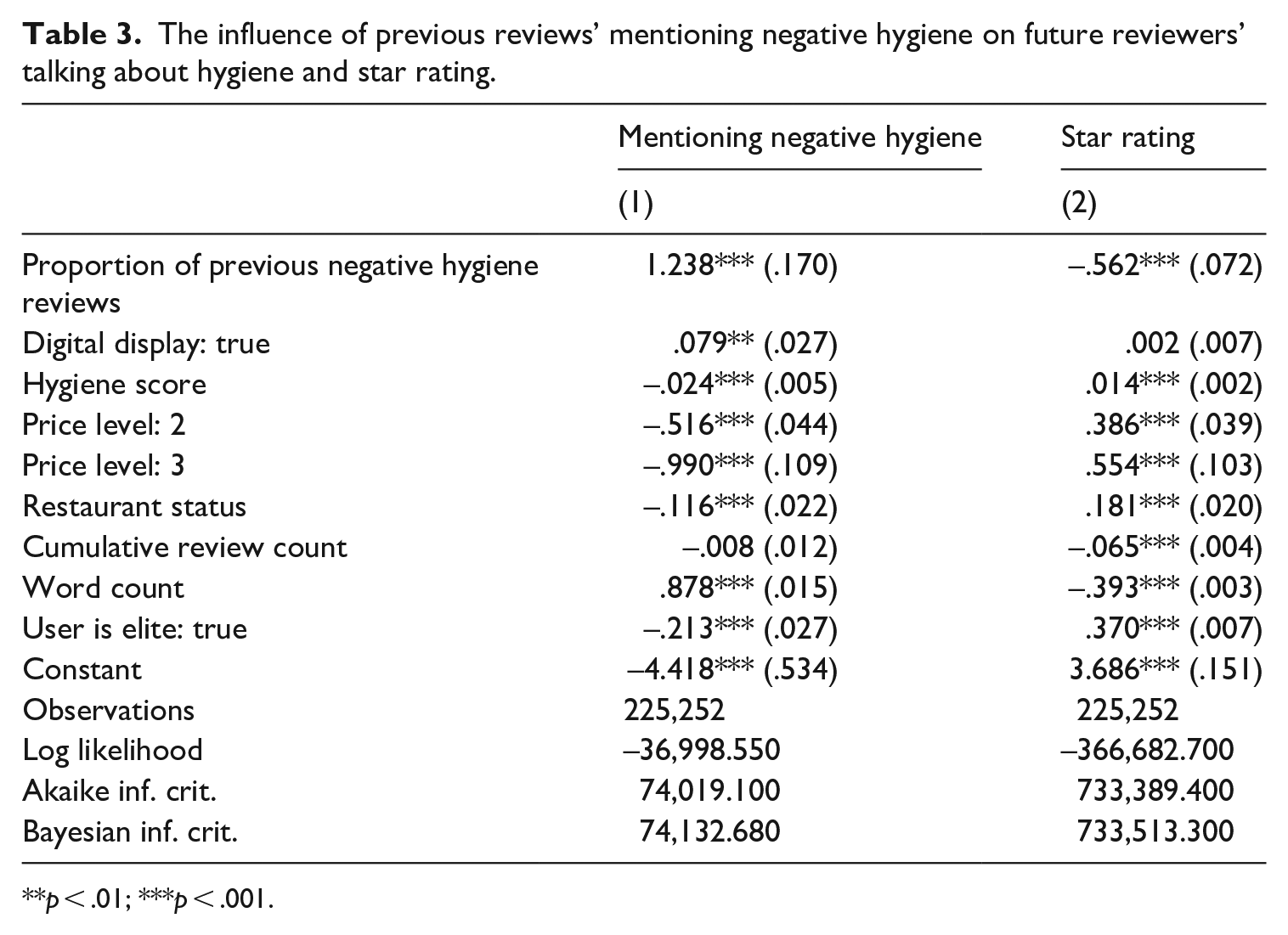
p < .01; ***p < .001.
Discussion
In this article, we argued for the presence of a cognitive–discursive dilemma. Specifically, while the digital hygiene display is known for helping restaurants keep good hygiene (Makofske, 2020) and increase consumer response in purchase and review intentions (Dai and Luca, 2020), this feature could eventually lead to reviewers’ heightened scrutiny of hygiene toward restaurants with lower economic and cuisine status, producing a more biased discourse. We find evidence of this dilemma in an investigation of 225,252 Yelp reviews toward 1,937 restaurants in Charlotte. Specifically, after the scores were digitally displayed on Yelp, review mentions of hygiene were more “accurate” as they became more in line with hygiene scores. However, the digital display also led to greater attention to hygiene, leading to lower scores for restaurants of lower price levels and cuisine status. Our study resonates with previous qualitative studies that reveal biases and inequalities induced by online platforms which are seemingly neutral and objective (e.g. Duffy and Meisner, 2022; Noble, 2018). This study also provides several implications.
First, our work expands earlier studies on the digital hygiene display by showing that the digital display also influences how people talk about hygiene and how they rate restaurants. Theoretically, the digital display may further boost consumer confidence by increasing the salience of hygiene scores that are both objective and accurate. However, as many consumers are biased by their pre-existing hygiene-related stereotypes, the heightened scrutiny by the digital hygiene display may further amplify the articulation of biased views, especially when they can freely express their opinions online. As review sites have become an important source of information when making consumption decisions (Askalidis et al., 2017), our study calls for more attention to a broader theoretical implication about the provision of “accurate information” on review sites.
More broadly, our findings of support for a cognitive–discursive dilemma and its potential to produce bias contribute to the literature on inequalities on online platforms. For example, studies have shown that many biases and inequalities observed offline are extended to online contexts, such as the sharing economy and review sites (Edelman et al., 2017; Koh et al., 2019; Kovács and Horwitz, 2018; Noble, 2018). Meanwhile, sometimes a seemingly fair and neutral policy can lead to unexpected results (Mejia and Parker, 2021; Yu et al., 2021). Similarly, this study shows that by addressing one problem of hygiene scores on doors not being salient enough, the digital hygiene display brings another problem: Restaurants with lower economic and cuisine status suffer more from their reviewers’ heightened scrutiny of hygiene. The basic problem is that though the information provided may reduce bias, it also promotes discussion of a topic on which much bias remains, potentially increasing the spread of biased views.
This finding then leads to important policy and design implications. Online platforms, such as review sites have control over what to show their users, and when, where, as well as how to show specific information to their users. Depending on how they present information, we demonstrate that, as expected, platforms can leverage the existing hygiene scores of restaurants from local authorities to increase consumers’ awareness of hygiene in their reviews. Yet, informing audiences who are also contributors has two, potentially competing effects. Claiming that the information provided is “objective,” or even showing that it can reduce bias in judgments made from it, does not address the whole of the problem, because users may also be more likely to create messages about that topic which contains their pre-existing biases. Policies can thus simultaneously inform specific users while also leading those users to mislead other users. One suggestion is that platforms could remind reviewers if their comments about hygiene toward a restaurant are appropriate and fair when their algorithms detect hygiene-related words in reviews. This reminder may reduce people’s unconscious biases, and thus attenuate the unequal impacts toward low-status restaurants. Airbnb recently made a similar move as it now requires guests to keep their reviews “on-topic.” 4 Otherwise, their reviews will be removed.
Limitations and future directions
Some limitations of this study provide opportunities for future research. First, what we have found may only reveal a partial picture of how the digital hygiene display influences Yelp users’ reviewing behaviors. Specifically, the digital hygiene display on Yelp reduces consumer demand at dirty restaurants (Dai and Luca, 2020), so that, our dataset does not include those who were discouraged by restaurants’ lower hygiene scores and ended up avoiding those restaurants. However, even among the ones who were less sensitive to and undeterred by the digital display of poorer hygiene scores, we still found the unequal impacts of the display on restaurant reviews.
In terms of how reviewers talk about hygiene in their reviews, our study focuses on whether they mention hygiene-related words. This is in line with our argument that talking about hygiene itself is problematic because it signals status. However, reviews that solely focus on hygiene are qualitatively different from those only briefly mention hygiene. Future research could use qualitative approaches to better identify and understand the granular details of review texts that mention hygiene.
Another empirical limitation is that we do not have data on restaurant responses toward consumer reviews. Previous studies show that timely and detailed responses to consumer reviews enhance merchants’ future financial performance and lead to favorable consumer inferences (Sparks et al., 2016; Xie et al., 2017). Thus, restaurant responses to reviewer comments may influence future consumer behaviors in terms of how they talk about hygiene and how they give overall ratings. This may attenuate or exacerbate the influence of previous reviews in the context of hygiene expression. We thus call for future studies to investigate this avenue of research.
Finally, as consumers have mis-calibrated interpretations of hygiene scores on Yelp (Kim and Martin, 2021), this may be another reason that the digital hygiene display causes unequal impacts toward restaurants with different economic and cuisine status. While observational data help reveal real-world consumption behaviors, it is difficult to parse closely related mechanisms, such as interpretations of hygiene scores with the current dataset. Future research might consider using experimental designs to control for this relevant factor.
Supplemental Material
sj-docx-1-nms-10.1177_14614448221127674 – Supplemental material for Heightened scrutiny: The unequal impact of online hygiene scores on restaurant reviews
Supplemental material, sj-docx-1-nms-10.1177_14614448221127674 for Heightened scrutiny: The unequal impact of online hygiene scores on restaurant reviews by Chao Yu and Drew Margolin in New Media & Society
Footnotes
Declaration of conflicting interests
The author(s) declared no potential conflicts of interest with respect to the research, authorship, and/or publication of this article.
Funding
The author(s) received no financial support for the research, authorship, and/or publication of this article.

Supplemental material
Supplemental material for this article is available online.
Notes
Author biographies
References
Supplementary Material
Please find the following supplemental material available below.
For Open Access articles published under a Creative Commons License, all supplemental material carries the same license as the article it is associated with.
For non-Open Access articles published, all supplemental material carries a non-exclusive license, and permission requests for re-use of supplemental material or any part of supplemental material shall be sent directly to the copyright owner as specified in the copyright notice associated with the article.
