







Abstract
Attention-seeking personal profiles on social media increasingly define successful political communication. But Angela Merkel, during her 16-year chancellorship, has come to stand for the opposite. The first woman to ever fill the office, she built a reputation for rational, evidence-based decision-making and predictable performances. Based on a visual discourse analysis of Angela Merkel’s official Instagram account, this article shows how her authenticity was strategically built through performances of ordinariness and consistency, without relying on more emotional aspects of presentation such as immediacy and intimacy. Instead of shaping her online persona according to the traditions and style of Instagram, Merkel attempted to bend Instagram to host her unique persona. Instead of “instagramizing” Merkel, she “merkelized” Instagram. This finding complicates understandings of social media and contemporary politics as being focused on relatability, spectacle, and drama. It also questions the close conceptual connection of authenticity and intimate, emotional representations.
Keywords
Introduction
When Angela Merkel stepped down after 16 years as Germany’s chancellor in 2021, she was widely celebrated internationally. Families had named their children after her honoring her “heroic” stance in Europe’s “refugee crisis” in 2015 (Bennhold, 2021), “the free world” had come to rely on her as its new leader during the Trump administration (Morris, 2021; Sauerbrey, 2021), and she was lauded for navigating the pandemic with outstanding efficiency (Tworek et al., 2020). She was popular not only internationally, but also nationally: a vast majority of German citizens evaluated her political reign positively (Fetterolf and Schumacher, 2021; Statista, 2022a).
The first woman to ever become a German chancellor, Angela Merkel had built a reputation for rational, evidence-based decision-making and skilled negotiation. Merkel came to stand for level-headed efficiency and pragmatism. At the same time, critics tended to point out her limited charisma in social interactions and her lack of “vision” as a leader. Her approach to legacy and new media had also been criticized for being deliberately repetitive and for ignoring the power of visuals. Her self-representation was in juxtaposition to the populist rhetoric that has helped many other figures ascend to power and thus her unusual case complicates simple explanations of populist success. Her farewell ceremony and the media’s reactions to it, if nothing else, have shown that Merkel had inspired imagination and stirred emotional attachment even with a very technocratic approach to politics and media (Bennhold, 2021). The deep and widespread concern as to whether she could ever be replaced (Eddy and Erlanger, 2021) especially showed how much more than a mere officeholder she had become in public perception.
Angela Merkel did not follow mainstream expectations of contemporary media, yet somehow she still managed to capture the public’s imagination in the current media ecology. Focusing on her official Instagram account, this article asks how Merkel built up her social media image while curiously lacking conventional cues of authenticity in her public presentation such as spontaneity, immediacy, intimacy, and display of emotions. What methods did she use to succeed, while largely ignoring the cultural and social expectations of influential platforms? Our analysis shows how her case goes against preconceived notions such as the power of spectacle and drama on social media. We highlight that a repetitive, predictable political image focusing on expertise and bureaucratic efficiency can still succeed in the current, new media landscape that is thought to favor drama, outrage, and spectacle. Thus, the analysis adds to an understanding of visual authenticity cues and challenges a dominant view that authentic performance entails an appeal to the audience’s emotions.
Building on the assumption that politics has seen a strong tendency toward individualization, we bring together strands of literature on political authenticity, performance of politics, charisma, and political personalization. We conclude that Merkel’s Instagram profile—much in line with her general public presentation—includes the “authenticity cues” of consistency and ordinariness while dropping more intimate or immediate self-presentation techniques. Instead of adapting visuals to social media’s logic, Merkel shapes the platform to effectively host her spectacle-free and expertise-based persona. While our focus here is on Instagram, the research could later be extended to other platforms as well, providing a cross-platform analysis of her unconventional approach to the contemporary media landscape.
Theoretical framework: personalization, authenticity, and charisma
The growing literature on the personalization of politics argues that campaigning and political journalism have an increasing focus on candidates and officeholders as individuals instead of parties and their political agendas (Adam and Maier, 2010; Balmas and Sheafer, 2013; Holtz-Bacha et al., 2014; Van Santen and Van Zoonen, 2010). This general tendency entails at least two aspects: On the one hand, “privatization” describes the shift “from the public to the personal”—a tendency to present political actors in the media as private individuals, among their families, in their homes, or other private contexts. On the other hand, “individualization” signals the shift “from parties to politicians”—a growing focus of media representations on individuals instead of collectivities. Furthermore, there is a shift from considering politicians as officeholders to perceiving them as ordinary, emotional human beings. This trend is especially reflected in the analysis of politicians’ visual representations (Metz et al., 2020).
Whether it is true or not that personalities and their stories play a more salient role in contemporary politics compared to the past, they have certainly become more accessible. It is hard to ignore the centrality of social media for politicians and their self-presentations and personalization seems a “natural” outcome of their spread (Metz et al., 2020; Peng, 2021). Like television, social media enables personalization through a focus on the visual (Farkas and Bene, 2021; Poulakidakos and Giannouli, 2019). Research has shown that indeed “personalized,” privatized, and emotionalized posts attract more attention and engagement on social media, in Germany and elsewhere (Bene, 2017; Metz et al., 2020; Peng, 2021). Similarly, social media seem to promote “authenticity” in politicians’ communication (e.g. Dumitrica, 2014; Gilpin et al., 2010; Grow and Ward, 2013). Instagram especially has become a popular platform for political leaders to present their “authentic” selves and create a sense of intimacy. New Zealand Prime Minister Jacinda Ardern, US representative Alexandria Ocasio-Cortez, and Singaporean politician Baey Yam Keng are only three examples of young and progressive politicians, actively using the platform to enhance their political persona and effectively engage their electorate (Leaver et al., 2020). Populist politicians are also often savvy on social media; examples include Brazilian President Jair Bolsonaro (Mendonca and Caetano, 2021), former British Prime Minister Boris Johnson (Jones, 2021), and—most prominently—former US President Donald Trump (Clarke and Grieve, 2019). Social media are understood to have helped them communicate with their constituents in a direct, seemingly unscripted, and thus “authentic” manner (Sorensen, 2021).
Yet, appearing as “authentic” on social media is not a straightforward task. Gunn Enli (2015) in her work on “mediated authenticity” travels through time and looks at the historical emergence of new media to make the elusive concept more graspable. Focusing on the mediation that connects sender and audience, she delineates a threefold construction process consisting of “authenticity illusions,” the “authenticity contract,” and occasionally occurring “authenticity puzzles or scandals.” “Authenticity illusions” are strategies for the signification of the “real,” such as well-known scenes, pop-culture references, or other cues of familiarity that make performances recognizable to audiences. The default relationship between media and audience described by the “authenticity contract” is that of a “suspension of disbelief”: a semi-conscious trust in the authenticity of what is actually known to be staged and scripted. Some events, however, shake the contract of authenticity. These events profoundly question the authenticity of a new medium and leave audience members with a feeling of having been misguided and betrayed. Enli’s examples are the famed War of the Worlds radio broadcast from 1938, reality TV shows, or fake accounts on social media. The “contract” enabling the trust of an audience is regularly challenged in events that accompany the consolidation of new formats. Similarly, we currently engage in regular renegotiation of what constitutes the “authentic” on social media (Enli and Rosenberg, 2018).
At the heart of the conceptualization of “mediated authenticity” is the acknowledgment of a paradoxical tension between the idea of “authenticity” as truthfulness toward some personal essence of character and the necessity of staged political performance. Enli defines seven performative strategies that may create strong authenticity illusions to disguise this inherent tension: spontaneity, predictability, ordinariness, imperfection, ambivalence, immediacy, and confessions.
Building on Enli’s and others’ work, Lübke (2021) suggested a reduction to four dimensions, cues, strategies, or aspects of authenticity (p. 642): Consistency of a politician can refer to the coherence of their statements, public positioning, values, and convergence of private and public behavior. Consistency can also be created by a presentation that simply falls in line with pre-existing expectations, thus following the logic of a genre or a stereotype. Intimacy is marked by confessional rhetoric. It is common in autobiographies, filled with personal details and narratives. Publicly sharing images of a politician in their “backstage” environment such as private spaces, too, contributes to the creation of intimacy. Ordinariness shines through a performance in small imperfections and down-to-earth qualities that suggest proximity to constituents. Amateurism in published materials such as live videos or blog posts can also add to the perception of a politician as “just a human being” (Abidin, 2017). Immediacy is mostly forged temporally, in live communication or instant replies to comments on social media. It thus presupposes spontaneity, the performative opposition to scripted-ness.
Adding to these aspects, Mueller et al. (2019) identified markers of authenticity on various levels of Jeremy Corbyn’s media depictions: his atypical appearance and speech, his consistency in political positions, and a firm commitment to his beliefs. On a different level of analysis, Shane (2018) points out how, beyond the actual content of social media posts, authenticity can also be found in indexes such as characteristics of typing and punctuation, timestamps, and device info in Donald Trump’s tweets. Crucially, through whatever means, creating and sustaining successful “authenticity illusions” is a precondition for establishing trust in democracies and its institutions and ideally withstanding populist threats. Ironically, populist politicians seem to have done a better job at presenting themselves authentically, raising the question of how political success is possible without the populist impetus (Gilpin et al., 2010; Sorensen, 2021).
Closely related to the aspect of authenticity for politicians’ social media performances is the expectation that they appear as charismatic to audiences (Bligh and Kohles, 2009; Eisenstadt, 1968; Joosse and Willey, 2020; Weber, 1947). In the early 20th century, Max Weber defined charismatic authority as a “a certain quality of an individual personality by virtue of which he is set apart from ordinary men and treated as endowed with supernatural, superhuman, or at least specifically exceptional powers and qualities” (Weber, 1947: 364). This early conceptualization focused on extraordinary rhetorical performances of male politicians and presented a somewhat distanced, heroic, almost divine politician as an ideal-type. In contrast, contemporary expectations of politicians revolve more around relatability and charm, a magic spell that politicians cast to seduce and sometimes deceive their audiences in the current media environment characterized by the quick spread of visuals and the possibility to instantaneously communicate with politicians online (Sonnevend, 2019; Sonnevend and Katz 2020; Sonnevend and Kim 2020). Contemporary politicians often win by the illusion of presenting themselves as the “one we can have a beer with”—approachable and everyday-like.
The quality of being relatable and approachable is particularly problematic in the case of female politicians. These qualities are still often defined based on traditional, charismatic, male performances, shaping audience expectations. Comparing the journalistic coverage of Angela Merkel with her (then) male counterpart, the Social Democrat Frank-Walter Steinmeier, Lünenborg and Maier (2015) found that Angela Merkel was presented as a successful performer because she was able to act “as a man.” The coverage thus kept the traditional gender divide intact. Women also get criticized for lacking relatability, perhaps the most famous example being the failed presidential campaign of Hillary Clinton in 2016 (Nyhan, 2015; Parry-Giles, 2014). As Krogstad and Storvik (2007) have analyzed in the cases of France and Norway, male and female politicians in both countries drew on very different registers—so-called “national repertoires”—to perform as charismatic leaders. Failing to adhere to these gender-specific repertoires often leads to the political fall of the female politician.
Building on these strands of interdisciplinary scholarship, we explore how Angela Merkel’s authentic public persona was created without deploying the full range of social media strategies and despite omitting authenticity cues normally assumed to build a perception of charm and relatability. In our analysis of her Instagram account from her first post to her last over six years, we will focus on the visual presentation of Merkel as a person, and the specific aspects of authenticity she performs, as defined by Enli (2015) and Lübke (2021).
Case study and methods
Angela Merkel was elected chancellor of Germany in 2005 and remained in power through four consecutive elections, spending altogether 16 years in office. When she left office in December 2021—after a challenging phase of pandemic waves, a devastating flood in Germany, and political turmoil in Afghanistan and elsewhere—support for her performance was at 80% (Statista, 2022a). The trials and tribulations of a 16-year-reign had ultimately not impacted the constituents’ perception of her competence and leadership qualities. They seem to have only increased her authenticity ratings (Statista, 2022b).
When Merkel first entered politics in the newly united federal republic in the 1990s as an inconspicuous woman from the former East, things looked less promising. She worked her way up through party politics against the odds. In 2005, her victory against incumbent Gerhard Schröder still came as a surprise. However, as she established herself and got to work in the chancellery, the media adjusted representations in a way that scholars termed “the Merkel effect”: Her gender and origin were relegated to a backseat, while her powerful position became the factor most decisively defining her media representations (Kinnebrock and Knieper, 2014). As we will argue below, her Instagram presentation followed this strategic de-emphasizing of her gender and East German identity.
By the time she left office, Merkel’s international reputation had been most strongly shaped by her skillful diplomatic handling of the financial crisis in 2008, her assertiveness during the refugee crisis in 2015, and lately her relatively effective management of COVID-19 (Eddy and Erlanger, 2021; Morris, 2021; Schmemann, 2021). With her consistent use of a diamond-shaped hand gesture, she became a reliable and predictable visual presence on the global stage. Internationally, Merkel was even framed as an icon against the rising tide of populism. She was called the “new leader of the free world” in opposition to Donald Trump (Grothaus, 2018; Joosse, 2018). She gained sympathy even among groups that do not otherwise identify with the politics of her center-right party (Schmollack, 2021).
Merkel did not stage a populist spectacle to attract attention and gain approval. Yet, she was still exceedingly successful. But the reasons for her success are yet to be fully explored. Analyzing Merkel’s Instagram account grants us a partial yet revealing insight into how her idiosyncratic public persona has been built. Instagram especially defines politicians’ “visual rhetoric” and thus is a key element of their public image (Mendonca and Caetano, 2021). Merkel’s Instagram account @bundeskanzlerin was created on 2 June 2015, with an initial 45 photographs from the past years posted. By the time Merkel stepped down as chancellor in November 2021, it had 1.8 million followers and 2023 posts as well as about 100 stories published. After Merkel had taken down her Facebook account in early 2019 on the occasion of stepping down as head of her party, her Instagram account was the only social media account representing her personally. We analyzed a total of 2023 posts on her Instagram account @bundeskanzlerin (
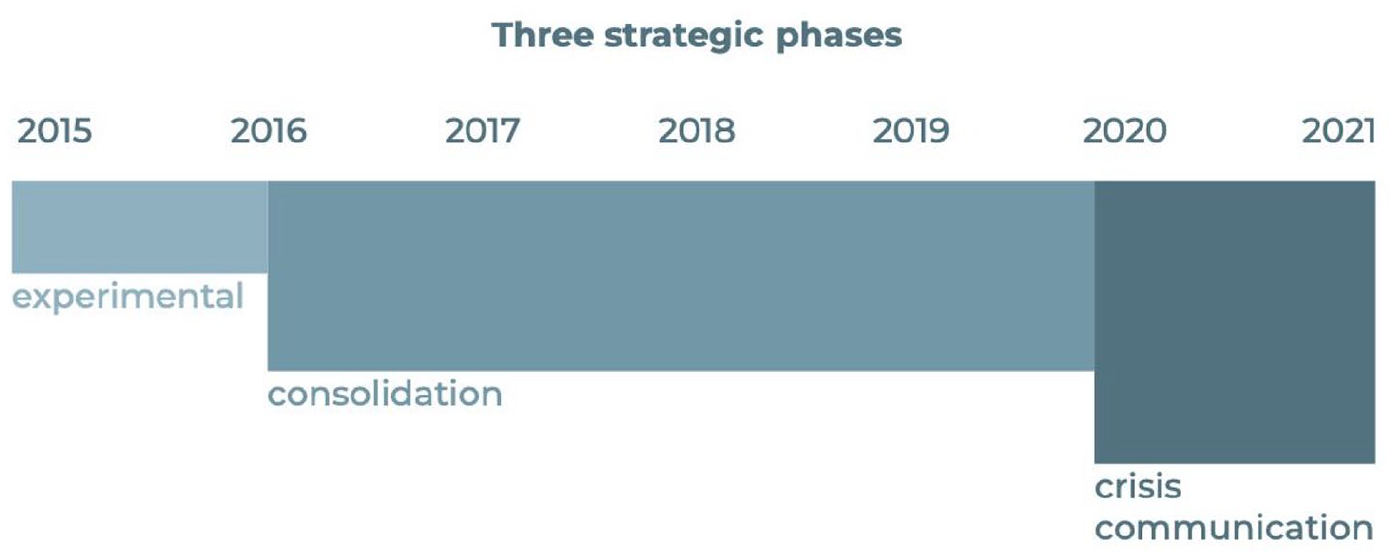
Strategic phases of Merkel’s Instagram representation.
All sampled posts were coded for Merkel’s direction of gaze as either at the camera—that is, the viewer—or somewhere else. This characteristic of her depiction works two ways in respect to the construction of mediated authenticity: On the one hand, gazing at the camera is a clear sign of awareness of being photographed or recorded and thus adds to the impression of the explicit staging of a visual. On the other hand, looking at the camera also gives the audience the feeling of being more directly addressed, which was especially salient in the video podcasts. Thus, visuals reduced the distance between Merkel and her audience at the same time as they pointed toward the scriptedness of her performances, weighing ordinariness against immediacy.
Photos that depicted Merkel were also coded for a depiction of a frontstage or backstage environment and a formal versus intimate atmosphere. A backstage visual would show Merkel in surroundings that citizens usually do not have access to. Most obviously that would mean her private spaces, but as these were absolutely absent we expanded the category to include her office and balcony in the chancellery—places that are commonly out of reach for news media. A visual with an “informal” and perhaps intimate atmosphere would show Merkel in conversation with her staff, doing reading, or traveling (seemingly) by herself.
Translating the building blocks of authenticity into visual cues in these posts was not a straightforward task and our operationalization can only be understood as approximation. The analysis thus had to allow for ambiguities as it traces the interconnections of personalization and authenticity construction in this specific case. Nevertheless, we considered a translation of authenticity cues into visual characteristics feasible and crucial. To that end, consistency could be thought of as a matching of Instagram visuals onto those presented in legacy media, following the journalistic style and perspective of “old” media. It could also be thought of as a visual continuity within the account and repeating patterns or genres of posts over time. Both would indicate a steadfast character with a clear goal and values, not unlike a corporate brand. Ordinariness in the case of Merkel can be found on many levels as well: her clothing, her bodily disposition, the contexts she is depicted in—and beyond Instagram, her tastes in rare semi-public moments of leisure (like hiking). More abstractly, we looked for ordinariness in casually staged appearances that communicate transparency rather than seclusion and distance. Intimacy is a little less complicated to find and roughly maps onto the idea of “privatization” of politics. We can locate intimacy where politicians display their private surroundings, openly show leisure activities and express emotions. Immediacy, as it is a time-based concept, too, can be elusive to define visually. A direct gaze addressing the audience, the spontaneity of a “snapshot,” and the posting immediately upon the occurrence of an event might be seen as cues toward understanding a performance as immediate. These operationalizations thus informed coding, and guided the qualitative analysis.
To get an insight into the depiction of Merkel vis-à-vis other heads of state and their own claims to authenticity, visuals depicting her with political leaders were also analyzed: Is she depicted as smaller or bigger or on an eye level with them? Does she dominate the interaction or take up the center of the composition? Does she touch or is she being touched by her interlocutor? The focus on these visual aspects was drawn from previous studies analyzing Merkel’s presentation as gendered (Koch and Holtz-Bacha, 2008; Lünenborg and Maier, 2015; Mushaben, 2018). To illustrate the insights drawn from this dataset more clearly, we also present three exemplary visuals from each phase below.
Three phases in Merkel’s Instagram representation
Experimentation, consolidation, and crisis communication
As described above, the splitting of the dataset into three phases allowed us to think of the account strategy as developing over time and reacting to its broader cultural and social context. For instance, the outbreak of the COVID-19 pandemic influenced Merkel’s opportunities and limits of authenticity construction. Drawing on the coding of our random samples, we outlined characteristic tendencies for each phase.
The first phase had an experimental, “trial and error” character in style and content of visuals, lasting for about 18 months from June 2015 to the end of 2016. Merkel’s account during that time is filled with photographic content almost exclusively, with only four videos. Likes for posts vary from hundreds to several thousand. The photos stand out for their aesthetic value, which is in line with the general “look and feel” of Instagram as a platform. Photos often use strong filters, unconventional lighting situations, and extreme perspectives. Architectural motifs and “snapshots” capture moods in and around the chancellery and Angela Merkel’s travels. Yet, only about half of the pictures sampled from that phase actually show her and only three show her by herself. Merkel appears often at a distance and almost exclusively with another person or in groups. These photos create an air of mystery and opaque power, following the chancellor in her everyday activities, but never giving anything away in regard to her personality. As the audience hardly gets to see Merkel’s face, the strong atmosphere does not translate into an emotional tone. Most scenes seem informal and sometimes surprising. More than half of the photos from this phase provide a “backstage” insight. The Instagram account was clearly approached within the logic of the platform, focusing on mood-heavy impressions and spectacular photographic content. Yet, during this phase, the Merkel account did not necessarily focus on Merkel as a person and did not cohere particularly well with her sober style of presentation in other media. However, this phase also came to an end rather soon with a shift toward a new representative strategy.
By the end of 2016, the style and content of posts seemed to shift, ushering in what we call the consolidation phase. During this phase, videos started playing a bigger role, especially through the launch of Merkel’s regular video podcast in April 2018. The number of likes grew fast and was at an average of 11,000 for the entire phase, with the average views of videos around 74,000. The aesthetic quality shifted from filters, backlighting, and spectacular perspectives to a more journalistic style. Merkel now is the central motif of almost all photos and a pattern of showing her in diplomatic or conference situations, often interacting and smiling, emerges. She was regularly presented in the company of other heads of state or celebrities like members of royal families or athletes, most commonly the German national soccer team. Overall, the account during this phase turned into a supplement to standard official reporting with events and situations of public interest depicted from a visually interesting, but still official and formal angle with less backstage scenery.
In the third phase, which began as a response to the outbreak of COVID-19 in Germany in March 2020, the account strategy again shifted significantly. The video format took over to form the majority of posts. Views averaged around 200,000. These videos mostly followed the pattern of clear, straightforward transmission of information. We see Merkel head to waist, calmly explaining topics to the viewer, with keywords being animated on top of the images. Alternatively, we see snippets of press conferences that deal with the pressing issues of her policy response to COVID-19 or other crises (e.g. the flooding in Western Germany and the takeover of the Taliban in Afghanistan in 2021). The content is professionally produced and edited. Merkel is now depicted by herself and gazing right into the camera almost half of the time. This makes her appearances more obviously staged, but she is also more directly addressing the audience. We rarely see visuals that convey a “backstage” character; at a maximum, we get glimpses into zoom environments. Rather, the account becomes a channel for crisis communication with Merkel playing the role of a leader and an expert communicating ritualistically with her audience. Even if her words do address the pandemic’s emotionally demanding dimensions, visually these depictions do not suggest personal, spontaneous feelings.
Overall, the strategy defining this Instagram account seems to have been gradually adjusted and fitted onto Merkel’s already existing style of presentation and reputation—rather than Instagram as a platform reshaping her public persona. The Instagram account thus becomes “merkelized” over time, reproducing her formal, scripted, and information-driven style of speech and appearance. The unfolding pandemic intensifies this “merkelization” process, as she regularly highlights her reliable expertise in an unpredictable global crisis.
Some key examples for visual construction of authenticity
To illustrate the trajectory described above, in the following we will focus on nine visuals that were selected as representative examples for each phase. Again, building on our theoretical backdrop, the analysis sought out the visual equivalents of personalization and authenticity cues, aiming to identify some patterns of their interconnections with representations of gender and charisma.
In the experimental phase, our first example (Figure 2) shows Merkel descending the government’s plane in Frankfurt in July 2015. The picture is taken from ground level and its frame includes the rims of a luxury car on the left. The perspective and sharp contrasts in black and white give the photo a spectacular, stylized air. Merkel remains at a distance. Her face is not visible, preventing the viewer from detecting any possible emotion. We see a second person, presumably a security employee in a suit. Shades add to the “coolness” and “VIP feel” of the scene, conveying strong masculine stereotypes. The photo emphasizes the power and extraordinariness of a traditional charismatic leader rather than an intimate glimpse into the private life of a contemporary, relatable politician. The image paints a figure of mythical size that avoids immediacy or intimacy as much as contact to the “ordinary.” Neither is this representation consistent with images of Merkel circulating in other media in 2015, leaving this example with low levels of Lübke’s four authenticity markers: the persona here shown is withdrawn instead of intimately or immediately approachable. She is presented as superior instead of ordinary. The image is consistent with depictions of political leaders in general, but clearly not Merkel specifically.
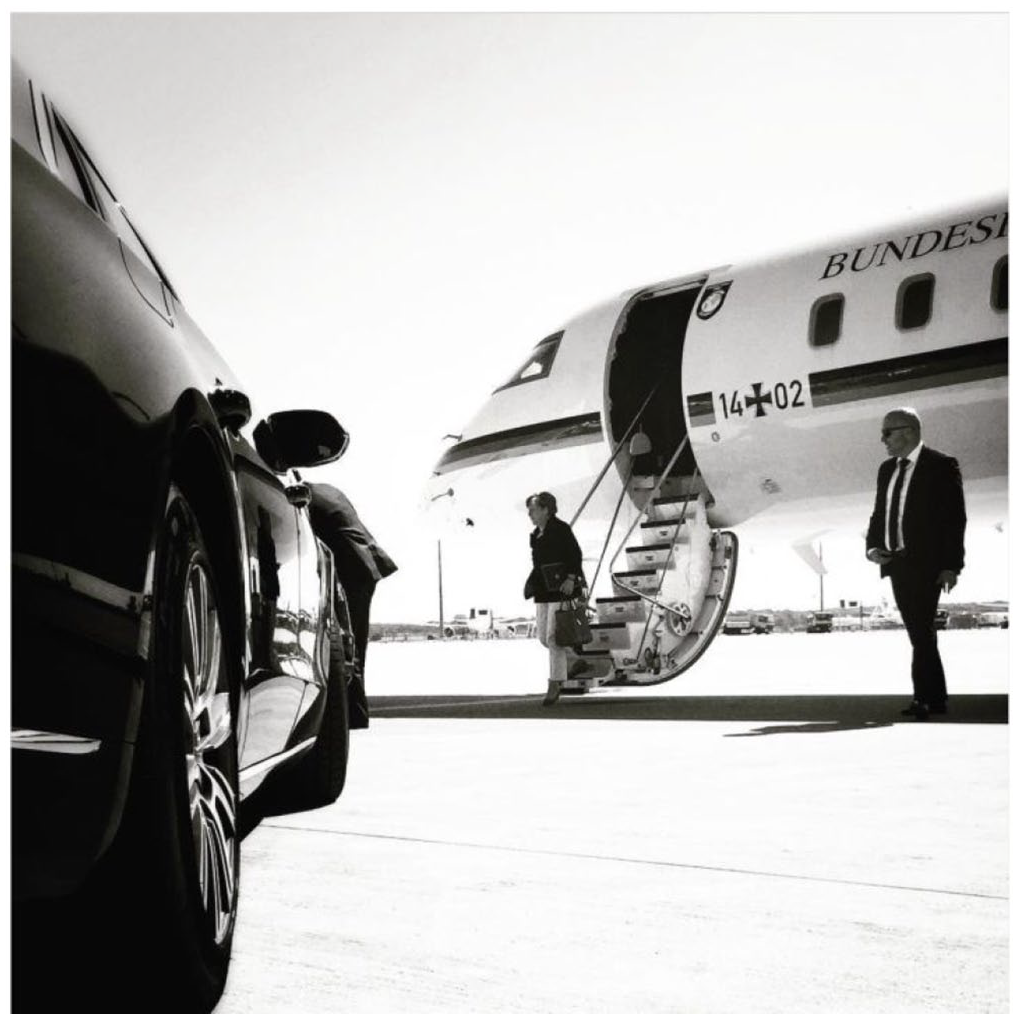
Post by @bundeskanzlerin on 2 July 2015.
In a second example from this phase (Figure 3), we see Merkel next to French President Francois Hollande at a bilateral meeting in April 2016. The photo is again taken from a very low angle, so that the sky becomes the background. The two politicians are shown side by side, walking away from the camera. Framing the image to the right, we see a guard in an elaborate historical military uniform, holding an epee to his side. The uniform connotes some “imperial grandeur” and thus creates an extra level of symbolic distance between the viewer and the two politicians. To the left, another man in a suit is turned with his back to the camera. Merkel’s steps are in sync with those of Hollande and their bodies equally take up the center space of the composition. Thus, their dyad conveys a sense of power and extraordinariness. Like our first example of this phase, the politicians portrayed convey the message of traditional, male-oriented, charismatic leadership. Yet, Merkel’s bright red jacket stands out, allowing a little reference to femininity, and we see her profile as the only face in the image—a tiny window into the exchange.
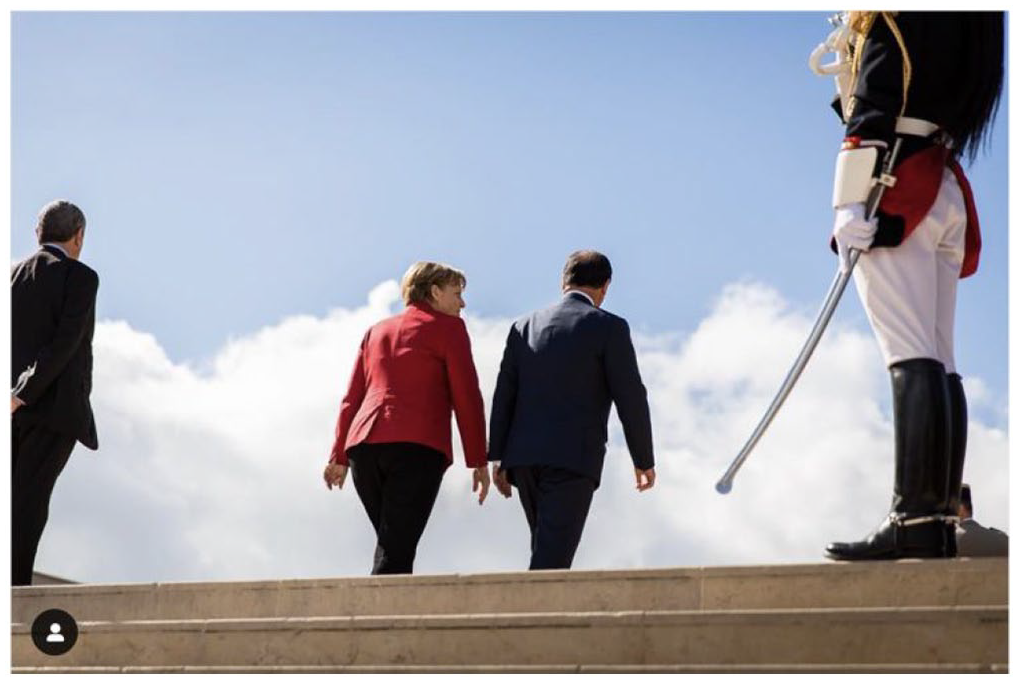
Post by @bundeskanzlerin on 7 April 2016.
Our third example for the experimental phase (Figure 4) shows an unconventional closeup of the shoes of British Prime Minister Theresa May and Angela Merkel standing on a podium in July 2016. May’s bare legs in leopard patterned heels clearly stand out from the gray carpet—as a contrast to the plain black slippers and black pants of Angela Merkel beside them. The photo delicately communicates the powerful on-stage position uniting the two women while simultaneously emphasizing the stark differences between them. The contrast between the two highlights Merkel’s unsophisticated and “non-feminine” presentation, proving again Lünenborg and Maier’s (2015) point about Merkel’s strategic transcendence of gender norms. Yet, in this case the masculine coding of Merkel could be perceived as a positive quality as well as a deficiency. Photographing female politicians’ feet does invoke a sense of the “backstage” scene here, as this detail would usually not be visible on the TV screen. However, instead of indicating proximity and relatability, the unconventional clipping rather mystifies the invisible but powerful personas presented. In either case, despite the unusual form, the character portrayed here is well known from other—often caricatured—media depictions of Merkel as unsophisticated and literally “grounded” persona, closer to the masculine world of power than to the feminine realm of fashion. This allows for some consistency between Instagram and other media.
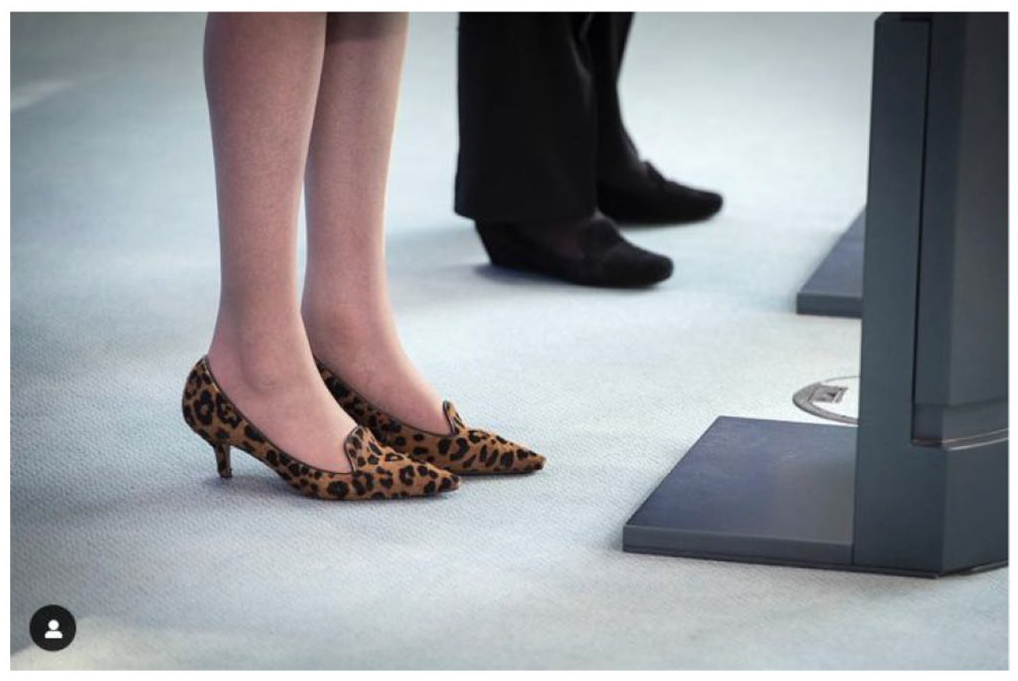
Post by @bundeskanzlerin on 20 July 2016.
Overall, this phase did not seem to be strategically concerned with authenticity as much as fitting Merkel’s public persona into the aesthetic logic of Instagram as a platform. Some low-level immediacy was created by the seemingly spontaneous snapshot quality of posts, but this minimal level of immediacy was outweighed by the distanced presentation of Merkel as a “charismatic leader,” signaling masculine stereotypes. Visual consistency among the posts as well as between Instagram and other media outlets was minimal. Yet, the explicit elimination of femininity from her public presentation did connect to Merkel’s already established public persona.
Representing the second phase (“consolidation”), the first image shows Merkel walking next to Ursula von der Leyen. They are leading a group of people in formal attire, perhaps coming from a joint meeting in November 2019, days before von der Leyen became president of the European Commission (Figure 5). The atmosphere is one of professionalism and friendly exchange between colleagues. Yet, the two women—and especially Merkel—stand out of the crowd as the two are oriented straight at the camera. Merkel’s vibrant jacket color—again—pops out against a monochrome background. They communicate an air of thoughtfulness and grounded seriousness, presenting steadfast, trustworthy, and competent leaders who openly collaborate in the interest of both the European Union and Germany. In contrast to the first phase, Merkel is shown more transparently and less as a mysterious power player. Her frontal approach to the camera emphasizes her stability and pragmatism. Yet, we still see her as a chancellor rather than as a private individual as she addresses the one woman about to be her equal in the positions of power in Europe. At a high level of visual consistency, the shot might as well be from a daily newspaper, it has no specific social media quality to it—neither intimate nor immediate; at a maximum, it communicates some ordinariness in comparison with the distanced, oversized charisma portrayed in the first phase.
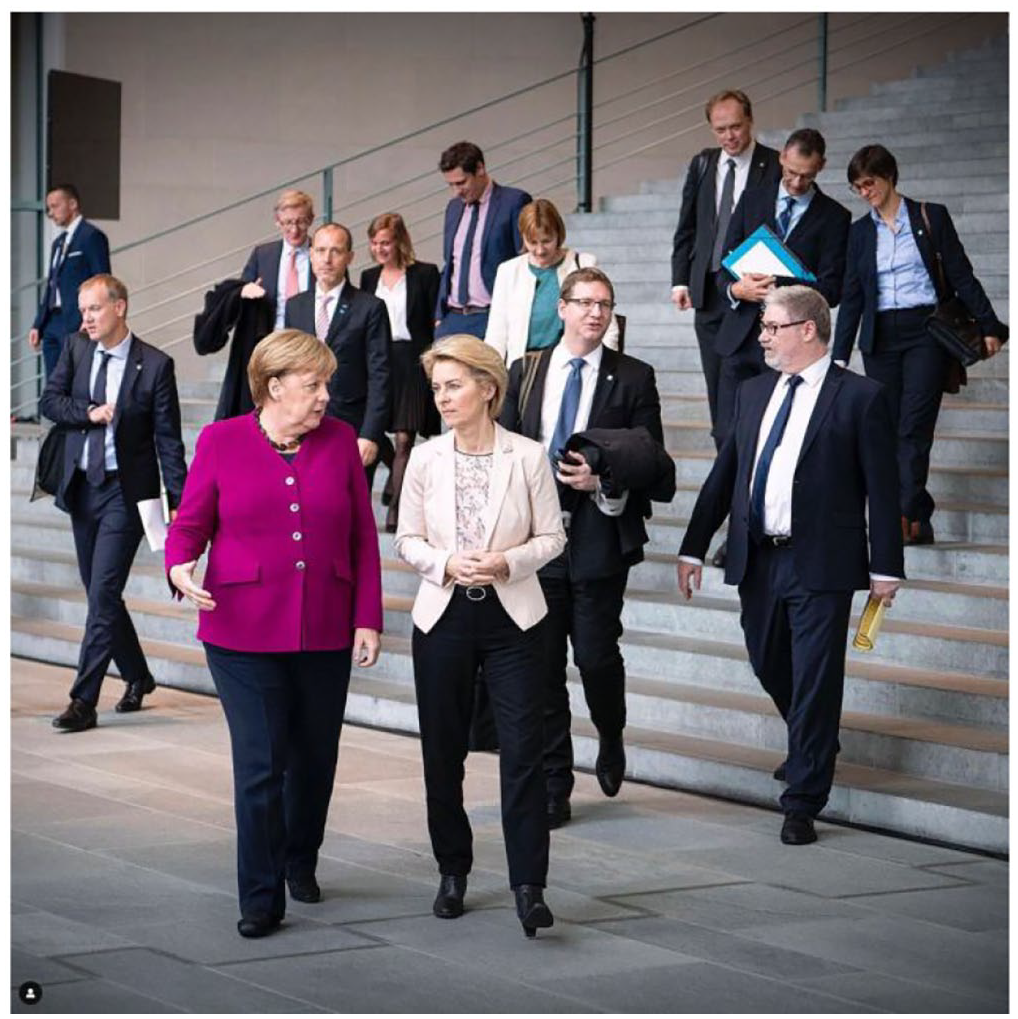
Post by @bundeskanzlerin on 8 November 2019.
Another example from the consolidation phase shows Merkel with a group of German national soccer team athletes as they prepare for the World Championship in summer 2018 (Figure 6). Encounters between the soccer team or other athletes and Merkel were a regular occurrence in that phase. Merkel actively built a reputation as a soccer fan throughout her career, emotionally cheering at world championships and taking photos with the team in wild enthusiasm after victory. As Lünenborg and Maier (2015) argue, Merkel’s visible enthusiasm for and familiarity with sports helped her adopt male stereotypes. Accordingly, we see Merkel in an unusually pronounced “masculine” pose here, as she leans forward, resting her elbows on spread knees (mirroring Manuel Neuer, sitting across from her). The atmosphere is informal and jovial with the athletes and Merkel laughing and chatting. The image has a backstage snapshot quality to it as none of the depicted is looking into the camera. The camera seems to peek in from a door with a bit of the door frame captured in the lower left corner. Such depictions stress Merkel’s ordinariness in her proximity to popular culture and taste. Comparable effects can be seen in depictions of her with children or pets, with citizens, and at church. As they represent efforts to stress “charming” friendliness instead of distanced charisma, they still omit overly private scenes of Merkel—attending to Germany’s “national sport,” she is a representative of that nation as much as an individual fan. Her choice of the usual formal costume with a colored jacket underlines that the person depicted is still Merkel the chancellor, not a private person, adding to the overall visual consistency.
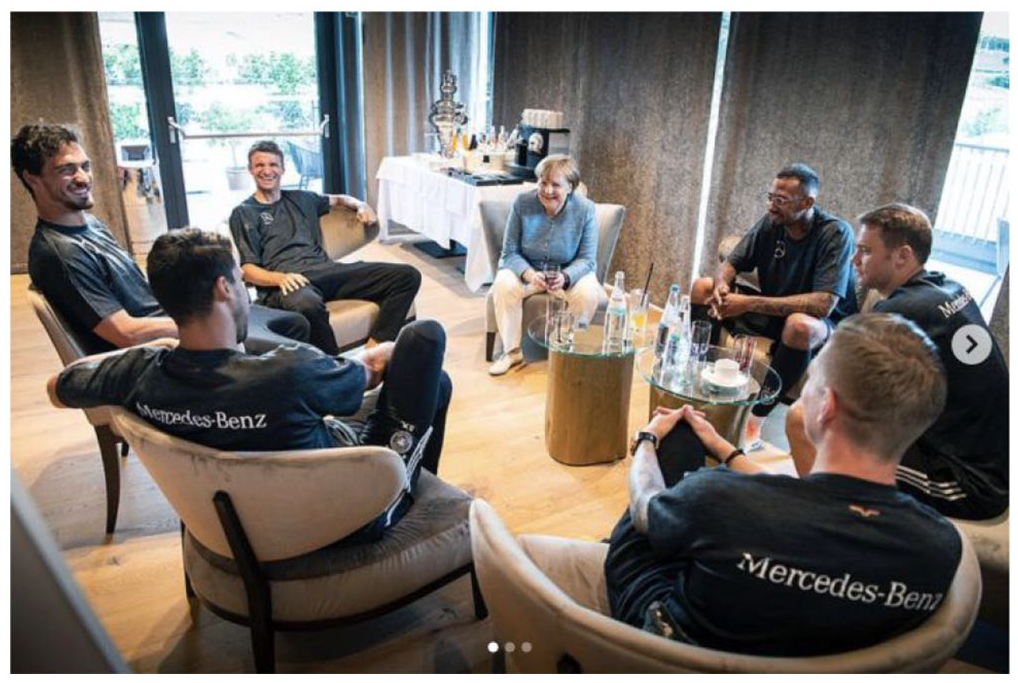
Post by @bundeskanzlerin on 3 June 2018.
A third example from this phase (Figure 7) is one of the many depictions of Merkel in conversation with another head of state, in this case, Russian President Vladimir Putin. The photo was posted in August 2018. At that time conflicts dominated German–Russian relations, and the media scrutinized Merkel’s stance toward Russia. This photo shows the two sitting in an almost perfectly symmetrical, friendly, sunlit setup at a garden table. Merkel’s jacket this time blends in with the background. The two leading politicians, seated at eye level, look at each other intently and seriously. Merkel speaks and gestures moderately as Putin listens, clutching his glass of water. The line separating the two down the middle of the photo is marked by two small pink bouquets. We see no paperwork, documents, or technical devices that would mark this encounter as “work”-related. The photo thus strikes a good balance between a positive atmosphere in the surroundings and two politicians possibly in contention. Merkel is presented as in charge here, as speaker and host to this professional yet intimate encounter. Again, the image transmits a bit of a backstage feel but is within journalistic traditions and does not reveal anything beyond public, political relevance. The high-level diplomatic encounter is staged in ordinary and relatable surroundings. Yet, deliberate and reasoned exchange is more pronounced than spontaneity or emotion.
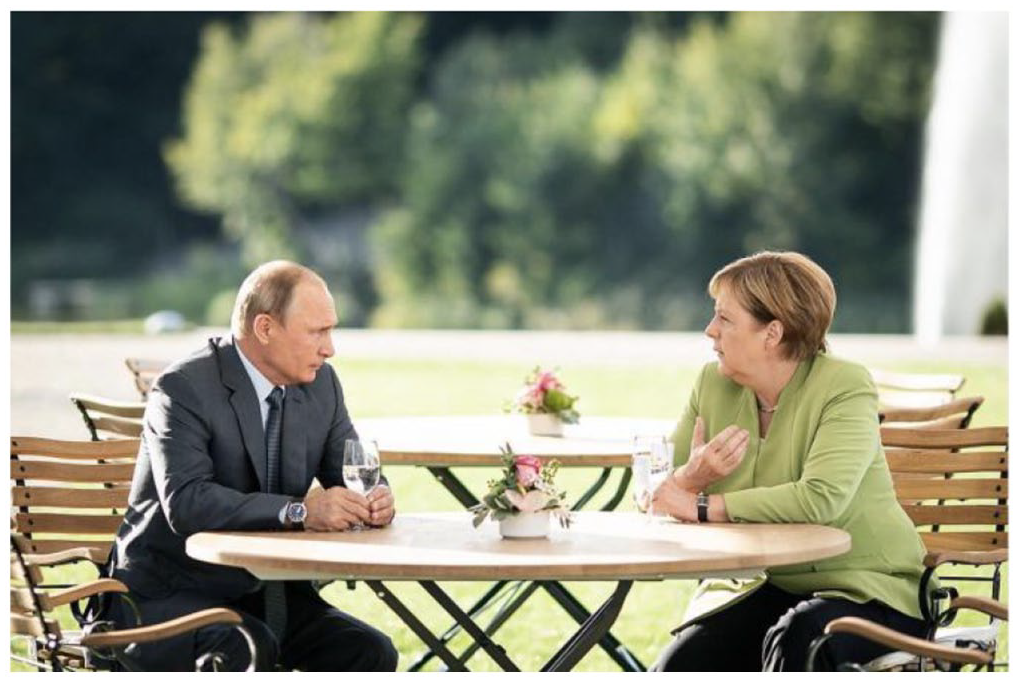
Post by @bundeskanzlerin on 18 August 2018.
In sum, the second phase displayed a heightened level of consistency—within Instagram as well as with visuals known from conventional media—and more emphasis on ordinariness in the reduction of distance and in the presentation of slightly more quotidian contexts. Intimacy, however, continues to literally stay out of the picture. Immediacy recedes further due to more obviously “staged” representations. Yet, the reduction of distance between the viewer and her as well as more depictions of personal, amicable interactions retain a “Merkel-level” of immediacy and intimacy. The strategy of this phase is more in line with theoretical understandings of performed authenticity.
Finally, we will be looking at the third phase defined by “crisis communication.” It is dominated by Merkel’s regular and popular video podcast formats, visually resembling the many snippets from press conferences and parliamentary statements posted during that period.
We now often see Merkel standing or sitting, frontally facing the camera (Figure 8). The image quality and professionalism of lighting differs across posted visuals. Our first example shows a medium level of professionalism: a formal press statement background is framed with a flag to the left but a slight lack of lighting and sharpness still give this image a somewhat amateurish feel. Fully committed to the transmission of information, black all-caps font is layered on white lines across Merkel’s chest, underlining her speech. While the textual content is tragic, the visual presentation is perfectly plain and in line with the visuals used in legacy media. Merkel’s facial expressions are bordering on boredom and seem to contradict the immediacy and emergency of her words, but also repeat a well-established performance of deliberation and reason. The visual also represents stability and control and almost produces a bemusing effect on the viewer. While the world is in crisis, there is nothing new or surprising to see here, nothing to fear. Watching Merkel’s regular Instagram video posts gives visual respite from the fast-paced changes and risks “out there” in the world. This is hardly an immediate reaction of a “real” person, but rather a professional “office” speaking. As mentioned above, these direct addresses can be seen as heightening immediacy, but they do not attempt to veil their staged nature. As leader in a difficult situation, Merkel’s performance takes on an even more formal style. This formal staging breaks with the tendency toward more performed ordinariness in the consolidation phase. Yet, unlike other heads of state in this phase, we also do not see her stylized as an extraordinary, superhuman defender of the nation.
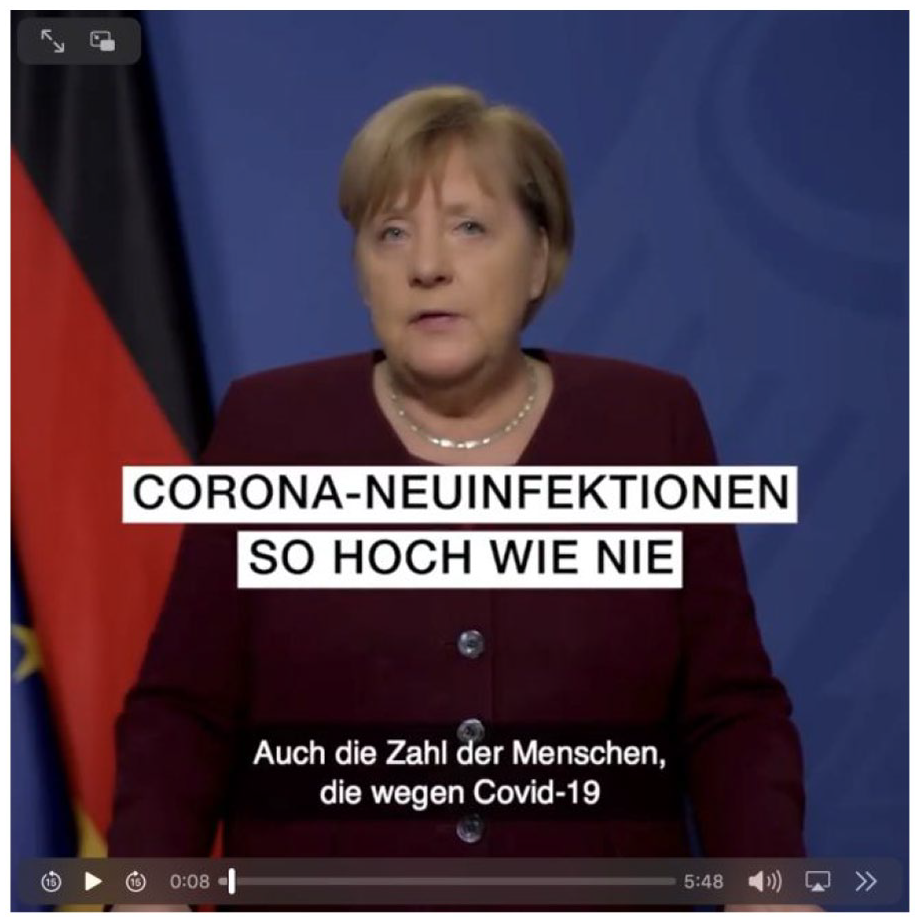
Post by @bundeskanzlerin on 13 November 2021.
As a second example (Figure 9), we chose one of many small group depictions that due to their strict and performatively strong adherence to social distancing appear on a whole new level of stagedness. We see the politicians involved in the formal handing over of a ministry in May 2021, including the former and incoming ministers, the president (in charge of representative tasks such as this) and Chancellor Merkel. The four figures are neatly lined up in front of the formal backdrop of Bellevue castle. All four face the camera, feet close together and hands clutched in front of them. The colors are bright and on low saturation, almost resembling the sterile interiors of a hospital, with Merkel’s blue jacket again being the most colorful highlight. The stiff formality of the image has a satirical effect (although some of the awkwardness clearly comes from the pandemic context). But the visual emphasis on stillness is also a hint at stability and the almost military discipline displayed by the politicians conveys a sense of reason and control. Furthermore, the depiction of Merkel repeats the format of the video podcasts with her frontal positioning and established pose. The group photo simply extends the frame to include her surroundings. The orientation toward the viewer makes this presentation look staged, while it also communicates a sense of public service mentality. Consistency governs these presentations. Other markers of authenticity, however, are less salient. Intimacy, again, is absent and the post has no specific social media quality to it. Immediacy, too, has no place in this staged scenery. That Merkel’s presentations stick to the orders of the pandemic moment—namely, distance and discipline—underlines a claim to ordinariness. Unlike other heads of state, she also performs as a responsible citizen.
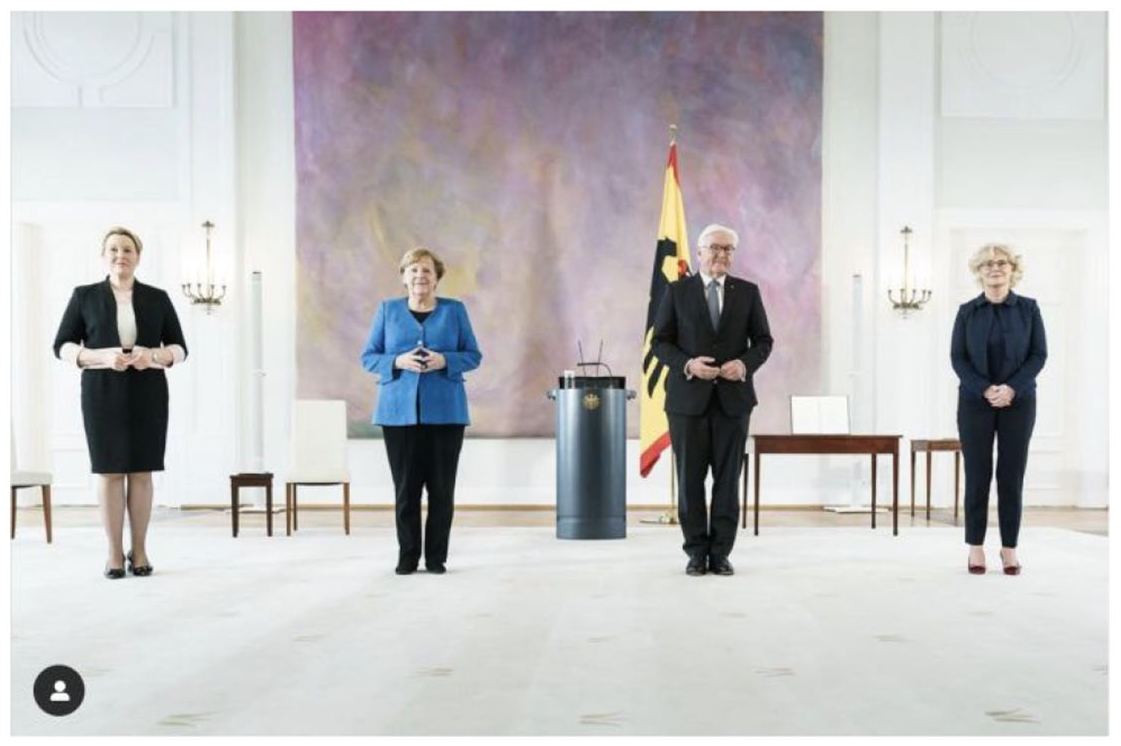
Post by @bundeskanzlerin on 20 May 2021.
Finally, it seemed important to discuss the most popular post ever published on Merkel’s Instagram account. It is a video snippet of a parliamentary address on 9 December 2020, arguing for a quick and effective decision on regulating schooling in the days before Christmas to reduce the risk of contagion within families over the holidays (Figure 10). The post reached a record of 1.6 million views. We see Merkel behind the Bundestag’s speaker’s podium, marked by the logo in front and two microphones to the sides. She is wearing a warm and powerful red, and gesticulates emphatically as she draws up the historical importance of a fast decision on the matter at hand. As in the prior two examples from this phase, there is nothing especially visually appealing or eye-catching about the scene. It is formal, and static—almost generic, indeed. Of course, the video’s high number of views is due to the immediate importance of this address and the moral weight of its contents. Yet, the unremarkable nature of the presentation’s visual aspects “stand out”: Merkel’s performances resonate most in absolute ordinariness rather than in spectacle. She is the most successful in building on consistency rather than on surprise. On Instagram, we found this to be the case most obviously throughout the crisis communication phase brought on by the COVID-19 pandemic, but it does not seem too far-fetched to claim that Merkel’s style of presentation and leadership had been determined and widely resonant before March 2020.
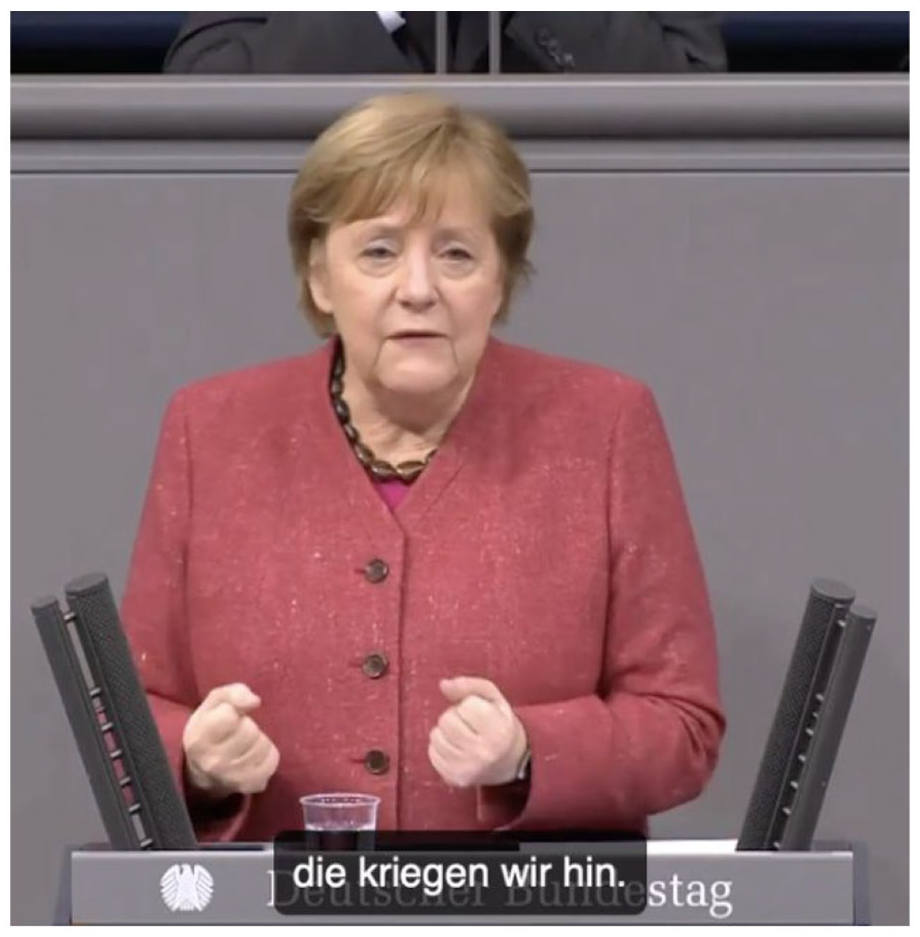
Post by @bundeskanzlerin on 9 December 2020.
The third phase thus makes the most unambiguous contribution to a performance of consistency and predictability, often at the cost of previously slightly higher salience of ordinariness, and rare hints of immediacy or intimacy. Undramatic and unsurprising, her Instagram account during the COVID-19 pandemic almost caricatured her well-established public persona instead of highlighting new aspects or seeking new avenues to speak to citizens. Assuming Instagram contributed to Merkel’s overall success as a leader in crisis, this continuity seems to have sufficed to sustain an authentic performance. The slightest show of a personal commitment and emotion—occurring on the formal stage of parliament—on the backdrop of this strategy then appeared as a moment of raw and pure authenticity. Speculatively, one could say the heated statement resuscitated some of the slightly more spontaneous and less distanced pre-pandemic persona.
Conclusion
This study is an exploration of Angela Merkel’s Instagram account with a particular focus on her strategic construction of authenticity. We found that Merkel’s Instagram account deploys only a fraction of the strategies that are theorized as effectively constructing authenticity by visual means. The construction of the relatable, emotional side of authenticity is neglected; the focus is on predictability, continuity, repetition, and expertise.
Extending her visual representations in legacy media, Merkel banks on the aspects of ordinariness and consistency which suffice to build her limited, idiosyncratic construction of authenticity. While attempts at performing immediacy or intimacy were briefly present in the earliest phase of her Instagram account, they were removed to shift from an Instagram pattern of presentation (exclusive, mood-centered, and aesthetically innovative) to a fully “Merkelized” pattern of presentation (transparent, information-centered, and predictable). The idiosyncrasy of this approach to Instagram culture becomes especially salient when compared with other leaders’ social media use, which often introduce all four aspects of authenticity to weaponize social media in the service of political legitimation (Bene, 2017; Blasch, 2021; Jones, 2021; McGuire et al., 2020; Mendonca and Caetano, 2021; Poulakidakos and Giannouli, 2019). This stark contrast makes Merkel’s Instagram a counter-case to how authenticity is visually constructed on social media.
Over time, Merkel’s visual depiction strategically shifted from a masculine, charismatic, distanced image in the early days of her Instagram account, to a more life-sized and relatable persona. However, especially during COVID-19, when the need for direct and emotional communication was high to provide leadership and foster a sense of national unity, Merkel’s social media presentations consistently remained void of more private and personal expressions, theoretically foreclosing a more intimate relationship with audiences. Her authenticity clearly relied on the consistency of her performances with her established image.
Instead of shaping her online persona according to the traditions and needs of Instagram, Merkel attempted to bend Instagram to host her unique persona. Instead of “instagramizing” Merkel, she “merkelized” Instagram. This finding complicates understandings of social media as being focused on relatability, spectacle, and drama. Merkel presents a case when a globally significant political player remains successful over almost two decades, without adhering to mainstream expectations of the new media environment. As Instagram itself is a relatively new medium, an understanding of what authenticity “looks like” in this environment is still developing. Merkel’s case asks us to be cautious in this quest. She proves politicians can build their authenticity on predictability, expertise, and repetition, in fact on “boredom,” rather than on emotional appeals, charm and spectacle. Future research will need to explore whether her strategy will hold up in the coming decades and whether it can be replicated in distinct cultural, social, and political contexts. Future studies could also explore more deeply how her messaging traveled across different legacy and new media platforms, communicating a relatively coherent image of Merkel as a rational, predictable, and reliable leader in an ever-shifting political and media landscape.
Footnotes
Funding
The author(s) received no financial support for the research, authorship, and/or publication of this article.
