







Abstract
Personalized news recommendations shape social media users’ information environment. However, whether news recommendation algorithms asymmetrically influence users’ news engagement remains largely unknown. Drawing on the three-level digital divide framework (access, use, and outcomes), we test a moderated mediation model in which social media usage motivations influence social capital via news engagement, conditional on using algorithmic news. Using two waves of survey data from South Korea (N = 948), the results show that the indirect effects of motivations for social media use on social capital via news enagement are conditional on the level algorithmic news usage. News algorithms enable information- and socialization-oriented users to increase news engagement and develop social capital but fail to help highly entertainment-focused users increase news engagement, and thus, they do not develop social capital well. We discuss the possibility that news recommendation algorithms lead to a Matthew effect in which the poor become poorer and the rich become richer, exacerbating information inequality.
Keywords
Introduction
News is essential in encouraging informed, engaged citizenship (Gil de Zúñiga et al., 2012; Kim et al., 2022). Communication scholars have focused on how social media can promote the news exposure of citizens. Some argue that social media can promote broader news exposure due to the incidental news exposure effect of social media providing citizens with access to a wealth of political and news information (Barnidge, 2020; Goyanes, 2020; Kim et al., 2013; Lu and Lee, 2019). Others contend that the social media environment allows individuals a high degree of control over their information flow, which, in turn, may increase their opportunities to choose entertainment content and avoid news (Aelst et al., 2017; Karlsen et al., 2020; Prior, 2007).
Based on these competing perspectives, scholars are increasingly concerned about unequal news exposure and engagement among social media users (Barnidge and Xenos, 2021; Kümpel, 2020). Current research has investigated differences in the frequency of news exposure on social media platforms and the stratification effects of individual engagement with news (Beam and Kosicki, 2014; Huang and Yang, 2022; Mukerjee et al., 2018; Thorson et al., 2021). Inequalities in exposure to and engagement with news can be traced to unequal access to the resources necessary for engagement, such as high socioeconomic status (SES) (Lane et al., 2023), motivation (Choi, 2016), media skills (Martens and Hobbs, 2015), and the size and structure of an individual’s social network (Barnidge and Xenos, 2021). Thus, Kümpel (2020) proposes the idea that there may be a “Matthew effect” present in social media news use. That is, users who are already interested in the news are more likely to be exposed to more news content by chance, while users who are not interested in information about current affairs are increasingly less likely to be exposed to more news. Ultimately, this leads to more polarized news exposure among different types of users.
Although the available evidence has amply demonstrated that news exposure and engagement on social media exhibit unequal characteristics, aspects of the actual outcomes (e.g. social capital) arising from unequal news engagement remain mostly unexplored. The third-level digital divide framework, for example, emphasizes that inequality requires attention in terms of three dimensions, namely, inequality of access on the first level, inequality of use on the second level, and inequality of actual outcomes on the third level (Calderón Gómez, 2021; Scheerder et al., 2017; Van Deursen and Helsper, 2015). Along this line, our study explores the antecedents and consequences of news engagement, investigating whether inequalities exist at the level of news engagement among social media users who hold different motivations and have differences in the substantive benefits they derive from news engagement.
Furthermore, an important phenomenon to consider in the debate about unequal news engagement is the widespread use of algorithmic news on social media. News users are increasingly exposed to information managed by platform algorithms (Swart, 2021; Thorson et al., 2021). The filtering and distribution mechanisms of personalized recommendation algorithms allow social media platforms to deliver differentiated content based on users’ preferences (Liu et al., 2021). News exposure on social media thus results from the intertwining of individual users, news organizations, and platform algorithms (Thorson and Wells, 2016). News algorithms could play an important role in helping users interested in news to engage more with it. The question, however, is whether news algorithms can, in fact, facilitate news engagement by helping expose people who use social media for various purposes to a broader range of news information. If not, do news algorithms widen the news engagement gap between different users? The answers to these questions are particularly significant for information inequality research that aims to address the question that scholars have attempted to answer for years whether news recommendation algorithms have the potential to mitigate or exacerbate the inequalities in news engagement.
Therefore, drawing on the three-level digital divide framework, we employ a moderated mediation model to explore how news recommendation algorithms affect inequality in terms of news access, engagement, and outcomes. The results of this study will help answer whether (a) there is inequality in news engagement among social media users with different motivations, (b) this inequality in news engagement leads to inequality in outcome benefits (i.e. social capital), and (c) the use of algorithmic news amplifies or reduces this information inequality.
Information inequality and news engagement
News engagement fosters informed citizens and, thus, the development of a robust democracy (Aalberg et al., 2013). Social media provide an important space for citizen news exposure and engagement activities. By using the “share,” “comment,” and “like” buttons, social media users can easily and quickly engage in a variety of news activities (Choi, 2016; Lee and Ma, 2012; Kim and Kim, 2019). Moreover, depending on the incidental news exposure effect, individuals can access various types of news and political information, even when using social media for purposes other than news consumption (Barnidge, 2020; Goyanes, 2020; Kim et al., 2013).
However, in recent studies, scholars have begun to notice that those who engage more with news on social media tend to be those who are already interested in the news (Karnowski et al., 2017), while those who are not as interested in public affairs can avoid news content that may appear in their social media feeds (Thorson, 2020; Thorson et al., 2021). Based on these results, some scholars have questioned the optimism regarding incidental news exposure and pointed out that it might mask inequality in users’ actual engagement with news (Kümpel, 2020). Gaps in news exposure and engagement may lead to a new form of information inequality that can be a hazard to citizens’ informed and democratic participation (Barnidge and Xenos, 2021; Robinson et al., 2015). Thus, although social media sites have become a major driver of news exposure, we still know little about inequality among users at the level of actual news engagement.
The three-level digital divide framework emphasizes concerns about information inequality, beginning with the division between those who have access to digital technologies and those who do not (the first-level digital divide or access divide). Later research extended it to include inequalities in digital media use (the second-level digital divide or use divide) as well as inequalities in users’ abilities to translate access and use into beneficial outcomes (the third-level digital divide or outcome divide; see Calderón Gómez, 2021; Scheerder et al., 2017; Van Deursen and Helsper, 2015). To theorize the antecedents and consequences of inequality in news engagement, we draw on the three-level digital divide framework to reexamine the dynamic evolution of news activities among different social media users at three levels: access motivation, actual engagement, and outcomes.
Motivations, news engagement, and social capital
Van Deursen and Andrade (2018) suggest that there are two critical factors at the first level of the digital divide: attitudes toward technology (e.g. motivation) and access to technology. Internet access has been well-established in most countries due to the generalization of media technologies (Calderón Gómez, 2021). However, the first level of the digital divide still requires attention in terms of motivational factors (Wang and Liu, 2022) because individuals have greater autonomy to choose content in a highly selective social media environment. These motivation-based choices shape general patterns of media use and influence a variety of media consumption behaviors (Eveland, 2002; Katz et al., 1973; Kwak, 1999).
Several studies have investigated the drivers of social media news activity, revealing how different motivations influence the possibility of users engaging with news on social media. For example, Lee and Ma (2012) explored the effects of information-seeking, socializing, entertainment, and status-seeking on news-sharing intentions and found that those respondents driven by these motives were more likely to share news via social media platforms. Choi (2016) distinguished three types of news activities (i.e. news reading, news posting, and news endorsing), noting that socializing was the strongest motivation driving all three types, while entertainment motivation had no positive association with news posting behavior.
These results highlight the differential outcomes of different motivations in predicting news activity. Prior (2007) argues that in a highly selective media environment, people shift from news to entertainment content consumption when they have more diverse media choices. Given this competitive relationship between entertainment and news engagement, inequality in news engagement can be expected to originate from the opposition between entertainment- and information-seeking motivations. In addition, given the prominent influence of social motivation on news activities on social media (Choi, 2016), we employed the three most common motivations—information, socialization, and entertainment—to investigate the motivational causes of inequality in news engagement. Specifically, we hypothesize that:
The third level of the digital divide involves the ability of people to derive benefits from using digital technologies to improve their opportunities (Scheerder et al., 2017). These differences in outcomes are often reflected in various sociocultural gains represented by social capital (Calderón Gómez, 2021), which is defined as the resources that people can obtain through their social interactions (Bourdieu, 1986). Social capital depends on relationships because it originates from the structure of social networks. In other words, individuals’ social networks contain certain social values, and people can accumulate social capital through daily interactions with family, friends, colleagues, and strangers (Kim and Kim, 2022).
Because the participatory culture of social media lowers the barriers to such social communication, individuals can widely share their private opinions, experiences, and insights on social networking sites. As a result, active content engagement behaviors on social media are often associated with the higher social capital of individuals (Zhong, 2014), especially in terms of news-sharing and interaction with news content. Several studies have shown a positive correlation between social media news usage and social capital building. For example, civic news consumption through social networks can increase individuals’ social capital and foster a sense of community among citizens (Gil de Zúñiga et al., 2012). Using Facebook and other social media sites to share and interact with news has also been found to promote social interaction and cooperation, ultimately improving social capital (Habes et al., 2021). Based on these results, we hypothesize that:
In summary, the impact of social media on social capital and news engagement can be expected to primarily depend on individuals’ motivations for using media. These different motivations then continue to shape users’ media use patterns, presenting either an instrumental or a hedonic media orientation. In particular, those who use social media for instrumental purposes (e.g. seeking political information or building relationships) are more likely to participate actively in discussions (Lin and Kim, 2023) and benefit from their news consumption. In contrast, those who are entertainment-oriented are not interested in engaging with large amounts of news and political information, which limits the opportunities for news to provide citizens with content engagement and social interaction opportunities to build social capital. That is, the gap at the second level of engagement will further widen the gap at the third level, that is, the social capital gap. Based on these insights, we propose that news engagement will mediate the relationship between different motivations and social capital:
Moderated mediation: algorithms and information inequality
In addition to exploring the indirect effects of motivations for social media use on social capital via news engagement, this study also investigates a possible moderating role of algorithmic news use in the proposed indirect mechanism. Given that the interaction between algorithms of digital media platforms and individuals is an important aspect of the digital media environment (Gran et al., 2021), examining whether the use of algorithmic news that platform algorithms recommend to users while they are using a specific platform has the potential to bridge or exacerbate information inequality is critical to expanding the current literature related to the three-level digital divide.
Social media algorithms are a set of mathematical instructions or rules that sort content and influence what users encounter on the platform (Calice et al., 2021). Social media algorithms affect various contents on social media platforms. In this study, the terms “news algorithms” or “algorithmic news use” refer to news content that is chosen for presentation by these algorithms (Joris et al., 2021; Swart, 2021). In other words, platform algorithms that have consequences for levels and kinds of exposure to news in particular are called news algorithms. Based on previous research, therefore, this study defines algorithmic news use as the act of using news that has been recommended by platform algorithms (see e.g. Joris et al., 2021; Swart, 2021).
Social media users are increasingly exposed to news content managed by algorithms (Swart, 2021). Thorson and Wells (2016) state that the visibility of news exposure on social media platforms depends on the intertwining of different players: users, social media friends, news organizations, and news algorithms. In other words, users’ exposure to news content depends not only on their own preferences or their friends’ postings but also on “how digital traces of their behavior on the site are used to infer information about their interests and content preferences” (Thorson et al., 2021: 193).
The use of algorithmic news implies that users are exposed to news content by algorithmic influences via explicit (e.g. news curation) or implicit (e.g. incidental exposure to algorithmically recommended news) mechanisms. For example, users can shape their own news feeds through news curation practices, such as sorting, hiding, and managing the social media sites of news organizations (Merten, 2021). Even for social media users who are not motivated to customize their news, news algorithms may offer the opportunity for incidental exposure to diverse news content through features such as “Suggestions” or “For you” (Swart, 2021; Thorson, 2020). Thus, news algorithms play a crucial role in shaping users’ personal news exposure.
Recent research has investigated users’ perceived biases toward news algorithms (Calice et al., 2021), algorithm awareness (Gran et al., 2021), algorithm experience (Swart, 2021), and how news algorithms capture their interests (Thorson, 2020; Thorson et al., 2021). However, little is known about how algorithmic news use affects the actual news engagement of social media users which could further influence individuals’ social capital. Some scholars have emphasized that news exposure does not equate to news engagement (Karnowski et al., 2017; Oeldorf-Hirsch, 2018); mere incidental exposure to the news environment may not have much positive impact, such as democratic participation or promoting knowledge (Heiss and Matthes, 2019; Kümpel, 2019, 2020). Engaging with news (i.e. liking, commenting, and sharing news), on the other hand, contributes to the cognitive elaboration of news content and thus promotes informed and engaged citizenship (Kim et al., 2020; Oeldorf-Hirsch, 2018). Therefore, it is critical to explore whether algorithmic news use can facilitate news engagement by potentially changing the news exposure environment of social media users.
Previous studies have demonstrated that personalized messages tailored to particular users can increase their perceived relevance, engagement, and positive attitudes toward the message content relative to general, nonpersonalized messages (Kalyanaraman and Sundar, 2006; Sundar and Marathe, 2010). In addition, personalized news can increase an individual’s cognitive elaboration, thereby promoting user content engagement (Beam and Kosicki, 2014). Thus, when users are exposed to news recommended by personalized algorithms, they should be more likely to engage with the news content. This optimistic result may contribute to mitigating the current inequality in news engagement. Nevertheless, the question remains: does this mobilizing effect of news algorithms hold for all social media users (especially those who are entertainment-motivated)? Given that algorithmic news is an essential component of incidental news exposure (Goyanes, 2020), the answer to this question needs to be traced back to the ongoing debate about whether incidental news exposure has a “compensatory” or a “stratification” effect (Barnidge and Xenos, 2021: 2).
Studies supporting a compensatory effect argue that incidental news exposure can increase the diversity of news sources, mobilize those with non-political interests, and attract users who are initially uninterested in the news, increasing their attention to news and public affairs (Fletcher and Nielsen, 2018; Valeriani and Vaccari, 2016). In addition, at the level of actual participation, incidental news exposure has been found to have a positive effect on narrowing the knowledge gap (Weeks et al., 2022), promoting political discussion (Ardèvol-Abreu et al., 2019), and reducing inequalities in political participation (Valeriani and Vaccari, 2016). These results suggest that using news recommendation algorithms can be expected to help mitigate inequalities in news engagement among different types of users.
However, some scholars have also questioned the idea of compensatory effects, arguing that incidental news exposure may lead to a stratification effect of news exposure and engagement, exacerbating information inequality (see Barnidge and Xenos, 2021; Kümpel, 2020). First, incidental news exposure ignores the role of individual motivational tendencies in shaping content exposure. In particular, news algorithms curate content based on users’ past expressions of interest (e.g. clicking on or reading stories) (Thorson et al., 2021). That is, algorithmically chosen news articles appearing in social media streams are not randomly combined and arranged; only users categorized by algorithms as interested in news and politics are more likely to be exposed to the news by chance. Thus, the combination of users’ preferences and motivational tendencies with algorithms may widen the gap between the already “information-rich” and the “information-poor,” thus leading to a Matthew effect of news exposure (Kümpel, 2020).
Second, users’ decisions to engage with the news largely depend on their interest in the news and their prior knowledge (Karnowski et al., 2017; Kim, 2019). Even when incidental exposure occurs, its beneficial effects may be limited to already interested users. If a person has no interest in the news, incidental news exposure will most likely not suddenly turn them into a news junkie (Kümpel, 2019). Furthermore, some studies have provided empirical evidence that incidental news exposure benefits those already interested in politics, further widening the knowledge and participation gap (Heiss and Matthes, 2019; Kim et al., 2013).
In light of this conflicting empirical evidence, it remains an open question whether and how algorithmic news use interacts with social media users’ motivations to influence their news engagement and social capital. Therefore, based on the three-level digital divide, we propose a moderated mediation model (see Figure 1) in which algorithmic news use moderates the indirect effects of motivations for social media use on social capital via news engagement. However, we are uncertain whether algorithmic news use will increase news engagement across all types of users (thus mitigating information inequality) or amplify individual preferences and be beneficial only to some user types (i.e. information and socialization-oriented users), leading to a Matthew effect of increased information inequality. We pose the following research question:
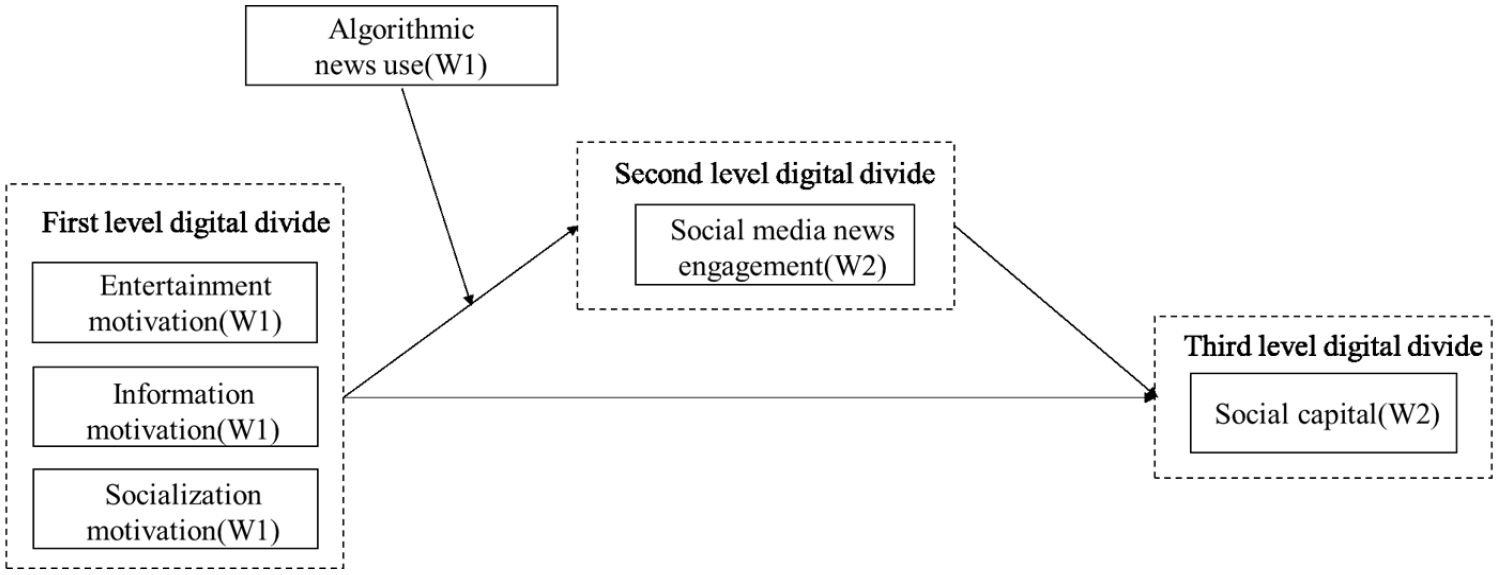
Conceptual model.
Context of the study
The proposed model is tested in the context of South Korea (hereafter Korea). Korea has the highest Internet penetration rate in Asia (Hootsuite, 2021). In addition, social media use is very popular, and the number of social media users tends to increase each year. According to a survey report (Korea Press Foundation, 2021), more and more Korean citizens use social media to access and engage with news, for instance, by liking, sharing, and commenting on the news. Despite the high levels of Internet adoption and digital media use, the digital divide is still a problem in Korea, as it is in the United States and Europe (Maji and Laha, 2022). Thus, Korea’s well-established Internet infrastructure, high social media adoption rates, and patterns of news consumption on social media provide an appropriate context for investigating differences in the digital divide at the outcome level. Moreover, considering that most theoretical references on the third digital divide and information inequalities have been developed in the United States and Europe, the results of this study help to identify global trends of digital inequality.
Method
Sample
The data for testing the proposed hypotheses and research question were collected from two waves of a national online panel study of South Korean adults conducted between January and March 2022. The participants were selected from a panel administered by one of the largest research companies in Korea, specializing in online surveys. The stratified quota sampling method was used based on Korean Census figures for gender, age, and region to obtain a representative national sample. The sample of the first-wave data included 1,075 participants, and the second-wave survey gathered 948 responses from participants who had also participated in the first survey.
The demographic factors of the sample are as follows: (a) 50.5% are male respondents (n = 479), (b) the median age is 46 years old, (c) the median range of monthly household income is US $3,000 to $3,999, and (e) the median educational attainment level is a bachelor’s degree (68.8%).
Measures
Motivations for social media use (Wave 1)
Referring to previous studies (Choi, 2016; Lin et al., 2017), we used a total of six questions to measure respondents’ motivations to use social networking services (SNS). Respondents were asked whether they use SNS: (a) to find entertaining information and content, (b) to pass the time when feeling bored, (c) to access useful information and content, (d) to access the latest information and content (e), to build and maintain relationships with others, and (f) to communicate with others who share their interests. Of these items, (a) and (b) were used to create an index of entertainment motivation (M = 3.74, SD = .90, Spearman-Brown reliability coefficient = .78), and (c) and (d) were used to create an index of information motivation (M = 3.64, SD = .90, Spearman-Brown reliability coefficient = .86). Finally, (e) and (f) were used to create an index of socialization motivation (M = 3.09, SD = 1.01, Spearman-Brown reliability coefficient = .79).
Algorithmic news use (Wave 1)
Algorithmic news use refers to the use of news content the platform algorithms recommend or provide to users (Joris et al., 2021; Swart, 2021; Thorson and Wells, 2016). Referring to previous studies (Beam and Kosicki, 2014; Merten, 2021), we measured two dimensions of respondents’ levels of algorithmic news use: explicit (i.e. news curation) and implicit use (i.e. being exposed to recommended news). Using a five-point Likert-type scale (1 = never, 5 = very often), respondents were asked to what extent they (a) use algorithmic recommendation services to filter and recommend favorite news sources or topics on social networking sites, and (b) read news that is recommended by algorithms on social media sites. The first item reflects respondents’ news use through personal news curation such as setting or subscribing to news services (Merten, 2021), while the second item reflects the use of news recommended by the platform algorithm. 1 We combined these two items to create an index of algorithmic news use (M = 2.78, SD = .84, r = .38, p < .001).
Social media news engagement (Wave 2)
Social media news engagement is defined as the activities of using the interactive features of social media to respond to shared news content (Oeldorf-Hirsch, 2018). Referring to previous studies (Choi, 2016; Oeldorf-Hirsch, 2018), respondents were asked how often they had actively engaged with the news on social media in the last month through the following activities: (a) express approval of other users’ news postings or comments on news stories using features such as the “like” or “favorite” buttons, (b) share news links or clicking the “share” button, (c) post news content or links, (d) post news links with their own thoughts or comments about the story’s content, (e) post comments on a news story or other people’s comments that agreed with their views, and (f) post comments on news stories or other people’s comments that disagreed with their views. Answers were given on a 5-point Likert-type scale (1 = never, 5 = very often). We combined these six items to create an index of social media news engagement (M = 1.87, SD = .86, Cronbach’s alpha = .90).
Social capital (Wave 2)
Considering the context of this study, we focus on social capital on social media, which is defined as the stock of social media-based social resources generated by individuals or organizations through their social media efforts (Saxton and Guo, 2020). We adapted six items from the previous measurement scales to assess participants’ bridging and bonding social capital (Hwang and Kim, 2015). Examples of the items are (a) “There are several people on social media I trust to help solve my problems” and (b) “Using social media, I can get specialized knowledge and information.” Answers were rated on a five-point scale (1 = strongly disagree, 5 = strongly agree). The scores of the six items were averaged to create an index of social capital (M = 2.95, SD = .85, Cronbach’s α = .91).
Control variables
Referring to control variables used in previous studies, potential variables that could influence the research variables were (a) demographic characteristics (i.e. gender, age, income, education, and political ideology), (b) mainstream media news usage (M = 2.75, SD = .62), (c) social media usage frequency (weekly use time: M = 10.25 hours, SD = 28.93), (d) political interest (M = 3.22, SD = 1.04), and (e) social network size (M = 1725.34, SD = 31180.45; due to skewness, after logarithmic transformation, M = 1.89, SD = .74, skewness = .34). 2
Statistical analysis
To test H1, H2, and H3, we used AMOS’s structural equation model (SEM) to verify the mechanism by which information inequality occurs at the three levels of the digital divide. To examine the conditional effects of algorithmic news use in this mechanism (RQ1), we specified an ordinary least squares regression model using the PROCESS Macro Model 7 template (Hayes, 2018). This model simultaneously allows us to test how the independent variable interacts with the moderating variable to affect the outcome of the dependent variable by including moderating effects (algorithmic news use) in the mediating path (motivations → news engagement → social capital). In addition, considering that the effects of news recommendation algorithms need to accumulate over time, lagged dependent variables help to explore the time-series relationships of the mediation model (Maxwell et al., 2011). We refer to previous studies (e.g. Diehl et al., 2016; Gil de Zúñiga et al., 2014) using news engagement and social capital in W2 to analyze the mediating effects. We set the number of bootstrap samples for the bias-corrected bootstrap confidence interval as 10,000, and the level of confidence for all confidence intervals (CI) is 95%.
Results
Three-level digital divide: the mediation model
Before testing the hypotheses, we examined the correlation coefficients (see Table 1) and SEM fit. The results show that the model displayed a good fit (χ2 = 640.23, χ2/df = 2.69, p < .001, goodness of fit index = .952, comparative fit index = .964, Tucker–Lewis index = .947, normed fit index = .944, standardized root mean square residual = .028, root mean square error of approximation = .042).
Correlation matrix.
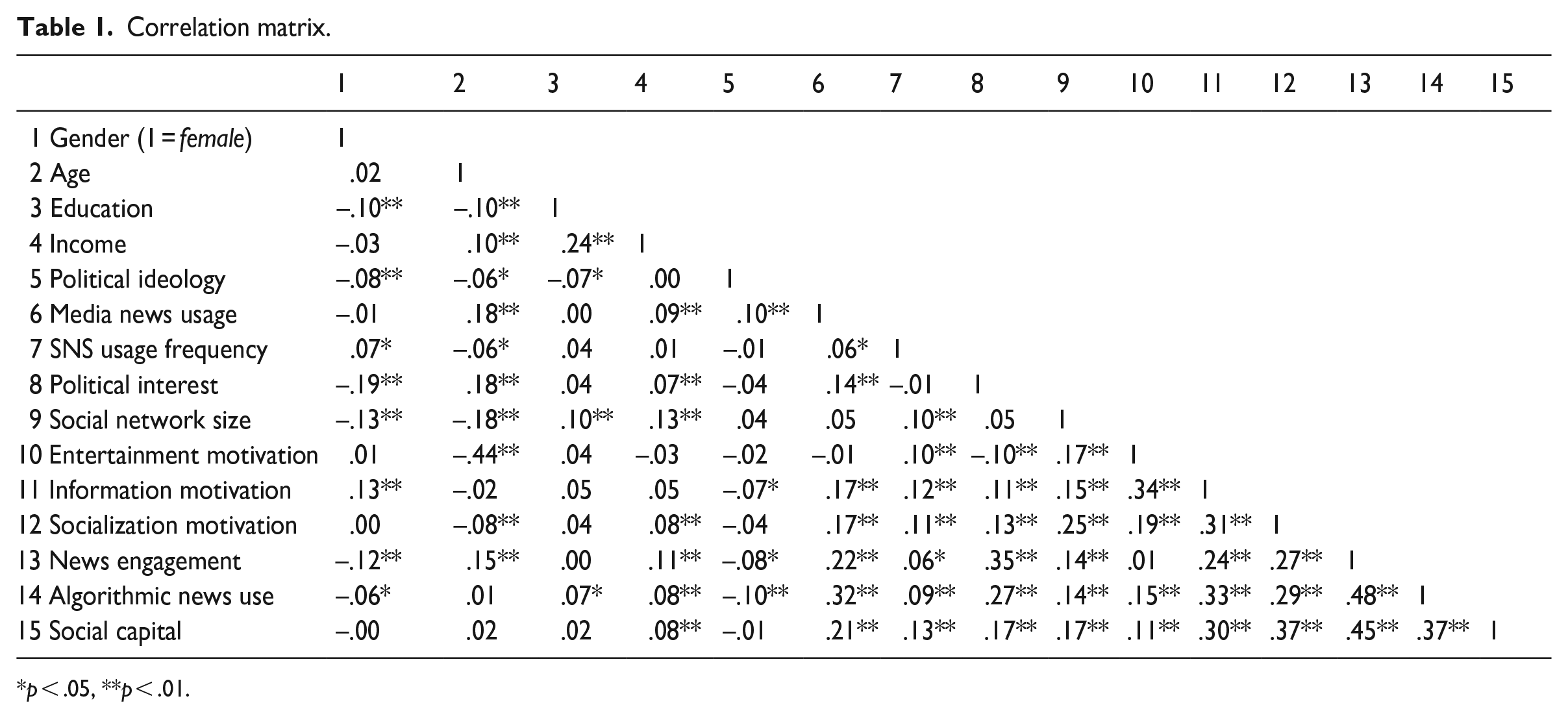
p < .05, **p < .01.
H1 postulated that both information (H1a) and socialization (H1b) motivations would positively influence news engagement, while entertainment motivation (H1c) would have no effect on news engagement. The results of the path coefficient test are presented in Figure 2. The results showed that the effect of entertainment motivation on news engagement did not reach a statistically significant level (B = -.02, SE = .05, p > .05), whereas information motivation (B = .16, SE = .04, p < .001) and socialization motivation (B = .18, SE = .03, p < .001) had a significant positive effect on news engagement. H1 was supported.
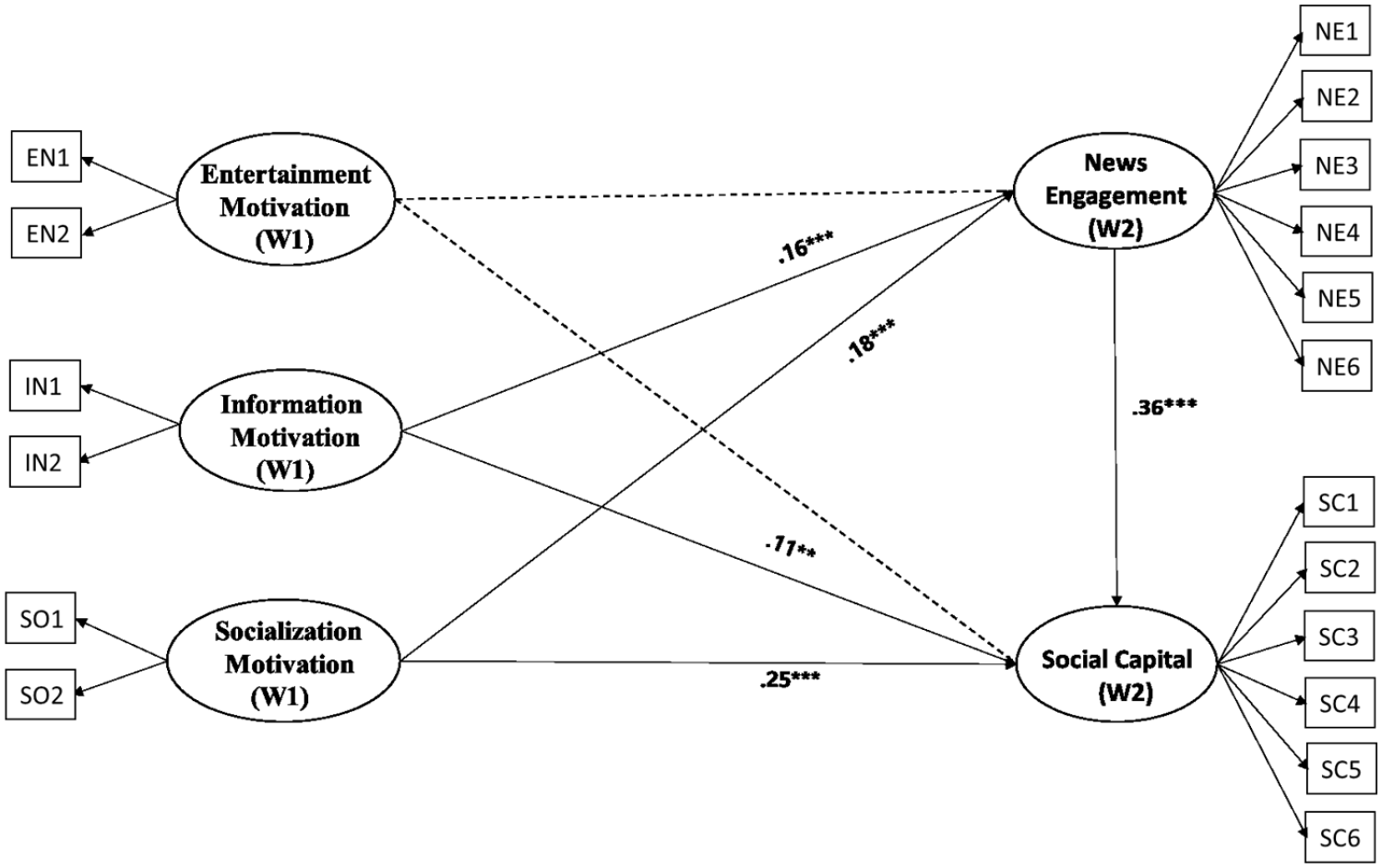
Path coefficients for mediation model.
News engagement significantly increased the level of individuals’ social capital (B = .36, SE = .03, p < .001). H2 was supported.
To test H3, we used the bootstrap estimation procedure in AMOS (bootstrap sample of 10,000; 95% confidence intervals). Table 2 shows the results regarding the mediating effect of social media news engagement on the relationship between different types of motivations and social capital. There were statistically significant indirect effects of information motivation (B = .062, CI = [.029, .082]) and socialization motivation (B = .070, CI = [.031, .074]) on social capital through news engagement, whereas the indirect effects of entertainment motivation on social capital through news engagement were not significant (B = −.01, CI = [ −.040, .017]). Thus, H3 was supported.
Mediation analysis.
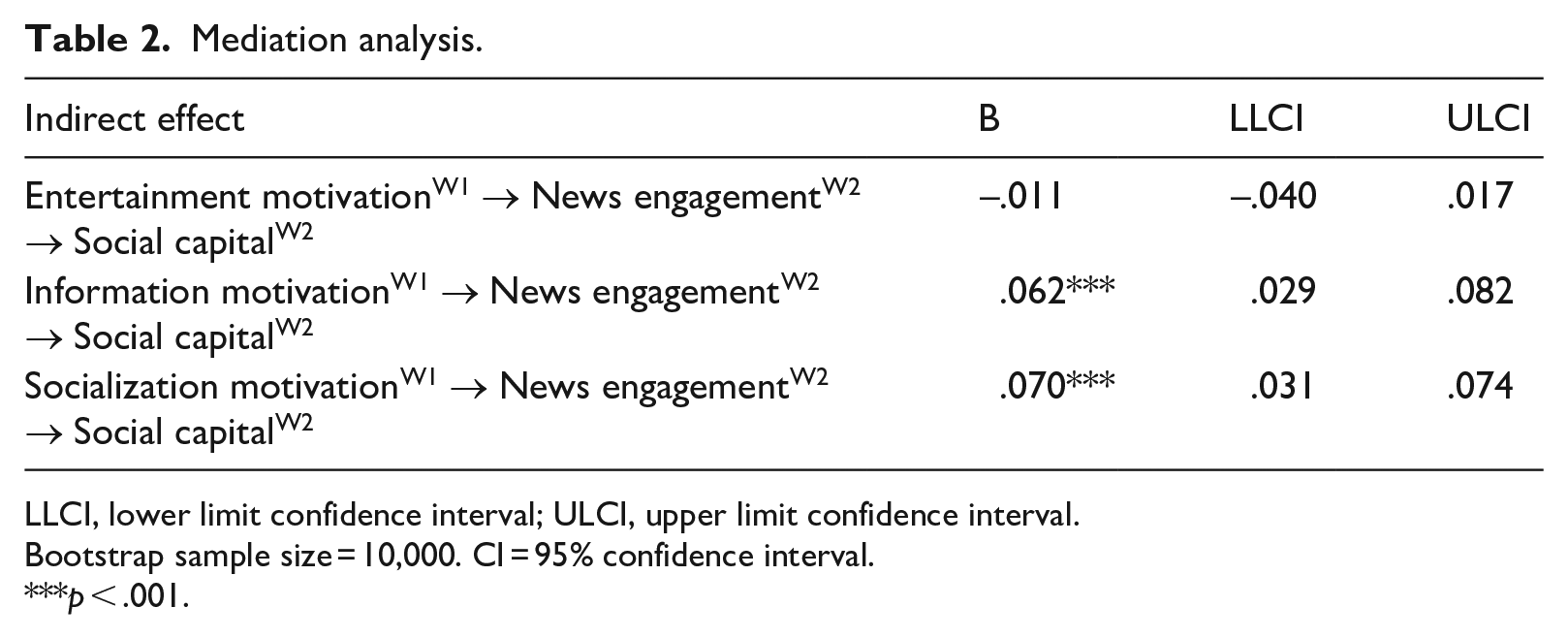
LLCI, lower limit confidence interval; ULCI, upper limit confidence interval.
Bootstrap sample size = 10,000. CI = 95% confidence interval.
***p < .001.
Algorithmic news use: the moderated mediation effect
The moderated mediation model created in PROCESS Model 7 further illustrates how algorithmic news use moderates the mediated pathways (RQ1). Table 3 reports the interaction terms and the coefficients for each mediated pathway. Each interaction and mediated pathway was tested in a separate model (three models in total). In addition, for the three independent variables, when one variable was specified as the independent variable, the other two variables were set as control variables to assure the consistency of the overall model used in the analysis.
Moderated mediation analysis using the PROCESS macro.
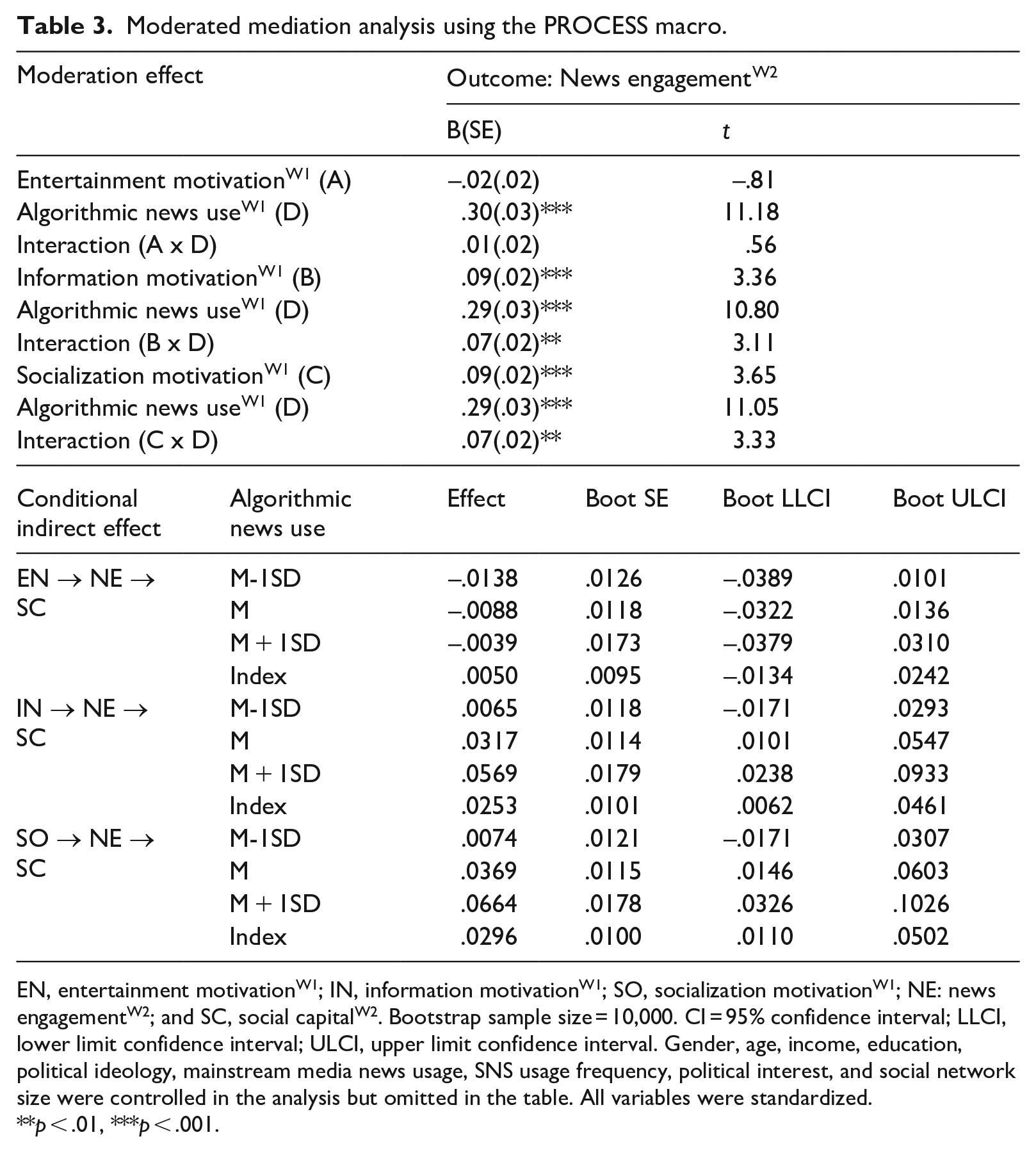
EN, entertainment motivationW1; IN, information motivationW1; SO, socialization motivationW1; NE: news engagementW2; and SC, social capitalW2. Bootstrap sample size = 10,000. CI = 95% confidence interval; LLCI, lower limit confidence interval; ULCI, upper limit confidence interval. Gender, age, income, education, political ideology, mainstream media news usage, SNS usage frequency, political interest, and social network size were controlled in the analysis but omitted in the table. All variables were standardized.
**p < .01, ***p < .001.
To answer RQ1, we tested the moderating role of algorithmic news use on the relationship between the three motivation types and social media news engagement (see Table 3 and Figure 3). The findings showed that the interaction terms for information motivation (B information × algorithmic news use = .07, SE = .02, p < .01) and socialization motivation (B socialization × algorithmic news use = .07, SE = .02, p < .01) had a significant positive effect on social media news engagement, but entertainment motivation (B entertainment × algorithmic news use = .01, SE = .02, p > .05) did not. 3
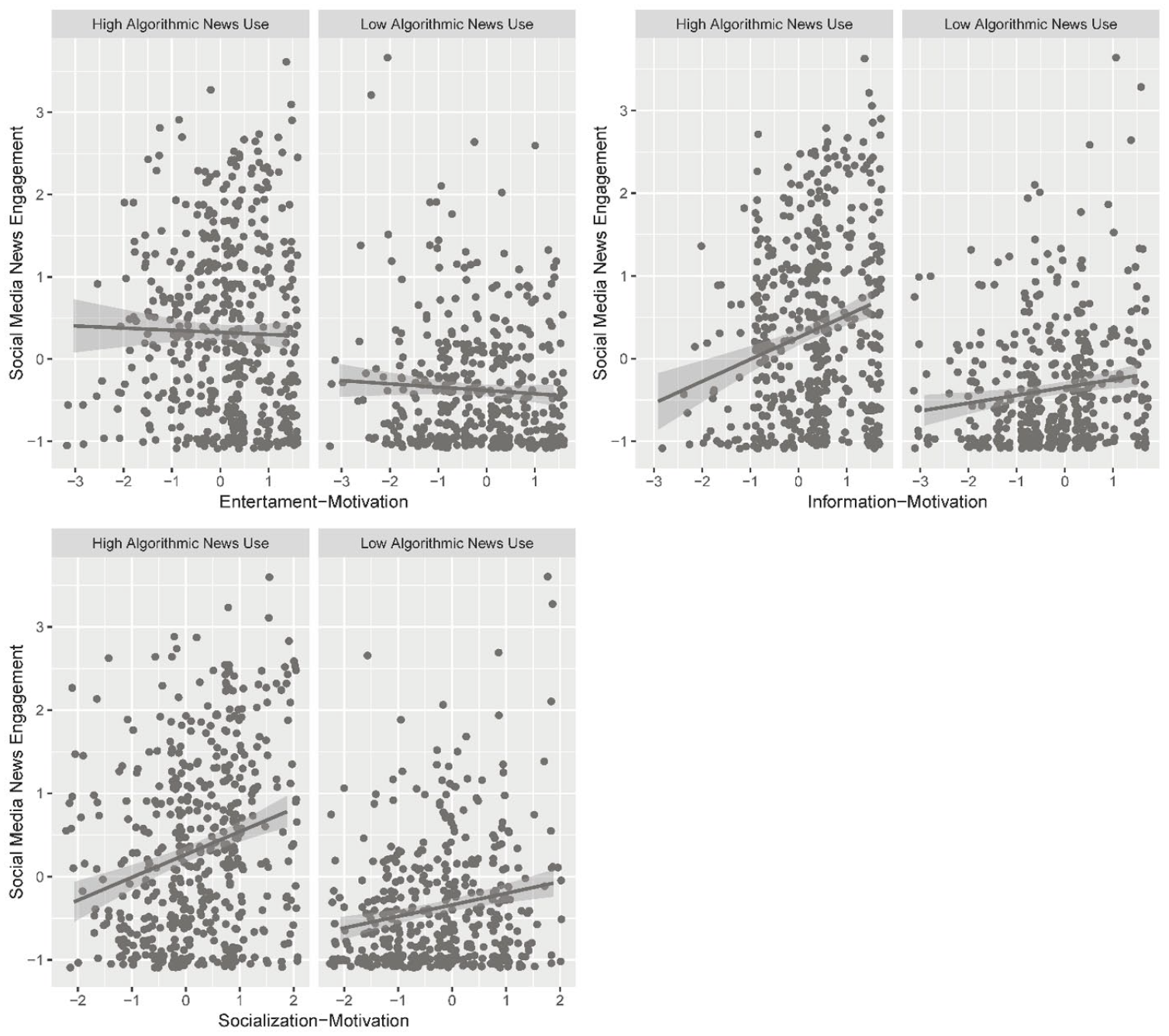
The conditional effects of three types of social media motivations on news engagement at two levels of algorithmic news use.
The results for the conditional indirect effects were also significant for information motivation and socialization motivation (Index information = .0253, CI = [.0062, .0461]; Index socialization = .0296, CI = [.0110, .0502]) and showed a more nuanced pattern. Specifically, we found that the positive indirect effect of information motivation (Blow = .0065; Bmean = .0317; Bhigh = .0569) and socialization motivation (Blow = .0074; Bmean = .0369; Bhigh = .0664) on social capital via news engagement increased with higher levels of algorithmic news use (see Table 3). These results demonstrated that news recommendation algorithms helped users with higher information motivation and socialization motivation improve their news engagement, which, in turn, increased their social capital. In contrast, algorithm usage failed to help those with higher entertainment motivation increase their news engagement and they thus struggled to develop social capital.
Discussion
Discussion of the primary findings
The findings can be summarized as follows. First, information and socialization motivations both positively predicted individuals’ news engagement on social media, but there was no significant relationship between entertainment motivation and news engagement. Second, news engagement on social media significantly predicted social capital. Third, the mediation mechanism based on the three-level digital divide framework suggests that those social media users who focus on information and socialization can enhance their social capital through their online news engagement. In contrast, those who focus on entertainment in their social media use cannot accumulate social capital through their news engagement. Finally, there was a significant moderated mediation mechanism of motivation for social media use, contingent on algorithmic news use, on social capital via news engagement: the indirect effects of information motivation and socialization motivation on social capital via news engagement intensify with increased algorithmic news use. In contrast, the recommendation algorithm plays no significant role for entertainment-motivated users.
This empirical evidence demonstrates that a digital divide exists in terms of news engagement and subsequent social capital formation through the news engagement of social media users based on their differing usage motivations. Platform algorithms further widen rather than narrow this divide because of their asymmetry in facilitating news engagement among social media users with different motivations.
These findings are related to several significant points of discussion. First, numerous studies have shown that news use on social media may be accompanied by various information inequalities (Barnidge and Xenos, 2021; Kümpel, 2020). However, previous research has only considered the gaps between news exposure and engagement levels. Our study, on the other hand, extends the explanation of the inequality of outcomes in terms of social capital. Our results support the third-level digital divide framework in that the engagement-level gap depends on users’ motivations at the accessibility level. The first-level gap gives otherwise advantaged groups a more significant usage advantage in accessing and processing relevant information, leading to inequalities in actual benefits. Our results also suggest that if people use social media primarily for entertainment, they are less likely to engage in news interactions, such as reposting news stories or commenting on news content that others have shared. Thus, users who are interested in the latest information and actively engage in relational interactions around such content are also more likely to accumulate social capital through their news engagement than users who use social media primarily or exclusively for entertainment purposes. This evidence highlights the far-reaching effects of gaps in news engagement, particularly in terms of exacerbating inequalities in social capital.
Second, our results support a stratification effect, rather than a compensatory effect, for platform recommendation algorithms in influencing news engagement. This evidence has important implications for expanding the field of research on incidental news exposure (INE). Many studies on INE focus on the optimistic potential of incidental exposure to news, especially for users who are not intrinsically motivated to seek out and engage with news (Valeriani and Vaccari, 2016). Thus, scholars expect it to bridge the news exposure and engagement gaps that exist between users (Weeks et al., 2022). However, most studies do not refine users’ motivations and ignore possible inequalities in news engagement among users with different motivations after their incidental exposure to news.
This study, therefore, adds to the theoretical and empirical evidence and raises some new questions about algorithm-based incidental news exposure. The results further suggest that while news algorithms provide incidental news exposure across all users, the “mobilizing effect” of recommendation algorithms (at least at the news-engagement level) is limited by the accessibility motivation of users. In other words, the effects of news recommendation algorithms are not equal for every social media user. An individual’s likelihood to engage with news content is still determined by intrinsic motivations, which are reinforced by news algorithms. Thus, an individual’s initial motivation to use a medium also largely determines the value of news recommendation algorithms. Future researchers should pay more attention to the prerequisites of individuals’ intrinsic motivations when considering the effects of news algorithms or incidental news exposure.
Finally, the differential results of the moderated mediation paths also suggest that news algorithms are further polarizing audiences. The interplay between algorithmic technology and individual motivations partially reinforces existing inequalities in news engagement. That is, those who benefit from seeing more news content and using news algorithms are already interested in public affairs and actively interact with others around related content. They gain beneficial experiences through their engagement with news and, thus, accumulate greater social capital. News recommendation algorithms amplify the impact of this indirect effect. However, people who use social media for entertainment are not motivated to engage in news interactions to accumulate social capital, even if they happen to stumble upon news because of platform algorithms. Therefore, it is no surprise that news recommendation algorithms cause this digital divide to further increase. In other words, people who are already interested in information and social communication are more likely to benefit from the news they are exposed to through recommendation algorithms. Those who are primarily concerned with entertainment, however, are excluded from the benefits that stem from news engagement (see Kim et al., 2013). Ultimately, news recommendation algorithms exacerbate information inequality and lead to a Matthew effect of the poor becoming poorer and the rich becoming richer (Kümpel, 2020) in terms of users accumulating social capital.
Limitations and future lines of research
There are several limitations to our study. First, although the current study used two-wave panel data, the analysis did not take full advantage of it. In other words, since we did not measure the dependent variable in the first wave, it is difficult to provide more robust evidence for causality through, for example, autoregressive techniques. Instead, we controlled the network size in Wave 1 in all analyses given that social network size is an important component of social capital (Calderón Gómez, 2021; Lake and Huckfeldt, 1998). Nevertheless, future researchers could consider approaches that can examine changes in outcome variables by measuring those variables with the same sets of items in both waves.
Second, the measurement of algorithmic news use relies on self-reporting. However, this measurement may not be perfect at the practical level (Wu-Ouyang and Chan, 2022). Because the role of algorithms is potential and algorithms may not be recognized, some users may not be aware that they are being exposed to algorithm-recommended content (Schellewald, 2022), although many people do perceive that news content is recommended by algorithms (Gran et al., 2021; Swart, 2021; Thorson, 2020). Nevertheless, we believe that a self-report–based survey is the most appropriate research method to understand how social media use motivations and algorithmic news use interact to affect individuals’ news engagement and social capital. Future researchers, however, could consider using realistic data or content-tracking methods to observe users’ news algorithm usage (e.g. Huang and Yang, 2022).
Third, algorithmic news use in this study was constructed by combining each item of explicit and implicit use. However, different types of algorithmic news use might produce different consequences. For instance, given that users can intervene with algorithmically curated content (Swart, 2021), they may alter or circumvent the effects of recommendation algorithms. Future researchers, therefore, could investigate whether and how different types of algorithmic news use show different effects in the proposed relationship with more specific and various measurement items. In addition, the concept and measurement of news engagement need to be discussed more carefully. The information-explosive social media environment makes it difficult for users to assess what is news and what is information. Considering this, Edgerly and Vraga (2020) introduced the concept of “news-ness” to assess the audience’s perceived tendency to characterize media content as news. Therefore, further research could consider measuring audience perceptions of “news-ness” to exclude any confounding effects on the findings due to the audience’s lack of clarity about the concept of news.
Finally, our findings are limited to the examination of social capital derived from social media platforms in consideration of the context of this study. It is important to note that the results of this study may not be generalizable to other types of social capital or a broad concept of social capital, which generally refers to the benefits or resources individuals can obtain through their relationships with others (Coleman, 1988). Social capital has been defined in various terms such as individuals’ social networks, the norms of reciprocity and trustworthiness that arise from social networks, and the advantages produced by social structures (Putnam, 2001; Williams, 2006). It encompasses “a stock of social norms, values, beliefs, trusts, obligations, relationships, networks, friends, memberships, civic engagement, information flows, and institutions that foster cooperation and collective actions for mutual benefits and contributes to economic and social development ” (Bhandari and Yasunobu, 2009: 486). Furthermore, the measurement of social capital in this study was based on self-reported perceptions, which may not accurately reflect the actual acquisition of social capital. It is crucial to explore the disparities between the perceived and actual acquisition of social capital as well as the potential differences between social capital acquired online and offline. Therefore, future researchers should investigate the feasibility of converting the advantageous use of algorithmic technology and news engagement on social media into various types of social capital including tangible offline social capital.
Conclusion
Despite these limitations, this work is the first step toward theorizing and empirically testing the impact of news recommendation algorithms on information inequality. These findings provide reflection for revisiting the role of news recommendation algorithms. In their current form, news algorithms are designed with personal preferences in mind, rather than being oriented toward civic engagement. While this orientation of the algorithms can help people access news information that better matches their preferences and needs at a lower cost, it may also expose users who are primarily or exclusively interested in entertainment to more entertaining information, thus reducing the attention to public affairs that is necessary for civic involvement, causing these users to lag behind others in terms of accumulating social capital.
Some scholars have also argued that innovations in data technology should reflect the “data justice” perspective of social equity and justice (Taylor, 2017). Therefore, if one of the goals of news algorithms is to reduce existing information inequalities and promote broader citizen engagement with news, research on news algorithms should not be limited to the exposure level. Even when incidental exposure occurs, users’ preexisting interests and motivational factors still determine the different ways in which news appeals to them. Therefore, increasing users’ “algorithmic awareness” (Gran et al., 2021), algorithmic literacy, and algorithmic curation skills (Swart, 2021) should also be directions of future efforts in algorithmic research. Researchers should also consider how news recommendation algorithms can enhance news attraction (see Thorson, 2020), encouraging greater news engagement among those who are otherwise uninterested in news. These efforts would have broad and profound implications for the mitigation of the digital divide and information inequality on social media.
Footnotes
Declaration of conflicting interests
The author(s) declared no potential conflicts of interest with respect to the research, authorship, and/or publication of this article.
Funding
The author(s) received no financial support for the research, authorship, and/or publication of this article.
