







Abstract
This study investigates the influence of digital platforms on the work–life balance of Brazilian journalists. It comprises empirical research with 35 news professionals, including 35 semi-structured interviews and 33 diary materials. Data were qualitatively analyzed using the thematic networks approach. Findings reveal that digital platforms have influenced the work–life balance of journalists in conflicting ways, encompassing positive, mixed, and negative effects. In this sense, news workers have employed various practices to limit their use of digital media and promote work–life balance. Overall, this study presents a more comprehensive description of the impact of digital platforms in journalism. It also highlights these technologies’ prominence to positive or negative spillovers between personal and professional spheres. Last, it introduces a cognitive map of the actions put in place by a professional group to keep their digital media use under some control, which may also be seen as practices of journalistic disconnection.
Introduction
The extensive presence of digital platforms in society has led to significant shifts in how people live, work, and carry out various activities (Gilkerson et al., 2018; van Dijck et al., 2018). In news industries, these changes transformed the daily routines in newsrooms, news outputs, how journalists relate to each other, their work environment, and life beyond professional practices (Bossio and Holton, 2021; Nieborg and Poell, 2018).
Despite the pervasive discourse that journalists work 24/7, which predates the emergence of digital media (Lucan and Zajc, 2023), the daily use of social media and messaging apps enhances the feeling of being connected to the workplace all day (Halliki and Josephi, 2020). This situation might have different consequences for journalists seeking to balance multiple domains of their lives.
Against this backdrop, this study delves into the influence of digital platforms on journalists’ work–life balance attempts. It seeks to understand how the daily use of digital media disrupts this balance and what practices journalists have been employing to manage diverse dimensions of their lives. In other words, it aims to complement the well-known diagnosis of increasing precarity in the news work (Rick, 2024; Rick and Hanitzsch, 2023) to grasp how digital platforms affect journalists’ daily routines—given the inseparability of professional and personal life in journalistic work (Örnenbring and Möller, 2018).
The research is grounded in empirical research with 35 Brazilian journalists. Thirty-five respondents participated in the semi-structured interviews, and 33 sent diary materials (Zimmerman and Wieder, 1977). Data was qualitatively examined through thematic networks (Attride-Stirling, 2001), identifying global themes corresponding to the research questions.
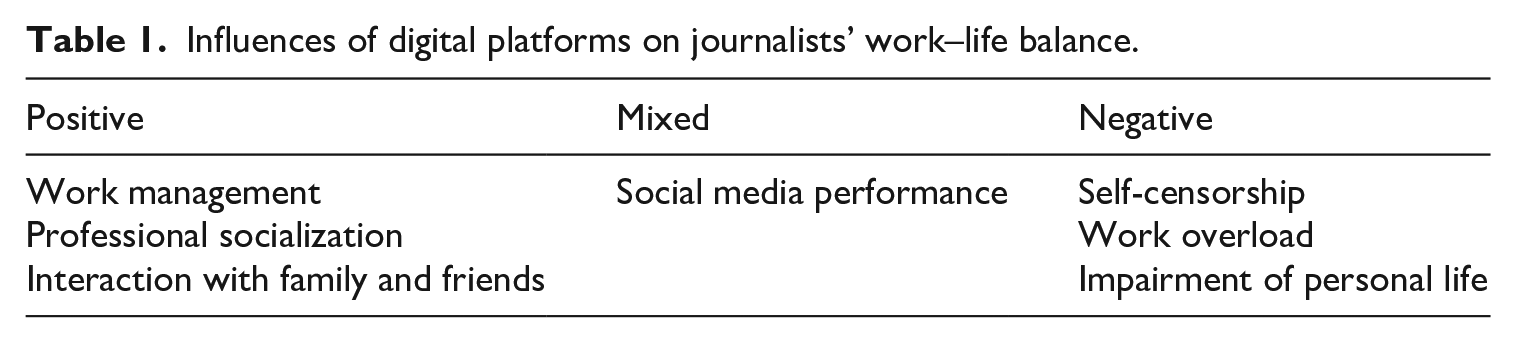
Findings show that social media and messaging apps impact journalists’ work–life balance, encompassing aspects perceived as positive (i.e. work management, professional socialization, interaction with family and friends), mixed (i.e. social media performance), and negative (i.e. self-censorship, work overload, impairment of personal life).
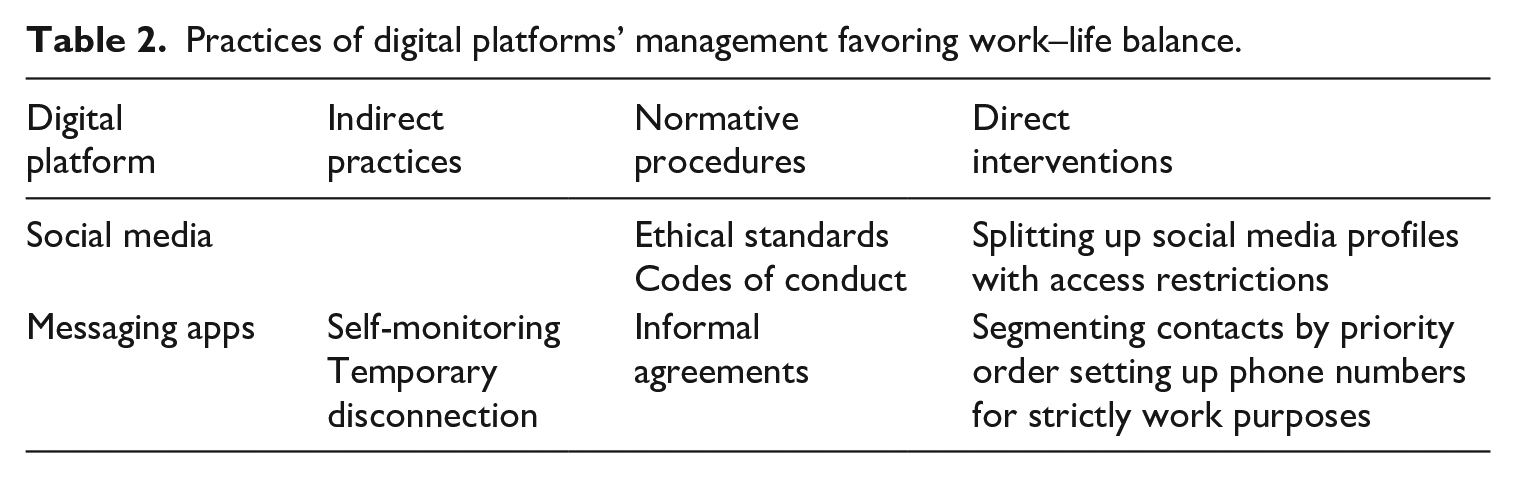
In order to mitigate the adverse consequences of digital platforms in their everyday routines, journalists employ various tactics to leverage these technologies with varying degrees of effectiveness, including indirect ones (i.e. self-monitoring, temporary disconnection), normative ones (i.e. ethical standards, codes of conduct, informal agreements), and direct ones (i.e. splitting up social media profiles with access restrictions, segmenting contacts by priority order, and setting up phone numbers for strictly work purposes). We categorize these practices based on their cognitive load, financial cost, and the time required to implement them. While not reversing the macro trends of growing precarity in news markets, these practices showcase journalists’ agency in managing digital platforms to benefit their work–life balance.
This study makes four significant contributions to the scholarly literature in digital journalism, the sociology of news work, and work–life balance studies. First, it provides a comprehensive understanding of the pervasive presence of digital technologies in journalists’ routines, exploring the permeability between professional and personal spheres in everyday life. Second, it builds upon previous research on journalistic disconnection, demonstrating how news workers have managed their use of digital media with partial disconnections within a connective logic. Third, it underscores the importance of considering the prominence of social media and messaging apps when examining the work–life balance, whether in journalism or other markets. Finally, it introduces a cognitive map of the actions put in place by a professional group to keep their digital media use under some control.
Literature review
Shifts in journalistic work
In recent years, scholarly literature has indicated either an acute “crisis” or “structural changes” in journalism (Pereira and Adghirni, 2011; Pickard, 2020). Studies based on different contexts have shown a worsening of journalists’ labor conditions (Nicoletti and Mick, 2018; Rick, 2024; Rick and Hanitzsch, 2023). It has highlighted the widespread multitasking in newsrooms (Koivula et al., 2023), the pressures to publish on a 24/7 scale (Lucan and Zajc, 2023), and the integration of digital technologies in news work (Dodds, 2019; Nieborg and Poell, 2018), which means deregulating news production, increasing the workload and losing the autonomy of journalists, especially in light of the industry’s use of metrics (Cohen, 2018).
In addition, journalism became more precarious, which encompasses the flexibilization of work contracts, the expanding array of atypical works (e.g. freelancers, part-time jobs) (Cohen et al., 2019; Lelo, 2022; Josephi and O’Donnell, 2023) and project-based employment in independent startups and alternative media (Fígaro, 2018).
Transformations in news industries have impacted not only the opportunities for practicing journalism but also the quality of life of news workers, including health-related problems (Pontes and Lima, 2019) and work–life imbalances (Snyder et al., 2019). It must be noted that this challenging context has been exacerbated by the COVID-19 pandemic (Fígaro et al., 2022; Rick and Hanitzsch, 2023), further impacting journalists’ lives.
Even though there is a lack of research on the work–life influences in journalists’ careers, a recent study (Pereira, 2020) has pinpointed the strong link between personal and professional motivations to pursue specific occupations. Decisions related to marital life, family planning, and time available to leisure influence satisfaction and career prospects in journalism. Nevertheless, most scholarship on news work has been workplace-centered (Örnebring and Möller, 2022), disregarding the intertwining of professional and personal fields in journalistic careers. Prior research has shown that news professionals’ careers are based on practical competencies, a specific lifestyle, and the establishment of various work and non-work-related networks (Ruellan, 2017).
Furthermore, there is compelling evidence that the working hours in newsrooms no longer serve as a clear boundary between professional and personal practices. In the current context of flexible labor relations, intensive use of digital technologies, and the growing prevalence of home offices (Rick and Hanitzsch, 2023), the lines separating work and leisure have become increasingly blurred in news industries (Grönlund and Öun, 2018).
Influences of digital platforms on journalistic practices
The body of knowledge on digital journalism has dug into the effects of digital platforms in media markets. We conceptualize digital platforms as proprietary infrastructures, most based in the United States (e.g. Google, Meta, X), that provide Application Programming Interfaces (API), which enable structured access to data and functionalities through “the systematic collection, algorithmic processing, monetization, and circulation of data” (Poell et al., 2019: 3).
A relevant branch of this scholarship has described the integration of digital technologies in news work, comprising verification practices (Himma-Kadakas and Ojamets, 2022), news sourcing (Zhang and Li, 2019), and team management (Bunce et al., 2018). There has also been research on using social media and messaging apps to distribute news content (Dodds, 2019) and for journalists’ self-promotion (Mellado and Hermida, 2021). However, with few exceptions (Bossio et al., 2024; Bossio and Holton, 2021), this framework is centered on depicting shifts in news work due to the use of new technologies, overlooking their macro consequences to the journalistic field.
In contrast, there has been plenty of critical research on the adverse effects of digital platforms in media industries (Nechushtai, 2017; Nieborg and Poell, 2018; Papaevangelou, 2024), encompassing editorial decision-making (Lischka and Garz, 2023), the interactions with users (Quandt, 2018; Waisbord, 2020), and the development of journalistic identities and careers (Powers and Vera-Zambrano, 2018). These works have called into question the gradual dependency of journalism on big tech support. It has addressed the “capture” of media outlets by platforms’ funding programs (Nechushtai, 2017; Papaevangelou, 2024) and the modularization of news content to the big techs’ technical infrastructure (Nieborg and Poell, 2018).
Moreover, the increasing visibility of journalists on social media has led to harassment from dissatisfied users, particularly when news professionals report context-sensitive topics (e.g. politics, religion, civil rights) (Quandt, 2018; Waisbord, 2020). The attacks against journalists on digital platforms have been characterized as users’ “dark participation” (Quandt, 2018). These attacks can potentially result in self-censorship to deter further persecution, threats to physical safety, and even the abandonment of journalism (Waisbord, 2020). Recent research has also conceptualized disconnection as a mediating strategy to curb journalists’ over-engagement with this controversial “cultural logic” of connection (Bossio et al., 2024).
Yet, it is worth mentioning that even this critical body of knowledge has neglected the interface between journalists’ professional and personal practices in their daily use of social media and messaging apps—an issue investigated in other labor markets (Gilkerson et al., 2018). This perspective is particularly relevant given the significant user base of digital platforms in Brazil, with over 147 million WhatsApp users and 150 million Facebook users (Statista, 2023). It underscores the importance of digital platforms in journalistic practices, as well as their impact on the work–life balance of practitioners.
Work–life balance
The scholarly literature on work–life balance, which originated in Europe and the United States in the 1970s (De Mello e Souza et al., 2019; Guest, 2002), emerged from a diverse range of academic subfields, including organizational behavior, human resource management, and quality-of-life studies (Sirgy and Lee, 2018). These early works focused on the conflicts and stress of modern life, the challenges women face entering the job market, and the role disputes within dual-career couples (De Mello e Souza et al., 2019).
The concept of work–life balance speaks about individuals’ “ability to fulfill role obligations in both the work and home environment” (Snyder et al., 2019: 2). This notion encompasses the work–family balance, which is more associated with family-related issues and couple conflicts on the distribution of domestic labor and childcare. The work–life balance also comprises personal lifestyles, including the aptitude to allocate time for healthcare and leisure (Snyder et al., 2019).
It should be noted that this framework is designed for analytical purposes to observe how a person’s job relates to other aspects of their life. Through this approach, professional activities refer to paid work and the responsibilities of a specific occupation. The personal sphere includes daily routines unrelated to some métier, as well as other aspects such as health, family, and leisure.
The academic interest in that topic has grown due to the degradation of working conditions in several labor markets. The pressures of work, the extending of business hours, and the impacts of these shifts on professionals’ daily routines have called into question how people have been facing these engaging circumstances in their personal and professional lives (Guest, 2002). In addition, the increasing privatization of family issues and the reduction in concern for community participation have led scholars to investigate the time dedicated to occupational activities and workers’ mental health and quality of life (Guest, 2002).
The concept of work–life balance has also been used in journalism studies. Research on that subject has centered on the challenges of women journalists balancing their professional and personal demands, particularly parenting concerns (Örnebring and Möller, 2018). Likewise, there has been research on how men and women practitioners have handled conflicting demands and the positive and negative spillover between work and life (Snyder et al., 2019).
It is worth noting that the scholarly literature on journalists’ work–life balance has predominantly centered on the so-called Global North. Even in Portuguese-language publications, there is a dearth of research on this topic (Egreja and Melo, 2023). Furthermore, the existing studies on the work–life balance of news professionals have overlooked how digital platforms have influenced that balance. Social media and messaging apps have become essential tools for journalistic work (Dodds, 2019; Himma-Kadakas and Ojamets, 2022; Zhang and Li, 2019), but their impact on news professionals’ life management still needs to be explored.
The Brazilian news market provides a compelling case study because digital platforms have strongly disrupted it in recent years (Fígaro and Marques da Silva, 2020). Previous research has highlighted how the big techs’ growing concentration of advertising revenues has hindered the profit margins of mainstream media, resulting in massive layoffs in traditional newsrooms (Pontes and Mick, 2023). Consequently, many journalists have worked part-time in atypical roles, such as freelancers and independent contractors (Lelo, 2022). In addition, the COVID-19 pandemic has accelerated the shift to home office, particularly in news startups (Fígaro et al., 2022). Thus, the boundaries between work and leisure have become increasingly blurred, with digital platforms used daily to manage various aspects of journalists’ lives.
Therefore, it is crucial to investigate how social media and messaging apps have been integrated into journalists’ daily routines and how they have navigated personal and professional requests to benefit their work–life balance.
Considering these gaps in the literature, this study asks:
Methods
This study is grounded in empirical research, encompassing semi-structured interviews and diary materials (Zimmerman and Wieder, 1977). Data were qualitatively analyzed using the thematic networks approach to answer the RQs. It aims to understand digital platforms’ influence on Brazilian journalists’ work–life balance and how they handle conflicting demands in everyday routines.
Although the research corpus is not representative, it tries to mirror the sociodemographics of Brazilian news professionals. Thus, it is guided by the most comprehensive report on this subject, the Brazilian Journalist Profile—2021 (Lima et al., 2022), to ensure the study’s relevance and applicability. This study mirrors the report data on gender and regional distribution. Yet, it also bears in mind information on age, race, and parental status to define the participants.
In constructing our sample, we also took into account the nationally situated definition of what it means to be a journalist in Brazil. For historical reasons (Lima et al., 2022), this definition includes people who work in newsrooms, freelancers and entrepreneurs’ journalists, as well as in press offices and public and corporate communications (for example, university and government journalists)—something that in other countries would be considered a PR job (Fredriksson and Johansson, 2014). Indeed, data from the Brazilian Journalist Profile—2021 (Lima et al., 2022) showed that 34.9% of the respondents work “outside media companies.”
Data collection spans from 20 March to 8 August 2023. It comprises 35 semi-structured interviews and 33 diary materials from 35 journalists. Verbatim transcripts were examined through thematic networks (Attride-Stirling, 2001). The data set comprises 324 pages of documents.
This study is an excerpt of more extensive research on negotiations between the professional and personal lives in the careers of Brazilian journalists. The Institutional Review Board (IRB) approval was registered on September 8, 2023, via number 70429223.2.0000.5540. To maintain the confidentiality of the sources, their names and personal information were excluded during the transcription (e.g. names of friends and family, places of work) and replaced by pseudonyms associated with one of the five major Brazilian geographical regions where informants lived. Thus, the codes used to refer to participants were C = Centro-Oeste (Central-West); N = Norte (North); ND = Nordeste (Northeast); S = Sul (South); SD = Sudeste (Southeast).
The specific methods used for collecting data are detailed below.
Semi-structured interviews
Thirty-five Brazilian journalists from the five country’s geographical regions were interviewed to understand how digital platforms have affected their professional and personal life management. The research team designed the interview script prior and tested it with four pilot interviews to adjust the method.
Informants were asked about (1) their trajectories and prospects for the following years, (2) their work–life balance strategies and how personal and professional demands have impacted their career, (3) their everyday use of digital media and how it has affected their work–life balance attempts. Given that this study is an excerpt from broader research, only questions focused on news professionals’ daily use of social media and messaging apps are further examined.
The sample follows the demographics of the Profile of Brazilian Journalist—2021 report (Lima et al., 2022) in five categories: regional distribution, gender, age, race, and education.
Regarding regional distribution, most interviewees worked in the Southeast (N = 16, 45.7%) and Northeast (N = 7, 20%). In the other regions (i.e. Central-West, South, and North), the same number of participants were registered (N = 12, 11.4%). With respect to gender, most informants identified themselves as women (N = 22, 62.85%), and 37.14% (N = 13) as men. Concerning age, the majority of journalists were between 31 and 40 years old (N = 13, 37.4%), followed by those between 23 and 30 years old (N = 9, 25.7%). With respect to race, most participants identified themselves as white (N = 20, 57.4%), followed by brown (N = 7, 20%), black (N = 5, 14.28%), and Asian (N = 2, 5.71%). Last, as regards education, most interviewees had a bachelor’s degree (N = 13, 37.4%). Many journalists also had a specialization (N = 12, 28.57%), but there were some with master’s (N = 8, 25.71%) and PhD (N = 2, 5.71%) degrees.
Given this study’s national scope, the interviews were conducted in a hybrid format. The journalists chose the interview format, whether video or telephone calls, audio recordings, or text messages. This flexibility was a deliberate effort to ensure the suitability of the study to the new workers’ agendas, a professional group well known for its long business hours (Halliki and Josephi, 2020). 21 interviews were carried out via video calls, nine through audio recordings, four via message texts, and one through a telephone call. In the case of video calls, the material was recorded only in audio for verbatim transcription. The average duration of interviews via video or telephone calls was 45 minutes.
Diary materials
In addition to interviews, participants were asked to register their professional and personal activities during an entire day, preferably a working day (e.g. Mondays to Fridays). This research method followed the diary-interview method proposed by Zimmerman and Wieder (1977). The research team chose it considering the strategic challenges of undertaking ethnographic research into journalists’ intimate spaces, like their homes, for extensive periods. The diary material aimed to grasp how news professionals manage their use of digital platforms with their work–life balance attempts.
The informants were asked to voluntarily share, via text messages or audio recordings, a summary of their daily tasks divided into the three parts of the day: morning, afternoon, and evening. Diaries should preferably be sent the day before or after the interview to detail the relationship between professional and personal practices in news workers’ everyday lives. Of the 35 participants of this study, 33 agreed to produce diary materials.
Thematic networks
Data was verbatim transcribed and grouped into standardized documents to undertake a qualitative thematic networks analysis (Attride-Stirling, 2001). The initial coding was produced by reading the transcribed documents to identify emergent themes related to the RQs. The three authors thoroughly dissected the qualitative material to identify any discrepancies in interpretation, which they then discussed and resolved in meetings to ensure reasonable agreement. Thus, emergent themes were grouped, keeping in mind the relationship between digital platforms’ use and journalists’ work–life balance concerns. Independent thematic analyses were conducted in these global themes to answer the RQs. This study’s findings encompass data from both interviews and diary materials.
Results
The major findings of this research are presented below to answer the RQs. The first subsection centers on how journalists understand digital platforms’ influence on their work–life balance attempts. The second introduces a cognitive map of practices news professionals adopt to mitigate the adverse effects of using social media and message apps daily.
Influences of digital platforms on the journalists’ work–life balance
Answering RQ1, i.e. “How have digital platforms influenced the work–life balance of Brazilian journalists?,” analysis shows a close relationship between social media (e.g. Instagram, Facebook, X) and messaging apps (e.g. Telegram, WhatsApp) management and their consequences on personal and professional practices.
Findings indicate that digital platforms’ have positive, mixed, and negative effects on news professionals’ work–life balance (see Table 1). The participants’ conflicting assessment of these technologies follows prior studies demonstrating contradictory consequences of digital convergence on journalistic practices (Bossio et al., 2024; Bossio and Holton, 2021; Dodds, 2019).
Influences of digital platforms on journalists’ work–life balance.
Positive influences
According to news professionals, social media and messaging apps have three positive effects on work–life balance: improving work management, strengthening social bonds in newsrooms, and enabling remote interaction with family and friends.
Regarding work management, several interviewees indicated that groups on messaging apps, particularly WhatsApp, have been used to oversee newsroom task flow. They highlighted that these tools have allowed them to speed up news production by overcoming physical distance, including communicating with co-workers, sources, and audiences. For example, SD6 (Man, 59 years old, journalist, and professor) dugs into this issue in his interview: “Nowadays you can hold an editorial meeting and talk with people over the country through messaging apps.” In addition, N4 (Woman, 45 years old, content director) stated in her diary that she can review the newspaper’s cover at home, after her son sleeps, far away from the newsroom: “Each editor revises these pages because they are strategic, a showcase to our newspaper.”
Another positive outcome of the daily use of digital platforms in newsrooms is strengthening social bonds. Several studies have pointed out how newsrooms’ socialization encourages conformity to journalistic norms and identity (Breed, 1955; Ruellan, 2001). Some participants stated that WhatsApp groups, created for working purposes, are important channels to interact with colleagues, enhancing affective bonds that extend beyond newsrooms, as emphasized by ND2 (Woman, 35 years old, journalist working for the government) in her interview: “Outside the work environment there is informal interaction in messaging apps’ groups, and sometimes we meet and go out somewhere.”
Furthermore, some informants, particularly women journalists with children (four cases), stressed that messaging apps facilitated remote family interaction during working hours, mainly with school-age children. This has led to a positive spillover between professional and personal lives. The diary of SD12 (Woman, 36 years old, government communication adviser, and freelance journalist) illustrates this point: “Throughout the day, I keep remote contact with my daughter to know how she is, providing some support and making myself as ‘present’ as possible to her.” Likewise, some schools now have apps that post students’ daily activities, allowing parents to follow their children’s day. N4 (Woman, 45 years old, content director) addressed this topic in her diary: “In these apps, they report any issues, and on Fridays, they share photos of the week’s highlights, creating a kind of social media experience for parents.”
In this sense, messaging apps have supported solidarity networks within the family, helping women journalists alleviate motherhood’s adverse consequences on their careers. This does not mean that parenthood impedes pursuing a career in journalism or that work and life are mutually exclusive dimensions. Nevertheless, given the poignant lack of public policies to support caregivers in Brazil, particularly women (Rodrigues, 2024), parenthood poses an additional obstacle for news workers. In our data, three women journalists with children have shared how motherhood has affected their careers. This includes reducing their workload to focus more on children (S3), as well as opting to work from home with precarious contracts to accommodate their children’s demands and schedules (SD14 and SD16). As previous research has shown, these challenges are widespread among journalists who are mothers (Kim, 2006; North, 2016; (Örnenbring and Möller, 2018).
Mixed influences
The only mixed influence of digital platforms’ everyday use on journalists’ work–life balance is the management of social media accounts to work and non-work-related practices. Some participants pointed out that social media performance is a vital resource for amplifying news articles’ reach and leveraging commercial partnerships. ND5 (Woman, 25 years old, content producer working for the government) foregrounded this aspect in her interview:
The investment and the money go to those who have many followers (. . .) because whether you like it or not, this is a thermometer of how many people you can convince, or how many people you can engage around your work.
However, social media management involves content creation, discouraging using digital platforms for personal purposes. ND6 (Woman 34 years old, journalist and government communication adviser) addressed this issue in her interview: “My social media (. . .) have always been for my stuff. Yet, over time, I have realized that my professional work on social media has grown.” Finally, some informants criticized the competition between journalists triggered by disputes over social media metrics. SD12 (Woman, 36 years old, government communication adviser and freelance journalist) delved deeper into that topic in her interview: “Social media bolsters something that has always been pervasive in journalistic careers. I believe it imposes competition on all occupations, which is a very noxious competition.”
Negative influences
The adverse influences of digital platforms’ use on journalists’ work–life balance attempts are self-censorship, work overload, and the impairment of personal life. These three effects fall under the negative work-to-life spillover (Snyder et al., 2019).
Self-censorship manifests through the fear of professional consequences due to posting or commenting on something that could disagree with the ideological guidelines of the media group a journalist works for. Therefore, journalists censor their self-expression to anticipate professional losses ranging from reprisals to dismissals. It should be noted that these concerns are not limited to current bosses but also potential employers that news workers believe will check their social media profiles in job interviews. These widespread fears among Brazilian journalists have led them to overconcern about having their careers affected by social media and the feeling that their online performances have not matched their moral values and political standpoints. N3 (Woman, 42 years old, communication director working for the government) outlined this permanent anxiety in her interview: “I cannot express my opinion [on social media] because I know that, in my organization, there are other viewpoints regarding that subject. Thus, although I want to speak, I must refrain.”
Many participants have also felt burdened by using digital platforms to manage newsroom workflow. They stated that these tools encourage people, from sources to bosses, to contact them anytime, from when they wake up until bedtime. C4 (Woman, 41 years old, manager at a media agency) illustrated this point in her diary: “I went out to dinner and still had to solve some work issues that popped up on my phone (. . .). I think there is also an addiction to following what is happening in the WhatsApp groups.” She argues that she has gotten used to the excessive availability demanded by the profession.
Interviewees also highlighted that the home office during the COVID-19 outbreak would have contributed to the work overload. Several informants said they felt mentally and physically exhausted, as SD13 (Woman, 65 years old, press officer): Before [the pandemic], when I left the office (. . .) I did not keep on social media to see if something worked, I did not keep talking with the team. When the day ended, we left the newsroom and said goodbye to everyone because we would be back tomorrow” (Interview).
Finally, journalists also regretted that the constant interaction via messaging apps and social media hindered them from concentrating on news articles that require more commitment, multiplying the number of tasks they need to manage simultaneously. S1 (Man, 40 years old, government press advisor) delved into this issue in his interview: “I decided to sit here now to write all morning, but next thing I know (. . .) I am receiving disturbances, sometimes it is on WhatsApp, so you have to deal with all those messages.”
In tandem with the experience of work overload while managing digital media for personal and professional purposes, many journalists mentioned a negative work-to-life spillover impairing their lives. News professionals claimed that the excess of demands received on messaging apps (mainly WhatsApp) prevented them from engaging with their family and friends. N4 (Woman, 45 years old, content director) exemplified that aspect in her interview: “It is WhatsApp morning, afternoon, and night. This is one of the things I have noticed that bothers my son. Then, when I am with him, I leave my smartphone away because he complains—Mommy, no phone.”
To conclude, news workers also emphasized that their free time is disturbed by requests from co-workers, sources, and readers, enticing frustration and emotional fatigue, as SD6 (Man, 59 years old, journalist, and professor) explained in his diary: “Journalism ends up being part of your life 24/7, even if you have a personal commitment, like going out, going to a children’s party, or something else. You are always on the phone and social media.”
Practices of using digital platforms to benefit the work–life balance
RQ2 asks how journalists leverage social media and messaging apps to benefit their work–life balance. Findings reveal plenty of practices adopted by these professionals aiming for a positive spillover between their life domains. They extend from indirect practices to normative procedures on news organizations and direct engagements on technological devices (see Table 2).
Practices of digital platforms’ management favoring work–life balance.
This typology is somehow inspired and adapted from Hennion’s pragmatic sociology and his use of the concept of engagement (cf. Stewart, 2015; Teil and Hennion, 2024). In short, we suggest that (1) individuals (journalists) engage in social practices (e.g. improving work–life balance) by using cultural objects (e.g. social media and messaging apps); (2) these engagements involve a degree of reflexivity; (3) these engagements vary in their focus and intensity—as well as in the resources required; (4) these engagements can modulate or even change the properties of such objects.
Thus, the more journalists use technological devices to promote, improve or change their work–life balance, the more time they spend planning and carrying out social practices. As a result, the intensity of such practices and the amount of cognitive resources required to perform them increases. Less engaging practices require small adjustments to journalists’ daily routines or to their perceptions of their work. More engaged individuals need to intervene in their informal or institutionalized agreements with the newsrooms or the professional group, including adapting their ethos (e.g. working less than expected by their peers and bosses) or their code of conduct. Finally, more engaging practices lead to innovative or subversive appropriations of social media and messaging apps, changing the intended uses of this object.
Otherwise stated, indirect practices are labeled as such because they require less planning and only put a cognitive load on the individual. Normative procedures are more engaging as they assume an agreement between the journalist and the media outlet, posing a cognitive and time burden on the journalist. Last, direct interventions are the most engaging as they require planning and are costly in terms of mental, financial, and time resources. In addition, they demand more planning. It must be noted that while these diverse practices may overlap in daily routines, they emerged as analytically distinct categories due to the resources required to be set in motion. The following details such practices, with examples from the dataset.
Indirect practices
Journalists’ indirect practices to moderate their use of digital platforms are limited to self-monitoring time expended on messaging apps or temporarily disconnecting them to enhance, although often unsuccessful, work–life balance. They usually impose a cognitive burden on those who rely on them.
Self-monitoring is a strategy to moderate the time expended in answering professional demands via messaging apps (mainly WhatsApp), prioritizing using these tools during working hours. When the day ends, journalists redirect their attention to personal issues. In her interview, C4 (Woman, 41 years old, manager in a news agency) described this practice: “I try to police myself to work during business hours because messages arrive all the time.” Likewise, S4 (Woman, 27 years old, journalist and freelancer) said in her diary that she strives to be present for her family at night, prioritizing family time over work obligations: “I leave the newsroom at 5:15 PM to pick up my son from school, and from that time onward I am completely available for my family. Evenings are the moments when we are together the most.”
Temporary disconnection goes beyond self-monitoring because it requires leaving smartphones aside in leisure time or family gatherings. Nevertheless, some participants concurred with being called on messaging apps, regardless of the moment, when there is an urgent demand. For instance, N2 (Woman, 24 years old, editor) said in her diary:
I only look at [the smartphone] after I finish my studies to see if there are any work requests. If something is critical [such as a big incident], I will attend to it, but if it is not urgent, I will leave for the next day.
Normative procedures
Normative procedures comprise appeals to ethical standards, informal agreements, and codes of conduct established in news organizations to ensure that journalists are not demanded after work. Given that these procedures demand active negotiation to formulate tacit or expressed agreements, they require a higher degree of agency and reflexiveness to be effective. Besides, they not only impose a cognitive burden on journalists who must negotiate these normative frameworks with their peers but also consume a lot of time.
The appeal to ethical standards is the first of these practices. Some interviewees moderated their self-exposure on social media, bearing in mind the ethical principles of journalism, such as objectivity and neutrality. In other words, they recurred to their professional identity’s ideological tenets (Deuze, 2005). In such instances, the decision to restrict social media performance did not come from fears of professional consequences or explicit codes of conduct but from a journalist’s intimate consideration. For instance, SD11 (Woman, 24 years old, journalist and content producer) stated in her interview: “I take extra care with all my posts, and I know how important they are, so I think very carefully before publishing anything on social media.”
In a more intersubjective way, establishing informal agreements with co-workers is another strategy to reduce the volume of demands received outside working hours via messaging apps. This procedure requires greater engagement from the journalist to be successful, given the need for consent from other individuals. SD7 (Man, 54 years old, press officer and content producer) went into this issue in his interview: “You must, I think, it is crucial to make clear for your customers that you will not be available on the weekends.” It is worth mentioning that this informant is referring to the clients of his press office agency when he speaks about “customers.” When SD7 was interviewed, he was running a small business focused on content production for nongovernmental organizations (NGOs). Thus, despite identifying himself as a journalist, his work would usually be considered a PR job in other contexts (Fredriksson and Johansson, 2014).
There are also codes of conduct expressly formalized by some news organizations to regulate their team’s social media performance. In such cases, the decision to restrict the use of social media and messaging apps was not due to an intimate or tacit decision but rather to comply with a given enterprise’s normative rules. N1 (Woman, 33 years old, manager and content editor) discussed that point in her interview: “We have a code of conduct in the company. We cannot expose ourselves politically (. . .) because this will interfere with our work.” This situation does not mean that news media organizations have adopted formal and structured policies to promote work–life balance in the newsroom. Instead, they have avoided political engagement by journalists to protect the company’s image.
Direct interventions
Last, direct interventions refer to journalistic practices that are quite challenging to implement due to their mental, financial, and time costs. They represent the most engaging efforts of news professionals to prevent negative work-to-life spillover. One of these practices is splitting up social media profiles and restricting private accounts where they interact with family and friends. Conversely, news workers create public accounts exclusively dedicated to managing their professional identity. In her interview, C1 (Woman, 27 years old, reporter) described that strategy: “My Instagram is a private profile where I do not accept sources (. . .) It is a profile that I exclusively use to share my stuff.”
Segmenting contacts by priority order is another journalistic intervention to moderate the usage of digital platforms. It comprises exploring technological tools’ facilities to classify messages according to their relevance. Some participants reported using different notification sounds for each contact, muted notifications from certain phone numbers, inserted reply reminders, and archived closed interactions. SD3 (Man, 26 years old, editor-in-chief) adopted this tactic: “I have reduced WhatsApp notifications as much as possible, and I have already excluded Facebook and Instagram notifications. Now, on WhatsApp, I only keep my girlfriend, close friends, and parents.”
The last practice journalists resort to limiting their use of digital media is setting up phone numbers for strictly work purposes. With these new numbers, they attend to work requests via WhatsApp and preserve private contact with their loved ones. This intervention can be done using the WhatsApp Business app, acquiring a new telephone number, or buying a new smartphone. C4 (Woman, 41 years old, manager at a news agency) addressed that topic in her interview: “I have this chip on my work phone which already makes my personal life more preserved (. . .), and I have a WhatsApp account exclusively used for work purposes.”
Among the practices described so far, splitting up phone numbers for personal and professional purposes is the most expensive and engaging one since it requires journalists to follow the flux of messages on two or more devices. For this reason, some participants who adopted this tactic gave up on it after some time because they deemed it unsustainable, as SD10 (Man, 40 years old, editor and reporter):
For some time, I had two smartphones, one for the trade union where I work, and other for personal purposes. However, many people who were my sources and some journalists (. . .) were contacting me on my private WhatsApp profile. So, I decided to unify these two numbers rather than carry two smartphones for whatever I went because it was annoying. (Interview)
To conclude, this study introduces a cognitive map classifying journalists’ practices in managing digital platforms, taking into account their work–life balance concerns. These practices are ordered considering their mental burden, financial costs, and the time expended to implement them (see Figure 1). On the left side of the cognitive map, we placed indirect practices that only burden journalists mentally as they strive to improve their work–life balance while using digital platforms. Another set of practices also considers the cost in terms of time and money, not to mention the mental load on news professionals who aim to subvert some pre-established uses of social media and messaging apps.
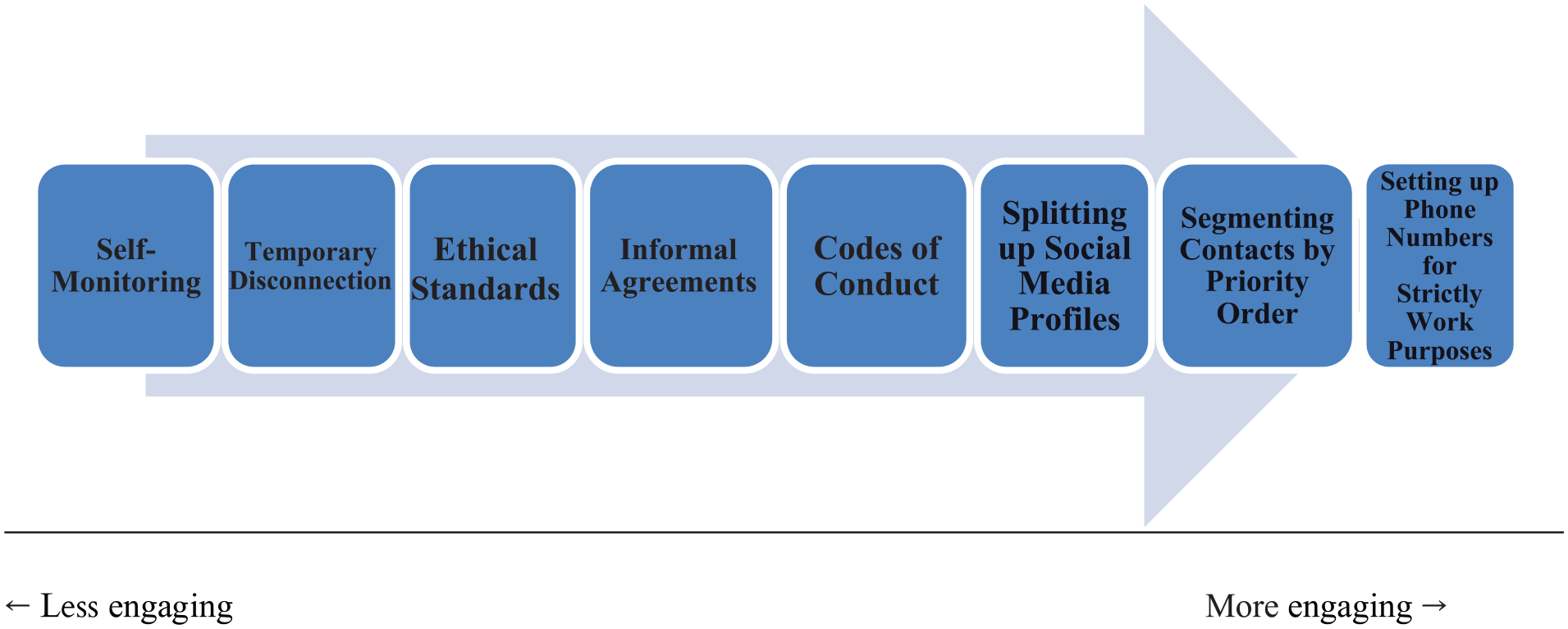
Practices for managing digital platforms favoring the work–life balance (process).
Discussion
This study has examined digital platforms’ influences on the work–life balance of Brazilian journalists. Qualitative research with 35 informants from the five geographical regions of the country has investigated the consequences of the pervasive presence of social media and messaging apps on news professionals’ daily routines. On the one hand, journalists have claimed that digital platforms have enabled them to connect with their co-workers, family, and friends throughout the day, strengthening social bonds. On the other hand, news professionals’ use of these devices has been inciting a feeling of emotional burden due to intrusive professional requests made via messaging groups, particularly outside working hours.
It must be stated that technological devices cannot be understood straightforwardly as sources of psychological distress (Cf. Ninaus et al., 2021). As this research has highlighted, journalists take advantage of these tools to benefit their work–life balance attempts. Besides, the experience of work overload and being a journalist 24/7 predates the existence of the Internet (Breed, 1955; Ruellan, 2001). In other words, digital platforms have become part of a professional environment where the imbalance between work and leisure has been historically normalized.
This does not mean social media and messaging apps have not impacted journalists’ work–life balance. In fact, scholarly literature has converged to diagnose a growing precariousness in media markets due to digital convergence (Rick, 2024; Rick and Hanitzsch, 2023). It has often revolved around acknowledging journalists’ workload and difficulty detaching personal and professional lives (Cf. Bossio et al., 2024; Bossio and Holton, 2021). This research has corroborated these findings.
In addition to the excessive burden and compromising of their personal lives, journalists reported self-censorship on technological tools to avoid professional consequences. In this context, trade unions and professional associations lack the means to intervene in digital work and prevent professionals from engaging in journalistic activities outside the workplace (and working hours). Like other workers, journalists are subject to the adverse effects of digital media use on well-being (Nguyen, 2021).
It is worth noting that our findings do not apply solely to the media industry. Significant changes in the labor market have made working relationships more flexible, blurring the boundaries between work and private life (Gilkerson et al., 2018). This has implications for job satisfaction and health. Literature began to pay more attention to this issue due to the negative effects caused by work–family conflict (Rashmi and Kataria, 2022), including increasing burnout and deteriorating well-being at work (Ninaus et al., 2021). Thus, our respondents experience and reproduce two social discourses: the first is based on the attempt to improve the quality of work life (Momin and Rolla, 2024), and the second is the need to denounce the harmful effects of the imbalance between work and family life.
This research goes beyond diagnosing the expanding precarity in newsrooms and the growing workload provoked by introducing digital devices in journalism. It has also explored inventive ways news professionals have exploited digital platforms to mitigate their adverse effects on their daily lives, often described by the academic literature as practices of journalistic disconnection (Bossio et al., 2024; Bossio and Holton, 2021). While these practices may not reverse macrostructural trends in media industries, they underscore the importance of recognizing the resourcefulness of news workers in establishing procedures to moderate their use of social media and messaging apps. The incorporation of these technologies in journalistic work can be understood through the sociology of sociotechnical devices (Boullier, 2019; Jouët, 2000) applied to news work, as the respondents suggested at least two possibilities for re-signifying these objects.
The first aspect to consider is the multifaceted role of digital platforms in Brazilian journalists’ lives. These devices are tools for managing workflows and establishing and strengthening social bonds in newsrooms. Furthermore, they are resources that allow news professionals to stay connected with their family and friends during working hours. Overall, this evidence indicates the emergence of new practices for adapting digital platforms’ facilities to journalists’ needs.
Moreover, even though the market-based model of media organizations usually promotes new technologies to increase productivity and workload, practitioners can devise ingenious tactics to counter these pressures and strive for a better work–life balance. In certain situations, technological devices provide the necessary space to develop individual and collective practices to protect a given group, as Salamon (2016, 2020) has described when discussing social media as places for organization, resistance, and activism for freelance journalists. These findings underscore the practical implications of this research, demonstrating how news workers can leverage digital platforms to their advantage.
This study also demonstrates that peoples’ use of technological devices has impacted their families in diverse ways, ranging from positive outcomes to detrimental ones. As some interviewees stressed, the disturbance caused by receiving several messages from peers and editors during leisure could lead to family dissatisfaction. Conversely, it is through messaging apps that journalists can connect with their loved ones while working. With the widespread adoption of home offices in the media industry due to the COVID-19 pandemic (Fígaro et al., 2022), several news professionals who are parents are now privileging this setting to be close to their children, especially toddlers, during business hours.
To conclude, this research argues that the identitarian discourse of Brazilian journalists has faced displacement. Traditionally, the excessive burden and impairment of news workers’ personal lives were overshadowed to emphasize constructing an identity grounded on a fierce bond and passion for exercising journalism (Hong, 2015). However, this research has demonstrated that this ethos may be being challenged. Participants showed their ingenuity to put in motion strategies to temper the growing precarity surrounding journalism in light of work–life balance concerns. Thus, further academic research could focus on how practices to manage precarity might be critical to journalistic identity and careers.
Contributions
To summarize, this study has four main takeaways to the scholarly literature on digital journalism, the sociology of news work, and work–life balance research.
First, it has presented a more comprehensive description of the impact of digital technologies on journalism, extending beyond work-centric accounts (Örnebring and Möller, 2022) that exclusively look upon these tools as resources for information production and distribution. The research has revealed how journalists have undertaken, sometimes simultaneously, diverse social roles through digital platforms. Take, for instance, the cases of news workers with children interacting with them throughout the day via messaging apps. Furthermore, this approach allows us to explore the permeability between professional and personal environments, given circumstances where co-workers establish friendship bonds through messaging groups. Thus, it may complement the traditional ways of socializing in newsrooms described by academic literature (Breed, 1955; Ruellan, 2001).
Second, considering that Brazil’s media market has been profoundly impacted by the “infrastructural capture” (Nechushtai, 2017; Papaevangelou, 2024) of digital platforms (Fígaro et al., 2022; Fígaro and Marques da Silva, 2020), this study also adds to research on journalistic disconnection (Bossio et al., 2024; Bossio and Holton, 2021) from a Global South context. Nowadays, online connection is the prevailing rationale in news cultures (Bossio et al., 2024). The practices developed by news professionals to moderate their use of social media and messaging apps could be seen as partial disconnections within a connective logic.
Otherwise stated, most of these tactics are not a matter of “turning off” technologies but handling them according to circumstances where the news professional is expected to take on multiple social roles. Sometimes, individuals partially disconnect from one environment to stay in touch with another, such as when journalists exchange messages with their family and friends while at work. These coping strategies complement the framework proposed by Bossio et al. (2024), highlighting a layer of connection hidden behind a measured disconnection from the newsroom.
With news organizations lacking policies on when journalists can be contacted for work (Lucan and Zajc, 2023) and the growing presence of non-traditional work arrangements in the media industry, such as freelancers and independent contractors (Lelo, 2022; Josephi and O’Donnell, 2023), further research could explore the resilience of the disconnection strategies proposed here.
Third, this study has contributed to the body of knowledge on work–life balance, pointing out the prominence of digital technologies for positive or negative spillovers between personal and professional spheres. Research on that framework has often neglected this issue (Gilkerson et al., 2018; Snyder et al., 2019), although social media and messaging apps directly intervene in classical work–life balance measures, such as the assessment of working hours and leisure time considering specific places (newsrooms x houses). This research has demonstrated that journalists have worked even during family parties and vacations while managing personal demands in newsrooms and public offices. Thus, it has put forward plenty of opportunities to further investigate the relationship between work–life balance and digital technologies’ usage, whether in journalism or other fields of work. Comparing work–life balance in journalism with other sectors of cultural production could be worthy, given the massive presence of digital platforms in areas such as music and games (Nieborg and Poell, 2018; van Dijck et al., 2018).
Last, this article has introduced a cognitive map of the actions put in place by a professional group to keep their digital media use under some control. Therefore, it has offered further opportunities for research grounded on the work–life balance framework, which has overlooked how digital media has influenced coping tactics so far (Gilkerson et al., 2018). Considering the growing blurriness between working hours and free time (Grönlund and Öun, 2018), this map is of utmost relevance for researching journalists’ tactics to keep their life domains in hand. Further studies could also compare journalists’ practices in handling these technologies in countries with diverse consumption habits of social media and messaging applications.
Limitations
While this study makes significant contributions to various academic fields, its limitations, particularly in data collection and the coding procedure, must be acknowledged.
First, although the dataset followed the demographics of the Profile of Brazilian Journalist—2021 report (Lima et al., 2022) on regional distribution, gender, age, race, and education, there were substantial discrepancies concerning parenthood, marital status, and areas of activity. Most respondents of this research were married (N = 14, 40%), had children (N = 23, 65, 71%), and worked outside traditional news companies (N = 26). In contrast, the majority of participants in the Profile of Brazilian Journalist—2021 report (Lima et al., 2022) were single, did not have children and worked in news outlets. Nevertheless, these limitations must be read against this study’s exploratory and nonrepresentative approach.
Second, requesting a summary of news professionals’ daily activities posed a few challenges. Because the documents were written by the participants rather than based on an activity log, they had full control over what they included in their diary materials. This meant that important information may have been left out. While this limitation is significant, it also provides insight into what the participants prioritized in their lives and what they chose to omit or consider of minor importance. Ultimately, a diary is a self-description that inevitably involves some omissions (Zimmerman and Wieder, 1977).
Another limitation pertains to data analysis. Even though the corpus encompassed journalists with diverse gender, race, and parental status, the thematic networks developed here were primarily generalist. Thus, the method missed how diversities intervened in the relationship between digital platforms’ usage and work–life balance attempts. This procedure was deliberately chosen to focus on the most common aspects of journalists’ practices in handling social media and messaging apps in daily routines. However, the results could have been significantly different if specific demographics were foregrounded, and further studies could explore this issue by comparing, for example, the uses of messaging apps by journalists with or without children.
Last, it must be pointed out that acknowledging journalists’ competence to manage their personal and professional demands via technological devices is not an excuse for news companies not to develop organizational policies to limit professional requests made outside working hours. Thus, journalistic enterprises must introduce codes of conduct to formalize how and when journalists can be contacted via digital platforms. This study might be a kickstart for practical proposals to institutionally regulate the use of social media and messaging apps in newsrooms, bearing in mind work–life balance concerns.
Our findings suggest that media organizations, as well as other companies facing similar situations, could revise their codes of conduct and human resources policies to formalize a set of principles for respecting the privacy of their employees, including a system of sanctions aimed at managers who fail to respect journalists’ personal boundaries. They could also begin to issue smartphones to employees exclusively for working purposes. Media companies could also create mechanisms to account for and reward (or at least value) work done on platforms outside of working hours. Finally, media companies could combine these recommendations with their own measures to address gender inequality in newsrooms, as women journalists are most affected by work overload and work–family conflict (Lee and Kim, 2022; Cf. Rashmi and Kataria, 2022).
Footnotes
Acknowledgements
The authors would like to express their gratitude to the anonymous reviewers for their insightful comments. An earlier version of this study was presented to participants of the Journalism Studies Working Group at the Brazilian Association of Graduate Programs in Communication 2024 conference. The authors are thankful for the constructive criticism, which significantly improved the article.
Funding
The author(s) disclosed receipt of the following financial support for the research, authorship, and/or publication of this article: This work was supported by the Brazilian National Council of Scientific and Technological Development (CNPq) under grant number 150552/2022-0.
Ethical approval
The study has obtained IRB approval under the register 70429223.2.0000.5540.
