







Abstract
This study examines how journalists are grappling with platform migration following Elon Musk’s acquisition of Twitterin October 2022. Using a mixed-method approach that combines computational analysis of the activities of 861 journalists on Twitter and Mastodon with qualitative interviews of 11 active journalists, this study aims to (1) examine the extent to which journalists have exhibited different forms of Twitter disengagement post-acquisition; (2) identify the motivating and discouraging factors influencing their move, guided by the push-pull-mooring model; and (3) explore how journalists managed their online presence across platforms. The results indicated minimal Twitter non-use following Musk’s takeover, and full migration was not observed within a 6-month post-acquisition period. Factors such as the flood of fake news and the loss of the blue-tick verification served as push factors, while the appeal of Mastodon’s enhanced user control and stronger community values acted as pull factors. However, the practical reliance on Twitter’s functionalities, audience base, and professional obligations made total abandonment challenging.
When Elon Musk acquired Twitter for $44 billion in October 2022, journalists worldwide reacted with concern. The already fraught relationship between the media and Musk reached a tipping point on December 15, when Twitter suspended half a dozen journalists who had criticized Musk (Isaac and Conger, 2022). This prompted many journalists to announce their departure for Mastodon, an alternative social networking site, by adding Mastodon usernames to their Twitter profiles (Bernstein, 2022).
Mastodon, established in 2016, has long appealed to users with its open-source, federated architecture. Following Musk’s takeover, Mastodon’s monthly active users peaked at 2.5 million in December 2022 but dropped to 1.4 million by late January 2023 (Hoover, 2023). This volatility raises questions about whether journalists’ and other users’ migration is temporary or permanent—a key focus of this study.
Leaving a social media platform is a gradual process (Edwards and Boellstorff, 2020), involving various stages and forms of disengagement, such as non-use, migration, or reverting to previous use (Baumer et al., 2013). Reverting to previous use occurs when users temporarily reduce activity or leave a platform, but later return to their former engagement level (Ng, 2020). Previous studies have examined push factors (dissatisfaction with current platforms), pull factors (attractiveness of alternatives), and mooring factors (switching costs) in platform migration (push-pull-mooring (PPM), Chang et al., 2013). The backlash against Twitter and the sudden interest in alternatives like Mastodon offer a unique opportunity for studying user migration between social networking sites (SNSs).
This research employs a mixed-method approach, combining computational analysis of 861 journalists’ activities on Twitter and Mastodon with qualitative interviews of 11 active journalists. It (1) examines the extent of different forms of Twitter disengagement among journalists; (2) uncovers the motivating and discouraging factors influencing their move; and (3) explores how journalists managed their online presence across platforms.
This study sheds light on journalists’ decision-making processes when leaving a platform, enriching our understanding of push, pull, and mooring factors in platform migration and how users potentially discontinue using a technology after initial adoption (innovation post-adoption behavior, Ng, 2023). The mixed-method study, combining computational analysis and qualitative interviews, simultaneously explores user activities on both incumbent and alternative platforms. This approach helps researchers triangulate social media data with users’ perspectives and experiences, providing a more nuanced understanding of their motivations, challenges, and outcomes of a platform migration. The findings will help journalists assess the risks and benefits of platform changes, facilitating smoother transitions and audience maintenance in the future.
Literature
Journalists & Twitter—a love–hate relationship
Journalism and news organizations have always been prominent users of Twitter. Around seven in 10 US journalists (69%), particularly younger journalists, consider Twitter their primary or secondary social media site for their job (Jurkowitz and Gottfried, 2022). Journalists utilize Twitter for newsgathering, reporting, content distribution, and personal branding (Kreiss, 2016; Usher and Ng, 2020). Besides its functionality, the widespread use of Twitter in journalism is influenced by social factors within the industry, where peer influence and coaching encourage its use (Swasy, 2016). The adoption of Twitter by journalists reflects “hybrid normalization” (Bentivegna and Marchetti, 2017), involving a blend of traditional norms with new practices of the digital tool. It has also reshaped journalistic norms and routines as a result of newer audience feedback mechanisms in the form of followers, likes, comments, and retweets (Tandoc and Vos, 2016).
However, this relationship has become increasingly strained over time. Journalists face mounting pressure to engage with online audiences while dealing with rising levels of hate, hostility, and harassment (Lewis et al., 2020). This physical and mental strain causes social media fatigue (Bossio and Holton, 2018), which leads to mental trauma, emotional stress, and even thoughts of leaving the platform or the profession altogether (Ferrier and Garud-Patkar, 2018). The acquisition of Twitter by Elon Musk in 2022 further complicated matters, raising concerns about freedom of speech on the platform. Shortly after Musk’s takeover, Twitter suspended the accounts of 10 journalists who had criticized the company and Musk (Isaac and Conger, 2022). This suspension drew criticism from media outlets and international representatives from the United Nations and the European Union (Dang, 2022).
Journalists have reacted differently to Musk’s takeover, with some opting for reduced engagement, non-use/discontinuance, and migration to alternative platforms. Mastodon emerged as the primary alternative for Twitter users during the first 6 months of Musk’s takeover, spanning from October 2022 to April 2023. 1
Platform discontinuance
While alternative platforms gain momentum, their ability to retain users remains uncertain. With many alternatives available, users must decide how to allocate their limited time and attention among various options (Arrese and Albarran, 2003), creating uncertainty for existing SNSs.
The early work of Rogers and Shoemaker (1971) differentiated between two types of discontinuance: replacement discontinuance, where one innovation is replaced by a better one, and disenchantment discontinuance, where users abandon an innovation due to dissatisfaction with its performance or because it does not meet their needs. Since SNSs typically do not require financial switching costs (Park, 2014), users may be more likely to discontinue use if alternatives seem better. Disenchantment discontinuance is particularly common, with over 60% of users quitting an innovation due to dissatisfaction (Keaveney, 1995). A survey by Ng (2018) confirmed disenchantment as a significant reason for discontinuing Twitter use, commonly due to unsatisfactory content and an overwhelming flow of information.
Leaving a platform, however, is usually a complex, gradual process (Edwards and Boellstorff, 2020), involving several stages and forms of disengagement like non-use, migration, and reversion. Ng (2020) described this as a cyclical “disturbance-coping process,” where users go through phases of refusal, disconnection, and possible re-adoption before complete abandonment
Platform non-use—from reduced usage to deleting accounts
Research on platform non-use reveals a spectrum of disengagement behaviors, including breaking usage patterns, logging out, and archiving or deleting accounts (Edwards and Boellstorff, 2020). Expanding on this, Satchell and Dourish (2009) outlined a broader range of non-use cases, including resistance, rejection, exclusion, and disenchantment. These actions can be categorized as moderate strategies (e.g. reducing usage) and drastic measures (e.g. deactivating accounts) (Ng, 2020).
Early research indicates minimal Twitter non-use following Musk’s takeover, with only 2.26% of users abandoning Twitter in the first month (He et al., 2023). In tracking roughly 4000 journalists from 19 US news outlets, Gotfredsen (2023) discovered that fewer than 10 users deactivated their accounts within the first 3 months post-acquisition. Daily tweet volume declined by only 3%, though there were noticeable decreases in journalism community activity following changes to the verification requirement. However, National Public Radio (NPR) ceased posting on its official feeds in April 2023, 6 months after the takeover, after being labeled “state-affiliated media” on Twitter. This move, followed by PBS and others (Folkenflik, 2023), could potentially trigger a broader exodus of journalists from the platform.
Platform migration—transitioning to new digital spaces
While most disengagement rarely involves account deletion, users may start exploring and eventually migrate to other platforms (Ng, 2020). Roger’s (1962) Diffusion of Innovations theory is a common framework for understanding how new ideas and technologies spread within social systems, particularly relevant to the adoption of alternative social media platforms. Expanding on this concept, the push-pull-mooring model (Chang et al., 2013; Fiesler and Dym, 2020) further describes platform migration as a strategic balancing act of moving between old and new digital spaces, driven by the interplay of push, pull, and mooring factors.
Push-pull factors
Platform migration is driven by push and pull dynamics. Push factors can be voluntary (user disenchantment) or involuntary (platform closure or user bans) (Chandrasekharan et al., 2017; Pearce, 2011). Conversely, pull factors represent the attractiveness of alternative platforms. The 2018 Tumblr migration exemplifies large-scale voluntary migration. Tumblr’s “adult content” ban, perceived as restricting free speech (push factors), led to a 25% decrease in monthly page views (Jackman, 2019). Users migrated to alternative platforms like Pillowfort, which offered an inclusive space for adult content and the LGBTQ+ community (pull factors), effectively attracting former Tumblr users (Edwards and Boellstorff, 2020).
Migration can also stem from cultural, economic, and social identity factors. The shift from MySpace to Facebook in 2006–2007 was compared to “white flight” by boyd (2011), reminiscent of post-war times. MySpace’s increasing non-White user base and perception as a lower-income, alternative platform (push factors) prompted users to move to Facebook, viewed as a higher-income, mainstream platform (pull factors) (Marwick and boyd, 2011).
Disenchantment with Twitter post-Musk has created push factors driving journalists to explore alternatives. Mastodon’s decentralized structure allows users to create and moderate their own servers, offering greater control over content and community interactions. Users can create and manage their own instances, establish rules, and moderate content (e.g., hate speech, spam), fostering safer online communities.
Mooring factors
Users may return to a previously used platform when there are switching costs (Chang et al., 2013). Kraut et al. (2016) identified three types of commitment that hinder migration: affective, normative, and need-based commitment.
Affective commitment is tied to users’ emotional attachment and sense of identity with the platform’s community, making departure difficult. For example, a player deeply invested in a massively multiplayer online game would struggle to leave due to established friendships, time investment, and emotional bonds to the game and community. Normative commitment involves a sense of obligation due to previous benefits. For instance, users may feel obligated to continue using LinkedIn if they received job offers or endorsements there, despite diminished enjoyment. Need-based commitment occurs when users rely on a platform’s benefits or lack alternatives.
Platform migration involves switching costs, including social factors and technical incompatibility (Luther, 2015). For example, accumulated ride credits may keep users committed to a ride-hailing app, or the hassle of transferring data may deter them from switching email providers (Gazan, 2011). Similarly, Baumer et al. (2013) found resuming use often related to maintaining professional ties and certain platform features, such as Messenger or signing in on other platforms through Facebook credentials.
In contrast, factors such as disagreements in values, often prompted by platform policy changes, can significantly decrease platform commitment, influencing users’ decisions to migrate (Fiesler and Dym, 2020; Kraut et al., 2016). However, discontinuance decisions are complicated by the “fading effect bias” (Walker and Skowronski, 2009)—negative experiences fade over time, leading users to focus on positive past experiences and return (Grandhi et al., 2019).
These studies collectively suggest that various factors influence platform migration decisions, including dissatisfaction, alternative appeal, switching costs, and commitment.
For journalists, leaving Twitter is fraught due to its centrality in networking, self-branding, and news dissemination (Bossio and Holton, 2018). The lack of interoperability (followers do not automatically transfer to new platforms) amplifies switching costs. While some journalists have left Twitter, it is unclear if most are temporarily disengaging or permanently abandoning the platform. This leads to three research questions:
RQ1a: To what extent did journalists exhibit different forms of disengagement from Twitter?
RQ1b: To what extent did journalists migrate from Twitter to Mastodon?
RQ2: What push-pull-mooring factors influenced their migration?
Challenges and strategies during the transition
The decision to either “pack up and move” or “keep posting for now” requires careful negotiation of social connections and consensus (Edwards and Boellstorff, 2020). Some journalists may opt to maintain a presence on both platforms, making it particularly relevant to examine how they approach both the new and old platforms. Each platform’s unique ecosystem demands experimentation with content formats, tones, and engagement styles. While cross-posting might seem efficient, it can risk audience fatigue due to repetitive or unengaging content, potentially frustrating audiences with a “one size fits all” approach. Existing literature offers limited guidance on optimizing platform-specific content during migration, particularly in early stages. This gap motivates our final research question:
RQ3: How did journalists maintain their online presence across Twitter, Mastodon, and other alternative platforms during the migration? What were the challenges and their strategies?
Methods
This study employed a mixed-method approach to explore journalists’ social media behavior following Musk’s Twitter takeover. We conducted a computational analysis of 861 journalists’ activities on Twitter and Mastodon from October 2022 to April 2023, the first 6 months of the takeover. We investigated the various forms of Twitter disengagement (e.g. non-use, migration, or reversion) journalists exhibited, answering RQ1a, RQ1b, and RQ3. Furthermore, to understand how journalists managed their online presence across platforms 1 year after Twitter’s takeover, we interviewed 11 active journalists, answering RQ2 and RQ3. This aims to uncover the challenges and strategies journalists employed during their migration and the factors motivating or discouraging their move. The computational analysis offers generalizable findings, while qualitative interviews provide deeper insights into individual experiences and motivations. The research was approved by the Institutional Review Board. Our study adheres to ethical considerations specific to researching decentralized social media platforms (Abbing and Gehl, 2024; Wähner et al., 2024), focusing on public-facing professional journalists who intentionally maintain visible profiles. For a detailed discussion of our ethical framework, data governance protocols, and platform-specific considerations, please refer to the Supplemental Appendix.
Computational analysis
Sample and data collection
We identified a purposive sample of 1325 journalists from a public online database. 2 These journalists voluntarily shared their Twitter and Mastodon handles, areas of expertise, and newsroom affiliations. The sample included journalists from various countries, such as United States, United Kingdom, and Australia, with diverse backgrounds and specializations, working across different media types. In addition, our sample included some academics and journalism scholars.
After filtering out duplicate entries and uninformative responses (e.g. deleted Twitter accounts or missing Twitter handles), we successfully gathered Twitter account metadata for 1081 (81.6%) of the responses and Mastodon account metadata for 979 (73.9%) of the responses. After pairing the Twitter and Mastodon account metadata, we had a total of 861 unique users in our dataset. Among these 861 users, we were able to download 812 Twitter timelines (with 49 of them being protected accounts) and 803 Mastodon timelines (the rest either did not post a single status or their instances were down at the time of the crawl).
Using the Twitter and Mastodon APIs, we collected user activity data up to April 2023, including post interactions and creation information. We compiled account metadata and tweet timelines from valid Twitter handles between 1 May 2022 and 30 April 2023. Similarly, we gathered Mastodon account metadata and timelines using the public API. Figure 1 provides a detailed overview of the data collection and cleaning process, while Supplemental Appendix Table A1 describes the Twitter and Mastodon datasets.

An overview of the Twitter and Mastodon data collection and cleaning process.
Analysis
We aggregated the data to calculate the frequency of posts across 26 equal time periods of 14 days each. To answer RQ1a, we examined the number of deleted/protected accounts and the change in posting activities. To answer RQ1b and estimate the impact of Elon Musk’s Twitter acquisition on users’ posting activity, we conducted an interrupted time series analysis. Given the fairly short time period (t = 26 weeks), a segmented regression analysis was performed. Since there were multiple users, a linear segmented regression model with user-level fixed effects was fitted to the data. The model was specified as follows

Here, Yit is the frequency of posts for user i at time period t; timeit is the value of the first time period in the series; treatit is the intervention status; and ∆timeit is the time since treatment. We controlled for user-level unobservable characteristics by entering User IDs as dummy variables. Time periods after 27 October 2022 were coded as post-treatment periods. A robustness check of the posting activity analysis is detailed in the Supplemental Appendix.
To investigate whether activity features could predict a journalist’s decision to leave Twitter, we computed the average number of Twitter posts per 14 days for each user in the pre- and post-acquisition periods. The difference between these averages served as the dependent variable in a linear regression, with a positive value indicating a net decrease in activity. Independent variables included the average post-acquisition Mastodon post-frequency and logged counts of Twitter followers, following, favorites, and statuses for each user. Robust standard errors were used to address heteroskedasticity.
To partly answer RQ3, we examined the similarity of content posted across platforms after 27 October 2022. This analysis included only journalists who posted at least three times on Mastodon (N = 698). We utilized a term frequency-inverse document frequency (TF-IDF) matrix and cosine similarity measures to identify highly similar posts between Twitter and Mastodon (Salton and Buckley, 1988). Multiple iterations were conducted with cosine similarity thresholds ranging from 0.5 (similar) to 1.0 (identical). We then calculated the percentage of each user’s Mastodon statuses that were similar to their tweets and analyzed the distribution of similarity scores among the journalists.
Semi-structured interviews
Sample
To answer RQ2 and RQ3, we conducted semi-structured interviews with 11 journalists in October 2023 to explore their motivations and challenges regarding social media migration after Musk’s Twitter takeover. Participants were selected from the same database used for computational analysis, displaying varied Twitter and Mastodon activity patterns. Interviews lasted 25-40 minutes via Zoom.
Interview procedure
The interview protocol examined journalists’ experiences, challenges, and strategies during the platform migration transition. We asked journalists to describe their (1) changes in platform usage; (2) motivations for change, including both push and pull factors, as well as mooring factors representing challenges encountered; and (3) content and engagement strategies across platforms. Participants were assigned pseudonyms to protect their privacy.
Table A2 outlines example interview questions and analysis methods, where Supplemental Appendix Table A3 provides descriptions of the interviewed journalists.
Results
RQ1a: to what extent did journalists exhibit different forms of disengagement from Twitter?
At the time of final data collection in May 2023, 861 unique users had valid Twitter and Mastodon accounts. Timeline data was gathered from 812 Twitter users, indicating that 49 (5.7%) users had removed or made their accounts private since October 2022. Timeline data across both platforms was collected for 765 users (88.9%). Among these users, 21.4% had higher posting activity on Mastodon than on Twitter after the acquisition, while 78.6% remained more active on Twitter.
RQ1b: to what extent did journalists migrate from Twitter to Mastodon?
As shown in Supplemental Appendix Table A4 and Figure 2, there was a spike in Twitter activity from September to October 2022 during Musk’s acquisition, peaking in November 2022, likely due to conversations and deliberations about leaving the platform. A corresponding spike in Mastodon activity occurred in November 2022 when most users signed up. However, activity on both platforms gradually declined over the next 2 months. This suggests little evidence of journalists abandoning Twitter entirely for Mastodon. If this were the case, we would have observed an inverse relationship between the number of posts on Twitter and Mastodon over the six months from October 2022 to April 2023.
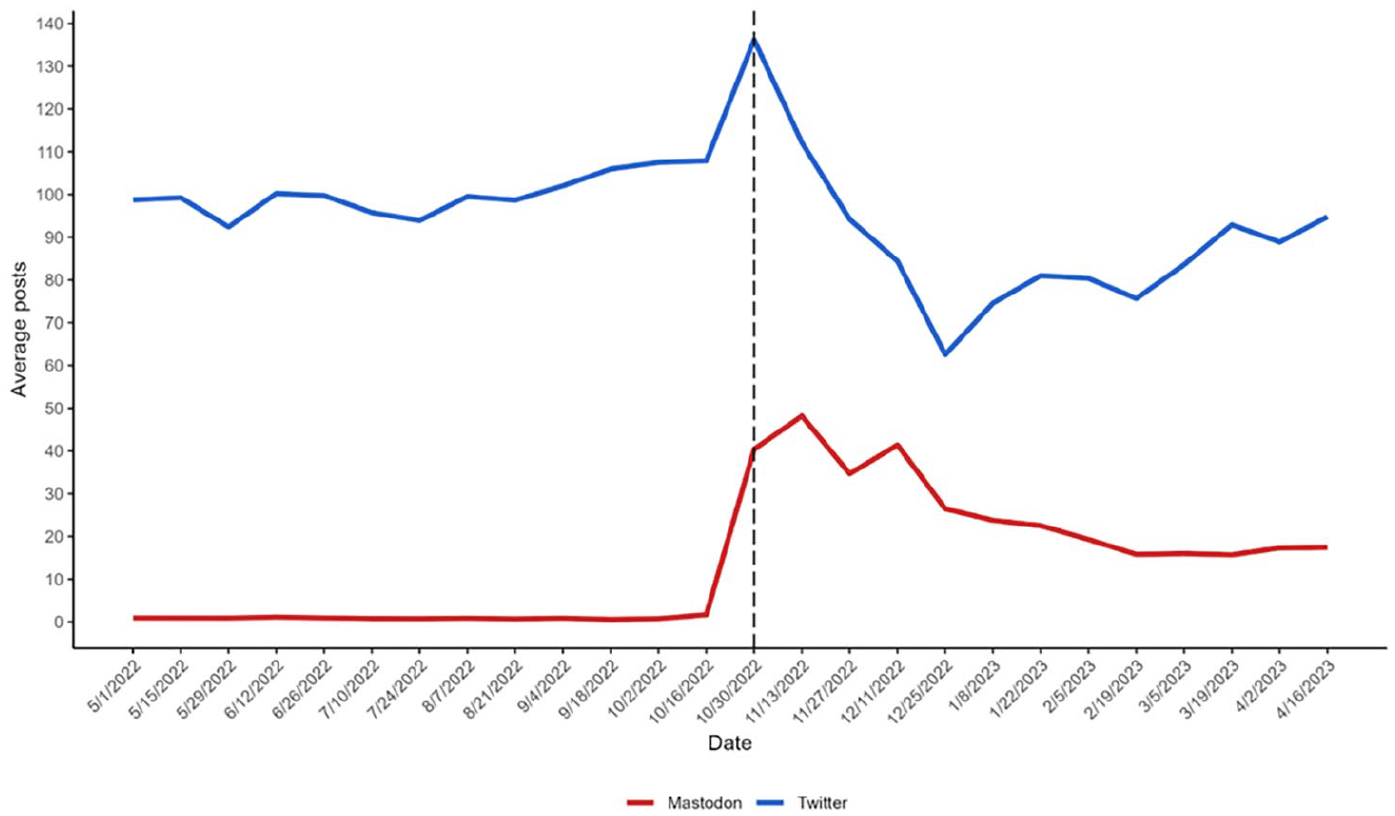
Average posts on Twitter and Mastodon between May 2022 and April 2023.
The linear fixed effects model (Figure 3(a)) indicates that there was a significant positive trend before the acquisition, with approximately a 0.5% increase in expected Twitter posts every 14 days. While no immediate impact was observed due to the takeover, the post-acquisition trend showed approximately a 3% reduction in expected Twitter posts every 14 days. These results are corroborated by the negative binomial model as well (Supplemental Appendix Table A5). Results from the OLS model (Figure 3(b)) indicate that Mastodon user activity was positively associated with the difference in Twitter activity before and after the acquisition (b = .41, p < .05), suggesting that some decrease in Twitter activity can be explained by increased Mastodon activity. Except for the number of Twitter statuses (b = 8.62, p < .001), none of the other Twitter activity metrics were significantly associated with a change in posting frequency. For every 1% increase in the total tweets posted by users, the difference between pre- and post-acquisition tweet frequency changed by approximately 0.09 units. In other words, journalists who were more active on Twitter were more likely to reduce their activity on Twitter.
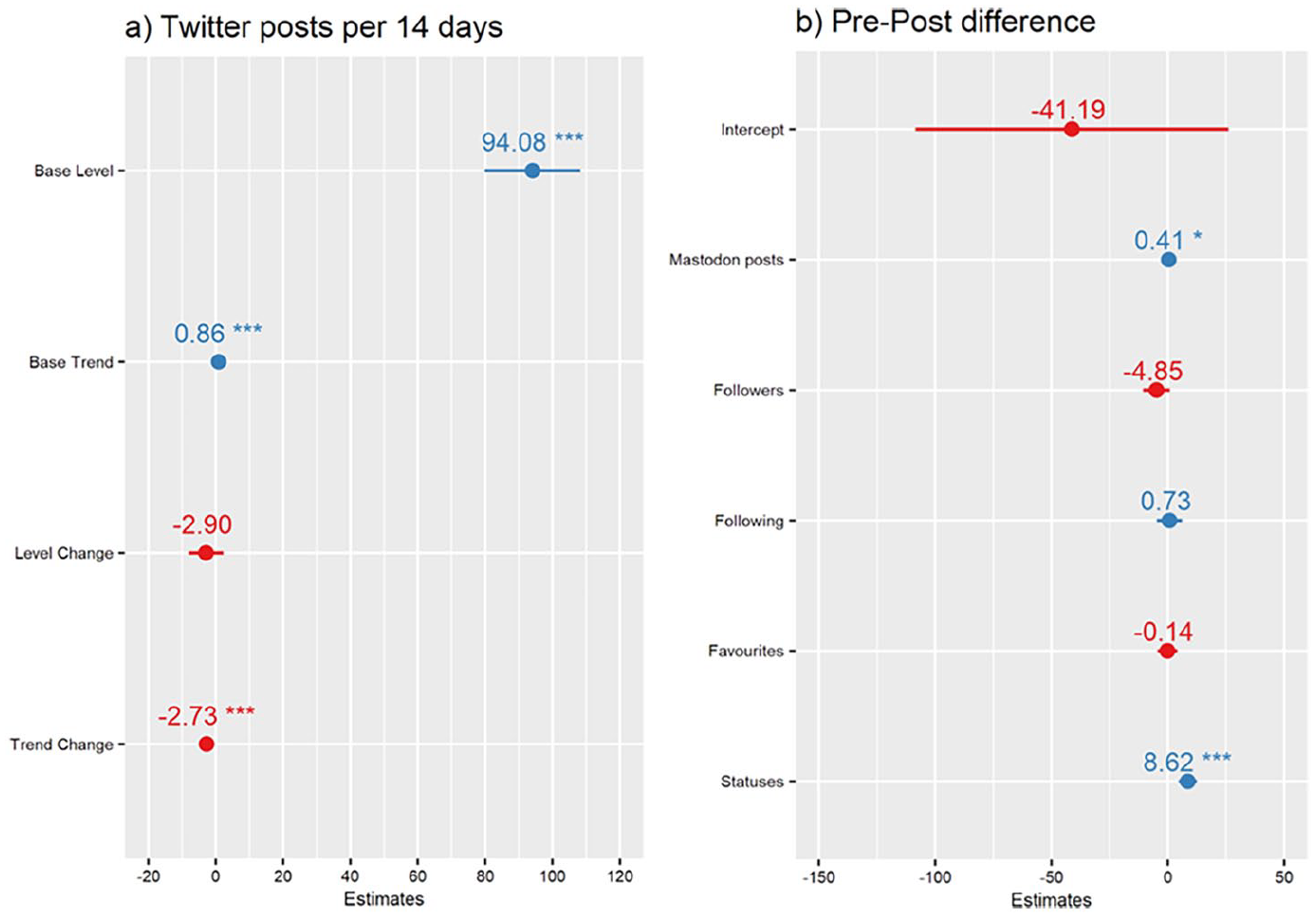
(a) Linear fixed effects (within) model of the frequency of Twitter posts. The base level is the global intercept computed as a weighted mean of the user fixed effects. N = 812, total observations = 21,112. (b) Linear regression model of the average pre–post difference in Twitter activity per 14 days before and after the acquisition. N = 765.
RQ2: what push-pull-mooring factors influenced their migration?
After Musk’s takeover, the change in Twitter’s content moderation policies and algorithm changes negatively impacted journalists’ experiences, forcing them to reconsider their use of the platform. Participants T1 and T11 represented a small subset of journalists who deleted their Twitter accounts, though this was not an easy decision. T1 described it as a “long goodbye,” with the Israel-Hamas conflict and the flood of misinformation on Twitter being the final straw. T1 recounted:
A couple of times, I made it [my Twitter account] private just so no one could sign up [with my name] and then I and then I decided no, I don’t want to do this. So, I kind of went back and forth with it. But the rise of antisemitism, and particularly what happened after the invasion of Israel by Hamas? That’s when I said, “Okay, I’m done.”
Push factors—dissatisfaction with Twitter
Antagonism against journalists
Although most of the interviewees retained their Twitter accounts, many interviewees reduced their engagement on Twitter due to feeling antagonism against journalists. A few had even stopped posting entirely. Participant T3 lamented, “From the get-go, Elon Musk just wanted to antagonize the journalists [. . .] My job has been made so much harder because of him.” These journalists were aware of algorithmic changes that increased extremist content and incivility. They were also concerned about potential shadow banning—when Twitter secretly limits an account’s visibility by hiding posts from others while keeping them visible to the user—or other forms of algorithmic suppression in the future.
Sharing a similar feeling, Participant T8 had become more “frustrated” and “skeptical” about Twitter’s algorithm changes, feeling that his journalistic content was no longer being seen or valued. Participant T5 grew more “cautious” about posting his articles and tagging other journalists, concerned about the “hostility towards journalists and those not aligned with Elon Musk’s politics.”
Changes in verification and content moderation system
In April 2023, Twitter ended its legacy verification process, allowing users to buy blue checkmarks for $8 per month (Isidore, 2023). This change diminished the checkmark’s credibility, and some interviewees noted decreased engagement after losing their unique verification status. As Participant T2 recalled:
I’m also starting from scratch there [Bluesky]; I only have a few hundred followers. On Twitter, I had 20,000+ and I used to have a blue check, which, you know, made all the difference in terms of my stuff getting shared on Twitter. It just shot up my engagement figures.
Participant T1 quoted an article titled “Welcome to Hell, Elon” by The Verge editor Nilay Patel (2022), which argued that Twitter’s primary product was its content moderation system. Hence, the relaxation of the moderation rules greatly diminished the value and utility of the platform for journalists. Similarly, T6 expressed frustration with Twitter and its increasingly toxic atmosphere following the loosening of moderation. She decided to reduce her use of the platform to preserve her mental health, saying:
After October 7, I mean the attack in the Middle East after the war broke out [. . .] I just decided I didn’t want to be part of that [Twitter] anymore. It didn’t seem like reality anymore; it didn’t seem connected to the real world, and it seemed harmful and bad for my mental health.
Pull factors—alternative attractiveness
Journalists gradually sought alternative platforms to maintain their work and public engagement. Familiarity with new or existing platforms and welcoming communities were pull factors that made the transition easier. Participant T1 credited a large overlap of followers on both Twitter and Facebook for facilitating his return to Facebook, while the community of tech journalists on Mastodon helped him settle in. Multiple interviewees described Mastodon as “a federated alternative to Twitter” (T7) and “a more niche community with knowledgeable members” (T5).
Participant T6 took her migration more slowly. She tried Mastodon but temporarily reduced her use of Mastodon, eventually returning, reassured by the platform’s commitment to openness and transparency. She was drawn to Mastodon’s local communities and the emotional depth of interactions, though she lacked the time and energy to engage with each response. She stated:
The thing that was so good about [Mastodon] is that everyone was there, and you could create your own community and/or different pockets of Twitter. You can tap into the local one [. . .]. And as a local reporter, that’s really, really valuable to me.
Participant T9 observed a shift in how journalists use social media, with an emphasis on video platforms like TikTok and YouTube, and less frequent real-time updates on Twitter and Facebook. Similarly, Participant T4, a food critic and reporter, found that Instagram’s role as a photo- and video-sharing platform suited her beat well. Others, like Participants T10 and T11, considered LinkedIn a potential alternative to Twitter. Participant T11 stated:
I think LinkedIn has an opportunity they haven’t yet fully explored to be a space for the professional conversation about journalism. LinkedIn seems content with being a place where you post about your promotions and job opportunities. That’s fine, but it could also serve as a venue for the kind of professional ethical debates within journalism that used to happen on Twitter.
Mooring factors—switching costs
However, some interviewees suggested that a mass exodus of users following a single event is unlikely. Instead, people typically leave in waves after a series of events. Similarly, the choice to abandon the platform is often driven by self-interest. Most journalists are likely to leave only if their engagement declines to the point where their posts become completely invisible.
Social factors
Many journalists were hesitant to completely abandon Twitter due to the lack of comparable user bases on alternative platforms like Mastodon and Bluesky. As T10 stated, committing to Mastodon felt like a gamble:
At the end of the day, it’s the more active microblogging site. Frankly, those other platforms are just much smaller. And it’s hard to invest in—you’re basically making some gamble of like, do I spend a lot of time on Mastodon and hope that it’s the thing, or, you know, like, you could end up spending all your time building an audience on Mastodon only to have the whole thing fade in the next three or four years.
Job culture and industry inertia
Newsroom expectations often required journalists to maintain a Twitter presence. Participant T2 commented,
[News outlet] pays you, you have this Twitter background. It’s your job to share the reporting. Twitter’s there, that’s it. In my perfect world, we’re all on Mastodon [. . .] It’s not going to work. [I] was very optimistic at first.
Many journalists reduced their Twitter activity but kept their accounts to maintain communication channels with sources and readers. Some journalists expressed the journalism industry tends to coalesce around a single social media platform, making mass migration difficult. As Participant T2 put it,
I say I don’t want to use it and never use it again. But I do the work because I love it and I want the people to read it. I want it to have an impact. You don’t get that on Mastodon or Bluesky to the extent you do on Twitter. Media still uses Twitter.
Security factors
Security was another concern; some interviewees (T1 and T2) worried about impersonators exploiting Twitter’s new paid verification system to post malicious content under their names. Participants highlighted instances where fake accounts could potentially damage a journalist’s reputation by spreading false information under their name.
Superior features
Twitter’s direct messaging functionality and superior search capabilities were cited as advantages over alternative platforms. As Participant T1 put it,
Twitter direct messages was one of the ways I talked to a lot of colleagues and sources. And I don’t have that channel anymore. Most of them I know how to get in touch with in a different way. But it was very easy to hop into direct messages because it was a good channel. However, they are not encrypted. Anyone who works for Twitter can see them.
Participant T2 observed that neither Mastodon nor Bluesky offered comparable search capabilities or advanced features like TweetDeck for organizing contacts. Bluesky also lacks two-factor authentication, posing a security risk.
For journalists who were not particularly tech-savvy, Mastodon’s complexity and decentralized structure presented a steep learning curve. Participant T6 questioned the wisdom of investing time in an emerging platform with an uncertain future:
I guess I’m rethinking the wisdom of trying to be an early adopter. I don’t want to invest a lot of time and energy in a space that’s not going to be the next big thing and possibly dies out.
However, to tech journalists, Mastodon could be a new playground. Participant T1 “refound” his community there. While Meta released its own microblogging product, Threads, Participants T4 and T7 expressed concerns about the company’s track record in data privacy and the potential association of users with the same network on their Instagram profiles, typically reserved for personal connections.
RQ3: how did journalists maintain their online presence across Twitter, Mastodon, and other alternative platforms during the migration? What were the challenges and their strategies?
Our computational analysis indicates that journalists tended to post different content across the two platforms (Figure 4). On average, only 1.14% of Mastodon statuses were identical to a tweet (similarity threshold = 1.0). Most users who migrated used the platforms to post completely different content, with the predominant group showing zero similarity (cosine similarity threshold 0.5–0.9). This suggests that only a small subset of journalists mirrored their content, while most aimed to create different personas on the two platforms.
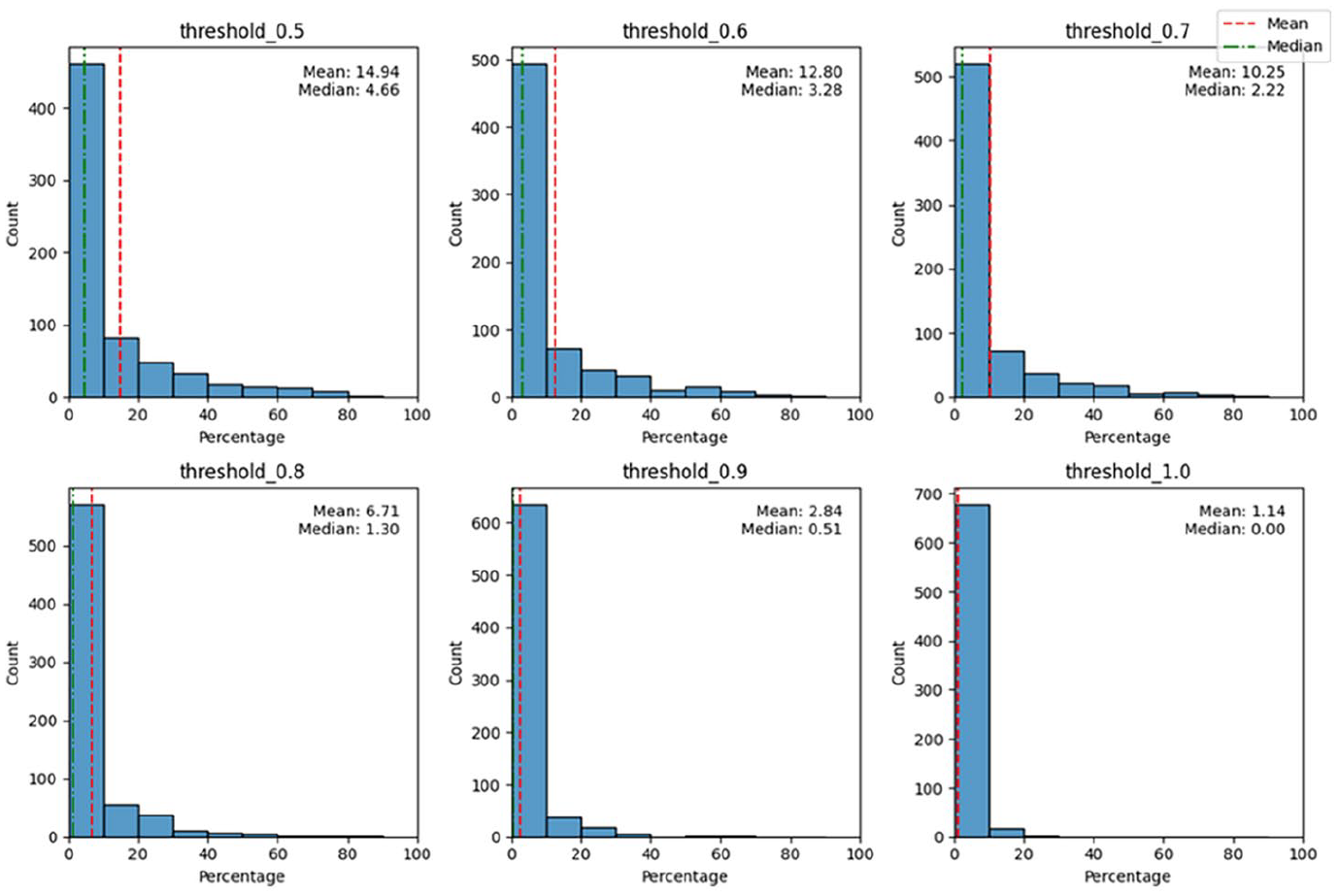
Histograms for Mastodon–Twitter posts similarity.
During the interviews, we reaffirmed that journalists were keenly aware of the diverse audiences, preferences, and cultures associated with different social media platforms, adapting their strategies accordingly to manage their online presence effectively.
Participant T5 emphasized the importance of flexibility and adaptation in the face of constantly changing technology and platform fragmentation. They highlighted the need to understand each platform’s unique culture, likening it to learning different languages to engage various communities effectively.
In my experience, I have tried to diversify my posts to cater to the unique preferences of different audiences on each platform. It’s like learning to speak “Mastodon” in one corner and “Twitter” in another, to engage with various communities effectively.
Participant T1 took proactive steps to regain followers on Mastodon using tools like FediFollows and Movetodon. These tools helped identify and reconnect with individuals from other platforms who had listed their Mastodon handles. He also tailored his content “to the right voice” to promote his work on each platform—writing longer and more personal posts on Facebook since those followers knew him personally, and focusing more on business topics on LinkedIn.
Participants T10 and T9 advised journalists to focus on growing their own follower base rather than relying solely on social media sites. They recommended maintaining accounts across multiple platforms to avoid over-dependence on any single service and mitigate the risk of losing access. Similarly, Participant T7 advised journalists to embrace the unique features of each social media platform they use, rather than trying to fit them into a preconceived mold. He said,
I think my biggest thing is just that nothing is a one-for-one replacement. Yeah. And so don’t try and fit a square peg in a round hole. If you’re somewhere else, there will be some adjustment. And that’s fine and expected and embrace it.
Discussion
This study examines journalists’ platform migration to alternative platforms following Elon Musk’s controversial takeover of Twitter. We analyzed the posting behavior of 861 journalists on both Twitter and Mastodon over a 6-month period following the acquisition. Although a decline in activity was noted among active users, little evidence supported the complete abandonment of Twitter for Mastodon or other alternatives, aligning with recent research (Gotfredsen, 2023; He et al., 2023).
We conducted interviews with 11 active journalists 1 year after Musk’s takeover to uncover the factors influencing their platform transition. While fake news and loss of verification pushed journalists away from Twitter, practical reliance on its features, audience base, and professional obligations made total abandonment challenging. ournalists tailored content to each platform’s audience, often cultivating distinct personas.
Platform reduced usage: surge but then gradual decrease of Twitter and Mastodon activity
We observed a significant surge in journalist activities on both Twitter and Mastodon in the weeks following Musk’s takeover. This could be attributed to the attention and discussion on Twitter generated by the acquisition. Journalists, in particular, may have felt a sense of urgency to be more active due to the need to remain informed about potential developments and to actively steer the conversation. Ironically, while journalists criticized Twitter, they also relied on it as the medium to broadcast and receive feedback on their criticisms.
Although journalists gradually reduced their activity on the platform, a disengagement process that has been documented in previous studies (Edwards and Boellstorff, 2020; Ng, 2020), many of them still maintain a passive presence on the platform, such as reading posts or updates without actively engaging. This gradual disengagement process, paired with the possibility of return, mitigates switching costs, such as losing access to important information or contacts (Baumer et al., 2013).
Platform migration: push-pull-mooring factors
Changes to the algorithm, moderation policies, and verification system that negatively impacted journalists’ experiences (push factors) validate Rogers and Shoemaker’s (1971) hypothesis that disenchantment can trigger platform discontinuance. At the same time, many journalists have been prompted to prepare for a potential exodus by exploring alternative platforms, such as Mastodon, Instagram, or Facebook. This allows them to enjoy the “first-mover advantage” (pull factors) by establishing their presence on new platforms while the user base is still small. The journalists interviewed were drawn to the unique cultures and decentralized infrastructure of these platforms and, in some cases, the overlap in communities. For these reasons, Mastodon witnessed an immediate increase in traffic after the takeover.
However, after some time, many who flocked to Mastodon or other platforms out of excitement or experimentation have lost interest. While journalists expressed dissatisfaction with Twitter’s changes, their reluctance to fully abandon the platform underscores their emotional, normative, and need-based commitments (mooring factors). The journalists expressed emotional attachments to the platform’s community, similar to Kraut et al.’s (2016) concept of affective commitment. While SNSs typically don’t involve direct financial switching costs associated with changing brands or products (Park, 2014), for journalists, Twitter plays an integral role in their professional and personal lives, serving as a means to break news, connect with sources and colleagues, and promote their work (Kreiss, 2016). This practical reliance is reinforced by a normative commitment, as newsrooms expect journalists to publicize their work. This sense of responsibility obligates journalists to navigate Twitter’s evolving dynamics.
Furthermore, Roger’s (1962) Diffusion of Innovations theory helps explain Mastodon’s challenges in achieving widespread adoption. The platform’s struggle to move beyond early adopters and reach a critical mass reflects difficulties in transitioning to the “early majority” stage. Also, the limited transferability of social capital from Twitter to Mastodon and Bluesky, along with journalists’ need for Twitter’s superior search function and advanced list functionality, create a need-based commitment (Kraut et al., 2016). While Threads offers better social capital transfer through Instagram integration, but its adoption has been hindered by Meta’s privacy concerns.
Therefore, the “disturbance-coping process” identified by (Ng, 2020) appears to be reflected in the behavior of the journalists. These journalists have shown evidence of media refusal or disengagement from Twitter due to policy changes. However, they expressed that they continue to use Twitter out of professional necessity or concern about impersonation issues. This perpetuates a cycle in where tensions drive disengagement, yet professional obligations foster re-adoption. Deleting accounts remains a rare action (Ng, 2020). Thus, despite a combination of multiple push and pull factors associated with Twitter and alternative platforms, the mooring factors ultimately prevented any significant exodus from materializing.
Content and engagement strategies
Notably, the news organizations they represented and the broader journalism industry have provided minimal guidance on tackling these challenges. This leaves journalists largely on their own in a rapidly changing digital landscape, grappling with balancing professional responsibilities, audience expectations, and evolving platform rules.
Results from the computational analysis indicate that most journalists post distinct content on each platform, creating distinct personas. Understanding the cultural nuances of various social media platforms emerged as a common theme in interviews. Each SNS offers unique affordances and serves different outreach purposes. Journalists are strategic in their platform use, leveraging Twitter and its alternatives to meet professional goals.
During platform migration, many journalists cross-posted content on both Mastodon and Twitter to maintain their audience and prevent follower loss, as followers were often fragmented across platforms. They adopted different posting strategies and personas on each platform, tailoring content to specific audiences and communities. For instance, Mastodon’s chronological timeline and 500-character limit encourage thoughtful, in-depth discussions. This structure led some journalists to prefer Mastodon for its focus on community-building and relaxed pace compared to Twitter.
Platforms aiming to attract journalists could consider implementing advanced search functions, robust direct messaging capabilities, and tools for organizing contacts and sources. In addition, features that facilitate real-time news dissemination and audience engagement, such as live-streaming options and customizable notification systems, could enhance their appeal to journalists seeking alternatives to Twitter.
Limitations
This study provides valuable insights into how Musk’s Twitter acquisition affected Twitter usage and the subsequent migration to Mastodon and other platforms. However, there are several limitations to consider. First, migration often occurs over an extended period. Our computational method tracked activity for the first 6 months, limited by the termination of the Twitter API, while our interviews were conducted a year after the takeover.
Second, with numerous alternative platforms available, our study captures only a transient usage overlap in a limited number of SNSs, particularly focusing on Mastodon, the primary alternative during the initial 6 months of Musk’s takeover. Future studies should track migration over a longer period and across a broader range of platforms.
Third, we may have overlooked other aspects of journalists’ experiences on Mastodon, such as journalist-specific instances (e.g. journa.host and newsie.social) and the reactions of marginalized groups to journalists.3,4 Future research should examine these platform-specific social dynamics and their impact on journalists’ migration decisions and engagement strategies.
In addition, the study’s sample was drawn from a database where journalists voluntarily provided their Twitter and Mastodon handles, potentially introducing self-selection bias. This non-systematic compilation may limit generalizability. Future research should consider more systematic sampling methods, such as identifying journalists from a predetermined list of news outlets to represent diverse journalistic branches.
Conclusion
This study examines journalists’ platform migration following Musk’s Twitter acquisition. Despite concerns, full migration was uncommon. Personal and professional factors influenced journalists’ responses to platform changes. The migration process emerged as cyclical and strategic, involving content and persona management across platforms. These findings offer insights into platform migration decisions and their implications for digital journalism.
As of January 2025, Twitter retains a robust user base of 611–650 million monthly active users (SEO.AI, 2025). Meanwhile, Bluesky has gained popularity as an alternative to Twitter, amassing over 28 million users, particularly after Trump secured a second term as the U.S. President in 2024 (CNBC, 2025). In contrast, Mastodon’s (2025) growth has stagnated at roughly 908,000 monthly active users. As the social media landscape evolves, journalists must remain adaptable and strategic in platform selection and engagement.
Supplemental Material
sj-docx-1-nms-10.1177_14614448251321165 – Supplemental material for The journalists’ exodus: Navigating the transition from Twitter to Mastodon and other alternative platforms
Supplemental material, sj-docx-1-nms-10.1177_14614448251321165 for The journalists’ exodus: Navigating the transition from Twitter to Mastodon and other alternative platforms by Yee Man Margaret Ng and Rik Ray in New Media & Society
Footnotes
Acknowledgements
This research would not have been possible without the exceptional and persevering work of Vivian La, a journalism undergraduate student at the time of writing this paper. She not only collaborated in conducting interviews but also supported the foundational research of this project and future ones. We are also profoundly grateful to the 11 anonymous journalists who generously shared their time, insights, and enthusiasm for academic research.
Data availability
The data underlying this article will be shared on reasonable request to the corresponding author.
Funding
The author(s) disclosed receipt of the following financial support for the research of this article: This study was supported by grants from AEJMC Emerging Scholar Grant, James W. Carey Fellowship, and Kappa Tau Alpha Research Grant.

Supplemental material
Supplemental material for this article is available online.
Notes
Author biographies
References
Supplementary Material
Please find the following supplemental material available below.
For Open Access articles published under a Creative Commons License, all supplemental material carries the same license as the article it is associated with.
For non-Open Access articles published, all supplemental material carries a non-exclusive license, and permission requests for re-use of supplemental material or any part of supplemental material shall be sent directly to the copyright owner as specified in the copyright notice associated with the article.
