






Abstract
This study investigates shifts in citizenship norms during crisis. Citizenship, a core concept of democratic theory, reflects an allegiance to the state founded on public sovereignty, and individuals having the right and capacity to participate in political decision-making. Drawing on Schnaudt et al.’s framework, we explore changes in dutiful, autonomy, and solidarity norms through a two-wave panel study conducted across 17 European democracies in December 2019 and April 2020. Our data demonstrate that media use expectedly increased, and citizenship norms shifted significantly in some cases. Changes correlate strongly with rising levels of political interest. Complex patterns occur for different platform use: Facebook reinforced dutiful citizenship, Twitter strengthened autonomy norms, and WhatsApp solidarity norms. Exposure to congruent content enhanced adherence to all three norms, while peer-to-peer influence positively impacted autonomy and solidarity norms. The study contributes to ongoing discussions about the impact of the digital media environment on citizens’ relationships with democratic institutions.
Keywords
Introduction
Representative democracies, arguably to the detriment of the notion of the people being sovereign, operate effectively when the majority of citizens play largely passive roles confident in the efficiency and legitimacy of their elected representatives (Urbinati, 2011: 5). However, it is argued that more active models of citizenship are emerging, and that exposure to differing forms of content across the hybrid media environment can lead individual’s norms of citizenship to evolve and for some citizens to participate in expressive forms of behaviour (Gagrčin et al., 2022). Good or dutiful citizens are only active at key times in the democratic cycle: voting in elections or referenda; selecting, contacting or lobbying representatives; or forming collectives to facilitate greater representative voice. A suite of activities viewed as ideal democratic political participation (Verba and Nie, 1978). Norms of citizenship are implicit and learned within a society but also have a perceptual quality, whereby citizens develop normative orientations towards forms of participation which they see as their duty to perform (Van Deth, 2007); arguably, perceptions of citizenly duty are not fixed but can form or change in response to socio-political events. This argument reflects observations that formal and more passive forms of political participation are being replaced by alternative forms of action involving critiquing political institutions. This trend has led to redefinitions of good citizenship to better reflect the actions of those feeling detached from the core processes of representative democratic culture and who view classical forms of political participation with apathy (Schnaudt et al., 2024).
The revised models of citizenship reflect first that citizens are becoming ‘engaged’ (Dalton, 2008) or ‘self-actualizing’ (Bennett, 2008) facilitated by innovations in digital technologies that offer new ways for citizens to express their views (Ceccarini, 2021). Digital platforms permit access to infinite amounts of information, offering differing perspectives and opinions, generated by a range of actors from established news organisations to ordinary citizens posting news-like content on social media. The ability to access, or accidentally be exposed to, various viewpoints on myriad issues can act as a form of secondary socialisation, shaping how an individual citizen feels in relation to the polity and their society, and thus how they should perform their roles and duties as a citizen (Gagrčin and Porten-Cheé, 2023).
Our research explores perceptions of citizenship norms, founded on collections of connected values, during the early months of the COVID-19 pandemic. The pandemic impacted most areas of social and economic life, isolating people and increasing reliance on digital technologies. Our two-wave panel survey across 17 countries explores changes in norms between December 2019 and May/June 2020, assessing whether the experiences of lockdown and restrictions on mobility and sociability, alongside heightened use of digital media for accessing news and the attendant exposure to congruent or cross-cutting opinions, impacted perceived norms of citizenship during the pandemic. Controlling for broader socio-economic, political, and communicational factors, our research thus gives insights into how an individual’s values and norms can be impacted by a combination of the pressures on their lives caused by a societal crisis (the global pandemic) as well as their accessing information and engaging with content circulating within the digital media environment and what impact these have in shaping their understanding of the ideal performance of citizenship and what norms are salient given the socio-economic or political context that impact individual citizens’ lives.
Citizenship norms
Considerable academic attention has been devoted to identifying which forms of participation signal ‘good’ citizenship. These notions of citizenship performance have evolved alongside the emergence of digitally enabled modes of action (Kligler-Vilenchik, 2017). Foundational research indicated the predominant norms were that of the
Traditional forms of participation are increasingly perceived as less important in comparison with more expressive and individualised forms of participation, aligning with the concept of engaged or self-actualising citizenship (Bennett, 2008). The complex ways in which citizenship is being performed has led to the development of new paradigms to reflect the various forms of activism adopted. While it is recognised that dutiful citizens remain part of the democratic landscape, Kunst et al. (2021) identified the
Reflecting the rise of contentious publicness further, Schnaudt et al. (2024) developed the notion of the
To capture the complexity of citizenship in the digital age, independent of the nature of the causes promoted, we adopt a simplified version of three paradigms of citizenship norms: dutiful, solidarity and autonomy (Dalton, 2008: 78–79; Schnaudt et al., 2024; Van Deth, 2014). These three different norms, driven by different sets of societal values, reflect aspects of classical ‘good’ citizenship but also capture the evolution of citizenship performance in the digital age and how citizenship norms may reflect norms of behaviours when engaging with politics within digital media environments (Gagrčin et al., 2022). In testing for support for these norms, Schnaudt et al. (2024) revealed individuals generally hold complex configurations of values. The discrete clusters of values which inform the norms can be reprioritised due to changing socio-political contexts or evolve through secondary socialisation processes from content circulating across digital platforms.
Digital information environments offer citizens exposure to a range of alternative perspectives on the issues of importance and what action is appropriate to reach political outcomes they desire. Citizens choose to promote and participate in local and global causes, a shift which potentially hollows out state-centred citizenship (Zaff et al., 2010). Hooghe et al. (2016) show value-driven activism leads to increased focus on causes relating to sustainability, human rights, protesting unjust laws and participating in activities that benefit the local community. Digital political engagement can lead citizens to feel they need to take action in order to express their values and influence public policy often taking the form of ‘Internet political activism’ (Choi et al., 2017). While digital technologies are not drivers of change, they facilitate individualised ways to perform citizenship and create the perception that such acts may have a societal impact. Hence, we see self-actualising citizenship being performed through participatory media (Kligler-Vilenchik, 2017). It is therefore argued that interaction within the digital communication environment is shaping users’ conceptions of their duty as a citizen (Gagrčin and Porten-Cheé, 2023). Collective, value-driven behavioural norms emerge within communities (Geber and Hefner, 2019) which in turn shape repertoires of activism (Couldry, 2024). The combination of exposure to content, interactions and actions facilitates changes in the perceptions of what constitutes good and dutiful citizenly performance (Lane et al., 2022) which can be driven by changes in socio-political context. The pandemic presents such a context which creates the conditions for values to change, we therefore add to theoretical debates regarding the conditions whereby individual values could be reprioritised when perceived as threatened so shaping perceptions of how one should perform the role of a good citizen (Opp, 2001).
The socio-political context of the pandemic crisis
Citizen’s attitudes towards government and perceptions of governmental performance were likely shaped by a range of long-term and immediate factors during the pandemic. Restrictions on civil liberties negatively impacted governmental support and were only viewed as acceptable if they were perceived to have a tangible effect, verified by trusted, independent sources (Amirkhanyan et al., 2023). Latent trust in government and institutions tasked with managing the pandemic and informing the public, as well as partisan affiliations, mediated perceptions of government performance (Brouard et al., 2022). Perceptions of equity across a society, and the differential effects on low-income groups, were also factors; citizens rewarded governments who offered inclusive support and protection (Amirkhanyan et al., 2023). Socio-economic factors which determined anxiety levels, such as job security, the ability to work from home, family situations, and vulnerability to illness, additionally shaped how individuals interpreted the restrictions placed on their movement and the extent to which these measures contributed to reducing the virus’ spread (Brouard et al., 2022). Hence, general equity levels, overall economic stability and impacts on personal circumstances determined how accountable and trustworthy governments were perceived in their handling of the pandemic. Research also found that national culture shaped citizen’s attitudes. Strong libertarian or masculine cultures were more likely to form negative attitudes towards restrictions on civil liberties (Gomez and Spencer, 2024). These findings emphasise the importance of communicating initiatives in ways that resonate with cultural values and norms when facing populations with differing levels of collectivist, individualist and risk avoidance attitudes (Rodriguez et al., 2023). Governments that communicated appropriately, acted fast and appeared in control retained citizen support (Stowell et al., 2022), depoliticising pandemic restrictions, and deferring communication and decision-making to senior health professionals increased trust and reduced polarisation (Lilleker et al., 2021). Thus, the culture of government and the quality of democracy, as well as long-term perceptions of government performance, determined general trust levels and had the potential to shape citizen’s perceptions of pandemic performance and the citizenship norms prioritised during this health crisis.
Based on the above, we formulate two research questions that utilise the baseline data from the 2019 and 2020 survey waves to study the impact of the COVID-19 pandemic on citizenship norms:
Individual and digital media contexts
Political interest, often used as a proxy for political knowledge, is likely to drive engagement with news (Lane et al., 2022) and the effects of exposure to information (Prior, 2018; Strömbäck and Shehata, 2019). Citizenship norms may be impacted depending on the interest paid to political and public affairs, with high interest leading to dutiful citizenship norms being prioritised (Shehata and Amnå, 2019). As engagement with current affairs increased alongside the pandemic (Redbird et al., 2022), this impact is likely, although moderated by perceptions of government performance, personal risk and the perceived veracity of measures designed to stem the spread of the disease. The most vulnerable to the disease and economic disruption can engage more or become apathetic and disengaged (Belchior, 2024). Hence, political interest levels during crises can be complex, but we hypothesise the following:
Interest in politics is interconnected with digital platform use, exposure to differing messages may shape perceptions of good citizenship, especially when concerns over civic rights become salient (Vaccari and Valeriani, 2021). During the pandemic, digital platforms played a crucial role in maintaining connections with friends and family and for building or connecting with online communities (Saud et al., 2020). Platform usage (Boulianne et al., 2024), in particular for sourcing news and information, and the content individuals were exposed to, may impact their prioritisation of citizenship norms. What users view as news and trustworthy information is seen to be perceptual, derived from whether content has news-ness qualities (Edgerly and Vraga, 2020). Younger users are particularly found to consume content as news if they perceive it as news-like and compartmentalise content and content creators based on how news-like content appears (Swart and Broersma, 2024). Thus, platform usage can influence citizens depending on the sources and content they access.
Platforms offer unique affordances and user experiences which shape how individuals engage with content (Zhao et al., 2020). Importantly, differences have been found in individuals’ attitudes who access information via closed (private) networks offering lower levels of visibility or open (public) networks which can reach a mass audience (Malhotra, 2025). During the pandemic, there was evidence of increased levels of community volunteering, including building support networks on social media to support the vulnerable (Kavada, 2024). Closed networks (Bouilliane et al., 2024) allow interpersonal ties to develop, which may foster solidarity between members independent of socio-political or demographic diversity (Bourgeois and Friedkin, 2001). Within the context of crises, a solidarity-cooperative economy can develop (Petropoulou, 2013) WhatsApp groups were one space where strong communitarian bonds formed around a shared identity and consciousness (Udenze and Ugoala, 2019). Facebook community pages offered similar affordances (Chwat, 2021). Collective identities formed within these spaces can shape patterns of political engagement and participation (Velasquez et al., 2021). Closed communities tend to be formed around fairly homogeneous perspectives; they reinforce ties through value-based identity markers; those using more open networks such as Twitter/X or YouTube receive a more heterogeneous diet of information (Theocharis et al., 2023). Closed networks may thus see users more likely to conform to norms of thinking and behaviour (Geber and Hefner, 2019). The heterogeneity of open networks may foster more self-empowered or autonomous thinking (Fenton and Barassi, 2011) by facilitating access to a broader range of individuals and information (Maireder and Ausserhofer, 2014) and exposing people to diverse communities and viewpoints, which foster a self-actualising perspective of citizenship (Bannister and Wilson, 2011). Hence, we hypothesise the following:
The pandemic was accompanied by an ‘infodemic’, with contrasting perspectives, outdated information and conspiracy theories circulating (Gisondi et al., 2022). Exposure to such cross-cutting perspectives challenges pre-existing values and can be a source of anxiety (Lu and Myrick, 2016). Contrasting views on the personal risks from COVID-19 and the extent to which rules should be obeyed to prevent the spread of the disease, and uncertainty over the best means to protect vulnerable individuals or frontline care workers were found present across platforms (Durante et al., 2021). Exposure to contrasting perspectives can lead to indecisiveness due to the complexity of the situation, forcing those exposed to weigh evidence (Shahid et al., 2023), weakening senses of autonomy. In contrast, having existing perspectives and opinions reinforced can provide an illusion of autonomy (Lackey, 2021) as individuals believe their attitudes are correct due to reinforcement and are consistent with the prevailing societal consensus (Onitiu, 2022). Thus, depending on the information environment an individual engages with, one may find oneself conflicted or have attitudes reinforced thus impacting citizenship norms (Gagrčin and Porten-Cheé, 2023). Hence, we hypothesise the following:
The platforms accessed for information and the extent to which information is congruent or cross-cutting can also be shaped by the information sources individuals view as influential and trustworthy. Trust in elites from both scientific and state institutions increased and declined across the pandemic’s waves (Hamilton and Safford, 2021), often due to inconsistencies in communication from governmental sources (see Coman et al., 2025). Hence, individuals may have found peers, family members or influencers as more credible sources of information than official sources. Peers can be particularly influential. Conceptions of self are determined by identity and group belonging, and the need to conform to the norms of a peer group can shape attitudes and behaviours and so conceptions of the ideal role of a citizen (Conover, 1995). Peer influence during the pandemic was found to enhance existing norms through reinforcement within close peer communities (Bor et al., 2023). Compliance with rules, when reinforced by peers, was also found to heighten notions of autonomy (Morbée et al., 2021). There have been more mixed findings on the impact of families as influential information sources. Conflict within families can arise over differences of opinion on pandemic restrictions. However, largely, there was solidarity within family units (Basaure et al., 2021). Social media influencers (SMIs) due to their reach and public trust could reinforce public health announcements (Pöyry et al., 2022), or misinform followers (Archer et al., 2021). Given SMIs’ dual role, it is likely their impact is moderated by the extent to which they offer cross-cutting or confirmatory perspectives and if exposure took place in closed or open networks (Boulianne et al., 2024; Valeriani and Vaccari, 2017), although cross-cutting information is found to be accepted if from credible sources (Min and Wohn, 2018). At the same time, alternative sources of influence and the believability of information may have had a significant impact within environments where preventive rules became politicised, trust in government institutions diminished and critical content, misinformation and conspiracy theories circulated (Lilleker et al., 2021). Hence,
Methodology
To address the research questions and test the hypotheses, we employ data from a two-wave online panel survey fielded in 17 European countries: Austria, Belgium, Denmark, France, Germany, Greece, Hungary, Israel, Italy, Netherlands, Norway, Poland, Romania, Spain, Sweden, Czechia, and the United Kingdom. Wave 1 was conducted in mid-December 2019 (before the outbreak of COVID-19), and Wave 2 in May and June 2020 (after the outbreak). Fieldwork was conducted by Dynata, all respondents completed a consent form. A total of 28,317 respondents completed the survey in Wave 1, and 14,218 in Wave 2. The sample size per country in Wave 1 ranged from 1600 to 1723 respondents and the retention rate ranged from 39.9% to 60.6%. Quotas were used for age, gender, and metropolitan region approximating population heterogeneity in each country. The distribution of respondents by education and gender group slightly changed across waves (e.g. the sample surveyed in Wave 2 is slightly older than Wave 1). Since the study explores changes during the pandemic, only respondents participating in both waves are included in the analyses (Tables A3 and A4 in Supplementary material). Over the period between waves, most of the countries included went through severe lockdowns and restrictions, but by the second wave were no longer in lockdown but had in place stringent measures limiting social life and public interaction.
Dependent variables
Each grouping of norms represents a set of clustered values which cumulatively shape how the individual feels they should act as a citizen (Kunst et al., 2021). Tables A1 and A2 in Supplementary material provide a systematic review of the conceptualisation and measurement of citizenship norms, establishing a foundation for selecting the following three norms.
All indexes are measured in both waves; we employ the difference between their values in Wave 2 and Wave 1 as the dependent variable. The indexes follow the theoretical conceptualisation by Schnaudt et al. (2024).
Independent variables
Control variables [W1]
To answer RQ2 we employ several measures for national contexts: GDP, Democracy Score ‘19-‘20, Trust in government ‘19-‘20, Freedom Index, Media Freedom Index, Inequality Indicator, Populism of the governing party, COVID-19 Stringency Score, and COVID-19 Toll of Deaths. All variables and their sources are indicated in Supplementary material Table A5.
The statistical analyses are run with OLS regression. All dependent variables are measured as differences between their value in Wave 2 and Wave 1. The independent variables indicated as measured in Wave 1 (marked as [W1]) but also, if available, as a change of the variable’s measurement between W1 and W2 (marked as [∆]). This approach allows us to indicate both the enduring (lagged) and short-term (differential) effects of key independent variables. The models also include clustered standard errors at the country level.
Results
To answer our research questions, we first constructed a graphical representation of the change in each citizenship norm between wave one, before the pandemic hit, and wave two launched in the midst of social restrictions (Figure 1).
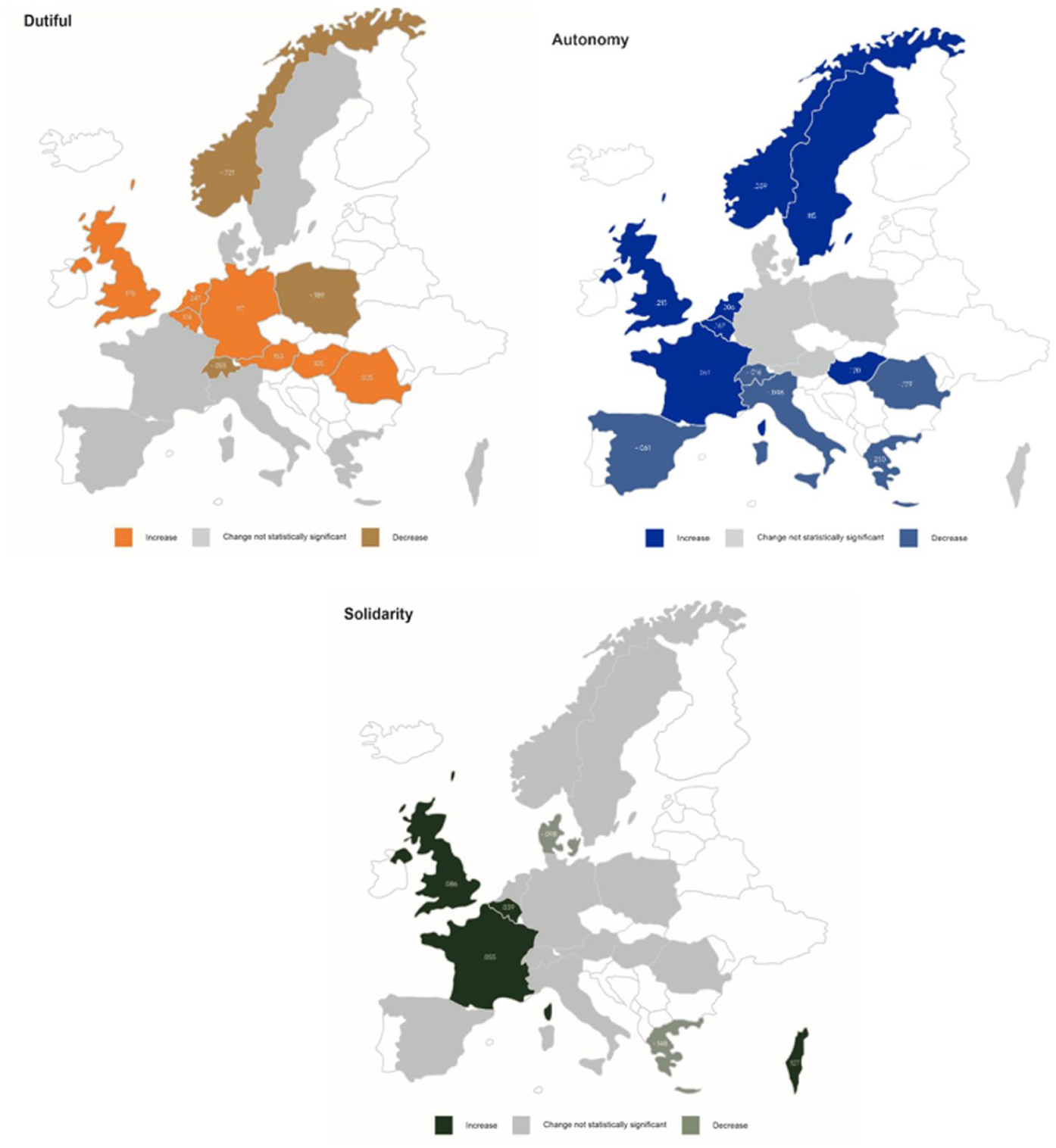
Indicates differences in means for Dutiful, Autonomy, and Solidarity norms between Wave 1 and Wave 2. In countries marked in grey, the difference is not statistically significant, in countries marked with a darker colour, the values increased, while in those marked with a lighter colour, values decreased over time.
As Figure 1 indicates (for details, see Supplementary material Table A6, A7 and Figure A1), all citizenship norms (dutiful, autonomy, and solidarity) increased in only two countries simultaneously, Belgium and the United Kingdom. In the rest of our sample, those changes were more nuanced. Norway and Poland witnessed the sharpest decline in dutiful norms (with a difference of (−.721) and (−.189)) between Wave 1 and Wave 2. In Poland, this decline may be partially explained by a highly controversial electoral campaign occurring at the beginning of 2020. However, in France, a decline was not observed even though the election was held after the outbreak of the pandemic and days before a complete lockdown. Switzerland experienced a similar decline. In several countries, including Germany, Austria, Belgium, Hungary, the Netherlands, Romania, and the United Kingdom, support for dutiful norms increased, reflecting a potential shift towards greater civic obedience during the pandemic.
Support for autonomy norms increased in Belgium, France, Hungary, the Netherlands, Norway, Sweden, and the United Kingdom, but decreased in Greece, Italy, Romania, and Switzerland. Support for solidarity norms increased in Belgium, France, Israel, and the United Kingdom, and decreased in Greece and Denmark. Hence, overall, we find both positive and negative changes in norms occurred, but changes are country and context specific with no stable patterns.
To further explain variations and answer RQ2, the political and socio-economic indicators were correlated with difference in the indexes between the waves (for details, see Supplementary material Table A8). The results show that for the dutiful norm, GDP stands out as the only significant predictor (r = −.468, p < .06). Countries with higher economic status were less likely to experience an increase in support for dutiful norms.
The autonomy norm displays a more complex pattern. Countries governed by populist administrators (r = .419, p < .1) but also, somehow surprisingly, those with higher levels of trust in government, both in 2019 (r = .512, p < .05) and 2020 (r = 477, p < .06), are more likely to see increased support for autonomy norms. Higher levels of general media freedom are linked to decreased support for autonomy norms (r = −.455, p < .1).
Interestingly, for solidarity norms, the only positive correlation is observed with the COVID-19 Stringency Score (FT) as stricter governmental restrictions correlate positively (r = .427, p < .1). Other variables, including trust in government (2020), media freedom, democracy scores (2019 and 2020), and death toll, show significant negative correlations with changes in support for solidarity norms. The respondents who trusted their government to take care of the weakest in society were also less likely to show signs of solidarity. In countries with high death tolls, individuals did not exhibit increased solidarity, possibly due to fear of contagion.
To test our hypotheses, we ran regression analyses measuring changes in the citizenship norm indexes between waves (Table 1). H1 explores the role of interest in politics, which visibly increased between waves. The lagged interest in politics measured in W1 shows a negative impact on the change of norms, especially for supporting dutiful and autonomy citizenship norms (β = −.039 and β = −.058, p < .01). However, the increased interest in politics between waves sees the effect becomes statistically significant and positive for all indexes. Individuals who became more interested in politics during the time of pandemic are more likely to declare stronger support for dutiful (β = .042), autonomy (β = .052, p < .000), and solidarity norms (β = .030). Thus, we confirm our hypothesis, however only in terms of reinforcing existing norm perceptions as interest in politics increased.
Regressions W1–W2 difference for Dutiful, Autonomy and Solidarity norms.
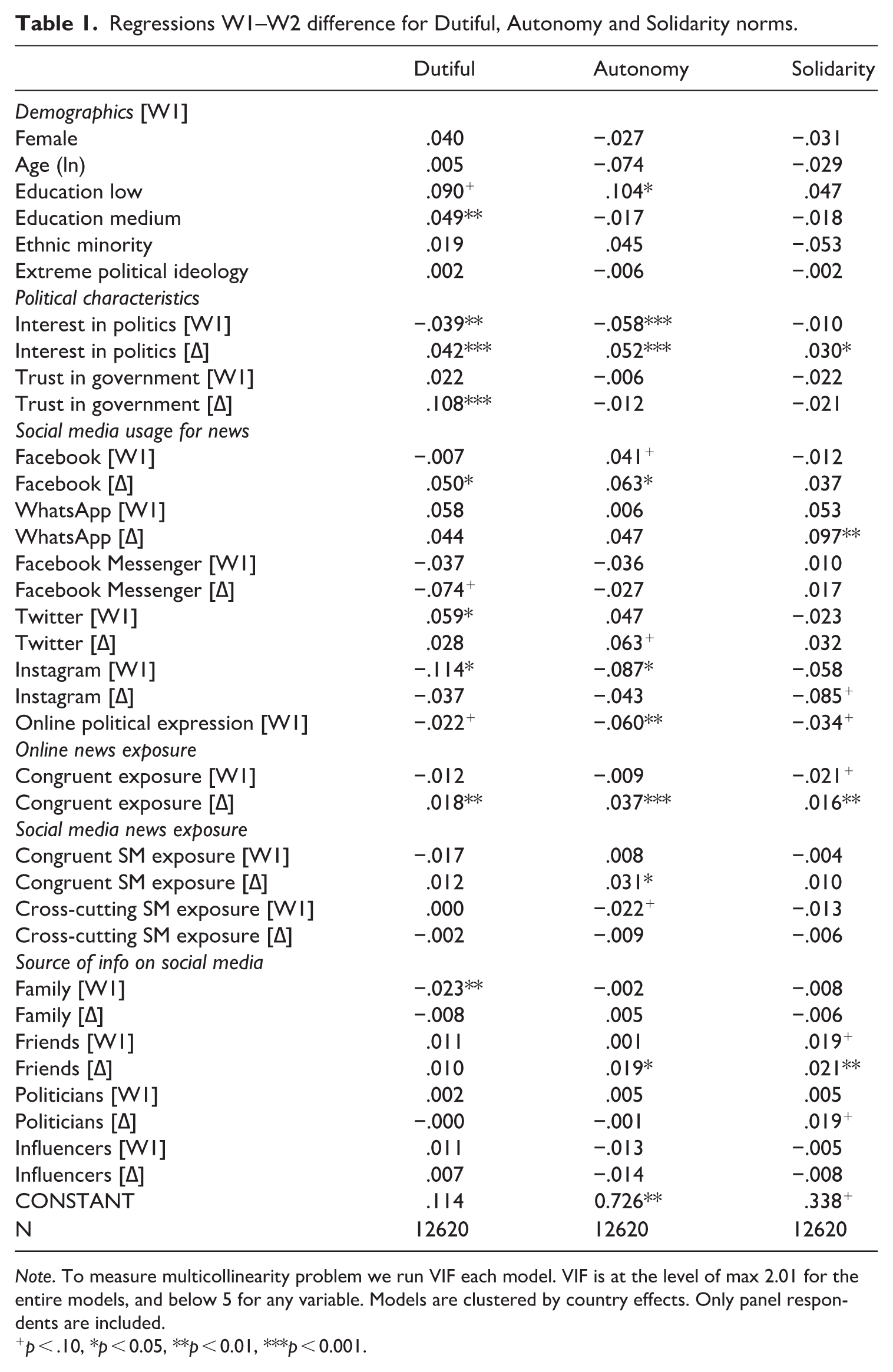
Note. To measure multicollinearity problem we run VIF each model. VIF is at the level of max 2.01 for the entire models, and below 5 for any variable. Models are clustered by country effects. Only panel respondents are included.
p < .10, *p < 0.05, **p < 0.01, ***p < 0.001.
Next, we explore the relationship between platform usage and changing support for citizenship norms. The results show WhatsApp, a private, closed-network platform, is the only platform that had a positive impact on support for solidarity norms (β = .097, p < .01), especially among those who reported increased usage of the application. However, other platforms considered as private (Facebook or Facebook Messenger), do not have similar effects. Thus, hypothesis H2a is only partially confirmed. However, increased usage of Facebook during the pandemic correspondingly increased prioritisation of dutiful citizenship norms (β = .050) and autonomy norms (β = .063). As for the public open-network platforms, the data suggests divergent outcomes. While Twitter (at the time) had a positive impact on increasing prioritisation of autonomy norms, Instagram had a negative effect. The effect of Twitter is significant for those who increased their usage of the platform (β = .063). The effect of using Instagram is however inverse, users were less likely to prioritise dutiful or autonomy norms. Thus, hypothesis H2b is also partially confirmed.
To assess the effect of congruent or cross-cutting news exposure, our model employs three measurements (H3). Respondents who had their existing points of view reinforced via increased use of online media, had their existing norms reinforced, dutiful (β = .018), autonomy (β = .037), and solidarity (β = .016). Those receiving more news with a congruent point of view via social media reported an increase in support for autonomy norms (β = .026), but there was no significant impact on changes for solidarity or dutiful norms. We also find a weak effect of exposure to cross-cutting views on social media decreasing support for autonomy norms (β = −.022).
Finally, we turn towards information sources on social media. We find confirmation for H4b, receiving credible information from peers does increase support for autonomy (β = .019) and solidarity norms (β = .021). H4a is not confirmed, rather receiving information on social media from family members decreases feelings of dutifulness. In answer to RQ3, receiving news on social media from political actors has limited effects (even if receiving such information increased substantially between waves), as it only increased support for solidarity norms (β = .019). No significant effect is found for Social Media Influencers on citizenship norms.
With respect to our control variables, we find the effect of education, with those having low education being more likely to become more dutiful citizens during the pandemic (β = .090) and becoming more supportive of autonomy norms (β = .104). Trust in governments increased during the pandemic, which increased support for dutiful citizenship norms (β = .108).
Discussion
The pandemic impacted how people feel as citizens, suggesting relations with democratic institutions changed. However, the changes that occurred depended on existing attitudes and perceptions of citizenship. The lack of clear patterns across the nations surveyed reinforces that individual factors shape support for and prioritisation of citizenship norms. The only strong pattern, which resonates with sociological research during the pandemic (see Layte, 2012), is that citizens feel more dutiful if a nation’s economy is stable, probably due to the belief their own economic circumstances will remain secure. The country data suggests respondents who trusted their government more were also less likely to show signs of solidarity, probably assuming the government will take care of the vulnerable in society. In countries with high death tolls, individuals appeared cautious about adopting solidarity norms. This finding requires further investigation. A plausible explanation may be individuals became more selfish due to fear of contamination, or this might reflect wider traits of individual responsibility within nations (Minkov et al., 2017, Table 3). Due to the diversity of government communication during the pandemic, and clarity of instructions declined across pandemic phases (Lilleker et al., 2021), we did not include government performance as a variable as there is no clear measurement scale for regulations or communication.
Media use had significant effects. Many monitored news intensively to receive updates on regulations and the course of the pandemic (Coman et al., 2025). Many also turned to social media for news, to connect with others and to distract them from the boredom of isolation during societal lockdowns (Durante et al., 2021). In some ways the impacts were positive. Lower educated citizens’ interest in news increased, suggesting the pandemic increased the importance of receiving news alerts across society. Social media usage had specific platform-based effects. WhatsApp, a platform often used to share information within very limited circles of acquaintance, had a strong, positive effect on solidarity norms (similar effects were found within other messaging groups; Pasitselska et al., 2025). This finding suggests connections with familial or neighbourhood communities led at minimum to stronger bonds forming within these online groups that were mirrored within society (Kavada, 2024). Facebook usage had positive impacts on both dutiful and autonomy norms, perhaps indicating that different users were exposed to differing forms of content within their disparate networks. Perhaps due to the nature of Twitter, and the weak ties individuals have to the range of actors who broadcast content, the only effect of increased Twitter usage was to positively enhance autonomy norms.
Influencers, official or unofficial, have minimal impact on citizenship norms. The only clear finding is that information from politicians increased support for solidarity norms. This finding is interesting as it would suggest that politician’s appeals for solidarity, adjusting to the rules for the common good, had a positive impact. Although we cannot know what kind of messages respondents were receiving, many national leaders successfully appealed to citizens using rallying around the flag rhetoric and inclusive communication (Knudsen et al., 2023). Hence, it is reasonably safe to assume the small but positive impacts of politicians on solidarity norms was due to this common communication tactic which circulated across news and social media. It also indicates that the socio-political context, overlaid by the pandemic and governmental responses, may have played a significant role, which could in some ways be moderated by who individuals connected with across different platforms and the views they were exposed to.
Conclusion
The study aimed at establishing how perceptions of citizenship norms can alter during periods of crisis, focusing on the global pandemic, and how those changes may be shaped by engagement within the digital media environment. Our findings suggest that there were small but significant changes in endorsement for different citizenship norms. The changes were not uniform and likely were specific to individual citizens while being shaped by their context and use of platforms to source information. But the data demonstrates that experiences of crises can lead some citizens to feel they should be more dutiful, some to adopt solidarity norms and others to pursue a more autonomous approach. The changes we see may have been also shaped by personal circumstances impossible to capture within the survey; however, we can hypothesise that changes in personal economic security, and/or declining conditions within nations or regions, would have similar effects. Contributing to theoretical discussions of citizenship norms, we propose that under crisis conditions citizens may feel they should be more critical or perform different roles if they are to act as a good citizen, for example, questioning the extent they should passively accept the legitimacy of governments and the laws made without question or critical deliberation (Urbinati, 2011: 5). An interesting question is the extent support for different citizenship norms changed further as the pandemic dragged on and the extent such changes persisted. The widespread support for more populist political projects as well as electorates rejecting managerialist governments that oversaw the pandemic may indicate that citizens developed a greater demand for autonomy. While it is impossible to understand all the complex reasons that determine voter choices, it could be the case that there is a thread between the small shifts in norms we detect in the early months of the pandemic (which may have increased further over time) and the dissatisfaction with governments expressed at the ballot boxes in subsequent years. The various interactions with news and other users across platforms may have reinforced or reprioritised citizenship norms in the post-pandemic age. Further research is required to determine whether that is the case.
Limitations and further research
Our research has some limitations, mainly due to the complexity of the intervening and confounding variables that are impossible to measure fully. First, it is impossible to capture all the potential individual variables impacted by the pandemic that could shape perceived citizenship norms. It is natural to conclude that all effects found could be moderated by intervening variables such as trust in government; one’s own perceptions about the regulations; impositions on social life; and fears about personal economic circumstances. The pandemic impacted individuals differently depending on their circumstances, not all of which can be measured accurately.
Second, while following established measures of citizenship norms and finding internal consistency across the measures, the way respondents interpreted the questions might result in conflicting constructs which appear to be consistent. For example, one may support greater autonomy due to taking a critical stance towards pandemic regulations, or due to general scepticism of governmental efficacy. The measures were developed for normal political conditions and not for the very specific situation of the COVID-19 pandemic and so further testing under different conditions might be required. Finally, it may also be that the formulation of the question could lead respondents to diverse understanding of certain notions, while in normal circumstances, ‘being sceptical’ can be seen as healthy democratic critical thinking, during the pandemic time it may indicate a level of cynicism.
It is also impossible to fully ascertain what effects are due to usage of social media platforms. Users select platforms according to their preference and offered affordances, they use them to access certain forms of content and construct individual networks of contacts. Hence there is no such thing as a uniform effect from platform usage. We can posit that probabilistically there are differences in the effects of closed and open networks, and we can measure recall of viewing congruent or cross-cutting content and which sources were deemed influential. However, the extent these had a significant impact on support for citizenship norms is speculative. More granular research is required to fully understand how exposure to different forms of content from differing sources impacts political attitudes. Future research must investigate such phenomena platform by platform, as clustering them within certain characteristics (closed/private versus open/public networks) does not provide consistent results. We were also unable to have a full list of all potential platforms. Given that Instagram had a negative if not always significant effect on citizenship norms, there is also a question whether platforms that offer distractions rather than news detach users from society instead of connecting them and reinforcing citizenship norms. These questions can shape future research agendas.
Supplemental Material
sj-docx-1-nms-10.1177_14614448261444723 – Supplemental material for Changing the norms of citizenship? Attitude, platforms and crisis-driven shifts in 17 countries during the COVID-19 pandemic
Supplemental material, sj-docx-1-nms-10.1177_14614448261444723 for Changing the norms of citizenship? Attitude, platforms and crisis-driven shifts in 17 countries during the COVID-19 pandemic by Karolina Koc-Michalska, Darren Graham Lilleker, Yannis Theocharis, Toril Aalberg, Ana Sofia Cardenal, Laia Castro, Nicoleta Corbu, Claes de Vreese, Frank Esser, David Nicolas Hopmann, Jörg Matthes, Christian Schemer, Tamir Sheafer, Sergio Splendore, James Stanyer, Agnieszka Stępińska, Vaclav Stetka, Jesper Strömbäck and Alon Zoizner in New Media & Society
Footnotes
ORCID iDs

Funding
The authors disclosed receipt of the following financial support for the research, authorship, and/or publication of this article: This project was financially supported by the Network of European Political Communication Scholars (NEPOCS). Data collection in Denmark was supported by the University of Southern Denmark. The collection of data in Hungary and Poland was supported by the Economic and Social Research Council (ES/S01019X/1). The collection of the data in France was supported by an Audencia Foundation grant. The collection of data in Sweden was supported by the research project ‘Knowledge resistance: causes, consequences, cures’, funded by Riksbankens Jubileumsfond. YT acknowledge the support of the ZeMKI Lenkungskreis at the University of Bremen, which generously contributed to funding this research.
Declaration of conflicting interests
The authors declared no potential conflicts of interest with respect to the research, authorship, and/or publication of this article.
Supplemental material
Supplemental material for this article is available online.
Author biographies
References
Supplementary Material
Please find the following supplemental material available below.
For Open Access articles published under a Creative Commons License, all supplemental material carries the same license as the article it is associated with.
For non-Open Access articles published, all supplemental material carries a non-exclusive license, and permission requests for re-use of supplemental material or any part of supplemental material shall be sent directly to the copyright owner as specified in the copyright notice associated with the article.
