






Abstract
An informed citizenry is thought to be key to democratic accountability, yet the question of where people can go online to evaluate the US administrative state is a sociotechnically complex one. Drawing on the lens of governmentality, this research argues that in its moderation of ratings and reviews, Google actively suppresses carceral information, narratives, and digital trace data related to the US Immigration and Customs Enforcement’s (ICE) detention facilities. It interrogates Google’s role in shaping the visibility of carceral institutions through content moderation. The study draws on a scraping audit of Google reviews of ICE detention facilities. The governmentality employed by Google shows how search engines can—on an ad hoc basis—limit attempts to circulate carceral narratives. Though this study focuses on carceral institutions in the United States, the method is transferable to other jurisdictions, including to countries, whose governments are now co-producing carceral infrastructure at the request of the Trump administration.
Keywords
Introduction
Previously scholars have examined search engines as a critical part of a broader “online civic infrastructure” (Thorson et al., 2018) that allows people to access important political information. In recent years, media practitioners have shown that Google knowledge panels have also become a place for detained people and their families to disclose their experiences with US Immigration and Customs Enforcement (ICE) detention facilities (Koithan, 2025). Anti-carceral activists have noted, however, that Google has begun to restrict access to reviews of prisons and other carceral infrastructure, such as ICE detention facilities; Google, via one of its project managers (Wichiencharoen, 2023), announced . . . longer-term protections for places where we have found user contributions to be consistently unhelpful, harmful, or off-topic. This includes places that people go to without choice or places only accessible to people stationed or assigned there—such as police stations and prisons. A set of frameworks helps us evaluate how helpful user input might be for these types of places, and based on the outcome we may apply restrictions ranging from limiting contributions to blocking a specific type of content to blocking contributed content altogether. (para. 5)
While the technical details of Google’s longer-term protections for prisons and detention facilities are not public information, it is possible to identify by way of sociotechnical audit that not all ICE facilities have their reviews turned off, raising questions about what kinds of institutional logics are underlying the moderation of carceral reviews. While, in their official statements, Google declares that it is restricting review access for prisons and police stations (Wichiencharoen, 2023), there is no clear declaration as to where detention facilities run by ICE and its affiliates belong in the broader paradigm of Google’s content moderation practices.
Like Griffin and Lurie (2024), my own work on Google seeks to “denaturalize and reconceptualize how information could be provided to the public vis-à-vis the search engine” (Noble, 2018: 180). It thus adopts an information seeker-centered review audit in order to determine how Google treats knowledge panels for ICE detention facilities; what digital traces, if any, ICE maintains from this private infrastructure; and what carceral narratives emerge within remaining reviews. In this research drawing on theories of governmentality, I argue that Google is actively depoliticizing deliberation and suppressing the circulation of carceral information and counter-narratives, calling into question how the company approaches the ideology of search, when it concerns the reputation of the US administrative state.
Introna and Nissenbaum (2000) have historically argued that a single set of commercial logics should not uniformly undergird web search, as it would foster “systematic inclusions and exclusions” (p. 171). The decision by Google to limit access to past archives of ICE reviews reveals that democratic, and by extension carceral, accountability deepens our understanding of the company. It also suggests that Google, through practices of content moderation, is helping to co-produce ICE’s institutional reputation, especially by making certain reviews entirely inaccessible.
This study deploys governmentality (Dean, 2010; Foucault, 1991) as a framework for examining how private technology firms, such as Google, and democratic institutions work with and also against each other. Studies of governmentality try to examine the direct and indirect ways in which governors encourage or limit the behavior of the governed, especially when confronted by a specific social, political, or technocultural problem. The governmentality employed by Google shows how search engines can—on an ad hoc basis—limit attempts to publish carceral counternarratives and call attention to the cruelty of carceral infrastructure. Google, like other platforms (Wirzburger, 2025), seems to perpetuate what Nyberg and Murray (2023) call “corporate populism,” wherein efforts are made to depoliticize deliberation and suppress speech in the name of the common good.
This project is not about review bombing. 1 It is about a different kind of destruction—one that involves the decision of Google as a technology firm to erase counterspeech to the carceral state by restricting access to previous reviews of ICE detention facilities. Such an approach allows Google to enact a narrow technological solution instead of situating reviews themselves within larger discourses related to immigration and incarceration. Reviews themselves are not merely individual speech acts but are structured by and within platform affordances that govern visibility and legibility. As such, this research expands recent scholarship by Lane and Ramirez (2024), expanding the concept of “carceral communication” and putting it in conversation with literature concerning platform governance (Gorwa, 2019).
In this article, I thus ask the following research questions:
RQ1: How uneven are Google’s content moderation practices toward ICE detention facilities?
RQ2: What digital traces, if any, might ICE maintain from their now inaccessible Google reviews?
RQ3: What carceral narratives are produced within Google reviews?
Conceptualizing “the carceral”
Communication scholars have historically attended to the carceral as it operates through specific types of communication infrastructure. In this project, I take particular inspiration from Beckett and Murakawa (2012), who urge scholars to adopt a “broad understanding of penal power and the carceral state” (p. 221). In offering up the term “shadow carceral state,” (p. 221) they gesture to ways in which penal power moves through and is controlled by institutions that are not traditionally recognized as “penal.” While Beckett and Murakawa (2012) are focused on how civil, administrative, and criminal law merge together to allow for punishment to occur, their work ultimately points for the need to adopt a capacious approach in thinking through the institutions responsible for co-producing carceral power. Carceral geographers have called for analyses and counter-maps of carceral institutions that consider their interconnectedness (Gill et al., 2018). This concern has led to additional examinations of a range of carceral institutions, including immigration detention centers (Mountz et al., 2013). Researchers have also spoken of the idea of a “carceral age” (Brown, 2014), which has been defined by the rise of different types of confinement (e.g. ad hoc, quasi-legal, state-sanctioned) as well of the diversity of infrastructures, private and public, that have come to support the mission of carceral institutions around the world.
In the final chapter of Discipline and Punish, named “The Carceral,” Foucault (1977) introduces the idea of a “carceral system” that extends far beyond a prison and speaks to the “coercive technologies of behavior” (Foucault, 1977: 293). Critical geographers (Moran et al., 2018) have been since debating the kinds of spaces and institutions belong to the “carceral system.” Hamlin and Speer (2018) take the position that carcerality is “enacted across a range of intensities and sites” (p. 799). This project takes inspiration from their claim by looking at ways in which private technology firms, such as Google, contribute unevenly to the shadow carceral state by both providing a forum for some critiques of ICE while also censoring others. While many scholars have examined the relationship between private firms and government agencies responsible for incarceration (Benjamin, 2019; Harcourt, 2019), less attention has been paid to the communication practices that technology companies afford to diverse carceral systems, such as ICE, and to what extent content moderation by private firms may in fact be extending carceral power by erasing some of the discursive spaces through which detained people, their families, and their allies contest the authority of carceral institutions.
A brief history of Google’s conception of democracy and relationship with carceral institutions
Scholars have a long history of trying to understand Google’s influence on democratic institutions and civic engagement (Richey and Taylor, 2017). Cassin (2017) asks: “How exactly is Google democratic, and what kind of democracy are we dealing with?” Historically, having an informed citizenry has been seen by many scholars as a prerequisite for an accountable democracy (Carpini and Keeter, 1996), but the matter of where people can go online to hold the US federal government accountable has involved an increasingly complicated set of sociotechnical choices. Under the US Administrative Procedures Act, members of the public can submit comments and provide feedback to new regulations proposed by individual US federal agencies; they can contact different help lines affiliated with specific democratic institutions as well, but there is no requirement that their voice be heard and that government officials respond. As a result, Google reviews remain one of the main public-facing portals, where people can complain, protest, and recount the intolerable conditions faced within many ICE detention facilities, but Google’s changes in content moderation threaten to render these narratives invisible.
In their first letter to investors as Google’s founders in 2004, Page and Brin declared, “Google is not a conventional company. . . . We believe a well functioning society should have abundant, free, and unbiased access to high quality information” (Page and Brin, 2004: 27–30). Since its launch, Google as a search engine has provided access to civic and political information by including search results for political candidates (Diakopoulos et al., 2018). While some brief empirical attention has been given to the Google ratings of the Badan Pusat Statistik, or Indonesia’s national statistics office (Panuntun et al., 2022), as well as of public libraries in Spain (Borrego and Comalat Navarra, 2021), less explored is the positionality of government institutions within the search engine’s affordances and architecture.
Federally managed detention facilities are not like traditional democratic institutions insofar as they produce exclusion rather than participation (cf. Davis, 2011) and have tended to privilege discipline over democracy (Foucault, 1977). Given the ways in which carceral institutions have typically exercised control over the generation, dissemination, and censorship of information about what transpires within them (Moore et al., 2024), the need to identify who has control over the publication and circulation of carceral knowledge has intensified.
Sociology and political theory scholars have argued that prisons are inherently political, not just neutral administrative systems (Wacquant, 2009). Garland (1990), in his book Punishment and Modern Society, demonstrates that punishment institutions serve simultaneously as bureaucratic systems and political symbols. Yet, Google has historically asked for people to avoid politics in reviews (Google, n.d.), raising the question as to where critiques of the carceral belong in Google search and its other products and who, precisely, gets to draw boundaries between what is good for Google, commercially, and for democracy, discursively.
The platformization and content moderation of carceral communication
While communication scholars have suggested that marginalized communities face disproportionate content moderation (Thach et al., 2024), those who have served time and been detained by the US federal government have not been the focus of study to date. Yet, Cavallaro et al. (2016) note that “the prison is invested in ensuring that communication follows only a very few carefully prescribed channels that are manufactured to isolate, silence, and contain” (para. 4). As Lane and Ramirez (2024) explain, carceral communication is much more than what unfolds within a prison and sometimes “operate in . . . obtuse ways (e.g. Facebook messages)” (p. 681); they hint at the role that social media platforms play in mediating and restricting the flow of information but focus more on its evidentiary potential and the ways that incarcerated populations have experimented with ephemeral social media like Snapchat (Bayer et al., 2016). Some researchers have tried to understand carceral communication through an institutional lens, by analyzing prison websites (Zielinski et al., 2022), while others have considered the trollish behavior that forums devoted to discussing incarceration can risk attracting (Withers et al., 2025).
Communication practices within, about, and by the ICE, however, have been left largely underexplored and undertheorized. Husain (2021) writes poignantly about letters written by women being held within the T. Don Hutto Residential Center in Taylor, Texas and argues that the letters represent a “feminist archive of resistance” (p. 259). Others (Lanzing, 2024) have examined ICE’s partnerships with technology firms, such as Palantir, which allow the federal agency to “access a vast ‘ecosystem’ of data to facilitate immigration officials in both discovering targets and then creating and administering cases against them” (Woodman, 2017). Despite these empirical inroads, little has been documented or understood with regard to how technology firms approach, treat, and code carceral communication related to ICE. In 2025, the so-called “One Big Beautiful Act” allocated more than $170 billion to the federal agency, giving it an annual budget bigger than all local and state law enforcement agencies combined across the United States (O’Herron, 2025); with ICE’s astronomical budget, the need to interrogate the moderation of carceral communication by technology firms as well as the platformization of carceral communication of has intensified.
Previous scholars have demonstrated that platforms can serve as valuable cultural archives, especially in the context of human rights, memory, and accountability (Smit et al., 2017), but to date, there has not been an effort to consider content moderation of carceral communication, including potential expression by self-identified former detainees. 2 Google Maps and by extension, reviews are worthy of further empirical consideration in part because they offer a particular distribution of territory, space, and borders that is entangled with state-based strategies of governmentality and security (McQuire, 2019). Scholars like McQuire (2019) have noted “how few mechanisms currently exist for any formal public review of content on something like Google Maps” (p. 160), often putting civic information needs at odds with Google’s own commercial interests. Applying a lens of governmentality allows us to extend Google’s legacy as a quasi-sovereign actor, which shapes, through omission and content removal, whose carceral narratives, counter-memories, and knowledge are legitimate.
Method
This research draws on a scraping audit of all existing Google reviews of ICE detention facilities as of 23 August 2025; my method of analysis consisted of a comparative inductive examination of the posted expression. ICE Google reviews were scraped on 23 August 2025 for each detention facility that had an active knowledge panel with available reviews using Apify’s Google Maps Reviews Scraper. In total, I collected 1636 reviews, spanning across 26 individual detention facilities. Google had already turned off reviews for the remaining 91 facilities. This allowed for the collection of a corpus of 28,915 words with excerpts in English as well as Spanish and Chinese, which I initially translated on my own and then confirmed the translations with native speakers of these respective languages. I categorize the Apify-based data collection as a scraping audit, as it relies upon “repeated queries to a platform and observing the results” (Sandvig et al., 2014).
The study of absences requires what Brian Russell Roberts and Michelle Ann Stephens (2017) aptly call an “anti-explorer’s method” which “involves looking at the putatively known world and attesting to its final unknowability” (p. 23). To that end, part of this research relies on an acknowledgment that we cannot know in full what types of expression belonged to the archives of Google reviews that the company has subsequently made inaccessible. It also cannot be established if individual ICE facilities asked Google to enact archival annihilation or if Google employees took this ad hoc action on their own. Similarly left unknown is whether the content moderation practices involving ICE Google reviews were the result of automated processes, human teams, or an amalgam of both.
The research draws on a comparative inductive analysis that focuses on identifying two types of data generated by carceral communication practices on Google reviews, with an eye toward the erasures provoked by content moderation. I initially mapped the ICE detention facilities—including both those with and without reviews, and I also took stock of the range of ratings that were still accessible. I then performed an inductive analysis of the corpus of scraped Google reviews of ICE detention facilities. Using open coding techniques (Strauss and Corbin, 1998) and the constant comparative method (Glaser, 1965), I first examined each individual review that had not yet been made invisible by Google; inductive analysis allows the researcher to move “back and forth between the logical construction and the actual data in a search for meaningful patterns” (Patton, 1990: 411). As such, there were originally 20 codes, ultimately, upon another round of coding, distilled into 6 main codes. Given the sensitivity of the topics examined, I do not quote the usernames of the individuals, who left reviews on Google.
Uneven content moderation practices: Corporate and democratic records management practices
Notable is the fact that when intervening in carceral reviews, Google has thus far opted to turn off posts for 91 facilities, not only forbidding people from further evaluating the institutions themselves but also eliminating access to the archive of previous reviews. Depoliticization becomes a guiding logic of platform governmentality in that people are subsequently structurally encouraged to not treat Google reviews as an extra-institutional accountability mechanism. Yet for a small number of detention facilities, Google adopts a lens of data-centered capitalism (Srnicek, 2017; Zuboff, 2019) in allowing people to not only rate the carceral institutions but also describe them. This uneven approach in content moderation sets up a dynamic well-described by Wirzburger (2025), wherein “[p]latforms wield visibility as both carrot and stick for their users” (p. 3). We see here how Google’s content moderation practices make carceral reviews susceptible to oblivion in that they cannot easily be resurfaced or liberated.
While Google Maps are fundamentally a corporate product, Plantin (2018) and others aptly consider it to be a “knowledge infrastructure,” containing “robust internetworks of people, artifacts, and institutions which generate, share, and maintain specific knowledge about the human and natural worlds” (Edwards et al., 2013: 23). Accordingly, scholars have traced how Google Maps—and its underlying reviews system—thus draws on diverging forms of participation from noncartographers and nongeographers (Goodchild, 2007). In the case of Google, it appears that a concerted effort was being made to confirm the contact information of a series of ICE detention facilities with many having “been confirmed by phone call 9 weeks ago” (see Figure 1) as of 23 September 2025. However, by the time the knowledge panel was checked by the researcher on 1 October 2025, notification of the time and method of the update was no longer visible. These calls, whether automated or not by Google, require the institutional engagement and involvement of ICE, who subsequently contribute to legitimizing the knowledge infrastructure and by extension, the existence and reputational maintenance of the detention facilities more generally.
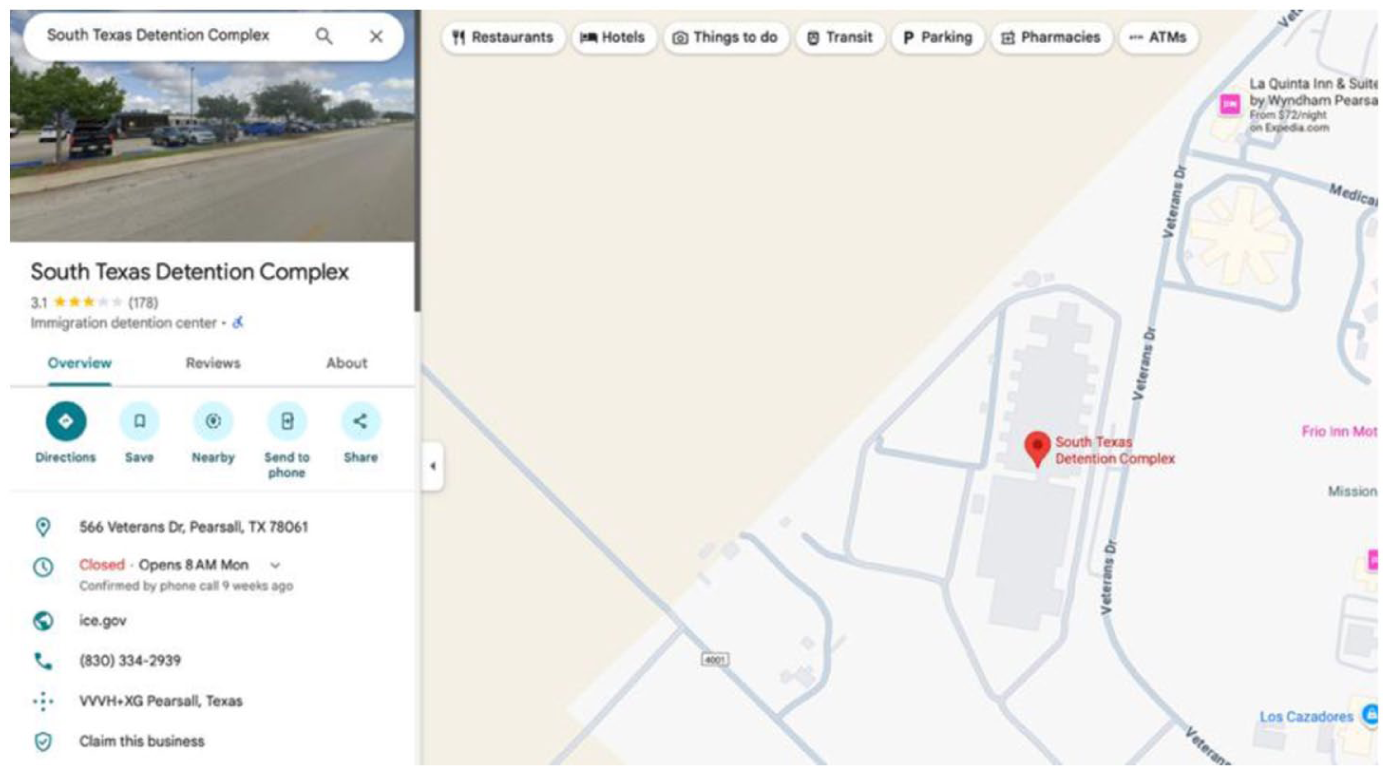
Screenshot of a Google Maps page for the South Texas Detention Complex (Map data ©2025 Google; Street View image ©2025 Google, image capture June 2023)
While Google appears to have turned off comments for at least 91 ICE-affiliated or ICE-managed detention facilities, there is no granular sociotechnical indication as to when or why these erasures of the review archives were made—or to what extent, if any, federal officials themselves were consulted in the process.
Civic audits: Seeking infrastructural and institutional accountability
Self-identified family members wrote Google reviews to attest to the communication struggles they faced while attempting to contact detained individuals—with many disclosing problems in reaching loved ones. As one person explained, “This place does not know what it’s doing [sic] you called ask questions and you get transferred to phone numbers that don’t even exist.” Others explicitly expressed a desire to access contact information for detention facilities and their officials: “Can someone give me information about the email address of the officer in charge?” Some reviewers put their complaints more succinctly: “Learn to answer your damn phones!” For others who described themselves as being outside carceral institutions, the challenge was not making calls but rather receiving them; as one self-identified former girlfriend of a detainee lamented, “I keep getting calls from this place and I’m not sure if my ex is trying to contact me.”
Others tied their critiques explicitly to the affordances of Google specifically, noting the limits of a review system that only narrowly allows for criticism of democratic institutions: Can we put my tax dollars to good use and pay people who are willing to answer the phone and provide us the good American people the information we obviously are calling about. That one star you see is actually 0! Thanks google for helping me inform others.
One reviewer describing herself as the wife of a detained man similarly lamented, “If I could give 0 zeros I would I’ve called them over 1,000 times to know about my husband and no one answers.” Many of the comments criticized sociotechnical breakdown within ICE facilities, focusing on communication practices fraught with rupture and uncertainty.
It is evident that some people are turning to Google reviews as a way to seek out institutional accountability for ICE’s wrongdoing and thus are relying on a commercial search engine to scrutinize and criticize the conduct of carceral institutions. Yet, as Keane (2011) previously explains, the creation of additional channels for public complaint does not necessarily facilitate greater accountability and citizen empowerment in liberal democracies. While ICE employees are able to call and change the contact information of individual detention facilities, there is no immediate evidence to suggest that these reviews constitute a dialogic communication channel between ICE and commenters who self-identified as US citizens but rather an information-sharing forum that centers carceral counter-narratives calling for institutional accountability.
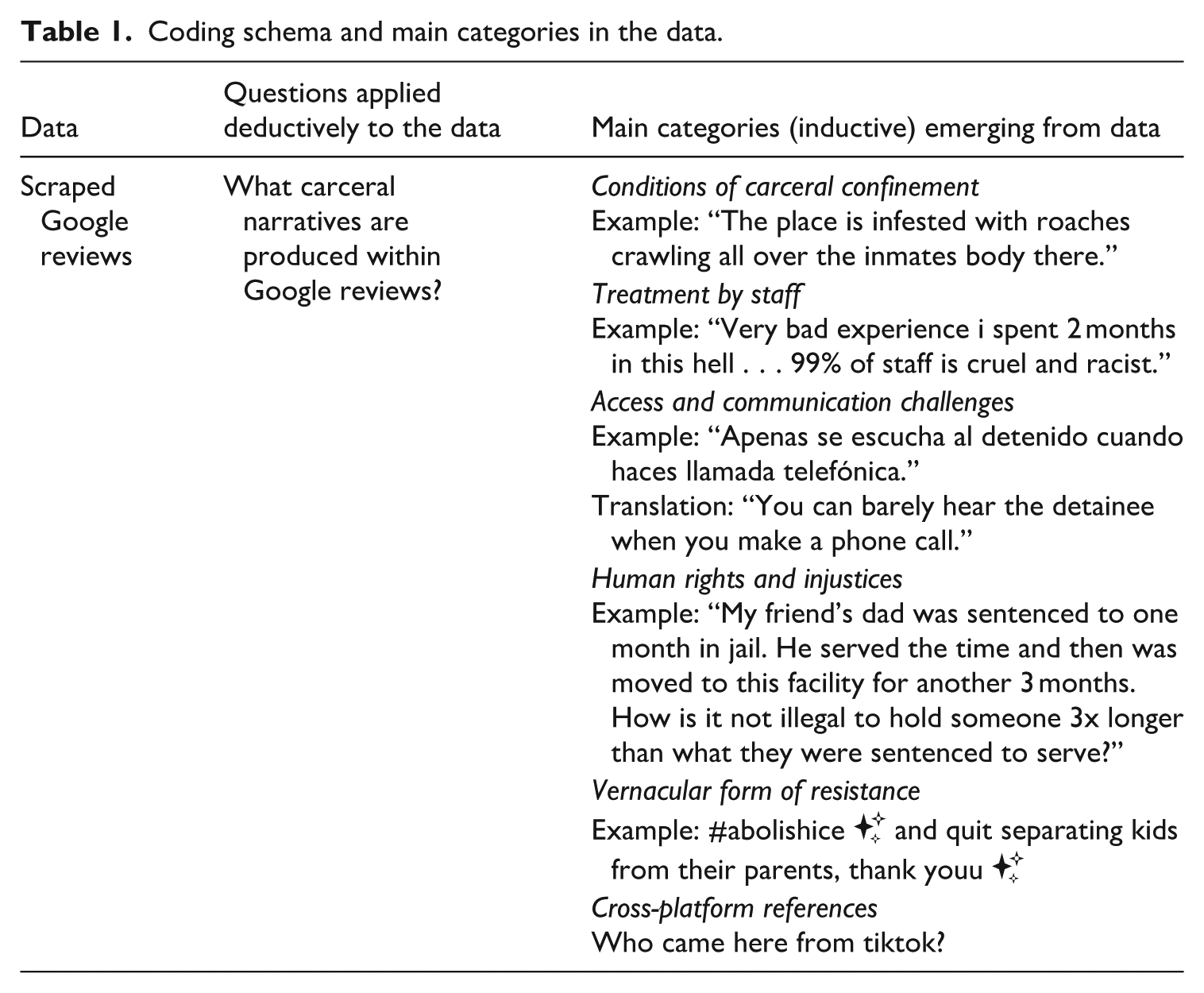
In this context, accountability refers to the extent to which decision-makers are expected to justify their choices to those affected by their decisions and to be held answerable for their actions, failures, and wrongdoings (cf. Perel and Elkin-Koren, 2016: 481). But for those seeking answers on Google, regardless of their offline identities, there are no institutional answers, no indication that ICE employees have ever tried to respond on behalf of their employers and engage directly with concerned citizens and other reviewers. 3 The corpus, however, also indicates that not everyone posting is seeking information or coming to share a memory narrative of their experiences. Some posts reference vernacular forms of resistance (e.g. “#abolishice”), while others name specific corporate social media platforms, some of which have hosted accounts encouraging people to post reviews on Google, regardless of whether they have experienced the detention facilities firsthand. 4
Efforts to call for infrastructural and institutional accountability are flattened in the quantitative ratings that accompany each detention facility (see Table 2). While numbers and politics have historically had a co-constitutive relationship, it is unclear how these ratings, as an extension of Google Maps, as systems of carceral measurement and quantification might influence ICE or challenge its reputational facework. It does have the effect of offering a crowd-sourced and technologically deterministic view of democracy by way of carceral critique.
Coding schema and main categories in the data.
Available ratings for ICE detention facilities as of August 23, 2025.
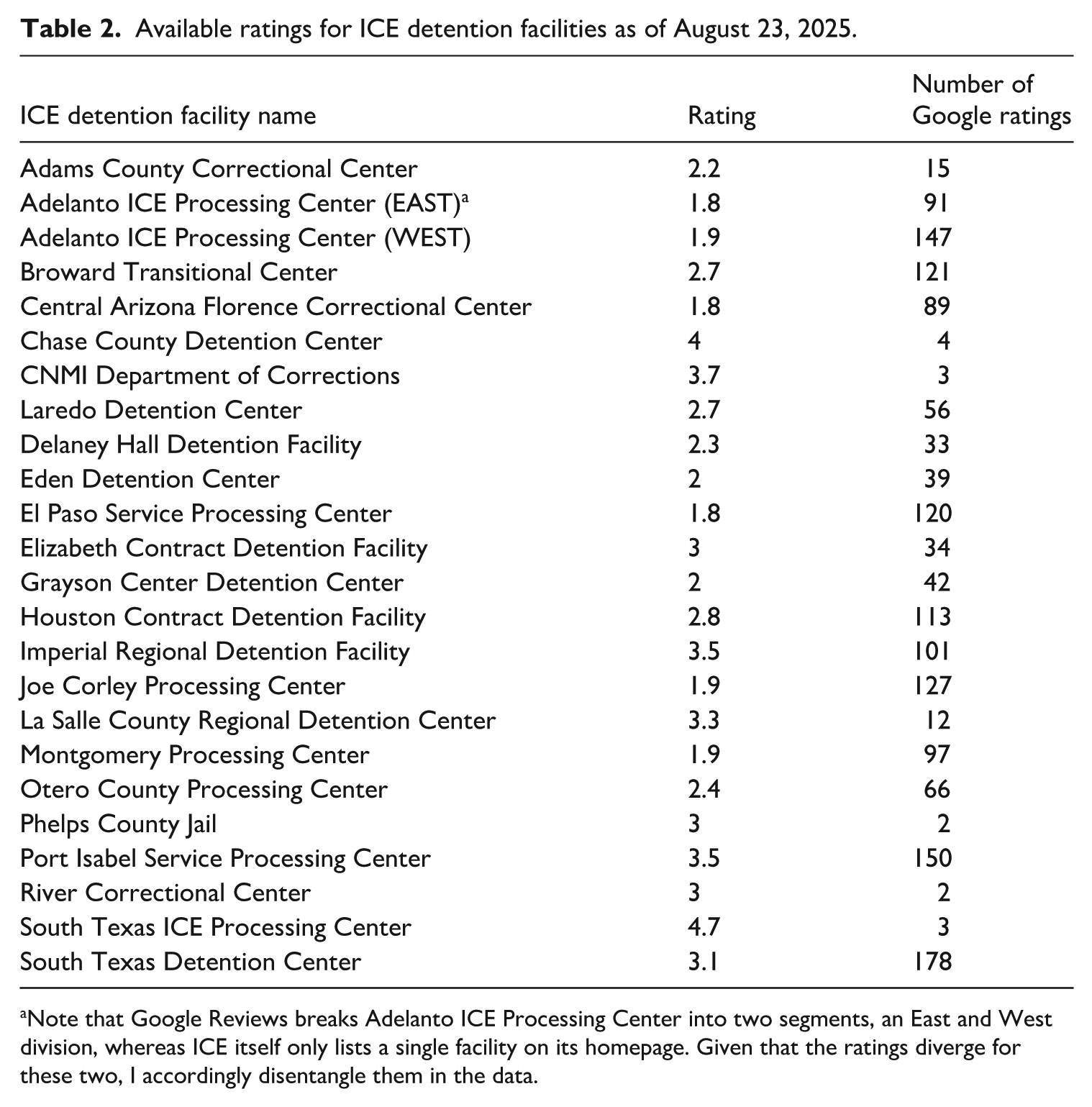
Note that Google Reviews breaks Adelanto ICE Processing Center into two segments, an East and West division, whereas ICE itself only lists a single facility on its homepage. Given that the ratings diverge for these two, I accordingly disentangle them in the data.
Ratings thus serve as a collaborative and quantifiable effort to represent and problematize not only what it means to be governed but in part, what being detained entails. Ratings of democratic, and by extension, carceral, institutions thus represent a numeric form of civic deliberation, though it is Google that structures and platformizes this specific data regime.
Carceral narratives as platformized: The discursive work of remembering and resisting detention
Google reviews are definitively a form of knowledge infrastructure in that they operate as a forum for information-seekers of carceral institutions, but an analysis of the scraped reviews also reveal that they partially constitute a corporate memory infrastructure, wherein individual narratives published by self-identified formerly detained people, their families, and other members of the public speak to their memories of, with, and within ICE detention facilities.
Many reviewers who described themselves as previously detained or conveying the words of detained people were grappling with how to describe their carceral experiences more broadly and how to indexically approach the governing structure responsible for holding them. As one person noted, “You can call it whatever you like, but this is a prison.” Another self-identified formerly detained person spoke extensively of their experiences in a detention facility in New Jersey, entitling their review “A Personal Account of My Time at the CCA Detention Center in Elizabeth, NJ”: This was one of the most difficult and dehumanizing experiences of my life. What’s happening inside facilities like this needs to be seen and understood for what it truly is—not simply a holding center, but a prison in all but name.
Narratives like this one from individuals asserting their status as former detainees tend to reference specific moments in time, certain carceral practices (e.g. treatment by staff), the trajectories taken by other detainees, or the need for institutional oversight of named detention facilities. We can thus situate some of these reviews not only as carceral data but memory narratives, recounting what reviewers described witnessing inside and attempting to define the detainee experience with an attention to indexicality and onomastics. We see here an effort to hold ICE accountable through bearing witness in the form of Google reviews, wherein knowledge panels tied to specific detention facilities host individual carceral memories.
Google reviews offers a structured, if not formulaic way for citizens, non-residents and others passing through the United States to bear witness to carceral practices without having to wade through limited and often opaque federal infrastructure. Many of the memory narratives circled back to linguistic isolation and problems with communication, which were exacerbated by ICE’s tendency to not offer detained people sufficient access to interpreters. As one person lamented, I stayed there for more than a month. The food there was okay, but very unpalatable. They were all very kind. Due to the language barrier, there was a big barrier to communication. I felt that most people couldn’t express their thoughts and needs. Why didn’t they have a translator?! Even if it’s not expensive. The air conditioner there was very cold, and many people, including me, caught cold from the cold. Even so, they were unwilling to turn up the air conditioner temperature. When I slept at night, I only had a thin blanket to cover myself, and it felt very cold.
A reoccurring pattern in posts like the aforementioned one is to reference other detained people, who may not have had or may not have the capacity to post on Google or seek accountability through other fora. In some instances, though, there is suspicion as to whose voices are being heard online. For example, one self-identified resident of Pomona, California lamented, “Shame on all the staff who leave fake positive reviews; I’d like to see reviews from the people imprisoned here.” At the time of writing, Google does not provide researchers with a reliable or systematic method for verifying the real-world identities of individuals who post reviews on the platform, though some degree of triangulation might be possible on occasion, based on accessible account information, profile histories, and Local Guide badges.
Google’s platform architecture ultimately prevents people from scrolling through all reviews of ICE detention facilities simultaneously, forcing individuals to instead click on reviews that are specific to one location. As a result, seeing evidence of the potential interconnectedness or overlaps in detainee experiences within the carceral system is not always immediately apparent from clicking on one knowledge panel. Still, Google reviews thus offer memory producers, and specifically the formerly detained, a relatively fluid way to engage with the past of carceral institutions and to enable new forms of mnemonic contestation all the while remaining at the mercy of private firms and their algorithmic systems. Search engines, like Google, serve as not only a form of information intermediary (Wallace, 2018) but also a mnemonic intermediary that sorts and determines the kinds of carceral memory narratives that people will be able to access online. While employees of search engines have been criticized for not transparently explaining the sociotechnical levers undergirding how the past can be accessed (Paßmann and Boersma, 2017), the mnemonic potential of Google reviews of carceral institutions specifically has thus far been ignored by scholars. Yet part of the advantage of this type of forum is that detainees, as well as their legal advocates and activist allies, do not have to respond to a specific rule proposal being offered up by the US administrative state; they are able to post generally about their experiences within the detention facilities and for those reviews, at least temporarily, to be visible to broader publics.
Here carceral memory agents, who also claim to have been witnesses within ICE detention facilities, are attempting to “perceive their own commonality through representations of shared existential threats” (Frosh and Pinchevski, 2009: 10), but what is unfolding here in the Google reviews is not the same as what memory scholars have termed “social media witnessing” (Griffin, 2022). The self-identified formerly detained people here are not inscribing their memories into social media networks or explicitly sharing their carceral narratives with their followers. While people can leave emojis as a form of solidarity with individual reviews, it is not as easy to forward a Google review to other audiences, as it is say a tweet or TikTok. Like Google Maps allows for a space in which memory can be produced and seen, but the technology firm draws very firm sociotechnical boundaries about to what extent and whom can co-create a socially shared experience. The only people who can respond directly to a review of a carceral institution are those with control and access to the ICE detention facility’s knowledge panel, limiting the flow and metacommentary that individual memory narratives can beget within the search engine’s apparatus.
Looking ahead: The future of privatized accountability systems of the US carceral state
Historically, people have had access to a number of public sector channels in order to provide feedback and critique of the US administrative state and its underlying federal instrumentalities. ICE (2015) maintains privacy policies and notices for its Facebook, X, Instagram, and YouTube accounts, wherein it discloses: . . . ICE reserves the right to review all comments and remove any that contain profanity, personal attacks of any kind, spam, refer to Federal Civil Service employees or other individuals by name, otherwise contain PII, contain offensive terms that target specific ethnic or racial groups, promote commercial products, are geared toward the success or failure of a partisan political party, group, or candidate, incite hate, or are subject to a claim of infringement or deemed to be an infringement of intellectual property, or that is otherwise objectionable.
Notably, there is no mention of ICE policies toward Google or any corporate infrastructure beyond the four mentioned platforms, despite the fact that much like X or Instagram, Google reviews have turned into a site of contestation over the reputation and legacy of the carceral institution. There is no public-facing verbiage to indicate how, or to what extent, government officials might seek to intervene or coordinate with Google to remove comments. Private infrastructure is not the only place, where people can plead for institutional accountability. In the past, ICE has issued requests for public comment via the Administrative Procedures Act, which mandates that people be allowed to provide specific feedback toward the creation of rule changes to federal policy, but the law does not outline any clear policies regarding the types of speech government agencies can censor, redact, or withhold from public circulation. 5
Here it is worth rethinking the potential of affordances of search engines that are run by private technology firms and thus potentially isolated from the full force of the US federal government’s grasp. Yet the ambiguities of Google’s content moderation practices leave unresolved the question of just how quasi-sovereign the reviews are as a federal accountability system and what kinds of sociotechnical levers undergird the relationship between the Trump administration and other technology companies, such as OpenAI and Anthropic. It is important to trace and document too emergent acts of erasure, disconnection, and rupture as well as the terms in which institutions justify the removal of carceral expression.
Conclusion
If Google and other profit-driven technology companies are willing to opt certain democratic institutions, including individual ICE detention facilities, out of their review system, it is worth inquiring as well, what other types of special privileges might they be permitted? It is also important to monitor the ways in which the US administrative state can alter government records of past presidential administrations in a way that might further manipulate how its work is perceived publicly; in 2025, for example, The Guardian reported that the Trump administration’s ICE officials had updated thousands of old press releases with a timestamp that read “Updated: 01/24/2025,” giving the artificial impression of hyper-efficiency and perhaps to some, transparency (Kerr, 2025).
Future research can expand the dataset to consider reviews of detention facilities that are outside the United States, though mention of Google reviews in the context of other carceral systems is also somewhat sparse (cf. Comparative Network on Refugee Externalisation Policies [CONREP], 2022). 6 More research too is needed on the discursive negotiations between platform governors and the governed—but especially the detained. While communication scholars have long reckoned with infrastructure within prisons (Kaun and Stiernstedt, 2023) and how different related interpretive communities (e.g. incarcerated people and correctional officers) rely on specific social media platforms (Adorjan and Ricciardelli, 2023), less explored has been the relationship between search engine logics and carceral landscapes more broadly.
The need for future researchers to examine the discursive application of security logics invoked in the name of carceral institutions is particularly important. In September 2025, Apple removed ICEBlock, which allows people to report local sightings of ICE officers, from its App Store, releasing the following statement to the press: “Based on information we’ve received from law enforcement about the safety risks associated with ICEBlock, we have removed it and similar apps from the App Store” (as quoted in Duffy (2025)). Justifying the decision, Attorney General Pam Bondi explained, “We reached out to Apple today demanding they remove the ICEBlock app from their App Store—and Apple did so” (as quoted in Oliver (2025)). The creator of ICEApp presented a structural counter-argument, “ICEBlock is no different from crowd sourcing speed traps, which every notable mapping application, including Apple’s own Maps app” (as quoted in Duffy (2025)). Here we see a gesturing to the cartographic and infrastructural dimensions of carceral expression, which also require additional study.
Online reviews have long been the topic of theoretical discussion (Askay, 2015; Schreiber and Noy, 2025), but as ICE continues to arrest reporters (Chidi, 2025) and government officials, including city and state lawmakers who have tried to access detention cells in the name of institutional oversight (Ngo, 2025), there is now an even greater need to consider the infrastructural fragility and systems of governance undergirding forums, where carceral institutions may manipulate or co-produce informational control in coordination with quasi-sovereign authorities, such as Google. As this work goes to press in 2026, it also appears that the number of ICE detention facilities in the United States with inaccessible Google reviews is increasing, demonstrating the need for more empirical work in this domain.
Given Google’s willingness to erase entire archives of reviews associated with individual detention facilities, it is also worth considering whether sociotechnical researchers should consider actively creating and maintaining what Iliadis and Acker (2024) call “public interest archives for platform accountability” (p. 2343) to preserve carceral trace data, especially that which might be important for future historians and human rights activists. Though the study focuses on carceral institutions within the United States, the method is transferable to over 200 countries, where Google maintains a presence, though not all; notably, South Korea is one of the few modern democracies, where Google Maps is not accessible (Klawans, 2025). Given the interconnectedness of institutions, the need to examine carceral power beyond the US government’s control is paramount, and thus, archives of Google reviews—or records of their absence—may also prove data-rich for researchers in and of other countries with strong penal legacies.
Footnotes
Acknowledgements
This text’s existence results from collective efforts, though its faults are my own. I am deeply grateful to the two anonymous reviewers, who provided generous feedback during this paper’s development. Tian Yang read an earlier draft and kindly offered insights, which strengthened the argument. Presentations of this work at the International Communication Association’s 2026 conference in Cape Town, South Africa, and at a 2025 symposium hosted by the University of Pennsylvania’s Center for Media at Risk shaped my thinking as well. This research was supported in part by a residency at A Studio in the Woods. I learn constantly from Dan Bateyko, Lindsay Cronk, Florence Madenga, Will Mari, Ruth Moon, Julia Sonnevend, Diami Virgilio, Morgan Weiland, Daniella Zalcman, and Barbie Zelizer, and thank them for meaningful conversation during the drafting of this piece.

Funding
The author received no financial support for the research, authorship, and/or publication of this article.
Declaration of conflicting interests
The author declared no potential conflicts of interest with respect to the research, authorship, and/or publication of this article.