






Abstract
This article analyzes the network structure and content of local Telegram chats in Belarus using the theoretical framework of connective action logic. Using the data collected right at the aftermath of the protests, we created a bimodal network consisting of almost 800 local chats and over 440,000 unique users. This “network of networks” featured subnetworks within the country’s regions, towns, and city districts, as well as Belarusian diaspora, with large and smaller hubs connecting parts of the network together and enabling coordination and information exchange. Content analysis of the messages shared within top-50 most popular chats demonstrate that participants discussed news, shared safety tips, and organized small-scale community-building activities. This article demonstrates the role of local Telegram chats in enabling and sustaining pro-democratic movement in Belarus and advances our understanding of digital technologies in social movements, while also pointing out its limitations in non-democratic regimes.
Introduction
The scale of Belarusian pro-democratic protests in 2020 surprised observers and scholars alike, who emphasized that the leaderless, grassroot, and spontaneous nature of these demonstrations (Stykow, 2023) was a striking contrast to previous post-election protests that mainly happened in the capital. Research underlined that protesters organized their dispersed actions at workplaces and universities, city districts and neighborhoods, separate apartment buildings and courtyards (Artiukh, 2021; Gabowitsch, 2021). Telegram, a cloud-based instant messenger, became especially popular due to its encryption features and virtual private network (VPN) accessibility (Urman et al., 2021), which initially helped to circumvent the regime’s security forces and Internet shutdowns. Local Telegram chats for various neighborhoods, schools, university departments, organizations, and demographic groups mushroomed in Belarus. Participants used these groups to exchange and discuss local and national news, as well as coordinate their actions of solidarity and activism among each other.
This case has several important characteristics that present an opportunity to study how digitally supported social movement organization has evolved and adapted since well-documented protests of Occupy Wall Street, Indignados, and Arab Spring in 2010s. Namely, this case featured many local chats spread across the country, prevalent use of one platform (Telegram), relatively small country’s population (about 9.4 million people in 2020), widespread belief that election results were substantially falsified, and resilience of this grassroot protest movement despite brutal repressions. Describing shifts that social media brought to social movement mobilization, scholars (Bennett and Segerberg, 2013; Gerbaudo, 2012) argued that organizational structure of these protests became less centralized. The largely leaderless nature of Belarusian protests, shared grievances across a relatively small population, and important role of interpersonal communication through one prevalent platform allow us to collect data and better understand the organizational and cohesive capacity of multiple Telegram chats during 2020 protests across the country.
This article analyzes the network structure and content of local Telegram chats through the theoretical lens of connective action logic (Bennett and Segerberg, 2013). Using data collected in the immediate aftermath of the protests, we built a bimodal network consisting of almost 800 local chats and over 440,000 unique users. The nodes in this network are Telegram chats and the links are connections between Telegram users and chats, so the connection between the chats exists if the same user is a member of these two chats. Comparing this network’s structure to theoretical models outlined by Bennett and Segerberg (2013), we argue that it resembles a theorized yet not empirically presented crowd-enabled “network of networks.” Like most networks in the world, it follows the preferential attachment model (Barabási and Albert, 1999) with several important hubs, which correspond to chats for regional centers in Belarus and Belarusians abroad. However, this network also has smaller hubs within the country’s regions, towns, and city districts, stitching otherwise disjoined parts together and enabling coordination among members.
To verify the nature of conversations within these chats, we also analyze their content from August 2020 until March 2021, selecting the top 60 most important chats in the network based on indegree centrality measures across all chats and within four identified subnetworks. We employ latent Dirichlet allocation (LDA) to categorize messages into categories based on their use of language. Our results show that users of these chats coordinated protest actions, actively connected with each other, discussed news and politics, as well as reflected on their actions and events. These results also reveal that there was little to no difference between discussions in the capital and in the regions, further corroborating the dispersed and horizontal nature of these protests.
This article advances the theory of connective action logic by presenting one of the first empirical examples of the theorized “network of networks” complemented by description and analysis of that network. Results of our analysis demonstrate the role of local Telegram chats in enabling and sustaining the pro-democratic movement in Belarus in the face of authoritarianism. These insights can also inspire and inform local and nation-wide social movements in other contexts of authoritarian or dictatorial regimes. For instance, growing evidence suggests that anti-ICE (US Immigration and Customs Enforcement) protesters in Minneapolis, MN, have relied on Signal chats for organizing, coordinating, and disseminating information for protests, community defense, and rapid response actions (Buttons, 2026; Greenberg and Newman, 2026). This project also enables us to explore the role of Belarusian diasporas abroad and their central role in supporting the pro-democratic movement in the homeland. Overall, these findings advance our understanding of digital technologies for sustaining pro-democratic social movements, while also pointing out their limitations in authoritarian regimes.
Connective action logic: Modern theory of mobilization in digital age
The theory of connective action logic, proposed by Bennett and Segerberg (2013), emerged to explain the increasing role of digital media in organizing people around a common cause. Social media became a facilitator for assembling and publicizing large and small gatherings in which protesters came and acted together in public space (Gerbaudo, 2012). The central concept of connective action logic theory is personalized communication, which is achieved through symbolic inclusiveness and technological openness. The former describes personalized ideas that encompass different personal reasons for contesting a situation, while the latter includes interactive digital affordances that allow individuals to determine the degree of their participation and permit connection among individuals and organizational actors or directly between individuals.
Scholars further explain that technological openness creates more egalitarian communication networks, which can achieve similar results to those with more hierarchical structure in terms of setting agendas, bringing policy change, or mobilizing and coordinating an action (Bennet and Segerberg, 2013; Diani, 2014). Bennett and Segerberg (2013) coined a term network power signature, which refers to the degree to which recognition is concentrated or dispersed among network actors. Based on that criterion, they defined three types of network signatures: power law, moderate power signature, and dispersed power signature. Power law signature occurs when nearly all recognition belongs to a few actors, while others have very little or none. Moderate power signature represents a less steep network curve with a gentler slope of power-law distribution, suggesting that the network is less centralized and more actors in the network possess prestige and influence. The third type is dispersed power signature, which represents a multi-centered, multi-tiered, dynamic, and dispersed network. In this “network of networks,” there are layers of distinct networks with limited overlap that create granular and dispersed relations throughout the action network. While scholars acknowledge that there will likely be power curves in layers of the overall network, they suggest that such network power signature lacks centralized leadership.
However, other scholars of social movements in the digital age questioned this assumption of equality and non-hierarchical structure. Studying the Arab Spring, the Indignados, and the Occupy movements, Gerbaudo (2012) suggested new forms of “liquid” or “soft” leadership that exploits the interactive and participatory character of the new communication technologies. While small transactions help online participants to stitch different networks into a “network of networks,” respond to external conditions and long-term adaptations, there is still a small core set of participants who contribute more than others in the process of building shared identity, solidarity, and producing elements of organization (Gerbaudo, 2014). Gerbaudo (2017) called this core set of participants “digital vanguards,” which represent collective and informal leadership structures that direct collective action using digital communication. Beyond social movements, peer production projects, such as Wikipedia, also demonstrated centralized organizational structure, following “iron law of oligarchy,” which proposes that “democratic membership organizations become increasingly oligarchic as they grow” (Shaw and Hill, 2014: 215). This understanding of leadership challenges Bennett and Segerberg’s (2013) idea of completely decentralized “network of networks,” suggesting that digital vanguards exhibit different, yet necessary leadership qualities in digitally facilitated social movements. This necessity of leadership also finds support in the network science theory.
Dispersed power signature: A network science perspective
Another criticism of a fully dispersed power signature comes from network science scholars who aptly pointed out that connective action logic relies on implicit assumptions that are rarely put to an empirical test and often are “not consistent with well-established findings in network science” (González-Bailón and Wang, 2016: 95). Indeed, in their book Bennett and Segerberg (2013) cited examples of Twitter-driven Arab Spring revolutions as a potential embodiment of such a network, yet all data analyses contained in the book demonstrated networks that fell either under power law or moderate power signature categories. Perhaps, this is not a coincidence or a gap in the data collection process as other empirical studies of the Indignados and the Occupy communication on Twitter revealed that online networks of these movements were highly centralized and fragmented, connected by the brokers that facilitate the diffusion of information (González-Bailón and Wang, 2016).
Modern network science coalesced around the idea that most known networks in our world follow a scale-free model (Barabási and Albert, 1999). The model explains the process of networks’ self-organization into a scale-free state, incorporating the idea of network growth over time and considering preferential attachment component, a feature of new nodes to attach not at random, but rather to nodes that already have many connections. The main premise of the model is that the more connections a given node in the network has, the more likely it will receive connection from each new node that joins that network. In other words, preferential attachment means that high-degree nodes have a high probability of receiving new links (Menczer et al., 2020). As networks grow, the oldest nodes are present from the beginning and have the advantage of receiving more connections, in contrast to nodes that joined the network later. Thus, the number of connections of the oldest nodes always exceed those of newer nodes, and this makes the former even more likely to attract new links in the future (Menczer et al., 2020). In social networks, popular individuals are such high-degree nodes with many social connections, often connecting various social circles together. As new people join a social network, they are more likely to be introduced to a popular individual compared to other less known members.
Barabási and Albert (1999) proposed the scale-free model to explain why most networks in the world inevitably have hubs, or the nodes with the largest number of connections in the network, which also serve as connecting joins for various part of this network. Thus, the idea of a coherent network without centralized hubs contradicts main premises of network science theory, yet it is possible to theorize that in the case of a more decentralized digitally enabled social movement we can observe larger number of hubs that help to connect otherwise disjoined parts of the network together, essentially creating the theorized “network of networks.”
Case study: Belarusian pro-democratic protests
The scale of Belarusian pro-democratic protests in the aftermath of the 2020 presidential elections developed counter to the predictions of many scholars (Stykow, 2023). With all viable oppositional candidates in prison or in exile, with civil society playing a limited role in expressing Belarusians’ grievances (Bindman and Chulitskaya, 2025), with unprecedented police brutality, people nevertheless gathered en masse both in the capital and across the country (Asmolov, 2020). Scholars have quickly highlighted the role of Telegram messenger in facilitating these protests at local and national level (Wijermars and Lokot, 2022), making this case study particularly intriguing for testing and improving the concept of the “network of networks” from connective action logic.
Anatomy of protests
Self-organization of Belarusians started when Belarusian authorities denied the COVID-19 pandemic, damaging trust in the state and prompting people to coordinate volunteer activities to support doctors, as well as protect themselves and others (Moshes and Nizhnikau, 2021). When all viable oppositional candidates were arrested or denied registration to run in the elections, the wife of one of the arrested candidates, Sviatlana Tsikhanouskaya, stepped up. She and two of her supporters from other oppositional campaigns held large rallies all over the country (Way, 2020). Brutal riot police repressions following peaceful gatherings of voters around polling stations on the Election Day, August 9, left at least four people killed, hundreds injured, and almost 7000 detained (Human Rights Watch, 2021). Tsikhanouskaya was sent into exile, while two other female leaders were arrested or left the country. While she became a vocal opponent of the Belarusian regime abroad, after exile her role in orchestrating and sustaining protest movement within Belarus became very limited. For instance, she appealed for a national strike on October 26, which received very limited support from working Belarusians and undermined future attempts to coordinate the pro-democratic movement.
As a response to violence, new and even stronger mobilization of peaceful marches ensued across the country, organized with “partisan tactics” to circumvent the efforts of security forces (Stykow, 2023). During the fall of 2020, the protests continued to grow in size, scope, and spread even further across the entire country to both urban and more rural localities (Douglas, 2024; Onuch et al., 2023). Researchers estimate that about 18% of the adult population between 18 and 64 years based in cities over 20,000 inhabitants took part in the protests in-person and/or online (Douglas et al., 2021). Other estimates suggest that about 10% of the capital dwellers and 5% to 6% of the population in over 100 cities across the country took part in protest actions (Mateo, 2020).
Technological openness manifested itself in widespread use of digital technology to organize and sustain protests. From the beginning, protesters created a crowdsourced map of police presence, spearheaded mutual aid centers, while diaspora members collected donations for victims of state violence through crowdfunding platforms (Asmolov, 2020). Social crisis situations, such as electoral fraud and police brutality, provide fertile ground for social movements to strengthen their mobilization using social media (Jost and Dogruel, 2023). Grassroot activists created thematic channels and chats to engage and coordinate the so-called “guild” or “group actors” such as students, sportsmen, artists, doctors, IT specialists, factory workers, pensioners, and women, among others (Gabowitsch, 2021). Local activists also spearheaded their own local chats at the level of apartment buildings, neighborhoods, villages, city districts, and regional centers to disseminate news about local protest actions (Artiukh, 2021). By the end of August 2020, in 11 out of the 20 largest Belarusian cities local Telegram protest channels had number of subscribers equivalent to 3.5% to 5.5% of their total population (Gabowitsch, 2021).
This use of Telegram chats is akin to 2019 pro-democratic protests in Hong Kong, where traditional protest leaders played less prominent role than local communities, while local community channels served as hubs in disseminating protest-related information (Urman et al., 2021). Content analysis of these local community channels in Hong Kong revealed that participants distributed information related to police presence and protest-related actions, as well as deliberated (Urman et al., 2021). In Belarus, content analysis of 818 local chats between August and October 2020 revealed that around 40% of messages evolved around coordination of protest activities, while 25% were devoted to “general communication” (Shelest, 2020).
Decentralized structure
Absence of clear political leaders, spontaneous coordination, and scattered nature of protests across the country attracted attention of observers and scholars (Asmolov, 2020; Stykow, 2023). First, they noted the lack of leadership and ideology among oppositional leaders, emphasizing the inability of politicians to communicate and coordinate with various protest groups (Moshes and Nizhnikau, 2021). Many informal community initiatives sprang up along with protests, creating so-called “networks of solidarity” (Astapenia, 2020), yet they had very chaotic and non-systematic relationships with established civic society organizations (Bindman and Chulitskaya, 2025). Marches, unlike political rallies, created a horizontal spatial structure in which all participants appeared as equal agents rather than supporters of a leading figure (Gabowitsch, 2021). Protesters gathered at local focal points, formed columns, and only then decided where to go and what chants to use (Moshes and Nizhnikau, 2021). Protests spread to all regions and social groups: in addition to weekly Sunday marches, Belarusians also participated in marches for women, elderly, people with disabilities, and just neighbors, all of which happened on a regular basis during fall 2020 (RFI, 2020). Since most of these marches were not concentrated at a single point, as many previous revolutions in post-Soviet region (Stykow, 2023), it was more difficult to suppress these marches at once (Asmolov, 2020). These mass protests continued without apparent leadership structures until late October, while smaller localized protests and neighborhood actions continued into early 2021 (Onuch et al., 2023).
Scholars also highlighted the important economic and political role of Belarusian diaspora (Guriev, 2020), which includes about 3.5 million Belarusians abroad compared to 9.5 million residing in Belarus. Some of the diaspora’s Telegram-based initiatives, such as solidarity funds and crowdfunding initiatives, helped to diminish the regime’s economic threats against protesters (Moshes and Nizhnikau, 2021).
Propositions: Theoretical expectations
Considering the theoretical underpinnings of connective action logic, insights from network science about networks structure, and the case study of Belarusian pro-democratic protests in 2020, we make the following theoretical propositions. Symbolic inclusiveness of protests’ slogans and symbols, technological openness allowing various ways to join the movement, and the decentralized nature of protests led by multiple grassroot networks suggest that
Methods
Data collection and network analysis
To understand the connective action logic during pro-democratic protests in Belarus in 2020, we collected data from local Telegram chats assembled by Belarusian activists who created a crowdsourced map to find relevant communities. Anyone could add a new chat or channel to the map, and by 2021, the website featured a long list of Telegram links, which covered the entire country of Belarus and diaspora all over the world. Given that channels only transmit top-down communication from channel creators to subscribers, we decided to focus on chats where all participants can send messages and communicate with each other. This choice had consequences for prestige distribution as we expect that people interested in protest activity would likely join their local chats for interaction with neighbors in addition to joining large chats and channels that are run at the higher level of neighborhoods, towns, and cities.
In March 2021, we collected a list of all Telegram chats in Belarus and abroad from the crowdsourced website https://dze.chat/ (“dze” is Belarusian for “where”) and, using the Telegram API, collected the unique user ID of each participant in all these chats. Mindful of privacy and security of chat participants, we did not collect any information beyond unique user IDs. In March 2021, overall activity of protests largely diminished; however, the level of repression was still relatively low, and many chats still included most of their members. In the months that followed, Belarusian authorities started active persecution of chat administrators and members, prompting people to leave the chats. While these circumstances prevented us from collecting the data overtime, we still captured likely the fullest network of political local chats in Belarus before its dismantling in the months to follow. Using channel name and unique user IDs, we created a bipartite network, where two chats are related if they share a link to a common user node. To visualize this network, we used Gephi software and opted for a ForceAtlas2 layout, given the large size of the network.
According to Bennett and Segerberg (2013), power signature is assessed based on how recognition in the form of prestige (inlinks) and influence (outlinks) in the network is centralized or evenly distributed among actors. To measure distribution of recognition in Telegram chats network, this analysis explores indegree centrality. Given the bipartite characteristic of the network, chats can only have inlinks. The more people decided to join a given chat, the more inlinks it received, and the higher the indegree centrality of this chat became.
Content analysis
To better understand the nature of conversation that happened within these chats and validate the premise that people used them for political action, we also collected all messages posted by chat participants between the time when the chat was created and the end of March 2021. To limit the number of messages and make data analysis more manageable, we decided to focus on the top 58 chats within the network, as measured by indegree centrality. These chats each had over 1500 messages posted to them and demonstrated a large-scale usage of Telegram by the participants.
We used a naive Bayesian topic classification framework to categorize each message with the most similar messages with a minimum of a priori assumptions, such as Latent Dirichlet allocation (LDA). This approach works exceptionally well with text corpora that have individual short texts that can have a reasonable expectation of having a single topic (i.e. not so long that multiple “topics” might be statistically valid). In our case, there is a reasonable expectation that text messages with an average length of only 100 characters have a prevalent single topic.
Prior to the analysis we eliminated messages with less than 50 characters of text, tokenized each message, removed URLs and mentions, and removed English, Russian, and Belarusian language stop words (i.e. words like “the,” “v,” and so on, that have no semantic meaning). Next, we removed words with less than three characters, which are generally either stop words, abbreviations, or typos, as well as lemmatized the words, which removes word endings to reduce words to their grammatical root. Afterward, we screened out words that appeared in more than half the individual texts (to eliminate words so common as to provide no semantic meaning) and kept the 5000 most frequently appearing words below that threshold.
We ran an iterative model in which we attempted an LDA categorization from 3 to 10 topics. Three is the minimum number of topics because in practice a naive classification will always yield a residual category, in which texts that simply don’t fit anywhere are dumped. This means that with a minimum categorization into two different topics, there will be a third residual category. The upper limit was picked as 10 and is consistent with previous works using LDA modeling in political communication field (Maier et al., 2018). Figure 1 shows the trend of coherence and perplexity for our LDA model from 3 to 10 and demonstrates a clear spot of maximized coherence (with nearly zero perplexity) at four topics. For this reason, we have focused on the four-topic LDA model.
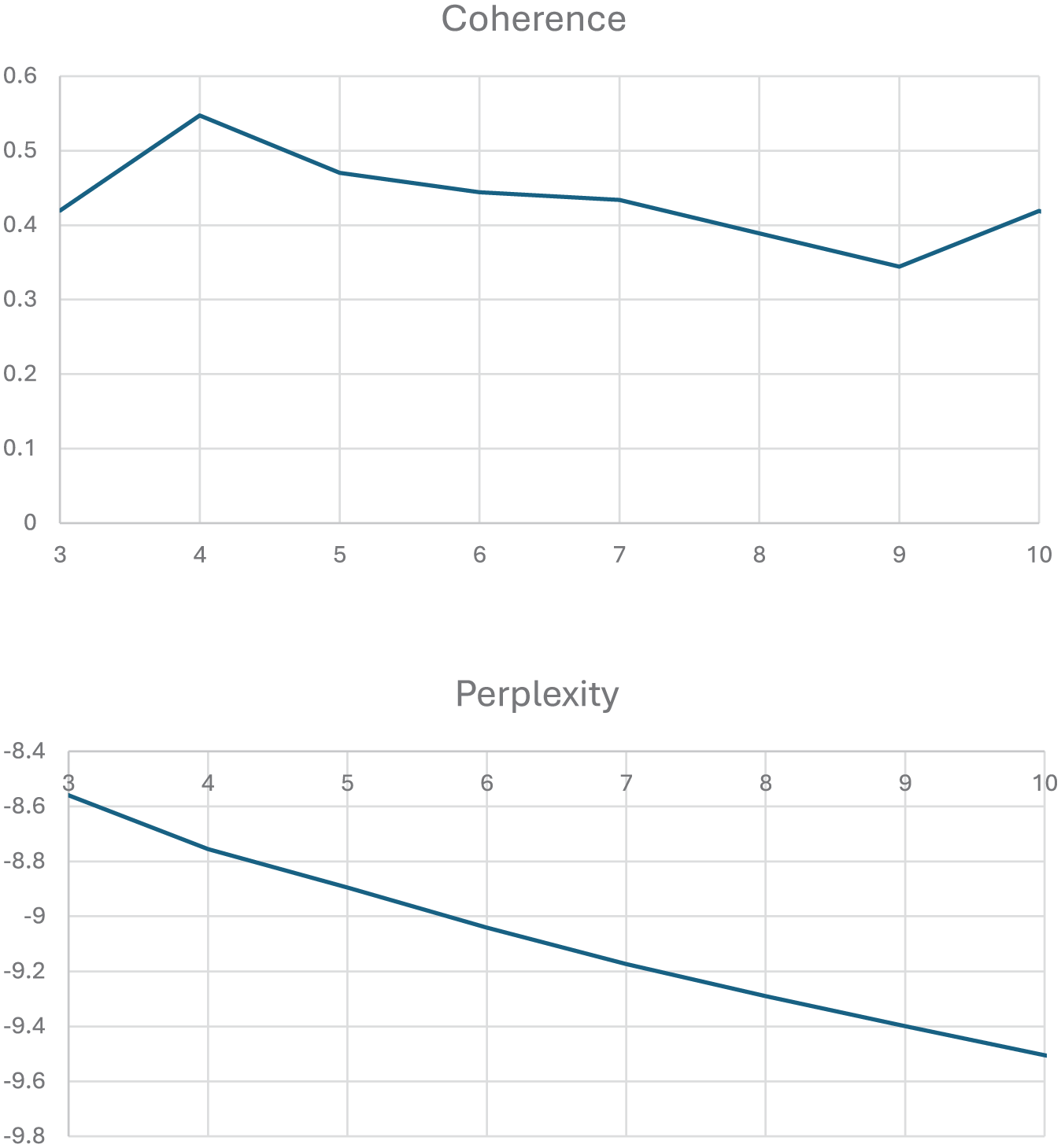
Coherence and perplexity scores for LDA models used to determine the optimal number of topics.
Results
The resulting directed bipartite network of local Telegram chats consisted of 295,638 nodes, of which 797 were chats connected through shared users, and 440,037 user-chats edges. The size of the nodes is proportionate to indegree centrality measure, meaning that larger nodes represent chats that have more participants. The color also corresponds to indegree centrality with more intense color signifying more popular chats. The edges are white and very thin, so even if it looks that some chats are not connected, this is because they share few common participants. On the other hand, visible brighter links indicate a fairly strong connection among chats that have many shared users.
Network assessment and analysis
Our first hypothesis (H1) predicted that this network follows crowd-enabled connective action logic with dispersed power signature of the “network of networks.” The first look at the visualization of this network (Figure 2) reveals that it has six popular chats that correspond to the capital city of Minsk, four out of five regional (oblast) centers in the country (Vitebsk: vitebsk97pro, Gomel: gomel97pro, Brest: brest97pro, and Grodno: grodno97pro), as well as a diaspora chat for Belarusians in Poland (BelarusyPL). Notably, diaspora chat in this network performs an important brokerage role, connecting chats of Minsk and the Minsk region with chats from other regional centers and smaller cities and towns in Belarus. This confirms the diaspora’s important role not only in economic support of protesters, emphasized by previous scholarship (Guriev, 2020; Moshes and Nizhnikau, 2021), but also in communication flow between the capital and regional centers. To the best of our knowledge, only one Minsk chat (minsk_new) was created by a well-known Belarusian (in this case, journalist Anton Motolko) in October 2020 to discuss various city issues, while other regional chats sprang up as grassroot initiatives of local activists.
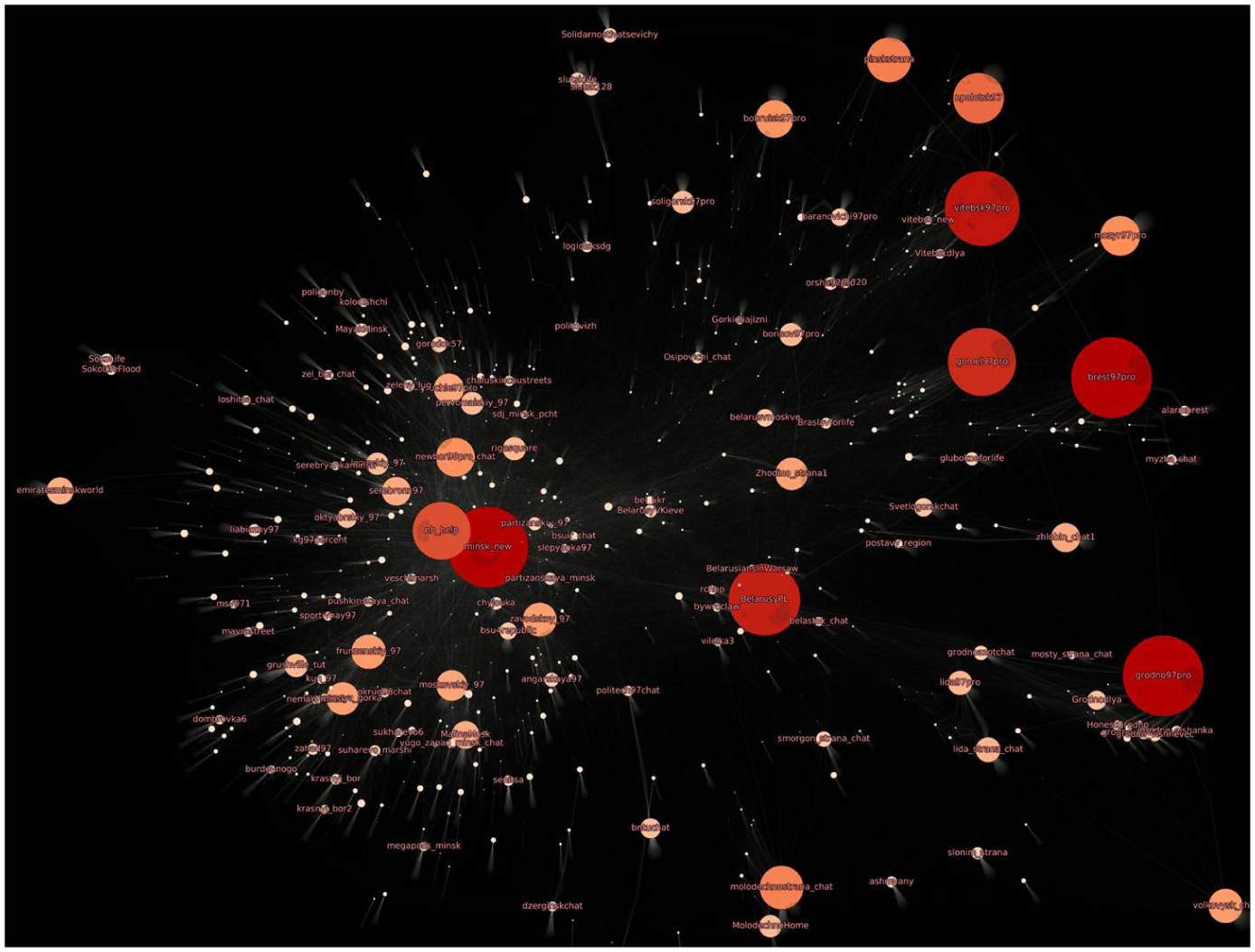
Local Telegram chats network in Belarus, March 2021.
In addition to these six large chats, we notice many smaller chats that represent smaller cities and towns, and neighborhoods within them. For instance, close to grodno97pro chat are smaller “satellite” chats for various neighborhoods in Grodno (grodno_olshanka, grodno_vishnevec), for Grodno Azot factory (grodnoazotchat), and for other towns in the Grodno region: Lida, Volkovysk, Ashmyany, Slonim, and Mosty (Figure 3). These chats are also close to the chat for Belarusians in Poland since Grodno sits right on the border and consequently shares many participants with this diaspora.
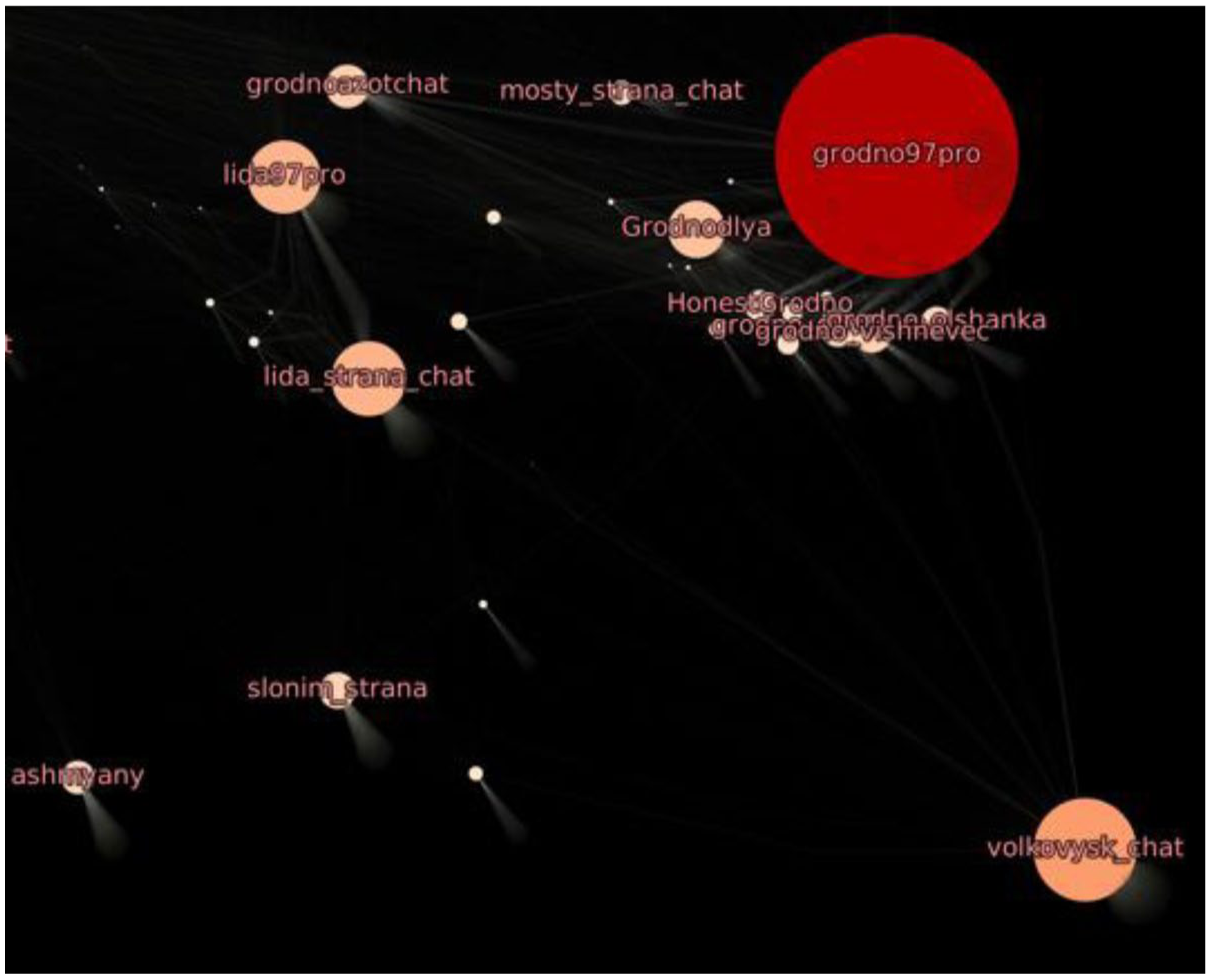
Fragment of local Telegram chats network in Belarus, March 2021.
Similarly, next to the capital city of Minsk smaller subhubs represent other cities in Minsk region, city’s administrative districts and neighborhoods, such as Zavodskoy (zavodskoy_97), Frunzenskiy (frunzenskiy_97), and Moskovskiy (moskovskiy_97) districts, Novaya Borovaya (newbor98pro_chat) neighborhood, and so on (Figure 4). Looking closer at Frunzenskiy district, for instance, we can discover chats within district’s neighborhoods, such as Kamennaya Gorka (kamennaya_gorka), Krasnyj Bor (krasnyj_bor and krasnyj_bor2), Zahad (zahad97), Kuntsevshina (kun_97), or Sukharevo (suharevo6 and sukharevo_marshi). One of these chats, sukharevo_marshi, is specifically dedicated to organizing marches. If we zoom even further, the smaller not labeled dots correspond to chats of streets and apartment buildings within these neighborhoods. With so many chats, it is not surprising, yet still remarkable, that this network of local Telegram chats in Minsk largely repeats the physical geographical layout of the city.
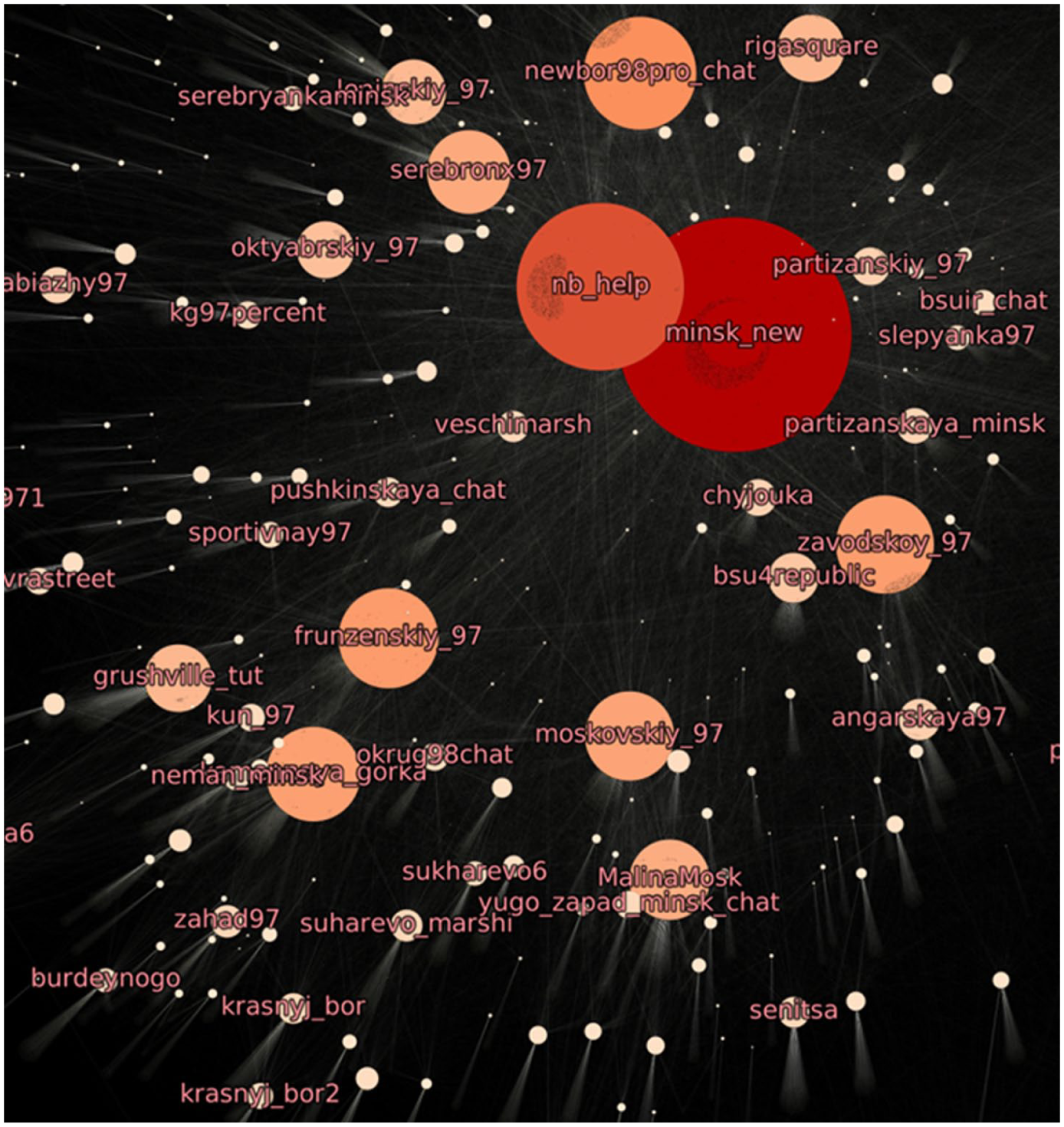
Fragment of local Telegram chats network in Belarus, March 2021.
However, some of the chats centrally located in the middle of the network are actually on the periphery of the city. One prominent example is Novaya Borovaya neighborhood (newbor98pro_chat). It likely became central due to its protest activities, which political blogs and news media extensively covered in their reporting (Yapparova, 2021). However, even more possible explanation is community crisis. In the end of November 2020, this neighborhood was shut off from heat and hot water for almost 3 days. Authorities claimed that it was due to unforeseen plumbing issues; however, people strongly suspected it was a punishment, especially when local authorities brought portable toilets painted in the white-red-white color scheme. In response to this local humanitarian crisis, Minsk activists organized nb_help Telegram chat where participants invited Novaya Borovaya dwellers to their houses to take a shower, get some water, or borrow a room heater. So, while authorities tried to punish this neighborhood for its activism, they inadvertently created a broker hub in the network and brought this neighborhood chat closer to the center of Minsk protest Telegram network.
After qualitative analysis of this network, we conclude that our first hypothesis is largely supported, and this network is one of the first observed real-life data-driven crowd-enabled “network of networks” described by Bennett and Segerberg (2013). First, this network clearly has communities centered around the largest chats in the capital, regional centers, and among Belarusian diasporas. Yet, smaller chats of cities, towns, neighborhoods, workplaces, and even apartment buildings help to stitch these otherwise disjoined communities of the network together. Moreover, within these subcommunities, we also detect their own centers of gravity, such as districts within larger cities, which draw smaller chats for neighborhoods and apartment buildings. This structure enables information flow across geographically related chats but also makes it possible to coordinate action at the level of larger cities and regional centers with support from the grassroot communities.
Our qualitative reading of this network also enables us to recuperate a sense of “depth” of protest movements and to pay attention to other sources of evidence beyond social media (Gerbaudo, 2018). Analyzing separate protest communities, such as Grodno Azot factory or Novaya Borovaya neighborhood, we also discovered so-called “digital vanguards,” new types of collective and informal leadership structures (Gerbaudo, 2017), that emerged as influential examples of protest activities in their respected cities and gained coverage in national and international news (Bennetts, 2020; Nechepurenko and Troianovski, 2020).
Hubs and prestige distribution in the network
Our second set of hypotheses predicted that in line with the preferential attachment model (Barabási and Albert, 1999) and previous empirical studies of social movements (González-Bailón and Wang, 2016), this network will have several hubs (H2a) yet will not follow power law in distribution of recognition among the network’s nodes (H2b). Our first part of the second hypotheses is supported because the network has six major distributed hubs, which correspond to chats for the capital, regional centers, and the Belarusian diaspora in Poland. However, we also detected smaller hubs for smaller cities and towns across the country, connecting parts of the network together through their brokerage function, outlined in previous social movement research (González-Bailón and Wang, 2016). Such smaller hubs are represented by chats for Soligorsk (soligorsk97pro), Bobruisk (bobruisk97pro), Baranovichi (baranovichi97pro), Borisov (borisov97pro), Zhodino (Zhodino_strana1), Molodechno (molodechnostrana_chat), Smorgon (morgon_strana_chat) (Figure 2). All these smaller cities are in different regions of Belarus, yet together they perform the brokerage function in the network connecting regional centers to the capital and to the diaspora.
To evaluate degree distribution across the network, we first plotted indegree values of all 797 chats to determine the slope and its steepness (Figure 5). In addition, mindful of the different communities we discovered with qualitative network assessment, we also plotted indegree distributions for subnetworks of Minsk, Minsk region, diaspora, and other regions of Belarus (Figure 5). For that, we manually labeled each chat as either being part of the capital city of Minsk, Minsk region (oblast’), all Belarusian diasporas abroad, and the remaining five regions of the country. We use maximum likelihood estimator (MLE) to estimate the value of α in these distributions and calculate the likelihood ratio test (LTR) to compare the observed data to power law and lognormal distributions (Table 1).
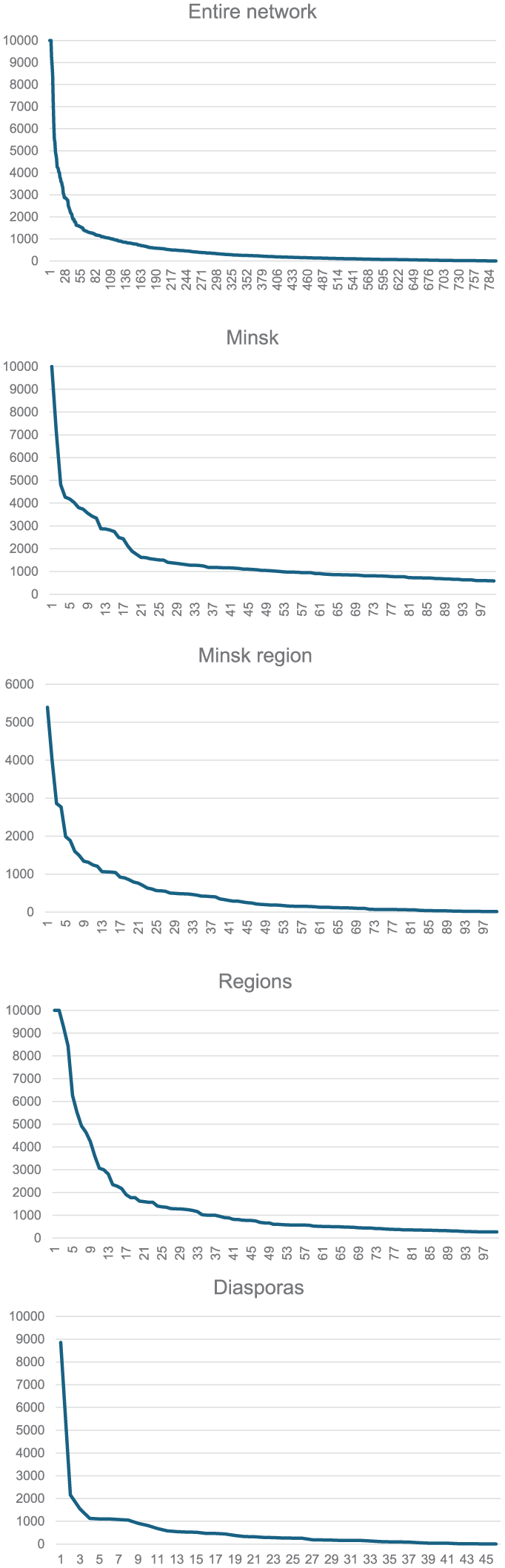
Indegree distributions of local Telegram chats in Belarus.
Alpha and log-likelihood values of distributions for Belarus’ Telegram network and subnetworks.
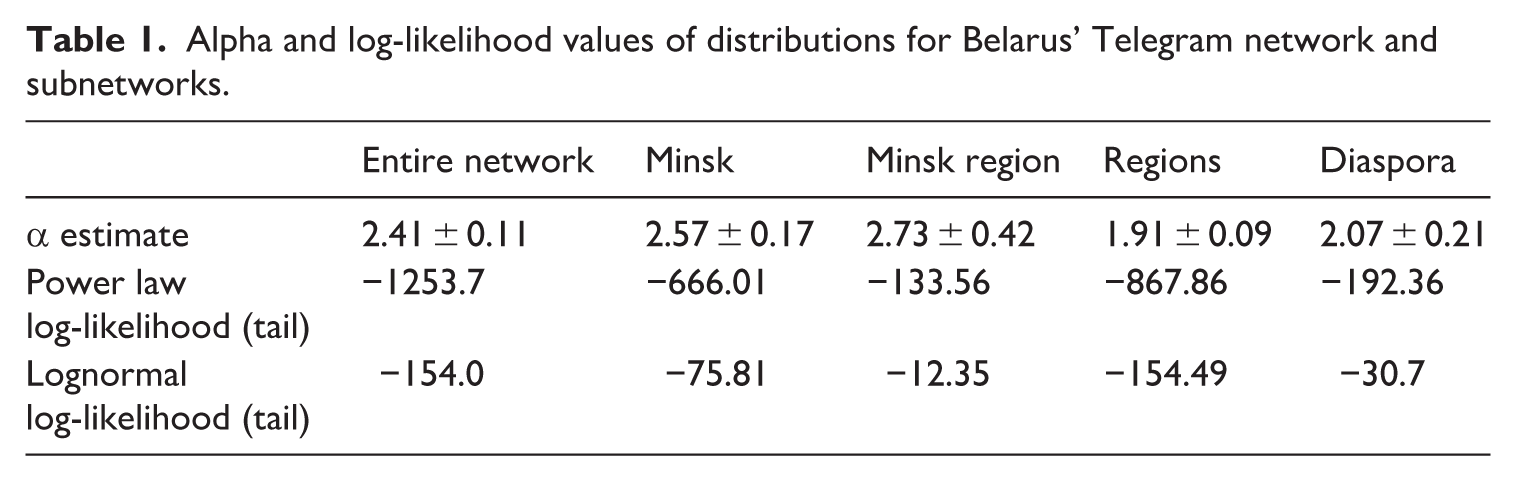
Alpha values in these distributions are close to each other and mostly fall between 2 and 3, which means that the distribution has finite mean and infinite variance along with a “fat tail” of smaller values (Clauset et al., 2009). At the same time, comparing fits of our distributions to either power law or lognormal models, we see that across all of them lognormal fit has much better log-likelihood values compared to the power law, confirming that lognormal model better describes the tail data for our distributions. A lognormal model describes a distribution that is skewed right with a long positive tail, which is lighter than classic power law distribution because the tail is shorter as it decays faster than a pure power law (Cameron and Trivedi, 1998). Lognormal distribution is also used to describe multiplicative growth process (Cameron and Trivedi, 1998), which is in line with the preferential attachment model of networks growth (Barabási and Albert, 1999). In our case, older chats created in the beginning of protests continued to grow as new members joined the movement, yet participants also created local chats to coordinate activities and form communities with their immediate neighbors. As new participants joined the movement, they most likely joined their local chats to follow local events and connect with like-minded individuals. The few most active participants also likely joined larger chats for their respective town, city, or regional center. Since there are fewer people living in neighborhoods, small towns, and villages, the growth of these smaller chats was limited by politically engaged population within these communities, yet larger chats continued to grow because regional centers had larger populations and encompassed smaller communities.
To further explore distribution of influence in this network at the user-level, we created a purposive sample that included the six major hubs we identified earlier, the five randomly selected regional chats with over 4000 users, and the five randomly selected Minsk-region chats with over 1000 users, striving to represent local chats’ various locations and sizes. We plotted a histogram and kernel density of the number of messages per chat participant to see if smaller regional chats would have flatter or more peaked distributions compared to largest chats in our network (Figure 6). Overall, smaller chats in regions have more peaked distributions, while most large chats, except for the capital, have more flat distributions. Thus, larger chats exhibit more distributed leadership qualities with more participants contributing toward discussion, while smaller regional chats only have a few activists. We also analyzed how many accounts belong to several chats in this sample. As expected, the vast majority (128,420 accounts or 93.2%) only belonged to one chat (especially since we assembled a geographically dispersed sample), while only 5.35% of accounts belonged to two chats and a mere 1.45% of accounts in this sample joined three or more chats. We also ran a correlation between the number of chats an account participated in and the number of messages each account posted. The minuscule correlation coefficient of 0.077 suggests that belonging to many chats does not translate into more posting, confirming that this network included several types of leaders and activists: those who connected the chats together and those who posted in chats, while one does not necessarily be another.
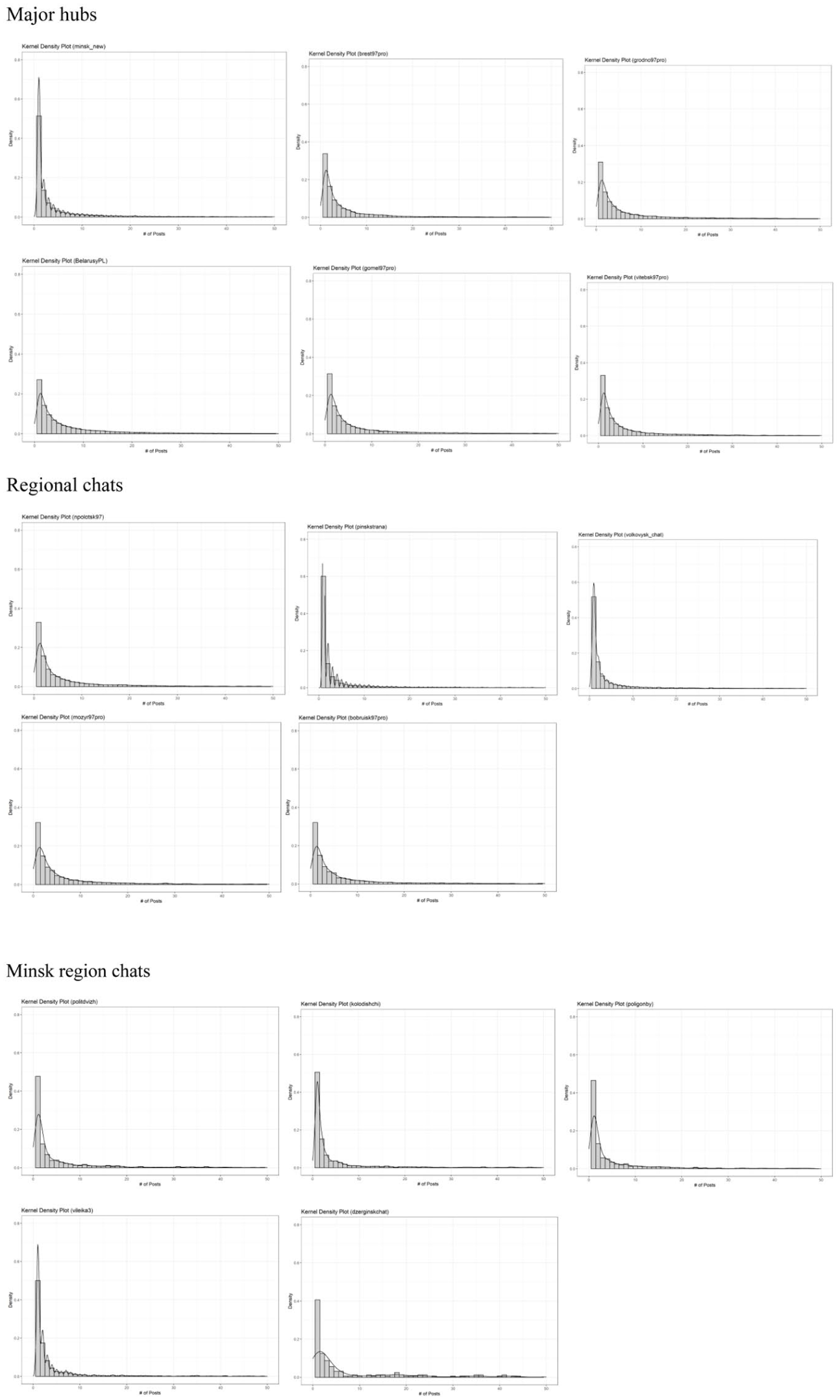
Distribution of chat messages per user across 16 chats.
Overall, we find support for our second set of hypotheses, demonstrating that this “network of networks” still had larger and smaller hubs, but the distribution of prestige (inlinks) within this network and regional subnetworks was lighter than classic power law distribution with shorter tails that tapered off faster. While these distributions are far from “flat” or “egalitarian” theoretical concept introduced by Bennett and Segerberg (2013), they fit network science explanation of network growth and show that this particular network and subnetworks followed multiplicative growth process, that is, as smaller communities emerged and grew, older and larger communities grew faster, creating hubs but also contributing to lognormal distribution of inlinks in the network.
Content analysis of Telegram communication
Our third hypothesis (H3) serves as a face validity test in order to confirm that political discussion is actually driving our results as opposed to the network analysis merely reflecting some untheorized hidden variable. The hypothesis predicts that the most popular chats would feature discussions of political events, community building, and protest coordination activities. Results of our computational content analysis reveal that discussion of political events and discussion of collective activities were prevalent across the top 58 chats. Table 2 shows the top 30 most statistically salient words within each of the four topics that we identified with LDA topic modeling. While some of the words have little semantic meaning by themselves, for the most part there are distinct word patterns in the qualitative categorization of each topic. Topic 1, which we labeled “action,” represents discussion of political activities, including words such as together (вместе), piquet (пикет), rally (митинг), leaflets (листовки), place (место), let’s (давайте), going (ехать). Topic 2 “communication” is devoted to sharing news, chat information, subscriptions, and phone numbers with indicative words such as chat (чат), news (новость), interesting (интересно), subscribe (подписаться), friend (друг), write (написать) and number (номер). Topic 3 “politics” is devoted to discussion of politics in Belarus with the names of politicians, candidates, discussion of elections, and voting, as indicated by words Lukashenko (Лукашенко), Tsikhanouskaya (Тихановская), Babariko (Бабарико), Tsepkalo (Цепкало), elections (выборы), USA (США), Russia (Россия), Ministry of Internal Affairs (МВД), Central Electoral Committee (ЦИК), to vote (проголосовать) are very indicative. Topic 4 “reflection” represents people’s thoughts and discussions about the country, economy, possible actions, people, opinions, as expressed by key words such as think (думаю), do (делать), question (вопрос), money (деньги), country (страна), opinion (мнение), people (народ), clear/understood (понятно), want (хотят), work (работать).
Top 30 most statistically salient words within each of the four topics based on the results of LDA modeling.
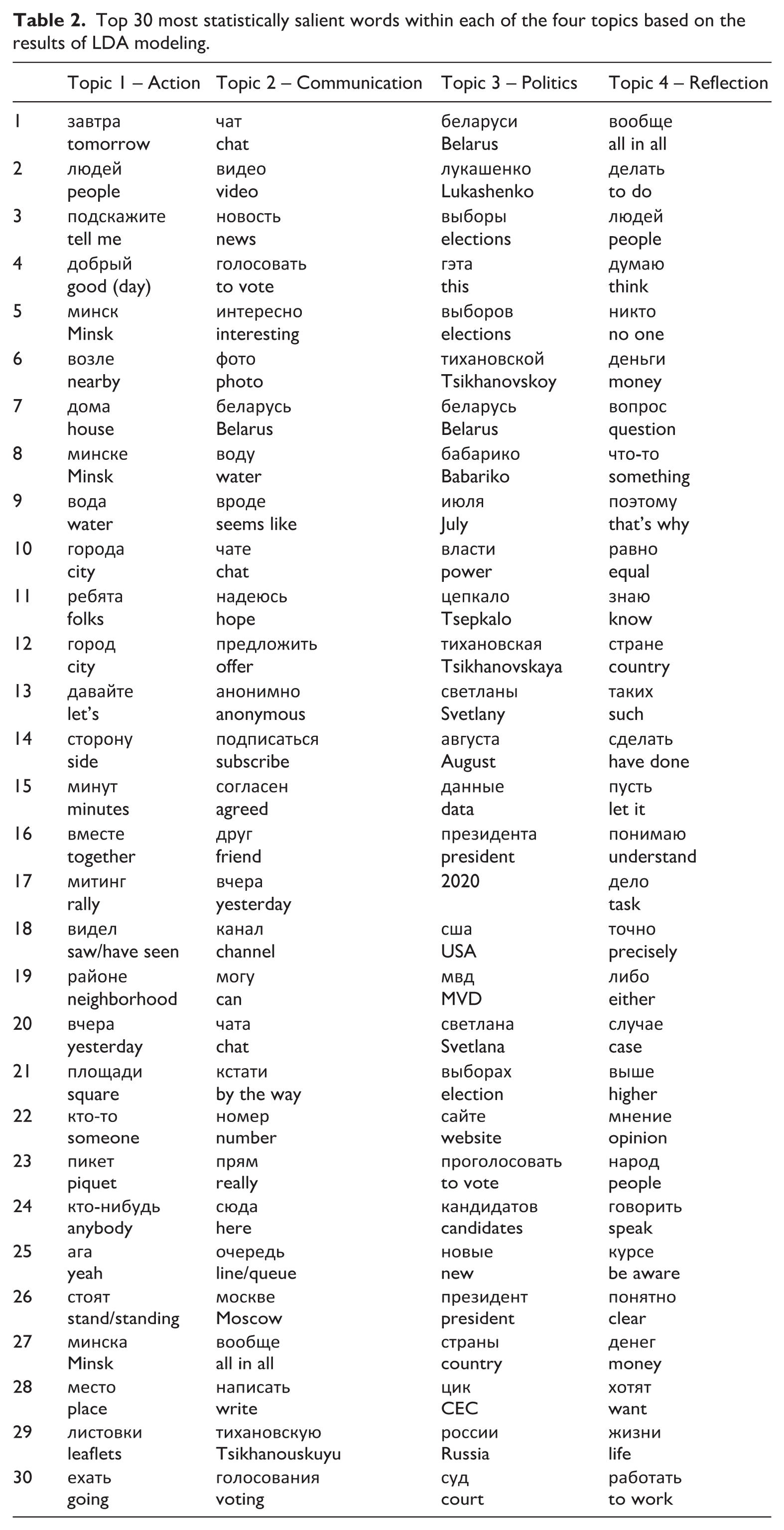
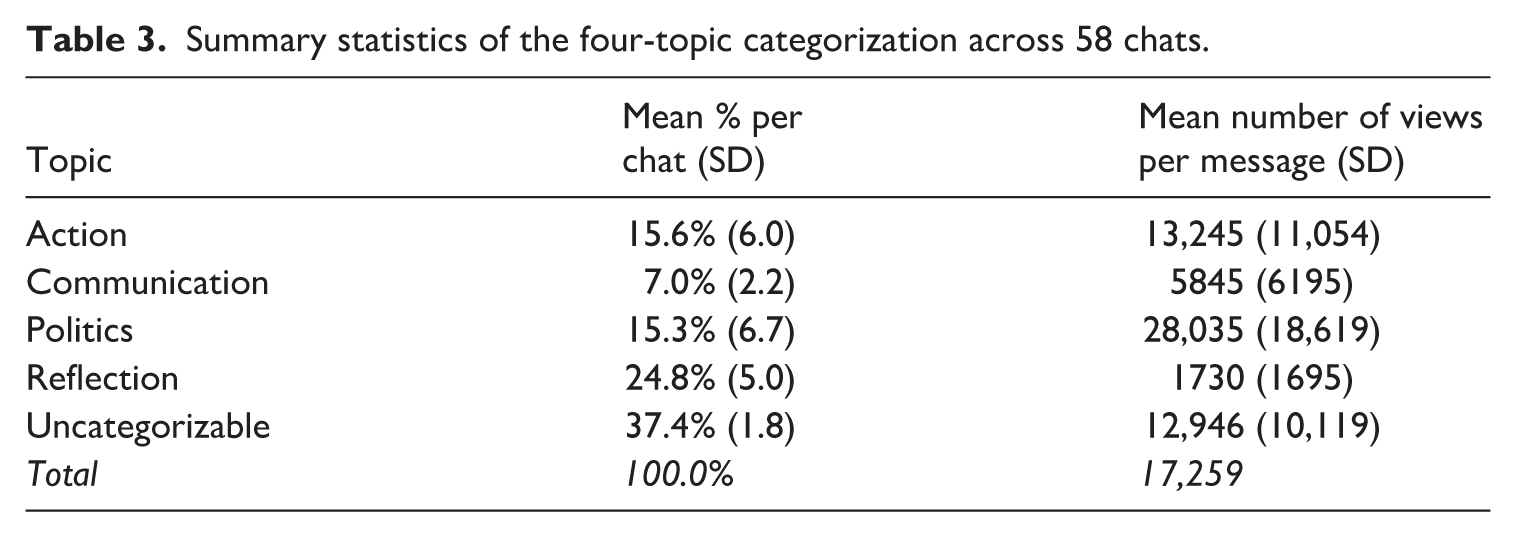
Table 3 contains summary statistics of the topic categorization across the 58 chats. First, the mean number of views per message in the “politics” category is much higher than among the others, amounting to more than twice the average engagement in any other category. The “action” category is in second place and has more than twice the average engagement. Interestingly, reflection has the lowest engagement, despite being the most popular singular category of messages across chats (37.4%). Thus, these engagement numbers are not being driven by the sheer number of politics or action-based messages, as those only account for about 15% of the absolute total number of messages. Finally, the large degree of variance in these chats with relatively high standard deviations points to a heterogeneous mix of discussion across the chats.
Summary statistics of the four-topic categorization across 58 chats.
Taking into account four major geographical subnetworks within the overall Belarusian Telegram protest network (Minsk, Minsk region, regional centers, and diaspora abroad), we further probed differences and similarities across these subnetworks with the results of our content analysis to determine whether this heterogeneous mix of discussions prevailed primarily in Minsk and Minsk region, compared to regions and diaspora. To keep the analysis manageable and maintain a rough numerical parity with our previously examined top 58 chats, we selected top 15 chats in each category: Minsk, Minsk region, regions, and diaspora, and then re-ran the topic distribution analysis. As seen in Table 4, across all four topics, there is more similarity between Minsk and the regions, as well as between Minsk region and diaspora. As with the top 58 chats, reflection remained the most popular topic (42.6%), but politics (24%) and action (22.73%) were almost equally popular and accounted for nearly half of chats’ messages.
Summary statistics of the four-topic categorization across 60 chats.
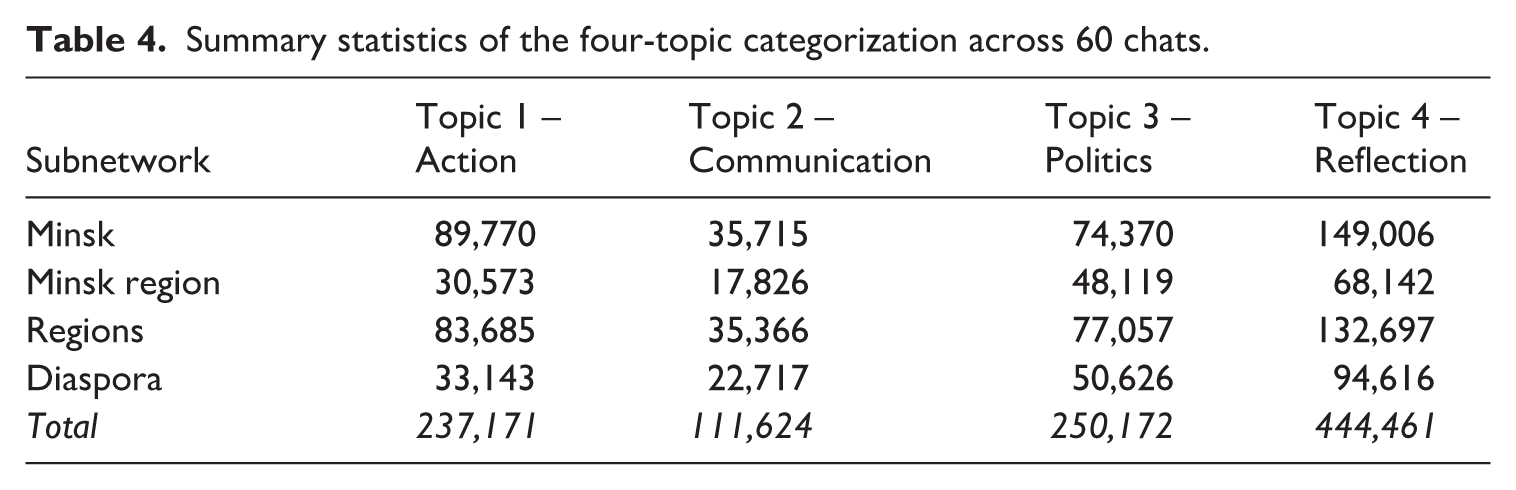
Results of our content analysis reveal that participants of local Telegram chats in Belarus utilized these communication spaces not only for reflection about ongoing events but also for coordinating collective action, discussing politics, and community building through communicative practices.
Conclusion
Overall, this article demonstrates the important connective role of local Telegram chats in enabling and sustaining the historic Belarusian protests of 2020 despite the oppressive authoritarian regime in the country. Using a unique dataset collected in the aftermaths of these protests before they fizzled out in face of unprecedented political persecutions, we could test a variety of important empirical hypotheses by leveraging that nuanced and rich textual and network data. By analyzing the network formed from nearly 800 chats, and nearly 300,000 distinct users, we demonstrated one of the first observed and measured instances of crowd-enabled action, theoretically proposed by Bennett and Segerberg (2013) in their seminal work on connective action logic. With multiple layers of local networks stitched together into one large communication mechanism, these chats helped active citizens to discover like-minded neighbors, coordinate protest activities, discuss news and politics, as well as create communities and reflect upon the events unfolding around them.
This article also further refines connective action theory by demonstrating that even a crowd-enabled “network of networks” still has important hubs and follows lognormal distribution, which is far from theorized flat and non-hierarchical structure. However, we reflect that these new types of liquid leadership in the form of “digital vanguards” do not dominate the discussion but rather create opportunities for network growth and creation of important brokerage nodes within it. The Belarusian diaspora is one of these brokerages, connecting Minsk and the Minsk region to other regions of the country. As many politically active Belarusians left the country, this article highlights the importance of diaspora in supporting hope for democratic Belarus and activating connective action anew when the circumstances arise. By analyzing the millions of messages posted to these chats through latent topic modeling, we demonstrated that these chats were used with an extensive political motivation, and that those political discussions drove the engagement in these chats.
This work is also not without its limitations. First, we could only collect information and messages from the chats posted on crowdsourced websites, and only from public chats. We also only focused on Telegram chats, where all participants can contribute toward discussion, and intentionally excluded Telegram chats, which also contained a lot of information sent to participants by channels’ moderators. If there were secret chats that were not published on the website or were private, we did not collect data from them and cannot estimate how this missing data affects our results. Second, despite our efforts to keep the depth and describe the network qualitatively, we inevitably overlooked many important details and specific messages shared across these chats. Choosing a computational bird-eye view of the protests, we sacrificed granular details and deeper understanding of their nature. Despite these limitations, this work improves our understanding of connective action theory and opens discussion for its advancement and enrichment by studying similar protest movements in other political contexts.
Footnotes
Acknowledgements
The authors are grateful to Laurent Bioux for help with data collection and thank Brooke Foucault Welles for initial feedback on the project.

Funding
The authors received no financial support for the research, authorship, and/or publication of this article.
Declaration of conflicting interests
The authors declared no potential conflicts of interest with respect to the research, authorship, and/or publication of this article.
Data availability statement
Data used for this project is available upon a reasonable request.