






Abstract
Existing research offers mixed evidence on how social media use contributes to or hinders healthy democratic societies. This study examines the impact of social media use generally, and perceived exposure to political misinformation and correction on social media specifically, on two forms of democratic citizenship: constructive behaviors and destructive democratic attitudes. Drawing on a two-wave survey of US adults, we find that greater social media use is linked to heightened concern about election fairness but not to greater political participation among political partisans. Higher perceived exposure to political misinformation predicts attendance at political events but is unrelated to destructive democratic attitudes. Higher perceived exposure to corrections is positively associated with donating to campaigns and volunteering, but also predicts stronger endorsement of violence for political goals. These results reveal the mixed role of social media in encouraging democratic participation while amplifying some anti-democratic attitudes.
Keywords
Introduction
The question of whether social media would strengthen or weaken democracy has been an open debate since its advent (Koc-Michalska and Lilleker, 2024; Wells and Thorson, 2017). This question remains important today as the use of social media continues to shift over time and concerns surrounding the impact of misinformation on democratic processes increase (Budak et al., 2024; Nisbet et al., 2021). This article considers how social media use, exposure to misinformation, and exposure to correction relate to democratic processes. While many have considered the impact of social media use on democratic participation and political beliefs (Enjolras et al., 2013; Koc-Michalska et al., 2016, 2024), few have considered how exposure to misinformation and correction impacts these same issues, nor considered them in conjunction.
We examine two outcomes that are important to healthy democratic functioning. Constructive democratic citizenship – donating to political campaigns, volunteering for political causes, and attending political events – represents productive engagement with democratic activities, drawing from a long literature on political participation. But we also consider destructive democratic attitudes – support for political violence, concern about 2020 election fairness, and non-importance of living in a democratically governed country – as political beliefs that are in tension with liberal democratic ideals. These acts and attitudes constitute important areas of study as American political discourse becomes increasingly polarized and efforts to mobilize voters come from political coalitions across the spectrum.
These two outcomes are particularly important to examine in the context of the 2020 US presidential election. Scholars and commentators have raised alarms about the dangers of an increasingly polarized electorate and the potential for elections in particular to not only encourage participation but also inflame tensions or encourage support for political violence (Kalmoe and Mason, 2022; Levendusky, 2023). Even in the absence of the highly contested election, the COVID-19 pandemic, and the Black Lives Matter protest movement, both laid a groundwork where democratic participation and broader orientations were likely to be salient and volatile.
In this context, our two-wave panel survey data around the 2020 election describing social media use, exposure to misinformation, and exposure to correction and their relationship to democratic norms paint a complicated picture. Our results suggest that some types of social media use can pull people into the political process while decreasing support for democratic norms among those participating. The implications of these patterns are essential in understanding how to combat problems within the online ecosystem and with the troubling uptick in support for political violence.
Literature review
Social media use, constructive citizenship, and destructive attitudes
Does social media open new avenues for political participation? Or, do these technologies platform extreme and anti-democratic voices? Scholars have sought to understand the positive and negative effects of social media, acknowledging that no platform is monolithic, meaning the impact is likely varied. Building from traditional models predicting political participation, social media adds the power of social networks, which can bring people who typically do not participate into the process in meaningful ways (Koc-Michalska et al., 2024; McClurg, 2003). Social media that pairs traditional content with social network affordances can empower different groups, bringing new participants into the process (Chadwick, 2013; Gil de Zúñiga et al., 2012; Karpf, 2016).
Past studies have shown that social media is particularly effective at mobilizing individuals for political events, such as protests and boycotts (Boulianne, 2015; Enjolras et al., 2013). Political campaigns and interest groups are highly active on social media, often directly soliciting donations and volunteers (Karpf, 2012; Kreiss and Welch, 2020). Therefore, social media use can potentially foster constructive democratic behaviors by connecting interested users to organizations and information that can help ease the cost of participation (Boulianne, 2015; Jungherr, 2020).
To measure a respondent’s commitment to constructive democratic behaviors, we ask whether they have participated in any of the following three activities: making a contribution to a campaign, volunteering for a campaign or political party, or attending an event for a candidate or political issue. Importantly, we capture whether individuals are participating in offline political behavior through volunteering and attending, while donating can be done either online or offline. This connects our argument to an important literature that explores the relationship between social media use and participation in both online and offline environments (see Gil de Zúñiga et al., 2017; Lilleker and Koc-Michalska, 2017; Theocharis et al., 2023) and contributes to this literature by examining these three distinct constructive democratic behaviors in the context of the 2020 US election.
At the same time, other scholars point out that social media has a real downside, especially in terms of destructive democratic attitudes. For example, prior research found an association between digital media use and reduced political trust (Lorenz-Spreen et al., 2022), though overall Internet use is not linked to political trust (Lu et al., 2019). Meanwhile, questions of how many people hold destructive democratic attitudes are increasingly important (Kalmoe and Mason, 2022; Sides et al., 2018), and many have pointed to social media as a possible culprit. While a minority of users express these destructive democratic attitudes, they have the ability to travel further online due to the algorithmic amplification of negative messages and platform effects (Gillespie, 2018; Wojcieszak, 2010). If fringe views have higher visibility online, it could lead users to overestimate the number of people who actually hold these fringe opinions (Vilone and Polizzi, 2024). In a study of the subreddit r/The_Donald, Gaudette et al. (2021) demonstrate how extremists utilize platform affordances like upvoting to spread their hateful messages toward Muslims and the Left more broadly, validating these beliefs as legitimate and supported by the community. Other communities (notably, QAnon) have unique knowledge-making structures that seek to challenge the existing beliefs of users who engage with them by encouraging users to distrust common knowledge and expertise (Marwick and Partin, 2024). The validation of extreme beliefs paired with an attack on existing norms and narratives can radicalize individuals who engage in these communities.
This study extends existing literature on how social media use can contribute to destructive democratic attitudes by using three separate questions to capture distinct yet interlinked beliefs: support for using political violence to advance political goals, the belief that the 2020 election was unfair, and the view that living in a democracy is unimportant. Capturing these attitudes is crucial, as existing research suggests that they are detrimental to democratic norms (Kingzette et al., 2021; Pickel et al., 2022). In addition, these attitudes are prevalent in specific online spaces, which aligns with our theory that engaging with social media and misinformation online may increase the prevalence of these attitudes in those who spend more time online or are exposed to misinformation and correction (DeWitt et al., 2018; Mahl et al., 2023; Wischerath et al., 2024).
Therefore, based on prior literature, our first set of hypotheses examines how social media may contribute to constructive political participation and also feed destructive democratic attitudes.
The influence of seeing political misinformation on democratic citizenship
But even while there is debate about the potential value or harm of social media use for democratic citizenship writ large, this research acknowledges we need to consider the kinds of content that people see on their social media feeds (Koc-Michalska et al., 2016). The logic of algorithms and curations means that social media experiences can be quite individualistic and diverse, depending on people’s interests, their identity, and their social connections (Thorson et al., 2021).
One type of harmful political content on social media that has received a lot of scholarly attention is the extent to which people are exposed to rumors and misinformation, defined as information that counters the best available evidence or advances unverified claims (Vraga and Bode, 2020). Increasingly, scholarship reflects two separate but related ideas: while there is a fair amount of misinformation on social media, exposure to and sharing of such misinformation tends to be concentrated among a relatively small subset of the online population (Budak et al., 2024; Guess et al., 2019; Vosoughi et al., 2018). This tension may explain the ongoing debate about the extent to which misinformation exposure changes versus reinforces existing (mis)beliefs, given that such misinformation exposure tends to be concentrated among the politically extreme or those already likely to believe the promoted myth (Budak et al., 2024; Eady et al., 2023; Rao et al., 2022).
But the literature is only beginning to consider the other downstream negative implications of exposure to misinformation on broader political perceptions and behaviors. For example, studies have produced mixed results as to whether political misinformation can harm trust in institutions of government or news (Boulianne and Humprecht, 2023; Ognyanova et al., 2020), and resilience to misinformation may depend both on individual characteristics and societal-level differences in institutions and trust (Humprecht et al., 2020; Mari et al., 2022). We contribute to this literature by considering whether self-reported misinformation exposure is associated with constructive citizenship behaviors and destructive democratic attitudes.
We have reason to suspect a relationship between misinformation exposure and orientations toward democracy and citizenship. Misinformation and toxic content – for example, content that uses uncivil, hateful, and derogatory language – are often linked (Hameleers et al., 2022b; Mosleh et al., 2024), so it would make sense that exposure to misinformation could lead people to endorse more destructive democratic attitudes. Moreover, misinformation or hateful speech often targets marginalized groups, such as racial and ethnic minorities, and thus may amplify stereotypes and elicit hostility toward these communities (Soral et al., 2018). Furthermore, political misinformation tends to reach the most polarized segment of the population (Budak et al., 2024; Rao et al., 2022), and such exposure may reinforce that polarization and translate it into destructive democratic attitudes, although at least one study found no evidence of increased polarization after exposure to misinformation (Eady et al., 2023). To our knowledge, no one has tested this relationship explicitly for destructive democratic attitudes, though one study found that perceived influence of (although not direct exposure to) misinformation produced lower satisfaction with democracy (Nisbet et al., 2021).
Specifically, in this study, we focus on understanding how perceived misinformation exposure influences people’s democratic citizenship and attitudes, which can be consequential, particularly when shaping attitudes and behaviors in a polarized media environment (Chan et al., 2025). For example, survey data from Canada, France, the United Kingdom, and the United States show that Facebook users who believe they have frequently encountered misinformation express the greatest concern about misinformation on Facebook (Boulianne and Hoffmann, 2024). Moreover, perceived misinformation exposure is linked to increased political cynicism (Jones-Jang et al., 2021) and even reduced trust in news media (Hameleers et al., 2022a; Stubenvoll et al., 2021). Therefore, perceived misinformation exposure may be linked to increased destructive democratic attitudes. To contribute to the literature on the implications of perceived misinformation exposure on destructive democratic attitudes in the context of the 2020 US presidential election, we propose H3 below.
However, the perceived exposure of misinformation on constructive citizenship remains unclear. If it is people who are already polarized who are most likely to report seeing misinformation, it could reinforce their perceived polarization and thus participatory intentions (Enders and Armaly, 2019). On the other hand, existing studies have found little evidence of a link between exposure to misinformation and participatory behaviors (Eady et al., 2023), so this also remains an open question, and this article will fill in this gap.
The influence of seeing corrections on democratic citizenship
Given widespread concern about the risks of political misinformation, correction or responding to misinformation with accurate information has emerged as an important solution and has become common on social media (Tang et al., 2024). Studies have demonstrated that exposure to corrections of misinformation on social media (sometimes called “observed correction”) reduces misperceptions and improves organizational perceptions (Tang et al., 2025b, 2026; Walter et al., 2021), although partisan biases can limit belief change even when individuals encounter fact-checks (Francia et al., 2025). But these social media corrections can also lead to additional harms, such as increased toxicity and partisanship on the part of the person corrected (Mosleh et al., 2021) or even greater spreading of or belief in the misinformation if not done appropriately (King et al., 2021).
Likewise, perceived exposure to correction could either increase or inhibit constructive citizenship behaviors. Perceived correction is inherently cross-cutting in nature as two different views about what is “truthful” information are being presented – and such cross-cutting exposure has produced mixed effects on political participation (Lu and Myrick, 2016; Matthes et al., 2019), and tolerance or respect for the other side (Gill, 2022). Because people say they value correction (Bode and Vraga, 2021), perceiving a correction may reinforce social norms that encourage pro-democratic attitudes and behaviors. Conversely, previous research found that those people who said they had corrected someone after the 2020 election were also more likely to endorse political violence (Tang et al., 2025a). Given how little research explores the implications of perceived observed corrections on individuals’ political behaviors and attitudes, we ask how it relates to constructive political behaviors and destructive democratic attitudes, and fill this gap.
Method
We used data from a representative two-wave panel survey of American adults during the 2020 presidential election, collected by YouGov. 1 The respondents were selected using a stratified sampling approach, drawn from the full 2018 American Community Survey (ACS) 1-year sample. Within each stratum, participants were chosen through weighted sampling with replacement. Propensity scores, calculated based on gender, age, race, and education, were used to match the selected respondents to the sampling frame.
The introductory wave of the panel survey was conducted between 6 and 14 October 2020 with only demographic and political orientation questions. A total of 2815 US residents participated, and the final sample included 2615 people, which included an oversample of Black Americans. 2 Out of the 2615 participants, 1865 (71.3%) continued in the first wave, from 23 October to 2 November 2020 (immediately before the 2020 election, which occurred on 3 November 2020). The second wave was conducted between 9 and 16 November and involved 1471 participants who had completed both previous waves, representing a retention rate of 56.2% from the introductory to the second wave. In each wave, the data were weighted according to gender, age, race, education, and voting behavior in the 2016 US presidential election.
In this article, we rely on participants’ responses to all waves, including demographic and political orientation questions in the introductory wave participants’ social media experience, including social media use, seeing political misinformation, and seeing misinformation corrections in wave 1, and their constructive citizenship (whether making a contribution to support campaigns, whether doing any political volunteer work and whether attending any political event), destructive democratic attitudes (endorsing political violence to advance political goals, non-importance of living in a democratic country, and concerned about 2020 election fairness) along with whether they voted for the election in wave 2.
In wave 2 of the 1470 participants, 3 51.3% were Women, 66.8% were White (with 13.4% Black, 12.7% Hispanic, and 7.1% other races), 29.9% had a 4-year college degree or higher, and 83% said they voted in the 2020 election. The average participant was 48 years old (M = 48.38, SD = 18.21). In addition, the sample was slightly Democratic (M = 3.73 out of 7, SD = 2.24) and moderately interested in politics and government (M = 3.29 on a 4-point scale, SD = 0.95), and fairly knowledgeable (M = 2.73, SD = 1.37, max = 4). All control variables, including the demographic variables and political orientations, such as party affiliation, political interests, and affective polarization between the political parties, 4 were measured in the introductory wave of the survey, except for the 2020 election vote.
Measures 5
Descriptive statistics for each variable are available in Table 1, and frequencies for the social media independent variables can be found in Figure 1.
Descriptive statistics for measures.
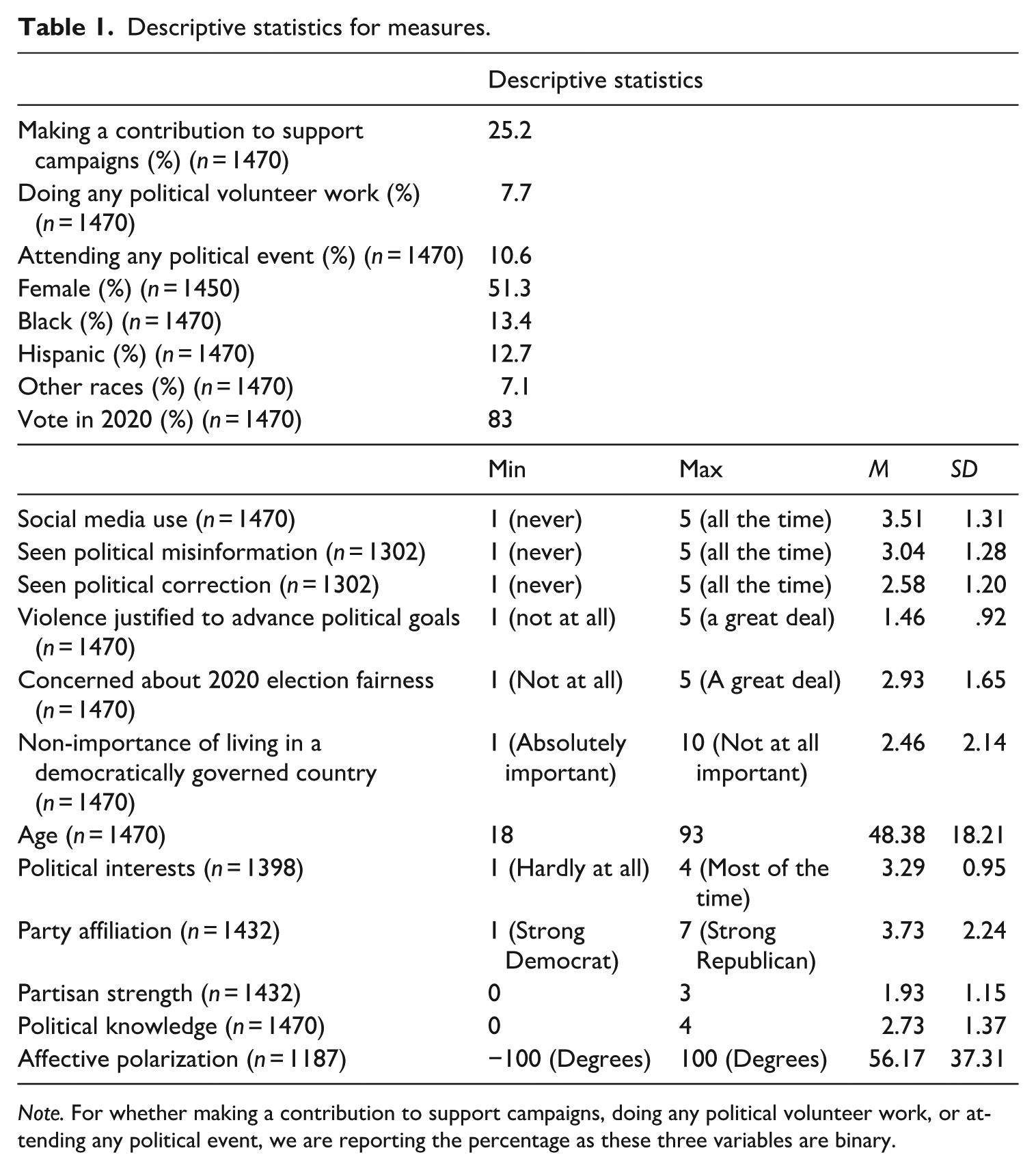
Note. For whether making a contribution to support campaigns, doing any political volunteer work, or attending any political event, we are reporting the percentage as these three variables are binary.
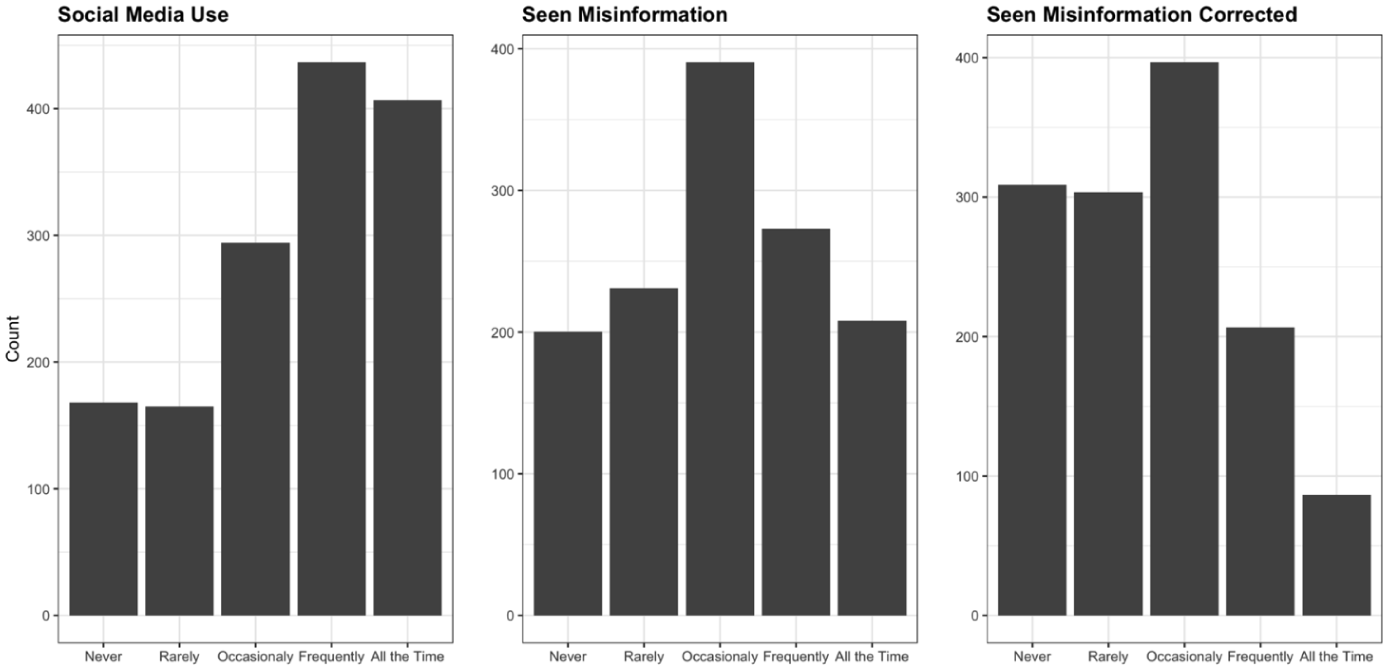
Frequencies for the social media independent variables.
Independent variables
Social media use
Participants were asked, “In the past week, how often have you used social media?” on a 5-point scale from “never,” to “rarely,” to “occasionally,” to “frequently,” to “all the time.” 6
Perceived political misinformation exposure
Participants were asked, “In the past week, how often on social media have you seen someone share misinformation about politics or the 2020 elections?” on a 5-point scale from “never,” to “rarely,” to “occasionally,” to “frequently,” to “all the time.”
Perceived political misinformation correction exposure
Participants were asked, “In the past week, how often on social media have you seen someone who shared misinformation about politics or the 2020 elections be corrected?” on a 5-point scale from “never,” to “rarely,” to “occasionally,” to “frequently,” to “all the time.”
Dependent variable
Whether making a contribution to support campaigns
Participants were asked, “During an election year, people are often asked to make a contribution to support campaigns. Did you give money to an individual candidate running for public office?” on a binary scale (Yes/No), adapted from the 2016 ANES Time Series Study (2016).
Whether doing any political volunteer work
Participants were asked, “Did you do any volunteer or other work for one of the parties or candidates?” on a binary scale (Yes/No), adapted from the 2016 ANES Time Series Study (2016).
Whether attending any political event
Participants were asked, “Did you go to any political meetings, rallies, speeches, dinners, or things like that in support of a particular candidate or political issue?” on a binary scale (Yes/No), adapted from the 2016 ANES Time Series Study (2016).
Endorsing political violence to advance political goals
Participants were asked, “How much do you feel it is justified for people who share your political views to use violence in advancing their political goals these days?” on a 5-point scale from “Not at all” to “A great deal.”
Concerned about 2020 election fairness
Participants were asked, “How concerned are you about the fairness of the 2020 election?” on a 5-point scale from “Not at all” to “A great deal.”
Non-importance of living in a democratically governed country
Participants were asked, “How important is it for you to live in a country that is governed democratically?” on a 10-point scale from “Not at all important” to “Absolutely important.” Then, this item was reverse-coded to measure the non-importance of living in a democratically governed country.
Data analytics
To answer our research questions, a series of binary logistic regressions were run for binary outcomes (participation measures), and ordinal logistic regression models were run for outcomes measured with a scale (destructive democratic attitudes) 7 in SPSS. Three blocks of variables were entered: (1) demographic controls, (2) political orientations, and (3) social media experiences, including our key measures of social media use, perceived political misinformation exposure, and perceived political misinformation correction exposure. 8 We checked the variance inflation factors (VIFs) for all models to assess the multicollinearity among our independent variables. All VIFs were under 2.0, indicating acceptable levels of multicollinearity in our models. Also, we ran a series of bivariate correlations among all the continuous independent variables in our regression models. As Supplemental Table D demonstrates, all inter-item correlations are small to moderate in size, suggesting there is little risk of multicollinearity in our regression analyses.
Results
We begin by exploring the dual influence of social media use on constructive political behaviors and destructive democratic attitudes (see Figures 2 and 3 and Supplemental Tables A-B). H1 is rejected, as general social media use (in wave 1) is not significantly associated with any of the three constructive democratic behaviors (in wave 2). H2b is supported, as social media use is associated with greater concern about the fairness of the 2020 presidential election; H2a (endorsing political violence to advance political goals) and H2c (non-importance of living in a democratically governed country) are not supported.
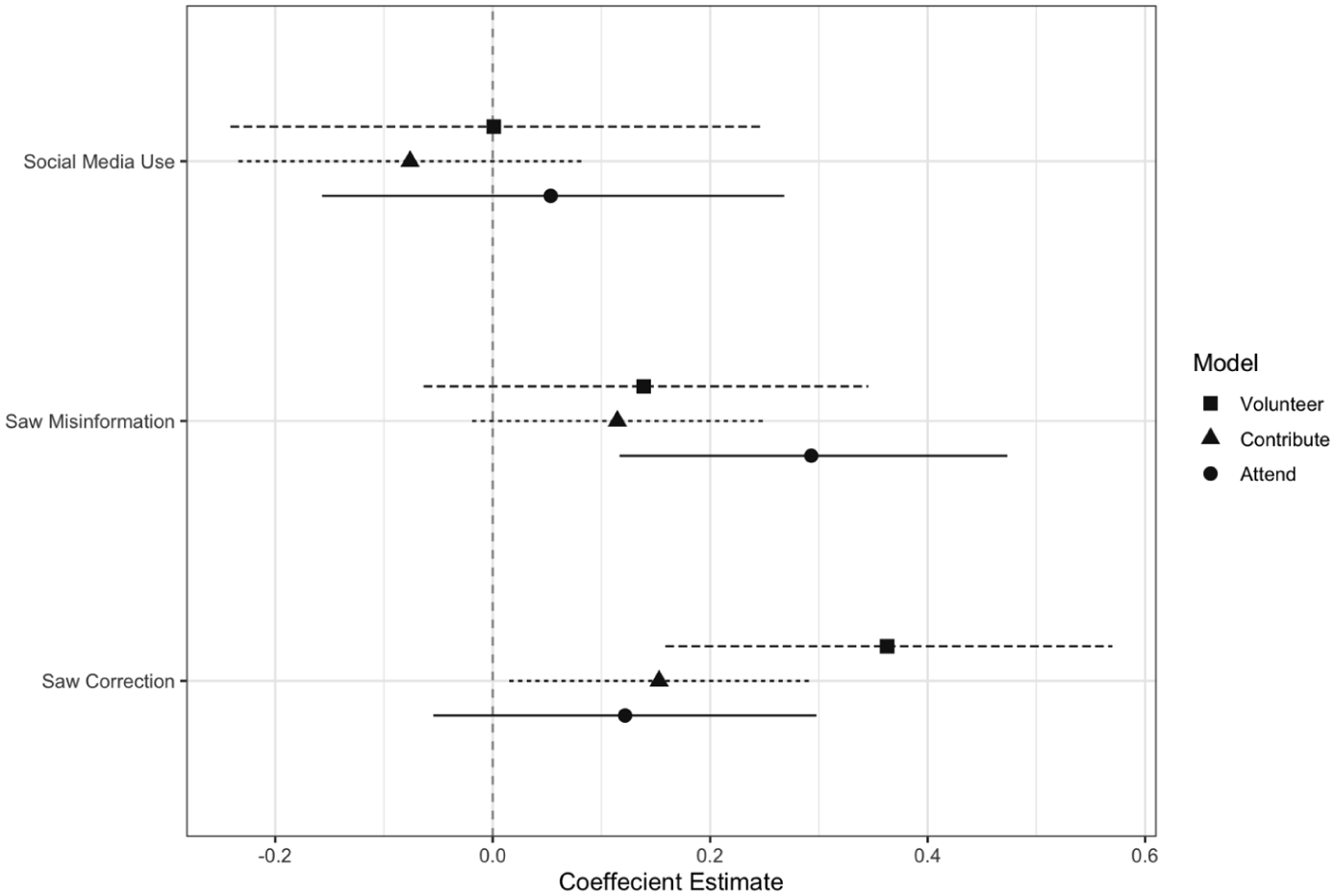
Coefficient plot for constructive democratic behaviors.
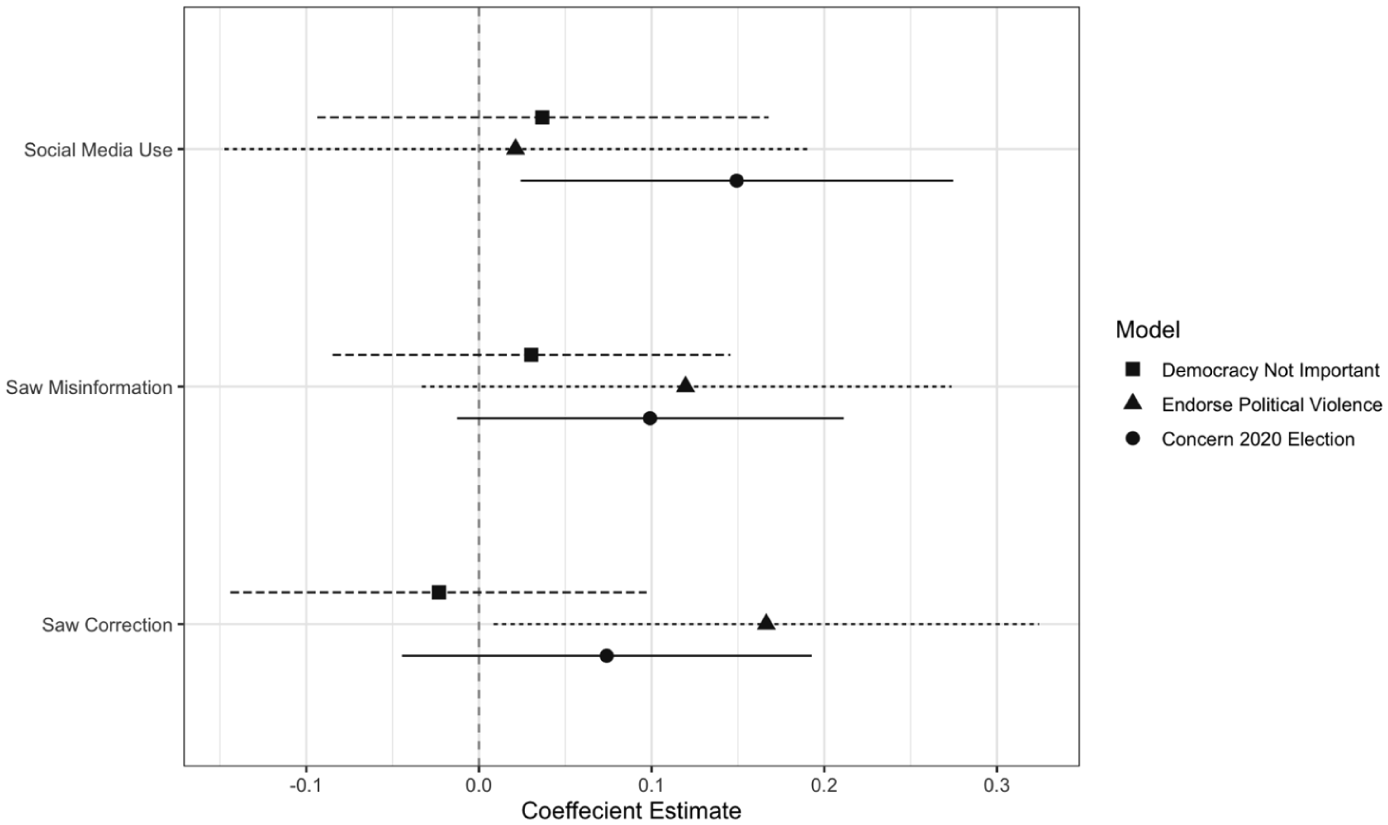
Coefficient plot for destructive democratic attitudes.
Next, we turn our attention to the role of seeing misinformation on social media in explaining these outcomes. Per RQ1, we find mixed evidence that perceived misinformation exposure is associated with constructive democratic behaviors: it is significantly associated with a higher likelihood of attending a political event, but is not associated with donating or doing volunteer work. Finally, H3 was rejected as perceived misinformation exposure is not associated with expressing concerns about the fairness of the 2020 election, endorsing political violence to advance political goals, and the non-importance of living in a democratically governed country.
Finally, we consider the relationship between perceived correction exposure and these dual outcomes. The findings are again mixed. Specifically, perceived correction exposure is positively associated with two constructive behaviors (RQ2): donating to campaigns and volunteering, but not attending a political event. Per RQ3, perceived correction exposure is positively associated with endorsement of political violence, but not the other two destructive democratic attitudes of election concern or importance of living in a democratic country.
Discussion
This study examines the relationship between social media use, perceived exposure to political misinformation, and perceived observed correction to constructive democratic behaviors as well as destructive democratic attitudes among political partisans. The findings highlight the dual influence of these social media experiences, as these experiences often produced both negative and positive outcomes in terms of constructive democratic behaviors and destructive democratic attitudes. This reinforces a truism regarding social media: its effects depend on how it is used and the content people see. As such, research should carefully parse what people are experiencing on social media to better understand its potential relationship to democratic functioning. This also means expanding the kinds of democratic outcomes studied to consider how misinformation and correction exposure do not just affect (mis)beliefs but also partisans’ broader sense of and participation in a democratic society.
First, we find that the higher levels of social media use before the 2020 US presidential election led people to express more concerns about the fairness of the election after it occurred. These findings align with previous research suggesting that social media was central to the propagation of the claim that the result of the 2020 presidential election was fraudulent (Canon and Sherman, 2021; Enders et al., 2023). In contrast to previous work (e.g., Boulianne, 2015), however, it was not associated with more participatory behaviors, although our supplemental analyses suggested social media use generally also reduced negative affect toward women and minorities. 9
Interestingly, perceived misinformation exposure only produced one significant relationship: it was associated with a greater willingness to attend political events. However, when we consider partisans who reported being exposed to corrections of misinformation, we again find dual impacts. Correcting misinformation is often touted as an important tool to address misinformation, as it generally reduces misperceptions (Walter et al., 2021). This study considers the democratic potential of perceived seeing such corrections. Yet again, the picture is mixed; however, perceived exposure to corrections on social media fosters constructive participation in terms of donating and volunteering, but also increases the endorsement of political violence. The relationship between seeing misinformation corrected and endorsing political violence echoes concerns raised by Mosleh et al. (2021), who observed that corrections can lead to increased toxicity and partisanship. It may be that the conflict inherent in correction contributes to the further deterioration of democratic attitudes, as indicated by support for political violence (Kalmoe and Mason, 2022), especially when looking at the experiences of partisans.
This connection between corrections and the endorsement of political violence warrants careful consideration. Fact-checkers and platform moderators should be aware of the potential for backlash or radicalization (Mosleh et al., 2021) among party adherents because they may perceive corrections as a threat to their political identity. Moreover, consider how to best tailor corrections to the groups who are most open to the information – for example, focusing on those groups vulnerable or receptive to misinformation (Krishna, 2021) – may also be warranted.
The finding that two social media experiences – perceived misinformation exposure and perceived correction exposure – are associated with more participation is also noteworthy. The positive relationship between perceived witnessing corrections and political engagement suggests that fact-checking and correction initiatives on platforms such as Facebook and Twitter can promote civic behaviors like volunteering and campaign contributions. Policymakers and platform designers could leverage this by creating more prominent, user-friendly correction features that encourage engagement with accurate information. However, perceptions of misinformation are also linked to attending any political event, which may suggest that these perceptions alter how people think about the stakes of the election: differences between the parties are not just about policy but fundamental truths, encouraging people to get involved (Downs, 1957). This may also suggest that our initial framing of participation as a form of constructive citizenship may be too optimistic. If people are participating more from distrust or disgust toward one’s opponents, encouraging participation may be a double-edged sword that can both bolster and harm democratic functioning (Kalmoe and Mason, 2022; Lutz and Hoffmann, 2017). We take this opportunity to encourage all researchers to consider why people participate as well as whether they do when they consider these outcomes.
Several limitations of this study should be acknowledged. First, the reliance on self-reported data introduces potential biases, particularly in assessing sensitive topics such as political violence and negative attitudes toward minorities and women, or for strongly normative behaviors like voting (Schwarz and Oyserman, 2001). Likewise, people tend to be quite bad at reporting their own behaviors, including on social media (Guess, 2015; Knuutila et al., 2022; Rodríguez-Virgili et al., 2021; Shin, 2020), and our use of generic labels for these experiences (i.e., from “never” to “all the time”) may further exacerbate these difficulties. Therefore, our study speaks to how perceived misinformation and correction exposure relate to democratic attitudes and behaviors, and future research should explore how actual exposure is associated with these outcomes, using alternative designs such as experiments or digital trace data.
Second, while this study uses a two-wave panel, we cannot establish the causal relationship between social media use, exposure to political misinformation and/or corrections, and democratic citizenship and attitudes. Also, while our sample was nationally representative, it was also highly participatory and interested in politics. Moreover, our results examine only partisans who could report affective polarization, excluding true Independents. Therefore, further exploration into how these dynamics differ across subgroups – and especially among those less involved in politics or who do not identify with a political party – is warranted. For example, future research could explore whether the relationship between social media experiences and democratic orientations differs among individuals or groups, such as political ideology, ideological strength, media literacy, or political knowledge, although a supplemental analysis suggests these results are consistent across political ideology, ideological strength, and political knowledge. 10
Meanwhile, while this study reports interesting results regarding the relationship between social media experiences and democratic outcomes, future research should explore whether different platforms produce distinct relationships. Finally, we acknowledge that the size of the relationships uncovered in this study is often modest, but given the importance of these outcomes for healthy democratic functioning and the potential for stronger relationships among specific subgroups, we believe our study supports the need for sustained research in this area.
In conclusion, our results shed light on the dual impact of social media on democratic citizenship and attitudes. Social media use, perceived misinformation exposure, and perceived correction exposure can not only, in some cases, enhance political engagement but can also sometimes foster more extreme and destructive attitudes. These findings emphasize the need for strategies to promote constructive democratic behaviors while mitigating the risk of radicalization. As social media continues to play an important role in influencing political discourse and potentially democratic citizenship and attitudes, as demonstrated by this study, researchers and practitioners must remain vigilant about its dual influence on democratic life.
Supplemental Material
sj-pdf-1-nms-10.1177_14614448261448547 – Supplemental material for From democratic engagement to destructive attitudes: Social media’s dual influence on democratic citizenship and attitudes in the United States during the 2020 presidential election
Supplemental material, sj-pdf-1-nms-10.1177_14614448261448547 for From democratic engagement to destructive attitudes: Social media’s dual influence on democratic citizenship and attitudes in the United States during the 2020 presidential election by Rita Tang, Benjamin R. Burnley and Emily K. Vraga in New Media & Society
Footnotes

Ethical considerations
The University of Minnesota Institutional Review Board granted ethical approval before the data collection.
Consent to Participate
Informed consent was obtained from the participants.
Author contributions
Rita Tang: conceptualization, formal analysis, manuscript writing and review.
Ben Burnley: conceptualization, formal analysis, manuscript writing and review.
Emily K. Vraga: conceptualization, supervision, manuscript writing and review.
Funding
The authors disclosed receipt of the following financial support for the research, authorship, and/or publication of this article: This study was funded by the Center for the Study of Political Psychology and the College of Liberal Arts at the University of Minnesota, as well as the University of Minnesota Foundation.
Declaration of conflicting interests
The authors declared no potential conflicts of interest with respect to the research, authorship, and/or publication of this article.
Supplemental material
Supplemental material for this article is available online.
Notes
Author biographies
References
Supplementary Material
Please find the following supplemental material available below.
For Open Access articles published under a Creative Commons License, all supplemental material carries the same license as the article it is associated with.
For non-Open Access articles published, all supplemental material carries a non-exclusive license, and permission requests for re-use of supplemental material or any part of supplemental material shall be sent directly to the copyright owner as specified in the copyright notice associated with the article.
