







Abstract
This article explores how a large digital platform exploits its user data to legitimise itself through the tone, form and content of its public-facing outputs. Our case study is the annual Insights (Year in Review) reports released by the pornographic platform Pornhub between 2013 and 2024, which we engage with as cultural artefacts and upon which we conduct detailed content and discourse analysis. These reports, Pornhub claims, are based on the extensive data captured about every unique visitor who accesses the site each year. We show that, in the reports, Pornhub works actively to legitimise and celebrate a multifaceted range of practices which exploit the data gathered, often unknowingly, from users. These practices rely upon the company’s platform infrastructure and use of social media logics. The Insights reports serve as a stark reminder of the power platforms have to exploit their users’ data to create celebratory narratives which elide complex ethical questions.
Introduction
Take a look around. You will find plenty of eye-catching infographics laying out a variety of results between the genders, sexual orientations, breakdowns of state-by-state search habits, the time people spend on Pornhub, and so much more. Revel in it! Share it with your friends! Have a toast and a laugh and most of all, enjoy yourself.
This quote is drawn from the introduction to Pornhub’s annual ‘Year in Review’ report for 2023. These reports (hereafter referred to as the Insights reports) are the subject of this article. Created by a team of anonymous data analysts and copywriters and first published in 2013, they became considerably more detailed and explicit over their first decade. The 2023 Insights report, for example, is more than 8000 words long, supported by copious links, photographs, infographics and colour-coded maps. Each report works to celebrate and make visible usage of the platform, with user groups disaggregated by age, gender and location. Using these datasets, the reports foreground ‘trends’ in usage: top search queries; length of visits; and top genres and performers. They also report on demographic breakdowns, including most popular performers and genres compared between visitors who are gendered and age-estimated, and usage patterns across different devices, operating systems, countries and US states. Many of the reports also track patterns in user access to Pornhub during major public holidays, festivals, and sporting and cultural events. The majority of the reports end by reviewing many of the above facts separately for each of the ‘top 20 countries’, ranked in terms of numbers of visitors to the site (all of the annual reports are archived and available at https://www.pornhub.com/insights).
The reports are written in a playful and ironic tone, celebrating practices which raise complex ethical and legal questions. These include top-10 lists of searches for pornographic videos depicting fictional characters (which rely at least somewhat on searches for non-consensual deepfake videos of the actors who play them in TV and film franchises), and the ranking of performers and content types that are often explicitly racialised, gendered and age-based. In creating these reports, Pornhub claims to draw upon the data gathered by tracking the behaviour of every unique visitor, including how long they stay on the site, which videos they watch, and with which genre-categories they engage. The platform uses the functionality of Google Analytics and cookies to estimate the age and gender of each user, and uses IP address data to track locations. It is this huge corpus of data – over 42 billion unique visits in 2019, for example – that the Insights reports exploit.
In this article, we discuss the findings of a detailed discourse and content analysis of the reports from 2013 to 2024. We draw upon concepts and literature on social and cultural aspects of datafication (Cukier and Mayer-Schönberger, 2013): principally, we use Manovich’s (2001) distinction between narrative and database, later applied to cultural analysis of pornography by Saunders (2020), as well as the frame of ‘everyday data cultures’ (Burgess et al., 2022). Using these frameworks, we argue that the types of data analysis, graphics and accompanying explanatory text created by Pornhub function as an interlocking set of strategies through which the platform asserts its own authorial capacity. The Insights reports celebrate the platform’s choices to collect, analyse and make meaning from user data while also communicating the perceived legitimacy of these practices.
We began this project after discovering a shared interest in the reports as cultural artefacts, particularly in relation to the granularity of each text, and the increased detail contained within the reports over time. The Insights reports demanded analysis because they made so many urgent questions visible simultaneously. As we analysed the reports, we discussed the access, often rendered invisible, that Pornhub has to vast quantities of user data that it can use with relatively few constraints. We noted the celebration within the reports of complex, often ethically fraught, and sometimes illegal pornographic practices. We investigated the unequal relationalities between users and Pornhub as a platform that collects data about deeply intimate, individual user engagement with sexual media products. We also considered the racialised, gendered, disability, age and nation-based inequalities that are all visible in the design of the reports themselves.
Our analysis of the reports as cultural artefacts thus contributes to academic debates in critical platform and social media studies, and to discussion of how forms of intersectional inequality are reproduced through digital practices. Our focus is to view the Insights reports as resources for the making and sharing of multiple overlapping and related meanings about the platform’s own data exploitation practices, though ‘meaning creation’ is a complex and multiply theorised process. The perspectival nature of the ‘encoder’ and ‘decoder’ and the relevance of considering, in Hall’s terms, the ‘frameworks of knowledge’, ‘relations of production’ and ‘technical infrastructure’ complicate simplified narratives about the meanings contained within any cultural product (Hall, 1980: 120). With this complexity in mind, we focus our analysis here on how the Insights reports work to construct a discourse around pornography distribution that not only seeks to normalise and celebrate the often exploitative nature of the platform’s content, but also to normalise and celebrate the platform’s exploitation of the data it collects, analyses and disseminates about its users for its own purposes.
This then, is a multilayered argument about exploitation: Pornhub exploits data gathered from its users, the Insights reports function as artefacts which celebrate and legitimate this data exploitation, and these forms of exploitative practice occur in relation to the other forms of exploitation, related to content and interface design, upon which the platform relies. Relevant here is the argument that pornography functions as ‘one cultural space in which societies work out where their limits lie, where they decide what is obscene and what is acceptable (as well as what kinds of obscene are acceptable)’ (Meikle, 2023: 47). The Insights reports function as an attempt to make Pornhub’s gathering of data about their users, much of which is ‘obscene’ in both its granular detail and its political implications, a form of ‘acceptable’ knowledge.
This article thus contributes to research about datafied exploitation carried out by online platforms, and particularly to research that seeks to explore the discursive efforts that platforms make to legitimise and normalise their capacity and choice to exploit user data. Our primary contribution is delineating how Pornhub carries out these practices. In the Insights reports, populations of users are categorised, and in many cases crudely profiled. Pornhub’s gamification discourses, and tone of irreverence and playfulness work to normalise both the claims the platform is making about user behaviour, and the vast resources of data gathered by the platform upon which such claims rest. This argument led us to a second contribution: we explore here whether Pornhub can be understood as a social media platform. Our analysis of the Insights reports therefore functions as a heuristic device through which we might ask broader questions about social media platforms’ exploitation of their users’ data, and their attempts to legitimise these practices in public-facing cultural artefacts.
Pornhub in the context of social media platforms
Pornhub launched in 2007, during a cultural moment where the possibilities of user-generated content, and the blurring of distinctions between professional and amateur media creation, were attracting considerable excitement and investment (Paasonen, 2010). The platform was later acquired by a Canadian company, branded as Aylo at the time of writing, and remains privately held. Throughout the 2010s, while trading under the name MindGeek, the company expanded significantly, establishing a dominant position in the pornography sector by acquiring competing sites and providers (Paasonen et al., 2019). Fabian Thylmann, a key figure in the platform’s development, explained in an interview that Pornhub was modelled on YouTube, copying its reliance on user-generated content and advertising revenues (Ronson, 2017).
The Insights reports, then, are artefacts created by a platform whose purpose is to encourage user engagement with pornographic content. This content has the potential to be highly exploitative. In 2020, the New York Times published an investigation into Pornhub’s operations that included testimony from women and girls reporting that videos of them being sexually assaulted had been posted on the platform (Kristof, 2020). Some victims described how these non-consensual abuse videos would reappear on the site each time they were successful in having them removed. As a result of this article, Mastercard and Visa withdrew their services from Pornhub. In response, Pornhub deleted 9 million videos from its database of 13 million, leaving only those that had been uploaded by verified users, and blocking the unverified from uploading further content (Paul, 2020). Pornhub has also been implicated in criminal cases such as the prosecution of the operators of the GirlsDoPorn website (Cole and Malberg, 2019; Guardian, 2025). It has become subject to age-verification requirements for users in jurisdictions including many US states, the United Kingdom and France.
While pornography been analysed in relation to questions of gender, sexuality, labour, health, violence, consent and identity (Attwood, 2018; Smith et al., 2018; Sullivan and McKee, 2015), we are focused principally on considering the exploitation that Pornhub engages in with regards to the users of that platform. It thus proved productive to draw upon insights about social media, defined as ‘networked data platforms that combine public with personal communication’ (Meikle, 2024: 21). Further factors led us towards considering the platform as a social media site: Pornhub has a platform-based architecture, a reliance on user-generated content, and uses recommender algorithms to keep users engaged. Yet Pornhub is rarely discussed as social media. It receives no mention at all in major social media textbooks (e.g. Fuchs, 2024; Hjorth and Hinton, 2019; Sujon, 2021), and appears only 12 times in the database of New Media & Society and only 5 times in that of Social Media + Society, with academic discussion largely confined to the specialist journal Porn Studies. Though Pornhub’s relative critical neglect in the specific area of social media research is perhaps a consequence of its exploitative content and practices, it also perhaps mirrors the ways in which sexual forms of representation have increasingly been deplatformed by mainstream social media (Tiidenberg and van der Nagel, 2020).
This discursive deplatforming misses the opportunity to explore Pornhub’s ongoing role within the social media landscape. Pornhub is used as social media by individuals engaging with it as part of their wider, cross-platform, engagement. Our Insights analysis showed that ‘verified amateur’ content creators, for example, often use multiple platforms, driving engagement with their content through links embedded on each site’s page, and encouraging consumers to move from less to more explicit material, or from free to paid content. When users arrive at Pornhub, they engage with a platform openly modelled on early iterations of YouTube, with analogous interface design in terms of public display of categories including most viewed, most favourited, most discussed and most responded, which encourages communication between video-makers and viewers (Burgess and Green, 2018). Platform users also react to content: in 2018, for example, the Insights report claims that 64 million messages were sent between users, 141 million videos were ‘voted on’, and 8 million comments were left on videos. Pornhub’s design and interface have clear parallels with other social media platforms, whose affordances also enable communication through hosting and circulating content made or shared by users (Poell et al., 2022).
Social media platforms as sites for datafied exploitation
Social media platforms provide an infrastructure that exploits users’ communications through the capture, analysis, interpretation, and exploitation of their data, most often for commercial advertising (Gillespie, 2018). Platforms reveal the extent of their data resources differently. Some create affordances that become taken-for-granted features: the recommendation of ‘People You May Know’ on Facebook or Instagram, for example, is enabled by drawing inferences from other users’ contact lists, while the identification of ‘Trending Topics’ on X or Bluesky is enabled by aggregating search terms and keywords from the dispersed behaviour of large numbers of users. The gamification of health activities promoted by tools such as Alphabet’s Fitbit devices adds ideas of competition to the harvesting and analysis of intimate personal data. Other digital services actively celebrate the volume and indexicality of their data resources, the annual Spotify Wrapped release, for example, has been analysed as an ‘algorithmic event’ (Annabell and Rasmussen, 2024). These examples are all illustrations of the data power available to such platforms. In some cases, platforms’ data exploitation hides in plain sight, while in others it is foregrounded as entertainment, with their services presented as indispensable and central to digital life (Burgess et al., 2022).
The largest and most dominant platforms have substantial capacity to influence the digital environment in which their users engage, with their continuous accumulation of data further entrenching their position. However, the rules by which such data are gathered, combined, analysed, circulated and interpreted are most often not transparent to the people to whom these data refer, despite the potential for the granularity and indexicality of those data to directly identify a given user (Kitchin, 2022). What is at stake here is that people cannot know how their data will be used, or to whose benefit, and the use of such data benefits the platforms that gather it.
Given this unequal relationship between the users of the platform and the owners of the platform, it is productive, therefore, to think in terms of exploitation – a concept with many meanings, within and beyond academic spheres. The Oxford English Dictionary definition has three parts: (1) harvesting natural resources, (2) deriving benefit from something by making full use of it and (3) taking advantage of something or someone in an unethical manner. In the Insights reports, all three of these definitions of exploitation are visible: Pornhub treats data generated by the behaviour of its users as a resource to be used without meaningful consent from such users; it derives benefit by using these ‘raw’ data in aggregate forms to craft a narrative about the platform’s own cultural and social importance; and it legitimises a range of unethical practices that occur on the site through the use of such data in its Insights reports. Somewhat similarly, when theorising exploitation, Vrousalis (2013: 132) explains that: ‘A exploits B if and only if A and B are embedded in a systematic relationship in which (a) A instrumentalizes (b) B’s vulnerability (c) to extract a net benefit from B’. It is this relationship – in which Pornhub instrumentalises its users’ vulnerability – in which we are interested here.
Some users are recognising and challenging these data exploitation-based harms: for example, the group ‘Pornhub Tracking Exposed’ challenged the platform ’s compliance with GDPR legislation in 2023 on the basis that recommendation algorithms on the site prompt users who are non-consensually categorised by Pornhub to engage further with different types of content (StopDataPorn, 2023). In another example, a class action lawsuit filed in 2024 contends that users’ pornography preferences are shared with Google for the purposes of targeted advertising beyond the platform (Brennan, 2024). Forms of exploitation engaged with by Pornhub then, are entangled and co-constitutive. Understanding the ramifications of the Insights reports involves placing them in this wider context of challenges to the platform, as well as the wider context in which exploitation as a concept, and the data exploitation practices of other social media platforms, have been theorised and challenged.
Within the field of social media exploitation in particular, much work begins with political economic questions at the level of the sector. The function of the digital platform sector is theorised in relation to capitalist structures (Fuchs, 2014; Srnicek, 2017; Zuboff, 2019) or colonial histories (Couldry and Mejias, 2019). In this article, we depart from these wider political economic analyses of exploitation by focusing only on one platform. We also depart from analyses that consider the impact of platform exploitation on those labouring for the platform (Roberts, 2016). Instead, we focus primarily on analysing the platform’s own discursive construction of its exploitative data practices. In taking this approach, we are motivated by Hall’s assertion, drawing on Gramsci, that ‘the nature of power in the modern world is that it is also constructed in relation to political, moral, intellectual, cultural, ideological, sexual questions’ (Hall, 1987: 20–2 1). It is Pornhub’s choice to celebrate its own exploitative practices relating to its users, which the Insights reports portray in political, moral, cultural and ideological terms, upon which we focus our analysis.
The forms of exploitation we are interested in then, are primarily achieved through ‘datafication’, a term generally credited to Cukier and Mayer-Schönberger (2013) which describes ‘the growing trend of turning human behaviour and social activities into data points that can be collected and analysed’ (Dencik et al., 2022: 1). Datafication raises powerful questions about governance and citizenship, as it ‘enables both corporate and state actors to profile, sort and categorize populations’ (Hintz et al., 2019: 3). The generation, collection, and uses of data are not inevitable, but ‘are rather bound up with certain social structures, interests and ideas’ (Dencik et al., 2022: 2), relying on and making possible ‘the quantification of social life’ (Verdegem, 2025: 4) for purposes of profit accumulation.
As our analysis is focused primarily on the relationship between datafied exploitation carried out by the platform and the narrative that the platform builds, in its Insights reports, about its own datafication choices, we draw on Manovich, who identifies the database as a cultural form, and the narrative as a storytelling form. A database, he observes: ‘allows one to quickly access, sort, and reorganize millions of records; it can contain different media types, and it assumes multiple indexing of data’ (2001: 214). Databases are structured collections of discrete items, organised for search and retrieval, while narratives display development and are organised through cause-and-effect relationships.
Saunders draws upon Manovich’s distinction, and extends it into the context of datafication, arguing that online pornography ‘heralds the insertion of sexuality into the information economy’ (2020: 58). Searching for and viewing content on a pornographic platform generates data that can be exploited by that platform, transforming desires into ‘sexual datafication’ (Saunders, 2020: 58). The structuring of pornography platform interfaces around database logics contributes to this datafication. Sites use ever-proliferating micro-categories of sex-acts and body-types to present their content through menus and suggested search terms. This database logic, Saunders argues, positions female bodies ‘as knowable, capable of anatomisation, and as requiring physical and behavioural categorisation’ (2020: 71). The user is positioned and invited to refocus their sexual desires around specific categorisations, precisely because this renders their online behaviours more amenable to datafication.
In our analysis, however, we are interested less in how Pornhub mobilises datafication practices to shape the experience of users engaging with the platform, and more in how users themselves become a form of data for the platform. In order to critically interrogate how Pornhub legitimises and normalises their use of user data we draw upon work on ‘everyday data cultures’. Such work examines the emergence of cultural practices and responses to datafication, from the shifting of basic everyday services and activities to digital platforms, through the embedding of networked sensors across urban environments (Bunz and Meikle, 2018), to the use of automated decision-making and algorithmic operations on everyday lived experiences (Burgess et al., 2022: 2– 3). Pornhub, we show, makes discursive choices that attempt to render the datafied exploitation of its Insights reports into an ‘everyday’ event, normalised and divorced from its political implications.
Methodology: Content and discourse analysis
We conducted a detailed and longitudinal comparative content and discourse analysis of all 11 of Pornhub’s Insights reports from 2013 to 2024. Through examining lexical choices and patterns, organisation and assumptions, as well as the use of image and design, we analyse the discursive strategies that characterise these texts (Fairclough, 2003; Machin and Mayr, 2012). In addition, for their first 4 years, the reports were accompanied by an open comment space in which readers and staff members at Pornhub discussed the reports’ findings. We included these comments in our analysis, as they make visible discussions between readers and Pornhub staff who explain elements of their exploitation of user data.
The types of data exploitation in the reports become more extensive and specific over time. Over the first decade of the reports, 15 different data analysis categories were used by the platform, although in the earliest report, only seven of these categories appeared. These earliest categories include top search terms, analysis of time users spend on the platform, analysis of device type used to access the platform, the impact of holidays and events on viewership, most popular types of videos, and viewer location. By 2017, categories had expanded to include: state-by-state breakdowns of user data within the United States and country-based trends globally; data on searches for non-pornographic public figures and cultural products and additional user demographic analysis, including estimations of users’ age and gender. From 2021, the Insights reports increasingly began to characterise the ‘trends’ in user data in introductory statements and instead of introducing the reports with numerical data – such as numbers of views, interactions and comments – and instead began to highlight ‘terms that defined the year’. Throughout each report, Pornhub exploits user data in a range of ways, providing averages and rankings, calculating changes over time or space, and conducting comparative analyses of two or more different data types.
Our comparative analysis of the reports was complicated by the fact that there has not been a linear increase in the inclusion of different types of data analysis. In 2016, for example, the Insights report included a breakdown of 19 popular searches for public figures not part of the pornography industry, alongside the day of the year that the ‘celebrity’ was searched for the most, and the percentage increase in searches recorded. However, the reports’ included this level of detail on ‘celebrity search’ data for 4 years only.
Our methodology, therefore, was somewhat constrained by the changing inclusion of different data-types within the reports. Clear information on how Pornhub gathers its data, as well as the reasons for the platform’s choice to include certain types of analysis, are not presented in the reports. This absence of transparency or rationale encouraged us to comparatively analyse the reports alongside each other in an effort to understand how Pornhub’s discursive strategies changed over time. We thus paid attention to how Pornhub uses graphics in its reports, observing a chronological increase in the sophistication and branding of graphic imagery, as well as the development of graphics formats, such as the colour-coded maps of pornographic search terms. To contextualise the visuality and active discursive construction of these graphics, we considered the tonality of the text that accompanied them.
This methodology, one that is concerned with reading the reports as cultural artefacts, sets clear constraints around our arguments. We have not had direct conversations with the reports’ authors nor had any access to the processes and practices that occurred out of public view, through which the reports were made. The authors of the reports are not named – referred to primarily by Pornhub as ‘our statisticians’ – and Pornhub itself does not provide explicit justification for the decision to create and release the reports each year, beyond its description of creating ‘a year in review’, although the reports do celebrate the potential for engagement from media and public figures. Our argument, therefore, is not concerned with Pornhub’s intentionality, rationale or the mechanics of its data gathering and report-creating processes. Instead, we focus on what the reports convey. Our interest is in what is shown by conducting a close reading of the textual narratives both within and across the reports. We examine the ways that Pornhub has chosen to extract, order, describe and classify its numerical data, attributing different types of meaning to those data. We pay attention, too, to how the reports both reflexively engage with, and render invisible, Pornhub’s own data-gathering practices.
Findings and discussion: Critically reading the Insights reports
We consider Pornhub’s exploitation of its users’ data in two subsequent sections. First, we draw upon the distinction between narrative and database, in exploring the strategies of categorisation and public communication deployed in the Insights reports; we do this to establish how the reports work to legitimise their use of user data. Second, we consider the Insights reports within discourses of datafication as everyday cultural practices; we do this to establish how the reports work to normalise both their own content and the role of Pornhub as a platform. First, however, we introduce Table 1 to highlight how Pornhub engages with user data. The table is created from excerpts taken from the opening sections of three of the most recent Insights reports.
Examples of ‘terms that defined the year’, taken from the 2022–2024 Insights reports.
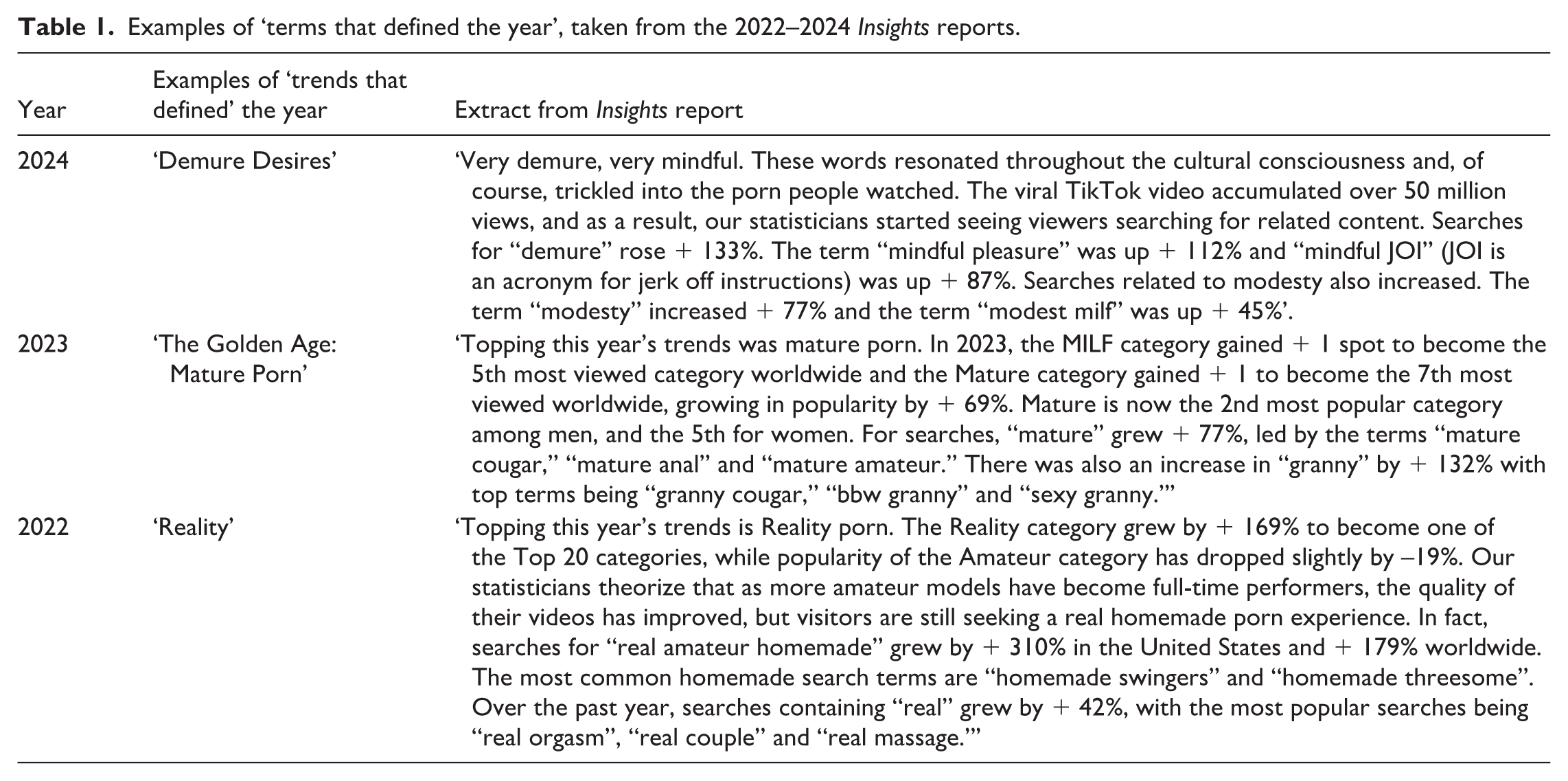
This table illustratively demonstrates both the wide-ranging nature of Pornhub’s capacity for data exploitation and the active work the platform performs to provide commentary on such data. Reading these reports as cultural artefacts highlights that they contain discursive strategies for legitimisation and normalisation, which we argue need to be understood as facets of exploitation.
Narrative and database – How the Insights reports work to legitimise the exploitation of user data
Pornhub’s access to data on its users’ behaviour is extensive. These data exist in relation to, but separate from, its other database – that of the pornographic content uploaded to the platform. There is an interdependent relationship between these two data types: the capacities of Pornhub as a platform mean that, in addition to monitoring and managing uploaded content, it can also monitor the behaviour of its users in granular detail and can build extensive databases that aggregate and differentially disaggregate such user behaviour; it can then link this to facets of user identity, including estimated age, gender and physical location. The Insights reports, then, can be read as a space in which Pornhub crafts its own narrative about the database of user data that it collects and exploits in order to legitimise specific data collection practices.
It is here that Manovich’s understanding of ‘narrative’ and ‘database’ become useful, although these are not opposing forms. Instead, ‘database and narrative produce endless hybrids’ (Manovich, 2001: 234). The Insights reports function as such a hybrid, exploiting user data in order to create a narrative about the platform, its content and its practices. These discursive narrative strategies are mobilised, for example, in Pornhub’s highlighting of ‘headline stats’ for the year at the beginning of each report from 2013-2019. For example, the statistics on visitor numbers and searches in the 2017 report are presented and contextualised as follows: Our users and content partners uploaded over 4 million videos in 2017, including 810,000 amateur videos. That is more videos than the number of people who visit the Great Wall of China each year. While we are on the topic of mind-bending stats, a total of 3,732 Petabytes of data was streamed in 2017, which makes for 7,101 GB per minute and 118 GB per second. That is enough data to fill the storage of all of the world’s iPhones currently in use. In fact, every 5 minutes Pornhub transmits more data than the entire contents of the New York Public library’s 50 million books. Over the course of 2017, there were 120 million video votes on Pornhub of which nearly 80% were positive. That is a million votes more than we cast in the last U.S. Presidential election. With 24.7 billion searches performed on the site this year, there was clearly a lot to find, as this translates to about 50,000 searches per minute and 800 searches per second. This is also incidentally the same number of hamburgers that McDonalds sells every second, which has nothing to do with us but somehow makes the numbers easier to digest?
As well as revealing the vastness of the data to which it has access, Pornhub here contextualises the scale of its database by averaging the data collected over a year into smaller timeframes – per second, per minute. In this way, the report presents the reader with data that might be easier to comprehend. In addition, Pornhub here crafts a narrative in which its own roles – as platform owner and database manager – are articulated and legitimised. The report contextualises and explains the quantity of its data by placing itself into the proximity of a major global institution, event or infrastructure. Such comparisons perhaps aid reader comprehension but also reveal clear self-promotion strategies. The symbolic resonances of the objects of comparison are worth considering. How might the statistics read differently if a different set of symbolic comparisons were invoked? Pornhub’s choice of comparisons is itself doing discursive work. By placing itself in relation to a global range of institutions (the New York Library and the Great Wall of China), valued technological artefacts (the iPhone) and discourses of American global dominance and exceptionalism (references to the US election and to McDonald’s sales), Pornhub crafts a narrative which contains within it a positioning strategy. The platform positions itself alongside objects which hold resonance and power. This legimisation strategy ultimately elides the reality that Pornhub is choosing to exploit user data which has often been gathered without users’ awareness or meaningful consent.
Questions of awareness and consent connect to the narrative/database functions of the Insights reports in other ways. Since 2016, one section of each report has reported on the number and types of user searches and video views for non-pornographic public figures and characters from movies, TV series and video games. An infographic in the 2016 report, for example, ranked 19 popular ‘celebrity searches’ on the platform. Text accompanying this graphic states: When it comes to percentage increase in searches, no one comes quite as close as U.K Secretary of State, Boris Johnson. On June 29th – a few days after the Brexit vote, searches for the Secretary of State and Brexit advocate, reached it’s peak [sic] up by a whopping 14624%.
Other individuals within this infographic were Melania Trump (described as ‘Model/First Lady’) and Theresa May (described as ‘Prime Minister of England’). Each of these is accompanied by numerical data pertaining to the number of searches, the date on which searches were at their peak, and the percentage in search increase at that time. Pornhub here does discursive work to render the non-consensual pornographic parodies or deepfake videos created about these public figures normative, unremarkable, or even comic, often inaccurately describing the public figure and their role in the world at the same time.
The function of these claims, as a discursive strategy of legitimisation, becomes even clearer when we consider the information that Pornhub does not share. In the 2023 Insights report, the platform claims to have 20 million registered users, 74% identifying as male, 26% as female, with an average reported age of 35. However, in many territories Pornhub’s content can be freely accessed by anyone. Even in territories requiring the use of age-verification systems, some users of the platform may be under the age of 18. Yet the site’s published figures imply that no children visit the site. However, the reports themselves hold contradictions along these lines: for example, many of the most searched for fictional characters on the site come from cultural products that are aimed at children and young people (Harry Potter and The Incredibles, for instance, ranked fifth and seventh in the ‘Most Searched for Movies & Characters’ infographic in the 2024 report).
Pornhub’s lack of acknowledgement of both underage users and adults interested in engaging with pornographic content related to children’s media products perhaps relates to the fact that the reports are promotional artefacts, designed to attract media coverage. Pornhub’s promotional materials have been frequently drawn upon by established media, including the BBC, New York Times, Wired and the Guardian (Saunders, 2025). Thus, the narratives that the company crafts about its database are fundamentally partial. Pornhub not only uses narrative forms to justify the existence of its user datafication practices, but also uses the vastness of its data resources to strengthen narratives about the ‘natural’ and ‘exciting’ business practices in which the platform chooses to engage. These business practices raise complex ethical, moral and legal questions: for example, in the cases of deepfake videos of celebrities, or of sexualised videos of characters that might appeal to children.
Everyday data cultures – How the Insights reports work to normalise the exploitation of user data
The Insights reports not only legitimise Pornhub’s data gathering processes but also normalise them through discourses of ‘the everyday’. In 2018, for example, the report included an ‘Every Minute on Pornhub’ infographic, modelled on the viral genre of ‘One Internet Minute’ images that circulated widely from the mid-2010s. Pornhub’s version claimed that every minute of 2018 saw: 207,405 videos viewed on the platform; 13,962 user profiles viewed; and 55 views of Kim Kardashian’s sex tape (the consensual nature of which has been disputed). Such infographics normalise the existence of Pornhub as a platform, the size of its userbase, and the existence of its data-gathering strategies, by rendering them activities that occur on a minute-by-minute basis.
In this way, the Insights reports both flex the platform’s data power and encourage further platform use. Their playful tone chimes with research on the promotional strategies of digital self-monitoring technologies such as fitness trackers, which have been described as ‘playful surveillance’ (Bunz and Meikle, 2018: 103–106). Such strategies are crafted to communicate acquiescence to the constant, invasive capture of data as novel, competitive activities in which every user can become a winner. Yet, as Lupton (2016) observes, data ‘have their own social lives, which are quite independent of the humans who originally generated them’ (p. 5). Where those data are able to travel is an intensely political question. These observations – on tensions of datafication and data power, which are expressed by platforms through discourses of the everyday – apply also to the language and approach of the Insights reports. The reports work hard to align their contents with the everyday lives of their users, using a breezy tone and rendering the existence of the platform in relation to its users’ daily lives.
The userbases that Pornhub references are disaggregated not only through a temporal frame, but also along a number of other lines, including geographic location, gender and age. The reports situate each user’s geographical location through infographics, such as colour-coded maps identifying the most-viewed genres in individual countries or US states. These maps show the platform asserting strong claims about the reach and depth of the data it collects from visitors both globally and at local levels. The maps’ claims about national preferences and pornographic taste cultures imply an omniscience derived from the volume of user data on which they are based.
The Insights reports do not pretend to be universal: on the contrary, their analysis foregrounds national habits and practices across 20 individual countries. Pornhub normalises the existence of differences in pornography preference, but in doing so, also normalises its capacity to make pronouncements about what is ‘most common’ for various identity-related user groups within their dataset. This short sample of text is typical of the reports’ granular detail and distinctive tone, in its suggestion that duration of a visit to Pornhub is a matter of national competition: The world is lasting a few seconds longer! This year, the average time spent on Pornhub increased by 15 whole seconds, making the average visit duration 10 minutes and 9 seconds. We can thank the 45+ year olds for that, as their average time was up between 25 seconds and 77 seconds. While the 18 to 24 age bracket was down –74 seconds, the 25 to 34 age bracket was down –34 seconds, and the 35 to 44 age bracket was down –6 seconds. Broken down by country, the Philippines increased +16 seconds per visit, taking the lead from Egypt last year, who decreased –24 seconds per visit, putting them in 3rd. Following the Philippines is Japan, who was up +15 seconds this year, holding the same spot as last year.
These reports then, while somewhat inclusive of global majority contexts in terms of geographically based comparison, reproduce reductive discourses about identity-based groups. These groups are not only placed into competition on a national basis, but on a number of other fronts, including, for example, the categorisation of parts of women’s bodies, as in the following excerpt: When it comes to categories that were viewed the longest, Small Tits was up +108 seconds, for a total of 15 minutes and 46 seconds. Trailing closely behind Small Tits was Brunette, which saw an increase of +177 seconds, for a total of 15 minutes and 34 seconds. Double penetration was up +143 seconds, for a total of 15 minutes and 3 seconds. The categories that did not get viewed as long this year include Feet, which saw a decrease of –128 seconds, for a total of only 6 minutes and 3 seconds.
Here we see a reductive datafication of complex, intersectional identity characteristics and the misogynistic treatment of women’s bodies, which are ranked and scored in relation to one another. This reality occurs throughout the reports, where user preferences for gendered, racialised and age-based identities are listed comparatively, devoid of any contextual significance or acknowledgement of relational or structural power imbalances. On other social media platforms, company policies and user practices reinforce the intersectional racialisation and gendering of user content, often without acknowledging that this is part of their policy and practices (see Higgins, 2024; Roberts 2016). But in the case of the Insights reports, the content that is categorised is sexual in nature, and Pornhub not only classifies and organises the content of the platform on the basis of identity but also works to legitimise its data gathering practices explicitly in relation to these identity-based descriptions. This use of ‘offensive, derogatory’ terms in Pornhub’s outputs has also been noted by Saunders (2025: 13), who explores how the platform’s descriptions of its data dehumanise transgender performers and legitimise violence against women, creating ‘a cynical legitimising of [ …] heteropatriarchal violence’ (2025: 11). Throughout the Insights reports, then, a wide range of practices are rendered simply as data-points to be read in relation to one another, with no recognition of their political significance or of the very real harms that may be implicated in both the practices themselves and in their representation.
Conclusions: The celebration of exploitation
In this article, we have explored how increasing forms of platform datafication enable multiple forms of exploitation. In the case of Pornhub and the Insights reports, this datafied exploitation relates not only to the content on the platform, but to the data gathered about users of the platform. By closely analysing Insights reports produced over an 11- year period, we show that the reports consistently attempt to both legitimise and normalise these multiple forms of exploitative practice. Throughout the reports, data exploitation is narrativised. The datafication of the captured behaviour of many millions of people is transformed by Pornhub into insights and trends.
Why is it important or meaningful to recognise and interrogate how Pornhub gathers data about its users and presents these publicly in aggregate form? It matters because the annual Insights reports actively celebrate the volume and variety of data that Pornhub holds about people whose most intimate practices and preferences are expressed through their use of the platform. This celebratory approach works to position the platform as a central part of everyday entertainment cultures, and to normalise its business model and its contents.
The Insights reports then, can be read as discursive artefacts which prioritise legitimisation and normalisation of a range of ethically and morally charged practices and content. Complex social-inequality and harm-based considerations emerge when the reports are critically analysed, but these are not acknowledged by the platform. Instead, the reports discursively entrench the data exploitation on which Pornhub relies. To return to Manovich’s (2001) distinction, the Insights reports are a categorisation mechanism and hence draw upon the cultural logic of the database; but they are also a narrative of the year-in-review, framed around moments, developments and trends. Yet it is not the pornographic content on the platform, but rather its users that are categorised, and their behaviours narrated – their preferences, locations and behaviours subject to analogous levels of taxonomy to those with which the platform designates and markets the pornographic video content that it hosts. This categorisation of users within the reports relies upon discourses of the everyday that flatten and render invisible the vast inequalities upon which the platform relies. Instead, the reports repeatedly engage in active celebration of Pornhub’s collection and manipulation of huge volumes of its users’ data.
We have shown that the reports raise ethical questions about content upon the platform: ‘celebrity’ and ‘public figure’ rankings raise questions about consent, deepfakes and impersonation. The ranking of cartoon characters, video games and children’s films raises questions about the age of viewers and how Pornhub celebrates or obscures this. Detailed, colour-coded maps that show relative sexual preferences for geographic locations raise questions about cultural and racialised essentialism and the power to disaggregate, define and generalise groups of users. The reports also raise ethical questions about data access. The importance of these questions becomes clearer when Pornhub is contextualised alongside other social media platforms. The Insights reports are a stark dramatisation of the capacities social media platforms have for datafication, shedding light on how penetrating and pervasive such practices of categorisation and sorting by digital platforms have become. Such practices are often second-nature elements of everyday social media use, from the naming and ranking of trending topics, to the shared novelty of Spotify Wrapped. These practices work to present platforms as indispensable and natural, while disguising the unpredictable ways in which their data may go on to be exploited: for example, users of Fitbit devices may not have anticipated their data being absorbed by Alphabet in its acquisition of that company after a decade of data collection, while users of Twitter may not have anticipated their data being acquired by Elon Musk and deployed in both the political realignment of the renamed X and the development of its Grok AI tool.
Paying attention to the Insights reports offers a stark perspective on the resources and information that users, often unwittingly, have extracted from them by the platforms with which they engage. Users cannot know how their data will be exploited, or to whose benefit. Such datafication can manifest actual harms, including exploitation, discrimination and surveillance (Dencik et al., 2022). All of these harms are both visible and celebrated in Pornhub’s Insights reports each year. Analysing the Insights reports, then, leads to a deeper understanding of the discursive work that platforms do to narrate their exploitation of datafication. The celebratory discourses of the Insights reports make visible the extent and depth to which user data can be gathered, mobilised and exploited by the social media platforms that have access to our most intimate digital behaviours and desires.
Footnotes
Authors’ note
Both authors have agreed to the submission. The article is not currently being considered for publication by any other print or electronic journal.

Informed consent
There are no human participants in this article and informed consent is not required.
Funding
The authors received no financial support for the research, authorship, and/or publication of this article.
Declaration of conflicting interests
The authors declared no potential conflicts of interest with respect to the research, authorship, and/or publication of this article.