






Abstract
Personalized digital mourning platforms are gaining increasing acceptance among the Chinese public. This study employs a mixed-methods approach combining virtual ethnography and in-depth interviews to explore how digital mourning, as a novel form of mourning, influences death memory established upon traditional Chinese death rituals. The study finds that digital mourning platforms drive the digital transformation of traditional Chinese death rituals through three mechanisms: creating digital tombs, quantifying mourning rituals, and visualizing mourning emotions. However, this process blurs the boundaries between death-related mourning activities and daily life. The erosion of mourning sentiments by capitalist logic and the dissolution of death-mourning culture through performative rituals are gradually undermining the social foundations upon which traditional Chinese death memory is built. Currently, digital mourning is only gradually accepted by the Chinese public as a new form of traditional death commemoration. It has not fundamentally driven the modernization of traditional Chinese death rituals nor profoundly impacted traditional death-mourning ceremonies and death memories. Nevertheless, examining the digital transformation of death mourning reveals both its value in advancing the transformation of traditional Chinese death memory and the endogenous crises it triggers. This holds significant practical implications for China, a society undergoing deep aging, in promoting modern funeral reforms and implementing cultural transformation.
Introduction
China’s long-term social evolution, under the intertwined influences of Confucian culture and feudal politics, gave rise to a highly systematized and ritualized framework governing death. This framework has been shown to both discipline people’s understanding of death, thereby giving rise to the traditional Chinese view of death as “observing death through the lens of life” (He, 2024), while simultaneously constraining mourning practices through temporal, spatial, social, and power dynamics, thereby maintaining control over the interpretation of death.
First, with regard to death-mourning concepts, Chinese people consider death to be one of the two stages of life. It is the belief of the subjects under investigation that death is not the termination of existence but rather a continuation and new beginning (Chen, 2012), with the construction of a “world of the dead” (the underworld) that is parallel to the real world. For departed loved ones to live in a state of peace in the “world of the dead,” it is the responsibility of the living to provide them with daily necessities through death-mourning rituals. These necessities may include incense, candles, joss paper, fruits, and clothing, among other items. Conversely, the deceased will bless the living in their work, studies, and daily lives (Chan et al., 2005). Consequently, within the conceptual framework under consideration, death mourning functions as both an expression of filial piety and a conduit for communication with the deceased (Le et al., 2025).
Second, within the discourse surrounding death, the concept of “death” is often associated with negative connotations, including “ominous” and “unlucky.” This has led to the development of euphemisms that reflect hierarchical order within society. Examples of such euphemisms include “bēng” (for an emperor’s death), “yuán jí” (for religious figures), and “cí shì” (for commoners). The incorporation of mythical and superstitious elements into the concept of death serves to mitigate its psychological impact. The open discussion of death has become a cultural taboo. The public’s tendency to avoid and marginalize death-related topics has evolved into a social consensus that is tacitly accepted, unquestioned, and unchallenged.
Third, within the framework of death-mourning rituals, this is achieved through an interlocking matrix of spatiotemporal, symbolic, and performative orders: the spatial arrangement encompassing gravesites, spirit altars, and ancestral temples—selected according to the principles of Feng Shui and the deceased’s birth chart (Bazi: year, month, day, and hour of birth according to the Chinese lunar calendar); the cyclical temporal order marked by death anniversaries and festivals like Qingming; the symbolic order of ritual paraphernalia (funeral money, incense, and candles) and colors (white and black); and the prescribed sequence of kneeling, crying, and offerings. Collectively, these elements contribute to a culture of death commemoration that is characterized by its closed, private, solemn, and mystical nature.
This practice serves to extend the power order of the living world into the realm of the dead through mourning rituals, and thereby, it embodies the normative framework of traditional Chinese culture regarding death rites. This culture of mourning for death is deeply integrated into the social structure of China, permeating the ritualized reverence in the collective memory landscape and daily practices. It effectively places the discourse of death in a marginal space, presenting the Chinese people’s attempt to achieve a “reconciliation” with death through the comfort of the spiritual world, forming a unique Eastern-style view and memory of death, and also making the view of death and memory of death an important field of cultural collision between Eastern and Western cultures in the process of China’s modernization transformation.
The introduction of Christian funeral rites during the Ming and Qing dynasties initiated an early encounter between Western and Chinese death cultures, producing a nascent space for cross-cultural negotiation (Sun, 2025). Following the establishment of the People’s Republic of China, a state-led modernist project, underpinned by atheistic ideology, recategorized traditional death rituals as feudal superstition. This was institutionalized through policies like the “Opinions on Funeral Reform Work,” which aimed at the systematic suppression of these practices. The post-1980s market reform era, however, witnessed a recalibration of the state’s relationship with tradition. Increasing cultural tolerance permitted the reemergence of traditional mourning within private and spiritual life.
In recent years, the Chinese government has introduced further regulations on funeral management to promote the modernization of traditional Chinese mourning practices. In the realm of funeral management—faced with the increasingly evident trend toward commodification in the marketization of funeral services, as well as industry malpractices such as “exorbitant funeral fees” and the bundled sale of funeral goods—the government has placed curbing excessive consumption in funeral culture at the core of its policy agenda. The revised “Regulations on the Administration of Funeral Affairs,” to take effect in 2026, explicitly prohibits the burning of joss paper in no-fire zones and stipulates that newly established offline funeral service providers must be government-run, thereby restricting profit-driven market behavior at the institutional source (The State Council of the People’s Republic of China, 2025). Regarding environmental policies, research indicates that air pollutants generated by daily activities in China—such as cooking; fireworks; the burning of incense, candles, and joss paper during ancestral rites; and barbecuing (collectively referred to as “Five Categories of Fugitive Emission Sources” or FMSs)—account for approximately 1.5‰ to 2.2‰ of China’s total emissions (Cheng et al., 2022). To achieve carbon neutrality goals, many regions in China have successfully implemented measures banning the burning of joss paper and other physical offerings. Government regulatory authorities have restricted such traditional ritual practices on the grounds of “feudal superstition.” The dual regulatory framework of funeral management and burning bans has objectively limited the space for conducting traditional mourning rituals, serving as a significant institutional driver for the rise of digital mourning platforms.
Furthermore, the constraining effects of the aforementioned policies on traditional mourning practices do not occur in isolation; rather, they operate in tandem with broader social transformations—namely, the ongoing erosion of traditional social structures due to urbanization, as well as the shift of daily life from offline to online spaces driven by the widespread adoption of social media. Against this background, personalized digital mourning platforms—which integrate traditional mourning culture with the transtemporal and highly interactive nature of cyberspace (Kern et al., 2013)—are gradually emerging as a positive exploration to alleviate the constraints imposed by modern institutions on traditional culture and to sustain mourning practices in the digital age.
Currently, digital mourning in China is primarily carried out through public digital platforms (which serve national agendas) and private digital mourning platforms (centered on family ethics and emotional bonds). Public digital mourning platforms serve the social objectives of national education and the construction of collective memory; their operation reflects top-down political and social mobilization, incorporating individual emotions into the framework of the national narrative and fostering social identity through collective rituals. To promote a shift in traditional attitudes toward death, the Chinese government has actively established public platforms (such as the China Martyrs’ Memorial Network and the National Memorial Day website) to guide the public toward accepting modern forms of mourning through collective participation. However, these measures have neither fundamentally addressed the cultural foundations of traditional mourning practices nor extended to personalized, family-oriented mourning contexts. According to data from the Ministry of Civil Affairs, during the Qingming Festival, the 1576 online mourning platforms nationwide served only 117,100 members of the public (Ministry et al. 2025). This indicates that public digital mourning platforms generally enjoy low social acceptance because they fail to adequately address users’ emotional and practical needs regarding the deceased, nor do they align with the cultural identity upon which death and mourning are based.
Personal digital mourning platforms are oriented toward private emotional expression, centered on family ethics and the emotional bond between the living and the deceased, and focused on creating personalized mourning spaces so that every deceased person has their own dedicated space. The acts of remembrance on these platforms do not stem from external directives or commercial incentives but rather from the genuine emotional connection between the living and the deceased. Such mourning activities more closely resemble the context of pure “private mourning.” Their organizational structure is based on relationships rather than individuals, and their legitimacy stems from the spiritual interest of “maintaining connections,” which centers on relationships.
This study focuses on private digital mourning platforms, with particular emphasis on a specific type: personalized digital mourning platforms embedded within social media and oriented toward the expression of private emotions. Unlike collective, public digital platforms dedicated to public figures, personalized platforms embedded within social media offer highly contextualized, participatory, and embodied mourning experiences through features such as free creation, customizable settings, scene recreation, and member sharing. The integration of digital technology has the potential to carve out new spaces for traditional Chinese cultural practices. As alternative ritual spaces, digital mourning platforms provide new digital pathways for the continuation of China’s traditional mourning culture. This transformation not only drives the reshaping of socialized interactive memory between the living and the deceased but also facilitates the shift of traditional death and mourning practices from physical to digital spaces (Hamid et al., 2019), serving as a crucial entry point for understanding the transformation of contemporary Chinese death and mourning culture (Xu, 2021).
Therefore, this study aims to focus on digital mourning platforms currently providing personalized mourning services to the Chinese public, analyzing how this new form of digital mourning influences Chinese people’s memories of death.
Literature review
The long history of Chinese civilization has not only created world-renowned cultural wonders such as the Great Wall and the Qin Terracotta Army but also shaped a uniquely Eastern perspective on death and its associated mourning rituals. Historically, the very inaccessibility and symbolic density of Chinese death rites have rendered them a critical hermeneutic site for cross-civilizational dialogue and studies of social change. Traditional mourning rituals coalesced into a socially obligatory custom, shaped by a syncretic moral framework drawn from Confucian ethics, Buddhist soteriology, and Daoist cosmology. In the imperial period, the state strategically codified these practices—through canonical texts like the Book of Rites and legal decrees—transforming grief into a governed social performance that served political stability while circumscribing affective expression (Brown, 2002). Notably, the state began to strategically appropriate and administratively incorporate these revived rituals into its social governance framework. This process facilitated the transformation of once-private folk worship into standardized public commemorative ceremonies, effectively harnessing their communal power for contemporary social ends (Liu, 2025). Research has also found that even when residing in other countries, Chinese individuals continue to adhere to traditional death-mourning rituals (Smits, 2008). Collectively, these studies demonstrate that traditional Chinese death-mourning practices remain deeply embedded within Chinese society to this day. They not only influence the material and spiritual worlds of the Chinese public but also play a significant role in social governance.
The interplay of China’s urbanization, aging population, and low birth rate is profoundly reshaping demographic patterns and traditional mourning practices (Wu and Xu, 2023). Against the background of large-scale population migration and spatial dispersion, private digital mourning platforms—with their technological capabilities to “transcend time and space and ensure enduring remembrance”—provide family members scattered across different regions with an alternative space to continue their mourning. The reason why private digital mourning platforms need to be examined within a “platformization” analytical framework is that the act of mourning itself has been incorporated into a commercial closed loop centered on monetizing traffic and selling virtual goods. Some studies argue that online cemeteries digitize the “joss money” from traditional Chinese ancestor worship. Through the mechanism of buying and selling virtual offerings, they transform the practice of ancestor veneration—which originally carried the connotations of gratuitous gift-giving and emotional reciprocity—into a controllable, quantifiable, and commodifiable labor of mourning, thereby profoundly altering China’s symbolic system of death and its ritual gift economy (Xu, 2021). Consequently, private digital mourning platforms are not neutral containers for mourning but rather media-technological constructs driven by specific commercial motives. The underlying logic involves restructuring mourning—an inherently highly private and non-transactional emotional practice—into a user-participatory activity with sustained consumption potential. Against this backdrop, an examination of private digital mourning platforms requires a systematic analysis of the multifaceted social, commercial, and institutional responses to technological innovation (Arnold et al., 2018: 1); this framework offers direct reference value for understanding the commercial logic embedded in China’s private mourning platforms.
At the same time, as social media has become an integral part of daily life, Chinese people have increasingly come to rely on platforms like WeChat to maintain social relationships, including family and friendship ties. Social media has thus created a parallel space for interaction between the deceased and the living, giving rise to mourning rituals adapted to digital media usage habits, as well as new emotional concerns and cultural anxieties surrounding the commemoration of the deceased (Nansen et al., 2017). This raises fundamental challenges for digital mourning: when the hyperconnected, hyper-personalized digital footprints of the deceased become a permanent legacy, how can we ensure the integrity of digital mourning, establish ethical guidelines for it, and determine who bears responsibility for these practical issues—questions that demand attention (Savin-Baden and Mason-Robbie, 2020: 42–43). In China, private digital mourning platforms, while offering bereaved families the convenience of commemorating the deceased across time and space, have also redefined the boundaries and sovereignty of mourning through their control and commercialization of mourning data.
Compared to the public and collective nature of mourning on public social media, private digital mourning platforms—through their design of private spaces, control over access by family and friends, and emotionally oriented interfaces—have significantly reduced the physical distance mourners must travel to pay their respects and commemorate the deceased (Hamid et al., 2019). At the same time, they have separated the mourning of the deceased from the mysterious and closed traditional rituals, endowing mourners with characteristics such as participation, autonomy, and informality (Gibbs et al., 2015). Research indicates that digital forms of mourning—even on private platforms—deconstruct and reconstruct established mourning norms at the ritual level; at the cognitive level, they not only establish new ways of processing death and alter the mechanisms of constructing family memory and self-identity (Thimm and Nehls, 2017) but also reshape the cultural meaning systems of death for both individuals and the collective (Cao et al., 2022; Xu, 2021).
Existing research has analyzed the practice of digital mourning on social media in non-Western contexts, such as the Philippines, from perspectives including ethical dilemmas, cultural differences, and digital transformation (Babis, 2020; Cabañero et al., 2025), making significant contributions to addressing the knowledge gap in research on non-Western digital mourning. However, these studies often examine digital mourning as a coping mechanism for bereavement, with little inquiry into the structural drivers behind the platformization of mourning practices. This article focuses on private digital mourning platforms in China, aiming to explore the complex interplay between death mourning, digitalization, and cultural transformation. As a country with a profound tradition of death mourning, China’s traditional mourning culture and the memories of death it has fostered continue to serve a cultural function of fostering social consensus. Digital mourning practices reflect the historical evolution of China’s memories of death, as well as the resulting transformation of traditional mourning paradigms. This transformation concerns not only ritual changes brought about by shifts in technological media but also the deep-seated interplay between cultural values, emotional ethics, and commercial logic.
To address this gap, this study proposes a virtual ethnographic inquiry. Using Chinese social media-based digital mourning as its empirical field, the research will investigate the following question: How do personalized digital mourning platforms influence Chinese death rituals and the resulting death memories?
Materials and methods
Participants and procedure
This study employs a combined methodology of virtual ethnography and semi-structured interviews. Virtual ethnography allows for immersive, participatory observation within the “digital field sites” (Dalsgaard, 2016) where mourning practices are enacted on social media. This method is crucial for tracing how individuals construct private, personalized commemorative spaces and negotiate their sustained participation within them. Complementarily, semi-structured interviews are employed to elicit rich, nuanced data on public perceptions and subjective understandings of digital mourning. This approach facilitates an analysis of how this emergent form mediates, challenges, or transforms traditional frameworks of death memory and ritual practice.
Virtual ethnography serves as a crucial entry point for the researcher to access the field of study. First, the subjects of this research and the issues they raise occur on WeChat, one of the most widely used social media platforms among the Chinese public. Existing research has already established that Facebook possesses the conditions to function as a mature research field, facilitating researchers’ adoption of multiple roles and identities while reducing certain structural barriers encountered during the research process (Piacenti et al., 2014). First, WeChat in contemporary China has evolved beyond a mere social platform to become a comprehensive digital infrastructure, deeply embedded in the domains of finance, mobility, and everyday sociality. This pervasive integration makes it an indispensable medium for public engagement, establishing it as a primary field site—analogous to Facebook in other contexts—for studying digitally mediated social practices. Second, the platform’s architecture fosters open, participatory spaces that facilitate the construction of digital mourning realms. These realms serve as sites where participants simultaneously perpetuate traditional ritual logics and generate novel forms of death memory through digital interaction. The rich, user-generated tapestry of text, images, and videos within these spaces provides critical empirical material for analysis. Finally, commemorative mourning is an intrinsically experiential, prolonged, and agentive social process. Its nuances resist reduction to quantitative metrics, necessitating a methodological approach capable of capturing depth and context. Virtual ethnography, therefore, is strategically employed to gain embodied access to this field. Through sustained observation and participatory engagement, it enables the collection of thick descriptive data and cultivates an interpretive understanding of the research problem.
Semi-structured interviews were conducted in conjunction with virtual ethnography to supplement data on Chinese public participation in digital mourning practices. Building upon participatory observation, these interviews employed a first-person perspective to gather participants’ personal experiences, reflections, and insights—particularly regarding how this participatory behavior influenced their views on death and their memories of the deceased. The first interviewee was recruited online by the researcher during the virtual ethnography phase. Researchers proactively identify users matching the specified research criteria during participatory observation. In order to ensure the comprehensiveness and authenticity of the information provided, researchers first conduct a month-long observation of the individuals concerned (primarily assessing whether they frequently engage in digital mourning on the platform, with a minimum selection criterion of accessing the “iCloud Mourning” at least three times per week). Eligible users are then invited to participate, on the condition that they have substantial experience with digital mourning practices. Additional participants were recruited partly through methods consistent with the first participant and partly via existing researcher referrals. Regardless of recruitment method, all interviewees were explicitly informed of the interview’s purpose, content, and intended use of the data prior to participation, with full respect for their informed consent. To protect personal privacy, all participants’ identities were concealed, and interviews were conducted through a combination of in-person and online formats. Depending on participant preference, each interview lasted approximately 30 minutes to 1 hour.
Instruments and data analysis
This study investigates digital mourning practices on WeChat, with a focused analysis of the prominent platform “iCloud Mourning” (Yunshang Sinian). The selection of this case is based on its significant user adoption and interactive density, which render it a pertinent site for examining the mainstreaming of digital commemoration.
First, in contrast to previous collective digital mourning for public figures on social media—such as collective commemorations on National Memorial Day or for celebrities—iCloud Mourning is a personalized digital mourning platform designed to offer individuals a convenient, digital way to commemorate and remember departed loved ones. The establishment of a WeChat subscription account and mini-program results in its integration within the WeChat social media platform, thereby conferring benefits such as privacy, social connectivity, and accessibility to the general public. Users have the option of logging into their personal digital mourning space using self-created accounts and passwords or, alternatively, inviting WeChat friends to join. The mourning process is unconstrained by time, space, or traditional death-mourning rituals and remains free from external interference. The platform has achieved a high level of popularity among the Chinese public by striking a balance between personal privacy and the needs of those who have lost a loved one. Its scale is evidenced by a user base exceeding 5 million, the creation of over 5 million digital mourning halls, and more than 43.2 million user-generated tributes (Yunshang Sinian, 2025).
Second, “iCloud Mourning” employs a participatory model centered on free mourning hall construction and customizable scene recreation. Users are able to access the digital mourning halls they have created for their deceased loved ones, where they can express their remembrance through various methods. These include leaving messages for the deceased or the performance of mourning rituals on their behalf by their “digital avatars” (including traditional gestures such as bowing, kneeling, and the offering of joss sticks). Users can also actively participate in mourning activities by purchasing digital offerings (including joss sticks, joss paper, fruits, tobacco, and alcohol—items commonly used in traditional death rituals) and adjusting the layout of their mourning (with some background designs requiring a paid purchase). This approach facilitates a space for civilized public mourning while maintaining the platform’s normal operations.
Third, the platform’s core activity is the digital mediation of “memorialization”—the foundational affective schema of traditional Chinese death culture. The demographic of users encompasses young people who are unable to visit the graves of their loved ones due to professional and familial commitments, as well as elderly individuals who experience physical limitations yet report profound yearning for their deceased relatives. Some individuals seek solace for recent losses, while others honor long-passed loved ones through remembrance. The “iCloud Mourning” platform brings diverse groups together to honor departed loved ones. This initiative not only honors the deceased but also blends traditional Chinese mourning sentiments with a new form of remembrance enabled by digital media.
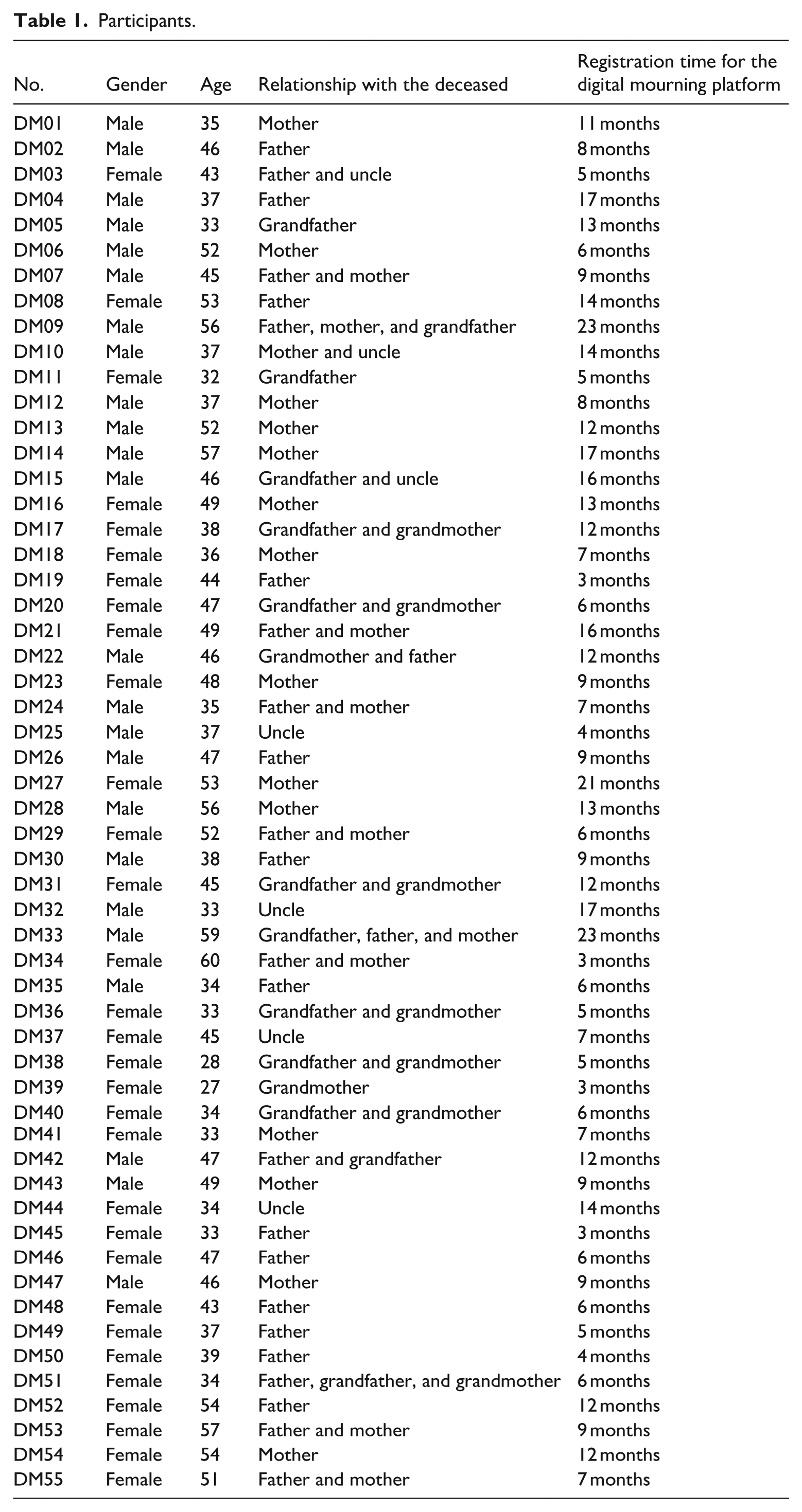
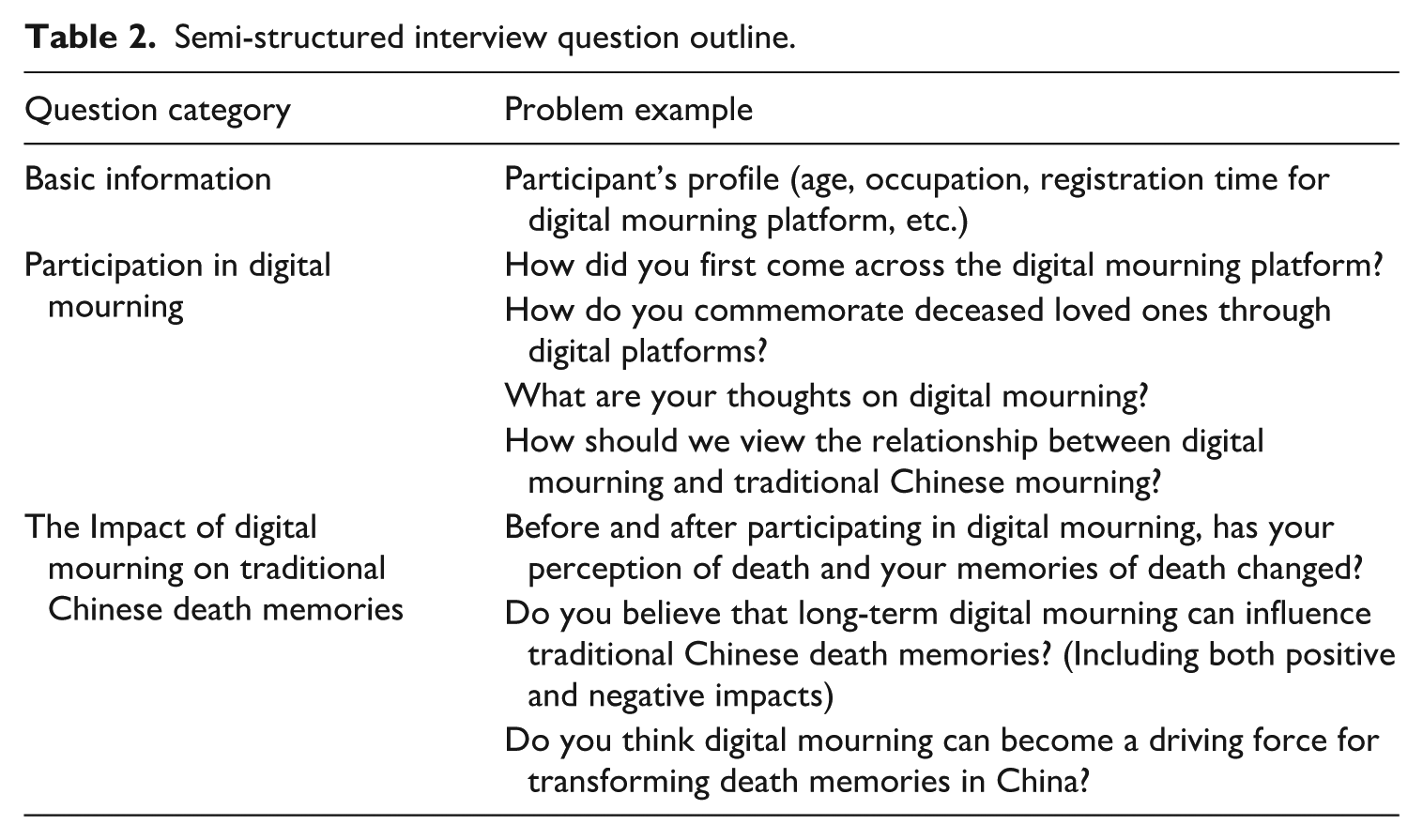
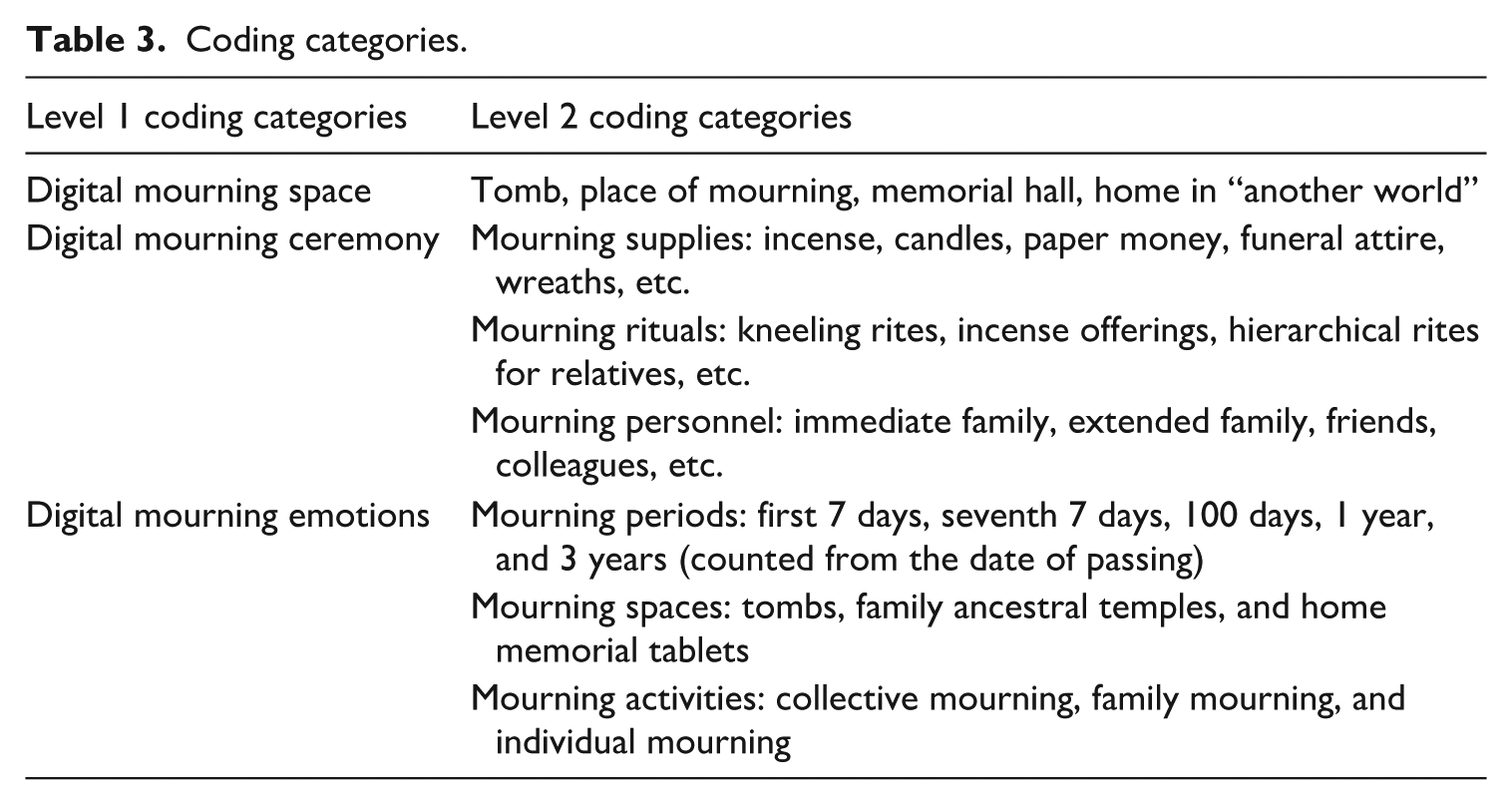
Researchers recruited 55 interviewees, comprising 24 males and 31 females. All participants had engaged in “digital mourning” on the “iCloud Mourning” for over 3 months (see Table 1). The interviews aimed to explore Chinese users’ personal experiences, perceptions, and feelings regarding participation in online digital mourning, with particular focus on how such engagement influences their views on death and death-related memories. The interviews primarily covered three dimensions: participants’ basic personal information, their perceptions of death and death memories, and the effects of engaging in digital mourning activities on these perceptions and memories. Respondents shared their motivations for participating in digital mourning and the personal impacts of this behavior (see Table 2). Approximately 467,500 Chinese characters were collected through in-depth interviews. The collected text was coded and analyzed using NVivo 20 software, with the entire analysis process completed within approximately 2 months (see Table 3).
Participants.
Semi-structured interview question outline.
Coding categories.
Virtual ethnography was conducted on the “iCloud Mourning” platform over an 8-month period (November 2024–June 2025). The research design comprised two interconnected phases of engagement. Initially, the researcher performed platform immersion, registering an account to experientially engage with its operational logic and the digitization of ritual practices. This firsthand engagement facilitated a comparative understanding of the continuities and disjunctures between digital and traditional mourning, forming a foundational comprehension of the platform’s sociotechnical ecosystem. Subsequently, the researcher shifted to a mode of observant participation. This involved systematically browsing publicly accessible digital mourning halls created by users, analyzing the architectural and symbolic construction of digital gravesites, and basic ritual performances. Concurrently, during in-depth interviews, researchers—with participants’ consent—observed participants personally accessing the digital mourning they had registered for deceased loved ones on the “iCloud Mourning.” This allowed direct observation of digital tomb creation and mourning practices, supplemented by context-specific follow-up questions. A total of 12 participants were recruited. All virtual ethnographic research on the “iCloud Mourning” adheres to the guidelines published on the AOIR Ethics page: “Ethics Guidelines for Internet Research 3.0.”
Results
Digital mourning, as a novel form of death mourning, propels the Chinese public toward bodily liberation from the temporal and spatial constraints of traditional death rituals while simultaneously initiating a conceptual reshaping of death memory. This phenomenon encompasses both the “digital inheritance” of traditional Chinese death rituals and commemorative practices, as well as the values aligned with modern civilized memorialization. Within the public’s engagement with digital mourning, these two cultural strands are not merely juxtaposed but exist in a state of productive ambiguity and negotiated detachment, reflecting an ongoing process of cultural adaptation.
Creating “digital tombs”: The spatial production of digital mourning extends and reshapes traditional Chinese death memories
Traditional Chinese death mourning, understood as a socially constructed process (Brussel and Carpentier, 2012), is characterized by stringent spatial orders and institutionalized rituals. The tomb, as its core locus, must conform to geomancy (Feng Shui) principles such as “harbouring wind and gathering energy” and remain ontologically tied to commemorative practice. This binds memory to specific, material lieux de mémoire (Alavez and Caquard, 2023), forming a fixed spatial foundation for collective remembrance. Consequently, the act of visiting the gravesite of the deceased to pay respects has emerged as the physical medium of traditional Chinese mourning practices, constituting the fundamental means for the Chinese public to express their remembrance of the departed. However, rapid urbanization since the 1980s has precipitated a spatial rupture. As millions migrated to concrete metropolises, the foundational link—where the living commune with the deceased at physical tombs—was severed. While migration spatially dislocated traditional commemoration, the enduring cultural schema of “viewing life through death” (He, 2024) ensured that the imperative to remember not only persisted but also was often intensified, fuelling a search for alternative commemorative forms. Research suggests that the rapid popularity of “iCloud Mourning” among the Chinese public stems primarily from their ability to digitally bridge the temporal and spatial barriers that prevent people from visiting gravesites to pay respects. This digital approach has been shown to resolve the conflict with fast-paced urban lifestyles, thereby eliminating the constraints of traditional Chinese mourning practices, which are rooted in fixed physical spaces. Consequently, the constraints imposed by physical locations have been rendered obsolete in terms of hindering the living from mourning the deceased.
Research indicates that digital tombs, as the principal spatial vessels for death memory on these platforms, constitute a co-constructed artifact shaped by shared recognition between platform architectures and user agency. Within the “iCloud Mourning” platform, the process begins with users creating “digital tombs” for the deceased. While this digital construction dispenses with traditional geospatial logics (e.g. feng shui and auspicious timing), it introduces a new protocol for personalization. The platform’s design offers a menu of symbolic choices, allowing users to curate a contextualized mourning space. This includes selecting a tomb background informed by personal preference or the deceased’s cosmological elements (e.g. Metal, Wood, Water, Fire, and Earth—Five Elements), inscribing a biographical epitaph on the virtual tombstone, and choosing tomb specifications and virtual offerings—options that are often tiered and commodified, reflecting both relational intimacy and economic transaction (see Figure 1).

Digital tomb created by the user for the deceased on the “iCloud Mourning” (Yunshang Sinian).
Although rationally speaking, the living’s mourning for the departed is not directly tied to the scale of tombs or the variety of ritual offerings, the hierarchical culture of death formed under Confucian influence in feudal China has subtly conditioned Chinese people to accept material and monetary constructs as the space of the deceased, viewing them as an extension of the departed’s earthly power. Thus, even as mourning practices migrate from physical spaces to cyberspace, this traditional disciplinary framework of death memory remains fundamentally unchanged. Tradition has not vanished; it has merely undergone a digital transformation in its modes of expression (Sapalo, 2024): It’s been a long time since I returned to my hometown to tend to my deceased parents’ graves. Even when they were alive, I rarely visited them due to work commitments and didn’t show them enough care. Now, on the “iCloud Mournin,” platform, I’ve “buil,” a digital tomb for them using only the finest materials. This is my way of making amends . . . (Content cut from DM07 interview transcript)
Research reveals that among all users participating in digital mourning, some are extremely wealthy while others barely make ends meet. Yet when it comes to building “digital tombs” for the deceased, none consider spending money “unnecessary.” In this dialogue between life and death, the “digital tombs” constructed with money represent not only the living’s remembrance of the departed but also a form of self-comfort for the bereaved. Rather than being a form of compensation from the living to the deceased, it is more accurately a form of compensation from the living to themselves. After all, in the living’s mourning of the dead, only money can make their thoughts and emotions tangible. Beyond that, the living can do nothing and are powerless to do anything else.
The “digital tomb” operates through a dual logic of transposition and transcendence. It mediates and extends traditional tomb-building logics into cyberspace while simultaneously emancipating mourning practices from the constraints of physical geography. This shift enables a participatory reconstitution of commemorative space.
First, the advent of digital technologies has enabled the Chinese populace to construct and engage in spaces for the commemoration of the deceased in an autonomous manner. In the context of digital platforms such as “iCloud Mourning,” users have the capacity to establish mourning halls for departed loved ones, thereby creating permanent digital commemorative spaces. The occurrence and conclusion of mourning activities may transpire at any temporal juncture, unencumbered by the ideological and spiritual constraints imposed by traditional cultural and social norms that govern death rituals. This “virtual presence” approach has the potential to compress time and space, thereby disrupting the conventional reliance on simultaneous, co-located mourning. It has been demonstrated that this reconfigures the temporal and spatial constraints that are inherent in China’s traditional death rituals, thereby effectively alleviating the limitations imposed by physical distance and travel conflicts in modern urban life. This innovation achieves a balance between the cross-regional, fast-paced lifestyles of urban populations navigating modernization and the practical need to honor departed loved ones.
Second, the architecture of these digital spaces facilitates a scalable sociality of remembrance. While serving as a site for individual reflection, they are designed to be shared—via invitations or requests—with kin and friends, thereby reinforcing and digitally mapping the deceased’s intimate social network. Digital mourning provides accessible tools for emotional expression, including virtual flowers and condolence messages, thereby enabling fragmented, real-time participation. This is a particularly salient issue for those unable to attend in person due to time constraints and serves to alleviate any feelings of guilt that may be experienced by these individuals. The concept of dispersed relatives and friends forming a digital mourning community has been posited as a means of perpetuating the continuity of death memories.
This transformation of online spaces into enduring repositories for commemorating the deceased while preserving familial and social bonds is a significant development. This dual liberation—from fixed geography to fluid digitality and from prescribed ritual to personalized practice—constitutes a significant cultural recalibration for a public long accustomed to hierarchical mourning structures. By centering autonomous participation, digital mourning advances the modernization of ritual practice. Moreover, it subtly sustains emotional continuity and collective memory through digitally mediated ceremoniality (Giaxoglou et al., 2017; Harju, 2014): I remember how complicated it was to visit family graves when I was young. Not only did we have to walk a long way to the cemetery, but we also had to check the auspicious time before setting out and perform ancestral rites. And because I was a girl, they wouldn’t let me go alone—I had to accompany an elder . . . Nowadays, I rarely have time to visit either. So I created a digital tomb based on my memories of the ancestral graves. Whenever I miss my family, I can pay my respects anytime—it fulfills a small wish of mine. Mainly, it’s incredibly convenient, free from all those cumbersome formalities. (Content cut from DM17 interview transcript)
The digital tomb, as a space for mourning the dead, decentralizes the authority of death commemoration from society and clan to the individual, transforming it into a wholly personal activity. However, the seamless transition between mourning spaces and non-mourning spaces dissolves the spatial order established by death-mourning rituals, further blurring the boundary between these rituals and everyday life. These ever-accessible mourning spaces allow the living to spontaneously express grief toward the deceased, and as engagement deepens, they become increasingly difficult to disengage from. Over the long term, such digital platforms not only fail to alleviate the living’s longing for the departed but also intensify it, trapping the bereaved in an overreliance on the death-mourning spaces constructed by digital tombs: When my mother first passed away, I missed her terribly. But after returning to the city for work, we grew distant. A friend told me about this digital mourning platform, so I created a digital mourning there. That way, I could see her every day . . . At first, it really helped. But gradually, I found myself opening it habitually whenever I had free time—I couldn’t control myself. My family has reminded me several times that this isn’t healthy, that it’s already affecting my daily life . . . (Content cut from DM23 interview transcript)
As the core medium for digital mourning, the “digital tomb” not only inherits the spatial attributes of traditional death rituals and death memory production but also disrupts and reshapes the traditional cultural and ethical order of death mourning through digitalization, driving the digital transformation of death memory. Notably, while these digital mourning spaces encourage autonomous participation and blur the boundaries between mourning and daily life, the resulting issues of arbitrary and disorderly commemorative activities are gradually eroding the social value of mourning rituals in preserving collective memory, spiritual continuity, and intergenerational belonging (Mariyono et al., 2025). The spatial migration generated by digital mourning merely represents a formal reshaping of traditional Chinese death rituals. To profoundly transform the deeply ingrained death memory of the Chinese people, it is necessary to establish a death-mourning order that aligns with the logic of digital space production.
Quantifying “mourning rituals”: The transplantation and dissolution of symbols from digital mourning spaces in traditional Chinese death memories
Traditional Chinese society placed great emphasis on death. The interplay of Confucian, Taoist, and Buddhist philosophies gave rise to a comprehensive system of meticulously structured, complex death-mourning rituals (Hsu et al., 2009). This evolved into a symbolic system comprising mourning paraphernalia (incense, candles, funeral paper money, mourning attire, wreaths, etc.), mourning rituals (kneeling rites, incense offerings, and kinship-based protocols), and mourning participants (organizers and attendees). These symbols are deeply intertwined with death rituals and are regarded as the primary means of guiding the deceased safely to the afterlife (Braun and Nichols, 1997). Consequently, any form of mourning that transcends these rituals is viewed as abnormal or pathological (Howarth, 2000). This has made traditional Chinese death-mourning rituals not only the overarching framework for all mourning activities but also the symbolic logic governing the formation of public death memory in China. Research indicates that digital mourning platforms like “iCloud Mourning” gain popularity among the Chinese public primarily because they digitally transplant traditional death rituals. This facilitates the integration of digital mourning practices into—rather than replacing—traditional death culture (Bovero et al., 2020). By integrating the ritualistic and participatory nature of death commemoration with users’ personal mourning for the deceased, these platforms empower participants to engage in spatial production through traditional Chinese death commemoration symbols: Actually, for us Chinese, the best way to mourn our departed loved ones is to burn incense, kowtow, offer funeral money, and place offerings at their graves . . . But now the government promotes civilized mourning practices and discourages these traditional methods. Yet I can’t help but wonder if without these rituals, they (referring to the narrator’s deceased loved ones) might not feel our remembrance. So I explored various alternatives and ultimately found the “iCloud Mourning” platform quite effective. It offers many of the customary mourning rituals we’re accustomed to, maintaining a strong sense of solemnity that allows me to feel I’m truly honoring my family . . . (Content cut from DM09 interview transcript)
The “Digital Mourning” platform has systematically “digitally transplanted” traditional Chinese funeral rituals. It not only meets the Chinese public’s practical need to convey their grief to the deceased through mourning rituals shaped by traditional memories of death—as well as the practice and expression of filial piety, one of the most important tenets of Chinese culture—but also resymbolizes these rituals through their digital presentation. This resymbolization manifests in two parallel and interrelated dimensions: the simplification of rituals and the commodification of rituals.
First, the simplification of rituals. In traditional funeral rites, rituals requiring physical participation—such as kowtowing and preliminary preparations—have been reduced to a brief touch of the fingertips on a screen: a single click or command is all it takes to complete a mourning ritual that once demanded significant time and physical effort. The complex procedures of traditional mourning, which required the collaboration and coordination of many people, have also evolved into a series of algorithmic commands: precise and efficient, yet calm and cold. While this simplification lowers the barrier to participation in mourning, it also replaces the sense of ritual associated with physical presence with the immediacy of interface interaction.
Second, the commodification of ritual symbols. This is the core operational mechanism of the commercial logic behind personal digital mourning platforms. To meet operational and profit needs, mourning items that once required only minimal financial investment—such as joss paper, incense, candles, and offerings—are now displayed with clear price tags in “digital stores,” where users can purchase them using virtual currency. An even more profound shift lies in the mourning rituals themselves—from bowing to kowtowing, from the number of bows or kowtows to the number of mourners, and even virtual attire—all of which are sold as commodities (see Figure 2). The ritual movements that traditionally required physical participation in death mourning can now be completed simply by purchase; the corresponding physical actions have been transformed into standardized animations on electronic screens: standardized, mechanical, and solemn, yet increasingly distant from the genuine emotional investment of the living.
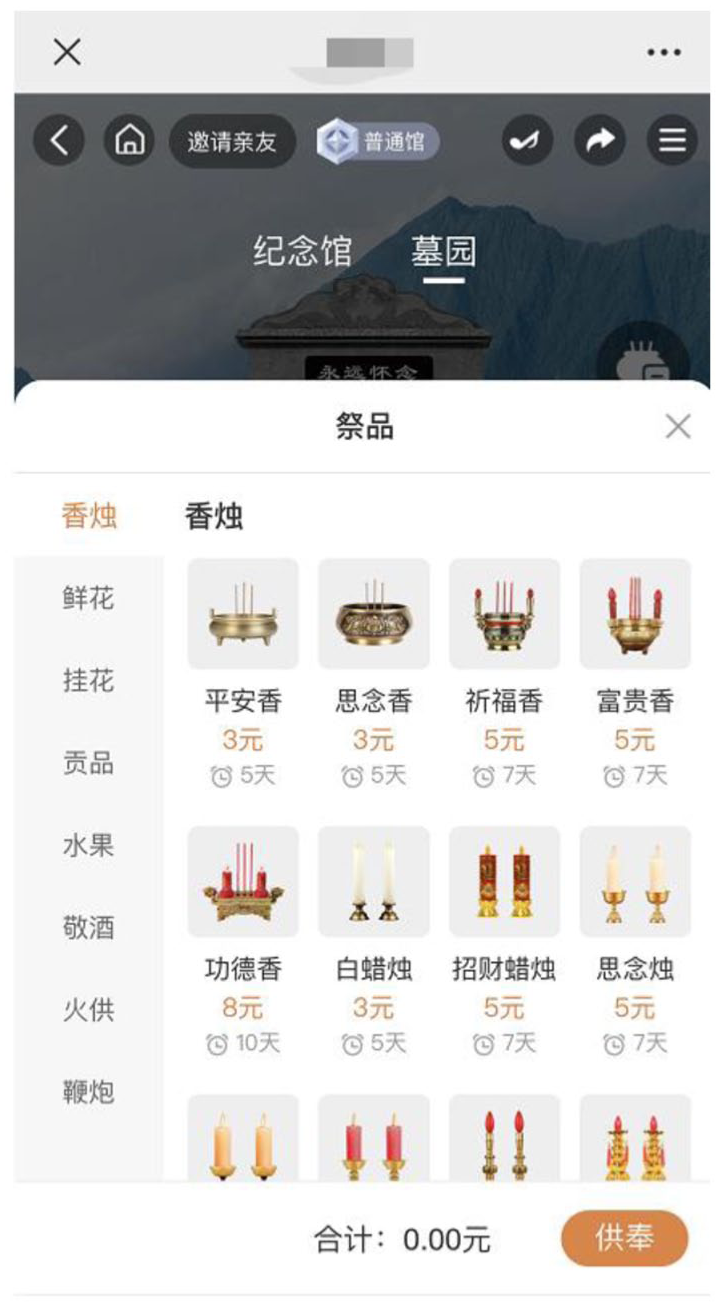
Items required for mourning ceremonies are displayed on the “iCloud Mourning” (Yunshang Sinian) (each clearly priced).
This commodification mechanism is not an accidental “side effect” of platform operations, but rather a structural prerequisite for the survival of private digital mourning platforms. Platform companies have restructured mourning—an emotional practice that was originally highly private and non-transactional—into a user engagement activity with sustained consumption potential. Through avenues such as the purchase of virtual offerings, membership subscriptions, and value-added services, the gift economy of traditional mourning—where “emotions are conveyed through objects to honor loved ones”—is transformed into a transactional logic of “payment in exchange for mourning services.” In this process, mourners complete the ritual through consumption rather than through physical participation and emotional labor to maintain a symbolic connection with the deceased: At first, I thought this method (digital mourning) was quite good. But later, I felt like on one side, the “me” on the screen was kowtowing and burning incense at my parents’ digital tomb, while on the other side, I was lying in bed staring blankly at my phone. It felt like I had participated in all the mourning activities, yet at the same time, it felt like I hadn’t . . . (Content cut from DM21 interview transcript) At the beginning, even knowing it was virtual, I sat up straight and proper. But as the frequency increased, with distractions from the kids or household chores at home, sometimes after hurriedly paying for the service, I’d set my phone aside to attend to other matters. When I returned to check the phone much later, I’d find the mourning ceremony had already ended. (Content cut from DM12 interview transcript)
The systematic “digital transplantation” of traditional Chinese mourning rituals onto private digital mourning platforms has undoubtedly driven the modernization of mourning practices—it allows family members scattered across the globe to continue their mourning across time and space and, to some extent, adapts to the pace of life in the digital age. However, the dual processes of ritual simplification and commodification have also given rise to cultural consequences that warrant caution. On the one hand, while simplification lowers the technical barriers to mourning, it also erodes the emotional depth rooted in embodied rituals—a single click cannot replace the solemnity of a bow, and standardized animations struggle to convey individualized grief. On the other hand, commodification deeply ties mourning activities to the logic of capital. This not only erodes the ideological foundation upon which death-related mourning traditionally relies—namely, filial piety as an unconditional emotional obligation—but also gradually dismantles the social ethics and mechanisms of identification surrounding death-related mourning. When acts of mourning can be clearly priced and purchased on demand, the cultural sanctity and emotional uniqueness inherent in death itself face the risk of being diluted.
Consequently, digital mourning can create new spaces for the production of digital symbols in the context of death and mourning, driving a transformation in mourning practices while also subtly influencing the Chinese public’s memories of death on the levels of thought and cognition. However, this influence is not a one-dimensional “reshaping” but rather a process fraught with tension: while offering convenience and accessibility, it also structurally erodes the cultural core of traditional mourning through simplification and commodification. The resulting derivative issues—such as social and cultural identity, cultural beliefs, and moral norms—urgently require systematic reflection and a prudent response at the societal level.
Manifesting “mourning sentiments”: How digital mourning spaces inscribe and alienate traditional Chinese death memories
Traditional Chinese mourning rituals constitute a form of social and cultural labor and disciplined emotional labor. Within the “dialogue” scenarios they construct between the living and the deceased, the mourners’ emotions are directed both toward the departed and toward the living, with the latter occupying a more significant role (Yick and Gupta, 2002). Therefore, the mourners’ emotions must seek balance between catharsis and restraint. This manifests in strict constraints on the timing (traditional Chinese mourning divides the period of mourning into 7 cycles of 7 days each, with the final day of each cycle designated as a mourning day, during which vocal crying is encouraged), space (vocal crying is discouraged outside the deceased’s tomb), and collective versus individual expression (within the prescribed time and space of mourning rituals, the expression of grief is collective, requiring shared emotional connection with relatives).
Thus, within the mourning spaces constructed by traditional Chinese society, grief is often constrained by social institutions and rituals, with its duration, intensity, and scope all procedurally defined. However, while the mourning space constructed through time, space, and order can externally constrain the expression of grief, it cannot sever the emotional foundation of the living’s remembrance for the deceased, leaving them in an emotional predicament of ambiguous loss (Boss, 2016). Against this backdrop, commemorating and honoring the deceased through digital mourning platforms provided by social media has become a cultural practice for regulating death and the deceased, repositioning emotional experiences within mourning activities (Hutchings, 2012).
This study argues that the “iCloud Mourning” platform functions as a digital mourning space that reconstitutes ritual practices and mediates affective flows. The platform facilitates mediated affective practices through a dual process. First, it dismantles the spatiotemporal and socio-normative constraints inherent to traditional death rituals, enabling unrestrained and public expressions of grief. This constitutes a form of ritualized emotional disclosure. Second, it materializes and archives these affective expressions as digital traces—texts, emojis, images, and visit logs—thereby transforming private emotion into a persistent, visible record. These traces are not solely personal; their visibility to a networked audience of relatives and friends within the platform creates a shared, co-witnessed digital afterlife for the deceased (see Figure 3). Consequently, the platform operates simultaneously as an infrastructure for emotional catharsis and as a collaborative site for the ongoing (re)construction of familial memory and identity (Thimm and Nehls, 2017): After creating a digital mourning account for my father, I invited all my relatives to join. Everyone can participate in the mourning together or pay their respects at their own convenience. Each visit leaves a record on the platform that we can all see. People leave messages, send virtual flowers, and share memories here. Every time I see these tributes, my eyes well up . . . (Content cut from DM19 interview transcript)

A personal mourning hall on the “iCloud Mourning” (Yunshang Sinian) (mourning records and friends and family invitation functions are clearly displayed).
This analysis further contends that data-driven mourning platforms produce a paradox of visibility: while digitally visualizing affect, they simultaneously obscure the lived emotional continuum between the bereaved and the deceased. For users, this constructs a Goffmanian dramaturgy of grief. The digitally curated “I” on-screen occupies the frontstage, performing as the visible avatar of sanctioned mourning sentiments. In contrast, the offline “I” recedes into the backstage, rendered invisible as the subjective site of raw, unstructured emotion. Consequently, the platform’s logic prioritizes the performance of sincere remembrance—achievable through interface interactions—over the internal, subjective state of the mourner. This reduces digital mourning to a datafied performance, where affective legitimacy is derived from platform engagement metrics rather than private feeling.
Thus, rather than facilitating a transformative engagement with China’s traditional mourning paradigms, such platforms risk accelerating their digital alienation. The intervention of the platform does not fundamentally reckon with traditional cosmologies of death and memory but transposes them into datafied “tombs.” Here, memory is not worked through but archived and placated through ritualized digital gestures. In this process, as Walter might suggest, all participants become unwitting pallbearers in the digital transformation of social memory, hearing its bells toll within the platform’s architecture (Walter, 2014).
Discussion
Traditional Chinese death mourning and the resulting memory practices are deeply embedded within the historical trajectory of Chinese civilization, constituting a persistent cultural script that shapes both material and spiritual life. While extant research has noted the participation of the Chinese public in collective mourning for public figures through digital means (Hu and Jiang, 2025), the concept of digital mourning as an activist empowerment tool—as evidenced by public and collective mourning activities (Proust, 2024)—cannot be applied to the Chinese public’s personal bereavement. This distinction between mourning strangers and mourning loved ones remains fundamentally different. It is evident that traditional Chinese death-mourning practices centered on personal and familial grief, along with the resulting death memories they cultivate, continue to dominate digital mourning activities (Christensen et al., 2017; Giaxoglou, 2015).
The “iCloud Mourning” has been developed to meet the Chinese demand for individualized, private ways of commemorating their departed loved ones. Furthermore, it has the capacity to modify the form of death commemoration through the process of transplantation over a brief period. Nevertheless, the transformation of the logic of death memory formation among the Chinese at the spiritual and ideological level is not a process that can be achieved in a short period of time. The evolution of death-mourning practices represents the first step in transforming traditional Chinese death rituals and death memory. For a more profound and sustainable integration—where digital mourning is not merely used but meaningfully embraced—its operational and symbolic framework must achieve a form of cultural reembedding. This entails ensuring substantive continuity with the core values of traditional Chinese death rituals, thereby fostering voluntary and affectively resonant public participation. Furthermore, the discourse of “civilized mourning” propagated by digital platforms can be understood as an emerging sociotechnical imaginary, reflecting an awakening of reflexive societal consciousness regarding mortality in the digital age.
Critically, to counteract the fragmenting and commodifying pressures exerted by platform capitalism, there is a compelling argument for reconceptualizing digital mourning spaces as essential public digital infrastructure. Such a policy-oriented move would aim to safeguard collective memory from excessive commercial erosion. Concurrently, the integration of systematic thanatology (death studies) into formal education curricula (Chen et al., 2024; Wu and Tang, 2008) is paramount. This would cultivate a foundational societal literacy about death, establishing the cognitive and emotional groundwork necessary for any authentic, society-level transformation of mourning practices.
Digital mourning, as a novel form of remembrance, is entering the public consciousness in China and gradually gaining acceptance. This holds positive guiding value for advancing the transformation of traditional Chinese death-mourning paradigms and reshaping death memory. The Chinese public’s motivation for engaging in digital mourning, therefore, may not necessarily drive the future digital transformation of traditional death rituals; rather, it stems largely from curiosity about digital technology. However, it is precisely this unconscious participation that enables the public to actively embrace civilized mourning practices and scientific mourning in their actions, thereby fostering ideological shifts through practical engagement. While its positive value requires time to be fully validated, it is evident that the existence of this model is a significant factor in the transformation of China’s death memory. The traditional Chinese concepts of death, mourning, and the subsequent death memory are deeply rooted in historical and cultural contexts, influenced by the intricate interplay of political, economic, and cultural factors (Cheung and Ho, 2004; Lou and Liu, 2020). These cultural influences are further compounded by regional customs, urban-rural disparities, ethnicity, and educational attainment. Consequently, it is challenging for media technology alone to effect a comprehensive transformation, which also represents a limitation of this study’s perspective. The modernization of traditional death mourning is a societal endeavor that requires not only public initiative but also the concerted efforts of governments, media, social organizations, and other stakeholders, alongside the investment of time.
Mourning is not merely about commemorating the deceased; it also embodies the living’s profound reverence for life itself. The fundamental nature of bereavement is not to be found in a fixation on the past, but rather in an aspiration toward a more positive future. As media technology continues to evolve, this new form of digital mourning will gradually gain wider acceptance. It is hoped that the present study will shed light on the tension between technology and culture in the modernization of China’s traditional death rituals, as highlighted by digital mourning. It is also hoped that, in the face of the relentless advance of digitalization, greater emphasis will be placed on humanistic care and cultural preservation. This approach would facilitate the transition of China’s traditional death rituals toward a more civilized form while ensuring the preservation of cultural continuity. This study, constrained to the digital perspective, unveils the transformation process of digital mourning; however, it does not delve into the underlying causes. Building upon this research, subsequent studies should explore the relationship between digital mourning and traditional Chinese death memory by examining the social foundations of traditional death-mourning practices and death memory formation. This research holds significant practical implications for China—a deeply aging society with profound roots in traditional cultural thought—in advancing civilized mourning practices and modernizing funeral reforms.
Conclusion
As digital media permeates human daily life and China’s urbanization accelerates, the physical spaces sustaining traditional Chinese death rituals are gradually being squeezed out, further yielding to virtual spaces (Hamid et al., 2019). Digital mourning, as a new platform for commemorating the deceased, is rapidly entering the public consciousness in China and gaining wider acceptance. In the near future, “mourning in the iCloud” will not only reflect the digital transformation of traditional Chinese death rituals but also embody the underlying logic of digitally extending and reshaping the memory of the departed.
This study posits that digital mourning platforms, such as “iCloud Mourning,” facilitate a platformization of ritual by digitally transposing traditional Chinese death rituals into “digital tombs.” This process operates through three interconnected affordances: the quantification of rituals enables autonomous, participatory ceremonies; the visibilization of grief constructs a communicative bridge between the living, the deceased, and the bereaved community; and the spatialization of practice creates dedicated digital mourning spheres. These affordances mutually reinforce one another, accelerating the migration of mourning practices online (Walter, 2014).
However, empirical analysis suggests this migration constitutes a digital shift in practice rather than a paradigmatic transformation in the understanding of death. It engenders three interrelated crises: the blurring of boundaries between mourning and daily life, the commodification of affective labor invested in grief, and the substitution of algorithmically driven operations for embodied, ritual participation. Consequently, rather than profoundly reshaping traditional Chinese death memory, digital mourning platforms challenge and deconstruct its sociocultural and moral-ethical foundations, reconfiguring the conditions for its production and reproduction within a platform logic.
Footnotes
Acknowledgements
There are no other people or organizations to thank for this article other than the author of this article.
Ethical considerations
This research involving human participants strictly adheres to the standards and norms for human subject participation outlined in the Declaration of Helsinki. However, as this study only involves basic information interviews with human subjects and does not address sensitive content such as disability-related biological information, it is exempt from ethical review and approval requirements for human subjects research according to the local laws, regulations, and institutional guidelines applicable to the researchers. (According to Article 32 of the latest version of the “Circular on the Issuance of Measures for the Ethical Review of Life Science and Medical Research Involving Human Beings” issued by my government in 2023;  .).
.).
Consent to participate
In the informed consent form, all participants were informed that they were free to leave the study at any time they wished, and they agreed that their data could be analyzed and published for scientific purposes.
Consent for publication
Informed consent was obtained from all participates involved in the study.
Author contributions
Funding
The authors received no financial support for the research, authorship, and/or publication of this article.
Declaration of conflicting interests
The authors declared no potential conflicts of interest with respect to the research, authorship, and/or publication of this article.
Competing interests
The authors declare that the research was conducted in the absence of any commercial or financial relationships that could be construed as a potential conflict of interest.
Data availability statement
The original contributions presented in the study are included in the article; further inquiries can be directed to the corresponding author.