






Abstract
Social exclusion threatens fundamental needs (i.e. belonging, self-esteem, meaningful existence, and control) and impairs emotional well-being. Previous research on media as a tool to mitigate these detrimental effects has predominantly focused on traditional devices, leaving the role of immersive technologies, such as virtual reality (VR), underexplored. Our preregistered laboratory experiment (N = 114) investigates whether VR-based coping facilitates need restoration and emotion regulation compared to conventional 2D media. After inducing ostracism via Cyberball, participants watched a short video of a social interaction on either a VR headset or a 2D screen. Whereas both coping conditions yielded comparable increases in emotional well-being, VR exposure led to significantly higher need restoration than the same video presented in 2D. Mediation analyses indicated indirect effects of VR exposure on both need restoration and emotion regulation via spatial presence, but not via social presence or self-presence. These findings underscore VR’s potential as an effective coping tool following social exclusion.
As social beings, humans heavily rely on others’ attention and acknowledgment. In turn, even subtle cues such as an averted gaze by passing strangers can be perceived as alarming, signaling potential social exclusion (Wesselmann et al., 2012). These so-called ostracism experiences, defined as being ignored and getting no attention at all (Wesselmann and Williams, 2017), happen quite frequently in individuals’ daily lives (e.g. Büttner et al., 2024). Even brief ostracism episodes are theorized to impair emotional well-being and threaten fundamental needs for belonging, self-esteem, meaningful existence, and control (Williams, 2009). Over time, ostracism can further contribute to severe psychological consequences, such as depression (Rudert et al., 2021) or suicidal thoughts (Chen et al., 2020). Thus, identifying coping tools and strategies (Wolfers and Schneider, 2021) mitigating these detrimental effects is of crucial importance.
A recent systematic review indicates that media represent a valuable resource for coping with social exclusion, while also pointing out that empirical evidence is largely limited to “traditional” devices (e.g. computers or television; Lutz et al., 2023). Thus, the authors explicitly suggested studying the potential of more recent technological developments, such as virtual reality (VR) applications, to overcome episodes of social exclusion. Arguably, this recommendation aligns with recent findings indicating that immersive technologies may evoke stronger psychological effects than conventional 2D media (e.g. Beyea et al., 2022; Kuhne et al., 2023). Furthermore, research has demonstrated VR’s high utility for coping with related challenging experiences, such as stress (Meshkat et al., 2024), pain (Gutiérrez-Maldonado et al., 2012), and negative thoughts (Prudenzi et al., 2019). Most importantly, however, we note that specific technical and perceptual affordances of VR-facilitated environments (Hartmann and Fox, 2021), such as their high immersion and their ability to foster embodied experiences, hold great promise as an effective coping tool for socially excluded individuals.
Although consumer-grade VR technology has only become widely available in recent years, it is already used by notable percentages of the population—in this study country, for example, recent surveys estimate that one in five people is at least somewhat familiar with VR (Bitkom Research, 2023). Even more so, as VR technology continues to become more affordable, its adoption is expected to grow substantially in the coming years (ARtillery Intelligence, 2023). Still, in the specific context of social exclusion, VR technology has mainly been studied as a source of exclusion, for instance, when investigating the effects of ostracism episodes during virtually simulated interactions (e.g. Kothgassner et al., 2021; Prendergast and Schubert, 2020). A rare exception that explicitly tested VR’s effects in coping with ostracism episodes is the work by Stallmann et al. (2023), which reported a significant improvement in users’ emotional state after receiving support from a virtual agent. Yet, as potential shortcomings, this study did not measure coping effectiveness in terms of those fundamental needs typically threatened by social exclusion (Williams, 2009), nor did it draw comparisons with a non-VR-based coping condition or examine psychological processes potentially underlying the observed effects. Furthermore, the study conceptualized VR simultaneously as a source of exclusion and a tool for coping with this experience; however, being ostracized in virtual environments significantly decreases individuals’ intention to further engage with the virtual world (Kim et al., 2024), suggesting the need for a different research design. Advancing the scholarly understanding of social exclusion coping, we therefore address the following overarching question: To what extent do VR applications help socially excluded individuals—mediated via the experiences of social presence, spatial presence, and self-presence—to improve their emotional well-being and restore their threatened needs? In particular, we adopted a comparative perspective, juxtaposing the effectiveness of VR coping with that of more conventional, 2D-based means of overcoming the negative effects of ostracism.
Theoretical background
Detrimental consequences of ostracism episodes
The psychological effects of social exclusion can be examined through various frameworks, with the Temporal Need-Threat Model arguably being the most prominent (Williams, 2009). In its so-called reflexive stage, the model postulates that ostracism threatens four fundamental needs: (1) the need to form a minimum quantity of temporally stable relationships (i.e. belonging; Baumeister and Leary, 1995), (2) the need to maintain a favorable self-evaluation (i.e. self-esteem; Rosenberg, 1965), (3) the need to feel worthy of attention (i.e. meaningful existence; Greenberg et al., 1986), and (4) the need to exert control over one’s social environment (i.e. control; Burger, 1992). Furthermore, ostracism episodes are postulated to reduce positive (e.g. happy) and increase negative (e.g. sad) affective states, representing the emotional component of an individual’s subjective well-being (Diener et al., 1999). Over the past years, these detrimental consequences have been demonstrated for a variety of exclusion episodes, such as not receiving immediate answers when chatting with friends (e.g. Lutz, 2023) or being excluded from offline activities such as workplace discussions (e.g. Büttner et al., 2024). The most extensively studied experience is being ignored during a virtual ball-tossing game, the so-called Cyberball paradigm (Williams and Jarvis, 2006), in which participants believe they are interacting with two other players who are, in fact, computer-controlled agents passing the ball only to each other. Psychologically, this experience affects all four needs described in the Temporal Need-Threat Model. First, it prevents participants from forming positive social connections with the other “players” (i.e. threatened belonging), and it may lead them to question whether the others think poorly of them, hindering favorable self-evaluations (i.e. threatened self-esteem). The experienced lack of attention further makes participants feel that their presence in the game does not matter (i.e. threatened meaningful existence). Finally, having no influence over who receives the ball leaves them in a passive, powerless position (i.e. threatened control). Indeed, meta-analytical evidence from 120 experiments (Hartgerink et al., 2015) indicated a large effect of this paradigm on threatened needs as specified in the Temporal Need-Threat Model.
Coping with ostracism episodes
Given the detrimental consequences outlined above, socially excluded individuals’ coping efforts typically revolve around two overarching goals: reestablishing optimal levels of those needs being most saliently threatened (i.e. need restoration; Williams, 2009) and decreasing the negative emotional state evoked by the ostracism episode (i.e. emotion regulation; Riva, 2016). Previous research has identified a range of strategies to achieve both goals, which can be broadly situated on an approach–avoidance continuum (Riva, 2016).
Typical approach-oriented responses aim to enhance individuals’ inclusion status by turning toward the source of exclusion or alternative sources of reconnection. This tendency manifests, among others, in an increased desire to talk to others in person (Büttner et al., 2024) or a heightened sensitivity to social cues in general (Gardner et al., 2005). In contrast, avoidance-oriented responses are directed away from the source of exclusion or social interactions in general (Riva, 2016). Typical examples are avoidance behaviors such as seeking solitude, which can serve as a self-protective mechanism to minimize the risk of future exclusion experiences (Ren et al., 2016; Ren et al., 2021).
Intriguingly, both coping approaches can also be facilitated by the use of media, such as reading books or watching television—a perspective that has also been addressed under the framework of the so-called parasocial compensation hypothesis (see Hartmann, 2016; Lutz et al., 2024; Stein et al., 2024). In a crucial delimitation, however, research has highlighted that the same media-based activity might offer both approach and avoidance opportunities (Gabriel and Valenti, 2017; van Ingen and Wright, 2016). For example, reading a book about a group of friends in a faraway world might offer both a form of distraction (due to its fantasy setting) and foster a renewed sense of belonging (through the narrated social experiences). Yet, irrespective of these potentially interwoven motivational mechanisms, it is now a common understanding that engaging with entertainment media can be a highly beneficial and easily accessible way of coping with social exclusion experiences (for an overview, see Lutz et al., 2023). At the same time, there is now growing interest in whether this fundamental merit also extends to more novel, immersive media formats and technologies, not least involving the realm of virtual reality.
Using VR applications as a coping tool
As outlined in the introduction, previous research on VR-based coping has focused on specific negative experiences such as stress (Villani et al., 2006), pain (Gutiérrez-Maldonado et al., 2012), or destructive thinking patterns (Prudenzi et al., 2019). Notably, social exclusion episodes are frequently associated with these outcomes as well: they increase individuals’ cortisol levels (Blackhart et al., 2007), activate the same brain area as physical pain (Eisenberger et al., 2003), and lead to negative or even suicidal thoughts (Chen et al., 2020). Given these similarities, VR applications may also serve as a powerful coping tool for individuals experiencing social exclusion. However, to our knowledge, only one prior study has empirically addressed this assumption (Stallmann et al., 2023). Although this study provided meaningful evidence, it should be pointed out that this previous work only focused on emotion regulation as the key outcome, sidelining more complex need threats as specified by the Temporal Need-Threat Model (Williams, 2009). Accordingly, our first goal was to determine whether VR as a medium can generally facilitate coping after ostracism, in terms of both emotional regulation and the restoration of threatened needs. As such, the present study serves to situate the overall effectiveness of VR-based coping within a theoretically grounded investigation of complementary outcomes and, vice versa, to introduce one of the most well-established social exclusion frameworks into the VR literature. Offering a crucial starting point for deriving our main hypothesis, previous studies have demonstrated that using VR is positively associated with satisfying the very needs typically threatened by ostracism episodes (e.g. self-esteem; Koek and Chen, 2024). In fact, this became particularly evident for VR content offering specific social cues (e.g. eye contact), which are well-known to satisfy fundamental needs as well (e.g. Wirth et al., 2010). Thus, extending previous research on VR-based coping by addressing both relevant coping goals—emotional regulation (see Stallmann et al., 2023) and need restoration—we hypothesize the following:
As Hypothesis 1 refers to changes over time, it involves comparing pre- and post-coping levels of individuals’ well-being and needs. However, as the detrimental effects of ostracism episodes slightly decrease over time (Buelow et al., 2015), any observable differences might also be attributed to fade-out effects. Thus, directly comparing VR-based coping with strategies that do not involve a VR headset is necessary to draw conclusions about the technology’s inherent coping effectiveness. Building on previous research on television viewing for ostracism coping (e.g. Derrick et al., 2009), we focused on “traditional” 2D videos as a comparison condition. This approach enabled us to determine whether coping effectiveness can be specifically attributed to the VR experience rather than merely watching a video of a social situation.
Importantly, when comparing VR and 2D videos, the distinction between the two formats is not limited to the technical display itself, but also concerns the degree of immersion they afford (Hartmann and Fox, 2021). Conventional 2D videos typically constrain perception to a fixed frame presented on a screen, whereas immersive VR videos are designed to create a more encompassing perceptual experience by providing a broader field of view and enabling viewpoint changes through head movements. Accordingly, VR-based and screen-based videos differ in how strongly they position users as external viewers of a scene or perceptually situate them within it. Importantly, the immersive qualities of a medium and the psychological experience it elicits should not be conflated (Slater, 2009; Slater and Wilbur, 1997). Whereas the term immersion encompasses system-level affordances of a medium (e.g. stereoscopic display, broader field of view, head-tracked viewpoint changes; Slater and Wilbur, 1997; Steuer, 1992), the concept of presence is typically employed to describe the users’ subjective experience that may emerge from these affordances—a psychological state in which “the individual’s perception fails to accurately acknowledge the role of the technology in the experience” (Lee, 2004: 32). As such, the presence construct provides a particularly suitable process-level framework for this study, as it helps explain how presentation formats at different levels of immersion may translate into psychologically relevant coping experiences.
Over the last few years, scholars have developed divergent and overlapping definitions of presence (see Felton and Jackson, 2022). What many of them share, however, is their systematization of the concept into distinct dimensions: (1) spatial presence describes a sense of being there, or physical self-location within the virtual environment (Wirth et al., 2007); (2) social presence refers to the feeling of being together with others in the virtual environment and recognizing them as possible interaction partners (Biocca et al., 2003); and (3) self-presence involves the experience of a virtual body as one’s own (Forster et al., 2022)—a construct closely related to the concept of embodiment.
Crucially, each of these dimensions could offer distinct opportunities for need restoration and emotion regulation following ostracism episodes. Concerning spatial presence, Wirth et al. (2007) suggested that “mental capacities are bound by the mediated environment instead of reality” (p. 497). More specifically, spatial presence is assumed to arise when users form a coherent mental model of the mediated space and allocate their attentional resources primarily to that environment rather than to the surrounding physical setting. This makes spatial presence particularly relevant for coping with ostracism, as it may temporarily reduce the salience of exclusion-related cues in the immediate real-world context. In line with this idea, Weber et al. (2020) found that spatial presence enhances emotion regulation when coping with stress, which is, as outlined above, also an outcome of ostracism.
Second, social presence conceptually overlaps with approach-oriented responses specified in models of social exclusion coping (Riva, 2016). This is because social presence refers not only to perceiving others in a mediated setting but also to experiencing them as psychologically available and as potential interaction partners (Biocca et al., 2003; Short et al., 1976). In the context of social exclusion, such an experience may be especially relevant because even subtle social cues—such as eye contact, coordinated attention, or socially contingent behavior—can signal acknowledgment and thereby support coping processes. In line with this assumption, social presence has been found to be positively related to a sense of belonging (Gao et al., 2017), while also being negatively associated with feelings of loneliness (Oh et al., 2023).
Finally, self-presence may also be relevant because it concerns the subjective experience of one’s own body and identity within the mediated environment. In coping contexts, such experiences may matter insofar as they allow users to momentarily shift self-focus, adopt an alternative perspective, or experience the mediated role as temporarily self-relevant. One theoretical lens that may help explain such processes is the so-called Proteus effect, that is, the idea that embodiment experiences in VR can have a direct—albeit temporary—impact on a person’s self-perception and identity (see Ratan et al., 2020). At the same time, we acknowledge that this mechanism is likely to depend more strongly than the other presence dimensions on embodiment-related affordances, including body ownership cues, agency, and sensorimotor consistency.
Taken together, all dimensions of presence may contribute to social exclusion coping in different ways and, potentially, to different degrees. Keeping in mind the extensive body of research that has already demonstrated increased levels of social presence (Oh et al., 2018), spatial presence (Breves and Schramm, 2021), and self-presence (Mottelson et al., 2023) for VR applications in direct comparison to 2D or 360° videos, we hypothesized:
Method
Design and research ethics
To test the proposed hypotheses, we conducted a between-subjects laboratory experiment comparing two different coping tools (VR vs 2D video) after an induced ostracism episode (for further details, see below). Participants were assigned to one of the two conditions using a randomization algorithm embedded in the questionnaire. This study’s procedure received ethical approval from the Institutional Review Board of Chemnitz University of Technology, Germany, prior to data collection (Approval no. #101738941). Applying open science practices, all materials (i.e. translated questionnaire, 2D version of the stimulus video, translated script of the stimulus video, dataset, codebook, and data analyses file) are available via the project’s Open Science Framework repository (OSF; see https://osf.io/2shwr/). The study’s research propositions, design, target sample size, and planned analyses were preregistered (see https://aspredicted.org/vk52-ck8p.pdf).
Procedure
At the beginning of the laboratory session, participants were presented with a cover story (i.e. training mental visualization skills via VR headsets, short videos, and online games) and asked to provide informed consent. All participants then completed a brief training session on how to use the VR headset employed in our study (Meta Quest 3), irrespective of their experimental condition. During this step, they were instructed to view a nonsocial video of a rainforest. Familiarizing all participants with the use of the VR headset was deemed necessary to increase comparability between conditions and to eliminate the need for further experimenter interaction at later stages of the VR condition (i.e. between pre- and post-coping measures); otherwise, potentially higher levels of need restoration and emotion regulation in this group might have been caused by additional interactions with the experimenter providing instructions. Moreover, this training session helped to maintain the cover story that the study was about VR headset use. Subsequently, the experimenter instructed participants to put aside the headset and proceed with the questionnaire on a provided desktop computer. Once these instructions were provided, the experimenter left the room.
Within the questionnaire, an ostracism induction was implemented using the well-established Cyberball paradigm (Williams and Jarvis, 2006), in which participants believe they are interacting with two other players who are, in fact, computer-controlled agents passing the ball only to each other. Importantly, our laboratory consisted of a main room for welcoming participants and two separate testing rooms, making the cover story of other participants simultaneously playing the ball-tossing game more plausible. As Cyberball’s effectiveness has been confirmed across multiple studies (for meta-analytic evidence, see Hartgerink et al., 2015), we did not incorporate an inclusion condition. Thus, all participants were excluded by the other two “players” (i.e. computer-controlled agents) for an average duration of 141 seconds (SD = 24.34). Importantly, the “Next” button was disabled for 120 seconds, so that every participant experienced at least 2 minutes of exposure to the Cyberball game. As an induction check, participants’ inclusionary status was assessed immediately before (t0) and after (t1) the game. At t1, they also answered an attention-check item concerning the number of ball throws and indicated whether they had already known Cyberball prior to playing. Furthermore, they self-reported their fundamental needs and emotional well-being.
Next, we proceeded to our core manipulation, with the questionnaire prompting participants to watch a video of a social situation on either the provided VR headset or the desktop computer (see Figure 1). In this video, three friends are shown playing cards in a living room for a total duration of 3 minutes and 29 seconds. The stereoscopic 360° video was filmed for this study using an Insta360 Pro 2 camera from a first-person perspective, with a man seated on the left and a woman on the right, both facing the viewer. To enhance the social quality of the video—and thus increase its merit as an exclusion coping tool—we depicted the first-person character as actively included in the interaction through direct address and eye contact (i.e. looking directly into the camera), for example, when cards are dealt or drinks are poured. During the game scenario, the group also engages in casual conversation, such as discussing a newly opened escape room in town that they could visit together. Toward the end of the video, the game is interrupted by the arrival of a pizza delivery person at the door. This open end was chosen deliberately in order to avoid certain emotions related to winning or losing, overshadowing the positive social nature of the situation. In the VR condition, participants viewed the video on a Meta Quest 3 and could freely explore the scene via natural head movements (i.e. head-tracked viewpoint changes). In the 2D condition, participants watched a forward-facing desktop rendering of the same source material; they could not pan or look around the scene via mouse or keyboard. However, in both conditions, it was ensured that the main actions in the video occurred in front of the participant.
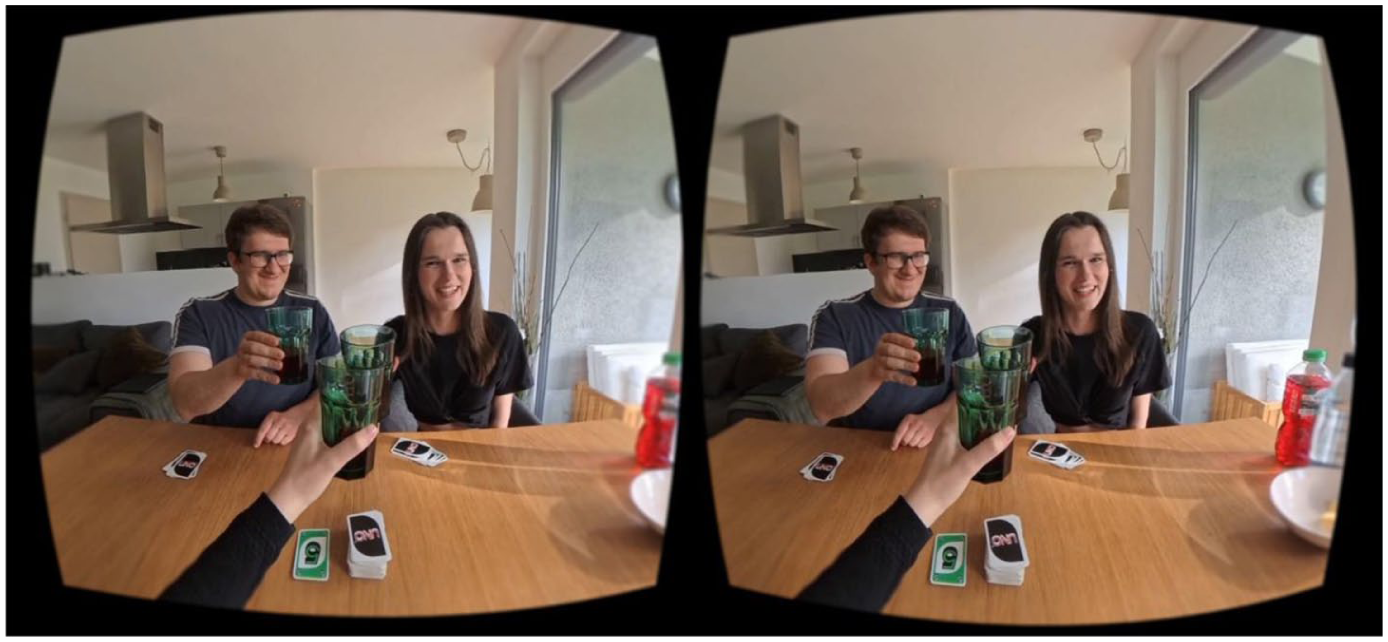
Screenshot of the stimulus video in its stereoscopic VR version.
Following this phase, participants completed an attention check regarding the video and various measures assessing their presence experience, fundamental needs, and emotional well-being (t2). The study concluded with a suspicion check, collection of demographic data, and debriefing. Finally, after learning about the study’s true objectives, participants were asked to provide their informed consent again.
Participants
To determine the required sample size for this study, an a priori power analysis was conducted using G*Power (Faul et al., 2007). Given the absence of specific empirical evidence regarding the expected effect size, we assumed a medium effect size (f = 0.25). This follows Cohen’s (1988) recommendation and appears reasonable in light of similar studies that have investigated VR as a coping tool following Cyberball, albeit without including a non-VR control condition (Stallmann et al., 2023). With a significance level of α = 0.05, a desired power of 1 – β = 0.80, and two conditions in a repeated-measures between-subjects design, the analysis indicated a required sample size of N = 98 (i.e. 49 per condition). Providing a buffer for data cleaning, we decided to oversample by at least 10% (N > 110).
Students from a mid-sized German university were recruited for the study and compensated with either €10 or equivalent course credit, depending on their preference and field of study. In total, 124 participants completed the experiment. We excluded those who reported being familiar with Cyberball (n = 6) or who experienced technical issues in the laboratory (n = 4). We also preregistered to exclude participants who failed at least one of our two attention-check questions (see “Measures”). However, this did not apply to any participants. Taken together, we achieved a final sample of N = 114 (nVR = 57, n2D = 57). On average, participants were 23.01 years old (SD = 3.94) and almost equally distributed by self-reported gender (57.89% female). In terms of education level, 68% were currently enrolled as Bachelor’s students and 32% as Master’s students.
Measures
Emotional well-being
Using the Scale of Positive and Negative Experience (SPANE, Diener et al., 2010), participants indicated on a seven-point agreement scale to what extent they experienced six positive (e.g. “happy,” αt1 = 0.94, αt2 = 0.93) and six negative (e.g. “sad,” αt1 = 0.86, αt2 = 0.86) emotions. This was repeated once before (t1) and once after the coping manipulation (t2). A balance score (SPANE-B) ranging from –36 to + 36 was created for both measurement points, by subtracting the negative sum score from the positive sum score.
Need threat
We used four 7-point semantic differentials (Rudert and Greifeneder, 2016) assessing each need described in the Temporal Need-Threat Model (Williams, 2009) before (t1) and after (t2) coping: rejected—accepted (belongingness), devalued—valued (self-esteem), powerless—powerful (control), and invisible—recognized (meaningful existence). In line with recent ostracism research (e.g. Büttner and Greifeneder, 2024), these were aggregated into an overall need-threat index (αt1 = 0.85, αt2 = 0.81) with lower values indicating stronger need threat.
Presence
The Multimodal Presence Scale for Virtual Reality Environments (Makransky et al., 2017) was used to measure experiences of spatial presence (five items; e.g. “I had a sense of acting in the depicted environment, rather than operating something from outside,” α = 0.83), social presence (five items; “I felt like I was in the presence of another person in the depicted environment,” α = 0.82), and self-presence (five items; “I felt like my real hand was inside of the depicted environment,” α = .92). Participants responded to these items, whose wording was slightly adapted to fit both experimental conditions, on a seven-point agreement scale.
Additional variables
As an induction check, we assessed participants’ inclusionary status before and after playing Cyberball (Inclusion of Other in the Self Scale; Aron et al., 1992). Furthermore, we measured whether participants were already familiar with Cyberball (i.e. yes vs no). The questionnaire also contained two attention-check questions concerning (a) the number of throws received during Cyberball and (b) the content of the stimulus video (see codebook).
Results
Induction check
Confirming the success of the ostracism induction, a one-tailed t-test predicting the IOS item by the time variable (i.e. t0 vs t1) showed a significant decrease in participants’ inclusionary status from before to after playing Cyberball, t(159) = −22.03, p < .001, Cohen’s d = 2.92 (see Table 1 for descriptive statistics).
(Group-specific) means and standard deviations of all study variables.
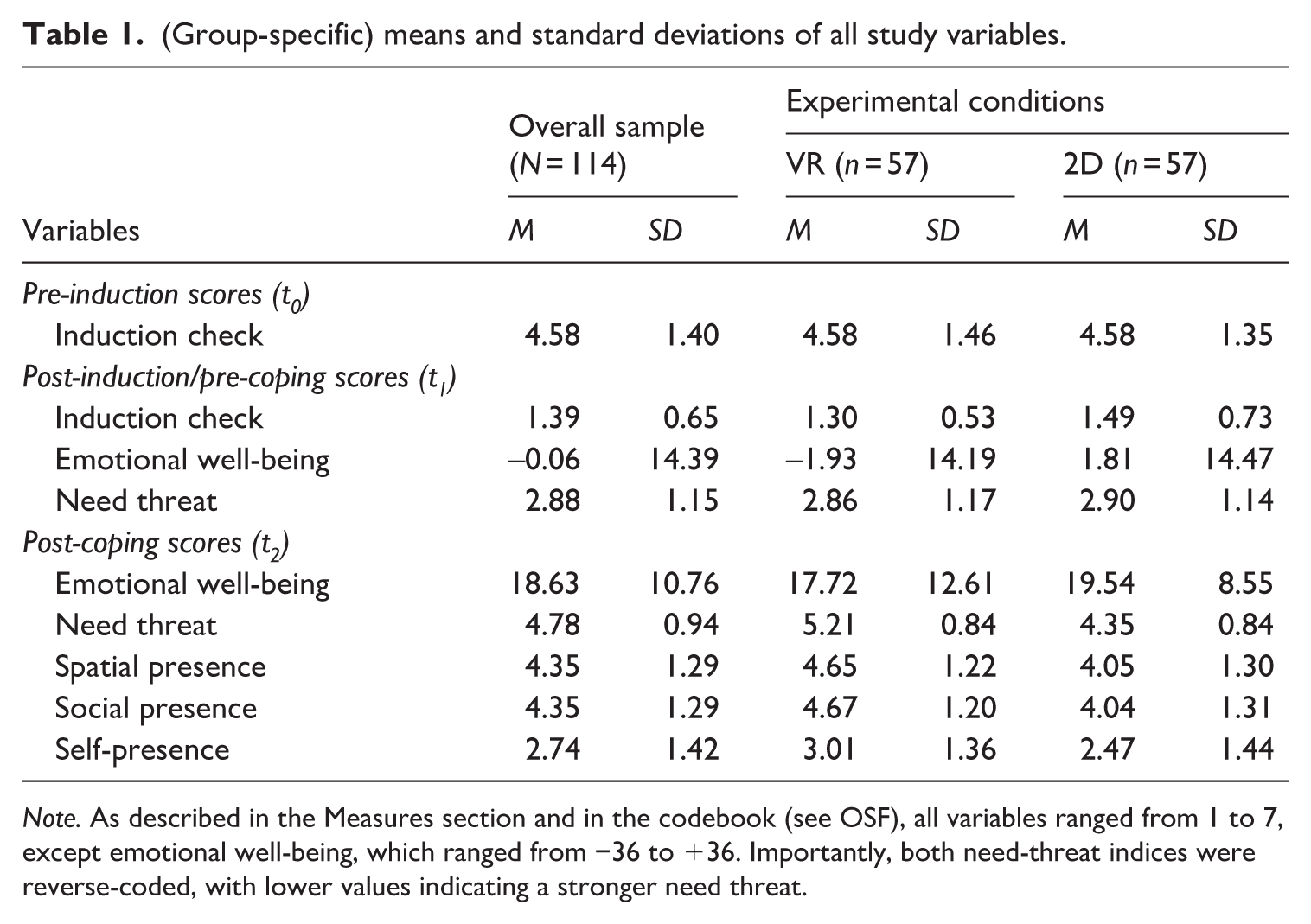
Note. As described in the Measures section and in the codebook (see OSF), all variables ranged from 1 to 7, except emotional well-being, which ranged from −36 to +36. Importantly, both need-threat indices were reverse-coded, with lower values indicating a stronger need threat.
Hypotheses testing
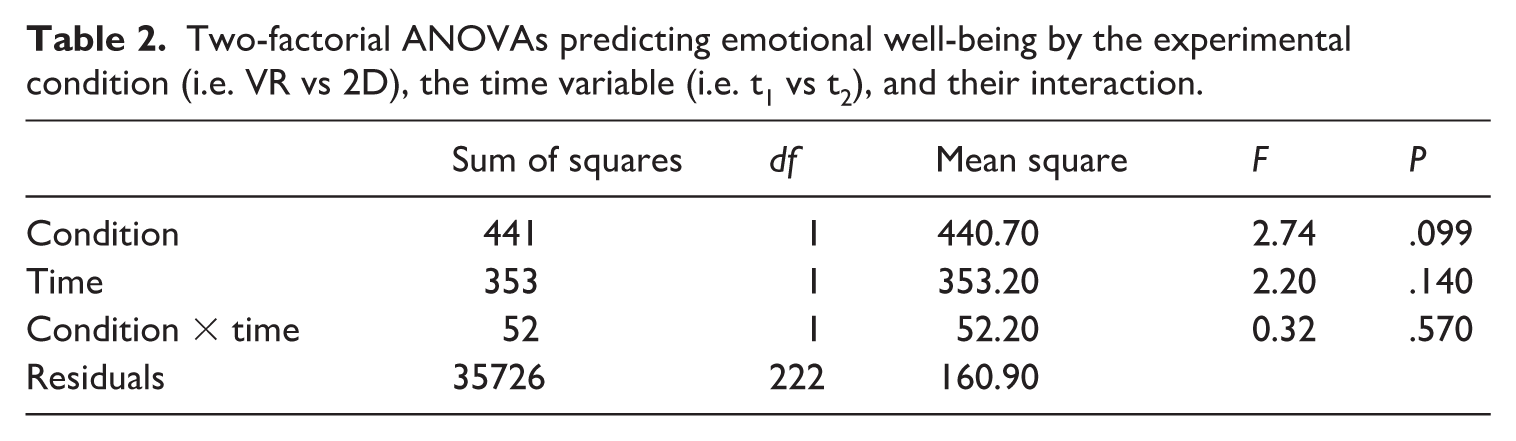
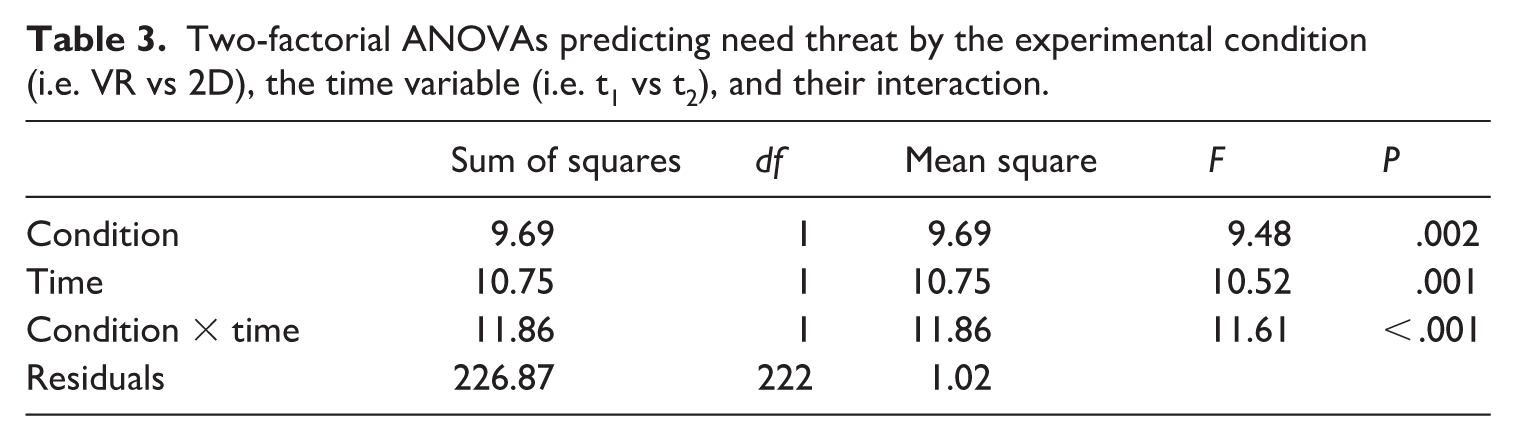
Hypothesis 1 predicted that, following an ostracism episode, exposure to a VR video of a social situation would (a) improve individuals’ emotional well-being and (b) restore their threatened needs. To test this hypothesis, the data were transformed from wide to long format, with time (pre- vs post-coping) specified as a within-subjects factor. We then conducted two-factorial ANOVAs predicting each outcome variable by the experimental condition (i.e. VR vs 2D) and the time variable (i.e. t1 vs t2), as well as their interaction. Contrary to Hypothesis 1a, no significant main or interaction effects were found for emotional well-being (see Table 2). However, for need threat, significant main effects of condition and time, as well as a significant time × condition interaction, emerged (see Table 3). Thus, we calculated planned contrasts to directly compare pre- and post-coping need-threat scores across both experimental conditions. In line with Hypothesis 1b, participants’ needs were significantly less threatened after the VR coping intervention than before, t(222) = 3.96, p < .001 (see Table 1), with a medium-to-large effect size of Cohen’s d = 0.53. Importantly, need threat was also significantly alleviated from pre-coping to post-coping in the 2D condition, t(222) = 2.34, p = .020 (see Table 1), albeit with a slightly weaker effect size of Cohen’s d = 0.31.
Two-factorial ANOVAs predicting emotional well-being by the experimental condition (i.e. VR vs 2D), the time variable (i.e. t1 vs t2), and their interaction.
Two-factorial ANOVAs predicting need threat by the experimental condition (i.e. VR vs 2D), the time variable (i.e. t1 vs t2), and their interaction.
Hypothesis 2 postulated that, compared to exposure to a 2D video of a social situation, exposure to a VR video would (a) evoke a stronger improvement in emotional well-being and (b) more effectively restore threatened needs. Accordingly, difference scores were computed by subtracting each outcome variable at t1 (i.e. after the ostracism induction) from the respective value at t2 (i.e. after the coping intervention), with higher scores indicating greater emotion regulation and need restoration. We then compared each difference score between the two experimental conditions using one-tailed t-tests. For emotional well-being, the difference score in the VR condition (M = 19.65, SD = 17.62) was not significantly higher than that in the 2D video condition (M = 17.74, SD = 14.83), p = .267, Cohen’s d = 0.12. Thus, Hypothesis 2a was rejected. However, in line with Hypothesis 2b, the achieved level of need restoration was significantly higher in the VR condition (M = 2.36, SD = 1.47) than in the 2D condition (M = 1.45, SD = 1.20), p < .001, Cohen’s d = 0.68.
It was further hypothesized that social presence (Hypothesis 3), spatial presence (Hypothesis 4), and self-presence (Hypothesis 5) would mediate the effect of the experimental condition on (a) improvement in emotional well-being and (b) need restoration. For each difference score, we performed a parallel mediation analysis in which the experimental condition served as the predictor, while the three presence indices were entered simultaneously as mediators (see Figures 2 and 3). All three a-paths were significant, indicating that participants in the VR condition reported higher levels of social presence, spatial presence, and self-presence compared to those in the 2D condition (see Table 1). Regarding the b-paths, spatial presence positively predicted both emotional well-being and need restoration, whereas self-presence negatively predicted need restoration, contrary to expectations. No other b-paths were found to be significant. We then calculated Monte Carlo simulated 95% confidence intervals (20,000 repetitions) for the indirect effects. The analyses revealed significant indirect effects through spatial presence, supporting Hypothesis 4a and Hypothesis 4b. Specifically, VR led to higher spatial presence, which in turn predicted greater improvement in emotional well-being (95% CI [0.463, 5.296]) and stronger need restoration (95% CI [0.028, 0.396]). However, there were no indirect effects via social presence and self-presence, thereby rejecting Hypothesis 3a/b and Hypothesis 5a/b.
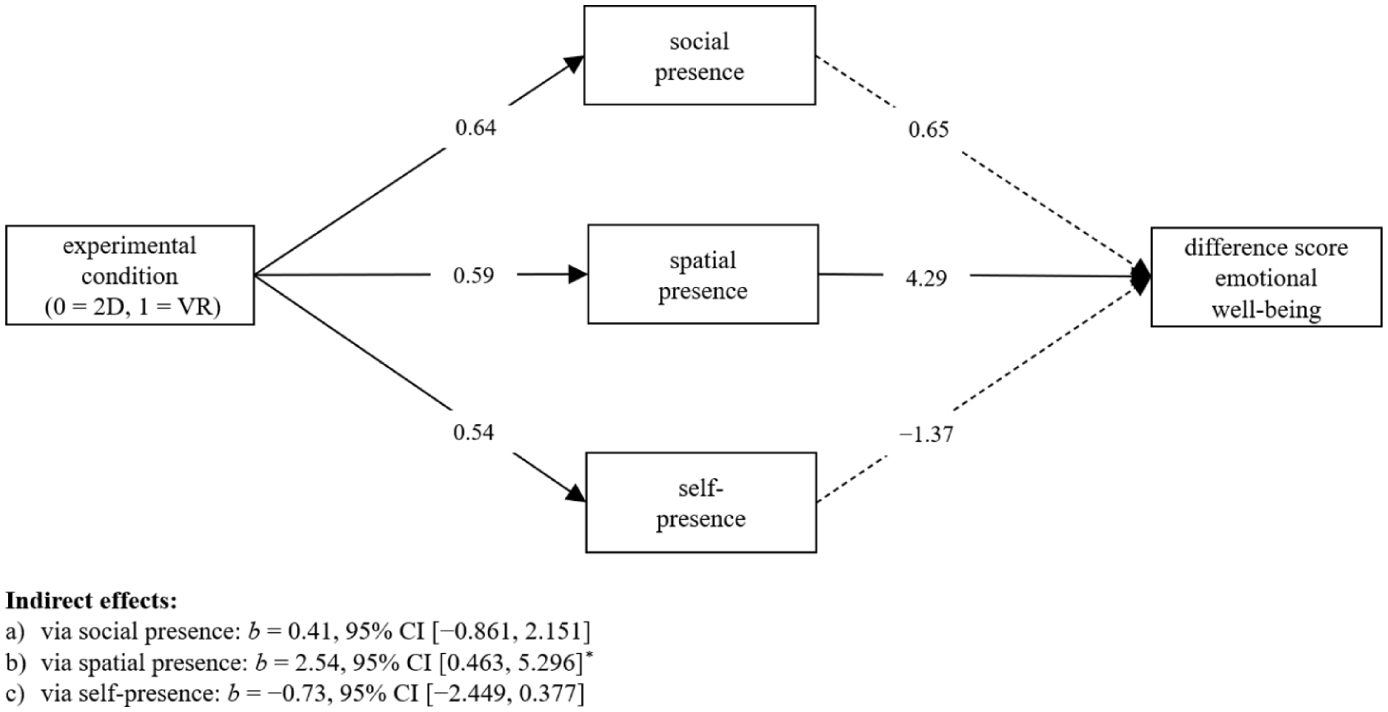
Parallel mediation analysis predicting the emotional well-being difference score.
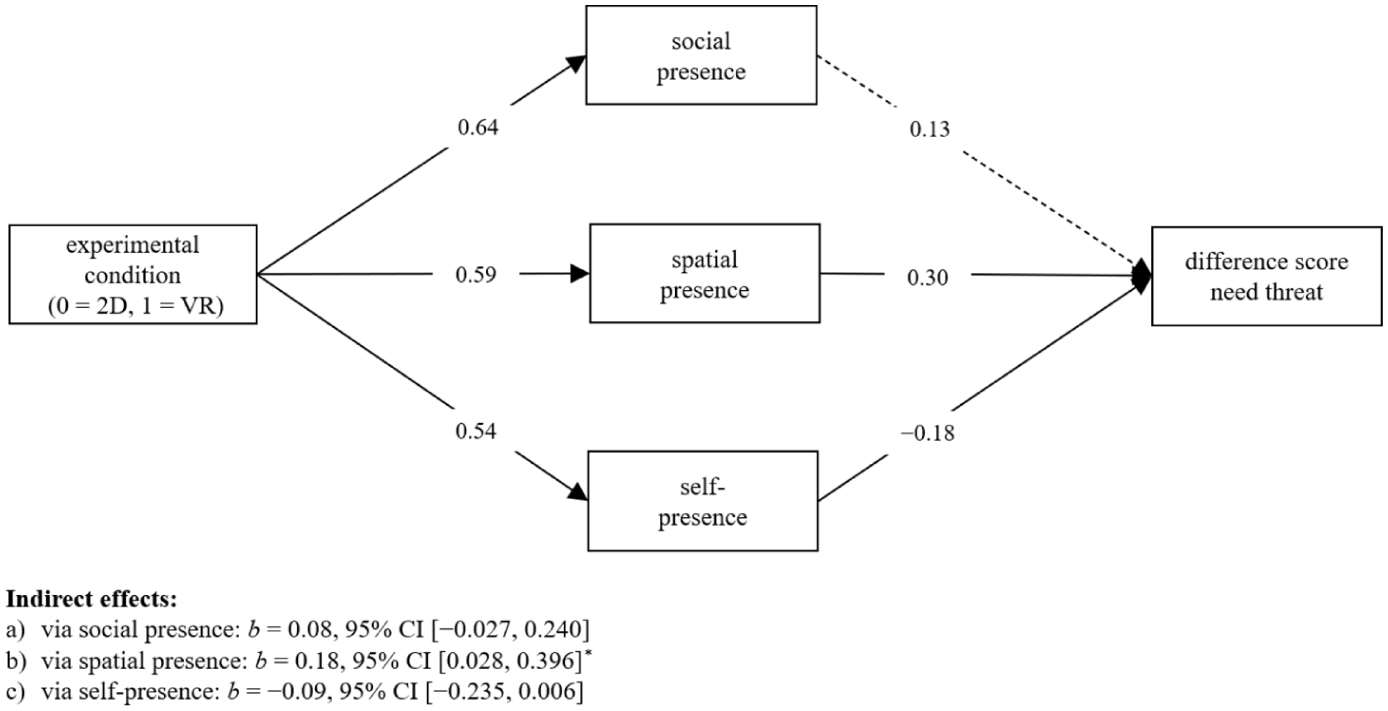
Parallel mediation analysis predicting the need-threat difference score.
Exploratory analyses
For exploratory purposes, we preregistered that all analyses described above would also be conducted at the individual need-threat item level, using belonging, self-esteem, meaningful existence, and control as separate dependent variables (further statistical details are provided in Section 8 of the data analyses file). These models revealed patterns consistent with those obtained for the overall need index: all four needs were significantly less threatened after the VR coping intervention than before (Hypothesis 1), and the level of need restoration was significantly higher in the VR condition than in the 2D condition for each need (Hypothesis 2). Spatial presence again emerged as the most relevant mechanism, significantly mediating the effect of the experimental condition on three of the four needs (i.e. belonging, self-esteem, and control; Hypothesis 4). By contrast, the other two presence dimensions showed only isolated indirect effects: social presence significantly mediated the effect on meaningful existence (Hypothesis 3), whereas self-presence showed a significant indirect effect on belonging (Hypothesis 5).
Discussion
Audiovisual media hold considerable potential to affect users’ well-being in complex and often multifaceted ways. While this fundamental principle typically connects to both chances and risks on an individual level, the current project set out to scrutinize a particularly beneficial effect: media’s effectiveness as a coping tool after social exclusion experiences. Going beyond the common focus on conventional 2D media in this research field, we investigated whether VR applications also serve as an effective (and possibly more effective) means of coping with episodes of ostracism. Drawing on the notion that socially excluded individuals typically pursue two overarching coping goals—that is, alleviating their negative emotional state (i.e. emotion regulation) and restoring threatened needs for belonging, self-esteem, meaningful existence, and control (i.e. need restoration)—we scrutinized both processes in a standardized laboratory experiment. More specifically, it was examined whether VR-based coping fosters restorative and regulatory effects over time—and if these benefits could actually surpass those evoked by conventional 2D media.
Considering prior evidence that has framed virtual treatments as a promising coping approach, we postulated that exposure to a social situation in VR would support restorative processes following an induced ostracism episode (see Hypothesis 1a/b). More specifically, referring to the Temporal Need-Threat Model (Williams, 2009) and related empirical findings (Lutz et al., 2023), it was postulated that two central coping outcomes—emotion regulation and need restoration—would be supported by a VR-based intervention. Yet, for the first proposed process (i.e. emotion regulation), we were surprised to find that emotional well-being did not improve via our VR intervention, thus yielding a different result than a related previous study (Stallmann et al., 2023). Arguably, this might be explained by mood management theory (Zillmann, 1988), which proposes that individuals typically regulate negative affect by selecting media that provide strong hedonic gratification—such as humorous, uplifting, or otherwise positively valenced content. In this study, the stimulus video was predominantly designed to present a socially rich interaction, containing rather few genuinely amusing or affectively rewarding elements (as noted in the Method section, the game’s outcome was left open to avoid confounding effects). From this perspective, the lack of a notable improvement in well-being over time does not necessarily indicate that VR is ineffective for emotion regulation per se (see Colombo et al., 2021); rather, it suggests that the content itself may not have been sufficiently hedonic or joyful to trigger affective benefits. As such, we deem it likely that a more emotionally rewarding scenario—for example, showing the group celebrating a win or engaging in joyful banter—might have elicited stronger mood enhancement effects.
Importantly, a different pattern emerged concerning our second proposed outcome (i.e. need restoration): as hypothesized, VR exposure indeed facilitated a significant restoration of threatened needs following the ostracism episode. Thus, although it did not uniformly alleviate the affective consequences of ostracism, our VR-based coping intervention successfully contributed to restoring participants’ fundamental needs typically threatened by social exclusion. Taken together, the result pattern observed in our study suggests that different coping outcomes are likely shaped through distinct psychological mechanisms, which might be inherently linked to the content of the VR intervention: whereas emotion regulation likely benefits most from content that provides strong hedonic gratification, need restoration is facilitated by content that provides cues of social engagement and inclusion.
Another finding worth discussing emerged from our comparison between the observed VR effects and a conventional 2D condition (see Hypothesis 2a/b). Indeed, this comparative perspective across different media modalities also holds high methodological relevance, as isolated pre–post differences in single conditions could simply reflect fade-out effects (Buelow et al., 2015) rather than demonstrating coping effectiveness. First, regarding the suggested improvement in emotional well-being, no significant differences emerged between VR- and 2D-based coping. Clearly, this aligns with our abovementioned interpretation that the stimulus video’s content (which was the same across conditions) might have lacked the inherent hedonic qualities to evoke notable mood improvements. More crucially, however, it was observed that presenting our stimulus video via VR actually yielded much stronger need restoration effects than showing it on a conventional 2D screen—highlighting VR’s advantages in restoring fundamental needs. In other words, letting individuals experience a (mediated) social setting in more immersive ways proved particularly powerful for restoring the psychological needs typically threatened by social exclusion episodes. Given the design of our study, this comparative advantage ultimately boils down to certain technical affordances: unlike the 2D condition, the VR condition utilized a head-mounted display to provide stereoscopic presentation, a slightly wider field of view, and head-tracked orientation within the 360° scene. Therefore, the observed advantages of VR should be interpreted as the combined effect of a more immersive delivery format, as well as the resulting affordances.
In the final step of our analysis, we focused on different presence components that might explain the advantages of VR-facilitated environments (vs 2D media) on a process level. Supporting previous research, VR indeed led to substantially stronger experiences of social presence (Oh et al., 2018), spatial presence (Breves and Schramm, 2021), and self-presence (Mottelson et al., 2023). However, concerning their proposed role as relevant mediators (see Hypothesis 3a/b, Hypothesis 4a/b, and Hypothesis 5a/b), our results suggest that not all presence components might be equally important in the context of social exclusion coping. In fact, we only identified significant indirect effects on need restoration and emotion regulation through spatial presence, but none via social presence or self-presence. Conceptually, this indicates that feeling physically transported into a mediated environment (rather than merely experiencing social connectedness or self-embodiment) is likely most central to VR’s effectiveness in coping with ostracism.
This observation is consistent with the conceptual understanding of presence as the subjective sense of “being there” in a mediated environment (Lombard and Ditton, 1997). Spatial presence, in particular, closely corresponds to Slater’s (2009) Place Illusion—that is, the perceptual illusion of being located in the place depicted. As this subdimension most directly captures the central “being there” quality that distinguishes immersive VR from conventional 2D viewing, it appears to be the most relevant route by which VR helps individuals to overcome episodes of social exclusion.
Likewise, the lack of mediation via social presence is also theoretically meaningful: social presence is typically defined as the sense of being with another (Oh et al., 2018). Here, both conditions likely provided a baseline level of this experience because the video contained salient social cues (e.g. eye contact and coordinated interaction). Thus, although VR elicited an additional boost in social presence (significant a-path), the baseline level may have been “good enough,” such that any incremental increase was insufficient to generate further restoration gains. Future studies could test this interpretation by manipulating responsiveness and reciprocity (e.g. through contingent feedback or interactivity) to identify the specific threshold at which increases in social presence translate into stronger coping benefits.
Finally, the absence of mediation via self-presence could be explained by the fact that this presence component is particularly sensitive to specific embodiment affordances (e.g. a controllable avatar, agency, haptic feedback)—most of which were absent or at least somewhat limited in our brief, passive video exposure. Specifically, participants did not embody a personalized avatar but only saw limited body-related cues from the protagonist’s first-person perspective (i.e. noninteractive limbs). To minimize salient gender cues, the protagonist wore long sleeves in a neutral color; nevertheless, some incidental identity-related cues, such as skin tone or the approximate age of the depicted hands, could not be fully eliminated. Notably, self-presence even showed a significantly negative b-path to need restoration in the parallel mediation model, suggesting that heightened embodiment without validating social contingency might increase a negative self-focus rather than alleviate exclusion-related threats. Yet, as our study elicited only small-to-moderate levels of self-presence across the sample, our findings regarding this mechanism should be interpreted with caution. To overcome these limitations, future replications of our work with embodiment cues of different quality and quantity are strongly recommended. Beyond that, we want to point out that presence is only one candidate mechanism when investigating individuals’ experiences in virtual worlds: VR also affords features such as agency, interactivity, and perceived control that may contribute to coping and should be examined in future multimediator work.
Apart from our study’s practical implications—which might be particularly valuable for designers and practitioners in the field of coping and well-being restoration—the present work also contributes to ongoing theoretical discussions in at least two ways. First, it extends models of ostracism coping to immersive media contexts by showing that VR-based coping may be particularly relevant for post-exclusion need restoration. This indicates that existing coping frameworks may benefit from more explicitly accounting for immersive media environments as situational resources that can regulate exclusion-related threats. Second, our findings support current perspectives that presence should not be treated as a uniform explanatory construct. Rather, empirical merit may lie in a more differentiated understanding, as specific presence dimensions vary in relevance across outcomes, not least in the context of need restoration and coping. In the present case, spatial presence emerged as the most relevant process-level pathway, suggesting that place-related immersion and attentional binding may be more central to managing negative ostracism experiences than other related perceptual states such as social or self-related presence.
Limitations and future research directions
To our knowledge, this study was the first to explicitly scrutinize the effectiveness of VR (vs 2D media) as a coping tool after social exclusion through the lens of the Temporal Need-Threat Model (Williams, 2009), thus examining both emotional regulation and need restoration. Given the predominance of “traditional” devices (e.g. computers or television) in this research field (Lutz et al., 2023), our work therefore addressed an important and innovative research gap, not least under standardized laboratory conditions. Still, several limitations need to be considered when interpreting our findings. First, our study’s sample was not representative of the broader population, which limits the generalizability of the findings. Participants were predominantly young university students, and it is therefore unclear whether the observed effects can be generalized to other demographic groups (e.g. in terms of age or educational background), especially those less familiar with emerging technologies such as VR. A similar limitation applies to the sample’s cultural homogeneity, as most participants were German native speakers currently living in the same cultural context. This seems relevant not least because certain elements of the stimulus video, such as instances of direct eye contact, may be interpreted differently across cultures, potentially leading to variations in emotional impact. Along the same lines, individuals with different cultural backgrounds might hold different expectations for what a casual social setting looks like, so that VR-based social coping interventions (such as the one examined in this study) might require some customization depending on the target group.
Relatedly, we note that the intervention was very brief (i.e. 3 minutes and 29 seconds) and involved only a single exposure situation. Consequently, no conclusions can be drawn from our results regarding the long-term effects of VR-based coping. To overcome this gap, future research could examine repeated, longer-term exposures. Moreover, future research is needed to disentangle whether VR-based coping is effective primarily because it offers cues of social reconnection (i.e. approach-oriented coping) or because it redirects attention away from the exclusion episode (i.e. avoidance-oriented coping). This could be tested, for instance, by experimentally varying whether the VR content provides social inclusion cues, social distraction, or no social content, while holding other stimulus features constant. Furthermore, a study that includes a high-embodiment VR condition (with avatar, body ownership, and agency) alongside the passive 360° video used in this study would allow a direct test of self-presence as a coping mechanism and thus substantially advance theoretical understanding of when and why different presence dimensions matter for need restoration.
While this study focused exclusively on ostracism as a specific form of social exclusion, individuals can also feel socially excluded when receiving explicit negative attention (i.e. rejection; Wesselmann and Williams, 2017). Extending the current findings beyond ostracism, follow-up projects might investigate whether VR similarly functions as a coping tool in response to this different type of exclusionary experience. Finally, although this study included a comparative element by comparing VR-based and 2D presentation formats, it does not allow conclusions about the effectiveness of VR relative to other coping strategies (e.g. natural social interactions) or even the absence of any coping strategy (i.e. wait-list controls). Including such comparisons in future studies would help to more precisely situate VR-based interventions within the broader landscape of coping approaches. Moreover, variations in VR content—including duration, topic, or character attributes (e.g. gender, race/ethnicity, or age of the protagonist)—should be considered to clarify certain boundary conditions and optimize VR-based coping interventions.
Conclusion
Extending prior work on stress and pain relief in virtual environments, our findings suggest that VR may also hold great potential to restore fundamental needs after individuals feel excluded by their social environment. Even more so, our comparative analysis indicated that VR’s restorative effects clearly surpassed those of viewing the same content on a 2D screen—an advantage that was mediated by the stronger experience of “being there” in the virtual world. For the ongoing psychological and societal discourse of whether consuming media in more immersive forms is actually all that different (e.g. Wrzus et al., 2024)—or, better yet, ‘worth’ the additional technical effort—this evidence may be seen as another relevant piece of the puzzle.
Footnotes
Acknowledgements
The authors thank Lilli Schnurrer and Stefan Neubauer for their assistance in collecting the data. Furthermore, they would like to thank Lisa Forner and Dominic Lutz-Peipelmann for their role as actors in the self-created VR scene.

Ethical considerations
This study’s procedure was approved by the University Ethics Committee (Institutional Review Board) of Chemnitz University of Technology, Germany (Approval No. #101738941).
Consent to participate
Written informed consent to participate was obtained from all participants prior to the study and again after debriefing.
Funding
The authors disclosed receipt of the following financial support for the research, authorship, and/or publication of this article. This research was supported by an internal grant from the Faculty of Humanities, Chemnitz University of Technology, awarded to Sarah Lutz (€1000 for participant compensation).
Declaration of conflicting interests
The authors declared no potential conflicts of interest with respect to the research, authorship, and/or publication of this article.