






Abstract
This article is concerned with how life in poverty affects people’s possibility to enact citizenship through their use of the media. More specifically, it examines the varying preconditions for impoverished citizen’s mediated public connection. Whereas empirical studies into this area are few overall, conceptual approaches have a limited grasp on the many-faceted nature of poverty-induced disconnection and its embeddedness in everyday life. This article first develops the multi-dimensional media poverty framework positing that disconnection can be understood as the outcome of three key preconditioning dimensions: everyday life conditions, access, and resources. Second, applying this framework in the analysis of repeated interviews with 41 poverty-stricken citizens in Norway, it illuminates how possibilities for public connection are preconditioned and restrained by life in poverty. In this way, this article advances conceptual approaches to studying media use in contexts of deprivation and provides new empirical knowledge about a critical demographic seldom studied before.
Introduction
Increasing socioeconomic inequality globally (Piketty, 2020), in Europe (Eurostat, 2018), and in Norway (Statistics Norway, 2026), render it critical to attain knowledge and understanding of how economically disadvantaged citizens connect to the public through their use of the media. Through the diffusion of news and information, the media is a key intermediary between citizens and the world beyond their private sphere. People’s use of the media therefore constitutes a fundamental condition for their orientation toward the public and political world – for their public connection – and thus a critical factor for informed and active citizenship (Couldry et al., 2010). Statistical research consistently documents systematic relationships between background resources, media use, and public connection (e.g. Couldry et al., 2010; Hovden and Rosenlund, 2021; Sivertsen, 2023). Likewise, large-scale qualitative research from a range of different national contexts (e.g. Nærland, 2019; Couldry et al., 2010; Danielsson, 2021; Swart et al., 2016) show how media use is embedded in everyday life conditions which, depending on various background resources, allows for public (dis)connection. This research is important in evidencing the social structuring of people’s possibilities to connect to the world of politics and for re-actualising class as an explanatory factor. Yet it predominantly attends to middle- and working-class strata, leaving those least advantaged out of the scope of inquiry. Consequently, this article asks: How do conditions of poverty affect people’s possibilities to connect to the public and political world through their use of the media?
Poverty, in contrast to inequality, designates not only that some people have less than others but also that they lack substantial goods to cover fundamental needs, and therefore have reduced possibilities for a good life (Townsend, 1979). At the same time, we also know that poverty is systematically connected to various forms of civic and political marginalization (e.g. Verba et al., 1995), low electoral turnout (Bergh et al., 2019), and limited involvement in civil society organizations (Eimhjellen and Fladmoe, 2020).
Research into the media use of vulnerable groups has thus far largely, albeit with notable exceptions (e.g. Lindtner and Nærland, 2024; Smit et al., 2024; Søholt, 2024; Talvitie-Lamberg et al., 2022), centered on questions of media access and digital divides. Following repeated calls for expanded approaches from a range of different strands of research, including digital inequalities research (e.g. Helsper, 2021; Scheerder et al., 2019), ethnographically oriented scholarship on digital everyday life (e.g. Ytre-Arne, 2023), and lifestyle research on the uses of media and culture (Nærland, 2019), this article starts from the basic premise that we need to move beyond the focus on access and digital divides and factor in the messier and compound reality of everyday life in poverty.
Building upon this scholarship, this paper first develops the multi-dimensional analytical media poverty framework. The first dimension is everyday life conditions, which may include a range of possible factors underpinning their overall media use, such as economic hardship, illness, stress, and disposable time. The second is access to media content, platforms, and technology that offer possibilities to engage with potentially connective media content. The final key dimension is resources to make use of media in ways that are civically empowering, including language skills, media literacy, and civic dispositions. Crucially, as this article will show, focusing on these three dimensions directs attention to key factors inhibiting or facilitating civically enabling media use.
Second, it applies the media poverty framework in large-scale qualitative research on impoverished citizens from Norway – an affluent Nordic “media welfare state” (Syvertsen et al., 2014) where, however, 10.9% of the population live in relative poverty (Statistics Norway, 2026). Forty-one informants (each interviewed twice) were recruited from three socio-demographic groups in Norway consistently identified as particularly vulnerable to poverty: first-generation Somali immigrants, single providers, and social benefit recipients (Hatrem, 2025). The analysis reveals both commonalities and socio-demographically specific variations within and across these groups. Finally, the article discusses the fertility of the media poverty framework in and beyond the context of Scandinavian media welfare states.
Public connection, socio-digital inequalities, and lifestyle
Informed and active citizenship necessitates a minimum of knowledge, attention, and interest concerning issues or problems that are of collective significance. Citizens’ use of the media is thus a ground condition for citizens’ public connection, conceptualized by Couldry et al. (2010) as “an orientation toward a public world where matters of common concern are addressed.” As such, public connection constitutes a bottom-line factor in all major theories of democracy (see Couldry et al., 2010: 8–10). More specifically, public connection foregrounds orientations toward issues related to politics, its processes and mediations, and toward issues of resource distribution more generally, also encompassing questions concerning values or identities – when these are either contested or on the public agenda (i.e. Kaun, 2012). Public connection may manifest through non-mediated actions such as attending rallies or discussing politics with friends. Mediated public connection necessitates online and offline media practices that sustain attention to, interest in, and knowledge of public matters of collective concern, most prevalently through the habitual use of news (Swart et al., 2016), but also through the use of other genres including entertainment (Nærland, 2020). The aim of this article is to examine how conditions of poverty affect people’s possibilities for mediated public connection.
To study poverty and public connection at close range, this article primarily draws upon two different yet complementary strands of theory: lifestyle (Weber, 1978[1921]) and socio-digital inequality (Helsper, 2021). Albeit with different emphasis, both these strands accentuate the need to take a compound approach to the variety of factors that underline media use and its outcomes. Lifestyle, according to Max Weber, can be understood as the “structured whole of people’s behaviors and practices.” Later revisions of the lifestyle concept (Bourdieu, 2010[1979]) emphasize the intersection of both tangible factors, such as demographic variables (economy, class, age, gender, etc.) and intangible factors such as a person’s values, preferences, and outlooks. The concept of lifestyle thus directs attention to how media use and its potential for public connection result from a number of interlocking factors pertaining to everyday conditions of poverty, be it tangible factors such as space, money, or technology, or intangible ones like values, inclinations, or tastes.
Whereas the lifestyle perspective urges an openness to the variety of factors that may condition people’s possibilities for connective use of media, advancements in digital inequalities research invite a more structured focus on key drivers. Helsper (2021: 28) introduces the concept of socio-digital inequality to account for the “. . . systematic differences in the ability and opportunity for people to beneficially use (or decide not to use) ICTs (. . .).” Critiquing simplistic understandings of exclusion as a result of clear-cut digital divides (as “have and have-nots”), Helsper (2021) urges scholars to regard digital, social, and political inequalities as intertwined and part of what she terms a “continuous cycle of mutual influence.” To account for the many-faceted and gradual nature of digital inequality, she builds upon existing conceptualizations of first-level (access), second-level (skills, literacies, and content), and third-level divides (outcomes). Crucially, Helsper’s conceptual incorporation of third-level divides invites us to consider also mediated public connection as an outcome of social, material, and digital inequalities.
These are not the only relevant strands of theory that take a compound approach to media use, everyday life, and citizenship. The concept of media reliance, for instance (i.e. Jansson et al., 2026), foregrounds how social and technological forces and internal motivations shape how people use and make sense of media in their everyday lives. Likewise, the concept of cultural citizenship (i.e. Hermes, 2005), placing people’s media experiences at the center of analysis, foregrounds how the everyday engagement with media can stimulate senses of civic belongings, passions, and identities.
These perspectives thus highlight the need to approach mediated (dis)connection as a matter of a range of interlocking factors (social, material, cultural, and technological) underlining life in poverty and for conceptual advancements apt to account for how public disconnection is embedded in everyday life conditions of poverty. To this end, and building upon the aforementioned perspectives, this article introduces the three-dimensional media poverty framework.
Media poverty: Everyday life conditions, access, and resources
This framework is developed to study poverty and mediated public connection at micro-level, on the level of the individual. Yet as this article will demonstrate, it allows for systematic comparison within and between groups. The media poverty framework thus aligns with middle-range theory construction (Merton, 1968) in that it starts with the specific problem of poverty-induced public disconnection and then develops a framework to understand this problem. The following sections introduce each dimension of the framework and specify key features.
Everyday life conditions may include a range of possible factors underpinning their overall media use. This dimension is contingent on the notion of lifestyle in that it accentuates the composite nature of poverty-incited disconnection and its grounding in the lived life of poverty. Moreover, following phenomenologically oriented scholarship on digital everyday life (Ytre-Arne, 2023), it is open to the experiential dimensions of life in poverty. From extant research from Norway (Hatrem, 2025), we know that life in poverty is systematically connected to the lack of a range of essential and social goods. Yet as conditions may vary within and across the three demographics in focus, it is important to remain open to various factors that may emerge. Possible factors include, for instance, illness, stress, and disposable time, but also gender roles that, to varying degrees, allow or encourage media use. Conditions may also include housing conditions such as stable housing, heating, physical space, and so on.
Access to media content, platforms, and technology constitutes a ground condition for people’s public connection. Without access to media technology or content, there is little possibilities for mediated public connection (unless indirectly, through others). This dimension, contingent with first-level divides (Helsper, 2021), encapsulates basic access to both ICTs and to content. Access to either, however, is not only a matter of have/have not. Helsper (2021: 30) highlights the gradual nature of digital access and defines access-based inclusion as “high-quality, ubiquitous, and autonomous use of common ICTs.” Moreover, this dimension encapsulates how access, or the lack thereof, shapes the possibilities for connective media repertoires and practices, in regard to news in particular. This article empirically explores basic yet key features of material access to Information and Communication Technologies (ICTs), such as access to Internet, PC, cell-phone, and TV-set, and to content, such as news and streaming subscriptions.
Resources to make use of media in ways that are civically empowering constitute the third critical dimension. This dimension is contingent with second-level digital divides, skills (Helsper, 2021: 30), but encapsules people’s possession of a broader set of resources. Resources also include factors such as media literacy, digital competence, and language competence, but also dispositional factors (Bourdieu, 2010[1979]) such as the habitus-rooted inclination to engage with news and/or to be civically engaged.
The case of Norway
A combination of country-specific features constitutes Norway as a “critical case” (Flyvbjerg, 2006). First, it represents an affluent welfare context known for comparatively small class divides (Flemmen et al., 2022). However, inequalities have risen over time (Geier and Grini, 2018), much driven by wealth accumulation and inheritance in families (Hansen and Toft, 2021). In addition, the number of citizens with low income has slowly increased over the past 30 years (Omholt, 2019), and according to Statistics Norway (2026), 10.9% of the Norwegian population nominally live in relative poverty. Relative poverty in Norway is structurally connected to weak labor market attachment and lack of education and has been exasperated by an influx of refugees from the Middle East in 2014 and later from Ukraine (Statistics Norway, 2026). As of 2022, 27% of immigrants lived in low-income households (Directorate of Integration and Diversity, 2025).
The relative measure of poverty applied in Norway (and this study) follows European Union (EU)/Organisation for Economic Co-operation and Development standards in which enduring (minimum 3 years) household income below 60% of the national median income is classified as relative poverty. This means that they have a perpetually poorer economy and less-favorable living conditions than what is regarded as necessary or normal in Norway (Omholt, 2023). Poverty in Norway is, compared to less-affluent European countries, characterized by generally high living standards. In consequence, poverty in Norway is rarely a matter of lacking basic necessities like food and shelter (absolute poverty), and impoverished citizens enjoy relatively better access to material goods (such as housing and technology) and social goods (such as past time activities).
Statistical research on poverty-derived problems in the Norwegian population shows that the three most overrepresented groups are single providers, social benefit recipients, and immigrants from Africa or Asia (Hatrem, 2025). For instance, 40% to 80% within each of these groups is found to lack either material or social goods and the ability to handle unexpected expenses (Hatrem, 2025). Statistically, these three groups thus stand out as the three most disadvantaged in the Norwegian context and are consequently selected as the empirical foci for the interviews. Roughly over half of the first group, the social benefit recipients, have migrant background. Moreover, for the last group, the selected focus is on immigrants from Somalia specifically, who stand out with long residency in Norway yet are subject to consistent challenges in living standards (Omholt, 2023).
Second, Norway can, like its Nordic neighbors, be described as a “media welfare state” (Syvertsen et al., 2014) in which far-reaching cultural policies are deployed to pursue various measures of access. These include extensive press support, well-funded public service media, efforts to make news available through public sponsorship and libraries, and a highly developed digital infrastructure (Syvertsen et al., 2014). Yet, unfavorable class position remains a predictor of low use of connective media such as news (i.e. Hovden and Rosenlund, 2021). The case of Norway thus allows for insights into how and why inequalities in media use and public connection persist despite favorable conditions overall.
Method and data
This study relies on a research design comprising in-depth interviews with a total of 41 poverty-stricken informants, each interviewed twice. The interviews were conducted in and around Norway’s second biggest city Bergen by a team of three researchers, in the summer-autumn of 2022 and winter 2023.
Selection, recruitment, and interview design
We recruited informants from three groups consistently identified as marginalized in the poverty statistics from Norway (Hatrem, 2025): Norwegian-Somalis, social benefit recipients, and single providers. These are not socially homogeneous groups – the social benefit recipient category, for instance, involves a multitude of routes into poverty. Neither are these groups mutually exclusive. In our material, we have several informants who can be placed in all three groups simultaneously. For instance, we have Norwegian-Somalis who are also both single providers and social benefit recipients.
From each of these groups, we recruited 12–15 informants between 18 and 80 years of age. Except for the single provider group, which is predominantly made up by women, we sampled informants to ensure balance in gender and age. The recruitment of informants was guided by standardized poverty measures: EU’s low-income definition of 60% of the national income (Fløtten et al., 2011). An additional guiding criterium was housing: eligibility to social housing in Norway relies on income below the poverty line. To recruit informants, we collaborated closely with several local poverty organizations, including also food- and clothes-distribution centers for vulnerable citizens. A methodological implication of recruiting through these organizations, who are often in close relationships of trust with its users, is that the informants we were put in contact with likely had an established connection with society and possessed certain resources, including language skills. To incentivize participation, each informant was offered a gift card for a local shopping mall.
All recruited informants with migrant background had at least a minimum proficiency in spoken Norwegian, and all interviews were conducted in Norwegian. Due to the known potential risk of social control associated with using interpreters in small diasporic networks, we chose not to interview informants in their native language.
To mitigate uneven power relations in the interview situation in which marginalized informants may adapt to researchers’ expectations (e.g. Skeggs et al., 2008), interviews were conducted at a place of comfort, chosen by the informants themselves. We also attempted to avoid imposing a preconceived, normative idea of, for instance, news’ superiority over other forms of media by emphasizing that “media” can encompass TV, films, newspapers, books, Facebook, YouTube, and more.
The two-round design was instrumental in gaining the informants’ trust and facilitating open articulations of their life-worlds. The first round predominantly focused on descriptive measures, while the second focused predominantly on experiential dimensions and key themes emerging from the first round. The semi-structured interview guides included both pre-established research interests and explorative questions about basic material access, media repertoires, habits, interpretation of content, civic values, orientations, living conditions, and so on. The guides also included open questions about everyday life experiences with poverty, technology, and news. The time between each round ranged from 1 week to 2 months. Each interview lasted from 45 to 130 minutes and was subsequently transcribed by assistants.
The study complies with the National Research Ethic Committee guidelines (including for data and privacy protection, and for informed consent to perform procedures) and is approved by the Norwegian Centre for Research Data (NSD). The privacy protection of all informants presented in this article is ensured through the use of pseudonyms and the removal of personally identifiable information.
Analytical approach
The analysis was conducted in three steps, relying on a combination of thematic and portrait analyses. In the first step, interviews from both rounds with all informants were analyzed and coded for a number of key themes. These included biographical characteristics (including, for instance, housing conditions, marital status, occupational status, their parents’ level of education, number of children, etc.); access to ICTs, Internet, and media content; media repertoires (platforms, genres, topics); and dispositions (civic values and practices). This initial charting generated an overview of how the critical dimensions of everyday life conditions, access, and resources in variable ways manifest both in the lives of the informants individually and across the three sample groups. In addition, for each informant, we developed a one- to two-page profile, summarizing key characteristics.
The second step presents three strategically selected informant cases, each from the social benefit recipient, single provider, or the Norwegian-Somali sample. In methodological terms, these informants are selected as “extreme cases,” which, according to Flyvbjerg (2006: 229), are cases well suited for getting a point across in an especially telling or dramatic way. These are thus informant cases in which key problematics (concerning everyday life, access, and resources) typical of their respective group are particularly clearly pronounced. They were selected for presentation because they are exemplary of their group yet evocative of typical traits. Through analytical portraits, this second step offers thick yet systematic empirical texture to how and with what consequences the dimensions of access, resources, and everyday life conditions manifest in the informants’ lives. Analytical portraits is an approach apt to synthesize complex data into evocative accounts (Rodríguez-Dorans and Jacobs, 2020) and crucial to this study: to provide in-depth understanding of the everyday context of poverty, while preserving the voice of the informant.
Based on the analysis of the full informant sample, the third step highlights key commonalities and specificities across the three groups, as well as significant nuances and variations.
Analysis
The following sections first analyze three selected case informants from the three sample groups. Prior to each analytical portrait, general characteristics of the sample group are presented. Each analytical portrait is structured around the dimensions of everyday life conditions, access, and resources. Finally, the analysis zooms out and identifies commonalities, specificities, and variations across the three groups.
Social benefit recipients: The case of Arne and Ruth
The informants from the social benefit recipient sample are highly diverse in terms of age, gender, and ethnicity and do not constitute a “demographic” as such. Yet, common to all is that they stand outside regular working life, and over longer periods, they have relied fully or partly on various forms of means-tested benefits. The reasons differ. Most of the informants in this category report various forms of health challenges, but some report substance abuse, and a few also report past criminal convictions. None but two of the informants in all three groups report that they have higher education, and none except one report that they have parents with college or university degrees – thus suggesting a pattern in which their social position is inherited. What emerges as a common feature is first and foremost hard-pressed personal economy. In consequence, all report that they forsake activities or lack goods they regard as normal in society – being able to go on holiday for instance, hobbies, or consumer goods. The informants Arne and Ruth, to whom we will now turn, exemplify a situation in which long-term economic precarity and constrained access to paid media result in selective and inventive use of free digital platforms, in which news engagement is limited and issue-specific.
Everyday life conditions: Hard prioritizing, health issues, and unpredictability
Arne and Ruth are a married ethnically Norwegian couple in their sixties, living in a house in a rural municipality outside Bergen. We originally planned to interview only Arne, but Ruth showed up at both rounds of interviews and consequently became part of our material. While Arne has been on disability benefit for the past decade (he previously worked in transport and “with computers”), Ruth has been unemployed for a long term and, in periods, reliant on social assistance. Yet, in between the two rounds of interviews, Ruth secured a 4-week temporary engagement as a warehouse assistant through an agency. Unlike all but three other informants in the whole material, they own the house in which they live. Yet according to them, this comes with a downside: Ruth is not eligible to further public benefits because they are married, and their combined assets exceed the set limit.
They describe a life in which strained personal economy leads to hard prioritizing. Throughout the years, they have regularly picked up food, clothes, and other necessities from a local shelter for economically disadvantaged people. For the past 2 years, they have also been active as volunteers at this same shelter and tell that it provides an important social network for them. Exemplifying the hard economic choices many of our informants have to make, neither Arne nor Ruth has been to a dentist the past two decades (dental care, as opposed to medical care, is not covered by public health insurance in Norway). Yet their precarious economic situation also leads to creative methods to keep the wheels turning. For heating, for instance, they pick up discharged pallets and parquets, and for free coffee, they go to IKEA or petrol stations. As we shall see later, this creativity also manifests in their media use.
Access: Limited Internet connection, no subscriptions, and selective media repertoires
Similar to almost all our informants, and reflective of the comparatively high Internet penetration in Norway, Arne and Ruth have basic access to Internet. They have mobile broadband at home, and Arne has a limited data package on his phone. Ruth, however, gets mobile connection through Arne’s phone, by using a cash card, or free Wi-Fi in public places: “I’m good at making use of free Wi-Fi where I’m at. IKEA, Spar, Kiwi.” Like most of our informants, they both have a PC and phone, which they tell they have “bought very cheaply.” Whereas they do not possess a TV, they use their PC for “everything.” This lack of access to media technology conditions their media repertoires and practices. As prevalent among many of our informants, YouTube constitutes the primary content source. Arne says that they use YouTube for everything from films and news to “how to fix things” and cat videos. Since the national conversion to a new digital radio standard (DAB), they have not been able to buy a new and functional radio. Crucially, the case of Arne and Ruth exemplifies a feature characteristic of all our informants: the lack of means to prioritize paid subscriptions. While roughly half of our informants pay for a streaming service, Ruth and Arthur subscribe to neither streaming nor news – “we can’t afford it.” As a consequence of their limited access, Arne and Ruth are inventive. For entertainment, for instance, they borrow a Netflix subscription from a cousin, and for news, they google news items which are closed behind paywalls and then find them open in other places online.
Resources: Limited digital competence and limited interest in news
For the social benefit recipients, factors such as media literacy and digital competence to some extent and variably emerge as factors inhibiting connective media use. Ruth, for instance, appears dependent on her spouse to handle technicalities related to Internet and content access. Generally, in our material, advanced age and traditional gender roles exasperate the lack of digital competence.
Several key dispositional factors emerge in terms of their inclinations to keep informed and attitudes toward news. Both Arne and Ruth exhibit a disposition in which the use of news is seen as a limited yet natural part of everyday life. While use and interest in news vary greatly among the informants, many exhibited what can be described as relatively low interest in news and actuality. As outlined earlier, Arne and Ruth have limited access to news, and both state that they have little interest in news. Yet Arne maintains that “it is kind of important to be updated on what’s going on.” Arne and Ruth exemplify another salient feature among the informants: the orientation toward issues and topics familiar to their own lives. Arne, for instance, tells us that he browses through the headlines of the hyperlocal newspaper on a daily basis and that he is interested in news about the cost of electricity.
Moreover, Arne, like several other informants, expresses considerable skepticism about the truthfulness of news – “I have seen many times that the news presented in the media do not add up with the reality” – and adds that the news outlets are owned by the same big corporation and that the news therefore “are all the same.” He regards the NRK (the national public broadcaster) as “state propaganda.” None of them use alternative media actively, but Ruth tells us that she routinely gets posts from the immigration alarmist organization SIAN in her Facebook feed. Both Arne and Ruth express disinterest in politics in general, yet they both maintain that they try to make a difference in a small way, through volunteering for the food shelter and through their engagement in their caravan club.
Norwegian-Somalis: The case of Aasiya
Like the social benefit recipients, all the Norwegian-Somalis in our sample sustain themselves through some form of benefit and could thus nominally be placed in the same category. They share key features such as hard-pressed personal economy, unemployment, and living in public housing. However, the Norwegian-Somalis are characterized by several key distinguishing features. For one, they are part of large families; several of our informants have six to eight children. They consistently also report to be part of large but tight-woven Somali networks. Unlike the ethnic Norwegians, only a few of the Somali informants report health issues to be the reason why they remain outside working life. Limited integration, command of Norwegian in particular, emerges as a critical factor. Furthermore, social factors such as conservative gender roles and also civic or news-related dispositions also emerge as distinguishing factors. Our next case informant, Aasiya, embodies many of these features. She exemplifies a situation in which limited access, housing conditions, restricted literacy, and gendered expectations constrain her news use, thus making her heavily reliant on her family and network for information.
Everyday life conditions: Enduring economic hardship, conservative gender roles, and tight networks
Aasiya is in her forties and lives together with her six children and husband in a public housing flat located in a suburb of Bergen. She came to Norway almost 20 years ago. Aasiya has no formal education, reports that she is a housewife, but has attended a number of different activity courses offered by the municipality throughout her years in Norway. None of her parents had formal education. Aasiya describes a situation of enduring economic hardship and defines herself as “poor.” You know, we have six children. They need activities. We have to pay for internet, clothes . . . what children need. Like Norwegian kids, they go to school and need money for food, cinema and activities. This is difficult . . . what are we supposed to do?
Neither she nor her husband have paid jobs, but they support all of their six children – including two of their over-18 children for whom they do not receive any child support: “we get support for five people, but are in reality eight people.” She tells that she regularly has to apply for extraordinary social assistance funds in order to be able to cover running expenses for food and clothes.
Gender roles clearly matter for Aasiya’s possibilities for mediated public connection. She articulates a strong identity as a mother and a wife and is not expected to be an active user of news. Substantial parts of her news consumption take place as a consequence of watching whatever her husband or children are watching. She also expresses that interest in politics is primarily something reserved for the men. In conjunction with such gendered expectations, time to engage with news is scarce: “I have six children. I never get help from my husband. He is out, comes home, and relaxes. I do everything.” Likewise, crowdedness and a small flat, where others have higher priority as media users, emerge as a factor that inhibits her possibilities to connect.
Access: Limited access to ICTs, no subscriptions, and diasporic media repertoires
Aasiya describes a situation in which she has some, but limited, access to ICTs and media content. They have Internet at home, but she has limited Internet on her cell phone – she reports that she connects to free Internet when she is attending public courses or visits public libraries. She does not have a laptop, but her children do. They do not have any subscriptions to either newspapers or streaming services, but one of her daughters signed a television subscription deal during the interview period. The family of eight shares a television set.
Her limited access to technology and content is consequential to her media practices and repertoires. She reports a daily life in which there are relatively few media sources. She uses the national broadcasting service, the NRK (which does not require a subscription), on a daily basis and tells that she watches their televised news cast every morning. She regularly browses news sites on her phone, including local and national newspapers. However, as she has no subscriptions and cannot access most of the news entries: “I mostly read the headlines and look at the pictures.” She also emphasizes Supernytt – a news program for children, which her own children watch – as a source of information, due to its pedagogic and accessible presentation of current events. She also tells that she is quite interested in news about Somali politics and society but keeps updated through her husband who follows Somali news more closely.
Resources: Limited language competence, civic dispositions, and connective networks
Language competence emerges as a prime critical factor for Aasiya’s public connection. Whereas Aasiya speaks Norwegian well enough to partake in the interview (executed in Norwegian) and can read news transcripts, she does not have a command of written Somali or Norwegian. She attests this to the broken school system in the Somalia she left, and to difficulties learning to write Norwegian after coming to Norway.
Another critical factor is her disposition toward news. Although she expresses interest in news and reports to have daily news habits, she does not exhibit a disposition in which keeping up with news is naturalized as inherently important or a civic duty: “it’s not typical for Somalis to read newspapers,” she says. However, in the absence of comprehensive news repertoires and habits, tight-woven social networks do emerge as a resource for her public connection. Generally, she describes a situation in which a significant part of her knowledge about current affairs is gained indirectly, through chat with others who engage directly with news: her husband, children, and friends
Single providers: The case of Carolina
The single providers in the sample distinguish themselves from the two other categories through several features. For one, they are less reliant on benefits, several of the informants have full- or part-time jobs, and several have completed higher education. Their difficult economic situation primarily comes as a consequence of having to take the full economic burden of raising often multiple children in the midst of otherwise precarious conditions. Apart from one, all informants are women. While they reported differing reasons for why they are single parents, several told stories about past physical abuse toward themselves and sometimes their children. Carolina exemplifies a situation in which caregiving responsibilities, health problems, and economic pressure limit her media access and news engagement, while at the same time, she aspires to maintain daily news habits.
Everyday life conditions: Lack of time and money and caring responsibilities
Carolina is in her forties and lives together with her one child and dogs. She has finished high school and a degree from a vocational school. She is currently unemployed due to an undisclosed health problem but participates in an obligatory social service program to reintegrate into working life. She owns the small flat they live in, made possible with a means-tested public loan.
She describes a situation in which her daily life is characterized by health problems, lack of time, and pressured economy. A contributing reason for this, she tells us, is gendered expectations to her as a carer: in addition to her child, she spends a considerable amount of time caring for her father and her brother (and his kids). She defines herself as “poor” and tells us that she experiences her own situation as “shameful.” For instance, she mentions how not being able to pay for regular past time activities for her child makes her feel like “a bad mother.” For this reason, she avoids social occasions with “normal people” and tells that social media exacerbate feelings of “not being a part of it all.” However, and similar to several of the informants in our overall sample, this self-awareness of being disadvantaged has pivoted organizational engagement. Carolina is currently leading a self-organizing association for people in similar circumstances to herself. She thus illustrates how limited media access and resources do not necessarily lead to withdrawal from civic life.
Access: Lack of subscriptions but daily news habits
Carolina has stable Internet where she now lives but has previously experienced longer periods with unstable connection and technical problems. She has a mobile phone with a minimum data package and owns a laptop from 2011 that she describes as “barely functioning.” Except for a shared Spotify subscription, she has no subscriptions to either news or entertainment. Like all of our informants, she has access to the NRK, and through her Internet deal, to a few other Norwegian channels. Carolina expresses explicitly that she would have liked to have better access to news online: I miss a lot having a subscription to Bergens Tidende (a regional newspaper) on my cell phone. Last year, they had a special offer, only a hundred kroner for the rest of the year. It was fantastic to be able to read anything I wanted.
Generally, she reflects that for many in her own situation, the lack of access to news combined with stress, worries, and other problems make regular news habits unrealistic to sustain – “news come far down on the list of priorities.” She further argues that the cost of newspaper subscriptions should be adjusted to people’s level of income. Despite limited access to news sources, Carolina exhibits comprehensive daily news habits. She reports Facebook, the NRK, and radio as her main sources of news. On a regular day, she reports to listen to news on radio (in the morning), check her Facebook throughout the day, and to watch news on the NRK in the evening.
Resources: Civic dispositions and agency
Generally, Carolina is knowledgeable about current local, national, and to some extent, international events. In addition, and like many of our informants, she is attentive to issues of relevance to her own life situation: “I zoom in on news about child poverty and injustice.” At the same time, she tells us that the combination of health challenges, stress, and little time makes her emotionally vulnerable – she regularly turns off or distances herself from emotionally charged news. Carolina exhibits a disposition in which news is a natural and important part of everyday life: “one has to know about what goes on in society.” She also expresses civic values, maintaining that it is important to contribute to society, to vote, and “to make a difference.” She is one of the informants for whom the experience of poverty, rather than leading to withdrawal and apathy, fuels organized social engagement on behalf of her own situation.
Media poverty across the groups
After having now explored in-depth how media poverty manifests in the context of selected informants’ lives, this section utilizes the analysis of the full informant sample to highlight key commonalities and specificities across the three groups (see Table 1), but also significant nuances and variations.
Key inhibiting factors in and across groups.
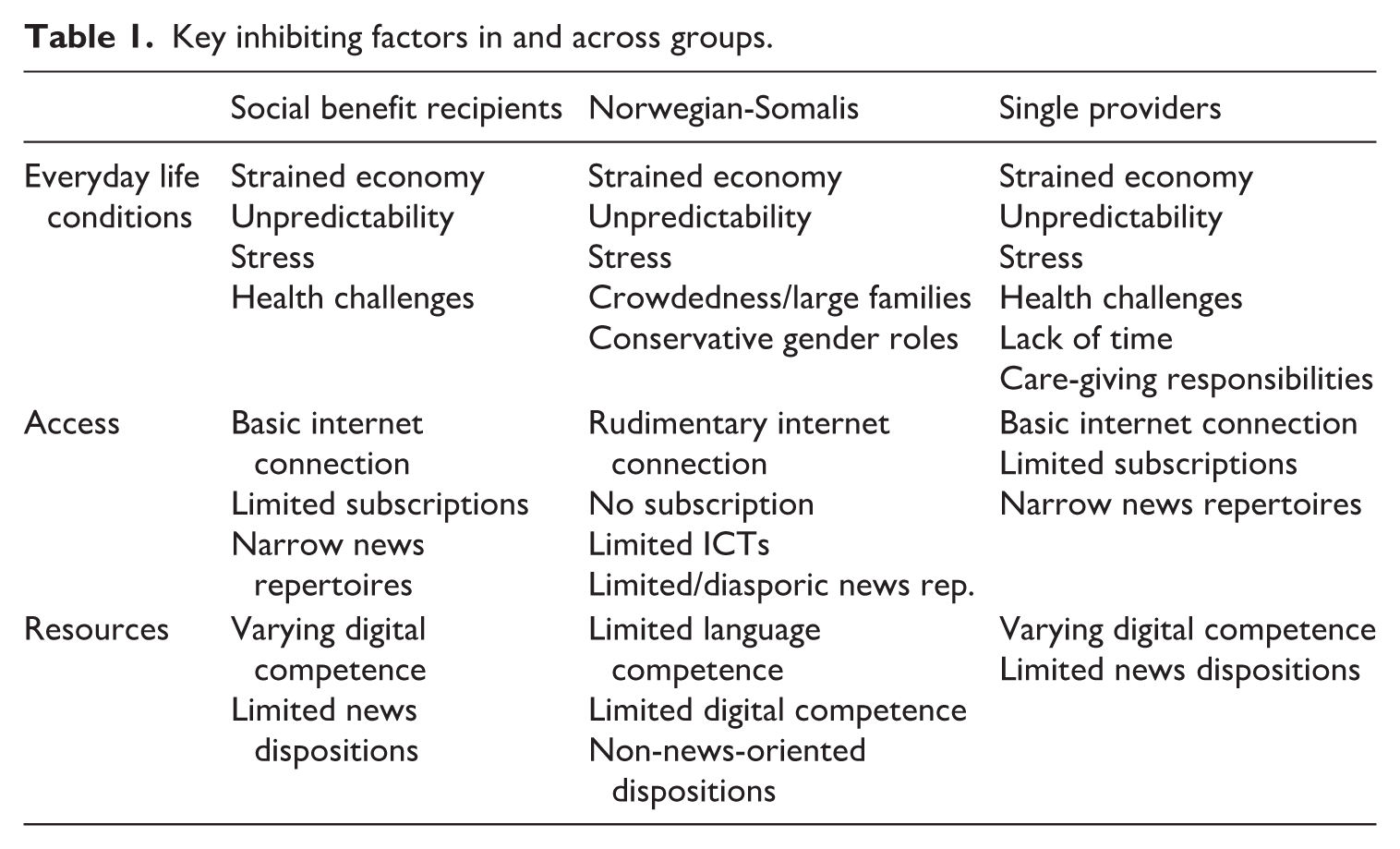
Starting with everyday life conditions, several key features emerge. Strained personal economy and hard economic prioritizing stand out as features of all the informants’ everyday lives. Stress connected to an often-unpredictable life situation in which they are economically dependent on others emerges as another pervasive feature. Likewise, many informants across all groups struggle with various health challenges. Importantly, all informants in this study live in a state of constant vulnerability (MacKenzie et al., 2014) in which they are susceptible to sudden changes in their everyday life conditions. A pervasive theme is unpredictability and insecurity: sudden health issues, changes in social benefits, or the breakdown of expensive but vital home equipment may have immediate and drastic consequences for the unfolding of their everyday lives. Thus, whereas most of the informants in this study live in conditions that secure at least a minimum threshold of possibilities for connective media use, they live in a state of vulnerability that may suddenly and drastically reduce these possibilities. The intensity of these vulnerabilities vary – from the relative stable lives of many of our informants to the direly unpredictable everyday life of a long-term undocumented refugee we interviewed. For the most disadvantaged informants, life in poverty involves a near-constant state of ontological insecurity (Giddens, 1991): their basic trust in that life as they know it holds together is constantly challenged.
Important to note, also significant experiential factors emerge as part of the informants’ everyday life. Psycho-social factors such as shame induced by social comparison with assumingly more well-adapted others emerge as a factor inhibiting participation on social media, particularly among the single providers. More gravely, many of the informants of migrant background articulated enduring anxiety toward the Norwegian child-protection services, which they fear will make intrusive measures into their families. A concrete consequence of this fear is their focused monitoring of news about child deportations and custody matters. Informants across all three groups articulate feelings of powerlessness and a negative sense of efficacy, in which keeping up with the news about society is seen as futile. Likewise, several of the informants of migrant background express feelings of displacement in which Norwegian news “are not for us.”
In contrast to less-affluent contexts than Norway, all informants can be said to have basic access to ICTs and content. For instance, all have a Wi-Fi connection, possess a smart phone, and have access to a television. However, as illustrated through the analytical portraits, possibilities for Internet connections may be unstable, equipment are old, and laptops and TV-sets are shared by many persons. Their access is thus best described not in terms of absolute, but gradual and relative first-level divides (Helsper, 2021): gradual because of the sometimes limited or rudimentary nature of their access, and relative because they have limited access compared to what is normal in Norway. Moreover, several critical and cross-cutting features emerge. First, a lack of subscriptions to streaming services and news is pervasive across the whole material. As highlighted in the analysis, subscriptions are not prioritized in life situations that are marked by economic hardship. Second, they have markedly limited access to potentially connective content. While there is considerable variance between informants and groups, their access to technology and content media only to a limited degree allows for repertoires centered on news and actuality, which arguably constitutes the most important media source for public connection. Important to note, many of the informants expressed explicitly that they wished they had better access to news. Last, in the absence of paid subscriptions, the free-of-charge public service broadcaster – the NRK – do emerge as an important source for news and actuality for many of the informants.
Lack of certain resources also cuts through the groups. Several critical dispositional factors emerge. First, dispositions toward news vary greatly within and across the groups. Some of the informants exhibit what appears to be deep-seated dispositions in which keeping informed through news is a naturalized and self-evident feature of everyday life. Others exhibit a limited understanding of what news are in the first place, not distinguishing professionally produced news from those produced by miscellaneous private or commercial sources, and a limited understanding of news’ ties to democratic processes. Second, and more generally, civic dispositions vary. While the majority of the informants express civic values such as the importance of voting and to have knowledge about what is going on society, many also express a sense of exclusion, which manifests in negative sense of political efficacy, indifference, and sometimes lack of trust of both media and politicians. Digital competence, to some degree, emerges as a factor inhibiting connective media use. While there are informants across the whole material that report past and present difficulties managing technical aspects of using ICTs or accessing content, many do not. Generally, in the sample, (high) age but also gender roles appear connected to the lack of digital competence.
The analysis also reveals how many of these aforementioned features have strong salience in specific groups. For the highly diverse group of social benefits recipients, all these features are salient, yet with considerable variation between the informants and several exceptions. For the Norwegian-Somalis, many of these features are more sharply accentuated. At the level of everyday life, their possibilities for connective use of the media are gendered and limited by economic hardship in combination with crowded housing and large families. Likewise, a lack of access to technology and content, and of connective media repertoires, is most pronounced in this group. In contrast to the two other groups, language challenges severely reduce their possibilities to make meaningful use of the Norwegian media to which they have access. And dispositions in which news usage and keeping updated is naturalized as part of daily life are markedly less pronounced. As illustrated in Table 1, the single providers share most features with the social benefits recipients. This attests to the similarity in living conditions found in these samples, but also underscores a more general point: how key factors such as hard-pressed economy, limited access to news, and lack connective media repertoires cut through the whole material. For the single providers, however, lack of time and stress in connection with raising often multiple children emerge as particular obstacles to their connective media use.
Conclusion: Toward a more substantive vision of media welfare
This article started by asking how conditions of poverty affect people’s possibilities to connect to the public and political world through their use of the media. It has premised that to study mediated public connection and poverty at close range, we need to move beyond the focus on access and digital divides and factor in the messier and compound reality of everyday life in poverty. To this end, it has argued that the perspectives of socio-digital inequalities and lifestyle are mutually enriching. Combining these perspectives, the article has developed the media poverty framework, a structured yet flexible framework that aims to explain how poverty translates into public disconnection.
Through the conceptual prism of the media poverty framework, the analysis has shown how everyday factors such as unpredictability, hard-pressed economy, and health problems limit the possibilities for autonomous use of the media. It has shown how scant access to content, news in particular, allows for only rudimentary monitoring of public issues and events. And it has shown how resource factors such as limited language competence and news dispositions reduce the possibilities and likeliness of making connective use of accessible media. As summarized in Table 1, some of these factors cut through all groups, and some are group-specific. Such deprivations are connected to more general group-specific varieties in life situations. For the Norwegian-Somalis, these are tied with overall and structural social exclusion; for the social assistance recipients, to generally precarious life situations; and for the single providers, to the cross-pressure between responsibilities and economic resources.
Owing to the relative affluence of the Norwegian context, most of the informants in this study live in conditions that offer at least a minimum threshold of possibilities for connective media use. However, a key insight from this study is that poverty induces a state of vulnerability in which these possibilities are fragile. Here, social theorists Mackenzie et al. (2014) usefully distinguish between potential and actual states of vulnerability, where the former designates states of being in which harms are likely to or may emerge, and the latter designates states of vulnerability that engender manifest and critical consequences. Both states are pervasive in the material. Although to varying degrees, all the informants in this study live in a state of potential vulnerability in which changes in everyday conditions or access may suddenly and drastically reduce possibilities to connect. And as illustrated in the analysis, such vulnerabilities routinely and concretely manifest in the form of, for instance, breakdown of laptops, phones, or TVs or the reconfiguration of everyday life due to immediate health or economic issues. In some cases, the confluence of such factors threatens to collapse the access to the public sphere altogether. And while such vulnerabilities are often both inherent (e.g. chronic illness) and situational (e.g. the breakdown of equipment), they may also be pathogenic (Mackenzie et al., 2014), in which institutions designed to support end up augmenting vulnerabilities. In the analysis, we have, for instance, seen how the social security system and child-protection services instill a sense of insecurity and sometimes fear in many of the informants.
While making causal inference between the preconditions identified in this study and the informants’ public connection is beyond the scope of this study, some qualified approximations can be made. Contingent with Helsper’s incorporation of third-level divides in her socio-digital inequalities framework, we can consider the public disconnection illuminated in this study as an outcome of everyday life conditions, access, and resources. None of the informants are absolutely disconnected in the sense that they do not have an orientation beyond matters outside their private sphere. For instance, all reported that they monitored major critical events such as the COVID pandemic. However, compared to findings from large-scale qualitative research on more advantaged citizens in Norway (i.e. Nærland, 2019), the informants in this study stand out with significantly less observable attention to, interest in, and knowledge of the topical issues in the public sphere. This is underscored by low reported usage of news in general, and of political news specifically. And to the extent that this attention is directed to the world of politics, it is more often toward issues of direct relevance to their own lives, thus indicating a narrower scope of public connection. These findings are supported by recent statistical research on media use and public connection in the poverty segment in Norway (Eimhjellen and Nærland, 2025), documenting that the low-income demographic on average has a weaker public connection than more privileged demographics, and this connection is critically weak in particular demographics such as young, unemployed immigrants and male social assistance recipients in rural areas. Consequently, and as conceptualized elsewhere (Ibid), the outcome of the deprivations highlighted in this study can be understood as relative public disconnection: the informants in this study have markedly less pronounced public connection than more privileged demographics in Norway.
There are, however, issues that complicate this picture. While preconditioning factors such as economic hardship, lack of access through subscriptions, and bad housing conditions are systematically connected to life in poverty, other factors are not. Conservative gender roles, large families, and care-giving responsibilities, for instance, stem from cultural expectations rather than poverty. What is revealed in this study is thus how the confluence of different factors, both poverty-specific and others, can inhibit connective use of media. As such, this study has highlighted the inherently intersectional nature of poverty. A variety of different factors such as income, gender, ethnicity, religion, and disability reinforce each other to augment different forms of marginalization – in this case, civic marginalization. This underlines the very point of the everyday life dimension of the media poverty framework: it entails a crucial openness to the multitude of factors that may combine on a day-to-day basis to inhibit possibilities for connective media use.
Moreover, this study has focused on mediated public connection. Yet as only alluded to in the analysis, there are also other sources for public connection. People may connect to political issues through cause-based organizational engagement, volunteering, or through talk with friends, family, and networks. It has centered on the use of news specifically. Although news constitutes a primary source for public connection, other genres also matter. Entertainment, fiction, and sport may spur attention to issues of collective importance (Nærland, 2020), and so may the plethora of content on social media (Søholt, 2024). Future research should attend more systematically to these aspects than this study has done.
Moreover, the media poverty framework privileges micro explanations of poverty-induced public disconnection. It thus needs to be complemented by perspectives that illuminate how poverty is structured and maintained by economic, institutional, or cultural macro conditions. Furthermore, the case of Norway lends itself first and foremost to countries sharing contextual features – in North-Western Europe, and the Nordics in particular. In regions where inequalities are greater, poverty is absolute, and with less functional digital and media infrastructure, its applicability is less clear-cut.
On a last note, this article addresses more fundamental questions about media and social policy. The current policy regime in the Nordic media welfare states is aligned with “resourcism” (Rawls, 1971) in that it is set up to secure equal provisions of goods to all citizens – in our case, access to media content and technology. Contingent with Amartya Sen’s (1979) critique of resourcism in his influential lecture “Equality of what?”, this article has shown that even a minimum access to media goods does not alone guarantee equality of neither opportunity nor outcomes. Through the media poverty framework, the article has elucidated how deprivations in everyday life and of resources critically limit impoverished citizens’ actual possibility to make connective use of the media goods accessible to them. Thus, a media and social policy committed to its own mandate of offering also the most marginalized citizens real and substantive possibilities to know about and act upon public matters of collective importance – what Van den Bulck et al. (2025) have termed “epistemic welfare” – needs to take into account the messier and compound reality of life in poverty illuminated in this study.
Footnotes

Ethical considerations
This study was approved by the national ethics board in Norway SIKT (809206) on 22.04.2022.
Consent to participate
All participants provided written informed consent prior to enrolment in the study.
Consent for publication
Informed consent for publication was provided by all informants in this study.
Funding
The author disclosed receipt of the following financial support for the research, authorship, and/or publication of this article: This research is funded by The Research Council of Norway (project number: 326033).
Declaration of conflicting interests
The author declared no potential conflicts of interest with respect to the research, authorship, and/or publication of this article.