






Abstract
This article addresses the issue of how team identity is constructed between two people during a series of regular meetings of a work group in Serbia. Using conversation analysis to investigate (multimodal) social actions, this study looks at the recurrent construction of an implicit team identity by focusing on management of speaking rights and co-construction of units, and displays of knowledge and accountability. With its longitudinal perspective, the article contributes to the existing body of research on teams in interaction in general, as it builds upon previous research on interactional parties and conjoined participation. The results are especially relevant for the investigations of teams in meetings, as they provide evidence of how formal features of interaction are recurrently employed to display institutionally relevant epistemics and accountability.
Keywords
Introduction
Construction of identities in and through interaction has been the object of study across several scientific disciplines in recent decades. In the theoretical framework of conversation analysis, investigation of identities is analytically related to the sequential properties of talk-in-interaction, or as Drew puts it: ‘Our relationship to one another and our sense of who we are to one another, is generated, manifested, maintained, and managed in and through our conversations’ (2005: 74). In other words, by looking at formal and sequential properties of talk – for example, word selection, topic selection and ordering of sequences – analysts should be able to ground their claims regarding properties of the inferential order of interaction, such as rights, obligations and expectations, that are constituted in the interaction. 1 These properties are, in turn, the basis for the analysis of social relations and identities. Identity is here defined in its broadest sense, in terms of who people are to each other (Benwell and Stokoe, 2006).
There are two different approaches that a conversation analyst can take when looking at identities in interaction. The first strategy would be the analysis of how members use certain identity labels in their interactions (e.g. grandparent, doctor, interviewer), and the documentation of the kind of interactional work that these invocations are employed to do (see Antaki and Widdicombe, 1998). The second approach invites the analyst to look at the constitution of action in interaction. In this case, researchers would investigate if and in what way the action, and the connected and implied rights, obligations, knowledge, etc. can be understood by the participants, and ultimately by the analyst, as doing ‘being a doctor’, ‘a grandparent’, ‘an interviewer’. Recent examples of studies that apply this approach to the investigation of identities in interaction are Pomerantz and Mandelbaum (2005) and Raymond and Heritage (2006). 2 Both analyses start from a concrete structural practice and/or action, and then connect their employment to participants’ orientations to particular identities. In the case of Raymond and Heritage, their focus lies in an assertion and orientation toward epistemic rights, while Pomerantz and Mandelbaum look into pairing of actions (e.g. using improprieties and answering by additional improprieties and/or laughter, to take just one example). These and similar explorations prove how valuable the integration of the sequential and inferential order is to the analysis of identities in interaction.
The present study adopts the latter approach. It started as an inquiry into the formal features of the investigated cases of meeting interactions, specifically, overlapping turns and pre-emptive and collaborative turn completions. Soon, it became obvious that if the study was to produce an analytically relevant account of the cases, it needed to document what the participants accomplished by employing these features in particular sequences. In the final step, this meant paying close attention to the identities that the participants were orienting to and making consequential. If one follows the described analytical steps in the proposed order, the invocation of identity becomes analytically grounded; it is the product of the analysis and not a ‘promiscuous introduction into the analysis that the writing needs for the argument in progress’ (Schegloff, 2007: 476).
Team as an implicit identity
One of the most relevant accounts that has spurred further analytical explorations of implicit identity constructions comes from Sacks’s analysis of ‘operative identity’ (Sacks, 1992, vol. 2: 327). Sacks analyses a piece of interaction during a family dinner involving a stepfather, his son and his daughter-in-law. The participants never call the stepfather ‘an old man’ and ‘a burden’. Nevertheless, Sacks argues persuasively that the participants as well as the analyst can easily infer such a category based on the analysis of performed actions. These actions are ‘do-able by virtue of series of relationships that are in play, such as whose place it is, who is being referred to, who is being instructed and so on’ (Benwell and Stokoe, 2006: 76).
‘Implicitness’ of the team in the current study lies in the fact that the participants in the recorded interactions never explicitly invoke the category ‘team’ in reference to the analysed two-person interactional unit. The label team has been chosen due to the analytical necessity to name a specific relational identity that is constructed and made consequential through the participants’ actions. What makes the team visible to the participants, and the analyst, is the way turns are co-constructed and speaking rights are managed. These practices in turn make a basis for negotiation of epistemic rights, personal authorities and mutual accountability. We now turn to these issues in more detail.
Interactional party, alliance and team
It is necessary to clarify the similarities and differences between the phenomena that I describe as ‘displays of team identity’ in the following analysis, and related previous research on interactional parties, alliances and teams. First, the constituting property of all these phenomena is that they pertain to interactions which involve more than two participants. All these units are instantiated by an ensemble of participants in relation to some other participant(s) who are not its incumbents. The issue of ‘directionality of address’ (Lerner, 1987: 213–15) is thus a key one, and should be kept in mind throughout the following discussion. Nevertheless, there are some differences between the notions of ‘interactional party’, ‘team’ and ‘alliance’, and these concern the focused level of interactional structure used to define them.
On the level of the turn-taking system, Schegloff (1995) introduced the notion of ‘interactional party’, arguing that the system is operational for any number of parties, which may be different from the number of participants. Schegloff used the notion to explain one type of overlapping talk that includes members of the same party. An important point here is that the status of a single interactional party does not imply that its incumbents take similar stances towards the sequence in progress. 3
On the other hand, scholars who have investigated ‘alliances’ (Ford, 2008; Kangasharju, 1996, 2002; Nikko, 2009) foreground the construction of alignment and affiliation on the level of turn and sequence structure. For the purpose of the current study, relevant practices on this level are collaborative constructions (see Eder, 1988; Falk, 1979; Ford, 2008; Lerner, 1992). Alliances are, not surprisingly, described in relation to stance-taking (e.g. negotiations, assessments).
Finally, when discussing ‘teams’, researchers often relate this term to a shared accountability for the produced action (Kangasharju, 1996; Lerner, 1993), in other words, a shared author/principal status (see Goffman, 1979). Such a status implies a range of different practices, not just the affiliating ones – members of a team may monitor and repair each other’s turns. Lerner (1987) has observed two interactional environments usually associated with participants’ teaming-up – story-telling and explaining. The present study analyses teams in just those sequence types. In addition, the current study attempts to document team practices across different interactions, and thus it demonstrates that a microanalysis of teams can incorporate a longitudinal perspective. Furthermore, the study investigates accountability in institutional interaction and epistemic authority (see, e.g., Heritage and Raymond, 2005) as the basis for team identity. We discuss this issue in the next section.
Team and institutional interaction
Scholars interested in institutional interaction have been discussing methodological challenges in documenting ‘institutionality’ of an interaction for quite some time. The initial interest in connecting institutional properties to formally distinct interactional patterns (e.g. Atkinson and Drew, 1979) has been subsequently supplemented by the interest in how ‘interactants display orientation to the institutional relevancies at hand’ (Arminen, 2005: 50). The interactional practices that will be described in the analysis – co-construction of turns and sequences – are in no way formally characteristic of meeting interaction, and have been first documented and described in mundane conversation (Hayashi, 2005; Lerner, 1987; Szczepek, 2000a, 2000b). Nevertheless, I will argue, following Arminen (2005: 50), that ‘practices do gain distinct meanings through their reflexive ties to the context and the institutional identities it makes relevant’. In the current study, team displays invoke institutional context as they are connected to displays of shared but independent access to institutionally relevant knowledge and information, and thus function as claims of work-related epistemic authority.
Data
The data for this study consist of approximately five hours of video-recorded meetings. The material comprises four consecutive meetings of an intranet editorial group in a multinational telecom company operating in Serbia. The language of meetings is Serbian. The meetings were filmed with two cameras placed diagonally in two corners of the meeting room, in order to capture the body and gaze orientations of the participants.
The editorial group meets regularly, once a week, and the meetings are the primary arena for the interaction of the group as a whole. The main task of the editorial group meetings is to create and keep up to date a publishing plan for the company’s intranet (e.g. they must decide what articles and information they will publish on the intranet portal, in what section of the portal and whose responsibility it will be). Another important task includes reporting on and evaluating published articles and the involved processes (e.g. how the information was obtained, who provided it, etc.). The meeting chair is Alex, 4 who is working in the communications department. This department has the overall responsibility for the management of the intranet. Dona is working in the same department and is co-operating with Alex on a daily basis. The rest of the meeting members are appointed from different departments throughout the company. Not all appointed members are present at all meetings, so the number of participants varies across meetings.
The analysis concerns Alex and Dona, who, I will argue, are acting and are recognized as a team in the presented examples. We will be looking at excerpts that include questions posed by other meeting participants to one or both of them, and the way such situations are dealt with. The interest in precisely these sequences has risen during preliminary viewings of the material. Initially, I sampled the cases of the chair’s involvement in overlapping talk. This initial sampling subsequently revealed some regularities regarding who the overlapping talk involved (predominantly Alex and Dona), but also the types of sequential environment where the overlaps occurred (e.g. story-telling, explanation sequences). This article presents four out of ten cases of coordinated team displays that followed a question directed to one or both team members. The examples illustrate the abovementioned sequential environment, and they provide proof of the involved accountability of team members vis-a-vis one another. Some other types of interactional environments in which the team is made relevant are also present in the collected material (e.g. joint argument building and team conferring), but these collections are not represented in this article.
Analysis
Example 1
The first example is an excerpt including the following participants: Alex, Dona, Sandy and Lens. Two other meeting participants are present at the meeting, but do not participate in this excerpt (see Figure 1 for the layout of the room and identification of the participants). Sandy has just finished delivering her story about some trouble at a meeting that she had previously attended (the others had not attended this meeting). In the excerpt, she talks about a problem caused by new video-conferencing software. The transcript 5 features a story-telling sequence, 6 which is prompted by Sandy and then co-constructed by Dona and Alex. Their story concerns the trouble that the Chief Executive Officer (CEO) of the company, Ken, had experienced using the same software.
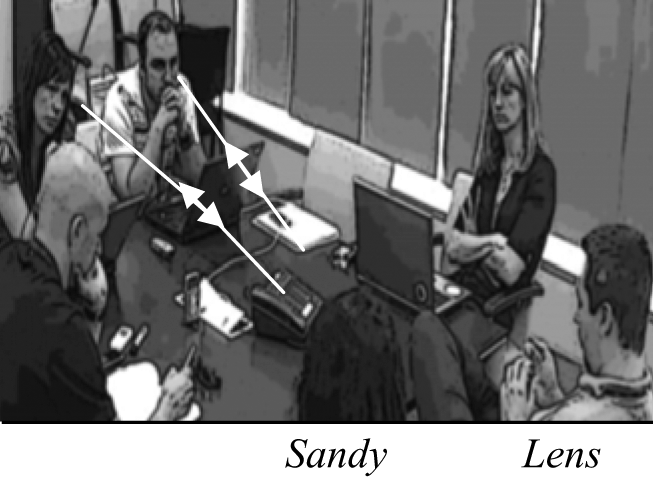
Lines 1–5
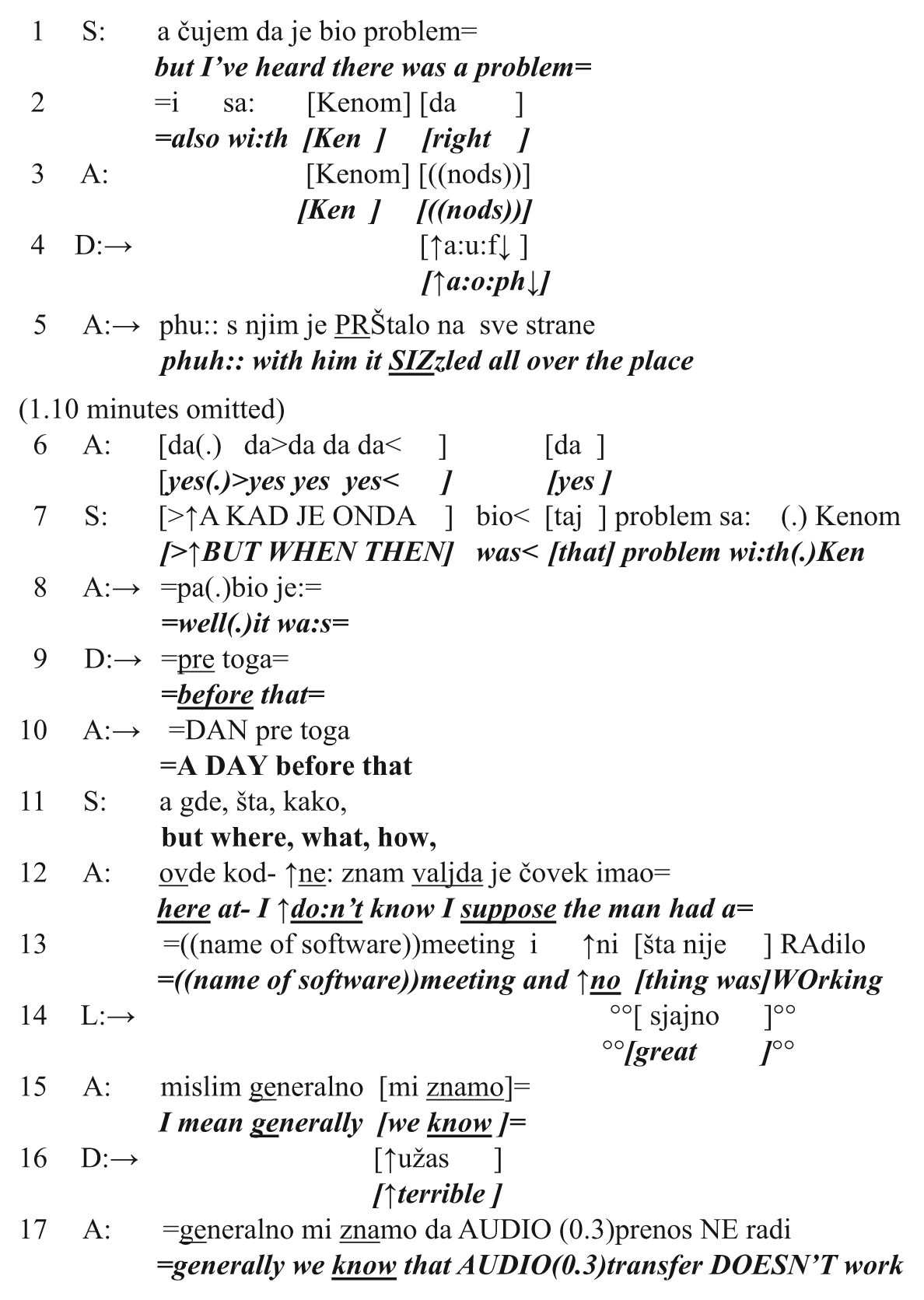
In lines 1 and 2, Sandy initiates a new sequence, using a ‘fishing device’ (Pomerantz, 1980). Sandy’s gaze is directed first at Dona and then at Alex, constructing them both as legitimate recipients of her question, creating an opportunity for their participation as one party (Sandy’s gaze direction was documented by the other camera in the room). In return, both Dona and Alex respond as legitimate recipients (lines 3, 4 and 5). On the one hand, Alex takes up Sandy’s prolonged delivery of ‘with’ in line 2 as a sign of word-search, and collaboratively completes her turn. On the other hand, Dona launches her turn in line 4, latching on to Sandy’s and Alex’s overlapping delivery of the trouble word (Ken). Dona produces ‘aoph’, using auditory resources and facial expression that come across as an evaluatively loaded exclamation that confirms the proposition of Sandy’s turn – something that could be glossed as ‘there indeed was a big problem’. In providing this condensed reply, Dona both refrains from speakership, and displays knowledge about the event in question, showing that she could have the necessary epistemic grounds for providing the elicited story. Alex accomplishes the same confirming action with a nod, then he starts his turn immediately after Dona’s, initially copying Dona’s use of vocal resources and facial expression (‘phuh::’ in line 5), and then elaborating on it by following with the story preface, ‘with him it sizzled all over the place’. In just a few seconds, Dona and Alex manage to accomplish a display of knowledge of the event that each of them has had on their own, and each is able to provide an assessment of the event, as well. Their independent assessments come across as congruent, without any displayed conferring – their gazes and bodies are orientated towards Sandy throughout this segment (see Figure 1 for an illustration of the embodied modes of interaction; arrows mark the projection of the direction of the gaze and the caption connects the illustrated orientations to the relevant lines in the transcript). What we can notice is that Dona and Alex are simultaneously interacting with Sandy, but also with each other. While their eyes and torsos are oriented towards Sandy, they nevertheless closely monitor each other’s actions, and adapt their productions accordingly.
After this point, the talk about the CEO’s problem with the software is left temporarily in favour of a side sequence. One minute later, Sandy returns to the main sequence in line 7. This creates yet another opportunity for conjoint participation by Dona and Alex, as Sandy requests additional information on the event about which both Alex and Dona have previously claimed knowledge. While Sandy utters the question ‘but when then was that problem’, both Dona and Alex look at her. Sandy is looking at Alex. Right after the word ‘problem’ has been articulated, Dona starts to turn her head towards Alex (illustrated in Figure 2). In this way, she aligns with Sandy’s choice of recipient and disassociates herself from the role of a potential answerer. She also creates a participation framework in which Alex can act as a spokesperson for both of them. However, even though she is not voicing the response herself, she is closely monitoring Alex’s response. All it takes is a prolonged delivery of ‘was’ in line 8 for her to come in with the collaborative completion 7 ‘before that’. Dona provides the very information that was the focus of Sandy’s question. Her intonation is falling and assertive. The turn is thus not a listener’s attempt at guessing what the speaker, Alex, was about to say; rather, it is a co-teller’s and co-author’s completion. Alex acknowledges Dona’s turn as a pre-emptive completion in his next turn (line 10), as he repeats it (see Lerner, 2004: 231), but he also adds something to it, making it more precise. The design of his turn displays Alex’s acceptance and confirmation of the validity of the information provided by Dona, and thus her epistemic authority on the issue. However, at the same time, the very fact that Alex produces a turn that confirms Dona’s completion, asserts his own authority over the action (see Lerner, 2004: 250, note 2). Dona continues to direct her gaze towards Alex and monitors his next turn in lines 12 and 13. Right before Alex completes his turn, Lens produces a story receipt, an ironic ‘great’ (line 14). Alex does not attend to this assessment and continues to produce an account in line 15, but Dona orients to Lens’s turn. She turns away from Alex and towards Sandy and Lens, and in line 16, produces her own assessment of the event, ‘terrible’ (see Figure 3). What is interesting to notice is that Lens reacts as a story-recipient, directing his assessment towards the story-teller, Alex, while Dona directs her assessment to the story recipients, Lens and Sandy, taking once more the footing of a co-author and co-teller. Alex constructs his response as a more or less factual report of what happened, while Dona delivers an evaluative comment. Eder (1988) has analysed the practice of sharing the narrator’s role, and has argued that ‘evaluative comments carry more weight when expressed by a second narrator than when the same person gives the description’ (1988: 229). Dona thus displays the authority to evaluate the event as an author, and she explicitly aligns with, and ‘gives weight’ to, the negative evaluation that Alex’s account projects.
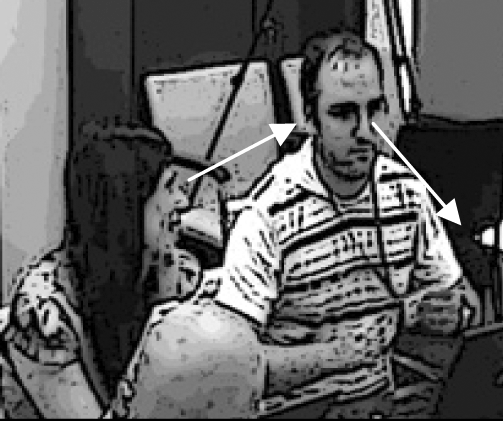
From line 7 ‘Ken’ to line 15
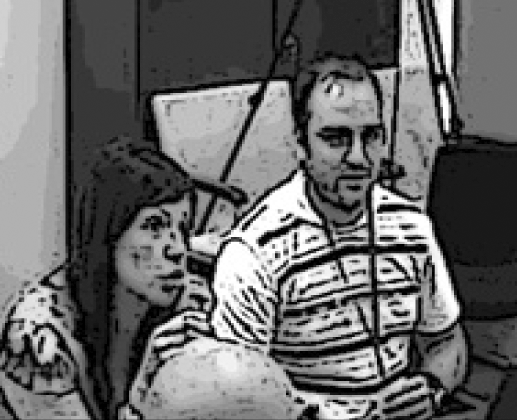
Lines 15–17
The analysis of the above example shows how initially, Sandy treats Alex and Dona as a single party in interaction, meaning that either one of them could potentially answer the question. This initial actualization of one-party status is then confirmed by coordinated joint story-telling, in which both Alex and Dona monitor and ratify each other’s contributions, while they display independent epistemic authority on the subject of interaction, as well as a co-authors’ footing and an aligned evaluation. To achieve this, they co-deploy language resources, body orientation and facial expressions.
Example 2
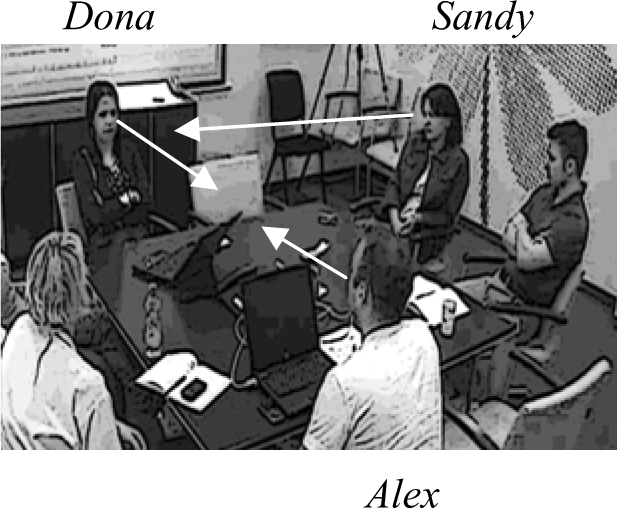
This excerpt, from a different meeting, is a closing of a two-and-a-half-minute-long reporting sequence. Dona has reported on a project that should communicate to both the employees and to the general public facts about electro-magnetic emissions from mobile network base stations. In the final phase of the sequence, Dona offers an assessment of an information brochure that was one of the outputs of the project. The active participants are Dona, Alex and Sandy (see Figure 4).
Lines 2–4
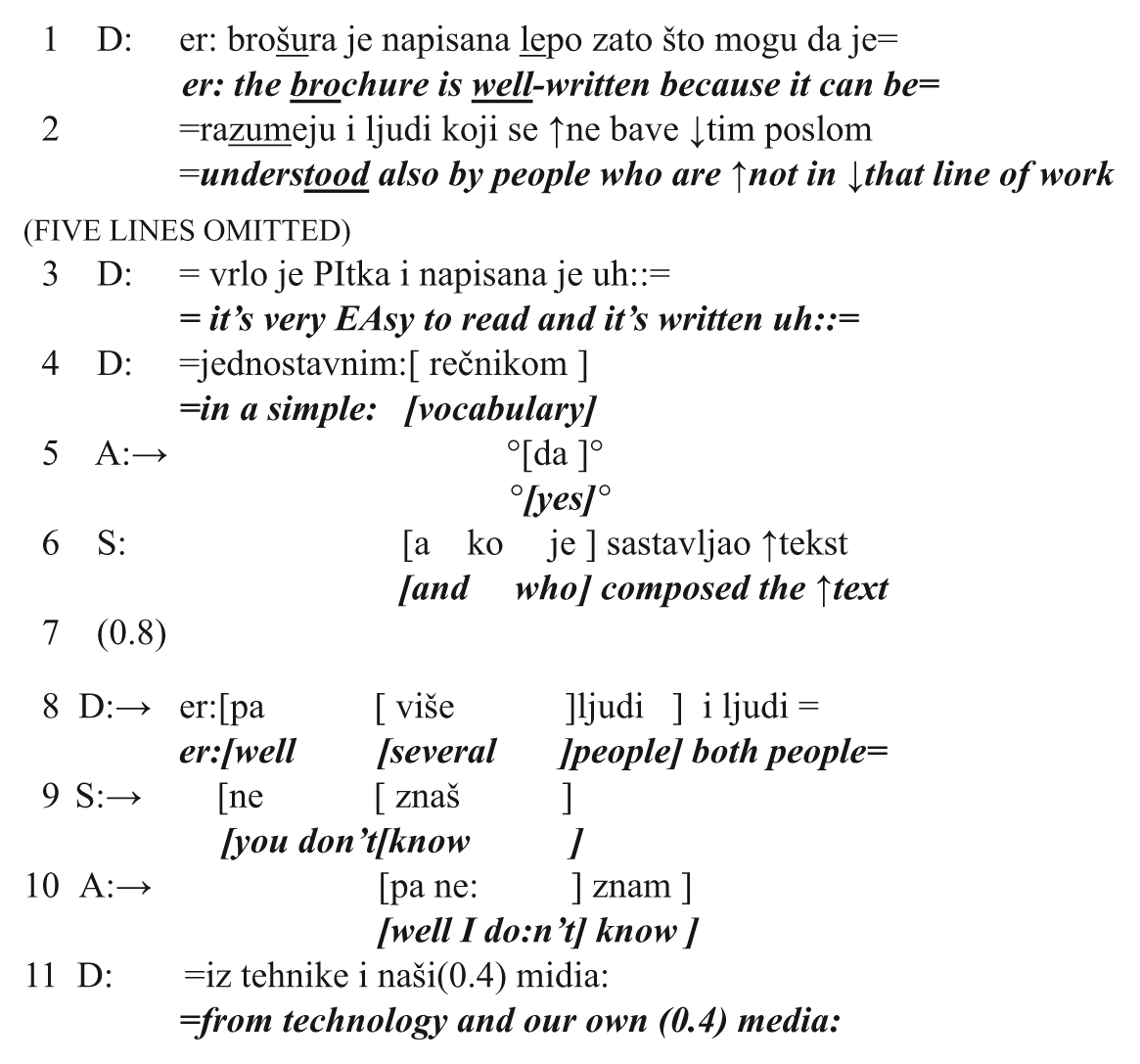
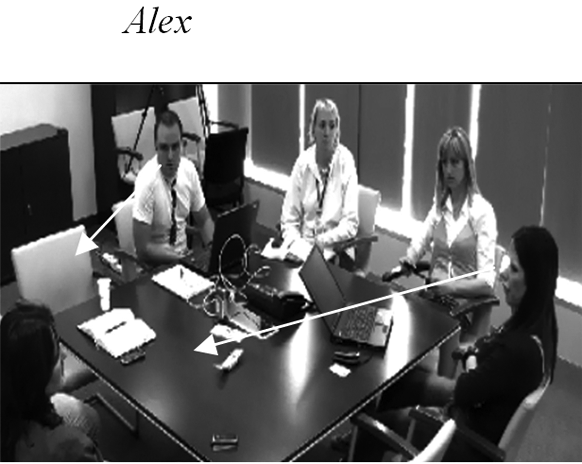
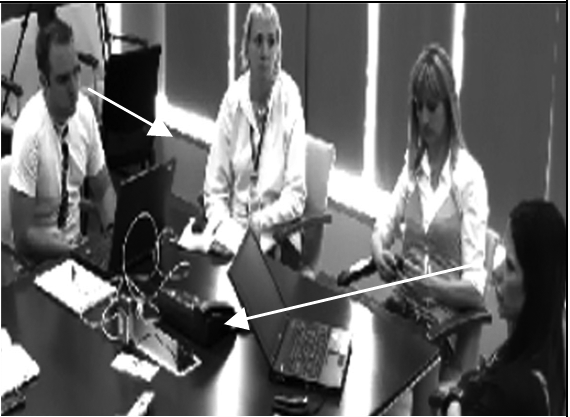
While she is uttering her assessment (turns 1 to 4), Dona is looking at Alex (see Figure 4). Alex responds by producing an agreement token ‘yes’, which claims access to the assessed referent (Pomerantz, 1984). Alex presents himself as someone who is informed about the brochure and is supporting the assessment that Dona has supplied. Sandy then directs her request for additional information in line 6 to Dona. Alex and Dona reorient their gaze and posture towards Sandy (see Figure 5). The following 0.8-second pause is something both Sandy (line 9) and Alex (line 10) treat as a sign of interactional trouble. Their respective ways for dealing with it are, however, markedly different. Alex monitors Dona’s actions. During the pause in line 7, he turns his head to Dona (see Figure 6), and can see that she is fully attentive to Sandy and still does not produce an answer. Alex treats himself as accountable for providing an answer when Dona does not, even though he cannot supply the requested information (line 10). Sandy, on the other hand, keeps her eyes on Dona throughout the excerpt. Sandy’s solution to the trouble is to propose a candidate answer (i.e. Dona’s lack of knowledge on the issue) (line 9).
Line 6 from ‘who composed’
Lines 7–11
This example bears some resemblance to the previous one, where Dona ‘helped Alex out’ (Example 1, lines 8–9). In this case, however, Alex does not display access to the required information. This example illustrates Alex’s interpretation of his accountability as a ‘team member’ in relation to Dona. Alex was not the chosen legitimate recipient for Sandy’s question, but his previous ratification of Dona’s assessment of the brochure in question constructed him as potentially ‘knowledgeable’ on this matter. When Dona hesitates in providing the answer, Alex treats himself as accountable for providing one. As he does not have the requested information, he offers an account of why he is not able to provide it. His account is directed at Dona, as he directs his gaze at her in lines 7 to 11 (Figure 6).
Once Alex has displayed knowledge of the brochure and ratified Dona’s assessment, his team member identity is made relevant. This relevance then becomes consequential in the next interactional step – handling trouble as a team.
Example 3
The next example is from the same meeting as the previous one, about half an hour later. It is an excerpt from a longer reporting sequence. Dona is reporting to the group on how she obtained the information about a charity initiative, involving employees donating their March 8 coupons. 8 Dona has informed the group that the initiative needed approval from a certain manager, Kayla, before it could be implemented, and before Dona could write an article about it. Kayla is the director of the company’s foundation, which is in charge of all work involving corporate social responsibility in the company. The transcript starts in the middle of Dona’s report, when Sandy asks for additional information on why Kayla needed to approve the initiative.
EXAMPLE 3 (DONATION)
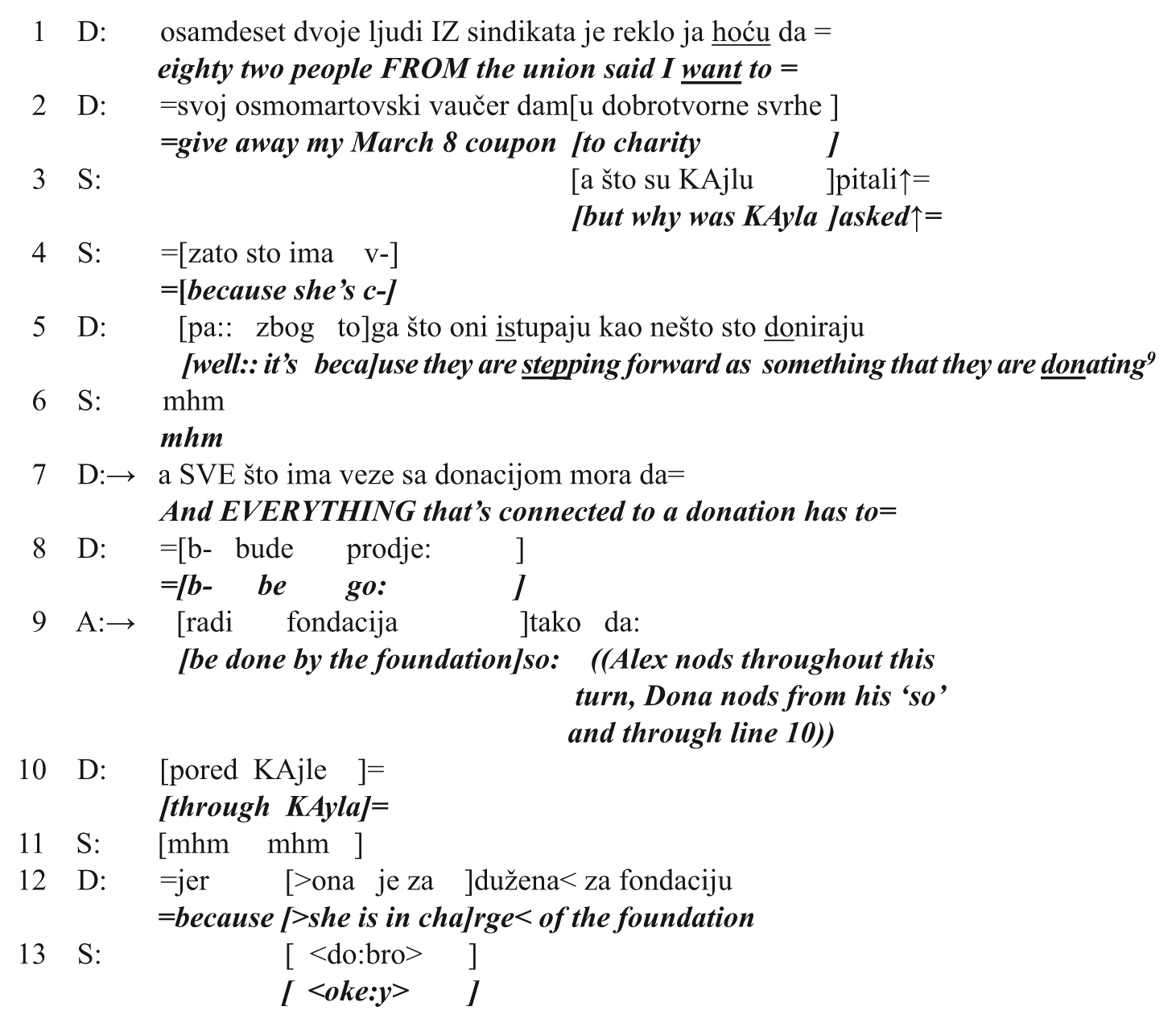
At the start of this excerpt, Dona is oriented toward Sandy as her primary recipient. Alex is sitting next to Dona and working on his computer (see Figure 7). Sandy’s question in line 3 is a request for information that disturbs the progression of sequence as projected by Dona. The topic of Dona’s turn has obviously moved away from Kayla. When Sandy utters ‘Kayla’ in line 3, Alex looks up at her (as shown in Figure 8). His action does not interfere with Dona’s next turn, but it signals the change in Alex’s focus, from looking at his computer to following the talk between Dona and Sandy. 10 In Goffman’s (1979) terms, the participation framework has changed, as Alex is no longer a bystander but has made himself available as a participant. As Dona delivers her answer (lines 5 and 7), Alex is still looking at Sandy as he launches his turn in line 9, fitting his completion to Dona’s turn in progress. Grammatically, his turn is designed as a collaborative production (Szczepek, 2000a) of Dona’s turn construction in line 7. Furthermore, the information that he offers is what Dona herself takes up in continuation of her account in line 12. Both Alex and Dona are facing Sandy as their recipient the whole time (as illustrated in Figure 8), but they also orient to each other’s contributions, as they ratify them by nodding (as illustrated in Figure 9). Alex nods throughout the overlap. Dona joins in at the transition relevant place in line 9, after ‘foundation’, and then she produces the last segment of her own turn – ‘Kayla’ in line 10.
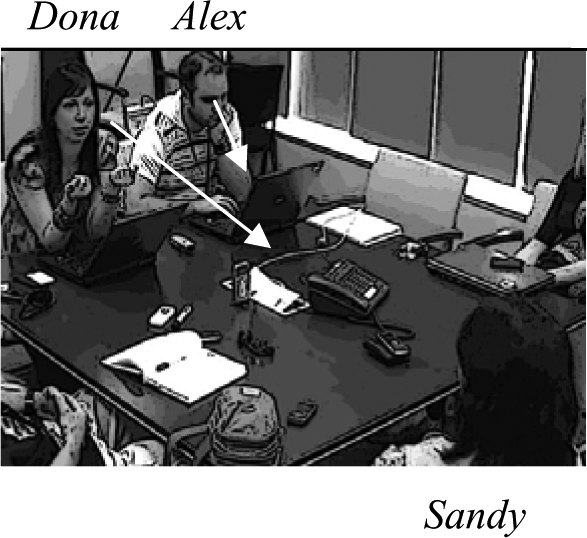
Lines 1–3 (the arrows illustrate gaze direction)
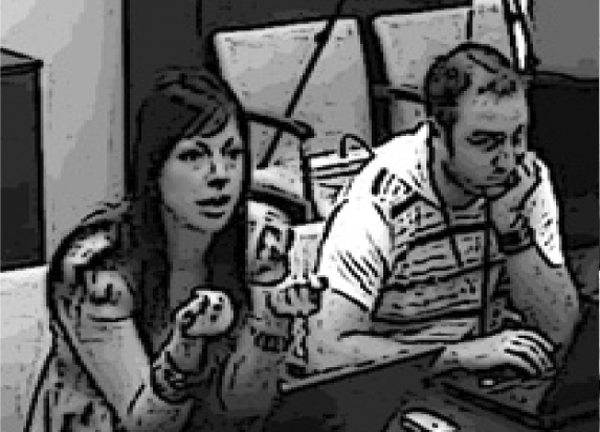
Line 3 ‘asked’
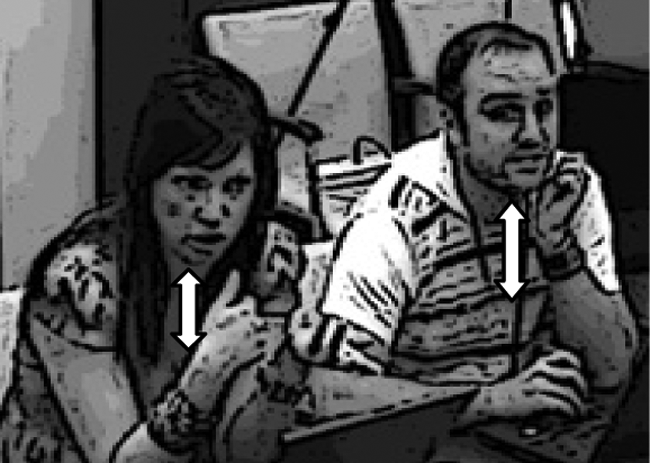
Line 9 (the arrows illustrate nods)
If we compare this example to the previous one, we see that Alex is not taking a turn as a reaction to the trouble that Dona as a team member is having in answering the question. Here, he is supporting the argument that Dona is making. Alex treats Sandy’s interference with the projected continuation of Dona’s turn as relevant for his participation. Sandy’s question concerns an institutionally relevant issue – the authority of one particular manager. Alex’s co-construction of the explanation in the form of a collaborative completion displays his independent knowledge on ‘how things work’ in the company, but it also supports Dona’s argument, as the collaboratively completed part of the turn contains information that is displayed as knowledge which Dona and Alex share.
Example 4
So far, we have looked at examples where Dona and Alex use collaborative sequences to both claim personal epistemic authority and orient to the team without any displayed conferring. The following example, however, illustrates how Dona and Alex negotiate on-the-record what the correct answer to a question is and who will take the role of answering on behalf of their team. Dona and Alex once again function as a single party. Their joint answer occupies several turns. The sequence starts with Alex’s initial answer to Jane’s question, continues into different and overlapping accounts, and ends up with Dona and Alex acknowledging and ratifying each other’s accounts.
The editorial group is discussing how to organize sitting and catering for an upcoming company-internal event called ‘Let’s talk’. 11 The communications department has the main responsibility for organizing the event, but members of the editorial group are also included in its planning and implementation. The transcript starts when Jane directs a question to Alex and Dona regarding registration of attendees.
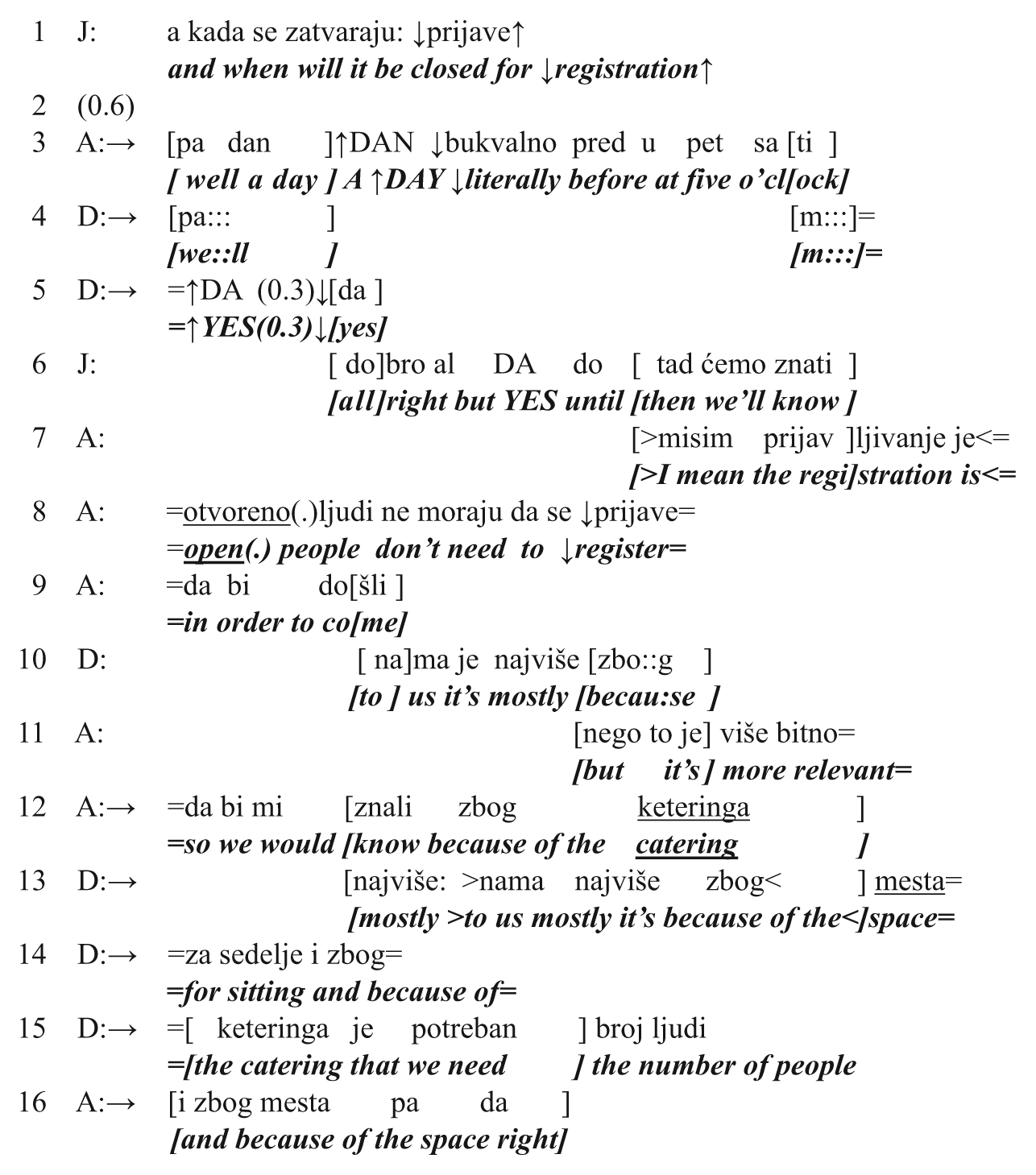
Jane treats Alex and Dona as a single recipient party by directing her gaze first at Dona (Figure 10) and then at Alex (Figure 11). There is a 0.6-second pause in line 2, and then both Dona and Alex initiate turns ending up in an overlap, which is resolved when Dona drops out of her turn and Alex finishes his. However, at the end of his turn, when Dona utters a hesitation marker ‘m:::’ (line 4), Alex reorients his body and directs his gaze at Dona, and she subsequently ratifies his turn in line 5 (see Figure 12). Dona keeps her gaze on Alex throughout this turn. Lines 3 to 5 can be interpreted as a display of an on-the-record team negotiation of the answer to Jane’s question. Jane’s turn in line 6 is a candidate closure of the sequence, and is directed at Dona. However, Alex expands the sequence by elaborating on his previous answer (lines 7–9). The recipients, however, can treat this elaboration as being in conflict with the information previously provided, that is, that the attendees will be registered and that there is a deadline for applying. Dona initiates an account (line 10), which explains the discrepancy, but then the floor is reclaimed by Alex (line 11). Alex’s turn initiation marks the beginning of a ‘negotiation phase’ of the co-constructed sequence. The negotiation concerns the content as well as the rights to the floor. Both Dona and Alex refer to ‘us’ in their competing turns, making it a negotiation on who gets to represent them both. During the overlap in line 11, Alex looks at Dona, and then reorients to Jane for the rest of his turn. Dona has lost the attention of her recipient Jane, but her repetitions and restarts in line 13 signal that she is not giving up her turn. Her attempts at claiming the floor are recognized by both Alex and Jane, who reorient to Dona as soon as Alex has uttered ‘catering’ in line 12. At this point, it is clear that Dona and Alex have provided discrepant accounts of why it is important for them to register the attendees. In the subsequent phase, Dona and Alex re-establish affiliation. Dona orients to consensus by incorporating Alex’s account as she continues her turn in line 14. Alex initiates a new turn in overlap, echoes Dona’s ‘and because’, and explicitly acknowledges her contribution in line 16 by building it as an increment to his previous turn.
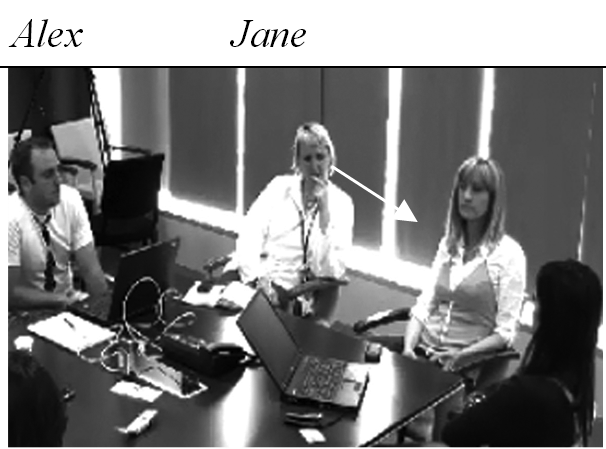
Line 1 ‘when . . . closed’
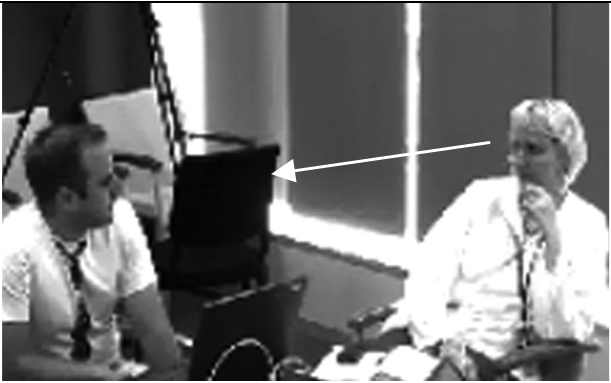
Line 1 ’for registration’

Line 4 ‘m:::’ to line 5
This example reveals that the shared but independent epistemic authority, which is the basis for team formation, can at times lead to negotiation between team members. Interacting as a team is an achievement, and this example shows how both members work to re-establish joint participation after the initial negotiation on what is the joint position.
Discussion and conclusion
The main goal of the present analysis was to provide a detailed empirical investigation of the way in which a range of previously identified practices for making a team relevant in meetings are combined with interactional management of epistemic rights and accountability. The result is the description of recurrent patterns across different meetings that provide for talking about the team as a type of identity. The analysis has included both embodied and linguistic modes of interaction, which enabled the central finding – Alex and Dona orient to each other and are treated by the other participants as a team; this is accomplished as much by body and gaze orientation and nodding, as through talk. In the following, I will summarize the identified features that can be relevant for future investigations of teams in meetings.
The first of the issues to discuss in connection with team displays is the status of a single interactional party. The presented excerpts were identified against a backdrop of numerous sequences in which Dona and Alex each participate as a party for themselves. The single party status is a result of a negotiation between party incumbents, but also between them and the rest of the group. Functioning as one party is an accomplishment. It can be made relevant by participants outside the party through forms of address and/or gaze direction (see Lerner, 1993) – as is the case in Examples 1 and 4 – or it can be made relevant through actions which party incumbents initiate themselves (Example 3). However, single party status is not the same as team status for two main reasons. First, single party status can be based on local interactional contingencies; for example, newcomers can treat all those already present as one party (see Schegloff, 1995). Second, party incumbency relates only to speaking rights, but does not include shared authorship of an action, which is the crucial feature of team displays.
This brings us to the second important element in team instantiations – shared accountability in relation to other meeting participants. The present analysis focuses on the way that team members co-construct actions by orienting to each other’s contributions. It provides examples of how co-constructed completions receive ratification, and how one member’s assessment or provided information is supported by the other. Sharing authorship in explaining and story-telling sequences has been documented in earlier research on conjoined participation in conversations (see Eder, 1988; Goodwin, 1984; Lerner, 1992). Such sequences are present in the current study as well. However, the presented analysis has revealed one more interactional environment that seems to be relevant for team displays in meetings. In Examples 3 and 4, the team was enacted in order to deal with some kind of interactional trouble – in this case, Sandy’s trouble in understanding Dona’s report in Example 2, and Sandy’s interference with Dona’s projected course of action in Example 3.
In addition to the previous point, team members may also display accountability in relation to each other. In Example 3, Alex offers an account to Dona when he is not able to provide what he treats as expected supporting action. Such explicit orientations toward accountability between team members might provide a useful test in future research devoted to teams, as it can help discern ‘incipient teams’ (Kangasharju, 1996) from teams that are established and developed across different occasions.
The next issue to be discussed is epistemic authority. This issue is closely connected to the institutional character of the analysed interactions. The analysis has shown that the other participants infer that Alex and Dona have shared knowledge on a certain issue, when they address their questions to both of them. This inference has roots in the institutional context of the meetings, and the institutional roles that Alex and Dona have. However, the way Alex and Dona manage these inferences is a local interactional process. Across the presented excerpts, I have shown the subtle negotiations and adjustments that both of them make in order to display epistemic authority independent of one another, but also to support and ratify the other’s contributions. Sequentially, this is accomplished by employing and responding to collaborative completions. When one of the team members produces collaborative completions of the other member’s turns, these contain information that is crucial for the current sequence (Examples 1, 3 and 4). In this way, they display personal knowledge on the current subject. On the other hand, the member whose turn is completed by the other nevertheless provides his/her own completion as well. This is done in a way that both acknowledges and confirms the other’s contribution (by repeating or rephrasing it), but at the same time, the original speaker completes his/her own turn, and thus reclaims epistemic authority.
Finally, a note should be made on the recurring character of the team displays and the basis for the claim that a team can be studied as an identity construction (Pomerantz and Mandelbaum, 2005). The study presents a claim that a team is a complex phenomenon found in the cross-section of management of speaking rights, turn constructions and displays of alignment and authority. None of these practices are team-specific or enough on their own to account for the existence of a team. However, when they are combined and employed across interactions, they provide evidence of a more enduring association than contingently constructed interactional parties and alliances. On the level of a single sequence, teams need to be ‘activated’ in order to become consequential for the interaction. If teams are based on epistemic authority, as the one described here, it seems that once activated, team displays remain potentially relevant throughout the particular sequence. In the case of a story-telling sequence, the co-teller monitors and can intervene until the story-telling is closed (Example 1). If it is an explanation of some issue, team incumbency is potentially relevant until the topic changes. Further research is needed on this issue.
By taking an inductive approach, the analysis has discovered a team that is produced and maintained through interaction. Its implicit nature means that participants do not talk about it. Nevertheless, by tracing specific interactional practices that both team members and their co-participants employ, we can show how the team is made ‘visible’ and consequential in interaction.