







Abstract
The article examines how discourse participants use language, the body and the local interactional and material context in the construction of offers. The data consist of eight hours of video recordings of everyday interactions in English and Finnish, and conversation analysis is used as the method. We focus on offers that make available to the recipient some concrete referent or material object or artifact in the current situation, that is, ‘concrete offers’. The article shows that such offers can be conceptualized as consisting of two interlinked actions, one identifying the referent and the other explicating the offer. The article further argues that the frequent accomplishment over time of such complex actions may contribute to the emergence of a set of social action formats for offers. This action combination is explored by discussing offers that range from fully linguistically articulated ones, to types where embodied actions take an increasingly central role.
Keywords
Introduction
Prior research within conversation analysis has established the reflexive relationship between language, embodiment and the surrounding material context (e.g. Goodwin, 2007), but not much research exists that shows how the three feature in the co-construction of a specific social action. This article advances such research by examining how discourse participants use language and the body as well as the local interactional and material context in the construction of a specific social action, namely offers. We focus on offers that make available to the recipient some concrete referent or material object or artifact (either visible or not visible) in the current situation, that is, ‘concrete offers’. The article shows that such offers can be conceptualized as consisting of two interlinked actions: one action identifies the referent, often by focusing the recipient’s attention on it, while the other explicates the offer. The article further argues that the frequent accomplishment over time of such complex actions may contribute to the emergence of a social action format, or rather, a set of formats, for offers. This action combination (or complex action linkage; Ford, 2002) is explored by discussing offers that range from fully linguistically articulated ones, to types where embodied actions take an increasingly central role.
By social action formats, we understand conversational formats for enacting particular activities (Fox, 2000, 2007) that encompass language, embodiment and space, and to various degrees also mobility (though the latter is not at issue here). In line with Fox (2007) and Couper-Kuhlen and Thompson (2005, 2008), we maintain that such recurrent conversational routines originate in the interactional needs of participants in talk- in-interaction. We will present evidence from the sequential, linguistic, prosodic and embodied production of concrete offers, that is, the different modalities working together to co-construct these action combinations. Such interlinked actions are essentially viewed as contingent accomplishments between speakers and recipients. As a consequence, mutual monitoring of participants (Goodwin, 1980) in terms of trajectories of gaze and orientation to the spatial location of the participants and the object of offer will be attended to in the analysis. Recent research is beginning to show that instead of treating action formats as fixed products, we should acknowledge the process-like nature of action production, and the situated and multiple interplay between verbal and bodily-visual formations (Ford, 2011).
Previous linguistic-interactional research on conversational formats
A large body of research on conversational formats can already be said to have existed in the 1980s, variously calling them conversational routines, gambits, prefabricated speech, lexicalized sentence stems, ritual illocutions, and so on. Similarly, Curl (2006: 1258–1259) observes that ‘[t]he idea that discourse or conversational use can shape and influence syntax or grammar goes back some 25 years at least’, and that some work in this vein has shown how certain grammatical formulas are used to accomplish particular actions such as complimenting.
A newer body of work aspires to extract not only the recurrent linguistic formats of conversation, but also their sequential–interactional functions. For example, Thompson and Couper-Kuhlen (2005) observe that the favorite linguistic unit, clause, is in itself an interactional resource, used by interactants to project what actions are being done by others and to subsequently act on these projections. And Goodwin and Goodwin (1992) were among the first to propose that there is an action format for doing assessments: [proterm] + [copula] + [(intensifier)] + [adjective]; for example, they’re so nasty. Further, several studies deal with routinized conversational patterns that perform one or several social actions. Thus, pseudo-clefts are regularly used to alert listeners, and consist of [wh-clause] + [focus], as in what we need to do, is this board has to realize (Hopper and Thompson, 2001, 2008). Extrapositions are found to assess situations and events and to consist of [assessing phrase] + [assessable]; for example, it’s great that we got in for free though (Couper-Kuhlen and Thompson, 2008). Similarly, negative interrogative constructions such as it’s kind of smelly, isn’t it and isn’t that weird have been shown to contain a high degree of formulaicity and be used to challenge, assess and request for confirmation, among others (Keisanen, 2006); concessive repair is used to preface disagreement and create agreement; for example, but even privately owned places here are so characterless, I mean by and large. Outside the Village they are (Couper-Kuhlen and Thompson, 2005); extension-type turn increments are used to continue the action of the turn, An’ how are you feeling? these days, while unattached noun phrases are often found as turn increments that assess or take a stance, She had it [i.e. baby] yesterday. Ten pounds (Ford et al., 2002). Indeed, Fox (2000) is among the first to suggest that a social action format may be quite diffuse and range over several clauses or utterances; for example, understanding checks and cases of other-initiated repair are often prefaced by I mean, while the subsequent utterance contains a negation and a certain range of pronouns. She claims that grammatical organization is very closely tied to sequential location. In more recent work, Fox (2011) further emphasizes the contingent nature of grammatical formats as recurrent situated practices for formulating turns-at-talk.
Overall we may conclude that there is a great deal of regularity and routinization to be observed in the way we perform and verbalize certain recurrent actions in talk-in-interaction; the regularity is to be found at the level of individual clauses and clause constituents, in combinations of two clauses, and even beyond.
Objectives and data
Our aim is to extend the study of social action formats to also include their embodied realization, as well as the surrounding material context of talk in the analyses. Simultaneously, we begin our research from types of action (e.g. ‘greeting’, ‘noticing’, ‘offer’) and explore the different linguistic, prosodic, embodied and other turn constructional means for their accomplishment, and the possible division of labor in interactional work between them.
The data used in the study comprise some eight hours of videotaped casual face- to-face conversations in English and Finnish from the Oulu Video Corpus of English at the University of Oulu, and from the Conversation Data Archive at the Department of Finnish, Finno-Ugrian and Scandinavian Studies, University of Helsinki. The data are transcribed according to the Discourse Transcription conventions by Du Bois et al. (1993), with the intonation unit (IU) as the basic unit of transcription (such that one line equals one intonation unit; please see Appendix A for transcription symbols). Embodied actions are mainly shown through screen shots, but some key actions are also included in the transcripts (in
We will start by introducing in the next section, an action template for offering activity in spoken language, which involves two paired actions: the identification of the referent and the actual offer. Continuum of offers section then presents the full continuum of concrete offers emerging from the video recordings used as data for the present study, in terms of the linguistic forms and embodied actions deployed by the participants. We start from the linguistically full form that involves two linguistically articulated actions. We then discuss types of offers where the first part is done only through embodiment, and the linguistic form is no longer a complex sentence but a one-clause format, then move on to offers which are done exclusively through embodied actions.The final section presents some concluding remarks on the interplay of language and the body in the accomplishment of these action combinations.
Social action formats for offering
This section introduces an action template for offering activity in spoken language, consisting of two interlinked actions. Such sequences of actions typically consist of a first action, which identifies the referent or object of offer, and a second action, which explicates the offer.
Curl (2006) has examined offers of assistance made during phone calls, that is, in audio data. She establishes the following linguistic formats for offers of assistance in her data: 1) ‘if X, (then) Y’; 2) ‘do you want me to X’; and 3) ‘do you want’. The first and most elaborate type, syntactically a conditional + main clause structure, is used in reasons-for-calling offers, such as if your husband would like their address, my husband would gladly give it to him (adapted from Curl’s data, 2006: 1260). The if-clause specifies a condition under which the content of the head clause is relevant for the recipient, that is, there is a causal or resultative link between the two parts (2006: 1264).
However, perhaps because our data is not from telephone conversations but from face-to-face interactions, we have found a different set of offers, those that make available to the recipient some more concrete referent or material object or artifact present in the current situation. Offering (the use of) such concrete objects is done slightly differently from offers of assistance, which attempt to provide a resolution to some problem. The formats in Table 1 for performing such offers were found in the data.
Social action formats for offers.
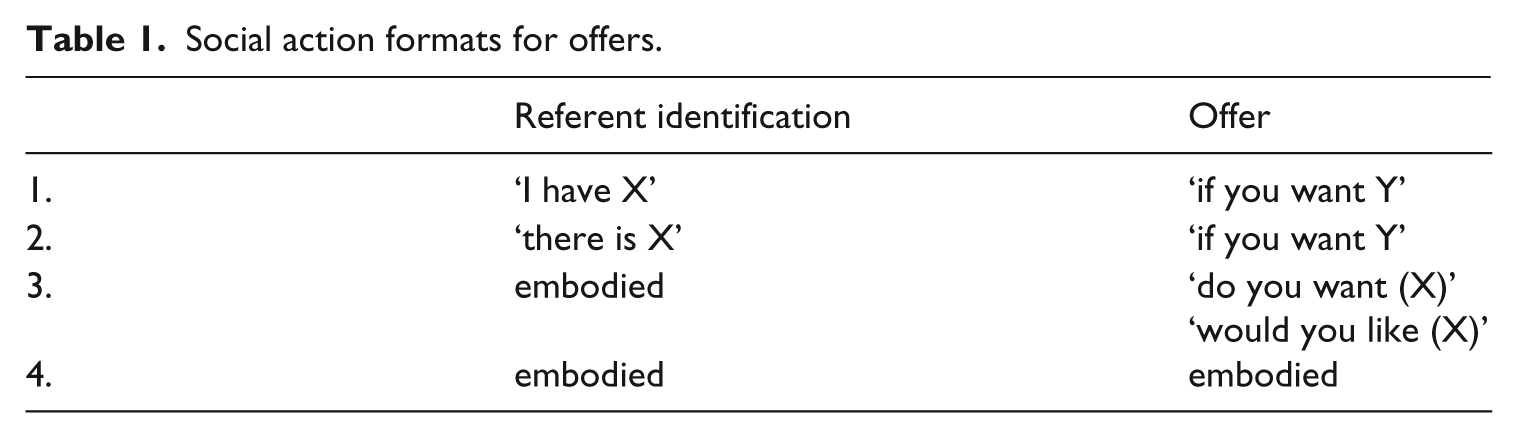
The first and second formats consist of a linguistically fully indexed first part (e.g. I have a room directly across/ There’s also that lamp on the desk) and a likewise linguistically fully indexed second part (if you guys want to hang out/ if you want to turn it on). Here there is no causal or resultative link between the situation in the main clause and the if-clause. Rather, the first part mentions the availability of some referent (Schegloff, 2007), typically in the form of an existential clause or a clause expressing possession, and the latter part states the offer explicitly. The two-part syntactic structure has been sedimented and routinized into performing a concrete offer. As for the third template, the target referent of the offering activity is indexed through bodily actions (see Eriksson, 2009). This touching or getting hold of some item constitutes an equivalent action to the first actions in formats 1 and 2, which we have named ‘embodied’ referent identification. The second part of this action template is formulated with one main clause, typically with an interrogative (e.g. Do you want one, Would you like some more wine). The offering activity is also accompanied by a physical act of moving an object or item within reach of another discourse participant. In the fourth format both parts are established through bodily action alone.
Continuum of offers
Here we will present and exemplify the full continuum of offers that emerged from our database. The following sub-sections exemplify linguistically fully articulated offers and discuss the role of gesture, gaze and the body as organized in view of that complex action; show cases where an embodied referent identification is accompanied by a linguistic one-clause offer; and illustrate offers made by speakers entirely through the body, respectively.
Linguistically fully indexed offers and embodiment organized in view of them
In this section, we discuss fully articulated two-part offers, where the referents of the offers are not similar in the sense that in the first example the referent is not co-present in the context, while in the second example it is. In both cases the object of the offer has not been oriented to in prior discourse.
Example (1) is from a conversation between three students. The interaction takes place in the kitchen of a student dormitory. Sophie is Canadian, while Mary and Jason are American; in camera 1 Sophie is sitting on the left, Mary in the middle and Jason on the right, while in camera 2 Sophie is in the foreground and the other two are in the background. Just two minutes into the conversation, the recording crew are still present but are getting ready to leave the scene (and possibly the building) for its duration. Pentti, who is in charge of the recording, is mostly behind the camera and thus not visible.
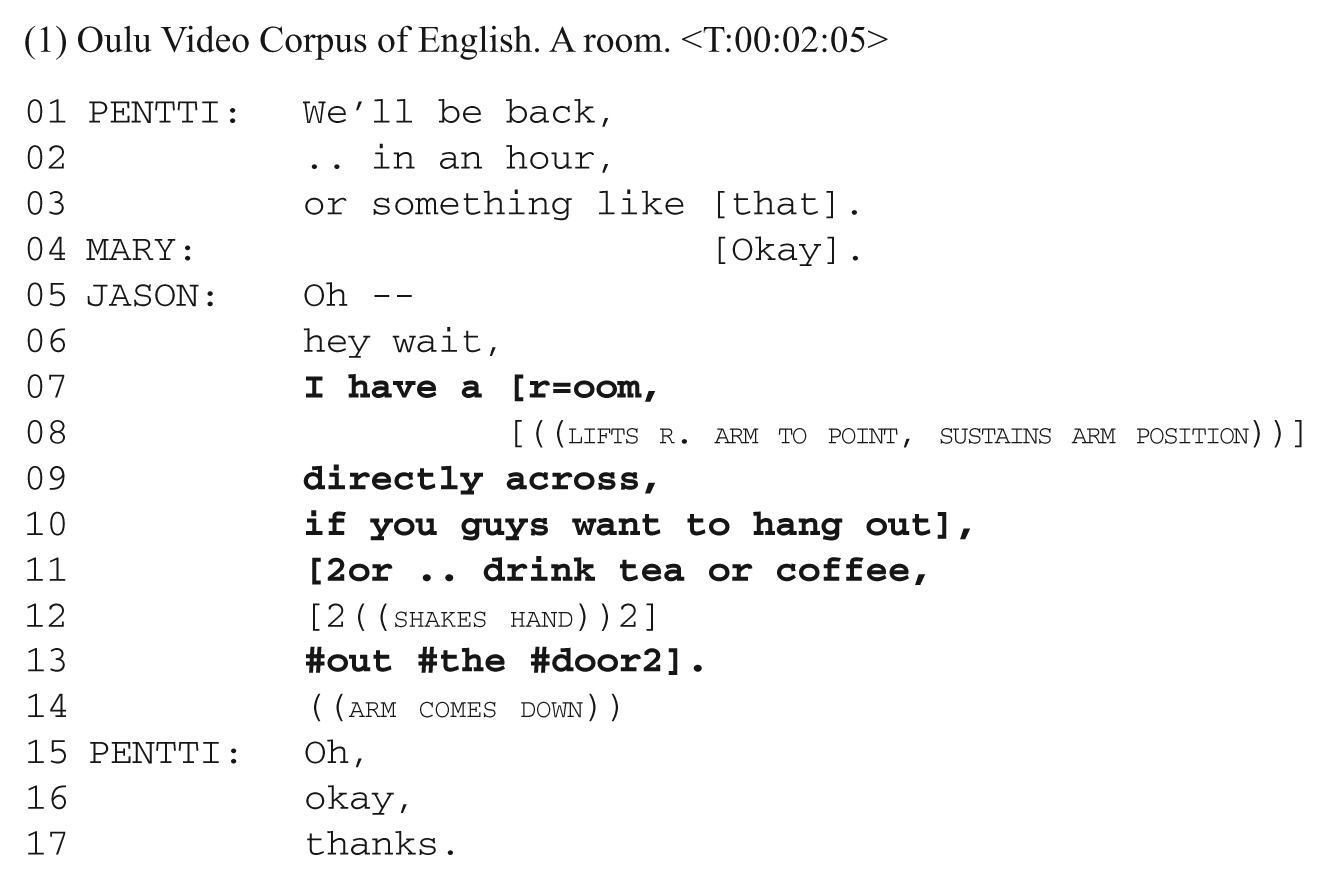
The offering action in lines 7–10 consists of the first action I have a r=oom directly across that simply mentions the availability of a referent not actually visible or present in the context, and the second action if you guys want to hang out that specifies what kind of activity is being proposed for the recipient(s). Prosody and embodied action are organized in view of the complex action. Prosodically, the two actions are produced as a chunk that consists of three intonation units, each ending with a continuing intonation contour (marked by commas at the ends of the lines), that is, the speaker does not pause between the first and second part but appears to have planned them as a unit. There is also a rather clear declination of intonation to be heard over the complex action: after a fairly high onset, the speaker’s pitch goes steadily down over the unit. In terms of embodied actions, Jason first turns his head slightly to the right with the onset of line 7, and then upon the word r=oom he initiates a deictic gesture, that is, lifts his right arm and points with his index and middle finger in the general direction of ‘the room’ (Figure 1); the gesture reaches its acme on r=oom. He keeps this position until the end of line 10, if you guys want to hang out, (as we will see, the arm only comes down later, at the end of line 13). 1

Hand rising and fingers pointing towards ‘room’ (lines 7–10; camera 2).
The preferred way to respond to an offer is acceptance, and speakers monitor their unfolding offer for its potential acceptance or rejection while they are producing it (Davidson, 1984). There is neither audible, nor very likely visual, acceptance from the recipient upon completion of the actual offer, that is, at the syntactic transition relevance place at the end of if you guys want to hang out (intonationally the unit is not complete, as it ends in a continuing intonation contour marked by the comma). This may be why Jason immediately latches on a subsequent version (Davidson, 1984) of the second part of the offer on line 11, or .. drink tea or coffee,. This new version creates a new acceptance/rejection slot for the recipient, but Pentti does not produce one even now. Jason then adds a ‘tag-positioned’ component (Jefferson, 1973) #out #the #door. (not clearly audible, however, as indicated by the #-signs), which according to Davidson (1984: 117) may provide the offerer with a monitor space, ‘in which he or she can examine what happens or what does not happen there for [the offer’s] acceptance/rejection implicativeness’. As it turns out, there is no need to add further new components to the offer, as Pentti now responds with what looks like acceptance (lines 15–17), Oh, okay, thanks. However, the acceptance is produced with a somewhat less-than-enthusiastic tone of voice, while Oh displays that the speaker only now recognizes the offer for what it is (Heritage, 1984, on oh as a change-of-state token). The offer is indeed somewhat surprising: Jason is offering the use of his room to about five to seven members of the recording crew.
Prosodically, the declination of intonation continues until the final intonation at the end of line 13 #out #the #door., with just a local rise in pitch at the beginning of line 11 or .. drink tea or coffee,. The latter may be seen as an indication of the unplanned nature of the subsequent version, especially as there is a brief break in timing there as well. In all, the initial complex offer + subsequent version + tag-positioned component (lines 7–13) form a unified prosodic whole. As for the visual production of the subsequent offer, some further gestural configurations are observable in addition to the still suspended raised arm. Simultaneously with the production of lines 11 and 13, Jason shakes his (now open) hand vertically in the air, coinciding with the stressed words tea, coffee and out (Figure 2). The shaking gesture, together with the lexical affiliates, can be seen to display and emphasize the choice of several possible activities available to the recipients. He then briefly waives his open hand once towards the ‘room’, as though handing the offer to the recipients to either accept or refuse (Figure 3), before bringing his arm down to home position at the end of line 13, when the offering activity has been brought to completion.
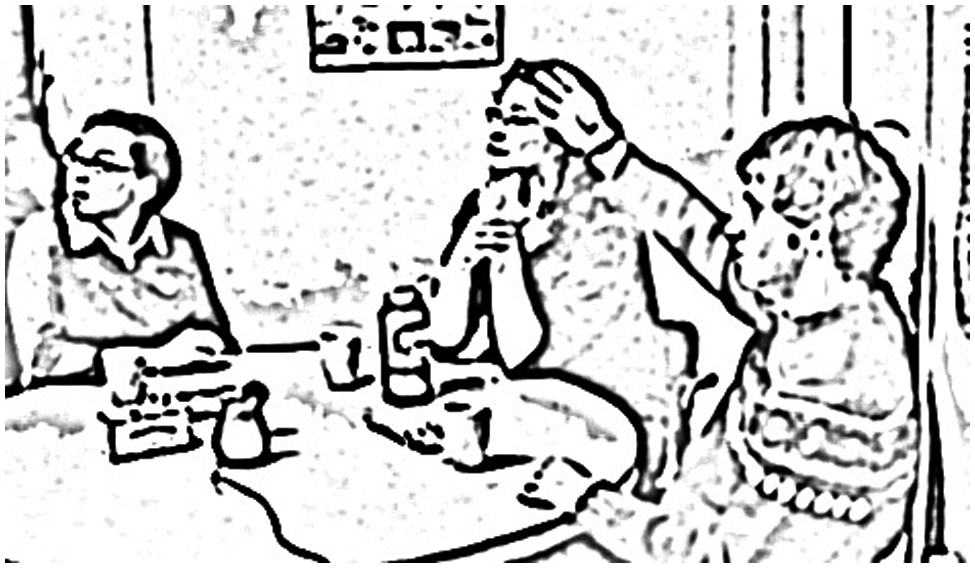
Hand shakes coinciding on the lexical affiliates tea, coffee and out (lines 11, 13; camera 1).
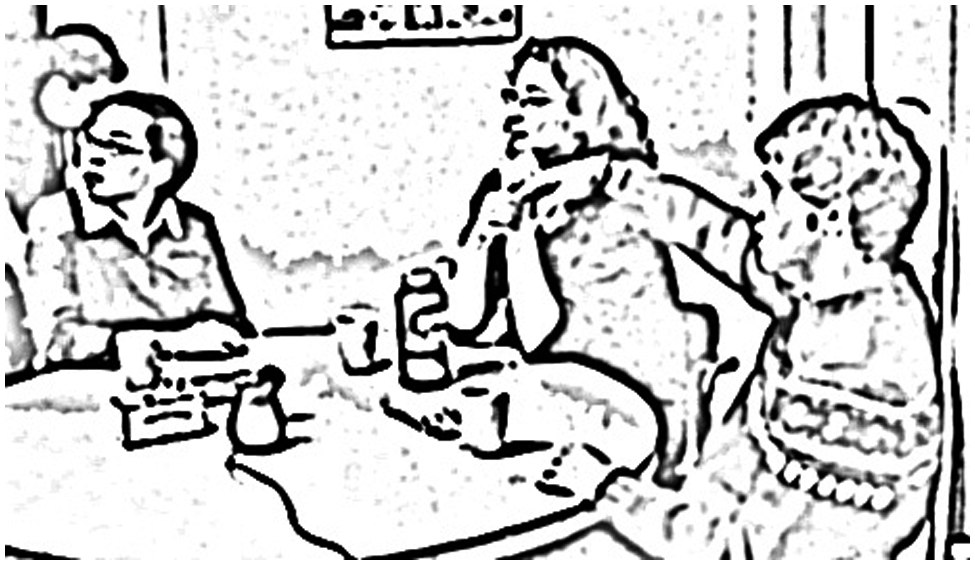
Waving gesture on #the #door (line 13; camera 1).
We have seen evidence that the two-part syntactic structure ‘I have X, if you want Y’ has been sedimented and routinized into performing the action combination of ‘offer’, but that prosody and embodied actions of the offerer work together to co-construct it. That the subsequent version is included under the same gestural trajectory is due to the contingent accomplishment of the action combination: when no clear acceptance or commitment has been immediately forthcoming, the activity continues, as is also indicated by the gesture. This example has involved a referent that is not visible in the interaction, nor is it oriented to in prior discourse in any way (as we have seen, it actually comes as something of a surprise), and we can argue that a full verbalization of the offer is therefore necessary.
Example (1) involved native speakers of English co-constructing a complex offering action through deploying language, prosody and visual actions. The same action template for offering is also found in Finnish. The following conversation includes five participants, four of whom are within the camera view and are being recorded, and the fifth, Jukka, is the person making the recording. The excerpt is from the beginning of the recording where Jukka is adjusting the lighting.
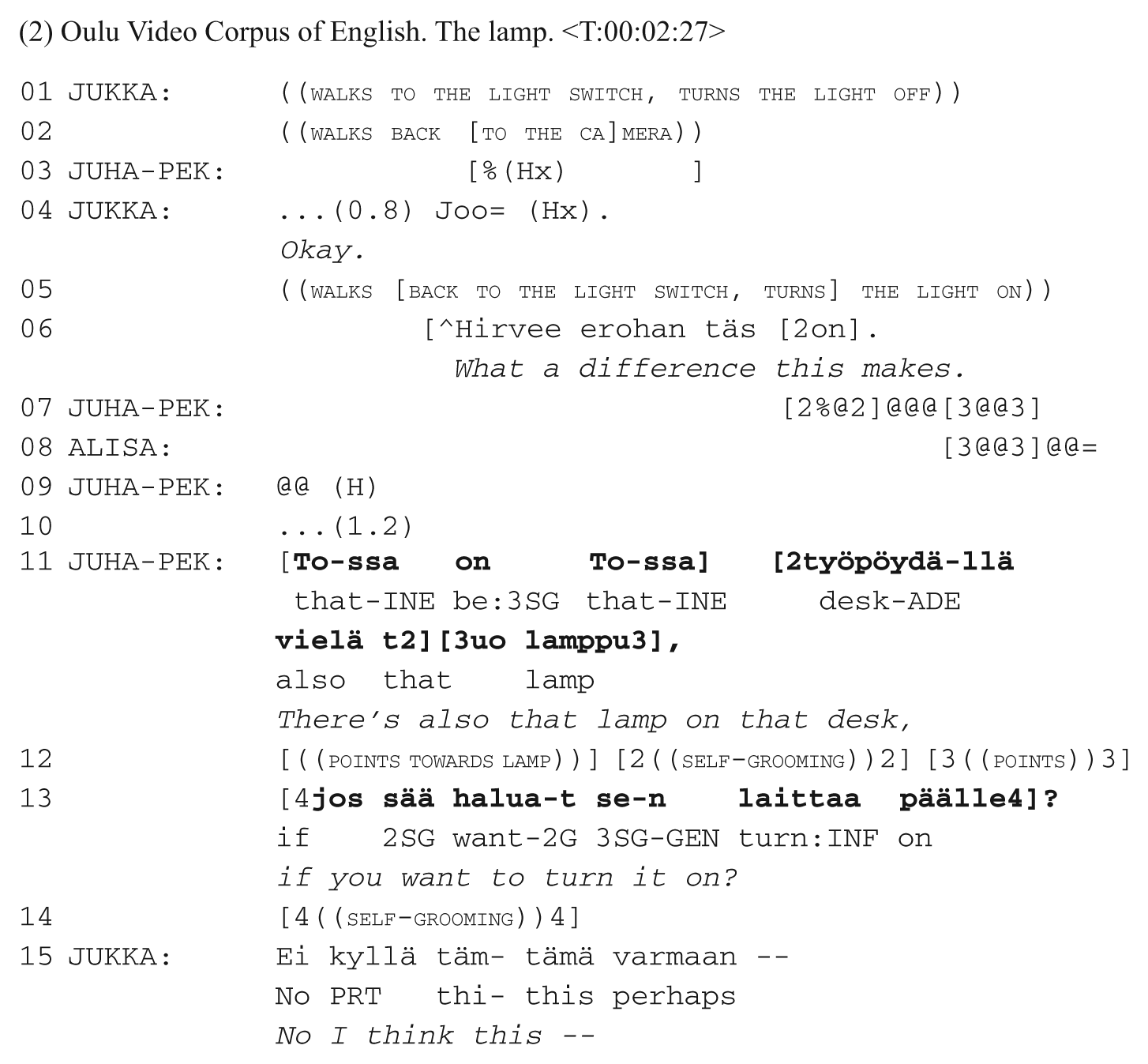
The extract takes place two minutes into the recording when Jukka is still adjusting the environment for optimal recording conditions. He is experimenting as to whether it would be better to have the pendant light behind the camera on or off during the recording (lines 1–5). The difference does not appear to be significant, however, as he jokes about it (line 6). Juha-Pekka has been following what Jukka is doing, and at this point he offers the use of a lamp located on the side desk. The offer consists of the first action There’s also that lamp on that desk, (line 11) and the second action if you want to turn it on? (line 13). As in example (1), also here the first part establishes the target referent of the offer and indicates its availability, while the latter part includes an if-clause specifying the proposed activity. Prosodically, the action combination is produced in two intonation units, but with continuing intonation on the first action (marked with comma) (line 11).
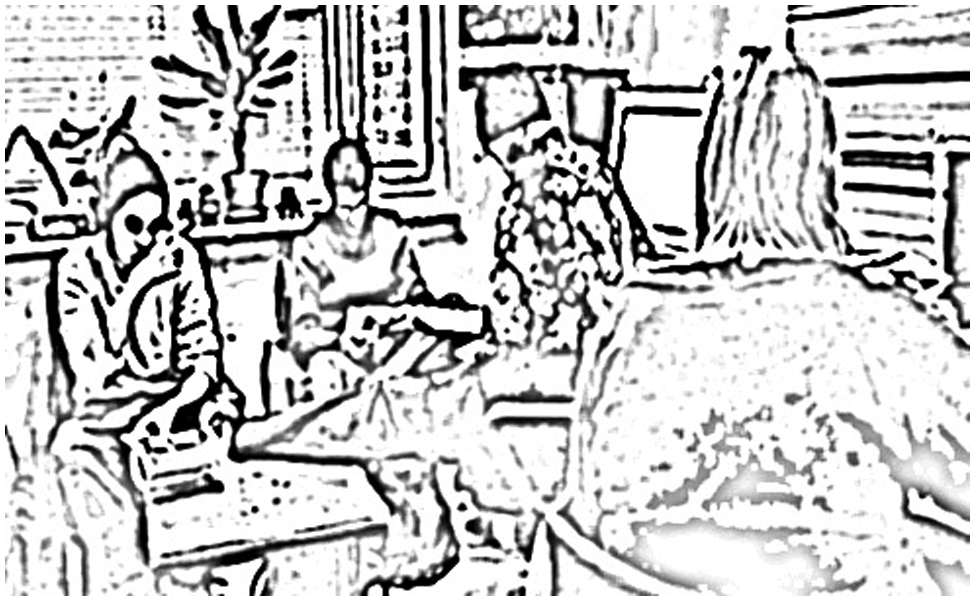
Juha-Pekka (on the left) points at lamp on second tossa (‘on that’) (line 11).
The following screenshots illustrate the use of gesture during the offering activity. The first gesture is initiated concurrently with the initiation of the first action on line 11. This pointing gesture reaches its acme at the second mention of tossa (‘on that’) (line 11, Figure 4).
The hand is then briefly retracted to self-groom the face, before initiating a second pointing gesture on the target referent lamp (line 12; Figure 5). During the entire second part of the action combination, if you want to turn it on? (line 13), the hand is performing self-grooming (Figure 6).

Second point at lamp, position at the end of lamppu (‘lamp’) (line 11).
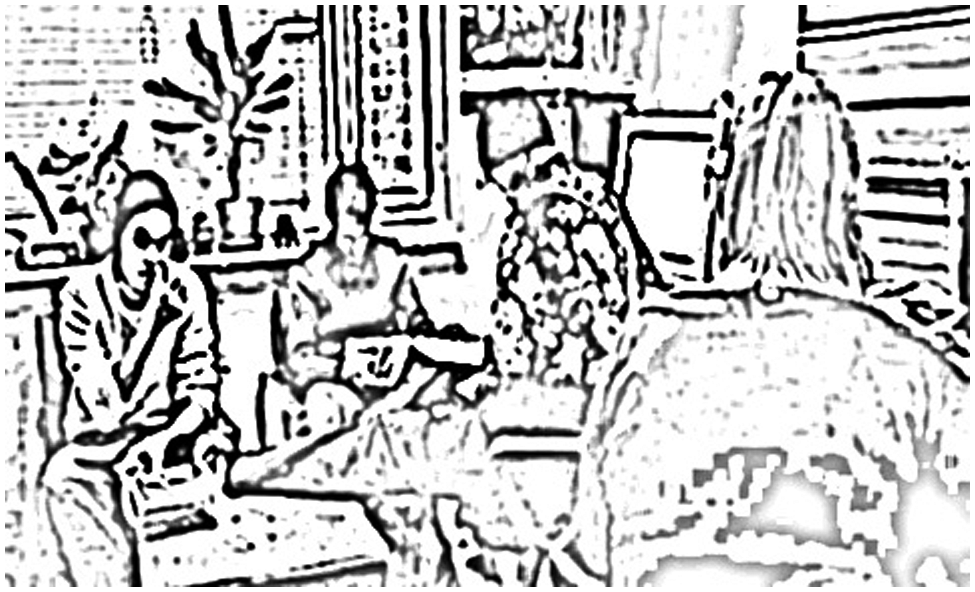
Self-grooming at the end of päälle (‘on’) (line 13).
While the self-grooming may indicate that the recipient’s, that is, Jukka’s, gaze is no longer appropriate (Goodwin, 1986) and that re-orientation is required (perhaps towards the lamp; unfortunately we do not have video data of Jukka as he stays behind the camera the whole time), the active gesturing throughout the turn (two pointing gestures and self-grooming) extends over the entire two-part action format. Juha-Pekka’s body posture and gaze direction towards Jukka also indicate attentiveness and display that an extended turn is under way. Juha-Pekka returns his hand to home position only after Jukka’s declining response in line 15.
Both parts of Juha-Pekka’s offer are linguistically fully formulated. This is likely because this particular lamp, which is located at some distance from both the offerer and the recipient, has not been oriented to in prior talk. The distance and also the status of the lamp as a new referent are reflected in the linguistic formulation of the offer: the multiple use of the demonstrative pronoun tuo (‘that’) marks the referent as being outside both participants’ spheres of attention (VISK, 2004: §722).
In this section we have discussed fully articulated two-part offers. In both cases the object of the offer has not been oriented to in prior discourse, which necessitates full verbalization even though the referent is in one case co-present, while in the other it is not. In both examples, unfortunately, we cannot make claims about mutual monitoring regarding, for example, when exactly the recipient’s gaze is secured. The following sections will discuss cases where the object being offered has been oriented to in prior talk or is somehow otherwise accessible in the environment. The first part of the action combination is done only through gesture, and the linguistic form is no longer a complex sentence but a one-clause format.
Gesture accompanied by one-clause offer
In the examples in this section the item being offered is made available to others through embodied actions, through direct touching and holding of the objects. It is argued that mutual orientation is one contributing factor in how the action combination of offering is designed. The target referent of the offering activity is identified for the intended recipient of the offer through bodily actions alone (see Eriksson, 2009). The objects are co-present in the immediate environment, that is, they are not abstract issues, activities or otherwise out of sight/reach (see previous sub-section). This touching or getting hold of some item constitutes an equivalent action to the linguistically indexed referent identification in formats 1 and 2. The offer itself is produced with one main clause, often with an interrogative of the type ‘do you want (X)’ or ‘would you like (X)’. We will observe how the lack of mutual gaze between participants may contribute to a full verbalization of the second part of the social action format for offering activity. Finally, in conjunction with indexing the target referent and making an offer, the offering activity here also includes a physical act of moving the object or item within reach of another discourse participant.
In the following example Cassandra offers candies in succession to three other participants in the conversation. Edith and Jenny are native speakers of English; Edith (on the left) is from Australia and Jenny (in the center) from the United States. Cassandra (on the right) is Spanish and Viola (behind Cassandra) Hungarian. The four are in the kitchen of a student dormitory.
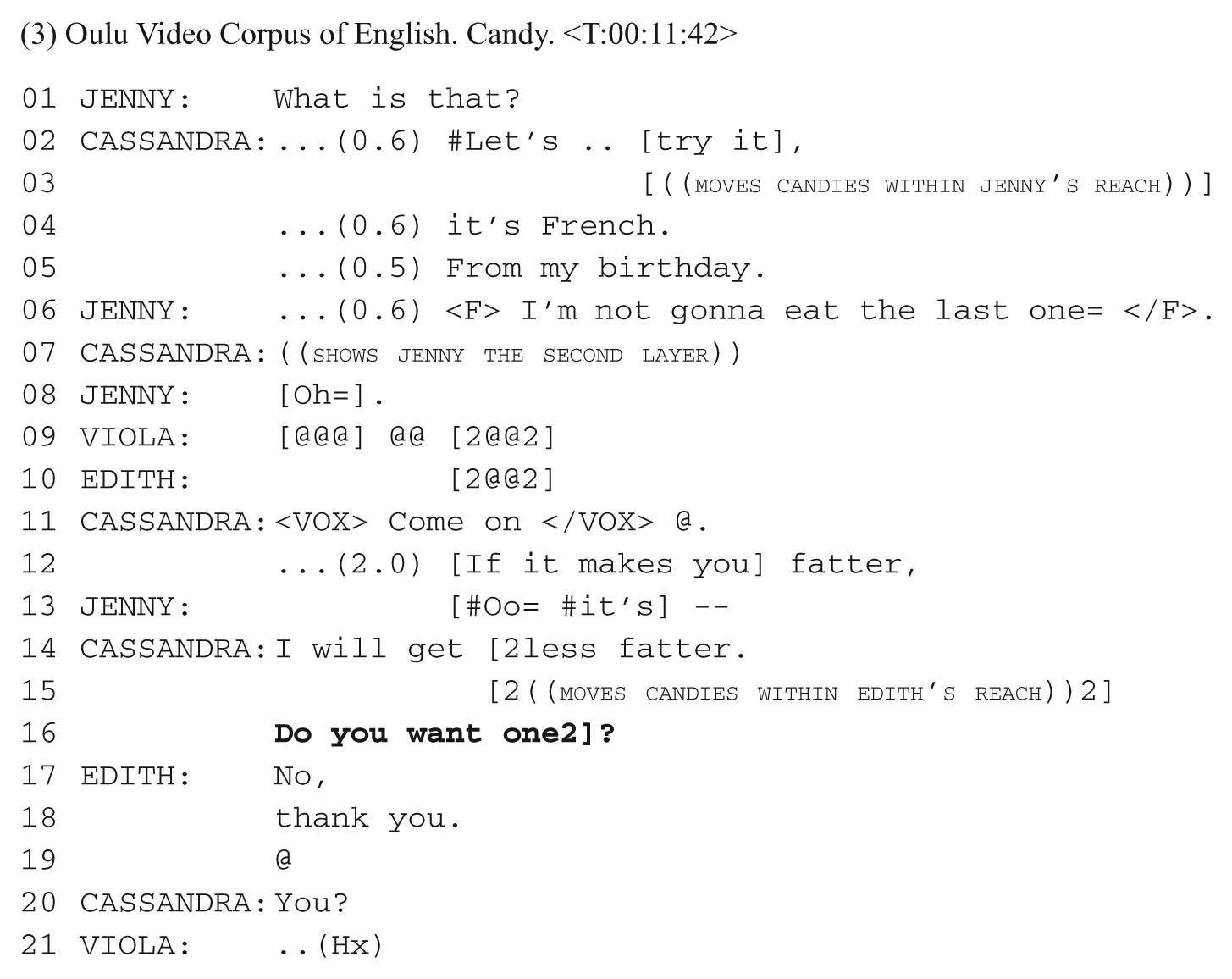
The candies are introduced for the first time into the interaction through Jenny’s question What is that? at line 1. This functions as a pre-request, as a result of which Cassandra offers the candies to Jenny (lines 2–14). At focus here is the latter part of the extract, lines 15–16, where Cassandra offers the candies to Edith. The first part of the action combination of offering, referent identification, is here done through embodied actions. Cassandra’s gaze and body orientation have so far been towards Jenny, and she now begins to orient towards Edith while saying less fatter (line 14; Figure 7).

Cassandra’s (on the right) orientation changing during less (line 14).
Cassandra then begins to move the item being offered, the box of candies, within Edith’s reach. The acme of the gesture (see Figure 8) is reached at the end of the offer Do you want one? (line 16).
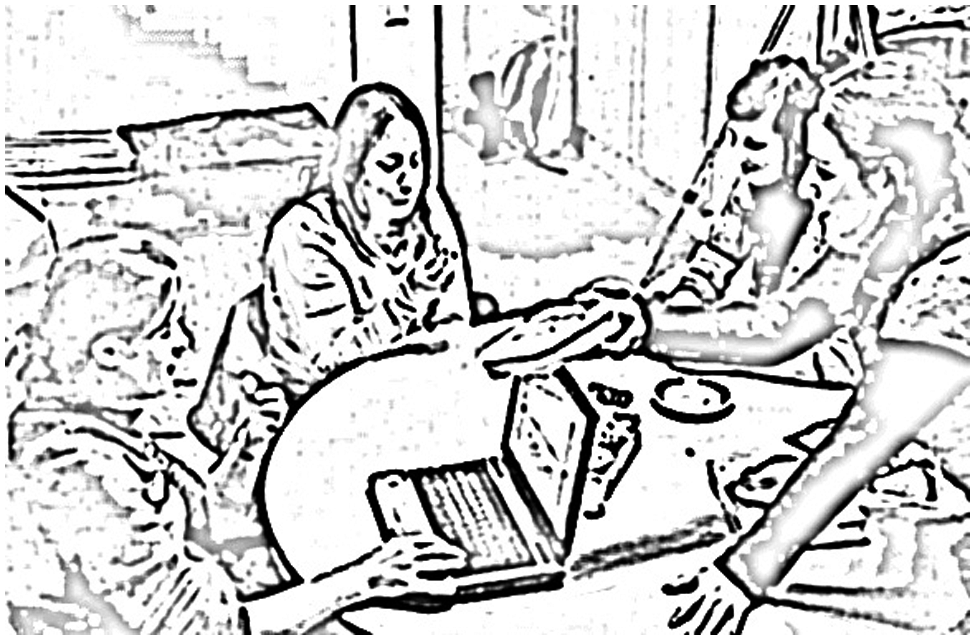
Acme of Cassandra’s gesture during one (line 16).
As Cassandra first offered the candies to Jenny, the offer at focus here is thus not the first offer in this sequence of actions. This also means that the target referent was already established during the first offer. However, here the embodied gesture also carries out the further action of referring (Eriksson, 2009), making the referent available for this particular recipient, Jenny. In this example the two parts of the action combination of offering take place simultaneously. Further, it is possible to argue that because the referent is accessible on the basis of just-prior discourse, and the same offering activity continues, the referent does not need to be introduced with a full noun phrase, as was done in the examples in the previous sub-section. We may actually claim that the reference term one (Figure 8) refers to the referent after it has already been brought into the recipient’s field of vision, and that the linguistic form (one) thus arises out of the semiotic environment. 2
Though the referent of the offer is identifiable based on prior talk and on concurrent embodied actions, the offer itself is formulated linguistically. This may be influenced by the lack of mutual gaze on line 13, prior to the offer (see Figure 7): Edith orients towards the computer screen throughout the extract, though she briefly gazes up after Jenny’s question on line 1 to identify the object the others are talking about. Edith continues to gaze towards the screen also during the offer (Figure 8), and it is not until the offer has been completed that Edith raises her gaze and declines the offer. We can thus say that a full clausal verbalization of the offer appears to be contingent on the organization of recipiency.
Another similar example is presented in the following. Here we have another full verbal format for making an offer, ‘would you like (X)’, taking place concurrently with the bodily conduct for producing the offer, that is, we have a full clausal verbalization of the action and simultaneous bodily production. Here, as in the previous example, the concurrent full verbalization of the second part of the complex action is contingent on the organization of recipiency: again there is no gazing recipient when the offer is initiated. The participants are having dinner, with Lynne and Rebecca sitting on the left and Gwyneth on the right; Rebecca sits behind Lynne. Rebecca has just offered Lynne more salad, and Gwyneth in turn now offers her more wine.
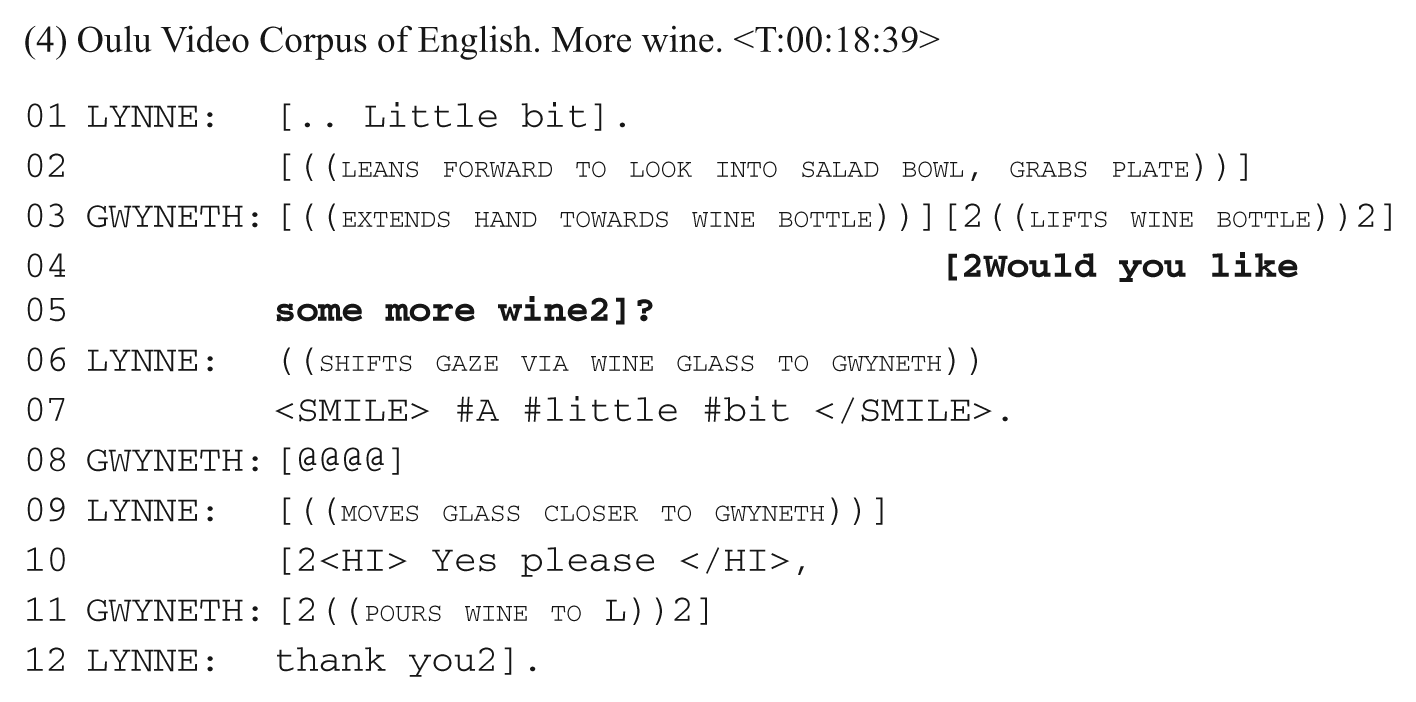
The serving of the salad is still ongoing as Gwyneth starts to get hold of the wine bottle on her right on line 3. She then lifts the bottle in the air to the proximity of her upper body and raises her eyebrows. The actual verbalization of the offer, Would you like some more wine? (lines 4–5), is done simultaneously with getting hold of and lifting the bottle. But we may argue that the referent/object of the offer is not sufficiently identifiable for the recipient, Lynne, who is still oriented towards accepting the previous offer for salad and looking down at her plate (see Figure 9). The recipient is thus not making eye contact with the offerer even during the verbalized offer, but only after it is completed (line 6).

Gwyneth (on the right) holding wine bottle (between lines 5 and 6).
The acceptance of this offer is likewise verbalized and embodied. Lynne is gazing at the salad bowl during Gwyneth’s offer and even at the end of it, as was established above. She now starts to accept the offer by shifting her gaze from her plate towards her glass and then moves the glass closer to Gwyneth. Simultaneously she verbalizes the acceptance by saying A little bit (line 7), with a smiling voice and with a smile on her face.
Embodied actions are used for identifying the referent also in our Finnish data. The discussion includes five participants, who are having dinner. Taavi is the host.
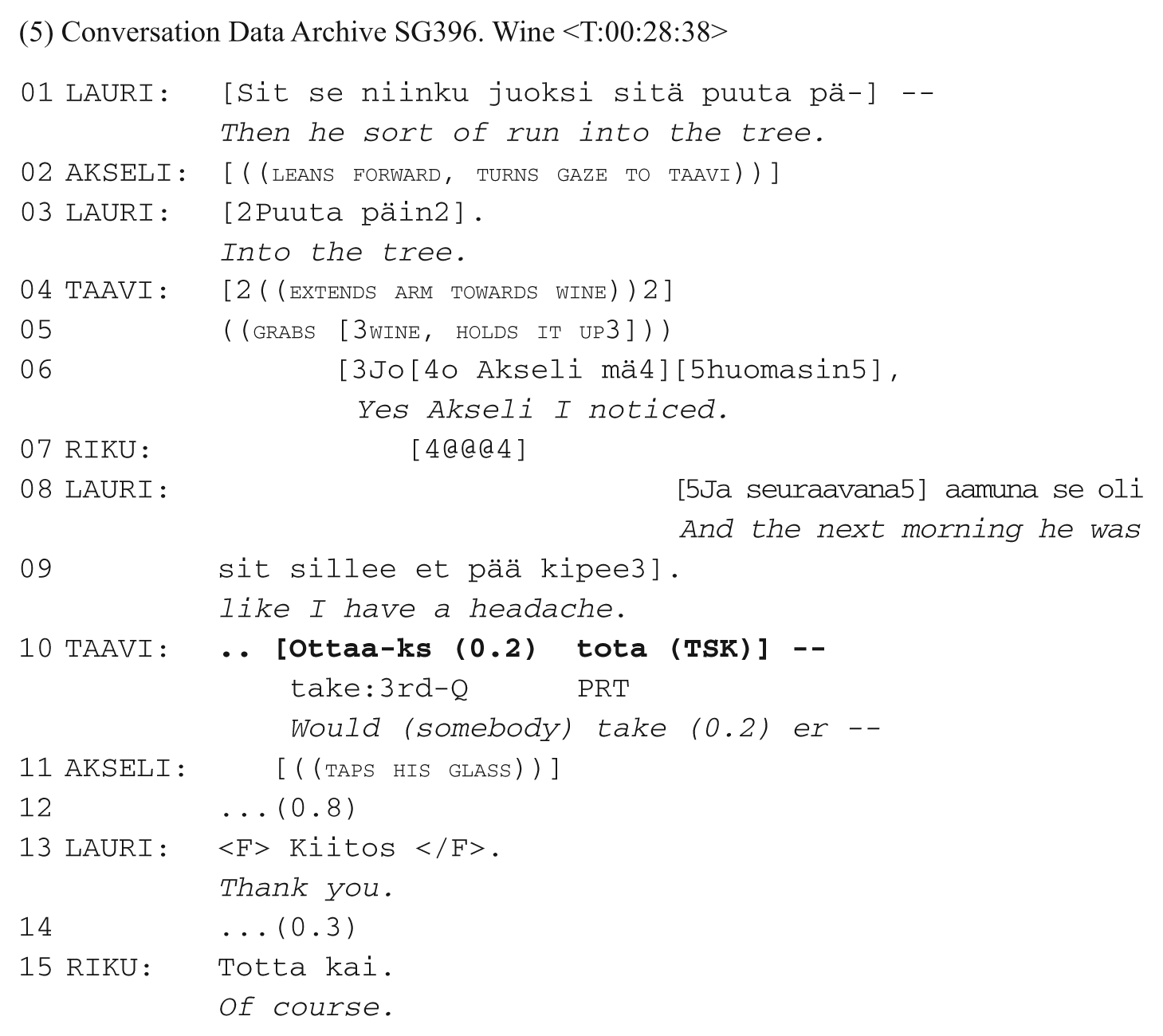
At the beginning of the example Lauri produces a comment on Taavi’s previous deprecating story about a guy they know, by depicting how he would run into a tree (lines 1, 3) and then complain about a headache the next morning, apparently not remembering the incident (lines 8–9). Just prior to the extract, four of the five participants have finished their glasses of wine almost simultaneously; Akseli is one of them. During Lauri’s turn on line 1, Akseli leans forward and turns his body and head towards Taavi, who sits at the far end of the table (line 2; see Figure 10, Akseli is closest to the camera). This does not go unnoticed by Taavi, who interprets Akseli’s embodied actions as a request for wine: while uttering Yes Akseli I noticed (line 6), he takes hold of a bottle of wine next to him (Figure 10).

Taavi (at far end of table) takes hold of a bottle of wine (line 6).
Instead of immediately offering wine to Akseli, Taavi extends an offer to all the participants with Ottaaks (0.2) tota (TSK) -- (line 10) (‘Would (somebody) take (0.2) er (TSK) --’), holding the bottle of wine up in front of him. Akseli taps his wine glass during the offer, to display his eagerness to have more wine (line 11). Taavi briefly glances towards Akseli’s glass and hand. Subsequently he turns his gaze to Lauri and establishes mutual gaze with him, selecting him as the primary recipient of the offer, instead of Akseli. This seems to amount to a slight reprimand towards Akseli’s eagerness. First Lauri and then Riku accept Taavi’s offer (lines 13 and 15, respectively). After quite a bit of intervening talk (another participant arrives), Taavi pours wine to all participants (data not shown). As in examples (3) and (4), embodied actions identify the referent of the offer, here a bottle of red wine. It can be noted that the identification of the referent is occasioned by Akseli’s embodied request on line 2. On the other hand, the offer itself on line 10 is not linguistically complete, in that it does not include a linguistic formulation of the referent, nor the intended recipient. This serves as a further piece of evidence for the identifiability of the referent (wine), and for the contingent nature of offering activity.
In the examples in this section the referent of the offer is established through bodily action, while the offer is established with a clause. The two parts of the action combination may take place more or less simultaneously. While this seems to be a recurrent pattern in the data, the contingent bodily–visual features of these cases lead us to further hypotheses: it seems that if there is no mutual gaze during the establishment of the referent, the offer tends to be verbalized. The production of the offer thus appears to be contingent on aspects of recipiency. Further, in some cases a verbal format without an explicit reference term, as in Would you like some? in example (4) on offering wine to Lynne, would not be sufficient because the referent is not focal enough for the recipient; that is, she does not have direct visual access to it, nor has it been oriented to in prior interaction. The next section discusses cases in which the entire offering sequence is established through embodied actions alone.
Embodied offers
This section discusses cases in which both the referent identification and the actual offer are done only through embodied actions. Example 6 involves the same participants as in example 1, Sophie, Mary and Jason. Just prior to the extract, Sophie has been transferring boiling water into a thermos in the kitchen (outside the frame). After this she takes the thermos to the table. The offer takes place during lines 9–14.
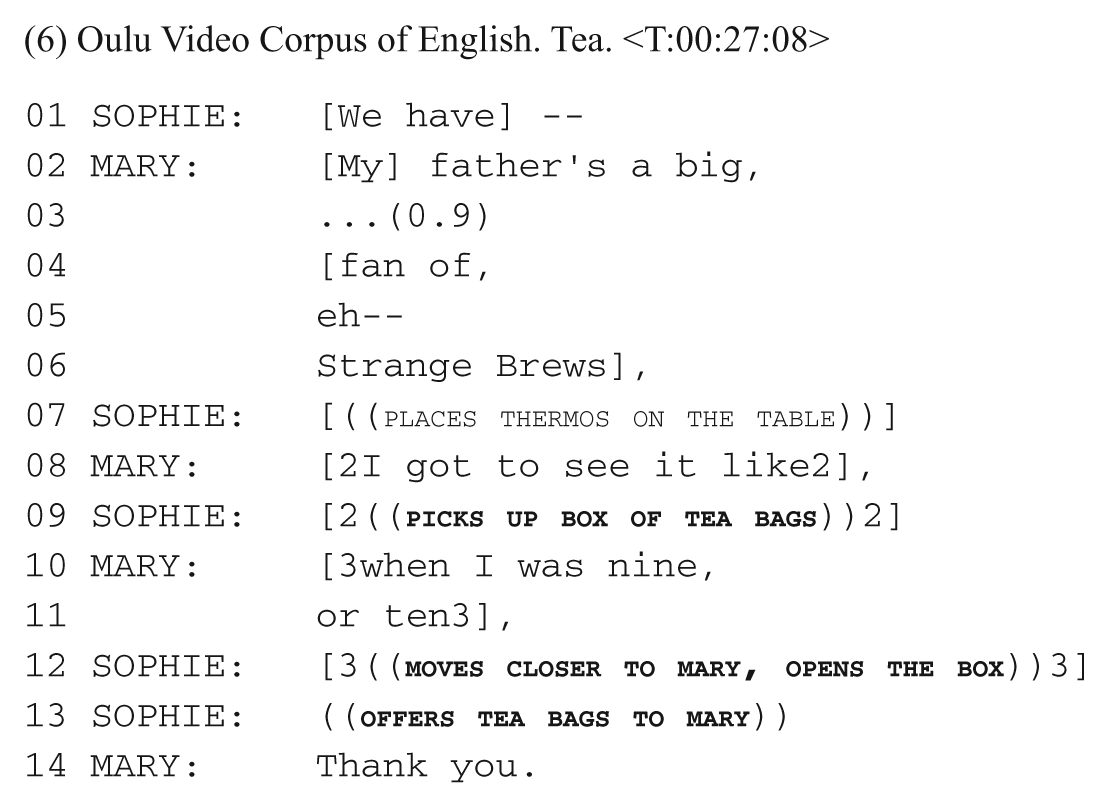
Sophie produces her interrupted turn on line 1 when she has reached the table and is standing next to it with the thermos in her hands. However, Mary is in the middle of a telling, which may be the reason why Sophie opts for an embodied offer. On the other hand, Mary co-ordinates her telling to fit Sophie’s embodied actions that relate to the tea bags, and finishes the telling just as Sophie is moving towards her with the box in order to offer them to Mary.
The screen shots below illustrate the phases in the embodied offering activity. During Mary’s telling on lines 2–11, Sophie picks up the box of tea bags from the table (Figure 11), opens it up, and moves closer to Mary. Sophie and Mary reach mutual gaze during Mary’s telling. This indexes mutual orientation and attention to Sophie’s actions and the tea bags as she moves closer to Mary. The telling is interrupted only while Sophie opens the box of tea bags (Figure 12). Mary is gazing towards the tea bags during this (Figure 12). This sequence of embodied actions establishes the referent of the offer, and constitutes the first action in the offering activity. The offer itself follows on line 13 (Figure 13), where Sophie extends the box of tea bags within Mary’s reach. At this point Mary has finished her telling, and the participants orient to the offering activity for the next few turns.
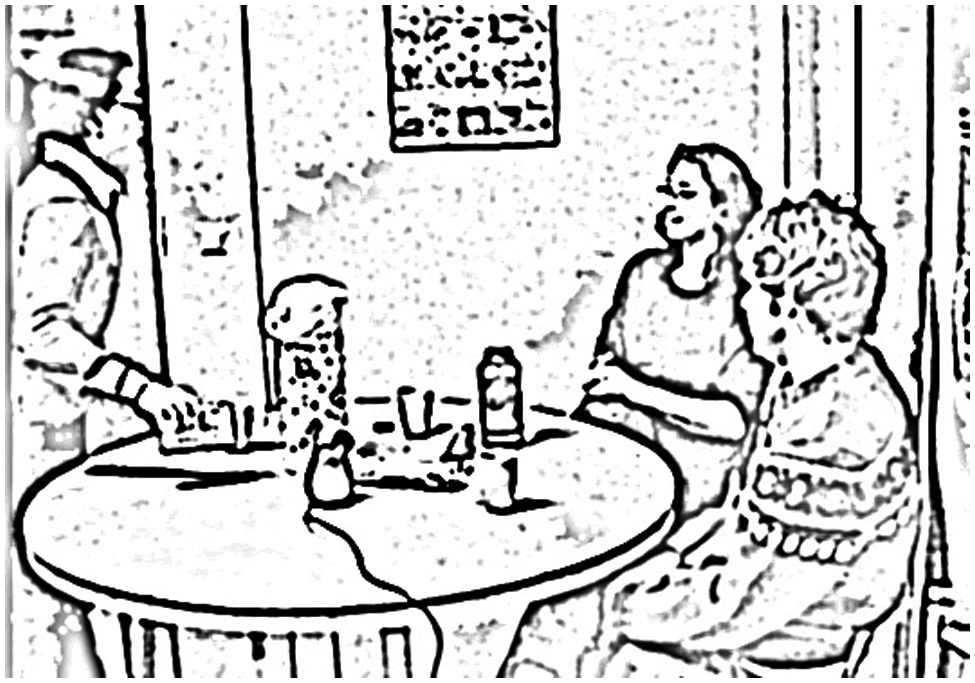
Sophie (on the left) has the box in her hand at Mary’s it (line 8).
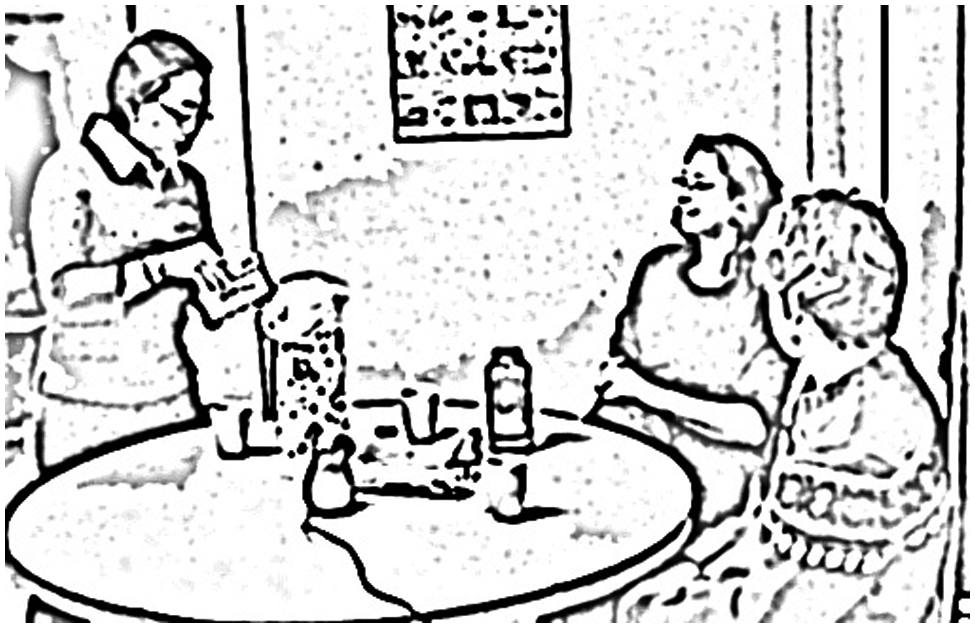
Sophie opening the box at Mary’s ten (line 11).
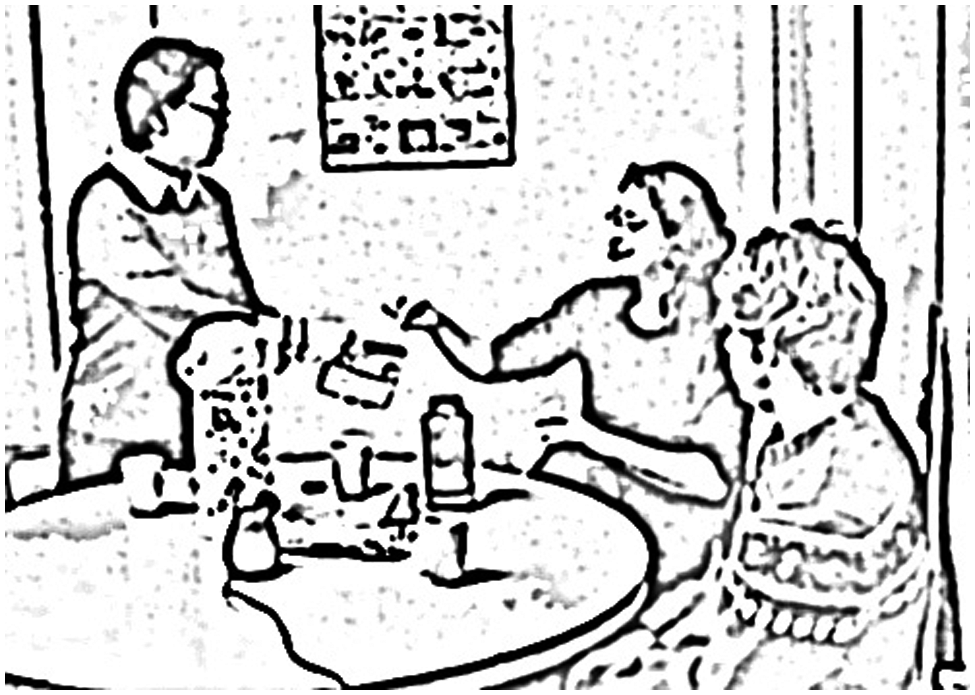
Sophie’s offer on line 13.
On the basis of example (6) we may argue that the embodied execution of the offering activity here in a sense ‘overrides’ language, as it is carried out at first independently of (the unrelated) talk, while the recipient of the offer organizes her actions in view of the offer-in-progress and withdraws talk at the moment of receiving the offered goods, that is, of accepting the offer.
Embodied offers can also be done on their own, without other concurrent (non-related) verbal activities. The following excerpt takes place about a minute and a half after example (6). At focus here is the latter part of the extract, where Sophie offers water to Jason (lines 9–11).
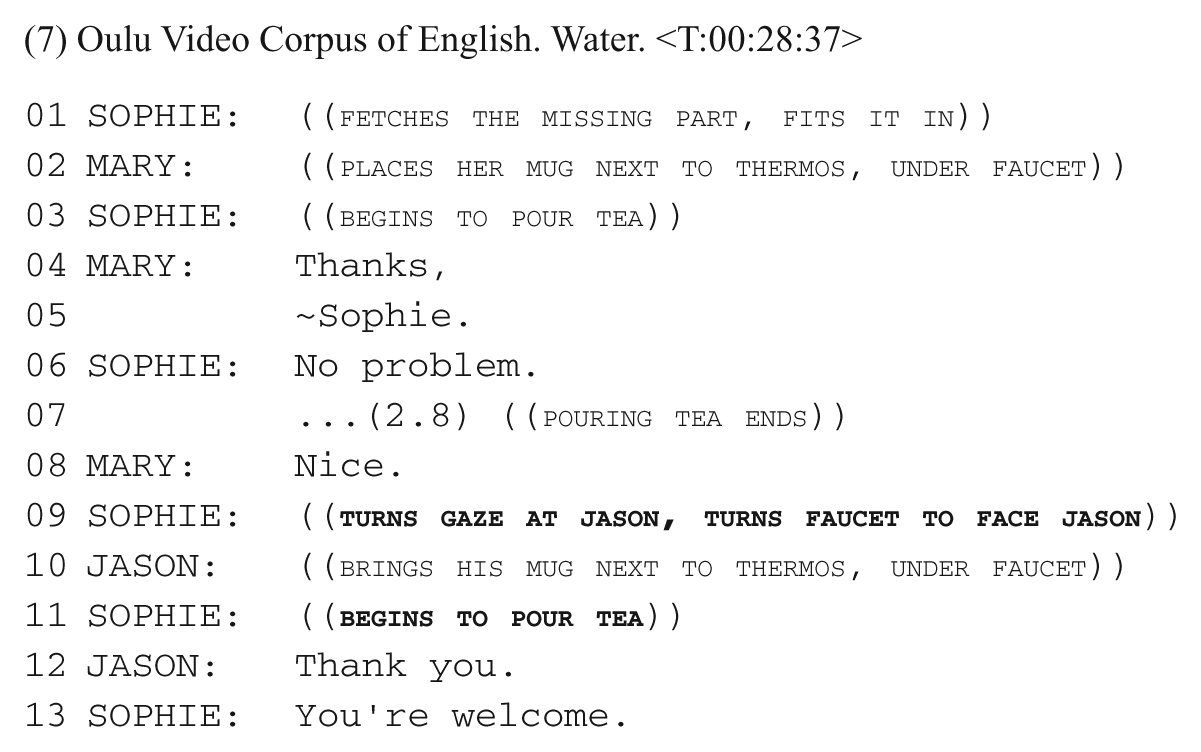
Prior to the extract, Mary has attempted to pour water for herself but failed because the faucet of the thermos was missing. After some negotiation, Sophie fetches the missing part (line 1) and pours water into Mary’s cup (line 3), which Mary has placed under the faucet (line 2). This part does not include verbal interaction. After pouring water to Mary, Sophie turns to Jason. The screenshots below illustrate the organization of the offering sequence.
Sophie is oriented towards Mary until the end of Mary’s evaluative turn nice on line 8 (Figure 14). After Sophie has finished pouring water to Mary, she first turns her gaze towards Jason (Figure 15). The gaze is followed by the act of turning the faucet in Jason’s direction, while holding the hands on top of it, displaying readiness to pour (Figure 16). These nonverbal activities illustrated in Figures 15 and 16 constitute the embodied offering activity, where the item being offered (water in the thermos) is referred to and the activity of pouring water is indicated. Even though it is not clear from either camera, it appears that Jason does not engage in direct mutual gaze with Sophie. Yet he accepts the offer by moving his cup under the faucet, after which Sophie begins to pour water (Figure 17).
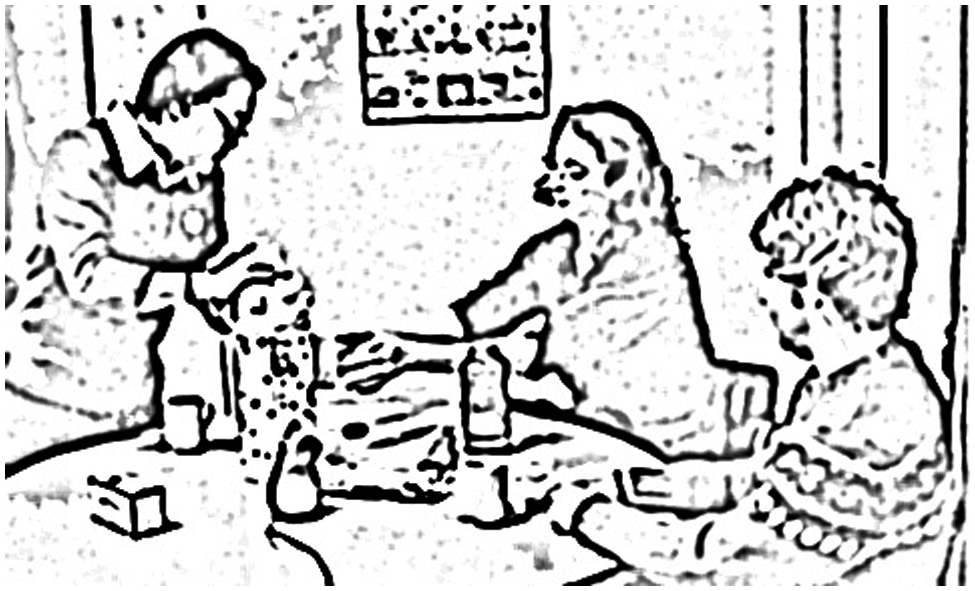
Sophie (on the left) orients to Mary at the end of nice (line 8).
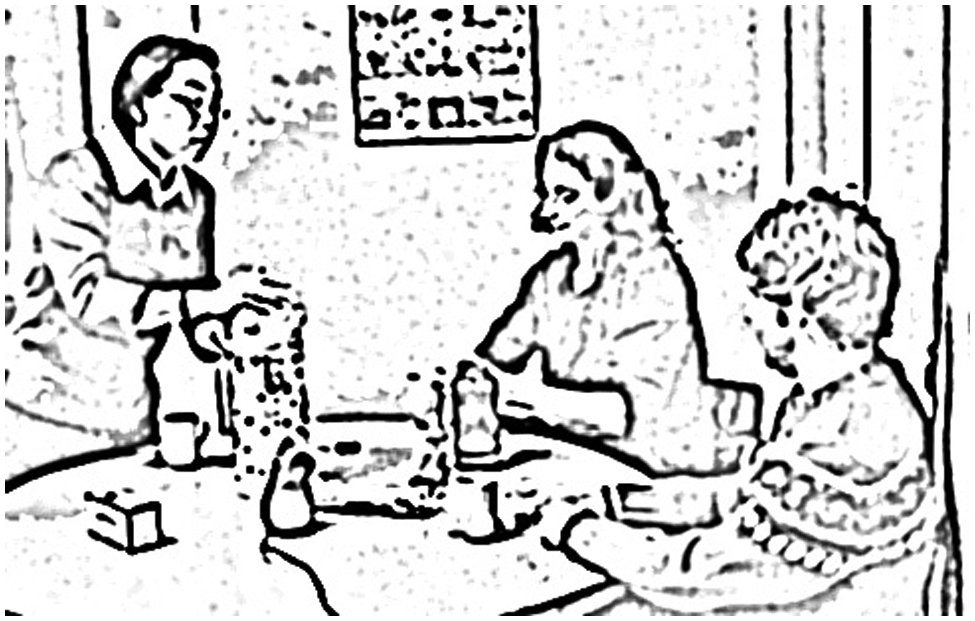
Sophie gazes at Jason (line 9).
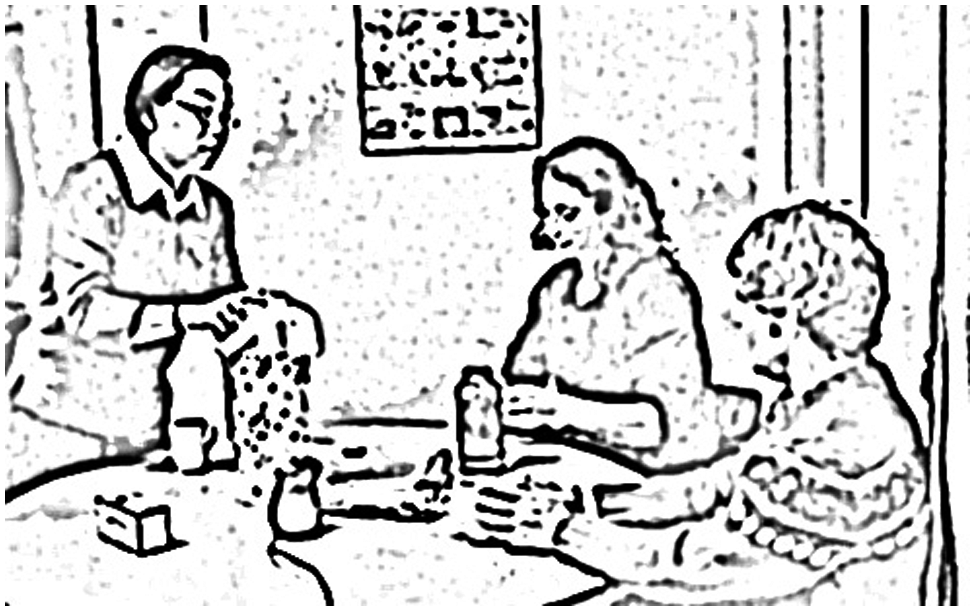
Sophie has turned faucet towards Jason, holds gaze (line 9).
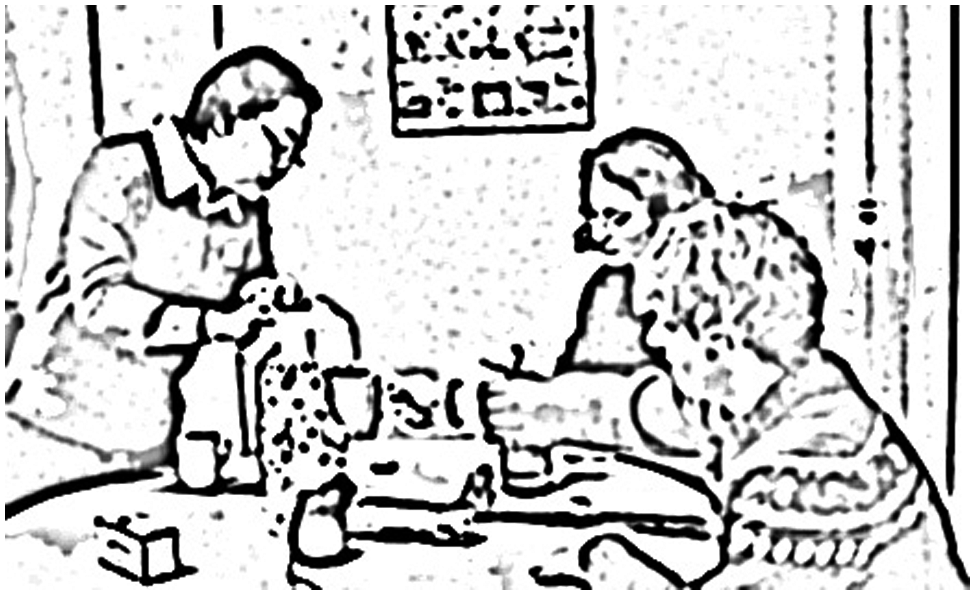
Jason accepts offer, Sophie pours water (lines 10–11).
In this section we have seen cases where the referent of the offer has been oriented to in just prior interaction and the recipient has direct visual access to it (both examples 6 and 7). In example 6 the participants also reach mutual gaze before the actual offer. The production of the offer through bodily actions alone seems unproblematic in both examples, very likely because the referent is so focal in the interaction. Finally, it is worth noting that this kind of production does not impinge on simultaneously ongoing (verbal or other) activities, as we saw in example 6.
Concluding remarks
We offer here some concluding remarks on the interplay of language and the body in the accomplishment of the action combination of ‘offer’. Our main finding has been that concrete offers regularly consist of two interlinked actions, one identifying the referent and the other making the offer.
Discourse participants’ embodied actions have different roles in the continuum of offers. In the first format, ‘I have X/ There is X, if you want Y’, complex actions are co-constructed by language, prosody and the body. We have argued that the trajectory of co-occurring deictic hand gestures and prosody are organized in view of the complex action of offering and continue for the duration of the offering activity. Moreover, further gestural detail, such as the sideways waves of the hand on the stressed words (example 1) or self-grooming (example 2), may in subtle ways further elaborate on the semantic content, (in)completeness, or some other aspect of the offer.
We have further shown that embodiment may establish, in a very concrete way, parts of the offering activity. The target referent of the offer may be indexed through bodily actions, while the offer itself is produced linguistically with one main clause typically of the form ‘do you want (X)’ or ‘would you like (X)’. In such cases, the referent of the offering activity may, even though not always, have been established in just-prior discourse and is therefore already accessible, though not made focal for the intended recipient. In these cases the two parts of the action combination may overlap.
Lastly, we have discussed cases where the indexing of the referent, as well as the offer itself, is carried out through embodied actions only. Such actions can be accomplished both in overlap with other (verbal or non-verbal) activities and also when there are no other overlapping activities going on.
We have further observed that certain aspects of the ongoing interaction may have an impact on the realization of the action format. These include how focal the referent is in the activity, that is, whether it has been introduced in prior discourse or is otherwise ‘naturally’ present and within the gaze trajectory of the recipient. We have seen that whether the referent is co-present (visible) in the activity or not may not be decisive, but what is important is whether the speaker judges it to be focal enough for the recipient: with both a visible and a non-visible referent, a full verbalization seems to follow if the referent is deemed not to be focal enough. On the other hand, even if mutual orientation toward the object of offer is established through embodied actions (through touching or holding the object in the vicinity of the recipient), a clausal verbalization tends nevertheless to be produced if there is no direct recipient gaze towards the referent already before or during its bodily establishment (in fact we have seen that verbalization and referent establishment are often more or less simultaneous). And finally, if the referent of the offer has been oriented to in just-prior discourse and the recipient has direct visual access to it, that is, the referent is quite focal for him or her, a simple embodied offer may be enough.
In conclusion, we may briefly consider the relationship between language and embodiment in action formation. As became evident from our data, language and embodied actions are variously implemented in the accomplishment of offering actions, and language is not always necessary at all. Much research still needs to be done to determine the full range of ways in which other social actions are concurrently produced through language and/or bodily actions.
Footnotes
Appendix A: Transcription symbols
Symbols used in transcription from Du Bois et al. (1993, updated in 2006)
UNITS
Intonation unit (one line is one IU) {carriage return}
Truncated intonation unit --
Truncated word -
TRANSITIONAL CONTINUITY
Final (clear falling intonation) .
Continuing (level, slight rise or fall) ,
Appeal (high rise, seeking a validating response) ?
SPEAKERS
Speech overlap [ ]
(numbers inside brackets index overlaps) [2word2]
Lengthening (of a sound, syllable) =
PAUSE
Long pauses > 0.7 seconds …(0.8)
Time not measured yet, longer than a short pause …
Short pause < 0.2 seconds (brief break in speech rhythm) ..
VOCAL NOISES
e.g. (TSK), (SNIFF), (YAWN), (DRINK) (CREAK) (GLOTTAL)
Glottal stop %
Exhalation (Hx)
Inhalation (H)
Laughter (one pulse) @
Laughter during speech (e.g. 1–5 words) @ (e.g. @two @words)
Laughter during speech (e.g. +6 words) @ (e.g. <@> words </@>)
QUALITY
Smiley voice <SMILE> words </SMILE>
Special voice quality (voice of another) <VOX> words </VOX>
Forte: loud <F> words </F>
Piano: soft <P> words </P>
Higher pitch level <HI> words </HI>
TRANSCRIBER’S PERSPECTIVE
Uncertain hearing #two #words
Uncertain #word
Indecipherable syllable #
Researcher’s comment ((
Code-switching <L2> words </L2>
Appendix B: Abbreviations used in glossing
Based on Bickel et al. (2008)
1sg, 2sg, 3sg first-person singular (ending or personal pronoun), etc.
1pl, 2pl, 3pl first-person plural (ending or personal pronoun), etc.
4 passive person ending
abl ablative (‘from’)
acc accusative
ade adessive (‘at, on’)
adv adverbial
all allative (‘to’)
cli clitic
comp comparative
con conditional mood
ela elative (‘out of, from’)
gen genitive
ill illative (‘into, to’)
imp imperative
ine inessive (‘in’)
inf infinitive
neg negation
pass passive
pcp participle
pl plural
prt particle
pst past tense
ptv partitive (‘part of’)
q question clitic
trans translative (‘into’, ‘for’)
voc vocalism
Acknowledgements
We are grateful to the anonymous reviewer for constructive criticism. We would also like to thank Mirka Rauniomaa, Maarit Siromaa and Marika Sutinen for discussions and comments throughout the development of this article. Any errors and inconsistencies are of course our own.
Funding
The research was funded by the Academy of Finland (project number 128286) and the Faculty of Humanities, University of Oulu, Finland. We have contributed equally to the preparation of the article, and our names are presented in reverse alphabetical order.
Notes
Author biographies
Elise Kärkkäinen is a University Lecturer in English Philology, based at the University of Oulu. Her research has dealt with different aspects of conversational English, especially modality, preferred argument structure and stance taking. She is currently heading a research project on multimodal analysis of conversational routines and social action formats.
Tiina Keisanen is a Postdoctoral Researcher at the University of Oulu, Finland. Her research focuses on the practices of everyday language use and social interaction in different settings. Keisanen’s current work relates to the construction and use of conversational social action formats in multimodal face-to-face interaction.