







Abstract
Building rapport is considered important in investigative interviewing of children about alleged sexual abuse, but theoretical understanding of the nature of rapport and how to judge its presence remains sketchy. This article argues that the conversation analytic concept of progressivity may provide empirical tractability to the concept of rapport and indeed may be partially what people are detecting when they judge the presence of rapport. A single case is analysed, drawn from a corpus of 11 video-taped interviews with children conducted by police in an Australian sexual crime unit. Analysis focuses on how the interviewer responds when progressivity breaks down, and how restoration is collaboratively achieved. Findings are discussed in terms of implications for future work that might investigate a more thoroughly social interactional account of rapport, and in terms of new ideas about what might constitute skilful interviewing practices amongst investigative interviewers.
Building rapport is an important priority for interviewers charged with the task of conducting investigative interviews into alleged child sexual abuse, interviews where children are asked to talk about potentially embarrassing or distressing topics (Faller, 2007a; Poole and Lamb, 1998; Scottish Executive, 2003; Wilson and Powell, 2001). However, the training literature for investigative interviewers does not provide clear guides on how to develop rapport with child witnesses or how to know whether, in fact, rapport might be occurring.
Although rapport is a ubiquitous construct in the clinical literature and treated as commonsense and intuitive, it has nonetheless been a difficult concept to pin down from an empirical perspective. The function of rapport in this institutional setting of interviewing child witnesses is primarily about enabling a child to feel comfortable enough to disclose potentially embarrassing or distressing and accurate information to an interviewer in sufficient detail to help determine whether a prosecutable crime has occurred (Vallano and Schreiber Compo, 2011). Given the interactional nature of such interview settings we turned to conversation analysis as a conceptual and empirical framework to analyse interactional phenomena that could, potentially, be treated as implicit indicators of rapport or its absence by researchers, investigating officers, or indeed the interviewers themselves as they participate in the interview. Our analysis of these interview data led us to the conversation analytic concept of progressivity, which we explain further later. We argue that progressivity may be an element of what we detect when we talk about rapport in this particular institutional setting (and perhaps in other settings also). Using conversation analysis, the present study aims to explore how progressivity might provide some additional empirical tractability to the concept of rapport, as well as suggesting new directions regarding the recruitment and/or training of skilled investigative interviewers.
A brief review of rapport
Even though we speak of rapport in clinical, therapeutic and everyday settings, it is a difficult concept to pin down. We seem to know rapport when we see it (Grahe and Bernieri, 1999) or experience it firsthand, yet research consensus on what it may comprise remains elusive (Vanderhallen et al., 2011). In a study into the verbal and nonverbal aspects of rapport, Grahe and Bernieri (1999) described rapport to their research participants in this way: Rapport is a term used to describe the combination of qualities that emerge from an interaction … When you come away from a conversation that was two hours long and you feel invigorated, you have experienced an interaction high in rapport. Terms like engrossing, friendly, harmonious, involving, and worthwhile describe interactions high in rapport. (p. 258)
In formulating their description, Grahe and Bernieri drew upon earlier work by Tickle-Degnen and Rosenthal (1990) who, in an attempt to theorize rapport, proposed three elements: mutual attentiveness, positivity and coordination. Mutual attentiveness refers to how two people experiencing rapport express ‘mutual attention to and involvement with one another’ (p. 286). Positivity describes how ‘interactants feeling in rapport with one another feel mutual friendliness and caring’ (p. 286). Coordination, the authors suggest, is the sense of ‘balance’, ‘harmony’ and ‘being in sync’ (p. 286) that people have when experiencing rapport with one another.
Tickle-Degnen and Rosenthal (1990) suggested there were also non-verbal correlates to these three experiential components of rapport, which might enable rapport to be measured. For example, mutual attentiveness might be correlated with behaviours such as bodily orientation toward the other person and direction of gaze. Positivity might be correlated with behaviours such as smiling and head nodding. Coordination, they argued, is more difficult to measure at a molecular level of behaviour and they suggested interactional synchrony as a potential variable for measuring the degree of interactional coordination. Bernieri et al. (1994) define interactional synchrony as movement synchrony between the two interactants (i.e. bodily coordination) as well as posture similarity, both of which are perceptible to external observers.
Criticisms of Tickle-Degnen and Rosenthal’s definition of rapport include concerns about the clarity of concepts such as ‘coordination’ and whether or not observers of an interaction can discern between ‘positivity’ and ‘coordination’, since people may implicitly judge as positive an interaction where people are ‘in sync’ or coordinated (Cappella, 1990).
Perhaps because of rapport’s conceptual slipperiness, there is little guidance in the investigative interviewing literature on how to generate rapport, despite the fact that building rapport is uniformly recommended (Saywitz and Camparo, 2009; Vallano and Schreiber Compo, 2011). Instead, the investigative interviewing literature mainly focuses on elucidating interviewer behaviours presumed to contribute to rapport (Collins et al., 2002; Vallano and Schreiber Compo, 2011; Walsh and Bull, 2011). Collins et al. (2002) and Vallano and Schreiber Compo (2011) tried to measure rapport by asking participants to give post hoc accounts of whether or not they experienced rapport with their interviewer. Collins and colleagues asked participants to provide a one-sentence account of their perceived relationship with the interviewer, which was then coded and categorized by the researchers as indicating the degree of rapport present. Vallano and Schreiber Compo used a survey questionnaire where, following a mock interview, participants were asked to rate the interviewer and the interaction on qualities such as friendliness, smoothness, harmoniousness, awkwardness, positivity and so on.
But this methodological approach seems a poor fit because an important characteristic of rapport, as it is commonly understood, is that rapport is an emergent, interactional phenomenon that occurs between people within a ‘live’ interaction. Thus, these studies may not be measuring the presence or absence of rapport per se but, rather, the presence or absence of interviewer behaviours likely to make a person report greater or lesser degrees of comfort within an interview setting. This might correlate with rapport, but it is not necessarily the same thing as rapport. To say rapport was present should perhaps require, at a minimum, both people’s experiences of the interaction to be taken into account.
Another common problem with existing studies on rapport – both in the wider social psychological literature and investigative interviewing literature already cited – is that rapport seems to be studied in ways that judge it as either present or absent for the whole piece of interaction being examined. By contrast, it may be more accurate to treat rapport as present or absent at different moments in time throughout an interaction, depending on factors such as the topic under discussion and how the interviewer and interviewee are behaving in relation to one another. This is a position we think our analysis supports. We argue there is a need to think about rapport from a more thoroughly social interactional perspective, which focuses on both the visible and audible signs that two people are conversing in a collaborative, harmonious way – or not, as the case may be.
Progressivity in interaction: An element of ‘rapport’?
Progressivity is a conversation analytic concept that means progressing a particular activity or social action 1 through a sequence of turns, and how interlocutors either collaborate, or fail to collaborate to achieve this in relatively smooth and unproblematic ways.
In the data analysed in this study, when interviewers ask questions (referred to as a first pair part in an adjacency pair, using conversation analytic parlance) children normally do one of two things: they answer the question (i.e. they provide the second pair part in the adjacency pair) or they provide some other kind of response that does not answer the question as such but demonstrates awareness that an answer is called for, often by providing an account for not giving an answer.
Stivers and Robinson (2006) examine more generally the issue of questions and answers through the conversation analytic lens of preference organization. Drawing on Heritage (1984), they argue that whilst there are two categories of possible second pair part (SPP) responses upon completion of a first pair part (FPP) question (an answer, or a non-answer response that nonetheless addresses the relevance of an answer even if it does not provide one), these two response categories are non-equivalent and answers are preferred over non-answer responses.
An answer represents a preferred response because it is something that furthers the progress of the activity projected by the FPP question, rather than something that impedes it. Stivers and Robinson (2006) give this example:
Here the boy’s request for information makes relevant an answer, which Mom goes on to provide at line 2. Thus, the activity, or action of requesting information launched by the FPP question is progressed by Mom providing the information in her answer.
A non-answer response, conversely, can do one of two things. First, it can display an orientation to the relevance of an answer but satisfy only the technical two-part structure of a sequence. Stivers and Robinson give this example:
Stivers and Robinson note several things that mark Christina’s SPP response at line 3 as dispreferred. However, the main point is that although ‘I don’ kno:^::w.’ technically satisfies the two-part structure of the adjacency pair sequence (by providing an account for not informing, in this case ‘not knowing’), it does not provide an answer about what happened at work and therefore does not further the activity of informing. As Stivers and Robinson state: Accounts reveal what is potentially problematic about non-answer responses: although they address the relevance of a response to the question, non-answer responses fail to collaborate with promoting the progress of the activity through the sequence. In this way they satisfy only the technical structural aspect of sequence closure while failing to promote closure of the activity. (2006: 373) Accounts reveal what is potentially problematic about non-answer responses: although they address the relevance of a response to the question, non-answer responses fail to collaborate with promoting the progress of the activity through the sequence. In this way they satisfy only the technical structural aspect of sequence closure while failing to promote closure of the activity. (2006: 373)
A second kind of non-answer response observed by Stivers and Robinson is where the response impedes the progress of the sequence by not delivering a second pair part in the relevant turn slot, or ever. Thus, initiating repair at the place where an SPP answer is due effectively delays the answer and holds up the completion of both the sequence and the action or project that the initial FPP question projected.
We intend to show that in our data, when interviewers ask delicate questions surrounding the topic of abuse, children often display a great deal of trouble providing answers that progress the activity being launched by the interviewer and, hence, there is a problem with progressivity in the interaction. Thus, we contend that progressivity might be one element of what we are detecting when we talk about having experienced or observed ‘rapport’ between two people. This is not to suggest, though, that progressivity is an exclusive marker of rapport. Clearly, an argument between two people could also be marked by progressivity. We are making the more modest claim that progressivity is likely to be present in interactions that are judged as containing signs of rapport in this institutional setting of investigative interviews into child sexual abuse. We leave it for others to establish whether this might be true in other settings also.
Overall, we aim to show how the concept of progressivity may provide some additional empirical tractability to the concept of rapport as it is understood in commonsense terms, as well as suggesting new directions regarding the recruitment and/or training of skilled investigative interviewers.
Method
Data
The current article is based upon one videotaped interview of a child conducted by police interviewers from the Sexual Crime Investigation Branch (SCIB) in the South Australian Police (SAPOL). The child is an eight-year-old boy being interviewed about an allegation of abuse on multiple occasions by his step-brother. This interview is drawn from a larger corpus of child witness interviews that formed the basis of the first author’s PhD research. All of the interviews were from finalized cases when we gained access to the videotapes, and consent was gained from the families involved to view, analyse and publish anonymized data.
Procedures for accessing and handling the data
SAPOL provided temporary office space on-site to view the videos and transcribe them. Each interview was transcribed in a three-step process. Adobe Premiere Elements version 2.0 was used to play the DVD files on computer. Step 1 was to transcribe an interview verbatim, replacing people’s names with pseudonyms and anonymizing other identifying details. In step 2 the interview was re-transcribed using Jeffersonian notation (Jefferson, 2004; Ten Have, 2007). In step 3 the body movements of both the interviewer and child were transcribed.
Others have transcribed body movements in ways that incorporate video still shots within or near the extracts of transcribed talk, together with a verbal description of the movements that accompany that talk (Beach and LeBaron, 2002; Goodwin and Goodwin, 2000; Heath, 2004; Heath et al., 2010; LeBaron and Streeck, 1997; MacMartin and LeBaron, 2006). However, we needed an alternative because the conditions of access to the data would not permit the use of video still shots in this way. The Goodwins’ (2000) method does not rely upon video still shots, but since it involves inserting text, symbols and sketches directly into the body of the transcribed talk, it appears to work best for small fragments of interaction to avoid appearing cluttered.
By contrast, we needed to transcribe and show long sequences of talk-in-interaction and so we developed a system that uses different frames for each interlocutor: a solid line for the police interviewer and grey dotted line for the child witness. The frames encase sections of the verbal interaction (and silences) to indicate that some particular body movement was occurring simultaneously. A text box to the right hand side of the transcribed talk describes the body movements that the frame refers to: the darker, normal text refers to the interviewer’s movements, and the lighter, italic text refers to the child’s movements, as in this example:

To indicate multiple movements in one line of talk, we use two or more frames. In the text box, when the word ‘then’ precedes the description it refers to these additional frames. A fuller description of how to read the body movement transcription can be found in Fogarty (2010).
The agnostic analytic stance toward emotion
In the video-recorded interviews that form the data corpus for this research, children at times appear uncomfortable, and we might even infer that they are experiencing emotions such as shame, embarrassment or confusion. However, in this study we adopt discursive psychology’s non-cognitivist perspective on emotion (see Edwards, 1999). Hence, we refer to verbal and bodily signs that in combination give the impression of discomfort of some form, observable displays that are available for inspection (to the police interviewer, to the analysts and to the reader). Our main focus, though, is the consequence these displays have for the interaction, particularly as they impact upon progressivity. We are not making claims about the child’s mental state or emotions, since that is not accessible for empirical inspection. Yet we think it important to make clear that when first developing preliminary observations of the video data in our corpus, we responded as ‘ordinary members’ might, by recognizing and orienting to certain bodily and verbal responses of the child as surface signs of underlying mental states and emotions, such as embarrassment.
By way of precedent, other conversation analytic research has examined how emotion gets displayed in interaction, and in particular the part played by the body (Beach and LeBaron, 2002; Goodwin and Goodwin, 2000; Heath, 1988). Beach and LeBaron (2002) and Heath (1988) noticed moments where patients showed a loss of composure in the context of medical encounters between patients and medical professionals. Heath (1988), drawing upon the work of Goffman (1981) and others, observed what he termed ‘characteristic signs of embarrassment, in particular a loss of composure and an inability to participate, if only momentarily, within the encounter’ (p. 138). Writing about embarrassment in particular, Heath (1988) observes that: [e]mbarrassment … is sequentially organized. It consists of actions and activities, systematically coordinated by the participants, at some here and now within the interaction itself. Embarrassment emerges in relation to a specific action produced by a co-participant. The specific movement, for example which embodies the individual’s fluster, is designed in part with respect to the immediately preceding action, the offence, whilst simultaneously attempting to deal with related sequential constraints on their behaviour at that moment in time. (p. 154)
In these studies, and ours, there remains an agnostic stance toward the participants’ mental states, and yet some word is needed to gloss the phenomenon being observed before the analysis unpacks how that phenomenon is produced in interaction. Heath (1988) adopts the term ‘embarrassment’ to describe a section of data he was drawn to analyse; Goodwin and Goodwin (2000) use the term ‘indignation’ in their analysis of a moment in a girl’s hopscotch game; and we, in turn, use the term ‘discomfort’ to characterize the vocal and bodily displays that one child produces in the sequential context of moments where he is asked to talk in detail about alleged sexual abuse. We think the term discomfort is a sufficiently neutral term and, consistent with discursive psychology, avoids speculating about the internal mental states or emotions that might be contributing to such discomfort.
Analysis
The data shown here are from ‘Richard’s’ interview, an eight-year-old boy being interviewed about an allegation of abuse on multiple occasions by his step-brother. Elsewhere (Fogarty, 2010) we examine a longer, uninterrupted sequence from this interview that clearly shows the waxing and waning of progressivity, ending finally with the interviewer gaining the detail necessary for prosecution. But here we only show several of the most salient moments to illustrate our main analytic points, which are: 1) that the movement from those moments where the interaction is progressing smoothly (that is, the actions initiated by the interviewer are being collaboratively completed by the child) to those moments where progressivity is disturbed, also correspond to moments where the child sounds and looks uncomfortable; and 2) to show the fine-grained interactional resources that the interviewer and the child mobilize in their efforts to progress (or not progress, in the case of the uncomfortable child) the interaction, in the sense intended by the term progressivity.
We think it important to state from the outset that our analysis differs from the style of conversation analytic research that focuses on a single phenomenon, often identifiable within a single turn or sequence, which is then analysed for how it functions – the work it is doing – across a number of instances. An example is Antaki’s (2007) analysis of how mental health practitioners use idiomatic expressions (e.g. ‘at the end of the day’) in ways that appear to achieve certain institutional objectives, such as moving to next topic – effects that are observable within the next one or two turns. By contrast, in our analysis the phenomenon of interest is progressivity itself, and how progressivity in this particular institutional setting may be an element of what people are detecting when they observe that rapport is present. To show the waxing and waning of progressivity, it is necessary to describe the details of turns and sequences for how they are evidencing this waxing and waning. 2
In extract 1, we focus on the interviewer’s efforts to elicit the details of the alleged sexual acts and the emerging vocal and visible signs displayed by Richard that give the impression of discomfort. 3 The extract follows an extended attempt by the interviewer to get Richard to say what has happened to him. Prior to this, Richard has provided a number of details about the events leading up to a particular abusive act perpetrated by his step-brother Damien (e.g. cooking pasta, being asked by Damien to help make his bed, and Damien laying on top of him and doing something that was ‘funny’, ‘bad’ and ‘wrong’). However, he has not yet named the sexual act. The interviewer then shifts topic and spends time establishing less sensitive details, such as the number of years the abuse has been happening and details about Damien and other members of the household, before shifting back to the delicate topic of what the abusive act actually was. She then spends some time doing several ‘scaffolding’ activities described in detail elsewhere (Fogarty, 2010). We begin with what happens when she reaches the point of explicitly asking Richard what has happened.
EXTRACT 1
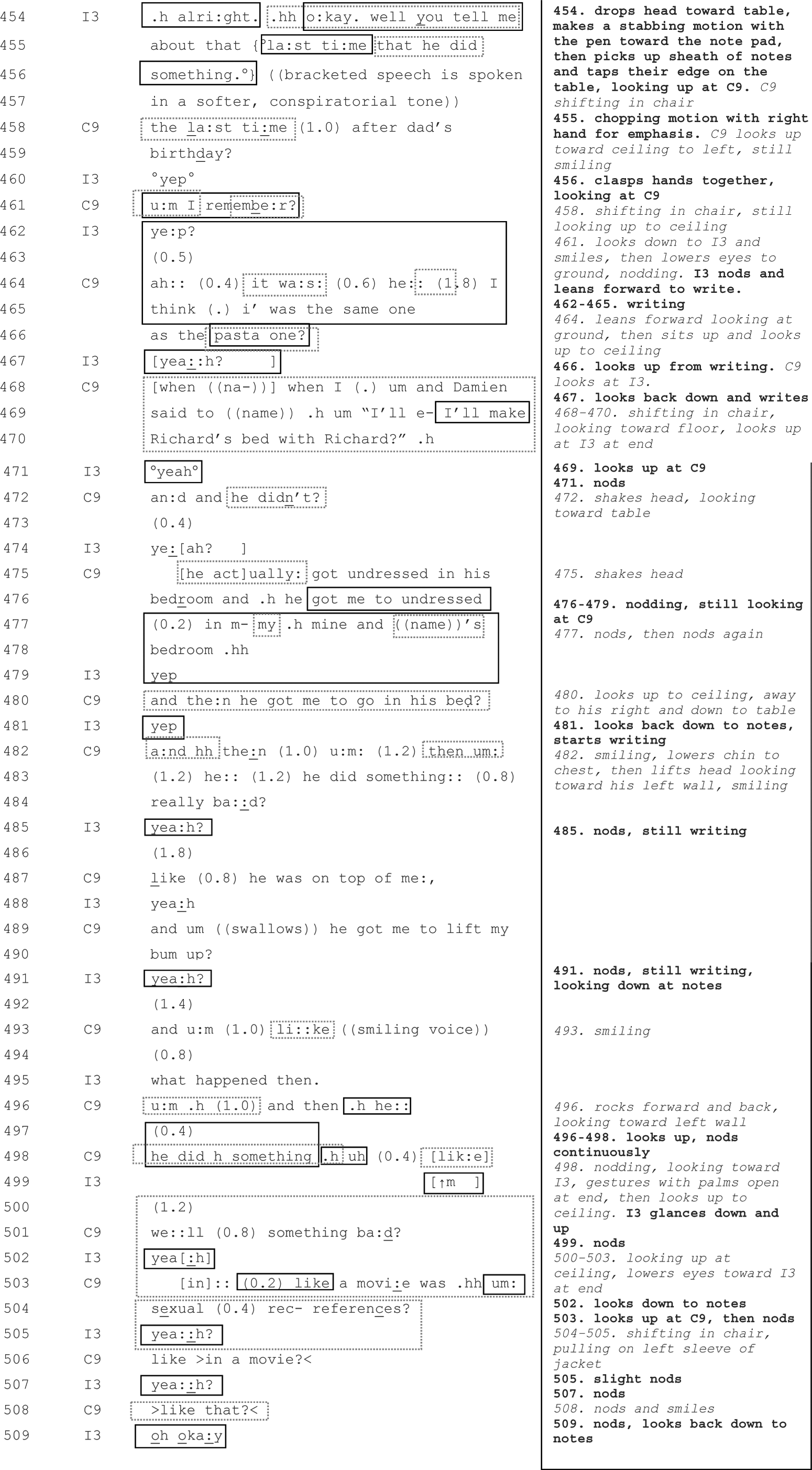
After a brief insert sequence at lines 458–460 where Richard seeks a confirmation of the target occasion the interviewer wants him to talk about, he begins his responsive SPP to the interviewer’s FPP request to tell (‘requesting’ is the social action embodied in her FPP). The important things to notice are, first, that throughout this whole sequence Richard still does not name the abusive act in detail. He alludes to it being something ‘sexual’ (line 504) but, apart from that, provides no new additional information to that which he provided earlier in the interview. Second, his talk and his body gestures generate an impression of discomfort. Third, the interviewer uses continuers 4 and silences in ways that maintain the sequential space for Richard to continue his turn in spite of these possible signals of discomfort. In other words, she attempts to restore progressivity. We deal with each of these points in turn.
Lines 482–484 appear to be the first point where Richard’s talk might logically start to include details of a sexual act, since he has just described how Damien got him to go into his bed. Up to this point, the interviewer’s continuers at lines 460, 462, 467, 471, 474, 479 and 481 are acting as signals that the interviewer is treating Richard’s turn as still in progress, thus creating a sequential pressure for him to continue his extended turn. But at lines 482–484 he avoids naming the act and instead provides an assessment of the act: it was ‘
There are several characteristics of Richard’s speech and bodily displays that together contribute to an impression of discomfort, or unease. First, there is the fact that he continues to defer telling the interviewer the explicit sexual details of what Damien did, which in itself implies this is problematic for him. One audible way that he defers this telling is through stretching out his words and through the many gaps within his turns. For example, at line 461 ‘
The stretching of words and intra-turn gaps start again the next time Richard approaches the point of telling the sexual detail of what Damien did at lines 482–484: ‘
The bodily displays that contribute to making Richard look uncomfortable to an observer include his smiling (lines 455, 461, 482, 493), particularly at those points where his speech is also dysfluent, and also the way he shifts his gaze between looking up toward the ceiling, to the interviewer, and down to the floor (lines 454, 461, 464, 466, 468–470, 480, 482, 496, 498). Other displays that contribute to the overall impression of discomfort include shifting around in his chair (lines 458, 464, 468–470, 496, 504–505) and pulling on his jacket sleeves (lines 504–505).
Shifting focus from Richard’s displays to the sequence as a whole, it is clear that the sequence itself lacks progressivity. Richard’s turns at talk are only slowly progressing the action initiated by the interviewer at the start of the sequence, and at the end of the sequence he has not yet disclosed ‘what happened’ in the detail required by the interviewer.
The third important feature of this sequence is how the interviewer responds to Richard even as she presumably detects all these audible and visible displays, which she could diagnose as indicating his discomfort. First, she relies heavily on continuers, which display to Richard that she is hearing and understanding but also, vitally, that she is bypassing opportunities to take a substantial turn herself, leaving space for his turn to continue. These continuers recur throughout the sequence at lines 462, 467, 471, 474, 479, 481, 485, 488, 491, 502 and 507. Regardless of whether or not she actually notices Richard’s displays, the consequence for the interaction is that by not topicalizing or making relevant any of these vocal or visible displays by Richard, it maintains Richard’s current turn space. She is not doing any conversational action that could terminate Richard’s current turn (e.g. by asking a question or making an assessment), and in this way the sequence structure, whereby Richard’s SPP turn is being treated as current and ongoing by the interviewer, maintains an onus on Richard to either continue his turn or find a way to complete his turn without aid. One clue that she might be interpreting his displays as indicating discomfort, though, is the amount of writing she does, which gives her cause to remove eye contact from him. Notably, these moments of writing coincide with moments where Richard sounds the most dysfluent (lines 462–465, 481–496). She also glances down at her notes toward the end of the sequence at several points in the midst of Richard’s multiple shifts of gaze, smiling and dysfluency (498, 502, 509). This removing of eye contact may indicate that she is indeed interpreting his displays as discomfort and is trying to make the interaction less inquisitorial for him.
In this interviewer’s responses, then, we see a possible orientation to ignoring visible and vocal displays that could be seen as discomfort through the use of conversational practices such as continuers and the removal of eye contact. Based on this and other examples throughout the data corpus, we argue that interviewers may have come to deploy such practices as part of their repertoire for restoring progressivity to an interaction that is threatening to stall. From the perspective of ordinary conversation these particular practices could be viewed as insensitive, but from this particular institutional perspective it is perhaps necessary to ignore children’s discomfort at times. Since there is rarely a chance of a case proceeding to prosecution if a child is unwilling to disclose what happened in sufficient detail for a court to make a determination in favour of the child, it is this end that may justify the means whereby interviewers press children to go on, in spite of plain signs of reluctance.
Nevertheless, at this point the interviewer does close off the sequence (line 509) and changes topic for a short while before introducing the idea of getting Richard to draw a picture of the bedroom where the act took place, which is the focus of extract 2.
EXTRACT 2
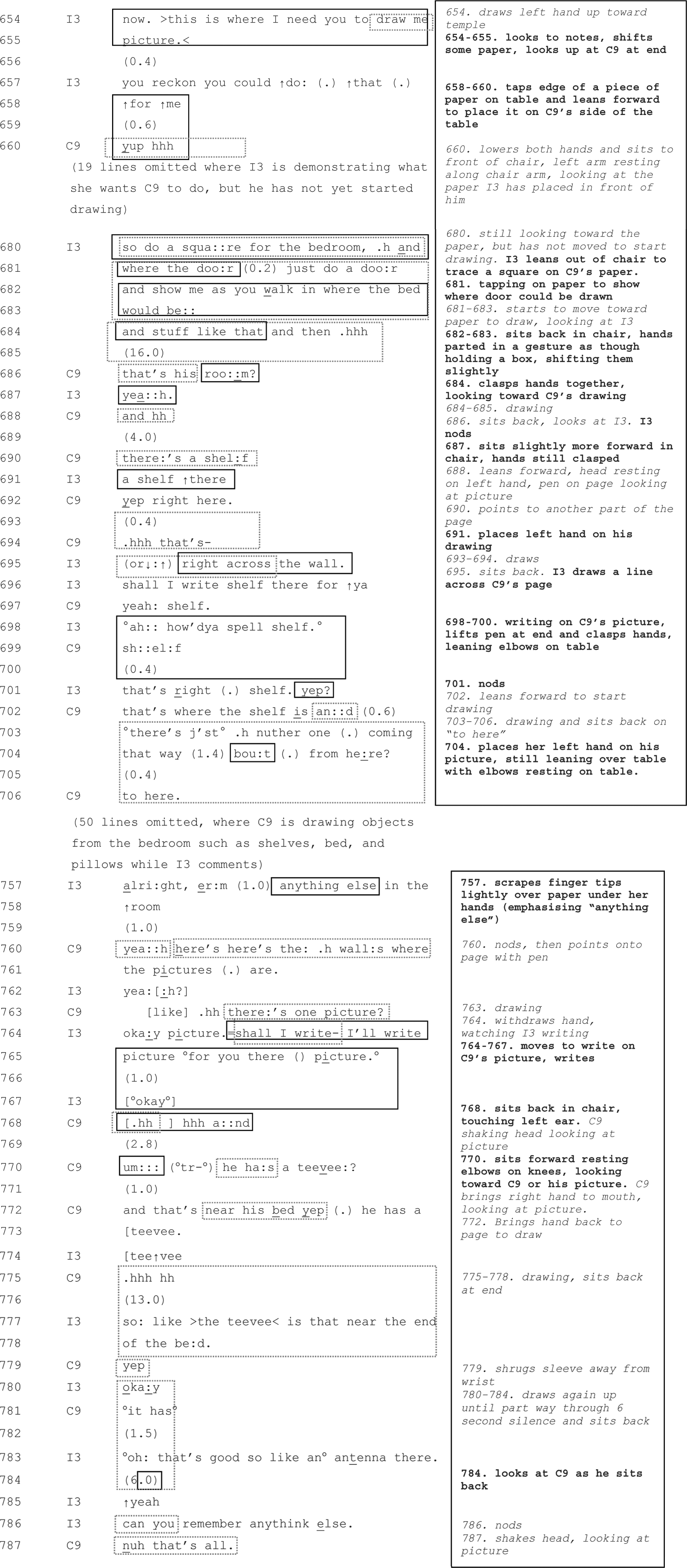
The main point we want to make about this sequence is that after Richard has established that he understands the task, which takes place during the turns omitted from the extract, and the interviewer has prompted him by drawing a square on his piece of paper (line 680), Richard then takes the lead in the interaction and begins a lengthy response to her request that he draw the layout of the bedroom. This lengthy response is made up of both the act of drawing and by his small announcements of what he is drawing (lines 686, 690, 703–706, 760–761, 763, 770, 772). For her part, the interviewer facilitates Richard’s extended turn by responding minimally to each of his announcements with continuers (687, 701), understanding checks (691), offers to label the picture (696, 764), ‘oh’ receipts (783) and assessments (783).
This collaborative activity focused on the drawing plays an important part in restoring progressivity to the interaction during this sequence; and the earlier displays that contributed to the impression of discomfort on Richard’s part, such as the smiling and shifting his gaze from ceiling to floor, along with the concurrent verbal dysfluency when sensitive topics were being approached, have now largely disappeared. Although Richard’s talk could be characterized as dysfluent at lines 768 and 770, it is notable that the interviewer is not showing any signs of treating this as a threat to progressivity, for example by using continuers as she did in the previous extract. Richard’s visible display of shaking his head and looking at the picture (line 768), followed by his stretched ‘a::nd’ (line 768), the 2.8 second gap (line 769) and the stretched ‘um:::’ and ‘ha:s’ (line 770) is perhaps being treated by the interviewer not as a sign of reticence or discomfort here, but rather as a display of taking his time to ‘remember’ or ‘recall’ the details of the room.
He eventually sits back from the drawing just prior to line 757 (lines omitted), which necessitates the interviewer prompting again with a new FPP question ‘
In extract 3, still using the picture, the interviewer brings the topic back to the sensitive issue of what happened while Richard was in Damien’s room, which has previously threatened to bring the interaction to a standstill.
EXTRACT 3
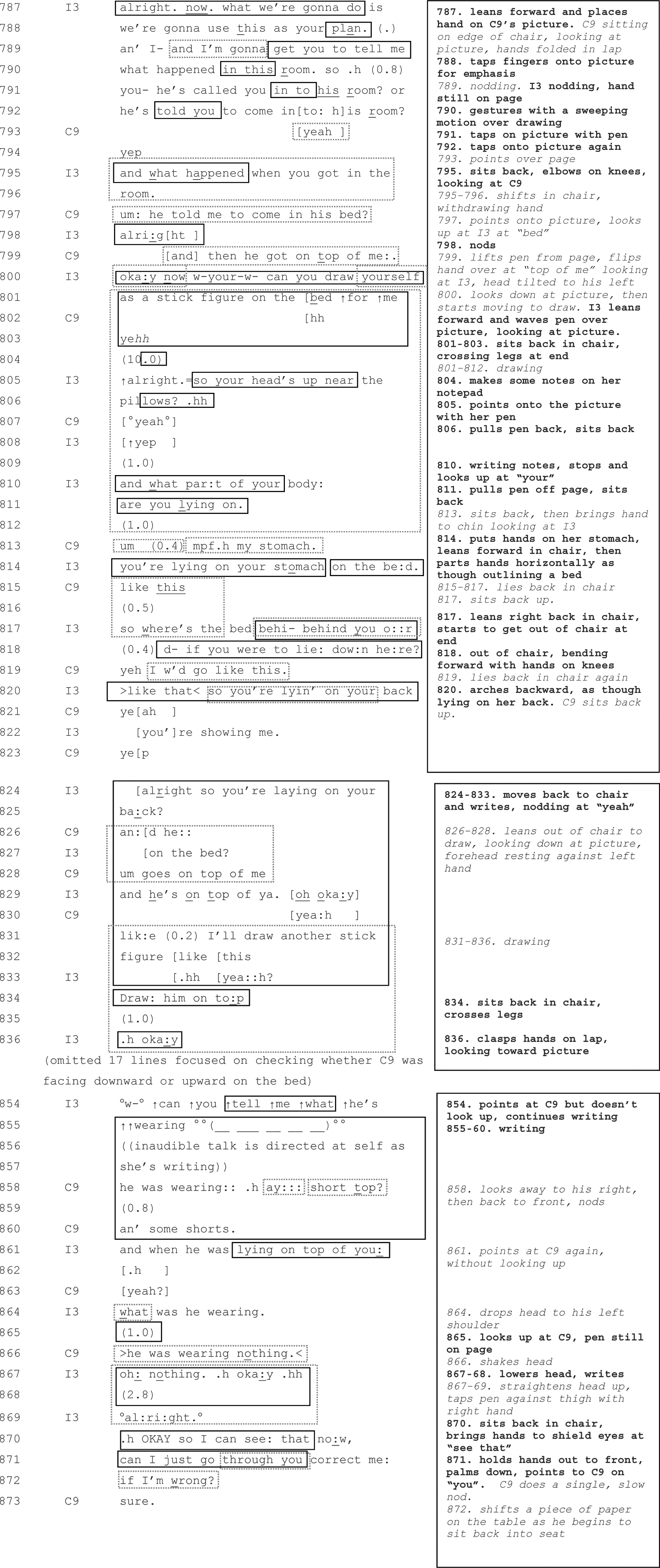
Before asking the potentially delicate question ‘
Richard continues to display engagement during the remainder of the sequence, with no signs of hesitating speech or the lengthy intra-turn delays that characterized extract 1. He initiates his own drawing of Damien’s body position without prompting (lines 831–833), and when the interviewer asks what Damien was wearing while he was on top of Richard, Richard delays but then answers quickly and fluently while maintaining eye contact: ‘
EXTRACT 4
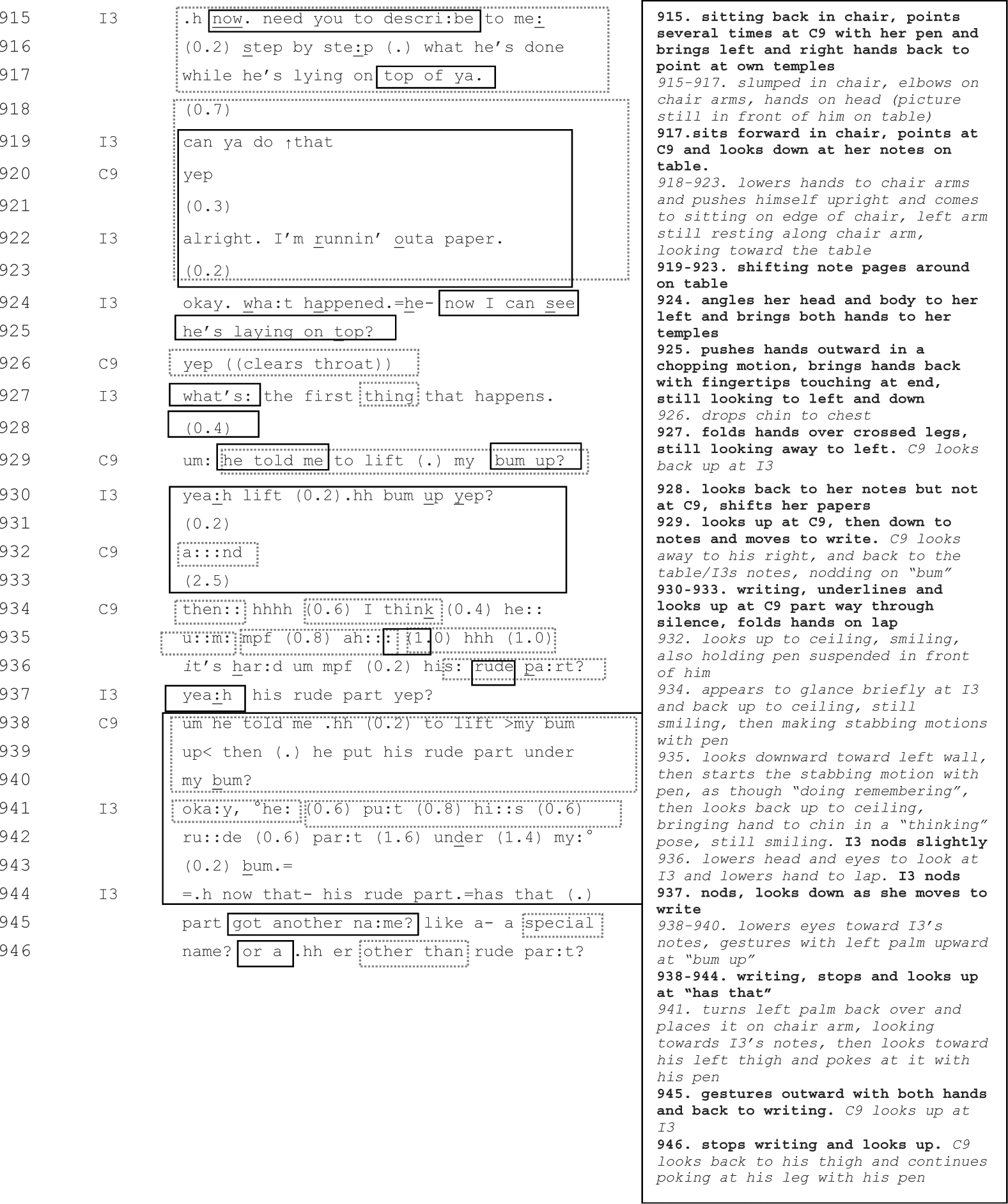
The first thing to note about extract 4 is that the interviewer is no longer orienting them both to Richard’s drawing, even though it still remains in front of him on the table. Hence, there is no third object here for them to focus upon, which, as we saw previously, gave a legitimate reason not to have direct eye contact and also allowed Richard to communicate some of what happened without having to verbalize it. Her first turn, ‘.
The interviewer thus needs to formulate a more explicit request to tell, which she begins at line 924 with ‘
The interviewer continues to keep her gaze off Richard and when he does begin his responsive SPP after a brief delay, the interviewer glances at him but then looks down to her notes and begins writing, prompting him with a repeat that works as a continuer ‘
From part way through the silence at line 933 through to 937, the interviewer appears to be looking at Richard but he does not meet her gaze. He glances briefly at her once, but for the most part directs his gaze to the ceiling, while still smiling. His ongoing SPP from lines 934–936 is filled with signs of trouble: ‘
Another continuer turn from the interviewer at line 937, coinciding with her removing eye contact again as she looks down to start writing, prompts Richard to complete his turn, which he does with comparable ease: ‘
In this example, and others in the data corpus, interviewers frequently repeat the words for sexual body parts and sexual actions that children have just used in the prior turn, and they tend to do this in continuer turns and in sequence-closing thirds, 5 as happens here (lines 930, 937, 941–943). This appears to be a helpful practice because by delivering these repeats in a fluent, untroubled way, the interviewer is demonstrating that they are not surprised or shocked by the child’s disclosures and in this way the activity of talking about genitals and explicit sexual things is normalized as the interaction proceeds.
Whatever labels children use to name either their own or the perpetrator’s genitals, bottom or other potentially sexual parts, interviewers need to establish with the child precisely which body part they are referring to (Cheung, 1999; Poole and Lamb, 1998). Once again, this is important for any future prosecution, where a child’s case might be undermined if it turned out that the ‘rude part’ meant one thing to a child but the interviewer had inferred it meant another. Pursuing this clarification is the interviewer’s main action-orientation in the ensuing talk and, although it provides further illustration of the consequence for progressivity when Richard begins to display all the vocal and visible behaviours that combine to suggest discomfort of some kind, it is not shown here (see Fogarty, 2010). The important thing to note is that the interviewer establishes that ‘rude part’ means ‘dick’, which completes that particular action.
In extract 5 the interviewer returns to the main action of finding out where and how Damien touched Richard’s body.
EXTRACT 5
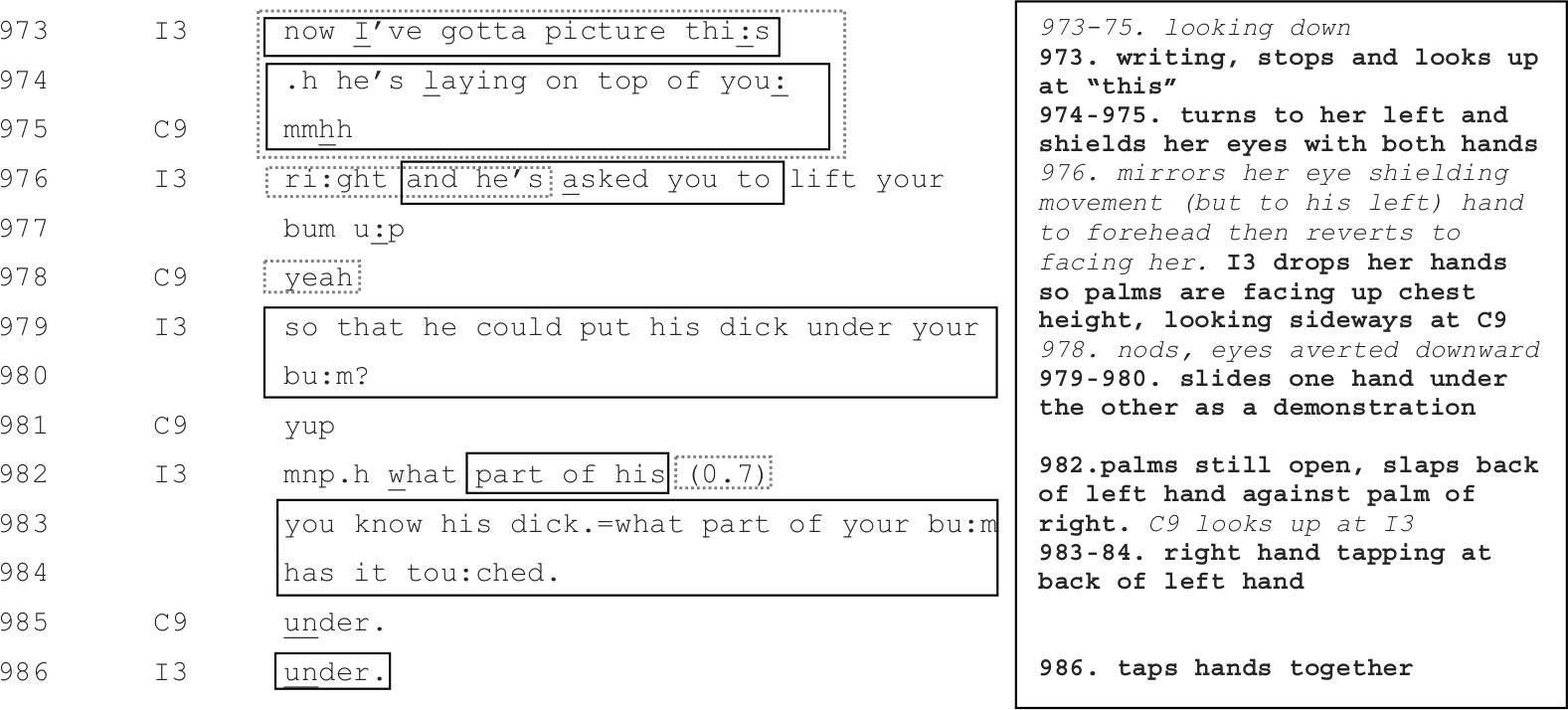
The main action-orientation of this sequence is to ascertain precisely where on the ‘bum’ the ‘dick’ has touched. But before the interviewer initiates her base FPP question at line 982, she first embarks on a pre-expansion sequence that recaps the story thus far and elicits Richard’s agreement to each element of the story (lines 975, 978, 981). In this way, she appears to be working to focus Richard on the moment in the story they were up to before she took them off the main track into the insert sequence to establish the meaning of ‘rude part’.
Her initial topic shifting TCU, ‘
At this point in the interaction, Richard is displaying fewer signs of discomfort, evidenced by the fact that he is no longer smiling and is also responding without delay to her confirmation eliciting turns (lines 974, 976–977, 979–980) and her eventual base FPP (982–984). However, his base SPP response ‘
Once Richard’s comprehension of the concepts ‘in’ and ‘on’ are on the official record, the way is open for the interviewer to set up a simple yes/no question–answer sequence to determine whether or not Richard was anally penetrated, seen here in extract 6:
EXTRACT 6
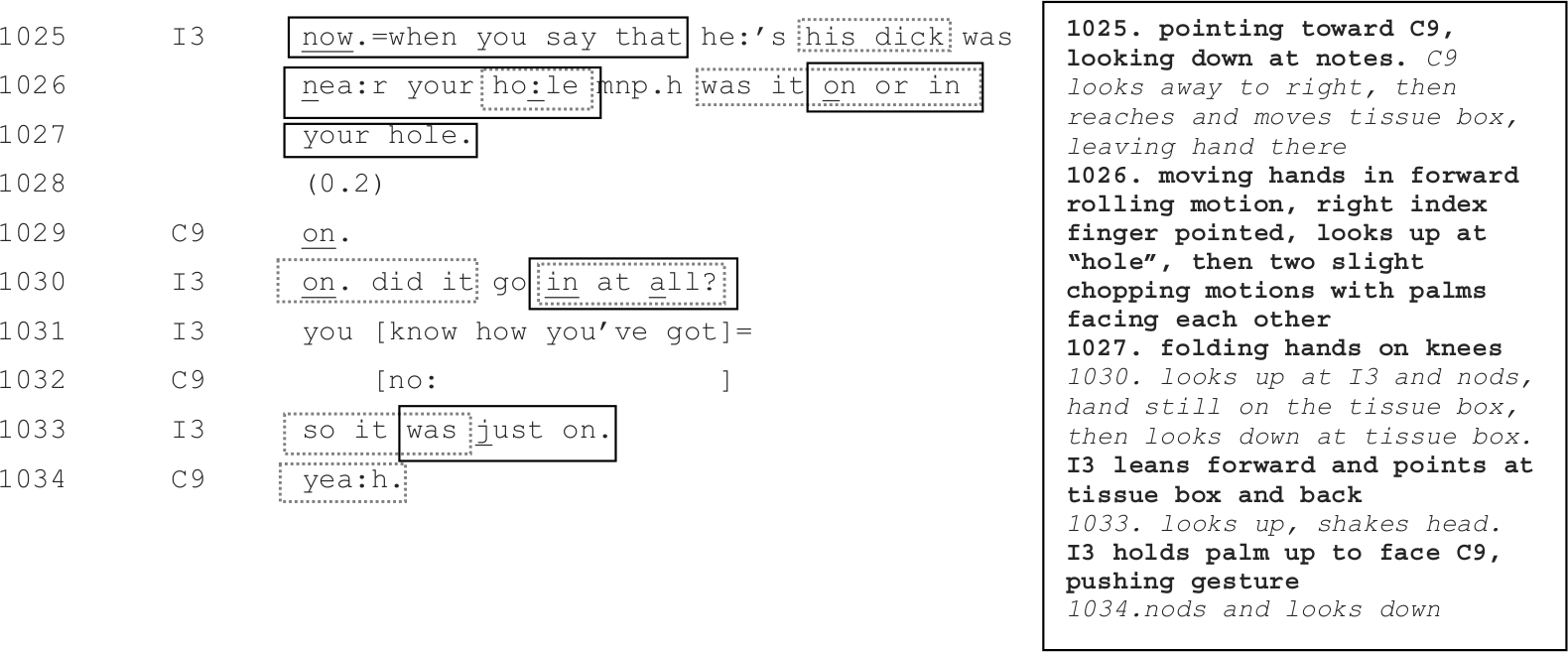
Richard delays only slightly before emphatically answering with ‘
Discussion
This study suggests that progressivity – the smooth, collaborative completion of actions within a given sequence of interaction – might be an element of what we are detecting when we judge that rapport is evident between two people. In support of this contention, we showed how progressivity was collaboratively achieved, lost and recovered between an investigative interviewer and a child witness during a sexual abuse interview. Importantly, we showed that progressivity waxed and waned throughout a long sequence of interaction. Thus, if we accept the possibility that progressivity is an element of an interaction that could be characterized as containing rapport, then perhaps we can also argue that rapport is unlikely to be a fixed state – simply present or absent to differing degrees. Instead, it is in flux throughout an interaction. This is especially likely in the setting of an investigative interview into child sexual abuse, where the child is being asked to talk about sensitive, potentially embarrassing topics that they are unused to talking about, and would probably prefer not to.
By locating rapport in this more thoroughly social interactional perspective, it gives greater empirical traction to making observations about the presence or absence of rapport. Whereas previous research has searched for correlates in body and speech that are presumed to reflect inner states, such as feelings of warmth, connectedness and friendliness, we make the case for partitioning off these inner states and focusing solely on the audible and visible displays that contribute to an interaction proceeding smoothly and collaboratively.
A potential criticism is that we are not talking about the same thing: that progressivity and rapport are unrelated concepts. Our counter-argument is that prior research also has some definitional and methodological problems when it comes to specifying rapport and measuring its presence or absence, and that perhaps progressivity is one audible and visible interactional element that can aid our understanding of rapport as it is commonly understood.
Consider this in light of Tickle-Degnen and Rosenthal’s (1990) three-fold model of rapport. The first component, mutual attentiveness, is defined as ‘mutual attention to and involvement with one another’ (p. 286), and the authors suggest that the non-verbal correlates might be body orientation and direction of gaze (presumably, gaze directed toward the other). In our data, we saw that when progressivity was stalling, the child’s gaze was often shifting from the ceiling to the floor: anywhere but directed at the interviewer. This supports Tickle-Degnen and Rosenthal’s suggestion that gaze may be a non-verbal correlate of rapport. But then, when progressivity was restored – for instance when both the child and the interviewer were working through the child’s drawing – their gaze was jointly focused on the drawing (not one another). Here, the direction of gaze seemed less important than the fact that they were attending to one another’s ‘moves’ within the interaction in a cooperative way. Thus, the interviewer and child were certainly meeting Tickle-Degnen and Rosenthal’s criteria of mutual attentiveness, but if we relied upon gaze or body orientation alone as markers of mutual attentiveness, there is much more ambiguity than if we focus on the ‘attentiveness’ being displayed by each person responding cooperatively to the other’s turns-at-talk, in ways that progress the activity at hand.
Similarly, Tickle-Degnen and Rosenthal (1990) propose positivity as a component of rapport, defined as the way that ‘interactants feeling in rapport with one another feel mutual friendliness and caring’ (1990: 286). They propose non-verbal correlates could be behaviours such as head nodding and smiling. In our data, by contrast, Richard’s smiling co-occurred with moments when he was dysfluent, often shifting in his chair, and shifting his gaze around the room (which gave the impression of discomfort), and this was also when progressivity in the interaction was most impaired. Yet when progressivity was restored, Richard was frequently unsmiling. We think this makes it clear that non-verbal correlates like smiling or head-nodding only gain their precise meaning within a particular interactional moment, and cannot be taken out of the context of their place in the sequence of interaction to be treated as straightforwardly reflective of feelings of friendliness or warmth. By contrast, noticing that moments of head nodding and smiling coincide with moments of progressivity in the interaction seems a more useful and parsimonious indicator of rapport than insisting on the presence of underlying feeling states that are inaccessible to the observer (and maybe even to the participants themselves if they are asked for post-hoc accounts of their emotions during an interaction that is now in the past).
The third component of rapport, coordination, or interactional synchrony, refers to movement synchrony between the two interactants as well as posture similarity (Bernieri et al., 1994). Yet, as others have noted, interactional synchrony might not necessarily coincide with positivity, and it may even be the case that people implicitly judge as positive an interaction where people appear ‘in sync’ or coordinated (Cappella, 1990). This muddies the conceptual waters when it comes to determining if positivity and interactional synchrony are distinct concepts; but it lends support to our position because we are suggesting that the observation of rapport in situ (in the sense of a perceived positive interaction) is bound up with both the verbal and embodied components of each person’s turns at talk, which unfold into a sequence of turns. And if this happens in a way where each person is contributing to the completion of actions initiated by the other throughout the sequences that comprise any interaction, then this is at least what partly forms the impression of a positive and synchronous interaction. For example, when a head nod occurs in precisely the right turn slot, without delay, and this moves the activity of the sequence along (progressivity), then this contributes to the impression of coordination. By contrast, when no response (either verbal or bodily) is forthcoming where one is due in a particular turn-slot, this can appear as a lack of synchrony or coordination in that moment. Conversation analysis (CA), with its focus on turn construction, turn-taking and sequence analysis, provides a method for homing in on this kind of detail.
A second important finding, with implications for investigative interviewing as well as therapeutic contexts, is that when it comes to building rapport, the greater skill may reside in being able to restore progressivity to the interaction through one’s own interactional moves, and not just in creating rapport in the first place. To begin with, progressivity is a jointly created phenomenon and not due to the interviewer alone. It is the reciprocal responsiveness of both the interviewer and the child to one another’s turns at talk that generates progressivity. However, when the child stops responding in ways that preserve this progressivity (most often when discomfiting topics are introduced), then the interviewer’s skill in making well-timed interactional moves to restore progressivity becomes paramount. In the data, we showed the skilful ways in which the interviewer went about this restoration, particularly when delicate, discomfiting topics were under discussion.
An implication of this for investigative and therapeutic interviewing is to re-consider the idea of a distinct ‘rapport building stage’, which implies that rapport building entails a concentrated effort at the start of an interview, which then provides a ‘store of rapport’ to draw upon during the remainder of the interview. Instead, it may be more useful to recognize that rapport – insofar as that includes the element of generating progressivity, and restoring progressivity – is an ongoing project throughout an interaction. Spending time at the beginning of the interview conversing about benign topics, as well as giving the child some information about the rules of engagement, is clearly important, but this is unlikely to be a prophylactic against the loss of progressivity as soon as the difficult topic of sexual abuse is introduced.
A third implication of this study speaks to the issue of recruiting or training interviewers for child abuse investigations. Perhaps a consideration in recruitment could be to focus on a prospective interviewer’s skill in restoring progressivity to interactions, since this is likely to be a marker of their capacity to move the interaction back and forth between less delicate and more delicate topics, so as to maintain the child’s engagement in the interview until the required information is gathered. By contrast, interviewers who are insensitive to the audible and visible signs of a child’s discomfort, or who bludgeon their way through the interview in spite of these signs, are possibly less likely to achieve their ends.
A fourth implication of this study is to provide some insight into the role of props, such as drawings. We saw how the judicious use of a drawing helped restore progressivity to the interaction when it had stalled. What ought to be clear, though, is that the drawing only succeeded in conjunction with both the interviewer’s and the child’s abilities to engage one another by the rules of ordinary talk-in-interaction as the drawing project was introduced, carried out and brought to an end.
The investigative interviewing literature has focused mainly on how props like drawings and body diagrams assist in overcoming the language limitations of young children and also their role in increasing the amount of material that children can recall and report (Aldridge et al., 2004; Faller, 2007b; Gross and Hayne, 1999). Whilst there is some reference made to how drawings and body diagrams may assist children who feel shame or embarrassment when reporting sexual information (Steward et al., 1996), there is no explication of the process by which the props might achieve this.
The present study suggests one way into this process question is to look at when and how these props get introduced into the interaction by an interviewer, the kinds of interactional happenings that precede their introduction and the impact they have upon the interaction. With its focus on the sequential organization of interaction, conversation analysis is a valuable method to explore such questions.
Notably, it is the fact of Richard not collaborating with the interviewer’s requests to start telling his narrative that contributes to the impression of discomfort and reticence to tell, and this creates the contingency where it makes sense to introduce the drawing as an aid to help him tell. Thus the drawing is consequential to the interviewer’s ability to hear and respond to the emerging interactional signs of Richard’s discomfort. And the drawing’s success as a prop is largely achieved through the interviewer’s and Richard’s mutual responsiveness to one another’s actions in the talk which accompanies their focus on the drawing. The drawing, at least in this instance, functions as an adjunct to responsive interaction and not as a substitute for it.
Therefore, while this study does suggest that a drawing can be a useful tool for investigative interviewers to use to help children at those moments where they are being asked to do potentially embarrassing namings of body parts or sexual acts, the more important factor is an interviewer’s capacity to notice and respond skilfully within the interactional moment to children’s discomfort. Without this skill in creating and restoring progressivity, the props are unlikely to be of very much value.
In this article we have illustrated the sheer complexity that interviewers face as they manage multiple activities within sequences of interaction ostensibly focused on finding out the details of what has happened to a child. Although not all parts of the sequence were shown in this article, the interviewer needed to depart several times from her main project of getting Richard to articulate the details of what was done to him sexually in order to label sexual body parts, clarify the meaning of those body parts and check his conceptual understanding of ‘in’ and ‘on’, before returning to the main activity of finding out what was done to him. And because these side projects were also involved with asking him about sensitive, potentially discomfiting material, they opened up even more opportunities for the interaction to stall (and for perceived rapport to wane).
We think that future research using conversation analysis could fruitfully look at interview outcomes for interviewers who display skill in creating and restoring progressivity, compared to those who do not. A key focus would be the ways in which interviewers, using the ordinary rules of conversation, work around children’s reticence to talk, for this is what ultimately counts in terms of both institutional outcomes (prosecuting cases that should be prosecuted, and not prosecuting those that should not) and outcomes for the child, the child’s caregivers and the accused. This includes justice, certainly, but also perhaps the speed with which interviewers can complete an interview so that an uncomfortable child can be released as soon as practical; and also the interviewer’s ability to move responsively between delicate and not so delicate material so that the child is not in a constant and unrelenting state of discomfort throughout the entire interview. This implies that the very best interviewers may be those who can maintain the dual focus on achieving institutional outcomes and simultaneously the ‘here and now’ ethics of interacting with child witnesses in ways that attend to the perceived discomfort of the child.
Footnotes
Acknowledgements
Thank you to staff of the Sexual Crime Investigation Branch within the South Australian Police, and the families involved, who gave their consent for access to, and use of, the anonymized data in this study. Thank you also to Stuart Ekberg and Scott Hanson-Easey for valuable critiques of the manuscript in its early stages.