






Abstract
This article analyzes doctor–patient communication at admission interviews in an outpatient mental health care service at a public hospital in Buenos Aires, Argentina. These interviews are the first contact between professionals and patients, and they result in the admission or rejection of the latter into the medical institution. In particular, we observe how context, understood as a sociocognitive and scalar concept, is reshaped with gaze direction and agenda-setting through interaction, resulting in three hierarchical spaces which can be represented as degrees in a scale: the public, the private, and the intimate level. This description will allow us to understand a series of communicative difficulties that may result from scale maladjustments, in which professionals interact with patients at different levels and therefore cannot give adequate feedback to satisfy mental health care needs.
Keywords
Introduction
The role of language in producing and reproducing social inequality has been studied in different settings with special interest in public and private organizations and institutions (Blommaert, 2010; Hymes, 1996; Moyer, 2011; Sarangi and Roberts, 1999; Sarangi and Slembrouck, 1996). In countries like Argentina, which has experienced over a decade of dismantling of the state apparatus, the symbolic and practical place of public institutions, such as health care services, has become radically different from private ones. The lack of infrastructure, equipment, and medical supplies, together with poor working conditions and an overall mercantilization of health care, are among the main factors which left the public health system in a subordinate place (Stolkiner, 2009). Even after 10 years of new policies, there has not been a structural reform in this regard. This is a key to situating the problem of access to civil rights such as health care and the well-known problem of doctor–patient communication in a concrete social, economic, and institutional environment because the structural constraints are intertwined with the specific conditions of interaction.
Specifically for the case of mental health care in public hospitals in Ciudad de Buenos Aires, access to outpatient service is conditioned by an ‘admission interview’, which is carried out by two psychologists who decide whether or not the case is worth psychological and/or psychiatric treatment at the hospital. Later, the whole team involved in the admission process join together to decide on the specialty into which accepted patients should enter (individual therapy, group therapy, addictions, legal psychology, etc.).
As we can see, admission interviews are the nexus between the ‘outside’ and the ‘inside’ of the outpatient mental health care service. The performance in the interaction will be one of the main factors in the access to treatment in at least two ways: for the psychologist, it will provide information for diagnosing the patient, and for the patient, it will be an instance of evaluation of the service which will serve to decide whether s/he will be eligible for treatment or not (see Bonnin, 2013).
Indeed, resistance to treatment can be conditioned by interaction during the interview in ways close to primary health care encounters (Heritage and Maynard, 2006; Peräkylä et al., 2008) and acute medical visits (Koenig, 2011). In this sense, Heritage and Clayman (2010) have proved that, although first contact with medical discourse can have therapeutic value in itself, ‘this will not be realized if patients do not feel that their concerns were adequately heard and addressed’ (Heritage and Clayman, 2010: 105; see Barry, 2002; Iedema, 2005b; Moore et al., 2004). This ‘feeling’ can be described as ‘active listening’, ‘sympathy’, or ‘transference’ in psychotherapeutic conversation (Leudar et al., 2008: 153). In psychoanalytical terms, in order to ensure the continuity of the treatment there has to be some kind of transference relationship between the patient and a meaningful other in the situation, typically the analyst (Fink, 2007). 1
We will argue that one of the interactional conditions that make this kind of reciprocity possible at the admission interview is the construction of different spaces or scale-levels of context shared by the analyst and the patient throughout interaction. When both occupy the same level, sharing a common agenda and situation, there is a reciprocity which allows for an analytical relationship. On the contrary, when a maladjustment exists between the space inhabited by the psychologist and the space inhabited by the patient, reciprocity becomes difficult or even impossible, and the demand of mental health care cannot be satisfied. As an unintended consequence of communicative action, the patient is formally accepted but communicatively rejected.
In the following, we will first present a theoretical section in order to discuss the place of institutional settings in doctor–patient interaction analysis, adopting an indexical and scalar view on context (Blommaert, 2006; Silverstein, 2003) as a socio-cognitive construct (Van Dijk, 2008). This will allow us to set a critical position towards current literature on the issue. Second, we will describe the discursive co-construction of three different ‘levels’ of context in admission interviews based on two dimensions: gaze direction and agenda-setting. Finally, we will observe two cases in which maladjustments between spaces are produced, and reciprocity cannot be achieved.
Doctor–patient interaction and the issue of context
Verbal interaction between doctors and patients in medical settings has been traditionally issued from Talcott Parsons’s (1951) perspective on social systems and role assignation (‘the sick role and the role of the physician’; Parsons, 1975). Assuming his overall characterization of ‘the organizing principles’ (Heritage and Clayman, 2010: 119) of medical context, ethnographical descriptions are often missed or even underrepresented in specialized research. As Blommaert (2005: 51–52) notes, the combination of theoretical claims and prima facie ethnographic results, in many cases, in an a priori contextualization which situates verbal material within a static framework of ‘non-discursive’ situation (May, 2007). As a consequence, doctor–patient interaction appears framed in rough, schematic terms which ignore everyday negotiations of these roles, historical developments and traditions of health care, and ideological and political heterogeneity within the hospital’s personnel, etc. (Fochsen et al., 2006; Fox et al., 2009). 2 Even information on whether the hospital is public or private is often missing in this kind of research. 3
Important contributions to professional–patient interaction, such as Heritage and Maynard (2006) and Heritage and Clayman (2010: 119 ff.), adopt Parsons’s description of roles. They proceed to perform linguistic analysis without questioning the interface between social structure assessments and interactional data. Cordella’s (2004) outstanding work on participant voice during medical consultation finds a similar tendency in a wide variety of doctor–patient communication studies (pp. 30–38). May (2007) has noted an analogous situation in sociological studies on clinical encounters that are usually described as a dyadic relationship defined by asymmetrical distribution of power and knowledge. On the contrary, he describes a more dynamic and multidimensional situation that includes state and corporate actors which locate the clinical encounter only as a ‘part of an assemblage of complex organizational, institutional and disciplinary resources and practices (. . .) where subjectivities are constructed and worked out in multiple and diverse ways’ (May, 2007: 41; May et al., 2006). Adopting this kind of dynamic perspective, recent research has shown a more flexible distribution of roles which are negotiable and subject to change (Fochsen et al., 2006; Fox et al., 2009) on the basis of socio-economic backgrounds, gender, and race (Cordella, 2004; Peck and Denney, 2012).
From a discursive point of view, studies on health organizational communication (Candlin and Candlin, 2003; Crawford et al., 2005; Iedema, 2005a, 2005b, 2007; Sarangi, 2004, 2011) show the need for ethnographical approaches to hospitals as institutions to understand communication in medical settings. As Iedema (2005a) points out, the adoption of the hospital as context – and not just the micro-level of the interaction within the consulting room – is needed ‘to inform policy makers, health managers and hospital clinicians about how work is changing in these sites and what these changes entrain for clinical professionals in interactive-discursive terms’ (p. 244). Therefore, the consideration of hospital settings as multicultural social sites which require a thorough ethnographical work (Moyer, 2011) allows, on one hand, a collaborative research on health care (Candlin and Candlin, 2003; Sarangi, 2004) which will serve to solve clinical problems. On the other hand, shifting away or problematizing the relationship between the doctor and patient allows fuller understanding of what constitutes everyday medical practice (Sarangi and Roberts, 1999). Therefore, negotiation and reconfiguration of institutionalized roles and situations become not the exception, but a constitutive feature of medical settings (Cicourel, 1999; Sarangi, 2011). This reconfiguration includes basic contextual parameters as time and space, which are subject to variation based on former experiences of participants (Candlin and Candlin, 2007).
The theoretical problem is to integrate the co-construction of text and context as mutually constrained: a discursive recontextualization of situation and a situational conditioning of discourse (Bonnin, 2011). The latter is often addressed by doctor–patient conversational analysis (for a thorough review, see Heritage and Clayman, 2010). The former is less often explored because of either extremely restricted definitions of situation or, on the contrary, because of wider, structural representations of context which disregard the specific features of interaction (Blommaert, 2005: 39–67).
In this sense, Van Dijk (2008) has pointed out that many theories of context have a ‘deterministic’ point of view which considers the situation as an objective crystallization of social properties which has a determinant impact on discourse production and interpretation. Instead, he argues that ‘context is what is defined as relevant in the social situation by the participants themselves’ (Van Dijk, 2008: 5). From this perspective, even material/physical properties of situation can be recontextualized in different terms. For example, the ‘waiting room’ and the ‘reception desk’ of the mental health care service at the hospital are two areas occupying the same space: same wall, roof, floor, and light. Yet, after a patient registers him/herself at the table which works as reception desk, s/he is told to wait ‘outside’. S/he waits in a different space in socio-cognitive terms, although it is the same room in physical terms and the same institutional setting in sociological ones. Nevertheless, the behavior of the patient in front of the desk (i.e. ‘inside’) and at its side (‘outside’) is different. Following Van Dijk (2006: 164), ‘contexts are not observable, but their consequences are’. This perspective is especially useful for our research because it allows us to think that two speakers, engaged in a conversation, can be participating in different mental contexts although they share the same space and they interact (acoustically and/or linguistically) between themselves.
This process of constructing context is not only related to immediate situation. On the contrary, as Silverstein (2003) has shown, the micro-social event of a singular act of communication and the macro-social categories which are connected to wider social processes are ordered in hierarchical levels. This order is indexicalized by discourse’s metapragmatic function, realized by both explicit and implicit communicative resources (whether linguistic or not) that allow speakers to move from one order to another; from the ‘here and now’ of the situation to cultural values and rituals (Silverstein, 2003: 201–204). Similarly, the concept of sociolinguistic scale coined by Blommaert (2006) explains the relationships between language and a ‘stratified, non-unified image of social structure’ (Blommaert, 2006: 4). The term aims to provide a ‘vertical’ metaphor of social order which helps understand every utterance as indexicalizing different levels of the scale, from the local and momentary interaction to translocal, widespread, long-term processes. In this sense, speakers can make scale adjustments (i.e. pointing to different scale levels) to accomplish different kinds of purposes. Although Blommaert’s interest is to link locally defined situations to global processes, we adopt the idea of ‘scale’ to understand the different levels which compose the local situation itself. As we shall see, the discursive construction of situation (i.e. spatial boundaries, agenda, and participants) is also scalar and can be described as a hierarchy which goes from the institutional, public level of the hospital to the subjective, intimate level of patient’s emotions.
By combining these concepts, we observe that speakers engaged in admission interviews may indexicalize the same scale level, constructing the same mental context, or, on the contrary, they can inhabit different spaces at the same time. When the latter happens, we observe a maladjustment of scales: one participant interacts at one level and the other at a different one.
Scale levels at the admission interviews
The health care system in Argentina is organized in three sectors: public, private, and mixed (Acuña and Chudnovsky, 2002). The private sector is financed through voluntary insurance schemes. According to recent surveys (Abeledo, 2010), about 10% of the population is included in this sector. The mixed sector is financed through obligatory insurance schemes and administrated by labor unions, which provide health insurance to 20.3 million users (53% of the total population). The public sector offers free health care to all inhabitants of the country. It is financed by the state, which also finances research and education. Although public health services could be used by any inhabitant of the country, only around 16 million people (37% of total population), who are not included in other sectors, go to public hospitals and primary health care centers (De Almeida-Filho and Silva Paim, 1999).
The neoliberal decade of the 1990s left public health in Argentina as a dismantled, saturated system that lacks basic human and material resources (Belmartino, 2002). After decades of privatization of social rights, the public health care system ceased to be perceived as a human right to which every citizen was entitled and began to be seen as poor relief (Comes and Stolkiner, 2005).
As far as we have observed, most people who attend public hospitals in order to receive psychotherapy or psychiatric treatment do not have access to private health insurance or have a job in the formal sector of economy. We have even observed that health effectors at the hospital we are concerned with reject patients with medical insurance arguing that ‘people who come here do not have any other place to go’ (‘las personas que vienen acá es porque no tienen ningún servicio para atenderse’). Under these conditions, the system is overwhelmed by a demand that cannot be adequately satisfied by impoverished public hospitals. Due to the lack of personnel and physical space, mental health care services at this hospital have only 10 vacancies a week available for new patients. For this reason, people arrive at five in the morning to register at eight and have the admission interview between 8:30 and 10:30 a.m.
I have ethnographically observed 72 admission interviews and tape-recorded 41 of them (total of 579 minutes) throughout the year 2012 with the informed consent of patients and professionals. The interviews were held at an outpatient mental health care service located in a public hospital in Buenos Aires, Argentina. To ensure the confidentiality of data, I do not identify the hospital where the interviews took place. I have also replaced, when it was necessary, the names of patients and professionals with randomly selected letters.
Patients traverse three different situational levels through the interview. The first is the explicitly institutional level of state rationality, which deals with bureaucratic discourse and the inscription of the patient in the state apparatus through demographic information (age, gender, etc.) of an epidemiological-statistical form which is collected to generate quantitative data. The second level is clearly situated, has fewer active participants, and is centered on the patient conceived as the subject of a biography, creating a private space which favors history taking (Boyd and Heritage, 2006: 151–184; Heritage and Clayman, 2010: 135–153). Finally, the space of interaction may be even more restricted at the third level. It becomes exclusively centered on the patient’s emotions, which tend to be expressed through crying and volume lowering, shaping the intimate level of the interview.
In the following, we will observe how these three levels are co-constructed through gaze, gesture, and agenda-setting. Then, we will see the effects of scale maladjustments when participants interact at different levels.
The public level
The first level of interaction takes place when the patient is called for interview by a psychologist. Consulting rooms are small cubicles made of moveable panels; when there are no rooms available, interactions take place in the corridors of the department. Background noise is constant and interferes in the interaction in two ways: either overcoming the speakers’ voice or interfering with the actual interactions (e.g. calling in a high voice to one of the participants from outside the cubicle; see further, extract 14). If we take into account only the participants who physically stay in the consulting room (whether comprising just panels or chairs) where the interview is taking place, we can outline two significant dimensions in the construction of space.
Gaze direction
The role of gaze in turn-taking allows not only the establishment of speakership, but also the other-selection of speakers (Lerner, 2003; Mondada, 2007). As a consequence, gaze may work as a resource to designate legitimate interlocutors during interaction. In the corpus we have examined, many gaze patterns observed in other kinds of doctor–patient interactions (e.g. the role of the computer in gaze behavior, as in Asan et al., 2012 or Yu et al., 2011) are impossible to compare with a situation which, in many cases, does not include even a table or a proper desk. In the interviews we have observed, the patient faces three other people: someone who will lead the interview, whom we call the psychologist in charge (PC); someone who assists the PC and takes notes in a file (the assistant psychologist, AP); and someone who stays still, aside from the table, taking notes – the researcher (R). In this first contact, gaze direction is still exploratory in the case of the patient, but it is quite directed in the case of the PC:
Extract 1
Extract 2
Both examples show how the PC tries to narrow the space of interaction as a way to establish her role as the main interviewer. In order to do this, she displays a series of postural and gaze resources during the opening sequence of the interview: leaning her elbows on the table, physically approaching the interlocutor, and seeking eye contact (extract 1, lines 1 and 4; extract 2, line 3). The other two participants, who already know the usual development of the interaction, fix their gaze at the table or the body of the patient or take notes (the AP to fulfill the admission form, the R in his notebook), making their subordinate role in the interview clear. Nevertheless, the patient does not know the prearranged roles. In extract 2, line 4, as well as in extract 1, line 2, patients look alternatively at the three interlocutors, looking for some sort of feedback to infer their positions at the institution or their roles in the interaction. The same happens in extract 1, line 5, in which the patient’s gaze addresses the researcher, who will have an insignificant role in the interaction.
This first level, hierarchically higher and more impersonal than the lower ones, is also open to the influence of other participants who can be stared at or verbally addressed, widening the space of interaction. Although, due to the spatial disposition of participants, psychologists are in a more favorable position to widen gaze, patients also show a representation of the space of interaction wider than the immediate physical situation. In the next example, a woman inside the consulting room addresses one of her children who stays outside while the AP is closing the door:
Extract 3
In this example, the transition from the outside to the inside is made from within the consulting room, which has permeable boundaries. The momentary rise in volume, in line 1, has a pragmatic function (to give an order) rather than a phatic one; that is the reason the volume is immediately lowered. On the other hand, there is a clear distinction between inside and outside, shown by the PC in line 2 with the deictic verb ‘entrar’ (‘to come in’). This difference is reinforced by the role of the door, which is closed after the decision to leave the children outside (line 3). However, although the door may be closed, participants can be called from the outside, and they may answer these calls (see further, example 14).
With this last observation, we can schematize gaze directions by setting the widest space for the interaction and the maximum number of participants (Figure 1).

Gaze at the public level.
Agenda setting: The patient as a demographic subject
The main theme of the interview is always the patient’s particular situation, who is asked to tell his/her story in order to detect meaningful symptoms. At this first level, however, the patient is characterized only as a demographic entity and is requested to give demographic/bureaucratic information: name, identification number, age, gender, etc. In many cases, professionals already have this information, which is provided by the patient to the secretary. Yet it is requested again, as a topical way to establish the public level of interaction. The interviewers’ own roles are vaguely characterized, especially when the researcher is present. This characterization is made through general categories, such as ‘professionals’ (profesionales) or ‘colleagues’ (colegas), as seen in extract 1, line 3. On very few occasions do psychologists introduce themselves with their proper names.
Consequently, the addressees of the solicited information also abstract entities:
Extract 4
Extract 5
In extract 4, the PC begins by detailing the sequenced organization of the interview through the ordinal ‘first’ (‘primero’, line 1) and the adverb ‘then’ (‘después’). In line 2, there is a false start; the feminine article ‘la’, which is replaced by ‘el’, is concordant with the masculine noun ‘hospital’. In extract 5, line 1, a very similar beginning sticks to ‘la’ and continues with the feminine noun ‘estadística’ (‘statistical records’). In both cases, the addressees of the information are abstract entities which are beyond the concrete interlocutors: the hospital and the statistical records.
The purpose of this first level of interaction is the patient’s framing as an emergent of demographic categories such as gender, age, or education. This procedure can be corroborated in a series of repairs which rephrase speech in the bureaucratic terms of institutional discourse:
Extract 6
Extract 7
The epidemiological-statistical form presents two consecutive questions: first, educational level (primary, secondary, and tertiary), and second, degree of completeness (complete or incomplete). As it is a standard form, previous experience of speakers in bureaucratic discourse enables interviewees to foresee the questions which will be addressed to them. Therefore, the answer to the first question in extract 6, line 2 anticipated the second one, which still had not been formulated. In this sense, it is interesting to note the non-concordance in gender between ‘secundaria’ (‘secondary’, fem.) and ‘incompleto’ (‘incomplete’, masc.). The PC employed ‘secundaria’ as a feminine adjective, modifying ‘educación’ (‘educational level’). Nevertheless, in the statistical-epidemiological form it usually modifies ‘nivel’ (‘level’), which is a masculine noun. The non-concordance between feminine adjective and masculine noun in the patient’s answer is, therefore, a trace of experience in bureaucratic communication: ‘secundaria’ is answering the PC while ‘incompleto’ is addressing the form.
However, in extract 7, line 2, the patient answers with her own singular biographical information. The PC then makes a repair (line 3) in order to rephrase the answer in terms of the form: ‘[nivel] secundario incompleto’. In both cases, we observe how the public space is inhabited by the demographic subject and not by the biographical one, which will be the main character of the private level.
The private level
The second space built in admission interviews is the private one, in which the biography of the subject as an individual is the main topic. Listening to his/her story will allow psychologists to diagnose the patient. Without the movement towards this key level, there cannot be a diagnosis or transference.
From the patient’s point of view, this is the space where therapy happens: s/he can expose private feelings, wishes, or frustrations to a professional who is ‘supposed to know’ (Lacan, 1977: 236) and can help him/her solve personal problems. Within this private space, the subject becomes the protagonist of a biography, the main character of his/her life story. From the psychologist’s point of view, this is also a key space because it allows for gathering of private information that will serve to diagnose patients. As we will see in the next section, patients and analysts can deepen into an intimate space. This move, however, is not necessary; on the contrary, in many cases there is a clear strategy to avoid this kind of profundization.
Gaze direction
My observation of the interviews is not a participant one. This is the reason why, unconsciously at the beginning and consciously later, I kept myself away from the surface of the table. This object organizes the basic opposition of roles (interviewer(s)/interviewed) and the distribution of space between two clear areas. The PC and the AP write official forms (the epidemiological file and the admission form) beside each other at the table while I take notes on my lap. As can be seen in Figure 2, it would require an extra effort by the patient to look at me once s/he enters the private space.
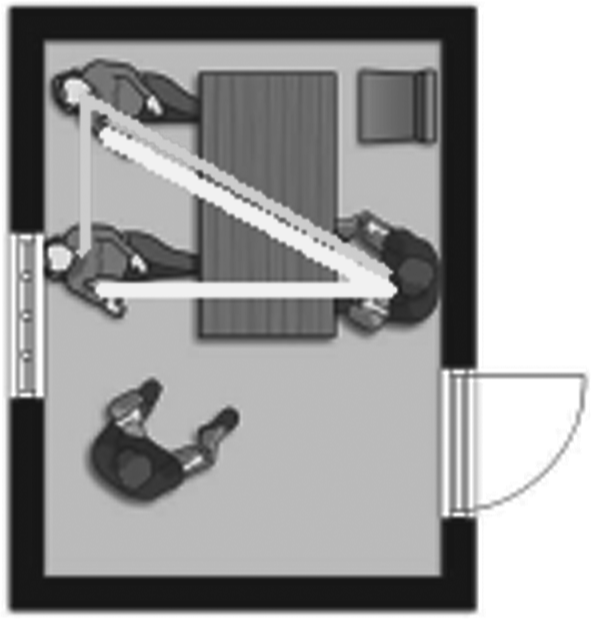
Gaze at the private level.
Therefore, gaze direction closes a space which includes both psychologists and the patient. The PC immediately assumes a position of authority which allows him to lead the interview, posing questions and addressing the patient directly, becoming the individualized interlocutor of the patient.
However, the AP has his/her own role, such as assenting, taking notes, and receiving instructions from the PC. Although subordinated, his/her place in the interaction is noticeable because s/he is addressed by at least one of the other participants. Therefore, the space outlined by gaze is semi-closed, privileging a relationship two to one, excluding the researcher, who does not have an identifiable role as seen in Figure 2.
Agenda setting: The patient as a biographical subject
The main topic discussed in this second level is the patient as a biographical subject; an individual who emerges from the standardized demographic categories employed in the previous stage. In fact, being the main motivation for the visit to the hospital, the patient usually tries to enter private space during opening sequences and respond to the statistical-epidemiological form with his/her singular biographic data:
Extract 8
Extract 9
In both cases, we observe how patients repair their answers to change their subjective positions. In extract 8, facing the demographic question on home composition (line 1), the patient changes, after a pause, the amount of brothers (line 2) and introduces a justification of this repair (line 3). This allows her to point out her brother’s death as the reason why she went to the mental health care service to request attention. The PC, however, who is still asking the questions from the epidemiological-statistical form, postpones the issue in line 4 in order to preserve the public level agenda. Something similar happens in extract 9. The PC asks for the marital status in line 1, but taking into account the patient’s facial expression and the long pause of three seconds, the PC asks for a confirmation in line 3, provoking the repair by the patient, who points out the existence of a conflict with her husband. In lines 4–5 the patient begins her biographical story which ends at the consulting room, indexicalized by the change in the verbal tense: from past (‘me quería separar’, ‘I wanted to divorce’) to present (‘no se quiere ir’, ‘he does not want to leave’). As seen in both examples, the life story begins with the emergence of the first person: ‘mi mamá y mis dos hermanos’ (‘my mum and my two brothers’, extract 8, line 2); ‘yo me quería separar’ (‘I wanted to divorce’, extract 9, line 4).
From this point on, PC’s interventions usually look forward to make the story telling easier, asking questions about the patient and the circumstances of the narrative:
Extract 10
Extract 11
In the first line of extracts 10 and 11, the PC points out the moment of displacement towards the private space using the imperative second form ‘contame’, ‘cuénteme’ (‘tell me’, informal/formal), which builds a deictic space limited to only two participants (first-person singular in the verb and second-person singular in the clitic pronoun), although the patient’s gaze includes the AP. Therefore, in line 10, the interviewee replies to the psychologist with the second-person singular (‘mire’, ‘look’, l. 2), while looking both at the PC and AP (l. 8). The psychologist, on the other hand, encourages the conversation to develop, adapting her strategies to the narrative style of the interlocutor: in extract 10, the speaker shows his loquaciousness, and then the PC uses only polar interrogations, receiving elaborated answers. On the contrary, in extract 11 the patient does not speak much, so the PC assents and shows a sustained interest by her speech in order to encourage her to talk, with wh-questions and continuative expressions such as ‘sí’ or ‘ajá’ in lines 8 and 10. Although different strategies are adapted to different interlocutors, the PC intends to encourage personal narratives which provide private information about the patient as a biographical subject.
The intimate level
The last level we have observed is the most difficult to describe because the emotive function dominates the rest, and the audio register is poor from the patient’s crying and lowering voice. The anguish, understood both as a symptom and/or a clinical diagnosis, imposes the control of the speaker’s voice and limits communication to a minimum space as almost a monologue driven by a somatic subject.
Gaze direction/agenda-setting: The patient as a somatic subject
By reaching the intimate level, the closing of space between the patient and the professional cannot be heard or understood by the rest of the participants. In the next example, a male patient, who has just lost the custody of his children due to an episode of drug abuse, begins to lower his voice with the PC, ending in an intimate conversation which leaves the other two participants ‘outside’:
Extract 12
Here, when the patient begins to tell the most emotional part of his biography, crying and volume lowering becomes increasingly important. The endings of lines 2 and 3 (by the patient and the PC), line 4, and the last two turns are completely inaudible to the tape recorder, and the AP and the researcher, but not to the interacting patient and the PC. This exclusion of the rest of the participants closes space more to a level of intimacy which is qualitatively different from the private one.

Gaze at the intimate level.
The construction of the intimate level can be also oriented by the psychologist, as in the next example:
Extract 13
In example 13, the patient explicitly topicalizes his crying as an intimate matter, which cannot be observed in the interview (‘ya no tengo llanto’, ‘I do not have more tears’, line 5) opposing the deictic present of the interaction and the ‘elsewhere’ of crying, ‘una persona que no llora’ (‘a person who does not cry’, lines 2–3). This tension between the third and the first person begins to resolve towards the latter in lines 5 and 6. In line 7, the PC quickly updates the non-temporal affirmation ‘solamente cuando me emociono’ (‘only when I am touched’, line 6) in deictical terms ‘le está pasando ahora’ (‘that is happening now to you’, line 7), lowering her voice in order to emotionally move the patient to break resistances to transference, as she explains later. The patient enters, then, to the intimate space in line 8, repeating his last utterance at a much lower volume and beginning to cry. In this turn, he explicitly describes the action he is engaged in: crying. At this point, the patient’s voice is so low as to be overcome by ambient noise.
In this last level of interaction, it is practically impossible to distinguish between dimensions as we have done in previous sections because gestures and gaze are a constitutive part of the content of the story. Therefore, patients cease to talk about crying and begin to cry. Sometimes, a specific mimic exists which replaces the verbal component: one woman touches her cheek in silence when remembering being battered by her husband; another woman imagines holding the bus stop to avoid jumping into the street to kill herself (see further, example 14). Body and speech are the form and content of the story because the intimate space requires a different kind of topic; it is not what attaches a person to a demographic profile or the singular story of his/her own biography, but the description of a subjective experience that is updated in the speech’s situation. The somatic subject is defined non-temporally: s/he displaces the space of institutional communication to his/her experience. Actions, such as crying or suffering a punch in the face, are represented through iconic gestures which not only communicate, but perform the story being narrated.
Scale maladjustments
Up to this point, we have shown a series of imaginary spaces that represent different levels on a scale. The wider scale, the public, is the space where the situation of interaction appears to open to the outside of the consulting room. In it, the patient is an example of demographic categories. The second space, a narrower scale at the private level, is where most of the interaction takes place, involving the patient, the PC, and, in a secondary role, the AP. Here, the patient is the main character of a biography which will lead to the establishment of a clinical diagnosis. The last place, the intimate space, is mainly closed in on the patient as an experimenter of physical reactions; the patient is a somatic subject who cries, lowers his/her voice and gaze, closes his/her eyes, and mimics the story with body language.
Now, in extract 12, we have observed what happens when the PC is also in the space of intimacy; both the psychologist and patient build a closed space that is inaccessible even to the other people in the room whose participation is reduced to a minimum. However, in extract 14, the patient enters the intimate space in a highly vulnerable position, but the PC is at the public space with her attention divided between the interaction and the outside area of the consulting room. This is what we call ‘scale maladjustments’; speakers inhabit different imaginary spaces in the same empirical room and, therefore, act differently.
In the next example, the patient tells of suicidal fantasies occurring at a bus stop. She is closer to the tape recorder than to the PC:
Extract 14
In this example, the patient’s anguish causes a lowering in voice and gaze, which remains fixed on the table. Emotion is also shown through diminutives, reiterations (‘fierrito’, ‘little stick’), and body language. When a patient uses body language, he or she not only narrates vocally but enacts the facts as a somatic subject. The PC, who is not in the same space, asks repeatedly for a repair in lines 2 and 4, which occurs only as a repetition (‘fierrito’, l. 3), and does not receive an adequate feedback from the PC. The psychologist is situated in the public space, which has permeable boundaries to the outside of the consulting room (as seen in lines 4–5 and 7) and higher volume. The patient, however, is in the intimate space and does not find an interlocutor at the same level. When the PC left the room, the patient remained crying while the AP and the researcher stood still, not knowing what to do.
In other cases, we observe these scale maladjustments with other levels, as seen between the public and the private scale in extracts 8 and 9, or in the next example:
Extract 15
In lines 4 and 6, the patient offers a series of repairs which begins with ‘wrong’ answers (‘no’, then ‘yes’ in line 4), in order to break public space into private space that is reached in line 8. As this interview had taken place in the hall of the hospital, it was even more permeable to the interference of other participants, which occurs in line 11: a colleague (man X) asks for a clinical history which he is looking for. This interruption is typical of the public level, which has permeable boundaries and may include participants from ‘outside’, as seen in extracts 3 and 13. Therefore, there is a maladjustment between the private level of the patient in lines 6 and 8–10 and the public space inhabited by the psychologist in lines 5, 7, and following. After the interruption in line 14, we observe the same phenomenon: in lines 19–22, the patient enters the private level again, talking about her ‘panic attacks’ and trying to establish a dyadic relationship with the PC through second person. The interviewer, however, is still in the public space of the epidemiologic-statistical form at line 23 and asks for the patient’s occupation, disregarding the previous turn.
Conclusions: Interaction, vulnerability, and inequality
The examples we studied in this article outline a consistent use of gaze and agenda-setting as resources that construct different, hierarchically stratified spaces which can be understood as levels on a scale. The first one characterizes the interview situation as a public space inhabited by many participants, where permeable boundaries allow for interactions with the ‘outside’ of the consulting room. The patient is an emergent of demographic categories which must be classified: male/female, single/married/divorced, etc. The second level is restricted to only three participants, leaving the researcher outside the private space, so the patient can tell his/her biography. This is the level expected by patients who go to mental health care services to talk about their problems and feelings. As a consequence, they try to arrive at the private space from the beginning of the interview, a strategy which is usually resisted by psychologists. Finally, the third level is the most restricted one: gaze and volume are lowered in order to close an intimate space which is typically inhabited only by the patient and the PC. The story told is enacted by patients who become somatic subjects whose actions form and content their narratives.
This is the expected, preferable development of admission interviews: a gradual deepening in the patient’s singularity which allows the emergence of symptoms that will be interpreted in order to provide a provisional diagnosis. However, in many cases there is a maladjustment between the space constructed by the PC and the one inhabited by the patient. As a consequence, both participants are situated in different imaginary spaces and set different agendas as they are situated in different scale levels; reciprocity cannot be achieved and an analytical relationship becomes difficult, if not impossible.
This is the critical issue of our description; even when professionals explicitly accept new patients and positively recommend their admission to the outpatient service, scale maladjustment can prevent patients from coming back to the hospital on the basis of not receiving adequate feedback. Therefore, their demand for mental health care cannot be satisfied. It is an unintended consequence of communicative action: the patient is formally accepted but communicatively rejected.
From a theoretical point of view, the combination of a socio-cognitive view on context (Van Dijk, 2008) and a stratified conception of indexicality (Blommaert, 2006; Silverstein, 2003) is useful because it allows us to explain the nature of these maladjustments. From a traditionally sequential point of view, it would be difficult to understand the phenomenon of maladjustment, which would be interpreted in terms of power dominance by the PC or resistance strategies by patients; both participants share a situation with structurally determined roles which are adopted or resisted. From our perspective, however, we think it is possible to propose other interpretations of the same facts. Participants share the same physical room, but they inhabit different spaces by not sharing the same situation or setting the same agenda. When a psychologist addresses a patient as a demographic subject in public space, and the patient is locked up in intimacy as his or her gaze and voice lowers, there is no possible communication.
This characterisation, of course, does not deny the issue of power in doctor–patient communication; it allows the specification of some of its assumptions as they work in actual interaction. In the first place, as we have observed, the hierarchical nature of spaces of interaction restricts the positions available for the participants; the lowest levels of the scale are also the more vulnerable ones. Therefore, the patient who is at the intimate level is more vulnerable to the location of the interlocutors’ actions, such as in public space. In the second place, the possibility of entering or exiting levels is also conditioned by institutional roles; participants who can move from one level to another are the most empowered ones.
Both consequences are contrary to professionals’ intentions. When we discussed the results of this analysis with the staff at the mental health care outpatient service, they showed a great interest in the unintended effects of exclusion provoked by maladjustments in interaction. They also checked the recorded interviews to see their impact on patients’ decisions, confirming that they did not return to follow-up treatment, even when they had been formally accepted.
As a consequence, our research helped the staff of the outpatient service to think about and explicitly reflect on the communicative processes which take place during a routine practice, such as in the admission interview. Furthermore, the process of data collection and analysis was followed by a collaborative interpretation with the protagonists, who have provided the view on transference and clinical effectiveness (or lack of) at the construction of these different scale levels. During the next stage of our research, we will change the point of view and hear patients’ voices on admission interviews, which will provide us with a better understanding on the communicative conditions to access mental health care.
Footnotes
Appendix: Transcript symbols
Adopted from Richards and Seedhouse (2005).
[indicates the point of overlap onset] indicates the point of overlap termination= inserted at the end of one speaker’s turn and at the beginning of the next speaker’s adjacent turn, it indicates that there is no gap at all between the two turns
(3.2) an interval between utterances (3 seconds and 2 tenths in this case)
(.) a very short untimed pause
::: indicates lengthening of the preceding sound
- a single dash indicates an abrupt cut-off
? rising intonation, not necessarily a question
! an animated or emphatic tone
, a comma indicates low-rising intonation, suggesting continuation
. a full stop (period) indicates falling (final) intonation
CAPITALS especially loud sounds relative to surrounding talk
° ° utterances between degree signs are noticeably quieter than surrounding talk
°° °° considerably quieter than surrounding talk
(( )) comments on non-linguistic behavior
(guess) indicates transcriber doubt about a word
Acknowledgements
I want to thank professionals and patients at the hospital for making valuable contributions to the interpretation of the data and making this research possible. I would also like to thank Virginia Unamuno and the anonymous reviewer for his/her helpful suggestions to a prior draft of this article. Finally, I thank Anna Poon for reading and correcting the grammar and style of this article.
Funding
This work was supported by the Consejo Nacional de Investigaciones Científicas y Técnicas (CONICET), Argentina (project: PIP I 114 201101 00217).