







Abstract
This article explores the properties of formulations in a corpus of Hebrew radio phone-ins by juxtaposing two theoretical frameworks: conversation analysis (CA) and dialogic syntax. This combination of frameworks is applied towards explaining an anomalous interaction in the collection – a caller’s marked, unexpected rejection of a formulation of gist produced by the radio phone-in’s host. Our analysis shows that whereas previous CA studies of formulations account for many instances throughout the corpus, understanding this particular formulation in CA terms does not explain its drastic rejection by the caller. We therefore turn to an in-depth examination of strategies for lexical and syntactic resonance as a stance-taking device throughout the interaction. In so doing, we not only shed light on the anomalous interaction, but also offer an answer to a provocative question previously put forward by Haddington (2004) concerning which of the two – stances or actions – have more meaningful consequences for the description of the organization of interaction. In the particular interaction analyzed here, stances play the more significant role. We propose that the intersubjective stance-taking of participants may be viewed as a meta-action employed among participants as they move across actions, sequences, and activities in talk.
In this study, we analyze in detail a large segment from one particular interaction revealing the following anomaly with respect to its action sequences. In a radio phone-in environment (similar to Dori-Hacohen, 2012; Hutchby, 1996), a host provides a formulation of the gist of what the current caller said. All other formulations of gist in this corpus follow the preference for confirmation of formulation of gist as found in previous work in conversation analysis (CA henceforth; Heritage and Watson, 1979, 1980). Yet, in the specific interaction at the focus of this article, the caller rejects the formulation in a manner reserved for confirming formulations. In order to understand this unique sequence, we make use of the notions of resonance and dialogic syntax, as introduced by Du Bois (2007). Du Bois’ framework uncovers the stance work of interlocutors in interaction. In what follows, we show how juxtapositioning resonance and CA sequential analysis explains the caller’s rejection of the formulation.
A formulation sequence consists of two moves: the formulation of prior talk and the reaction to this formulation – the decision (Heritage and Watson, 1979, 1980). Moreover, a formulation is typically introduced by a metalingual utterance (Maschler, 2009), such as ‘you say’ (Heritage and Watson, 1980: 248) or similar utterances, as in that is, you mean, or meaning (zot ′omeret 2 [lit., ‘this says’] in Hebrew). The formulation sequence consists of three elements, as demonstrated in Figure 1.

An abstracted formulation sequence in Hebrew.
Heritage and Watson (1980) present the various actions that formulations may achieve in interaction. Central to our point is that formulation, according to Heritage and Watson, can deliver the gist of prior talk. Much like in the case of repair, every turn at talk can be formulated, but only after a formulation sequence begins can we treat the previous talk as one that is being formulated. Heritage and Watson further argue that in cases of formulation of gist, confirmation by the addressee is preferred over its rejection. They demonstrate how confirming a formulation of gist is done faster, employing a simpler form than that of rejecting a formulation, which is performed in a mitigated and delayed fashion.
Formulations may be central in various institutional settings. For example, Hutchby (1996: 53–54) suggested that formulation is an important action in radio phone-ins since it is one of the possible second actions which hosts use in the interaction structure, following the caller’s presentation of an opinion. Hosts tend to use formulations for summarizing the caller’s position, either in order to promote the discussion or as a closing action towards the end of the interaction. Hosts may also employ a formulation as a first move towards arguing with the callers. This serves to clarify the basis of the argument, without presenting the host’s own opinion.
Formulations in the Hebrew radio phone-in context
We examined all formulations involving the metalingual utterance zot ′omeret (‘meaning’, lit., ‘this says’) in an Israeli Hebrew radio phone-in corpus. Our collection comes from 100 interactions, over 7.5 hours (458 minutes) of talk, which took place on three different phone-in programs on the two leading Israeli public stations resembling the programs analyzed by Hutchby (see Dori-Hacohen, 2012). The following excerpts present the various constellations of a host’s second move in a formulation, followed by the caller’s reaction to it.
Examine excerpt 1, of a host’s formulation which the caller then confirms. The interaction concerns a reform in the educational system, which is criticized by the caller. The reform calls for longer teaching days in school, and the caller argues that this will lead to an increase in school violence:
In our analysis of this segment, we use Toulmin et al.’s (1979) theory of the structure of arguments. The caller’s claim is that the report of the reform committee does not discuss, and in fact deliberately ignores, violence in schools (1:1–10). His grounds for the claim concern the recommendation to prolong the school day: tired students are more prone to violence (‘justification a’ in Toulmin et al.’s terminology); nonetheless, the reform committee suggested keeping them in school until much later than before (4 p.m. instead of 2 p.m., ‘justification b’), and hence, violence is expected to increase (1:12–16, 18–19, 21; ‘ground’ in Toulmin et al.’s terminology), a fact that the report does not discuss (‘claim’ in this terminology).
In the course of this extended discourse structure, the host’s contribution to the interaction is limited. First, he employs continuers (1:7, 11, 17, 20). Then, he asks one clarification question concerning the occurrence of violence around specific school hours (1:23, 25). The caller (1:26) confirms the host’s understanding of his justification. Then, when the caller’s argument continues (1:27, 29), the host cuts him off with a token of understanding (1:28) and introduces a formulation with zot ′omeret (1:30). Note, the host does not formulate the different elements of the caller’s entire argument, but rather returns to the ‘claim’ (Toulmin et al., 1979) – the caller’s main point (compare the host’s 1:31–32 ′en hityaxasut leshe′elat ha′alimut (‘there is no treatment of the question of violence’) to the caller’s 1:2–5 ′en hityaxasut klal, shel ha–dox, le–ma′asay ha′alimut (‘there is no treatment at all, in the report, of the acts of violence’). To this formulation of gist, the caller responds with a fast and simple confirmation token, naxon (‘right’, 1:33) (Miller Shapiro, 2012).
Formulations can also be used to promote the discussion by radicalizing prior arguments (Hutchby, 1996: 71) and building a preference for a rejection of such radicalization. In excerpt 2, another caller is critical of the same educational reform as discussed in excerpt 1. He rejects the reform because it increases the managerial powers of school principals. The caller believes that principals will follow economic rather than educational logic. According to him, they will lay off costly veteran teachers and replace them with novice, inexpensive ones, and in order to maintain a good school record, they will force novice teachers to give their students higher grades. The host proceeds to formulate this position. He uses zot ′omeret (2:1) and then adds another metalingual utterance ma she′ata be′ecem ′omer (‘in effect what you are saying’, 2:2) to formulate the ‘bottom line’ of the caller’s argument. Furthermore, he employs here the pseudo-cleft construction with the verb ′omer (‘say’), which, much like Hopper and Thompson (2008) have shown for English discourse, is generally used to paraphrase prior discourse. Here, too, the caller confirms the formulation with no delay and in a clear-cut manner:
This excerpt shows that formulations can also receive the unexpected decision. The host gives the upshot of the caller’s position (2:3–6, 9–11) but uses a socially charged verb lezayef (‘to falsify’, 2:10, 11), having criminal implications. The use of this verb invites the caller to reject this formulation. The caller seems about to provide the expected decision (twice he utters l – probably the beginning of lo, ‘no’, 2:12) – but then cuts himself off to produce a strong confirmation bevaday! (‘of course!’, lit., ‘in certainty’, 2:13). The host is astonished by this, as is evident from his shouting at the caller ′ata ′omer bevaday? bevaday ′ata ′omer ′od? (‘you’re saying ‘‘of course’’? ‘‘of course’’ you’re even saying?’, 2:17–18). This response – treating the confirmation with disbelief, demanding two requests for further confirmation and an account for the confirmation (2:22) – indicates that the host expected a rejection.
The previous two examples demonstrate various features of formulation sequences in Hebrew: such sequences may open with zot ′omeret and may be marked by additional metalingual utterances. Both decisions in our examples were performed with no delay, employing the simple confirming tokens naxon (‘right’) or bevaday (‘of course’). However, each illustrates a different type of decision: an expected confirmation in excerpt 1 and an unexpected one in excerpt 2.
The following excerpt manifests a more hesitant confirmation of a formulation. Nine minutes after the shouting between the caller and host from excerpt 2 calms down, towards the end of their interaction, the host asks the caller to point out some positive elements in the reform. The caller responds with a list of three general examples (omitted here). The host then formulates the position of the caller unfaithfully, saying that the reform is equally negative and positive (3:4–5):
[10 lines omitted with the positive elements of the report]
The caller’s hesitation is expressed in his refraining from any confirming tokens in responding to the formulation (3:6). He picks up on the structure of the formulation utterance, yesh lexan ′ulexkan 4 (‘there exist to here and to there’, 3:5), which relates equally to the good things (the host’s first lexan [‘here’]) and to the bad things (the host’s second lexkan [‘there’]) in the reform. However, the caller focuses on the negative things, emphasizing the elements in the reform that teachers, himself included, cannot accept, thus arguing that the negative elements outweigh the positive ones. Unlike the previous two examples, in which the formulation is confirmed in a clear-cut manner, here we have a more reluctant response, rejecting the formulation.
Our examples so far illustrate that formulations of gist in the Hebrew radio data show the same patterns as English formulations, as discussed by Heritage and Watson (1979, 1980). Confirmations usually take the preferred form (Heritage and Watson, 1979), as they are performed with no delay, via confirmation tokens of acceptance (e.g. naxon [‘right’], bevaday [‘of course’]). When formulations are rejected or not accepted in full, confirming tokens are not used (excerpt 3:6) and the confirmation is somewhat delayed or mitigated in other ways. All the formulations introduced by zot ′omeret in our corpus are either confirmed (excerpts 1, 2), or rejected in a dispreferred manner (excerpt 1) – that is, all formulations but one, which we present next.
The anomalous case: Rejecting a formulation of gist in a manner reserved for preferred responses
The following interaction is the anomalous case in our formulations of gist collection. In the remainder of this article we account for this deviant sequence. In a program dedicated to the recent wave of violence, Bracha, 5 the caller, wishes to restore social order via strict education. She claims that a Supreme Court decision stipulating that one is not allowed to hit his or her children is directly responsible for the current crime wave in Israel, because children grow up undisciplined. Her argument is that there is nothing wrong with corporal punishment when dealing with children misbehaving, as was the case in her childhood:
Later on in the same interaction, the host formulates the caller’s position to convey his understanding that she believes that sometimes a bit of spanking is perfectly acceptable:
The caller immediately responds to this formulation in a vehemently misaligned manner, with a fast ‘no’ overlapping his utterance, followed by an elaboration of what she did not mean:
As can be seen in the PRAAT spectrogram in Figure 2, when the caller rejects this formulation, she uses marked prosody: as opposed to the host’s 75 Hertz pitch, her pitch spikes to 500 Hertz very close to the beginning of her rejection of the formulation; she also produces her utterance in rapid tempo and loud voice. This prosody, consisting of loud volume, prominent stressed syllables and pitch peaks, is marked. Furthermore, as described by Amir and his colleagues (2003) with regard to Israeli Hebrew, this prosody expresses much anger. The caller’s positioning of her turn precisely following the host’s makot kalot (‘light spankings’), not waiting for the end of his utterance, further enhances the expression of anger.

A prosodic presentation of the rejection of the formulation.
Thus, while the content of the host’s formulation seems to reflect the caller’s position, namely that mild physical punishment can be used with children (4(a):178–179), the delivery of her responding turn, its content, placement, and prosody all suggest that she does not take the host’s formulation to be fair and accurate. The question is, why?
As stated earlier, this formulation-rejection sequence is unique in our collection and it does not follow prior findings regarding formulations of gist. Therefore, we argue that a deeper examination of context is required, one which explores the entire interactional stretch leading up to the rejection of the host’s formulation. To achieve this, we rely on the framework of dialogic syntax, and in particular its concept of dialogic resonance, both of which are introduced in the following section and illustrated using several interactions from our corpus at large. We then return to our anomalous case and investigate it from a dialogic syntax perspective. We argue that the explanation of the rejection lies in the stance work built up through resonance across activities leading up to the formulation sequence. In the final section of the article, we discuss the implications of our study for both CA and dialogic syntax.
Dialogic syntax in understanding interaction
In order to shed light on the caller’s response at (4c:227–229), we must look not only at the action itself but rather at the wider context in which the action takes place. Specifically, we do this by examining the linguistic interconnectedness of the utterances leading up to the rejection, based on dialogic syntax, a framework which takes particular interest in the structural relations between turns of talk (Du Bois, 2007). Many studies in interactional linguistics have shown what syntax, prosody, and pragmatics can contribute to the study of interaction (e.g. Ford and Thompson, 1996). We would like to show that it is not syntax per se, but rather dialogic syntax which is essential for the understanding of the interaction order.
In dialogic syntax, Du Bois (2007, in press) presents a framework for the analysis of the affinities or engagement between utterances in interaction. This model of language use is concerned with describing and explaining the discourse patterns that emerge when participants reproduce – via lexical and syntactic repetitions – selected aspects of linguistic structure from (mainly) immediate prior context as a resource for stance-taking (Englebretson, 2007; Haddington, 2004). This model considers stance as a shared, intersubjective activity in interaction. Stance-taking is tripartite (Du Bois, 2007), consisting of the alignment and positioning of stances taken by two stance subjects, or co-participants, towards a single stance object – the focus of discussion. In taking a stance, the interactants both position themselves towards the stance object and establish an intersubjective, collaborative relationship; in other words, they engage with each other. As explained by Haddington: for Du Bois stance taking is a dynamic, dialogic, intersubjective, and collaborative social activity in which speakers actively construct stances by building on, modifying, aligning and engaging with the stances of other speakers. This understanding of course strongly resonates with CA’s fundamental conception of interaction; that different practices must be taken into account within their sequential context in order to provide detailed accounts of interactional situations. (Haddington, 2004: 110)
Utterances reflect either convergent or divergent alignment (Tannen, 2007/1989) of positive or negative positions towards the stance object. The basic component of dialogic syntax is the notion of resonance, in other words, the ways in which interlocutors linguistically rely on previous utterances when producing their own talk. Repetition here is viewed as one manifestation of language as the product of the dialogic confrontation of particulars (Becker, 1988, 1995) – embodied in the speaker’s active engagement with the words that were used in prior discourse. Such recycling across speakers and turns may result in considerable structural equivalences in language through the repetition of words, phrases, syntactic structures, or prosodic patterns, as well as other linguistic resources invoked by previous speakers (Kärkkäinen, 2006). These similarities link the two utterances, whether the speaker’s stances manifested through them are convergent or divergent (Du Bois, in press; Maschler and Nir, in press; Sakita, 2006).
Affinities between speakers’ talk can best be traced when utterances are formally paralleled with each other, identifying repetition – along with variation – across utterances. Du Bois writes: Resonance could be thought of as some kind of algorithmic process of feature-matching, except that sometimes the features in question are dynamically induced by the resonance process itself. That is, some affinities are not pre-existing, but are discovered or even created in the process of resonance production. [. . .] We can thus recognize a contrast between presupposing resonance, which builds deductively on pre-existing resonance resources [. . .], and creative resonance, which takes an abductive leap (Peirce, 1931-1958) to the recognition of novel resonance. (in progress: 9, italics added)
Within the framework of dialogic syntax, Du Bois (2007) brings out these qualitatively different types of affinities between utterances using resonance diagraphs – representational aids that ‘help to make visible key aspects of the mapping between forms that resonate across utterances’ (p. 166) by aligning abstract structures that speakers build up in real time as the dialogic interaction unfolds (Du Bois, in press).
To familiarize the reader with the diagraph system and to better explain the notion of dialogic resonance as an instrument of stance-taking in interaction, we use additional examples from another interaction in our corpus. In the following two excerpts, the caller opposes a proposition to appoint a foreign citizen as the governor of the Bank of Israel, the Israeli central bank. In these examples we find participants employing dialogic resonance in different ways:
Consider this excerpt, as presented in the following diagraph:
(Excerpt 5).
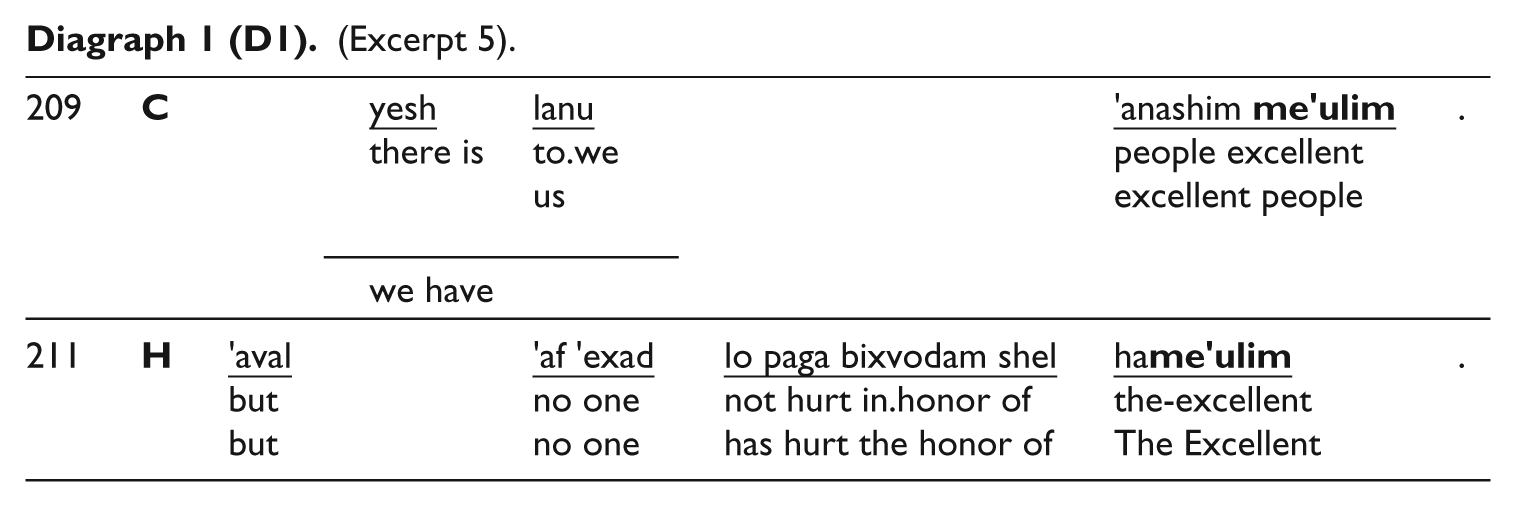
The caller assesses the quality of Israeli experts as me′ulim (‘excellent’, 5:209), thus suggesting that there is no need to bring in an ‘outsider’. The host does not respond with his own assessment of the excellent Israeli experts – the caller’s stance object (Du Bois, 2007); thus, he is not overtly objecting to this stance. Nonetheless, he begins disaligning by opening his turn with the discourse marker ‘aval (‘but’). To further construct his own stance on the matter and towards his interlocutor, he contrasts the personal pronoun fused within the caller’s prepositional phrase lanu (‘to.we’), implying ‘all of us Israelis’ (meaning, the ‘Israeli we’ – ‘the social we’; see Dori-Hacohen, forthcoming), with the indefinite, nonspecific phrase ′af ′exad (‘no one’) corresponding to the English indefinite pronoun ‘no one’ (albeit in a different syntactic role). This juxtaposition of semantically opposing nominal elements allows the host to strongly imply reference to the same group of Israelis. Furthermore, it allows him to reject a possibly implied argument that the Israeli experts would be dishonored if a foreign one were nominated (5:211). The host also re-uses the caller’s adjective ‘excellent’, but in a different syntactic position, shifting it from its role as attributive modifier to a highly marked noun form. By doing this, the host conjures up a humorous depiction of the Israeli experts as ‘The Excellent’, subtly ridiculing them as well as the caller supporting their nomination. Thus, dialogic resonance is used here not only for disalignment, but also for subtle mockery, and in this sense the strategy joins other keying (Hymes, 1986) means pervasively found on these programs (Maschler and Dori-Hacohen, 2012). We see how dialogic resonance may be employed in order to construct stances towards the subject matter as well as towards the interlocutor.
About 25 seconds later, the host points out the lack of logic in the caller’s refusal to appoint a foreign citizen as the central bank governor:
[4 lines omitted]
The host posits the analogy that, according to the caller, just as Israelis import cars because they are ‘not good enough’ at producing them, so should they ‘import’ a bank governor. He ends his argument with the rhetorical question ‘what, aren’t we good enough?’ (6:146–147), implying that of course ‘we are good enough’ and this has nothing to do with importing cars or central bank governors. In response, the caller negates the host’s questions and constructs his counter-stance by re-using all the words in the host’s utterance, except for the discourse marker ma (lit., ‘what’, roughly meaning here ‘what are you saying’; Maschler, 2009). The caller thus constructs an assertive assessment based on the host’s rhetorical question. In addition to this structural and pragmatic manipulation, the caller reverses the original word order, shifting the pronoun ‘anaxnu (‘we’) to the end of his utterance and creating a highly marked predicate-subject Hebrew clause pattern (Auer and Maschler, 2013; Maschler, forthcoming), bringing the negative predicate into focus and creating enhanced disagreement: lo maspik tovim ‘anaxnu (6:149). Let us examine the diagraph for excerpt 6:
(Excerpt 6).
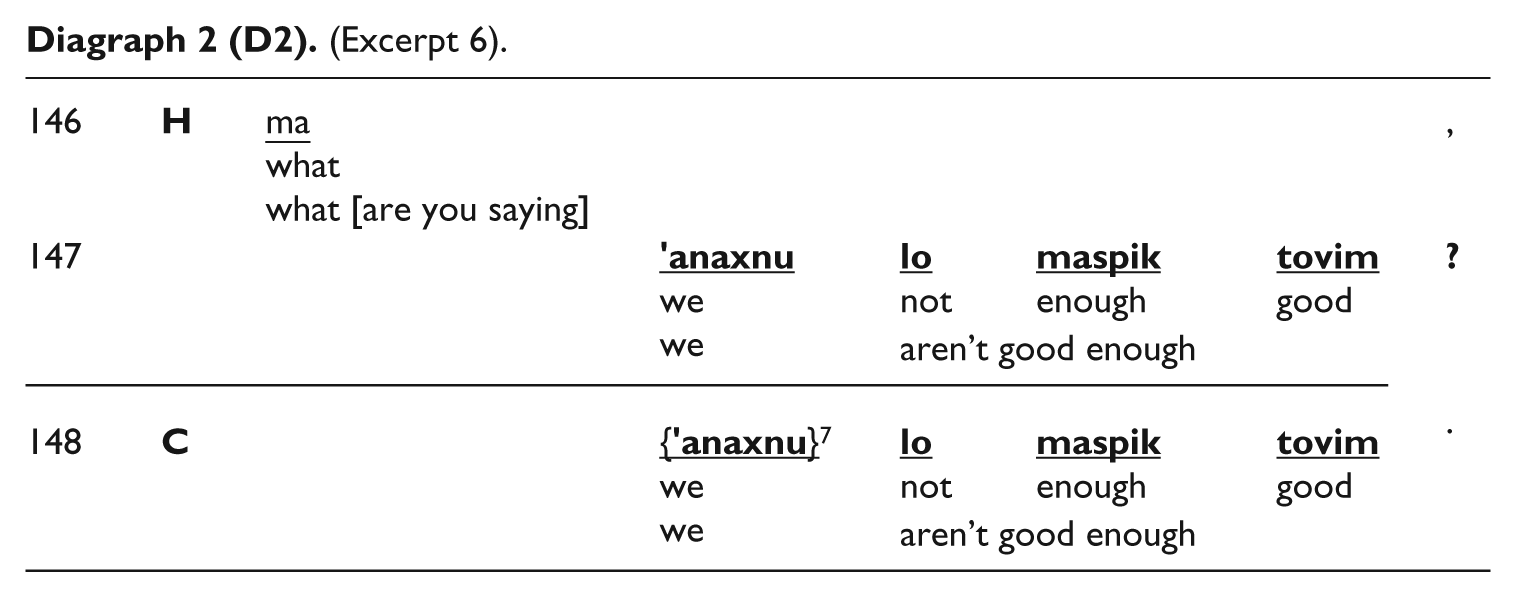
Thus, although the exact same lexical material is being used (hence, seemingly suggesting agreement), structural changes are employed by the caller in order to reject the host’s implication, arguing that in fact ‘we are
Let us now examine the use of resources in employing resonance in these two excerpts. Excerpt 5 demonstrates resonance of only partial and limited resources, manipulating only two elements of the interactant’s words. Repetition is only of a single lexeme, me′ulim (‘excellent’, line 209). Excerpt 6 demonstrates an almost full repetition of the prior turn, thus manifesting mostly resonance of pre-existing resources (repetition of almost all lexemes and syntactic structures). These two excerpts illustrate also different patterns of creative resonance. The creative resonance in excerpt 6 is based on the single manipulation of constituent order (VS as opposed to SV), while in excerpt 5 creative resonance is based on both manipulation of argument structure (substituting the indirect object lanu with the subject ′af ′exad) and of head-modifier hierarchies (nominalization of the adjective me′ulim [‘excellent’]). The two examples are thus qualitatively different in that they represent different blends of use of pre-existing resonance resources and creative resonance. However, both resonance of pre-existing resources and creative resonance function for stance-taking and convey alignment and disalignment between participants.
Resonance and stance-taking are the central elements of the dialogic syntax framework. As previously suggested by Haddington (2004), an analysis of dialogic syntax can be successfully combined with a conversation analytic approach. In describing the use of morphosyntactic, lexical, and prosodic elements, in conjunction with the stances taken by interlocutors, Haddington’s analysis of televised interviews shows that ‘it is both the action type and the implied stance in the interviewee’s turn that affect the trajectory of the subsequent interaction and how it is organized’ (p. 119). He goes on to show that the implied stance can be derived from the linguistic resources employed by interviewers and interviewees, and from the resonance between their utterances. Thus, resonance is a practice allowing interviewees to respond to positions projected from the hosts’ own talk. Moreover, Haddington then goes on to pose a provocative question contrasting to some degree actions and stance: ‘which one of these – stances or the interactional organization and actions – is more consequential for the description of the organization of interaction?’ (2004: 117). Haddington leaves this question unanswered.
Our study expands on Haddington’s suggestion, albeit in a different medium. As we will show, the analysis of resonance in a specific action is insufficient, and resonance as reflecting stance-taking must take into account the span of prior talk. We intend to account for the anomalous interaction by showing that the caller’s rejection is actually not a rejection of the host’s specific formulation, but that of his stance, which was cumulatively constructed across a stretch of previous actions.
The sequential development of resonance
In the following section, we undertake a detailed analysis based on dialogic syntax of the larger segment from which our formulation sequence is extracted. We will make use of a sequential analysis, in its basic form, going utterance by utterance and displaying the patterns of resonance between the participants’ speech, in order to show how each manipulates the other’s talk up until the formulation sequence. We will then rely on this analysis to show that even though the formulation at lines 224–226 (D7) is a new action – an action that is congruent with the caller’s position in both structure and meaning – it still carries stances built up throughout previous actions.
We would like to suggest that dialogic resonance, along with the stances it constructs, are seminal in determining the overall structural organization of the interaction (Robinson, 2013; Schegloff and Sacks, 1973). That is, while dialogically resonating with each other, participants move from one turn to the next, creating coherence across the different actions, sequences, and activities. In order to illustrate this, we start with the host’s first action relating to the caller’s topic, namely, his first clarification question, still within the phase of the presentation of opinion by the caller (Hutchby, 1996: 15). For reasons of clarity, we mainly present here the diagraph (for the entire transcript, see the Appendix):

The caller begins by spelling out the decision, according to which it is forbidden to hit children, via the impersonal construction ′asur laga′at beyeladim (‘[it is] forbidden to touch children’, D3:149) and the very general verb laga′at (‘to touch’). In this utterance, there is no specific entity to which the forbiddance pertains. The host then presents his clarification request, ma zot ′omeret (‘what does this mean?’, D3:157–158). Following this, the caller elaborates on her statement, employing the more specific verb
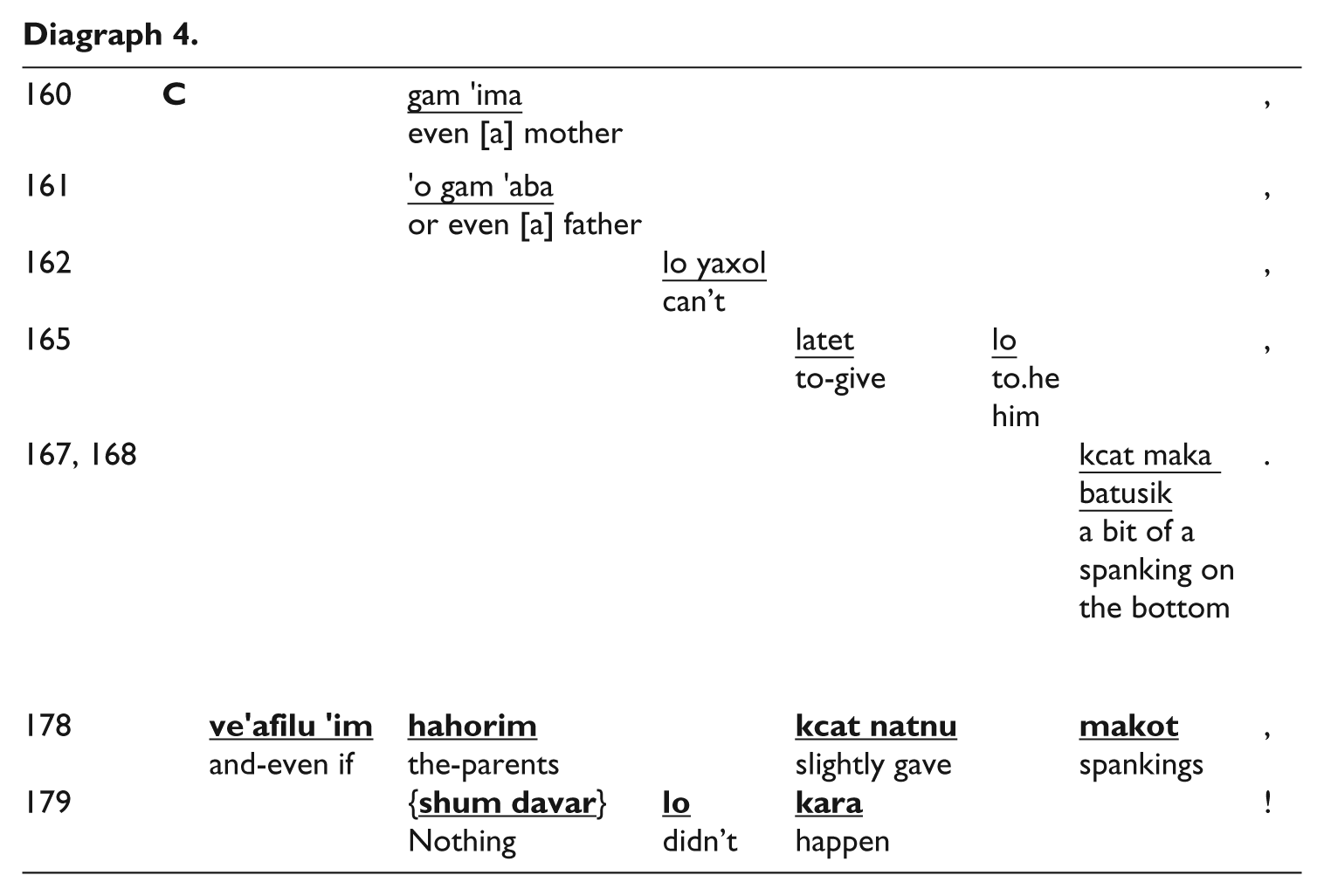
Here (D4:178) the caller omits the complement batusik (‘on the bottom’) of the NP (kcat maka batusik, D4:168) and changes singular maka (‘spanking’) to plural makot (‘spankings’), another move contributing to the generality of the behavior discussed. In addition, she scales down the verb latet (‘give’) by adding the adverb kcat (‘slightly’) forming kcat natnu (‘slightly gave’).
In contrast to the caller’s general terms, the host follows with a specific clarification question (D5:180):
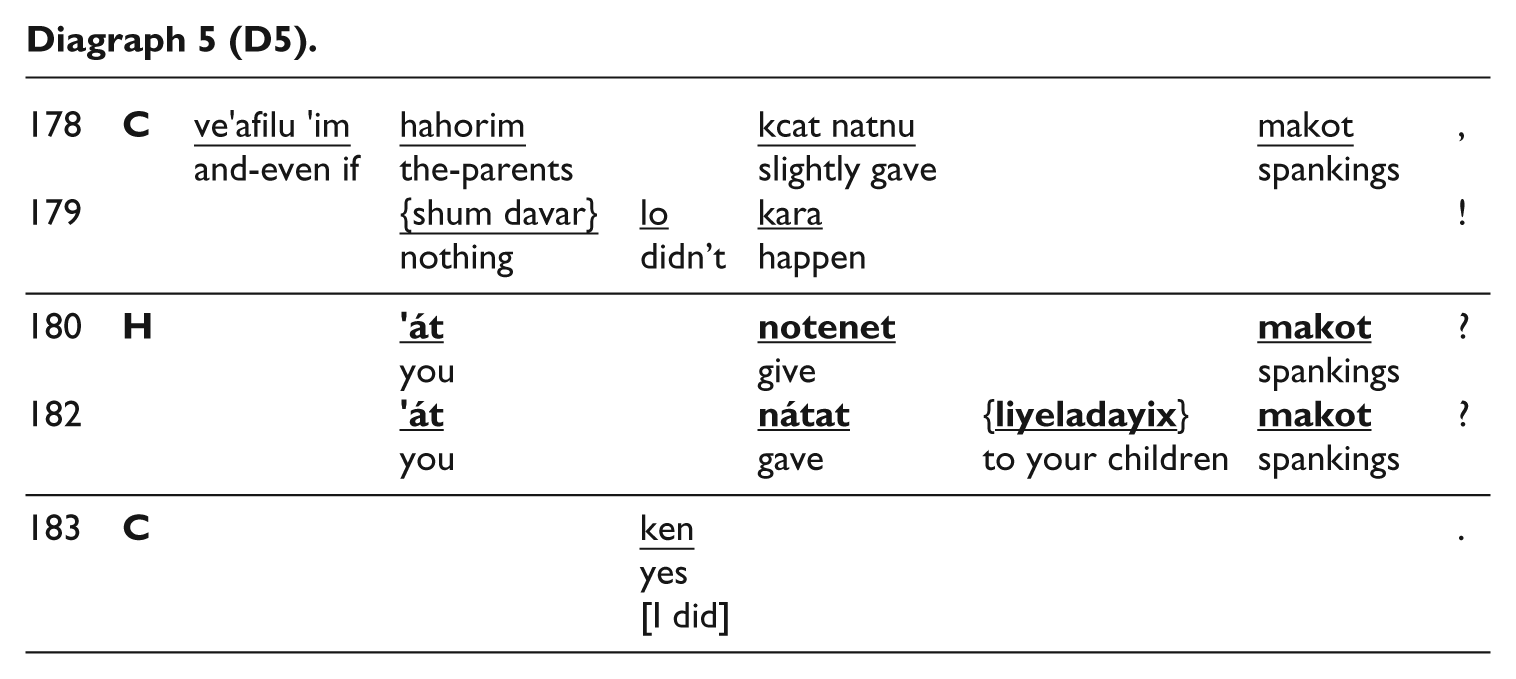
The host first presents the caller with a yes/no question (D5:180–181): ′át notenet makot? (‘do YOU .
The host then repairs the question using the marked double pronominal form (see Hacohen and Schegloff, 2006; Polak-Yitzhaki, 2004) in the past tense ′at natat makot liyeladayix? (‘Did you spank your children?’, D5:182), self-resonating his previous utterance. To this question the caller answers enthusiastically ken! (‘yes!’, D5:183). This is a preferred type-conforming answer (Koshik, 2002; Pomerantz, 1984; Raymond, 2003) in the most minimal form possible, suggesting that the caller understood the host’s question as a clarification request.
The caller then tells a short narrative concerning an incident with her son in which they had agreed to meet at his high school and he was late:
The caller uses this narrative to illustrate her argument (see Hacohen, 2007), restating that no harm necessarily comes to a child if beaten by the parent – lo kore shum davar (‘nothing happens’, 4(d):195), self-resonating lo kara shum davar (‘nothing happened’, D5:179), while shifting to simple present for expressing the timeless nature of the claim. Importantly, in a technique similar to what Labov (2001) described with respect to problematic stories, she omits the heart of her story, namely, that she did in fact hit her son.
Since the caller never explicitly admits to having hit her son (specifically, she does not refer to the act of giving spankings – neither with a verb nor with a noun), the host begins a third clarification sequence, this time with respect to her narrative, not her claim. He first claims that he does not understand the story (4(d):194), asks her to complete it (4(d):196), and then offers a candidate resolution to the story in interrogative form: natat lo flik? (‘did you give him a smack?’, 4(d):197), as a way to receive information (Pomerantz, 1988). By changing the general makot (‘spankings’) to the concrete and specific flik (‘a smack’), the host increases the vividness of the beating activity, while also aggravating the terminology of the beating. Note, also, that the host again relies on the verb form natat ‘you.
This section is followed by some overlap, as the caller evades the host’s specific question concerning the ending of her narrative:
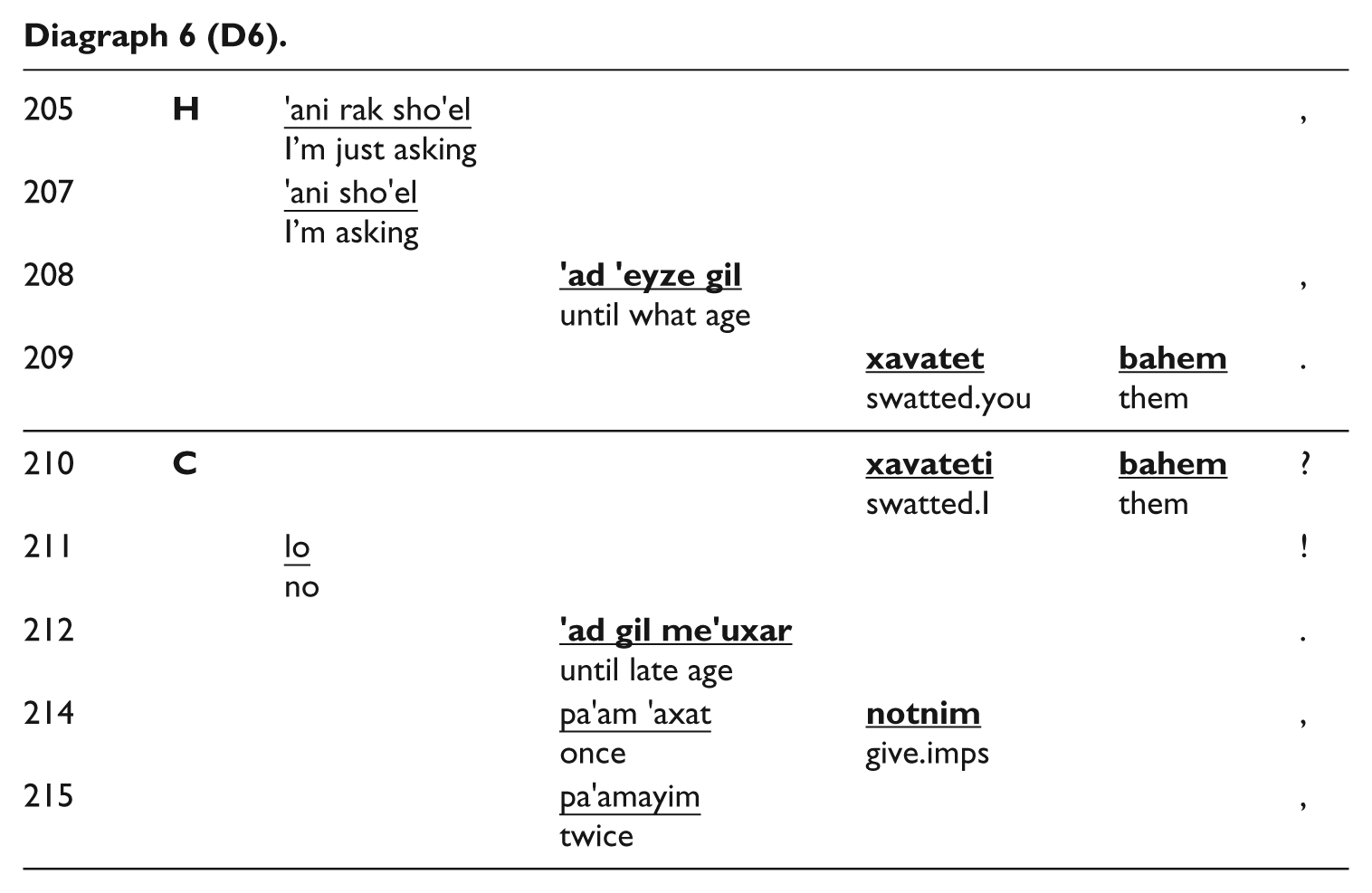
The host embeds another question in a complement taking phrase – ′ani sho′el (‘I’m asking’, D6:207), thus highlighting the following action in order to secure an answer using a pre-question (Dori-Hacohen, 2011). Again, the host phrases his question using considerably more aggressive terms: ′ad ′eyze gil, xavatet bahem? (‘until what age, did you swat them’, D6:207–209). By employing the adverbial complement ′ad ′eyze gil (‘until what age’), the host returns to the habitual perspective on the caller’s behavior. He also amplifies the verb regarding the child beating, mockingly using the high register aggressive verb xavatet (‘you swatted’), escalating once more the degree of violence. The host’s question resonates the famous rhetorical question ‘when did you stop beating your X’ (see Wheeler, 1983, for the different Xs of this question), using a pre-supposition to force the caller’s admission of swatting her children.
The caller responds to the host’s question with xavateti bahem? lo! ′ad gil me′uxar (‘I swatted them? no! until an advanced age’, D6:210–212) using pre-existing resources for the resonance with xavatet bahem of line D6:209. However, in her response, she also manifests creative resonance in following the preference for contiguity, meaning the AB-BA structure described by Sacks (1987). She first relates to the last issue raised, changing the person of the verb xavatet (‘you swatted’) from second to first person, and only then relates to the issue raised beforehand (i.e. the children’s age), saying that she used to hit her child until he was fairly old without specifying the exact age (D6:212). She also rejects the host’s particular word choice via the discourse marker lo! (‘no!’). In the present maneuver, the caller objects to the term ‘swat’ without replacing it. 8 Yet, in this, she indirectly admits that she used to regularly beat her children.
Throughout this exchange, the caller attempts to tone down her degree of violence towards her children, for example, by negating the implication that the hitting was violent via lo! (‘no’, D6:211). She then attempts a move away from the narrative and back to her original general claim that spanking does not harm the child, with the expression pa′am ′axat notnim, pa′amayim (‘once [one] gives [hits], twice’, D6:214–215), clarifying that she is not referring to unremitting beating, but only to sporadic and harmless events. In this move, she replaces the host’s verb, xavatet (‘you swatted’) and returns to the same verb as before, the leitmotif latet ‘to give’, using the form notnim (3rd
Up until now, the caller has been presenting her position: supporting harsher discipline of children, including light child-beating when needed. During this activity, phase two of radio phone-ins (Hutchby, 1996), the host has limited his talk to clarification questions, which targeted the caller’s argumentation and the story she supplied as evidence for her position. Throughout these questions, the host has refrained from explicitly disagreeing with the caller. We will now argue that in the formulation sequence, the caller rejects not only the action performed in the host’s turn (D7:224–226 below), but mainly the stance she understands his turn to deliver. This stance has been constructed dialogically by both participants via the resonance work throughout the earlier parts of the interaction.
Resonance across activities
Moving toward the next activity in the phone-in – ‘the argument’ (phase 3 in Hutchby’s, 1996: 15, terms), the host uses various metalingual (Maschler, 2009) resources to change the footing (Goffman, 1981). When formulating the caller’s previous utterances, the host shifts the frame with the discourse marker zot ′omeret (‘meaning’, D7:224 below), introduces the caller’s voice by the metalingual utterance ′at ′omeret (‘you’re saying’, D7:225), and then rephrases these words by the actual formulation makot kalot layeladim (‘light spankings to the children’, D7:226). In this utterance, the host formulates the caller’s position from the previous sequences – kcat maka batusik (‘a bit of a spanking on the bottom’, D3:168), and hahorim kcat natnu makot (‘the parents slightly gave spankings’, D4:178). Similarly to formulations in other interactions (see excerpt 1 earlier), he does not formulate the caller’s entire argument, but rather returns to her main claim and presents its gist.
In contrast to the divergent stance we have seen employed by the host throughout the previous span of talk, when formulating the caller’s position, he seems to take a convergent stance, as we discuss following diagraph 7:
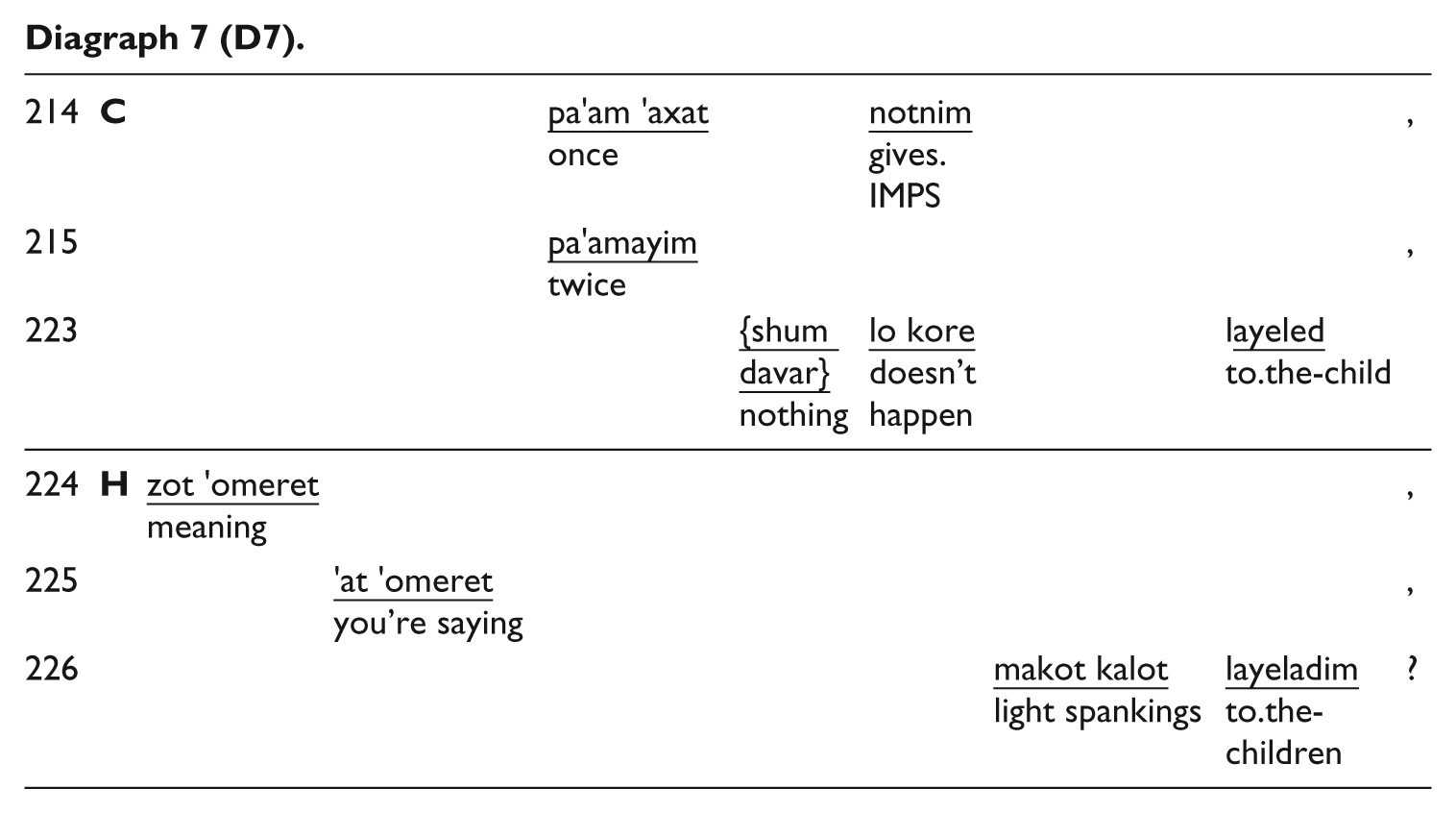
The host aligns with the caller’s move from the personal to the general, remote voice (D7:214) as he, too, also phrases his utterance in impersonal terms. The host’s utterance is even more impersonal than hers: while the caller used a construction with the impersonal 3rd
The host’s phrase also aligns with the indirect object of the caller’s utterance (compare layeladim ‘for the children’, D7:226 with layeled ‘to the child’, D7:223). As such, it verbalizes precisely those syntactic elements that are not explicit in the caller’s pa′am ′axat notnim, pa′amayim (‘once [one] gives [hits], twice’, D7:210–211), that is, the direct and indirect objects. The juxtaposition of these two partial but complementing utterances elucidates the host’s formulation of the caller’s stance. Weaving the turns of the host and the caller together produces the following statement: zot ′omeret, ′at ′omeret, pa′am ′axat notnim, pa′amayim, makot kalot layeladim – shum davar lo kore layeled ‘this means, you say, once, twice, one gives light spankings to the children – nothing happens to the child’. In other words, this formulation does not radicalize the caller’s prior position (a possible function of formulations; see excerpt 2), but quite to the contrary – it is fair to its content, using rather neutral and non-implicating terms. As argued above, and also by Heritage and Watson (1979), such formulations of gist generally show a preference for confirmation. Instead, as shown in diagraph 8, rejection is immediate, strong, and unwavering:
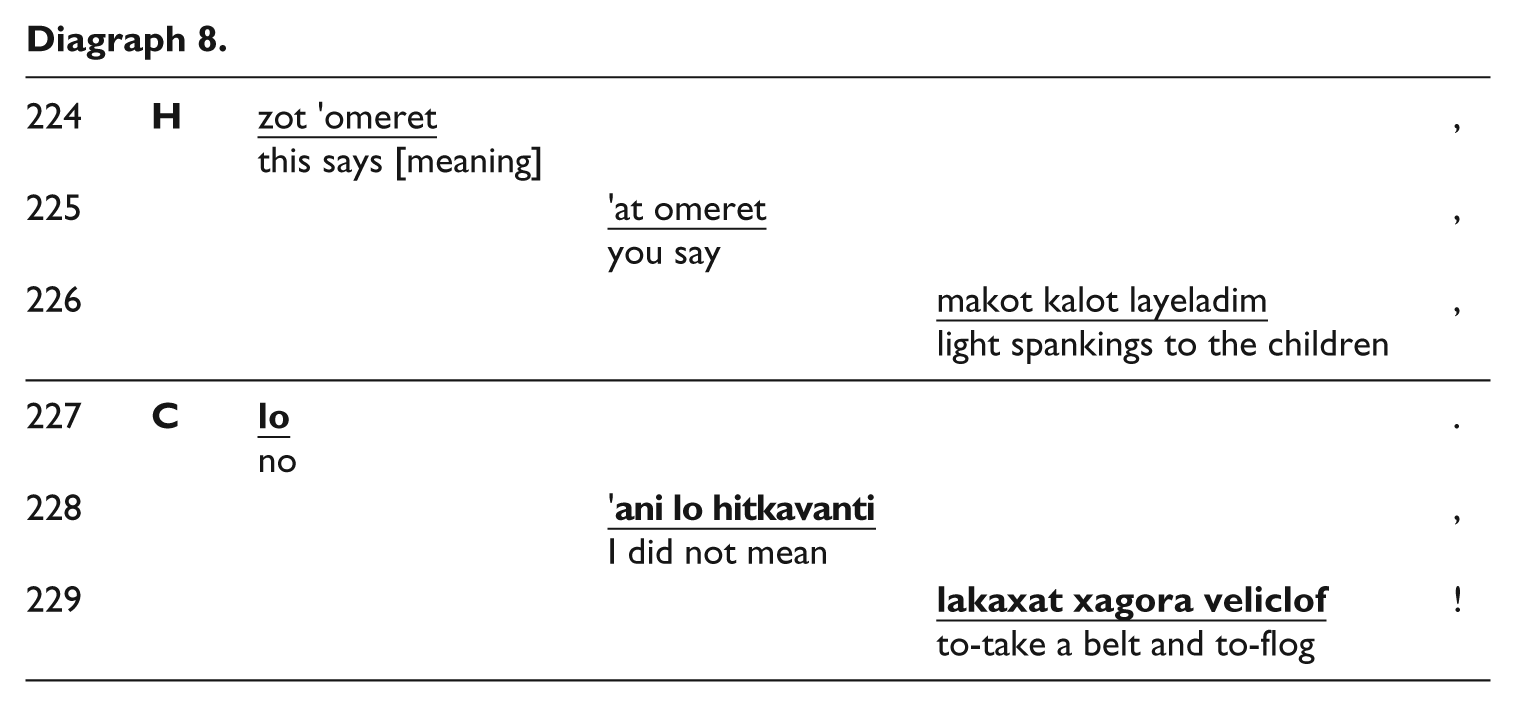
Up until now it has been mostly the host resonating the caller’s utterances. We now move to the resonance patterns of the caller, in order to show that she first and foremost rejects the host’s stance. Both turns begin with discourse markers (zot ′omeret ‘this means’ and lo [‘no’]), structurally aligned in turn-initial position. In paradigmatic substitution of the host’s discourse marker zot ′omeret (‘this means’, D8:224), we find the caller’s clear and fast discourse marker lo (‘no’, D8:227), rejecting the formulation in a manner suitable to preferred responses.
The caller then responds to the host’s metalingual utterance (compare D8:228 to D8:225) in the matrix clause position ′at ′omeret (‘you’re saying’) with a contrastive metalingual expression lo hitkavanti (‘I didn’t mean’). Similarly to what we have presented above, the caller employs pre-existing resources by resonating the host’s structure (as in excerpt 6). The caller also relies on creative resonance (as in excerpt 5): the verb of saying is replaced by a mental verb denoting intention, in past instead of present tense and in negative polarity. The caller uses these resonance patterns to take a negative stance towards the host’s formulation.
The disalignment stance is also amplified through the resonance patterns created with the complement of the metalingual matrix verb (compare D8:229 to D8:226). In both cases the complement is nominal – a noun phrase in the host’s utterance, makot kalot layeladim (‘light spankings to-the-children’), and an infinitival verb phrase, lakaxat xagora ve-liclof (‘to take a belt and flog’) in the caller’s utterance. The caller relies both on pre-existing resources for her resonance (repetition of a nominal form) and on creative resonance. Creative resonance is achieved via semantic manipulation as the caller uses the highly violent achievement verb (Vendler, 1957) liclof (‘to flog’) in distinct contrast to the ‘lightness’ of the host’s phrase makot kalot (‘light spankings’). The caller also manipulates the semantic arguments within the host’s complement: while the host refers to the recipient of the spankings, layeladim (‘to the children’), the caller refers to the instrument used for spanking, haxagora (‘the belt’).
The caller’s strong rejection of the host’s formulation, lo. ′ani lo hitkavanti, lakaxat xagora veliclof! (‘no. I didn’t mean, to take a belt and flog!’, D8:227–229) does not allow him to continue his utterance (an intention suggested by the continuing intonation contour of his utterance at line 226). That is, as a second action, the caller rejects the formulation quickly in a terminal onset overlap (Jefferson, 1986). This is followed by the complement-taking-phrase ′ani lo hitkavanti (‘I didn’t mean’) by which she negates the intention he allegedly ascribes to her. In other words, she stops his action in order to state what she did not mean – a severe corporal beating. However, her interpretation that he sees her as a severe spanker (D8:228–229) is not based upon any particular element in his immediately preceding utterance (D8:226). The rejection of the formulation now seems doubly complex: his formulation of her position is not only fair and congruent with her stance, it also carries nothing to explain why she interprets him as ascribing to her such violent intentions.
Our claim is that accounting for this anomalous rejection of the formulation is straightforward if we consider everything that has happened up until this point in the interaction. The host’s talk can be viewed as pertaining to two plains of discourse – that of activity (clarifications in the caller’s presentation of her opinion and formulation as a move toward the argument in the phone-in) and that of stance (towards the caller). Consider the following brief summary – concerning both word selection and grammar – of the progression of resonated concepts in the participants’ talk with each other, that shows how the host manages to construct a very particular stance through his use of resonance strategies:
with respect to the subject: from the caller’s impersonal (D3:149) and generic parents (D4:160–161, D4:178), to the host’s specifying her as a parent (D5:180–181);
with respect to the verb: from the caller’s innocuous ‘touching’ (D3:149) and ‘giving spankings’ (D4:168) to the host’s ‘swatting’ (D6:209);
with respect to the direct object: from the caller’s ‘a bit of spanking’ in the singular (D4:168) to the hosts ‘spankings’ in the plural (D5:180) and his final more aggressive ‘smack’ (D6:209).
In his seemingly benign set of clarification questions, the host managed to turn the caller’s utterances from general to specific, shifting the focus from the issue of violence in general to the issue of the caller as a spanking parent. He was also able to turn the caller’s spanking from minor to more and more violent, presenting her in an ever darker light. Finally, he succeeded in transforming the sporadic acts of spanking into habitual spanking. These transformations, prevalent in the host’s clarification sequences, imply a highly negative stance of the host towards the caller. It is this negative stance, carried over from the clarification sequences to the formulation, which the caller strongly rejects in her response to the formulation.
That the caller rejects the cumulative stance in the interaction is evident from the exact choices she makes in her rejection of the formulation. The caller’s stance in her rejection is not expressed towards the formulation, turn itself. She relies on resonance not only to reject the host’s formulation but also to relate her turn to the course of the interaction prior to the formulation, namely to the host’s clarification questions. This can be portrayed as a move in the overall structural organization of the interaction as she bridges across two distinct activities.
This bridging is created by a careful use of resonance in her rejection. Consider her use of the past tense in the metalingual utterance lo hitkavanti (‘I didn’t mean’, D8:228) which contrasts with the host’s present tense predicate ′at ′omeret (‘you say’, D8:225). Her paradigmatic choice of switching tenses points to her rejecting of prior discourse rather than the immediate discourse. Furthermore, the use of the verb hitkavanti (‘I meant’) targets not what was said in the formulation, but what happened in the prior section of the interaction. Her choice of ′ani lo hitkavanti (‘I + I did not mean’) uses double pronominal form (as opposed to the host’s unmarked form ′at ′omeret ‘you say’). Double pronominal form was found to achieve more than minimal reference (Hacohen and Schegloff, 2006), and here the ‘more than minimal’ achieves stance work.
Creatively resonating the entire prior activity, her use of the verb lakaxat (‘take’) here is pivotal. This verb is the mirror-image of the verb latet (‘give’), which was the leitmotif in the interaction so far (see D3:165, D4:165, 180, 197, D6:214). In her choice of words, the caller opposes the entire direction, or organizing mechanism, of the interaction so far.
The caller’s resonance illustrates that she was not referring only, or even mainly, to the formulation in her rejection. Although the formulation did indeed provide the gist of the caller’s position, she rejects it because she takes it to be the representation of the host’s cumulative negative stance toward her – a stance that was coproduced via resonance throughout the clarification sequences of the prior activity. The actual words used and the actions they comprise are no longer the most consequential for the caller. Rather, it is the implied negative stance towards the caller, emerging from the host’s previous sequences, that affects the trajectory at this point in the interaction. The host has succeeded, at least in the caller’s perspective, in alluding to severe insinuations which she cannot possibly accept. This is so to such an extent that she dissociates herself from her own previous words, kcat maka (‘a bit of a spanking’, D3:168). It is this negative stance, which the caller seems to perceive as a carry-over from the prior sequences, that explains her rejection of the formulation, despite the wording, the frame shift, and the convergent resonance which the host uses in his actual formulation turn. This, then, accounts for the rejection of the formulation of gist in a manner suited to preferred responses: all the elements in the new activity – that is, the formulation – provide the gist of the talk; nonetheless, the stance the caller attributes to this turn, as continuing the stance constructed through resonance in the previous activity, necessitates its rejection.
Conclusion
In this article we have focused on a particular interaction, in order to explore the use of lexical and grammatical elements employed as part of a language-game that emerges in a specific action in the interaction – a formulation. Our article began by exploring formulations in a corpus of Hebrew radio phone-ins. To the best of our knowledge, there are no systematic studies of formulation in languages other than English. This study thus contributes to the understanding of formulations and other activities in radio phone-in interactions. We showed that the relations between the turns of talk leading up to the formulation – and especially the coordinated grammar across turns of talk and across actions in talk – foreshadow the caller’s rejection of the host’s words. We followed Haddington (2004), who argued that although CA does not exclude any linguistic or syntactic items from its analysis, it considers these items mainly in relation to their relevance for turn-taking as building blocks for actions and activities in talk-in-interaction. By moving between and across turns, adjacency pairs, sequences, and activities, we highlight the benefits of examining dialogic syntax and exploring resonance in interaction.
The analysis in this study illustrates how dialogic resonance impacts the formulation sequence both within and prior to it. First, within an action sequence, in our case the formulation sequence, exploring dialogic resonance enhanced our understanding of the relations between the different pair parts. The caller uses dialogic resonance to reject the host’s utterances in the strongest possible way. She resonates his formulation by keeping his grammatical structure intact, while at the same time systematically replacing each element, thus employing both resonance of pre-existing resources and creative resonance. These delicate relations between the first and the second pair parts of the formulation adjacency pair are based on word and construction selection across turns of talk. Exploring the patterns of dialogic resonance allows us to expose how the rejection of a formulation is in fact symbiotic (Auer, forthcoming) with the proposed formulation. Thus, dialogic resonance may contribute to our understanding of the relations within an adjacency pair. This framework goes hand in hand with similar discussions of the relations between first and second pair parts, such as tying formation (Goodwin, 1990) or answering (Bolden, 2009; Stivers and Hayashi, 2010) in creating coherence between different turns of talk. In other words, the framework of dialogic syntax can contribute to the understanding of the preference structure (Pomerantz, 1984; Sacks, 1987), the confirming structure (Raymond, 2003), as well as other aspects of the relations between first and second pair parts.
In addition to the level of adjacency pairs, we argue that dialogic syntax contributes to an understanding of the overall structural organization of an interaction (Robinson, 2013). Dialogic resonance may explain the relations across sequences, and it may be one mechanism for connecting different activities. For example, we argued that the verb latet (‘to give’) was one of the tools used to organize the span of talk prior to the formulation (e.g. when the caller first expresses her position, and then in the following clarification sequences). We then highlighted the caller’s use of the antonym lakaxat (‘to take’) in rejecting the formulation. This particular creative resonance of verbs enables the speaker to construct both continuation and variation across activities, and in so doing to enhance coherence in the interaction at large. Dialogic syntax may thus be used as a fine comb to sift through the granularity of interaction (Schegloff, 2000) in context.
Moreover, we argue that resonance in fact ties the clarification sequences to the formulation sequence: the caller rejected not the content of the host’s formulation, but rather the cumulative stance which was constructed in dialogic resonance throughout the clarification sequences prior to it. Furthermore, we started this article by illustrating that formulations of gist are usually confirmed in the preferred manner, yet in the present interaction, the caller rejected the formulation of gist in a manner reserved for preferred responses. We showed that this was due to the cumulative stance constructed throughout the interaction. Therefore, our study suggests that the significance of resonance and the stance it achieves may sometimes override the significance of the sequences for organizing the interaction. Our analysis thus proposes a clear answer to Haddington’s question: ‘which one . . . stances or the interactional organization and actions – is more consequential for the description of the organization of interaction?’ (2004: 117). Stance-taking is more consequential in our particular interaction – at least from the caller’s perspective – than the organization of the specific sequences. It is the stance created through dialogic resonance to which the caller orients her talk and that explains her response, rather than the sequence organization of the clarification questions and the formulation.
The answer to Haddington’s question given here should, of course, not be taken to somehow imply that stances always outrank action organization. And in fact this opens up a promising future direction for this type of research: In what kinds of interactions are stances more consequential, In what kinds of interactions is action organization more consequential, and is it even possible to assess this for all interactions? 10
Du Bois (2007) conceptualizes the act of stance-taking as a triangle consisting of the alignment and positioning of stances taken by two stance subjects, or co-participants, towards a single stance object – the focus of discussion. In the formulation analyzed here, the stance object is the caller’s previous utterances, as formulated by the host’s ′at ′omeret, makot kalot layeladim (‘you say, light spankings to the children’, D8:225–226). Through dialogic syntax, the host and the caller construct a divergent stance also towards each other. The caller’s rejection of the formulation concerns not the stance object, but rather the intersubjective stance constructed between participants. Considering stance-taking of participants towards each other as an interactional achievement in its own right, we would like to propose a claim that awaits further research: intersubjective stance-taking may be viewed as a meta-action emerging through dialogic syntax employed among participants as they move across actions, sequences, and activities in talk.
Footnotes
Appendix
Funding
This research received no specific grant from any funding agency in the public, commercial, or not-for-profit sectors.
1.
This article is based on a talk presented at the 61st Annual Meeting of the International Communication Association, 25–30 May 2011, Boston, MA, USA.
Notes
Author biographies
