







Abstract
Confessions are central to criminal investigations. Although an increasing amount of attention is being drawn to the phenomenon of false confessions the majority of research focuses on psychological factors of false confessions. This study instead uses narrative analysis to examine the language of true and false confession narratives, with a focus on how evaluative devices convey degrees of guilt and blame. Justifications and deflection of blame were found to characterize true confessions, while false confessions did not place a primacy on these elements. Furthermore, the actual events of the crime were highly evaluated in true confessions, while false confessions left these events unevaluated. Although generalizability of these findings should be treated with caution, meaningful differences between true and false confessions occur at the level of discourse which may assist investigators in uncovering motives, key events, and the confessor’s state of mind, and may help guide interrogators’ questioning patterns.
Keywords
Introduction
As an admission of guilt, confessions are strong evidence against a suspect and are therefore a crucial aspect of many criminal investigations. Although it may seem counterintuitive and even impossible that suspects would confess to crimes they did not commit, false confessions are estimated to be a factor in approximately 25% of wrongful conviction cases (Innocence Project, n.d.-a). The majority of research into false confessions has focused on their causes and consequences (e.g. Drizin and Leo, 2004; Ofshe and Leo, 1997). Despite the opportunity for linguistic analysis to provide insight into the factors that distinguish true confessions from false confessions, few studies have addressed the linguistic composition of false confessions. This study uses William Labov’s narrative framework to address this gap in the literature with a focus on how evaluative devices are used to convey degrees of guilt and blame in true and false confessions. This study, therefore, brings linguistic insight to a topic which has until recently fallen within the domain of psychology and criminal justice.
Three true confessions and three false confessions, written after suspects had been interrogated by police, were used as data. Narrative evaluation in the confessions was analyzed in order to examine construction of blame in each. Evaluation is defined by Labov (1972) as ‘the means used by the narrator to indicate the point of the narrative, its raison d’être: why it was told, and what the narrator is getting at’ (p. 366). The use of evaluation was compared in true and false confessions, with a particular focus on the way in which the narrator portrayed himself and characterized his culpability. This research, and the potential avenues of future research which stem from it, can aid law enforcement in understanding the composition of confessions, has the potential to aid law enforcement in distinguishing between true and false confessions, and may in the future lead to more effective investigative techniques.
The section that follows provides an overview of the relevant literature, including Labov’s narrative framework and previous studies on the language of confessions. We then introduce the data and method of analysis, followed by a discussion of the findings and synthesis of common themes. Finally, we discuss implications, limitations, and future directions of research.
Review of the literature
The language of confessions
While many studies have focused on the psychological aspects of falsely confessing to a crime (Horselenberg et al., 2003; Horselenberg et al., 2006; Kassin, 2005; Kassin and Kiechel, 1996; Kassin and McNall, 1991; Klaver et al., 2008; Leo and Ofshe, 1998; Ofshe and Leo, 1997; Russano et al., 2005), linguistic analyses of false confessions are less common. An exception is The Language of Confession, Interrogation, and Deception, in which Roger Shuy (1998) describes his work as an expert witness analyzing confessions and interrogations. In this work, Shuy employed linguistic methods in order to ascertain the validity of confession statements and determine whether coercive methods were employed in an interrogation. This book primarily consists of Shuy’s analysis of specific cases, and makes few generalizations.
Several studies have focused on linguistic cues indicating deception in confession samples elicited from research participants. Villar et al. (2013) found that the use of adjectives declined in false confessions as opposed to true confessions, while noun and verb frequency were not significant indicators of deception. Ali and Levine (2008) found that denials, as opposed to confessions, contained fewer modal verbs, fewer past tense verbs, and more present tense verbs. Ali and Levine’s finding that modal verbs are more common in confessions than in denials relates to Labov’s narrative framework, as modal verbs are one technique narrators employ to evaluate their narratives.
The content of false confessions has also been studied. Although not necessarily a linguistic analysis, these studies can illuminate the components which comprise false confessions. Garrett (2010) examined 38 false confessions and determined that 36 contained specific details of the crime in question. Of the accurate facts contained in these false confessions, some were public information, while others were likely to be the result of leading questions and police suggestion. Appleby et al. (2013) also examined the content of false confessions. They compiled a list of 26 elements present in false confessions, including the time and location of the crime, visual details, references to the victim’s behavior and appearance, motives, emotions, justifications, remorse, and apologies. The authors emphasize that false confessions contain more than simply an admission of guilt and are filled with details of the crime, including the feelings of the confessor. These findings suggest that evaluation, in the form of emotions, is present in false confessions despite the fact that the confessor never actually committed the crime.
Following this descriptive study, Appleby et al. presented mock jurors with adapted versions of a confession in order to determine the effect of details, motives, and apologies on the credibility of confession statements. The detail-present condition included details of the crime, specifically the suspect’s actions and details of the victim’s appearance. The motive-present condition included information on the motive behind the crime and the apology-present condition contained an apology and remorse. The details-present condition and the motive-present condition resulted in more credible confessions and greater mock juror confidence in their verdicts. The authors label these confession statements ‘complex narratives.’ Appleby et al.’s findings demonstrate the important role that evaluative statements, in this case taking the form of a statement of motive, play in the perceived credibility of confessions.
Labov’s narrative analysis
William Labov’s narrative framework is well suited as a tool for dissecting a narrative into its structural components and investigating their functions. This method is based on Labov and Waletzky’s (1967) work on oral narratives of personal experience and divides narratives into six elements. The abstract is an initial clause which appears before any other and briefly summarizes the events that follow (Labov, 1999). The orientation provides the listener with the context of the narrative, including the situation, time, place, and actors (Labov, 1997). The complicating action contains ‘a sequential clause that reports a next event’ (Labov, 1997: 402) in which events of the narrative are laid out as they occurred (Labov, 1997). Evaluation may be present at any point in narratives, but generally follows the complicating action. It may take the form of an emotional reaction to the events described in the complicating action, or an explanation or justification for actions taken by an actor in the narrative. Finally, narratives may end with a resolution, which describes the final result of the complicating action, and the coda, which carries the narrative back to the present time (Labov, 1999).
Evaluation can be thought of as commenting on the importance of the narrative, and is an extremely important narrative element as it provides ‘information on the consequences of the event for human needs and desires’ (Labov, 1997: 403). Evaluation assures the listeners that the story has a purpose and is worth their time to listen to. Narratives lacking evaluation may be considered by listeners to be incomplete and often occur in narratives of vicarious experiences (Labov and Waletzky, 1967). As discussed in greater detail later, evaluative statements take various linguistic forms, including reported thoughts, dialogue, repetition, futures, and modals.
Narratives are centered on a most reportable event, which is generally preceded by evaluation (Labov, 1997). A most reportable event is defined by Labov (2002) as ‘an event that is the least common and has the largest consequences for the welfare and well-being of the participants’ (p. 37). A narrative is therefore organized around a noteworthy event, the importance of which is commented on through the use of evaluative devices. In confessions, the most reportable event is the commission of the crime, as this is the event which is most unusual and of central importance to the function of a confession. Based on Labov’s work, we would therefore expect evaluative statements to be concentrated around the events of the crime, as these are the key events that convey importance of the narrative.
Furthermore, evaluation functions as a way of assigning praise or blame to actors. Some actors or forces are presented positively, as protagonists, while other are portrayed negatively, as antagonists. The narrative may be polarizing, presenting the antagonist as ‘maximally violating social norms’ (Labov, 1997: 409), or integrating, where it ignores or glosses over blame: Narratives that center on conflict, violence, sickness and death are normally concerned with the assignment of responsibility for these events … Many such narratives are constructed to polarize the participants, so that the protagonist conforms to all community norms and the antagonist violates them. But narratives told by a family member … are frequently organized as integrating narratives, told in a way that minimizes guilt, and relieves participants of responsibility for the outcome. (Labov, 2002: 35)
Through the use of evaluation, narratives can therefore negotiate the blameworthiness of an actor for a negative event. While an antagonist is portrayed negatively, a protagonist will be presented as having acted appropriately. Even in cases in which the protagonist is objectively responsible for a negative event, his or her blame for the event may be diminished through the use of narrative devices. The assignment of praise and blame is a particularly important theme in confessions, as the function of a confession is to assign blame to the narrator. Due to the nature of confessions, the confessor must place himself or herself in the role of antagonist and admit guilt. However, this is in opposition to the natural wish of the narrator to create an integrating narrative and to place himself or herself in a more positive light, as described earlier. Using Labov’s narrative analysis, this study explores how culpability is constructed in true and false confessions and explores how confessors linguistically navigate their own blameworthiness.
Narrative analysis applied to confessions
Labov’s narrative framework has been applied to analyses of confessions and interrogations in only a few studies. Stygall (2008) concentrated on a discourse-level analysis, including an analysis of narrative features, of the confessions of four wrongfully convicted women in a case known as the Wenatchee Sex Ring case. Stygall used Labov’s narrative framework to compare narrative samples of the accused women in terms of time and length of episodes, result, resolution, and location markers. She concludes that the confessions of the four women had common authorship and were not written by each woman independently. Although evaluation was not present in any of the known narrative samples, and was therefore not addressed in this analysis, Stygall’s study demonstrates the utility of narrative analysis applied to confessions.
Johnson (2008) also employed elements of Labov’s narrative framework in her examination of evaluative statements made during police interviews. Johnson found that the interviewing police officer used a significant amount of evaluation in his or her questioning, but suspects included little evaluation in their responses. Through the inclusion of evaluation in questioning, the interviewer may cause the suspect to incorporate evaluation which had originally been absent into the narrative, creating a version of events which is more persuasive as evidence of guilt. Johnson’s conclusions align closely with Appleby et al.’s findings that confessions which contain a statement of motive were found by mock jurors to be more credible.
The present study carries evaluation into the sphere of written narrative confessions. Taking into consideration the evidential function of a confession, the role of evaluative statements in true and false confessions will be analyzed. Specifically, this study answers the following research questions:
What differences in the use of evaluation characterize true and false confessions?
How do evaluative statements in true confessions convey the blameworthiness of the confessor?
How do evaluative statements in false confessions convey the blameworthiness of the confessor?
These questions will be explored through the application of Labov’s narrative analysis in order to highlight differences in the portrayal of actors in true and false confessions.
Methodology
Types of narrative evaluation
Evaluation can be carried out using a variety of evaluative devices, as demonstrated in Table 1. These types of evaluation include external evaluation (when the narrator stops the events of a story and explicitly makes an evaluative statement), embedded evaluation (a more subtle form of evaluation which integrates evaluation with an actor’s thoughts, actions, or reported dialogue), and internal evaluation (conveyed through the syntax used by the narrator to describe the events of the narrative) (De Fina and Georgakopoulou, 2012).
Select types of evaluation (examples from Labov, 1972).
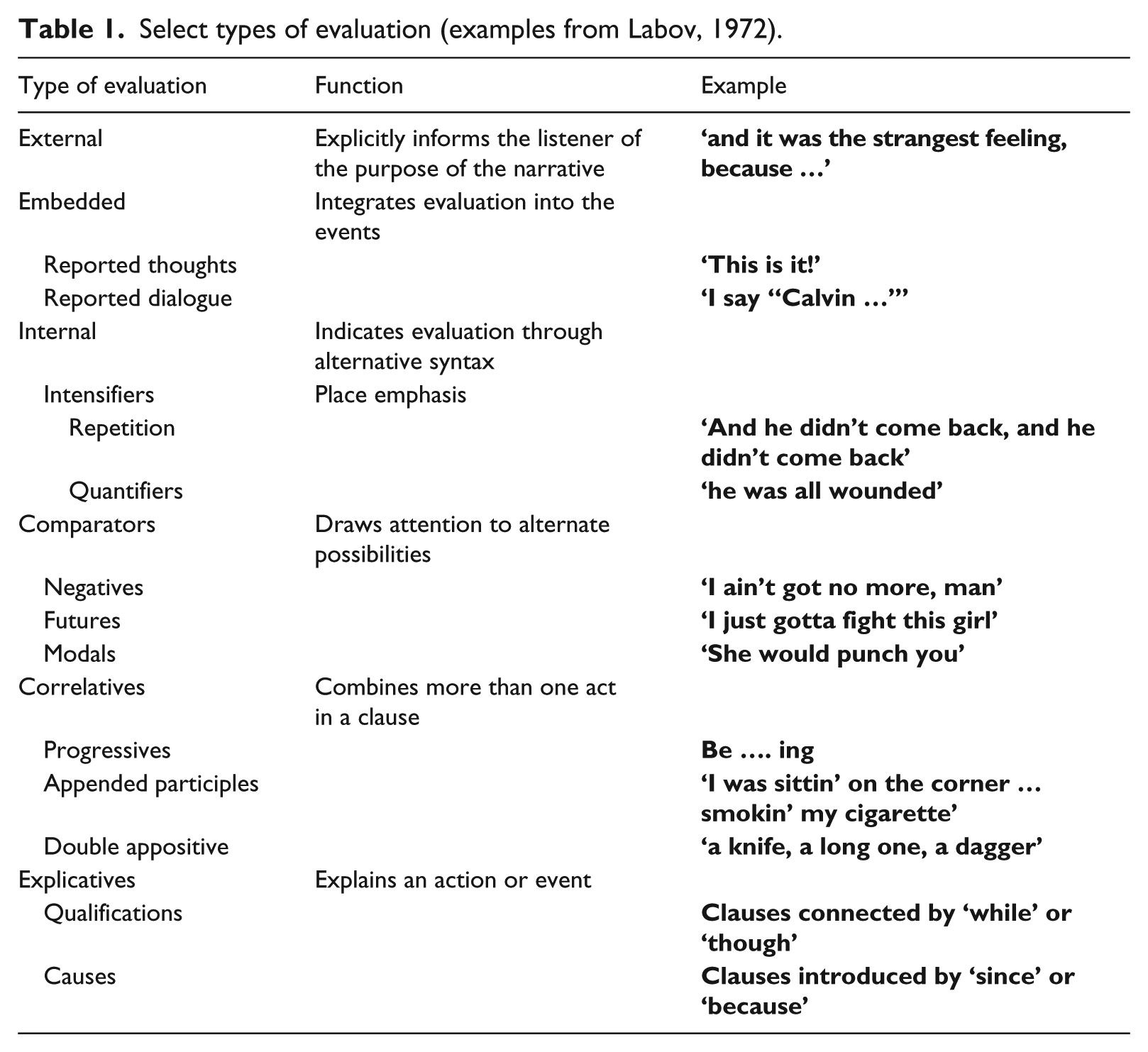
These evaluative devices serve to convey the function of the narrative as well as the narrator’s feelings toward the events and actors in the narrative. Examining the way in which these devices are used to suspend action and comment on the events of the narrative can reveal themes of culpability in the construction of actors in the confession narrative. Using these devices as a point of departure, this study examines how they are used to construct guilt and blame.
Data
Written narrative confessions were selected for analysis, as this medium resembles Labov’s narratives of personal experience more closely than do interview-style confessions. As De Fina and Georgakopoulou (2012) note, monologues are best suited for Labov’s method of analysis, as Labov’s original data ‘did not present cases of systematic audience participation, co-construction of the story between teller and audience and many other phenomena that characterize the telling of narratives in interaction’ (p. 35). Therefore, written narrative confessions are more appropriate than interview-style confessions in the present study.
Narrative analysis was applied to three true confessions, those of Susan Smith, Jake Evans, and Robert Riggs, and three false confessions, those of John Kogut, Marty Tankleff, and Antron McCray (Table 2).
Summary of confession details.
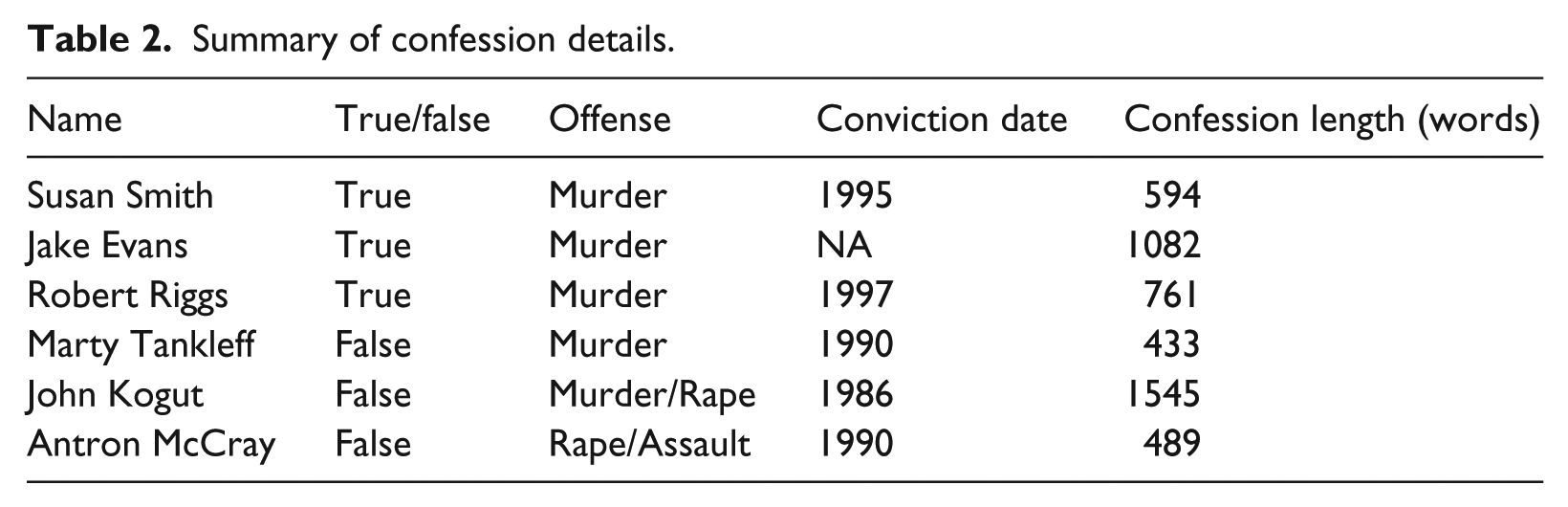
The three true confessions in our sample are all confessions to murder. In 1994, Susan Smith drove her car into a lake, killing her two young sons. Although Smith originally claimed that her car had been hijacked and her sons kidnapped, she eventually confessed and was convicted of their murder (Bragg, 1995). Robert Riggs confessed to killing Andre Melendez after a fight involving an unpaid debt, and pleaded guilty to manslaughter (Sullivan, 1997). Jake Evans, a 17-year-old boy, spontaneously called 911 to confess to the murder of his mother and sister (Stebner and Quigley, 2013). He also confessed to the crime in a four-page statement to police. Although at the present time he has not been tried for the crime, we believe that due to the spontaneous and unelicited nature of his 911 call, his confession statement can be considered true.
The three false confession statements are from cases in which the individual was found to be innocent after conviction. Antron McCray was charged and convicted in 1990 of rape and assault in the Central Park Jogger case, where a female jogger was beaten and raped while jogging in Central Park (Innocence Project, n.d.-b). John Kogut, along with two co-defendants, was convicted in 1986 of the rape and murder of a teenage girl who had been found dead in Lynbrook, New York (Innocence Project, n.d.-c). Marty Tankleff was convicted of the murder of his parents in 1990. McCray and Kogut have been exonerated with the help of DNA evidence (Innocence Project, n.d.-b, n.d.-c), while Tankleff’s conviction was overturned with the help of over 20 witnesses who testified that his father’s business partner had coordinated the murders (National Registry of Exonerations, 2014).
These data are subject to several limitations. First, although a larger sample of confessions would have been preferable in order to generalize more confidently, due to the sensitive nature of confessions, these are difficult to obtain. Second, Tankleff’s confession, unfortunately, ends abruptly in the middle of his description of the crime. His unfinished narrative therefore leaves some questions as to whether a greater degree of evaluation would have been present had the narrative been completed. Despite these drawbacks, enough material exists to draw conclusions as to the narrative structure of true and false confessions and the use of evaluative devices.
Finally, it is impossible to assess the degree to which these narrative written confessions were guided by interrogators. In addition to obtaining the truth from a suspect, interrogators aim to produce a confession which can serve as a persuasive piece of evidence (Leo, 2008). In order for it to be viewed as persuasive, Leo (2008) maintains that a confession must contain motives, explanations, and emotions. As Leo explains, ‘In many cases, investigators will suggest, and pressure suspects to accept, certain motives’ (p. 170), in addition to encouraging suspects to ‘express remorse and regret’ (p. 173). Some methods of interrogation, such as the Reid Technique of Interviewing and Interrogation, go so far as to specify the information that a confession should include: The details of a confession should not only contain the details of the offense itself, such as the date, time, place, motive, and manner of its commission, but also such things as the places where the confessor had been before and after the crime, and the names of individuals he saw and talked to before and after the event. (Inbau et al., 2013: 314)
Interrogators may therefore be trained to guide confessions to contain certain details. Although it is impossible to ascertain the degree to which the interrogators in the cases in our sample suggested themes to the narrators or guided the confessions, it is still possible to analyze the manner in which praise and blame are negotiated and assigned to actors.
Method
Using Labov’s narrative analysis as a framework, each narrative confession was separated into lines with each line containing one narrative clause. Clauses were separated at their temporal juncture. However, if the narrator repeated a clause, both clauses remained on one line. Using the Labovian definition of evaluation, types of evaluation in these lines were identified. Finally, the purpose of evaluative statements was examined in the context of the narrative, and used as a point of departure for a comparison of blame between true and false confessions.
Before discussing in detail the findings of this analysis, it is important to define the concept of mitigation of blame, as this is a central element to our analysis. In this study, a confessor was considered to be mitigating blame if he or she conveyed through lexical or syntactic choices that (1) an actor other than the narrator was to blame for a negative act or (2) the narrator had a justifiable reason to have committed a reprehensible act. Mitigation of blame is distinct from a motive, which instead gives the reasons and the thought process behind the objectionable action, without providing a reason that the actor should be held less accountable for the outcome.
Findings
As a whole, the true confession samples created integrating narratives which minimized blame. Evaluation in these narratives was concentrated around the events of the crime. In contrast, the false confession samples contained a greater number of evaluative devices which explained motive, but did not evaluate the events of the crime itself. The findings of this analysis are first presented for the three true confessions in our sample, followed by the analysis of the three false confessions.
Evaluation in true confessions
The three true confession samples, those of Susan Smith, Jake Evans, and Robert Riggs, highlight the opposing roles of a confessor as both protagonist and antagonist. While these confessions admit to the crime, they also demonstrate remorse, hesitation, and deflection of blame. Integrating narratives, which minimize the role of the narrator in a negative event, are therefore constructed through the use of evaluative statements in the three true confessions in our sample.
Susan Smith’s confession
Smith conveys a plethora of emotion throughout her narrative, continually expressing feelings of regret and guilt (‘I couldn’t believe what I had done’, ‘I am sorry for what has happened’). This sorrow is intensified through the use of absolutes, in such expressions as ‘I had never felt so lonely and so sad in my entire life’, ‘I had never felt so scared and unsure as I did then’, and ‘I don’t think I will ever be able to forgive myself for what I have done’ (Emphasis added).This overflow of remorse provides a measure of sympathy for Smith, despite her reprehensible actions.
Furthermore, Smith expresses her belief that her children are better without her as a mother: ‘I felt I had to end our lives to protect us all from any grief or harm’, ‘I know that they will never be hurt again’, and ‘My children deserve to have the best, and now they will’. These clauses, as well as those describing her love for her children, paint Smith as a mother who only wanted the best for her children. This recurring theme serves to minimize her blame by explaining that she simply wanted her children to have a better life.
The placement of evaluation within the narrative is also key to revealing patterns of blame. As Smith relates the details of the crime, she fills her account with evaluative statements (Evaluative clauses in bold):
In fact, Smith’s entire rendition of the crime is comprised of evaluative statements. The crime, therefore, is not merely described as a set of events, but as an intensely emotional and personal experience.
Smith relates her feelings at length throughout her confession, which conveys to the listener her profound sadness. This expression of emotion, combined with the theme of the grieving mother who wants a better life for her children, points to a mitigation of blame reminiscent of Labov’s integrating narratives. While she does not attempt to evade guilt, her emotional relation of the crime highlights her humanity and caring for her children, rather than presenting her as a heartless child-killer. In this way, Smith’s confession is an integrating narrative that constructs her as a caring mother filled with remorse for her actions.
Jake Evans’ confession
Similarly, Evans employs evaluative devices to justify the murders he committed, minimize blame, and convey his deep remorse. As justification, he explains that his sister, Mallory, had made racist comments and that he, as he put it, ‘felt like my own family were becoming the people I hate’. Evans also mitigates the blame placed on himself by describing the hesitation he felt (‘I then spent probably over an hour walking nervously around the house thinking how life will never be the same and how I would never see them again’), and how disturbed he was by the idea of inflicting pain upon Mallory (e.g. ‘Thoughts of causing her pain kept entering my mind and were really bothering me’).
There is also a lengthy suspension of the action which reinforces the theme of Evans’ hesitation. Between the time Evans says that he decided to murder his family members and committing the murder, he relates a miniature narrative about an argument with Mallory, explains that he went to get his father’s knife, then paced back and forth contemplating the murders, watched a movie and had a pillow fight with Mallory, checked on the location of his mother, and thought about the murder for an hour. Although in Labov’s narratives of personal experience, suspension of the action is used to enhance suspense, in Evan’s narrative, it instead demonstrates that he did not murder his family members out of rage or in a blind fury. Instead, the narrative paints Evans as an introspective young man who views himself as having had reason to murder his mother and sister, and who struggled with the decision.
Moreover, the placement of large amounts of evaluation before the crime also suggests that, to Evans, the crime may not necessarily be the most reportable event. The listener’s attention is drawn to those events which precede the crime, described above. The placement of evaluative devices in events leading to the crime suggests that the justifications and mitigating factors are the events which Evans wishes to emphasize.
Nevertheless, just as in Smith’s confession, the crime itself is also highly evaluated: 112. I shot her in the back and then the head. 113. I ran down to the study 114. and shot my mom 3 times.
119. As I emptied the shells on my bed 120. I heard noizes (sic)
123. While I loaded the gun back up
The placement of evaluation within the events of the crime further emphasizes Evans’ feelings of sorrow, fear, and shock. Thus, the evaluative devices in Evans’ confession create an integrating narrative which focuses the listener’s attention on his hesitation to commit the crime, his justifications for the crime, and his regret.
Robert Riggs’ confession
Riggs’ confession demonstrates a slightly different technique in mitigating blame, as he consistently deflects blame onto his accomplice, Michael. This is partially accomplished by explaining that Riggs attempted to prevent Michael’s violent actions (‘He then took a pillow and put it over Angel’s face. I made him stop by either telling him to stop or pushing him off Angel’). He also employs reported speech and repetition to paint Michael as the antagonist: ‘I yelled “what are you doing?”’, ‘I, again screamed, “What are you doing? What is your problem? He’s out!”’ and ‘He asked for the duct tape from the closet and said “You have to help me!”’ This use of reported speech, the repetition of Riggs’ question, and the imperative directed at Riggs, emphasize Riggs’ lack of control over Michael. Another method of mitigating guilt and shifting blame is Riggs’ use of the passive voice in ‘It was decided that I would go to get knives or something to help dispose of the body’. The use of the passive voice leaves the listener without a clear picture of the decision-maker in the narrative, leaving open the possibility that Riggs was simply a pawn and not truly to blame. Much of the blame for the crime is thus shifted onto Michael, the accomplice.
Evaluative statements are also included in the description of Riggs’ involvement in the murder, just as with Smith and Evans: 15. I grabbed the hammer which was in the closet directly to my left. 16. I stepped forward
19. After the first blow, he turned and grabbed the hammer.
22. but I snatched it back 23. and hit him in the head again. 24. He started to go down,
Here, Riggs places blame on Angel, the victim, by describing Angel’s violent actions and anger (lines 17, 18, 25, and 26). Riggs therefore justifies his involvement and use of violence by highlighting the danger posed by Angel and contrasting this with Riggs’ own worthy intentions to try to stop the violence. These examples demonstrate that the blame in this narrative is placed on Riggs’ accomplice and victim, creating an integrating narrative which glosses over and diminishes Riggs’ own role in the crime.
The three true confessions in this sample therefore create integrating narratives through justifications and expressions of hesitation and remorse. The effect of these emotions is magnified when placed within the actions of the crime, as this is the most reportable event and would therefore be most focused on. As discussed by Labov (2002), narrators have a natural tendency to relate narratives ‘in a way that minimizes guilt, and relieves participants of responsibility for the outcome’ (p. 35). Despite the fact that a confessor must necessarily accept blame, the excerpts presented here demonstrate that he or she will still attempt to mitigate, through evaluative devices, even the most heinous of actions.
Evaluation in false confessions
The use of evaluation in the false confessions in this sample differed from the true confessions in two significant ways. First, in contrast to the emphasis being placed on mitigation and diminishment of blame, in the false confessions the narrator instead simply presents his motive for the crime. Moreover, the events of the crime in the false confessions are presented merely as a sequence of events, and are left unevaluated.
John Kogut’s false confession
In his confession, Kogut clearly delineates his role and that of his accomplices in the rape and murder to which he confessed. This is accomplished through reported speech of the two accomplices (‘But just before the rope was thrown to me, Dennis, while standing over her, told her, “You have to die”’) as well as descriptions of their actions (‘She was fighting Dennis, but he was too big for her, and had a good grip on her’). Although this use of evaluation resembles that of Riggs due to the placement of blame on the accomplices, the corresponding minimization of blame on the narrator is not present. Whereas Riggs uses evaluative devices to minimize his role, Kogut instead plainly gives the motive for killing the victim (‘We were afraid she would tell on us’). Unlike Riggs, Kogut makes no attempt to hinder his accomplices or object to the murder. This false confession therefore includes no minimization of blame or morally acceptable justification, unlike the true confessions discussed above.
Furthermore, whereas the crime is highly evaluated in the three true confessions, this pattern is not found in false confessions. For example, in Kogut’s confession, the crime itself is told without evaluation: 92. I took the rope which was a hard nylon type. 93. I wrapped it double around her neck, 94. and then I twisted it like a corkscrew. 95. I twisted it for a few minutes, until her body went limp, and I felt she was dead. 96. I rolled her body up in the quilt, 97. and I threw her over my shoulder and into the van. 98. I threw the rope into the van, 99. and then I dropped the body into the floor of the van.
Here, a plain, factual, and unevaluated account of the murder is presented. Consequently, although Kogut gives their motive for the murder, there is no accompanying minimization of blame. This is in stark contrast to the true confessions, which each included mitigation in the form of justifications, hesitations, or regret.
Marty Tankleff’s false confession
Tankleff’s confession further demonstrates the way in which evaluation is employed in false confessions as a method to convey the confessor’s motives, rather than diminish blame: 6. 7. 8. 9. 10.
These statements describe Tankleff’s motive, an indispensable aspect of a confession according to Leo (2008). However, unlike the true confessions, there is no accompanying mitigation of blame. The crime is described in a straightforward manner, without evaluation, and responsibility is placed directly on Tankleff’s shoulders: 20. I decided to kill my mother first. 21. I ran across the bed. 22. I got to her quick. 23. I hit her 4 or 5 times on the head. 24. She fought me. 25. I went to the kitchen and got a knife. 26. I ran back with the knife. 27. I cut her throat.
The commission of the crime, described here, is strikingly similar to that of Kogut. Both confessors relate the events of the crime without the use of evaluation, and present the crime as merely a set of actions told one after another. The only evaluation in Tankleff’s confession is placed before the crime itself, and simply highlights his motives. Unlike in the true confessions, there is no hint of an integrating narrative.
Antron McCray’s false confession
Finally, McCray’s confession does not include any clauses relating to justification, or even a statement of motivation for the rape committed by him and his friends. The rape is presented as a group crime, devoid of emotion: 28. We were by the reservoir when this jogger came by. 29. We grabbed her 30. and I kicked her down. 31. One guy hit her 32. She went to the ground. 33. I grabbed her left arm. 34. 35. The same kid took off her shirt and shorts, 36. and then jumped on top of her. 37. The 38. I then jumped on while somebody else held her left arm. 39. Clarence was the next to get on. 40. Then Kevin got on.
While three lines of evaluation are present in the description of the crime, unlike in the true confession samples, none relate to emotion or justification. The events of the crime are instead related in a cold and detached manner. The remaining events of the crime are conveyed in a similarly dispassionate style. At no point are emotional or evaluative statements made, even when McCray and his friends are being chased by the police, and the listener might expect fear or anxiety: 41. We walked out of the park someplace on the west side. 42. We saw the police come 43. and we all ran. 44. I ran back in the park. 45. Me, Clarence, Kevin, and Orlando jumped over the wall 46. and ran into the park. 47. I ran down by the stream 48. and laid down in the mud. 49. I stayed there until the police left.
McCray’s confession contrasts strongly with the confessions of Smith, Evans, and Riggs, due to its complete lack of emotion, and also differs considerably from that of Kogut and Tankleff, as there is no hint of motive provided to the listener.
Discussion and conclusion
This study addresses a gap in research concerning the language of true and false confessions by seeking to determine differences in the function of evaluation in each. Although several studies have explored the language of deception in this context, to our knowledge no study has addressed discourse-level differences in true and false confessions. This study applied narrative analysis to a small sample of confessions in order to explore how the assignment of blame is constructed in confessions. Two primary differences between the two categories of confessions were found. First, in regard to true confessions, our analysis uncovered motives, justifications, and emotions, the same elements Leo (2008) describes as being central to confessions. Deflection of blame and an emphasis on the role of other actors as well as justifications of the crime characterized true confessions, whereas false confessions instead focused on the motive for the crime. True confessions were thus found to be consistent with Labov’s integrating narratives. On the other hand, the emphasis on motive in false confessions may be due to the fact that because the suspect is innocent, there is less physical evidence in the case, causing a motive to be extremely important in leading to a conviction. Interrogators may be likely to realize this, and may therefore ensure that a confession contains a motive.
Another contrast was evident in the amount of evaluation interwoven in the events of the crime itself, as these were highly evaluated in true confessions and unevaluated in false confessions. As Labov and Waletzky (1967) explain, narratives of vicarious experience contain less evaluation than those which were actually experienced by the narrator. This provides a possible explanation for the dearth of evaluation in false confessions: a suspect who confesses falsely did not actually experience the events he or she is relating and therefore has no emotional reaction to them. It is important to note, however, that the amount of evaluation and the types of evaluative devices employed varied greatly across confessions. Unfortunately, the great amount of variability in evaluation in false confessions (potentially due to the guiding influence of police or each narrator’s individual narrative style) prevents narrative analysis alone from being a factor which can contribute to accurately distinguishing between true and false confessions.
This study should serve as a starting point for future work on the topic of the linguistics of false confessions, and confessions more generally. One limitation of this study was the small sample size, as only six total confessions were analyzed. Future studies should investigate whether the findings of this study are consistent with a wider selection of documented true and false confessions. Furthermore, future research should also apply narrative analysis to different mediums of confessions. It is important not to overlook video- and audio-recorded confessions, as these mediums may also be introduced as evidence and will doubtless provide valuable insight into the language of confessions. If possible, an additional area of future research is the transformation a confession narrative undergoes from interrogation to confession statement, as well as from spontaneous confession to official confession statement (e.g. comparing Jake Evans’ 911 call with his eventual confession statement). Finally, analysis of spontaneous confessions made before a suspect has been interviewed by police, would greatly add to our knowledge of the elements of a confession which are present before the possibility of being guided by interrogators.
This study offers insights into the content and composition of confessions. The placement of evaluation in the narrative can help interrogators discern issues and concepts in the narrative that confessors deem most reportable. Although an interrogator believes the crime to be the most reportable event of the narrative, a confessor may view the justifications for the crime as more reportable, and this may be reflected in the placement of evaluative statements, as in Jake Evans’ confession. Placement of evaluation can therefore assist investigators in uncovering motives, the confessor’s state of mind, and key events, which in turn can help guide interrogators’ questioning patterns. Furthermore, while an analysis of evaluation in a confession is far from being an infallible method of identifying false confessions, the differences discussed in this study may signal to investigators that the confession may have been coerced, and may lead investigators to more thoroughly examine the other evidence in the case. In this way, this research, and future research stemming from it, may contribute to preventing the incarceration of innocent individuals and aid in the imprisoning of the guilty.
Footnotes
Acknowledgements
Many thanks to Dr Tammy Gales, who gave guidance and invaluable comments on an early draft of this article, and to Dr Natalie Schilling for her encouragement throughout the course of this project. We also thank the anonymous reviewer for having provided helpful comments and suggestions.
Funding
This research received no specific grant from any funding agency in the public, commercial, or not-for-profit sectors.