







Abstract
Humour is a prevalent feature in any form of human interaction, regardless of language modality. This article explores in detail how humour is negotiated in conversations among deafblind Australians who are fluent users of tactile Australian Sign Language (Auslan). Without access to the visual or auditory cues that are normally associated with humour (e.g. smiles, laughter, eye crinkles and ‘smile voice’), there is a risk that deafblind interactants will misconstrue humorous utterances as serious, or be unsure whether their conversation partner has got the joke. In this article, we explore how humorous utterances unfold in tactile signed interactions. Drawing on Conversation Analytic principles, we outline the ad hoc and more conventionalised signals deafblind signers use to signal amusement. Looking at humour in these conversations contributes to a greater understanding of how humour is conveyed across language modalities and further support for humour’s centrality to interactional solidarity.
Introduction
This article explores the humour of deafblind signers who communicate with tactile Australian Sign Language (Auslan). Tactile sign languages are used by people who are both deaf and blind. In order to follow a conversation, a ‘listener’ places their hands on top of those of the ‘speaker’ to feel how signs are made. However, the adaptation of a visual language to the tactile modality is far from straightforward. In visual signing a great deal of syntactic and prosodic information is conveyed through non-manual channels. For example, raised eyebrows can turn a statement into a question, shaking one’s head while signing can negate the utterance and polar questions are frequently answered via head nods rather than the lexical sign YES (Janzen et al., 2001). Lack of access to the visual channel also means that tactile signers cannot use features such as gaze or facial expression to monitor ‘listener’ involvement, manage turn-taking or display their stance towards an utterance. The above is not to cast deafblind interactants as deficient communicators; on the contrary, tactile signers draw on a range of alternative conventions and resources to convey information that would normally be perceived through the visual channel, and these adaptation strategies have been variously discussed in a small but growing body of literature (see, for example, Bono et al., 2018; Collins and Petronio, 1998; Edwards, 2014; Mesch, 2001; Raanes, 2011). In this article, we extend discussion of these adaptation strategies by exploring instances in our corpus where at least one party is amused, and the ways that they convey (or fail to convey) their amusement to their interlocutor.
Deafblind signers are a group at high risk of social isolation. They are also a group made up predominantly of people who have been deaf since a young age, but lost their vision later in life, and thus are adapting a previously known visual sign language to perception via touch (see Willoughby et al., 2018 for more on this point). What these two points mean in practice is that in situations where deafblind people have relatively few opportunities to come together socially and use a tactile sign language with each other, ways of adapting the local sign language for tactile delivery may remain ad hoc or relatively ineffectual. However, as Edwards’ (e.g. Edwards, 2014, 2018) work on tactile American Sign Language (ASL) with the Seattle deafblind community demonstrates, communities that have opportunities to come together and talk about language in a sustained way can end up developing conventions for language use that vary quite significantly from the structure of the ambient visual sign language. In the present study, we are dealing with a variety – tactile Auslan 1 – that does not have the same level of codification or divergence as tactile ASL, but that has a community of users who have been communicating in the language for decades and have developed a range of conventions for getting their message across. These include a preference for sitting with legs interlaced to allow perception of nods and other bodily movements, avoiding or more slowly articulating signs that may be confused with near homophones in the tactile mode, and using a variety of hand taps and squeezes as ways of giving ‘listener’ feedback during an interaction (Willoughby et al., 2014).
Data for this article come from a wider project seeking to document and describe features of the language, which has collected approximately 26 hours of data from 19 deafblind signers interacting with each other, interpreters and sighted deaf signers. Our focus on humour began from an impressionistic observation from reviewing a number of different recordings: participants did not seem to laugh very often. This alerted us to the potentially problematic nature of humour in tactile signed interaction and encouraged us to explore if and how participants signal amusement without access to cues such as eye crinkles, laughter or smiling. In our discussion, we present a number of examples of (attempted) humour in tactile Auslan discourse in order to understand how humour is managed in interaction (i.e. how the humorous phases are entered/closed without auditory or visual access to the other parties’ laughter), why some attempts at humour appear to fail initially and what speakers then do to ‘repair’ this misstep. By considering how participants who have no or highly restricted access to sight and sound nevertheless manage to achieve moments of mutual humour and laughter, we hope to enhance our understanding of humour across language modalities. In what follows, we introduce some general challenges of humour first from the perspective of prior work and then from the perspective of our study’s deafblind participants.
The analysis presented in this article draws on principles of Conversation Analysis (CA), with insights from multimodality. A small but growing body of literature has demonstrated the applicability of CA principles to sign language interactions – both those perceived visually (e.g. Dively, 1998; Groeber and Pochon-Berger, 2014; McCleary and Leite, 2013) and via touch (Iwasaki et al., 2019; Mesch, 2001; Willoughby et al., 2014). Scholars are yet to develop standardised transcription conventions or approaches for applying CA to sign languages, however, not least because of ongoing questions about the boundaries between linguistic and extra-linguistic information in sign languages. 2 For tactile signed interactions, there is also the added analytic complexity that one must consider not only the visual or haptic cues signers are deploying to (attempt to) manage the interaction, but also which of these cues are actually accessible or perceived by their interlocutor. For these reasons, at selected moments in our analysis we provide image stills alongside our transcripts. Furthermore, we have prepared a pack of video files of the annotated examples that are used in this article, which interested readers can access at https://doi.org/10.26180/5c8585e1460d9.
The challenge of humour in deafblind interactions
Humour is a complex area of interaction, regardless of whether we can see or hear our interlocutors. There is no objective way of explaining what makes an utterance humorous or whether an utterance was intended as humorous by either the speaker or the listener(s) (Glenn, 2003: 49), meaning that ‘funniness becomes understood as a jointly negotiated communicative accomplishment’ (Glenn, 2003: 33). Cues such as smiling, eye crinkles, ‘smile voice’ and laughter are all commonly used to mark utterances as humorous, but there is no one-to-one relationship between humour and the use of these cues; visible signs of amusement may not be present in a humorous interaction, and conversely features such as laughter may occur in response to triggers other than humour, such as unease (Glenn, 2003; Jefferson, 1979, 1984). In deciding whether an utterance should be treated as humorous in this article, we have thusly looked holistically at the facial expressions of the interlocutors, the presence of laughter and the playfulness or seriousness surrounding talk. We further consider whether either party deploys lexical signs such as LAUGH or other conventionalised haptic cues to communicate their amusement to their interlocutor.
There are many reasons that we may find an utterance amusing, but one of the most common is the presence of incongruity. As Glenn (2003) explains it, ‘laughing results from experiencing the unexpected, from a perceived inconsistency between what one believes will happen or should happen and what actually happens’ (p. 19). Glenn also notes that humour is also frequently tied up with teasing: a good tease will often have a kernel of truth behind it, and thus a gentle (or not so gentle) barbed or mocking element (see also Haugh and Bousfield, 2012). Whatever its sources, it is also clear that humour plays an important role in managing social relationships. As the copious literature on workplace discourse shows, humour is frequently deployed as a way of negotiating solidarity, gender or power. For instance, Holmes (2006) finds women poking fun at the stereotypical ‘good old boys’ network’ in a government meeting in order to challenge prevailing gendered power norms in government and business workplaces. In the same study, Holmes shows how humorous ‘imagined’ stories about other government offices (perceived to be less efficient) create solidarity among the storytellers, who through the co-constructed story construct their own office to be better. Schnurr and Chan (2011) show how playful teasing and self-denigration by Hong Kong and New Zealand managers enable these managers to provide (often corrective) guidance to subordinates while also tending to the face needs of these subordinates.
Both laughter and humour have been extremely well-studied in spoken languages, but remain underexplored in sign language interactions. The ubiquity of humour and jokes in Deaf culture and interactions is widely acknowledged, but Ladd (2003: 49) contends that this very ubiquity has led to few attempts to studying the phenomenon: it has been hiding in plain sight. What scholars are clear on is that sign languages lend themselves to embodiment and enactment to humorous effect and that skilled signers have at their disposal myriad ways of caricaturing people or personifying animals or inanimate objects that can create highly memorable and hilarious juxtapositions (Ladd, 2003; Sutton-Spence and Napoli, 2012). Just as spoken languages derive humour from word play, so too signers can create visual puns, play with metaphors and also create a genre of ‘bilingual’ jokes that rely on a knowledge of both English and the relevant sign language to decode the pun 3 (Nakamura, 2006; Rutherford, 1983; Sutton-Spence and Napoli, 2012). The fact that these forms provoke laughter is uncontroversial, but the fact that the studies mentioned in this paragraph have sourced their data from stand-up comedy routines, elicited storytelling sessions and ethnographic observation means that they provide little insight into how humour is negotiated in day-to-day sign language interactions. That much sign language humour seems to revolve around enactment, embodiment and other non-citation forms of signs also raises the question of how accessible these will be for deafblind signers. In previous studies, non-lexical signs have been identified as potentially challenging for tactile signers to decode because of the role that gaze, non-manual features and visual frames of reference play in decoding the referent (Edwards, 2014; Quinto-Pozos, 2002). Above all, deaf humour is described again and again as ‘visual humour’, so one must ask the question, ‘How does this translate in a context where one or more parties can no longer see?’
Provine and Emmorey (2006) provide what is to date the only published study of laughter within signed interactions, focussing on ASL conversations with between two and five deaf participants. In this study, they considered only instances of laughter that were accompanied by vocalisation; an approach that does not capture the relatively frequent cases where deaf people (and indeed hearing people) laugh silently (cf. Makagon et al., 2008; Bragg cited in Padden and Humphries, 1988: 97; Petridis et al., 2013). It also means that the study is considering the timing of an event (an audible laugh) that participants in the interaction may not be orienting too, since one would assume that for deaf signers the visual cues of laughter, such as changes in facial expression of shaking sides (see Petridis et al., 2013), are more meaningful interactional cues and these need not co-occur in precise timing with an audible laugh.
These constraints notwithstanding, Provine and Emmorey (2006) found that the current signer laughed much more frequently than audience members and that signer laughter generally occurred at phrase boundaries. They also found that women laughed more than men. However, this study does not give details about how these humorous interactions were negotiated (or even what was deemed funny about the short examples that were cited), so it tells us little about how signers signal that they are entering or leaving a humorous frame or how laughter timing is synchronised among participants after the first (audible) laugh. For the deafblind context, perhaps the greatest lesson from this study is the importance of considering not only when a stimulus like laughter is present, but also how accessible it is to all parties in the interaction. In the tactile signing context, this does not mean that all laughter is automatically inaccessible. Glenn (2003) reminds us that ‘hearty laughter involves involuntary contractions of the abdominal muscles, heaving of the chest and shaking of the sides … repeated head movements may [also] occur’ (p. 10) – and all of these should be perceptible to deafblind interactants in tactile contact with each other. However, less hearty laughter may be much harder to detect or under certain circumstances might be confused for other forms of bodily movement (such as sobbing). Therefore, a detailed interactional eye is required to understand how deafblind signers make sense of potentially humorous interactions, to which we now turn.
Data collection
For this article, we restrict our analysis to conversations between two deafblind signers, where both parties use tactile reception to follow the conversation. This forms a subset of our wider data and yields 21 conversations or around 5 hours of recordings. In total, 15 different signers are represented, but to vastly different degrees. One participant (who was in the process of transitioning from visual to tactile reception of sign language) appears for only 4 minutes of conversation while, at the other extreme, our focal informant Heather is present in just under 2½ hours of these recordings. Heather was chosen as our focal informant because she was the first signer in Australia to start using tactile Auslan after her vision deteriorated to the point where she could no longer follow the language visually several decades ago. She has also been a strong advocate and a mentor for other deafblind people making the transition to tactile signing though we note that many of our other participants have also been using tactile Auslan for 10+ years.
In sign language linguistics, it is common to prepare corpora by recording signers under studio conditions that tightly control seating position, lighting level, camera angles, shot framing and even the clothing participants wear (see, for example, Schembri et al., 2013). In our research, the focus was on obtaining more naturalistic interactions, and we generally ran recording sessions at camps or other events where deafblind people come together. At these events, we would ask potential participants if they would be willing to have a short, filmed conversation with each other. We did not prescribe what participants were to talk about, but suggested a few topics (school days and/or experience of being deafblind) to get people started. Our approach to recording required us to make do with the conditions (lighting, clothing, background noise, etc.) afforded by the room and participants available to us, but also allowed us to easily adapt our shot framing to the different signing postures preferred by our various participants and to respect the high level of photosensitivity many deafblind people have. 4 Conversations were recorded with a minimum of 2 HD video cameras and were transcribed for analysis using ELAN (https://tla.mpi.nl/tools/tla-tools/elan/). 5
The community of people who are proficient tactile Auslan signers is quite small, and thus almost all participants knew each other well. Indeed, many of them have known each other since childhood, and our data set includes a handful of conversations between sibling and spouse pairs. However, since we arranged some of our recordings at a national camp, we were also able to capture recordings of interactions with people who live in different states (and thus interact infrequently), as well as at least one case where participants are getting to know each other for the first time. As we explore below, the degree to which participants know each other or interact regularly does not have a clear impact on whether or how they deploy humour in their interactions, but certain individuals were much more likely to attempt humour than others.
Overview: Humour and laughter in the corpus
A striking feature in our corpus is that our participants seemed to engage in humour relatively infrequently, as noted in the introduction. The relative absence of humorous discourse, the challenges of conveying humour in the tactile mode and their sadness at the difficulties of connecting with other people through moments of humour were all points that our participants raised in our wider data (e.g. interviews and focus groups) when discussing their experiences as tactile signers. For example, in response to a focus group question about if/how participants understand humour and sense laughter in tactile interactions, Pam responded as follows: Pam: It’s difficult with deaf communication because I never see the joke or the laughter, nothing at all, or very rarely. Most Deaf people laugh and joke they know from the signs but tactile signing is very different signs. Deafblind people don’t know how to make up stories or jokes because they like to be serious plain communication, they can be happy and smiling – they can’t be bothered. Not really good at jokes at all. [Pam – focus group 7/4/18, Translated from the original Auslan]
Similarly, Heather had this to say about the need for (sighted) interlocutors to remain in physical contact with her as she signs, so that she can sense how they are reacting/responding to the unfolding discourse: Heather: Sometimes when the other person sits away from me and they laugh, I don’t know anything about it. I just sit on my own then when they come up to me laughing I feel very sad. I can’t laugh with them because they don’t have contact with me either through their hands or shoulder to shoulder. That would be different. I rather they have shoulder contact, being close is important. [Heather in conversation with Pam, Translated from the original Auslan]
Humour plays such an important role in how we negotiate and manage social relationships that it is hardly surprising that tactile signers would mourn its absence from interactions. What is more intriguing, however, is to look at examples of situations where humour is attempted in interactions, in order to see what cues are being used to convey or acknowledge that the discourse is funny. Despite Pam’s assertion that deafblind signers ‘aren’t really good at jokes at all’ and ‘like serious plain communication’, we do find instances of shared laughter and humour, albeit relatively infrequent. What seem to be almost entirely absent, however, are the more complex visual puns and wordplays that form the key components of Deaf humour (Sutton-Spence and Napoli, 2012). We speculate that a reason for this may be the potential for unexpected or complex humour to cause interactional trouble in tactile interactions. Prior research has shown that deafblind signers can have difficulties distinguishing between phonologically similar signs (Reed et al., 1995), and that in conversation this can lead to misunderstanding and repair sequences that are complex to resolve (Willoughby et al., 2014). Given this, we might assume that deafblind signers err on the side of caution in avoiding puns or wordplay, lest they derail the interaction.
The principal technique that we used to identify examples for consideration for this article was to manually inspect the data for instances where one or more participants were unambiguously laughing, 6 in order to see how these potentially humorous moments unfolded. This was supplemented by a search in the transcripts (via ELAN) for instances where our participants deployed the lexical signs LAUGH, JOKE and FUNNY either to indicate that they were laughing/amused or to clarify that their preceding utterance was not to be taken seriously. While in the United States tactile signers have developed conventionalised haptic cues to indicate laughter (such as scratching their interlocutor’s arm or moving the interlocutor’s hand to touch the laughing throat, McAlpine, 2017: 27), no such conventions exist in tactile Auslan at present, and thus could not be searched for.
The ELAN search yielded 29 instances of LAUGH, JOKE or FUNNY, of which four were cases of reported speech and one was a case of FUNNY being used in its sense of ‘strange’ (a case of polysemy that the sign shares with its English translation). This left 25 cases where the sign was used to mark that the prior utterance was amusing. LAUGH was the favoured sign used in this situation (13 usages), with FUNNY used seven times and JOKE five times. Notwithstanding the fact that participants were present in recordings for varied lengths of time, it is also worth noting that these signs were distributed very unevenly across our participants. Our focal informant Heather was by far the main user of these signs, accounting for 16 of the 25 occurrences in the data. Moreover, eight of the nine times that these signs were used by someone other than Heather was in a conversation with her after she had already used a sign in this way herself. Conversely, 16 of the conversations that we recorded (64% of the recorded minutes) included no use of these signs. We remarked earlier in this article that there remain high levels of variation in how people use tactile Auslan, and the use of explicit signs to convey amusement serves as an example of this. As the language develops, it will be interesting to see if the use of these explicit stance markers grows, or if an alternate convention gains prominence.
Having said something about the relative occurrence of moments of shared humour in the data, we now turn to detailed analysis of selected extracts in order to better understand how humour and amusement are attempted and negotiated.
Exploring tactile humour
One of the key challenges for a tactile signer producing a humorous utterance is establishing a playful frame for the interpretation of the utterance. Absurdity can be a useful device to draw on for humour under these conditions, as there is little doubt as to whether the utterance should be read as serious or playful. We see an example of this in Extract 1. Joe is planning a trip to the Northern Territory, where Heather went on holidays several years ago. Just prior to the text presented in Extract 1, Joe asked if Heather had eaten kangaroo and crocodile meat (two local delicacies in the Territory) and if they tasted good. Heather told Joe that they were delicious, but dry. They are sitting with their legs interlocked, meaning that they have some sense of changes in each other’s body posture that might indicate actions such as nodding or laughing:
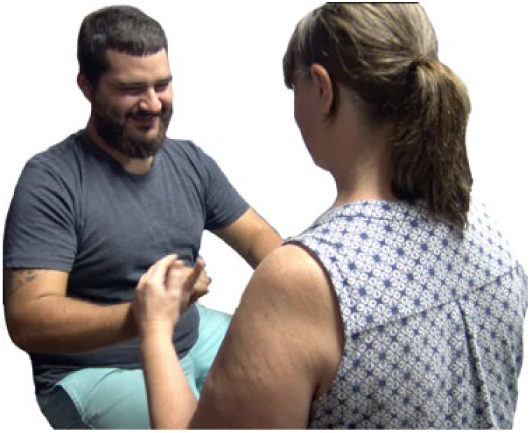
This brief exchange, while not self-evidently hilarious to outsiders, sees both participants laugh uproariously in line 05 and Figure 1, and is clearly an example of a successful humorous interaction.
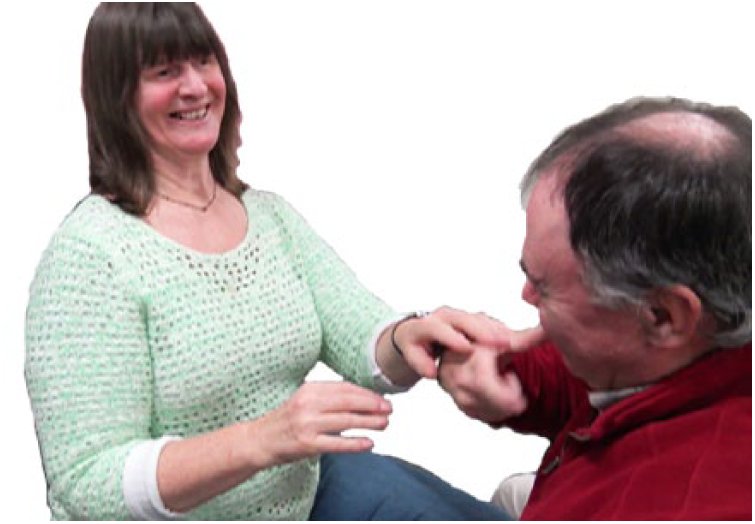
Heather (left) and Joe (right) laugh uproariously in line 05. Joe signs LAUGH repeatedly.
In line 03, Heather provides no explicit indication that what follows is to be taken playfully within her signed utterance. However, Heather starts her turn before Joe finishes his turn. After Joe’s AND(SE) in line 02, Heather moves her hands away from Joe. Before taking a turn, Heather smiles ((Image 1) in Figure 2) and closes her mouth tightly ((Image 2) in Figure 2) as she prepares to sign CAREFUL, which seems like she is trying not to laugh and signal her laughing through vibrations. Even though Joe cannot see her mouth movements, Heather’s facial actions display that she is going to say something funny. Heather’s CAREFUL overlaps with Joe’s KANGAROO, but their hand contact is disconnected. Thus, Heather restarts her turn and signs CAREFUL again.
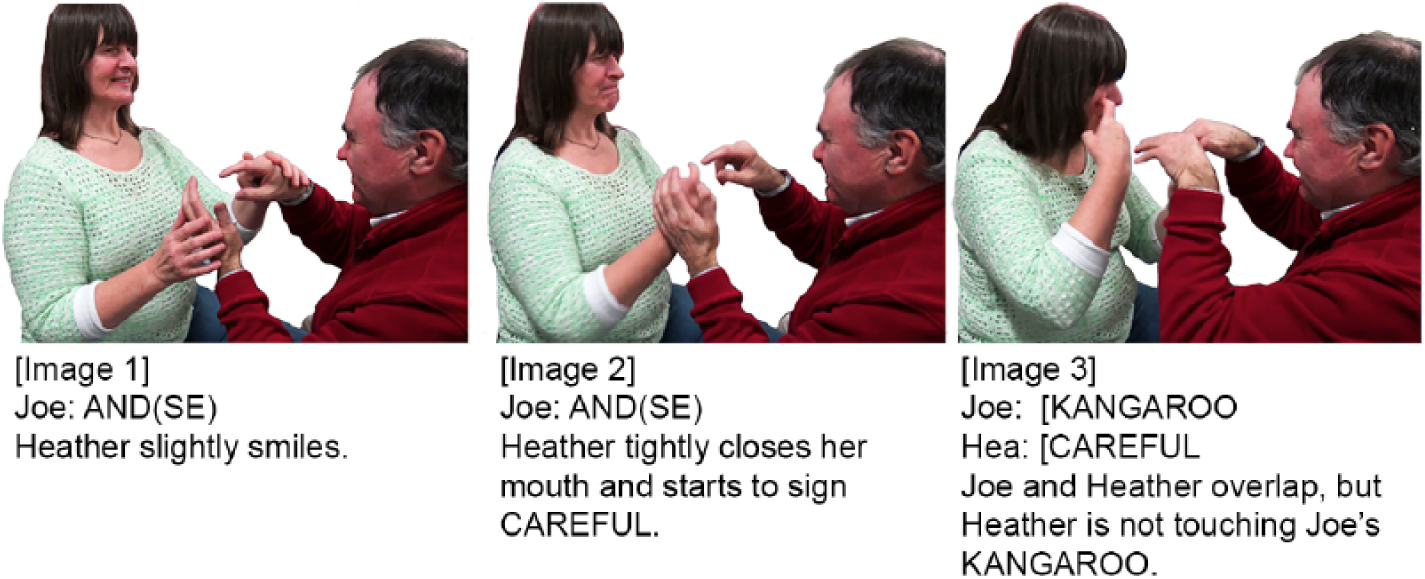
Lines 02–03.
The idea that eating crocodile will transform you into one appears crazy enough to promote laughter from both parties without further explanation. As soon as Joe begins to laugh, he also starts signing LAUGH repeatedly, and on receipt of this sign Heather laughs audibly as well, which is assumedly accessible to Joe as they remain in tactile contact with each other. The humorous moment is further prolonged by Joe signing GOOD (signed twice) and GOOD^ON^YOU. As in spoken language, the final GOOD^ON^YOU seems to round off the immediate frame (in this case, a humorous one), and move onto another frame (in this case, a more serious frame) (cf. Djenar et al., 2018: 78–79, for a discussion of the function of discourse markers for rounding off interactional frames).
The literature on humour and laughter notes that transgression often plays a key role in humour (see Hoza, 2007: 95–96). Extract 2 shows another type of humour we see deployed by our participants and may again promote the ‘playful’ reading of the utterance simply through the improbability that the speaker intended the utterance to be taken seriously. This example comes from a conversation between Heather and Pam, who have been close friends for many years. Heather is single and Pam had married relatively recently. Pam was born in Australia, but lived in the United Kingdom much of her adult life. In the preceding talk, she has been discussing her decision to move back to Australia:
Heather and Pam have known each other for many years, so Heather is able to draw on prior knowledge to expand on Pam’s statement that she finally got married, by referring to Pam’s husband by name and noting that they met after Pam moved back to Australia. She then begins her humorous utterance with the transgressive request ‘can I have Rob?’. Glenn (2003: 131) explains that impropriety such as this indicates that the speaker views the conversation as informal or intimate (see also Jefferson et al., 1987), but that they are also ‘“risky laughables”, possibly leading to hurt feelings or offence. Yet in that very riskiness lies a resource for bringing participants closer together’. The recipient of such an impropriety can choose to respond in a variety of ways, from taking the utterance seriously to laughing along and affiliating to the utterance and building on it, and we see Pam very quickly engaging with Heather’s request in these affiliative ways. As soon as Heather signs the B in Rob’s name, Pam begins to laugh (lines 03–04), and simultaneously disengages her hands from tracking what Heather is signing in order to place her hands under Heather’s to sign LAUGH (this moment is captured in Figure 3 below).
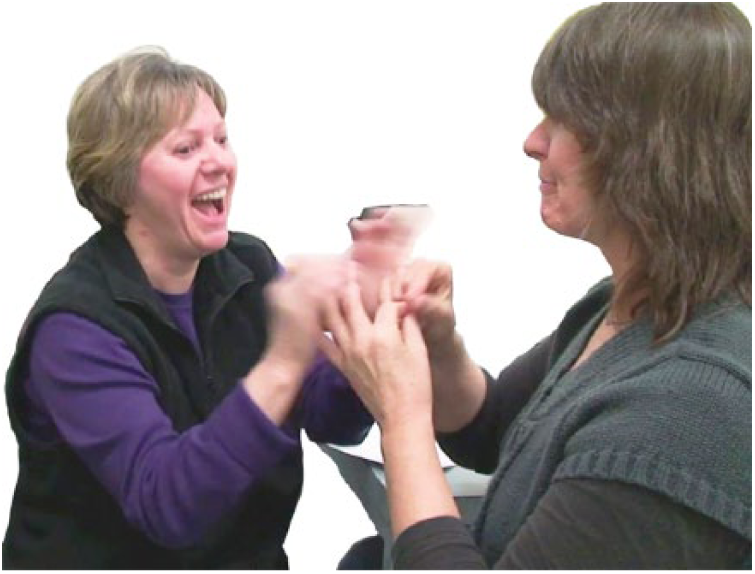
Pam (left) disengages to sign LAUGH at the end of the sign B in line 03.
Once Pam has re-established contact with Heather’s hands, Heather develops the joke by signing the bald directive ‘give me him’ in line 05. Pam continues to laugh at this brazenness and signs to Heather, repeating FUNNY twice: FUNNY PT: PRO2 FUNNY (‘That’s very funny, you are funny’) in line 07, at which point Heather laughs audibly, but does not convey this laughter through tactile means. Contemporaneously, Pam further builds on the joke by saying that what they need is a twin of Rob for Heather. Heather then says she will look for someone like Rob and explicitly marks this utterance as non-serious by concluding with the sign JOKE in line 10. Pam volunteers that Rob is blind in one eye, but without any explicit markers of humour. Heather interprets this as a statement of fact and indicates that she knows this already in line 12. In line 13, Pam deploys a palm-up gesture commonly glosses as WELL or SO across sign languages (cf. McKee and Wallingford, 2011). When produced turn initially, this gesture appears to function as a marker of topic shift, and in this instance moves the conversation back into a serious frame.
A striking feature of this extract is the recipient’s recurrent use of lexical signs LAUGH and FUNNY to explicitly mark the talk as humorous, even though the parties are also in tactile contact and (potentially) able to sense laughter through bodily vibrations. It is also noteworthy that not all laughter is marked lexically, leading us to believe that both parties are using lexical signs to indicate that something is humorous at points of potential tension in the interaction where there is a risk of miscommunication. By contrast, Heather’s laughter when Pam says ‘you’re funny’ is uncontroversial, and thus deemed not to require explicit marking.
Humour in tactile interaction appears to become more difficult to negotiate when what is funny is not a singular utterance said in jest, but rather a series of utterances that might be seen either as humorous or troubles-telling (e.g. Clift, 2012; Jefferson, 1984). Jefferson (1984) writes of such troubles-telling as, ‘It appears that in troubles-talk, a laughing troubles-teller is doing a recognizable sort of job. He is exhibiting that, although there is this trouble, it is not getting the best of him’ (p. 351). Yet, troubles-telling is a risky affair for the teller and the listener. The troubles-teller is at risk of being ascribed the identity of a ‘dispositional moaner’ (Edwards, 2005: 24), while the listener is at risk of finding something humorous where this is not the troubles-teller’s intention (see Clift, 2012). These risks are amplified for deafblind signers, who lack access to facial expression as a way of disambiguating the speakers’ orientation to the events they describe. Our final examples explore instances of troubles-telling in the data, and the degree and circumstances under which it was conveyed or taken up as humorous.
Troubles-telling in our data was mostly conveyed in a way that was not construed as humorous by listeners, regardless of the intent of the speaker. Generally, our deafblind participants did not tend to produce narratives that utilised the ‘over-the-top’ production (e.g. in facial expression, signing size/pace or repetition and characterisation) that is a hallmark of humour in visually perceived sign language narratives (Sutton-Spence and Napoli, 2012). Within our corpus, there was one possible (but ambiguous) exception found in a story told by one participant about a hiking trip where they got caught in a hailstorm and ended up very cold and beaten up by the hail. This story includes many elements of exaggerated and repetitious signing about the pounding hail and how cold the teller was, but she does not laugh or smile while recounting these events and her recipient orients to this as troubles-telling. The story ends with the teller reaching shelter, at which point she does laugh, but this may well be more at relief that the ordeal has passed than an indication that the preceding utterances should have been viewed as humorous storytelling. The default orientation to stories as troubles-telling may also come about not just because of linguistic constraints, but because a (understandably) common topic of conversation among our participants was the difficulties and frustrations of living with deafblindness. 8 Thus, if signers know that deafblind people often like to talk with each other about the difficulties that they face, they may be primed to interpret any narrative as troubles-telling by default.
However, our final example shows how one participant uses absurdity to insure that the troubles-telling frame is taken up as humorous rather than serious. Extract 3 develops from a discussion between Heather and Jet – who had not met before this particular interaction – around skill gaps that Auslan interpreters commonly have when it comes to working with deafblind people:
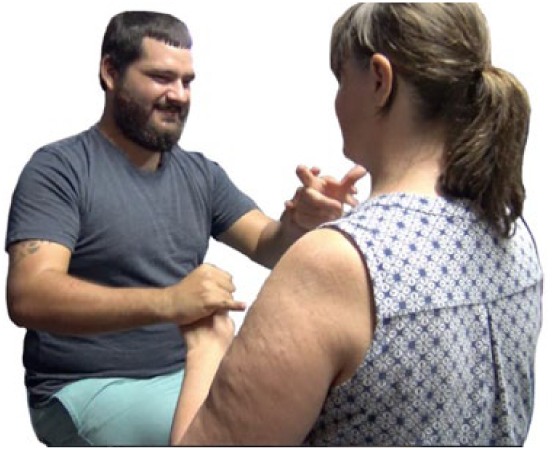
In this interaction, the talk in lines 01–14 is serious and fits within the troubles-telling frame discussed above. However, in line 15, Jet moves the conversation into light-hearted territory by suggesting that the solution is to use rubber bands to secure interpreters’ high heeled shoes to their feet. It seems to take Heather a moment to process this absurdity as she initially responds with a resigned YES G: OH^WELL, but simultaneously with Jet applauding his joke she registers exactly what has been said and dissolves into hearty laughter (as does Jet). Heather then builds on Jet’s humour by telling a story in lines 21–24 of a friend and her guide falling over in another high-heel-related incident. In line 25 and 27, Jet expresses sympathy for the people involved, but is very much smiling as he does so (as shown in the accompanying images). But since Heather does not have access to Jet’s smile, she adds in for good measure that this was funny (in lines 28) and Jet concurs in line 30 – adding a brief depiction of the falling person to make explicit to Heather that he also sees this as an amusing mental picture. This extract from Heather and Jet shows that while humour may have its challenges in the tactile mode, it is certainly still possible to tell funny stories in tactile Auslan and have others get the joke. Importantly, it also reinforces the important role that absurdity and incongruity seem to play in establishing a playful utterance frame in this modality, given the absence of cues such as facial expression for decoding a signer’s stance towards their utterance.
Conclusion
In this article, we have provided some initial observations of the challenges of negotiating humour in tactile signed interactions. For the deafblind signers who participated in our research, the most common forms of humour were moments of absurdity where there was little to no possibility that the signer intended to be taken seriously. Humorous storytelling was much less frequent and potentially ambiguous, and puns or other types of word play were absent altogether. Together, these observations suggest that adapting a visual sign language for tactile reception creates challenges for humorous or playful language use, but also that these challenges are not insurmountable.
It is important to note in closing that while the observations in this article are true for how tactile Auslan is being used in our corpus, they should not be seen as suggesting that these issues are inherent to all touch-based communication. In particular, the US-based pro-tactile movement promotes a radically restructured version of ASL (and attendant norms of interaction) that allow deafblind people to better express and comprehend non-linguistic communicative cues (see, for example, Edwards, 2014, 2018). While humour has not been looked at explicitly yet from a pro-tactile perspective, it is highly plausible that pro-tactile practices better facilitate the use of shared humour. We also strongly suspect that as the user-base of tactile Auslan expands, and as deafblind people experience more opportunities to come together and socialise with each other, tactile Auslan will undergo greater conventionalisation, potentially leading to the emergence of conventionalised signs or signals for indicating amusement. Such a development would further expand the opportunities for bringing humour into tactile conversations.
Humour can be problematic to convey in interaction and its transmission, and take-up is further confounded in tactile communication by a reduction in visual cues. This article has shown how some potential ambiguities emerge in the conveyance of humour (e.g. is the current troubles-talk meant to be taken up has humorous?), but also how these ambiguities might be resolved directly (e.g. absurdity) or indirectly (e.g. shifts in body) in interaction. More work clearly needs to be done, but the current article provides a first step towards a better understanding of humour beyond the better-studied spoken modalities, and also for interpreters and other caregivers who work with tactile Auslan users.
Footnotes
Appendix 1
Acknowledgements
We wish to acknowledge and thank Dennis Witcombe for his research assistant work on this project; particularly in data transcription. We also acknowledge and thank our many participants who gave freely of their time and often participated in multiple recording sessions - and particularly our focal informant Heather Lawson, who was always willing to take part in yet another recording session.
Declaration of conflicting interests
The author(s) declared no potential conflicts of interest with respect to the research, authorship, and/or publication of this article.
Funding
The author(s) disclosed receipt of the following financial support for the research, authorship, and/or publication of this article: This research was funded by the Australian Research Council [ARCDP160100142].