







Abstract
Public accusations of corruption leveled against public figures and institutions in Jordan have recently become a prominent feature of public discourse in the country. Informed by positioning theory as an analytical framework, this study focuses on public responses to such accusations through a discourse analysis of two major apologetic statements, or apologiae, issued in Jordan in 2018 and 2019: one by a controversial former royal court chief and minister of planning in response to public accusations of corruption and appropriation of public funds, and the other by the Office of Queen Rania of Jordan in response to accusations of wardrobe extravagance and overspending. The analysis shows that these two apologiae employed discourses that not only positioned the accused as blameless, but also as victims of defamation. Reference to one’s history, such as public service to the nation and one’s accomplishments, was exploited. In contrast, the accusers were explicitly or implicitly positioned as unjust, biased, vindictive, or motivated by hidden agenda. A variety of discursive strategies were deployed, particularly invoking cultural moral orders, resorting to banal nationalism, expressing pride in one’s public service and allegiance to the monarchy, and invoking a constellation of religious, professional and national identities. In the case of the royal apologia, it was implicitly positioned in western discourses, such as invoking feminine ‘corporeal modernity’, to respond to the wardrobe overspending accusations.
Keywords
Introduction
Accusations against public figures, government officials, and individuals have recently become a prominent feature of political life in Jordan. These accusations have targeted perceived or claimed institutional, political, social and economic wrongdoing and transgressions. This study focuses on responses to such accusatory discourse in two major apologetic statements, or apologiae: one by a controversial former royal court chief and minister of planning widely accused of corruption when in office, and the other by the Office of Queen Rania of Jordan in response to accusations of wardrobe extravagance and overspending. This study is part of a larger project investigating responses to accusations in Jordanian public discourse, which include, beside corruption, responses to accusations of nepotism and favoritism. The analysis is carried out through the lens of positioning theory (Davies and Harré, 1990; Harré and Van Langenhove, 1991; Van Langenhove and Harré, 1999), which looks at social actors’ positions and how these positions constrain and shape actors’ discourses, narratives and actions. The data for this study, and the larger project, come from the public responses, or apologiae, that are made through the social media and reported by local news websites. The study explores how responses to accusatory discourse are constructed and communicated in countering such accusations in the sociocultural context of Jordanian public life. The way such responses are constructed becomes important in view of the rapid and unchecked dissemination of such public accusations, and the publicity they receive, through the Internet and social networking sites in Jordan today. The focus of the study is the positioning practices embedded in these apologiae to accomplish the communicative purpose of persuading the audience and undermining the accusations in question. In contrast with the large body of research on apologia in other cultures (e.g. Benoit and Brinson, 1999; García, 2011; Miller, 2002; Simons, 2000; Valdebenito, 2013, among many others), there exists no work on apologia in Arabic discourse, which makes this study an attempt to, first, fill a gap in this area and, second, move away from the highly ethnocentric focus on western culture in image repair research.
A response to accusations in the Jordanian context takes the form of a public statement issued by the accused and made accessible to the general public through local online news websites. These responses to accusations have, therefore, become public texts and a form of public discourse accessible to large audiences and serving the function of persuasion in the public sphere. Responses to accusations, their discursive aspects, and their persuasive strategies will be shown in this article to be inevitably affected by the situational and sociocultural context in which they take place (Halmari and Virtanen, 2005; Pelclová and Lu, 2018).
Accusatory discourse and apologia
Individuals and groups are inclined to deploy repair discourse and take restorative action when there are threats to their image, reputation, or face. Goffman (1967: 27) long asserted that ‘when a face has been threatened, face-work must be done’, so face-work becomes ‘persuasive discourse designed to restore a blemished image’ (Benoit and Brinson, 1999: 146). Social actors feel compelled to take immediate action to repair their image by producing ‘defensive utterances’ in order to ‘reshape the audience’s attitudes’, and hence, ‘changing beliefs about the accused’s responsibility for an act’ (Benoit, 2015: 3).
Accusatory discourse is defined by Castor (2015: 1) as ‘assertions that another has done something wrong’, with the rationale behind such attacks being to alter audience’s attitudes toward the accused and to create new negative attitudes about them (Benoit and Glantz, 2017). Accusations, as Castor (2015: 20) points out, are ‘utilized in circumstances in which there is a perceived wrong’ and they ‘serve a variety of speech act functions such as reproaching, blaming, confronting, challenging, or questioning’. Accusations construct social reality and assess actions as violations of the social and moral order (Castor, 2015). Aristotle long observed that accusatory discourse motivates apologetic discourse (Ryan, 1982). When accusations occur, a response is preferred as failure to respond may be construed as accepting the charges of the accusation, with the typical, and preferred, response to accusations being denial or minimization of self-blame (Castor, 2015). Rejection has been regarded as the preferred mode of reaction to accusations (Pomerantz, 1978). Such rejection of accusations, which may take various forms, serves as a general ‘social defense’ strategy against the formation of negative self- or in-group impressions (Van Dijk, 1992: 92).
Responses to accusations are rhetorically known as apologia, which is defined as a speech act in which a social actor defends their character in response to a specific charge or accusation (Downey, 1993; Ware and Linkugel, 1973). It is a discourse of defense that has as a motive the clearing of one’s name and the purification of an image or reputation (Courtright and Hearit, 2002). In order to be considered as apologia, this basic accusation/response format should be in place (Ryan, 1982). As noted by Downey (1993: 53–54), growth in knowledge and technology has transformed apologetic discourse to focus on image management more so than strict self-defense. Thus, apologia has been re-conceptualized as ‘image restoration’ whose main goal is maintaining a reputation favorable to oneself (Benoit, 2015).
The apologiae investigated in this study are animated and influenced by the sociocultural context of their use in which underlying sociocultural assumptions impact the linguistic choices by the social actors. This brings to the foreground the role of culture in the analysis of apologetic discourse in this study. As pointed out by Gudykunst (1997: 327), rather than studying communication ‘in a cultural vacuum’, one should understand that ‘communication and culture reciprocally influence each other’.
Apologia opens ‘a public space of judgment’ and seeks to save face ‘in a space of public visibility’ (Tileagă, 2012: 68). As an attempt at self‑defense, public apologia becomes a species of argumentative discourse that is both ‘offensive’ (critical) as it explicitly or implicitly seeks to undermine rival versions of events, and ‘defensive’ (justificatory) as social actors attempt to ‘inoculate’ their accounts from attack by rivals (Potter, 1996; Tileagă, 2012: 68). In addition to being ‘a special case of offensive and defensive rhetoric’, public apologia can ‘start a rhetorical chain of explicit and implicit meanings, presuppositions, implications’ as ‘attack or defense can be rhetorically tailored to respond to cultural demands related to atonement, regret, morality, and so on’ (Tileagă, 2012: 68).
Theoretical framework
Positioning theory (Davies and Harré, 1990; Harré and Van Langenhove, 1991; Van Langenhove and Harré, 1999) originated within the field of psychology as an approach grounded in social constructionism and seeks to capture ‘how people use words (and discourse of all types) to locate themselves and others’ (Moghaddam and Harré, 2010: 2). In this theory, positions are conceptualized as social constructs that are primarily established through language in use. According to Davies and Harré (1990), ‘one’s beliefs about the sorts of persons, including oneself, who are engaged in a conversation are central to how one understands what has been said’ (p. 48). Accordingly, the complete meaning of a speech act is constructed by the combination of the ‘illocutionary’ and ‘perlocutionary’ forces of the speech act (Austin, 1975) and the social force exerted by the positioning of the interlocutors (Harré et al., 2009), which makes positioning theory complementary to speech act theory.
Positioning theory posits the following three ‘mutually determining’ (Van Langenhove and Harré, 1999: 17) elements that play a central role in bringing about a particular set of positions: a storyline, the social force of the speech and a position. Storylines are ‘loose cluster of narrative conventions according to which a social episode unfolds and positions arise’ (Moghaddam et al., 2008: 293–294). Narrative conventions involve prototypical events and prototypical characters (e.g. protagonists and antagonists). The second element, the social force of the speech, refers to an act that is achieved primarily through speech, or speech act, that constitutes the illocutionary, or the pragmatic, force of an utterance, such as warning, compliment, and advice.
Finally, a ‘position’ is a metaphorical concept in which individuals position themselves according to three social entities of ‘people’, ‘institutions’ and ‘societies’. Within each of these entities, discursive practices are conducted either privately or publicly. The notion of position in an institution or society has a more fluid connotation in regard to participation in conversations (Davies and Harré, 1990; Gillett and Harré, 1994; Tan and Moghaddam, 1995; Van Langenhove and Harré, 1999). Position is understood in relation to roles, such as father, teacher and leader, but unlike a role, a position is characterized by much more fluidity so positions may shift and some positions may be more detailed than others (Lee, 2018).
As positioning is a construction of social interaction and discourse, actions can be either appropriate or inappropriate for the individuals within the community, which pertains to the perception of individual rights and duties (Harré and Moghaddam, 2003). According to Harré and Moghaddam (2003), ‘positions are social in the sense that the relevant beliefs of each member are similar to those of every other’ (p. 4). When a speaker positions himself/herself, he or she also automatically positions the addressee, and when a speaker positions the addressee, he or she also automatically positions himself/herself (Harré and Van Langenhove, 1991: 398). Positioning is, therefore, characterized as ‘essentially conversational’ (Van Langenhove and Harré, 1994: 362). Accordingly, ‘an explicit positioning of self naturally involves an implicit positioning of other and an explicit positioning of other involves implicit positioning of self’ (Minow, 2012: 98).
In such positioning, ‘a satisfying discussion of positioning on any level absolutely requires the inclusion of cultural considerations’ since such cultural factors ‘fundamentally affect positioning practices’ (Tan and Moghaddam, 1995: 393, original emphasis). Positioning practices vary with the following three factors:
(1) the particular cultural ideals persons desire to move toward through positioning; (2) the particular dimensions which persons find relevant in positioning themselves and others in discourse; and (3) with the preferred forms of autobiographic telling, which may influence the types of stories people tell about themselves in the process of positioning. (Tan and Moghaddam, 1995: 393)
These positions, and how they fit into storylines, can thus be a fruitful framework in discourse analysis to analyze and understand conflict in responding to accusatory discourse. The discourse analytic nature of positioning theory, with its focus on the language in use, and the discourses that emerge and are shaped in apologia, makes positioning theory an ideal and apt analytic framework for examining apologetic discourse in this study.
Data and methodology
The data of this study are based on two major and long public apologetic statements published in Jordan in 2018 and 2019, which are part of a project investigating public apologiae in the country. The first apologia was issued by the controversial former royal court chief and minister of planning Bassem Awadallah in response to accusations that he had attempted to invest hundreds of millions of the country’s Social Security Corporation funds outside the country. The response was carried by the prominent local news website Ammon News (www.ammonnews.net) on 17 April 2018. This news website, launched in 2006, is considered the first and most prominent online news website in Jordan, providing all kinds of news for its readers. The second major apologia was issued by the Office of Queen Rania of Jordan in response to accusations regarding the Queen’s wardrobe spending. This apologia was posted on Facebook on 2 January 2019 (see Table 1).
Sources of apologia in the data.
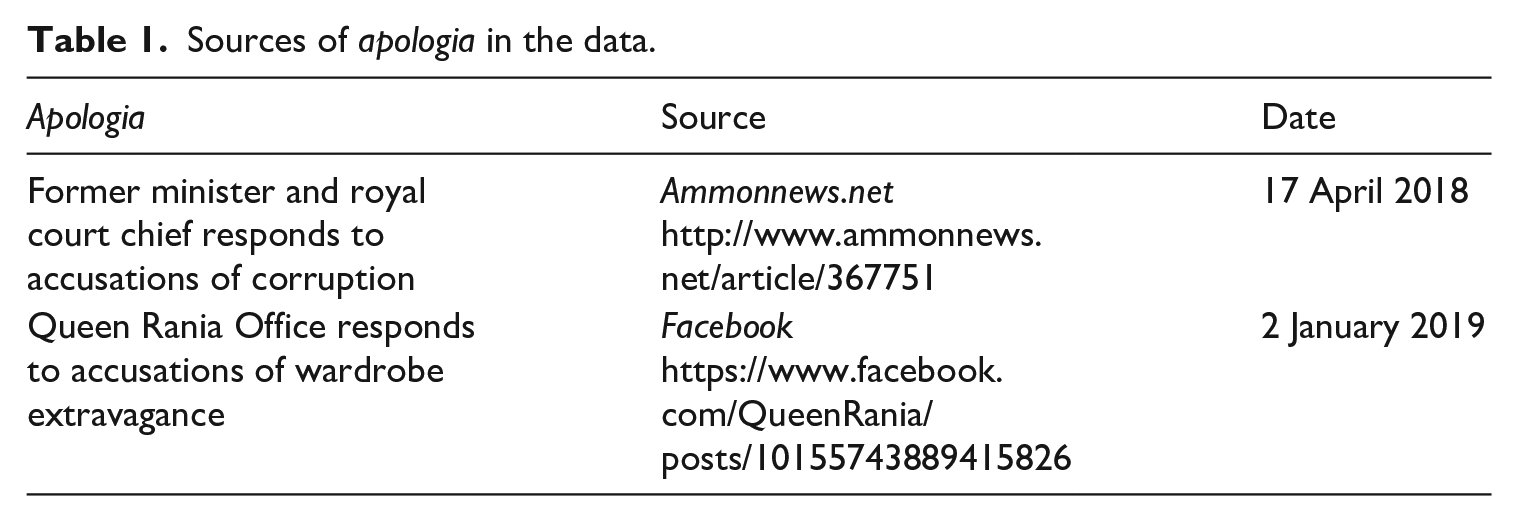
These two public apologiae were written in Modern Standard Arabic and contained no colloquial language. This reflects the serious nature of these statements as face-work designed to repair, protect and preserve the reputation of the accused. The study adopts a qualitative, theoretically informed approach focusing on the positioning acts and practices in the two apologiae and the discursive strategies deployed by them. The two Arabic texts were translated into English by the author as closely as possible to convey the nuances of the source language and the culture-specific meanings communicated by the source text. For constraints of space, it will not be possible to include the two original Arabic texts, but they can be accessed through the links provided in Table 1, or, alternatively, can be provided upon request.
Analysis
The apologia of Awadallah
Public apologia coming from public figures is described as the quintessentially speech act in political life where public figures seek to manage successfully a ‘spoiled’ personal and political identity (Tileagă, 2012: 67). This type of personal apologia in Jordanian public discourse is illustrated by the apologia made by a controversial public figure in Jordan, Basem Awadallah, who is a former Royal Court Chief and a former Minister of Planning. Awadallah has been long accused of selling the state assets and embezzling public funds while in office. The latest major accusation against him, to which he responded in a public statement, was that he sought to invest hundreds of millions of the country’s Social Security Corporation (SSC) funds outside the country. Awadallah denied the accusation through the following public statement:
As C. R. Ryan (2018) points out, talk about corruption pervades Jordanian political discourse and corruption has been the main focus and main complaint in Jordanian public life. This statement illustrates a response to accusations of corruption made against Awadallah, a public figure whose name has long been associated with corruption in Jordan, although this link has been viewed by some as part of identity politics in Jordan (Ryan, 2011). Awadallah begins his apologia by constructing and evaluating his own identity as a politician for whom public service is an ‘honor’ bestowed upon him, thereby positioning himself as a loyal and disinterested public servant. He further positions himself as a committed, constitution- and law-abiding professional politician who is aware of and recognizes others’ constitutional rights to voice their opinions and their right to criticize and evaluate the performance of a public servant. This construction of his professional identity, or his ‘role-based work identity’ (Caza and Creary, 2016) and the image of who he is as a professional (Slay and Smith, 2011) is exploited by way of countering discourses and positionings of misfeasance that have been projected onto him by the public and rejecting the projected discourse of corruption by referring to his commitment and expertise. This shows how deliberate self positioning takes place when someone intends to portray a particular identity usually in pursuit of a strategy or goal (Harré and Van Langenhove, 1991: 400–401; Van Langenhove and Harré, 1999: 24–25).
But rather than merely invoking his professional identity, Awadallah further brings the potential plurality of identities into his professional identity conversation (Caza and Creary, 2016). He further deploys both his religious identity and his national identity in order to position himself as someone who is guided by religious teachings and morality, and by patriotic concern for the progress and unity of his country. Thus, Awadallah attempts to ‘position religious faith as an inherent part of national identity’ (James, 2014: 25). This tripartite constellation of identities (professional, religious, political) is invoked by Awadallah as a legitimizing discursive resource in responding to the current accusation and by extension to previous accusations of corruption.
In terms of religious identity, Awadallah strategically employs texts from Islamic discourse and references to Islamic scripture, specifically hadith, that is, the body of collected reports of the Prophet Muhammad’s words and actions, which serve in this context as a means of both apologia and legitimation (Billings and Scott, 1994). First, Awadallah asserts that ‘there is none among us who does not make mistakes’, which intertextually echoes the Muslim prophetic tradition ‘All of the children of Adam [i.e. humans] make mistakes and the best of those who err are those who repent’. Allusion to this text serves to provide an implicit and preemptive legitimizing justification for any mistakes Awadallah may have made throughout his public service. Thus, he attributes any mistakes he may have made during his service to being a human rather than a civil servant or politician. Next, to justify not responding to earlier accusations of corruption, Awadallah calls upon a well-known prophetic tradition that is an established rule in Islamic jurisprudence, that is, البينة على المدعي واليمين على من أنكر, which in effect says that the onus of proof lies with the accuser and denial by the accused shall be supported by oath.
Another manifestation of invoking religious identity, and hence, lending authority and legitimation to his response, is the use of the expression الظلم ظلمات aḏ̣-ḏ̣ulm ḏ̣ulumāt ‘injustice is darkness’. This is part of a hadith warning against doing injustice, or ḏ̣ulm, to others as this injustice will turn into ḏ̣ulumāt or ‘darkness (pl.)’ on the Day of Judgment for the one who commits it, thus metaphorically, equating doing injustice to others with ‘darkness’, which is made rhetorically effective by the two words ḏ̣ulm and ḏ̣ulumāt having the same trilateral root ḏ̣-l-m ‘dark’. Awadallah thus implicitly positions himself as someone who has been wronged, and reminds others, through this intertextual reference to an Islamic hadith, of the divine punishment awaiting those who do injustice to others. These quotations of and references to sacred texts is consistent with research showing that, within the Arabic-speaking community in general, reference to the religious scriptures of hadith as well as the Quran is a common practice and a rhetorical strategy for argumentation across all topics, both secular and sacred, which serves as a means of supporting one’s position and invoking authority (Boutz et al., 2017).
The third religious reference deployed by Awadallah by way of projecting a religious identity in his response to accusations of corruption is his use of the well-known Islamic religious invocation أسأل الله أن يجنبنا جميعا الفتن، ما ظهر منها وما بطن ‘I pray to Allah to help us all avert [acts of] sedition, whether overt or covert’. This is a formulaic religious invocation in Islamic speech that is characteristically used by orators in Friday sermons. The Arabic term fitan, the plural of fitnah ‘sedition’, has religious connotations as it evokes times of civil strife and civil war in Islamic history, but Awadallah recontextualizes the term in his own (secular) statement to suggest that such ‘unjust’ accusations may lead eventually to strife and conflict, which he calls on God to prevent from happening.
Through all these religious references, Awadallah exploits sacred texts as ‘a source of incontestable wisdom’ and as ‘the wisdom of an unassailable authority’ (Boutz et al., 2017: 5, 19) that, according to Brown (2009), have historically served as a bridge of authority from past to present, linking later individuals and groups to the legacy of the Prophet. This exploitation of hadith by essentially a secular public figure further supports the view that religious texts are one component of cultural ‘tool kit’ of symbols, rituals and traditions from which social actors can draw to form strategies of action (Swidler, 1986). From a positioning theory perspective, Awadallah exploits ‘cultural moral orders’ in his response to accusations of corruption. Cultural moral orders refer to ‘the civilizational or cultural aspects of the society in which people live’ and ‘include moral opinions that go back to religious or secular codes’, such as ‘the Bible, Koran, or Talmud’, that ‘are all powerful reservoirs of values of what is right or wrong’ (Van Langenhove, 2017).
In terms of exploiting national identity to counter the accusations leveled against him, Awadallah positions himself as a patriotic citizen whose main concern is protecting Jordan’s ‘security, stability and development’ and ‘confronting the challenges facing the country’. This is conveyed in the form of hortatory discourse aimed at the evocation of emotional response in his audience (Bailey, 1983) prefaced by وعلينا جميعاً أن ندرك ‘We all have to realize . . . ’ which positions him as an expert who gives advice to others, thus implicitly positioning accusers as people of ‘empty slogans and false delusions’ while implicitly positioning himself as a man of ‘real work’. Awadallah deploys hortatory discourse built on truisms to conclude his response:
Protecting our homeland, its security, its stability, and its progress, and enabling it to confront the difficult circumstances and challenges it is going through, cannot be accomplished by [empty] slogans and false delusions, but by diligent and sincere action and by seeking truth, justice, and unity, [moving] away from injustice, division, and disunity.
This can be described as a ‘strategic use of consensual discourse’ that aims to ‘invoke consensual norms’ (Murphy, 1990: 24), and through such hortatory rhetoric, Awadallah shifts to the ‘role’ of a ‘guardian’ and a ‘defender’ of these norms and values.
Awadallah thus presents three identities in this part of his public response, which shows the polyvalence or multiplicity of identity and that each individual has the capability of combining several identities (Davies and Harré, 1990; Versluys, 2007). This shows that ‘the positions created for oneself and the other are not part of a linear non-contradictory autobiography’ (Davies and Harré, 1990: 49), and when the micro-level of conversations is considered, identities can shift in the course of one conversation according to the different story lines that are taken up (Davies and Harré, 1990).
Awadallah further resorts to ‘banal’ national discourse involving certain ideological habits of thought and mundane discourses that are reproduced on a regular basis, which is what Billig (1995) calls ‘banal nationalism’(see Culcasi, 2016). This is accomplished in his use of the formulaic prayer أسأل الله أن يحفظ أردننا الحبيب، ومليكنا المفدى ‘I pray to God to save our beloved Jordan and our worthy-of-sacrifice [i.e. precious] King’. In this invocation, Awadallah gives the abstract entity of Jordan as a ‘nation’ a human form through the use of ‘personification’, or ‘anthropomorphization’ (urdunnuna al-ḥabīb ‘our beloved Jordan’), which is one of the linguistic forms involved in the discursive construction of nations and national identity (De Cillia et al., 1999). He further expresses emotional attachment to Jordan, which functions as a basis for defining his national identity (De Cillia et al., 1999).
Awadallah equally prays for the King, referring to him as malīkuna al-mufadda مليكنا المفدى which literally translates into ‘our King who is worthy of sacrificing oneself for’. This is one of the honorific and glorifying formulas used in referring to monarchs in present-day Arabic political discourse. The use of this honorific serves to solemnize the value of the monarch and position the speaker/writer as a loyal servant who confers sublimity upon the ruler. Prayer for the King is further characterized by the use of the augmentative form for ‘king’ in Arabic, namely مليك malīk, rather than the unmarked ملك malik. The use of the augmentative here serves to glorify the King, which is part of the discourse of glorifying rulers and their deeds in Arab-Islamic tradition. The use of malīk further conveys connotations of ‘love’ and ‘affection’ toward the King, which reinforces the emotional attachment message conveyed by Awadallah in his prayer for Jordan as a nation. The use of mufadda ‘worthy of sacrifice’ as an attribute to the ‘King’ combines both metaphor and hyperbole, thus exploiting ‘figurative frames’ that are important in shaping public discourse (Burgers et al., 2016).
This discourse of banal nationalism is exploited by Awadallah to undermine and trivialize the accusations leveled against him, by positioning himself as someone who has allegiance to the country and the monarch, and therefore does not act in a way that is detrimental to national interests. At the same time, he implicitly positions his detractors as lacking such firm allegiance to the monarch and the nation. This suggests that a major way of responding to accusations of wrongdoing by public officials in Jordan is portraying these accusations as an attack against the whole political system, particularly the monarchy.
In constructing his position as ‘innocent’ in regard to the particular storyline of ‘accusations of corruption’, Awadallah resorts to victim discourse, or ‘victim playing’ (Berrocal, 2017), whereby he positions himself as a ‘victim’ of ‘relentless unjust accusations’. This is conveyed in the part of his statement reproduced here:
Awadallah’s construction of victimhood in this part involves a positive self-positioning and a negative other positioning (Berrocal, 2017: 89; Harré and Van Langenhove, 1991, 1999). Awadallah initiates this victim image by constructing hyperbolic temporal frame ‘no week passes without . . . ’ so as to portray himself as a victim of persistent and relentless public accusations, which serves as a complaint speech act that reinforces his victim image. These relentless accusations are metaphorically presented as sayl ‘torrent’ to emphasize the magnitude and ceaseless nature of the charges. Awadallah thus employs an image-based rhetoric of ‘victimhood’, perceived to be more effective than concept-based rhetoric involving abstract and pallid content (Emrich et al., 2001). An indirect denial of these accusations is presented in the form of a rather sarcastic explanation that is attributed to others, namely that publicizing these accusations against him have become the best way to gain popularity in Jordan today. It is noted that in this ‘explanation’ Awadallah used a third-person reference form, that is, ‘Bassem Awadallah’, to refer to himself. As Land and Kitzinger (2007: 494) showed, ‘the use of third-person reference forms in self-reference is designed to display that the speaker is talking about themselves as if from the perspective of another’, which is supported by ‘except for what some tell me’. This serves as a deliberate positioning of those spreading the accusations against Awadallah as if behind his back, which renders them as ‘gossiping’, which constitutes a case of other positioning in their absence (Harré and Van Langenhove, 1991: 403; Van Langenhove and Harré, 1999: 27).
Furthermore, through this third-person reference, Awadallah aims to convey, from the point of view of others, that he is ‘well-known’. Through referring to himself by his (first and last) name, Awadallah ‘proposes that the viewpoint of the other(s) is based on knowledge of him in particular’ (Land and Kitzinger, 2007: 497). Awadallah’s selection of his name for self-reference contributes to his overall public efforts of defending himself by positioning himself as a ‘wronged’ public figure and indexing his political identity within the Jordanian public context.
The apologia of the Queen’s office
According to Hearit (2006: 166), institutional apologiae ‘emanate from governments, religious groups, or educational organizations’. Furthermore, ‘an institutional apologia is a secular remediation ritual that places the institution’s name and reputation on the public record as acknowledgement and accounting of the wrongdoing’ (Courtright and Hearit, 2002: 356). Apologetic discourse of institutions in the data was found in three cases in which institutions in Jordan accused of wrongdoing have attempted to repair their damaged images. One of these cases is the public apologia made by the Office of the Queen of Jordan in response to accusations of overspending on the Queen’s wardrobe:
This institutional apologia responding to royal wardrobe overspending accusations is primarily predicated on questioning the truth or accuracy of the accusation, and the motives and integrity of the accusers, implicitly calling into question the veracity of their discourses on royal overspending and positioning them as deceptive. Thus, the response is marked by employment of evaluative language aimed at contesting the validity of the accusations by means of attacking the credibility of the accusers (Hearit, 1996). The validity of the accusations is thus challenged by deploying descriptions such as ‘not accurate’, ‘far from reality and far from the truth’, ‘creating a false and counterfactual impression’, ‘farthest from the truth’, ‘build a false public opinion’, ‘fabricate information’, ‘rumors and false information’ and ‘wrong impressions’. At the same time, the Queen’s Office is positioned as adhering to truthfulness and adopting a discourse of veracity, which can be seen from the very beginning of the apologia where the accused present their discourse as emanating from the ‘principle of transparency’, providing ‘correct information’, clarifying matters ‘in a direct and frank manner’, and ‘making facts accessible to all’. This credibility is further corroborated by reference to and calling on a ‘common and recognized’ practice of ‘loaning clothes’ and ‘offering preferential prices’ by international fashion houses, thus attempting to lend credibility and authority to and justify the royal narrative on how high-end royal wardrobe is acquired.
A second major strategy in this apologia is questioning the motives of the accusers and recasting the charge by attributing it to a problem with the accuser’s motives (Hearit, 1996). Questioning the accuser’s motives is clearly communicated by treating the overspending accusations as a ‘political tool’ exploited against the royal family. To undermine its validity, the overspending accusation is situated within a continuing ‘historically known’ behavior, whereby such charges against female consorts of world leaders have always been used an instrument of political ‘expediency’. The Royal Office thus invokes the conduct of past accusers and detractors of royal wives to undermine the current accusers’ entitlement to accuse the Queen of overspending. This invocation of past conduct toward royal wives does not directly deny the truth of the accusations against the Queen but questions the accuser’s motives behind them.
Invoking ‘past transgressions’ and ‘past actions’ of royal family detractors in this way serves to undermine the present accusers’ entitlement to level the overspending accusation. This is similar to the practice speakers use to navigate the problem raised by complaints about their conduct when they ‘tacitly or overtly admit to having committed the transgression attributed to them while opposing the complaint at the same time’ (Pino, 2018: 195). Along the same lines as proposed by Pino (2018) regarding complaints, invoking royal family accusers’ past behavior of harboring a hidden agenda undermines the validity of their accusations by ‘highlighting an incongruence between their moral stance’, as embodied in the accusation, and ‘their moral status, as evidenced in their past behaviors’ (p. 195, original emphasis), namely, using such accusations for ulterior political motives.
This royal apologetic discourse thus employs a kategoria, or counter-charge that, first, challenges accusers’ (the blog and those who use its information) right to accuse by calling their ethics into question, and, second, challenges the validity of the charges by redefining them as a case of political machination. An explicit counter-accusation is thus directed against the accusers (‘adopting this approach’) with their political motive (‘to portray Her Majesty as out of touch with reality’), which is highly contested (‘farthest from the truth’). The counter-accusation that the accusers seek to portray the Queen as ‘out of touch with reality’ implicitly refers and responds to an implicit accusation, namely that the Queen’s wardrobe overspending is highly incommensurate with the economic ‘reality’ of Jordan, with its limited financial resources, debts, and chronic budget deficit. Hence, this unstated accusation implicitly positions the Queen as ‘withdrawn and retired’ from the country’s economic reality and holding herself aloof from the problems and agonies of the Jordanian society. Further accusations are leveled against the accusers by anticipating their ‘rejection’ and ‘questioning’ of the royal clarification, with the ulterior motive of attempting to ‘build a false public opinion’. This counter-attack ‘reverses the traditionally defensive posture’ of the royal apologia, whereby the Queen’s Office ‘assumes an offensive persona, making the accused the accuser’ (Hearit, 1996: 196, 236).
By linking the current accusation against Queen Rania to and situating it within the history of accusatory discourses leveled against royal family (female) consorts, the statement covertly seeks to trivialize the accusation of wardrobe extravagance by treating the accusations as habitual, recurrent and expected. This in turn serves to treat them as a continuation of a ‘mendacious’ accusatory discourse. Furthermore, invoking the history of accusations against royalties serves to invite the idea that these accusations should be treated and viewed as part of ‘cultural stereotypes’ about royal consorts, that is, that the ideas about queens as overspending, extravagant, or leading a life of luxury seem to be ‘part of the general moral order of our society’ (Van Langenhove and Harré, 2010: 470). Thus, the apologia implies that this information about the Queen’s wardrobe can be rejected as something based on known cultural stereotyping of the community of royal consorts. This, therefore, becomes part of the ‘many different cultural stereotypes about all kinds of people’ and these ‘stereotypes appear as positions and as characters in storylines in all sorts of discourses’ (Van Langenhove and Harré, 2010: 471).
In its efforts to counter the wardrobe overspending accusations, the royal apologia covertly reproduces orientalist discourse on Muslim women. The apologia invokes the Queen’s ‘efforts to represent Jordan properly’, and attempts to ‘maintain a balance between these efforts and moderate spending’. The Queen is an unveiled Muslim, that is, does not wear the traditional Islamic head cover, or hijab, that is taken to be symbolic of a Muslim woman’s identity. Combining this with her western wardrobe, she ‘performs a monarchical persona in acceptable western terms’ (Yessayan, 2015: 438). There is a strong suggestion here, therefore, that a ‘proper’ representation of Jordan in the world requires, and consequently explains and justifies, obtaining modern, high-end western wardrobe and style designed by international fashion houses. The apologia indirectly links the Queen’s (expensive) western clothing style with being modern and liberated, thus implicitly positioning the Queen as doing service to the nation by projecting a ‘proper’ image of Jordan, so ‘proper’ here is implicitly defined in terms of ‘feminine corporeal modernity’ whereby ‘the publicly displayed female body’ represents ‘a key part of the process of western modernity’ (Fluri, 2009: 242). Accordingly, an orientalist image is reproduced here confirming ‘western associations of a Muslim woman’s unveiling with modernity’ (Yessayan, 2015: 435, my emphasis). There is, thus, an implicit positioning of Muslim women wearing non-Western clothes, such as hijab, as ‘conservative’ and ‘backward’ and, therefore, not projecting a ‘proper’ representation of Jordan as a nation. Hence, there is a ‘logic of western supremacy’ (Yessayan, 2015: 438) embedded in this apologia on the Queen’s wardrobe. Furthermore, following Haddad (2016), this image positions the Queen as ‘an archetype of a western-imagined, modernized feminine, non-Christian other’ (p. 145).
Finally, as part of countering the accusations, the apologia describes the Queen as cognizant, respectful, supportive and responsive to ‘responsible’ criticism. This description serves to position the Queen, and the monarchy as a whole, as a proponent of discourses and practices of tolerance (Brown, 2006) and as ‘a governing system that is civilized and operates by western modes of liberal governmentality’ (Yessayan, 2015: 437). In contrast with this liberal, yet responsible, political identity, the other is positioned as transgressing ‘responsible criticism’ and practicing ‘fabrication’, ‘mockery’ and ‘ridicule’. This negative other positioning is accomplished by portraying the other’s behavior as a transgression of the ‘cultural moral order’ of Jordanian society, that is, its ‘reservoirs of values of what is right or wrong’ (Van Langenhove, 2017). The royal apologia thus plays the ‘role’ of a ‘gatekeeper’ of these values. This serves to implicitly position the accusers as ‘outsiders’ who do not observe societal values of avoiding fabrication, mockery and ridicule, which constitutes a case of ‘forced other positioning’ (Van Langenhove and Harré, 1999). The use of a hybrid discourse of western liberality and local values, and shifting between the global and the local, functions to create varying cognitive positioning and shifting positions of the apologia’s audiences. This hybridity further helps create a hybrid identity that appeals to both local and global audiences, which maximizes the persuasive effect of the apologia of defending the Queen, both internally and externally.
Conclusion
This study examined two major statements of apologia in Jordanian public discourse, as part of a larger project on apologetic discourse in Jordan. The two major public statements were issued in response to public accusations and were analyzed within the framework of positioning theory. The first statement was issued by a former controversial figure in response to accusations of corruption, and the second by the Jordanian Queen’s Office in response to accusations of wardrobe overspending (by the Queen). The analysis showed how, in the course of responding to the charges and clearing one’s name, the accused resorted to different acts of positioning that involved positive self-positioning and negative other positioning. Throughout these positionings, the actors (i.e. the accused) produced autobiographical accounts in public speech-acts to positively present their personas. Following Lee (2018), analysis of such responses to accusations of corruption shows how the circulation of a particular discourse (i.e. public corruption) resulted in a forced self positioning among those who are ‘characters’ of that perceived corruption.
The responses to accusations in the two statements constituted ‘forced self positioning’ that involved identity construction and was solicited as the accused was already put in some position by others, to which they positioned themselves through the apologia issued (Van Langenhove and Harré, 1999). The analysis demonstrated different types of positioning the accused were engaged in and how such positioning inform their audiences of their positions in relation to their sociocultural beliefs, their differing values and their identities. The analysis also showed how the circulation of a particular discourse (i.e. accusations and responses to accusations) can result in a forced self positioning among those who are ‘characters’ of those accusations (cf. Lee, 2018).
The exploitation of ‘cultural moral orders’ (Van Langenhove, 2017) by the accused actors played a significant role in the discourse of the apologiae and the storylines offered. It was invoked by the actors in both apologiae as a strategy of positioning themselves as abiding by social and communal values, and hence it was unfair to accuse them of committing acts of corruption, namely squandering and mishandling public funds. In their defenses, the responders exploited the symbolic resources of society and religion, and appropriated the traditional values and practices of Jordanians. This was communicated through the deployment of religious formulas and traditional texts, such as prophetic hadith. In this way, the accused parties positioned themselves as observant of the cultural moral order, which undermines the corruption accusations against them.
Both apologiae appealed to and invoked banal nationalism as a defense mechanism and persuasive strategy. Reaffirmation of banal nationalism was displayed in the two defenses by emphasizing ‘true belonging and loyalty’ to Jordan through the reproduction of images of national fixity and ever-presence, such as ‘our beloved Jordan’ and ‘our worthy-of-sacrifice King’, which is consistent with the images that are reproduced in media representations of ‘our’ country and ‘our’ political leaders (Billig, 1995). This discourse of banal nationalism was combined with producing an image of ideological and moral righteousness for the accused, while producing ideological and moral deviation and manipulation for the other (i.e. the accusers).
Another conclusion that may be derived from this study is how Arabic apologetic discourse may implicitly involve acts of self-praise, reference to one’s accomplishments, and highlighting the superiority of one’s abilities, as in reminding the audience of one’s long public service (Haeri, 2003). As Suchan (2014) comments, such ‘persuasive strategies provide important clues to the values and identity of the speaker’ and ‘indicate one’s place in the hierarchy through connections; one’s education, knowledge, and social status through clever, skillful ways of speaking; and ironically (from a Western perspective) the sincerity and emotion a speaker brings to the communication situation’ (p. 287).
The role of perceived audience seems to have influenced the discourse deployed by each apologia. The first defense by a prominent yet controversial public figure in Jordan was addressed to a local, that is, Jordanian, audience so he used an apologetic discourse that predominantly appealed to the local cultural, religious and national norms and values that Jordanians typically embrace. The second apologia by the Queen’s office, while invoking the local norm of avoiding mockery and ridicule of others, was largely addressing a western audience. Accordingly, it appealed to historical ‘stereotypical’ narratives on royal overspending, and invoked discourses based on western ideals and values, thus implicitly seeking to link royal wardrobe spending to satisfying western images of feminine corporeal modernity. This, in turn, positions the Queen as representing modern western norms, and hence projecting, to the outside world, a modern image and identity of Jordan as a nation. Accordingly, these two speeches of defense are best understood as ‘facing’ multiple rather than single audiences. Whether either of these speeches was effective, that is, persuasive, or well-crafted, it can be seen that the ‘positioning effect’ these speeches were seeking in their target audiences (James, 2014) played an important part in their design of words. Judging from the current political scene in Jordan, the ‘social force’ (Van Langenhove and Harré, 1999) of these defensive speeches has been far from successful.
Footnotes
Funding
The author(s) received no financial support for the research, authorship, and/or publication of this article.