







Abstract
While the proliferation of social media technologies in China has empowered the public with new opportunities for public expression and political engagement in a ‘virtual public sphere’, Chinese Internet censorship has meant that users have to develop creative ways to engage in political criticism. In a context where both mechanical and human censors are employed, Chinese users have become adept at utilizing the affordances of technology, Chinese language and cultural resources to express their opinions through social media. Drawing upon data from the Chinese microblogging website, Weibo, surrounding the major chemical explosions in 2015 in Tianjin, the study explores three discursive techniques of indirection by Chinese social media users to express political criticism in the context of censorship. The study highlights that through the creative use of quotation, allusion and irony, users challenged the authority’s official narratives of the event. The study not only demonstrates the pluralization and dynamics of Chinese online expression, but also points to a better understanding of Chinese censoring as a continuingly evolving interplay between technology and cultural forms and between layers of government and users.
Introduction
The rapid development of the Internet and social media technologies in China has expanded the means through which users can communicate and express opinions, including opinions critical of the government (Yang, 2009). While some scholars believed that such development would transform the Chinese Internet into a relatively free and vibrant discursive space and virtual public sphere that facilitated critical discussion of social and political issues, formation of public opinions, and occasional collective mobilizations (Han, 2015; Lagerkvist, 2010; Montgomery et al., 2015; Su, 2016; Yang, 2003, 2009), this has increasingly shown to be more complicated as Chinese censorship has become increasingly effective (Ju et al., 2019; MacKinnon, 2011; Sullivan, 2014). Within this context, Weibo, a microblogging service that was launched in 2009 and originally based on Twitter has continued to provide a distinct socio-political function and become one of the most powerful channels for the articulation of critical attitudes of socio-political issues. Along with WeChat and other popular social media apps that were originally based on existing apps like Twitter, Facebook, YouTube, and so on, Weibo has developed beyond the affordances of Twitter and now offers a range of technological features on top of the original design (Rauchfleisch and Schäfer, 2015; Wu, 2018). While WeChat is private and requires an invitation to become ‘friends’ and is used for keeping in touch with family and friends, 1 Weibo is a platform where posts are publicly available to its users. The consolidation of features found in different communication apps into a few platforms not only provides users with multifunctional affordances of particular platforms, described as ‘super apps’ (Wu and Xue, 2017), but also means that these are easy to be monitored by censor mechanisms.
China probably has the largest and most sophisticated Internet censorship that monitors and controls information and information flow in cyberspace (Shen, 2019), with particular attention paid to political criticism and discussion on politically sensitive topics. This is not to say that criticism is absent or not allowed, as Weibo users have influenced the public agenda and policies and exerted pressure on the levels of government to take action to tackle actual problems in China (Feng and Wu, 2018; Wu, 2018; Yang, 2009). Rather, while criticism of the central government and leadership is not tolerated and quickly shut down, criticism of local and regional governments is possible where the target is exposing corruption or what is seen as inadequate responses to emergencies, such as disasters, food contamination, or more recently the COVID-19 novel Coronavirus outbreak in Wuhan, China, in 2020. It is, however, not clear in any particular case both the amount to be permitted and the limit of the criticism. This then creates the conditions for a cat and mouse game between users and censors where users attempt to post and keep their critical opinions alive while mechanical and human censors work to anticipate, identify and remove content. It is within this context that Chinese users continue to develop creative strategies to express political criticism on social media platforms like Weibo and WeChat.
Previous studies of online expression in China tend to frame it within the dichotomy of ‘censorship and counter-censorship’ or ‘control and resistance’, with a focus on examining how China controls the information environment through an increasing use of search filtering, content removal, website blocking and the ‘Great Firewall of China’, as well as how Chinese Internet users resist and struggle over online censorship. Recently, however, attention has been paid to the complex and dynamic landscape of online expression and the actual sense-making and strategic engagement with censorship mechanisms, such as examining how users design their critical posts to avoid or push back directly with censorship (Han, 2015; Wu, 2018; Xu and Feng, 2015; Yang, 2016). Drawing on these studies, we adopt a discourse approach to explore the methods deployed by Chinese social media users to express political criticism in the context of censorship. Our focus is on the ways users design their critical posts in such a way as to be seen but unnoticed, as ‘hidden in plain sight’. The study is based on the Weibo data from the aftermath of the 2015 Tianjin explosions where users reacted to the disaster, and focuses on three discursive techniques of implicit criticism. The discussion aims to show the limitations of a simple frame of ‘control and resistance’, but rather to perceive, approach and examine online political expression as a multi-layered game of cat and mouse between users and censors, technology and humans within political realms of power and government.
Censorship and counter-censorship
Censorship in China has been a recurring theme in Western coverage of the country and regarded as an increasing practice of Chinese government information control (Yang, 2016). Internet censorship constitutes an indispensable part of the Chinese media landscape where censoring through surveillance mechanisms blocks foreign websites like Twitter, Facebook and Google, and monitors, filters and deletes content that is deemed politically sensitive. Chinese Internet censorship practices are done both through software technologies and human power. Software technologies mainly refer to blocking certain websites and keyword filtering which stops users from posting verbal texts that contain banned words or expressions. However, human power censoring refers to parties acting putatively ‘on the government’s behalf’ at the central, provincial and local governmental levels including Internet police who physically examine and delete online content.
Chinese users have, however, employed various ways to circumvent those censorship mechanisms in order to continue public deliberation and social and political mobilizations (Lagerkvist, 2010; Yang, 2003, 2009). Users’ techniques of counter-censorship to some extent resonate with Yang’s (2009: 60) concept of ‘hidden digital transcripts’, which refer to ‘ways of resisting power in digital forms’. Yang identified four forms of hidden digital transcripts, that is, technical means, organizational creativity, online guerilla war and linguistic. Technical means refers to computer programs or software that helps evade the Great Firewall; organizational creativity refers to the secret online meetings held by a group of people in an online forum; online guerilla war refers to users starting a new website or hashtag when their original websites or hashtags are deleted by online censors; linguistic refers to the symbolic devices developed to substitute sensitive words in political discussions and get around keyword filtering and keep censorable topics alive on the Internet (Yang, 2009). Yang’s classification points to a more layered understanding of censorship. Together with more recent work, it highlights the complexity of forms of censorship including the relations between different forces and participants as well as the use of political criticism and censorship control within levels of government (see Han, 2015; King et al., 2013; Shao, 2018; Xu and Feng, 2015).
Rethinking the dichotomy of ‘control and resistance’
As Lagerkvist (2010) points out, China’s Internet is a ‘force field in which different social forces and political interests compete’ (p. 14). Recent studies have sought to challenge the simple understanding of ‘control and resistance’ and to explore the dynamics of discursive practices, the nuances of power relations and the multi-actor interactions taking place in Chinese online sphere (see Han, 2015; Wu, 2018; Xu and Feng, 2015; Yang, 2016). For instance, while Yang (2016) draws attention to the multi-layered operation of the Chinese censorship mechanism and its complex political effects in directly or indirectly influencing users’ views of their country, the involvement of multiple parties in the censoring practices is highlighted in Han’s (2015) study of the ‘voluntary fifty-cent army’, 2 members of the public who voluntarily defend the authoritarian regime online. In exploring how Chinese social media users challenged the official discourse of a disaster event by the local government and media, Wu (2018) points out that shades and overlaps exist in the power negotiation between the central government, local governments, the mainstream media and social media. These studies highlight the way users and censors are inextricably entwined through complex threads where power is not unidirectional. In this research, we aim to add to this understanding through examining the creative and dynamic interplay between the various parties involved and the ways they discursively engage and manage their online actions. In particular, we focus on the ways social media posts are designed to express political criticism through technological, linguistic and cultural affordances in the context of censorship.
Previous research examining the discourse practices undertaken by social media users in relation to online censorship includes Tang and Yang’s (2011) case study of ‘Grass Mud Horse’ as a form of symbolic power against Internet control, Meng’s (2011) study of E Gao (online spoofs) as an alternative way to conduct political discussion through the use of entertainment discourses, and Yang’s (2016) exploration of recoding through code words and images as a form of resistance and a cultural response to institutional power. Besides highlighting the creative ways users attempt to circumvent censorship, these studies also show that forms of resistance and control do not stand still but evolve in tandem with users’ creativity in design along with new censorship technologies and political initiatives. At the heart of these studies is the creativity of the users in terms of technology, culture and language to create a multimodal form of communication where the expression of something seemingly benign hides the act of political criticism. Building upon this previous research, the analysis below examines further the discursive forms that Chinese social media users draw upon through technology and shared linguistic and cultural resources to express political criticism during a major disaster as it unfolds and local government attempts to censor critical social media. To examine Weibo users’ reaction to the 2015 Tianjin explosions, our analysis takes a media discourse analysis approach (Montgomery, 2007; Thurlow, 2017) that combines close textual analysis of mediated forms of communication and the study of the interplay of cultural and technological affordances. The approach provides a useful lens to examine the techniques and methods of political criticism in light of and in reaction to the unfolding government response to the Tianjin explosions.
The data
On the midnight of 12 August 2015, a series of massive blasts took place in the chemical storage warehouses located in Tianjin (a major port city close to Beijing). The blasts, according to Chinese official reports, killed 173 people and injured nearly 800, and caused heavy economic loss and unknown environmental effects. This accident is documented as one of the most serious industrial accidents since the founding of the PRC in 1949. The data for the study are 1322 posts containing the keyword ‘Tianjin Explosions’ collected from Weibo between 23:00 on 12 August (when the accident occurred) and 24:00 on 20 August 2015 (when the situation was under control). This dataset first captures Weibo users’ general reaction to the Tianjin accident and a picture of the digital scene a week later. The selected examples have been translated into English for this study and due to ethical concerns, pixilation is used to blur out the names and features of the authors of the selected examples.
During the explosions, after the first microblog of the explosions was posted, hashtags with the keyword of ‘Tianjin explosions’ quickly became the top trending topics on Weibo. Users posted microblogs containing videos, pictures and words on Chinese social media platforms like Weibo and WeChat, documenting what they were witnessing. Meanwhile, slow reactions from the Tianjin government and local mainstream media meant that the official response was largely absent in the immediate aftermath of the explosions. This ‘liminal zone’ (Fitzgerald and Evans, 2018) was filled with speculations regarding the casualties, the truth behind the tragedy, and criticism of the local government and official media that went viral before targeted forms of censorship were imposed by the authorities. As the censorship apparatus was brought into force, over 360 social media accounts and 50 websites were blocked for spreading rumors and causing public panic three days after the accident (Chuan bo she Tianjin gang, 2015). Meanwhile, the most trending hashtag ‘TianjinTangguMassiveExplosions’ (天津塘沽大爆炸 in Chinese) as well as microblogs containing this hashtag were banned on Chinese social media.
Against this backdrop, users creatively drew upon technological and cultural affordances to keep their comments digitally alive. In terms of technical tactics, users took advantage of the immediacy and ephemeral nature of social media by posting and sharing one step ahead of the censorship, creating different hashtags such as ‘Tianjin explosions’ to replace the old one, as well as converted verbal texts into pictures (such as screenshots of microblogs posted by other users) that can be embedded in a microblog without being detected by the censors. Along with these technological means and affordances, Chinese culture and language have provided resources for social media users to express political criticism through seemingly benign posts as well as posts which ostensibly support the government. Our analysis below focuses on three tactics of indirection, quotation, allusion and irony, through which political criticism was hidden in plain sight.
Analysis: Hidden in plain sight
We have identified three interesting methods that Weibo users adopted to express political criticism. These three methods share one thing in common: indirection that involves implied meaning and the creative use of language. Users then did not explicitly criticize the government and the mainstream/official media but through the use of quotation, allusion and irony, their posts constitute a discursive repertoire of technologically mediated criticism in the context of online censorship. In the analysis below, we examine in detail how users strategically deploy these discursive techniques in criticism of the authorities’ actions and accounts.
Quotation
The first technique of indirect criticism is quotation where an extract from a Chinese film titled Back to 1942 was widely quoted to implicitly criticize the government for suppressing the truth and details of the accident. Back to 1942, directed by a Chinese director named Feng Xiaogang, is about the famine that happened in Henan province during the Second Sino-Japanese War. In examples 1 and 2 below, a section of dialogue between two actors who played Chiang Kai-shek (the former leader of Kuo Ming Tang) and his subordinate, Li, was posted. In the dialogue, Chiang asked Li about the death toll of the famine in Henan, to which Li offered without hesitation the number of 1062, attributing this to the official report. Chiang then asked ‘what’s the actual number?’. Li hesitated before providing the number ‘3 million’:
Example 1
Translation: It is reported that 114 people died in the Tianjin port explosions. That reminds me of a movie. Chiang Kai-shek asked: ‘How many people died from the famine in Henan province?’ ‘1062 from the official report’, Li Peiji answered. Chiang Kai-shek: ‘what’s the actual number?’ ‘About . . . 3 million’. – Back to 1942 by director Feng Xiaogang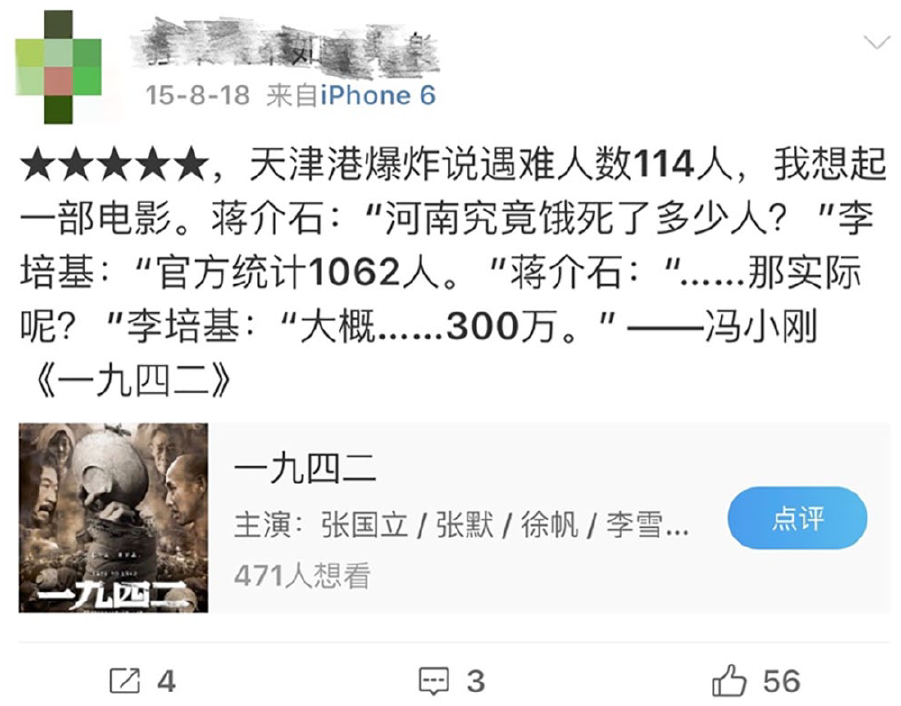
Without the context of the 2015 Tianjin explosions, this extract would simply be a dialogue in a film. However, as a number of Chinese Weibo users quoted this extract as part of their comments shortly after the Tianjin accident, it connected the great famine in Back to 1942 with the 2015 Tianjin explosions to suggest that there was a drastic disparity between the number given by the government and the actual casualties of the accident. Example 1 began with the official reported death toll of the Tianjin blasts, followed by the quote from Back to 1942. The report of the official death toll was attributed to a third-party ( ‘It is reported that 114 people died in the Tianjin port explosions’) and which then ‘prompted’ the author to be reminded of this movie and the dialogue about the death toll. Here then, there was no direct criticism of the government or direct challenge to the reported death toll of the explosions, rather the juxtaposition of two ‘official reports’ together with the actual death toll of the famine provided an implicit argument for not believing the official figures, and in this context the death toll of 114 in particular.
Example 2 is a re-sent microblog posted by a witness of the accident who was believed to be banned from posting on Weibo when other commenters noticed that she was no longer updating her Weibo or responding to the comments left under her microblog. In the extract, the user included the same quotation from the film as a response both to the original microblog which included images of the location before the explosions and the assumed censoring practice of silencing individual social media users by the authorities:
Example 2
Translation: I think of a movie. Chiang Kai-shek asked: ‘How many people died from the famine in Henan province?’ ‘1062 from the official report’, Li Peiji answered. Chiang Kai-shek: ‘what’s the actual number?’ ‘About . . . 3 million’. – Back to 1942 by director Feng Xiaogang #TianjinTangguMassiveExplosions. It’s really hard to see [it] . . . Translation of the verbal message in the re-sent microblog: #TianjinTangguMassiveExplosions Log 12 – the third day after the explosions. I am watching the news and checking the updates in the WeChat group of our community. A member posted some pictures of this area before the accident. We had many babies, dogs and recreation facilities. My niece who visited me every summer loved to spend time at the slide and sandpit in the neighborhood. Luckily, my family was not around when the accident occurred.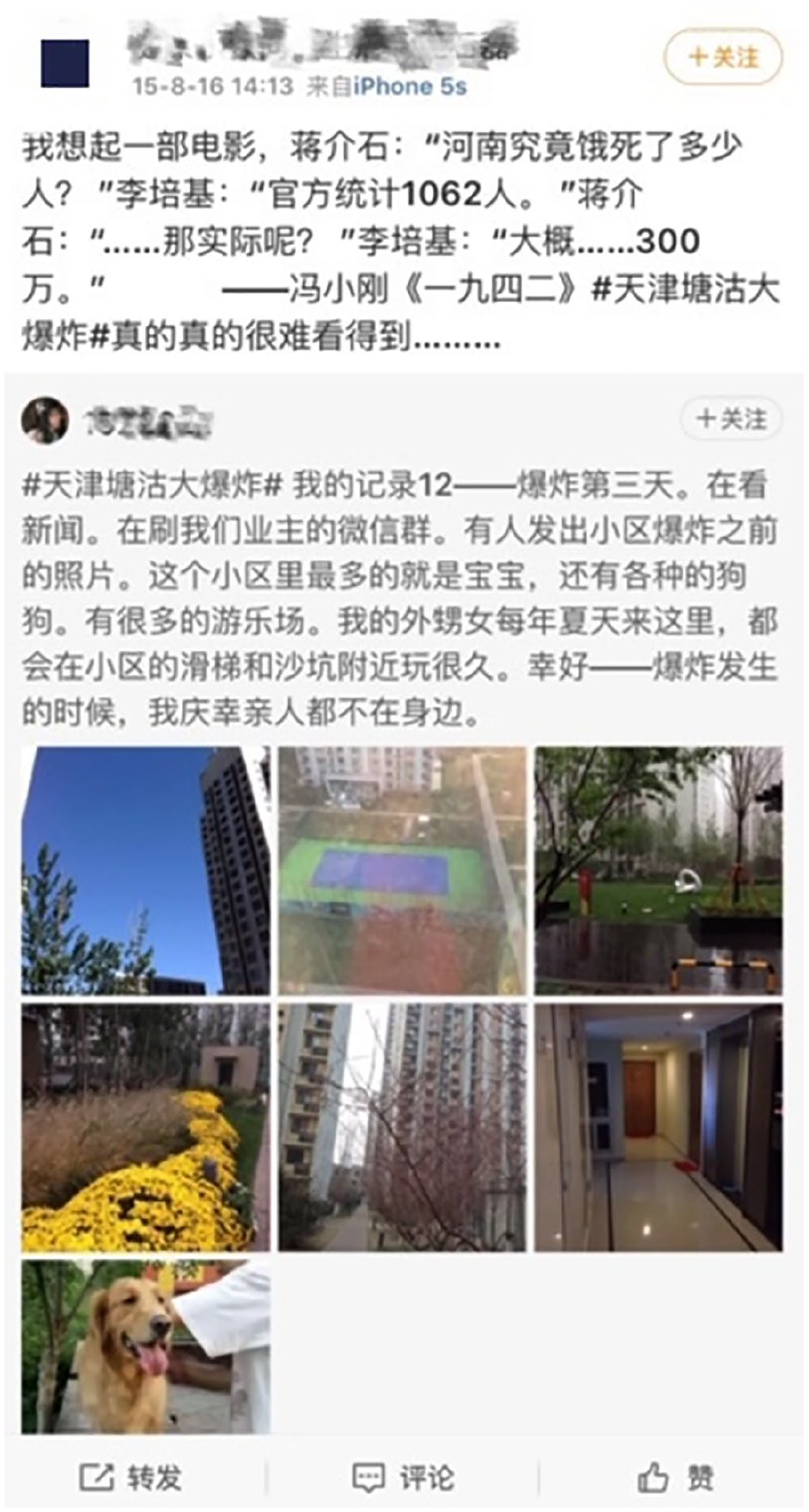
Here the original post depicted both in words and pictures what the neighborhood looked like before the Tianjin accident, emphasizing that there were ‘many babies and dogs’ and children who liked to hang around the recreation facilities in the affected residential area. By doing so, the post suggested that the impact of the accident could be extensive due to a large number of vulnerable groups in the neighborhood who would be within the area when the fatal explosions took place. Using the re-sent post by a censored user as a sort of experiential evidence, the second user added the film quote to suggest that the local government was being untruthful about the impact and casualties of the accident. Moreover, in re-using a ‘censored’ post, the combined post also suggested that the local government tried to hinder the public from finding the truth by blocking witnesses’ social media accounts that highlighted the lack of information and the possibility of underestimated casualties. The implicit criticism of the government’s performance through the film quote together with the images before the explosions was then reinforced by pessimistic anticipation ‘It’s really hard to see [it] . . . ’. Here ellipses were used possibly to replace the missing pronoun ‘it’ that referred to the residential tranquility shattered by the accident or the hidden truth of the accident.
To understand the import of the film quote as political criticism requires a set of practical reasoning resources underpinning the interpretation. First, Chinese social media users would have to be able to spot the disparity of death tolls inferred in the film sequence and then transfer it to the new context of the Tianjin accident either through the keywords or hashtags of ‘Tianjin explosions’. Users should also possess the pragmatic competence to perceive the similarities between the two disaster events: both events had a large scale of impact and would probably cause severe casualties, and both situations had seen the intervention of the government to cover up the truth. Second, the quote draws upon assumed common knowledge of the political set-up and the censorship mechanism that may be used, that is, that the authorities did not reveal the truth of the casualties and would take action to suppress such information to maintain social and political stability. This also takes place within the general level of understanding of censoring measures taken by the government (i.e. blocking social media accounts and deleting social media posts) such that users would be aware of what may be considered censorable content, such as the number of casualties in this case. The practical reasoning built into the posts through their design relies upon an assumed scheme of interpretation to understand the quotation as an indirect criticism of the government, where on the face of it nothing negative has been explicitly said.
Allusion
The second technique of indirect criticism is the use of allusion, a figure of speech that ‘makes an implicit or explicit reference to another text’ that invokes some cultural connotations of the source text (Montgomery et al., 2007: 156). It relies upon a pragmatic competence to recognize and trace the allusion, and thus understand it as political criticism. One interesting allusion among the data is Pinocchio, a popular Korean television drama with stories concerning truth, the media and the profession of news reporting. It is worth noting that the title of the drama alludes to the famous cultural icon Pinocchio in children’s literature who lies frequently. Recontextualized in modern Korea, this television program tells a story about the manipulation of the media and the public in covering up the truth of a factory explosion.
In examples 3 and 4 below, references to the TV drama series were used to implicitly criticize the local government for suppressing the truth behind the Tianjin explosions. Example 3 began with an assertion that ‘A sudden disaster made us see a real-life Pinocchio’, thereby, connecting the Korean television series, Pinocchio, to the Tianjin explosions:
Example 3
Translation: A sudden disaster made us see a real-life Pinochio. I saw the irresponsibility of ** and the dark side of the world. No explanation yet. How did you get to your positions? I watched Focus Report yesterday. The host was quite right by saying that 166 hours had passed but why there were still so many unsolved questions. #TianjinTangguMassiveExplosions This Chinese Valentine’s Day does not see joy but only deep sorrow.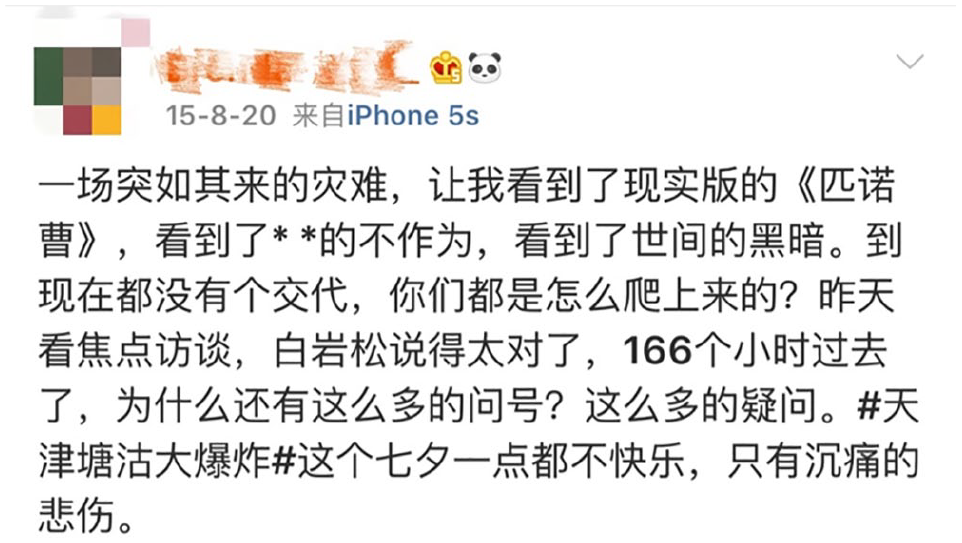
Here, Pinocchio was used to invite other users to look for the relationship between the drama series and the explosions. The user did not say explicitly what features and plots of Pinocchio they had seen in ‘real life’ but made an explicit allusion to the title of the drama series. By first invoking the TV series, the user then makes a series of observations about official responses to the Tianjin explosions, including negative evaluation of the (local) officialdom in handling the accident ( ‘I saw the irresponsibility of ** and the dark side of the world’), and a question targeted at local officials ( ‘How did you get to your positions’). Notably, the author did not spell out the target of the criticism but used ‘**’ and the second pronoun ‘you’ to refer to the government and officialdom. Recoding the target of the criticism into ‘**’ avoids direct naming and so, technically, avoids the keyword filtering system and arguably the human censors too. Furthermore, the question addressing the officials strengthens the criticism by doubting the competence of the officials. Example 3 ended by expressing the user’s sadness and sympathy to Tianjin. Such emotion was reinforced by a contrast between the joy of celebrating the Chinese Valentine’s Day with beloveds (the accident occurred close to the Chinese Valentine’s Day) and the sorrow of seeing people suffer from the disaster.
Example 4 deployed both words and pictures to carry the allusion. The verbal message started with a judgmental ‘conviction’ that no one was brave enough to reveal the truth of the accident and ended with a contrast between ‘a group of heroes who risked their own lives to fight for the safety of their people’ and ‘a group of live “Pinocchios”’ who lied and suppressed the truth. The visual message of example 4 contained 3 screenshots of Weibo posts by other users first as a way to circumvent automatic censorship (as mentioned earlier, verbal texts imbedded as visual message are undetectable by keyword filtering), and second, layer the criticism.
Example 4
Translation: #TianjinTangguMassiveExplosions No one is really brave to tell us the truth! We can only see a group of heroes who risked their own lives to fight for the safety of their people and a group of live ‘Pinocchios’!!!!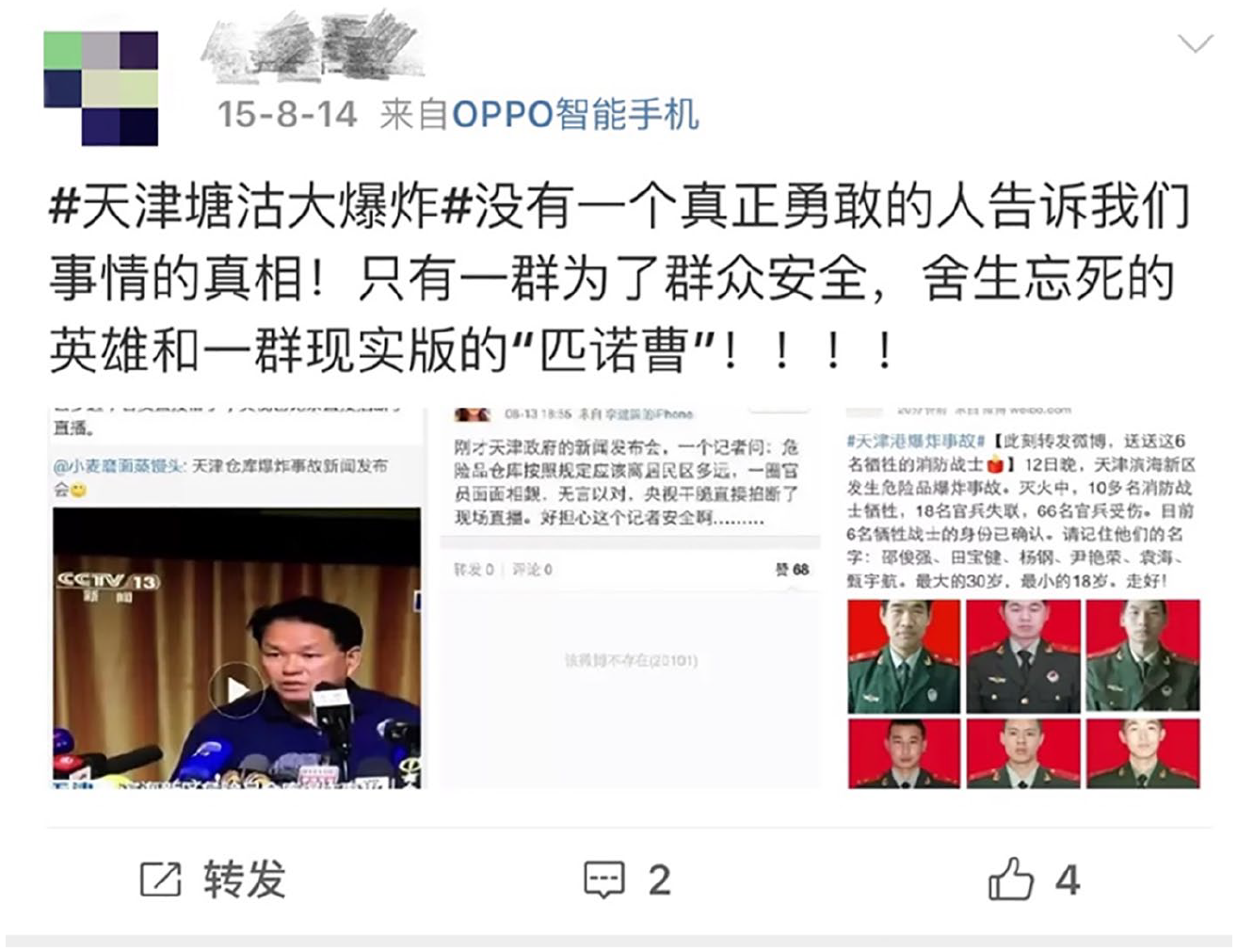
In separating out the screenshots for analysis, screenshot 1 shows the live scene of a press conference held by the Tianjin government after the accident:
Screenshot 1 in Example 4
Translation of the verbal message in Screenshot 1: In the end, when a journalist asked how far a chemical warehouse should be located from the residential area, the officials were bewildered and speechless. China Central Television had to cut off the live broadcasting.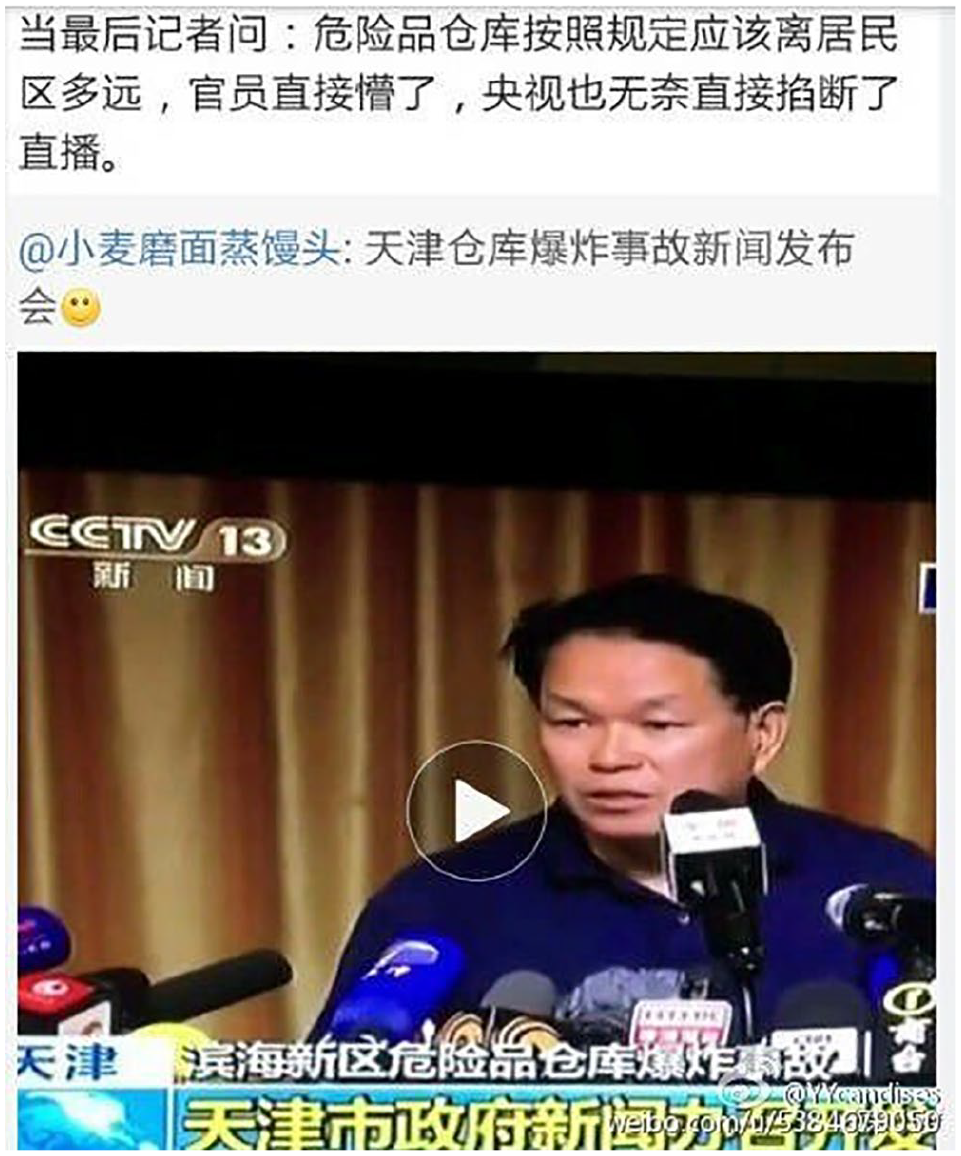
Screenshot 2 recounts the last few minutes of the conference when a journalist raised a question about the proper distance between a chemical warehouse and the residential area:
Screenshot 2 in Example 4
Translation of Screenshot 2: At the conference press held by the Tianjin government, a journalist asked: ‘how far should a chemical warehouse be placed away from the residential area?’ None of the governmental officials was able to answer the question. China Central Television then cut off the live broadcasting. I’m worried about the journalist.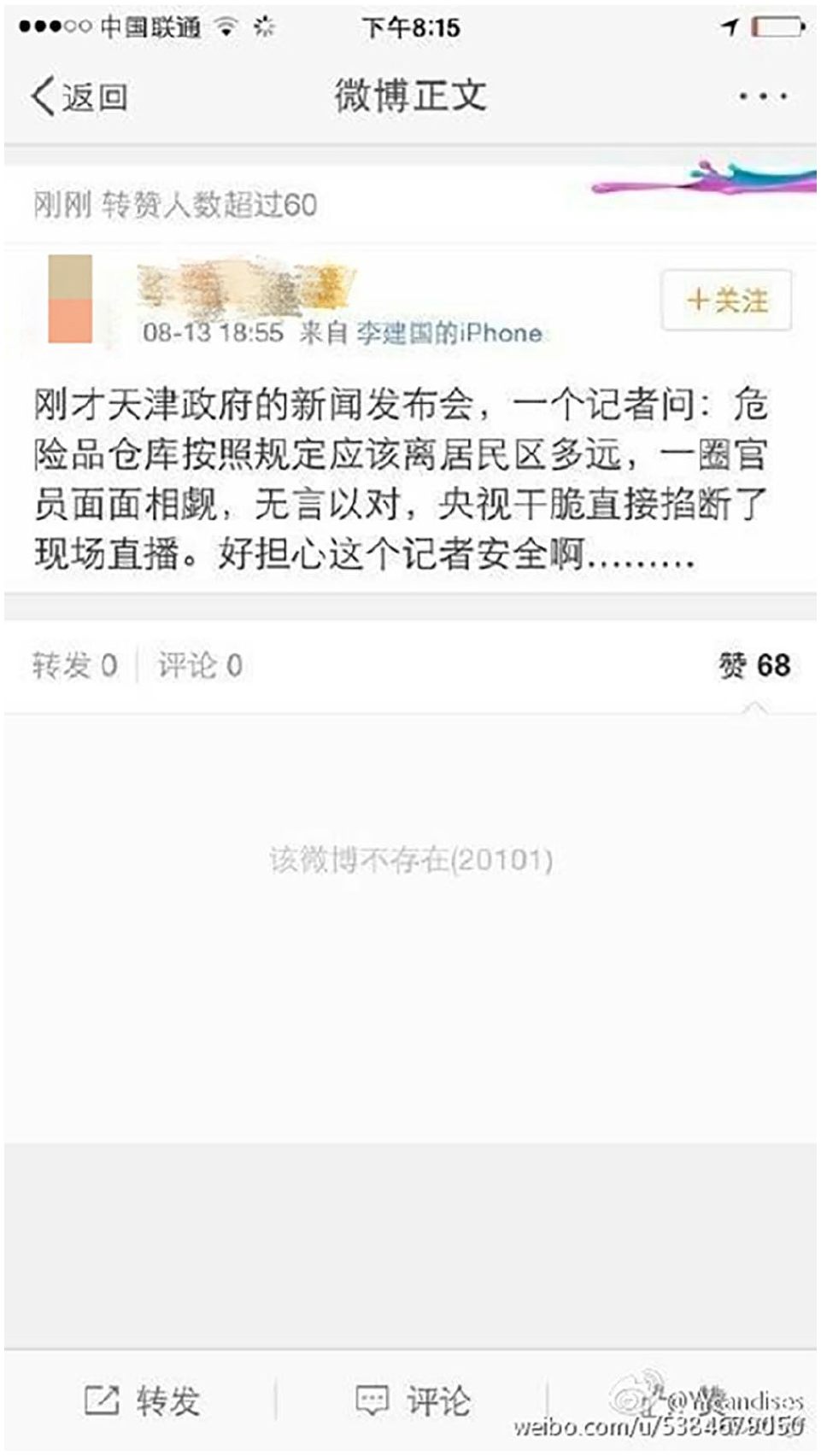
Screenshot 3 is a Weibo post that offers an update news lead and the pictures of the firefighters who died in the accident and whose identities had been confirmed:
Screenshot 3 in Example 4
Translation of the verbal message in Screenshot 3: #TianjinPortExplosions Re-send this microblog. May the six firefighters who sacrificed their lives in the accident rest in peace [candle]. On the midnight of the 12th, a series of chemical blasts took place at the Tianjin port. Over 10 firefighters have died, 18 are missing, and 66 injured. The identities of six of the dead firefighters have been confirmed. Let’s remember their names. The oldest firefighter is 30 while the youngest is 18. R.I.P.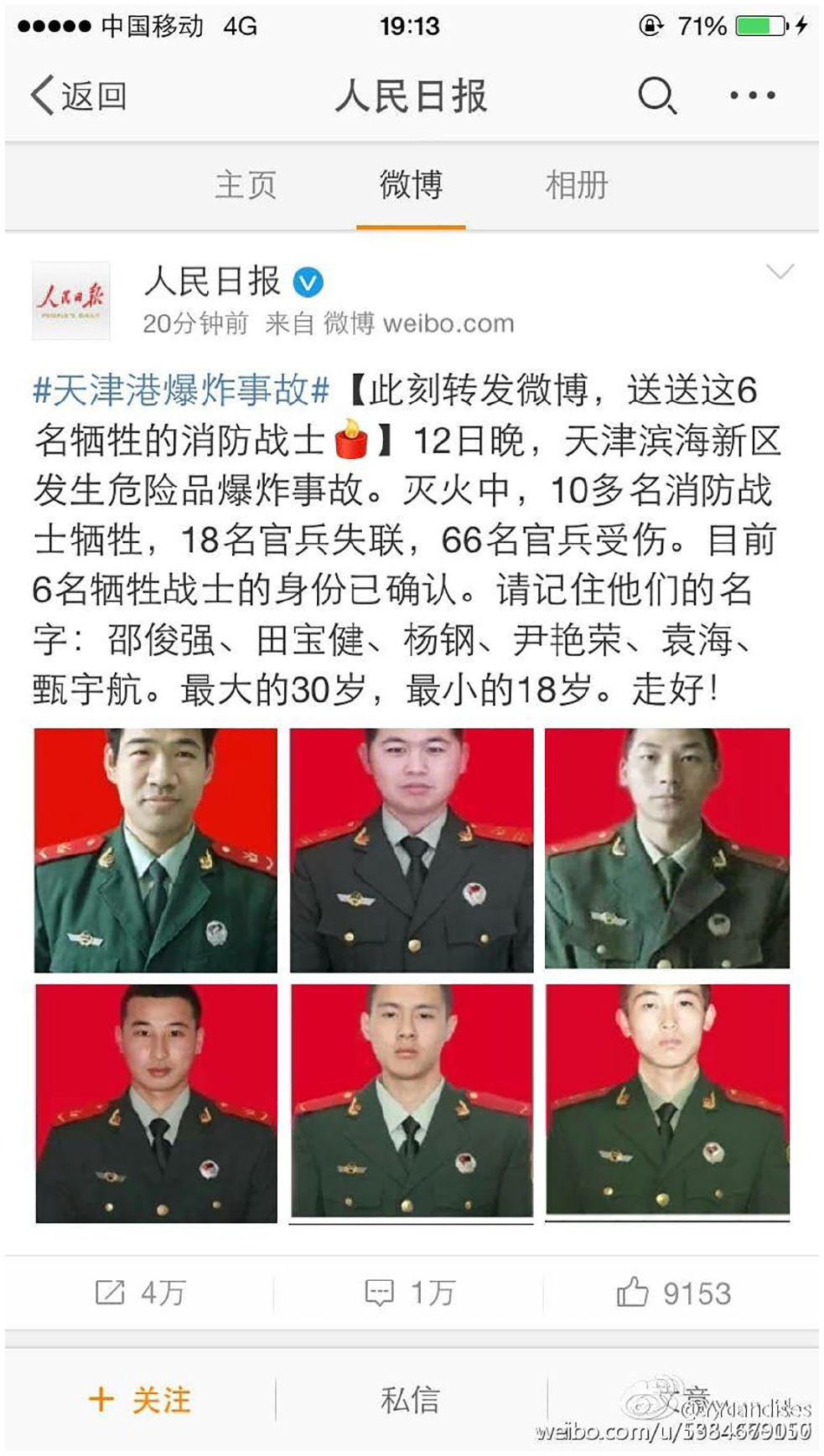
While screenshot 3 resonated with the category of ‘heroes’ in the verbal message, screenshots 1 and 2 resonated with the verbal allusion of ‘live “Pinocchios”’. In screenshot 1, Pinocchio was first used to refer to the local government officials who gave unsatisfactory response at the press conference (i.e. unable to answer the question raised by the journalist). The second screenshot hinted at possible actions taken by the local government to stop people from seeking the truth of the accident. After relating the question asked by the journalist and the inability of the officials to answer the question, the microblogger then expressed his or her worries and concerns about the safety of the journalist for questioning the local officials about the safe distance between a chemical warehouse and the residential area. The question, which rendered all the officials at the press conference ‘speechless’, could point to the possibility that this information was not known or available to those conducting the press conference at the time. Together with a concern for the journalist, local officials’ speechlessness also suggested the possibility of their malfeasance. Indeed, later investigations would confirm security mismanagement and governmental misconduct as the company used its political connections to avoid industrial scrutiny.
Similar to the technique of quotation, to understand Pinocchio as an indirect criticism also requires pragmatic knowledge of the drama series Pinocchio and the Tianjin explosions, the censorship apparatus, as well as how a shared scheme of interpretation was created through the allusion. First, although sharing some characteristics, the allusion of Pinocchio is different from the widely known cultural icon in western fairy tales. In this situation, Pinocchio refers to the storylines in the Korean television drama, in which the truth of a factory explosion was initially covered up deliberately as the interest groups colluded with the media to manipulate the coverage of the accident to distract the public attention. Second, for the allusion to work, users should possess the pragmatic competence to recognize the similarities between the two contexts. In the case of Pinocchio in examples 3 and 4, the common ground lies in the similar performance of the Tianjin government in reacting to and handling the chemical explosions and the performance of the media and the interest groups in the factory explosion in Pinocchio. Here, the implicit criticism is that the government has something to hide. In this post, the assemblage of the elements of the post provides a multi-layered critique of the government’s response to the explosions. Through describing how the interview was stopped after the journalist’s question, the post related a suspicion of government corruption and cover up similar to the drama story. Finally, users expressed their criticism based on their assumed knowledge of what was censorable (e.g. the word ‘government’ and governmental misconducts), and strategically, avoided keyword filtering and human censors while managing to raise the public’s awareness of possible corruption and collusion.
Irony
The third technique used is irony, saying one thing but meaning the opposite, for example saying something positive but meaning something negative (Wilson, 2006). Example 5 contained a hashtag of ‘TianjinTangguMassiveExplosions’ and two sentences. The first sentence pointed to an assumed conventional practice by the National Security Bureau – it would issue an order to carry out a comprehensive safety inspection and punish improper conducts only when accidents occur, and people die in the accidents. The second sentence ended the microblog with a ‘positive’ evaluation of ‘so caring for its people’ in quotation marks:
Example 5
Translation: #TianjinTangguMassiveExplosions The national security bureau will not conduct serious and comprehensive inspections until some people are killed. ‘So caring for its people’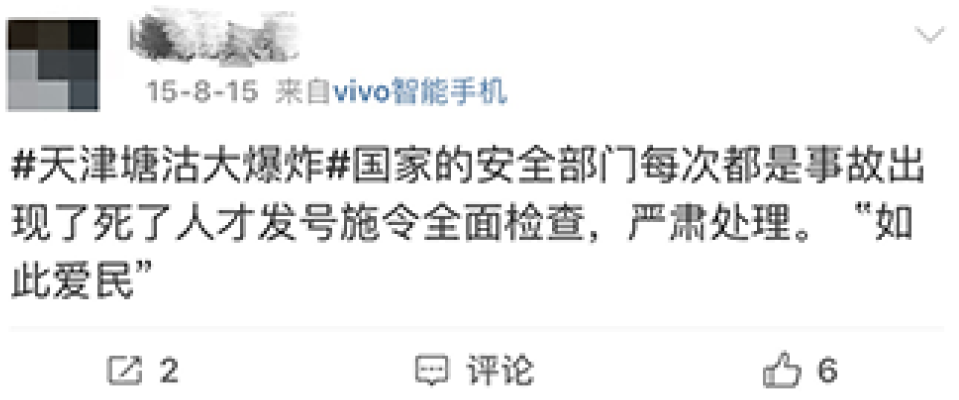
To understand this microblog as irony and indirect political criticism requires its reader to understand the mechanism of irony and evaluation within a Chinese context. The adverbial clause of the first sentence was inscribed with an implicit negative judgment on the National Security Bureau because it implied that under the normal circumstance, the National Security Bureau would not take responsibility for ensuring the security of its people. By contrast, the second sentence explicitly praised the Bureau for its conventional practice, which failed to be semantically coherent with the negative evaluation in the first sentence if it was literally interpreted. The comment was constructed in such a way to be interpreted as a figurative speech – ‘So caring for its people’ is a verbal irony that means the opposite – the National Security Bureau did not care about its people. The irony was strengthened by the quotation marks as they invoked the ‘mechanism of negation’ (Martin and White, 2005) that negated the content included in the quotation marks.
In a different fashion, example 6 deployed irony to criticize the government by making a proposal. The user proposed that the chemical warehouse should be built near the government buildings in the future and ended with a positive prediction that no accidents would happen again, and people would live a safe and prosperous life ever after:
Example 6
Translation: #TianjinTangguMassiveExplosions If the chemical warehouse is built near the government buildings, there will be definitely no damn more tragedies. We will see peace and prosperity and everything in its best form ever after.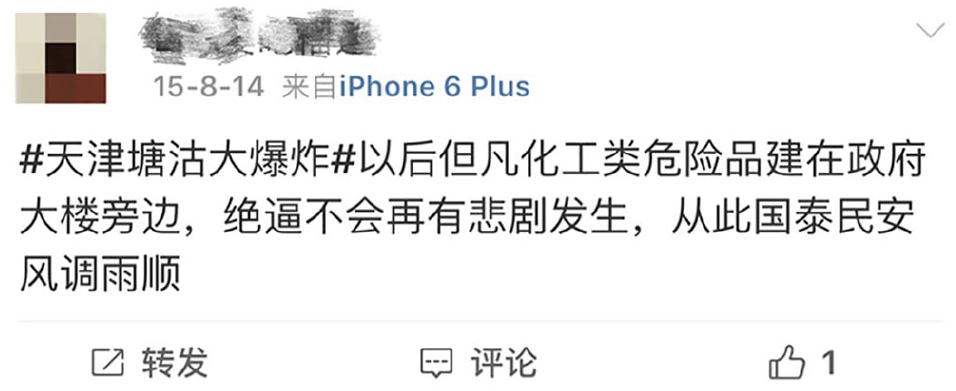
While the sentence contains no explicit criticism, it is easily understood to be humorous and point to government corruption and lack of safety oversight from the government. The second sentence reinforces this humor through an exaggerated positive exhortation to the future in the style of official language. In this style, however, the affordances of the Chinese language enable the user to incorporate taboo language/profanity such as ‘逼’ (vagina) and exaggeration such as ‘绝’ (definitely) and ‘从此国泰民安风调雨顺’ (we will see peace and prosperity and everything in its best form ever after). Here then, the use of irony allows political criticism in the camouflage of overtly positive sentiments and exhortations to the future.
Discussion
The recurrent feature in the earlier analysis is the creative use of indirection in expressing political criticism among Chinese social media users. This requires both the producers and recipients of the posts to have a pragmatic competence and a shared scheme of interpretation. In particular, it depends on users’ knowledge of the creative possibilities of language and a network of cultural references shared and mobilized by the users in the context of particular instances or events. In the case of the Tianjin explosions, the creativity is shown through the resources drawn upon in the in-situ design of political criticism to be understood by those who it is designed for, but also hidden within in the overall context of Chinese online censorship. Through these resources, users are able to hide criticism among the discursive foliage for the reader to find. This is not to suggest, however, that the parties act in isolation from each other. After all, the human censors and social media users are Chinese citizens with similar language, cultural background and technological access. Rather, there is a cat and mouse relationship with each drawing on various resources within a constantly evolving censorship environment. In this multi-layered environment, users not only act and react upon their knowledge of each other, but are also intertwined with each other, as each new form of resistance and control stimulates both sides to further develop techniques to counter and compete with each other.
The Tianjin accident was an unexpected event where Chinese social media users were able to take the lead in breaking news and disseminating information of the event while the authorities and censors played catch-up. Despite the Internet censorship, it was a watershed in Chinese disaster coverage and media response (Wu, 2018). Before the age of social media, with the mass media being the major information source, (local) authorities like the Tianjin government could easily cover up the details of disaster events by censoring and manipulating the mainstream/official media to either downplay the scale and consequence of the events or shift the public attention to the spreading of positive energy such as praising the heroic deeds during disasters. However, the asymmetrical relation between users and human censors – users vastly outnumber censors – as well as the fast dissemination of knowledge and information enable users to be a step ahead of the censors and disrupt the well-prepared disaster script by the government in abrupt events like the Tianjin explosions. The pressure imposed by Weibo and other forms of criticism became so strong that it forced the central state and the Tianjin government to investigate the cause of the accident and eventually held 49 officials and staff from the warehouse company criminally responsible (Wu and Montgomery, 2019).
This study also foregrounds the nuances of the multi-layered power relations between Chinese social media users, censors, the Chinese public, local authorities and the central government. On the surface, the Tianjin case presents a straightforward power negotiation between Chinese social media users and Chinese Internet censorship, in which users displayed their ingenuity in hiding their political criticism, and thereby, avoiding the possibility of posts being quickly identified and removed. However, it is important to understand the context of Chinese censorship as layered between the public as well as different levels of government with their own agendas. On the one hand, political criticism about the event took place at the level of the Chinese public and local governmental sectors, reflecting a lack of trust in official statements and calling for those responsible to be held accountable. On the other hand, the local government is subject to a further layer of power of the central government, such that the local government was sandwiched between the public and the central government. During the first 2 weeks after the explosions, the central government monitored the situation and intervened when it was necessary (e.g. designating a group of state officials to assist the relief work and investigation, as well as censoring and clarifying ‘rumors’ on social media). Thus, despite the ability to shut down criticism of the local government and even suspend the platform, the state government used this criticism to advance its own policy of anti-corruption by allowing Weibo users to highlight possible corruption at a local level. This also meant the local government was left alone to deal with the public anger and deflect scrutiny from the central government. This adds weight to the argument that online political criticism can be useful to the state when used selectively because it allows a safe degree of criticism of local and regional levels of government and meanwhile, does not assail the Party’s political leadership in China (King et al., 2013; Shao, 2018). Such criticism can be seen to survive partly because from the perspective of the central government, it helps attenuate the public’s negative emotions, improve the government’s public service, and in turn, consolidate the state-society relationship in China (Shao, 2018).
Conclusion
This study has explored the expression of political criticism in the context of Internet censorship in China by examining how Weibo users responded to the 2015 Tianjin explosions. Analysis of the Weibo posts after the Tianjin accident examined three techniques adopted by users to implicitly criticize the local government in handling the event. In turn, this exerted some pressure both on the central government and local authorities to actively respond to public sentiment.
In China where censorship is imposed under the name of protecting its people and maintaining social and political stability, online censors from local to the state levels pay particular attention to information and critical opinions regarding crisis events. For instance, large-scale disasters often involve politically sensitive topics which, if handled improperly, may lead to public panic and political turmoil. 3 However, social media technologies have endowed the Chinese public with a new form of infrastructure to counter-censorship and express critical opinions of the government and authorities through deploying the linguistic and technological resources.
However, despite Chinese users’ successful strategies (including but not limited to the techniques discussed in the study and previous research) at any particular time, Chinese censorship apparatus keeps evolving, becoming ever more sophisticated as each party adapts and evolves with the affordances of technologies. This is not only the ability to shut down or disable a majority of VPNs 4 during important political events, but also to employ over 2 million people to monitor and censor online content, according to a state media report in 2018 (China cracks down on video parodies, 2018). It would then be mistaken to think of these human censors as somehow not aware of the techniques, or lacking the same pragmatic knowledge used by other social media users to circumvent or avoid censorship. That is, censors and monitors should be seen as possessing the same kind of pragmatic competence and shared scheme of interpretation as social media users do, which means that they will be able to identify the political criticism hidden in plain sight once it is there. Therefore, it is fair to say that the proliferation and advances of the Internet and social media technologies not only empower Chinese users with new opportunities to counter the might of the authorities, but they also empower the censors with more sophisticated means to control the public discourse (Albeanu, 2017). In this game of cat and mouse, both Chinese users and censors act and react based on their mutual understanding. Such mutual understanding keeps growing as the Internet censorship apparatus is evolving and the Chinese users are developing new tactics to cope with it.
Footnotes
Acknowledgements
The authors wish to acknowledge the editor, Teun A. van Dijk, the two reviewers, Martin Montgomery and Debing Feng, and the participants of the 25th AIEMCA Conference and the 26th Ross Priory Seminar (where earlier versions of this article were presented) for their comments. They also wish to thank Rod Watson for his insights in developing this article.
Declaration of conflicting interests
The author(s) declared no potential conflicts of interest with respect to the research, authorship, and/or publication of this article.
Funding
The author(s) received no financial support for the research, authorship, and/or publication of this article.