






Abstract
Ever since Charles Goodwin’s seminal works on gaze, there has been a long-standing interest in Conversation Analysis in the interrelationship between talk and bodily conduct in the accomplishment of social action. Recently, a small but emerging body of research has explored the ways in which embodied conduct figures in the organization and operations of repair. In this article, I take up a similar theme and investigate the interaction between talk and iconic gestures in same-turn self-initiated repair in Mandarin conversation. The phenomenon I examine concerns the use of what I call “gestural repair.” The analysis focuses on how such repair can intertwine with talk in multi-stage operations in the progressivity and resolution of repair. The data are drawn from 50 hours of naturally-occurring conversations collected in China. Some unique features of such gestural repair observed in the Mandarin data are also discussed.
Keywords
Introduction
Ever since Goodwin’s (1979, 1981) seminal works on gaze in social interaction, there has been a long-standing interest in Conversation Analysis (henceforth CA) in the interrelationship between talk and bodily conduct in the production and interpretation of social action. Since early on, one major theme in this research tradition has concerned how talk and bodily conduct mutually elaborate and contextualize each other in achieving “intersubjectivity” (Garfinkel, 1984; Heritage, 1984; Schegloff, 1992) in situated interaction. For example, Schegloff (1984) considers the frequent pre-positioning of iconic gestures relative to their “lexical affiliates” and suggests that this ordering may create a possible “projection space” for bringing into play an element of talk that has otherwise not yet been articulated. Goodwin and Goodwin (1986) examine the activity of searching for a word and show how visible changes in the speaker’s gaze and gesture can work in concert with talk to provide interlocutors with information about how to delineate different phases and proposed participant roles within the search process. Along similar lines, Sidnell (2006) focuses on reenactments in conversation. He demonstrates how the coordinated use of gesture, gaze, and talk can play a central role in delimiting different components of a larger telling, allowing recipients to distinguish parts that reenact past events from those which just report them. The interface between talk and bodily conduct is also featured in Egbert’s (1996) account of repair initiation in German conversation. Observing that the repair initiator bitte? is used almost exclusively in contexts in which the speaker and the target recipient are not in mutual gaze, Egbert argues that bitte? serves not only to initiate repair but also to invoke a mutual orientation to a common focus or a common course of action in interaction. 1
Much of the work in this literature revolves around the interactive organization of understanding, and specifically how participants draw on verbal and bodily resources to build a basis for understanding one another’s conduct in conversation. More recently, however, a small but emerging body of CA and CA-inspired research has focused on how embodied practices figure in contexts in which there is an incipient or recognizable breakdown of mutual understanding. This line of research concerns embodied practices in the organization of repair (Schegloff et al., 1977) and examines their role in the initiation or resolution of troubles of speaking, hearing, and understanding.
A primary locus for investigation is other-initiation of repair. Some studies examine embodied practices for implementing repair initiations. For instance, while focusing on different body postures – sharp head pokes/tilts and cupping the hand behind the ear respectively – Seo and Koshik (2010) and Mortensen (2016) both show how postures can serve in the absence of speech to initiate repair akin to “open class” (Drew, 1997) repair initiations (e.g. “huh?”, and “what”). Other studies look instead at the repair turn and investigate the ways in which bodily conduct contributes to a possible solution to the trouble. Turk (2007) shows how self-referential gesture can be an integral part of the accomplishment of relational disaggregation when a speaker performs a repair that extracts the self from a collectivity. Olsher (2008) describes the use of gesturally-enhance repeats in the repair turn by second language learners as a way of avoiding further breakdowns in understanding.
Still other studies examine the relationship between embodied conduct and self-initiation of repair. In his account of word searches in Japanese conversation, Hayashi (2003a, 2003b) describes the workings of vocal and visual conduct by speakers during the course of word-finding difficulties, demonstrating how the juxtaposition of talk and a hand gesture by the trouble-source speaker can be seen to increase the recognizability of the searched-for item and facilitate relevant forms of co-participation. Hauser (2019) examines self-repeated gestures in Japanese interaction and shows how these gestures are often employed by speakers to accompany attempts to repair or redesign their prior utterances.
In this article, I take up a similar theme explored in the last line of research and investigate the interaction between talk and gesture in self-initiated repair in Mandarin conversation. Specifically, the phenomenon I examine concerns the use of what I call “gestural repair.” The analysis will focus on how gestures, especially iconic or illustrative gestures, 2 can intertwine with talk in multi-stage operations in the progressivity and resolution of self-initiated repair.
This article is conversation analytic in orientation. The data for this article are drawn from a corpus of approximately 50 hours of naturally-occurring video-taped face-to-face conversations collected in Beijing and Hebei, China, during 2001–2002 and 2006–2013. All participants spoke what is considered the standard variety of spoken Mandarin, Putonghua, although they were not all from Beijing or Hebei originally. Most participants came from middle-class backgrounds, and their ages ranged from the early 20s to the late 60s. Participants in each conversation were family members, friends, and acquaintances who were recorded during activities such as lunches, dinners, visits to relatives, and mahjong games or simple get-togethers for chitchat. No participants were provided with any topic to talk about in the conversation.
In what follows, I will begin by presenting some initial observations of the phenomenon in question.
Initial observations
The phenomenon reported here was first observed in the course of building a collection of cases of same-turn, self-initiated repair in Mandarin conversation. One subset of this collection involves instances in which the current speaker exhibits difficulties in finding a lexical formulation for what is to be projected next in an in-progress turn-constructional unit (henceforth TCU), and is recognizably engaged in what is generally glossed as “word searches” in CA literature (e.g. Goodwin and Goodwin, 1986; Hayashi, 2003a, 2003b; Lerner, 1996, 2013; Sacks, 1992; Schegloff, 2013; Schegloff et al., 1977). On closer inspection, it was noted that whereas not all such word search cases involve the use of iconic gestures, iconic gestures were nonetheless often found within this context. Excerpt (1) provides a prototypical case. 3 This example comes from a conversation among three female friends in their fifties. At this point, Martha (M) is telling her friends what she had read earlier that day, which turns out to be a substantial volume in a business English book series. Here, on her way to describing this book, Martha displays difficulties in finding an adequate reference form, stopping the TCU-in-progress and initiating a word search. Without going into too much detail in this sequence, our focus will be on her use of three iconic gestures to depict the title (line 5) and the shape (lines 6–7 and line 8) of this book in the course of the search.
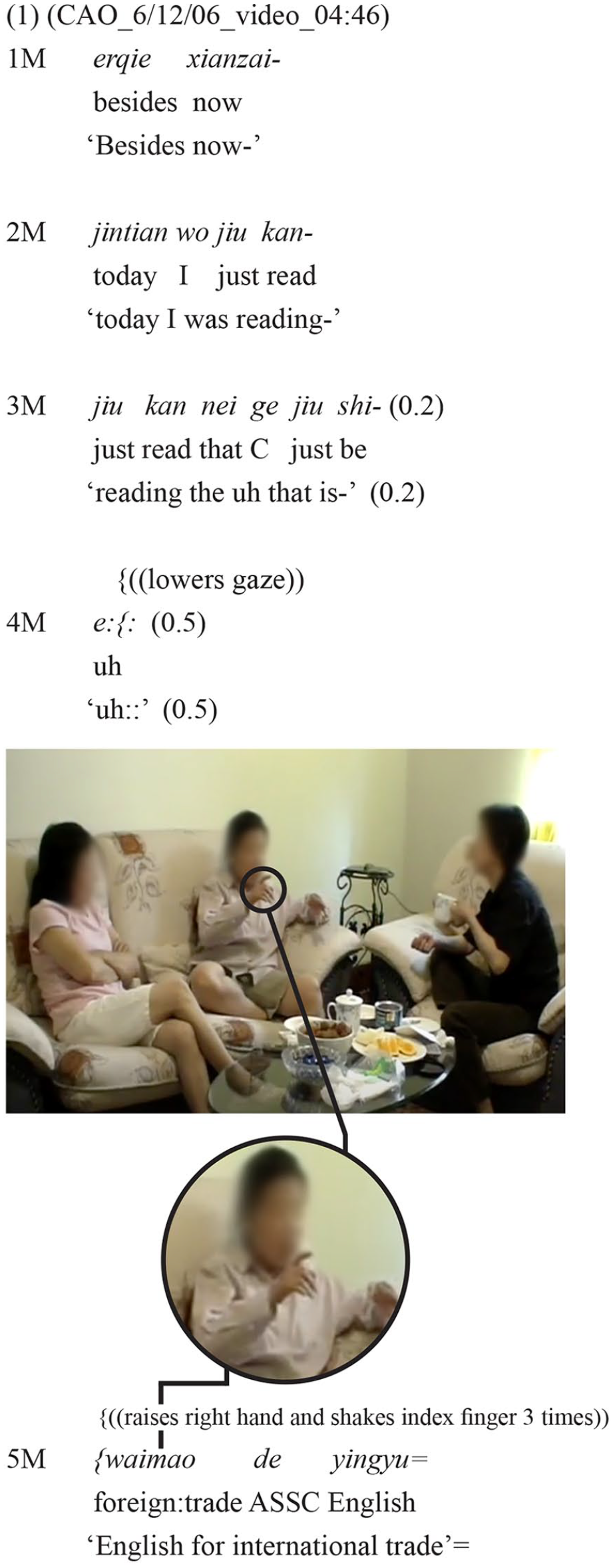
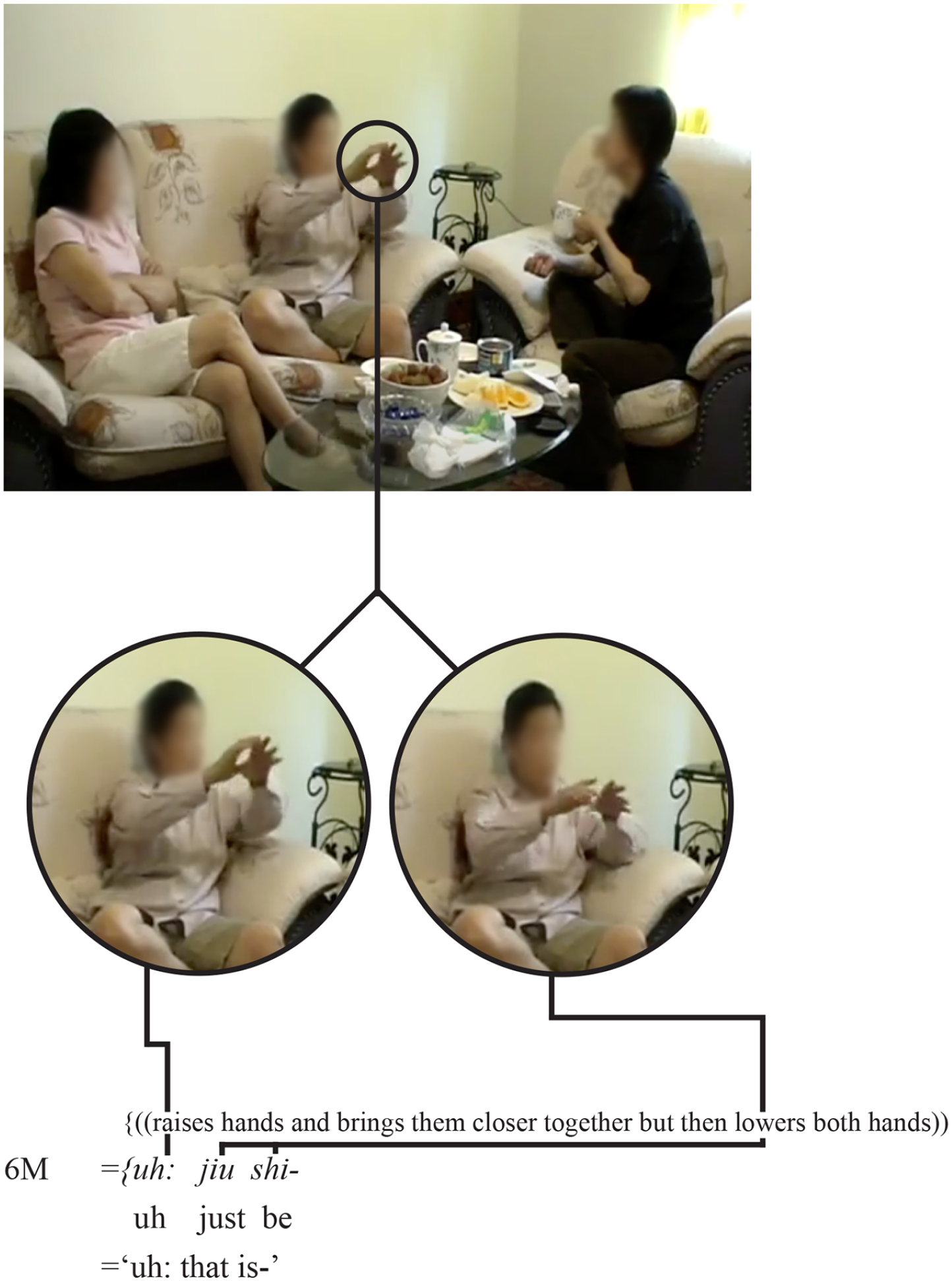
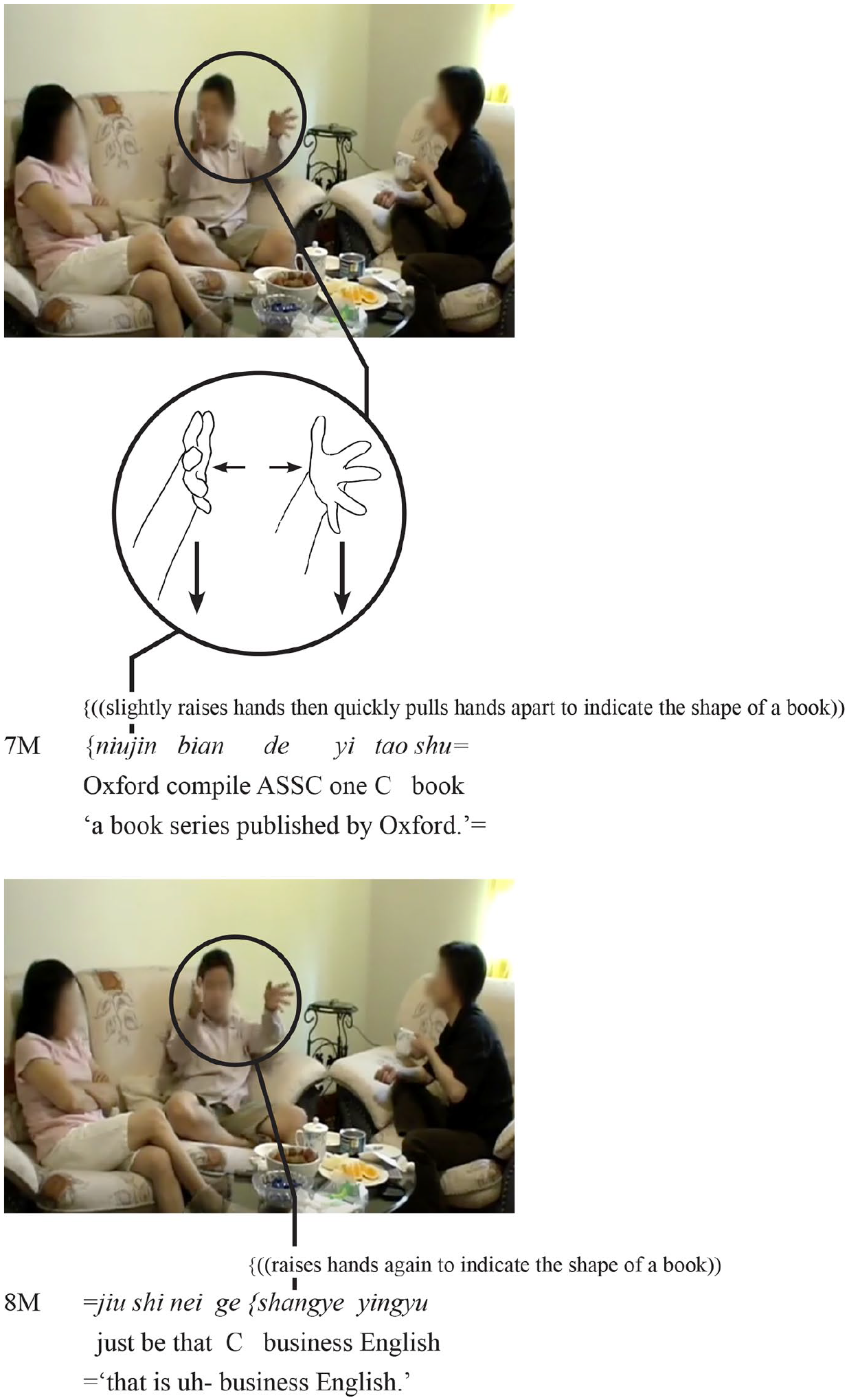
What is particularly noteworthy is the fact that the three gestures are co-incident with the production of the three referential formulations that the speaker offers as solutions to the search. Specifically, in line 5, Martha raises her right hand at the initiation of her first repair attempt (waimao de yingyu “English for international trade”) and continues on to shake her index finger three times, at “mao,” “ying,” and “yu,” respectively, as if she’s pointing at the title of the book. Her two subsequent iconic gestures – apparently depicting the size of the book in question – likewise co-occur with her two other repair proffers: In line 7, she pulls apart her hands, which had been held close to each other in front of her chest (line 6), and then draws a large square shape of a book just when she is furnishing more details in relation to the trouble source (i.e. that it’s part of a series published by Oxford University Press). She repeats a similar gesture in line 8 to accompany her third repair attempt as she reformulates the reference form from a less common expression, waimao de yingyu “English for international trade” (line 5), to shangye yingyu “business English.”
Looking more carefully at what happens, it can be noted that such co-incidences of the candidate repair solutions with the stroke peaks of the accompanying gestures are designed outcomes, rather than a coincidental pattern. This is evident not only in the fact that the gestures and repairs are produced in synchrony, but also in the deployment of gestures by Martha in lines 6–7. Here, at the same time Martha launches another try directly after her first repair attempt in line 5, she raises both hands and brings them closer together (line 6). However, just as this attempt by Martha quickly turns into a visible word search (as indicated by uh: “uh:” and jiu shi- “that is-”; line 6), she drops both hands a bit and holds them in front of her chest, in effect suspending the gesture-in-progress. It is only when she is on her way to delivering the searched-for item which the gesture is meant to depict (i.e. a large volume in a book series published by Oxford, line 7) that Martha again raises both hands, whereupon she pulls her hands apart to indicate the shape of a book while completing this TCU (line 7). Here, Martha’s suspension and resumption of this iconic gesture can be seen to be carefully coordinated with her repair efforts, arguably with a view to achieving a simultaneity between the gesture and the repair solution.
In Excerpt (1), then, there is evidence that the speaker works to overlay her iconic gestures with her repair solutions in the course of managing her word-finding difficulties. Arguably here, prior to, or at the moment at which, her gestures reach their peaks, the speaker is ready to offer a candidate repair solution to her previously-displayed troubles.
However, in contrast to Excerpt (1), iconic gestures are also found in the context of self-initiated repairs in which trouble-source speakers are still in the midst of a recognizable word search. Excerpt (2) illustrates. Prior to this excerpt, three middle-aged women had just talked about China’s food safety problems, including the rumor that nowadays animals are often fed special diets with added hormones in order to promote growth. In response, Mandy (M), who had served in the military with her sister, starts to recall the good old days, when pigs were fed simply on leftovers rather than special diets.
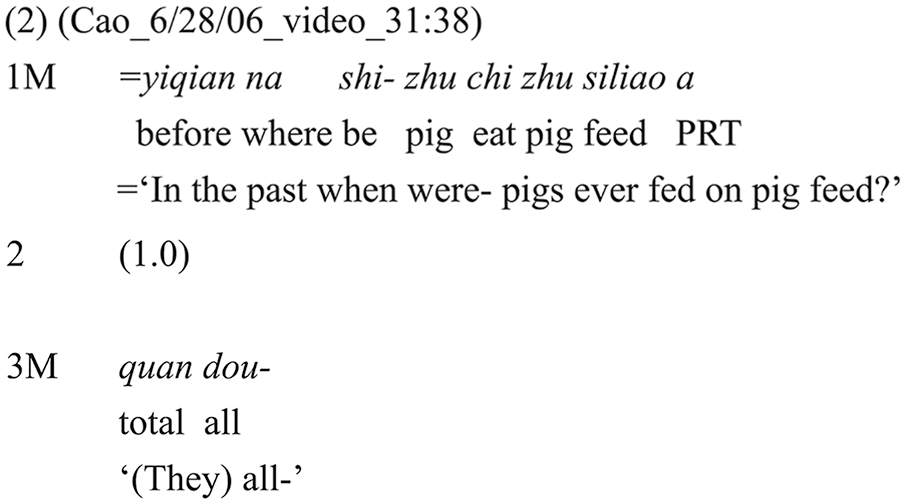
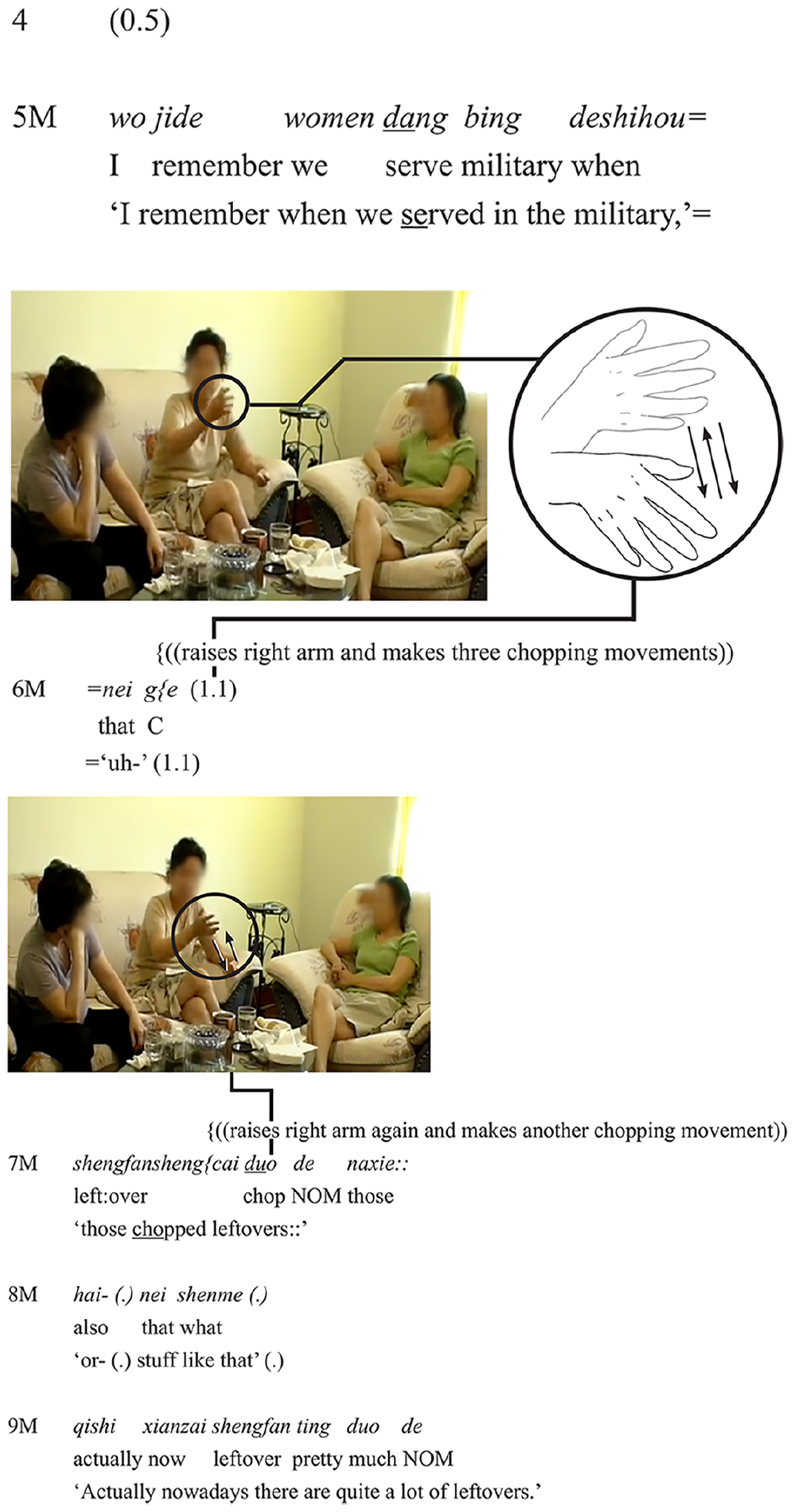
In lines 5-6, after producing the dependent “when” clause (wo jide women
A comparison of Excerpts (1) and (2) reveals, then, that whereas both excerpts involve same-turn self-initiated and self-repaired word-search processes, the iconic gestures by the speakers play a different role in these processes. Unlike Excerpt (1), in which the gestures are produced to accompany and synchronize with self-repair, the use of gestures in Excerpt (2) figures in a multi-stage repair process. That is, in the thick of a word search, the speaker first employs the gesture to depict the words that she’s searching for before undertaking to verbally offer the outcome of the search. This verbal repair, then, serves not only to provide a solution to the previously-indicated word-finding problem, but also to retroactively elucidate the meaning of the gesture.
Excerpt (3), from a causal gathering of four old friends, provides another instance of such a repair process. In this excerpt, Hanna (H) is reminiscing about an adventure trip she took with a small group of girls some 30 years before. Here, on her way to describing what turns out to be a tree branch that they picked up on the trip, Hanna initiates repair: In line 3, she halts the turn’s progress after she produces the first morpheme of “tree branch” (i.e. shu “tree”) and right before voicing the second morpheme that is due next (i.e. ganr “branch”). Thereafter, however, she exhibits difficulties in finding the right words to resume and complete her turn-in-progress (line 4).
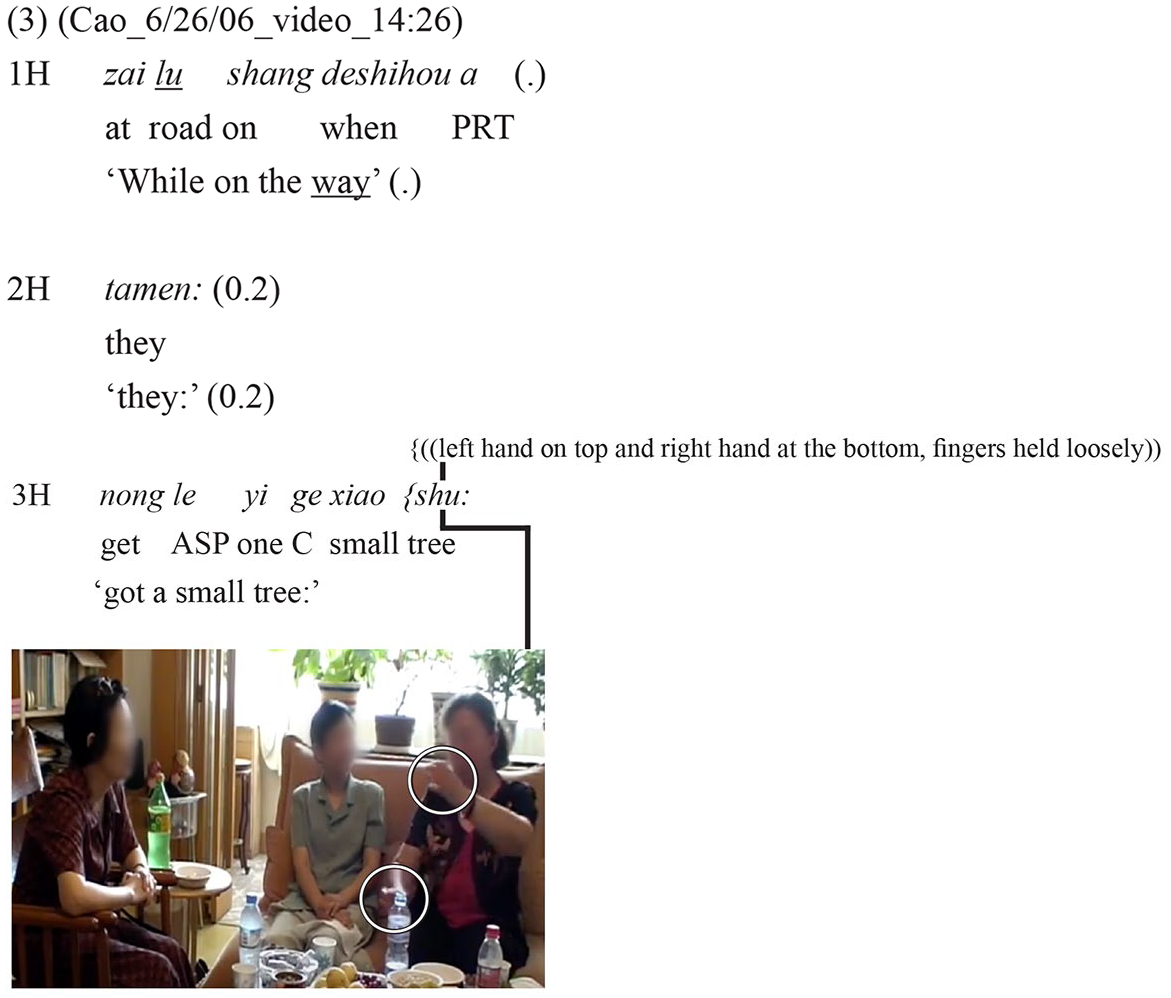
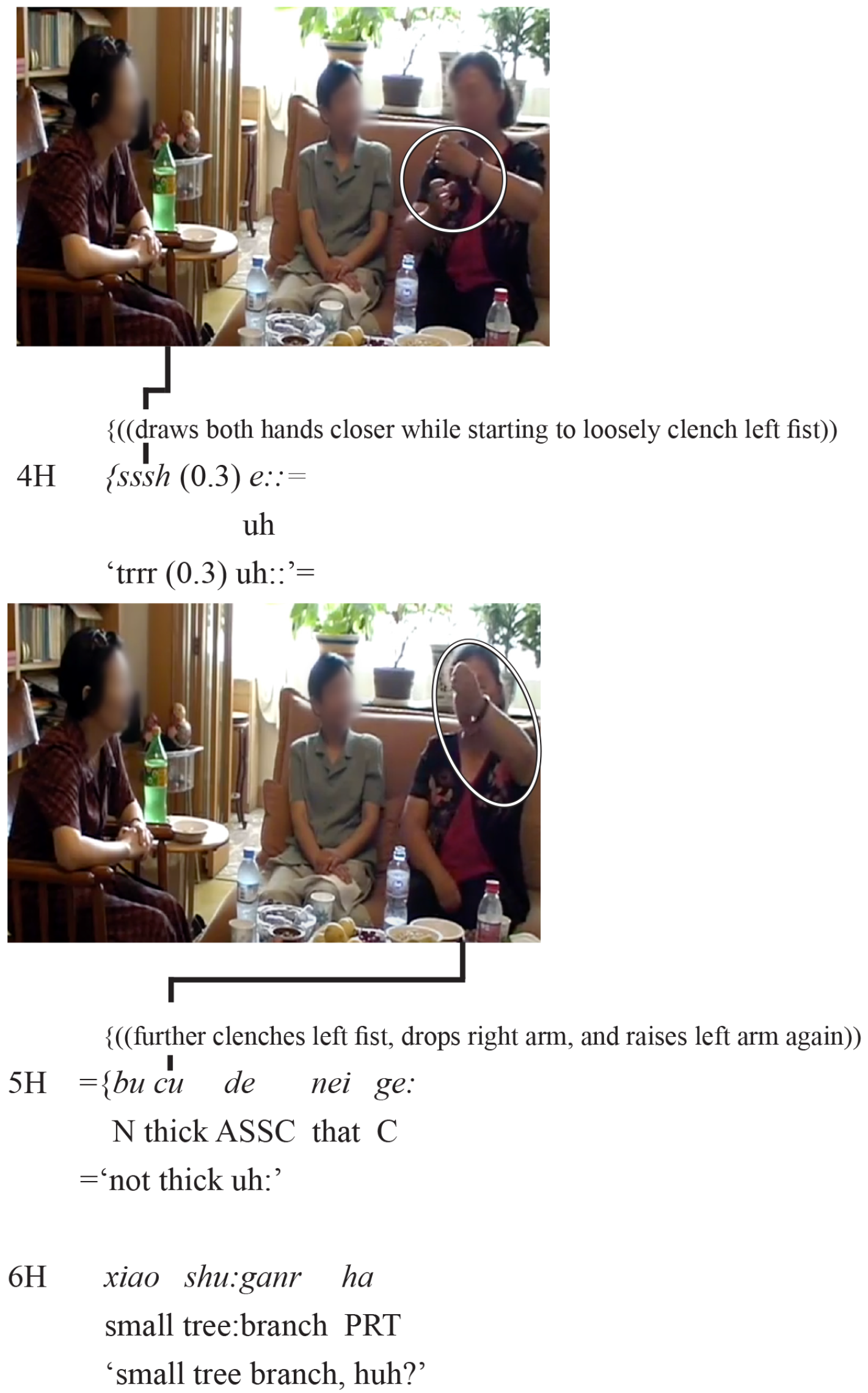
As it turns out, Hanna stops the forward progress of the turn-so-far apparently not because of her inability to retrieve the second morpheme of “tree branch,” but because of a difficulty she encounters when trying to modify the reference from a projection of xiao shu:(ganr) “small tree: (branch)” (line 3) to bu cu de nei ge: xiao shuganr “small tree branch that was not thick” (lines 5–6), that is, when she tries to insert new elements into the turn-so-far. 4
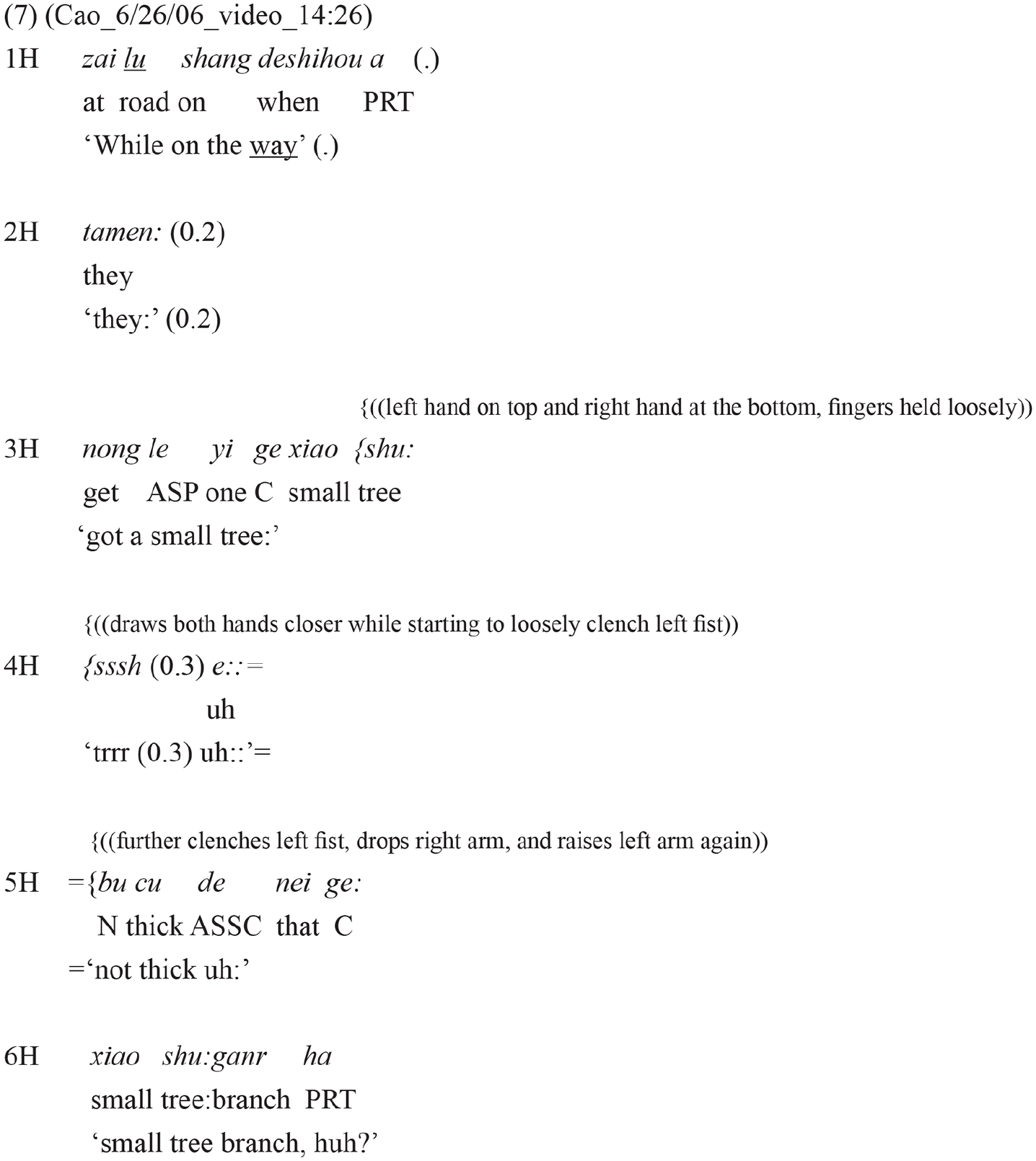
Here, Hanna’s word search involves a similar deployment of gestures in the repair process as in Excerpt (2). We can note that in line 3, as Hanna describes this portion of the adventure, she proceeds to gesturally represent what she’s apparently trying to describe verbally – (the length of) the tree branch – by placing her left hand on top and her right hand at the bottom, with hands wide apart, and fingers held loosely. Nevertheless, right at the point when she initiates repair (line 4), Hanna abruptly draws her hands closer together while beginning to curl her left-hand fingers and thumb to loosely clench her fist, as if to depict the width of the tree branch. (See Figure 1 for blown-up illustrations of the two gestures.)
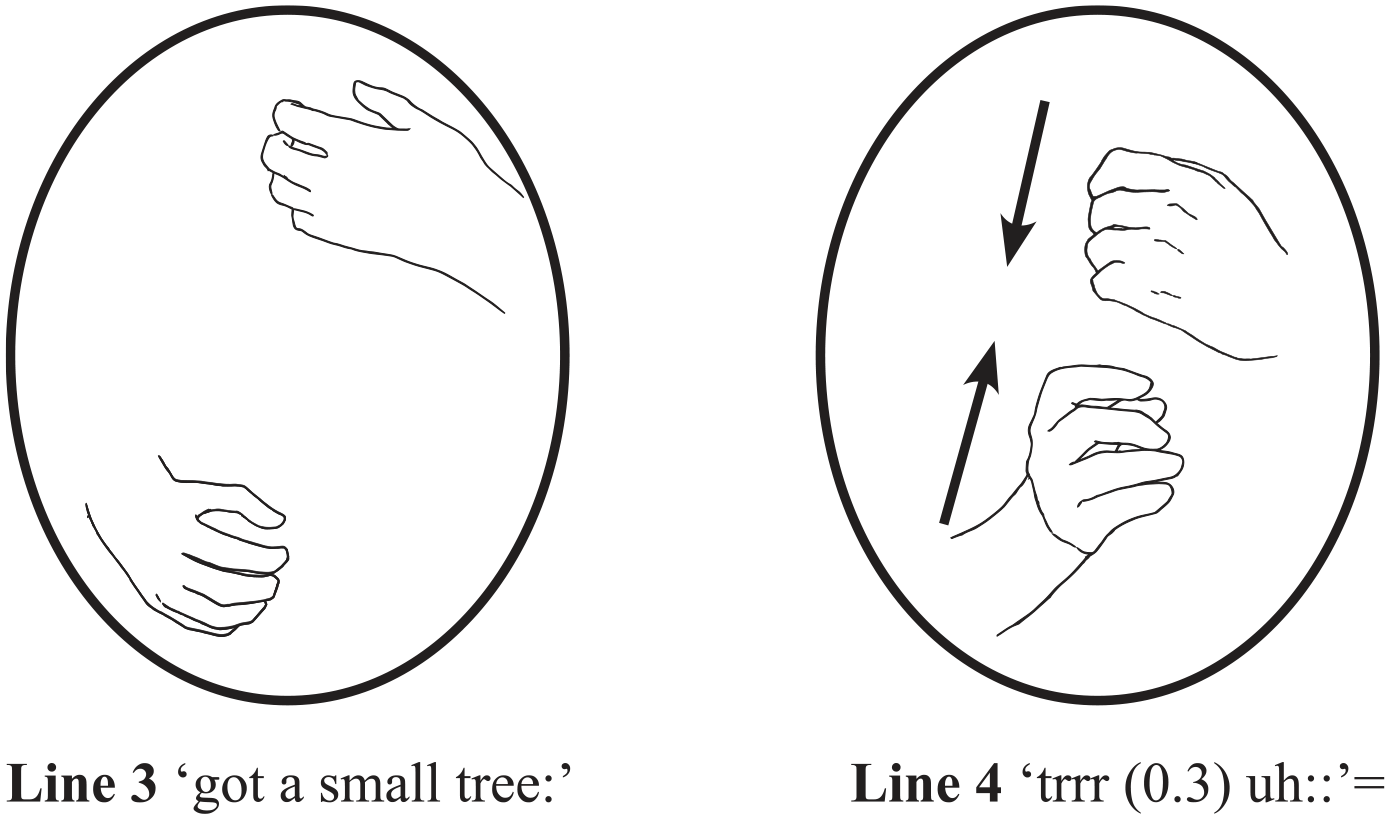
Hanna’s hand gestures in Line 3 and Line 4.
That is to say, in tandem with the initiation of repair, Hanna changes her hand gesture from a visual depiction of the general shape of the tree branch to one involving the detail of its width. This change in gesture – while produced without accompanying substantive words (line 4) – arguably projects, and coordinates meaning with, the speaker’s verbal repair that follows (bu cu de “not thick”; line 5). Here again, in the heat of a word search, the speaker who finds him- or herself at a loss for words first produces an iconic gesture (or gestures); only after that does the speaker move to offer a verbal solution to the ongoing word search, clarifying the meaning of the just-prior gesture(s) at the same time. Such a multi-stage self-initiated repair process involving the use of iconic gestures is what I call “gestural repair.”
A notable recurring feature of such gestural repair is the trouble-source speaker’s repeated use of the iconic gesture in an “attenuated” (Hauser, 2019) format when providing the verbal repair subsequently. That is, even though such self-initiated, self-repaired word searches involve launching an iconic gesture without accompanying verbal repair, the ensuing verbal repair is nonetheless commonly accompanied with a repeated version of the initial gesture. If we look back at Excerpt (2), it can be noted that in the process of offering the verbal repair (shengfanshengcai
As will be shown in the next two sections, this process of reproducing an immediately prior stand-alone gesture to align with the verbal repair that the speaker subsequently produces is a common practice in the data. Arguably, this process may involve a similar coordination of an iconic gesture and the repair proper previously discussed in Excerpt (1), in which the iconic gestures are designedly coincident with the repair solutions that the gesturing speaker provides to her word-searching difficulties.
Self-initiated and self-completed repair involving iconic gestures
In the cases examined thus far, the repair initiated by the trouble-source speaker is completed in the same turn by the same speaker via the practice of gestural repair. As already shown, the iconic gesture may be used to depict an action – a verb – associated with the repairable, such as the action of chopping leftovers (duo “chop”) in Excerpt (2). Or, the iconic gesture may depict a descriptor – an adjective – related to the repairable, such as the approximate width of a tree branch (bu cu de “not thick”) in Excerpt (3). To give a sense of the robustness of this practice and to explicate some variations of its usage, this section will consider an additional instance which involves a similar operation of gestural repair, albeit in a more complex way.
Consider Excerpt (4), which is taken from the same conversation as Excerpt (1). The gestural repair occurs in lines 14–15. Where this excerpt begins, Martha (M) is delivering a piece of news, advising her two middle-aged girlfriends, Rita (R) and Carla (C), against drinking milk.
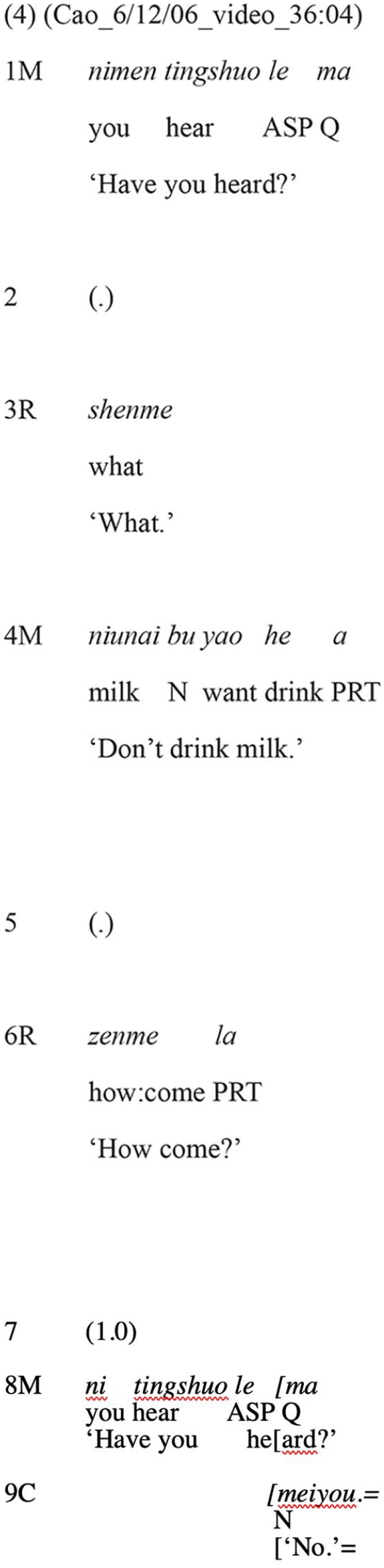
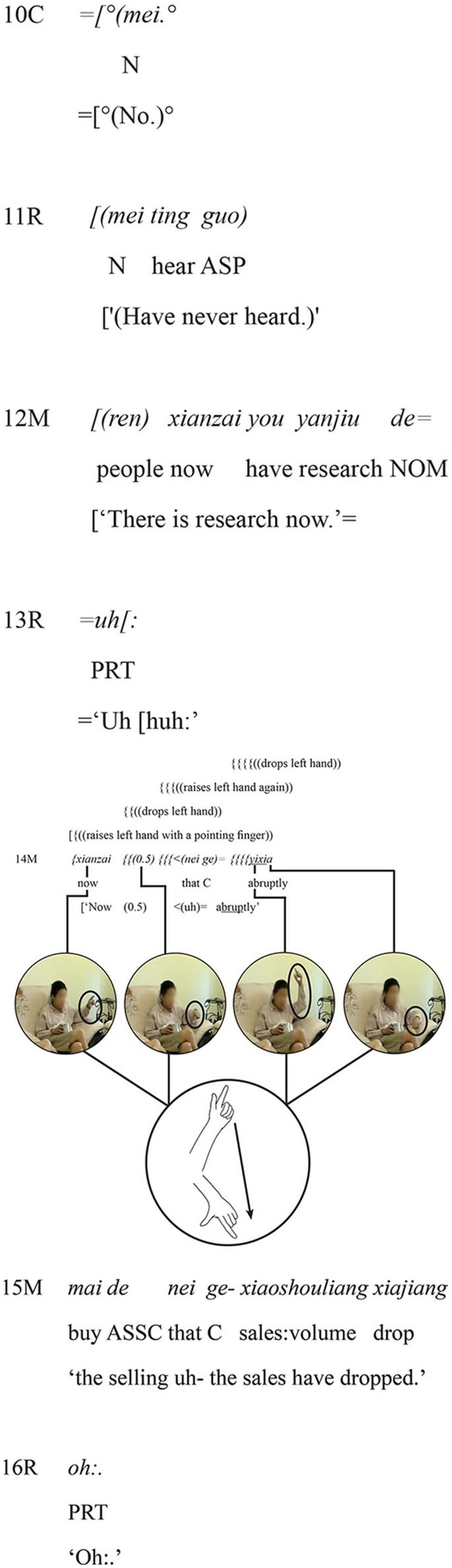
In line 12, after referencing the existence of research to back up her argument against consuming milk, Martha begins to raise her left arm with a pointing finger as she says xianzai “now” (line 14). However, she stops talking while continuing to raise her arm further upward before abruptly dropping it with a forceful downward thrust of her hand during the (0.5) second of silence. Immediately thereafter, Martha utters nei ge “uh” (line 14), visibly engaged in a word search, and simultaneously raises her left arm again. This time, she raises her arm to a higher point before bringing her hand down with yet another thrust. This second hand drop is produced coincidentally with yixia (line 14), which may be rendered into English as “abruptly” here.
Martha’s downward-thrust gestures and the message she intends to convey initially remain vague and opaque. It is not until what transpires in line 15 – and after another initiation of self-repair therein, which narrows down and better specifies what the repairable is (mai de nei ge- “the selling uh-”) – that the message becomes clear. As it turns out, Martha is trying to deliver the news that the sales of milk have plunged lately – that is, that they have dropped “abruptly” – as Martha’s two hand gestures appear to depict. 5
Notice here that Martha’s gestures are used in a similar way as those observed in Excerpts (2) and (3): Amidst a difficulty in coming up with the adequate expression due next, the speaker produces a gesture in its place to depict it, whereupon moving to verbally repair the trouble source and make clear what the gesture is meant to convey. Here, the speaker likewise reproduces the gesture previously produced during an intra-turn pause, and aligns it with the verbal repair (i.e.
Despite the similarities, the way in which Martha’s gestures contribute to the repair resolution appears to be more complex. Here, judging from what transpires in the ensuing TCU, we see that the repair initiated by Martha through the use of nei ge “uh” (line 14) seems to involve the search for the lexical item xiaoshouliang “sales volume.” However, in the face of a momentary difficulty in retrieving this word under time pressure, Martha proceeds to gesturally represent the adverb yixia “abuptly” first before subsequently unpacking and repairing the message being conveyed. Here, even though yixia “abuptly” is arguably not the lexical expression being searched for at the moment, it nonetheless carries the focal point of the news to be delivered. That is, the newsworthiness, as apparently designed to be conveyed, pertains more to the plunge in the sales volume than to a simple decline. This may explain in part why the gesture in question is mobilized in the first place to depict this adverb in Martha’s attempt to fashion a repair solution.
What Excerpt (4) has shown, then, is that the gestural component in a gestural repair may not always be linked directly to the lexical expression that is supposed to be due next had the turn-in-progress not been halted because of the speaker’s difficulty in retrieving and articulating that expression. Rather, such gestures may be launched with a view to quickly conveying the gist or focal point of what is to be projected next in the face of a breakdown of mutual understanding. In these cases, whereas the gestures are not meant to be a solution to the ongoing word search, they are nonetheless used in the service of the speaker’s search for a solution to the transient communication breakdown; that is, they serve not so much to repair the specific trouble source as to repair a trouble in intersubjectivity.
In the discussion thus far, we have examined cases involving the use of gestural repair in a multi-stage repair operation. In all these cases, the repair is initiated and completed by the trouble-source speaker in the same turn. In the next section, we will move on to discuss a different set of cases in which a recipient proceeds to furnish a candidate repair solution in response to the trouble-speaker’s gestural repair.
Self-initiated and other-facilitated repair involving iconic gestures
We now discuss examples of gestural repair that prompts a recipient to complete the repair. In these cases, following the trouble-source speaker’s initiation of gestural repair and before the speaker proceeds to complete the repair verbally, a recipient proffers a candidate repair solution on behalf of the speaker. This phenomenon is in line with previous conversation analytic findings that show how recipients may use another’s bodily conduct to achieve coordinated participation in situated activities, including, for example, description activities (e.g. Hayashi, 2003a, 2005) and word searches (e.g. Goodwin and Goodwin, 1986; Hayashi, 2003a, 2003b; Streeck, 1993). Of particular relevance here is Streeck’s (1993) and Hayashi’s (2003a, 2003b) studies, which demonstrate, respectively, how Ilokano and Japanese speakers may mobilize an iconic gesture produced by an interlocutor amidst a word-finding difficulty as a resource to achieve a collaborative completion of the ongoing word search.
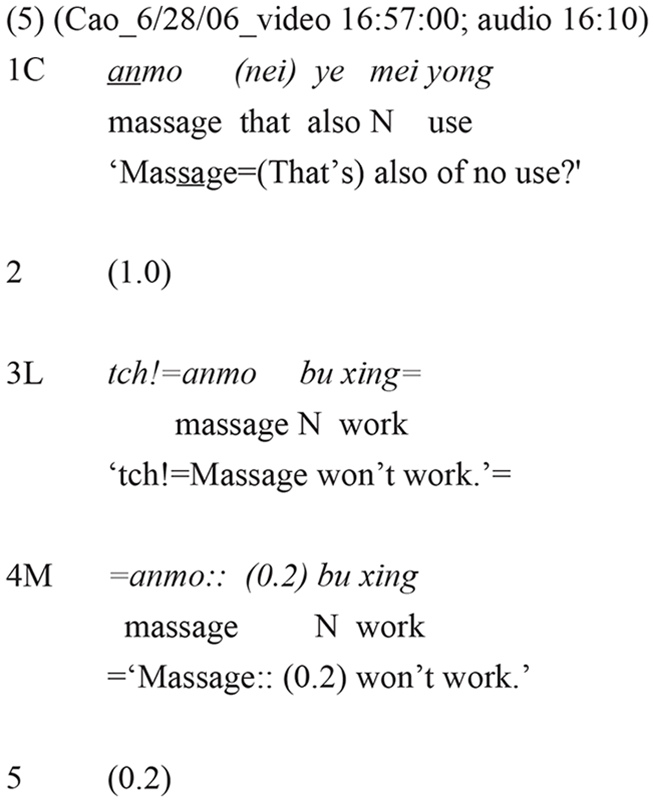
Consider the following Mandarin example in the data. This excerpt comes from the same conversation as Excerpt (2). The talk before this excerpt was focused on a bulging disc in the lower back that Lily (L) is suffering from. Prior to this excerpt, Lily’s sister, Mandy (M), who is a health professional, had just rejected surgery as a good treatment option in Lily’s case. In line 1, Carla (C) proposes an alternative option – massage therapy – the usefulness of which is nonetheless refuted by both Lily and Mandy (lines 3–4).
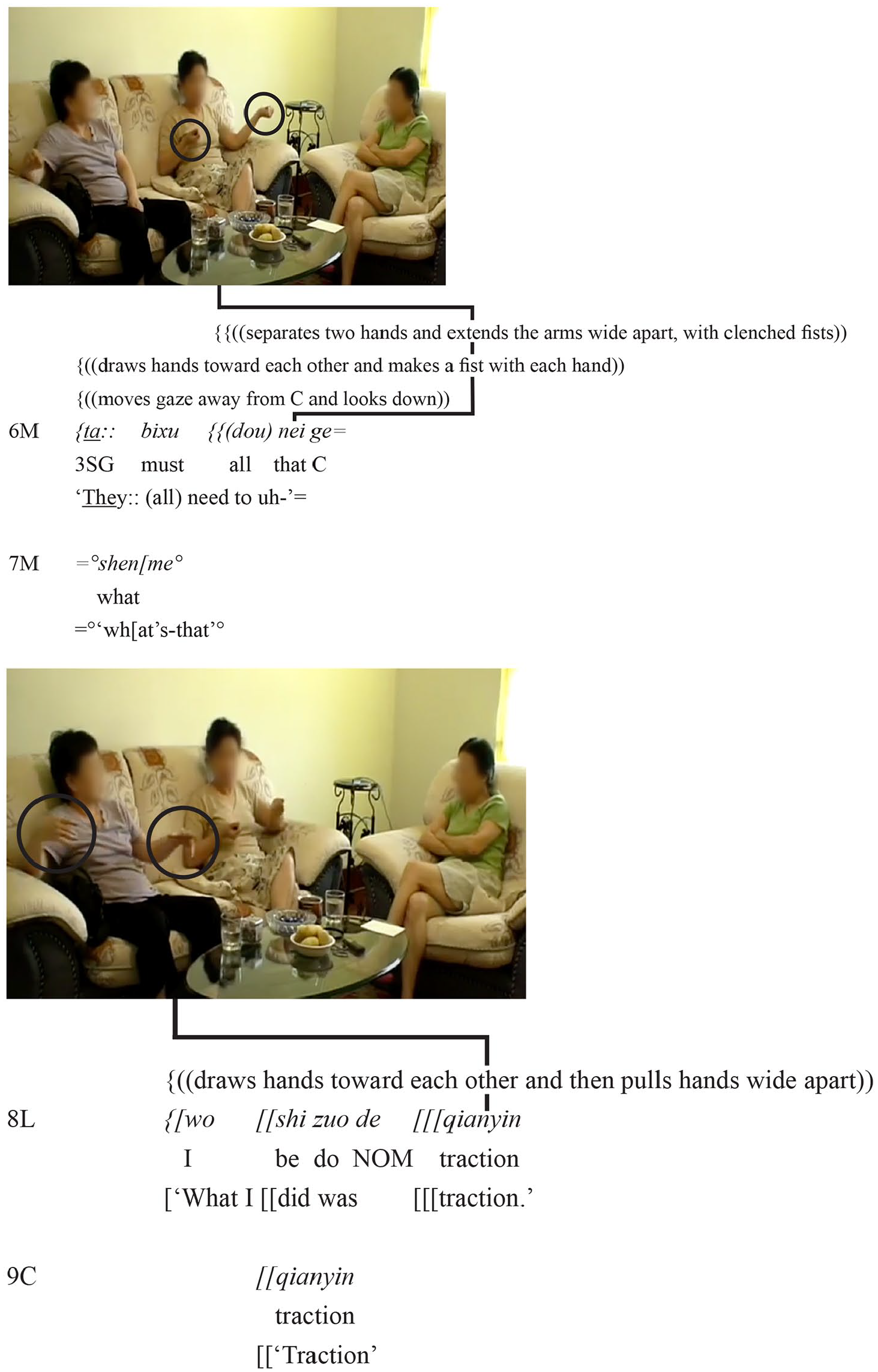
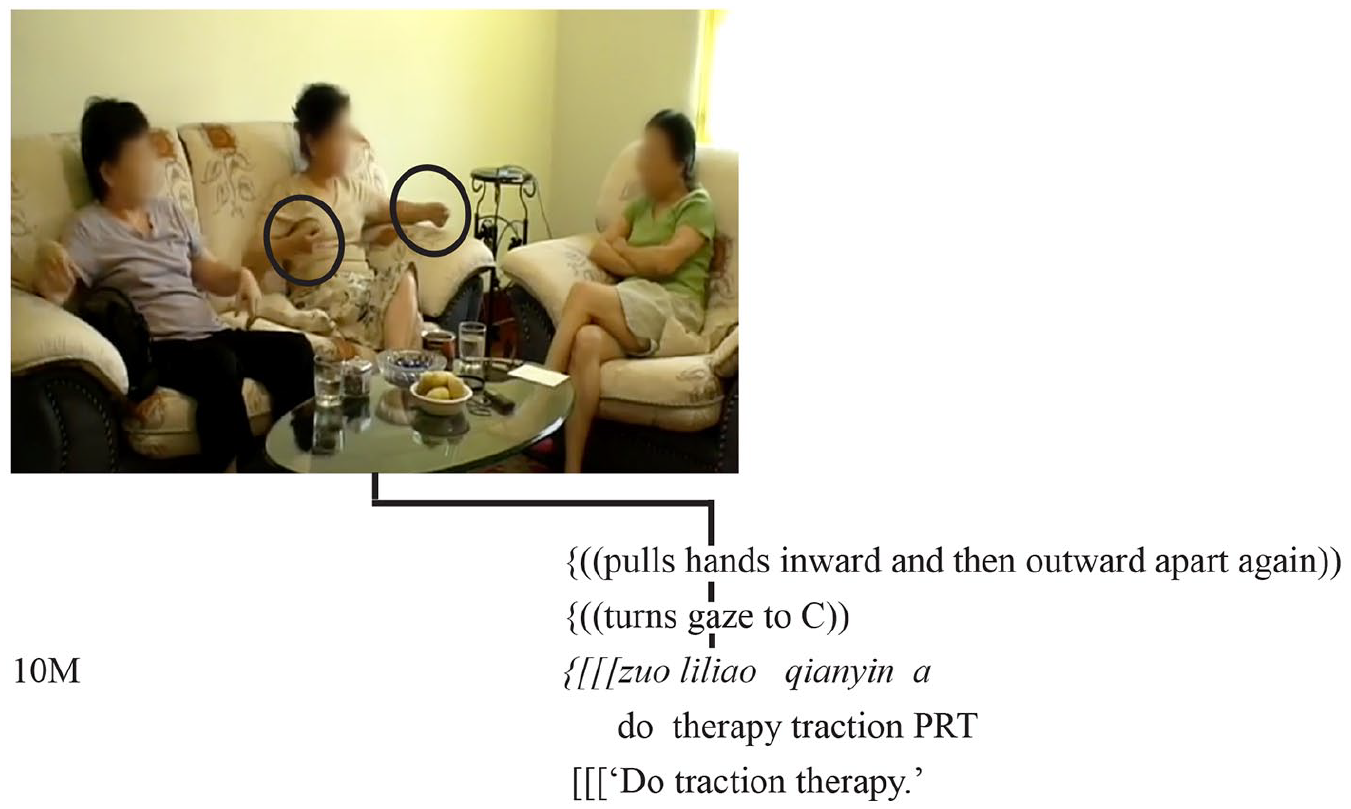
In line 6, as Mandy begins to suggest another medical treatment (i.e. traction therapy), she starts to draw her hands toward each other while making a fist with each hand. She then separates the two hands and extends the arms wide apart, with clenched fists, as if pulling something apart. However, at the moment she makes these pull-apart gestures, Mandy exhibits difficulties expressing herself verbally and initiates a word search (nei ge shenme “uh- what’s-that,” lines 6-7). In response, both recipients proceed to display an understanding of what Mandy’s gesture appears to convey. In line 9, Carla straightforwardly furnishes an answer to the word search (qianyin “traction”) while Lily names the treatment that she herself had undergone (wo shi zuo de qianyin “what I did was traction”; line 8). In turn, Mandy offers a repair solution (zuo liliao qianyin “do traction therapy”; line 10) while simultaneously reproducing her prior gesture.
Here, Mandy can be seen as adopting the same practice of gestural repair that we saw in the last section. That is, having trouble articulating the expression due next, she offers a gesture to provide a visual representation of the expression that eludes her, and only after that does she furnish a verbal repair (along with a repeat of the gesture) that clarifies the meaning of the gesture and the trouble. In this case, though, Mandy’s gestural repair alone enables the recipients to understand that which she is searching for, and the recipients’ offered candidate verbal repair comes before the speaker’s own.
What is additionally noteworthy about this example has to do with how the trouble-source speaker treats the recipients’ contributions. In line 10, we can note that Mandy goes on to provide her own outcome to the repair attempt without acknowledging Carla’s just-proffered solution (line 9). Moreover, in the verbal repair she offers, Mandy not only formulates it with a more professional-sounding term (i.e. liliao qianyin “traction therapy” as opposed to just qianyin “traction”) but also frames it in the format of a verb phrase (i.e. zuo liliao qianyin “do traction therapy”). Choosing a verb phrase over a noun phrase can be significant here because the former is grammatically more fitting in its sequential context. That is, a verb phrase can be more precisely tied back to the point at which Mandy initiated repair and interrupted her TCU-in-progress (
In the next example, the recipient of gestural repair similarly provides a candidate repair solution. This excerpt is taken from a conversation among a family of three and two visitors, Leo (L) and Christine (C), who are brother and sister. Just prior to this excerpt, the couple, Harry (H) and Wendy (W), had expressed surprise at the news that Christine, who had just returned home from the US after a semester of study, would be leaving soon for an exchange program in Singapore.
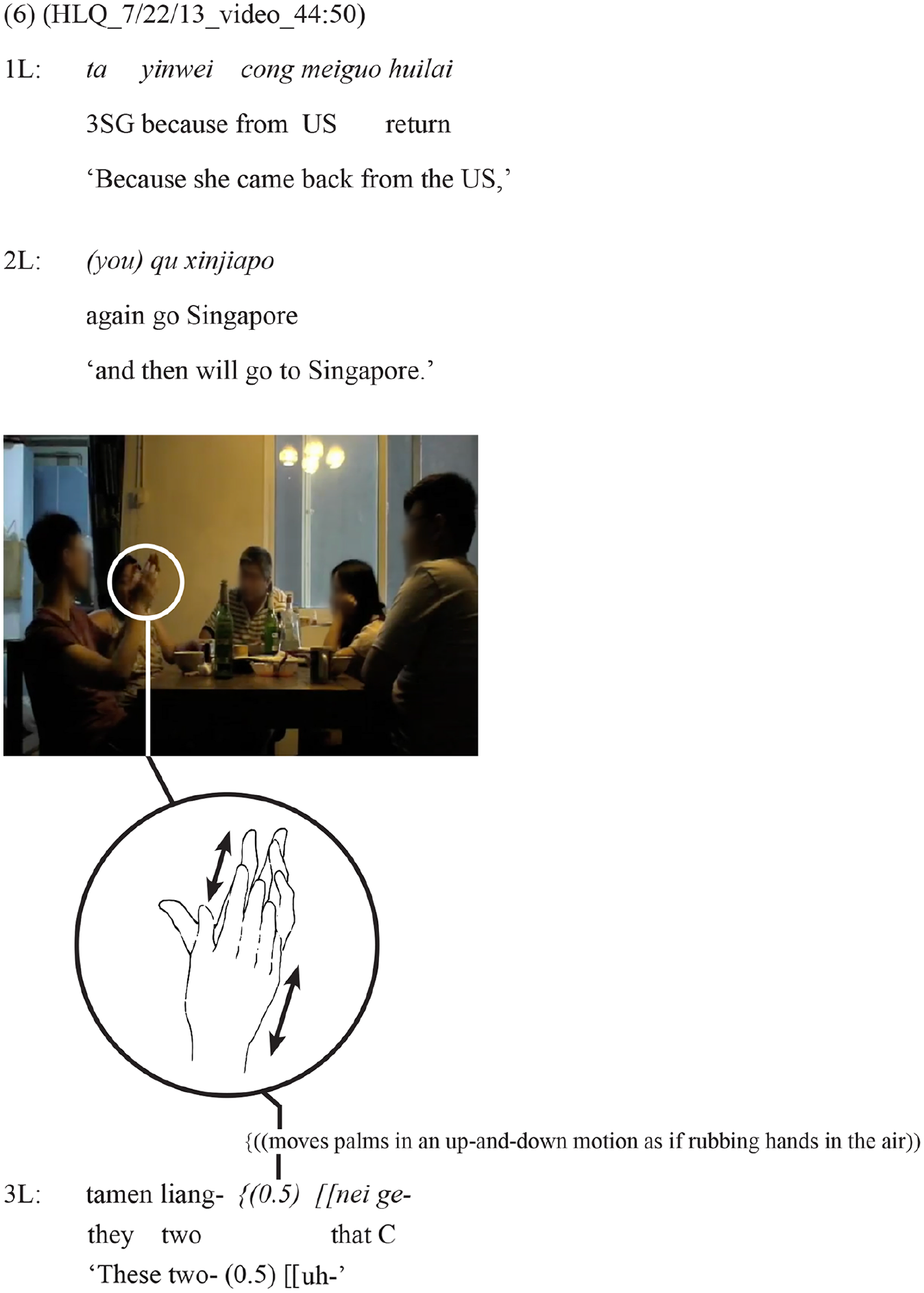
In lines 1–5, Leo is apparently trying to explain that Christine’s sooner-than-expected departure is due to the unsynchronized schedules of these two schools, perhaps in terms of their respective semester starting and ending dates, which he glosses as a “time issue” (line 5). In the midst of giving his account, however, Leo encounters trouble continuing his talk after he utters the words tamen liang “these two” (line 3). He then initiates repair with a cut-off on “liang,” followed by a (0.5)-second pause, during which he puts his two elbows on the table, with palms facing each other, and moves his palms in a slightly up-and-down motion in an asynchronous manner (line 3). This gesturing of an asynchronous motion with two palms, arguably designed to depict the somewhat misaligned schedules of the two schools in question, receives a recipient head nod (line 4), which can be seen as a display of understanding.
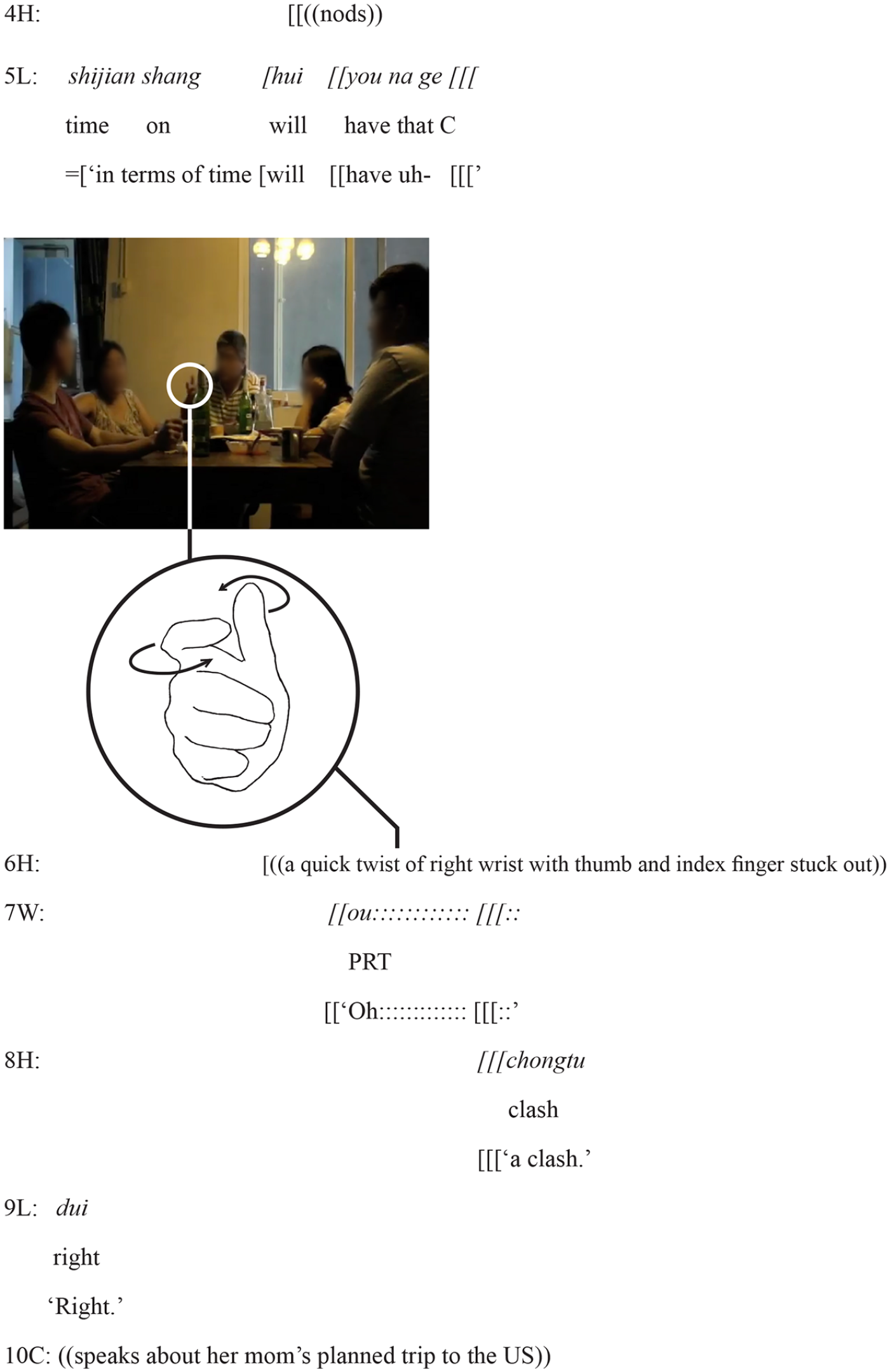
However, despite the recipient’s displayed understanding, following this repair initiation and the gesture, Leo finds himself still unable to produce the repair verbally; instead, he initiates repair again (nei ge- “uh-”; line 3) before continuing his attempt to furnish the verbal repair (line 5). It can be noted that in Leo’s continued repair attempt, right after he utters the key words shijian shang “in terms of time” (line 5), the recipient, Harry, produces a responsive hand gesture (line 6). Specifically, he quickly twists his right wrist with the thumb and index finger stuck out. This quick hand twist gesture appears to depict a sudden change, and as Harry subsequently deciphers, indicates a “clash” (line 8).
Given that this hand gesture is precisely timed to be latched onto Leo’s repair-in-progress, Harry can be understood to be trying to achieve a collaborative construction in the solution of the ongoing repair. Notably, in his collaborative entry into this repair, Harry adopts a similar practice of gestural repair – namely, performing an iconic gesture followed by verbal repair – which otherwise is commonly employed by the trouble-source speaker. Harry’s verbal repair (line 8) comes right on the heels of Leo’s initiation of yet another word search after his second repair attempt fails (shijian shang hui you na ge “in terms of time will have uh-”; line 5). Thereafter, Leo confirms the adequacy of Harry’s offered repair solution (line 9) and thereby closes this repair sequence.
Excerpt (6), then, involves the use of two interpolated sets of gestural repair, one by the trouble-source speaker and the other by the recipient. Both sets are mobilized to provide a solution to the same word search initiated by the trouble-source speaker. Here, clearly, the recipient’s gesture is based on his understanding of the prior talk and gesture produced by the trouble-source speaker. Nevertheless, the recipient proffers a different gestural representation of the lexical expression being sought for than that given by the trouble-source speaker. That is, whereas the trouble-source speaker’s asynchronous-motion gesture appears designed to depict a disalignment of the time schedules of these two schools, the recipient’s quick hand twist seems to emphasize a clash created by an abrupt change in place and position.
Although recipients may utilize the trouble-source speaker’s gestural repair to correctly anticipate and project a candidate solution to the word-search currently underway as in Excerpts (5) and (6), they may also err in their anticipation and understanding. Thus, in Excerpt (7), from the same storytelling sequence about an adventure trip that we examined in Excerpt (3), Hanna (H) continues to explain the reason why they picked up the small tree branch on the trip – that is, as a walking stick. As it happens, however, the recipient’s analysis of Hanna’s gestural repair results in an incorrect rendition of the gesture.
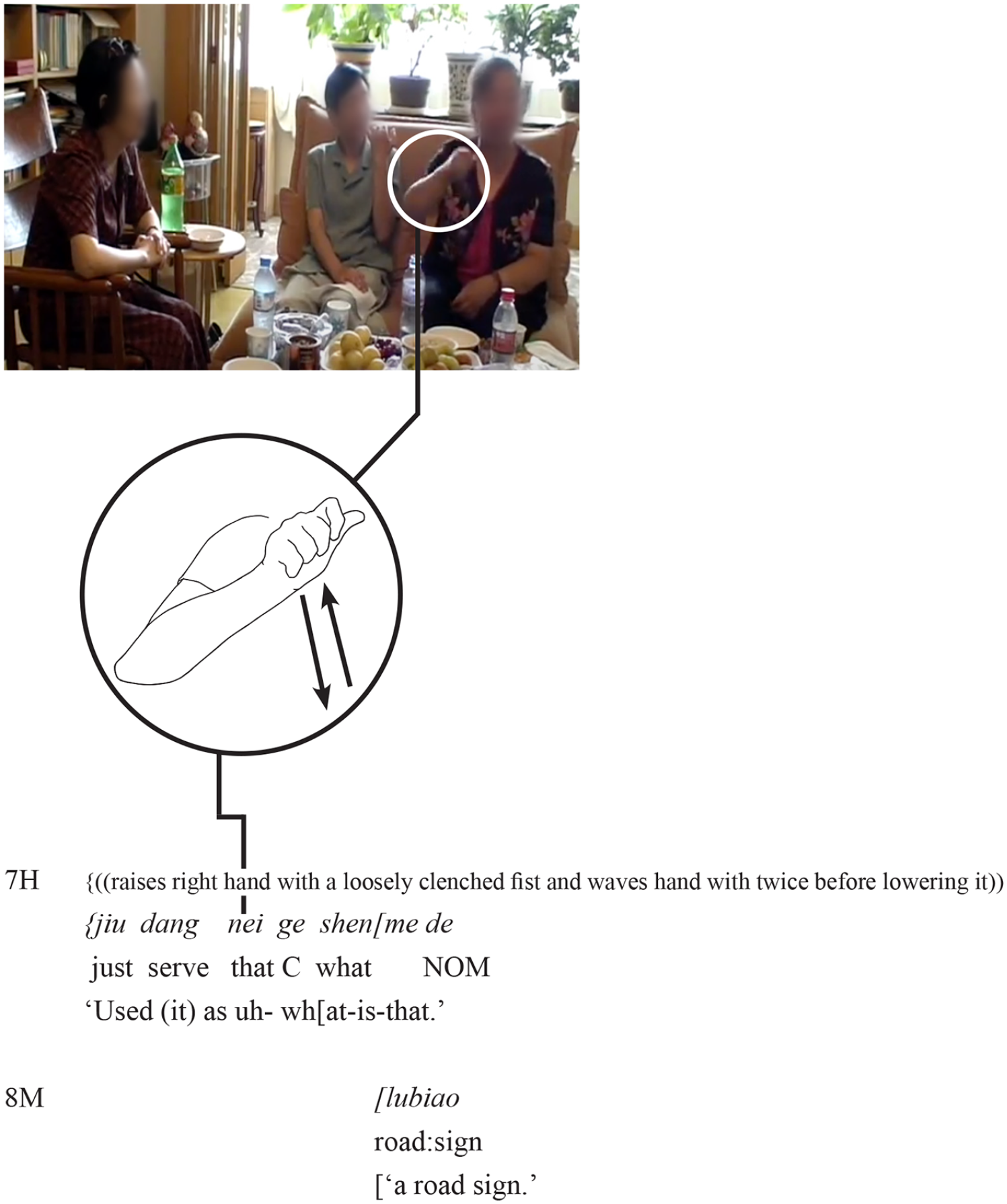
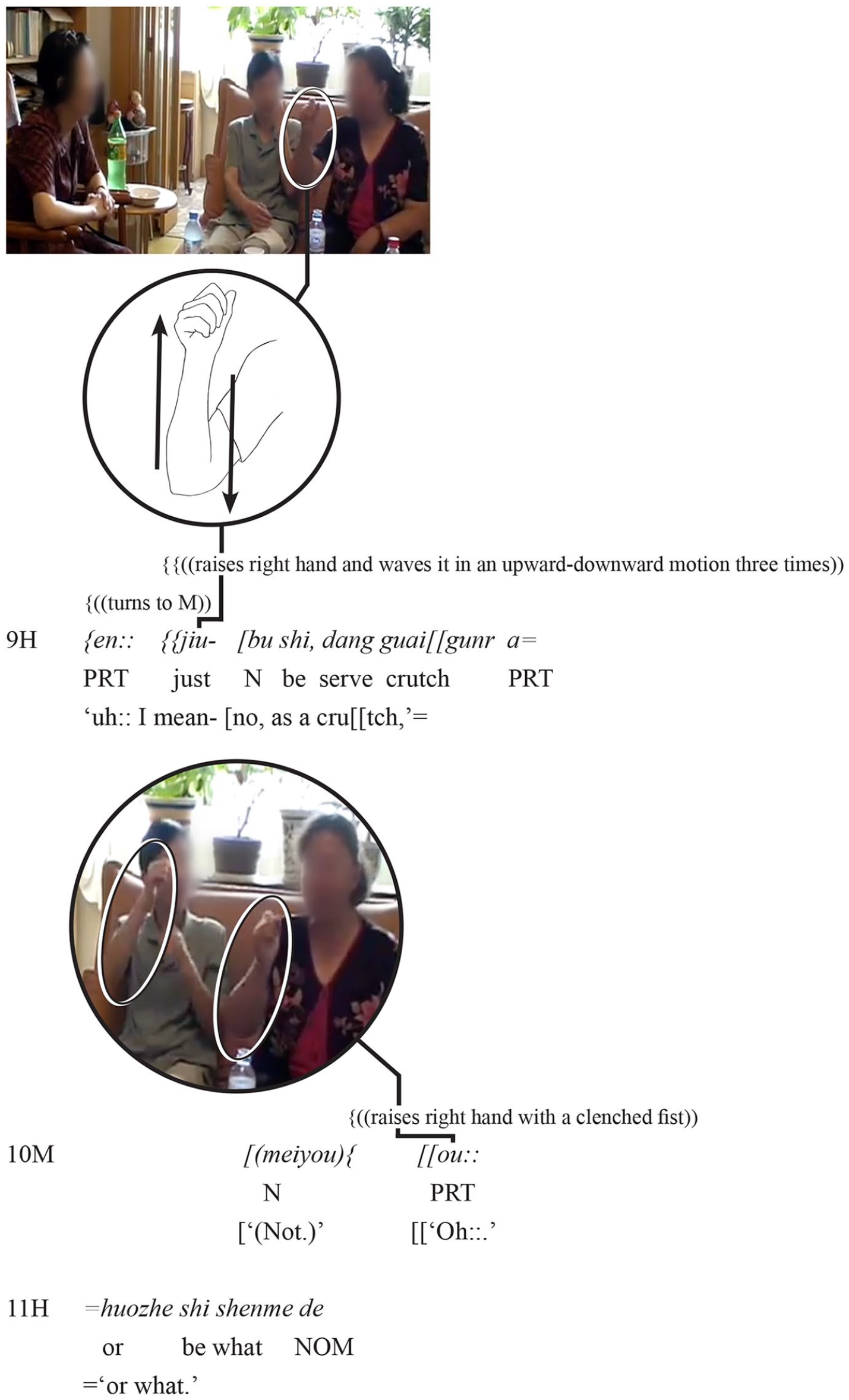
At the beginning of line 7, Hanna starts to raise her right hand. Here, in an apparent attempt to describe what the tree branch was used for, she waves her right hand with a loosely clenched fist twice in the air before lowering it. Nevertheless, whereas these waving gestures are accompanied by a verbal clarification, this clarification ends up failing to specify what that purpose was (jiu dang nei ge shenme de “and used (it) as what-is-that”; line 7). In slight terminal overlap with the talk by Hanna, Michelle (M) proffers a candidate understanding (lubiao “a road sign”; line 8), which nonetheless turns out to be in discrepancy with what Hanna’s gesture is meant to convey. In response, Hanna turns her gaze to Michelle and disconfirms Michelle’s answer (en:: jiu- bu shi “uh:: I mean- no”; line 9) before proceeding to clarify what was left unspecified in line 7 (dang guaigunr a “as a crutch”; line 9). While correcting Michelle and providing this verbal repair, Hanna raises her right hand again and waves it in a roughly upward-downward motion three times before returning her hand to her lap. In effect, as we’ve seen in several earlier excerpts (i.e. Excerpts (1), (2), (3), (4), and (5)), Hanna, the trouble-source speaker, reproduces a gesture that she had previously deployed when exhibiting a word-finding difficulty, and aligns this gesture with her verbal repair when finally delivered.
It is noteworthy that after Michelle’s proffered understanding in line 8 is disconfirmed, she briefly copies Hanna’s gesture by raising her right hand with a clenched fist (line 10), as if holding a tree branch, right at the moment when Hanna utters the key word in her verbal repair (i.e. guaigunr “crutch”; line 9). This is a phenomenon that is sometimes referred to as “gestural tying” (Hayashi, 2005: 46) or a “return-gesture” (Streeck, 2009: 106) in the literature. Notably, a similar pattern of speaker-recipient mirrored gestures of this kind can also be observed in our previous two examples. In Excerpt (5), Lily produces a “traction” gesture (line 8) that is very similar to Mandy’s (in line 6) to accompany her displayed understanding of what Mandy’s gesture is meant to convey. In Excerpt (6), as already noted, even though the gestures produced by the recipient and the trouble-source speaker are not exactly alike, they can be understood as “synonymous” in that they appear to depict similar meanings and interpretations.
In this section, we described cases in which the use of gestural repair by the trouble-source speaker prompts a recipient to voluntarily facilitate the resolution of an ongoing word search by supplying a candidate repair solution. As already observed, the recipient in each case draws primarily on his or her understanding of the visual projection provided by the trouble-source speaker in proffering the anticipated verbal repair on behalf of the speaker. This process involves a similar multi-stage repair operation through the use of gestural repair that we saw in the last section, except here the repair operation is shared among speakers, rather than accomplished solely by the trouble-source speaker.
Concluding discussion
In this analysis, I have focused on the use of what I call “gestural repair” in same-turn, self-initiated repair involving word searches in Mandarin conversation. I have shown that this repair practice involves a multi-stage operation composed of a package of an iconic gesture (or gestures) followed by verbal repair. In this practice, the speaker who has trouble articulating the lexical expression due next produces a gesture in its place to depict it, and only after that does the speaker offer a verbal solution to the word search, clarifying the meaning of the gesture as well.
Additionally, I have shown that even though gestural repair is frequently initiated and completed by the trouble-source speaker in the same turn, a recipient may facilitate the resolution of repair by voluntarily supplying candidate verbal repair on behalf of the speaker. As noted, here in achieving a collaborative construction in the solution to the ongoing word search, recipients draw primarily on their understanding of the just-proffered visual representations by the trouble-source speaker. This recipient-facilitated repair process thus arguably involves a similar deployment of gestural repair, except here the repair operation is shared among speakers, rather than accomplished solely by the trouble-source speaker.
An interesting recurring feature of such gestural repair observed in the data is the tendency for the trouble-source speaker to reproduce the stand-alone gesture and align it with the verbal repair when the latter is finally delivered. That is, even though such self-initiated, self-repaired word searches involve launching an iconic gesture without accompanying verbal repair, the ensuing verbal repair is nonetheless commonly accompanied with a repeated version of the initial gesture. This phenomenon appears to be in line with instances of word searches which involve the use of iconic gestures but not of gestural repair, as in Excerpt (1), in which there is evidence of a carefully coordinated effort on the part of the trouble-source speaker to achieve simultaneity between her gesture and repair solution in the course of managing the word-finding difficulties. In view of the designedly coincidental pattern of the repair solution with the accompanying gesture, then, there is a sense that in word-search sequences involving gestural repair, the gesture that would accompany the searched-for lexical item is initially produced without the lexical item when the speaker has trouble recalling it, and then is produced again when the lexical item is eventually retrieved.
The present analysis also provides insight into research on the interrelationship between talk and bodily conduct in the production and interpretation of social action. As many studies of gesture in interaction have argued (e.g. Goodwin and Goodwin, 1986; Hayashi, 2003a, 2003b; Hayashi et al., 2013; Mondada, 2013, 2019; Stivers and Sidnell, 2005; inter alia), talk and bodily conduct can mutually elaborate and contextualize each other in achieving intersubjectivity. In the case of multi-stage gestural repair, I have shown that once the missing lexical expression associated with the trouble source is retrieved in verbal repair, it can help clarify/elucidate the stand-alone gesture in the same way that the gesture helped clarify the trouble source. Here, we can see how a gesture and its lexical affiliate that co-occur in gestural repair can complement each other in establishing intersubjectivity.
Finally, in the past few decades, conversational repair – the phenomenon in which participants in conversation indicate and/or address trouble in speaking, hearing, and understanding – has perhaps become one of the most studied research topics in CA and other CA-inspired disciplines. However, as many have acknowledged (e.g. Drew et al., 2013; Hayashi et al., 2013; Schegloff, 2013), despite much of the research effort, there is still much more to be learned before a full account of the practice of repair can be arrived at. In a recent article, for example, Schegloff (2013) sketches 10 operations that speakers may perform in the management of same-turn self-initiated self-repair: replacing, inserting, deleting, searching, parenthesizing, aborting, sequence-jumping, recycling, reformatting, and reordering. However, Schegloff (2013) also acknowledges in a preamble that “only the repair operations are to be taken up, and not other facets of these repairs, such as the components of the repair segments through which the operations are prosecuted, the techniques employed in accomplishing those operations, and the systemic or interactional import that may be understood to inform the doing of a same-tum repair in any given instance” (p. 41).
Perhaps to be added to this list is how such repair operations and techniques may be intertwined with speakers’ non-vocal embodied conduct. As noted at the beginning of this article, to date only a small body of CA and CA-inspired research has focused on how embodied practices figure in the context of repair. Clearly, the work presented here is just the tip of the iceberg. However, by focusing on “gestural repair” – a repair operation integrating verbal and non-verbal components – I hope to have contributed to expanding our current understanding of same-turn, self-initiated repair in general and its manifestation in Mandarin conversation in particular.
Footnotes
Acknowledgements
I am grateful to Irene Koshik and the journal’s reviewer for their valuable input on an earlier version of this paper.
Declaration of conflicting interests
The author(s) declared no potential conflicts of interest with respect to the research, authorship, and/or publication of this article.
Funding
The author(s) received no financial support for the research, authorship, and/or publication of this article.
Abbreviation Notations
ASP aspectual Marker
ASSC associative (-de)
C classifier
N negator
NOM nominalizer (de)
PRT particle
Q question marker
3SG third person single pronoun