







Abstract
This study, by means of conversation analysis, comprehensively illuminates the advisee’s acceptance of advice in Chinese phone-in counseling for family problems from the perspective of Epistemics, and reveals advisee’s type of management of the epistemic status relationship as well as the epistemic stances during executing the management. The study finds that the advisee tacitly approved of the asymmetric relationship of epistemic status between an adviser and himself/herself when accepting advice; that this type of relationship management can be executed through four kinds of epistemic stances; that these stances actually reflect the advisee’s positioning of asymmetric relationship of knowledge distribution of both parties. This study investigates the acceptance of advice from the perspective of Epistemics, which can extend the theoretical perspective of the researches on responses to advice and give new illumination of the advisory interaction.
Keywords
Introduction
There are a large number of foreign linguistic researches concerning advice discourse, but Chinese academic circle seldom pays attention to such discourse (Ren, 2014: 49). As for the researches of advice interaction, most scholars focus on the face work, linguistic realization and strategies, power relationship and sequence organizations of advice discourse/interaction, such as Brown and Levinson (1987), Heritage and Sefi (1992), Hutchby (1995), Ding (2001), Yu (2009), Abolfathiasl and Abdullah (2013), Shaw et al. (2015), Tanaka (2015), Zalaltdinova (2018), et al. A few scholars have studied the responses to advice, such as Jefferson and Lee (1981), Li (2010), Heritage and Lindström (2012), Shaw and Hepburn (2013), Henricson and Nelson (2017), Hepburn et al. (2018), etc. These studies analyze the linguistic realization and strategies of accepting or resisting advice and the impact of these responses on the development of subsequent sequence organizations, which enables us to better understand the types and linguistic forms of the responses to advice, but scholars’ explanations of these utterances are often limited to the theories of power, identity and social distance of interactants, and the theoretical perspective is relatively narrow (Ren, 2014: 53). Even if some scholars exploit the knowledge asymmetry (Hepburn et al., 2018: 194) to explain some kinds of responses to advice, none have yet carried out a systematic epistemic study of the responses to advice.
This paper focuses on the acceptance of advice which refers to the callers’ receptive responses to the host’s advice in the Chinese phone-in counseling for family problems. There are a few scholars who conduct studies on the responses to advice on phone-ins, such as Pudlinski (2002), Hepburn and Potter (2011), and Hepburn et al. (2018). These studies mainly focus on the linguistic forms of response to advice, the impact of resisting advice on the subsequent sequence organizations and the essence of epistemic right competition embodied in resisting advice. Although these scholars explore the responses to advice, their discursive researches on the acceptance of advice are still not comprehensive, nor do they systematically explain the acceptance of advice from the perspective of Epistemics. In view of few studies on the conversations of phone-in counseling for family problems and the acceptance of advice in phone-in conversations, it is necessary for us to conduct a systematic research on acceptance of advice in the phone-in counseling for family problems so as to offer a comprehensive illumination of this linguistic phenomenon. This study attempts to probe into this linguistic phenomenon from the perspective of Epistemics (Stevanovic and Svennevig, 2015: 1), which will help expand the theoretical perspective of the researches on responses to advice and give a new interpretation of those responses.
Literature review
Responses to advice
According to Hepburn et al. (2018: 196), advisory discourse has four features: Advisory discourse proposes future behaviors, which are regarded as normative and should be implemented by the hearer(s); These future behaviors are regarded as beneficial to the hearer(s); Advisory discourse forms the asymmetry of knowledge between the speaker and the hearer(s), that is, the speaker’s knowledge is richer than the hearer(s) on specific matters; Advisory interaction can urge the hearer(s) to accept or reject the advice.
In the study of advisory interaction, the responses to advice have attracted relatively few scholars’ attention (Waring, 2005: 141). The scholars who investigated these responses mainly focused on three aspects of them: Firstly, the responses to advice have different linguistic realization. In the home visit of community nurses, mothers often use marked acknowledgment, unmarked acknowledgment and the assertion of their own ability to respond to nurses’ advice (Heritage and Sefi, 1992: 409). On the mental health phone-ins, callers often use non-mitigating refusal, non-mitigating acceptance and minimal acknowledgment to respond to advice (Pudlinski, 2002: 484–495).
Secondly, the linguistic realization of the responses to advice will have an impact on the sequence organizations of advisory interaction. Rejecting advice will often lead to the post expansion of the advisory interaction sequence, for instance, the adviser may revise the previous advice, supplement more detailed advice or provide more rationale support for the previous advice; Accepting advice will lead to the end of the advisory interaction (Li, 2010: 58; Hepburn and Potter, 2011: 216; Park, 2017: 253; Leyland, 2018: 267). Specifically, the response of marked acknowledgment (e.g. right) can make the advisory sequence come to an end; the advisee’s inhibition of marked acknowledgment (e.g. silence) and expression of unmarked acknowledgment (e.g. yeah and mm) imply that the advisee resists the advice, so the advice sequence will be expanded and difficult to be terminated (Heritage and Lindström, 2012: 174–177).
Finally, some scholars reveal the causes of certain linguistic realization of the responses to advice or the causes of the formation of some advisory sequence organizations. These causes can be divided into two categories: interactive internal causes and interactive external causes. As for the former, advice discourse implies the identity positioning of the advisee in specific knowledge. For example, the advisee is implicitly positioned as a knowledge deficit person, and once s/he accepts the advice, s/he will admit this positioning; On the contrary, for the reason of resisting this implicit positioning, the advisee will resist advice. Therefore, the advisory interaction can be regarded as a waiver or rival for specific knowledge rights (Hepburn et al., 2018: 201; Shaw and Hepburn, 2013: 350; Waring, 2005: 162, 2007: 133). In addition, the co-text will also affect the responses to advice. For example, assuming that the first pair part of adjacency pairs is trouble telling, if the speaker of the second pair part gives advice to solve the trouble, the advice will be most likely rejected in the third turn, This is because the advice is incompatible with the co-text constructed by trouble telling (Jefferson and Lee, 1981: 410). The interactive external reasons will also affect the responses to advice. The expression habits of different nationalities, advisers’ professional identities and social status, and the institutional contexts may affect the linguistic forms of the responses to advice (Guo, 2011: 69; Henricson and Nelson, 2017: 118).
To sum up, firstly, as for the studies on linguistic realization of the responses to advice and its impact on the sequence organization of advice, scholars mainly focus on the linguistic forms of responses to advice and the sequence structures initiated by those responses, and they summarize the categories of linguistic forms and reveal the relations between linguistic forms and sequence structures. However, they do not explore the internal reasons for using these linguistic forms and forming specific sequence structures, while Epistemics can well explain the internal causes for forming these linguistic forms and sequence structures (Heritage, 2018: 41). Secondly, in the third kind of studies, some scholars exploit Epistemics to explain the reasons for the formation of responses to advice, but they mainly focus on the responses that resist advice, such as Waring (2005), Shaw and Hepburn (2013), Hepburn et al. (2018). Although Waring (2007) probes into the responses of accepting advice, her classification of those responses is mainly the classification of linguistic forms (such as okay, okay with other receptive utterances and other utterances equivalent to okay), rather than the systematic classification from the perspective of Epistemics.
Researches on advice from the perspective of Epistemics
The knowledge asymmetry of the interactants affects the result of advisory interaction (Heritage and Sefi, 1992: 389). People monitor the knowledge in interaction at all times (Heritage, 2018: 17–18). In Epistemics, knowledge is a relatively broad concept, including information, ideas, feelings, experiences, hopes, and expectations (Heritage, 2013a: 558). According to Anderson et al. (2001: 45–60), knowledge can be divided into four categories: factual knowledge, conceptual knowledge, procedural knowledge, and metacognitive knowledge. 1 Epistemics is a theory about interactants’ judgments and monitoring of each other’s above four types of knowledge, that is, it deals with the problem of “who has knowledge of what” embodied in interactants’ discourse (Heritage, 2018: 17). The theory includes two dimensions: epistemic status and epistemic stance. The former refers to the acquisition, ability and right of knowledge of one party relative to the other in specific aspects, which is approved of by both parties; The latter refers to interactants’ knowledge in specific aspects displayed by turn design (Heritage, 2013b: 376–377; Yu and Wu, 2019: 41). An interactant’s epistemic stance can index his/er epistemic status vis-à-vis the other (Heritage, 2013b: 379).
The advisee can accept or resist the asymmetric knowledge relationship implied in the advisory interaction. When the advisee uses words such as okay, right, yeah, got it and all right to accept the advice, these epistemic stances display that the advisee approves of the asymmetric knowledge relationship that is projected by the advice, that is, the adviser has high epistemic status and the advisee has low epistemic status (Waring, 2007: 116–123). When the advisee resists the advice by explaining and claiming that s/he has previously possessed the knowledge in the advice, the advisee actually displays that s/he has certain knowledge concerning the advice and does not accept the knowledge deficit state that the adviser positions for him/er while providing advice, so s/he resists the asymmetric knowledge relationship projected by the advice (Hepburn et al., 2018: 199–203; Shaw and Hepburn, 2013: 350–360; Waring, 2005: 162).
In the phone-in counseling for family problems, the host provides the callers with advice on solving family problems, which reflects that the former has relatively rich knowledge in solving these problems, while the latter has relatively poor knowledge (Hepburn et al., 2018: 194). Advice is a kind of epistemic stance, which displays the adviser’s implicit judgment on his/her own and the advisee’s knowledge, that is, the issuance of advice displays that the adviser has a higher epistemic status on specific matters than the advisee does. In other words, the issuance of advice reflects the asymmetric knowledge relationship between the adviser and the advisee (Heritage and Sefi, 1992: 368; Pudlinski, 2002: 483; Shaw and Hepburn, 2013: 348; Waring, 2005: 162, 2007: 109). Giving advice is the process of knowledge flowing from the party with high epistemic status to the party with low epistemic status (Heritage, 2012a: 6, 2013b: 388).
At present, Epistemics has attracted much attention in western academic circle of conversation analysis, and its research objects and contexts are gradually enpanding (Stevanovic and Svennevig, 2015: 1). However, except for Yu and Wu (2019) and Peng (2020), few scholars in China have comprehensively and systematically classified and analyzed interaction from the perspective of Epistemics. Therefore, this paper intends to explain the discourse of accepting advice in Chinese phone-in counseling for family problems from the perspective of Epistemics. The research questions are as follows: (1) What is the callers’ management type of the epistemic status relationship when accepting advice? (2) What are the callers’ epistemic stances during executing the above management?
Data
The interactive goal of Chinese phone-in counseling for family problems is to provide advice to solve the callers’ family problems. Therefore, callers’ responses to advice are high-frequency linguistic phenomena on the phone-ins, which can provide rich data resources for this study. This study takes the dyadic conversation in China’s well-known phone-in counseling for family problems as the research data, including Ye Wen Has Something to Say, Chen Feng’s Saying, Jin Shan’s Night Talk and Xiao Sheng’s Long Talk. These phone-in programs are selected because they have been broadcasted for more than 10 years and they are the representatives of Chinese counseling phone-in programs. The hosts in these programs have rich experience in phone-in counseling for family problems. These programs are homogeneous, that is, in the dyadic interaction, the host provides advice for solving callers’ family problems. At the same time, these hosts’ communication styles and the program operation processes are similar. The program recordings contain naturally occurring conversations without abridgment, which satisfies the standard of data selection in conversation analysis. The researcher randomly selected 10 recordings from each of the four network radio programs respectively from January 2016 to December 2017. According to Jefferson’s transcription rules (Jefferson, 2004: 24–31), the recordings were transcribed into text, and the duration of all the recordings is about 18 hours. The researcher identified 86 clips of advisory interaction conducted by a host (hereinafter referred to as adviser or AR) and a caller (hereinafter referred to as advisee or AE), of which 55 clips contain the advice acceptance by an advisee. With the help of conversation analysis method (Schegloff, 2007), the researcher reveals the advisees’ management type of epistemic status relationship when accepting advice and their epistemic stances of executing the above management.
Data analysis
The management type of epistemic status relationship
When an adviser gives advice, the advisee can respond with “dui (right),” “shi (yes),” “xing (ok),” “hao (ok),” “o (oh),” “mingbai (got it),” “youdaoli (reasonable),” “queshishi (exactly),” and “nishuodeshi (what you said is true),” etc. From the perspective of Epistemics, these epistemic stances of accepting advice display that the advisee acknowledges the asymmetric relationship of epistemic status between the two parties projected by the advisory discourse (i.e. the adviser and the advisee have high and low statuses respectively) (Waring, 2007: 109), as is shown in sequence a.
a. [XSLT: 71] (AE took care of her mother-in-law, but AE’s husband was unwilling to accept the nursing fees paid by his sister. AE inquired about whether she should accept the fees.) 01 AR: nimen jia Who is in charge of your family? You or he? 02 AE: [ta shuo de suan]. He is in charge of the family. 03 AR: [ 04 (.) 05 ni keyi bu 06 ((xiao)) If you are in charge of the family, you can accept the fees if you want. If he is in charge of the family, you should follow his advice. But you should say you took care of the mother-in-law, you say: “you have to give me money, you may not charge your brothers and sisters, but you have to give me money”, got it? ((laughter)) 07 AE: ((xiao)) ((laughter)) 08 AR: kai wanxiao 09 I’m kidding. There are no other ways. You should get some fees from him. Let’s get some fees in this way, shall we? 10→ AE: right. 11 AR: jinguan na qian 12 xinli shang Although the money is yours, to be honest, it’s like the money from left pocket to the right pocket, however, it has a different psychological effect. 13→ AE: dui dui dui. Right, right, right.
The adviser gave advice with a conditional sentence (Locher and Limberg, 2012: 4) and script proposals (Emmison and Firth, 2012: 227) from line 03 to 06 to guide the advisee’s future behavior. Although both parties laughed in lines 06 and 07, and the adviser pointed out in line 08 that the above advice was a joke, however, the adviser reformulated the above advice in lines 08 and 09, and sought advisee’s confirmation. In line 10, the advisee accepted the advice with marked acknowledgment of “right” (Heritage and Lindström, 2012: 175; Shaw and Hepburn, 2013: 354), and obediently accepted the adviser’s guidance on future behavior. This epistemic stance displayed that the advisee implicitly admitted that she lacked certain knowledge in the planning of future behavior, Therefore, it was necessary to accept the procedural knowledge transmitted by the adviser, and the advisee tacitly approved of the asymmetric relationship of epistemic status (i.e. the adviser’s high and advisee’s low epistemic status) (Heritage and Sefi, 1992: 409). In lines 11 and 12, the adviser explained the psychological effect of the recommended behavior and extended the advice post-agreement. In line 13, the advisee uttered strong acknowledgment (i.e. the repetitions of “right”), which indicated that the advisee already knew the psychological effect before, and thus was in agreement about the recommended behavior and desired to move on to a new topic. In short, the advisee implicitly approved of the asymmetric knowledge relationship between the adviser and herself by responding with marked and strong acknowledgment in this sequence. Thus, when accepting advice, the advisees’ management type of epistemic status relationship is implicit approval of the asymmetric knowledge relationship projected by the advice.
Epistemic stances
When accepting the adviser’s advice, the advisee can acknowledge the asymmetric relationship of epistemic status projected by the advice through different epistemic stances.
Knowledge acknowledgment
When giving advice, the adviser actually provides knowledge for the advisee. In response to the advice, the latter can utter acknowledgment (i.e. “dui (right),” “hao (ok),” “shi (yes),” “xing (ok),” “youdaoli (reasonable),” “queshishi (exactly),” and “nishuodeshi (what you said is true),” etc.) to indicate the acceptance of the advice, and therewith acknowledges the correctness of the knowledge carried by the advice, and thus tacitly approves of the asymmetric relationship of the epistemic status between them.
b. [CFS: 86] (AE quarreled with her husband, which led to the contradiction between her mother-in-law and her.) 01 AR: ni gen ni laogong chaojia.(.)shouxian yi.(.)ni popo mei re ni.(.)ni jiu buneng 02 gei ni popo lianzi kan.(.)er.(.)renjia shi zhangbei.(.)ni zai renjia mianqian 03 bushuo shenmeshi<dou peixiaoxin>.(.)ni kending haidei zuo yige xiaobei 04 gaiyoude yige taidu. You quarreled with your husband. First of all, your mother-in-law didn’t annoy you, you can’t give your mother-in-law long face. Secondly, she is elder, you should be careful whenever you say something in front of her. You must have an attitude that a younger generation should have. 05→ AE: en. hao. Mm, ok. 06 AR: suoyi zanmen xiahui shuohua nengbuneng wenrou yidian.(.)ruanyidian.(.)ranhou 07 you yidian shiqing yong sagejiao a.(.)ranhou ne yong shaowei hao yidian de 08 taidu a.(.)weishenme women hui chaojia? (.)shi yinwei ni de yuqi buhao.(.)ta de 09 yuqi buhao.(.)shei dou buting duifang shuohua le.(.)zuihou jiu bai le.(.)shi ma? So let’s talk gently next time and use mild tone. And if you have something to talk with your mother-in-law, please act like a spoiled child, then, use a slightly better attitude. Why do we quarrel? It’s because your tone is bad, so is her tone. Neither of you listens to each other. Finally, you two have contradiction, don’t you? 10→ AE: en. dui. Mm. right.
The adviser gave advice from line 01 to 04 to transmit metacognitive knowledge to the advisee, which helped restrict advisee’s future behavior. The latter uttered “ok” in line 05 as an acknowledgment and accepted the adviser’s advice (Heritage and Sefi, 1992: 409). In fact, this response also acknowledged the correctness of the metacognitive knowledge transmitted by the adviser. From line 06 to 07, the adviser provided the advisee with procedural knowledge to take future action, and from line 08 to 09, the former provided the latter with metacognitive knowledge for illuminating the procedural knowledge and sought the latter’s acknowledgment. The advisee confirmed these kinds of knowledge with “right” in line 10, which verified that the advisee’s utterance in line 05 implied the meaning of acknowledging the correctness of the adviser’s knowledge. All in all, the advisee uttered acknowledgment in lines 05 and 10 to accept the knowledge transmitted by the adviser, and thus tacitly approved of the asymmetric relationship of the epistemic status between the adviser (high status) and her (low status).
The assertion of knowledge acquisition
After the adviser gives advice, the advisee can utter “mingbai (got it),” “wo mingbai le (I understood),” “wo zhidao le (I knew),” etc. to assert that s/he has acquired the knowledge in the advice.
c. [XSLT: 55] (AE’s husband betrayed the family and she inquired about how to cope with this situation.) 01 AR: ni 02 mingbai ta(.)ni shi 03 ziji.(.) Don’t say, well, why did he do this? Ah. He did something, and you want to understand him. But you will never understand him. You’d better understand yourself instead. Ah. What on earth do you want? 04→ AE: [en wo Mm, I understood. 05 AR: 06 wo gang [cai] You’d better understand what on earth you want? Right? How can you succeed? How to be better? Just like what I told you just now. 07 AE: [ Right. 08 AR: 09 10 nage shi.(.) 11 jieshou.(.)buxiang 12 zhege chengdu ye 13 You should not linger on that matter, and comforted yourself and said: “I absolutely can’t accept this matter, I absolutely can’t accept that matter.” I tell you that you can accept the matter. It’s just that you don’t want to encounter the similar matter in future. If you don’t want to encounter the similar matter in future, you should find a way out. So at the very least, the matter is not so serious as what you have just said. Do you understand? 14→ AE: Yes, I understood.
The adviser transmitted metacognitive knowledge to the advisee from line 01 to 03, so as to provide guidance for the advisee’s future cognitive behavior, in other words, the former was giving advice to the latter. In line 04, the advisee responded with “I understood” to assert his uptake of the knowledge transmitted by the adviser. This assertion of internalizing knowledge indicated that the advisee has accepted the advice. The advisee’s marked acknowledgment in line 07 verified that her utterance in line 04 actually indicated that she acknowledged the correctness of the advice and accepted the advice. From line 05 to 06 and from line 08 to 13, the adviser continued to provide the advisee with the knowledge of how to control his own cognitive behavior, that is, the former was keeping on giving advice, and he also required the advisee to confirm her understanding of the advice. The latter asserted again in line 14 that she has internalized the knowledge in the advice, that is, the advice has been accepted. In brief, the advisee indicated her acceptance of the asymmetric relationship of the epistemic status between the adviser (high status) and herself (low status) by asserting that the knowledge in the advice has been internalized in lines 04 and 14.
The repetition of (partial) knowledge
After the adviser gave advice, the advisee can respond to the adviser by repeating (part of) the knowledge transmitted by the advice, so as to accept the advice and prepare to execute the behavior mentioned in the advice (Pudlinski, 2002: 482).
d. [CFS: 95] (AE complained that his wife did not take good care of his mother.) 01 AR: ni buneng 02 hao(.) You can’t say it seems that mom hasn’t been taken good care of just because of this matter. You can’t put all the blame on her. Otherwise, it’s unfair. 03 AE: en.= Mm. 04 AR: =na shi That person is your biological mother. 05 AE: en. Mm. Right, right, right. 06 AR: = 07 dage So, sir, you should do more duty and take care of your mother more frequently. And you should set a good example, if your wife saw your behavior, she would learn from you to take care of your mother. 08→ AE: I will set a good example, I will set a good example.
The adviser provided the procedural knowledge to the advisee in lines 01, 02, 06, and 07, that is, the former provided advice on how the young couples should take care of their mother. Advisee’s responses in lines 03, 05, and 08 reflected that advisee’s acceptance of the advice upgraded gradually. The response in line 03 is defined as minimal acknowledgment (Pudlinski, 2002: 490–491) or continuer (Schegloff, 2007: 227), that is, the utterance mainly meant that the advisee did not take the floor but allowed the adviser to continue to speak, and it is unclear whether the advisee accepted the advice (Pudlinski, 2002: 490–491). In line 05, the advisee uttered strong acknowledgment (i.e. the repetitions of “right”) to acknowledge the correctness of the advice and thus came to term with the advice. In line 08, the advisee made clear that he will perform the recommended behavior by repeating (part of) the procedural knowledge in the advice (Pudlinski, 2002: 482). In a word, the trend of upgraded acceptance shows that by repeating the (partial) knowledge in the advice, the advisee not only acknowledged the correctness of the knowledge in advice, but also accepted the knowledge. In other words, the advisee tacitly approved of the asymmetric relationship of the epistemic status between the adviser and himself, and let the knowledge flow from the party in high status (adviser) to the one in low status (advisee).
Change-of-state tokens
When responding to advice, the advisee sometimes uttered the change-of-state tokens (e.g. “o (oh),” “yuanlairuci (So that’s how matters stand),” etc.) to register s/he changes from the unknowing state to the informed state in some matters (Schegloff, 2007: 118).
e. [CFS: 60] (AE made a new boyfriend after her ex-husband died, but when she lived with her new boyfriend, she always felt that the latter was too stingy in money.) 01 AR: ni gen renjia 02 (.)huozhe 03 bingjiling la(.) 04 ni You go out with him, for example, you two have eaten three meals, you have to pay one meal, or today he paid 100 yuan for a meal, when buying ice cream or drink after dinner, which cost 10 or 20 yuan, shouldn’t you pay it? Don’t be as mean as a miser, will you? 05 AE: zhexie xiaojie zanmen 06 We both did this etiquette, you see, generally speaking, we didn’t have that money and couldn’t spend money on those things. Now, what my problem is- 07 AR: [na ni 08 renjia You shouldn’t ask your boyfriend to spend so much money if you didn’t give him that much, ah. Madam, if you spend 50 yuan and he spends 80 yuan in return, that’s already very good. 09→ AE: [ Oh, so that’s how matters stand. 10 AR: [ni 11 hua 12 If you spend 1000 yuan and your boyfriend spends 1500 yuan in return, that’s already very good. Why should your boyfriend give your child 10,000 yuan while you didn’t pay a dime for your boyfriend? Don’t you think so? I think you two should be reciprocal. You are the half way couple, you should do something for him, and he would do something for you. 13→ AE: [ Oh, so that’s how matters stand. 14 AR: [ 15 bandaofuqi Did you win your boyfriend’s heart with sincerity? You are not the couple formed at a young age, which is different from the half way couple, madam. 16→ AE: [ Oh, right. 17 AR: [ni 18 renjia 19 You are calculating, but that man is not stupid, he can be also calculating. He may think that “if I give you all my money, I’m afraid that you’ll stash away my money and you’ll give my money to your mother’s family”. 20 AE: na Chen Feng laoshi wo 21 22 zuo hao. Mr. Chen Feng, let me ask you again, do you mean that he is doing the right thing now? I shouldn’t find fault with him, if I do, I first have to do thing well myself. 23 AR: wo 24 lijie.(.)nvshi 25 nage I can’t say he is doing the right thing, I can only say that I understand his actions very well. Madam, you thought he was wrong from your point of view, but he didn’t think he was wrong from his point of view. 26 AE: Right. This is sensible.
From line 01 to 03, the adviser stated that lovers should take the initiative to pay money for each other when they go out together, and in line 04, the adviser suggested that the advisee should help her boyfriend pay something in the form of an imperative sentence, that is, the adviser conveyed to the advisee some procedural knowledge of how to deal with the lovers’ relationship, and the former employed a tag question to seek for the latter’s acknowledgment. In lines 05 and 06, the advisee first indicated that she and her boyfriend had paid something for each other, but in the second TCU (Turn Constructional Unit), she stated that they didn’t have much money and didn’t buy what the adviser mentioned, and desired to move on to a new topic. Actually, this statement implicitly indicated the advisee’s resistance to the adviser’s advice. Especially, shifting to a new topic reflected advisee tried to control the epistemic domain to be talked about and thus resisted adviser’s higher status in monitoring the epistemic domain. The adviser competed with the advisee for the floor in line 07, and reformulated the way of getting along with a lover in terms of money in lines 07 and 08, and adhered to the views in his advice. The advisee uttered the change-of-state token “o (oh)” in the first TCU in line 09, and issued her uptake in the second TCU in line 09, which showed she had new understanding of how to deal with lovers’ relationship. The adviser provided more detailed advice on the money handling between lovers (couples) from line 10 to 12, and the advisee uttered the change-of-state token “o (oh)” again in the first TCU in line 13, and the second TCU also displayed the advisee’s new understanding of the relationship handling. In lines 14 and 15, the adviser continued to give advice and determined the nature of advisee’s current love life. Then, in line 16, the advisee uttered the change-of-state token and the marked acknowledgment “dui (right)” to respond to the advice. From line 20 to 22, the advisee tried to confirm her understanding of the advice by questioning and hypothetical statement. In line 26, the advisee acknowledged adviser’s views by marked acknowledgment “dui (right)” and rationality judgment, and thus accepted the advice. The understanding confirmation, marked acknowledgment and rationality judgment in lines 20–22 and 26 proved that the advisee’s change-of-state tokens in lines 09, 13, and 16 not only registered her change of knowledge state, but also implied her tendency to accept the advice. To sum up, the advisee responded to the advice by uttering the change-of-state tokens, so as to register that she grasped and accepted the knowledge in the advice, and tacitly approved of the asymmetric relationship of epistemic status between the adviser (high status) and herself (low status).
Discussion
The level of epistemic status is determined by the territory of knowledge involved in the interaction (Heritage, 2012b: 32). Different individuals have different information, ideas, feelings, experiences, hopes and expectations, which constitute their territory of knowledge. This territory is just like the territory of different countries, which can be different sizes. The knowledge on the micro topic discussed in the conversation will fall into different individuals’ territory of knowledge to varying degrees (Heritage, 2012a: 6, 2012b: 32, 2013b: 371). If this knowledge falls more into one interactant’s territory of knowledge than into another interactant’s, the former knows more about this knowledge than the latter, and thus, the former has more control over this knowledge than the latter, that is, s/he has higher epistemic status than the latter. This status can be displayed by the epistemic stance at the linguistic stratum (Heritage, 2012a: 6, 2012b: 32–33).
Interactants index the level of their epistemic status by means of epistemic stances formed by linguistic expression, these stances can display the level of their knowledge, rights to know, rights to express on a specific micro topic (Heritage, 2009: 309). If the knowledge on a micro topic is the information, thoughts, feelings, experiences, hopes or expectations owned by someone, this knowledge is an integral part of someone’s territory of knowledge, and s/he is familiar with it and has more control over it, that is, s/he is intensely aware of the characteristics and composition of this knowledge, and has the right to own it and decides how to transmit it. In most conversations, both interactants often have certain understanding of some knowledge, but the degrees of their understanding are various. If one party knows the knowledge better than the other, naturally, the former’s territory of knowledge contains more epistemic elements about this knowledge. In other words, this knowledge will fall more into the former’s territory of knowledge than into the latter’s. Therefore, the knowledge distribution relationship between the two interactants reflects the relative level of their epistemic status in certain knowledge.
At the initial stage of family problem counseling, the advisee is well aware of what happened in their own life, s/he is the expert or witness of his/er own experiences. However, when the advisee introduces his/er life experiences to the adviser in detail, both parties may share roughly equivalent knowledge of the advisee’s certain aspects of life experiences, but the adviser knows more about how to fix advisee’s family problems, so there is knowledge asymmetry between the two parties. In other words, it is only after the adviser gains knowledge of what was advisee’s privy matter (that is, the state of the current family problems experienced by the advisee) that the adviser can claim his higher epistemic status, and the advice is often put forward by the adviser at this time. The advisory interaction actually reflects the knowledge distribution relationship between the interactants (as shown in Figure 1), that is, the knowledge involved in the current micro topic falls relatively more into the adviser’s territory of knowledge. Therefore, the adviser has higher epistemic status than the advisee in the knowledge. The imbalance of the epistemic status between both parties leads to the flow of knowledge from one party with high epistemic status (adviser) to the other party with low epistemic status (advisee) (Heritage, 2012a: 6, 2013b: 388), this process is embodied in the advisory interaction. The advisee manages the epistemic status relationship between the adviser and himself/herself with different responses of advice acceptance, which actually reflects the advisee’s positioning of the knowledge distribution relationship between the two interactants. When the advisee utters knowledge acknowledgment, asserts knowledge acquisition, repeats the (partial) knowledge in the advice and expresses the change-of-state tokens, s/he actually tacitly approves of the asymmetric relationship of epistemic status of both parties, and thus, tacitly accept the knowledge distribution relationship in Figure 1.
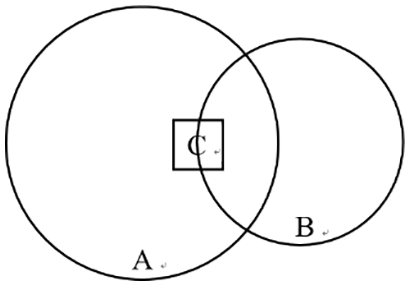
Knowledge distribution relationship. A, B, and C respectively stand for adviser’s territory of knowledge, advisee’s territory of knowledge and the knowledge on the current micro topic. Since the adviser often has more experience in solving family problems than the advisee, adviser’s territory of knowledge is larger than the davisee’s in Figure 1.
Before the phone-in counseling, the adviser and the advisee are strangers in most cases, and they do not know much about each other’s life experiences. Therefore, both parties only have a vague idea of each other’s knowledge distribution, or generally speaking, both parties may roughly consider with prior experience that most family knowledge will fall in the adviser’s territory of knowledge. However, when it comes to micro topics, the knowledge distribution relationship is negotiated in real time in specific interaction. In other words, the knowledge distribution relationship is plastic. The advisee exploits different epistemic stances to accept or eventually accept the advice, which is actually shaping the knowledge distribution relationship of both parties. Therefore, the epistemic status associated with the knowledge distribution is also dynamic (Yu and Wu, 2019: 41). The advisee accepts the advice by means of different actions, which in fact indicates that s/he approves of the current epistemic status relationship. However, in resisting advice, the advisee can compete for the ownership of specific knowledge or build a large territory of knowledge for himself. The competition for knowledge or territory of knowledge needs to be further studied in the future.
Conclusion
From the perspective of Epistemics, this paper analyzed the advisees’ acceptance of the advice in the phone-in counseling for family problems, and explored advisees’ management type of epistemic status relationship embodied by the advice acceptance and advisees’ epistemic stances during the management. Firstly, the advisees’ acceptance of the advice reflects that they tacitly approve of the asymmetric relationship of epistemic status between the advisers (high status) and them (low status); Secondly, this type of relationship management is executed through advisees’ four different epistemic stances, the advisees can display these stances by uttering knowledge acknowledgment, asserting knowledge acquisition, repeating the (partial) knowledge in the advice and expressing the change-of-state tokens, so as to tacitly approves of the asymmetric relationship of epistemic status; Finally, these epistemic stances actually reflect the advisees’ positioning of the asymmetric relationship of knowledge distribution between the adviser and the advisee.
From the perspective of Epistemics, this paper illuminated the advisees’ acceptance of the advice, showed their epistemic stances and revealed the essence of accepting advice, that is, the positioning of the asymmetric relationship of knowledge distribution. This study can help to expand the theoretical perspectives of researches on the responses to advice and give a new illumination of advisory interaction, and provide enlightenment for improving the service quality of the phone-in counseling for family problems and the hosts’ advisory skills in phone-in conversations.
Footnotes
Acknowledgements
The author would like to thank the anonymous referees and the editors of this issue for their valuable comments which greatly helped improve the paper.
Declaration of conflicting interests
The author declared no potential conflicts of interest with respect to the research, authorship, and/or publication of this article.
Funding
The author disclosed receipt of the following financial support for the research, authorship, and/or publication of this article: This study is funded by Guangdong Province Educational Science Project (No. 2020GXJK071) and Shaoguan University Research Project (No. SZ2020SK02).