







Abstract
With reference to the previous empirical works on applause, we explore the roles it plays during the first birthday celebration using multimodal analysis. Particularly, we focus on modes of its initiation and collaborative enactment. The empirical material includes 25 videos from different Polish families. The analysis demonstrates that applause works in interaction (1) as a ritual anchor that allows the participants to move to either the end or the next sequence of the ritual, (2) as an appreciative assessment of the previous action, (3) as a device for focusing joint attention, which coordinates the interaction of participants and (re)focuses the attention on the most important actor/recipient of the ritual.
Keywords
Introduction
Generating applause in public speeches is a well-known issue that has been investigated in the conversation analysis (CA) literature (Atkinson, 1984a; Bull, 2016; Clayman, 1992, 1993; Eriksson, 2009; Heritage and Greatbatch, 1986). Applause in comic performances has also been thoroughly examined (Keefer, 1981; Rutter, 1997, 2001). Wells and Bull (2007) conducted a comparison of audience affiliative responses to political speakers and comedians. However, much less attention has been paid to applause during smaller encounters. A recent exception is the article of Aronsson and Morgenstern (2021) who focused on instances of self-praise demonstrated by very young children.
Applause is one of a few interactional phenomena that are more effectively performed within multi-party interaction than in two-party settings. Like laughing and choral singing, it is performed jointly, so its adequate timing and simultaneity could be regarded as an interactional achievement (Jefferson, 1979; Stevanovic and Frick, 2014). Although applause occurs within a relatively regular sequential scheme of multi-party interaction, like singing, it is achieved effectively only when it connects its orderliness of occurrence with the spontaneity of enactment, like laughing. We believe that research into applause during an informal encounter could reveal important issues developing our general understanding of applause as a social device for collective action.
To ensure comparability between cases, we have collected for analysis one type of multi-party interaction, which is the family ritual of a first birthday celebration. A family ritual is defined by Fiese (Fiese et al. 2002; Fiese 2006) as a gathering for one family that has cultural value and involves symbolic meaning. Although we are taking this example, we are not interested in describing what cultural practice a birthday ritual is. We rather seek more general mechanisms of collaborative coordination of applause, and we would like to understand how applause itself coordinates a multi-party interaction. The birthday seems to us to be an interesting and relevant example for this study, as it is relatively easy to distinguish the specific parts that constitute this ritual.
As a starting point, we refer to earlier research on managing joint attention in a multi-party setting (Collins, 2005; Goffman, 1966; Lerner, 1993, 2002) and on producing applause during public gatherings and media performances (Atkinson, 1984a; Bull, 2006; Heritage and Greatbatch, 1986). In the second part, we will focus on an analysis of our own empirical data collected in the private settings of different families. We describe how group members work on performing sufficiently enthusiastic applause and what problems/disturbances they meet in its organization. As a result, we claim that applause is a specific interactional device to focus the collective attention, to make smooth transitions between different sequences of formalized interaction and to perform spontaneous assessment of an awaited action.
The problem of managing joint attention in a multi-party interaction
Ritualization makes a bridge between the structure of informal everyday interaction and more formalized interaction based on the expected events and allocated identities. It involves practical procedures by which members draw and sustain the attention of participants in interaction which it is not an easy task in a multi-party setting (Bolden, 2011). In a multi-party interaction, some forms of participation are neither serially organized nor designed for one participant speaking at a time and more than one person speaking simultaneously with the other is regarded as proper (Lerner, 1993). In the case of applause, choral co-production of voicing the same words/actions in the same way at the same time is not only proper but also an expected action (Lerner, 2002). Especially, during ritual action some actions and gestures are projected for performing by a collectivity simultaneously (Collins, 2005).
Not only the structure of attention is important for ordering multi-party interaction. As Goffman (1966) noted, the structure of inattention is also significant for an encounter, as it neglects all other interests and actions of participants. Correspondingly, instead of beginning by asking what happens when a definition of the situation breaks down, we can begin by asking what perspectives this definition of the situation excludes when it is being satisfactorily sustained adhering to what might be called rules of irrelevance or structure of inattention to most things from the external world. As in a multi-party setting multi-activity regularly takes place, some activities are given especial preference, while others are visibly treated as disturbing or subordinated actions. Whether a concurrent action is the important and protected line of the interaction or it is regarded as a rather disturbing concurrent action is decided by participants in an ongoing way. The difference between them is observable on the level of its enactment and only sometimes does it become a topic for conversation.
Organization of applause at public meetings: The sequential placement
CA literature describes applause that occurs during public events as playing different roles and specifies: (1) its position within the interactional sequences, (2) the ways it expresses an assessment in an interaction, and (3) the process of how it emerges and disappears within a collectivity.
Customarily, applause occurs at public events with or without special inducement at a specific phase. Introductory (welcoming) applause is when someone comes on stage to begin the performance, while closing (farewell) applause is when someone is about to leave the stage. During public speeches, closing applause follows the ending sequence. As Rutter showed, when it comes to a speech by a stand-up comedian, applause always occurs after the end of the speech, and this response is independent of the speech’s quality (Rutter, 1997). In these situations, applause is not an affiliative response to the speaker’s rhetorical device but emerges due to the phase of the current situation. This sort of applause belongs to the particular event’s sequence, and, to a certain extent, it is anticipated by the event’s participants.
Rewarding applause is somewhat distinct as it occurs when someone is honored or awarded (Atkinson, 1984b; Heritage and Greatbatch, 1986), but in many cases, applause appears, not as a structural part of the event, but in the middle of a speech or conversation. In his pioneering works on applause, Atkinson (1984b) considered the rhetorical and nonverbal techniques for triggering applause, such as naming, listing (especially a three-part list), and contrasting. Other studies have since corroborated and elaborated on his findings (Bull and Noordhuizen, 2000; Heritage and Greatbatch, 1986), and they have considered such rhetorical devices as a joke, negative naming, puzzle-solution, punchline, combination, position-taking, and pursuit. In this literature, applause is seen as a reaction to the particular behavior of the speaker, who is consciously focused on managing the audience. Developing this area of research has led to quantitative studies on rhetorical devices that effectively trigger applause (Liu et al., 2017).
While dependent on particular circumstances, applause can be controlled by the managers of the entire process (Eriksson, 2009). They may use introductory and closing applause as part of the media format, but they also may more or less overtly encourage the audience to clap and/or shout at any other proper moment by using rhetorical devices (Atkinson, 1984a). However, applause may also be managed quite covertly for a television show, such as when directors show a certain card or provide light cues to achieve the desired response from a studio audience (Altman, 1986: 49).
There is also uninvited applause, which is a type that occurs without any special signals from the speaker. Bull (2006) argues that it can be a response to the content rather than rhetoric. In such cases, the speaker does not elicit the audience’s enthusiasm, so the applause is likely to be asynchronous with the applauded utterance.
Applause as a collective assessment
A verbal assessment is a standard device that regularly occurs in an everyday conversation (Pomerantz, 1984). Beginning with the pioneering works by Anita Pomerantz, a large body of literature has described its sequential organization, forms of expression, and the epistemic conditions underlying the process (for overview see: Lindström and Mondada, 2009). Assessments are an essential part of participation in events and social activities where people are focused on the same things and actions (Pomerantz, 1984). Also, a growing body of research shows that an assessment can be formulated in a variety of ways (Davidson et al., 2014; Lee, 2014; Ogden, 2006; Peräkylä and Ruusuvuori, 2006; Ruusuvuori and Peräkylä, 2009).
The first wave of CA research devoted to applause primarily focused on the supporting reactions of the audience during political meetings and television debates (Atkinson, 1984a, 1984b; Heritage and Greatbatch, 1986). For politicians, applause serves as a sign of positive feedback and support for their account from an audience, although how much applause is involved in expressing the audience assessment depends on the context of the speech. Choi et al. (2016) discovered that while applause is connected to speakers’ achievements during the acceptance speeches of the political parties’ candidates for the presidential election and within the presidential election campaign, it is rather simple conformity to social norms during presidential inauguration speeches. While applause is obviously an affiliative response, public speeches (especially political ones) may also evoke disaffiliative responses, such as booing or disaffiliative, equivocal laughter (Clayman, 1992). Applause often appears in confrontational discussions in the mass media (see: Anderson, 1999). In such cases, an audience’s robust and supportive reaction toward one politician may emphasize the failure and mistakes of his or her opponent(s). Rutter (1997) noted that in the closing moments of a stand-up comedian’s performance, applause not only serves as appreciation, but the duration of clapping indicates the level of this appreciation as well. Atkinson described a similar pattern regarding award ceremonies (Atkinson, 1984a).
Assessment applause occurs when the attention of the group is focused on the action being performed by a particular person. Clapping is achieved as synchronously organized collective activity (Clayman, 1993; Collins, 2005). It may include a range of affiliative displays, such as “whistles, laugh[ter] or shouts” (Atkinson, 1984b: 372). As Clayman (1993) noted, individuals become sensitive to small cues from others, like raising hands or affiliative murmurs. When people are seated facing the stage, aural cues are more important than visual ones (Clayman, 1993). Mutual monitoring also determines the length of applause, which causes the audience to slowly “extinguish” applause, for example. At the level of individual behavior, particular individuals gradually applaud in an increasingly weak fashion until they are eventually “excluded” from this performance.
As a collaborative, positive valuation of a preceded action, applause may be useful to express the positive assessment on a low- or high-grade scale (Lindström and Heinemann, 2009). In the CA literature, the low-grade positive assessment contains items like, “good,” or comparative forms, such as “better,” whereas an example of a high-grade word is “brilliant” (Lindström and Heinemann, 2009). While Hosoda and Aline (2010a, 2010b) see applause as a one-dimensional positive assessment, we are convinced that judging by its properties, one may consider applause as either a low- or high-grade assessment. The assessment that is provided by applause depends on the way it is performed. For example, an immediate, well-coordinated, relatively long, and loud applause seems to be a more enthusiastic response compared to one that is delayed, dispersed, silent, and asynchronous (Atkinson, 1984b).
In some situations, applause is not synchronized with a particular utterance. Bull and Noordhuizen (2000) proposed a three-category typology of applause mismatch/mistiming, which includes: (1) isolated applause produced by one or two individuals, (2) delayed applause when there is a gap of silence between the speaker’s point of completion and the audience reaction, and (3) interrupting applause, which does not allow the speaker to continue.
In sum, this body of literature captures the main patterns of applause, which can be invited but not performed by one person, who exploits different sorts of verbal and nonverbal techniques.
Stage and audience divide as an option in a small gathering setting
As we have seen from the review of previous research, coordination of applause during public gatherings and media performance is based on a sharp “the stage” and “audience” divide. Without neglecting how the audience shapes the actions on the stage, we must admit that most initiatives are on the part of the stage while most responses to these initiatives are on the part of audience. In small encounters, there are greater opportunities to take various types of actions regardless of where one is standing or sitting, and thus the division between stage and audience could move or disappear. The interactions include both verbal, vocal and non-vocal turns of all participants present, who could arrange themselves in different ways.
Lerner (1993) observed that in a multi-party interaction people are not treated as separate individuals but some occasion-specific and momentary collectivities become relevant units of participation, which includes practices of speaking to a collectivity and acting for and as a collectivity (see also Schegloff, 1991). Lerner (1993) considers an applauding audience such a momentary ensemble which takes on occasion-specific identities.
In line with such identities and differentiated participation modes, members of the encounter could be more or less actively engaged in interaction and take more or less central positions in its organization. When it displays signs of centrality, the position is described as “deontic authority” (Stevanovic and Peräkylä, 2012). Situational identities of deontic authority position are relevant for explaining the ways of applause initiation, sustaining and closing. Applause initiation itself could indicate who has the right to invite and shape the collective response, and what specific role it plays in the interaction. For example, studies conducted by Hosoda and Aline (2010a, 2010b) in a Japanese English classroom setting showed that applause initiated by teachers demonstrated their expectations and assessment directed to pupils, thus confirming their epistemic rights and authority (Heritage and Raymond, 2005). Similar organization of interaction had been earlier described as a “pedagogical sequence” by Mehan (1979), and involved initiation, reply, and evaluation, strengthened by a collective confirmation of students. Hosoda and Aline’s (2010a, 2010b) research illustrated that applause also helped the teacher in a classroom to manage a transition between different sequences of interactions. The teacher used this technique to encourage the class to end the ongoing sequence and to switch the focus of attention onto the next one. Clapping was also observed in interactions between parents and their children as a form of both play and tuitional modeling of a child’s action (Burns and Radford, 2008).
Birthday, symbolic meaning, and applause
Culturally, a birthday celebration is not specifically connected with Polish culture, but rather more globalized social practices. Gilmore (1990) suggests that the birthday celebration is a characteristic of modern industrial society because it ritualizes the passage of time and puts a numeral count on a person’s years at the center of his or her individual identity. Sirota (2002) claims that the growing significance of children’s birthday ceremonies, observed in France, reveals a change not only in the position of children in Western society but also in the modes of their socialization and sociability. Referring to modern birthday performances, Shoham (2015) sees the difference between them and traditional rites of passage in that the main actors are not expected to perform any tasks that could demonstrate their particular abilities connected with this special occasion.
In a more interactive way, we investigate applause at the first-birthday celebration. In contrast to the family routines and everyday interaction, we treat it as a family ritual, which requires spatial and temporal rearrangements and preparations (Fiese, 2006; Fiese et al., 2002). It is a multiparty interaction often involving previously invited guests. The scenario of the celebration is only generally outlined, which means that participants usually expect the lighting and blowing out of a candle on the birthday cake and singing a birthday song collectively, but their actual placement in the whole event and modes of their performance are worked out by the collectively orchestrated interactions of participants. The level of collective emotional energy of a birthday party observably changes during the party, regularly reaching a peak when the birthday cake arrives and is marked by loud voices, intensively overlapping or simultaneous talk, joint laughter, some expressive movements and gestures, and the applause (Collins, 2005).
The task of the birthday main actor is to blow out the candle on the birthday cake. When it comes to the one-year-old child whose first birthday is being celebrated, this is not an easy achievement (Rancew-Sikora and Remisiewicz, 2020). Generally, toddlers’ participation modes in a collective interaction is different than adults. Around this time, toddlers are just beginning to control their attention in a more direct way and to use gestures such as reaching, showing, giving and pointing at objects or a person in a coordinated and purposeful way (Caselli, 1990). Children about this age achieve the ability to understand the intentions of other people which is necessary for predicting the next action and participation in more developed sequences of interactions (Baron-Cohen, 1991). This process, that starts from 9 months and becomes developed by 18 months (Tomasello, 1995), seems crucial for intersubjectivity making. Still gaining and keeping children’s attention for some time at this age is a big challenge for adults. Filipi (2009: 67–70) points out what gimmicks parents use to manage this task (see also Cekaite, 2016; Ferguson, 1964). In the context of a birthday, the participation of small children is highly differentiated among families and it is shaped by expectations and initiatives of the adults (Rancew-Sikora and Remisiewicz, 2020).
To varying degrees, a child of a certain age is acknowledged as a legitimate participant of social-cultural events. There is research that displays restrictions for the participation mode of children (Ochs and Shohet, 2006; Schieffelin and Ochs, 1986). Fatigante et al. (1998) claimed that these differences reveal not only how children are treated as participants in a community and their socio-cultural position, but also the organization of the broader society. Ochs et al. (2005) explain that limitations in the adjustment of the event to the communicative skills of the child could be linked both (a) to social asymmetries, wherein certain members have socially restricted access to socio-culturally organized interactions that could potentially amplify their communicative skills, and (b) to previously outlined developmental conditions that interfere with the communicative competence of the child. However, this competence is trained and developed: Goodwin and Cekaite (2018) demonstrated how children’s participation, practice, and personal engagement in everyday family routines are a form of situated learning. Parents regularly promote the child’s embodied competence in everyday routines via rhythmically coordinated embodied movements between them (Goodwin and Cekaite, 2018: 208). Moment-by-moment production of the mundane performance indexes agreement and joint attention, and it also implicates the trajectories of future action (see also Goodwin, 1986, 2000, 2007).
Current study: Materials and methods
In accordance with conversation analysis, our basic methodological assumption is that conversation is organized through taking turns by participants successively and overwhelmingly one party talks at a time (Sacks et al., 1974). All transitions from a current turn to the next one create the sequential order of interaction (Schegloff, 2007). A “ritual interaction” as we define a birthday celebration is organized in a partly formalized way, which means that participants share their expectations as to the overall interaction order, situational identities of participants and some “symbolic” activities which relate to the occasion for which they are meeting. At the same time, the expectations toward a ritual interaction course are themselves displayed and responded to as actions in the interaction, so they do not prescribe in advance the specific ways particular participants are involved. To be conducted properly, the ritual interaction needs participants’ mutual attention, collaboration, and repair in interaction. Occasionally a whole collectivity or its featured part acts simultaneously and jointly, so it could be treated in an analysis as an individual participant, although the explanatory relevance of such an association as one joint actor could change during the interaction course (Lerner, 1993). As we are interested in applause as a joint collective action, the focus of our attention is especially on how the transition from the previous collective or individualized action to applause is achieved through the collaborative effort of participants.
Our material consists of twenty-five video recordings of first birthday celebrations that were organized by different Polish families in their private homes. All videos were made by amateur participants (Jones and Raymond, 2012). According to their own orientation, the camera was focused mainly on the child and the nearest participants, mostly the parents, and only occasionally was widened or shifted to the guests (other participants). We have selected three cases for presentation on purpose in order to demonstrate different situations concerning applause organization: when applause followed the other choral action of the collectivity, when applause followed the individual action and when the applause had to be especially elicited and repaired in the situation of the participants’ inattention.
In previous research, applause was treated as a performance by the whole audience taken as one actor. In consequence, the transcript demonstrated applause initiating, closing, duration and intensity referring to its overall rhythm and volume. The small and expanded xs marked more silent and dispersed clapping while the large and unseparated Xs displayed the loudest and the most synchronous clapping, without breaks within its course. As our article also aimed to capture differentiated participation of the members in applause performing, we tried to attribute clapping and boosters to the individuals where possible. A more strict representation of the intensity of applause would be difficult in transcripts given that they were not standardized in terms of sound quality, the equipment used for recording, and differentiated spatial placement of participants. Because we use third-party videos instead of material produced for the study, we were also not able to control the frame recorded by the camera. At the moment of applause, not all performers were visible, hence we were not always able to attribute a hearable action to a specific actor. Nevertheless, we could extract some qualitatively relevant aspects, such as isolated claps and shouts. In reference to all members, the source of information was mainly the audio layer, while the video layer was in the main part limited to the crucial actors of the celebration.
The sequential order for applause during a birthday celebration
Regularly, the main part of the first birthday ceremony consisted of two ritual activities which were followed by applause: the collective singing of the birthday song and blowing out the candle on the birthday cake. Closing these two ritual activities could coincide in time when the blowing out of the candle was organized exactly as the song was being finished and thus the applause was initiated and performed once for both of them. Otherwise, they were more visibly fragmented and shifted in time in such a way that blowing out the candle came first, followed by applause and then collective singing, with applause appearing for the second time after the song was over. In this case, both activities were rewarded with the repeated onset of applause separately. Such a variation of interactive environments for applause occurrence during the birthday celebration allows us to make some comparisons about its organization, the ways the participants collaborate, and the potentiality for more general understanding applause as a joint action when it is studied in the setting of a small gathering.
[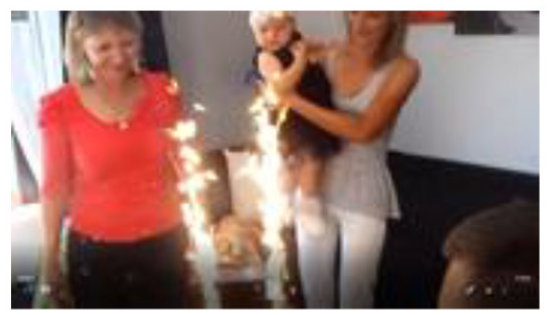
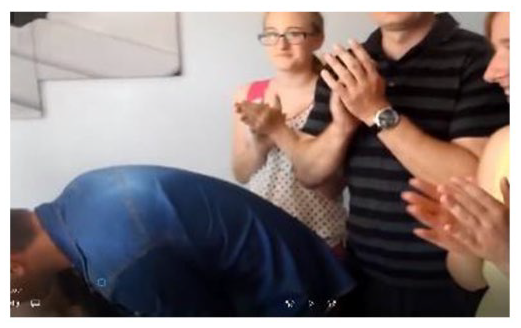
In this example applause occurred as a joint action of the collectivity which follows collective singing, so it could be seen as a kind of prolongation of the state of choral activity of the group and is both its loudest and most joyful moment of expression. As the length of the song could be precisely foreseen, participants started their new collective action almost immediately after it finished, which displayed their response as enthusiastic. The specific time and sequential adequacy of applause was additionally assured by the invitation produced by the mother who shouted the question “TO WHOM?” and grandmother who started clapping first, with the others joining in immediately The rhetorical question of the mother not only invited the collectivity to applause but also directed the collective attention to her child as the recipient. The grandmother appeared as her main supporter and the first performer of applause, demonstrating to the others what kind of applause and the intensity that was relevant. The grandmother was also the last person to stop clapping (line 3).
At the moment when the collective clapping audibly weakened but still had not faded completely, a male guest shouted “Bravo!,” to make it loud once more (line 6) but his action did not restart, strengthen or prolong the collective action. Quite the opposite, the father started to engage in a concurrent action leaning over to his older daughter. At this moment, just after the collective applause was completed, the grandmother produced additional applause shouting “BRA::::: ↓VO::::” with falling intonation (line 3). In an overlap with her shouting, the definite closing of applause was confirmed by the father who produced the question addressed to his older daughter (line 7). The father changing his body posture and producing the utterance related to this change, opened the next legitimate phase of collective engagement which was divided into smaller two- or three-party interactions.
The grandmother’s shouting alone after the applause collaborative was fading could be seen as “after applause,” a solitary performance by a participant who was unwilling to accept the applause finishing. In such a way, she presented her situational status as the most engaged participant. What is worth noting, neither her individual initiatives nor the male guest’s shouting evidently affected the applause closing, but contributed to the realization of really enthusiastic applause which is properly performed in overlap with other actions.
In this example, the applause lasted for 6 seconds approximately. Together with individualized actions of the four participants mentioned above, its collective enactment seemed smooth and unproblematic. There was no delay and the participants continually attached and detached from the joint action. While the parents’ initiatives helped the group to start and end applause at the proper moments, the male guest and the grandmother’s actions which slightly overtook and exceeded the joint performance, helped to give the impression that the group responded eagerly and applause was enacted in an appropriate way.
The excerpts presented below will consider the production of applause after the candle is blown out which is an individual action which modifies the interaction mechanisms of its outburst and also its social meaning. Performed in this place, applause connects its two main justifications: one linked to the placement of applause at the end of the ritual/formalized sequence and transition to another action, and the other associated with the assessment of the previous action. For most birthdays, blowing out a candle is not a difficult task, but for a one-year-old child it is a real challenge that very few children can fulfill.
First, we will demonstrate the organization of applause when these two forms of applause justification were congruent: the end of the ritual sequence had occurred and the child had blown out the candle effectively, getting the subsequent enthusiastic response from the audience. Later on, we will present one more ambiguous or problematic example.
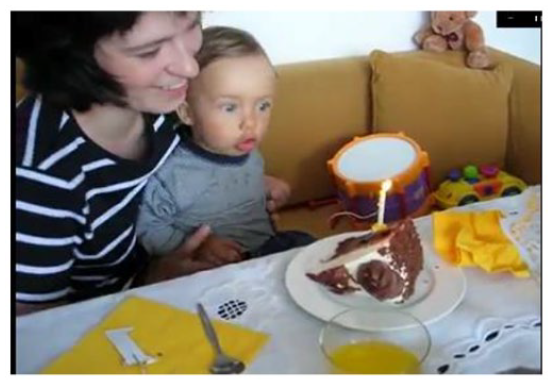
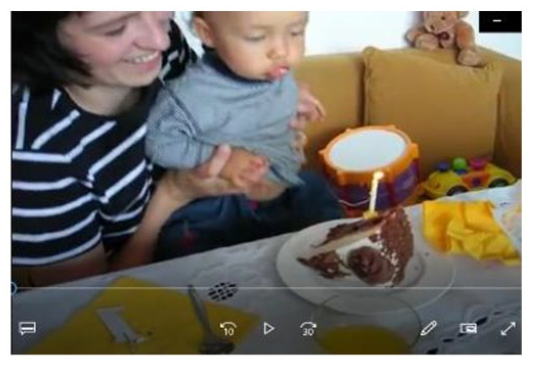
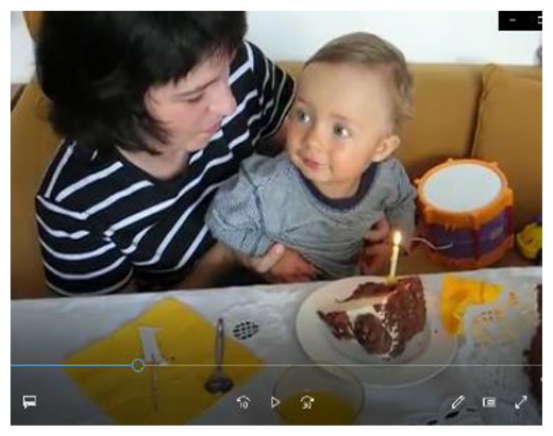
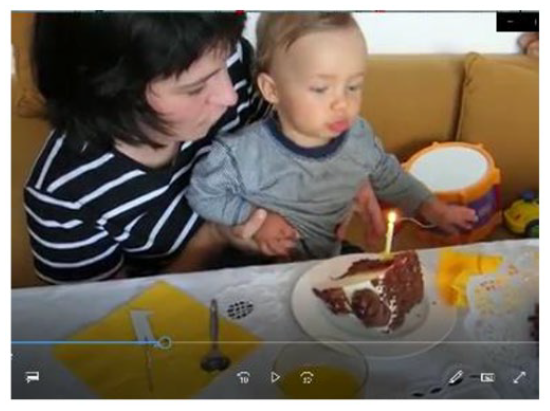
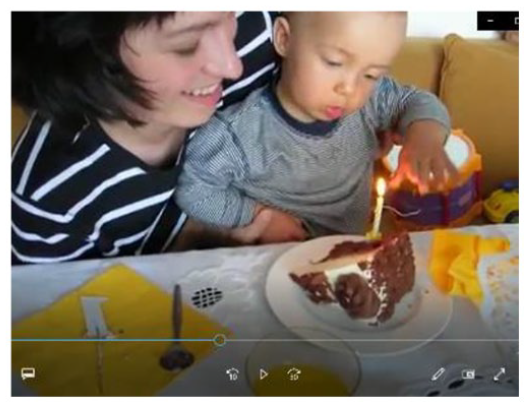
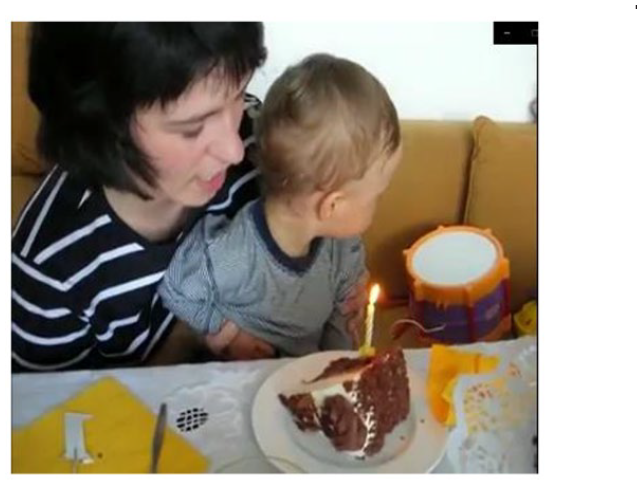
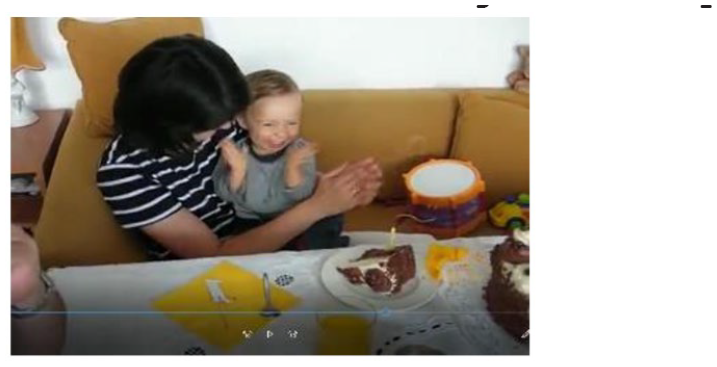
The problem of applause as an assessment attracts our attention not only to the turns that directly preceded or succeeded the assessed action, but a little bit deeper into the preceding sequences of interaction, during which participants decide whether this particular action is to be explained in ritual terms as placed properly in an expected order of interaction, or it is relevant to also regard it as a form of goal-oriented action. Although we have observed attempts to mobilize children quite regularly, in our material we have found only two examples where the child successfully blew out the candle on the birthday cake with the collaboration of adults.
Holding the child on her lap and directing his body toward the candle, the mother produced a whole repertoire of utterances and gestures directed at mobilizing the child for action. Her turns were focused on her child’s actions and adjusted to what he was doing. When we look closer at the whole interaction order transcribed in this excerpt we can see that it consisted of a set of succeeding three or four turn sequences produced by different participants, including the mother-child pair in each of them. Regularly the child or his mother initiated the sequence one by one, and then the other participants followed, so these other participants’ actions occurred as comments of their ongoing actions. The examples are: (lines 1–3) while the child is trying to blow, his mother is carrying him higher, and then the father says “get him closer;” (lines 7–11) the child makes a funny fish face, the mother is laughing, and then the grandfather and grandmother make confirmatory comments and laugh “what a face he is ma(h)king hy hy,” “Ye::ah. Like a little carp! ha ha”; (lines 12–15) the mother demonstrates blowing to the child (“Fu! Fu! Fu!”), the child exhales toward the candle (“hh hh”), and the two grandmothers comment (“O::h! look. The candle is going out!,” “O:::h Ni::::ce”); (lines 16–18) the child extends his hand, the mother catches it preventing him from being burnt, and the grandmother warns “Do not let him [catch] it with his hand?”; (lines 19–22) the child looks to the side, his mother attracts his attention (“So? Simon. Fu! Fu! Once more. Do it once more//”), the child looks straight ahead, the grandfather attracts his attention (“(Little) fish!”), and in lines 23–25 the mother is demonstrating blowing (“F:: f::”), the grandfather urges him to do his work (“So? To work! ↓(little)[fish!”), the child finally blows out the candle. Only then is a real collective response produced in the form of multimodal applause and laughter by all participants simultaneously and successively, extended and strengthened by one another from line 26 to 35. It is also the only example of the toddler self-praise in our material (Aronsson and Morgenstern, 2021).
What is important, the relevance of treating the ritual action as a possible achievement (or failure) was not automatic nor obvious in this context. Rather, it was being made important in the ongoing interaction by the participants who engaged in a collaborative effort of requesting, instructing, demonstrating, mobilizing, and helping the child to undertake this task. In our material some families did not engage in such an interaction at all while others did that with quite a lot effort (Rancew-Sikora and Remisiewicz, 2020).
When adults do not request, instruct or encourage the child to blow out the candle, there is also no space for forming this expectation to happen. Thus, the parents or someone else can blow the candle out on behalf of the child appropriately without making an issue out of the child’s failure. Rather, the whole procedure is normalized and neutralized by reference to an expected ritual order and conducted properly regardless of the child’s active involvement. On the other hand, when adults produce a series of commands and expectation marks before the candle is eventually blown out, this makes the active engagement of the child appropriate and an expected action, contributing also to the relevancy of its assessment in terms of effectivity. Thus, not only the child’s engagement but also the adults’ expectations directed at it are generated through the collaborative activity of the participants. In such an interactional environment the act of blowing out the candle is not only the matter of ritual order completion but it also becomes the goal-oriented action of the participants, including the small child who is the object of their joint attention and action. In such a case, when the collectivity finally abandons their hope and delegates somebody else to blow out the candle on behalf of the child, this does not withdraw the right of the child to be the proper addressee and recipient of applause, but the applause itself could be understood here not only as a ritual action but also as a failure cover or another form of repair for the lack of collective accomplishment.
The appearance of sudden applause is usually preceded by the group’s focus on a specific task, which is performed at a surprising moment for the participants, which in the studied occasion was when the child successfully blew out the candle. This usually manifests itself with a vocal sign of surprise first (“Oh:::”) and appreciation, and then, with well synchronized applause (Wilkinson and Kitzinger, 2006). Another example of a collective surprise mark was associated with a trouble and compassion expression, which was “oh:::” produced with falling intonation. This can be further studied in relation to interactionally achieved surprise.
As mentioned above, contrary to the case when applause follows collective singing, the moment of the candle being blown out for an elicitation of applause is a little bit more problematic. First, because it is preceded by preparatory sequences, which are differentiated in regard to time and collective engagement, and second, it follows a less visible and inaudible individual action, which could be performed by the child or another participant on their behalf. These uncertainties or ambivalences could imply some mismatches of applause, related both to the moment of its proper initiation (the previous action’s completion) and its proper enactment (the previous action’s assessment). Thus, the applause could stress alternatively only the legitimate ritual celebration of the small child’s new status and the proper placement of transition to the next part of the celebration, or it could also reward the child’s achievement, connected with the assessment of the adults’ contribution to the child’s successful action: both the proper placement of transition and the enthusiastic appreciation of the previous action. As already mentioned after Goffman (1966), Lerner (1993), and Bolden (2011), the multi-party encounter involves a single focus of attention on a preferential interaction course, and a heightened mutual relevance of acts and mutual monitoring, which all together also means introducing a temporary structure of inattention, which excludes all other interests and actions of participants as irrelevant at that moment. In the example provided below, the role of applause initiation was to re-direct collective attention back to the prioritized action and to its proper recipient, which made it possible to close this section and to make a transition to the next sequences of interaction. The most interesting issue in this case is, what the systematic difficulties for coordination of the ritual interaction connected with the inattention of participants are and how it could be repaired through applause, which appears to be a loud and pervasive enough action to make all other simultaneous concurrent actions more difficult or impossible to continue.
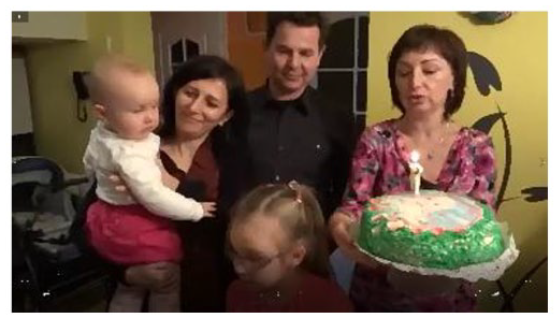
The scene was organized in such a way that the godparents and the mother were standing close to each other in the middle of the room, the father was recording the video and the guests were gathered at the table, not visible on the screen. The older girl occasionally came in to the scene. The godmother was holding the baby in her arms, and the mother was holding the cake with the lit candle in front of her.
This fragment begins just after participants decided that the birthday child could not blow the candle out and someone else had to do it for her. In line 1, the godmother indicated the course of the next action by saying “So let's blow.” to the other two adults in the scene. The mother displayed her readiness for the announced action and specified its timing: “Well?” in line 2, and then all three blew out the candle. Their action seemed unnoticed by the others, because at that moment there was no spontaneous applause nor any other activities related to the candle being blown out.
Instead, immediately after the candle was blown out, two other participants initiated alternative actions (lines 5 and 7). The older girl complained that it was not her who had done it (line 7), even though she had previously offered to blow out the candle on behalf of the one-year-old (line 3). Her initiative was responded to by the godfather in line 9 who promised to light the candle a second time for her and the mother in line 12 who asked him to light the candle for her. The sequential delay in their responses indicated a lower status of this line of interaction at that moment. The second concurrent line of interaction was a male guest’s joke, produced in line 5 just after the candle was blown out, which encouraged loud collective (mostly male) laughter (line 6). At this point, overlapping the older girl’s complaint, the father used “Okay” (line 8) to close these non-priority activities and redirect collective attention to the priority line of interaction, and started shouting “Bravo::::..” As he was making the video and he could not clap his hands, first he articulated his command to the other participants (second person plural in Polish): (“Bravo applaud-”), and then he corrected himself and produced a command in the first person plural, which included his own contribution as well: (“BRAVO we are applauding!”) (line 10). Only then was the collective applause performed, started by the two other participants’ clapping before the rest of the group joined in (line 11). After the applause was completed, the mother asked for the candle to be lit once more, confirming that other actions had become relevant here, although the grandfather alone produced additional post-completion applause, clapping his hands several times.
In this sequential context, the father’s invitation to applaud (lines 8 and 10) acted as a refocusing of the collective attention and prevented the threat of the ritual sequence being abandoned. The father performed the repair effectively, so despite the slight delay, further applause could be considered appropriate for the ritual scenario, and could complete the whole sequence in a coordinated collective action.
Collective interaction requires the establishing and maintaining of joint attention for a relatively long period of time, under the threat of failure (see Collins, 2005), but in a small assembly each participant can change the course of events in some way. In such arrangements, various simultaneous and overlapping participant engagements are so audible and visible, that they can easily attract the attention of others and thus may disrupt the course of the interaction more than during a well-defined stage-audience division at public events. As interactions between family and friends are generally less formalized, even on festive occasions, one of the problems with the multi-party collaboration is that participants may not be able to recognize and precisely manage the moment of transition between different parts of the ritual, or may not be willing to give up other activities. Individual participants may remain engaged in the previous part of the ritual and continue earlier activities, while others have already moved on to the next sequence, and this may result in an interactional mismatch that threatens the ritual order. As we could see, here there is room for the initiative of the local authority, who takes responsibility for maintaining a prioritized action and with the support of others is able to encourage participants to focus on it. The guided applause in the example above was achieved through verbal commands and accompanying demonstrations. This can also be achieved by merely presenting non-verbal embodied instructions by the people who simply start the expected action in an appropriate mode, and continue it until the others join in (Keevallik, 2010; Lerner, 1995; Raymond and Lerner, 2014).
Discussion
In this text, we have tried to look at a relatively simple and short ritual as if we had not seen it before. We were interested in its course and diversity, both within a given family and between families. The universalized scheme of the ritual action allowed us to make quite rigorous comparisons which revealed differentiated use and meanings of applause. Each of the three analyzed excerpts revealed different sequential placement of the applause and the slightly differentiated role it played in interaction. In the first excerpt, applause occurred at the end of the collective action of singing and allowed the participants to go further in the ritual order. In the second excerpt, the applause appeared as a collective appreciative response to the action of the small child which was connected to the ritual order. In the third excerpt, the applause occurred in the conditions of dispersed attention, and it was visibly elicited by the father of the child who took responsibility for focusing the attention of the participants and conducting the ritual to its end successfully.
A family celebration of the child’s first birthday, recorded both in the memory of participants and on the video, appeared as a part of socialization and introducing the child into cultural practice. We could observe on an ongoing basis how the family was focusing its attention on the child and also mutually on each other, and how it was making its collective effort to have a proper birthday and to preserve it from various distractions. In this process, the role of applause was evident as a clear point of passage within the ritual action, which needed to be coordinated and had the coordinating role. The ritual practice has reproduced some of the cultural traditions of modernity while at the same time contributed to shape family relationships and traditions in its own way. Like other holidays, birthdays are cyclical, although the status of the members changes with their age, just like the nature of their possible achievements and failures transform in time and the basis for the expression of enthusiasm by family-and-friends. How it happens later in the course of family life could be a theme for further investigations.
As mentioned above, the CA literature on applause has so far been based on a spatial and functional division into “stage” and “audience.” Unlike public gatherings, small encounters help to soften this sharp divide, even though family ceremonies involve similar distinctions, placing key actors on stage. Since a private space does not designate different areas for different categories of participants, all individuals can contribute to the course of interaction by performing different types of actions – assuming managerial roles, providing support or disturbing others, displaying more or less personal engagement in the performance as a whole. Thus, their actions contribute to negotiating or changing the meaning and shape of the collective action performed.
In our data applause appeared in various roles in a multi-party ritual interaction: as a performance inscribed in a ritual scenario, as an assessment of a previous action, and as a repair for inattention, and these three roles were played alternately or simultaneously. Both its sequential placement and the very details of applause performance showed what specific action the applause played in a given situation. An important issue related to its implementation was the reference, optionally, to a prior individual or collective action. When applause is related to the previous individual action, its assessment potential seemed to be more significant, although its evaluative property had been negotiated by the participants in the preceding sequences of action, and the relevance of the very category of an achievement included in the ritual celebration was different.
Immediate applause appeared in synchrony with the completion point of the sequence, while delayed applause was preceded by actions unrelated to the priority sequence of the ritual. This could be because the participants were unable to see the end of a particular sequence due to distracted attention or the organization of interaction did not provide clear signals. As previous research has shown, spontaneous applause seems to be displayed when the whole group starts it immediately and almost synchronously. On the other hand, guided applause occurs when a particular person with deontic authority had to use special incentives: he or she initiates the applause alone and/or verbally encourages others to join in. People with deontic authority also mark the applause closing, while the most engaged performers tend to continue it alone a little longer after its completion.
We have noted that vocal activity induced by one person could elicit a similar or the same echo response in others and precede collective clapping as a kind of invitation. When it followed the clapping, it gave the impression that the applause lasted a little longer, but at that point it could not restart the collective involvement. By starting first, finishing last and/or providing special boosters, the participants contributed to assigning or confirming the special status of those who took responsibility for all teamwork or supported the key participants most.
As we have displayed, applause that occurs in an appropriate sequential placement can give participants a clear signal and help them orient themselves at the most important moments of the interaction, so they can clearly distinguish between different sequences and specific ritual actions and manage their own transitions between them. An anchoring applause occurs when it follows the completion of the previous sequence of interaction, and it is a clear signal to start the next sequence after the ritual. Participants involved in this type of applause confirmed that the prior action was properly performed, which justified starting a new sequence. In other words, its occurrence was linked to the structural point in the ritual, according to the ritual’s script, similar to the closing applause of a comedian’s speech (Rutter, 1997). Ending the applause as a collective action itself was achieved step by step by mutual monitoring, and fading applause seemed to be the ultimate sign of the sequence closing.
There were two different bases for a positive assessment of the child through applause during the first birthday. The first was connected with the special status of the child on this day, as was the case at the end of the birthday song, and the second was linked to their possible achievement, regardless of whether they succeeded or not. The second case was especially apparent when, in very rare situations, the child actually managed to blow out the candle. But it may also be relevant in other situations, when the blowing out of the candle was preceded by a more or less extensive series of instructions, demonstrations and encouragements addressed at the child by the adults present.
We encourage other researchers to examine the occurrence of applause in other small-group settings, as well as in other cultural contexts besides Polish, as they may involve different interactional devices for the triggering, enhancing, and sustaining of applause. Using video data provides access to view the whole group, and this may be helpful for studying multiparty coordination and the role of gaze direction in the mutual regulating of an applause’s length and loudness in depth. Furthermore, an interesting topic that could be further developed is identifying different ways used for both repairing applause itself or repairing the ritual or other kinds of interaction through applause initiation and enactment.
Footnotes
Declaration of conflicting interests
The author(s) declared no potential conflicts of interest with respect to the research, authorship, and/or publication of this article.
Funding
The author(s) disclosed the receipt financial support for the research, authorship, and/or publication of this article: This work was supported by the University of Gdańsk [grant number 538-7132-B170-18].