







Abstract
This study explores how preteen children in everyday interaction mobilize relationship categories to negotiate what counts as appropriate romantic feelings among peers. The analysis draws on ethnomethodological work on membership categorization and conversation analysis, integrated with ethnographic knowledge of children’s social life. Particular attention is on how children make claims of and resist membership in a particular relationship category (that of boyfriend-girlfriend). The sequential analysis shows how category-based claims of ‘liking someone’ and ‘being together,’ indexing a boyfriend-girlfriend relationship, are responded to with resistance and denials. Categorical claims are also turned into public performances of relational pairing invoking the normative character of romantic matchmaking. The findings suggest that norms of feelings play a central role in preteen children’s emotional behavior, and serve as important cultural resources for children to address their emergent concerns regarding peer group relationships.
Keywords
Introduction
This study explores how preteen children (aged 11–12) in everyday interaction mobilize relationship categories to negotiate what counts as appropriate romantic feelings and relationships among peers. Prior research has shown that children begin to develop cultural knowledge and norms about romantic relationships in middle school, as well as how such norms are practiced within everyday spaces (cf. Eder et al., 1995; Goodwin, 2011; Renold, 2005; Renold et al., 2013). For example, in an ethnographic school study, Renold (2005) found that for most preteen girls, participating in the school’s boyfriend-girlfriend culture and being a girlfriend were central to attaining high status and popularity in their peer group. Simon et al. (1992) also show that adolescent females use a variety of discourse practices to communicate and reinforce feeling norms regarding the importance of romantic relationships and the appropriate object of one’s feelings. Other researchers demonstrate how preteen boys’ emerging romantic interests give rise to jocular language practices that address the ambiguities and embarrassment surrounding boys’ engagement in romantic relationships (Andréasson and Evaldsson, forthcoming; Kehily and Nayak, 1997; Renold, 2005). Although romantic relationships are important for children and youths, little attention has been given to the ways in which cultural knowledge about romantic relationships and feelings emerge, and are constructed among preteen girls and boys in everyday peer group interactions.
This study draws on a peer language socialization approach (Goodwin and Kyratzis, 2012) to examine how children build their social worlds and co-construct identities in interaction with peers, while cultivating social relationships and negotiating shared norms as part of their emergent peer culture (Corsaro, 2018). The analysis is based on ethnomethodological work on membership categorization and conversation analysis (MCA: see Sacks, 1972; 1992; Stokoe, 2010). Particular attention is given to how children, as they make claims of and negotiate romantic relationships, perform and resist membership in a particular relationship category (here of boyfriend-girlfriend). As Pomerantz and Mandelbaum (2005): 153) note, participants constantly achieve and renew their relationships with one another ‘through talking and acting in ways that are recognizably bound with relationship categories’ (cf. Goodwin and Kyratzis 2012: 366). Two interrelated aspects of membership categorization analysis, the invocation of norms and the organization of social relationships and social order, are in focus in the analysis, which combines ethnomethodology and conversation analysis (Housley and Fitzgerald, 2009; Sacks, 1992; Evaldsson, 2007). As Housley and Fitzgerald (2009) note, MCA involves an analytic sensitivity to displays of categories and normative assessments as practical and occasioned matters in relation to the accomplishment of social and moral organization. A crucial feature of membership categorizations is that they ‘both are constitutive of and reflect conventional expectations of normative behaviors within a specific group and culture’ (Evaldsson, 2021: 305; Stokoe and Smithson, 2001).
The selected data is based on ethnographic research combined with video recordings of preteen children’s everyday peer group interactions (approx. 45 hours of video) by the first author in a Swedish multiethnic school setting. The study investigates children’s performances of romantic relationships within a conversational environment of assessment activities (cf. Goodwin, 2011) and jocular play (cf. Andréasson and Evaldsson, forthcoming). Examining the interactional organization allows us to investigate both how categories that invoke particular relationships are deployed, and how normative assumptions of what counts as culturally appropriate feelings and relationships are negotiated among peers. The analysis is enhanced by an ethnographic understanding of children’s social life (Goodwin, 2011: 251), taking into account how ‘wider social structures and discourses can be located, observed and described within situated interaction’ (Evaldsson, 2005: 764).
Before proceeding with the analysis, we will first discuss prior research on how children across groupings make use of membership categorizations when building social organization. Thereafter, we present some methodological considerations and ethnographic information about the social life and peer cultures at the school that are of relevance for the analysis.
Research on peer language practices, relational work, and category memberships
Recent research has demonstrated how children, across groupings and cultures, mobilize a range of category devices to make evaluative commentaries and negotiate social relationships and gendered norms in everyday peer language practices (Evaldsson, 2002, 2007, 2021; Goodwin, 2007, 2011). Goodwin (2011: 255) shows how boys and girls in a progressive American school setting utilized gendered membership categorizations ‘to lay claim to particular activities as exclusive to their gendered cohort.’ Gendered categories such as ‘boy’ or ‘girl’ also functioned as a ‘stance carrier’ whose meaning depended ‘on the actions in which it is embedded and the context in which it is used’ (Goodwin, 2011: 268). The girls performed embodied actions (such as joyful response cries or negative assessments) together with gendered categories, to strengthen within-group relationships and express derision toward a particular peer. In an ethnography of girls in multiethnic friendship groups (aged 11–12 years), Evaldsson (2007) shows how contrastive relationship categories of ‘good friend’ versus ‘bad friend’ functioned as resources in the girls’ assessment practices for realigning the social and moral order. By ascribing negative category-bound activities such as ‘lying’ or ‘talking behind someone’s back,’ the girls cast a targeted girl as a member of the category bad friend and ultimately friendless (Evaldsson 2007). Evaldsson and Svahn (2017), investigating gossip dispute practices among a friendship group of young girls (aged 11) at a Swedish multiethnic school, found that the girls showed support in aligning against a non-present target while mobilizing highly affective stances together with negative membership categorizations, indexing particular behaviors such as ‘talking behind someone’s back’ as deviant for their gender (cf. Evaldsson, 2021). Goodwin (2007) also demonstrates how a group of white American girls handled the experience of being excluded from participation in a sport activity through assessment activities. The girls invoked negatively valued social categories and person descriptions in gossip talk both to display indignation regarding an absent offender and to demonstrate similar forms of alignment concerning the target being evaluated. Through their collaborative affective stances, the girls strengthened social alignments and affirmed their friendship while simultaneously creating differentiated identities and positions for those present, thereby justifying practices of exclusion (cf. Goodwin and Alim, 2010).
So far, few studies have investigated how evaluative language practices, including social categories, are used by children and youths to perform romantic relationships and construct norms of feelings. Particularly Simon et al. (1992; cf. Eder, 1993), in ethnographic studies of adolescents’ peer relationships and peer cultures in American middle school settings, demonstrate how adolescent females in everyday interaction developed feeling norms underlying romantic love. Social categories and person descriptions (such as ‘boy crazy,’ ‘slut,’ and ‘gay’) were used as resources to communicate and establish gendered norms related to monogamy, heteronormativity, and exclusivity. Even if the girls increased their popularity by orienting to norms of feelings that ‘one should always be in love’ (Simon et al., 1992: 41), being ‘boy crazy’ could be evaluated negatively among female friends as inappropriate behavior. The norm of heterosexuality was communicated through gossip about non-group members’ deviant affect and behavior, whereby overinvolvement with boys could easily give rise to slut shaming by their own friends. Eder (1993) also found that romantic relationships with boys created tensions among female friends that were difficult to deal with, especially if they gave rise to jealousy. The girls engaged in romantic and sexual teasing activities that accomplished ‘multiple peer objectives,’ such as strengthening female friendships, communicating liking to males, and experimenting with gender roles (Eder 1993: 18).
In sum, these findings demonstrate that relationship categories are central cultural resources for both boys and girls in evaluating ‘. . .what counts as culturally and morally appropriate conduct. . .’ while building local social organization in children’s friendship groups (Evaldsson and Svahn, 2017: 80).
Analytic procedures
In the analysis, an ethnomethodological approach to membership categorization sequence work (Stokoe, 2010; Stokoe and Smithson, 2001) is combined with a multimodal conversation analytic approach to stance (Goodwin, 2007), to explore how normative assumptions of romantic feelings and relationships are constructed and performed among preteen children in everyday peer group interactions. An ethnomethodological approach to membership categorization sequence work (MCA, Stokoe, 2010) involves examining the practices that display culture-in-action in relation to the accomplishment of social and moral organization (Housley and Fitzgerald, 2009). Building on Sacks’s (1972, 1992) work on membership categorizations, the analytic focus is on the practices through which group members, in making normative assessments, link category-bound actions and categories with the person being assessed (Evaldsson, 2007; Goodwin, 2007). According to Sacks (1992), membership categorizations are bound up with particular actions – so-called category-bound activities – characteristic or constitutive of a category (Goodwin and Kyratzis, 2012). By performing certain actions, a person may be ‘treatable as a member of the category with which those features are conventionally associated’ (Antaki and Widdicombe, 1998: 4).
By assessing group members, children also take up either common or divergent stances in relation to the target or stance object (Dubois, 2007) while positioning one another in the local peer group and negotiate social alignments (Goodwin and Kyratzis, 2012). A multimodal interactional approach to stance and membership categorization (Goodwin, 2007) is used here to analyze how children utilize membership categorizations as publicly available resources to make evaluative commentaries on one another’s actions, relationships, and feelings while positioning one another and displaying alignments (cf. Evaldsson, 2021). We use Goffman’s (1981) concept of footing to explore how the participants organize their participation through shifting forms of stances and/or alignments while they invoke relationship categories to assess one another (see also Goodwin and Goodwin, 2005). The attributions of relationship categories also index different social positions, rights, obligations, and status relationships among peers (Sacks, 1992; Antaki and Widdicombe, 1998). We will show how the multiparty participation organization of the children’s playful assessment activities allows them to create alignments and enhance friendship relationships while distancing themselves from categorical claims of romantic relationships.
The detailed analysis is enhanced by an ethnographic understanding of the children’s social life, interactional history, language practices, and social arrangements at school (Evaldsson, 2005; Goodwin, 2011). Thus, for MCA, the analyst necessarily draws on extra-contextual resources in the form of participants’ cultural knowledge and relationships as well as the wider context in order to explicate their sense-making practices (Stokoe and Smithson, 2001).
Setting, children’s peer relationships, and language practices
The video-ethnographic fieldwork was conducted by the first author over the course of a year in a multiethnic school setting, as a part of thesis work exploring children’s language practices and peer cultures in two fifth-grade classes. The long-term fieldwork provided access for documenting the children’s peer language practices (teasing, gossip, storytelling, assessment activities, etc.) and how they orchestrated their relationships (peer group relationships, friendships, girlfriend-boyfriend relationships, etc.) among peers.
In the schoolyard, the children socialized in both same-sex and cross-sex groupings. In boy-girl groupings they often initiated humorous, playful activities (such as teasing, humorous narration, and joking) to address ambiguities and transform tensions related to romantic relationships (Andréasson and Evaldsson, forthcoming; Eder, 1991, 1993). Particularly boys engaged in jocular play in their ‘doing of friendship’ (see Andréasson and Evaldsson, forthcoming). In so doing the boys oriented to shared norms of ‘having fun’ and the importance of coming up with playful and qualified responses (Andréasson and Evaldsson, forthcoming). However, more aggressive forms of teasing involving derogatory gendered insults and physical matchmaking (such as pushing a girl and boy into each other) were sometimes oriented to as problematic, not least by girls. Both girls and boys displayed an orientation to a taken-for-granted heteronormative social order, indexing local boy-girl relationships as being romantic (cf. Goodwin, 2011; Renold, 2005: 253). Through jocular language practices, they also positioned themselves as ‘popular’ and ‘being known’ among other school children, while strengthening cross-gender relationships within the local peer culture. In Eder’s (1985) terms, the peers formed ‘circles of popularity’ by talking about and making playful evaluative commentaries on others’ romantic feelings and relationships among peers. Girls who were described as attractive, and as having romantic interest in boys, were talked about as popular by both boys and girls. However, popularity did not always equal being ‘liked’ within the community (Eder, 1985: 155). The most popular girls could also be referred to as ‘girly girls’ whose only interest was in their appearance, clothes, and chasing boys. Boys gained similar peer status and popularity by participating in sport activities and jocular play practices (cf. Andréasson and Evaldsson, forthcoming). In contrast, boys referred to as ‘nerdy’ were not key protagonists in the school’s boyfriend-girlfriend culture. Importantly, as will be shown in the second section of the analysis, being pushed into a relationship with a popular girl could validate a boy’s social status and popularity in the network of romantic matchmaking.
Playful normative assessments and categorical claims
For the analysis we have selected episodes from peer group constellations in which the children, through playful language practices, make evaluative commentaries on one another’s romantic feelings and relationships by making categorical claims of a boyfriend-girlfriend relationship. We explore two forms of ‘categorization sequence’ work (Housley and Fitzgerald, 2009; Stokoe, 2010) in relation to moral assessments and evaluative commentaries on romantic relationships. In the first part of the analysis, we examine how category-based claims on romantic relationships are accomplished, responded to, and assessed among the peers. The second part focuses on performances of relational pairings into categories of ‘boyfriend’ and ‘girlfriend’ and how these are responded to, and allow the boys and girls to co-participate in public performances of romantic matchmaking.
The video-recorded episodes are transcribed following conventions within conversation analysis (Jefferson, 2004). The transcripts are combined with selected frame grabs to capture some of the bodily complexities of the children’s peer group participation. For ethical reasons, all names of the children in the analysis have been replaced with fictional names.
Categorical claims of romantic relationships
In the first part (Excerpts 1a-b) we focus on how category-based claims of ‘liking someone,’ indexing a boyfriend-girlfriend relationship, are responded to in a peer group of three friends – Tina, Elina, and Hamid – who often socialize in the classroom. When we enter Excerpt 1a, Elina is seated at her desk at the back of the classroom facing Tina. In line 1, Tina gazes at Elina and makes a categorical claim about a romantic relationship: ‘you like Hamid.’ This puts Elina in a position in which she must account for her supposed romantic feelings for Hamid: Excerpt 1a
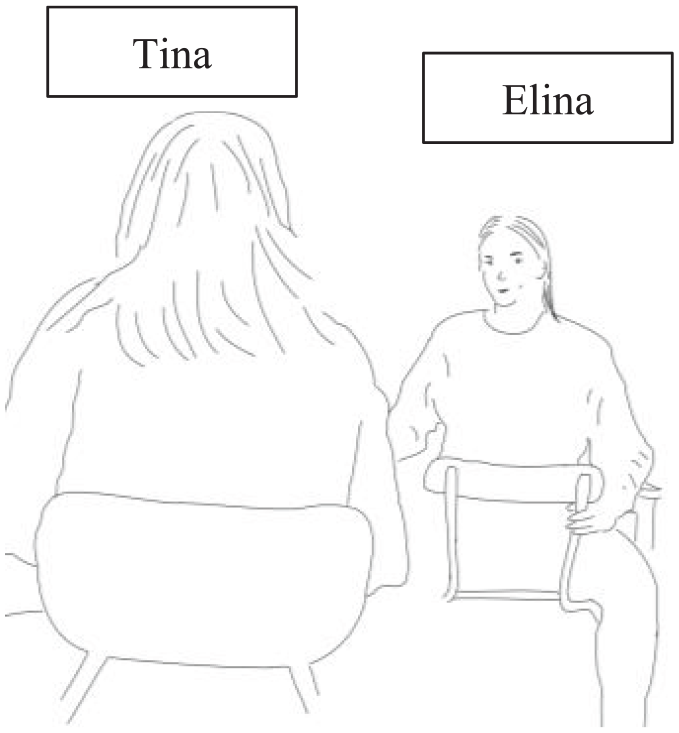
Elina hesitantly responds to Tina’s claim of a romantic relationship with a high pitched ‘wha
In what follows there is a shift in footing in the girls’ peer group participation (Excerpt 1b), as Hamid takes a seat beside Elina. At this point, Tina transforms the information about the two children’s romantic relationship into a public event in the form of a newsworthy announcement, first addressing Hamid in a shouting voice (line 8) and then claiming that Elina used to ‘like’ him (line 10).
Excerpt 1b
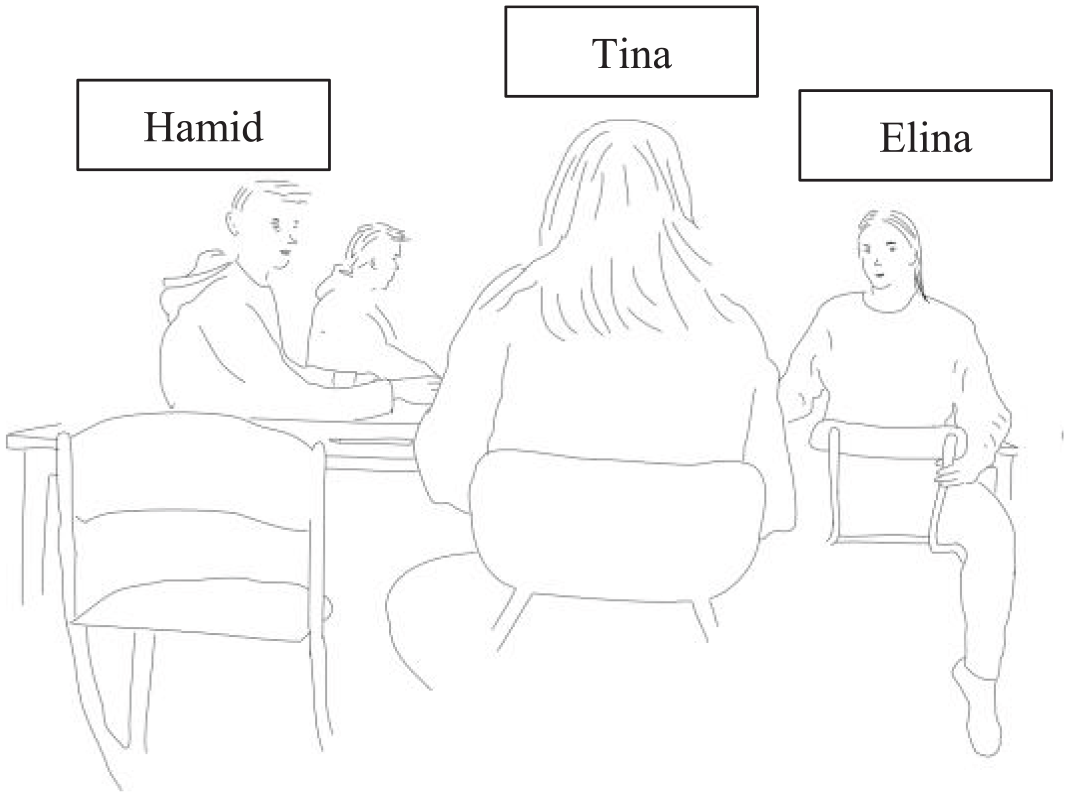
The romantic feeling of ‘liking’ Hamid, which was previously treated as private information between the two girls, is now recycled and transformed by Tina into a publicly shared romantic relationship claim involving the boy being discussed (lines 8, 10). Both Elina and Hamid downplay Tina’s emotional disclosure by forming an alignment, stating that this is already known information (lines 11–13). This collaborative oppositional stance downplays the claim of the two of them having a romantic relationship. Thus, by downplaying the newsworthiness of Tina’s claim Hamid and Elina manage to reinforce their ongoing friendship relationship (c.f. Thorne, 1993).
In what follows, the categorical claim of ‘liking someone’ makes available a frame of reference in which different forms of relationships and attributes of a person can be described (Evaldsson, 2005; Sacks, 1992). A few turns later Tina makes another categorical claim, stating ‘you’ve also been together’ (line 15). She now upgrades the relationship category ascription, explicitly positioning Elina and Hamid as part of a boyfriend-girlfriend relationship. The relationship category is treated as problematic by Elina, who immediately questions the category ascription with a high-pitched ‘what?’ (line 16). Hamid aligns with the oppositional stance taken by Elina, through a dismissive headshake (line 17). Elina’s and Hamid’s collaboratively performed oppositional stances toward the relationship category depiction serve to challenge Tina’s entitlement to disclose private information in public and fabricate others’ experiences (‘you’ve also been together’). The problematic relationship category ascription of ‘being together’ becomes even more evident as Elina uses an ‘extreme case formulation’ in her response (Pomerantz, 1986) to account for why she could not have been together with Hamid: ‘I have never been together with °anyone.°’ (line 18). In a playful mode Hamid aligns with Elina by providing further evidence for her claim ‘it’s true she’s been. . .single her whole life’ (lines 19–20).
Contrastive relationship category devices as moral resources
As shown, categorical claims of ‘liking someone’ are responded to with less resistance among peers compared to claims of ‘having been together.’ In the following part of the analysis (Excerpt 1c), we will show how the children deploy contrastive devices such as having ‘never been together with anyone’ (line 18) and of having been ‘single her whole life’ (lines 19–20) ‘as a means of providing morally contrastive resources’ (Housley and Fitzgerald, 2009: 351) that reference their notions of what count as (un)acceptable behaviors among peers (Evaldsson, 2007). In the following, Tina defends Elina by launching a contrastive relationship category, ‘fuckboy,’ which contrasts the positioning of Elina as ‘being single’ (lines 23–24): Excerpt 1c
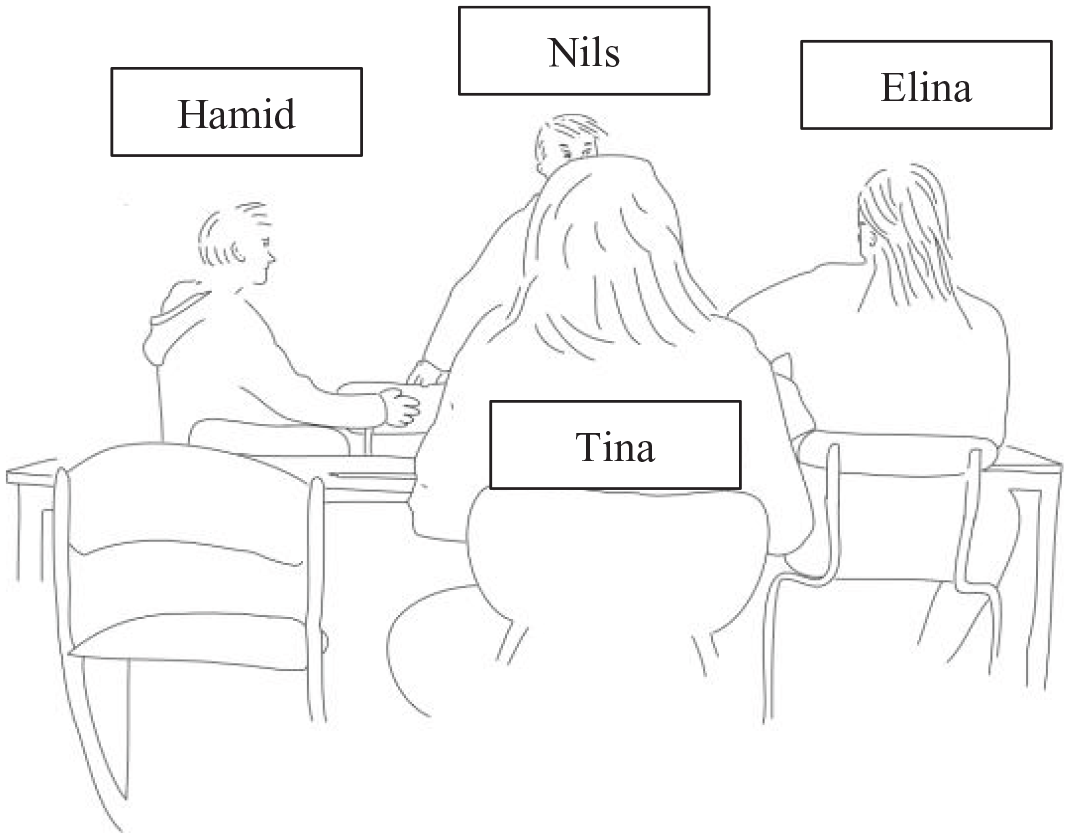
Hamid’s response, ‘that is actually tru:e Ti:n:a.’ (lines 25–27), involves some bodily cues that suggest that he does not treat the derogatory claim in line 30 that he is a ‘fuckboy’ seriously (i.e. of having several girlfriends at the same time). He then moves his body closer to Tina while smiling and looking at her, mockingly using her name as a term of address – ‘
Hamid immediately upgrades his mocking stance by playfully challenging Tina for having multiple boyfriends – ‘how many boyfriends do you have’ (line 30). Tina once again replies in a serious way. By turning the derogatory claim into a personal concern, she questions Hamid for his derogatory gender categorization of her as a ‘fuckboy,’ saying ‘I am not a boy.’ (line 31). At this point, Tina initiates a repair trajectory to get the others’ attention. Through an exaggerated oppositional stance displayed in a loud voice, ‘I AM N
The analysis demonstrates how contrastive relationship categories provide moral resources for the children to playfully mock one another and fight back with the aim of having fun (Andréasson and Evaldsson, forthcoming). The serious response displayed by Tina also shows that the use of derogatory gender categories such as ‘fuckboy’ and ‘fuckgirl’ is risky moral business that easily backfires as they can be turned against their user (Evaldsson, 2005). Simultaneously, the children orient toward the relationship category claims of being a (romantic) couple as morally problematic. Tina’s upgraded category-based denial of her as a ‘fuckgirl’ also indicates that the peers orient to gender norms of monogamy in the sense that ‘one should have romantic feelings for only one [person] at a time’ (Simon et al., 1992:39).
Relational pairing: Indexing ‘flirting’ and ‘being together’ as linked to social status
Membership categorizations are powerful interactional resources for organizing and negotiating social relationships, as they both reflect and are constitutive of different social positions, statuses, rights, and obligations within children’s local peer cultures (Goodwin and Kyratzis, 2012). In the second part, we will focus on how the children co-participate in public performances of relational pairings of boys and girls into the category of ‘boyfriend- girlfriend.’
The analysis focuses on how a peer group of two girls (Ghina, Johanna) and two boys (Hamid, Manish), with different social statuses linked to popularity, invoke romantic behaviors of ‘flirting’ associated with the category-bound activity of ‘being together.’ The episode includes Ghina and Manish as the focal participants. Ghina, one of the more popular girls in school, often socializes with the popular boys. In contrast, Manish does not belong to the ‘romantic circle of popularity’ (Eder, 1991), but rather often hangs around with his male friends, participating in jocular play practices.
As we enter the transcript the four peers are hanging out and talking in the schoolyard, and Manish has been instructing the others in how a web browser can be used to conduct an online search. In line 1 Ghina playfully teases Manish, telling him to search for the world’s most beautiful girl, which would allow him to see her ‘every day’ (lines 1–3). The two children’s different social statuses – Ghina being a popular girl and Manish being outside the romantic circle of popularity – contributes to the romantic category-based claim of ‘flirting’ becoming rather ambiguous, but also highly exciting and humorous: Excerpt 2
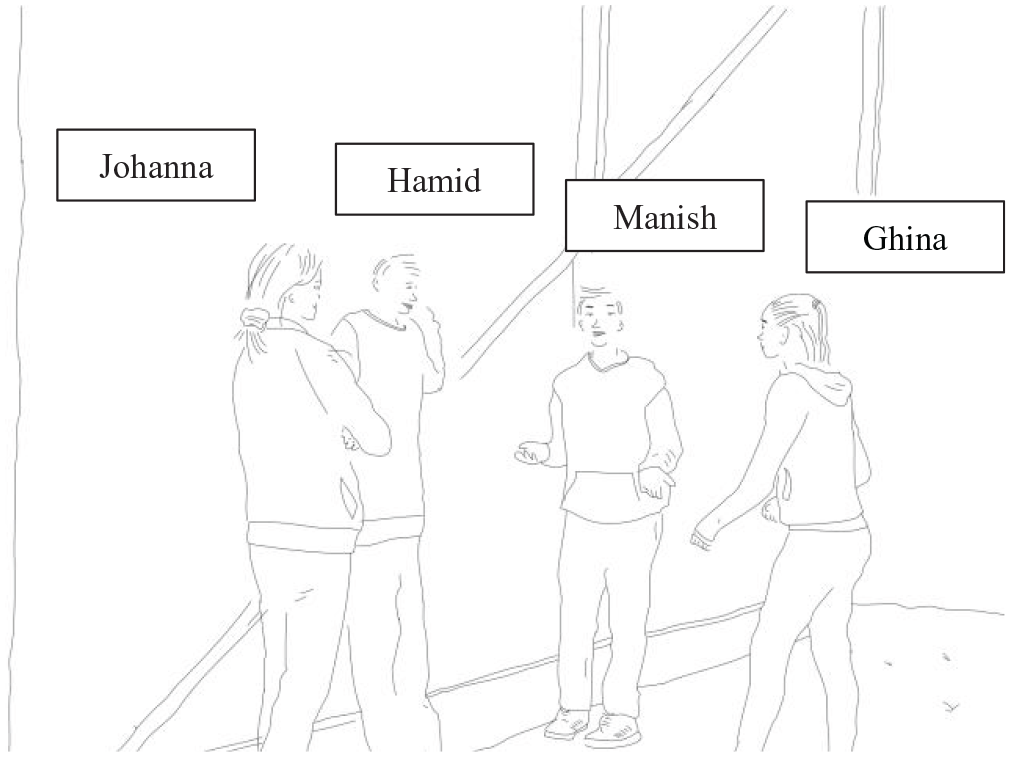
Manish
Johanna immediately transforms Ghina’s humorous subjective stance claim of being ‘the most beautiful girl’ into a normative expression of a romantic relationship claim directed at Manish: ‘was that a flirti:ing thing?’ (lines 6–7). Johanna’s public claim puts Ghina in a position in which she has to account for her potential romantic behavior toward Manish. At this point, all four children burst out in exaggerated laughter, shouting and making faces. The jointly performed affective stances frame the claims of Ghina ‘flirting’ with Manish as both unexpected and highly humorous (lines 8–11). Ghina responds to the ascribed categorical activity of flirting with a response cry, shouting and laughing out loud: ‘NAH NO::HOHO’: (lines 11). Simultaneously, the others engage in collective jocular outcries in which they playfully comment on deviant feelings of a popular girl, with Ghina ‘flirting’ with an unpopular boy like Manish (lines 12–16). The humorous framing thus enables the boys and girls to playfully address the normative character of ‘who are a romantic match’ within the local boyfriend-girlfriend culture (cf. Andréasson and Evaldsson, forthcoming). Simultaneously, the exaggerated embodied responses and collective laughter downplay the emotional tensions linked to the peers’ playful categorical claims that Ghina’s actions are ‘flirting’ (cf. Eder, 1991, 1993). The jocular play reaches its climax when Hamid produces a final punchline in which he evaluates the romantic relationship claims: ‘Ghina flirts with Manish, and nerd– the nerd – and the popular girl really get – (claps his hands) together’ (lines 17–20).
The peers’ collective and playful engagements illustrate the dramatic and performative character of relational pairing and romantic matchmaking, in the sense that claims about romantic relationships can easily be turned into an exciting and dramatic event through collective humor and laughter (cf. Andréasson and Evaldsson, forthcoming; Eder, 1991). By altering the participation framework into play, the children adopt a meta-communicative stance toward the relational pairing indexical of the boyfriend-girlfriend culture. In so doing, they play with the hierarchical gendered structures of romantic relationships and give new meanings to concerns of popularity and attractiveness, which maximize the fun of the activity (cf. Simon et al. 1992). This allows children with different peer statuses to participate in public performances of relational pairings and romantic matching in the schoolyard. At the same time, the analysis illuminates how romantic relationships are tied to social status and popularity, establishing systems of social stratification among peers.
Public performances of romantic relational pairing and normative actions
In the final episode we will continue to focus on how the children stage public performances of romantic relationships that are ‘configured in terms of a procedural relational pairing’ (Housley and Fitzgerald, 2009: 354), in the sense that they tie particular children to the relationship category of boyfriend-girlfriend. In Excerpt 3 the six classmates David, Hamid, Manish, Ghina, Maria, and Evelyn are socializing in the school corridor when David suddenly directs a playful tease at Ghina in the form of the implicit directive ‘it’s time to kiss Hamid’ (line 1). The anticipation of the category-bound activity of ‘kissing’ is rhetorically designed as a scripted (routine) event (Edwards, 1994) of what to do and what to expect from people being positioned as being in love. In what follows, we will look into how the embodied manifestation of a boyfriend-girlfriend relationship as a public performance creates not only excitement but also issues of accountability: Excerpt 3a
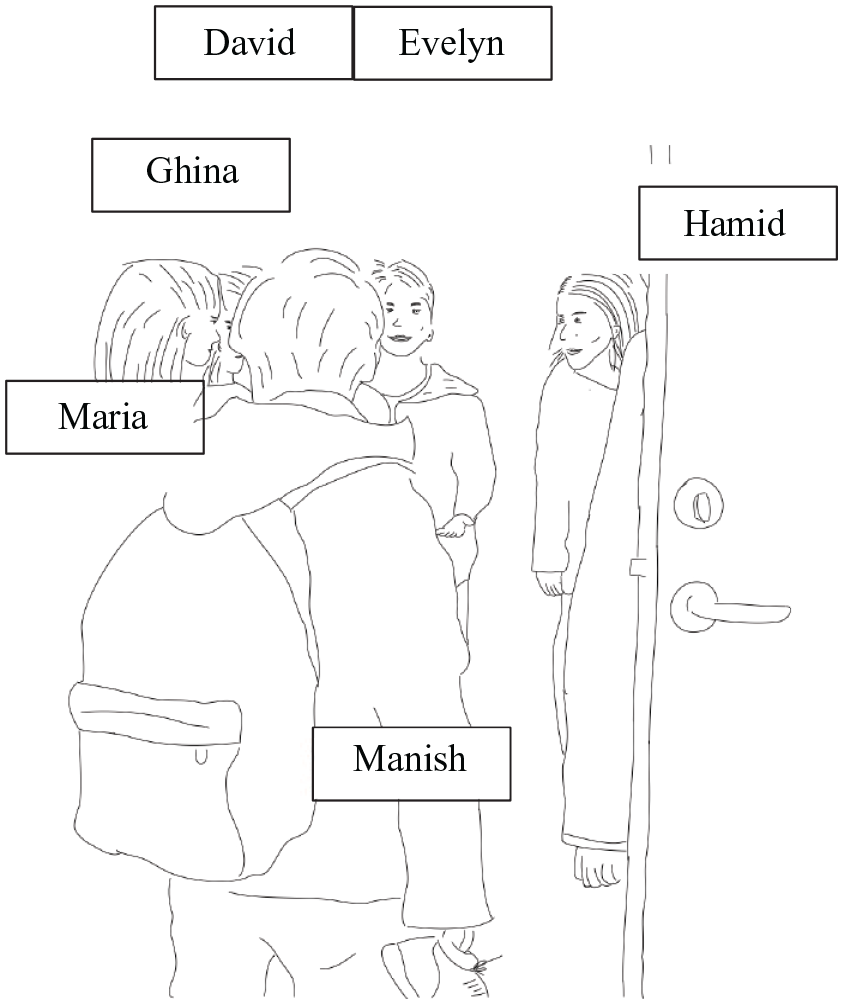
The scripted formulation ‘it’s time’ in line 1 signals a form of anticipation, indicating that the activity of kissing is a routine manifestation of a romantic relationship. The launching of the category-bound activity of ‘kissing’ warrants relationship categories such as boyfriend-girlfriend as standardized relational pairs. According to Sacks (1972), certain membership categories ‘go together’ in ‘standardized relational pairs,’ for example ‘husband-wife’ and ‘friend-friend,’ and ‘actions associated with such category pairing involve a routine ‘relationship’ that serves to render accountable interaction between the category pair’ (Housley and Fitzgerald, 2009: 348). Thus, the relational pairing of Ghina and Hamid into a girlfriend-boyfriend relationship has certain situated proprieties that form normative resources through which accountable actions can be displayed in public. However, the two classmates Ghina and Hamid immediately disalign from the moral expectations built into the relationship category, in the sense that a boyfriend and girlfriend are expected to perform a next step of kissing each other (lines 2, 4). The two children’s oppositional stances display the situated accountable character of enforcing romantic relationships in a publicly displayed event. Simultaneously, the anticipation of a romantic matchmaking builds up emotional tensions in the audience, who display their excitement at an upcoming kiss: ‘yeah::’ (line 3).
Below, Hamid also aligns with the playful framing of the romantic performance by replacing himself with another boy (‘take Manish instead’), thereby physically nominating a peer as a potential boyfriend as a way of avoiding inclusion in the relational pairing (lines 5–6): Excerpt 3b
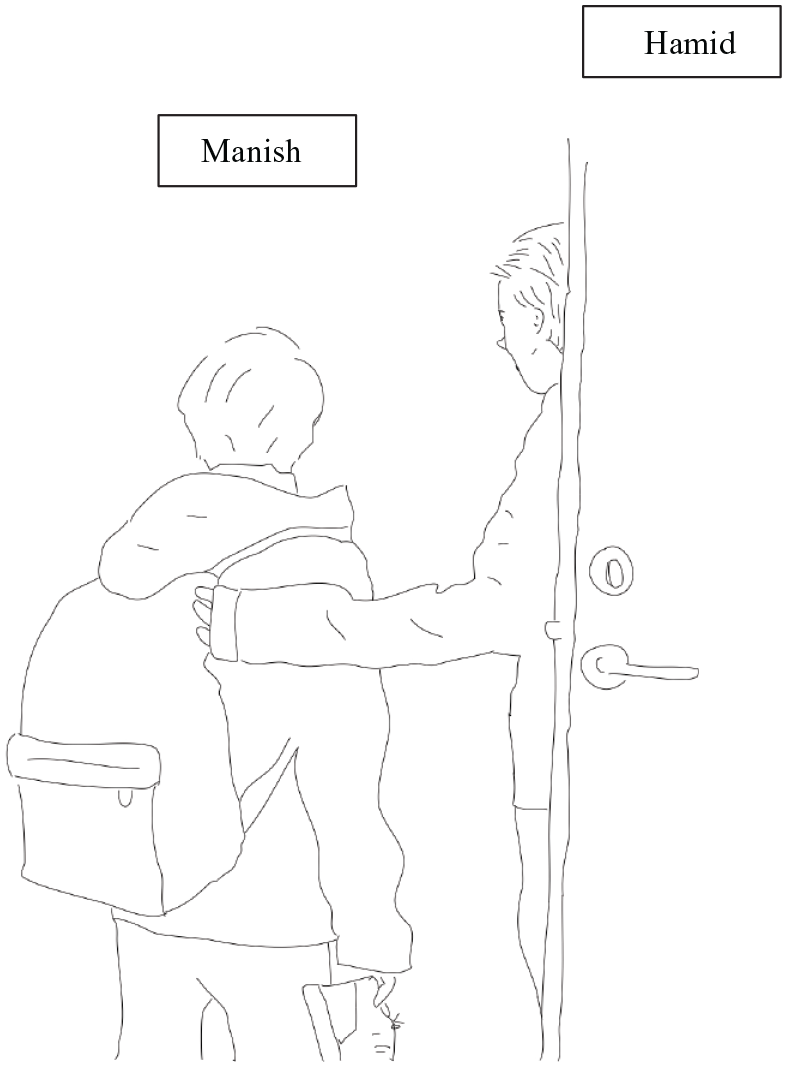
Through the embodied shifts in footing, whereby Hamid first puts his arm around Manish and then shoves him toward Ghina, Manish is cast as a potential boyfriend to Ghina. Maria supports the embodied two-party framework, grabbing Ghina’s arm and dragging her toward Manish (lines 7–8. The new, enforced romantic relational pairing creates further excitement among the present peers (line 11). In response, Manish playfully holds up his shoes in front of his face to avoid a potential kiss. In contrast, Ghina disaligns from a directive, followed by a negative assessment directed at Maria and David: ‘(don’t) be annoying now. please.’ (lines 12). Ghina’s oppositional moral stance is further reinforced as she turns her back on the group and steps aside, displaying her disengagement from the others’ playful yet highly forceful romantic matchmaking.
Ghina’s serious reactions to the others’ enforcement of a romantic relational pairing highlight the faults in the behavior of the peers involved. The moral discrepancy between Ghina’s serious embodied reactions and the others’ playful expectations transforms the bodily enforcement of romantic pairing into a transgressive and challenging activity among peers (cf. Goodwin, 2007). As Housley and Fitzgerald (2009: 355) note, ‘an ascription of moral discrepancy to such collectives may be normatively damaging’ and thus, once invoked in a peer context of friends like this, may provide further discursive resources through which in-group relationships may be questioned, disbelieved, or mistrusted. Simultaneously the other peers’ playful embodied actions shed light on the playful dimensions of romantic relational pairing and the importance of playing along and displaying alignments with others within the local peer group (cf. Andréasson and Evaldsson, forthcoming).
Discussion
In this study we have demonstrated how preteen children in everyday interaction make categorical claims to comment upon, resist, and stage public performances of boyfriend-girlfriend relationships among peers. In this process, they mobilize relationship category-bound activities such as ‘liking someone,’ ‘flirting,’ ‘being together,’ and ‘kissing,’ indexing what counts as anticipated romantic behaviors and norms of feelings among peers in the school’s boyfriend-girlfriend culture. This in turn illuminates how peers, as they make relationship claims, negotiate normative information and boundaries in terms of ‘who belongs where, and when and how they should or should not act’ (Housley and Fitzgerald, 2009: 359).
The analysis demonstrates the way relationship categories can be analyzed as they become embedded in the sequential organization of talk-in-interaction (cf. Stokoe, 2010). As shown, the category-based claims of a boyfriend-girlfriend relationship appear in the same action-oriented environments. In the first part, we saw how playful category-based claims of ‘liking someone’ and ‘being together’ indexing a boyfriend-girlfriend relationship were followed by resistance, opposition and denial by both the targeted girl and the targeted boy. In the second part, the targeted children also produced category-based denials in response to public performances of relational pairings. In both cases, the analysis shows how category-based denials are oriented to normative assumptions that are indexical of the categorical claims. This is especially evident when the targeted children respond with upgraded resistance to the others’ categorical claims of ‘flirting’ and ‘kissing’,’ projecting a public romantic performance with a peer (Excerpts 2, 3). The sequential analysis thus demonstrates how relational category claims function as resources not only for performing and occasioning instances of relational pairing, but also for avoiding being included in a publicly performed romantic relationship.
Another central finding is that categorical claims and stance-taking operate as both verbal and embodied tools of publicly available resources (including talk, laughter, facial expressions, gaze, and body orientations) (cf. Evaldsson, 2021; Goodwin, 2007, 2011). This underscores the importance of using a multimodal interactional approach in investigating the assembling embodied actions (gaze, facial expression, smiling, laughter, bodily orientations etc.) through which categorical claims are framed, occasioned, and performed in situ. In all cases, the children playfully frame their relationship claims through verbal teasing, joking, laughter, smiles, humorous gestures, and response cries to make them publicly available (Andréasson and Evaldsson, forthcoming; Eder, 1991). In this process, they have fun and reduce tensions as they manage rather delicate romantic feelings and relationships in public spaces (Eder, 1991). They also utilize a range of publicly available resources both for strengthening alignments and for disaligning from others’ category claims and actions. The ethnographically informed analysis points to that the peer’s collaborative engagements in jocular play, may over time affect the participants’ positions in the peer group and consequently the social relationships between boys and girls. For instance, our analysis demonstrates the risky business of using playful insults and derogatory gender categories as these can be taken seriously, not least by girls (c.f. Excerpt 1c) (Eder, 1991; Evaldsson, 2005; Goodwin, 1990). As shown, the girls (Ghina and Tina) compared to the boys (Hamid and Manish) respond in different ways (playfully vs seriously) to the more aggressive gender category-based claims (such as ‘Fuckgirl’ and physical matchmaking) (see Excerpt 1c; 3b). Consequently, our study sheds light on the importance for peers of being sensitive to normative assessments and category claims of romantic relationships as practical and occasioned matters in the local social organization of boys and girls (cf. Goodwin, 2011).
Our findings demonstrate the importance of integrating ethnographic knowledge of children’s social life with membership categorization analysis (Evaldsson, 2005; Goodwin, 2011). The MCA of situated actions highlights how children mobilize categorical claims to perform romantic boyfriend-girlfriend relationships, and how they use embodied actions and performances as means of accomplishing local social organization. The ethnographic fieldwork points to the peer group as central in promoting the importance of romance to preteen girls and boys, and shows that engagements in boyfriend-girlfriend relationships are a means by which both girls and boys attain social status and popularity among peers (cf. Simon et al., 1992: 30). Hence, category claims of ‘flirting’ directed at children with different statuses and popularity can be not only ambiguous but also highly exciting and humorous (see Excerpt 2) (cf. Renold, 2005). The norms of feelings that are communicated through the use of contrastive categorical devices (such as ‘fuckboy’ vs ‘single’) (Housley and Fitzgerald, 2009) also indicate that both boys and girls avoid the negative connotations associated with being ‘single’ (Simon et al., 1992: 43; cf. Renold, 2005). Simultaneously, the derogatory gender category ascription of ‘fuckgirl’ (Excerpt 1c) demonstrates how young girls deal with potential risks of being criticized for having a lot of boyfriends, by orienting to the norm of monogamy (cf. Simon et al., 1992). In all instances, the children’s depicted male/female romantic relationships display their normative orientation to a taken-for-granted ‘heterosexual social order’ (Goodwin, 2011: 255; Kitzinger, 2005: 222) in which girls and boys like, flirt with, and even kiss members of the opposite sex.
At the same time, our analysis demonstrates how children’s romantic and friendship relationships are highly dynamic and fluid. The peers contingently resist categorical claims of romantic relationships and downplay gender boundaries between boys and girls while strengthening cross-gender alignments and friendship bonds. Playing along with romantic relational pairing in multiparty peer play enables them to enhance cross-gender friendship relationships while commenting upon category-bound claims of romantic relationships and feelings. Hence, transforming cross-gender relationships into romantic ones does not necessarily pull boys and girls apart but can also push them together (cf. Thorne, 1993).
In sum, our study contributes by offering a situated understanding of how boys and girls perform and negotiate romantic relationships and norms of feelings through normative assessments and category claims in everyday peer group interactions. Within this process, they develop and communicate gendered norms and boundaries linked to romantic relationships and feelings, and also make sense of their emerging social peer relationships based on status and popularity in their everyday school life.
Footnotes
Acknowledgements
The study is approved by the Swedish Ethical Review Authority
Declaration of conflicting interests
The author(s) declared no potential conflicts of interest with respect to the research, authorship, and/or publication of this article.
Funding
The author(s) received no financial support for the research, authorship, and/or publication of this article.