







Abstract
Drawing on ethnomethodological and conversation analytic research on the intersection of person reference and membership categorization, this study elucidates how participants manage categorial inferences when referring to a third person. To achieve this aim, I examine sequences in which the membership category term tomodachi (“friend[s]” in Japanese) is used as a third-person reference form and later reformulated or elaborated upon. The analysis demonstrates that such reference reformulation and elaboration help manage categorial inferences by clarifying a categorial inference tacitly employed by a speaker, adjusting the applicability of a categorial inference to a specific person, or invoking a new categorial inference. Such management of categorial inferences can contribute to speakers’ action formation in interaction. The findings suggest that categorial inferences may concern normative associations between multiple membership categories within different membership categorization devices.
Introduction
In his pioneering lecture on ethnomethodological studies of membership categorization, Harvey Sacks argues that membership categories that classify people according to their positions in society (e.g. woman, old, American, Catholic) are “inference rich” because they store “a great deal of the knowledge that members of a society have about the society” (Sacks, 1992: I: 40). When a speaker refers to or describes a person by using a membership category, its inference richness allows a recipient to engage in commonsensical reasoning about that person. Furthermore, the speaker may mention a membership category to perform a specific action and to prompt the recipient to understand the action based on a particular categorial inference. In this regard, categorial inferences can serve as a resource for a speaker’s action formation and a recipient’s action recognition in interaction.
However, when a speaker tacitly employs a categorial inference by mentioning a membership category term, the recipient may not make the same categorial inference and may thus fail to understand the speaker’s action. For instance, when a speaker categorizes a third person as “Asian” to account for their “clumsy driving,” a recipient who is unfamiliar with the normative association between that category and the activity (or predicate) commonly used in the United States may find the account unconvincing or may even fail to understand it as an account at all. Furthermore, when a speaker mentions a membership category term, the recipient may make categorial inferences that the speaker does not attempt to make relevant, resulting in difficulty understanding the speaker’s utterance precisely. Land and Kitzinger (2005) report that when a lesbian speaker mentions the membership category term “spouse,” a recipient may make an incorrect categorial inference about the gender of the “spouse.”
Particularly when a membership category term is mentioned to refer to a third person, potential misunderstandings or insufficient understanding can emerge (see Whitehead et al., 2025: 153–179). In such cases, a speaker may have to clarify whether the membership category term is used as a “referring simpliciter” (Schegloff, 1996) or to accomplish more than mere reference. In other words, it may become a speaker’s task to make clear the (ir)relevance of the membership category and the associated inference to their actions, regardless of whether an understanding trouble is overtly indicated by a recipient or may have arisen on the recipient’s side without explicit indication.
This study aims to elucidate how participants manage categorial inferences in the context of third-person references. Among various membership categories, I focus on “friend(s)” because it covers a range of commonsensical and categorial knowledge while also functioning as a simple “non-recognitional” reference form (Sacks and Schegloff, 1979). More specifically, focusing on ordinary Japanese conversations, the current study examines sequences in which participants reformulate or elaborate on the membership category term tomodachi (“friend[s]”) used as a third-person reference form. The analysis illustrates how such reference reformulation and elaboration help manage categorial inferences and thereby contribute to speakers’ action formation. Furthermore, the analysis suggests that interactional participants’ categorial inferences may concern normative associations between a membership category and another category or membership categorization device (MCD). This study contributes to research on the intersection of person reference and membership categorization (e.g. Schegloff, 2007a; Whitehead and Lerner, 2009, 2022; Whitehead et al., 2025), as well as to empirical studies of the inference richness of membership categories (Sacks, 1992) and their interactional relevance and procedural consequentiality.
Background
Third-person reference and membership categories
Conversation analytic research has demonstrated that person reference is often performed without the use of membership category terms; instead, participants pervasively refer to persons using first names or pronouns (Schegloff, 2007a). Schegloff (1996) noted that participants may either merely refer to persons (i.e. a referring simpliciter) or accomplish more than mere reference when referring to persons. Previous studies have explored what participants accomplish when they refer to persons by mentioning membership categories, thereby advancing research on the intersection of person reference and membership categorization in interaction (e.g. Kitzinger, 2007; Land and Kitzinger, 2005; Lerner et al., 2012; Tennent and Weatherall, 2024; Whitehead, 2013; Whitehead and Lerner, 2009, 2022; Whitehead et al., 2025).
A third-person reference performed by mentioning a membership category term may impose interactional tasks on participants. On the one hand, when referring to persons, membership category terms such as “guy” and “woman” may not be designed to accomplish interactional work beyond indicating a speaker’s supposition that the referent is not known to the recipients. In such cases, at least from the speaker’s perspective, the membership category terms serve as “non-recognitional” reference forms (Sacks and Schegloff, 1979), and the speaker does not make these categories relevant (Kitzinger, 2007; Schegloff, 1996). On the other hand, choosing a membership category term from among other reference forms can accomplish specific interactional tasks. Since membership categories are bound to specific activities (Sacks, 1972b) and can invoke commonsensical knowledge (Sacks, 1972a), participants can perform various actions and activities (e.g. account, accusation, and storytelling) by mentioning membership categories when referring to persons (Kitzinger, 2005a, 2005b; Lerner et al., 2012; Raymond, 2019a; Stokoe, 2015; Whitehead and Lerner, 2009, 2022).
Interactional participants’ mutual understanding of what a categorial third-person reference implies and accomplishes is not always established immediately. Owing to the inference richness of membership categories, “even the non-recognitional reference forms that are most recurrently entirely system-relevant may on some occasions contribute to interaction-relevant (including category-related) work, and/or may be vulnerable to being taken up as interaction-relevant by recipients even when not designed as such by their speakers” (Whitehead et al., 2025: 163–164).
To advance research on the intersection of person reference and membership categorization, the current study investigates participants’ practices for managing categorial inferences in the context of third-person reference. However, participants’ categorial inferences may not always surface clearly in interactions, making it difficult for analysts to capture the relevant interactional phenomena. To address this issue, the current study focuses on conversational sequences in which a membership category used as a person reference form is reformulated or elaborated upon.
Reference reformulation and elaboration for managing categorial inferences
Previous studies have investigated sequences in which membership category terms are used to replace, reformulate, or elaborate on a prior person reference form to accomplish various interactional tasks (Lerner et al., 2012; Tennent and Weatherall, 2024; Whitehead, 2013; Whitehead and Lerner, 2009, 2022). Lerner et al. (2012) illustrated that repair practices replacing or reformulating an initial third-person reference form with a category term can invoke commonsensical categorial reasoning about the person, thereby contributing to action formation in ordinary conversations. Although Lerner et al. (2012) exclusively examined repair practices, researchers have also examined a broad range of practices that reformulate or elaborate on initial person reference forms. Examining emergency calls concerning domestic violence, Tennent and Weatherall (2024) illustrated practices that reformulate or elaborate on generic third-person references (e.g. “this person”) by mentioning relational membership category terms (e.g. “my partner”). Their analysis highlights that such practices help call-takers grasp the nature of the violent situations in which callers are currently involved.
Notably, reference reformulation and elaboration can also be employed to address possible categorial inferences that other participants might have made without explicit indications in their turns. Whitehead and Lerner (2022) reported that participants who initially used pronouns to perform self-reference might later refer to themselves using membership categories, thereby managing the relevance of the membership category and forestalling recipients’ potential inferences. For instance, in the context of a South African radio phone-in, when a caller uses the simple self-reference form “I” and hearably defends the colonization of African countries, recipients may make categorial inferences according to which the caller would be “White.” In this context, the caller can forestall such a possible inference by (re)describing themselves using a membership category term (e.g. “I’m Chinese”) before the recipients reveal such an inference in their turns.
These previous studies suggest that using membership category terms to reformulate or elaborate on initial non-categorial reference forms can manage categorial inferences and contribute to action formation. This is reflected in the observation made by Lerner et al. (2012: 198) – that, in “most (but not all) cases of reference recalibration repair, a person reference term is repaired in a way that results in a reformulated categorical reference that seems more attuned to the actions, attributes, and setting depicted in the talk.”
However, an initial categorial reference form may also be reformulated or elaborated upon by interactional participants. A speaker may have to reformulate or elaborate on a membership category term initially used as a person reference form in order to address potential understanding troubles that may have arisen on the recipients’ side, including cases in which they may not make the categorial inference that the speaker attempts to make relevant or they make categorial inferences different from the one the speaker makes relevant (see Whitehead et al., 2025: 163–164). As already mentioned in Section 1, Land and Kitzinger (2005) analyzed cases in which lesbian speakers use non-gendered family membership category terms, such as “spouse” or “partner,” to refer to a third person. Their analysis showed that recipients often made a commonsensical but incorrect categorial inference about the gender of the person referred to (i.e. that the caller’s “spouse” should be a “husband”), which may result in extended correction sequences. This suggests that sequences in which a membership category used as a person reference form is later reformulated or elaborated upon are worth focusing on to elucidate how participants manage categorial inferences.
Data and methods
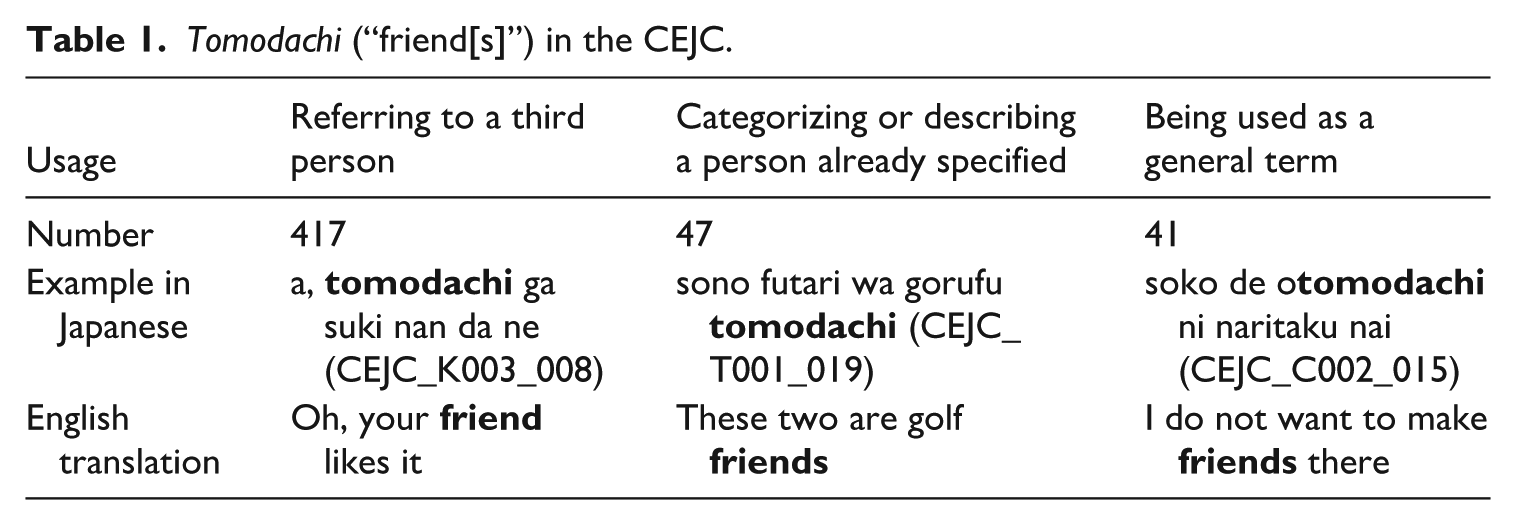
Data were extracted from the Corpus of Everyday Japanese Conversation (CEJC), which contains approximately 200 hours of video and audio data (Koiso et al., 2022). By searching the transcribed records of the corpus using the search engine application Chuunagon with the search query tomodachi (“friend[s]”), I identified 505 explicit mentions of the membership category term. I then classified these instances based on their usage: (1) referring to a third person, (2) categorizing or describing a person already specified or referred to, and (3) being used as a general term without referring to, categorizing, or describing any particular individual (see Table 1 for the composition of the corpus). 1
Tomodachi (“friend[s]”) in the CEJC.
I then collected 21 interactional cases in which the category term tomodachi was used as a third-person reference form and later reformulated or elaborated upon. Some of the 21 cases include sequences in which the category term tomodachi appears multiple times (e.g. Excerpts 1, 3, and 4–2). These interactional cases include self-initiated self-repair, other-initiated self-repair, third-position repair, and elaboration on the initial reference form, which is not typically regarded as a repair practice. Among them, eight cases clearly demonstrate that such reference reformulation and elaboration serve as practices for managing categorial inferences and thereby contribute to speakers’ action formation. Four of these cases are presented in the current paper.
Transcription conventions follow Jefferson (2004). The transcripts are presented in three tiers: the first tier shows the original Romanized Japanese; the second tier provides word-by-word glosses in English (see the Appendix for abbreviations); and the third tier presents the author’s English translation. All participants’ names were anonymized. Applying the methodology of conversation analysis (Schegloff, 2007b), I analyze how participants’ reference reformulation and elaboration practices are performed and what interactional work they accomplish within the sequence organization. Furthermore, the perspective of membership categorization analysis (Fitzgerald and Housley, 2015; Stokoe, 2012; Whitehead et al., 2025) is employed to examine membership categorization practices and participants’ orientations toward categories and MCDs, thereby shedding light on how participants manage categorial inferences. Additionally, as the corpus provides participants’ basic demographic information, including their ages, professions, and family relationships, I sometimes use it as a kind of ethnographic background for the analysis (e.g. a speaker in Excerpt 3 is in her 80s and older than her “friend,” whom she describes as “61 or 62 years old”).
Analysis
The analysis section is organized as follows. First, I examine cases in which speakers initially mention the term tomodachi (“friend[s]”) as a third-person reference form and later engage in reference reformulation to clarify categorial inferences that they have tacitly employed (Excerpts 1 and 2). Second, the analysis demonstrates how a participant adjusts the extent to which a categorial inference applies to a specific person while admitting the general plausibility of the inference (Excerpt 3). Finally, I analyze a case in which reference reformulation invokes a new categorial inference (Excerpt 4).
Clarifying tacit categorial inferences
In Excerpt 1, Leo, a lecturer, and Ike, a student, are talking about a part-time job involving the organization and promotion of events at their university (lines 01–04). When describing the benefits of the part-time job in which Ike is interested, Leo initially refers to third persons by mentioning the category term tomodachi (“friends”) in line 12 and then reformulates it by mentioning another category term, gakusei (“students”), in line 15.
In lines 06–08, Leo describes the job’s benefits, which allow workers some discretion regarding the purchase of equipment. In line 12, he mentions the category term tomodachi (“friends”), referring to members of the category of Ike’s “friends.” This third-person reference serves as a resource for concretely explaining the benefits of the job for workers. Leo’s utterance in lines 12 and 13 is also intelligible as a suggestion that Ike use the equipment together with his friends, who would not necessarily be his co-workers once he takes part in the part-time job. In line 14, Ike acknowledges Leo’s suggestion in the prior turn without indicating any trouble in understanding it.
In line 15, Leo succinctly reformulates the initial categorial reference form tomodachi (“friends”) by mentioning the other category term gakusei (“students”). This practice clarifies Leo’s own categorial inference, which he has tacitly employed when using the category “friends.” The categorial inference can be formulated as follows: Ike’s “friends” would also be “students” (at the same university), given that Ike himself is a university student. Notably, the Japanese final particle ne (line 15), commonly used to seek confirmation or agreement about a piece of information supposed to be known by a recipient or shared between a speaker and recipient, indicates that Ike’s categorial inference has already been implied in his prior utterance, rather than constituting entirely new information in this utterance.
This management of categorial inference also helps clarify Leo’s suggestion. Without Leo’s clarification of his tacit categorial inference, Ike might not understand that the “friends” to whom Leo has referred are supposed to be “students” (or students at the same university). In other words, Ike might understand that once he gets the part-time job, he can buy and use the equipment with his “friends” who are not “students.” However, this part-time job likely does not afford workers that level of discretion, even though Leo suggests that the equipment may be used not only with their co-workers or strictly within work settings. Leo’s reference reformulation and management of categorial inference clarify his own suggestion by addressing such a potential misunderstanding that might have arisen on the recipient’s side (Raymond, 2019b; Raymond and Gill, 2025).
Relatedly, this reference reformulation may mitigate the potential moral culpability of his suggestion. His suggestion in lines 12 and 13 may be heard as morally dubious insofar as it could be interpreted as encouraging the private misappropriation of work equipment. His orientation toward the possible moral culpability of his suggestion is displayed in his turn design. First, in line 10, he mentions the need to provide a proper reason for the purchase, thereby limiting workers’ discretion regarding equipment purchases. Second, his laughter in line 12, which can be heard as trouble resistance (Jefferson, 1984), contributes to constituting his suggestion as laughable (Ford and Fox, 2010), rather than as an encouragement of serious rule breaches. By clarifying the limits of workers’ discretion regarding the purchase and use of work equipment (i.e. workers can use equipment together with other “students”), he mitigates the moral culpability of his previous suggestion. Leo’s laughter in line 15 and Ike’s laughter in line 18 also indicate that they do not treat the suggestion as an encouragement of serious rule breaches.
The above analysis illustrates that a speaker’s reference reformulation clarifies a tacit categorial inference and thereby contributes to action formation (e.g. suggestion). Similarly, in Excerpt 2, reference reformulation clarifies a tacitly employed categorial inference and thereby contributes to providing an account or explanation. In Excerpt 2, Tac, a small food business owner, explains the requirements for an official food sanitation certification for such a business in Japan. In describing his current target customers, he refers to third persons by mentioning the category term tomodachi (“friends”) in line 05. He then engages in self-initiated self-repair in lines 09, 11, and 13 (only in line 09 in the translation), overlapping with the interlocutors’ utterances.
In lines 01–03, Tac explains the requirement for official food sanitation certification to engage properly in the food sales business. In lines 05 and 07, by using the conjunctive dakara (“so”), he presents the sanitation certification requirement as an account of why his food sales business targets only his “friends” at this stage. Why this requirement constitutes the reason for his narrow targeting is not explicitly stated but is implied in his turn design. First, the expression “only among friends” indicates his understanding that food business owners generally sell their products to “customers,” rather than restricting sales to “friends.” Second, by describing his conduct using the term “distribute” (ryuutsuu in line 07) instead of “properly sell” (chanto hanbai in line 02), he creates ambiguity regarding the extent to which official sanitation certification is required for his conduct. These practices imply that he does not have the certification necessary to sell food products properly to “customers,” whose commercial exchanges are regulated and protected by relevant legal rules; instead, he distributes food products to his “friends,” who may be willing to buy them based on mutual goodwill without formal certification.
However, the categorial contrast between “friends” and “customers” is made tacitly, which may make it difficult for recipients to understand Tac’s explanation for his narrow business targeting. In fact, Mel does not clearly demonstrate her understanding of Tac’s utterance. Her response in line 06 (naruhodo or “I see”) is directed to Tac’s explanation provided in lines 01–03 rather than to his utterance starting in line 05. In line 08, although Mel displays her understanding of Tac’s informing by producing a change-of-state token (aa or “Oh”; Endo, 2018; Heritage, 1984), it remains unclear whether she has sufficiently understood Tac’s explanation, as her response is minimal and overlaps with Tac’s ongoing turn.
Tac performs self-initiated self-repair at the “transition relevance place” (Sacks et al., 1974), which emerges at the end of line 07. In lines 09, 11, and 13, Tac reformulates “friends” as “people who do not strictly say no to that” (sooyuu no ga sonnani dame tte iwa nai hito), thereby clarifying a categorial inference he tacitly employed when mentioning the category term tomodachi in the service of person reference. This categorial inference can be formulated as follows: in the absence of official sanitation certification, a business owner’s “friends” may be less likely to report a potential legal violation than “customers” who are afforded legal protection. By clarifying the categorial inference associated with “friends,” Tac also clarifies his explanation that the reason for his narrow business targeting is his lack of official certification. 2 Mel, in lines 12 and 14, claims her understanding of Tac’s explanation.
In Excerpts 1 and 2, the speakers’ reformulation of the membership category term tomodachi (“friends”) clarifies categorial inferences that they tacitly employed when they initially used the term for third-person references. The management of such categorial inferences contributes to the speakers’ action formation, such as suggestion and account. Furthermore, the analysis of Excerpt 1 suggests that categorial inference may concern normative associations between the category “friend” and other membership categories (e.g. “student”). The following analysis further examines how participants manage this type of categorial inference, according to which persons categorized as “friends” are also expected to share co-membership in other categories.
Adjusting the applicability of a categorial inference to a specific person
In contrast to Excerpts 1 and 2, in which speakers perform simple reference reformulation, a participant in Excerpt 3 elaborates on the initial reference form at length. Furthermore, while speakers in the previous excerpts orient to possibilities that categorial inferences they have tacitly employed may not clearly be understood by their recipients, a speaker in Excerpt 3 orients to a categorial inference that is not particularly made relevant by the speaker herself but is employed by her recipient. Prior to the excerpt, Ken’s grandmother, in her 80s, talks about a recent visit to Yokohama, a large city in Japan, reporting that many people gather there to play Pokémon Go. In lines 01 and 02, she tells a story about her “friend” (otomodachi, in which o is an honorific prefix) who also went to the city to play Pokémon Go at another time, resulting in Ken’s asking for confirmation about the “friend” in line 03.
In line 03, although Ken initially acknowledges (fu:::n or “Hmm”) his grandmother’s story about her “friend” who went to Yokohama to play Pokémon Go, he immediately treats the story as surprising by uttering e (“what?”) and asking for confirmation about the “friend.” Here, his turn design does not reveal why he seeks confirmation after the grandmother has already indicated that her “friend” plays Pokémon Go.
Notably, the grandmother makes relevant the “age” or “stage of life” MCD in lines 05–06. She provides a category account (Raymond, 2019a) to explain the large number of people in Yokohama at the time of her visit, noting that they were not limited to “young people” and “children.” By explicitly mentioning these two membership categories, she implicitly categorizes her friend as “old.” The intelligibility of this implicit categorization is supported by the “consistency rule” (Sacks, 1972b), according to which the same MCD should be consistently used to categorize the same population. In so doing, she provides Ken with confirmation that she has a “friend” who plays Pokémon GO.
Furthermore, her utterance in lines 05–06, which categorizes her “friend” as “old” while emphasizing that “old” people also play Pokémon GO, indicates her orientation to Ken’s possible understanding. Given that Ken displays surprise upon hearing that his grandmother has a “friend” who plays Pokémon GO, he may understand that his grandmother’s “friend” would be “old” and that the category “old” is not normatively bound to the activity of playing mobile games, including Pokémon GO. The mother’s positive evaluation in line 04, which appears to orient to an unlikely association between the membership category and the activity, also displays the same understanding. Moreover, Ken’s possible understanding that his grandmother’s “friend” is “old” may be based on the following categorial inference: people who belong to the membership category “friends” would also share co-membership in a category within the “age” or “stage of life” MCD. As the interaction unfolds, this categorial inference becomes increasingly evident.
In line 11, using the age MCD, the grandmother elaborates on her initial categorial person reference form by explicitly categorizing the “friend” as “61 or 62,” which is approximately 20 years younger than herself. Notably, she contrasts being her “friend” with being “61 or 62” (otomodachi yuttatte or “Even if I said ‘friend’”), thereby displaying her orientation toward the categorial inference according to which “friends” would normatively belong to the same membership category within the “age” MCD. At the same time, she clarifies that this normative expectation does not apply to the specific “friend” she has been describing. Furthermore, the category term oyako (glossed as “parent and child” in the second tier) in line 16 is used as an analogy for the age difference between the grandmother and her friend, showing her understanding that their friendship is exceptional given their age difference. Additionally, in line 16, she ascribes the attribute “very sweet” (tottemo yasashikute) to her friend, accounting for their exceptional friendship despite their age difference (Heritage, 1988). These practices show her orientation toward a commonsensical categorial inference according to which “friends” would be close in age. Simultaneously, she calibrates the extent to which this inference applies to her specific “friend”: her “friend” is “old,” but NOT as old as she is.
Ken acknowledges his grandmother’s description of her “friend” in line 18, retrospectively suggesting that he made the same categorial inference to which his grandmother has oriented. That is, he inferred that the grandmother’s “friend” would be “old” and sought confirmation based on an unlikely association between the membership category “old” and the activity of playing mobile games.
In this excerpt, the speaker’s third-person reference using the category term “friend” allows the recipient to make an inference about which other membership category the person referred to would belong to. More specifically, the recipient infers that the speaker and her “friend” would both belong to the category “old” within the “age” MCD. The speaker then manages this categorial inference by adjusting the extent to which the categorial inference applies to the specific “friend” being discussed while admitting its general plausibility. This categorial inference management contributes to the speaker’s activity of storytelling by providing a more precise description of the person in question.
Invoking a new categorial inference
Finally, I address a case in which a participant invokes a new categorial inference by reformulating a reference form “friend.” Unlike the earlier excerpts, in Excerpt 4, a participant who does not initially use the reference form “friend” later picks it up for reformulation. In this excerpt, Jin, an elementary school student in the upper grades (i.e. 10–12 years old), talks with his parents about a recreational team activity in which he recently participated. Jin’s reference to one of his teammates becomes a topic of conversation and is problematized as the interaction unfolds. The first part of Excerpt 4 provides the context of their conversation, and I focus on the second part to closely examine the participants’ practices for managing categorial inferences.
Jin’s mother asks him about his teammates in line 01, and he refers to three teammates by mentioning their first or full names in lines 02, 04, and 06. In line 08, however, he refers to one student as “a first-year student I may have seen somewhere” (dokka de mitakotoaru yoona ichinensei) without mentioning a name. The father’s utterances in lines 10 and 13 constitute confirmation requests by using the Japanese final particle yone, and Jin provides confirmation in lines 12 and 15. Notably, however, the father’s utterances may also be understood as a possible accusation of his son for not remembering the teammate’s name. The father’s smile (lines 10 and 13) and the mother’s laughter (lines 11 and 14) contribute to mitigating the seriousness of this accusation. Furthermore, in line 16, the mother laughs again and quotes Jin’s phrase “I have seen somewhere,” indicating her orientation toward the potentially problematic nature of Jin’s prior use of the person reference form “a first-year student I may have seen somewhere.”
In what follows (Excerpt 4, Part 2), the participants’ talk revolves around person reference forms, leading to the mother’s reference reformulation of the category term “friend” in lines 22 and 23.
In lines 17–19, the father quotes the reference form “first-year student I (may) have seen somewhere” from his son’s earlier utterance (line 08 in Part 1) and indicates that the person referred to can be categorized as his son’s “friend” because they were once teammates in the recreational activity. As in the previous part, the father’s pursuit of agreement can also be heard as a possible accusation of his son, who did not (or could not) refer to a “friend” by mentioning the person’s name, while the father’s smile mitigates the seriousness of the accusation. The intelligibility of this accusation rests on a commonsensical categorial inference or norm: “friends” should remember each other’s names. As Lynch and Bogen (1996) demonstrated, memory is embedded in a publicly available interactional order rather than confined to a private cognitive realm, and participants become morally vulnerable when they fail to remember things they are expected to remember.
The son also orients to the moral culpability of not having referred to the teammate by name. In line 20, he accounts for his prior choice of the reference form “first-year student I may have seen somewhere” by confessing that he could not remember the student’s name. In particular, the expression “accidentally forgot” (wasurete shimatta) implies that forgetting someone’s name is undesirable, thereby showing his orientation toward its moral culpability. Notably, however, the son does not clearly agree with his father, who seeks confirmation that the person is the son’s “friend” rather than “a first-year student I have seen somewhere.” Accordingly, it remains unclear which categorial reference form is treated as more suitable.
The mother explicitly addresses this ambiguity. By using the Japanese phrase tte yuu ka (“or rather”) in line 22, she reformulates the categorial reference form “friend,” already mentioned in the father’s turn, as “first-year elementary school kid,” a categorial reference form that closely resembles the one used by her son. 3 The phrase highlights that she treats the reference form “first-year elementary school kid” as more relevant or appropriate than “friend,” without entirely replacing or denying the correctness of the latter reference form (Hayashi et al., 2019).
This reference reformulation is intelligible as invoking a categorial inference regarding the association between “friends” and the “school age” MCD. The intelligibility of this inference is supported as follows. In principle, a “first-year elementary school student” can be “friends” with the son, who is in the upper elementary grades. However, the mother’s practice indicates her understanding that simultaneous membership in both categories would be unusual. This implies a categorial inference according to which people who are “friends” would also belong to the same or a close category within the “school-age” MCD. In other words, when people belong to different membership categories within the “school age” MCD, they may not be categorized as “friends.” This categorial inference is arguably mobilized in her reformulation, in which the categorial reference form “first-year elementary school kid” is treated as more appropriate than “friend” in this context. 4
Furthermore, this practice contributes to her action formation: the defense of her son. The conjunctive dakara (especially in line 23) constitutes her turn as an account of why her son does not remember the name of the person referred to – namely, because the person would not be his “friend.” In so doing, the mother mitigates her son’s moral culpability for forgetting the person’s name. The son’s subsequent self-excuse for forgetting the person’s name is constituted as an additional one (omakeni or “additionally” in line 24), showing his understanding that the mother has defended him in the prior turn. In lines 28 and 29, she emphasizes that she does not remember “first-year elementary school students” well, thereby defending her son once again.
In this excerpt, the categorial inference concerning the association between the category “friends” and co-membership in a category within the “school age” MCD is not initially made relevant by the participant who mentions the term “friend.” Rather, the other participant invokes this categorial inference by picking up and reformulating the categorial person reference form. The practice of managing the categorial inference contributes to the speaker’s defense of her son, displaying her orientation toward the moral culpability associated with not remembering the name of a “friend.”
Discussion and conclusions
By examining interactional cases in which participants reformulate or elaborate on the membership category term tomodachi (“friend[s]”) as a third-person reference form, this study has elucidated how participants manage categorial inferences. Previous studies have shown that using membership categories to refer to a person or to reformulate prior reference forms can help establish participants’ mutual understanding of the persons referred to and achieve interactional goals (Kitzinger, 2007; Land and Kitzinger, 2005; Lerner et al., 2012; Tennent and Weatherall, 2024; Whitehead, 2013; Whitehead and Lerner, 2009, 2022; Whitehead et al., 2025). To advance this line of research with a focus on the inference richness of membership categories, the current study examines cases in which an initial categorial reference form is reformulated or elaborated upon, regardless of whether the subsequent reference forms are categorial.
The analysis shows that speakers may clarify the categorial inferences they have tacitly employed when such inferences may not be readily understood by their recipients (Excerpts 1 and 2). By contrast, when a recipient apparently makes a categorial inference based on a speaker’s use of a categorial person reference form, the speaker may adjust the extent to which the categorial inference applies to a specific person being discussed while admitting the inference’s general plausibility (Excerpt 3). Furthermore, a participant may reformulate a categorial reference form used by another participant in order to invoke a new categorial inference when the appropriateness of reference forms becomes a conversational topic (Excerpt 4). The analysis also demonstrates that such management of categorial inferences contributes to action (and activity) formation, such as suggestion, account, storytelling, and defense.
Previous research on membership categorization has extensively investigated the normative associations between a membership category and an activity or predicate (Fitzgerald and Housley, 2015; Hester and Eglin, 1997; Sacks, 1972b; Stokoe, 2012). The current study’s findings suggest that the categorial inferences employed in interactions may also concern normative associations between multiple membership categories in different MCDs. The analysis demonstrates that such a categorial inference can be formulated as follows: when persons belong to the category “friends,” they are also expected to share co-membership in other categories within various MCDs, such as the “age” MCD. For instance, the participants made categorial inferences according to which a student’s “friend” would also be a “student” (Excerpt 1) or an old person’s “friend” would also be “old” (Excerpt 3).
These findings may align with classic observations concerning the normative association between the membership categories “hair stylist” and “homosexual” in a particular social or cultural context (Sacks, 1992: I: 46–47), as well as with more recent discussions of the normative associations between different membership categories, such as “sports fan” and “male” (Whitehead et al., 2025: 301). However, the current study demonstrates that the category “friend” itself is not associated with any specific membership categories, such as “student” or “old.” Instead, when participants employ categorial inferences concerning “friends,” the categories in which a speaker and the referent are presumed to share co-membership may vary depending on the particular “friend” and the interactional context. 5
The possibility of such fluid and flexible categorial inferences may be supported by a defining feature of the membership category “friend(s)”: it is relational and accommodates more than one person (see Sacks, 1972a on the “R” MCD). As a relational membership category, “friend” may invoke categorial inferences about other membership categories to which both persons are expected to belong. In the context of third-person reference in conversation, “friend” is not an abstract category but a specific “friend” of a specific speaker about whom the recipient may already have some knowledge, including knowledge of other membership categories to which the speaker belongs. Such knowledge can serve as a resource for making categorial inferences about the “friend(s)” in question, even when the recipient does not have first-hand access to them at all. This argument remains to be empirically examined through future research investigating how interactional participants manage categorial inferences when mentioning other relational membership categories (e.g. “wife–husband” or “parent–child”).
Finally, in some of the cases analyzed, reference reformulation may orient to the moral culpability of the participants’ actions or activities, including the suggestion of using work equipment with people who are not co-workers (Excerpt 1), engaging in the food sales business without the required certification (Excerpt 2), or having forgotten the name of a “friend” (Excerpt 4). Given the intertwined relationship between membership categorization practices and moral order (Housley and Fitzgerald, 2009; Jayyusi, 1984; Okazawa, 2022), choices of categorial reference forms can have moral implications and may thus motivate their reformulation or elaboration through which the participants manage categorial inferences (see also Bolden et al., 2022). Future research may further investigate the organization of categorial reference reformulation and its implications for participants’ orientations toward moral order.
Footnotes
Appendix

Ethical considerations
This study uses the data obtained from the Corpus of Everyday Japanese Conversation (CEJC) constructed by the National Institute for Japanese Language and Linguistics. The author followed the ethical guidelines and contracts for using the CEJC.
Consent to participate
Participants for the CEJC have provided the National Institute for Japanese Language and Linguistics with informed consent.
Consent for publication
Participants for the CEJC have provided informed consent for publication. Following the ethical guidelines for using the corpus, the author has anonymized the data. All names are pseudonyms.
Funding
The author disclosed receipt of the following financial support for the research, authorship, and/or publication of this article: This work was supported by JSPS KAKENHI Grant Number 23K12627 and 23KK0032.
Declaration of conflicting interests
The author declared no potential conflicts of interest with respect to the research, authorship, and/or publication of this article.
Data availability statement
The author cannot share data.