






Abstract
This study examines the multimodal discursive construction of the 2021 Spanish energy crisis in online newspapers, a crisis marked by energy price surges and severe consumer impact. Drawing on Social Semiotics, with a critical stance, a multimodal discursive analysis of headlines and images in 20 articles, from Spanish and International newspapers, is carried out to critically look at how the energy crisis is constructed in the discourse. The results reveal a significant difference between the two data sets. From an international perspective, Spain enacts a protagonist role and engages in proactive crisis management and resolution, while the Spanish articles focus on citizens’ predicament, constructing crisis as an eventuation and ignoring the human social roles played in it. Both similarly show, however, the power of the interplay of multimodal resources in consolidating specific interpretations and reproducing divergent views on the same crisis.
Introduction
The energy crisis started looming in Spain, as in most European countries, in 2021 in a complex interplay of factors, the initial one being the universal efforts to recover from the pandemic recession after the global historical decline in energy consumption. While the oil and gas productions rebounded strongly and caused the prices to rapidly go up, the Russian invasion of Ukraine in February 2022, exacerbated the situation and the crisis escalated dramatically. Energy experts argue that the price increase in gas and coal, combined with rising European carbon prices, are the main trigger for the soaring electricity prices leading to severe energy poverty and high inflation (Barrella et al., 2025; Fernández Álvarez, 2021). Nonetheless, the crisis emerged within a complex global geopolitical situation, dominated for decades by an energy system focused on states interest in securing cross border oil and gas supplies (Kuzemko et al., 2025). Despite the urgency to move away from the drastic impact of fossil fuels and to embrace the long-term imperative of decarbonization, fierce power struggle between oil and gas corporations continue to shape debates about, and delay, emissions reductions (Franta, 2021). Kuzemko et al. (2025) argue that politics, and policies, actively drive, constrain, and shape energy materialities and geographies. This means that corporate and national fossil fuel actors have considerable capacities to influence energy and climate policy, bending markets, politics and geography to their interests (Kuzemko et al., 2025: 544). Within this context, the increase in Spanish electricity prices had a significant negative impact on citizens, prompted conflicting political reactions, and aggravated the disagreement over policy solutions.
To study the news discourse on the crisis, we must understand the power dynamics between the key players in Spain, namely politicians, energy companies, trade unions, media outlets, and their respective strenuous effort to dominate the public debate. Initially, the political arena was characterized by uneasy democratic coexistence between political parties. The right-wing conservative parties (PP and Vox) harshly criticized the Socialist-led (PSOE) government’s handling of the crisis and its active intervention to shield households against the rising energy prices. The government managed to obtain, along with Portugal, the European commission’s approval to “artificially reduce wholesale electricity prices by capping the price of gas used for electricity generation” (Fernández-Pasarín et al., 2023: 482). This policy, known as the Iberian exception, was widely criticized by conservative parties and energy companies (Iberdrola, Endesa, Naturgy, etc.) who warned that a government’s intervention would undermine investment, security and stability. Trade unions, on the other hand, demanded stronger protection for households and organized protests against energy poverty.
In the meantime, the news coverage of the crisis reflected the social actors’ power struggle, and the divergence between left-leaning and right-leaning media outlets. The reports issued by financial and energy research organizations (e.g. IEA, 2023, etc.) kept the debate technical while covertly shaping policy options to preserve the interests of their business allies (Cairney, 2023). It is very important to look at how the media discursively reproduced the political and social struggle for power during the crisis, and their role in protecting and/or promoting their interests. The aim of this study is to conduct a multimodal discursive analysis of the media construction of the Spanish energy crisis in digital news outlets. By taking a critical discursive perspective, and focusing on the interplay between headlines and images, the study is guided by the following research questions. (1) How are crisis responses discursively reproduced and recontextualized through the headlines and images in the online newspapers? and (2) how do the different semiotic modes interact to represent the social actors and recontextualize their social practices within the discourse? With these questions in mind, we hope to uncover, within our sample data, the ideological backdrop of the energy crisis discursive construction in relevant digital news outlets.
Crisis discourse in the media
Depending on the social and historical context in which crises happen, the discourse practices generated about them may vary considerably. The Oxford English Dictionary defines crisis as “a vitally important or decisive stage in the progress of anything; a turning point; now applied especially to times of difficulty, insecurity, and suspense in politics or commerce” (OED Online, 2024). Crisis reporting, as any news coverage, is governed by key factors including specific editorial policies influenced by the newspaper’s mission, target audience, and political or ideological leanings (McNair, 2006; McQuail, 2013). Certainly, the media do more than just reporting; they frame, interpret, and shape public perception of events, and they play a key role in constructing social and economic realities (Berger and Luckmann, 1967; Hiippala, 2017; Stocchetti and Kukkonen, 2011). From a critical perspective, news agencies and journalists not only shape the way events are told, but they mainly decide what should be told and in what frequency and with what terms (Bednarek and Caple, 2012; Fairclough, 1995; Herman and Chomsky, 1994; Richardson, 2007; Van Dijk, 1998a). Even more, there is a rising concern about the integrity of journalism in the digital revolution due to the connection between news agencies and corporate business interests (Bailard, 2016); and the growing influence of different forms of ownership on the production of news (Benson et al., 2025).
Research on media coverage of the energy crisis in Spain and other countries has captured the role of media outlets in reconstructing the struggle between the different social actors and the processes of their public deliberation. Some scholars explored the value-laden framing of crisis in specific contexts examining the way the media recontextualizes the processes of negotiations over energy policies and solutions. García-Carretero et al. (2023) studied the Spanish media discourse about the EU policy decisions during the crisis. Other studies focused on the crisis in the UK (Matthews, 2024; Panchendrarajan et al., 2024) and other European cross-border regions (Weber, 2024). While some studies examined the institutional energy narratives reproduced in news media (Vestrelli et al., 2025; Zeler et al., 2025), Teneva (2025) focused on emotionalization strategies revealing manipulations in the energy crisis news discourse. The multimodal constructions of other significant political events have also been the focus in a number of studies, namely Ishpekova (2021), Porto and Alonso (2025); and Römer-Pieretti et al. (2025). Cottle (2009) examines how different global crises become staged in the contemporary news media. He argues that “news media do not only communicate global crises, they also help to constitute them, and in so doing, can powerfully shape their course and conduct” Cottle, 2009: 508). Despite the magnitude of the media’s power, the energy crisis in Spain remains underexplored from discourse analytic perspectives. In particular, the interplay of semiotic modes to recontextualize the roles and actions of social actors in this context has been largely neglected. There is a critical need, hence, to examine how these multimodal processes work together to shape the Spanish 2021 crisis based on the filter of the news outlets serving specific institutional interests.
Theoretical framework
This paper draws on Multimodal Discourse Analysis (MDA) in the study of news coverage of the energy crisis in Spain. MDA, as informed by social semiotics (Kress and Van Leeuwen, 2006; Tool, 2011, among others) and Systemic Functional Linguistics (SFL; Eggins, 2004; Halliday and Hasan, 1989), is concerned with the scrutiny of multimodal meaning constructions. Its main aim is to “unveil the relationships and combinations between different modes (i.e. photos, text, typography, color, etc.), and how these are culturally and socially shaped to communicate, and to make meaning” (Jewitt et al., 2016). Social semiotics and MDA offer invaluable tools for the analysis of news discourse in the era of media transition to a digitalized multimodal web genre with interactivity as an added affordance component (Adami, 2015; Bateman, 2014). Online news combines multimodal artifacts, including technologically revolutionized images and infographics that work together and interact with textual resources to jointly create meaning. The synergy between text and image units has been widely analyzed within Semiotics (Bateman, 2014; Martinec and Salway, 2005; Unsworth, 2006), adopting SFL’s logico-semantic and status relations, showing the formation of new meaning through the interplay of image and text. This synergy is also referred to as “intersemiosis” or “intermodality” (Royce, 1998; Siefkes, 2015), where the specific meanings of one mode are complemented and partly modified by the other mode(s), a process that casts light on composition and intent.
Likewise, Kress and Van Leeuwen’s (2006) framework draws on SFL theories and the concept of meta-functions for meaning making in multimodal discourse analysis. First, the representational meaning can be of two types: narrational and conceptual. The narrative meaning represents social actors as being involved in doing something to or for each other, focusing on their actions, reactions and transactions. Ledin and Machin (2019) indicate that narration in images is interpreted based on indexical signs, because “strictly speaking a photograph cannot code social action because there are no moving images, but it can index them” (p. 73). Conceptual patterns, on the other hand, construe participants “in terms of their class, structure or meaning, in other words, in terms of their generalized and more or less stable and timeless essence” Kress and Van Leeuwen, 2006: 59). Second, the interactive meaning indicates the way images interact with the viewer. The key elements are gaze, indicating the level of engagement with the viewer, social distance, and angle determining power relations between viewer and subject. Third, the compositional meaning looks at how elements are arranged in a visual space, their visual weight, and principles of information value, salience and framing. Salience is determined based on the identification of visual cues that enhance verbal language (Machin, 2007). Framing starts with a decision to mark and/or delimit a ‘space’ (material or conceptual) which establishes a concern at a particular socio-political level. These tools help analyze the interaction between text and image, revealing how meaning is constructed in multimodal discourse.
The study draws on the work of Machin and Mayr (2012) along with the most influential Critical Discourse Studies CDS scholars (Fairclough, 1995; Machin, 2013; Van Dijk, 1998b; Verschueren, 2012) to explore power dynamics, ideology and how these are embedded in various semiotic resources. A critical approach examines how different modes in a news article work together to establish specific narratives that shape how issues and groups are perceived, and also how multimodal representations can serve to reinforce or challenge societal norms and power structures (Machin and Mayr, 2012). Ledin and Machin (2019) argue that the uses of semiotic materials are “ideological and have affordances that have evolved in specific sociopolitical moments that came to shape them. Yet, of course, such uses tend to appear more or less natural and neutral to members of a society” (p. 52). For Van Leeuwen all discourses are a priori a recontextualization of social practices, with principles linked to “key elements in social practices, namely, social actors and their roles and identities, actions and their performance styles, settings, and timings (. . .). aspects of any of these may be excluded from the discourse or transformed” (Van Leeuwen, 2008: viii). Media discourse is a perfect example of how debate as a social practice is recontextualized in media discourse, in the sense that it allows us to explore “how the discourses of one social practice are drawn upon and incorporated, into another” (Machin and Mayr, 2008: 22). In this process, elements of the social practices are transformed in discourse through mechanisms of substitutions, deletion or rearrangement. Recontexualization serves the purposes of discourse producers, namely (de)legitimation and evaluation (Caldas-Coulthard, 2003; Machin and Mayr, 2008; Van Leeuwen, 2008; Wodak, 2000). Building on this framework, the current study examines how the interplay of semiotic modes in news headlines and images recontextualizes the Spanish energy crisis and legitimizes divergent views of the crisis.
Methodology
The present study draws on social semiotics and critical discourse studies (CDS) in its inspection of the discursive construction of the Spanish energy crisis in online news articles. The qualitative analysis is concerned with the multimodal discursive dimension of the articles understudy and the interplay of the visual and the verbal modes in the texts. It relies, therefore, on analytical tools put forward by Kress and Van Leeuwen (2006) and Van Leeuwen (2008). The following section presents an overview of both the data collected and the methodology employed in the present study.
The data
The data consist of a corpus of 20 digital news articles issued between January 2021 and December 2022, all focusing on the energy crisis in Spain (Table 1). The articles, each ranging from 500 to 700 words. The dataset is evenly split between 10 articles from Spanish-language newspapers based in Spain and 10 from the English-language editions of international, primarily European, newspapers. This bilingual and cross-national design enables a comparative discourse analysis of how the Spanish energy crisis is represented domestically versus internationally within the interplay between headline and image. This should allow for an exploration of insider and outsider perspectives and the nature of recontextualization in the energy crisis reporting.
Data sources: Spanish and international newspaper articles.
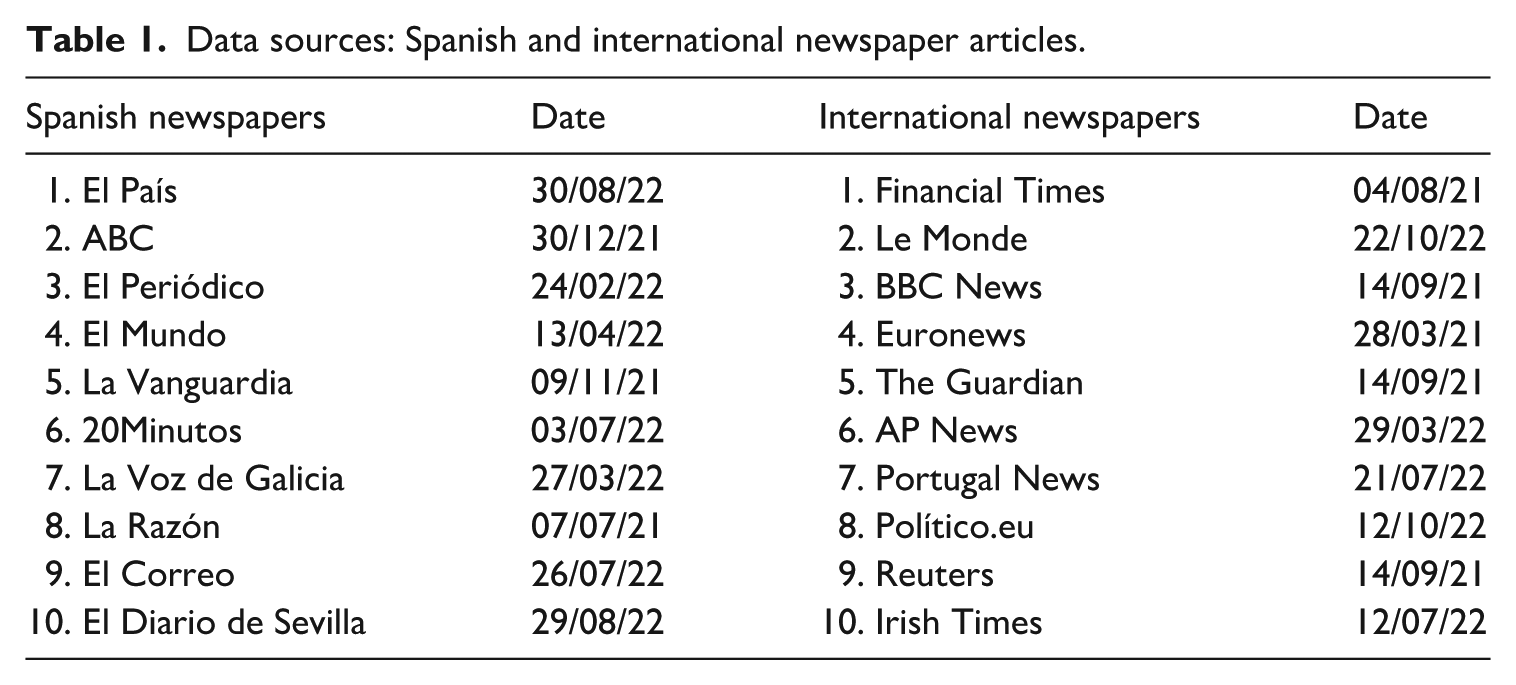
News outlets were selected using the 2022 Summer Edition of the SCImago Media Rankings (SMR) (Scimago Media 2022), which evaluates digital media reputation through metrics such as authority score, referring domains, and citation flow. From the top 20 ranked Spanish and European outlets, a subset was chosen to ensure geographic and thematic diversity. Articles were retrieved using keyword searches—such as “energy,” “electricity,” “crisis,” and “prices,” on the official websites of the selected newspapers. Filters were applied to limit results to the 2021 to 2022 period and to prioritize articles specifically focused on the Spanish context. Over 100 articles were initially retrieved, but only those with a clear and sustained focus on Spain’s energy crisis were retained, resulting in a final, thematically consistent and manageable corpus for qualitative analysis.
Method of analysis
The analysis focuses on how different levels of meanings are constructed, and how coherence is achieved between verbal and visual elements in headlines and images. Specifically, we examine how the social practice of responding to a global crisis is discursively represented through the selection and portrayal of social actors, their actions, and the strategies used to recontextualize these actions. Focusing on the headlines and images allows us to study the primary recontextualizing filter that prompts readers to construct meaning even before examining further reporting details. By occupying the “ideal” layout position, headlines establish the narrative “hook” and define the central “problem” under focus, while visuals contribute an emotionally charged dimension that actively shapes the readers’ perception of the crisis.
The analysis proceeds in three coding phases: initial, open, and axial. In the initial coding phase, we identify denotative meanings in both verbal and visual modes. Articles are categorized based on whether they frame the energy crisis primarily as a problem—emphasizing threats, causes, and consequences—or as a response—highlighting solutions, strategies, and action plans. In the open coding phase, we apply a data-driven approach to identify discursive strategies of recontextualization, following Van Leeuwen’s (2008) concept of “transformations.” Finally, the axial coding phase involves organizing and connecting the emerging categories to identify broader themes and patterns. This step allows us to assess how power relations are constructed through representational choices, particularly in terms of agency, authority, and control over the crisis narrative. Coding was conducted independently by both authors and then compared to ensure consistency. Discrepancies were resolved through discussion until full agreement was reached.
Findings and discussion
As an initial observation, the multimodal character of the texts prevails in online news outlets, which seem to rely, ever more, on engagement strategies that draw readers’ attention and keep them engaged with salient visual content. The visual power of images contributes, significantly, to the construction of energy crisis in our news data. All the images in the two data sets are remarkably salient in terms of size. Most of them are photographs (83.3%), and are positioned at the “ideal,” top-level position, right below the headline. In compositional terms, the ideal position in the webpage layout is a crucial spot that is used as a hook and a tool for attracting and retaining the viewer’s interest. The findings are organized into three thematics subsections. First, Section “Intermodal meanings and the energy crisis construction” examines the headline-image intermodal meaning constructions and the level of alignment between verbal and visual modes across both data sets. Second, Section 5.2 focuses on the discursive strategies found in the international coverage, specifically regarding the representation of crisis management and political agency. Finally, Section 5.3 analyzes the representational choices in the Spanish media, focusing on the portrayal of energy prices and the roles assigned to domestic social actors.
Intermodal meanings and the energy crisis construction
The critical analysis of headlines and visuals within news discourse requires a dual focus on recontextualization and multimodal constructions. These processes do not merely reflect external reality but actively reconstruct it by moving semiotic elements from their original contexts into new, ideologically charged narratives. This is evident in the adjacency between headlines, images and captions, which prompts readers to construct meaning even before engaging with further reporting details. Table 2. displays a summary of results from the analyses of the two data sets and indicates the intermodal relations established through the visual and linguistic representations enacted in headlines and their associated photographs. Both data sets exhibit strong multimodal cohesion, but the type of alignment differs. In the international data set, the headlines and images work together to support national or political discourse. They emphasize Spain’s active role (political agency, policymaking) and visually foreground elite actors and policy responses (e.g., politicians, protests). In the Spanish news articles, nonetheless, meaning is more focused on impersonal forces, mainly energy prices, as the main actors—suggesting a more passive or victimized positioning. Likewise, focusing on the everyday burden by foregrounding bills and appliances in the images indicates a bottom-up view of the crisis, and supports individual and domestic-level implications.
Summary of results on intermodal discursive constructions in the two data sets.

Despite the fact that our data sets are relatively small, the analysis reveals a significant difference between an insider’s and outsider’s discursive construction of the socioeconomic situation of crisis in the media. A close critical look into the analysis results allows us to discern the following dimensions characterizing each data set, as illustrated in Table 3. While crisis is represented as an issue allocated to political decision makers in the international data set, by granting special saliency to politicians and protesters, it is multimodally constructed in the Spanish data as a consumer’s burden, viewed reactively as a structural problem. These different representational choices showcase the ideological backdrops underlying the meaning enacted to energy crisis: constructed as a threatening phenomenon from insiders’ standpoints or as a matter of management practice from an outsider perspective.
Key insights about the crisis intermodal construction in the two data sets.
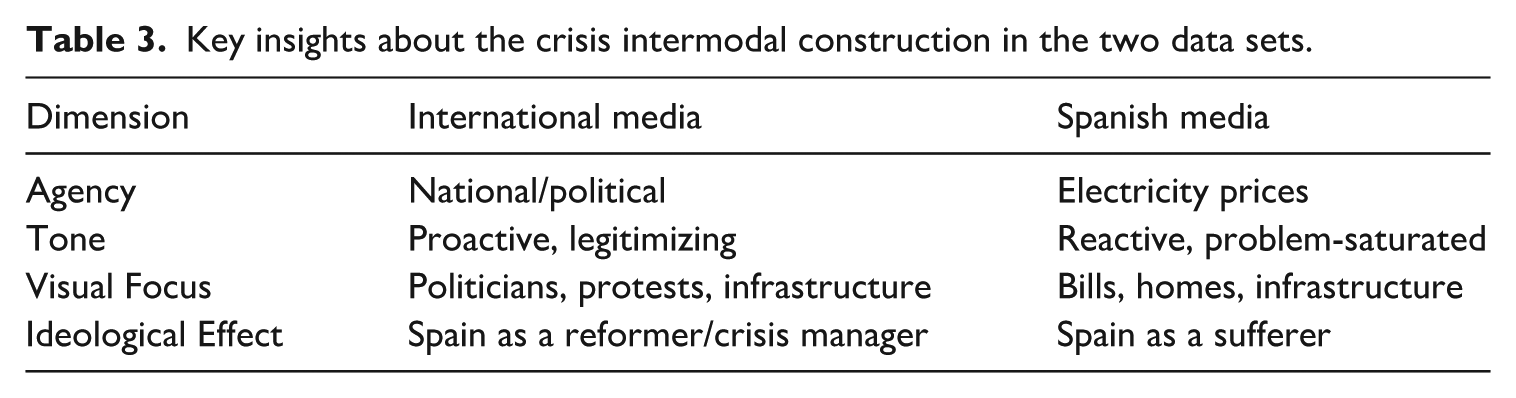
In the two data sets, actions indexed in the images also seem to work together with headlines and captions to discursively recontextualize the social actions under focus. This may be critically identified as biased or as ideologically motivated by the agendas of news producers and shaped by the complex institutional nature of news (Machin, 2008: 64).
The international data set discursive strategies
Spain in command of the crisis
In the international data set, the headlines exclusively focus on crisis management and response resolutions where in 90% of the cases, “Spain” takes the Actor role and enacts material actions mostly centered in crisis response. Spain, which is a common metonymy used to refer to the Spanish state or government in a generic way, is represented as acting, reacting and politically maneuvering a tough situation, but, more importantly, framed as being in command. Textually represented in the THEME position in the clauses in most of the headlines, “Spain” enacts the politicians in charge of managing a problematic situation. In addition, the exclusive presence of politicians as the main and almost only actors in the headlines excludes other key players in the crisis by defect and marginalizes their role in managing the crisis. The political policies are the focus in headlines constructions of crisis and showcase managerial leadership in example (1) and (2).
(1) “Tackling soaring energy bills, Spain to cap gas price, utilities’ profits” (Reuters)
(2) “Spain urges EU to act on soaring energy prices” (Financial Times)
Even in cases where the policy seems to be harshly criticized, as in examples (3) and (4), “Spain,” hence, politicians remain at the heart of the discursive construction of the crisis in the headlines.
(3) “Spain targets energy firms as European bills surge” (BBC)
(4) “Spain hits banks and utilities with windfall taxes” (Irish Times)
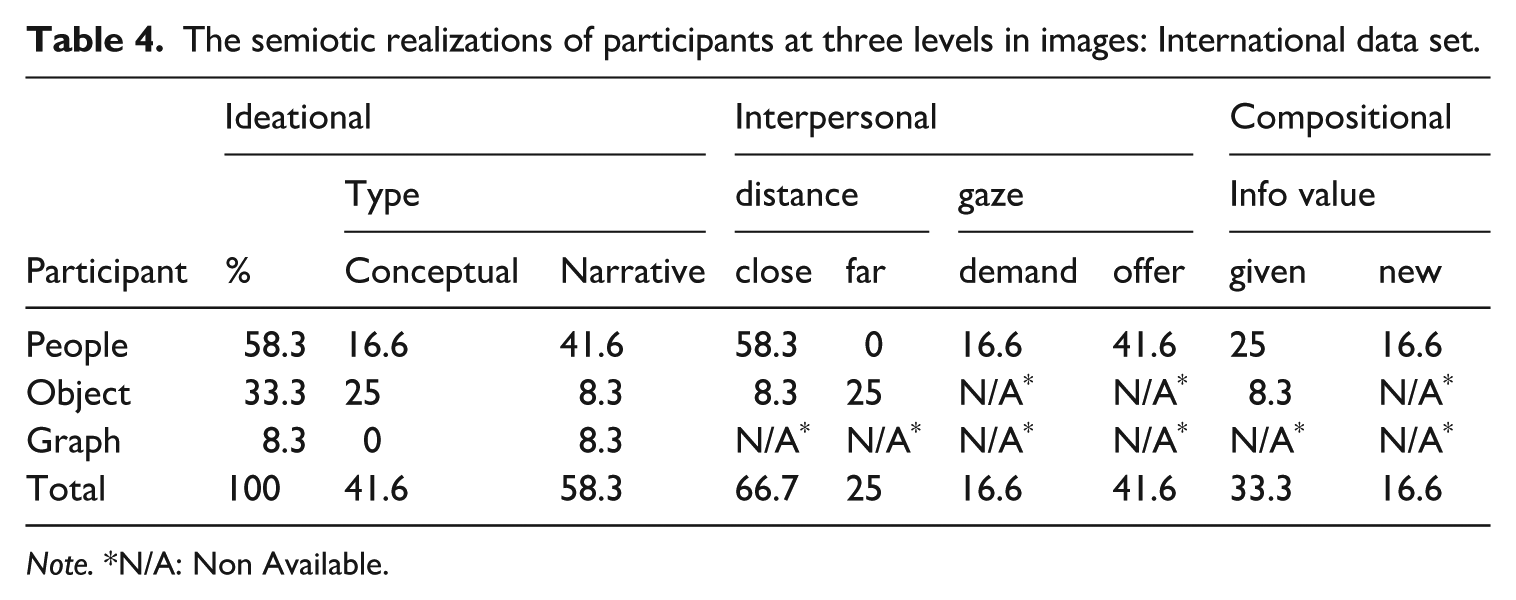
Taking a close look at the images and their role in the construction of crisis in the texts, the findings report a high level of coherence with the headlines. Table 4 presents the results from the analysis of the semiotic realizations in the international date set, in which attention is given to the participants at three levels of analysis: the ideational, interpersonal and compositional levels of meaning representation.
The semiotic realizations of participants at three levels in images: International data set.
Note. *N/A: Non Available.
In this data set, people are the main participants in 58.3% of the photographs, objects in one-third (33.3%), while in 8.3% information is multimodally displayed in graphic format. In almost two thirds of the pieces (58.3%), the images are narrative representations while in 41.6%, they are conceptual. The narratively represented participants feature either street protesting citizens or politicians performing their duties in public settings, highly proximal to the viewer in around 60% of the cases, gazing away in 41.6%. The conceptually represented participants, 25%, are energy sources, namely oil and gas plants or wind farms, which are generically iconic representations of the social and economic problem.
Legitimizing political crisis management
Legitimizing the power of authority
Among the most frequent recontextualization in the international data set are the ones legitimizing crisis management decisions which are multimodally realized by the interplay between textual and visual representations of politicians as the most visible actors in the construction of crisis. As an illustration, we take the example of The Guardian’s news piece, which features a headline saying: “Spain cuts soaring energy prices with emergency measures” juxtaposed with a photograph of Spain’s government official, Teresa Ribera, in a medium shot, standing behind a speaker’s desk during a political communication event.
The narrative representation of Ms. Ribera is indexed by her facial expressions indicating she is fully immersed in her speech. The multimodal interplay here recontextualizes the action representation at many levels. First, the government’s material action represented in “cutting prices,” coupled with the visual representation of Ms. Ribera, recontextualizes the action by nominating the Actor, in the captions, hence creating a specification of the generalized, aggregated “Spain.” Second, the action of “cutting prices” is semioticized by Ms. Ribera’s lively facial expressions, her engaging, direct gaze and self-assured posture. Direct gaze of a participant in images “demands that the viewer enter into some kind of imaginary relation with him or her” (Kress and Van Leeuwen, 2006: 118). Ms. Ribera’s active expressions call for the viewer’s compliance and trust and grant the message a certain persuasive power. The visual narrative of the engaging politician relaying eloquence and determination, juxtaposed with the linguistic representation of their political decision may be critically identified as a discursive construction of legitimation of Spain’s energy crisis management and an approval of its policies. Not surprising for the Guardian, the progressive-leaning newspaper, to take such a stance, defending government interventions in socioeconomic issues.
Legitimizing by appealing to justice
Taking another example from the Euronews news piece (Figure. 1), we look at the legitimation of the political decisions realized by appealing to moral values, more precisely, the moral obligation to address people’s needs. The headline reads: “Spain prepares economic support plan amid energy price spike” and the photograph is narratively represented through a close-up shot of a woman with a raised fist, evidently taking part in a demonstration. Her angry glare and raised fist construe a social protester in action. The raised fist, also referred to as “clenched fist” and commonly recognized as a symbol of social revolution, “represents power from below and solidarity between people joined in political struggle” (Faulkner, 2023).

Euronews headline and image interplay. Euronews 28/03/2022 (Photo: Gonzalo Fuentes/ Reproduced with permission from Associated Press).
A coherent relationship of Elaboration is established, here, with the interplay between the headline and the image. The central proposition in the headline referring to Spain’s responsive action to the crisis is reinforced by two circumstantial elements, textual and visual, both semantically serving as ENHANCEMENT (Halliday and Matthiessen, 2004: 262). The textual circumstance, the prepositional phrase introduced by “amid,” locates Spain’s political action within the time of “price spike,” while the image extends it circumstantially by summoning the waves of street protests to the proposition. Together, they ENHANCE the process of the government’s actions by combining two circumstances of time. The circumstances may also be inferred, here, as the causes of the political action. This multimodal representation seems to place double emphasis on the turbulent situation surrounding tough political responses to the crisis. The complex juncture of social and economic turmoil devised as a causation argument powerfully sustains and legitimates Spain’s political decision and construes it as unequivocal, stemming from popular support.
The Spanish data set discursive strategies
Electricity prices as natural phenomena
In the Spanish data set, “electricity prices” take the subject (THEME) positions in most of the headlines, in 80% of the cases, and act as the Actor, with realizations such as “el precio de la luz sube” (electricity price increases) or “subida del precio de la luz” (the rise in electricity price). There is no reference to politicians or other key players in the headlines, nor to crisis management. The actual social actors responsible for price increase, who are probably energy companies controlling raw materials, power plant operators and market agents, are excluded. Their behavior affecting prices is objectivated and their power dynamics are obscured. Objectivation, according to Van Leeuwen (2008) “allows social actions to be classified, labeled, (. . .) and the objectivated action or reaction then pre-modifies another objectivation which abstracts an aspect or quality from that action” (p. 65). Price increase is, hence, represented as an objective, socially disruptive phenomenon with threatening consequences, while the ones who induce and most benefit from the price increase are mystified and excluded. In example (5) the Spanish consumers are left with the “eventuation” of price increase, a plight which they must presumably confront as if inevitable. The impersonalized abstraction of electricity prices makes them seem natural phenomena, or inevitable events detached from human agency or responsibility.
(5) Hasta 18 millones de consumidores encaran a partir de ahora la subida de la luz (Up to 18 million consumers now face the rise in electricity Price; la Vanguardia)
In some headlines, the construction of the objectivated actions is realized through the use of metaphor and imagery that reinforces naturalization and hints to the intention of rendering the crisis an uncontrollable natural phenomenon. Construing the crisis as a disaster minimizes the human-driven actions and can help those responsible deflect accountability. In example (6), Spain is faced with a “storm,” where the metaphor here perfectly depicts the representation of crisis as a natural disaster. Equally, in example (7) “prices” are represented as forceful independent entities, where “skyrocketing” and “driving” create powerful imagery of a rapid, unstoppable explosion with a clear sense of direction and impact.
(6) España resiste a casi un año de tormenta eléctrica en el mercado. (Spain resists almost a year of electrical storm in the market; La Voz de Galicia)
(7) El precio de la electricidad se disparó un 107,8% en marzo y llevó al IPC al 9,8% (Electricity prices skyrocketed to a 107.8% in March, driving the CPI to 9.8%; El Mundo)
The crisis as an inevitable predicament for the citizens
As for image choices, and their representational characteristics in the Spanish data set, we can note a marked trend, the absence of politicians. Indeed, people are visually absent (or rather excluded) and objects are, instead, the most salient participants.
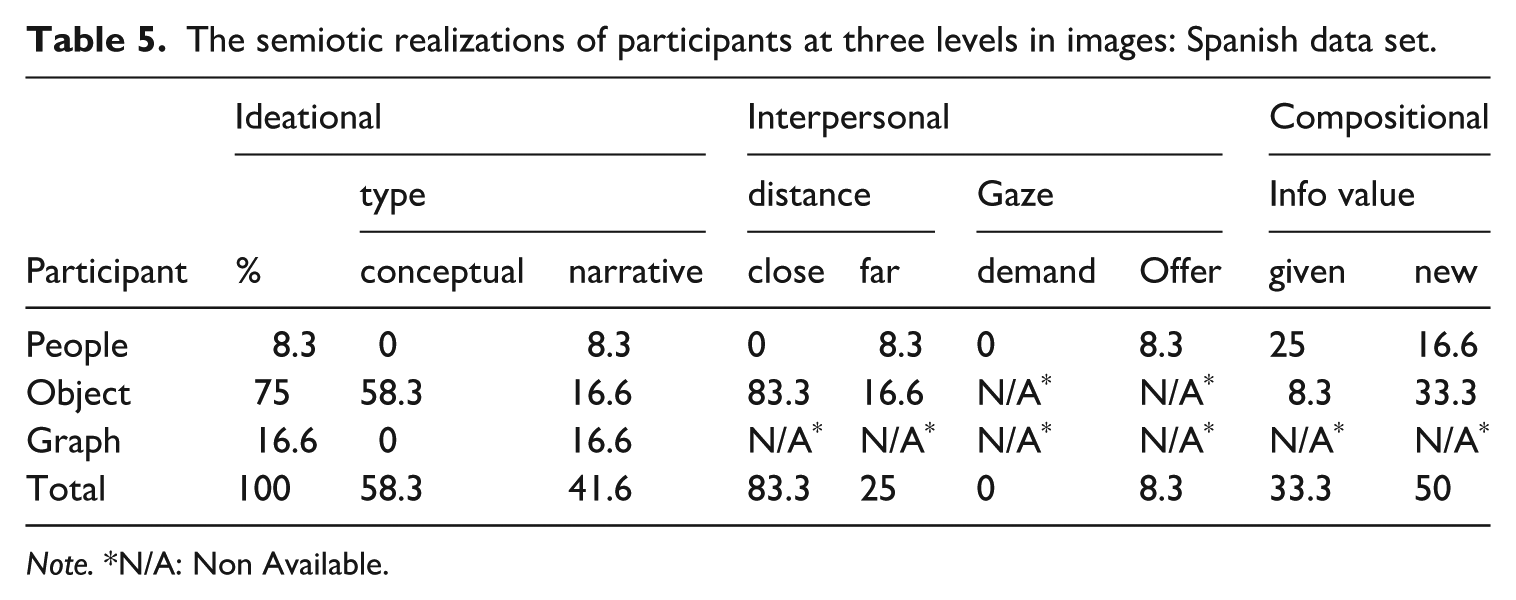
Table 3 displays the findings on image analysis in this set. Image participants that occupy the Actor position are primarily objects (75%) and are conceptually represented in 58.3% of the cases. Some of these representations involve energy icons such as electricity towers and power plants, which are metonymically construed as the cause of inflation surge affecting households in Spain. Other representations display social actions involving the use of energy, for instance, doing laundry, filling car tanks and reading energy bills, etc. and human agency is not discernable, but may be inferred or perceived in the background when hands are shown, for instance. These actions are objectivated, recontextualized to suggest generic citizens using energy sources. Power plants and citizens’ use of energy are representations of the public perception of risk, and they do not frame the issue from a crisis management-decision making perspective, at least not visually. They point out to people’s vulnerability and their dependability on energy, which has become an essential part of all human activities (Table 5).
The semiotic realizations of participants at three levels in images: Spanish data set.
Note. *N/A: Non Available.
The news headlines and accompanying images in the Spanish data set also display coherent relations in the multimodal constructions of the reports on energy events. However, the political policies related to crisis response and relief plan are not the focus in these constructions as is the case in the international data set. Instead, 90% of the intermodal meaning conveyed rests upon the increase in electricity price and its dramatic impact on consumers. Furthermore, price increase is identified as representation of a deactivated action; a representation that is construed as “something that happens, with no human agency, through natural forces” (Van Leeuwen, 2008: 66). Price increase is, in fact, the product of the social practices of stakeholders monitoring energy markets. The key social actors, conversely, and their potential actions causing inflation are ignored; instead, the social practices consequences articulated as “rise in price” take the front seat. This kind of deagentialized representation is identified as a naturalization of social action, “grammatically realized by processes of rise and fall, ebb and flood; of birth and death, growth and decay; of change and development and evolution” (Van Leeuwen, 2008: 68). This strategy of bringing together naturalization and objectivation of energy crisis shifts the focus aways from individual responsibility and evades accountability of the key actors perhaps allows the news outlet to preserve their business interest and/or ideological alignment with the entities that should be held accountable for the soaring prices.
As an illustration, we take an example from this data set, from El Periodico news report, where the headline reads: “La luz sube un 16.8% y alcanza su mayor nivel desde mediados de enero” (Electricity prices rise by 16.8%, reaching their highest level since mid-January). The text combines with photo, a visual representation of an energy transmission tower, in the middle of a highly sketched, out-of- focus landscape (Figure 2).

Headline and image interplay. El Periódico 24/02/2022/Reproduced with permission from Agencia EFE.
The articulation of the background has been reduced to such an extent that makes the tower extremely prominent. The tower proximity to the viewer, with its close-up-like shot, and its increased visual weight amplifies the meaning conveyed in the headline by “electricity price rise” and represents it as its cause. The act of price increase, or inflation, is deagentialized and represented as a phenomenon that happens, rather than an action brought about by human agency, acting in this construction as eventuation of a social action. This eventuated social action is visually coupled with its presumed cause, metonymically represented by the salient electricity tower. The cause of price increase, which should be in fact attributed to a complex series of man-made actions, is here represented as “an objectivated action, a spatialization, the substitution of a place associated with an action for the action itself” (Van Leeuwen, 2008: 64; emphasis in original). Hence, by choosing this visual conceptual representation, the issue reported is framed as an “eventual consequence” of the natural force of an electricity tower, that is, an energy source with a material objectivated power, rather than a social action involving human agency raging from politicians to owners of energy companies, to name only a few.
Conclusion
This study analyzed the multimodal recontextualization of the 2021 Spanish energy crisis, by examining the interplay of semiotic modes and the ways they reproduce crisis responses and represent social actors in online news articles. Taking a critical approach and drawing on Social Semiotics (Kress and Van Leeuwen, 2006), the study undertakes a systematic multimodal discursive analysis of headlines and their accompanying images in 20 news pieces to determine the interplay between these semiotic modes in the representation of social actors, and how their social practices are recontextualized in the discourse. When contrasting the two data sets, it is apparent that the outsiders’ perspective of international media tend to construct the crisis as a managerial issue, one that can be planned for, monitored and resolved through adequate crisis response. In the Spanish data set, the crisis is constructed from a citizen’s vantage point, primarily worrying about the increase in electricity prices and its threatening consequences.
This contrast in perspectives is clearly mirrored in the distinct linguistic and visual strategies employed by each media set. In the international news set, Spain is portrayed as a proactive leader, emphasizing government policies and political decision-making through material action processes and salient visual representations of politicians and public officials. This top-down narrative not only foregrounds political control and decision-making but also works to legitimize the Spanish government’s actions in the face of socio-economic turbulence. The strong alignment between image and text in these articles serves to reinforce a sense of coherence, urgency, and control, suggesting a view of the crisis as a national challenge to be confronted with leadership and strategy.
In contrast, Spanish media represent the crisis from the citizen’s daily struggle. The actual actors behind the crisis—energy providers, policymakers, or larger economic structures—are largely excluded, leading to a form of naturalization of price increases. Visually, this is achieved through conceptual representations of household items and energy infrastructure, rather than human agency, fostering a narrative of helplessness or inevitability. The multimodal discourse in Spanish outlets reveals a bottom-up construction, in which consumers appear overwhelmed by external forces. These diverging multimodal strategies highlight not only the ideological implications of news reporting but also the profound impact media framing can have on public perception and understanding of socio-economic crises.
Overall, this study has demonstrated how a multimodal social semiotics approach, grounded in the frameworks of Kress and Van Leeuwen (2006) and Machin and Mayr (2012), can reveal the nuanced ways in which media construct meaning around socio-political events. By examining both linguistic and visual modes, we have shown how different ideological positions, and cultural perspectives shape the public narrative of the energy crisis in Spain. These insights underscore the importance of critically inspecting media discourse in times of crises, through different semiotic modes, that influence social understanding and public discourse.
Footnotes

Funding
The authors received no financial support for the research, authorship, and/or publication of this article.
Declaration of conflicting interests
The authors declared no potential conflicts of interest with respect to the research, authorship, and/or publication of this article.