






Abstract
Paris has rules. The landmark Paris Agreement on climate change now has an accompanying ‘rulebook’. The rules, agreed at the 24th Conference of the Parties to the UN Framework Convention on Climate Change, set out in clear terms how parties to the Paris Agreement can implement, track and progressively enhance their contributions to tackling climate change.
In a promising move, the European Union has resolved to take action to restrict single-use plastic products. A meeting of the European Parliament and Permanent Representatives Committee agreed the Council’s position on a proposal for a new directive which will ban the use of certain single-use plastics for which an alternative exists. This embryonic development has all the hallmarks of becoming law in the very near future.
In the UK, the government issued a new Clean Air Strategy in January 2019. The new strategy hit headlines with, in particular, a bold new goal to reduce particulate matter from the burning of wood and coal in open fires and domestic stoves, together with an assault on the emissions of ammonia from farming. The World Health Organization (WHO) identifies particulates as the most damaging to humans. It hails the move as a global example for other countries to follow. There have been concerns raised about the lack of teeth in the strategy to enforce limits and restrictions. This welcome strategy comes after the government’s repeated defeat in the courts over its failures on clean air.
There have, over the last quarter, been a number of cases that concern fracking. This issue details the legal challenges that have taken place involving fracking, and the judicial reasoning in each.
Update
TRINITY CHAMBERS:
Matthew R. Crowe, Rebecca Suttle and Alice Richardson (assisted by Victoria Ball, Student, University of Northumbria)
NEWCASTLE UNIVERSITY:
Jennifer Stephens and Anna McClean

EU AND INTERNATIONAL LEGISLATION
Amendments adopted by the European Parliament on 24 October 2018 on the proposal for a directive of the European Parliament and of the Council on the reduction of the impact of certain plastic products on the environment (COM(2018)0340 – C8-0218/2018– 2018/0172(COD))
Draft plans approved by the European Parliament and the Permanent Representatives Committee seek to ban single-use plastics (such as bags or packaging and fast-food containers) from EU markets from 2021.
Report from the Commission to the European Parliament and the Council on the implementation of Regulation (EC) No. 1013/2006 on shipments of waste: Generation, treatment and transboundary shipment of hazardous waste and other waste in the Member States of the European Union, 2013–2015; exercise of the power to adopt delegated acts, European Commission, COM(2018) 762 final: SWD(2018) 468 final, 22 November 2018
This Report – the fifth in a series – concerns the implementation of Regulation 1013/2006 on Shipments of Waste. It covers the years 2013 to 2015 and draws together reports from individual Member States. The Commission is preparing to evaluate the Regulation. The Report analyses matters such as the reporting of exports/imports by member states, generation of hazardous waste and unlawful activity
https://eur-lex.europa.eu/legal-content/EN/TXT/PDF/?uri=COM:2018:762:FIN&qid=1542905702029&from=EN
Commission Implementing Decision (EU) 2018/2079 of 19 December 2018 on the approval of the engine idle coasting function as an innovative technology for reducing CO2 emissions from passenger cars pursuant to Regulation (EC) No. 443/2009 of the European Parliament and of the Council [2018] OJ L331/225, 17 January 2019
This Decision approves a joint application from vehicle manufacturers Audi, BMW, FCA Italy, Ford, Hyundai, JLR Jaguar Land Rover, Opel Automobile, PSA Peugeot Citroën, Groupe Renault, Robert Bosch, Toyota, Volvo and Volkswagen for the ‘engine idle’ function to be recognised as an eco-innovative technology within the meaning of Regulation 443/2009 setting emission performance standards for new passenger cars as part of the Community’s integrated approach to reduce CO2 emissions from light-duty vehicles, Article 12, provided that specified conditions are met.
http://eur-lex.europa.eu/legal-content/EN/TXT/PDF/?uri=OJ:JOL_2018_331_R_0012
Commission Implementing Regulation (EU) 2018/2066 of 19 December 2018 on the monitoring and reporting of greenhouse gas emissions pursuant to Directive 2003/87/EC of the European Parliament and of the Council and amending Commission Regulation (EU) No 601/2012 [2018] OJ L334/1, 1 January 2019
This Regulation lays down rules for the monitoring and reporting of greenhouse gas emissions and activity data pursuant to Directive 2003/87 on a scheme for greenhouse gas (GHG) emission allowance trading within the Community, in the trading period of the EU emissions trading system commencing on 1 January 2021 and subsequent trading periods. It further amends Regulation 601/2012 (on the monitoring and reporting of GHG emissions), effective from 1 January 2019. Regulation 601/2012 will be repealed on 1 January 2021.
http://eur-lex.europa.eu/legal-content/EN/TXT/PDF/?uri=OJ:JOL_2018_334_R_0001
Commission Implementing Decision (EU) 2018/2023 of 17 December 2018 on amending Implementing Decision (EU) 2017/1984 determining, pursuant to Regulation (EU) No. 517/2014 of the European Parliament and of the Council on fluorinated greenhouse gases, reference values as regards reference values for the period from 30 March 2019 to 31 December 2020 for producers or importers established within the United Kingdom, which have lawfully placed on the market hydrofluorocarbons from 1 January 2015, as reported under Regulation [2018] OJ L323/32, 19 December 2018
This Decision helps prepare for Brexit. It states that, for undertakings to which the Decision is aimed, and from the time that EU law ceases to apply in the UK, the reference value in the Annex to Decision 2017/1984 on fluorinated GHG is replaced by the reference value set out in the Annex to this Decision or the undertaking is removed from the Annex as specified in the Annex to this Decision.
http://eur-lex.europa.eu/legal-content/EN/TXT/PDF/?uri=OJ:JOL_2018_323_R_0008
Commission Regulation (EU) 2018/2005 of 17 December 2018 amending Annex XVII to Regulation (EC) No. 1907/2006 of the European Parliament and of the Council concerning the Registration, Evaluation, Authorisation and Restriction of Chemicals (REACH) as regards bis(2-ethylhexyl) phthalate (DEHP), dibutyl phthalate (DBP), benzyl butyl phthalate (BBP) and diisobutyl phthalate (DIBP) [2018] OJ L322/14, 7 January 2019
This Regulation amends Annex XVII to Regulation 1907/2006 on the Registration, Evaluation, Authorisation and Restriction of Chemicals (REACH). The amendment concerns entry 51 in the list of restricted substances.
http://eur-lex.europa.eu/legal-content/EN/TXT/PDF/?uri=OJ:JOL_2018_322_R_0004
Commission Implementing Regulation (EU) 2018/1992 of 14 December 2018 amending Implementing Regulation (EU) No. 1191/2014 as regards the reporting of data referred to in Article 19 of Regulation (EU) No. 517/2014 in respect of hydrofluorocarbons placed on the market in the United Kingdom and in the Union of 27 Member States [2018] OJ L320/25, 6 January 2018
This Regulation helps prepare for Brexit. The Regulation amends Regulation No. 1191/2014 on the format for submitting the report on fluorinated greenhouse gases to ensure that accurate data is available regarding the placing on the market of hydrofluorocarbons in the Union after the withdrawal of the United Kingdom.
http://eur-lex.europa.eu/legal-content/EN/TXT/PDF/?uri=OJ:JOL_2018_320_R_0003
Proposal for a Regulation of the European Parliament and of the Council on the alignment of reporting obligations in the field of environment policy and thereby amending Directives 86/278/EEC, 2002/49/EC, 2004/35/EC, 2007/2/EC, 2009/147/EC and 2010/63/EU, Regulations (EC) No. 166/2006 and (EU) No. 995/2010, and Council Regulations (EC) No. 338/97 and (EC) No. 2173/2005
The Council has agreed to align reporting obligations in the field of environment policy. This will require a regulation to provide a more cohesive approach to environmental reporting.
http://data.consilium.europa.eu/doc/document/ST-9617-2018-INIT/en/pdf
Report from the Commission to the European Parliament and the Council: EU and the Paris Climate Agreement: Taking stock of progress at Katowice COP (required under Article 21 of Regulation (EU) No. 525/2013 of the European Parliament and of the Council of 21 May 2013 on a mechanism for monitoring and reporting greenhouse gas emissions and for reporting other information at national and Union level relevant to climate change and repealing Decision No. 280/2004/EC), COM(2018) 716 final: SWD(2018) 453 final, European Commission, 26 October 2018
This report concludes that good progress has been achieved in relation to the EU Adaptation Strategy. There are areas in which further work is needed, including the implementation and monitoring of national strategies and the promotion of local action and ecosystem-based adaptation.
https://eur-lex.europa.eu/legal-content/EN/TXT/PDF/?uri=COM:2018:716:FIN&rid=1
Report from the Commission to the European Parliament, the Council, the European Economic and Social Committee and the Committee of the Regions: Summary of the Synthesis Report on the operation of Regulation (EU) No 649/2012 concerning the export and import of hazardous chemicals, COM(2018) 697 final: SWD(2018) 438 final, European Commission, 17 October 2018
This report considers the implementation from 2014 to 2016 of Regulation No. 649/2012 on the export and import of hazardous chemicals. The Regulation, sometimes referred to as the PIC Regulation, implemented the Rotterdam Convention on the Prior Informed Consent Procedure for Certain Hazardous Chemicals and Pesticides in International Trade.
https://eur-lex.europa.eu/legal-content/EN/TXT/PDF/?uri=CELEX:52018DC0697&from=EN
Communication from the Commission to the European Parliament, the Council, the European Economic and Social Committee and the Committee of the Regions Commission Work Programme 2019 Delivering what we promised and preparing for the future, COM(2018) 800 final, European Commission, 23 October 2018
This Communication sets out the Commission’s work programme. It lists general proposals in relation to climate change.
https://ec.europa.eu/info/publications/2019-commission-work-programme-key-documents_en
Preparations for the Implementation of the Paris Agreement and the first session of the Conference of the Parties serving as the meeting of the Parties to the Paris Agreement (and other documents)
This document and other associated decisions form a rulebook to make the Paris Agreement on climate change work in practice. There are detailed rules and guidelines concerning, among other topics, transparency, finance and adaptation.
CASE LAW
DOMESTIC CASE LAW
Air Pollution
HJ Banks and Co Ltd v Secretary of State for Housing and Local Government [2018] EWHC 3141
The claimant mining company applied to quash a decision of the Respondent Secretary of State refusing planning permission for a surface mine for the extraction of coal. The local authority had resolved to grant permission, but the Secretary of State had exercised his statutory power to make his own determination. A planning inspector recommended that permission should be granted. The Secretary of State accepted most of the inspector’s conclusions on particular issues but refused permission. The application was granted. The Secretary of State had erred in refusing planning permission after giving very considerable weight to the adverse effects of the emission of greenhouse gases. He had erred in his approach to paragraph 149 of the National Planning Policy Framework and had given inadequate reasoning on the critical issue of how a proposal for coal required to meet the country’s energy needs could be refused on the basis of the adverse impact of greenhouse gases, unless the gap was filled by renewables or low carbon sources.
Environmental Impact Assessment
R (on the application Kenyon) v Secretary of State for Communities and Local Government [2018] EWHC 3485 (Admin)
The claimant applied for Judicial Review of the defendant’s screening direction that a proposal for a housing development met the applicable criteria for an urban development project under paragraph 10(b) of Schedule 2 to the Town and Country Planning (Environmental Impact Assessment) Regulations 2017, but it was not EIA development because it was not likely to have significant effects on the environment, applying the criteria in Schedule 3. In an earlier hearing, the claimant had been given permission to challenge the decision on the ground that the defendant failed properly to consider the cumulative environmental effects of the proposal in his screening direction. In this application, the claimant also sought permission to challenge the decision on the ground that the defendant placed undue reliance upon conditions in an attempt to remedy the adverse environmental effects which were likely to arise from the proposal. The claim was dismissed. In relation to the first ground, the defendant’s screening direction was not unlawful. It was apparent from the evidence that the issue of air quality was carefully addressed by the Council in the planning application process, and that this would have informed its screening opinion. In relation to the second ground, permission was refused as the claimant had not established an arguable case that the conclusions were wrong either in fact or law and the claim was therefore unarguable.
Donnelly’s Application for Judicial Review, Re [2018] NICA 44
The appellants appealed against a decision upholding the grant of planning permission for an underground mine and associated surface level works on the basis that: (i) the planning permission had been granted for an 81-hectare site whereas an Environmental Impact Assessment had only be carried out on a 60-hectare site; and (ii) that the Department of the Environment had accepted a proposal for a monitoring scheme after it granted approval which constituted a failure to comply with the precautionary requirements of Directives 2001/92, 92/43 and 2006/21. The appeal was dismissed. The permission was limited to the 60-hectare site which had been subject to environmental assessment and the post-grant imposition of a monitoring scheme was not in breach of the relevant Directives.
Water Law
Moore (Valuation Officer), Re [2018] UKUT 324 (LC)
An appeal by the Valuation Officer against a decision of the Valuation Tribunal for England asking the Upper Tribunal to decide whether the risk of future flooding of a property, some sixteen months after the last flood, could constitute a material change in circumstance upon which a valid proposal to alter the property’s assessment in the ratings list can be made. The appeal was allowed. The Valuation Tribunal was wrong to determine that a heightened risk of flood constituted a material change in circumstance. The proposal was therefore found invalid.
Boots UK Ltd v Severn Trent Water Ltd [2018] EWCA Civ 2795
An appeal against a grant of summary judgment in favour of the respondent water and sewage undertaker. The manufacturer had sought the reimbursement of allegedly overpaid trade effluent charges arguing that the trade effluent was a mixture of water and trade effluent and that trade effluent charges should only apply to the part of the mixture that was actually trade effluent. The appeal was dismissed. The mixed liquid was trade effluent within the meaning of section 141(1) of the Water Industry Act 1991 and therefore liable to trade effluent charges.
Environmental Permits
R (on the application of Friends of the Earth Ltd) v Environment Agency [2019] EWHC 25 (Admin)
The claimant challenged a decision of the Environment Agency (EA) to grant a variation to an environmental permit granted to the interested party in relation to mining activities involving hydraulic fracturing. Three grounds of challenge were raised: (1) that the EA breached the requirements of the Environmental Permitting (England and Wales) Regulations 2016, No. 1154, the Mining Waste Directive (2006/21/EC), and the Industrial Emissions Directive (2010/75/EU) by failing to give any or any adequate consideration to whether electrocoagulation would constitute BAT for the treatment and re-use of flow-back fluid as part of the permitted activities under the varied permit (‘the Varied Permit’); (2) alternatively, under Schedule 7, paragraph 6 of Schedule 20, paragraph 12 to the 2016 Regulations, the EA breached its duty to encourage use of the emerging techniques at the site when deciding whether to grant the variation; and (3) when considering whether to grant a variation of the permit the EA failed to consider the claimant’s representations made during the consultation process that electrocoagulation was BAT for managing flow-back fluid. The claim was dismissed as although the court considered the grounds of challenge as arguable and permission could therefore be granted, none of the grounds of challenge were made out.
Energy
R (on the application of Baci Bedfordshire Ltd) v Environment Agency [2018] EWHC 2962 (Admin)
The claimant action group sought judicial review of a decision of the defendant to grant to the interested party an environmental permit for an energy recovery facility at a site in Bedfordshire. The claimant submitted that the decision was irrational as the EA had relied on the interested party’s mistake of fact and/or erroneous science in relation to fugitive emissions of potentially harmful heavy metals from the plant. The EA and the interested party admitted the error but argued that it had not been relied on in the grant of the permit. The claim was dismissed. The court was satisfied from the evidence that the EA had not made the same error and consequently its decision to grant the permit was not irrational.
R (on the application of Dennett) v Lancashire CC [2018] EWHC 2721 (Admin)
The claimant applied for an injunction to prevent an energy company from commencing fracking at a site in Preston and for permission to appeal the defendant local authority’s decision over the management and regulation of the environmental risk involved. The energy company had been granted a petroleum exploration and development licence and environmental permit and had been granted planning permission for a horizontal shale gas well by the secretary of state. The claimant submitted that the local authority had failed to take a precautionary approach to the environmental impact and risks of fracking, especially given the element of uncertainty regarding a new form of mineral extraction. The applications were refused. There was no evidence that the local authority had failed to properly assess the safety risks of fracking and no arguable case that it had failed to conduct appropriate emergency planning procedures.
York Potash Ltd, Re [2018] EWHC 3114 (Ch)
The claimant company applied for the court to grant it certain ancillary rights for the purpose of conveying polyhalite or potash from its mine in North Yorkshire via a 36.5 km tunnel to processing and port facilities in Teesside. The application had been made to the Secretary of State under section 4 of the Mines (Working Facilities and Support) Act 1966 and he had referred the matter to the court on the basis that there was a prima facie case for the grant of rights. Under section 3, the applicant had to satisfy the court that the grant of rights was expedient in the national interest, and that it was not reasonably practicable to obtain the rights by private arrangement. The application was granted and the court granted a wayleave under section 2(1)(b) since the relevant landowners could not be found or did not have the necessary powers of disposition.
Nuisance
Fouladi v Darout Ltd [2018] EWHC 3501 (Ch)
The first three defendants appealed against orders finding them guilty of noise nuisance and finding the first defendant in breach of covenant for failing to obtain the landlord’s consent to renovation works resulting in inadequate flooring. The claimant appealed against the dismissal of her claims against the fourth defendant (the landlord) for breach of covenant and in nuisance. The claims were all dismissed. The first three defendants were liable for nuisance for noise, the third defendant was in breach of covenant and although the landlord was aware of the works, it had no knowledge of the nuisance and was therefore not liable by participation.
Island Gas Ltd v Persons Unknown [2018] 12 WLUK 390
The claimants were gas companies that carried out fracking and the owner of land on which fracking was due to take place. In separate proceedings, the claimants applied to continue quia timet interim injunctions at various sites in order to restrain unlawful behaviour from defendant protestors, aimed at disrupting the claimant’s business. The applications were granted. The court held that rights under Articles 10 and 11 of the ECHR would not be materially affected, protestors could still engage in lawful protests and it was more likely than not that the claimant would win at trial. The court also held that there had been ample and compelling evidence of unlawful activity.
Roberts and others v R (Liberty and Friends of the Earth Intervening) [2018] EWCA Crim 2739
The appellants, who had been protesting against an authorisation which had been granted to an oil and gas exploration company to begin fracking at a site near Blackpool, appealed against immediate custodial sentences imposed following their convictions for offences of public nuisance contrary to the common law. It was the appellants’ case that an immediate custodial sentence was never appropriate for a non-violent crime committed as part of a peaceful protest and that such a sentence would breach Article 10 of the ECHR. The appeals were allowed. Immediate custodial sentences could be appropriate for non-violent crimes committed as part of a peaceful protest and such sentences did not breach Article 10. In the instant case, however, the immediate custodial sentences imposed on three protesters who had sat on the cabs of lorries delivering equipment to a fracking site were manifestly excessive. Community orders with a significant requirement for unpaid work would have been appropriate.
EU CASE LAW
Deza a.s. v ECHA (2019) Case C-419/17 P, ECJ (1 Chamber) 23 January 2019
Deza a.s. applied to set aside the judgment of the General Court of the EU in this case. The General Court had dismissed the action for annulment of Decision ED/108/2014 of the Executive Director of the European Chemicals Agency (ECHA), of 12 December 2014, updating and supplementing the existing entry of the chemical substance bis(2-ethylhexyl) phthalate on the list of substances identified (‘the decision at issue’) for eventual inclusion in an Annex XIV of Regulation (EC) No. 1907 (‘the REACH Regulation’). It was argued that there had been an error in interpreting the REACH Regulation, the ECHA had misused its powers, the judgment infringed the principle of legal certainty and that the Court below failed to have regard to the extent of its power of review and to the rights of the applicant. The ECJ upheld the judgment of the General Court and dismissed the appeal.
Inter-Environnement Wallonie asbl v Conseil des ministers Case C-411/17, 29 November 2018
This Advocate General’s Opinion discusses Belgian law. The Cour Constitutionnelle (Constitutional Court of Belgium) referred the following question for a preliminary ruling: Does the adoption of a law extending the period of industrial production of electricity by nuclear power stations require an environmental impact assessment? The Advocate General opined that the law, among other matters, was adopted without conducting necessary prior environmental impact assessments.
AS Tallinna Vesi v Keskkonnaamet Case C-60/18, 29 November 2018. This Advocate General’s Opinion concerns the definition of the concept of ‘waste’ within the meaning of Article 6(4) of Directive 2008/98 on Waste and the conditions which govern the end-of-waste status. The Advocate General noted that ‘waste’ as a concept has featured heavily in the case law of the ECJ. A question which has arisen rather more recently has to do with the conditions under which waste is converted back into a normal commodity no longer subject to the strict rules of the waste legislation. A number of questions were considered. The Advocate General opined that Member States may provide that waste is, as a general rule, subject to the waste legislation until such time as it fulfils the end-of-waste criteria which have been laid down as being applicable to the particular type of waste in question by a European or national act of general application. The Advocate General further opined that, where such criteria do not exist, the waste holder has the right to apply to the competent authority or a court of a Member State for a determination of end-of-waste status for certain waste, where that waste, account being taken of all relevant factors and the most recent state of scientific and technical knowledge, has beyond any reasonable doubt undergone a recovery operation enabling it to be made usable without endangering human health or harming the environment, and the holder does not discard it and does not intend and is not required to discard it, within the meaning of Article 3(1) of Directive 2008/98.
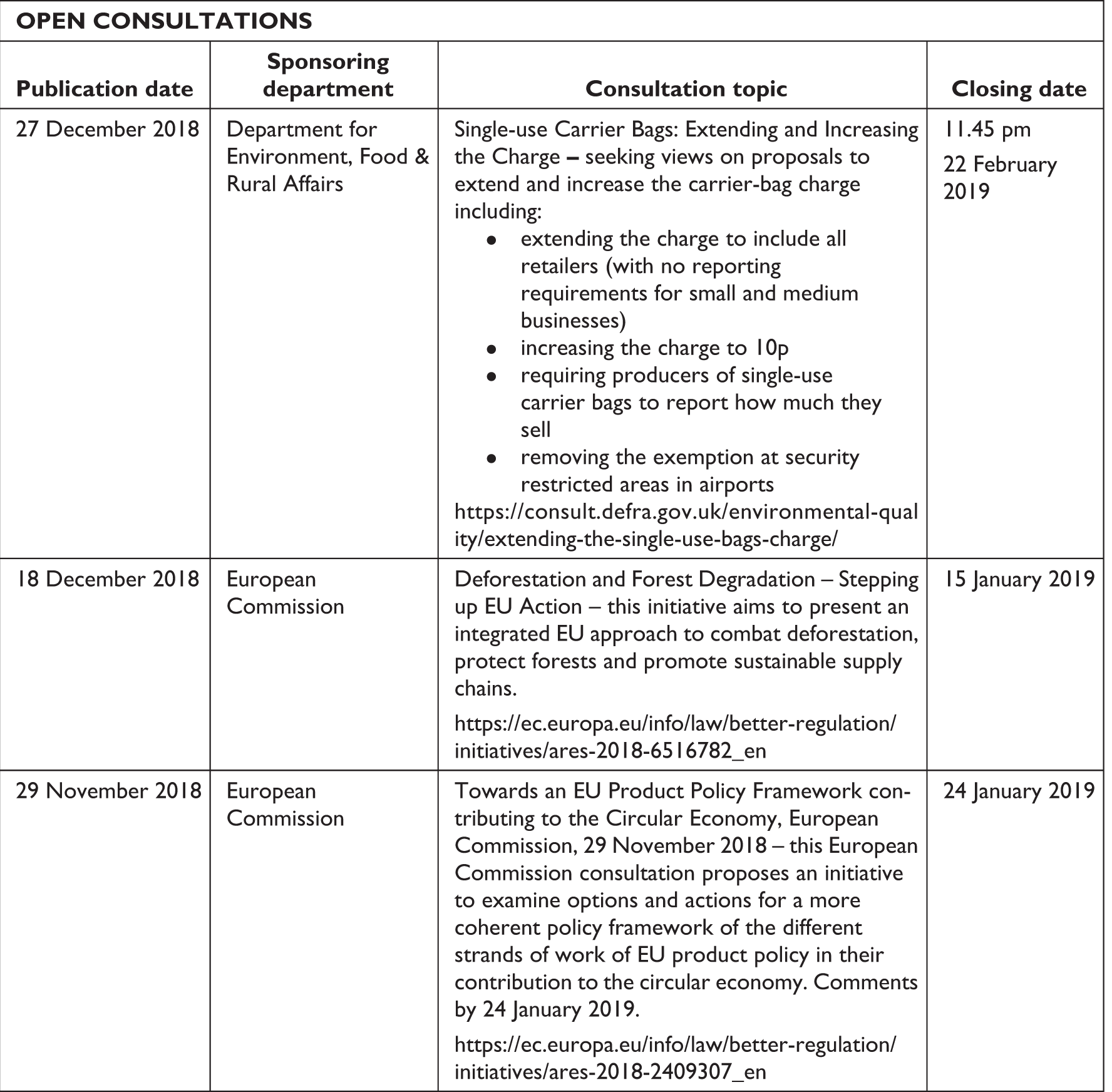
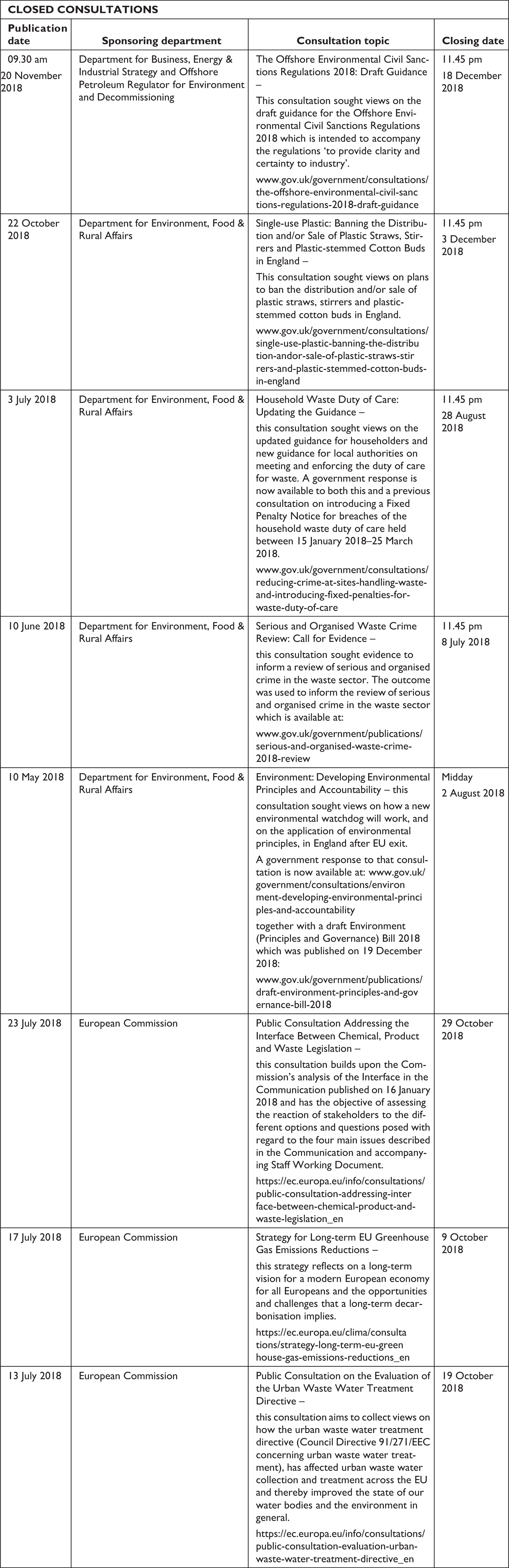
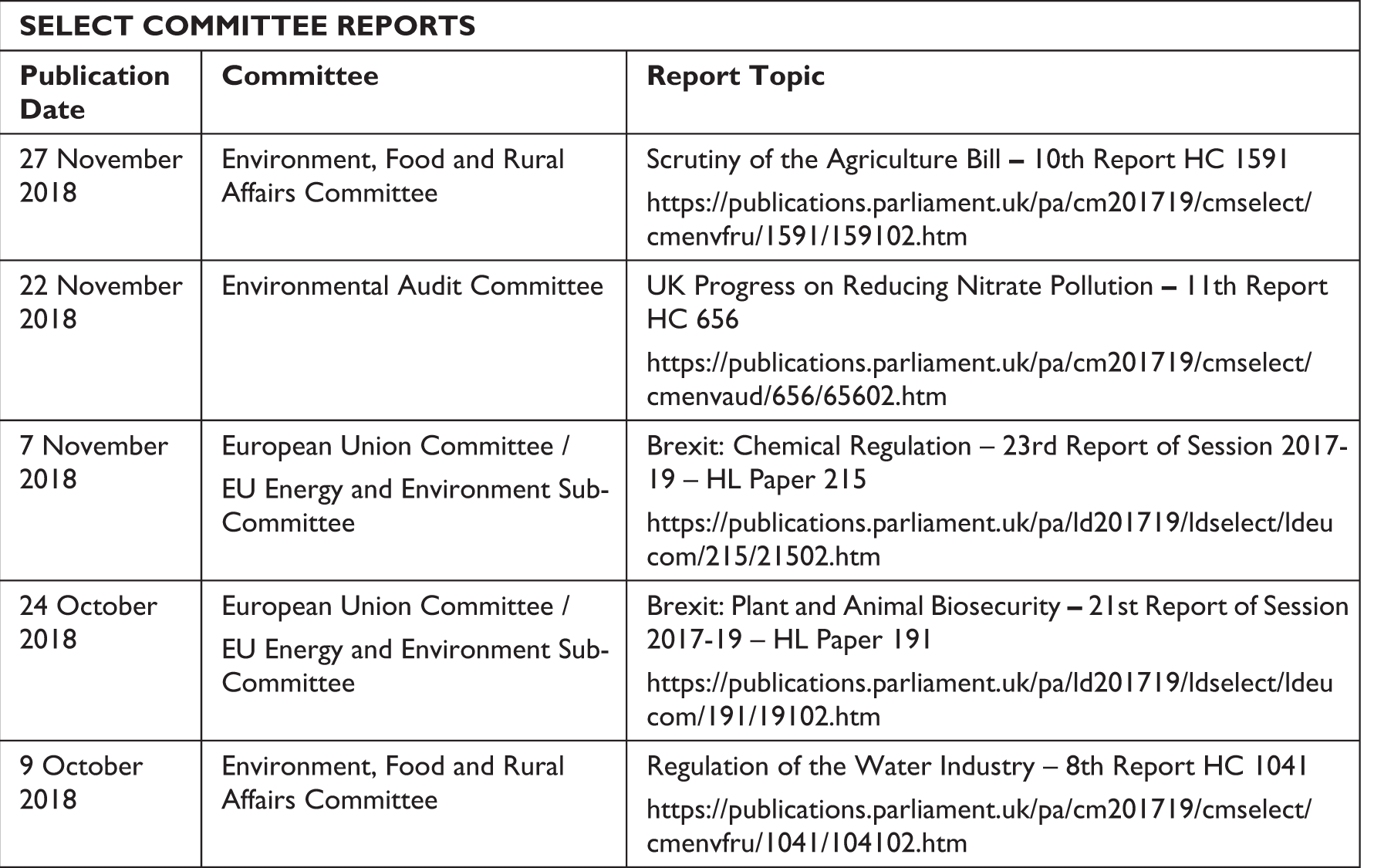
CONSULTATIONS
NEWS AND MISCELLANEOUS
Waste
Resources and Waste Strategy for England
In December 2018, the Department for Environment, Food and Rural Affairs and the Environment Agency published a strategy setting out how it intends to preserve material resources by minimising waste, promoting resource efficiency and ‘moving towards a circular economy.’
www.gov.uk/government/publications/resources-and-waste-strategy-for-england
Waste Duty of Care Code of Practice
In November 2018, the Department for Environment, Food and Rural Affairs and the Environment Agency published a Code of Practice issued under section 34 of the Environmental Protection Act 1990 providing practical guidance on how to meet waste duty of care requirements in England and Wales.
www.gov.uk/government/publications/waste-duty-of-care-code-of-practice#history
Energy
European Commission Proposes to Make Technical Amendment to EU Energy Efficiency Legislation to Take Account of UK’s Withdrawal
On 13 November 2018, the European Commission announced it had adopted a Decision to amend the EU’s energy efficiency legislation by lowering consumption figures to take account of the United Kingdom’s withdrawal from the European Union.
Carbon and Emissions
Mother wins right to seek new inquest over daughter, nine, whose death may be linked to air pollution, Sandra Laville, Guardian, 11 January 2019
The mother of a nine-year-old girl who suffered three years of seizures and 27 visits to hospital for asthma attacks, whose death has been linked to unlawful levels of air pollution in London, has won the right to apply for a new inquest. Legal experts believe that it is the first inquest case in the UK where it is alleged that air pollution had contributed to a death.
Brexit and Air Quality
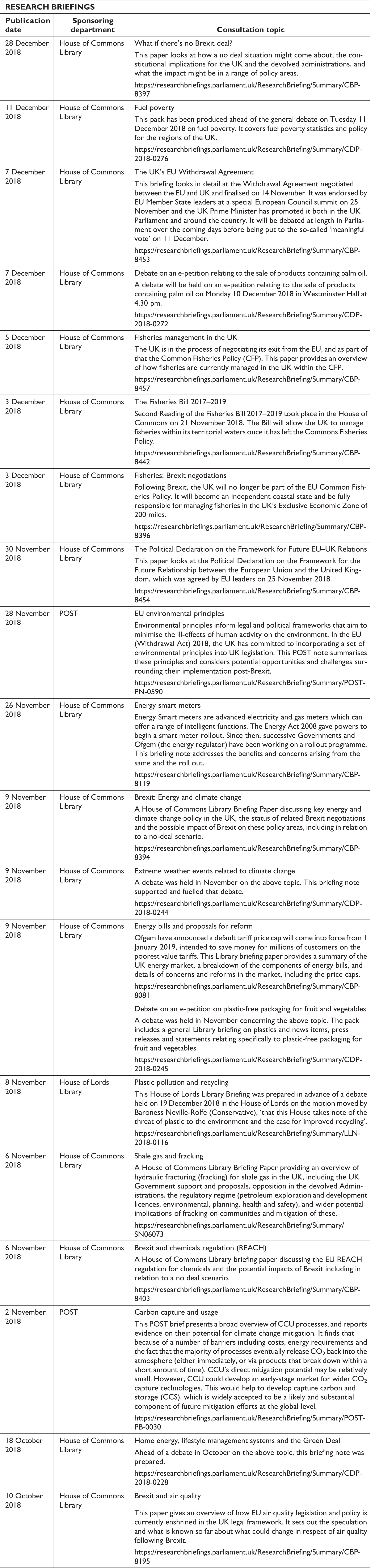
On 10 October 2018, the House of Commons Library published a briefing paper giving an overview of how EU air quality legislation and policy is currently enshrined in the UK legal framework and sets out the speculation about what could change in respect of air quality following Brexit.
https://researchbriefings.parliament.uk/ResearchBriefing/Summary/CBP-8195
Climate Change Impacts and Adaptation
On 26 November 2018, the Environment Agency published an ‘evidence-based report’ summarising climate change in England and its impact as well as the main adaptation actions that are being taken, or that are being planned, to prepare.
www.gov.uk/government/publications/climate-change-impacts-and-adaptation
Other
Single-use Plastics: Commission Reaches Agreement on New Rules to Reduce Marine Litter
On 19 December 2018, it was announced that the European Parliament and the Council of the European Union have reached a provisional political agreement on measures proposed by the European Commission to tackle marine litter at its source, targeting the 10 plastic products most often found on our beaches as well as abandoned fishing gear.
The Fisheries Bill 2017-19
The Fisheries Bill, published on 25 October 2018, is a framework bill designed to allow the UK to manage fisheries within its territorial waters once it has left the Common Fisheries Policy. On 3 December 2018, the House of Commons Library published a report following the second reading of the bill in the House of Commons on 21 November 2018.
https://researchbriefings.parliament.uk/ResearchBriefing/Summary/CBP-8442#fullreport
This was followed by a briefing paper on 5 December 2018: https://researchbriefings.parliament.uk/ResearchBriefing/Summary/CBP-8457
The Agriculture Bill
The Agriculture Bill 2017–2019 (HC Bill 266) was published on 12 September 2018. On 25 October 2018, the House of Commons Library published a report following the second reading of the bill in the House of Commons on 10 October 2018.
https://researchbriefings.parliament.uk/ResearchBriefing/Summary/CBP-8405
Revising the rules for free allocation in the EU Emissions Trading System, European Commission, 30 November 2018
A European Commission consultation proposes revisions to Decision 2011/278 (Benchmarking Decision) to: set the rules for determining free allocation to industrial installations covered by the EU Emissions Trading System; update the benchmark values which represent an essential parameter in determining free allocations; and determine rules for future adjustments to free allocation. Comments by 22 February 2019.
https://ec.europa.eu/info/law/better-regulation/initiatives/ares-2018-1523713_en
EU Implementation of the Aarhus Convention in the Area of Access to Justice in Environmental Matters
The EU and its Member States are parties to the Aarhus Convention on access to information, public participation in decision-making and access to justice in environmental matters. The Aarhus Convention Compliance Committee found that the EU does not comply with the Convention because of insufficient administrative or judicial redress at EU level. This initiative will evaluate the current situation and assess options to address compliance, to underpin possible decision making.
https://ec.europa.eu/info/law/better-regulation/initiatives/ares-2018-2432060_en
Green Insurance in Guernsey: Discussion Paper, Guernsey Financial Services Commission, 7 November 2018
A Guernsey Financial Services Commission consultation paper seeks views on how the development of green insurance in Guernsey might be supported through regulatory change. It also considers private-sector opportunities for green insurance in the Bailiwick. Questions include: Should the Commission be more proactive with respect to green insurance? Should a lower risk weighting be considered for green insurance? Can Takaful be made green in Guernsey? How can green be factored into valuation? Although the paper is intended primarily for insurance regulators and insurance professionals, submissions are welcome from anybody interested in climate change. Comments by 29 March 2019.