







Abstract
This paper offers a reframing of the dynamics of crime and punishment in the United States by exploring lethal violence and situating both violence and punishment within the larger capacity of the US political system to shield citizens from a range of social risks. I argue that security from violence is an important state obligation and then illustrate the exceptionally high rates of lethal violence in the US, relative to other rich democracies, and their clustering with a range of other racialized social risks, including poverty and imprisonment. I then provide a framework for understanding the exceptional status of the US by exploring the fragmented, racialized and legalistic institutions of American politics and the role they play in producing a range of socio-economic insecurities. I argue that both violence and punishment in the US can be seen as limited forms of state failure, particularly with respect to African-Americans.
Introduction
Few pathologies of the US state have garnered as much scholarly attention in recent years as US exceptionalism in imprisonment (e.g. Barker, 2009; Campbell and Schoenfeld, 2013; Garland, 2001; Gottschalk, 2006; Simon, 2014; Western, 2006). The United States is the world leader in incarceration, with over two million people in federal or state jails and prisons – roughly one in 108 Americans (Glaze and Herberman, 2013). Equally troubling is the racial disproportionality in confinement and its long-term consequences for individuals, families, and communities, particularly African-Americans (e.g. Clear, 2007; Western, 2006).
While the mass imprisonment literature has provided valuable insights into the causes of these developments, to a large extent arrest and incarceration have colonized the scholarly agenda on the politics of crime and punishment (e.g. Gottschalk, 2006; Lerman and Weaver, 2014; Tonry, 2009; Western, 2006). As a consequence, we have a much more limited understanding of the origins and consequences of the flip side of US over-punishment, that is, US under-security. 1 While most punishment studies begin with variation in rates of imprisonment, I begin with violent victimization and argue that the US state’s willingness to over-punish lawbreakers reflects its limited and racialized capacity to secure the citizenry from violence and other forms of social risk.
Re-centering serious crime in the politics of punishment literature renders visible the exceptional nature of the US, not only in imprisonment, but also in lethal violence and a range of socio-economic risks. Expanding the lens beyond mass imprisonment thus reveals a stark cluster of persistent, and in some cases, worsening social inequalities that are stratified by race and class. Considering violence in this context exposes both violence and punishment as forms of limited and racialized state failure that leave a substantial portion of the US population at high levels of social risk, including, but not limited to, imprisonment. These multiple risks are felt most acutely by the poor generally, and African-Americans specifically.
I explain this state failure through two inter-related aspects of US exceptionalism that are long-standing but became particularly ossified in the second half of the 20th century: the challenge of producing public goods owing to the fragmented and racialized nature of US political institutions; and the culture of legalism that has pushed political mobilization on imprisonment into challenges to state criminal law, procedure and practice. Both aspects of US politics have long obscured persistent race and class disparities in exposure to violence and other social risks, but important changes in political fragmentation after the Second World War – such as the growth of social issues on the national political agenda, the professionalization of state legislatures, prisons and local law enforcement, and the rapid retreat from broad social policymaking after the 1960s – collided with a wave of violent crime to produce distinctive social outcomes.
The article begins by discussing the importance of security from violence as a social good and its relationship to a general understanding of failed states. I suggest that, despite the fact that security from violence is a central state function, there is a yawning gap in the punishment literature theorizing its relationship to other state obligations, and to punishment. Drawing on comparative homicide rates, I then illustrate how homicide in the United States in the second half of the 20th century was strikingly higher, rose more dramatically, lingered far longer, and was more pervasive across populations than the literature generally acknowledges. Rather than relying solely on murder rates per 100,000, I also provide a heuristic for murder risk over a lifetime, and the diffusion of murder across demographic groups in order to highlight the exceptional and ubiquitous nature of US lethal violence.
From there, I leverage comparative political economy/institutions frameworks (per Lacey, 2008) to better understand the US case by observing a cluster of social risks, exposure to which is remarkably consistent across national political economies. Such exposure, I argue, can condition the political dynamics of punishment in important ways. I then locate the disproportionate cluster of risks in the US in the context of the long-standing fragmented, legalistic and racialized institutions of US politics that contribute to deep economic cleavages across racial groups, as well as high levels of social inequality, crime and punishment relative to other developed democracies.
I conclude by suggesting that situating crime and punishment studies more squarely in the arena of state capacity to secure the citizenry from a range of risks, including both violence and repression, highlights the broader incapacities and racialized nature of the US political system in the post-war period. While it is tempting to see the rise of mass imprisonment in the last few decades of the 20th century as muscular state capacity, I argue that it is more productively thought of as reflecting the challenges that inhere in the US political system to the production of collective securities, particularly when policy is aimed at expanding security to African-Americans. Such insecurities, including exposure to violence, then produce political pressures that are filtered through the same fragmented and racialized institutional mechanisms that contribute to high inequality and racial stratification in the first place. The result is a strong set of incentives to respond to growing risk of violence in one of the few arenas where state capacity is most visibly and easily increased: police and prisons.
Why focus on violence?
The lack of systematic theorization about the role of serious violent crime in US exceptionalism in imprisonment is puzzling (but see Zimring and Hawkins, 1997 and LaFree 2002). Security from violence is a basic human need, a legitimate state interest, and a core public good. Social theorists – from Hobbes to Weber to Rawls – have long recognized that a core source of state legitimacy is its ability to protect the individuals who constitute the body politic from both internal and external threat (Hobbes, 1962; Rawls, 1971; Weber, 2004).
2
High levels of serious violence raise questions about the authority and legitimacy of the state and the possibility of state failure. State failure, generally, can be understood as: The complete or partial collapse of state authority… Failed states have governments with little political authority or ability to impose the rule of law. They are usually associated with widespread crime, violent conflicts, or severe humanitarian crises and they may threaten the stability of neighboring countries. (King and Zeng, 2001: 653, emphases added).
While the term is associated with highly unstable political systems and is rarely applied to developed democracies, it nonetheless resonates with specific segments of the US socio-economic, legal and political landscape. As I will illustrate below, relative to other developed democracies, violent crime in the US is exceptionally high and homicide rates for some groups – young, black males, specifically – parallel those of some of the more murderous countries in the world. The limited capacity of the police to impose the rule of law in some urban areas and the weak political authority of the state more generally in such contexts, is also well documented (Anderson, 1999; Goffman, 2014). In addition, recent work on the dramatically different living conditions for African-Americans and whites in the most populated cities in the country reveals socio-economic, crime and health conditions for some black neighborhoods that can be characterized, without hyperbole, as a crisis (Massey and Denton, 1993). The analysis of urban neighborhoods by Peterson and Krivo (2010), for example, found that there simply are no majority white neighborhoods that are comparable to majority black neighborhoods, with respect to rates of violent crime, unemployment, poverty, and concentrated disadvantage.
This gap in theorizing the relationship between violence, social inequalities, and punishment risks misrepresenting the nature of the US state and the politics of punishment in several respects. First, it largely isolates punishment from a real and horrific social risk. Paradoxically, some of the earliest work on the rise of incarceration and other shifts in criminal justice in the late 20th century highlighted the centrality of sustained high rates of crime for such analyses. Notably, David Garland, in a series of works (1996, 2001), regarded high crime as a central feature of the current socio-political dimensions of punishment, not in terms of a one-to-one causal relationship, but, rather, as a context that both conditions and reflects the possibilities and capacities for governing. Strangely, scholars have largely neglected this particular feature of Garland’s work, focusing instead on the changes to the state apparatus, modes of governance, and public and private sector accommodations to late modernity. 3
In addition to the theoretical reasons to treat violence as a real social risk, an ample literature in public policy demonstrates that when destabilizing social conditions arise, such as unemployment or deadly disease, the public is likely to become acutely aware of them (Baumgartner and Jones, 1993; Kingdon, 1984). Studies of comparative welfare states, for example, have found that real economic insecurity and a worsening economy induce general public anxiety and such growing risks have very real political responses that vary across differently constituted democratic systems (Bermeo and Pontusson, 2012; Manza and Brooks, 2007; Rehm, 2011).
Analyses of crime and punishment, however, have yet to embrace this understanding of the relationship between growing risk of violence, political institutions and outcomes. While lethal violence in modern democracies affects only a small portion of the population, high levels of other social insecurities, such as unemployment or global pandemics, also touch only a fraction of the public. Yet they are typically studied as crises for their political consequences, especially when there are sudden and dramatic increases, or persistence over an extended period of time. Anxiety over the risk of serious predatory violence is rarely given such quarter. As a result, our understanding of imprisonment has become largely untethered from relative levels of material risk across democratic systems and over time. Reintegrating serious criminal violence into analyses of punishment provides the opportunity to think more systematically about state capacity to secure the citizenry not only from repressive practices, but from other forms of risk as well.
Second, and relatedly, neglecting violence obscures deep socio-economic and racial disparities in the experience of violence, and treats populations suffering from high risk as mere objects of social policy, rendering invisible their political agency and real interest in greater security. While scholarly work has rightly observed the disproportionate use of imprisonment for the poor and minorities, the neglect of violence has overlooked the daily threat to these same individuals, families and communities that real violence imposes (but see Forman, 2012; Fortner, 2013; Kleiman, 2010; Miller, 2010).
Finally, neglecting violence has led to an over-reliance on the US case as a basis for theoretically and empirically generalizable claims about the socio-political dynamics of punishment. Considering violence in the US more systematically, by understanding its persistence, diffusion and severity, alongside other forms of social risk, reframes the comparative analyses by situating crime and punishment within the distinctive features of US politics. In other words, thinking carefully about violence as a social risk provides an opportunity to consider how political institutions may exacerbate or mitigate such risks (e.g. Lacey, 2008). Moreover, it moves us beyond the narrow search for causal factors that explain year-to-year variation in imprisonment and toward a broader framework that considers how the experience of risk, broadly conceived, conditions the politics of punishment in different democratic political systems.
I argue that persistently high rates of life-threatening violence alongside high levels of other forms of social inequality provide an important context for the politics of punishment in three important ways. First, a high risk of violence may erode public confidence in the capacity of the state to secure the citizenry and increase social cohesion, much as it does in failed states (see Garland, 2001; LaFree, 2002; Roth, 2009; Zimring and Johnson, 2006 for a related discussion). Consistent with Barker (2009), such weakened political authority may increase demands for retribution, even from those who might otherwise be amenable to more restorative options. Second, these social conditions may reflect the actual limits of socio-political institutions and economies that render pervasive the conditions that give rise to violence and inequality in the first place. In other words, relatively high rates of murder and other social inequalities create a policy context in which the public – with good reason – lacks confidence in the capacity or willingness of the state to ameliorate their causes. High levels of violence and punishment would both reflect and reinforce the limited political opportunities for reducing them. Similarly, low rates of violence and inequality may pose less of a threat to the credibility of the state to return to its more secure norm. Such conditioning of the political process by real rates of violence and inequality are further likely to be filtered through race and class prejudices, where populations that suffer from high rates of both may be seen as incapable of being integrated into the mainstream.
Finally, where inequality across risk exposure is persistently and highly racialized, as it is in the United States – where, for example, homicide rates for blacks sometimes exceeds that of whites by an order of magnitude and where the unemployment rate for whites climbed past 8 percent only four times between 1975 and 2010 (1982–1983 and 2009–2010) while the black unemployment rate has remained over 8 percent every year but one during the same time period (2000) – socio-political analysis should consider whether and how such conditions constitute a full or partial racialized failure of the legitimacy and authority of the state. Theorizing violence not simply as an isolated potential predictor of variation in punishment rates but, rather, as a potential crisis that clusters with other risks, vulnerabilities and inequalities can increase scholarly understanding of the political capacity of democratic institutions to induce low levels of lethal violence, distribute social goods in a reasonably equitable fashion, and limit the use of state repressive apparatus in response to threats to, or breakdowns in, the social order.
A brief note on homicide
I deliberately focus exclusively on serious violence here in order to distinguish malum in se, acts that are themselves considered to be harmful, such as inter-personal violence, from malum prohibitum, acts that are collectively determined to be damaging to society, such as drug dealing. I think this distinction is crucial for guiding research on crime and punishment. Security from life-threatening violence is perhaps the most fundamental public good that members of the body politic can expect the state to provide, and homicide is particularly crucial in the existential threat it poses to individuals, communities, and the authority and legitimacy of the state (see Barker, 2007; Dubber, 2002; Loader and Walker, 2007; Miller, 2013; Ruth and Reitz, 2006). When people express fear of crime, it is typically violent crime that is in the forefront of their minds, not theft, pick-pocketing, or residential burglary (Zimring and Hawkins, 1997). Failed states, by definition, have largely lost the ability to ensure the physical safety of citizens in any systematic and predictable sense.
In addition, dramatically rising and sustained high risk of lethal assault is a crisis – much as economic recessions, outbreaks of communicable diseases, and terrorist attacks – and should prompt a search for an understanding of its wider implications vis-à-vis the state and its capacity to prevent and cope with a crisis. While non-violent crime may preoccupy people and generate frustration, resentment, and even fear, it is far less likely to induce the kind of deep anxiety that attaches to loss of life itself. Homicide, then, is a particularly potent social risk that deserves greater exploration for its political implications.
More pragmatically, homicide data are less plagued by measurement error than other types of violence, which fall prey both to changes in definitions over time as well as cross-national variation in recording. A robust literature finds that homicide and violent crime rates rise and fall in fairly close tandem, particularly when considered over long periods of time (Eisner, 2008; Fajnzylber et al., 2000). Thus, I rely on homicide both as a serious social problem in its own rite, as well as a proxy for understanding rates of serious violence more generally.
Homicide, four ways
Here I illustrate the magnitude of homicide in the US in four different ways in order to understand its exceptionalism – the standard rate per 100,000, risk during a normal lifespan, peak rates by state, and rates by race and gender.
4
Figure 1 illustrates the increases in homicide rates across six countries in the post-war period (US, Canada, England and Wales, Denmark, Netherlands, Italy). These six countries reflect the types of political economies that the punishment literature has identified with varying rates of imprisonment (see Cavadino and Dignan, 2006; Lacey, 2008): liberal market economies (US, Canada, and England/Wales); conservative corporatist (Netherlands and Italy); social democracies (Denmark). I use three-year moving averages for visual clarity.
Homicide rates, select countries, 1950–2008.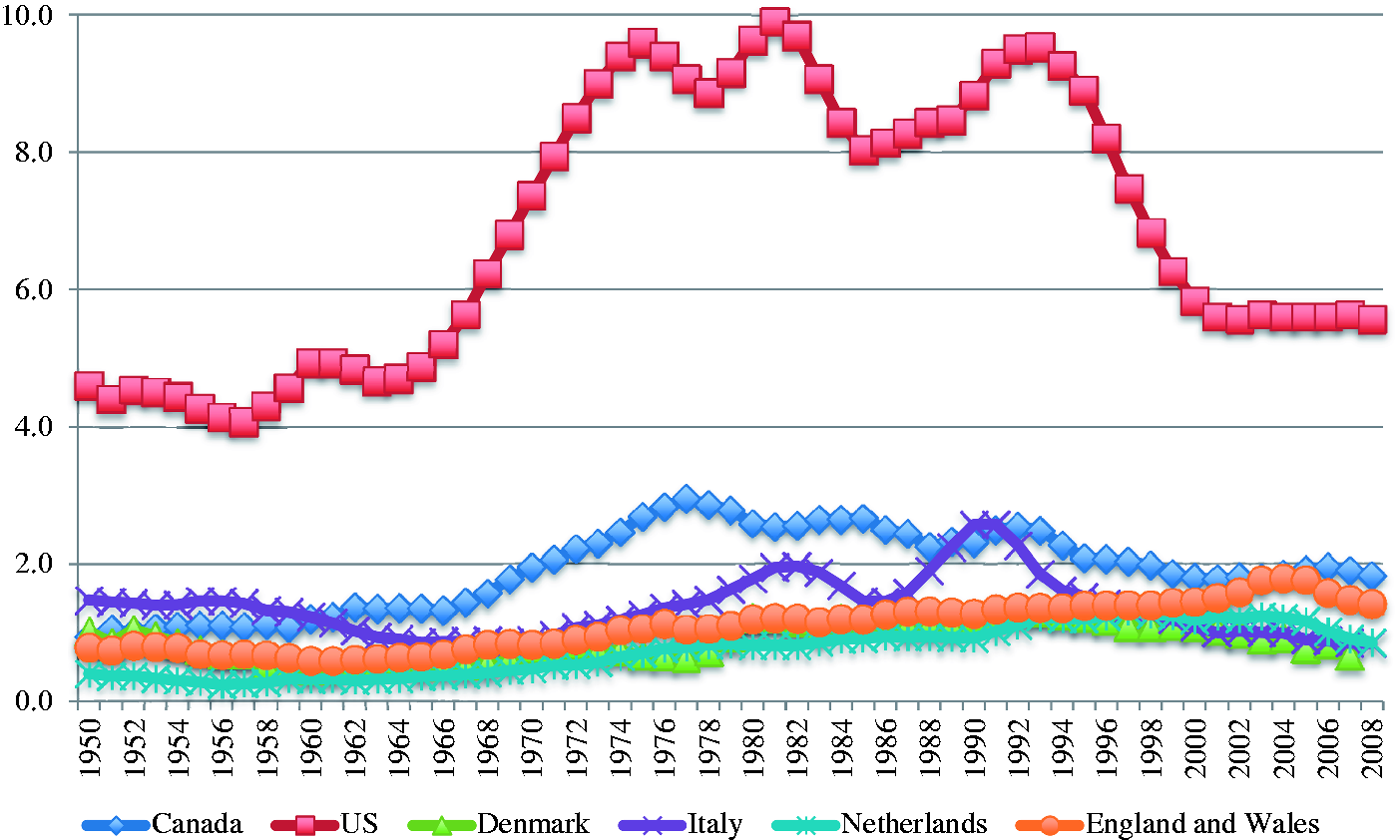
Two observations are noteworthy. First, the US is an extreme outlier for the full 60-year period. The lowest rate of homicide – 4.0 per 100,000 in 1957 – is 33 percent higher than the highest peak rate across the other nations – Canada, 3.0 in 1975. Second, the three-year moving average peak US rate (9.9 in 1980) is more than three times the peak rate of Canada and more than seven times the peak rates in Denmark and the Netherlands (1.3, three-year moving average in both countries).
Risk of homicide over 75-year lifespan 7
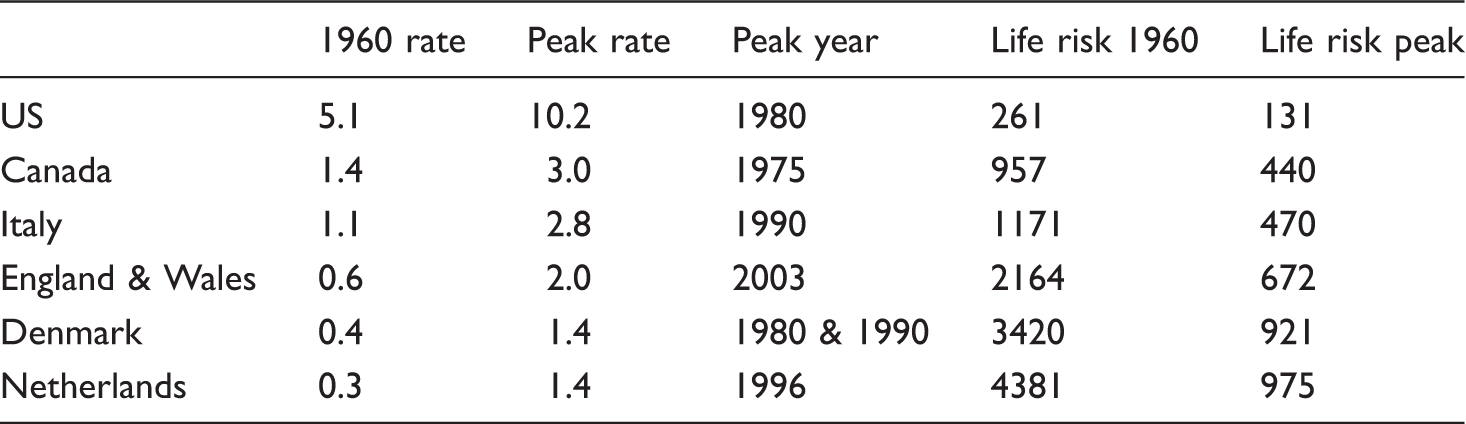
Once again, the US is an extreme outlier. Even at its relatively low 1960 rate (onein 261), life risk of homicide in the United States was greater than any other country’s peak (Canada, in 1975, at one in 440). If homicide rates had remained as high as they were in 1980, individuals born that year faced roughly a one in 131 risk of homicide, nearly three-and-a-half times as high as the peak risk in Canada, five times as high as England and Wales, and at least seven times that of the peak risk in the Netherlands and Denmark, and only slightly lower than the risk of dying in a car accident in the United States. 6 While differences across race and class make these risks higher for some groups and lower for others, the pervasiveness of murder during the high crime years made it a social condition that would have been difficult not to notice, particularly since other violent crime was also high.
Such risk calculations for the low violence countries further draw these differences into sharp relief. In Denmark and the Netherlands, even if the most homicidal years continued for a lifetime, only one in close to 1000 persons would be murdered. At their lowest points, this risk drops to a virtually unknown one in 3400 and 4400, respectively, putting the odds of being a victim of homicide in these countries somewhere between choking to death and dying in a bicycle accident. 7
A third way of understanding the realities of lethal violence in the US in the post-war period is to consider peak rates. Figure 2 shows the homicide rates for each state between 1960 and 2010, as a stacked area chart. The actual rates are not important here. Rather, we want to observe the overall trend. Much is made of 1980 as the apex of the homicide rate in the United States, after which imprisonment should have levelled off (e.g. Western, 2006). Indeed, between 1950 and 1980, the homicide rate more than doubled, increasing 122 percent from 4.6 to 10.2 murders per 100,000.
Homicide rates by state, 1960–2010.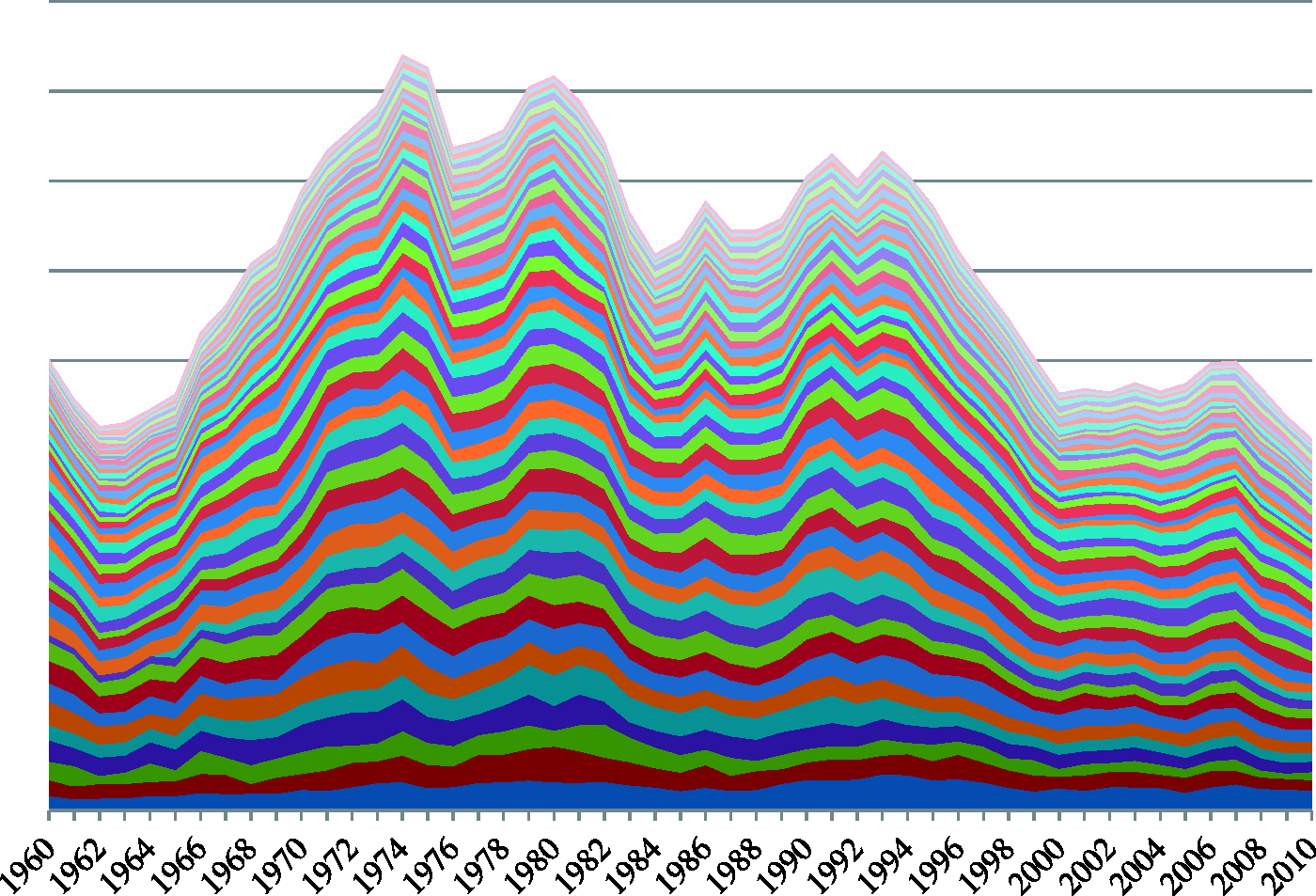
But homicide rates remained very high even after 1980, dipping barely perceptibly before rising again in 1990s. The national homicide rate dropped 24 percent between 1980 and 1995 (from 10.2 to 8.2), a small decrease in contrast to the 155 percent increase between the lowest rate of 4.0 in 1957, and the 1980 peak (10.2). In some states, and for some groups, the peak rate did not occur until the mid-1990s. Murder rates in Wisconsin do not reach their peak until 1991, and states as regionally diverse as Alaska, Connecticut, Louisiana, New York, Oklahoma and South Dakota do not reach peak homicide rates until the mid to late 1990s. Moreover, few states saw appreciable declines during this period.
Not until the turn of the century do rates begin to come down to previous levels and only toward the end of the first decade of the 21st century do murder rates reach or fall below those of the previous post-World War II lows. 8
Risk of homicide over 75-year lifespan by race and gender
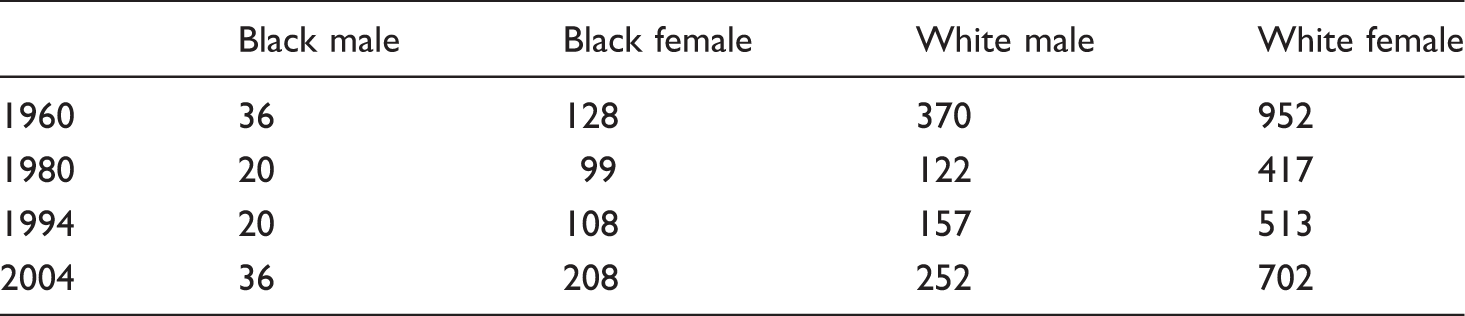
By contrast, and remarkably, black female lifetime homicide risk is consistently higher than white male rates. This is particularly striking, given the overall gender bias in violent victimization (male on male), and almost entirely overlooked by crime and punishment studies (Brookman and Robinson, 2012). The focus on racial disparities in imprisonment has obscured the risk of deadly victimization for blacks generally, but has particularly rendered invisible the lethal violence to which African-American women are routinely exposed (see Lane, 1989; Roth, 2009).
Most strikingly, African-American male lifetime risk of homicide dwarfs other groups at an incredible one in 20 in 1994. Between 1990 and 1995, black males were murdered at a rate seven times that of white males. In fact, in 1995, in absolute numbers, more African-American men were murdered than white men, a staggering fact, given that blacks constitute roughly 12 percent of the US population. 12
Homicide rates, race, gender and age, select years
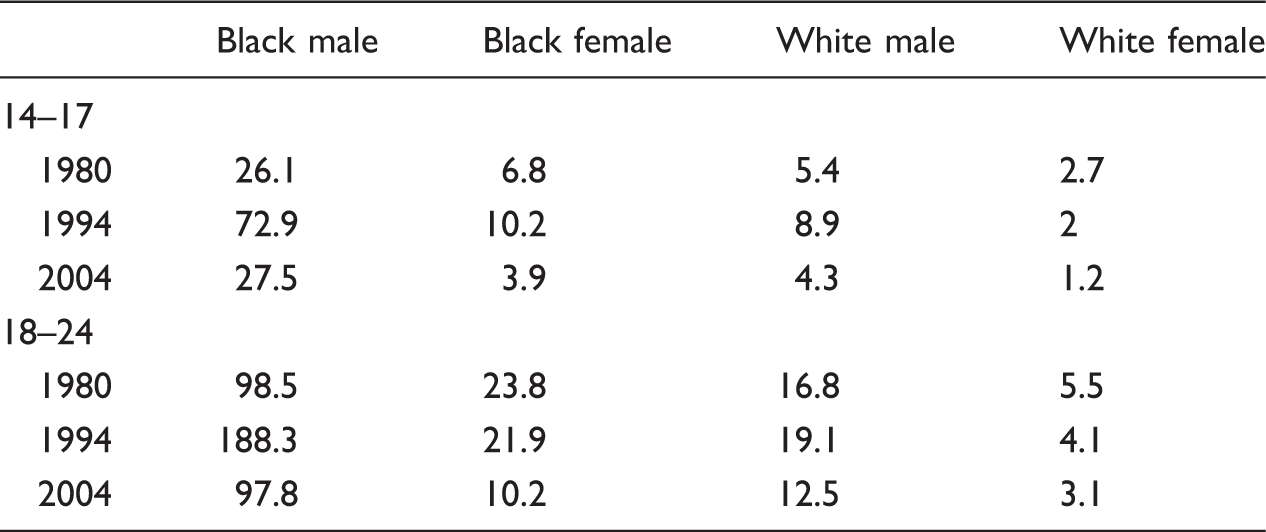
Once again, young black males experienced drastically higher risk of homicide, at a rate of 26.1 in 1980 for 14–17-year-olds and 98.5 for 18–24-year-olds, which rose to rates of 72.9 and 188.3, respectively, in 1994. Moreover, in 1994, black males between 18 and 24 years were nearly an order of magnitude more likely to be murdered than whites of the same age when black male rates were 188, but only 19 for comparable white males. It is worth noting that, by 2004, black male rates of homicide for teens 14–17 had fallen only to their 1980 levels, in contrast to other groups whose rates fell far more. Once again, white females are far more insulated from homicide, with young women 18–24 having a peak rate of 5.5 per 100,000 in 1980, which had fallen to 3.1 by 2003. While youth deaths from homicide have declined dramatically across all racial groups, black youth rates declined the least (White and Lauritsen, 2012).
Finally, but notably, though overall risk is clearly highest for African-Americans, the greatest increase in homicide rates between 1960 and 1995 was for white males, growing more than 150% from 3.6 per 100,000 to 10.9. White female and black male lifetime risk roughly doubled as well. While white fear of crime during this time was demonstrably related to racial biases, we should not rule out the possibility – indeed likelihood – that it was also related to increases in real risk. 14
In sum, homicide in the United States is exceptional, relative to other developed democracies. In addition, it rose dramatically between 1965 and 1980, remained high well into the 1990s and relatively high until the turn of the century. Moreover, lifetime risk of homicide grew for all groups, regardless of age, race or gender, diffusing across the population rapidly. In other words, risk of serious violence spread for virtually all Americans during this time period. African-Americans and young people, however, suffered particularly high rates of victimization and young black males were and remain exposed to an astonishingly high risk of murder, relative to whites.
Homicide in the context of social inequality and political institutions
Social risk comparisons
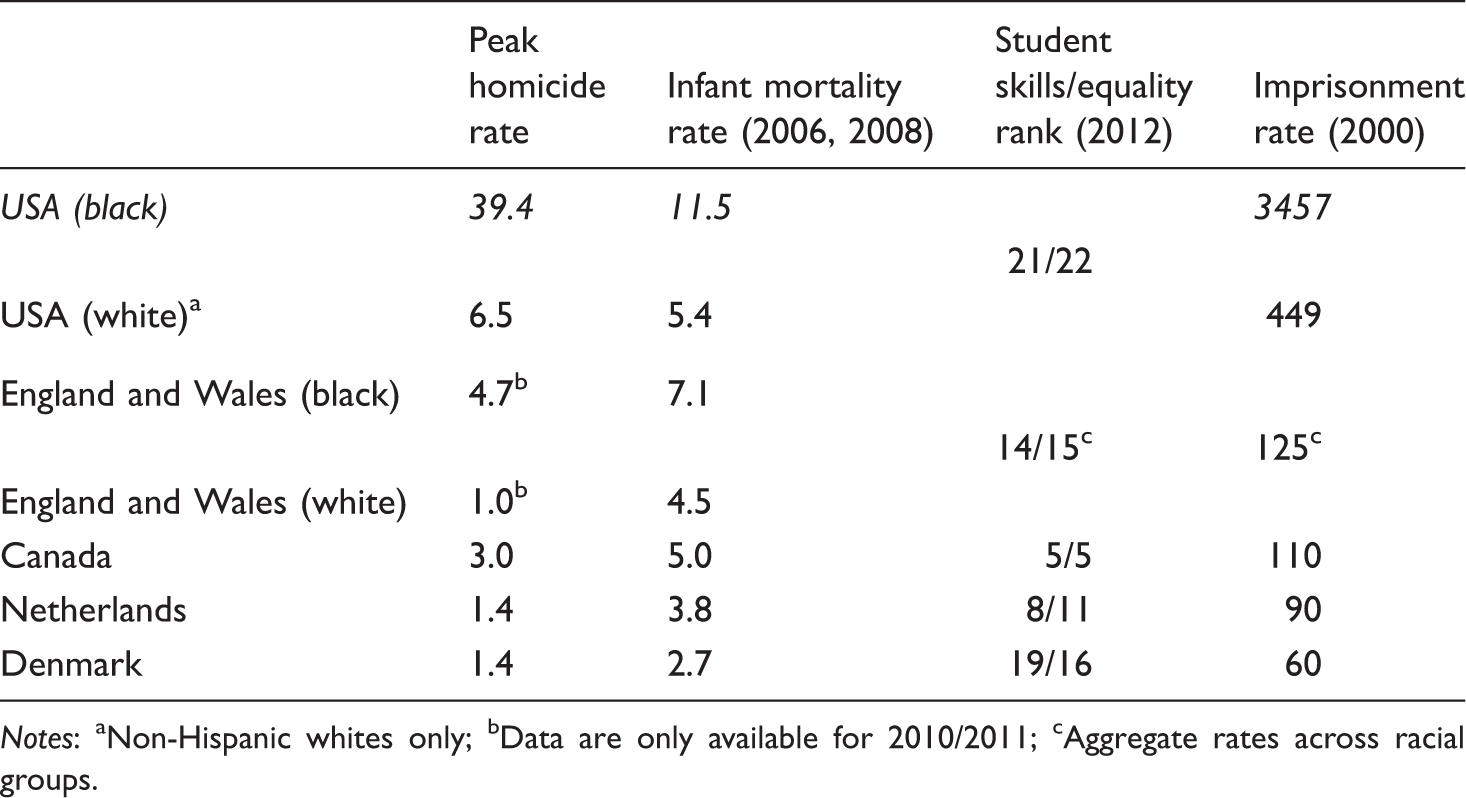
Notes: aNon-Hispanic whites only; bData are only available for 2010/2011; cAggregate rates across racial groups.
I add several other measures of risk exposure to the analysis to illustrate the consistency of the US in exposing the citizenry as a whole – but especially African-Americans – to higher social risks: peak homicide rates since 1950, infant mortality rates and the Organization for Economic Co-operation and Development’s (OECD) ranking of each country in terms of relative levels of social inequality in access to education. 15 I include racial breakdowns for England and Wales where available, though reliable data on racial and ethnic categorization of social indicators are more difficult to obtain outside the United States. Moreover, it is not clear what the appropriate comparisons are. For England and Wales, I use the data for black-Caribbean and black-African, though these populations are relatively recent immigrants to England, rather than descendants of slavery and apartheid.
Rather than situate the US with other liberal market economies as Lacey (2008) and others do, I place the US outside the framework to indicate its extreme status. Peak homicide rates for whites in the US are two, three, or five times their peak in the other countries. But peak rates for African-Americans are six times higher than for white Americans and several orders of magnitude higher than the average peak rates in the low violence countries. Rates of murder are much higher for black Britons than for whites as well, but the overall murder rate is at least six times higher for white Americans than for white Britons (at the peak) and closer to nine times higher for black Americans, compared with black Britons. Moreover, blacks in the US were murdered at rates six to seven times that of white Americans whereas the black to white ratio in England and Wales is less than five.
Infant mortality rates for whites in the US are slightly higher than for England and Wales, comparable to Canada and twice as high as Denmark. Black infant mortality rates, in the US, however, are more than twice the white rate and more than 50 percent higher than rates for Caribbean and African Britons. With respect to education, the OECD Better Life Index ranks 36 countries according to several measures of educational quality. The US is ranked 21st on student skills and 22nd on social inequalities in education (higher scores reflect more inequality). 16 By contrast, the UK ranks 14th on student skills and 15th on social equality of educational opportunity. Canada is exceptional in this ranking, and the Netherlands and Denmark also perform substantially better than the US on both measures. In fact, the US scores are closer to Chile (25/29) and Greece (30/27) than to its Northern neighbors or European cousins.
Finally, imprisonment rates follow a similar pattern, with black imprisonment rates dramatically higher than the others, but white rates also three times higher than overall rates in the UK and six to eight times higher than the other countries. 17
It is important not to gloss over substantial differences in social risk between whites and the worst off racial minority populations in other rich democracies. However, while we should be cautious in drawing conclusions since the data are sparse, where data are available, both the real levels of risk, as well as the magnitude of the difference with whites, is substantially higher for black Americans than for minorities elsewhere. 18 In short, the population of the US as a whole is exposed to higher social risks in most categories, particularly violence and inequality. But above the US, generally, lies a separate realm of inequality occupied by a large portion of African-Americans. The purpose here is not to isolate the relative amount of variation in imprisonment explained by these features but, rather, to highlight the clustering of high risk in the United States, generally, and for African-Americans specifically, relative to other developed democracies.
Violence and punishment as state failure
This section offers a framework for understanding the clustering of risks in the United States and its implications for the socio-political dynamics of crime and punishment. If high imprisonment is undesirable, both as a normative matter in democratic systems and as a weak mechanism for reducing rates of criminal offending, then both high levels of serious violence and high rates of punishment can both be limited forms of state failure. I have referred to this elsewhere as the security gap (Miller, 2013) and, seen in this way, explanations for the exceptional rates of punishment in the US that do not account for exceptional rates of murder, poverty, income inequality, and other insecurities, overlook the larger institutional context in which both crime and punishment occur. Here I situate rising punishment and high violence in the United States within the institutional landscape of US politics that also produce low social welfare spending, high rates of poverty, and racialized inequality.
Fragmentation and racialization
A vast literature has puzzled over the peculiar nature of US politics that produces substantial differences in social movements and policy outcomes in the United States compared to Europe, including higher rates of income inequality, poverty, poorer health outcomes and limited social safety nets. With a few exceptions, scholars of crime and punishment have not leveraged this comparative framework for understanding variation (but see Lacey and Soskice, 2013). While scholars disagree on the precise causal mechanisms that drive these differences, there is some common ground suggesting that dispersal of political power – for example, separation of powers, a strong upper legislative chamber with disproportionate representation, a robust and active judiciary, and federalism – is an important causal factor. Scholars link the fragmented, decentralized nature of the US political system to: weak party discipline and obstacles to the coordination of public goods (Hacker and Pierson, 2010; Soskice, 2010); impediments to social movements and labor organizing (Lowi, 1984; Soss et al., 2008); challenges to the implementation of social policy (Wildavsky, 1984); limitations on the political capacity of local governance (Miller, 2010; Peterson, 1981); and the maintenance of racial hierarchy (Katznelson, 2005; Riker, 1964).
Separation of powers and single-member district/winner-takes-all systems are also both linked to lower social welfare provisions (Moosbrugger, 2012). Indeed, studies of constitutional structures with many veto points – venues where small groups with strong material or ideological interests can block broad majorities – tend to have lower social welfare spending, weaker safety nets, and greater inequality (Huber et al., 1993; Lijphart, 1999; Manza and Brooks, 2007). Cross-nationally, these factors are also tied to rates of incarceration (Downes and Hansen, 2006).
One might reasonably ask how these features of the US constitutional framework – which long pre-date mass incarceration –contribute to contemporary political outcomes on punishment. While these basic features have long imposed general obstacles to the production of collective goods, the structure underwent substantial changes in the 20th century, in large part as a result of exogenous forces, such as world wars, the Great Depression, and strong social movements, which produced two important changes for our discussion here.
First, economic crises contributed to a growing nationalization of issues and helped push through robust social welfare reforms (e.g. the New Deal, Social Security, and the GI bill), while also reifying and entrenching the opportunities for vetoing their distribution by race and class. 19 For example, while the Social Security Act and GI Bill were aimed at ameliorating inequality and/or promoting prosperity, their benefits were least likely to flow to African-Americans (Dudziak, 2000; Katznelson, 2005). A key mechanism for this uneven distribution was the federal system, which facilitated the capacity of states to block social welfare provisions or to limit their distribution to blacks entirely (Riker, 1964). Similarly, while the Civil Rights Act of 1964 and the Voting Rights Act of 1965 were also major pieces of national, social legislation, their enforcement was highly uneven across the federal landscape and in some states, resistance to such rights continues today (Behrens et al., 2003; Parker and Barreto, 2013).
This underlying political opportunity structure has long been exploited by opponents of broad social goods in the United States such that, even as the national government took on a wide range of new issues in the second half of the 20th century, including the environment, civil rights, health care and other forms of social policy, the fragmented policy landscape thwarted the more sweeping efforts at reform and, where legislation was successful, facilitated its highly uneven implementation across region, race and class (Soss et al., 2008).
A contemporary example is the state-level resistance to the expansion of Medicaid – the social insurance program for the poor. Facilitated by a Supreme Court decision that overturned the portion of the 2010 Patient Protection and Affordable Care Act that required states to expand their eligibility for Medicaid, some states are declining to expand this coverage. 20 Many of these states are home to some of the nation’s poorest residents, and also include virtually all of the southern states that have a long history of exploiting the fragmentation and jurisdictional fluidity of the US system to openly defy federal efforts to dismantle segregation and reduce inequality. 21 The likely result is that race and class-based disparities in access to health care will persist and perhaps even increase.
Second, dramatic economic changes, white racial hostility and social unrest, and rising violence in the 1960s and 1970s collided with this deeply fractured US political landscape, even as civil rights were providing growing opportunity for middle-class blacks (Murakawa, 2014; Weaver, 2007). The fragmented nature of policymaking in the US that has long made social welfare policy challenging was especially difficult to overcome in the context of extreme rates of serious violence, collapse of cities, and deep hostility toward black progress by segments of the white population in the 1970s and 1980s.
Relatedly, political capacity is uneven across the US federal system, with cities and municipalities notoriously in the weakest position to enact redistributive policy (Peterson, 1981). As Lacey and Soskice (2013) argue, US federalism creates incentives for median voters at the local level to avoid spending money to address criminogenic conditions, such as education and employment, even if they would otherwise wish to do so, because such measures would likely impose higher property taxes on homeowners. Instead, local support for more and longer criminal sanctions can deflect costs onto a larger and more dispersed population at the state level. This situation became especially pathological in the second half of the 20th century as disadvantage in economic and educational opportunity became more racially concentrated at the local level.
Paradoxically, though perhaps not coincidentally (see Weaver, 2007), from the early 1950s and well into the 1970s, just as violence was rising and opponents of social welfare policy and racial progress were using veto points of US politics to block new legislation, state legislatures and local law enforcement, jails, and prisons were becoming more professionalized (Feeley and Rubin, 2000; King, 2000; Squire, 2007). As political demand to address crime increased, opportunities for responding were easily funneled into the one area that could respond most visibly and immediately to the crisis of crime, disorder, and concentrated poverty: police, state criminal laws, and prisons. 22
Taken together, fragmentation and racialization help explain the variation in social inequality between the US and other democracies in several ways. No matter one’s preferred theory of the causes of serious violence – income inequality, low levels of trust and legitimacy, spatially concentrated poverty and inequality, gun availability – the fragmented US system has both contributed to them and made them difficult to rectify (see Hacker and Pierson, 2010 on income inequality; LaFree, 2002 and Roth, 2009 on trust/legitimacy; Goss, 2008 on guns; Massey and Denton, 1993, Peterson and Krivo, 2010 on spatial segregation). Thus, as violence increased in the latter half of the 20th century, even where voters were sympathetic to more inclusionary policy proposals rather than purely punitive ones, they likely supported policies that further entrenched race and class divisions and ratcheted up punishment (knowingly or unknowingly).
Moreover, and crucially, these institutional arrangements of US politics constrain public trust in the ability of the state to ameliorate serious violence through means other than punishment. Support for, or simply tolerance of, increasing punishment may thus reflect concern among the US public that more structural solutions are unavailable and/or unlikely to be forthcoming. In other words, the policy alternatives that emerge when violence is high or rising are subject to the same racialized institutional dynamics that have also contributed to and mediated earlier efforts to reduce inequality, racial disparities and poverty generally in the United States. These same features then continue to push African-Americans, specifically, and the poor generally, into the most marginalized corners of the US polity (jails and prisons) when violence and insecurity rise. 23
While it is impossible to know the counter-factual – a US state without the many and varied opportunities for systematically blocking or unevenly distributing broad social welfare provisions – this account suggests that the veto-laden and fragmented nature of US political institutions has facilitated such activity, particularly when government policies might assist blacks. The punitive apparatus of the justice system may be a last resort mechanism for confronting high levels of violence and socio-economic exclusion, above and beyond the long-standing use of such institutions for the maintenance of racial hierarchy. In this sense, high risk of murder, economic marginalization, and imprisonment are features the US state’s ongoing failure to secure the citizenry – particularly blacks – more equitably (see also Wacquant, 2007).
The growth of legalism in (crime and) justice
Finally, related to these features of US exceptionalism – and in part as a function of them – is a deeply rooted legalism, a core dimension of US politics that routinely moves political disputes into the legal arena and frames political problems in legal terms (Kagan, 2001; Scheingold, 1984; Silverstein, 2009; see also Robertson, 2009). This is problematic from the perspective of social change and the production of social goods: “Adversarial legalism inspires legal defensiveness and contentiousness, which often impede socially constructive cooperation, government action and economic development … [it is] inefficient, costly, punitive and unpredictable” (Kagan, 2001, 4; see also Scheingold, 1984).
Despite the well-known limitations on the use of legal claims as tools for broad social policy change, resistance to the carceral state among political elites is heavily focused on procedural justice. Such a focus is deeply intertwined with civil rights claims about unfair treatment by agents of the criminal justice system and unjust crime policies enacted by lawmakers. Ironically, it was the persistent threat of white terrorist violence against blacks and the lack of state response, in the first decade of the 20th century, that formed the backdrop for the formation of the nation’s most prominent civil rights organization (National Association for the Advancement of Colored People (NAACP)), and such security from such violence was a core component of the early civil rights struggle. Moreover, early civil rights activists appear to have arrived reluctantly at legal strategies, after seeing political movements repeatedly thwarted, often through violent means (see Francis, 2014; Murakawa, 2014).
In the 1960s, when violence and arrest rates exploded, litigation over police and prisons further solidified the legal strategy, drawing attention to the horrific conditions in prisons and police brutality (Gottschalk, 2006). In some respects, this was a natural outgrowth of the successful legal challenges to segregation that emerged in the first decade after the Second World War. Some research indicates a clear effect of litigation on changes to these institutions (see Feeley and Rubin, 2000; Francis, 2014, for a more historical account). Others, however, suggest that such strategies may have also contributed to the growth of prison construction by reconfiguring prison litigation outcomes away from de-carceration and toward the need for newer, more humane prisons (Gottschalk, 2006; Schoenfeld, 2010). In any case, consistent with the well-known problems of adversarial legalism, a consequence of litigation was that the larger movement message – that deep economic disparities contribute to criminal offending – was obscured in the litigation process (Schoenfeld, 2010; see also Scheingold, 1984 for a more general discussion). 24
By the 1980s and 1990s, as the racial consequences of tough law and order policies became clear, a strong set of legal institutions were well situated to attack state action on punishment, specifically the largest civil rights and liberties organizations in the country – the American Civil Liberties Union and the Legal Defense Fund of the NAACP. The legal framework of these groups, however, has left challenges to state inaction with respect to reductions in disproportionate risk of violence and criminogenic conditions – the security gap – largely out of the discussion. The NAACP, for example, has four projects listed under Justice Advocacy on its website: Sentencing Reform; Effective Law Enforcement; Eliminating Barriers to the Formerly Incarcerated; and Survivors of Crime. Only recently, however, has the latter topic become a part of the agenda. Between 2004 and 2010, the NAACP Annual Report mentioned racial disproportionality in arrest and incarceration but made few references to the differential exposure of blacks to lethal violence. In fact, the references to crime are primaily in relation to the proliferation of handguns, police violence, and hate crimes. Ironically, given the organization’s origins in trying to reduce brutal white violence against blacks, the 2009 Annual Report, celebrating the NAACP’s 100th anniversary, makes no mention of the disproportionate risk of lethal violence for African-Americans.
Decades of litigation and legal arguments urging judges to disrupt the steady march of increasing punishment, however, have done little to reduce arrest and imprisonment, nor have they controlled serious violence or other risks. While the role of the federal courts in undermining the overt racist practices of state and local criminal justice systems in the 1970s is well documented (Feeley and Rubin, 2000), the federal courts have had more difficulty dealing with more institutionalized forms of racial bias and with lengthy criminal sentencing schemes that have disproportionately affected minorities (Murakawa and Beckett, 2010). 25
This limitation is apparent in cases such as McKlesky v. Kemp, 26 in which the court is asked to make use of aggregate evidence that the state of Georgia implemented its death penalty in a highly racially discriminatory manner. Unable to provide evidence that the state discriminated against McKlesky per se, the court rejected his claim. Similarly, in cases such as U.S. v. Johnson 27 and U.S. v. Armstrong, 28 in which defendants sought to demonstrate discriminatory treatment in cocaine prosecutions, federal courts have not imposed strict scrutiny standards for assessing these claims and have side-stepped the larger issues of racially disparate criminal justice outcomes (see also Murakawa and Beckett, 2010; Provine, 2007 for a related discussion). Moreover, in racial profiling claims, when law enforcement agencies have been able to provide non-racial reasons for stopping citizens, federal courts have usually upheld the police practice and declined to inquire into the thinking behind officers’ actions (Heumann and Cassak, 2003).
Beyond racial bias, federal courts have also been largely deferential to legislatures on criminal punishments more generally and the increases in mandatory minimum sentences and other lengthy sanctions have widened racial disparity in the justice system (Schlesinger, 2011). 29
In other words, as litigation strategies have been pursued as a means by which to limit state capacity – in the form of reducing its use of repressive practices in such disparate and excess fashion – what has largely been obscured is the failure of the state to increase the security of the most marginalized from a wide range of social risks, including lethal violence.
Conclusion: Theorizing violence and punishment as forms of state failure
Taking a closer look at the nature and extent of serious violence in the United States reveals a cluster of social risks that draw into sharp relief its exceptional status in far more than just imprisonment. Further, using the lens of social risk highlights the relationship between under-security and over-punishment and the role of the state in producing both. Mass victimization is a fact of life in the United States but, like other social risks (income inequality, poverty and so on), it is especially concentrated among African-Americans. If mass imprisonment is the tragedy of 21st-century US, mass social risk to blacks is the tragedy of US politics.
Reconsidering security from violence as a collective good, a core state responsibility and as one measure of state success can provide additional insight into the mechanisms through which violence can be kept low across populations, the link between violence and other forms of social, racial and economic inequalities and the ability of political systems to represent populations at most risk. Greater theorizing about the link between levels of violence and the use of state repression can help us better understand the conditions under which states are most capable of and likely to promote a wide range of public goods. Reducing imprisonment may be more tied to sustained reductions in serious violence and other forms of social inequities than we have heretofore assumed. The peculiar collection of US political institutions that have produced such high rates of violence, punishment, and inequality, however, make such reductions less likely in the US than in other democratic systems.