







Abstract
After 30 years of relentless expansion, the United States’ prison system faces the prospect of considerable contraction. This was certainly not expected and continues to be refuted by policy makers, activists, and academic theorists alike. Using evidence drawn from New York State, this essay argues that decarceration is taking place and may be expected to continue. Preliminary findings indicate, however, that the outcome is not likely to be the most commonly speculated ones: a return to a rehabilitative model, liberal reform along the lines of justice reinvestment, or the straightforward replacement of mass incarceration with parole and probation. Evidence to date suggests that a new and harsher criminal justice regime marked by justice disinvestment is being forged, entailing a significant shift from state penal institutions to differentiated, community-based social control, new private and non-profit actors, and new data and hardware technologies. These observations suggest a substantial rethinking of the political economy and theories of mass incarceration and the ‘carceral’ or ‘centaur’ state.
1970–2000: The prison society, the prison state
As is widely documented, mass imprisonment became a defining feature of the United States over the course of the last three decades of the 20th century. In the early 1970s, under 200,000 persons were incarcerated in state and federal prisons; by the end of the 20th century the number had reached over 1.5 million, with seven million under some form of criminal justice supervision (prison, jail, parole, probation). This was a truly historic outcome, surpassing any past pattern for the US, and placing the US alongside the harsh carceral complexes of the Soviet Union and apartheid South Africa. This was moreover a highly gendered, racialized, and spatially stratified system, from the increasingly Black and Brown incarcerated male population, to the segregated urban and rural communities across which incarcerated and formerly incarcerated persons circulated.
Criminologists and public policy advocates have spent considerable energy in countering the popular myths surrounding mass incarceration. Much attention has been focused on undermining the public order scenario publicized by the media, politicians, and many conservative policy analysts and scholars, namely that as crime went up in the 1970s and 1980s, laws were toughened up, criminals were sent down, and crime accordingly fell. There are data and correlations aplenty to rebut such simple explanations (e.g. Western, 2006, and more cautiously and comprehensively the recent survey by the National Research Council (2014)). Simply stated, crime and official crime rates have at best a weak relation to accelerating imprisonment rates or the racial and gender composition of the millions in prisons and jails. The origins of mass incarceration have more commonly been traced instead to the abandonment by radicals, liberals, and conservatives alike in the 1970s of the post-war rehabilitative ideal and a crime panic generated by the mass media and politicians (Mauer, 1999: 42–48; Wacquant, 2009: 7–11; Western, 2006: 59–62).
For those focused on the political development of the US, mass incarceration propelled an enduring, long-term transition away from a liberal, social democratic state to an increasingly less democratic ‘carceral state’ (Murakawa, 2014: p. 213 n.9). As Gottschalk defines it, ‘three features distinguish the U.S. carceral state: the sheer size of its prison and jail population; its reliance on harsh, degrading sanctions; and the persistence and centrality of the death penalty’ (2006, p. 1693). Central here is the weak and declining welfare state under neoliberalism, and the imposition of a workfare state (Gottschalk, 2015: 87–90; Wacquant, 2009: 58–69). Those more closely attuned to everyday experience and data reach a parallel conclusion: the entrenchment of mass imprisonment deep in the country’s social and economic life, with powerful, new political and economic interests steadily reproducing the carceral system. In Bruce Western’s terms, mass imprisonment had become ‘self-sustaining’, ensuring that ‘the penal system will remain as it has become, a significant feature on the new landscape of American poverty and race relations’ (2006, p. 198).
This essay challenges these conclusions by arguing that decarceration is taking place and needs serious, long-term analysis. The data and analysis are focused upon developments in New York State, an early adopter of the criminal justice and institutional innovations associated with mass incarceration. Given the recent nature of the phenomena and data in hand, the task is a preliminary one: to pinpoint and begin to chart significant shifts in the prison complex in New York State over the last 5–10 years. To what extent is decarceration taking place, and where?
Studies of decarceration, like those of incarceration and even the carceral state, are often narrowly focused on prisons and prisoners. Yet incarceration is a process that binds together the state, prison towns, and poor urban neighbourhoods – as is suggested by the expansive terms of the ‘carceral continuum’, the ‘school-to-prison pipeline’, ‘the prison industrial complex’, or even the ‘carceral state’ in its broadest uses. Even as our focus is upon penal institutions it is critical to trace outward and ask: What effect does decarceration have beyond the shrinking walls of the prison? What specific impacts are prison closures and the release of so many men and women having in rural and urban areas of the state, including post-prison practices (probation, parole, re-entry, and policing)? And finally, how do these evolving outcomes make us rethink theories of mass incarceration and the state? Each of these areas is assessed in turn below.
2010: Decarceration?
At the end of the first decade of this century, unexpected phenomena emerged to challenge long-accepted depictions of mass incarceration. For by 2010, it became apparent that the unrelenting growth of the penal complex had not just moderated, but was, in leading states, being reversed. One of the first national signs was in the imprisonment rate – the number of sentenced prisoners per 100,000 U.S. residents – which reached a turning point in 2008 when it declined for the first time, having peaked in 2007. In 2009, the number of persons in the US under correctional control – on probation, parole, or in prisons and jails – receded for the first time since the Bureau of Justice began reporting comprehensive statistics in 1980.
Twenty-four states were shortly reporting fall in their prison populations, ranging from New York (down 1660) to Michigan (down 3260) and Mississippi (down 1272), to California (down 2395) (United States Bureau of Justice, 2011). By the beginning of the second decade of the century, these signs solidified as the number of persons incarcerated in several large states continued to fall sharply. By early 2011, California, under court orders to reduce its prison population, incarcerated 161,000 persons, down from its 173,000 peak in 2006 (California Department of Corrections and Rehabilitation, 2010, 2011). New York State was reporting an even sharper fall, with the incarcerated population in January 2011 down 21% from its 1999 peak (71,000 to 56,000) (Fischer, 2011). These transitions were also seen in imprisonment rates. By 2013, New York’s imprisonment rate per 100,000 residents had fallen from 383 in 2000 to 271, significantly lower than the 2013 and 2000 national rate of 478. New York’s decline paralleled declines over this period for many states with large prison populations such as California (from 474 to 353) and Texas (from 730 to 602) (U.S. Department of Justice. Bureau of Justice Statistics, 2001: 3; U.S. Department of Justice, 2013: 7).
These changes were heralded by reform-minded policymakers, journalists, and op-ed writers alike, many of whom had long laboured to reverse the compounding carceral complex. Writing a cover story for The Nation, Sasha Abramsky, author of Conned (2006), celebrated the shrinking of incarceration and the emergence of alternative programmes: The gears of what journalist Joel Dyer, in the 1990s, tellingly labelled a ‘perpetual prisoner machine’—a self-sustaining interaction of conservative criminal justice lobbies, political opportunism, popular tough-on-crime sentiments, the economic needs of depressed prison towns and media sensationalism—seem finally to have gotten gummed up … . For the first time in more than forty years, criminal justice trends are starting to move in a sensible direction. (Abramsky, 2010)
The establishment of separate drug courts, more lenient parole policies, and more community-based alternatives to incarceration mark, for many reform activists and non-profit organizations, the beginnings of a new, more rational criminal justice system. The Sentencing Project’s 2010 analysis of four key states’ efforts celebrated, for example, new legislation and adjudication strategies aimed at reducing the harsh sentences and high incarceration rates of the past. As it cautiously argued, Over a period of years policymakers and practitioners have come together to assess the sources of growth in incarceration and developed policy responses that have reversed those trends while promoting public safety. Initial indications are that these trends may continue in these states and others. (Greene et al., 2010, p. 60)
Central to reform efforts has been the development of ‘Justice Reinvestment’, originally designed to reduce prison populations and budgets, and reinvest savings in high-incarceration communities. This would include not only re-entry, health, and social services but potentially extend to new investments in education, housing, and employment. Widely heralded by reform-minded scholars, foundations, and non-profits, Justice Reinvestment has been implemented in over 27 states by a coalition including the JFA Institute and the Council of State Governments, with initial support from the Open Society Institute and more recently the Pew Charitable Trusts and the Bureau of Justice Assistance. Speaking before the American Bar Association in August 2013, no less an authority than Attorney General Eric Holder praised the efforts of states, governors, and legislators of both parties who had ‘directed funding away from prison construction and toward evidence-based programs and services, like treatment and supervision, that are designed to reduce recidivism’. ‘Reinvestment and serious reform’, Holder argued, ‘are improving public safety and saving precious resources’ (2013). For those working in the policy and advocacy realms, a new era of decarceration had, it seemed, begun.
Less than even five years later the assessments are far more circumspect. The report card on 10 years of Justice Reinvestment efforts has been bleakly drawn even by many of its original proponents: ‘If the goal is to reduce mass incarceration, there is scant evidence of success. More alarming, there is little indication that historic rates of incarceration will be reduced in the future’ (James et al., 2013, p. 11). Indeed ‘the Justice Reinvestment Initiative … runs the danger of institutionalizing mass incarceration at current levels’ (James et al., 2013, p. 1). Most notable was the failure to direct, as originally intended, savings from closing prisons to re-entry and community services. The number of incarcerated persons at the end of 2012 was, moreover, down less than 3% from its historic peak in 2009 (U.S. Department of Justice, 2013: 1). In 2014, the Bureau of Justice reported that the number of persons incarcerated, which had been falling since 2009, rose again in 2013, leading scholars and activists to reconfirm the endurance of mass incarceration (e.g. Gottschalk, 2015: 259; Kilgore, 2014). Despite the Great Recession’s considerable pressure on state budgets, decarceration had clearly not taken off across the country.
This is decidedly not however a conclusion one can apply to New York State.
Plotting decarceration in New York: Neither model nor exception
Many trace the origins of mass incarceration to New York State – and there are good reasons to do so. New York has been home to the Attica rebellion in 1971, the Rockefeller Drug Laws of 1973, the crack epidemic of the 1980s, and the creation of new technological and policing strategies under New York Police Department Chief Bratton and Mayor Giuliani in the 1990s (and their successors since). Yet New York is a poor model to understand quite different criminal justice histories, policies, or contemporary practices elsewhere in the country. The common New York/northeast model of the invention of modernity and the prison, followed by alternating waves of rehabilitation and retribution, and culminating in today’s mass incarceration, is simply not replicated in the South or even in demographically similar states in the North, Midwest, or West. Long-term incarceration patterns in the US South and West, in particular, rarely followed the patterns in the Northeast – before and after slavery (Eason, 2010; Lynch, 2010; Perkinson, 2010). Recent imprisonment patterns, as Gottschalk reminds us, show similar wide variability across the country and international borders (2006, 2011a, 2011b).
As argued in other recent studies of decarceration (Garland et al., 2014: 454; Webster and Doob, 2014: 6), the case of New York also demonstrates contextually specific outcomes driven by local forces, institutions, and the enduring influence of their complicated histories. It also raises a methodological imperative that pushes us beyond the call to attend to different comparative and local histories: the necessity of observing the relations across and among the cases, regions, and spaces that reproduce together the uneven components of the nation’s and different states’ criminal justice systems. For New York State, this is especially important since the big prisons (e.g. Attica, Sing Sing, Elmira) and New York City are the cases upon which histories and theories have been constructed and then compared; at best we watch how prison practices and sentenced individuals are diffused from New York City to the rest of the state, particularly rural upstate prison towns. 2 Yet what mass imprisonment has done in New York over three decades is to tightly bind together, in an uneven hierarchy, quite divergent policies, practices and institutions related to mass imprisonment all across the state.
These observations are lent emphasis by the challenge raised by a strict definition of decarceration: not simply a fall in the number of incarcerated persons but a significant reduction in the number of persons imprisoned and the closing of more than a handful of outdated prison facilities. On these measures there have been dramatic drops in New York. By 2014, the number of persons incarcerated in New York State prisons had fallen by 26% from its peak at the turn of the century, marking a 25-year low as Figure 1 charts.
Incarcerated: NYS prisons 1950–2014. Sources: Hindelang, Dunn, Sutton, Aumick 1970: 351 (for 1950–1970), and United States, Bureau of Justice Statistics (for 1977–2002) and New York State, Department of Corrections and community Supervision (2007–2014).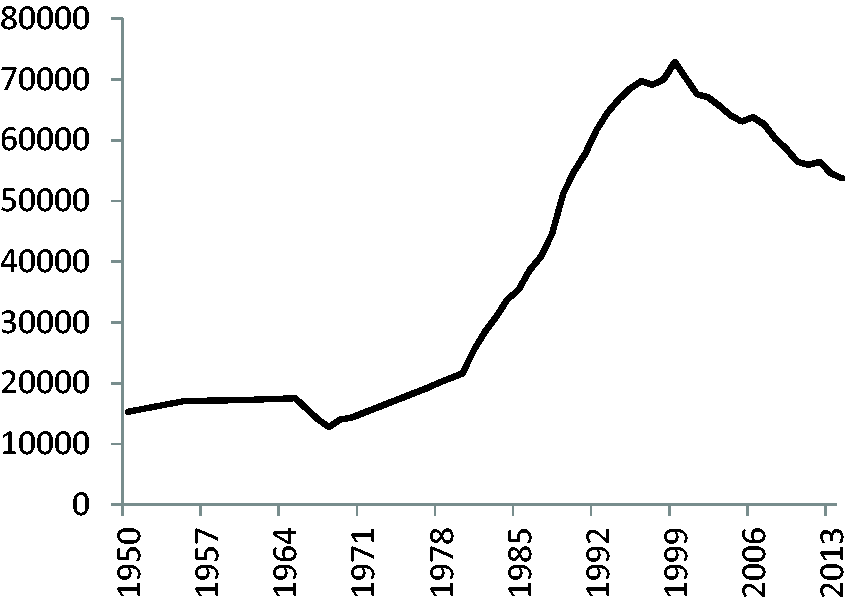
Since 2009 16 adult prisons (of a total of 69), previously housing almost 7000 persons, have been closed. These ranged in size from small work camps and a woman’s prison, housing 150–300 persons, to facilities housing over 1000; the average size was 434. Closing announcements were met with numerous organized protests across the state by unions, state representatives, and small communities dependent on prisons. Prisons were shuttered in both rural upstate towns and more densely populated urban areas in and near New York City.
Calculating savings is difficult and often deceptive, particularly for prisons closed only in the last few years. Significant savings only accrue when prisons are closed and positions reduced (personnel costs account for two-thirds of the state correctional budget), and even then there are many additional hidden costs. 3 The Vera Institute’s study of the cost of prisons calculated that the hidden costs of $825 million in the budget of the NY Department of Correctional Services (DOCS) meant that the real cost of incarcerating one person in 2010 was $60,000 per year, as opposed to a lower $46,000 per year rate based on the official DOCS budget. If one uses these figures the savings should be considerable: the 7000 fewer persons incarcerated in the closed prisons represent a potential saving of $322 million at the lower yearly rate, while the fall from 2000 to 2010 in total number of persons in the DOCS system suggests an estimated saving of $758 million. Such savings, trumpeted by reformers and advocacy organizations, have failed to appear: reductions in staffing have failed to produce any overall reduction in the corrections budget over the last 10 years – leading to investigations by state senators. 4 The most recent proposed 2015–16 budget projects an increase of $113 million over the previous year’s budget for the Department of Corrections and Community Supervision (DOCCS) (New York State. Division of the Budget, 2015).
The smaller state juvenile detention system has undergone a more dramatic and clear-cut reduction. As Figure 2 shows, the number of youth in state, county, and private facilities has steadily dropped over the last decade. The number of youth in prison and detention centres directly run by the state Office of Children and Family Services (OCFS), primarily from the New York City area, has declined especially rapidly. Building upon state and federal investigations of deaths and abuse in state-run youth prisons (versus county or privately contracted facilities), a new OCFS commissioner, Gladys Carrión, worked steadily after her appointment in 2007 to reduce admissions to state facilities. This culminated in 2012 in the ‘Close to Home Initiative’, which closed over a dozen youth facilities in favour of new facilities and treatment centres closer to juveniles’ homes. The ‘Close to Home’ initiative, developed by the New York City’s Administration for Children’s Services (ASC), signalled decarceration with a vengeance, with youth being transferred from state residential facilities to city-supervised, non-profit residential facilities (ACS has larger programmes dealing with non-residential youth services including community-based alternatives to detention). Even before the passage of the enabling legislation in 2012, the number of City youth in both secure and non-secure facilities had steadily fallen; between 2006 and 2014 it would fell from 1400 to 400 (see Butts et al., 2015: 27). The transfer of youth from very expensive non-secure state facilities to less expensive ASC-contracted facilities began in 2012 and took over a year to complete, fulfilling. This fulfilled a longstanding objective of New York City’s billionaire mayor at the time, Michael Bloomberg, to shed the city’s share of the $260,000 per year cost to keep a youth in an upstate detention centre – alternative programmes in the city were projected at the time to cost but $20,000 per year (King, 2012).
New York: Youth in public and private facilities. Source: Sickmund et al. (2013) and U.S. Department of Justice (2015).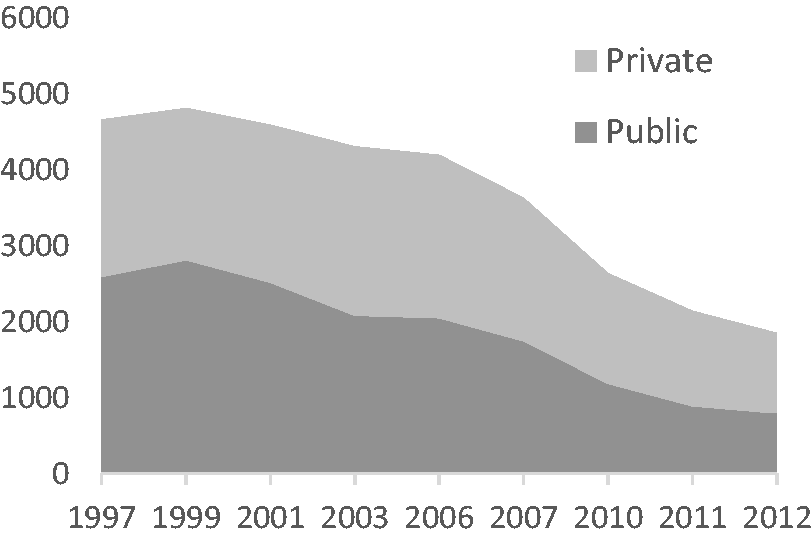
As can be seen in Figure 3, the result has been a dramatic drop in both the number of admissions to OCFS custody and end-of-the-year census counts of youth in state OCFS custody. The number of youth in non-secure (basically minimum security) city placement reached a peak of 213 in April 2014. The transfer of youth from state secure residential facilities as of early 2015 was however two years behind schedule and yet to begin.
OCFS admissions and youth in custody. Source: New York State, OCFS, Annual Report (2010, 2012, 2013).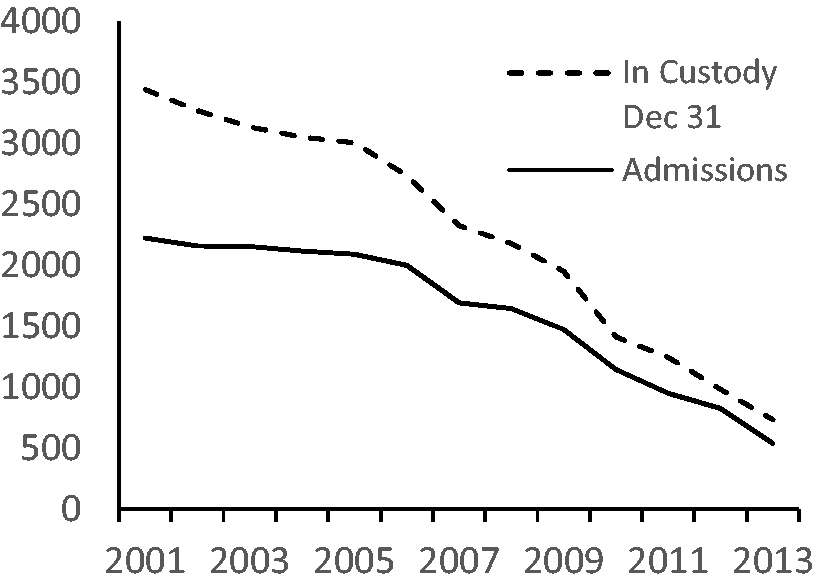
There have been considerable difficulties in implementing Close-to-Home, as detailed in assessments by ASC (New York City. Administration for Children’s Services, 2013), the state OCFS office (New York State. Office of Children and Family Services, 2014), and long-term advocates for the programme (Butts et al., 2015). Public transparency was written out of the enabling legislation, and the lack of clear and independent oversight – including unannounced visits to facilities and confidential interviews with youth in the facilities – has been criticized at city council hearings (Gabrielle, 2012). Finally, New York City’s large jail complex has also witnessed a fall from a peak of over 20,000 inmates in 1992, to a population of just over 12,000 on an average day in 2012 (New York City Independent Budget Office, 2013). 5 Recent exposes of brutality and abuse, especially of youth, at Rikers Island have propelled substantive new forms of oversight and organization (U.S. Department of Justice. United States Attorney Southern District of New York, 2014; Winerip and Schwirtz, 2015).
In short: while it remains uncertain if these dramatic declines will continue, it cannot be denied that decarceration has begun in New York State.
Mass incarceration expectations revisited
For those who have long emphasized the irrational character of criminal justice and especially sentencing practices, these trends represent a return to sanity and enhanced fairness and equity. What has driven the transition to decarceration has yet to be broached systematically. Timing is important. The fall in crime rates long predates, one might note, both the more recent transition to decarceration and the Great Recession. Media coverage of crime in both upstate and New York City newspapers has also long been declining, although the fall in the last five years is especially marked as Figure 4, which indexes newspaper coverage of crime, indicates.
6
Newspaper crime coverage index. Source: Data communication from Chungse Jung, 4 July 2014 ‘Upstate’ = The Times Union (Albany), The Post-Standard (Syracuse), Watertown Daily Times (Watertown), and The Buffalo News (Buffalo).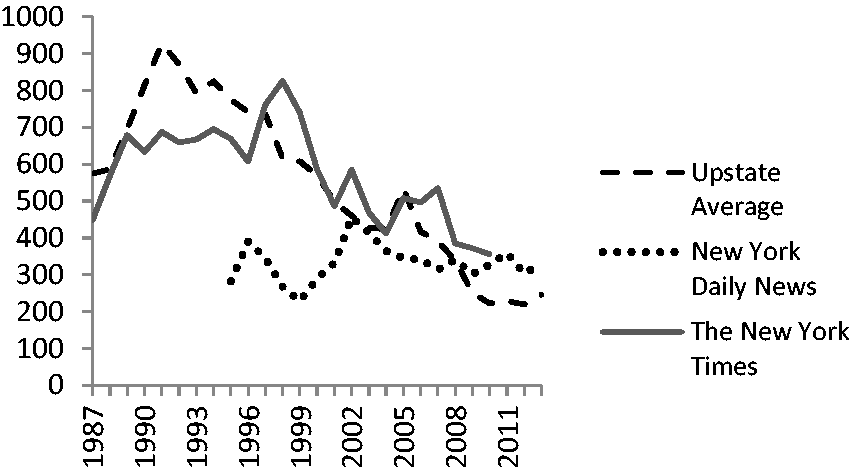
These unexpected trends press home the point that the impressive body of historical and theoretical work engendered by mass incarceration, and predicting its continuation for the foreseeable future, provides little guide for the present. The number of persons incarcerated has fallen significantly, prisons have been closed, and media crime coverage and the fear it generates in support of mass incarceration have steadily declined. Central supporting pillars of the ‘prison industrial complex’ have also been far less effective in defending mass incarceration than assumed. Most significantly, powerful state-wide public employees unions’ campaigns have not been able to prevent prison closings, despite protests and ongoing media advertising campaigns across the state. The most vigorous applause in Governor Andrew Cuomo’s first State of the State address in 2011 was surprisingly when he loudly proclaimed ‘An incarceration program is not an employment program’ (Hakim and Confessore, 2011).
Accounts that explain mass imprisonment as a new stage of racialized social control, as in depictions of a New Jim Crow (Alexander, 2010) or a Durkheimian prison/ghetto regime (Wacquant, 2001), face a similar conundrum: if mass imprisonment is so critical to controlling the poor and especially young men of colour, how can its central pillar, incarceration, be so steadily trimmed back in its flagship state? Factors driving increasing incarceration for these models, such as increasing inequality and urban segregation, have certainly not retreated in the last 10 years. More persuasive and comprehensive are arguments that have matched the decline of the welfare functions of the state with the rise of penal functions under neoliberalism and its ‘carceral’ or ‘centaur’ state. Yet one would be hard pressed to document any counterbalancing revival of public welfare services or even employment as the number of incarcerated persons has fallen – indeed public welfare services, including federal block grants, continue to be trimmed back and unemployment levels in poor neighbourhoods remain stubbornly high.
These observations point towards an explanatory factor that many suggest has recently exerted pressure on the prison regime: conditions of economic crisis and particularly the impact of the post-2007 Great Recession. Advocates of justice reinvestment specifically and decarceration more generally have often argued that fiscal crises are good moments to push substantive reforms and prison downsizing (Clear, 2011; Garland et al., 2014). Others more attentive to the historical record and variations across regional and state boundaries are less certain (Gottschalk, 2011a, 2011b: 484–485). Falling state revenues due to the recession and the necessity to balance state budgets (unlike the federal ability to run large deficits) have certainly directed governors’ attention to the cost of the penal and policing arms of the state. Yet as Figures 1 to 3 indicate, contraction of the prison system predates the Great Recession and continues in New York, as in other states, despite recent, unexpected budget surpluses (Lyman, 2014). Carceral Keynesianism, so central to prison industrial complex conceptions (Gilmore, 2007), seems to be relaxing its grip despite continuing surplus land, surplus labour, and surplus investment capital.
Theoretical projections and the limits of decarceration
These anomalies call for more investigation of the actual contours of decarceration and its impact across the institutions of the carceral system and the communities so deeply tied to mass incarceration – from prison towns to the targeted neighbourhoods to which men and women are now returning in the tens of thousands. Given the recent nature of the phenomena and the lack of existing research, this can be only a preliminary exercise here. Two starkly different scenarios nevertheless present themselves, based on quite divergent theoretical frameworks and policy expectations. On the one hand, judicial reformers envisage a more rational and sharply reduced criminal justice system sustained by reinvestment in human capital and communities. Other the other hand, more sceptical accounts foresee increased state supervision via enhanced surveillance, policing, parole, and probation. But do present developments allow us to confirm either possibility?
The first of these projections has a long vocal history. Criminal justice reformers (e.g. Mauer and Sentencing Project, 2006) have persistently argued that prisons hold too many people, are too ineffective in ensuring public safety, and are simply too costly – and that political elites could be persuaded to share such views regarding the irrationality of the criminal justice system built in the wake of 1960s rebellions and the ensuing panic over law, social order, and the war on drugs. Such an agreement would lead, liberal policy advocates have proposed, to the repeal of mandatory minimums (especially for drug offenses), three-strike laws, and life-without-parole sentences.
New York governors, legislators, and the media (particularly The New York Times editorial page) have indeed moved in this direction. No one has conducted a comprehensive evaluation of the political and media movements’ contribution to this past decade’s move to decarcerate, but this much is clear: state legislators and successive governors have slowly moved in concert with advocacy organizations to launch and sustain decarceration, starting with changes in sentencing and drug laws. While prisoner support movements and networks (e.g. the New York State Prisoner Justice Network) and campaigns (e.g. Drop the Rock) grew in strength, they have been increasingly joined by more organized and better funded non-profit, community-based, and advocacy organizations. These now aim to legislate against the strict conditions for parole (e.g. the Riverside Church Campaign to End Parole Abuses and Reunite Families (http://www.parolereformnow.org)), prison isolation units (the Campaign for Alternatives to Isolated Confinement (http://nycaic.org/), and the age at which youth are tried as adults (the Raise the Age NY campaign (http://raisetheageny.com/). 7 Many non-profit organizations engaged in prisoner and re-entry support work, from the Osborne Association and the Fortune Society to the Correctional Association, have also pushed hard for sentencing reform and social services for formerly incarcerated persons. Legislation proposed by these advocacy organizations has slowly garnered support – as in the introduction of bills for parole or isolation reform (with weaker and alternative bills, it must be noted, being proposed by legislative leaders). More radical protest and protest organizations, particularly abolitionist efforts and organizations such as Critical Resistance, have been eclipsed by more professionalized advocacy and non-profit organizations.
These political determinants dictate sharply the limits and wider impact of decarceration and the reform agenda. Falling admissions to state prisons have been related largely to fewer felony and especially felony drug arrests and sentences, particularly from New York City. The number of imprisoned drug offenders dropped from 24,085 in 1996 to 7053 in 2012, a statistic repeatedly cited to justify prison closures (New York State, Department of Corrections and Community Supervision, 2013). While crime rates dropped 15% over this time period, the State Department of Corrections and Community Supervision (DOCCS) notes, the number of drug offenders in prison dropped 71%. By late 2014, fewer than 7000 persons were incarcerated for drug offenses out of the 53,000 persons in state prisons. And nearly 10,000 persons in 2015 were serving life sentences alone. Even if all remaining drug offenders were to be released, and new admissions were correlated with a falling crime rate, New York State would thus still have a very large incarcerated population of well over 30,000 persons. Decarceration based on efficiency, cost-effectiveness, public safety, and even the form of drug sentencing laws cannot, it is clear, reduce prison populations to levels that held before the incarceration wave of the 1980s and 1990s.
One corollary of these limits is that the remaining adult and juvenile prisons are now weighted increasingly to maximum adult or ‘secure’ youth prisons. Of the 16 adult prisons closed since 2009, all were medium and minimum security prisons including drug and addiction treatment centres. The spatial pattern of closings is also critical to grasp. Prisons to be closed were to be selected on the basis of economic criteria, particularly the age and cost of renovating old and inefficient facilities. It is clear however that political considerations often overwrote these stated measures, as prisons were closed in districts with either marginalized political representation (e.g. Chateaugay in the far north near the Canadian border or Warwick in the Hudson Valley) or where prisons did not dominate the local economy (e.g. the Mt. McGregor prison near Saratoga Springs with its nearby booming tech sector, or Beacon prison, increasingly a commuting or bedroom community for wealthier New York City residents). Communities with several prisons saw, as well, one small prison or annex close while larger prisons remained open (e.g. the closure of Beacon and Chateauguay prisons while nearby Fishkill and Downstate (near Beacon) and Bare Hill, Franklin, and Upstate (near Chateaugay) prisons remained). It is also notable that more prisons in or close to New York City were chosen, proportionally, than prisons in the isolated rural regions of upstate New York. As a result prison towns in New York, as a group, now represent an even poorer group of towns, farther from large urban centres.
Life in the state’s increasingly maximum and supermax security facilities is changing as well. As part of the state’s efficiency plan, closed dormitories were opened at remaining prisons, and much protest by correctional officers’ union, NYSOPBA, has been targeted at the dangerous conditions created by overcrowded, ‘double-bunked’ prisons. And while juvenile facilities and prisons after 2007 have seen less use of force and more therapeutic efforts following the forceful implementation of Dialectical Behaviour Therapy and the Missouri Model (Mendel, 2010), which stress rehabilitation in small groups, constant therapeutic interventions, and minimal force, this has been predicated on closing non-secure, upstate state prisons (see Figure 3) and transferring youth to county and New York City agencies. State facilities that remain are largely ‘secure’ (or maximum) facilities for long-term incarceration. There is moreover little prospect of a transition to a therapeutic or rehabilitative model in the much larger adult system despite increased, often mandated, expenditures on health, particularly mental health care.
One conclusion that follows is that there is no evidence of a return, as in the 19th and 20th centuries, to an alternating cycle of reform and rehabilitation followed by harsher, retributive prison and criminal justice regimes. Nor is there any sign of repeating the de-institutionalization/re-institutionalization pattern in the last half of the 20th century, whereby mental institutions were closed and prisons were opened up. There is no analogue in the present of an alternative institutional facility for those who are currently incarcerated or who might in the future be incarcerated. The most optimistic projections of a new wave of deinstitutionalization depend instead on the unlikely combination of increased pharmacological treatment for those deemed mentally ill, federal financial incentives to deinstitutionalize, and vastly enhanced community services (Harcourt, 2011).
After decarceration
Prison reform efforts have long aimed not only to divert persons from prisons but to redistribute dollars from state budgets to more fruitful community safety and treatment services – and by extension educational, employment, and housing services. As Tonry has argued in his forceful critique of justice reinvestment, such efforts generally fail for quite explicit reasons: the failure to reduce the number of incarcerated, to actually close prisons, and to transfer spending to non-carceral programmes and services (2011: 641–642). Yet New York – not a state that was part of the now decade-long nationwide Justice Reinvestment Initiative – has met four of his five criteria of success: large numbers of persons have been diverted, entire prison facilities have been closed in significant numbers, the prison population continues to decrease, and the state government has been willing to shed its own penal institutions in favour of those run by cities or counties.
At the same time the state has recognized that releasing over 20,000 persons per year to parole and community supervision poses serious new challenges for state and especially local authorities (New York State. Department of Corrections and Community Supervision, 2013: 2). Here the prospects of reinvestment in human capital or communities arise. Re-entry services, which had been eclipsed with the decline of the rehabilitative ideal and the welfare state, had minimal support from most states or cities in the last half of the 20th century. Those released are now however perceived as major social and fiscal problem: not only do many return to prison at considerable expense on technical violations, but state politicians remain adamant in publicly confirming their commitment to ‘public safety’ even as the state closes prisons. The voluntary agencies which provided services in the past, such as the Fortune Society and the Osborne Association, clearly lacked the resources to deal with this new flow of persons from prisons to impoverished communities. These agencies are primarily based in New York City, moreover, a concentration of resources matched to the dominant belief that it is primarily New York City residents who are sent upstate to prisons and return downstate. Yet of those incarcerated in the state’s prisons, 42% come from and return to upstate counties set against the 46% that come from New York City (State of New York. Department of Corrections and Community Supervision, 2013: 6).
As persons began to be released in record numbers, the state government has responded with a flurry of programme announcements targeted at re-entry and alternatives to incarceration. These efforts have relied primarily upon non-profit agencies, community-based organizations, the corporate sector, and local policing and probation organizations. New York State non-profits working in and around the criminal justice system have grown rapidly: between 1995 and 2010 the number of registered non-profits in the crime and legal area in New York State grew by 40% and revenues doubled; the number of registered non-profits specializing in rehabilitation services for offenders tripled. 8 Larger organizations like the Osborne Association and the Fortune Society have seen their revenues double as well in the 10 years up to 2012 (the latest year for which federal forms are available; see National Center for Charitable Statistics, 2015). Perhaps no more literal example of the process exists than the Osborne Association in 2014 taking over control of the closed Fulton prison in the Bronx, and transforming it into a re-entry facility with $6 million in state funding. By 2015, advocates and activists were, as at the fifth annual ‘Beyond the Bars: Transforming (In)Justice Conference at Columbia University’ (6–8 March 2015), speaking of a ‘non-profit industrial complex’.
The state’s push to manage re-entry and parole extends across the smaller towns of the state. Most notable was the creation in 2005 of county re-entry task forces, which often took over more informal networks of formerly incarcerated persons and voluntary agencies, creating commissions with designated chairs drawn from county and department of corrections offices. Funded by New York State and operating in 19 counties, task force meetings and case conference meetings bring together personnel from DOCCS, local county and voluntary agency service providers, and local law enforcement officials. Formerly incarcerated persons and activists, who in some locations such as Broome County led the campaign for re-entry services, have been shunted aside. After 2011 all taskforces have been reorganized to utilize ‘risk-based metrics’ of success. As in other states, every individual paroled from a state prison is also now reported to be delivered to local parole officers with an actuarial risk assessment (Walker, 2013). In the case of New York, a private consulting firm, Northpointe, has received well over $1 million in state contracts for its evaluation and tracking software (New York State. Office of the State Comptroller, 2014). What the state has not done is significantly expand – as one might have expected from theories of social control through the centaur state – parole, probation, or even policing as part of releasing and incarcerating far fewer persons. The lack of such counterbalancing mechanisms is indicated by the steady fall since the late 1990s in the number of persons on parole and probation in New York State as reported by the Bureau of Justice Statistics. 9 The number of parole officers and full-time police has also fallen in recent years. This highlights yet once again how distant we are from derived theory: if the demise of the mid-20th century welfare state and the rehabilitate ideal took place through the creation of the penal, security state, how do we account for today’s fall in prison, parole, and probation numbers?
There are alternatives to note. In February 2012, the state followed these efforts with the creation of the Work For Success program, which funds nine non-profits working across the state to place formerly incarcerated in jobs – and gives corporations up to $2500 in tax credits for each formerly incarcerated person hired. After two years 1015 businesses had hired a total of 1646 formerly incarcerated people (New York State. Governor’s Press Office, 2014) – out of the tens of thousands who leave prison every year. In January 2014, Governor Andrew Cuomo announced the formation of a New York State Council on Community Re-Entry and Reintegration buttressed by $5 million in re-entry and alternatives-to-incarceration grants to 23 non-profits and a handful of county programmes. These relatively meagre achievements reinforce the perception that job training, so central to mid-20th century rehabilitation in and out of the prison, no longer leads to actual employment in today’s impoverished, post-industrial economy. The fruits of human capital development, as hoped for by many as part of expanded re-entry services (Clear, 2011; Miller, 2014: 307) are hard to find.
Such programmes do point to much greater coordination by the state of public and private agencies across the state, increasingly backed by foundations and the corporate sector. In the process new data-based forms of assessment, for both judging individuals and service programmes, are taking on new prominence under decarceration imperatives. This is most evident in the diversion of youth from state to New York City facilities, where even before the ‘Close To Home Initiative’ the majority of youth were placed with voluntary agencies. Appointed by the Governor, The New York State Juvenile Justice Advisory Group has sought to coordinate juvenile justice reforms across the state, with an emphasis on data-driven analysis, common metrics of risk assessment, and public/private partnerships (New York Juvenile Justice Advisory Group and The Tow Foundation, 2014; The New York State Juvenile Justice Steering Committee, 2011). Decarceration in this case has been a state-led, state-wide effort even as services and supervision have been transferred to private and county agencies. It is not difficult to perceive the charge that decarceration and the devolution of programmes, services, and supervision to non-state agencies is testing new modes of socializing released individuals, and their younger counterparts, to life in poor neighbourhoods.
Transitioning youth from the state OCFS to New York City control which uses non-profit and community-based service providers has proven however to be particularly difficult. Following the closure in 2006 of the City’s only alternative to youth detention, reform efforts accelerated to develop new alternatives to detention and an ‘empirically based risk-assessment instrument’ to assess youth’s likelihood to appear at trial or be rearrested. Alternatives to detention all involved surveillance in one form or another: curfew, phone call checks, and after school supervision – carried out by private agencies – and, at the higher level, checks by probation officers (Fratello et al., 2011).
One of the first acts of newly elected New York City Mayor Bill DiBlasio in December 2013 was to advance this programme by appointing its state office (OCFS) promoter, Gladys Carrión, as head of the city’s child welfare agency, the Administration for Children’s Services (ACS) where she now oversees a $2.8 billion budget and 6500 employees. In the six years before her arrival, the number of youth in detention had dropped by 38%, paralleling a drop of 41% in juvenile arrests for major crimes (New York City Office of the Criminal Justice Coordinator, 2013: 13). As youth were diverted from upstate OCFS facilities, Close to Home moved to radically expand residential facilities in New York City. Eleven voluntary agencies responsible for over 30 facilities were eventually contracted, with oversight from OCFS and ACS.
OCFS’ own evaluation of the process in March 2014 revealed a very troubled transition marked by inadequately trained staff, a lack of mental health and related programming, poor data collection, problematic collaboration among voluntary agencies and OCFS/ACS, unmet needs of young women in the system, and high absent-without-leave rates. Contracts with two agencies were subsequently terminated (New York State. Office of Children and Family Services, 2014). Privatizing of state services by contracting with local neighbourhood organizations, service providers, and counties has simply proven to be more difficult than anticipated in planning documents. Such developments parallel what Miller (2014) documents for re-entry in Chicago, where ‘carceral devolution’ takes place as the carceral functions exercised by the state under mass incarceration pass to programming provided by local city, county, and especially private profit and non-profit agencies. In this manner, the supervisory state has reached further into youths’ neighbourhood, streets, and families.
Justice disinvestment: Towards a political economy of decarceration
It must be admitted that the developments traced above present a confusing and contradictory pattern that calls for more research. Prisons have been shuttered and far fewer persons are being incarcerated, but the state’s correctional budget has barely budged – countering the fiscal pressure argument. At the same, rather than decarceration improving community life, as promised by justice reinvestment and related programmes, the cost of closing prisons has been especially harsh for poor prison towns upstate and poor neighbourhoods to which incarcerated persons return downstate. Crime rates and the media discourse on crime have been falling for decades, sustaining the state’s commitment to decarceration – yet coordinated state controls through new technologies and state-wide programmes seem enhanced. Advocates and activists are finally seeing the success of their arguments, and anticipating a new era of reform and justice, yet supervision rather than rehabilitation seems to be enhanced through both the state and non-profit sector.
How these elements might be understood, much less pursued and explained, is not easily seen from existing treatments of mass incarceration and the role of the state and private actors. Ruptures in the carceral system in other states, most notably California, share some attributes and shed some comparative light; all need more research. Certainly no projection of an unchanging penal state as we have known it, or a rehabilitative alternative to it, suffices.
Many of these seemingly anomalous developments do gain coherence if placed within a process which may be called ‘justice disinvestment’, a project marked by the state’s retreat from a direct reliance upon penal institutions and their replacement by enhanced technologies and private means of supervision and control. This suggests a regime of disinvestment in two sharp senses: one, and most immediately, in the shrinkage of the penal arm of the state, and two, the retreat from claims and expectations of greater equity and rights for individuals and communities disadvantaged by 40 years of mass incarceration. To the extent this scenario holds, decarceration heralds an era of neither justice reform nor justice for increasingly impoverished communities across New York State – and if the example diffuses, across the country.
Such a possibility recasts current expectations and agendas. Far from celebrating changes in drug and related sentencing laws, for example, we need to investigate the degree to which a new network that meshes together a private/public set of agencies is replacing the social control processes provided by prisons and key nodes of the criminal justice system in past decades. This is a quite different process than decarceration in the narrow sense; justice disinvestment matches the retreat of the prison and departments of correction, and the advance of new means of monitoring the poor and unruly, the creation of new programmes of psychosocial regulation (especially pharmacological interventions), and the proliferation of profit and non-profit, community-based re-entry and supervision services.
It would be specious to claim this process is advancing evenly and everywhere, even in New York State. Indeed the one area where carceral expansion has taken place in New York exemplifies the uneven process of devolution and disinvestment: many smaller counties outside New York City have seen their jail populations surge in the new century – in stark contrast to the fall in New York City. In the decade running up to 2007, jail populations outside New York City increased by 20%, with over 6000 beds added at an estimated cost of $1 billion (Kaplan et al., 2007: 1). Nationwide similar trends existed over this time period as a seeming extension of mass incarceration (Petteruti and Walsh, 2008). The number of persons in non-New York City jails continued to increase until 2012, after which they began to slowly fall, a drop almost wholly accounted for by declines in more populated and wealthier counties near New York City (State of New York. Division of Criminal Justice Services, 2015: 1). Jail expansion has primarily been pushed forward by the State Commission on Corrections, appointed by the successive governors, which has dictated to counties the size and timeline for new jails and expansions (without any financial assistance). Local jails have also held increasing numbers of persons detained by the Department of Homeland Security’s Bureau of Immigration and Customs Enforcement and the U.S. Marshal Service. Protest efforts in Dutchess, Cortland, Tioga, and Broome counties have highlighted these cases and been complicated by expansions designed to provide better health care facilities to meet state mandates. 10
There are potential parallels here to pursue with the California case, where the Supreme Court order to reduce the state’s overcrowded prisons was implemented by shifting incarceration from prisons to jails, adjusting sentencing to produce shorter sentences, and using more ‘evidence-based’ programming and new forms of local supervision. The assumption behind this ‘realignment’ was that fewer offenders would be housed for shorter periods in lower cost and more effective local prisons. Jail populations did increase, but other outcomes, particularly time in custody, did not (Owen and Mobley, 2012). No such alignment process has been designed or implemented in New York, as the statistics on long-term jail populations indicate. It is however precisely the small cities and rural towns of upstate, where jails have expanded, that lack the alternative pillars of carceral devolution found in larger and wealthier cities of the state: extensive, community-based re-entry service organizations and extensive intelligence-led supervision, surveillance, and policing. This suggests that we need to pay much closer attention to the uneven effects of decarceration and devolution across the rich and poor areas of even upstate New York.
As these comments suggest, whether and to what extent ‘justice disinvestment’ significantly advances, melding decarceration and a disinvestment in social justice at the local level, is an open question. Three particular processes bear investigation. First, we need to investigate more extensively if the character of control is altered, from warehousing in carceral facilities to continuous supervision and surveillance in neighbourhoods. This includes the increasing use of both high technology, as in electronic bracelets (Kilgore, 2013), as well as data-driven, state-wide coordination of probation, parole, and youth programmes.
Second, we need to examine the extent to which a seamless web is being extended from formerly incarcerated persons to people deemed to be potential criminals, particularly youth living in poor, segregated neighbourhoods. This has entailed, as is well known, ‘broken windows’ policing and related stop-and-frisk operations. Yet much more is hidden, particularly the expansion and coordination in recent years of intelligence-led and big data policing. The state’s IMPACT programme is key here, creating and funding local intelligence and data operations as well as regional Crime Analysis Centers in Albany, Binghamton, Buffalo, Rochester, and Syracuse. If the carceral complex in recent years has been thought of a continuum across the life course, from school policing and infractions through juvenile facilities to adult prisons, the new era is marked by the contraction of this continuum at the penal end (decarceration) and a much larger concentration of social and criminal justice control at the level of the segregated neighbourhood. The pre-emptive identification and then supervision of those ‘at risk’ for criminal behaviour becomes more central, with local programmes targeted at anger management, chemical dependency, and repetitive behavioural therapy.
These examples indicate a third major focus: the containment in poor neighbourhoods and towns, rather than in prison spaces, of subjects deemed to be unemployable and uneducable. This indicates how very far indeed we are from the political economy of incarceration and re-entry practices of the mid- and even late-20th century. Re-entry and community development programmes no longer channel persons to employers, much less education and public housing; they move persons instead from inside prison walls to a constant circulation across the psychological spaces and programmes of re-entry service providers, therapy centres, and community centres within poor neighbourhoods. If in the mid-20th century rehabilitation aimed to turn prisoners into productive, working citizens, in the 21st century formerly incarcerated persons are directed to programmes instilling the supervision and regulation of the excluded self. This is not a panopticon political effect, in the sense of producing self-regulating, self-disciplining citizens, but rather a constant, repetitive regulation of unfree, poor subjects in tightly demarcated spaces.
These observations that flow from tracing out decarceration raise the possibility of a substantially altered criminal justice system. Most notably, rigid conceptions of the carceral state will need significant reconsideration as prisons close and alternative, often non-state actors and institutions, emerge. The common spatial dichotomy of expanding rural prison towns linked to large urban centres producing criminals is similarly challenged by a new spatial geography of poor neighbourhoods – both urban and rural – containing increasingly supervised and treated populations. There is little room here as well for discussions of ‘exclusion’ as posed in policy and academic analyses: overcoming exclusion by opening the doors to work and citizenship is precisely what is excluded by justice disinvestment in our post-Fordist political economy. Human and community development aimed at alleviating poverty recedes as well: there is by design little expectation of countering increasing inequality in New York City or across the state. Disinvestment in prisons and human beings is now meshed to enhanced social control.
These bleak trends if carried forward pose considerable risks for the stability of theories of mass incarceration and public authorities seeking to maintain social order. On the one hand, conceptions of carceral disciplinarity and self-regulating bodies fade away as permanent exclusion from the social body and full citizenship takes place outside the prison and related state institutions. On the other hand, public authorities are assuming that social order can be maintained through increased supervision, surveillance, and behavioural programming – an assumption which has yet to be proven. Need we recall here the stated origins of mass incarceration in political and media leaders’ formative response to the social disorder and social movements of the 1960s and 1970s? And this leads us yet further back to what is most often hidden in statistics and our narratives of incarceration and neoliberal penalty: the actions of those who have been incarcerated and those who see themselves as carceral targets. Will they remain quiescent? Recent events in major urban centres suggest this may not remain so.
Footnotes
Acknowledgements
The author gratefully acknowledges the inspiration and critical guidance of members of the Decarceration Research Working Group at Binghamton University, including John Eason, Luis Gonzalez, Chungse Jung, Brendan McQuade, Andrew Pragacz, Joshua Price, and Kevin Revier. Comments from anonymous reviewers are also gratefully acknowledged.
Funding
This work was supported by a grant from Binghamton University’s Citizenship, Rights and Cultural Belonging Transdisciplinary Area of Excellence.