







Abstract
This article explores the politics of punishment in contemporary Central Europe. Based on an analysis of penal policies and discourses in Hungary, Poland, Slovakia, and the Czech Republic, it examines how penal politics have taken shape in a region with direct experience with the abuses of penal confinement. On the one hand, it reveals how Central European politicians and state actors used tough, law and order rhetoric to reimagine the postsocialist community and to redraw the lines of social inclusion and exclusion, thus developing a uniquely East European penal nationalism that equates punitiveness with national sovereignty and protection. At the same time, the article argues that this penal nationalism emerged largely as a response to the dilemmas of democratization in the region—to the political challenges of forging new solidarities amid changing social boundaries and of state and political actors’ ongoing legitimacy crises. In this way, the article uncovers the layers of complexity that characterize the postsocialist world of punishment as well as the intersecting influences of past and present, of global and local, and of ideology and practice on those politics.
Of the many changes that have occurred across Central Europe since the collapse of state socialism, rising concern with crime is among the more noticeable. Fear of crime now expresses itself in the visual backdrop of many major cities: gone are the monuments of state socialism, replaced by new images of crime and punishment. Newsstands overflow with magazines devoted to tracking trends in crime and the efforts of law enforcement to grapple with them. On television, cop shows and crime dramas fill the evenings, while the nightly news report on the criminal transgressions of the day. This media frenzy feeds everyday talk about crime and punishment: on public transportation, in workplaces, and over family meals, Central Europeans talk incessantly about the “crime problem.” Every week, there is a new crime event to captivate the population like the killing of a cop, the murder of a schoolteacher, the disappearance of a child.
Then there are the politicians. Rarely a major political speech goes by without copious references to pressing threats to law and order. From the Kaczynski brothers in Poland to Vaclav Klaus in the Czech Republic to Viktor Orban in Hungary, political speeches on crime are always bellicose and combative as democratic leaders try to appear as virile and manly as possible. They usually end with calls for symbolic legislation designed to buttress the tough rhetoric: from castration laws for sex offenders to three strikes laws for repeat offenders. Their appeals are so similar that they can appear orchestrated, as when politicians used the 20-year anniversary of the collapse of communism to warn of new threats to law and order, equating the crimes of communism with the criminal transgressions of the present. Or when the 2015 influx of refugees and migrants from the Middle East prompted Central European leaders to proclaim almost in unison that their countries were under attack—from those who, in the words of Viktor Orban, rebelled against “legal order” while undermining the region’s “Christian roots.” Their response to the “attack” was similarly uniform, with leaders of the Visegrad countries using some of the most punitive measures possible—from mobilizing riot police with assault weapons to sealing their borders with barbed wire to arresting and incarcerating refugees—all as ways of protecting their national, legal orders.
This fixation with punishment and crime in postsocialist political and popular culture is somewhat surprising. 1 At least in the abstract, one might assume that Central Europeans would be suspicious of penal power, particularly given their experience under state socialism with how confinement can be used to quash political dissent and social conflict. Indeed, the process of democratization could have made East Europeans resistant to penal harshness. As Melossi (2011: 54) puts it, there can be a “historically-induced skepticism toward punitiveness” from those who lived through the harshness of war, dictatorship, and occupation. Certainly this occurred in parts of postwar Europe, such as the Netherlands, which introduced many of its progressive criminal-justice laws in response to war-time experiences. Thus, one could imagine that the carceral world of state socialism would make Central Europeans less sympathetic to calls for renewed harshness.
Unlike other postauthoritarian states, such as those in South Africa and South America, there have been few attempts to untangle the relationship between democratization and punitiveness in East/Central Europe. Despite the emergence of rich field of comparative punishment studies, the comparative line in Europe usually stops at Germany as if the countries that lie to the East are another category of cases, requiring different explanatory tools. When analyses of the East are included, they often adhere to a past reductionism as if contemporary penal patterns can all be explained by the communist past. In one of the most insightful accounts of postsocialist punishment, Krajewski (2013) makes this argument explicitly, claiming that socialism only whet the region’s appetite for stern punishment. He shows that many common explanations for punitiveness do not apply in Central Europe, insisting that punitiveness in the region is “primarily an inheritance of the communist way of thinking”—a kind of “communist culture of control” (Krajewski, 2013: 22).
While Krajewski is certainly correct in noting the pull of the past in postsocialism, it remains unclear how that past exerts its pull in the area of punishment. Like most pasts, the state socialist one is complicated. While this legacy included the overincarceration that is so common of authoritarian one-party rule, it also conditioned Central Europeans to expect law and order from their governments. In this part of the world, national penal systems have been politicized for decades; prior to 1989, these states used prisons and criminal law as tools of political repression. These state practices could have made the population accustomed to the manipulation of criminal justice just as they could have made them suspicious of it. There is no direct correlation between past and present: the route is a winding one, replete with detours and zigzags that incorporate some elements of the past while avoiding others.
In this paper, I argue that this winding process evolved in ways that reflect a series of contemporary dilemmas and that the past was deployed in penal politics as an attempt to resolve those dilemmas. To do this, I make two substantive claims. First, I argue that across Central Europe politicians and state actors used tough, law and order rhetoric to reimagine the postsocialist community. They utilized punitive discourses to redraw the lines of social inclusion/exclusion and to reestablish order in a world that seemed disorderly. And they did this in a way that advocated for an East European version of penal nationalism. While overlapping with the penal populism we see in other national contexts, the East European version differs in key respects, particularly in the ways it appeals to the nation as it defines transgression and equates punitiveness with national sovereignty and protection.
This leads to my second key argument about postsocialist punishment: like other forms of nationalism that have sprouted up across Central Europe, penal nationalism is intricately linked to the dilemmas of societal transformation in the region. And not simply as a response to economic crisis and/or structural adjustment. As Stewart (2012) has argued about ethnic politics in the region, this punitive turn is shaped by larger shifts in national citizenship and the anxieties they engender. Something similar can be said of penal nationalism: on the one hand, it is a political response to the challenge of forging new solidarities amid rapidly changing social boundaries. Yet it is also a politically opportunistic response of state and political actors facing a legitimacy crisis—actors who now operate on a political landscape in which much of their power has been taken over by transnational forces, while the populations that elect them harbor deep and persistent distrust of the state. Penal nationalism appears to solve all of these dilemmas at once. In this way, Central Europe is an exemplary case of what Sparks (2003: 163) calls the “unholy meeting of media hyperbole, ambient insecurity, and political actors and moral entrepreneurs.” The way that meeting took place here reflects the larger dilemmas of democratization and the draw of nationalism in the process.
Since this paper is concerned with Central European discourses of punishment, a few disclaimers are in order. First, I limit the analysis to the four Visegrad countries of Central Europe—Poland, Hungary, the Czech Republic, and Slovakia—because they are most comparable in terms of their state socialist pasts and postsocialist trajectories. That is, they emerged at around the same time, in the immediate post-1989 period, as a result of democratic opposition and resistance. In the decades that followed, they all experienced simultaneous shifts from authoritarian political rule to liberal democracy and from state-controlled economies to market economies (or at least some versions of them). Second, my analysis focuses on these countries’ discourses of punishment, on the political and public rhetoric of transgression and retribution. In analyzing these discourses, I highlight what they share—overlaps in how they conflate criminal and national transgression, while imagining penal power as a means to protect national character and sovereignty.
In this way, I conceptualize penal nationalism as a discourse that has evolved and circulated throughout the region, getting picked up and elaborated on at different moments in different places in Central Europe. My interest is in charting those rhetorical convergences. But this does not imply that punishment talk is the same in all these countries; of course, it differs in emphasis and in form, both within countries over time and across the region. Nor does this imply that the actual penal systems in Central Europe are all the same; of course, there are significant differences in the size and scope of their prison systems as well as in the legal cultures surrounding their justice institutions. Yet for the sake of analytical clarity, I largely bracket these institutional divergences, focusing instead on the common contours of penal nationalism and its links to the larger politics of democratization.
Penal populism meets penal nationalism
Based on statistical profiles alone, the postsocialist world of crime and punishment seems ironic, even contradictory. First and foremost there are high imprisonment rates in countries celebrating their freedom from state tyranny and repression—after decades of totalitarian rule and the misuse of incarceration, forced imprisonment remains the social control method of choice. Central Europe now has the highest imprisonment rates in Europe, outpaced only by countries further to the East, like Russia and Ukraine. As Figure 1 shows, across Central Europe incarceration rates have either returned to their state socialist levels or they have exceeded those levels. This is true despite the drop in the incarceration rate in 1990, which was largely due to the political amnesties initiated by the newly elected democratic governments in an attempt to break from the penal politics of the past.
Incarceration rates in Central Europe, 1989, 1992, and 2010.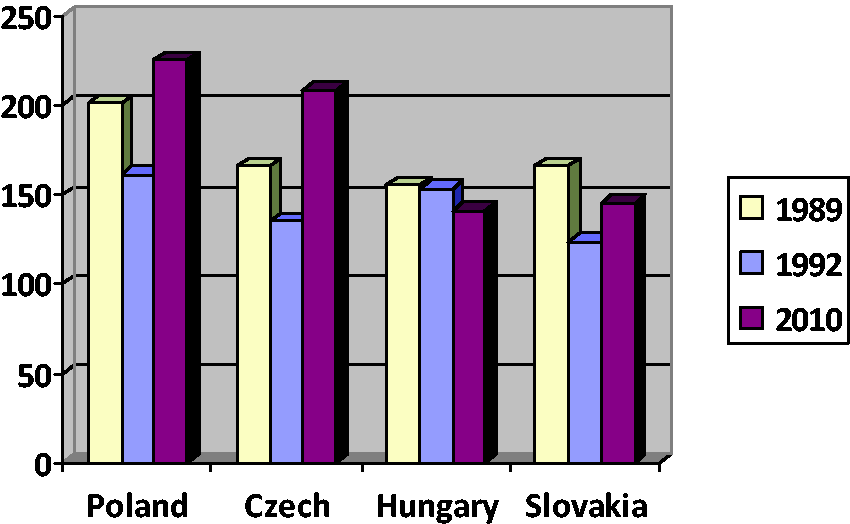
Usually, when countries have imprisonment rates this high, they tend also to have relatively high crime rates. Although the two are not causally related, there is usually some rough correlation between them. Not so in Central Europe: here, high incarceration rates exist alongside of some of the lowest official crime rates in Europe. As Figure 2 indicates, all of these countries have crime rates well below the European average, often at half of those of Germany, France, Italy, Holland, and the UK. For instance, the Hungarian crime rate hovers around 4000/100,000 as compared to the German rate of roughly 7900/100,000.
European crime rates, 2007. Source: Krajewski (2012).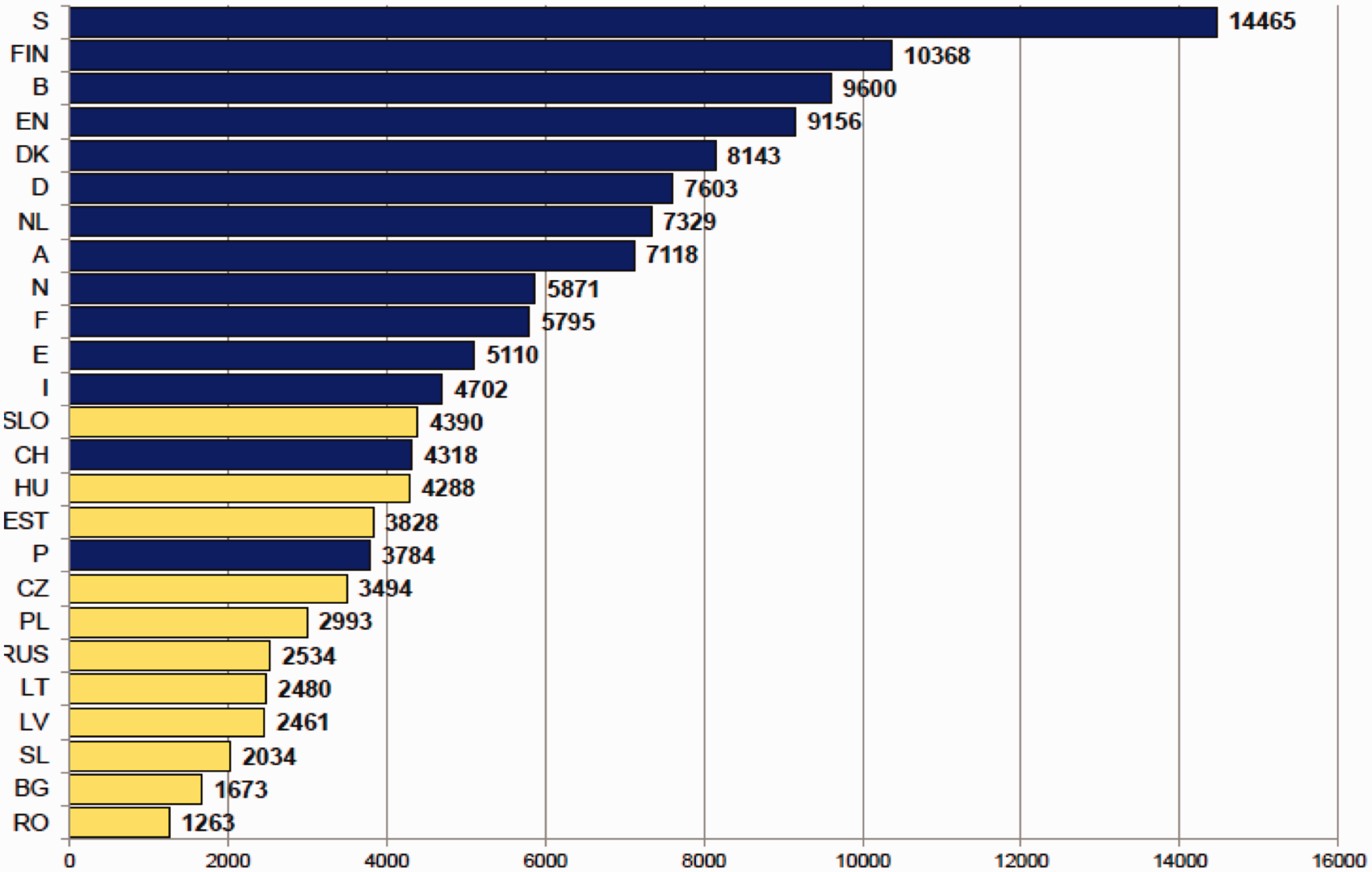
Of course, we need to be suspicious of official crime statistics, since they reflect all kinds of biases in reporting and recording. We also need to read them in both absolute and relative terms. So while Central European rates are comparatively low, they did rise significantly in the early 1990s. Most of this increase was due to spikes in property crime. Indeed, the violent crime rate in Central Europe has always been low as the overwhelming majority of crimes are nonviolent and property related. Even those crimes recorded as violent offenses tend to be of the less serious sort; armed robbery, assault, and murder remain rare. In the last decade, all these crime rates leveled off to their 1970s rates.
Despite these trends, across Central Europe fear of crime is off the charts: these populations consistently overestimate their national crime rates and underestimate those of West European countries (Kó, 1998). For instance, public opinion surveys find that the overwhelming majority of Hungarians rank their country’s crime rate as “much worse” than any other European country; 67% of them insist that Hungary is among the 10 most dangerous European countries (Dunavolgyi, 2004; Kerezsi, 2004). In reality, Hungary ranks among the 10 safest countries on the continent. What’s more, these same surveys find that Hungarians worry incessantly about being victims of crime: 80% fear they will be victims of violent crime, 62% of burglary, and 80% of auto theft—all in the next year (Kó, 2004; Papp and Scheiring, 2009). Similar fears plague Poles, Czechs, and Slovaks (Krajewski, 2004, 2009; Siemaszko, 2007; Valkova and Hulmakova, 2007). While these kinds of surveys should be approached with caution for methodological reasons, their findings are too consistent to be ignored: EU studies find Central Europeans to be among the most fearful in the EU when it comes to violent crime—with the Poles leading the bunch, and the Hungarians and Czechs closely behind (Kossowska et al., 2012; Kowalczuk, 2010; Los, 2002).
In this way, across East/Central Europe, low crime rates exist alongside of very high imprisonment rates and fears of crime. Although it would take a different kind of analysis to make sense of these tensions—as well as the social trends they index—the data point to one conclusion: something is happening to play up social uncertainty in the region. And to direct people’s social fears into a concern about criminal transgression. Indeed, in a region where social dislocation is rampant, the ground is quite fertile for the use and abuse of punishment talk. So it was in Central Europe, where a punishment discourse took genuine problems of social insecurity and fed them with anxieties about safety. This discourse was articulated by politicians who promised to deal with the former by being vigorous about the latter. As Lévay (2012) has pointed out, the Central European politics of fear look similar to those described in Simon’s (2007) classic description of the US impulse to govern through crime. Although, in this region, that political impulse emerged amid massive systemic change, where the economic, legal, and political foundations of social life were all transforming at once, which perhaps made the pull toward the politics of fear even stronger and all the more resonant.
Penal populism, East European style
One of the ironies of the politicization of punishment in Central Europe is that it emerged somewhat late in the transition period when crime rates were leveling off and even declining. Immediately after the collapse of state socialism, crime rates did rise significantly. Yet as Kerezsi (2009) has shown in the case of Hungary, immediately following 1989, there was not much public discussion about the criminal justice system. Krajewski (2009: 116) has made a similar point about Poland, where early criminal justice debates were about the “rationality” of crime control policy and the protection of offenders’ human rights. Indeed, for most of the 1990s, punitive politics were absent from political culture throughout the region. The public discussion of crime remained confined to the crimes of communism and how to adjudicate them. Reforms to the penal system were left primarily to legal experts and social scientists. And they introduced some of the most comprehensive and effective penal reforms in the early stages of the transition (Jasinski, 1996; Krajewski, 2012).
As the 1990s progressed, however, crime and punishment began to seep out of expert reform circles and into political culture. This was perhaps first apparent in Poland, where getting tough on crime was the main preoccupation of the Law and Justice Party, which governed Poland for years and remains one of its largest parties. It didn’t take long for this politics to reach the surrounding countries. By the early 2000s, punitive rhetoric had become a mainstay in East European politics—a central way to redraw the lines of social inclusion and exclusion and to reestablish order in a world that seemed increasingly disorderly.
Of course, the politicization of crime and punishment is not unique to Eastern Europe; it is a global phenomenon. As punishment scholars have revealed, the 1990s saw the emergence of new forms of penal populism that shifted the form and focus of penal politics (Bottoms, 1995; Pratt, 2007; Roberts et al., 2003). On the one hand, there was the active manipulation of crime and punishment by politicians to gain electoral advantage. As Roberts (2003: 5) has put it, penal populists promoted laws and policies that were “electorally attractive, but unfair, ineffective, or at odds with a true meaning of public opinion.” At the same time, others have shown that penal populism had a more diffuse base and was activated through a variety of social movements and local groups (Pratt, 2007). In this way, a strikingly similar set of themes and concerns connected penal populists across time and place: like other forms of populism, their penal politics tended to be based on antistate and antiexpertise rhetoric as they promised to give power and voice back to the “people.” And the central vehicle for delivering these messages was usually the same: a crime-driven media devoted to chronicling the criminal transgression of the day in the most sensationalistic way.
Most of these features of penal populism also characterized its East European variant. First and foremost, politicians across the region used and abused penal policies for political gain. Some used crime in a more “benign” way, attempting to be responsive to what they perceived as the public’s real concern for issues of law and order. But there were also those politicians who were more cynical and sinister—taking any chance they could to tap into those fears, to ramp them up, and to create panics over them.
For instance, in Hungary, FIDESZ’s landslide victory in 2010 was in part the result of its unapologetic politics of fear and promises to get tough on crime. Indeed, the first speech given by Prime Minister Viktor Orbán after the election was a “law and order” speech that outlined his plans for the swift passage of Three Strikes legislation (Kerezsi, 2013). Yet the best example of the use of punitiveness for political gain remains Poland’s Law and Justice Party, which was a politically marginal group until the late 1990s, when the party heads (aka the Kaczynski twins) used a “law and order” campaign to great public success. As a single-issue party, they instigated a public panic over crime that explicitly imported penal models from the United States, claiming that mass imprisonment and zero tolerance laws were “proven” methods for dealing with criminal threats (Kajewski, 2004, 2009). As a result, they became the governing party in 2005 and remain a powerful, formidable political force in Poland.
Like penal populism in the West, punitiveness in Central Europe has also been taken up by nonstate actors and social movements which draw on many of the same themes. Their antistate, antigovernment rhetoric is resounding, as they promise to give voice to “the masses” who they insist have been forgotten about by unresponsive state actors. Like their counterparts, penal populists in Eastern Europe claim to be radically democratic—not so much in their gesturing to the victims of crime (since crime rates remain low) but more in their promise to empower “society” vis-à-vis the “state.” Such rhetoric is powerful in this part of Europe, given the lingering public perception of the association between state authorities and oppressive rule. This is especially true when it comes to distrust of the police and criminal justice officials—a distrust that can still be read in terms of the “us vs. them” dichotomy of the state socialist past.
This association has thus led to situations unimaginable in other parts of Europe. For instance, in 2011 the local police force in the Hungarian town of Gyongyospata was handed over to the extremist, paramilitary group “Civil Guard Association for a Better Future.” The group then formed civilian patrols, which set out to police the town claiming to protect “law and order” and the population from criminal threats, particularly those posed by the Roma. After a slew of government officials applauded the move, several thousand supporters invaded the town to join the policing efforts and to engage in paramilitary training. With the Hungarian government unwilling to intervene, the international Red Cross eventually came in and evacuated the most vulnerable, mainly Romani, families living in the town—a move that ultimately led to a special election to replace the local government (an election which ended up being won by the head of the paramilitary Civil Guard).
In this way, there is also an antiexpert current to this strand of penal populism. Once critical to the penal reforms of the early 1990s, the last 20 years have been marked by the almost complete exclusion of experts from penal policy making (Kerezsi, 2009). This is particularly true of academic experts, who were instrumental to the cautious approach to penal reform in the immediate post-1989 period. Since then, the emphasis shifted to the emotional and intuitive in penal politics and legislation. Across Central Europe, there are countless examples of the symbolic politics of punishment and displays of retribution. As in many other countries, these policies are pursued not because there is evidence of their effectiveness, but because they have symbolic, expressive power. Like the “Three Strikes” legislation enacted across the region, which is a bizarre cultural import for societies with little knowledge of baseball. Or the castration laws enacted in Poland and the Czech Republic, which experts repeatedly warned had no deterrent effect on sexual offenses (CPT, 2009). But that is the point: these are rituals of shaming, not evidence-based policymaking.
Deepening the Central European backlash against expertise are the dynamics of Europeanization. As the example of the Red Cross intervention in Hungary suggests, the conflicts between national and supranational actors often take the form of struggles over expertise and who has the right to “know” what is best for a particular country. Indeed, the Czechs and Slovaks have been engaged in ongoing struggles with the Council of Europe over several of their penal policies (CPT, 2007, 2009). This is especially true of the more symbolical ones, which the European Committee for the Prevention of Torture (CPT) often deems irrational and unscientific. For instance, after a series of prison visits, CPT issued a strong recommendation that the Czechs put an immediate end to the surgical castration of sex offenders. The Czechs refused to comply. Then more lengthy reports were written, based on more prison visits and interviews with offenders who provided detailed documentation of the abuse of castration. In their final report, CPT called the Czech practice “degrading and mutilating” and found more than 50% of castrations were done to first-time, nonviolent sex offenders without informed consent concluding that the practice was “not based on any sound scientific evaluation” (CPT, 2009: 15). The Czech response? To proclaim it was their “right,” as a “sovereign nation” to decide how to treat “men who can’t control their sexual instincts and are sexually aggressive” (CPT, 2009: 7).
Another example of this battle over who knows best is Hungary’s defiance over its sentence of Life Without the Possibility of Parole (LWOP) and EU restrictions on the death penalty. Besides the UK, Hungary is the only European country with an LWOP sentence, which the European Court of Human Rights (ECHR) deemed cruel and unusual. Yet Hungary refused to withdraw the sentence, claiming it is their national prerogative to decide who and how to punish. Eventually, the Hungarian government upped the ante by inserting LWOP into the constitution it passed in 2011: Article IV constitutionally protects LWOP and allows for its continued usage. Despite pushback from international human rights groups like Amnesty International and the ECHR, the Hungarian government refused to relent, maintaining its right to govern within its borders, even at the risk of legal battles at the EU level to defend the policy (Amnesty International, 2011). In 2015, it added capital punishment to the battle when, in a speech to the European Parliament, Prime Minister Orban claimed Hungary’s discussion over the reintroduction of the death penalty was a matter of “freedom of expression” and “freedom of thought.” By using these particular terms, Orban equated EU membership and totalitarian control suggesting that EU restrictions on Hungary’s use of capital punishment harkened back to when Hungarians lacked such democratic freedoms themselves.
Finally, as with other variants of penal populism, a central vehicle of transmission is the media. Central Europe is a textbook case of the link between the popular consumption of crime/punishment and populist abuse of it. Here, too, the relationship is a symbiotic one. The Central European media is on overdrive, spinning out daily installments of criminal transgression. The stories that resonate then get covered incessantly, becoming national spectacles that unite otherwise disparate groups. Yet the actual targets of this seem to vary somewhat across the region. As Chancer (2005) argues in reference to U.S. high-profile cases, such cases speak to common fears, in culturally specific ways. They thus reflect and touch off specific social anxieties. For instance, the Poles and the Czech are especially preoccupied with sex offenders—the Polish castration law was put into effect by the more moderate Tusk government after public outrage over and media obsession with a high profile case of pedophilia. The Hungarians, on the other hand, are more moved by crimes involving parental figures, like the mother who kills her children or the teenager who killed a much loved high-school teacher. And, with Slovaks, they share an insatiable obsession with Roma crime: in both countries, research shows that the media focuses on the ethnicity of a criminal suspect only if that suspect is Roma (Benkovic and Vakulova, 2000; OSI, 2001).
In this way, the Central European media is engaged in a race for the competitive edge on those crime stories they can make resonate widely. Once they find them, politicians are ready to harness and channel them politically. Law and order parties then engage in masculinity matches for the title of the toughest, roughest political leader on the bloc—all of which become ideal media events in their own right and only add to the spectacle. The whole dynamic is very circular, in much the same way as is penal populism in the West.
Penal nationalism and the criminalization of the other
At the same time, there is an element that is somewhat different in the Central European popular culture of punishment. This element emerged from a populist politics in the late 1990s to grow into what looks more like penal nationalism. The timing of its growth varied somewhat across the region. In some countries, like Poland, it sprouted up in the early 2000s to shape national politics. In others, like Hungary and the Czech Republic, it did not grow into a formidable force until the late 2000s, when it became central to political debates around crime and punishment (Karabec, 2009; Lévay, 2012). Given the different timing, there is some country variation in the relative weight of the penal nationalism vis-à-vis other discourses. So while it would be a mistake to characterize the entire penal culture of the region as nationalist, this penal discourse now circulates throughout the region, getting picked up and elaborated on at critical moments. It has become a crucial tool for pulling the more moderate penal populists toward extreme stances by calling them out on being “soft” on crime in much the same way that penal populists draw moderates toward their positions in other European countries (Roberts, 2003). And this pull toward penal nationalism is significant because it differs from the more common penal populism in both form and content.
In terms of its form, although there is no way to measure levels of punitiveness in discourses of crime, nationalist sentiments do seem more pervasive and mainstream in the East. They are not only articulated by the small “law and order” parties we know so much about in the West (Pratt, 2007) but they are also voiced by political figures from some of the largest, most powerful political parties. The Polish Kaczynski brothers provided some of the earliest expressions of penal nationalism while heading up the Law and Justice Party, which has remained one of the most influential Polish parties. In Hungary, FIDESZ, with its “super majority” in parliament, is a central mouthpiece of penal nationalist ideas and ideals. In the Czech Republic, it was Vaclav Klaus, the Czech President and Prime Minister, who was a main voice of nationalist punitiveness. And lest we reduce penal nationalism to a Christian-conservative politics, there is the neighboring Slovak version, which is connected to left-wing nationalism more broadly. So even if penal nationalism is just one discursive branch, it often seems as though its roots are in the tree trunk itself, that is expressed through the politically powerful and foundational forces in the region.
Similarly, these powerful political figures articulate penal nationalist sentiments more explicitly and unapologetically. Such sentiments figure directly into their campaign slogans and promises. In Poland, the Law and Justice Party campaigned throughout the 2000s almost exclusively on its promise to protect the nation from internal and external threats. In Slovakia and Hungary, penal nationalist arguments were mobilized openly to secure the passage of Three Strikes legislation, despite condemnations from the European Parliament. Then, by the late 2000s, there was the explicit penal nationalism of Jobbik, the Hungarian ultra-right party which became a strong presence in national politics and parliament. As Figure 3 demonstrates, their campaign billboards often focused on crime and punishment, with this one suggesting to ban everything from “gypsy criminality” to “laziness” and “corruption.”
Jobbik Campaign billboard, 2010.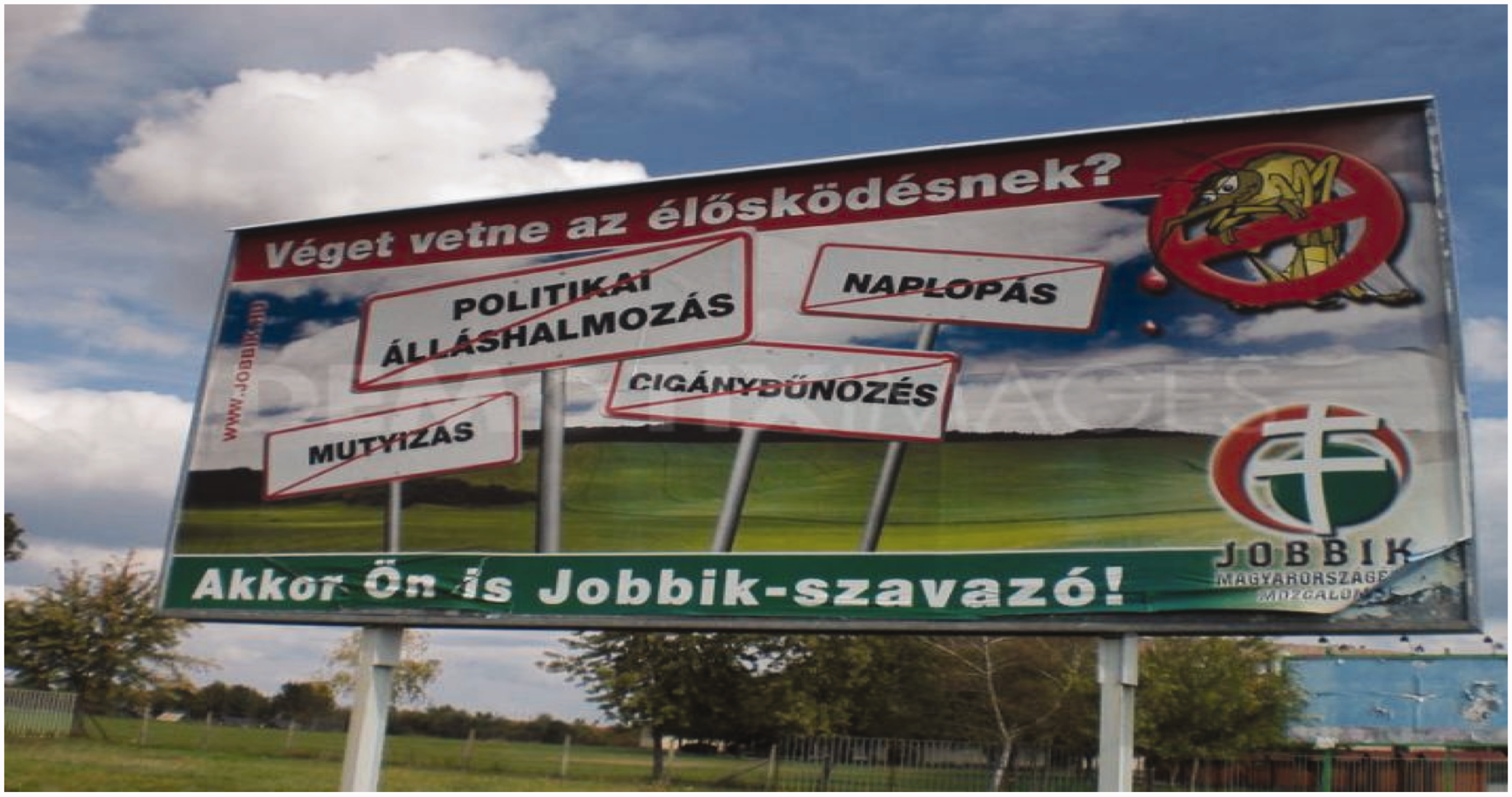
Yet the real divergence between penal nationalism and penal populism comes in the content of the former’s message. Penal nationalists talk about both the “people” and the “nation.” For them, crime control is not simply a matter of security as it is in much of the right-wing discussions in Italy, France, or Germany. Rather, it is a matter of national protection. Getting tough on crime means securing national well-being; punishing criminals is essential to national welfare. Punitiveness is then presented as part of the national character as when Polish politicians link the war on crime to the war against communism. Or, as Hungarian government officials continually proclaim: “Hungary is not a paradise for criminals” (Lévay, 2013). Indeed, it was largely this nationalist message that brought so much international notoriety to the Hungarian response to the 2015 migrant issue: the way Prime Minister Orban equated the influx of migrants with threats to the Hungarian legal order and, ultimately, to national well-being. It was also these nationalist appeals that prompted leaders in the neighboring Visegrad countries to contribute to Orban’s solution—sending their own military police to assist with the containment of migrants and, in the words of the Slovak foreign minister, to “secure our citizens’ security.”
As the Central European response to the migrant crisis also reveals, for penal nationalists punitiveness has become the basis of national sovereignty—it is as if being “soft” on punishment will mean a loss of national independence and autonomy. For example, in debates about castration laws for sex offenders, the need to protect the nation frequently comes up. This is particularly true in public debates over how to punish sexual offenses against children. In Central Europe such offenses are often read in national terms as threats to the future of the nation. And this has prompted otherwise moderate Polish politicians, like Prime Minister Donald Tusk, to decry such perpetrators as “inhuman” and “in need of castration” (Krajewski, 2013). In the Czech Republic, the other country in the region with castration laws for sex offenders, the rhetoric echoes this national fear. When confronted with public outrage over cases involving pedophilia, former president Vaclav Klaus became notorious for insisting that “they” were stealing “our” children. And for calling for a swift, punitive response to such crime as a way of signaling that “they” could not have their way with “our” children. Exactly who “they” are was left purposefully unclear.
This focus on criminal threats to the nation has frequently led penal nationalists to invoke metaphors of national essence and blood ties. On the one hand, they link the courage to resist criminals to “Polish strength.” Or they connect the will to be tough on crime to the “Czech spirit.” On the other hand, those thought to be a criminal threat are deemed internally different. Politicians from Poland’s Law and Justice Party are notorious for portraying criminals as both less than human in their evil essence and as super human in their violent prowess and abilities (Krajewski, 2012). In both cases, those who pose a criminal threat are represented as intrinsically other, as non-Polish.
This national othering of criminal threats is clearest in the social construction of Roma crime, which is the real paradigmatic case for penal nationalists. This is especially true in Hungary, the Czech Republic, and Slovakia, where the Roma are the cultural icon of criminality—worthy of their own term in Hungarian, “gypsycriminality” in one word (ciganybunözés). They are, thus, key targets of penal nationalists. As the term itself connotes, their criminality is presented as fundamental to who they are, biologically and culturally or “mentally” as the leader of the Czech Party of Civil Rights recently put it (Mares, 2012). Or, as right-wing Czech politician Miroslav Sladek made the biological connection, “For the Gypsies, the age of criminal responsibility should be from the moment of birth because being born is their biggest crime” (Fawn, 2001: 1202). Similarly, in Hungary, surveys indicate that 64% of the population believe that the “predisposition to crime was in the Gypsies’ blood” (Fabian and Sik, 1996). Then there is the cultural determinism of Jobbik, which ties Roma crime to their essential “otherness.” As they claim in their 2014 party platform: The phenomenon of “gypsy crime” is real. It is a unique form of delinquency, different from the crimes of the majority in nature and force. This recognition does not imply racism, of course, since it blames their peculiar socio-cultural background… The way to solve this problem is to raise their children to respect our social norms and culture. And to reestablish law and order by removing those who do not [respect our social norms]. (Jobbik, 2014)
Such conflations are what make this strand of postsocialist penal discourse more nationalist than the penal populism of its neighbors—the way it links all possible “others” and categorizes them as worthy of the harshest of punishments. Let me be clear: Central Europe is hardly the only area with harsh, racist, penal politics. This occurs all over the world. What is more distinctive is the substance of that politics in this region: how it equates the general crime problem with specific historic crimes against the nation and how it frames crime prevention as an issue of national sovereignty. How this nationalist criminalization of the other evokes an extreme politics of inclusion and exclusion—treating perceived differences through confinement, while insisting on a hierarchical version of social and cultural inclusion. And how, as Hungarian criminologist Katalin Gonczol (2011) has put it, this politics can spread “almost unhindered” in democratic societies with little tradition of democracy. Indeed, Gonczol indictment is also suggestive of how we can make sense of the emergence of penal nationalism and its resonance across postsocialist societies.
Penal nationalism and the dilemmas of democratization
The last decade has seen a comparative turn in the scholarship on punishment, with case studies of the politics of mass imprisonment giving way to comparative work on different penal pathways (Bosworth, 2010; Loader, 2010; Snacken, 2010). This is a welcome development, with scholars now analyzing how penal systems are shaped by broader economic and political forces (Lacey, 2008). Their work has revealed how penal systems fall into regime clusters that mirror the political economies of welfare capitalism (Cavadino and Dignan, 2005). It has exposed how the structure of the polity matters, as proportional representation leads to more political cooperation, more respect for penal expertise, and thus less penal populism (Lacey, 2008; Tonry, 2008). And it has unearthed how welfare systems matter, as entitlement-based, redistributive welfare regimes breed more solidarity and are thus associated with more inclusionary penal policies (Lappi-Seppala, 2008; Pratt, 2008).
While enormously revealing, the cases at the center of these comparative models are strikingly similar: they are all long-standing constitutional, liberal democracies with some form of (social) market economy. Yet much of the world does not live in these political and economic systems—or, if they do, such systems are relatively new to them. Posttotalitarian and/or newly democratizing states, like those of Central Europe, thus offer a chance to broaden our comparative understanding of punishment. These states raise questions that are often left unexplored: what happens to penal systems when political structures democratize? When patterns of decision-making reconfigure and diffuse? Why do some penal discourses rise to the fore in this context?
Answering these questions is enormously complex. Establishing causality is a complicated task, particularly since there is always an interplay of factors at work to shape the form and focus of penal politics: from a mixture of global and local imperatives to pressures from the past and present. Indeed, a few Central European scholars have attempted to sort out these influences, finding that the causal arrows point in all sorts of directions (Selih 2012). For instance, Krajewski (2012, 2013) has applied the laundry list of common factors used to explain the punitiveness of penal culture to Central Europe—arguing that many of the “nonfactors” in the West, like rapid social change, ethnic tensions, and cynical politicians, were in fact very consequential in Central Europe. He also insists that many of the common “risk factors” for punitiveness in the West were not as relevant here, like the structure of the state and the role of experts (Krajewski, 2013). Further complicating the picture is Lévay’s (2012: 147) insistence that these causal factors may vary in strength and consequence across the countries of the region—with the penal cultures of some countries being more responsive to media sensationalism and ethnic scapegoating, while other countries saw these pulls tempered by welfarist logics and conceptions of democracy.
Instead of following these attempts to explain penal culture overall, I suggest narrowing the analytical lens a bit—by focusing on particular discourses and asking why they got picked up when they did. In the process, I also suggest narrowing the explanatory scope a bit. As Sozzo (2011) has argued in the Latin American context, establishing clear causalities in the penal arena is not always possible or desirable. It can be equally productive to chart the “elective affinities and confluences” that shape specific penal discourses (Sozzo, 2011: 210). Taking from this insight, I propose a series of convergent factors, of elective affinities, that often get overlooked in analyses of postsocialist punishment and yet help to explain the pull and appeal of penal nationalism in the region.
More specifically, in Central Europe penal politics developed amid three distinct challenges of democratization experienced in the region—dilemmas for which nationalism in general and penal nationalism in particular seemed to offer solutions. First and foremost were the political dilemmas faced by postsocialist states. One might assume that the collapse of state socialism would have ushered in renewed legitimacy for democratically elected governments. Not so in Central Europe. Instead, political and state officials inherited legitimacy problems, from populations used to questioning anything and everything the state did. There is an enormous literature, both popular and scholarly, on the deep distrust that these populations harbored toward state socialist political figures and officials (Havel, 1985; Verdery, 1996). From 1989 on, this deep and persistent distrust of the state has continued to show up in all kinds of indicators (Andorka et al., 2002). On Euro Indexes, countries like Poland, Hungary, and the Czech Republic continue to rank among the least satisfied with their governments and most distrustful of the police (Kolosi et al., 2004; Toth, 2008; Van Kesteren et al., 2014). Their levels of political party loyalty remain low, as does voter turnout in national and local elections. The tendency of Central Europeans to vote out governments, to split the vote among tiny parties unable to form governing coalitions, and to flip from one end of the political spectrum to the other in short periods of time, only heighten the challenges of newly democratizing states.
Connected to this, Central European democratization occurred in the unique context of Europeanization. As Fox and Vermeesch (2010) have pointed out, this had a further constraining effect on states in the region: it took many key social, political, and economic issues off the table. The EU came to Central Europe with a long list of things to be fixed before they could join the European club. The EU had a model and was willing to travel—offering up, and even imposing, its toolkit to resolve all kinds of national problems in the region. The political reverberations of this were complex and remain much debated. But there is little question that it provoked a fear of losing control, once again, of national interests—perhaps only deepening the distrust in public figures and state officials. Moreover, as Vermeersch (2009) has argued, Europeanization further limited national states by restricting the terms of the national political debate: with the framework for accession spelled out and nonnegotiable, the debate shifted to other areas, other terrains. As Bryant and Mokrzycki (1994: 6) put it, with so many of the basic features of the postcommunist landscape preordained, like parliamentary democracy, market economy, and civil society, by “the self-proclaimed victors of the Cold War,” national political space was curtailed and circumscribed.
Finally, it is critical to remember that the postsocialist democratization process occurred amid profound social insecurity. Central Europeans experienced a “triple” transformation: political, economic, and social change occurred all at once. It is hard to overstate how unsettling this simultaneous transformation was to so many. This complex mixture of displacements meant it was not always clear to people what was causing what. The result was a generalized sense of anxiety and fear—the sense that so many lives have been turned upside down in a very short period of time. This sense of insecurity also shows up on all the Euro Indexes, with surveys indicating Central Europeans have been the most uneasy and unsatisfied with their present lives, as well as the most pessimistic about their prospects for the future (TARKI, 2009). To make things even more complex, the same surveys reveal these countries to be extremely state centered and collectivist, with citizens still expecting their governments to provide everything from jobs to family benefits to subsidies for food, housing, and basic necessities. Surveys find that Hungarians and Slovaks insist the state become more involved in economic policy, while Poles and Czechs express more concern over family and social policy. So Central Europeans are anxious that governments they don’t trust are not more interventionist in and powerful over economic and social life.
In a very basic way, appeals to the nation seem to provide a way to grapple with many of these dilemmas. Clearly, there are political gains to be made by playing the nationalism card. As Fox and Vermeersch (2010) argue, nationalism opened up the political space for the internal differentiation among political parties that was largely closed off by Europeanization. It allowed them to reinvent and reinvigorate themselves by mobilizing around such a vague and malleable construct as “the nation” while providing a fulcrum for interparty contestation. The nation became an effective discursive device for recasting political issues as national ones, as between those “for” and “against” national interests. Thus, it also aided in external differentiation, from EU structures and toolkits. Nationalism offered a platform with which to oppose the EU as neglectful of national interests, radicalizing some groups away from conventional politics and toward more virulent ideas and actions (Fox and Vermeersch, 2010). And I would add that it gave these groups a way to differentiate themselves from the past, from the legacy of the socialist state which helped postsocialist state officials and political actors contend with their legitimacy problems and public distrust. In effect, nationalism became an antidote to many of the political dilemmas of democratization.
It also became a way to address the social dimensions of insecurity and discontent. On the one hand, it gave people a common frame from which to make sense of all the changes and disruptions occurring around them. And “the nation” is a particularly resonant frame, in part because it taps into the population’s collectivist sentiments, while signifying yet another break with the past. As Berezin (2009) has argued in the West European context, the post-Second World War “world of security”—of collective well-being and social solidarity underpinned by economic growth and productivity—also characterized the East, albeit less securely. For both parts of Europe, the “nation” is a way of stitching back together these frayed attachments. As Berezin (2009: 6–7) puts it, the nation-state is the “institutional location of a relation between a polity and a people”; its legal institutions “structurally inscribe individuals in the polity and society.” Thus, the rhetoric of the nation has a remarkable ability both to give voice to people’s sense of loss and to suggest habits of belonging, thus promising structural and emotional security (Berezin, 2009: 253). That is one powerful antidote to a series of complicated and contradictory societal disequilibriums.
How, then, does all of this relate to penal nationalism? If nationalism seems to provide a way to resolve key political dilemmas, penal nationalism is all the more effective. There are both symbolic and practical reasons for this. As scholars of punishment know so well, the penal system is an arena ripe for symbolic projection (Garland, 2001). It provides a space to imagine the social attachments and habits of belonging that Berezin finds so critical across contemporary Europe. Of course, it creates this imagined community by criminalizing the other—solidifying imagined national values and identities in opposition to a constructed other. And criminals can easily become the other from which this community unites. How better to secure this unification than by tying it to blood or even to historic assaults against the nation? Moreover, this can be even more alluring in transitional states like those of Central Europe since, as scholars of transitional justice remind us, it is in times of societal crisis that the law (and, by extension, lawbreaking) becomes all the more central (Krygier, 2005; Teitel, 2000). Penal nationalism offers a powerful way to mark those social boundaries of inclusion and exclusion, thus providing a sense of security in an otherwise insecure world.
Connected to this, the symbolic pull of penal nationalism also comes from its power to define transgression in socially resonant ways. Perhaps more than other forms of nationalism, penal nationalism can hook into cultural constructions of wrongdoing and fantasies about wrongdoers. This is largely because criminal transgression can be represented as signifying something deeper and more threatening than lawbreaking. The transgressions of the postsocialist criminal are said to be many—they are cultural, economic, legal, physical, and national, all rolled into one. Even human: as Hungarian journalist, political figure and founding member of FIDESZ, Zsolt Bayer (2013), proclaimed in an article about the iconic “gypsycriminal”: “They are not fit for co-existence. They are not fit to live among people. They are animals and behave like animals.” In this way, the penal nationalist panic over criminal transgression allows for the expression of all sorts of other panics; it can attach to other anxieties and insecurities, racial or other. And this only furthers its ability to plant and deploy powerful symbols in Central European penal politics.
In addition to its symbolic power, penal nationalism is quite effective in a practical sense. By reverting to the nation, penal nationalists can allay common fears about and distrust of the state—uniting the public by promising to protect them and national interests, simultaneously. Moreover, given the many external constraints now placed on these states’ ability to control economic and political development, penal nationalists have found one arena in which governments still have considerable influence: punishment. So criminal courts, criminal law, and prisons can retain some of their use as political tools. And they serve this purpose at the very moment when other areas of policy making are increasingly limited. Indeed, the conflicts between the Czechs and the Council of Europe over surgical castration, or the Hungarians and the European Court over LWOP and the death penalty, are all theoretical: the EU has little actual control over what member states do with their penal systems. Unlike other spheres, EU interventions in this arena are only advisory; they can only make recommendations for change. So penal nationalists can appear strong in this arena—like they are delivering on their promises to secure and protect the nation, no matter how politically motivated those promises actually are.
Prisons of the past
There is a final form of practical power wielded by penal nationalism: it promises a straightforward solution to the complicated insecurities of postsocialism. If the populace can be convinced that criminals are the source of their insecurity, then penal confinement is a way to make that insecurity disappear. If criminals are thought to pose the biggest threat, then their expulsion is the obvious next step. There is no need to reintegrate offenders. As the Hungarian journalist Zsolt Bayer (2013) concluded in his now infamous essay, because they are incapable of coexistence, “gypsycriminals must be cast out of society.” Or as a Hungarian inmate explained to me when I asked him why he spent all of his free time studying English: They want us gone, out of their sight and out of their country. They put marks on our papers, so everyone will know what we did, where we were. They put us in here [prison] where they cannot see us. When we get out, they want us to leave. They will not hire us. They will not let us live around them. So I will go. Far, far away.
Yet his remarks reflect the central claim of this paper: he is describing a contemporary form of punitiveness that marks, excludes, and expels those considered transgressive. Instead of viewing that punitiveness as simply a pull from the past, I have suggested that it has more to do with the social and political dynamics of the present—the dilemmas of democratization and Europeanization. This is not to say the past is irrelevant. Rather, the past has been filtered through the dilemmas of the present, creating an imagined community of security, which is tied together by imagined national values and opposed to the criminal other.
For those of us with scholarly interests in Central Europe, this suggests that we become a bit wearier to attribute everything we find troubling about the present to the state socialist past. It also implies that we stop falling back on the past as an excuse for the present or trying to explain so much through the “post” of postsocialism that we ignore the complex dynamics of the contemporary world. Indeed, these dynamics of the present are what make the case of Central Europe intriguing for those engaged in comparative questions of punishment. There is much to gain, empirically and conceptually, by moving the comparative line in Europe past Germany to the East. This movement highlights the factors that can give rise to penal populism and the factors that can turn penal populism into penal nationalism. It also sheds conceptual light on how democratization, while opening up room for political accountability and expression, can also breed social vulnerability and insecurity. And it suggests that if the dilemmas of democratization are not resolved responsibly, they can end up creating fertile ground for a renewed criminalization of the other and the penalization of transgression as they have in contemporary Central Europe.