







Abstract
Violence risk instruments are widely employed with at-risk minority clients in correctional and forensic mental health settings. However, the construction and subsequent validation of such instruments rarely, if at all, incorporate the perceptions, worldviews, life experiences, and belief systems of non-white communities. This study utilized a culturally informed qualitative approach to address the cross-cultural disparities in the forensic risk literature. Cultural perspectives on violence risk assessment were elicited from a sample of 30 American Indian and First Nations professionals from health, legal, and pedagogical sectors following an inspection of the Structured Assessment of Violence Risk in Youth instrument. Generally, participants believed that the Structured Assessment of Violence Risk in Youth instrument was not culturally appropriate for use with American Indian and First Nations youth in its current form. Recurrent themes of concern included the instrument’s negative labeling capacity, lack of cultural contextualization, individualized focus, and absence of cultural norms and practices. Recommendations to improve the cross-cultural applicability of the Structured Assessment of Violence Risk in Youth are discussed within.
Keywords
Mental health practitioners and correctional professionals are often tasked with assessing a client’s level of risk for future violence and other problem behaviors. This process prompts a variety of medico-legal repercussions ranging from attending to client areas of psycho-social need, institutional placement, and court sanctioned restrictions on patient/offender liberties. In decades past, risk adjudication was unevenly performed by medical professionals before the introduction of scientifically grounded risk instruments which engendered a greater level of assessor consistency and transparency (Dolan and Doyle, 2000; Grove et al., 2000). The application of risk instruments in correctional and forensic hospital settings is now commonplace (Singh et al., 2014; Viljoen et al., 2010; Wachter, 2014).
Risk instruments comprise a suite of factors associated with violence and criminal behaviors. The items, which may include environmental (i.e. criminal peers), clinical (i.e. major mental disorder symptoms), and historical (i.e. early violence initiation) phenomena, are customarily derived from samples of offenders and forensic patients (Helmus et al., 2012) or sourced from the behavioral science and criminological literature (Douglas et al., 2013). Instrument items may include static factors, which represent past unchangeable episodes (i.e. age at first offence), and dynamic factors, also known as criminogenic needs, which feature current changeable circumstances (i.e. peer group delinquency). The way in which an assessor gathers and considers an individual’s risk factors when evaluating their level of risk is shaped by the type of risk approach employed. The “actuarial” approach to risk assessment is mechanical and comprises a fixed suite of weighted risk items that distinguish reoffenders from non-reoffenders (Harris et al., 1993). A predictive orientation is favored while the explanatory process of each risk item in relation to recidivism is less articulated (Ward, 2016). Under the actuarial approach, clinical discretion is minimized and risk factors with statistical associations with recidivism are prioritized. The second approach, structured professional judgment (SPJ), allows for an assessor to contextualize a list of static and dynamic risk items drawn from the empirical literature base and then formulate an overall rating of risk (Douglas et al., 2013). The assessor uses their discretion to identify the relevance of specific factors to speculative acts of future violence in various scenarios and then formulate an overall rating of risk (Guy et al., 2012). The aims of SPJ extend beyond prediction, instead viewing assessment as a nuanced information gathering exercise to prevent violence and guide intervention (Douglas et al., 2013). Despite their procedural differences, actuarial and SPJ systems of risk assessment are widely utilized in practice and demonstrate similar capacities to predict future offending (Yang et al., 2010).
The risk instrument validation literature is expansive and spans several decades. Given the implications for individual liberty and community safety, there is an obligation to ensure the accuracy of any violence risk assessment used to inform medico-legal decision-making. However, based on the extant literature, there is concern that assessment tools may suffer from cross-cultural bias—that is, they may not work the same way (or with the same accuracy) for diverse cultural groups (Shepherd, 2016; Shepherd and Lewis-Fernandez, 2016). Recent summaries underline the paucity of minority representation in adult instrument validation samples and the often lower predictive accuracy of major adult risk instruments with selected non-white groups (see Shepherd and Lewis-Fernandez, 2016, for a review; Shepherd, 2016). As such, a stronger evidence base appears to be warranted before declarations of cross-cultural generalizability can be made. Moreover, if bias does exist, we do not know whether it is psychometric bias (i.e. attributable to the instruments themselves), or evaluator bias (i.e. attributable to assessors, stemming from the way they employ or interpret the instruments)(Hart, 2016; Shepherd and Lewis-Fernandez, 2016).
The historically mono-cultural nature of risk assessment development and practice could underpin both forms of bias. Existing schemes of risk assessment are largely underpinned by white Anglo-European cultural precepts with the expectation that such classification strictures extend universally (Gillies, 2013; Shepherd, 2016). Risk factors for problem behaviors are generally drawn from and validated on samples of predominantly white patients and offenders (Olver et al., 2014; Singh et al., 2011) despite actual correctional and forensic populations disproportionately comprising minorities of color. Studies that do not adequately report on or capture the full extent of population diversity are common in both forensic psychology (Carter and Forsyth, 2007) and psychology at-large (Henrich et al., 2010). An analysis of 500 empirical articles from leading forensic psychology journals revealed that less than 1 in 10 articles substantively attended to issues of race or culture (Carter and Forsyth, 2007). The generalizing statements that emanate from such research may not be entirely applicable if cultural variation is not accommodated. Shepherd and Lewis-Fernandez (2016) outline how cultural differences in worldview, belief systems, behavioral expectations, health practices, experiential reality, and epistemology render the task of assessing risk commensurately across cultural groups expressly challenging. Instruments developed on the perspectives, practices, and values of one cultural group are at risk of omitting phenomena uniquely relevant to other cultural groups (Bravo, 2003; Gillies, 2013). These concerns could affect both actuarial and SPJ risk assessment frameworks differently. The norms of actuarial instruments are often sample-specific and finite which, in turn, may not afford flexibility to account for cultural differences and idiosyncrasies. In other words, cultural biases may be in-built into the algorithm or formula. In particular, the narrow framing of risk may ignore structural imbalances underpinning community-level or individual-level risk variables. For SPJ instruments, the discretionary element allows for assessors to consider and weigh up culturally unique information. However, this latitude also allows personal prejudices and harmful stereotypes to shape the assessment. As such, proposals to modify or develop instruments with assistance from multicultural health professionals and community members have emerged (Shepherd and Lewis-Fernandez, 2016). The accommodation of multicultural worldviews allows for multiple perspectives enabling the development of forensic mental health models of assessment that identify the needs of diverse clients. This also ensures that risk assessment methods have been culturally “peer viewed,” that they are culturally appropriate and that their validity is commensurate across different cultural groups.
These developments are particularly necessary for Indigenous peoples in North America and Oceania for whom risk instrument accuracy is found to be persistently lower than for white individuals (Shepherd, 2016). It is well documented that histories of colonization and discriminatory government policies have led to intergenerational socioeconomic disadvantage, trauma, and overrepresentation in the criminal justice system (Anthony, 2013; Cunneen, 2009; Heart et al., 2011; The Royal Commission into Aboriginal Deaths in Custody (RCIADC), 1991; The Truth and Reconciliation Commission of Canada, 2015). Current rates of Indigenous imprisonment remain at elevated levels in Australia, New Zealand, and North America (Australian Bureau of Statistics, 2016; Department of Corrections, 2016; Statistics Canada, 2016). Furthermore, the treatment of Indigenous peoples by criminal justice and health institutions has historically been inequitable and inconsiderate of cultural behavioral norms and healing systems (Dudgeon and Walker, 2015; RCIADC, 1991; Sherwood, 2013). In fact, sector indifference to Indigenous perspectives when developing justice health initiatives and hesitancy to incorporate Indigenous cultural values into programs and services for Indigenous offenders remains contemporary concerns (Shepherd and Phillips, 2016). The absence of cultural considerations in forensic methods and measures may result disadvantageous outcomes for Indigenous clients. Individuals from such groups will still be (perhaps disproportionately) subjected to repeat assessments of risk, the outcomes of which could be legally restrictive and/or therapeutically (in) significant (Hannah-Moffat and Maurutto, 2010). A failure to determine the reasons why risk instruments are not performing as well for Indigenous offenders does a disservice to their specific needs and subsequent chances of rehabilitation.
The intention of this study is to initiate a culturally informed approach to risk assessment. This method enables a deeper understanding of cultural-specific explanatory frameworks and cultural interpretations of environmental phenomena, and how such praxes impact offending behavior. More important, a culturally informed approach is emic in nature and facilitated by representatives of the cultural group itself whereby issues, concepts, views, and interests of pertinence are conveyed through cultural lens. The Indigenous populations of North America possess worldviews and belief systems that are often reframed in western terms of understanding or considered peripheral to formalized models and measures of behavior (Champagne, 2015). This study aims to unearth subjugated Indigenous knowledge which may inform, augment, and/or possibly broaden the concepts encompassed within existing risk instrument structures. Methodological pluralism is essential to the identification of multiple realities that may contribute to how antecedents to problem behaviors manifest and are understood cross-culturally (Gone, 2012). Moreover, international protocols on conducting ethical health research with Indigenous peoples (Canadian Institutes of Health Research et al., 2014; National Health and Medical Research Council, 2003; United Nations General Assembly, 2007) have underscored the necessity for collaborative research approaches with Indigenous communities. The protocols require community participation throughout the research exercise to ensure that the handling of the project is culturally sensitive and findings are beneficial to Indigenous communities.
This study gathered the perspectives of American Indian and First Nations (AI/FN) professionals from health, legal, and pedagogical sectors on the face validity of the Structured Assessment of Violence Risk in Youth (SAVRY; Borum et al., 2006) instrument. The SAVRY conforms to the SPJ style of risk assessment and has demonstrated strong predictive validity in several international studies (Shepherd, Luebbers and Dolan, 2013). Few studies, however, have explored the cross-cultural validity of the SAVRY instrument with Indigenous youth. Meyers and Schmidt (2008) found that the SAVRY total score was able to predict violent recidivism for Native Canadian young offenders. Prediction estimates for a three-year follow-up post-release were in fact stronger for Native Canadian young offenders compared to Caucasian young offenders. In a study from Australia, Shepherd and colleagues (2014) discovered commensurate predictive validity for the SAVRY total score across Indigenous and non-Indigenous youth. In both investigations, Indigenous youth presented with significantly higher SAVRY total scores compared to non-Indigenous youth. Almost no studies have investigated whether a risk instrument is culturally appropriate for use with non-white groups on the basis of its format, item inclusion, operationalization, and interpretation. This exercise lends itself to SPJ-style instruments rather than actuarial-based instruments which are structurally rigid, prediction-oriented, and curtail clinical input. A previous unpublished study reported commentary by Aboriginal community workers in British Columbia, Canada on the broader applicability of the SAVRY instrument for Aboriginal youth and recommendations for case management (Rogers and Viljoen, 2012). The current study expands on this literature by facilitating detailed observations by AI/FN participants for each individual instrument item. The qualitative nature of the study allowed for a detailed interpretive exercise with a focus on cultural experiential meaning and ethnographic contextualization. We anticipate that this process will generate a culturally nuanced body of knowledge from which future risk assessment endeavors may draw upon.
Method
Participants
By way of purposive and snowball sampling strategies, participants were recruited from both national and regional AI/FN health organizations (i.e. Society of Indian Psychologists), academic institutions (health, social work, law, and Indigenous studies departments), and legal and well-being services in tribal jurisdictions. All participants were required speak and understand English and to have worked with at-risk AI/FN youth specifically in health or legal capacities as a component of their profession.
Ninety-six participants consented to participating in the study. The final sample was reduced to 30 participants (76.7% female, N = 23; 23.3% male, N = 7) as 66 participants did not complete the questionnaire. The attrition rate was expected due to the length of the survey and absence of compensation for participating. The mean age of participants was 47.11 (SD = 11.90, range = 26–67) years. Professions included Mental Health Practitioner (N = 9), Academician (N = 5), Drug and Alcohol counselor (N = 4), Tribal College Teacher (N =3), Social Worker (N = 2), Tribal court official (N = 2), Community health official (N = 2), Tribal College Graduate Student (N =2), and Tribal Law enforcement official (N = 1). The mean number of years participants reported working with AI/FN youth was 14.94 (SD = 11.72, range = 1–40) years. Half of the sample (N = 15) reported working with AI/FN youth for 10 or more years.
Twenty-eight (93.3%) participants self-identified as AI/FN. Participants then self-identified tribal affiliation through an open-ended response. The tribal identification of the sample indicates representation from all regions of the United States. Northern Plains Nations (e.g. Fort Belknap, Pine Ridge and Rosebud Lakotas, Omaha, Fort Berthold), Northeastern Nations (e.g. Potawatomi, Ojibwe), Northwestern Nations (Coastal Salish, Shoalwater Bay), Southern Plains (e.g. Kiowa), Southeastern Nations (e.g. Cherokee, Choctaw), and Southwestern Nations (Hopi, Dene) were represented. There was also representation from Canadian Aboriginal Peoples (e.g. Marten Falls, Mi’kmaq Nation, and Montagnais Nation). Two (6.7%) participants self-identified as white.
Procedure
Data were collected in 2016 between January and July. Prospective participants were informed of the study by way of an online invitation outlining the research and the requirements of participants. The invitation was distributed to prospective participants by either research assistants directly through the participant’s organization or advertised on the websites of relevant cultural health/law organizations (i.e. Society of Indian Psychologists). Interested individuals were then encouraged to complete an online semi-structured questionnaire via a link provided within the invitation. The questionnaire was conducted on an online research survey software program. Once accessed online, participants were then required to read a detailed summary of the study’s design, research questions, and participant expectations. Informed consent was then required prior to completing the study questionnaire. Consenting participants were not obligated to complete the questionnaire and could opt out at any stage of the process. The questionnaire took approximately 1 h to complete including the perusing of preliminary information.
Materials
The study questionnaire allowed for a comprehensive commentary on the suitability of the SAVRY (Borum et al., 2006) instrument for use with AI/FN youth. The SAVRY (see Appendix 1) is widely employed internationally by medico-legal professionals to ascertain the likelihood that a young person will engage in future violent behavior. Information from the SAVRY is often utilized to inform legal decision-making and treatment allocation. The instrument has been widely validated in young offender populations (Olver et al., 2009; Singh et al., 2011). It comprises 24 risk items that are associated with increased risk for violence and six protective items that can mitigate future violence (Borum et al., 2006). Assessors consider all items before assigning a client a high-, medium, or low-risk rating. Items can also be tallied numerically for research purposes.
Participants were provided with a short summary outlining the purpose of the SAVRY instrument and how it is employed practically. They were then asked to view both the entire SAVRY questionnaire and additional assessor administration information, as they appear in the SAVRY manual. The assessor information material includes item operational definitions and behavioral examples of each item. Participants were then expected to complete two tasks. First, they were encouraged to provide open-ended commentary on the cross-cultural appropriateness of each individual SAVRY item (i.e. wording, cultural relevance) where preferred. Second, participants were asked seven questions relating to the overall suitability of the instrument as well as offering practical recommendations for non-Indigenous clinicians assessing AI/FN youth.
Data analysis
Two phases of analysis were carried out. In phase one, thematic analysis was employed to arrange responses from participant responses for the individual SAVRY items collectively into concepts and categories that occurred repeatedly. After the responses of 30 participants had been collected, two raters independently analyzed the responses and coded the interviews for dominant themes using NVivo, a qualitative data analysis program. Following NVivo coding, dominant themes were cross-checked between raters until a consensus was reached, producing four dominant nodes. It was determined by the raters that saturation had been reached.
Participant responses to the concluding seven-item component of the questionnaire were then analyzed independently and also presented thematically. Again, raters identified common statements then conferred to share ideas and remove duplication.
Ethical approval
Ethical permission for this research was obtained by the Institutional Review Board at the University of Nebraska-Lincoln. The study was also approved by the Society of Indian Psychologists.
Results
Themes identified across SAVRY items
Thematic analysis of participant responses across individual SAVRY items is presented in Table 1. Four recurrent themes were identified from coding sessions: (a) negative labeling; (b) cultural de-contextualization; (c) absence of cultural manifestations of behavior; and (d) absence of cultural norms and practices. Grammatical errors have been removed from participant excerpts.
Themes and representative responses.
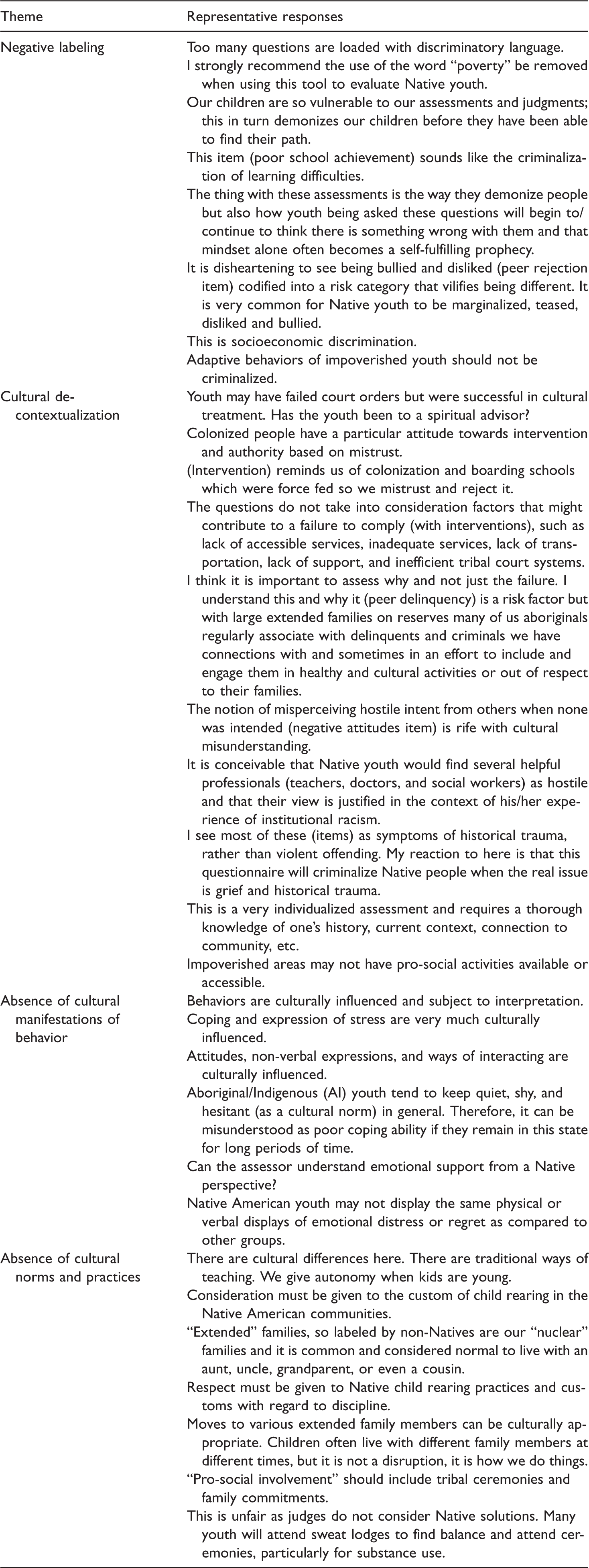
Negative labeling
Generally, participants perceived that the risk items and the risk item content had the potential to negatively label Native youth. This was believed to manifest in several forms. The use of specific terminology generated some concern: “Too many questions are loaded with discriminatory language.” Words like “delinquent” (“Perhaps use ‘People involved in crime’ rather than delinquents”) and “comply” (“Comply is a very western term…we’ve been forced to comply for hundreds of years”) were viewed as problematic. Participants regularly referred to the instrument’s capacity to criminalize poverty (“This is socioeconomic discrimination”) which served to disproportionately impact AI/FN youth: “families living in poverty are seriously disadvantaged by these questions.” This included the use of particular language (“I strongly recommend that the use of the word ‘poverty' be removed when using this tool to evaluate Native youth…poverty is not maltreatment”). Concerns extended to the risk item “Child Maltreatment” of which neglecting a child (i.e. failing to supply the child with adequate food, clothing, shelter, education, and medical care) could engender a high-risk rating for this item: “The mis-label of neglect continues to be utilized by non-Native social workers. It is the professional opinion of several social workers that life on a reservation alone constitutes neglect…my overall suggestion is to stick with the notion of Maltreatment as ‘intentional’ infliction of pain or injury.”
Many participants believed the labeling potential of the instrument extended to client’s families, particularly for SAVRY items canvassing parental/care-giver/peer criminality and community dysfunction: “Several grandparents and other relatives have overcome past difficulties to provide safe and sound homes.” It was asserted that AI/FN families can provide necessary support despite not having previously been law-abiding: “How many years earlier are the ‘illegal activities'? … many turn their lives around…you know it, others in the family know it, and close community knows it.” Some participants believed such items excluded AI/FN people from seeming pro-social: “pro-social and law-abiding people… I feel offended by this question; it makes me feel that they are suggesting that Native culture can be neither of these things.” One participant linked this sentiment to past injustices: “This type of question in an assessment has been utilized to remove children from Native American families and land for many years.” Other respondents asked whether the term “law abiding,” “refers to tribal law and lifeways?” Contact with criminal peers was also deemed to be common and unavoidable: “I understand this and why it (peer delinquency item) is a risk factor but with large extended families and reserves many of us aboriginals regularly associate with ‘delinquents’ and ‘criminals’ we have connections with and sometimes in an effort to include and engage them in healthy and cultural activities or out of respect to their families.”
Other areas of the SAVRY were highlighted for their perceived labeling properties. The “poor school achievement” item received considerable backlash due to its inclusion of special school attendance within the item’s high risk description: “Special learning classes have not been created to be used in a high risk assessment, they are meant to create the best learning environment for students who need extra help, not incarceration.” This engendered calls for part of this risk item to be reframed (“I think the last portion of the high risk category ‘…and may be in a special learning class’ should be omitted”) and with consideration to cultural differences (“What assumption is made of a youth who has been educated in a traditional or cultural way (oral) and struggles with testing in the mainstream system?”). Additionally, several participants commented that the “peer rejection” item could criminalize the victim of racial abuse or “vilifies being different”: “Most Indigenous youth get called a racist name at some point or other in their school terms… Are you saying that Indigenous youth are more at risk with this factor because of their racial identity?”
Overall, there was a belief that the instrument would be used for punitive/harmful purposes that would perhaps induce further problem behaviors: “It's no wonder many do not find their paths as they are so misled by our assessments and take the findings as their core identity.” Another participant remarked that “youth being asked these questions will begin to/continue to think there is something wrong with them and that mindset alone often becomes a self-fulfilling prophecy.” Coupled with these observations was a common mistrust for the professionals assessing youth. One participant offered that “many Native people, including youth are highly suspicious of the intent of these agencies (law enforcement and health professionals) and do not trust them,” leading several participants to question “how is this information (from risk instruments) properly known and verified?”
Cultural de-contextualization
For many respondents, the instrument did not appear to entertain the causal dynamics nor the culturally relevant circumstances associated with the presentation of various risk factors. Again, the theme of mistrust emerged; this time as a factor influencing AI/FN cooperation with health and legal services: “Many youth have been raised to mistrust authority and when placed in a situation where they are forced to comply, many historical issues of colonization are re-visited not surprisingly leading to a failure to comply.” Several participants felt that risk items canvassing a poor compliance with interventions, and negative attitudes towards authority should be understood in light of both past and contemporary injustices: “Traumas can be generational, such as a parent having been sent away to a ‘BIA Indian Boarding School,' or taken from their families by the ‘welfare' system and adopted out. It makes many people grow up not trusting the welfare system, authority figures, doctors etc.” Some responses detailed personal experiences which underpinned a pervasive distrust of authority.
“I believe all Native people have some level of distrust of non-native social workers, police and even health care representatives. I used to have to hide when the county nurse visited as my parents feared the unwarranted removal of their children due to too many of us living in our home. Lots of kids were taken away. …they (Law enforcement) never came when we needed them, but would deliberately seek us out to intimidate and harass us. This is unfortunate, but many Native people, including youth are highly suspicious of the intent of these agencies and do not trust them.”
Similar concerns extended to specific SAVRY items, such as “Negative attitudes” which include in its definition, a tendency to misperceive hostile intent where none was intended: “Many professionals who are not in touch with their privilege do not understand this area at all. It is conceivable that Native youth would find several helpful professionals (teachers, doctors, social workers) as hostile and that their view is justified in the context of his/her experience of institutional racism.” Another participant added; “Males of color are often rated as having higher inabilities to control anger when displaying the same behaviors as mainstream males.” The perceived non-consideration of culturally driven rehabilitative alternatives in the instrument was also highlighted: “Youth may have failed court orders but were successful in cultural treatment. The instrument should ask whether the youth been to a spiritual advisor.”
Many participants believed that the individualistic nature of certain items discounted genuine reasons for their manifestation, prompting one respondent to offer: “I think it is important to assess why and not just the failure.” Concerns were held that youth could obtain high-risk evaluations on particular items due to local disadvantaging circumstances beyond their individual control. For example, participants cited the inaccessibility of both appropriate schooling and community support services as key barriers for Native youth which necessitated acknowledgement during assessment. Some items “don’t take into consideration factors that might contribute to a failure to comply, such as lack of accessible services, inadequate services, lack of transportation, inefficient tribal court systems, etc.” Several participants pointed specifically to the lack of resources on some reservations in relation to schooling (“Many reservation schools don’t provide adequate educational support. This contributes to poor achievement”), access to police (“I would suggest adding in components such as access to law enforcement, etc … for some reservations, the nearest police station can be communities away, 30+ miles)” and access to pro-social activities, (“In our area, the schools are 15 miles and 24 miles away, many parents cannot drive their kids to the school for sports”; “What about Indigenous youth living in remote communities? They do not have access to such activities. Many families also do not have money for organized sports so how is it they we are again criminalizing poverty?”)
As such, one participant concluded that, “non-compliance and school attachment cannot be truly assessed if there is no context to describe that in courts as there may be no services available on a reservation.” For example, “youth who are not engaged in school are often caretakers in the family whether it be younger siblings or elders.” It was additionally suggested that preliminary material must precede the scoring of items: “First it must be determined if there is anyone in the youth's life that can support compliance (with intervention orders), or help monitor orders.” Participants expressed the danger of ignoring this notion as “this category of young person should not be confused with another who does not want treatment.” Additionally, cross-cultural differences were perceived by some to perhaps contribute to poor compliance with intervention orders: “There may also be some (court requirements) that are not deemed culturally appropriate.”
Several participants expressed concern with the tallying of prior violent and non-violent acts without discerning the circumstances of the offending: “The act alone would not worry me - instead, I would care about the context in which the youth found him or herself.” Crime in the context of survival and self-defense was acknowledged for violent crime, (“Many Native American youth commit acts of violence to protect vulnerable family members, which should be separated from other acts of violence”) and non-violent crime (“What were the circumstances of this offense e.g. homelessness, hungry, etc.?”) One participant recounted the experience of a former client: “He committed multiple acts of theft, including food and clothing from the school. We realized that he didn't have access to these things at home and didn't know that he could talk to his counsellor for assistance.” The location of prior offending was also referred to in relation to legal jurisdiction: “Many tribal members, including teenagers are judged differently by non-tribal law -enforcement, especially in locations that are immediately surrounding or in close proximity to tribal territories.”
References to historical trauma stemming from colonization were common in relation to risk factor manifestation. Historical/intergenerational trauma was perceived to underpin negative views of authority, resentment of police, substance use, aggression and Attention Deficit Hyperactivity Disorder (ADHD) symptoms. Some participants indicated that all risk markers on the instrument could be explained by historical trauma: “I see most of these (items) as symptoms of historical trauma, rather than violent offending. My reaction here is that this questionnaire will criminalize native people when the real issue is grief and historical trauma.” The following observation was posed: “Historical trauma is not addressed…the history of exposure, increases the likelihood to offend.”
Absence of cultural manifestations of behavior
Another identified theme was that cultural specific expressions of behavior were either not encompassed in risk item definitions or were in danger of being misidentified by non-Native clinicians. This sentiment was particularly salient for items canvassing behaviors such as empathy, remorse, anger, ADHD symptoms, stress, and poor coping which were perceived by many to be culturally influenced and subject to interpretation: “Native American youth may not display the same physical or verbal displays of emotional distress or regret as compared to other groups. I certainly hope this risk item is assessed by a mental health professional with experience with youth of color.”
Similarly, non-verbal communication and shyness/reticence were referred to as embedded in a culturally interpretative context: “Non-verbal people often suppress their anger and express it inwardly rather than in outbursts. They might take off and disappear.” In particular, it was opined that shyness [“AI (Aboriginal/Indigenous) youth tend to keep quiet, shy, and hesitant (as a cultural norm) in general”] may be misconstrued as indicative of a youth’s coping ability in certain situations: “…after significant stress or loss, it (shyness) can be misunderstood as poor coping if they remain in this state for long periods of time.” Similarly, a lack of responsiveness may be merely an attempt to “keep up a hard protective façade” rather than symptomatic of callousness or remorse.
Concerns were also aired that AI/FN youth would be potentially subject to an overestimation of ADHD: “Native style of non-interference parenting leads to kids who feel free to explore their environment, which could be interpreted as hyperactivity and restlessness.” Others suggested that ADHD may not be the focal point here: “All kids with a trauma history experience difficulty with concentration, hyperactivity, and restlessness.” In addition, participants described the need for cultural specific coping mechanisms to be included: “As long as coping strategies are discussed and examined fully, this should not be problem. Native American coping styles of prayer, humor and family interdependence should be included in the assessment.”
Absence of cultural norms and practices
Respondents perceived the descriptive content of specific items to capture western norms and practices to not reflect Indian customs. The item “early caregiver disruption” which is described in the instrument manual as “the discontinuity of care during childhood” including “sudden moves to various family members” prompted concern among numerous study participants. The “definition of family is broad in American Indian families” and “moves to various extended family members can be culturally appropriate… children often live with different family members at different times, but it isn’t a disruption.” Many AI households include “Aunts, uncles, grandparents, cousins, even distant relatives” whose care “can be as fulfilling or as satisfying as the standard White family model including only mom, dad, kids,” and who “often can have a very strong presence within the home as integral as the parents themselves.” It was also identified that it was not uncommon to see “the grandparents as head of the household while the biological parents of the child are still viewed as under grandparent rules/guidelines/expectations.” Such extended family arrangements were perceived by participants to be “not considered abandonment and/or neglect as our kinship system is different and we are closer to our relatives both in practice and by definition.”
Participants highlighted the absence of cultural practices as sources of treatment and pro-social behavior on the instrument. One respondent offered that “only white therapy is considered” here and that a “youth may have failed court orders but may have been successful in cultural treatment.” Other participants noted that pro-social activities should include “cultural activities such as cultural gatherings and games”—”Pro-social involvement should include tribal ceremonies and family commitments.” The use of hallucinogenic drugs in ceremony was also alluded to, provoking one participant to state: “I would include the word ‘recreational’ in front of ‘drugs’ on the instrument. While Indian members are allowed use of it (hallucinogenic drugs), in western culture it is still considered a drug, therefore the instrument can misrepresent the term drug when it is used in ceremonial practice.” Furthermore, it was specified that “culturally, some tribes use self-mutilation as an expression of grief and/or ceremonial self-sacrifice” which should not be confused with self-harm.
Cultural-specific childhood rearing practices were identified, and concerns were held that traditional methods would be estimated as problematic during an assessment with the risk instrument. The “poor parental management” item, the definition of which refers to parental regulation that can be overly permissive, strict, inconsistent, or uninvolved, received feedback from a number of participants: “Overly strict is not clear. Some American Indian families have many adults playing the roles of discipline and guidance, which can outwardly appear too strict.” Another respondent added that “this needs to be spelled out for various cultures. My own culture was very permissive in some areas and strict in others.” Cultural differences were also underscored: “We give autonomy when kids are young… it is a learning process.” In light of Native extended family arrangements, there was concern that there would be a misunderstanding that parents were not primarily involved. Therefore, it was suggested that “if the assessment examines family management of the youth, rather than parental management, then this question works.”
General suitability of the SAVRY instrument for Native American youth
Participant responses to each of the seven questions that concluded the questionnaire are presented thematically below. Three participants did not complete the seven-item survey.
Question 1
Do you think the SAVRY is a useful instrument for AI/FN youth in its current form?
Respondents considered a variety of themes. These included historical recognition (“The instrument pathologizes normal human responses to genocide”; “There are aspects of the instrument that do not consider a comprehensive understanding of one's trauma history”) disadvantage (“I also feel that many of the questions are adding numbers and strength toward punishment but are environmental and beyond the individuals control… thereby a majority of American Indians would fall under high risk for no other reason than historical…it makes me wonder how a youth with no criminal background or risk, but merely Indian ethnicity would fare using this assessment”; “It may be more a reflection of the community's socioeconomic realities and survival to deal with those realities, and not necessarily a reflection of the child's level of risk”) and cultural worldview (“Some questions lack the cultural lens that would address both urban and reservation youth”; “I think Natives have a different mindset. We think community as family. Non-native namely Westerners think individual”). Several participants also commented that the survey was overly lengthy. Furthermore, positive aspects of the instrument were identified: “I think the SAVRY is a thorough tool and I like the degree of detail…it asks very broad questions, but the right ones.”
Question 2
Do you think the SAVRY instrument is culturally appropriate for use with AI/FN youth in its current form?
The absence of cultural-specific information was frequently observed: “The instrument does not consider an understanding of one’s cultural dynamics that influence behaviors due to social norms being different to that of mainstream society”; “Several of the items need cultural tweaking…important cultural definitions are not included.” Concerns were held that the absence of cultural information on the instrument may preclude the evaluator from situating risk factors in a cultural context: “Too many questions need the professional to understand specific tribal family and historical factors that would influence the answers”; “The evaluation criteria make no attempt to provide a cultural context”. Some suggestions ensued: “Small components need to be included to reflect on cultural/spiritual values; as this is often of very high value in AI families” and “the instrument should identify cultural strengths.”
Question 3
Do you think protective factors (strengths) are a useful inclusion on the instrument?
The bulk of respondents strongly agreed with the premise that protective factors or strength items are useful additions to the instrument. One participant noted that the “inclusion of strengths aid in taking the focus off one's deficiencies to focus on the possibilities and solutions that foster resiliency, hope, and empowerment.”
Question 4
Should the instrument include/exclude risk items?
Several themes emerged from the responses. It was perceived that the instrument necessitated a stronger focus on the family or community rather than the individual. Questions were suggested to be couched in familial terms: “It is important to understand a family history of substance use, the coping and relationship patterns of the family system, familial patters of conflict/conflict resolution, familial trauma and familial/cultural values and priorities.” Risk to the family unit was recommended for consideration (“Has the youth engaged in behaviors that have hurt their immediate and/or extended family?”) as was being alienated from one’s community and culture. Community suicide rates were also raised as a potential issue: “It may be important to note a family history of self-harming behaviors and attempts as well as loved ones in their lives who have committed suicide… the risk for suicidal behaviors increases when those close to one commits suicide as well as the community trends of suicidal gestures and behaviors.” More specifically, it was suggested that suicidal behavior may be expressed in varying ways: “In my work with Native people I have found that often times their engagement in risky behavior (e.g. car accidents) is suicidal behaviour that often goes unreported and unnoticed.”
Historical/intergenerational trauma was identified as a risk factor worthy of attention. “The residual effects of intergenerational trauma such as racism, discrimination, prejudice and oppression” were believed to contribute to youth violence. In particular “genocide,” “racial discrimination,” “boarding school experiences,” “internalized racism,” and “broken treaties” were cited as current and historical incidences necessitating embodiment within the instrument. Grief from the significant loss of extended family members was also suggested as risk factor.
Other proposals included the creation of an “acute” range for the “self-harm” item, the separation of the alcohol and illicit substance use item, foster care placement outside of one’s culture, availability/knowledge of resources and helping agencies, and experiences of sexual abuse/exploitation. A stronger focus on emotional abuse was also flagged: “It may be important to note emotional and verbal abuse as well as shaming which have been major areas of trauma reported by Native clients.” Several respondents also believed that the instrument lacked questions on “how to bring change” and instead “just focused on the problem.”
Finally, participants frequently expressed that foetal alcohol spectrum disorder (FASD) was potentially the source of myriad items on the SAVRY instrument: “FASD is a major factor in Indian communities.” It was suggested a number of times that all high-risk AI/FN youth should be screened for FASD.
Question 5
Should the instrument include any additional protective items?
A number of foci emerged with particular reference to culture. Cultural engagement was identified by numerous participants as a protective item: “Does the child actively participate in cultural or spiritual activities?; Include involvement in cultural practices and protocols (but be cautious with those who have never been given the opportunity).” Specific cultural activities included sweat lodges, Native American church, ceremonial participation, spirituality, art, praying, drumming, dancing, and learning traditional language. Related to this concept was contributing to the community (“role in the community is missing”) which included helping elders, cultural leadership, appreciating/spending time in nature and espousing tribal values and traditions. A strong cultural identity was also viewed as a strength.
Several participants identified the protective mechanism of having an older role model/mentor from within the cultural group: “Youth identification of a positive relationship or role model with an adult from their culture/community.” This included “.if the youth has an elder or grandparent in their life.” The notion of safety was attached to these responses: “The youth knows where to go to find a safe environment/person.” This sentiment was also extended broadly to the community: “The community acknowledges the importance of providing programs, recreation, arts and music and other means of positive outlets.”
Question 6
How would you enhance the cultural sensitivity of the instrument?
Participants indicated the need for the instrument to “be adapted but not reinvented.” One response closely summarized the main concerns: “Change some of the wording to be more open to cultural ways, remove some questions that are more reflective of socioeconomic positioning, add in culture-specific questions, and create an accompanying booklet that describes some of the unique cultural contexts of Native youth.” Recommendations for editing included slight changes of vernacular (“Re-word the questions to make the instrument culturally appropriate and no so generalised”; “Avoid saying the words, parents and he/she as much as possible”) to the removal of certain questions (“Remove all questions that would automatically label American Indians (based on ethnicity) as high risk”).
An acknowledgement of historical issues was deemed important to understanding the presence and manifestation of risk factors. Users need to “identify how historical issues towards the tribe or community may overshadow assessment criteria” and understand “historical trauma in different communities and how it has impacted culture, parenting, housing, food access, jobs, geographic placement, carrying on traditions.” The consideration of location (reservation compared to urban areas) was also signaled and whether the assess is tribally enrolled. As was the heterogeneity of tribes: “Recognition that each First Nation community has different belief systems and traditional values.” A common suggestion for culturally adapting the instrument was to “get input from tribal elders and/or communities on traditional native methods of diagnosing violent tendencies in at risk youth.”
Question 7
Should a set of supplementary guidelines be appended to the SAVRY?
Cultural guidelines were generally viewed as a potentially useful accompaniment to the instrument by providing a “cultural lens that includes an understanding of Historical trauma and multi-generational Post-traumatic Stress Disorder (PTSD) which is critical for working with American Indian.” One respondent stated that “if assessors do not have specializations in multicultural communities, it would be helpful to have a list of cultural guidelines at a minimum.” Assessor–client interaction was proposed as a key component for any set of guidelines, with particular attention to respect. Examples included: “Rushing one and interrupting one can be the fastest way to lose connection and show disrespect. Youth are taught that elders speak first so you may have to gently solicit feedback and then listen do not interrupt.” Furthermore, “avoiding eye contact, speaking softly, very little, or not indulging deep personal information is not a form of disrespect; it is often taught and viewed as courteous for youth to do especially when working with those who are older (elders) than them so it may take time for the youth to open up and interact according to expectations of mainstream society.” Following such procedures were believed to useful in situations where an “assessor may behave in a way that is disrespectful of the culture—the person being assessed will not share as much information if this happens.” Several participants emphasized the importance of cultural safety mechanisms: “Answering tons of questions to a non-Indian can feel invasive and demeaning,” and so “understanding cultural norms Indian youth can help them be more comfortable answering questions that can bring up uncomfortable memories.”
Despite general concurrence with the notion of cultural guidelines, participants possessed mixed feelings over whether this would entail an acceptable level of cultural competence. Some participants suggested that guidelines would “serve as a reminder”; however, additional cultural training or workshops were expected. Others indicated that “clinicians should allow for a cultural advocate to accompany youth and help them be comfortable with service providers.” Another respondent suggested that “clinicians should strive to become part of the community where they work, or they should be aboriginal or at least part of the aboriginal community in some way.”
Some participants demonstrated less enthusiasm for clinical adherence to cultural guidelines: “It will be ignored by clinicians… best to adapt the instrument itself,” and referred to previous endeavors “even the Diagnostic and Statistical Manual of Mental Disorders (DSM) provides a list of cultural behaviors/diagnoses….but they are in the back (of the book).” One respondent believed that even with a cultural addendum “the SAVRY assessment is for mainstream society and many still could not relate.” Others suggested that culturally aware clinicians should not need the guidelines: “If someone is culturally competent they will not require guidelines as an add-on.” An overarching theme was that assessors should be trained in cultural safety—which requires an understanding of how an assessor’s own culture may influence an assessment or demean the culture of their client—rather than learning basic cultural sensitivities.
Discussion
This is the first study to address existing risk assessment approaches from a culturally informed perspective. Multicultural understandings (in this case Indigenous knowledge) allow for an identification of different realities, meanings attributed to various experiences, unique interpretations of environmental phenomena, and other social standards that may exist—all of which could influence psychological and behavioral outcomes and the subsequent assessment of risk. In addition to the previous work (see Rogers and Viljoen, 2012) on the overall cross-cultural suitability of the instrument at large, this study included a thematic analysis of participant considerations of individual SAVRY items. This enabled the collation of richly descriptive contextualization of individual items into common themes of cultural significance. Moreover, the study provided a novel opportunity to elicit valuable perceptions and guidance from community-based Indigenous stakeholders.
Major themes
Four major themes emerged from the analysis of SAVRY item descriptions by community-involved professionals. Many participants believed that the instrument served to negatively label AI/FN youth. Instrument terminology was critiqued for its potentially harmful branding of AI/FN youth living in impoverished circumstances or possessing learning difficulties. Such situations were perceived by participants, to be beyond the control of a youth and not necessarily reflective of individual risk. Specifically, the manual’s repeated use of the word “comply” invoked historical connotations of forced assimilation. Furthermore, respondents believed that the instrument conveyed an expectation that one should “cast-off” peers who had previous contact with the justice system. This was commonly thought to be culturally insensitive, judgmental and in many cases, unavoidable. Law-breaking members of the community were still regarded as having the capability to be “pro-social” and could therefore exert a positive influence on younger members of the community. In addition, the vocabulary of the instrument was thought to convey a punitive sentiment which for some participants was in contrast to their understandings of justice which were more aligned with restorative healing and community problem-solving approaches. The framing of client needs in punitive terms as a consequence of employing risk instruments has been referred in previous research (Hannah-Moffat and Maurutto, 2010).
The SAVRY instrument was broadly assumed to lack socioenvironmental context. Several respondents noted that the instrument appeared to focus on failure or the accumulation of indiscretions rather than the circumstances or specific issues that undergird them. Certain SAVRY historical items were believed to merely involve the tallying of past offences without attention to the specific nature of the crimes, which according to participants could be justified in certain situations (i.e. theft due to hunger; assault due to self-defense) and not necessarily indicative of future violence. Under-resourced communities and an historical mistrust of authority were also flagged as legitimate explanations for the violation of court orders or schooling non-attendance rather than perhaps a personal disregard of rehabilitation or education. Moreover, many of the SAVRY items were attributed to the ongoing effects of intergenerational trauma stemming from state-sanctioned injustices. Participants indicated that a risk assessment should incorporate an understanding of how historical events shape contemporary markers of risk.
Another major theme centered on cultural expressions of behavior. Participants provided several examples of how cultural idioms of conduct and distress deviate from the explanations provided in the SAVRY item descriptions. It was emphasized that non-AI/FN workers may misinterpret cultural-specific manifestations of particular risk factors if they are unfamiliar with cross-cultural variations in behavioral expression. A related theme was the absence of AI/FN cultural norms and practices within item descriptions. Many participants asserted that SAVRY risk factors relating to family/caregiver arrangements and parenting styles were framed within western conceptualizations of the nuclear family. Finally, the vast majority of respondents underscored that cultural activities and ceremonial events are patently pro-social and therapeutic occasions, necessitating inclusion on the instrument.
Participant recommendations for instrument modification
Risk instruments have received criticism for transferring the emphasis on client rehabilitation to “risk-informed” treatment or “penal managerialism” (Hannah-Moffat and Maurutto, 2010). This critique has generally been leveled at actuarial-based instruments due to their focus on narrowly defined criminogenic variables, and low prioritization to needs not statistically predictive of recidivism (Maurutto and Hannah-Moffat, 2006; Ward and Maruna, 2007). However, participant responses from this study also suggest that similar concerns affect SPJ-based instruments. The rigidity and singular purpose of actuarial instruments may limit the scope for genuine cultural modifications. In contrast, SPJ instruments may be easier to modify cosmetically and in practice, given the focus on information gathering and risk formulation rather than direct prediction. Several recommendations were presented by participants to enhance the cultural applicability of the SAVRY. These included rewording where appropriate, less significance afforded to socioeconomic status and an understanding of how historical trauma impacts contemporary disadvantage. Much has been written about the link between intergenerational trauma and a variety of emotional and psychological sequelae (see Heart and DeBruyn, 1998). It may be useful to identify unresolved grief stemming from historical trauma in light of the SAVRY’s intention to inform therapeutic intervention. There was a widespread view that a broader focus on family/community concerns would be of greater relevance to an assessment. The importance of assessing an Aboriginal youth’s ecological system has been flagged in past research (Rogers and Viljoen, 2012). Rather than laying emphasis on individual standpoints and behaviors, it was suggested that instrument particulars and lines of questioning view family/community as the locus of analysis. For instance, family histories of substance abuse, suicide, coping mechanisms, trauma, grief, and mental health were deemed as important as an individual’s history of these phenomena. Community suicide rates were also believed to be influential on a youth’s risk for suicide. Recent evidence has pointed to both high rates of youth suicide in Indigenous communities internationally, often occurring in sequences. As such, some respondents recommended an additional “acute” range for the suicide/self-harm risk item on the SAVRY which could also encompass community suicide trends.
The addition of a cultural addendum to the SAVRY received support from participants. For some, a set of guidelines outlining culturally acceptable forms of interaction, behavioral idiosyncrasies, and historical context were desirable, particularly for assessors with limited exposure or experience working with multicultural populations. However, it was stressed by several respondents that the guidelines were not to replace ongoing cultural safety training. Meeting the cultural needs of Indigenous people in contact with the justice system warrants greater medico-legal prioritization and often requires a stronger organizational commitment to cultural competence/safety initiatives (Shepherd and Phillips, 2016).
Alienation from culture and community was noted as a potential risk factor. This included situations where AI/FN youth may be placed in foster care arrangements with non-AI/FN caregivers. There was some disagreement over the inclusion of a “racism” item. While many respondents acknowledged that experiences of racism had serious social and emotional well-being effects on young AI/FN people, others noted that the inclusion of such an item would criminalize AI/FN youth for being the victims of racial vilification. It was also noted that any AI/FN youth who received a high-risk rating should be screened for FASD. High rates of FASD have been disproportionately detected across some North American and Australian Indigenous communities and among Indigenous prisoners.
Respondents overwhelmingly agreed that protective items should be considered on the SAVRY, supporting prior research (Rogers and Viljoen, 2012). A number of recommendations for protective items emerged, the bulk of which revolved around cultural engagement. Participation in cultural and spiritual activities was widely perceived to have protective qualities, as was a youth’s contribution to their own community. A youth who embraces a cultural role, possesses a strong cultural identity, or is connected to culture was believed to lower their likelihood of engaging in problem behaviors. Research has demonstrated an association between cultural engagement and a reduction in violent recidivism for Australian Indigenous people in custody (Shepherd et al., 2018). Some participants noted that the regular availability or accessibility of a “safe place” to reside or visit when in need was a crucial protective means for youth who were experiencing difficulties. Having an older role model or mentor from within the cultural group was also acknowledged as a potential protective influence. Last, a more robust emphasis on the identification of youth strengths and cultivating positive change was advised by numerous respondents in order to balance the perceived punitive outlook of the instrument. This may entail a more holistic assessment framework that motivates Native youth to obtain life goals while situating needs socially and culturally (Ward &Maruna, 2007).
Implications
The SAVRY risk items were viewed for the most part, as relevant to offending. However, findings denote that some degree of cultural modification to the SAVRY instrument is perhaps required in order to reflect the life experiences of AI/FN youth. There was almost unanimous agreement on the importance of cultural consideration in risk assessment. Common themes and mutual proposals were derived from the analyses notwithstanding broad tribal representation across North America.
The SAVRY instrument may require a combination of the following cultural revisions: item rewording to expunge insensitive and/or stigmatizing language; the broadening (or nuancing) of risk items to reflect cultural norms and experiences; the potential addition of a cultural addendum; the reframing of items in familial/community terminology; the potential addition of culturally relevant items and categories; and the possible removal of risk items that bear little relevance to AI/FN levels of risk. Specifically, a greater focus on client strengths and positive change may be a necessary direction for the instrument, rather than an emphasis on risk (or deficit model)—the general sentiment gleaned from participant responses was that the instrument served to designate challenging life circumstances as “risks” as opposed to areas for improvement or targets for treatment. Consequently, the instrument was understood to be punitive in nature rather than operating in the best interests of an Indigenous client. As such, it is important that items are culturally contextualized. In an SPJ framework, this could facilitate a culturally and situationally informed forecasting of potential offending and a better of understanding of which interventions may be useful (or even available) in light of the clients cultural surroundings. Moreover, several of the instrument shortcomings that were raised in the study (i.e. risk-centric focus, negative labeling of juveniles, and criminalizing of poverty) could negatively impact young people regardless of cultural group.
The specialist knowledge obtained in this study has provided numerous illustrations to inform the above modifications; however, international replications are recommended to strengthen the literature base. The testing of culturally modified instruments is then a necessary step to establish validity; however, this exercise must also involve community consultation. It may also be the case that a recidivism-centric approach to evaluation delimits the true worth of a culturally themed instrument. Other potential tangible and intangible markers of progress include: improved client rapport, cooperation, and candor during the clinical encounter; reduced levels of client discomfort and mistrust, improvements in cross-cultural communication, and the identification of cultural-specific phenomena; enhanced culturally relevant treatment matching; stronger therapeutic alliances; the educative nature of the instrument for assessors with little cross-cultural knowledge; and community participation, credibility, and subsequent endorsement. However, as highlighted by several participants in the study, any cultural alteration to the instrument should not preclude (or replace) ongoing cultural safety training. A culturally themed instrument should serve as an aide-mémoire and not represent an ad hoc introduction to Indigenous culture.
Limitations
There are limitations to the present study. First, the number of participants in the sample may appear low. However, in qualitative analysis, the size of the sample does not guarantee sample quality. Rather, a sample that facilitates adequate responses to the research question posed is deemed suitable (Marshall, 1996). Moreover, greater numbers of participants were not required in the current study given the emergence of tangible themes. With the constricted number of medico-legal AI/FN professionals nationwide (Native Youth Report, 2014), the sample gathered was representative and allowed for a meaningful, coherent thematic analysis of perspectives on risk assessment.
Second, since AI nations are distinct cultural and political entities, with over 560 AI nations in the United States alone (Bureau of Indian Affairs, 2016), one could argue that the sample here is too diverse and a focus on a single AI/FN group of professionals would be most insightful. However, despite AI/FN cultural variability, there is agreement across AI/FN communities concerning western legal systems and the implementation of criminal justice for AI/FN people (French, 2005; Hamby, 2008). Thus, the consensus demonstrated in the present findings highlight the continued coherence of perspectives among American Indigenous people concerning the non-AI/FN legal system and legal proceedings.
Third, the responses were not completely spontaneous. The use of survey methodology and open-ended responses precluded the possibility of non-guided commentary. However, one of the pressing issues becomes whether accuracy in risk assessment across ethnic groups exits and to what extent for a given measurement instrument. If the goal is for best practice by legal system personnel and fairness to AI/FN defendants, then identifying accurate behavioral predictors and maximizing behavioral risk measurement are crucial. Thus, there was a need for an organized approach to assess the risk instrument. The opportunity of AI/FN professionals to contribute to this assessment is enhanced with approaches like the current study, particularly given the disparate contributions of AI/FN people to a legal system that was founded outside the traditional justice of AI/FN communities (Ross and Gould, 2006).
Finally, participants were not forensically trained clinicians who may have resulted in responses that were unmindful of the professional context of risk assessment. Participants were also untrained in the use of the SAVRY instrument. This, however, was deliberate as the aim of the exercise was to solely determine the cultural appropriateness and semantic equivalence of the instrument content. It is useful for the risk factors on the instrument to be cultural contextualized by community representatives who have the local knowledge and cultural expertise to comment on how such phenomena may manifest within unique cultural surroundings. Community authorization for approaches that will ultimately be utilized on people from that very community is critical for reciprocal research methods.
Conclusion
The research on violence risk assessment has existed for over 25 years, yet no study has utilized a culturally informed approach to examine the cross-cultural applicability of widely used instruments. This study presented a unique opportunity to understand and interpret risk assessment from the culturally informed perspectives of a sample of AI/FN community health and legal professionals. A thematic analysis identified several cultural limitations of the SAVRY instrument which may have ramifications for both the accurate prediction of violent offending and culturally relevant risk management.