







Abstract
Using a combination of FOIA-requested legislative committee hearings and in-depth interviews, this manuscript investigates the work of Illinois prosecutorial lobbyists in state-level crime policy during a time of penal reform. I find that prosecutorial lobbyists are a regular and influential presence in policy discussions, advocating primarily for 'law and order' policies that expand prosecutorial discretion, even following the Great Recession. I also find that they repeatedly evoke their relationship to crime victims to frame their policy positions for a bipartisan audience. However, attention to discourse reveals that victims’ own interests regularly clash with prosecutorial discretion. These clashes create what I term discursive ruptures, or uncomfortable and surprising rhetorical fissures that emerge in what is otherwise seen as a near iron-clad political alliance. In such instances, prosecutors risk alienating a key source of their political legitimacy to protect their own discretionary authority. Beyond insight into momentary political discomfort, these ruptures suggest that the powerful and productive alliance between prosecutors and victims is neither as natural nor as robust as relational perspectives have generally assumed, unearthing fault lines in prosecutors’ unparalleled power to punish.
Introduction
Over the past fifteen years, scholars have increasingly noted US prosecutors’ unparalleled powers to punish. Prosecutors have sole discretion in determining whom to bring charges against, which charges to bring, and which plea deals to offer, if any (Lynch, 2016; Pfaff, 2017; Alexander, 2012). As such, county-level prosecutors have uniquely benefitted from ‘tough on crime’ policies enacted across the country in the late 20th and early 21st centuries (Simon, 2007), which stiffened carceral penalties, providing prosecutors with greater leverage to plea bargain with defendants (Lynch, 2016). Even amidst more recent calls for criminal justice reform, not only have prosecutors’ discretionary powers remained intact, but the crime policies amplifying these powers have undergone only modest reforms (Beckett and Beach, 2020). It is perhaps surprising, then, that the work of state-level prosecutorial lobbyists, who seek to directly influence crime policy, has received little attention from punishment scholars.
This article addresses this empirical gap by examining the work of prosecutorial lobbyists in Springfield, Illinois in the years following the Great Recession. Like many states across the country, Illinois experienced modest declines in its prison population in the decade following the Recession (Vera Institute of Justice, 2019) as it coped with budgetary constraints as well as increasing calls to reform a racially unequal and highly punitive criminal justice system (Jackson-Green, 2016). Like most states, Illinois residents also elect prosecutors to serve specific jurisdictions (Perry, 2006), resulting in post-Recession elections of prosecutors from larger, urban counties who ran on platforms of reform, and from smaller, more rural counties who campaigned on more conservative, ‘law and order’ platforms. As such, it presents a good opportunity to examine prosecutorial lobbying in an environment that is simultaneously receptive to calls for criminal justice reform, but unexceptional in its general approach to punishment.
Drawing on four years and over 110 h of FOIA requested recordings of state-level, legislative committee hearings, as well as in-depth interviews with prosecutorial lobbyists and their legislative interlocutors and adversaries, I ask, what role do prosecutorial lobbyists play in the early stages of Illinois crime policy, and how do they frame this work to suit a variety of political tastes? I find that prosecutorial lobbyists are early and frequent participants in crafting state crime legislation. They are regular participants in House Judiciary Committee hearings, where they both introduce bills and take official positions on others’ bills to protect and expand prosecutorial discretion. While the aim of this work is no secret, prosecutors frame and legitimate these efforts by aligning their positions with victims’ interests. Committee transcripts reveal that this powerful political alliance is not as iron-clad, or mutually beneficial, as it is often portrayed, though. Paying close attention to policy debate rather than outcomes, I identify numerous incidents of what I term discursive ruptures, or rhetorical breaks in which prosecutorial interests are at odds with those of crime victims, raising questions about the strength of this stalwart political alliance.
This work intervenes into two interrelated bodies of punishment scholarship. First, recent studies by Beckett and Beach (2020) and others have demonstrated the failed hope of meaningful criminal justice reform following the Great Recession, pointing to a continuation of tough on crime policies, particularly those geared toward more violent offenses. I show how prosecutors, specifically, are contributing to this continuation of punishment-as-usual policies, strengthening their position both within and outside of the courtroom even amidst calls for reform. Second, I build on a body of research that has emphasized both the role of special interests as well as strategic alliances among these interests in shaping US punishment policy (Miller, 2008; Campbell, 2012, 2014; Goodman, Page and Phelps, 2017; Page, 2011). Prosecutorial lobbyists are active and influential players in Illinois crime policy, with a keen ‘feel for the game.’ Further, they use a strategic alliance with victims to legitimate their own policy initiatives and interests. However, within this body of research, relational approaches to the study of punishment have overstated the strength of this alliance (see, e.g., Goodman, Page and Phelps, 2017; Campbell, 2012, 2014; Page, 2011). By focusing instead on shifting discourses, we observe how one of the greatest sources of prosecutorial legitimacy is also one of its greatest threats. Prosecutors repeatedly state their allegiance to crime victims, but victims do not reciprocate. In fact, close analysis of committee transcripts shows that the two interests are routinely at odds. Beyond momentary discomfort, these discursive ruptures reveal that the politically productive alliance between victims and prosecutors is rooted in dynamic rhetorical constructs, vulnerable to contestation and change. As such, the paper shows the importance of rhetoric and discourse in preserving prosecutorial influence in the oft-symbolic realm of policymaking (Scheingold, 2010), even during periods of penal retrenchment. But it also shows how their unparalleled discretionary powers are more susceptible to disruption, and perhaps meaningful change, than generally assumed.
Contemporary crime policy and prosecutorial discretion
As evidence of the pervasive and racialized harms of mass incarceration mounted in the late 20th century, punishment scholars began to investigate the antecedents of the draconian crime policies that ballooned the US incarcerated population. These studies repeatedly demonstrate the importance of power struggles among savvy political actors looking to advance their own political standing, resources or agendas in the passage of punitive legislation (Goodman, Page and Phelps, 2017; see also, Miller, 2008; Campbell, 2014, 2012; Campbell and Schoenfeld, 2013; Page, 2011; Lynch, 2009). Beginning in the late 1960s and early 70s, politicians used a fear of crime to win local, state-level and national elections (Simon, 2007; Scheingold, 2010). Once in office, politicians worked with professional associations and formal lobbies to pass mutually beneficial, law and order policies trained on poor Black and Brown communities (Beckett, 1997; Page, 2011; Campbell, 2012, 2014).
The degree to which these policies ‘solve’ crime problems is another question altogether, though. As Scheingold (2010) has pointed out, crime is an intractable social problem. ‘Law and order’ is therefore a rhetorical tool in a scramble for (finite) power and resources rather than a guiding ethos meant to enact real change. This isn't to say that the policies enacted under the guise of ‘law and order’ don't have real social impact, but instead that laws will reflect the interests of particular legislative participants more than meaningful attempts at reform. 1 Building on this insight, Miller (2008) shows that the structural features of federalism itself benefit powerful, single-issue interest groups in state and federal level policy environments in the US, narrowing citizen concerns into ‘focused and manageable conflicts’ that benefit these special interests (2008, p. 8). As such, professional interests severely limit the scope of criminal law reform, advancing the professional priorities of well-organized interest groups, including prosecutors, rather than engaging in broad-range problem solving that is more likely to serve the under-resourced urban communities of color most impacted by crime (Miller, 2008, p. 186).
More recently, the relational turn in punishment scholarship has been used to make a similar observation. Aggrandizing legislative actors are especially impactful when they can align themselves with individuals and groups that appear ‘justice oriented’ (Page, 2011). This was the case in California, for example, where the state's correctional officers’ union teamed with the Crime Victims Bureau to great success in the 1980s and 90s (Page, 2011). Ultimately, the work became a self-reinforcing cycle, creating a path-dependent response to mass incarceration in which institutional actors who benefitted from higher incarceration rates continued to ‘work in ways that preserve jobs, authority, and resources,’ which in turn necessitates mass imprisonment (Beckett et al., 2018). This has resulted in sentencing enhancements (Alexander, 2012; Forman, 2017) and determinate sentencing laws (Campbell, 2014; Lynch, 2016) that have largely remained intact to this day (Beckett et al., 2018).
Of the institutional actors that have benefitted from these policy changes, prosecutors stand out. This is due to their enhanced power to plea bargain with defendants who fear lengthier sentences resulting from trial (Simon, 2007). It is not surprising, then, that previous research has identified prosecutors as important agents of change in enacting punitive crime policies in the late 20th century, both directly and indirectly. For example, Simon (2007) shows how the political support of prosecutors helped provide those requisite ‘tough on crime’ bona fides to state legislators running law and order political campaigns (see also Miller, 2008). But prosecutors have also played an instrumental role in drafting and advocating for ‘get tough’ crime policy, as the Texas County and District Attorneys Association (TCDAA) at the center of Campbell’s (2012) study did. Using documents from legislative meetings and professional organizations, Campbell (2012) carefully shows how the TCDAA used their legal expertise, presence in the state legislature, and political standing to help pass draconian crime policy in the Lone Star state in the late 1980s and early 90s, even without a formal lobby.
As Campbell (2012) and others have pointed out, local prosecutors’ success as influential political actors is due, in no small part, to their relationship to crime victims. Prosecutors do not technically represent victims in court; instead, they represent the interests of ‘the state.’ Yet prosecutors can and do claim to represent victims’ interests within a court of law, on campaign trails and in the legislative arena (Simon, 2007; Gottschalk, 2006; Miller, 2008; Campbell, 2012). The desire to be associated with victims has only increased as victims themselves have gained a more prominent role in punishment due to professional lobbying groups and increased legal standing (Gottschalk, 2006; Miller, 2008). What's more, a shared interest in harsher penalties has made victims—and their lobbies—easy legislative allies with prosecutors (Miller, 2008; Gottschalk, 2006), just as they have been with other professional lobbies, such as correctional officers’ and sheriffs’ associations (Page, 2011; Campbell, 2014). As such, most scholarship has assumed a natural and durable affinity between prosecutors and crime victims that is mutually beneficial in all three branches of government.
Yet there is reason to believe that the (symbolic) alliance between prosecutors and victims is built on faulty ground. Not only are prosecutors not legally beholden to victims, but stories that focus on specific historical moments of hyper-penality may mask the dissatisfaction most crime victims have with the criminal justice system, including with prosecutors (Alliance for Safety and Justice, 2016). 2 Similarly, an emphasis on specific policy outcomes, rather than policy debate and discussion, may also obscure the cracks and fissures that emerge in political alliances. Indeed, while a relational approach to punishment (Page, 2011; Goodman et al., 2017) helps us see that political actors do not need to be working in lockstep to be successful allies, it obscures the power differentials between allies in the ‘dominant group’ (Page, 2011). As such, it may over-estimate the durability—and inevitability—of the path forward that these allies depend upon to ensure power retention. At the same time, such approaches may underestimate the adaptability of the dominant group to new penal contexts. For example, bipartisan calls for criminal justice reform are a hallmark of the post-Recession penal era, creating unlikely allies in resource-poor political environments thanks to a ‘new discourse of cost, frugality, and prudence’ (Aviram, 2015, p. 4). Yet, while this new political context has engendered some modest policy reforms (Gottschalk, 2015; Aviram, 2015), none have substantially reduced the incarcerated population, and recent studies suggest that more conservative ‘law and order’ policies retain their political appeal (Beckett et al., 2018).
To better understand the endurance of harsh crime policies, including the unequal relations of power that buttress them, I turn to the discourse of penal discretion in the legislative arena. More specifically, I examine how prosecutorial lobbyists, who openly advocate for punitive crime policies that support their discretion, justify their work in a post-Recession, ‘decarcerative’ era. Discursive analysis deepens insights into the logics, rationalities, and restraints of those observed (Ewick and Silbey, 2003; Garland, 2001). By focusing on policy discourse rather than policy outcomes, I uncover the strategies prosecutorial lobbyists use to frame their work during a time when we would anticipate the most skepticism toward it. These strategies, in turn, reveal what prosecutors deem their strongest, most respected sources of legislative legitimacy, namely, their relationship to crime victims. This focus on discourse also shows that individual crime victims have not been pushed out of state-level legislative politics to the degree that previous research, such as Miller (2008), has assumed. Discursive analysis allows us to see the ebbs of flows of relational power (Foucault, 1995) in the legislative context and how these relations are impacted, yet not overly determined, by external factors, such as the Recession. Discourses reveal disagreements, points of tension, where political wills come into conflict and alliances are not as stable, or strong, as they may first appear. As such, my analysis shows not only how powerful legislative actors adapt to changing political currents, but also how one of their greatest, most enduring sources of legitimacy simultaneously threatens to unravel it.
A window into prosecutorial lobbying: data and method
This state-level, post-Recession case study of prosecutorial lobbying employs two types of data: Freedom of Information Act (FOIA) requested audio recordings from two Illinois House committee hearings and in-depth interviews with participants in these committees. All data come from the five years following the Great Recession, a time of change in Illinois punishment. Like most states, Illinois has undergone modest decarceration in the decade following the Recession (Prison Policy Initiative, 2018). Further, as with most other states, this trend has been driven primarily by large, liberal, urban counties (Beckett and Beach, 2020)—Cook, in the case of Illinois—while some smaller, more conservative counties have continued to grow their incarcerated populations since the State's peak incarceration rate in 2013 (Vera Institute of Justice, 2019). Still, Illinois mirrors national trends, disproportionately incarcerating people of color who hail, primarily, from larger, urban counties (Prison Policy Initiative, 2018). Additionally, Illinois is one of 47 states in which residents directly elect prosecutors to serve specific geographic jurisdictions within the state (Perry, 2006). As such, elected state's attorneys represent a range of political views but share a unique position as the ‘crime-fighter-in-chief’ for their respective jurisdictions (Simon, 2007). Illinois also presents a particularly good opportunity to understand how prosecutorial lobbyists function in a time when the state's economic and social currents do not favor incarceration-at-any-cost: Illinois's post-Recession rate of incarceration is well below average for the country, 564 per 100,000 versus 698 per 100,00 (Prison Policy Initiative, 2018), suggesting there may be changes afoot in Illinois beyond the general economic restraints brought on by the Recession.
Data collection began with 16, 3 in-depth, semi-structured interviews I conducted both in person, in the state capitol and in Chicago offices, and over the telephone over several months in 2012. Interviews were open-ended and participant-led, but clear in their intention to learn about the work of prosecutorial lobbying. Interviews lasted between 20 min to over an hour and were recorded and subsequently transcribed and coded thematically. Interviewees were recruited with the help of a key informant, a prosecutorial lobbyist who introduced me to legislators and lobbyists he worked with regularly in the House Judiciary Committee, including individuals with opposing (professional) perspectives. Indeed, while respondents were snowball-sampled, and therefore all have working relationships with one another, they represent a range of special interests in criminal law legislation, including: three current or former prosecutorial lobbyists representing three different organizations; one criminal defense lobbyist; one lobbyist for a victim's organization and lobbyists from two other not-for-profit organizations. All had at least five years of lobbying experience in the Illinois State Legislature and many more years of experience as attorneys involved in criminal defense or prosecution. Additional participants included several members of the House Judiciary Committee, which my key informant indicated was the most important place for prosecutorial lobbyists, and others with a vested interest in shaping Illinois state law. I also spoke with former legislative staff members and bill writers. Identities of interviewees are obscured as several requested anonymity.
The interviews provide valuable insight into the work of prosecutorial lobbyists in Illinois, but interviews raise questions of ‘saying versus doing’ (Jerolmack and Khan, 2014). This concern is heightened for lobbyists and politicians who are accustomed to speaking with media and might therefore have rehearsed scripts to describe their work in the best possible light. To better understand the work of prosecutorial lobbying in action, I therefore filed FOIA requests with the Illinois State Office of the Clerk for the two committees my key informant reported being most active in: the House Judiciary Committee and the House Appropriations Committee. For both committees, I requested recording dates leading up to, during, and following the time of my interviews, using data saturation as a guiding principle to determine end dates. Table 1 provides an overview of the number of recorded hours and meetings listened through, as well as the frequency of prosecutorial lobbyist participation in these hearings.
Prosecutorial lobbying participation in the Illinois House Judiciary Committee (2010–2013) and Appropriations Committee (2011–2012) hearings.
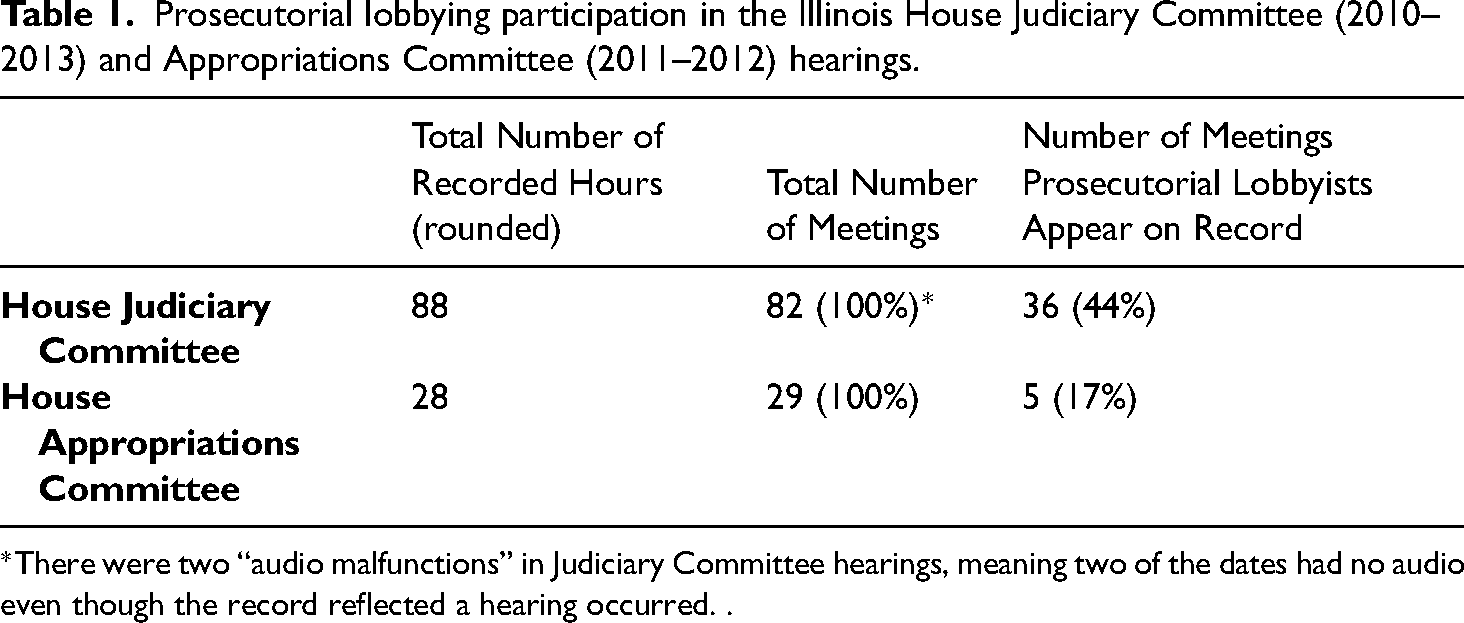
*There were two “audio malfunctions” in Judiciary Committee hearings, meaning two of the dates had no audio even though the record reflected a hearing occurred. .
Following the lead of other recent, post-Recession studies on punishment policy such as Beckett and Beach (2020), I did not focus on policy outcomes, which ride roughshod over concessions and debate. Instead, I was guided by a desire to understand the day-to-day work of prosecutorial lobbying in the earliest stages of Illinois crime policy, and how this work functioned alongside that of other actors seeking penal control or influence. 4 As a scholar of discourse, I was particularly interested in how prosecutorial lobbyists explained and justified their (bipartisan) policy positions to bipartisan committees in a post-Recession era. But I was also interested in where and how these positions met resistance, as power ‘relies upon a subordinate's participation and response’ (Ewick and Silbey, 2003). That this ‘subordinate’ was also prosecutors’ greatest perceived source of legitimacy in policy debate was an insight that emerged inductively from the data.
Prosecutors, victims and Illinois punishment policy
Exerting influence: prosecutorial lobbying and legitimacy in Springfield, Illinois
Prosecutorial lobbying exists within a broader paradigm of interest group involvement in state (and federal) policymaking in the US. That is to say that the general goals of prosecutorial lobbying—to protect and build resources, influence, and efficacy—are in line with those of other interest groups (Baumgartner et al., 2009; Barker, 2009; Miller, 2008). While some interest groups in US politics rely on monetary resources to exert influence, prosecutors are one of many that rely primarily on political standing and symbolic capital (Baumgartner et al., 2009; Miller, 2008). 5 Further, the goals of interest groups are pursued in a competitive context, where actors vie for limited resources and policies that reflect the self-sustaining interests of group members rather than broader community interests that might address crime problems in a meaningful way (Scheingold, 2010; Miller, 2008).
For prosecutors, state-level lobbying translates more specifically into protecting and expanding prosecutorial discretion. As one prosecutorial lobbyist succinctly put it in an interview, ‘one of our priorities is that prosecutors have absolute prosecutorial discretion in the conduct of their duties. OK? We’re not giving that away without a fight.’ Later in the interview the lobbyist noted the tension that existed even between state-level prosecutors and the Illinois Attorney General's (AG's) Office, which had recently attempted to increase their discretionary powers. The respondent opposed this move, noting, […] we don't want any AG having enough power to come in and be a super state's attorney and take over our jobs, because we’re our own masters, we’re constitutionally created […] We are the general power of the prosecutor in the state; the AG is the special power prosecutor of the state. We get to prosecute everything; they get to prosecute certain things. [emphasis respondent's own]
The quote illustrates how the power of elected state's attorneys can be threatened even by other prosecutors, namely, the State Attorney General, a tension that has likely increased in the wake of the Black Lives Matter movement where state attorney generals have repeatedly intervened in the prosecutions of police officers. State's attorneys’ objective of protecting their power and standing was clear to other key actors in Illinois crime policy, too. A respondent with experience lobbying for public defenders dubbed prosecutorial lobbying a ‘turf issue,’ where lobbyists ensure state's attorneys’ ‘powers or jurisdiction [are] not diminished or removed in any way.’ The respondent continued that, post-Recession, this often also meant campaigning for monetary resources, stating ‘[state's attorneys] also are spending a lot of time, more and more time, on funding for their offices because that's becoming a bigger and bigger problem for them, having adequate resources.’ Supporting earlier findings by both Miller (2008) and Campbell (2012), the perspectives of both respondents emphasize an understanding of county-level prosecutorial discretion as an actively constructed, zero-sum game that should not be conceded to other legal actors.
In practice, state's attorneys accomplished these objectives through introducing their own bills (sponsored by members of the House Judiciary Committee) and by taking a formal position on bills introduced by both allies and adversaries, including, in some instances, assisting in revising the language and contents of those bills. In the four years of Committee hearings included in my dataset, prosecutorial lobbyists introduced or took formal positions on a wide range of bills. These bills were overwhelmingly related to punishment, including every stage of the process: policing and arrest, legal procedure, sentencing, parole/probation, and criminal records, but also included advocacy for resources and funding, a particularly thorny issue for all publicly funded offices and programs in the years following the Great Recession. 6 One prosecutorial lobbyist summed up his two ‘general rules of thumb’ for lobbying: ‘One, anything that undermines or diminishes the authority of state's attorneys, we oppose. Second, anything that gives judges more discretion, we generally support.’ The lobbyist went on to explain that overwhelmingly, judicial discretion benefits prosecutors, but also that states attorneys have no interest in restricting the power of judges unless it undermines the prosecutorial power to charge. 7 The desire to protect and expand prosecutorial discretion was therefore at the center of prosecutorial lobbying, even if indirectly by maintaining other aspects of the status quo in criminal procedure.
In fact, in the House Judiciary Committee, prosecutorial lobbyists—including those from specific state's attorneys’ offices as well as from a professional association representing all elected state's attorneys in Illinois—overwhelmingly supported bills that boosted prosecutorial discretion both directly (e.g. allowing surreptitious recordings of meetings with defendants) or indirectly (e.g. sentencing enhancements), and usually, although not always, more punitive in nature. One prosecutorial lobbyist summarized their general policy position as ‘tough on crime.’ When asked to elaborate, he stated, ‘well, generally, we’re not going to be voting for penalty reductions—no one wants to vote for penalty reductions. Almost everything you’re going to see is going to be a penalty enhancement of one thing or another.’ That said, penalty enhancements per se were not the main objective. The same lobbyist subsequently admitted that ‘we have done so much with penalty enhancements at this point that it's, for the most part, it's hard to argue that we don't have sufficient penalties to address the crimes that exist. He noted that his focus shifted in recent years to prosecutorial immunity and making it easier to obtain evidence. Sentencing enhancements were therefore not the only tool in prosecutors’ arsenal for increasing discretion and maintaining prosecutors’ upper hand in criminal procedure.
Other lobbyists viewed prosecutors shift away from penalty enhancements differently. A lobbyist for a national non-profit that works to implement evidence-based reforms noted that prosecutors always have the upper hand in policy debates, but that, ‘in recent years [the playing field's] gotten more level, I think primarily because of concern of disproportionate contact with the minority community. You know, the minority legislators are very concerned about that and they want to have a productive discussion.’ She went on to say that revelations about former police commander Jon Burge's torture ring, which targeted the Black community, changed the terms of the debate, particularly for politicians of color. Another lobbyist echoed these sentiments, saying that states attorneys began ‘making adjustments’ when Emil Jones, an African American Democrat, was elected president of the Illinois Senate in 2002, eventually serving from 2003 to 2009. This shifting political dynamic did not escape prosecutors, with one prosecutorial lobbyist noting, if we have a bill that's pushing the envelope a little bit too much for the Black Caucus, we’ll get most of those [legislative] votes, but we’ll lose a fair number of those, too. […] When the Senate Republicans controlled the Senate […] the state's attorneys could get whatever they wanted passed out of committee. But those days are gone.
The respondent did not admit to changing his strategy because of the Black Caucus, but did note that the changing racial composition of the legislature changed the uptake of the policies his office was likely to sponsor. Importantly, each of these lobbyists also noted that the Recession changed the terms of the debate even further, with the cost of incarceration now an important factor. Prosecutorial lobbying seeking to increase penalties met resistance in the early 21st century, due to both a change in racial composition of the legislature and economic constraints. As such, one wonders if prosecutors truly ‘maxed out’ on penalty enhancements or simply met political pushback to them.
But even considering the social and economic changes that occurred in the first decade of the 20th century in Illinois, the symbolic power of appearing ‘tough on crime’ hardly diminished. In fact, numerous respondents articulated the belief that being tough on crime or ‘law and order’ remained a widely shared, bipartisan position. One former Democratic legislative staff member put it this way, I think both sides of the aisle think along the same way, particularly when it refers to criminal justice stuff. They all want to be tough on crime and prosecutors generally represent that tough on crime perspective, so they’re going to have a little warmer welcome than the defense arguments.
This finding supports recent scholarship on the limits of post-Recession punishment reform by Gottschalk (2015) and Beckett et al. (2018) and suggests a shift to ‘smart on crime’ policy initiatives was even more circumscribed than Aviram (2015) posited. Economic constraints coupled with a more powerful and emboldened Black Caucus did bruise the efforts of prosecutorial lobbyists, but only slightly, since penalty enhancements are not the only means of protecting prosecutorial discretion.
Prosecutorial lobbyists are active, repeat legislative players in Illinois, particularly in the House, where they contribute substantially to crafting punishment policy. Like other interest groups, they work to both protect and expand prosecutorial discretion and influence daily, from the earliest stages of the policy process, by shepherding favorable, largely—albeit not exclusively—punitive, law and order policies through the House Judiciary Committee. This finding supports earlier insights by Miller (2008) and Scheingold (2010) that legislative actors’ drive for self-preservation will over-determine the kinds of crime policy ‘solutions’ offered. Perhaps more surprisingly, the drive for organizational protection and perseverance is no secret. Yet, over the course of policy debate, it is disguised as prosecutorial lobbyists lean heavily into their association with crime victims to legitimate their self-serving positions.
Legitimacy by association: prosecutors and crime victims
Protecting and expanding the powers of a particular person or group is not a resonant basis for public policy, even if it is a driving organizational goal. As such, lobbyists from all backgrounds involved in the Judiciary Committee frame their work as serving some public good. This is particularly true in the post-Recession era, as increasing scrutiny has fallen on elected state's attorneys of large, diverse cities, including Chicago, to find alternatives to draconian prison sentences that disproportionately harm minority communities (Daniels, 2019). This section highlights the primary discursive strategy prosecutorial lobbyists use in my dataset to frame their policy positions during debate, namely, their relationship to crime victims. More specifically, the data show that prosecutors wish to be seen as the ‘public face of victims,’ and that this symbolic rhetoric is evoked frequently, but especially when their legitimacy is in question.
On campaign trails and in courtrooms, prosecutors have long aligned themselves with the plight of crime victims (Simon, 2007; Gottschalk, 2006). A tried-and-true strategy, lobbyists use it in the legislative context as well (Miller, 2008). Early into an interview, a prosecutorial lobbyist spoke of his success, and I asked what factors he believed contributed to it. Without hesitation, he responded, ‘because we are the face of the victims. We are their face in the community. We are the spokesperson for criminal justice issues.’ This response captures a certain amount of (intended) bravado, but it was not meant to be flippant. Similar remarks were stated in Judiciary Committee hearings as well. Arguing in favor of a bill initiated by the Prisoner Review Board that would extend parole hearings for ‘violent offenders’ from every three years to every five years, the lobbyist for the Illinois States Attorney Appellate Prosecutor (ISAAP), representing all elected state's attorneys in Illinois, introduced his remarks by saying, ‘In my previous life as an assistant state's attorney in Peoria County, I had the privilege of representing many of the victims before the Prisoner Review Board’ (Illinois House Judiciary Committee, 2011c). The lobbyist, Mr Jones, then described the story of an ‘African American mother’ of a woman who had been ‘brutally murdered in her home’ many years earlier and the trauma the mother endured by attending parole hearings every few years. By saying that he had the ‘privilege of representing’ crime victims, and their families, Mr Jones draws a clear, if misleading, connection between prosecutors and victims. Further, the anecdote fortifies his policy position, as lawmakers rarely oppose victims, even though the bill would impact tens of thousands of incarcerated people. Finally, by naming the race of the victim's mother, Mr Jones appears to speak directly to Black legislators on the committee, reminding them that Black communities experience not only disproportionate rates of incarceration, but also victimization.
The rhetorical summoning of crime victims in defense of prosecutors’ policy positions was commonplace in Judiciary Committee hearings. In another instance, Mr Sobol, the State's Attorney from Grundy County, a midsize, suburban county, came to speak to the Committee himself on behalf of the ISAAP, testifying against the bill that would eventually ban the death penalty in Illinois. Objecting to the bill, Mr Sobol simultaneously observed the absence of victims’ voices in the debate while confidently implying that prosecutors could speak for them: ‘You certainly aren't going to hear what the victims, what all the victims think or what those costs would be. And for that reason, the Association is opposed to this bill going forward without an adequate time to fully explore the ramifications’ (Illinois House Judiciary Committee, 2010b). While Mr Sobol could have invited a victim to speak during his allotted time, he instead retained control of the argument, evoking victims’ symbolic power. Following this testimony, the State's Attorney from DuPage County, the second most populous county in Illinois that usually employs a lobbyist for Committee testimony, offered his own rationale for opposing the bill. The State's Attorney referenced a case of a murder of an 11-year-old girl, and then another involving a serial killer who murdered an elderly woman ‘living alone’ and a 23-year-old man who had ‘two kids at home, one of whom was only three weeks old’ (Illinois House Judiciary Committee, 2010b). The debate over the bill to end the death penalty was contentious and individuals on both sides brought what they viewed as their most compelling arguments for or against. State's attorneys took a strong position against the bill, and in their testimony repeatedly referred to victims of heinous crimes to justify their position. In so doing, prosecutors underscored their connection to crime victims, even though they did not invite victims themselves to speak.
In rarer instances where prosecutors lobbied in favor of a decreased penalty, victims were also evoked. For example, the Cook County State's Attorney, whose office also employs fulltime lobbyists,
8
introduced a sweeping measure on child sex trafficking that would simultaneously enhance penalties for those who exploit children and decrease penalties for the children exploited in this work. While sex work is and was categorically illegal in Illinois, the lobbyist reframed this behavior as a form of abuse, thereby justifying a less punitive approach to the sex workers themselves. He argued that children caught up in sex trafficking should be taken ‘out of the criminal justice system and into the child protection system so that we don't have repeat abuse of these children’ (Illinois House Judiciary Committee, 2012a). In a separate piece of testimony on the same bill ten days later, the lobbyist added that, one of the difficulties in trying these cases is that the children don't see themselves as victims and sometimes they’ve been indoctrinated by the ones who have exploited them…what we say in the approach is we want a victim-centered case, but not a victim-built case. And we don't want to lean on these kids any more than they’ve been harmed (Illinois House Judiciary Committee, 2012b).
These excerpts are revealing in several ways. First, state’s attorneys use victims as justification for the policy change, dubbing the approach ‘victim centered’ by reclassifying child sex workers as victims rather than perpetrators. Second, the testimony shows that prosecutors believe they are the best judges of who is and is not a crime victim, not even victims themselves, who in this case, do not identify as such. Once again, we see how prosecutorial lobbyists speak on behalf of victims in policy debate, rather than alongside them. A victim's advocacy group, the Polaris Project, which ‘provides direct services to survivors of human trafficking,’ did speak in support of the bill, stating that child victims of sex trafficking are twice victimized ‘by both those who are purchasing sex acts, as well as traffickers and pimps’ (Illinois House Judiciary Committee, 2012b). Yet no victims were invited to testify. Finally, while the bill does decriminalize one behavior, it simultaneously increases penalties for those who exploit children for profit. The bill therefore demonstrates the Cook County State's Attorney's willingness to enact only limited reform in the 2010s, particularly reforms that would not impact prosecutorial discretion, since judges always had sentencing discretion for minors.
Crime victims were frequently invoked by prosecutors as the basis for legitimating enhancements to prosecutorial power, but especially in instances of debate. Many bills introduced by the Illinois State Appellate Prosecutors, specifically, passed out of Committee without debate because they concerned ‘technical’ changes. In these instances, as well as during instances of public disagreement with victims discussed below, prosecutors largely adopted a rhetorical framework of obeying the rule of law, ensuring policy did not violate the Constitution or case law. Scheingold (2010) observed that politicians pull from a variety of symbolic repertoires to assert their agendas, including the ‘myth of the rule of law,’ which circulates alongside what we might term the ‘myth of the pure victim’ in policy debate. 9 But the myth of the pure victim was ultimately the most common justificatory script prosecutors used in my dataset, even invoked during instances of disagreement with victims, discussed below.
Committee hearing excerpts display the centrality of victims to post-Recession prosecutorial lobbying rhetoric. Prosecutors are proud to be seen as the ‘face of victims,’ and routinely evoke crime victims as justification for policy positions. But the excerpts also suggest an asymmetry in this stalwart alliance: prosecutors speak for victims, rather than with them. Prosecutors therefore legitimate the protection and expansion of their discretionary powers by referencing the experiences of crime victims, but do not center victims’ own voices, a strategy that sometimes quite publicly backfires.
Discursive ruptures: discord between anticipated allies in crime policy debate
The absence of victims’ voices from prosecutors’ policy initiatives hints at an alliance based more on rhetoric than mutual support, but this discord was on full display in the multiple victim-led policy initiatives in my dataset. Indeed, while Miller (2008) observed a near erasure of policy initiatives led by victims in Pennsylvania in the early aughts, my dataset suggests that individual crime victims were still active participants in Illinois crime policy debates in the first two decades of the 21st century. When individual victims did provide testimony, it was usually for bills that would create new or harsher penalties rather than structural reforms, a finding Miller (2008) would anticipate, although this was not exclusively the case. In both instances, though, it was not prosecutors who sponsored victim-led initiatives, but rather individual legislators.
One example of a victim-led initiative in my dataset is Jasmine's Law, a bill inspired by a victim's mother and sponsored by a Judiciary Committee member. The original bill proposed adding an additional 11-years imprisonment for any sexual abuse committed against a minor. Prosecutors did not support the bill because there was no ‘constitutional basis’ for the 11-year enhancement, why eleven years across the board? Well, the issue of that is because the age of Jasmine at that time she was the victim was she was eleven. From a legal perspective, that is not a rational basis in order to have a penalty enhancement. If she had been nine at the time, we would be here seeking a nine-year penalty? (Illinois House Judiciary Committee, 2010a)
Mr Jones, the lobbyist for the ISAAP continued, dubbing the bill as written ‘fatally flawed and constitutionally infirm’ but added that he was ‘always happy to work to […] protect children. We think we’ve done that. State's Attorneys were on the forefront of passing the legislation to promote child advocacy centers’ (Illinois House Judiciary Committee, 2010a). Sounding defensive, Mr Jones concluded his testimony by reminding the Committee of his own work supporting victims, stating, I have served on domestic violence and sexual assault advisory councils for our local shelter. I have sent these people to prison. I have worked for over ten years as an advocate for victims of crime [but] despite its best intentions […] [the bill] does a disservice to all of the hard work and the folks who have been championing [victims] all along (Illinois House Judiciary Committee, 2010a).
In an interview, a prosecutorial lobbyist with firsthand knowledge of the debate was flabbergasted by the 11-year penalty enhancement request. But they also noted the need to be diplomatic on the record. The respondent stated that Mr Jones couldn't tell the victim's mother ‘that she's full of crap and doesn't know what she's talking about and that's a stupid idea’ even if that's how Mr Jones felt. The reaction demonstrates the importance prosecutors assign to protecting their public-facing relationship with victims despite personal contempt for policy driven by what is perceived as an emotional, rather than constitutional (or ‘myth of the rule of law’) response to crime.
The juxtaposition of interviews with committee hearing records reveals an important tension: prosecutors are eager to pay lip-service to the needs of victims but have contempt for victims who try to participate directly in the policymaking process, deriding their lack of legal expertise. It may very well be true that many crime victims lack the legal expertise to know which laws might be challenged on appeal, but the comment also suggests that clear, constitutional guidelines exist for the penalty enhancements prosecutors have sought, which is not entirely the case. In fact, prosecutors use victims’ emotional experiences as the basis for their own penalty enhancements, as illustrated by the child sex trafficking enhancement. Thus, the problem isn't so much using crime victims’ experiences—and the emotions those experiences elicit—to enact policy, but rather that prosecutors wish to be seen as the foremost experts on crime policy.
Ultimately, the ISAAP worked with the bill's sponsor to create a more narrowly tailored penalty enhancement modeled off existing policy, but the initial disagreement created what I term a discursive rupture in prosecutorial lobbyists’ justificatory scripts. Discursive ruptures are breaks with anticipated discursive paradigms and rhetorical tropes, evincing a disruption in politics-as-usual. Such ruptures are important because they represent a snag in the intricate web of power relations that support both the work of prosecutorial lobbyists, as well as the broader power dynamics in punishment policy and implementation. It is not only a disruption to politics as usual, but one that risks prosecutors’ self-identified greatest source of (legislative) legitimacy. As such, these ruptures are also public windows into the core motivations and allegiances undergirding political behavior. In this instance, the rupture reveals a hostility toward the aims and interests of victims, even where they largely overlap with prosecutors’ own policy goals. But discursive ruptures are telling of the self-serving nature of interest groups seeking to preserve their standing and credibility, including as authorities on what is sound, ‘constitutional’ sentencing policy. Discursive ruptures can therefore illuminate both the importance of rhetoric in shaping our understanding of the true power relations undergirding ‘dominant’ political alliances, as well as an absence of commitment behind the words. Gottschalk (2006) has argued that victims’ interests have historically been at risk of co-option by prosecutors and other ‘conservative crime control proponents’ who have the political clout and authoritative abilities to steer the discourse on crime, including what is in the best interest of victims. But it is difficult to pinpoint cooption in-action, making alliances seem natural, durable, and mutually beneficial. That is, until discursive ruptures bubble to the surface, forcing disagreements and locating fragilities.
Jasmine's Law was not the only instance of a discursive rupture between prosecutors and victims where the policy supported by the victim was dubbed ‘emotional’ and bad policy, even if it would technically give prosecutors more power. In early 2011, a Republican legislator introduced House Bill 1161, which ‘would remove the statute of limitations for sex crimes committed against juveniles’ in Illinois (Illinois House Judiciary Committee, 2011a). The bill was inspired by the experience of a victim-constituent who had been told by his local sheriff's office a few months prior that he could not report his claims of sexual abuse by a Boy Scout troupe leader that occurred over 40 years prior. The victim provided moving testimony, sharing the fear and shame that kept him from previously reporting the crime. Mr Jones testified on the bill directly following the victim. Expressing the position of all elected states attorneys in Illinois, including the victim's own, Mr Jones stated, ‘it is with a profound sense of reluctance that I am here today to testify against this bill’ (Illinois House Judiciary Committee, 2011a). He then went on to explain that he was glad that the bill's sponsor was ‘coming forward on behalf of his constituents,’ but that ultimately, ‘this is bad public policy.’ Unpacking further, and invoking a rule-of-law script, Mr Jones stated that prosecutors are obliged ‘make sure that justice is done to all parties in the system, including the defendants’ adding that ‘sometimes the law needs to be blind and it can't be ruled by emotion.’ Under questioning from committee members who were skeptical that this bill would greatly impact the rule of law, Mr Jones conceded that ‘I’m trying to remember an instance where prosecutors have said don't give us more discretion,’ but that it was still the ‘historical position of the state's attorneys of Illinois’ to not want this additional discretion. Mr Jones made clear in his testimony that aging memories would make such prosecutions more difficult. As such, he revealed an opposition to discretion that wouldn't lead to clear wins for prosecutors, even at a cost to victims.
Sometimes discursive ruptures occurred from a clear encroachment on prosecutorial discretion, though. In a proposed change to the Illinois Victim's Bill of Rights, discussed and debated over numerous hearings, the same mother from Jasmine's Law
10
testified on behalf of an amendment that would create a third-party ‘ombudsman's’ office to provide victims’ families with their own legal representation in court. The office would also be a place where victims and their families could file complaints against state's attorneys, something of personal import to the mother, who had a negative experience with her local state's attorney's office. Attempting to preempt state's attorneys’ concerns about the bill as written, the bill's legislative sponsor said the legislation would ‘provide a voice to victims who do not have a voice’ (Illinois House Judiciary Committee, 2011b). But a Committee member who was himself a former state's attorney and worked closely with prosecutorial lobbyists questioned this framework, saying, I didn't realize that the state's attorneys weren't the voice of victims…I think what you’re saying is a little disingenuous, that every prosecutor that walks across the state of Illinois has no care or no concern about victim's rights. And every state's attorneys’ office that I’m aware of has a victim's advocate… (Illinois House Judiciary Committee, 2011b).
In this instance, prosecutors were not alone in defending themselves against accusations of not being sufficiently pro-victim. The accusation also threatened the self-conception of Judiciary Committee members who work closely with prosecutorial lobbyists.
When the amendment was introduced again the following year, state's attorneys had formally changed their positions from in-favor-with-concerns to against the bill, creating further conflict. Trying to head off the rhetoric of performative allyship before it could begin, the Committee Chair and bill-sponsor opened the debate by stating, ‘we’re not here to discuss whether the state's attorneys of Illinois don't think victims deserve to have these rights under the constitution […] we made that decision [in creating a Victim's Bill of Rights]’ (Illinois House Judiciary Committee, 2012c). Following these remarks, Mr Jones, the lobbyist representing all Illinois state's attorneys, acknowledged that his group's formal change in position on the bill was ‘perhaps the most uncomfortable moment I’ve ever experienced in this committee’ but went on to say that ‘this issue outstanding [over the ombudsperson] is not a trivial, superficial matter’ (Illinois House Judiciary Committee, 2012c). Mr Jones continued, saying his Association did not believe victims were entitled to their own representation in court because ‘we view ourselves as the voice of victims. We brand ourselves as the voice of victims. We stand shoulder to shoulder with victims every committee hearing. And yet this is the one time we don't’ (Illinois House Judiciary Committee, 2012c). Even as he formally opposed the bill, Mr Jones reminded the Committee, and the victims behind the amendment, that state's attorneys are ‘the voice of victims’ and stand with victims ‘every committee hearing.’ Yet this was a clear overstatement. In four years of Judiciary Committee hearings, this was one of three instances that generated substantial debate in which prosecutors opposed a policy initiative introduced by individual victims. While this might not seem like a lot, most crime bills pass out of Committee with little to no debate. The proposed amendment to the Victim's Bill of Rights alone was debated, at length, on three separate occasions in the four years of committee hearings. Thus, while it may be true that prosecutorial lobbyists are largely in-step with victim's policy positions, they do not always ‘stand shoulder to shoulder,’ particularly, it seems, when victims themselves introduce the bill.
The debate over the Victim's Bill of Rights amendment also makes clear the fallout that stems from a proposed crime policy that isn't simply punitive, instead threatening to disrupt the taken-for-granted balance of power. This caused concern beyond the offices of state's attorneys. For example, the lobbyist for the Illinois Coalition Against Sexual Assault, one of the primary victim's advocacy groups in the capitol, also testified about her three ‘concerns’ with the bill, stating, ‘First of all, it creates an ombudsman's office, which, as [the ISAAP] alluded to, has punitive authorities to impose fines on prosecutors and law enforcement,’ noting that this has ‘not been the most effective mode for enforcement of either individual crime victim rights or for systematic change’ in ‘other’ states (Illinois House Judiciary Committee Hearing, 2011b). She went on to describe funding concerns and ‘an incompatibility of this statute with the current Illinois constitutional language.’ In other words, the group objected to the bill because it threatened prosecutorial discretion, was costly and was ‘incompatible’ with the constitution, echoing concerns of prosecutorial lobbyists. Yet data show that crime victims in Illinois and across the country have low levels of trust in the courts, with only two in 10 victims surveyed in Illinois reporting that they received help from a district attorney or prosecutors’ office, and a majority reporting that the current criminal justice system does not work (Alliance for Safety and Justice, 2016). The solution to this problem is, undoubtedly, more complex than creating an ombudsman's office, but the desire to change existing victims’ services in the courts is well supported by the data on victims’ experiences. Still, as a large, single-issue lobby, the Coalition Against Sexual Violence relies on prosecutors as an ally in the legislative process and is themself concerned with organizational preservation (see Miller, 2008). As such, their position should come as little surprise.
The degree to which a threat to prosecutorial power and standing could disrupt politics-as-usual was also discussed in my interviews. During an interview with a Judiciary Committee member, for example, the legislator referenced the controversy over the same amendment, unprompted, in a broader conversation about prosecutorial discretion, stating, [state's attorneys] don't like anybody telling them what to do in their four corners of the world. So when they see legislation coming that forces them to do something, they are very reactive […] [F]or instance, there is an amendment to the Victim's Rights Bill that imposes a lot of different—I won't call them mandates, but a big change in how we treat things for victims, and [state’s attorneys] don't like it at all.
The lawmaker highlights the retention of discretion as a primary concern for prosecutors, defending it at all costs. But even if those with intimate knowledge of prosecutorial lobbying were unsurprised by prosecutors’ reaction to the bill, the fallout between prosecutors and victims is still seen as politically difficult. A former legislative aide put it this way, ‘Sometimes you will see [state's attorneys] at odds with who you might think their natural allies might be, like victims of crime.’ Continuing, he added, “It's kind of like a Venn diagram, you know? There's the area of overlap where they’re together, but sometimes the State's Attorneys are in the position of going, ‘Umm, uh [pauses for dramatic effect], eww.’” The respondent's sound effect, ‘eww,’ was a good representation of the discomfort created by discursive ruptures, or, as he put it, when prosecutors are ‘at odds with who you might think their natural allies.’ The choice of the words in ‘who you might think’ was also notable, highlighting the importance of assumption in assessing political alliances. When ruptures do emerge, they provide a view into the discord that constantly simmers under the patina of a unified front.
What ruptures reveal: discussion and conclusion
Corroborating previous findings by Campbell (2012), my data show that prosecutors are savvy, trusted, repeat legislative actors who contribute to punitive, state-level crime policy initiatives. But my data build upon earlier findings by showing that such activity transcends punitive historical moments. Indeed, legislative committee hearings and interviews show that prosecutorial lobbyists in Illinois were early and active participants in a wide array of crime bills that were proposed and debated in a four-year period shortly after the recession. That it occurred during this time is notable because state and national rates of incarceration were on a modest decline (Vera Institute of Justice, 2019), engendered by state budget cuts and calls for criminal justice reform (Beckett and Beach, 2020), not to mention changes in the racial composition of the Illinois legislature. But elected state's attorneys from across the political spectrum in Illinois continued to advocate for policies that would expand their discretion through sentencing enhancements and many other ‘law and order’ initiatives. Even when prosecutorial lobbyists faced substantial resistance, as with the death penalty, for example, their presence in crime policy debates was never under attack. As such, my findings suggest that Recession-era punishment politics of being ‘smart on crime’ were even more circumscribed than Aviram (2015) and other assumed, at least in Illinois. In the five years following the Great Recession, the Illinois state legislature continued to support an overtly ‘tough on crime’ politics, largely supporting criminal justice actors whose self-preserving policy work further entrenches mass incarceration, rather than rejects it. Elected prosecutors, even Democrats from large, diverse, urban counties, showed a strong preference for discretionary retention and expansion, which in turn makes conviction, and therefore incarceration, easier.
The push for this discretionary protection, though, is cloaked in the language of assisting crime victims. While my data suggest that ‘law and order’ policies retained bipartisan appeal during this time, the policies were not framed using this exact language during heated committee debates. Instead, prosecutors emphasized the benefits to crime victims and prosecutors’ work on their behalf. Crime victims have long been a source of prosecutorial legitimacy and supporting victims has long held bipartisan appeal (Simon, 2007; Gottschalk, 2006). Perhaps amidst calls for reform this also presents an opportunity for political cover, since no one wants to be seen as unsupportive of crime victims. At the time of my interviews, even the Black Caucus was not seen as uniformly against ‘tough on crime’ politics. Irrespective of the precise reasons, both interviews and committee hearings show that prosecutors are eager to portray themselves as the ‘voice’ or ‘face’ of crime victims, and that their audience is widely receptive to such characterization. Even though prosecutors do not legally represent crime victims, they continue to symbolically through discursive repetition, a powerful political tool. As Garland (2001) has pointed out, ‘discursive statements and rhetorics—and the knowledge-based or value-based rationales that they involve—will [sic] be as important as action and decisions in providing evidence about the character of the [penal] field’ (p. 24). The productive power of the alliance between prosecutors and victims can be grown through discourse, even when such rhetoric is detached from action.
By paying close attention to the language of policy debate rather than outcomes, my data provide a window into the fault lines of a powerful political alliance. Relational approaches to the study of penal power (e.g. Page, 2011; Goodman, Page and Phelps, 2017) are right to emphasize the role of political alliances in creating penal policy, as well as the legitimacy such relations can bestow upon what is essentially self- and organizational-preserving behavior (Miller, 2008; Scheingold, 2010). But relational approaches can also overemphasize the durability and mutual benefit of the political relations they examine, particularly amongst dominant penal actors. By zeroing in on policymaking discourse, I find that the very relationship that bestows prosecutors with bipartisan legitimacy is also one of the greatest threats to prosecutorial standing in the legislative arena. The discursive ruptures I pinpoint reveal lingering points of tension and distrust between prosecutors and victims that cannot be easily smoothed over. Prosecutorial lobbyists wish to be the definitive authority on good crime policy. The also do not wish to power-share with victims in a court of law. My data point to this asymmetry in political alliance, where prosecutors can speak for victims, but victims are not invited to reciprocate. Discursive analysis reveals that prosecutorial lobbyists privilege their own discretionary goals first and foremost. But in so doing, they necessarily reveal the performative nature of political rhetoric. The debate over the Victim's Bill of Rights may not typify crime policy debates in the Illinois House Judiciary Committee following the Great Recession, but it reveals a structural weakness in the empty promises of power-preserving, ‘tough on crime’ political rhetoric.
The data presented here expand our understanding of contemporary prosecutorial discretion, but the data are also limited in scope. The current period of modest penal retrenchment is still underway and calls for criminal justice reform have only grown stronger in recent years. It is unclear how prosecutors will continue to adapt to calls for reform, and to what degree. Future research should continue to follow the work of these powerful criminal justice actors both within and outside of the legislative arena, with particular attention to the impact of the Black Lives Matter movement, which centers historically marginalized voices and policy proposals aimed at structural changes, such as abolishing police and prisons (Black Lives Matter, 2021). Such groups also center the experiences of Black crime victims, particularly as they relate to state violence. Given the disproportionate rate of victimization experienced within Black and Brown communities in the US, this has the potential to change the terms of state-level crime policy debates, including proposed solutions. The impact of changes in the racial and political composition of legislative bodies should also be examined more systematically, as these changes might ultimately be more meaningful than economic constraints in producing policy that erodes mass incarceration and benefits crime victims more equitably.
This paper began by asking what role Illinois prosecutorial lobbyists play in the early stages of crime policy creation and how they make this work legible in a time of modest penal decline and reduced spending. Drawing on over 110 h of FOIA-requested House Judiciary Committee hearings and 16 in-depth interviews, I find that prosecutorial lobbyists are active, repeat players in the legislative arena, primarily advocating for punitive policies that protect or expand their discretion. What's more, I find that they rely heavily on a victims-first rhetoric to frame and legitimate this work. But my data also show how the very alliance that legitimates prosecutorial lobbying also threatens it. Discursive ruptures between prosecutors and victims disrupt preconceived notions of an ironclad, mutually beneficial, power share, underscoring the active nature of political alliances, and as such, their vulnerability to change. Disagreements therefore represent more than moments of rhetorical discomfort; they suggest entry points for new configurations of power within the penal field.
Footnotes
The author thanks Bernard Harcourt, John Hagan, and Charles Camic for helpful comments on earlier drafts of this manuscript, Taylor Becker for research assistance, the anonymous reviewers at P&S for their instructive feedback, and the research participants who generously agreed to be interviewed for this study but cannot be thanked by name.
Declaration of Conflicting Interests
The author(s) declared no potential conflicts of interest with respect to the research, authorship, and/or publication of this article.
Funding
The author(s) received no financial support for the research, authorship and/or publication of this article.
